Archives for category: Lies

Remember how voucher advocates claim that vouchers will “save” poor kids from “failing public schools”? T’aint so.

Stephen Dyer compared the progress of Ohio students in voucher schools to those in public schools. Guess what? The longer students are enrolled in voucher schools, the farther behind they fall.

He writes:

One thing you’d expect to hear a lot from voucher proponents is that students taking private school tuition subsidies do better the longer they’re in the private schools taxpayers are paying.

I mean, assuming these “choices” are so vastly superior to “failing” public schools, right?

Yet you never hear that argument. Now I know why: according to state test data, the longer students take vouchers, the worse they do on state tests — in some cases a lotworse. Especially in high school.

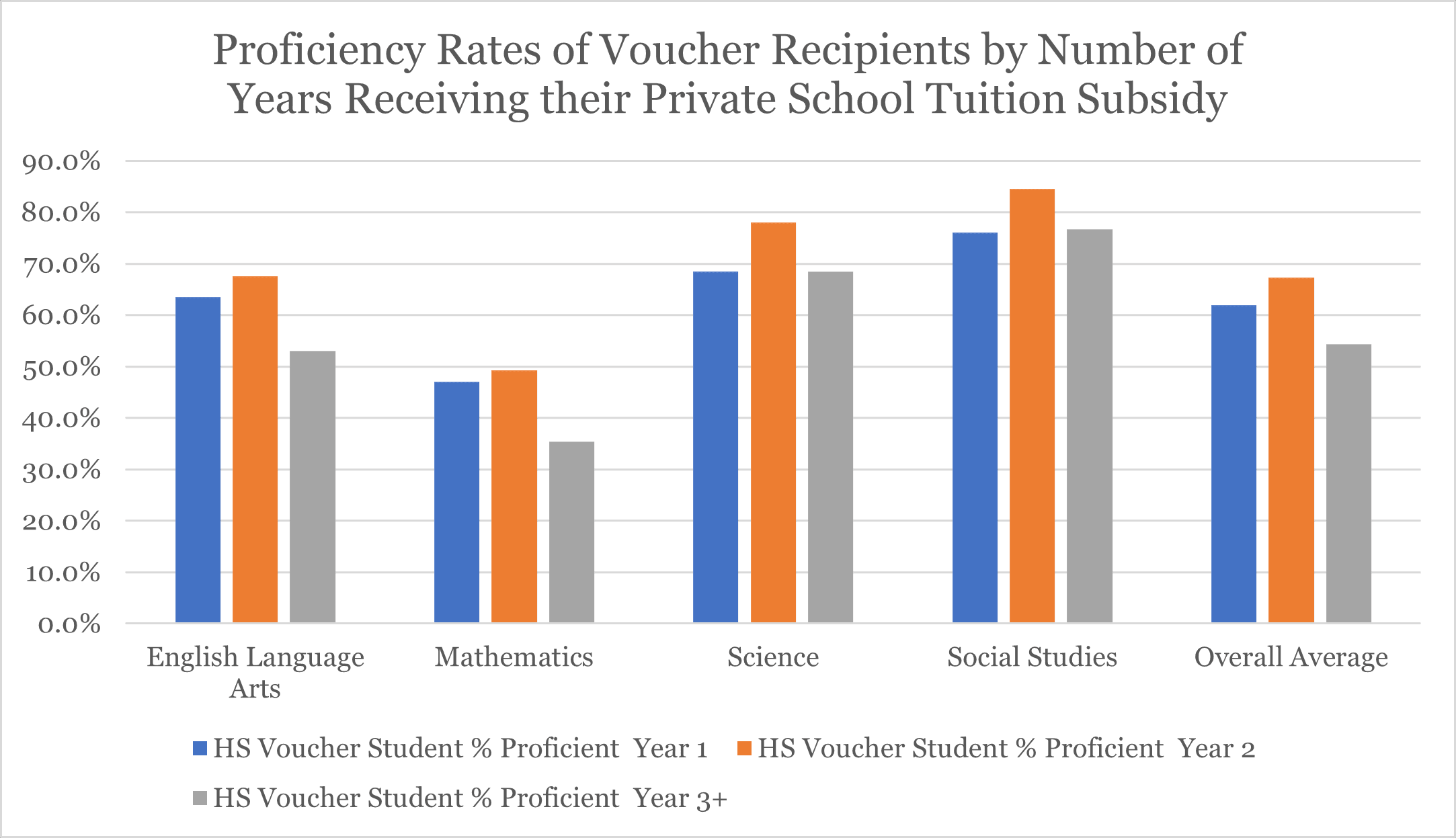
Here is how students perform on state High School proficiency rates, depending on how long they’ve been taking vouchers. You can see pretty clearly that especially in English and Math, students do markedly worse if they’ve been taking vouchers for 3 plus years than they do if they’ve only been taking it for a year.

This provides some pretty compelling evidence that students taking vouchers are better prepared by public schools, but once they enter the private system, that success wanes. Only in Social Studies is there an increase, but it’s only a 0.9% increase. Math drops by nearly 1/4. Overall, there’s, on average, a 12.1% drop in proficiency rates the longer a high school student takes a voucher….

Let me put it simply:

  • Generally, Voucher students do worse on state tests the longer they take vouchers.
  • The Black-White achievement gap is much greater among voucher students than public school students.
  • Private Schools that accept Vouchers take a Whiter population of students than the districts from whence the students come.

I just have one simple question: How is it again that Vouchers provide “better” opportunities for students of color who are being “failed” by public schools, as voucher proponents continuously claim?

Because Ohio data sure suggest that students of color are best served by their local public schools, not the private schools who are more reluctant to take them, even with significant taxpayer-funded tuition subsidies.

The Texas Tribune and ProPublica collaborated in an investigation of the school massacre in Uvalde, Texas.

We know that Governor Greg Abbott immediately responded to the massacre of students and teachers at Robb Elementary School by congratulating the Texas State Police for their prompt and effective response. Either he was misinformed or he lied. The school was full of law officers but no one made a move to save the children for over an hour.

The investigation revealed that the state is withholding records of that terrible day.

Ever since the Uvalde elementary school shooting left 19 students and two teachers dead, blame for the delayed response has been thrust on local law enforcement. The school police chief was fired and the city’s acting police chief was suspended.

But the only statewide law enforcement agency, the Texas Department of Public Safety, has largely avoided scrutiny even though it had scores of officers on the scene. That’s in part because DPS leaders are controlling which records get released to the public and carefully shaping a narrative that casts local law enforcement as incompetent.

Now, in the wake of a critical legislative report and body camera footage released by local officials, law enforcement experts from across the country are questioning why DPS didn’t take a lead role in the response as it had done before during other mass shootings and public disasters.

The state police agency is tasked with helping all of Texas’ 254 counties respond to emergencies such as mass shootings, but it is particularly important in rural communities where smaller police departments lack the level of training and experience of larger metropolitan law enforcement agencies, experts say. That was the case in Uvalde, where the state agency’s 91 troopers at the scene dwarfed the school district’s five officers, the city police’s 25 emergency responders and the county’s 16 sheriff’s deputies.

The state police agency has been “totally intransparent in pointing out their own failures and inadequacies,” said Charles A. McClelland, who served as Houston police chief for six years before retiring in 2016. “I don’t know how the public, even in the state of Texas, would have confidence in the leadership of DPS after this.”

Instead of taking charge when it became clear that neither the school’s police chief nor the Uvalde Police Department had assumed command, DPS contributed to the 74-minute chaotic response that did not end until a Border Patrol tactical unit that arrived much later entered the classroom and killed the gunman.

“Here’s what DPS should have done as soon as they got there,” said Patrick O’Burke, a law enforcement consultant and former DPS commander who retired in 2008. “They should have contacted [the school police chief] and said: ‘We’re here. We have people.’ They should have just organized everything, said, ‘What are all of our resources?’ And they should have organized the breach.”

DPS has fought the release of records that could provide a more complete picture of the role state troopers played during the mass shooting. Agency officials declined to answer repeated questions from ProPublica and The Texas Tribune for more than three months, citing an ongoing investigation. On Tuesday afternoon, DPS officials said they had referred five responding troopers to the agency’s internal affairs division, the Office of Inspector General, for an investigation into whether they broke any department policies. Two have been suspended, according to DPS.

DPS also released a July email in which its director, Col. Steve McCraw, said the agency would “provide proper training and guidelines for recognizing and overcoming poor command decisions at an active shooter scene.” The agency has refused to share its active shooter policies and training manuals.

The latest moves by DPS come a week after reporters from ProPublica and the Tribune sought comments from the four appointed members of the Public Safety Commission, which oversees the agency, about the response by state troopers.

DPS did not identify which officers were being investigated or detail potential wrongdoing.

Previously, agency officials referred reporters to comments made by the head of DPS during a June legislative hearing in which he largely blamed the Uvalde school district’s police chief, Pete Arredondo, for the failed response.

During that testimony, McCraw told lawmakers that the time it took for law enforcement to rescue teachers and students at the elementary school was an “abject failure.” He called Arredondo the only obstacle between armed police and the teenage shooter while dismissing the idea that DPS could or should have taken control of the emergency response.

“I’m reluctant to encourage or even think of any situation where you’d want some level of hierarchy where a larger police department gets to come in and take over,” McCraw said.

Yet, DPS has sprung into action time and again when disaster strikes in Texas, which has proved key during mass shootings and public emergencies, local officials across the state said.

More than three decades ago, for example, state troopers helped local law enforcement confront a gunman after arriving within minutes of a shooting at a Luby’s Cafeteria in Killeen, about 60 miles north of Austin. The shooter killed himself after a brief exchange of gunfire.

“They knew that people were dying, and so they acted,” said Suzanna Hupp, a former Republican state representative whose parents died during the 1991 Luby’s massacre. She said that didn’t happen in Uvalde, adding that “clearly there was a command breakdown there.”

In a 2013 chemical explosion in West, about 70 miles south of Dallas, state troopers immediately took control of the law enforcement response at the request of the county’s emergency management coordinator. And in the 2018 shooting at Santa Fe High School, about 30 miles south of Houston, state troopers quickly fired at the gunman, according to local law enforcement officials who initially responded. The rapid engagement by school police and DPS was key to the gunman surrendering, district and county officials said.

Please read the rest of the article.

How do you spell “COVER-UP”?

One of our readers who assumes the sobriquet “Democracy” posted the following comment. Like most people, I did not read the bipartisan Senate Intelligence Report on the 2016 election.

He/she writes:

From the Senate Intelligence Committee report on the 2016 election, volume five:

“the Russian government engaged in an aggressive, multifaceted effort to influence, or attempt to influence, the outcome of the 2016 presidential election…Manafort’s presence on the Campaign and proximity to Trump created opportunities for Russian intelligence services to exert influence over, and acquire confidential information on, the Trump Campaign. Taken as a whole, Manafort’s highlevel access and willingness to share information with individuals closely affiliated with the Russian intelligence services, particularly Kilimnik and associates of Oleg Deripaska, represented a grave counterintelligence threat…Russian President Vladimir Putin ordered the Russian effort to hack computer networks and accounts affiliated with the Democratic Party and leak information damaging to Hillary Clinton and her campaign for president. Moscow’s intent was to harm the Clinton Campaign, tarnish an expected Clinton presidential administration, help the Trump Campaign after Trump became the presumptive Republican nominee, and undermine the U.S. democratic process…While the GRU and WikiLeaks were releasing hacked documents, the Trump Campaign sought to maximize the impact of those leaks to aid Trump’s electoral prospects. Staff on the Trump Campaign sought advance notice about WikiLeaks releases, created messaging strategies to promote and share the materials in anticipation of and following their release, and encouraged further leaks. The Trump Campaign publicly undermined the attribution of the hack-and-leak campaign to Russia and was indifferent to whether it and WikiLeaks were furthering a Russian election interference effort.”

Click to access report_volume5.pdf

From The Washington Post, two days ago:

“Some of the seized documents detail top-secret U.S. operations so closely guarded that many senior national security officials are kept in the dark about them…Documents about such highly classified operations require special clearances on a need-to-know basis, not just top-secret clearance. Some special-access programs can have as few as a couple dozen government personnel authorized to know of an operation’s existence. Records that deal with such programs are kept under lock and key, almost always in a secure compartmented information facility, with a designated control officer to keep careful tabs on their location.”

“… the FBI has recovered more than 300 classified documents from Mar-a-Lago this year: 184 in a set of 15 boxes sent to the National Archives and Records Administration in January, 38 more handed over by a Trump lawyer to investigators in June, and more than 100 additional documents unearthed in a court-approved search on Aug. 8…Among the 100-plus classified documents taken in August, some were marked ‘HCS,’ a category of highly classified government information that refers to ‘HUMINT Control Systems,’ which are systems used to protect intelligence gathered from secret human sources, according to a court filing.”

https://www.washingtonpost.com/national-security/2022/09/06/trump-nuclear-documents/

Trump is a traitor to the Constitution and the rule of law and he is a clear and present danger to the American democratic republic.

Carol Burris is the executive director of the Network for Public Education. She recently received a press release from Betsy DeVos’s organization, the ironically-named American Federation for Children, asserting that the drop in test scores during the pandemic was the fault of the unions. The purpose of the “American Federation for Children” is to promote vouchers, especially for religious schools, and it is always eager to criticize public schools and teachers’ unions. AFC much prefers religious schools where children are indoctrinated without apology and where discrimination against unwanted children is common. Maybe they should change their name to the American Federation for Some Children (who share our religious views).

Burris writes:


Walter Blanks, the Press Secretary of the American Federation for Children, got on the rickety old soapbox of Betsy De Vos to blame teacher unions for the recent drop in student performance on NAEP. Moms for Liberty then jumped on calling for parents to “fire teacher unions.”

Did children suffer a decline in learning progress during the pandemic? Of course.  Anyone who has ever taught in a school, unlike Mr. Blanks, could have predicted a drop.

As a former teacher and principal, I know that the relationship between a student and teacher and the relationship among students is critical for learning. And I also remember all those students who, without my cajoling and watchful eye, would have been content to put their heads down or look out the window instead of at their books. That’s kids. The warm smile directed at them, the subtle tap on the desk, you can’t do that over the internet.

But are unions the culprit for the NAEP score drop? There is no evidence of that. 

First, if union influence in keeping remote learning were to blame, we would expect to see a larger drop in city scores than suburban scores. Suburban schools, with or without unions, were far more likely to open. However, suburban scores dropped significantly more in Reading for both low and high achievers than for city students, whose scores barely budged. In Math, the point drop for high achievers was the same; suburban low achievers lost more ground than their counterparts in cities. 

Second, we would expect regional differences depending on the influence of unions.

But there is only one point difference in the scores’ drops between the union-heavy northeast and the right-to-work dominated south. And western states, where unions are prevalent in the most populous states, saw much smaller score drops than the south.  

Not content to blame unions in general, Walter Blanks singles out Randi Weingarten as a national villain. Ms. Weingarten, a woman and strong leader, married to Rabbi Sharon Kleinbaum, has become a prime target for the misogynist right. But the facts do not bear out his accusations. Even as Weingarten was listening to her members concerned with their own family and student health, she was quietly working behind the scenes to get schools safely opened.

As a New York City public school grandma, I know it. And I am thankful for those efforts. My granddaughter returned to in-person learning in the fall of 2020 as New York City public schools opened. There were bumps and starts, but they opened. Even so, the majority of NYC parents still kept their children remote. 

Will Mr. Blanks blame those parents and hundreds of thousands like them who were fearful of sending their children back to school? 

Covid 19 was a national tragedy. Over one million Americans died horrible deaths.  We will feel the pain and ramifications for years to come. And yes, our children deserve all our efforts to repair the academic and emotional damage of the pandemic. But using that tragedy to push an anti-union agenda does not help repair the damage. It continues to enflame the anger of parents still reeling from the pandemic themselves.

Blanks ends his essay by touting how school choice is the answer. I am scratching my head to reconcile that with the American Federation for Children’s stalwart support for low-quality online virtual schools and homeschools. You can’t blame learning loss on a lack of in-person learning and then support virtual learning solutions. Will AFC now advocate for the closure of online charters and homeschools? Don’t hold your breath. 

Dana Milbank tries to keep up with Republican lies, but there are so many that it’s hard to refute them all. Right now, the biggest lie (other than the claim that Trump won the 2020 election) is that Biden’s Inflation Reduction Act will enable the IRS to hire 87,000 armed agents who will target middle-class Americans and arrive at their doors armed with AR15s. I know this lie has taken hold because a friend of modest means told me that, because Biden’s legislation passed, the IRS would send an armed agent to her door to collect her taxes.

He writes:

It is impossible to keep up with the volume of disinformation churned out by the MAGA-occupied Republican Party. But sometimes it’s worth pausing to examine the anatomy of a particularly egregious fabrication, to understand the broader “alternative fact” ecosystem that misinforms tens of millions of Americans.

Let’s consider the lie, endlessly repeated by Republicans and the Fox News-led echo chamber, that new legislation enacted by Democrats funds the hiring of “87,000 armed IRS agents.” Like the “death panel” fabrication during the Obamacare debate, this is a whole-cloth invention designed to stoke paranoia.

Sen. Rick Scott (Fla.), head of the National Republican Senatorial Committee, sent an open letter last week warning Americans not to work for the IRS. He falsely claimed that the Democrats’ climate, energy and tax bill would add “roughly 87,000 agents” at the IRS, creating “an IRS super-police force”:

“The IRS made it very clear that one of the ‘major duties’ of these new positions is to ‘be willing to use deadly force.’ … The IRS is making it very clear that you not only need to be ready to audit and investigate your fellow hardworking Americans, your neighbors and friends, you need to be ready and, to use the IRS’s words, willing, to kill them.”

Where to begin?

The IRS certainly isn’t adding 87,000 armed agents. It isn’t even adding 87,000 agents. In fact, it’s not even adding 87,000 employees.

When you figure in attrition (current funding doesn’t let the IRS fill all vacancies), Treasury officials tell me, the expected increase in personnel would be more like 40,000, over the course of a decade — which would merely restore IRS staffing to around the 117,000 it had in 1990.

Only about 6,500 of the new hires would be “agents.” The rest would be customer-service representatives, data specialists and the like.
And fewer than 1 percent of the new hires would be armed. (The IRS job posting Scott cited, which predated the new law, was specifically for such law-enforcement personnel.) Such officers, who go after drug rings and Russian oligarchs, have been part of the IRS for more than a century.


As for the IRS coming after “hardworking Americans,” Treasury says the new law will result in a “lower likelihood of audit” for ordinary taxpayers, because technology upgrades will enable the IRS to target the actual tax cheats — the super-rich — for more audits. The wealthiest 1 percent defraud the government, and fellow taxpayers, of more than $160 billion a year.


So here we have a Republican Party leadership figure generating false hysteria about armed government agents, hysteria that has increased threats against the people who collect the funds for the U.S. military, among everything else. And he’s dishonestly fomenting antigovernment fury in the service of protecting filthy-rich tax cheats.
It isn’t just Scott.


Sen. Ted Cruz (Tex.), fantasizing about an “army of 87,000 IRS agents,” proclaimed that “we WILL NOT FUND these 87k armed new IRS agents who will target the American people.”

Sen. Chuck Grassley (Iowa) mused on Fox News about “a strike force that goes in with AK-15s [sic] already loaded ready to shoot some small-business person.”

House GOP leader Kevin McCarthy (Calif.) warned that “Democrats’ new army of 87,000 IRS agents will be coming for you.”

Republican National Committee Chairwoman Ronna McDaniel saw an “IRS ‘SWAT team’ ” invading “your kids’ lemonade stand.”

Fox News’s Brian Kilmeade imagined that IRS agents would “hunt down and kill middle class taxpayers that don’t pay enough.”

Rep. Thomas Massie (Ky.) envisioned “87,000 new agents, AR-15s and 5 million rounds of ammunition.”

Somebody has to keep track of GOP lies. I’m glad Dana Milbank is doing it.

John Thompson, historian and retired teacher in Oklahoma, reviews Dana Milbank’s new book about the crackup of the Republican Party. As I have often said, Milbank is my favorite columnist in the Washington Post.

Thompson writes:

Dana Milbank’s The Destructionists: The Twenty-Five-Year Crack-Up of the Republican Party is based on his quarter of a century of political reporting. From 1992 to the present the Republicans won the popular vote only once. There were calls for diversity in their party in order to reach more voters, but it went in the opposite direction. In the 1990s, the false and polarizing propaganda of Rush Limbaugh, G. Gordon Liddy, Sean Hannity, and Fox News took off, as Newt Gingrich became the key political driver of an ideology that would dismantle legislative norms and institutions.

This piece only has room for a brief overview of the 90s. I assume that readers will see and will be shocked by the cruelty and lies of that decade, and how they foreshadow today’s assaults on democracy.

Milbank starts with the suicide of the Clintons’ aide, Vince Foster. Rush Limbaugh, who called the 13-year-old Chelsea Clinton “the White House dog,” claimed, “Foster was murdered in an apartment owned by Hillary Clinton.”

The prime donor of Gingrich’s political training organization, the Global Organization of Parliamentarians Against Corruption (GOPAC) was Mellon Scaife. Scaife then joined with Christopher Ruddy, who would become Donald Trump’s friend and informal advisor, to found Newsmax. They said Vince Foster’s death showed that Bill Clinton “can order people done away with … God there must be 60 people who have died mysteriously.” (By the way, such words didn’t keep Oklahoma Governor Frank Keating or Congressman J.C. Watts from helping to lead GOPAC.)

Brett Kavanaugh, who assisted in Ken Starr’s investigations of Bill Clinton and helped draft the Starr Report, knew as early as 1995 that “I am satisfied that Foster was sufficiently discouraged or depressed to commit suicide.” But he spent two years investigating, thus legitimizing, what Milbank called “all of the ludicrous claims.” In Kavanaugh’s files, that were released two decades later, were 195 pages of articles by Ruddy and Limbaugh’s transcript on the case.

Milbank writes that once Gingrich became Speaker of House in 1995, he “threw the weight of the speakership behind the Foster conspiracy theory.” That year, Ruddy, Scaife and Newsmax, would spread the lies further.

(By 2016, Rep. Pete Olson said that Bill Clinton admitted to A.G. Loretta Lynch that “we killed Vince Foster.” And Trump said the charges that Foster was murdered are “very serious.” And Milbank concluded that Justice Kavanaugh was not the most ideological of the Supreme Court’s majority, but he was the most political.)

Milbank explains how rightwingers encouraged violence. After the Waco tragedy of 1993, G. Gordon Liddy said of the ATF agents, “Kill the son-of-a-bitches.” Sen. Jesse Helms said “Mr. Clinton better watch his guard if he comes down here (North Carolina). He’d better have a bodyguard.”

Moreover, even though the Fish and Wildlife Department didn’t have helicopters, Rep. Helen Chenoweth said they were “sending armed agency officials and helicopters” to enforce regulations and “if they didn’t stop, I will be their “worst nightmare.”

In 1995, the Oklahoma City bombing of the Murrah Building killed 168 people; Timothy McVeigh said his terrorist act was designed “to put a check on government abuse of power.” But some rightwingers claimed the bombing “was really a botched plot” by the FBI.

Also, Limbaugh asserted, “President Clinton’s ties to the domestic terrorism of Oklahoma City are tangible.” And Gingrich responded by defending the “genuine fears” of rural America regarding the federal government, and doubled down on repealing of the assault weapons ban.

Milbank goes into detail recounting how Gingrich “changed forever the language of politics.” Gingrich quoted Mao saying, “Politics is war without blood.” And he repeatedly made charges such as the Democrats “‘trash’ America, indict the president and give the benefit of every doubt to Marxist regimes.”

In 1977, a year before Gingrich was first elected, Milbank reports that a Gallup poll found that 40% of Americans had “a great deal” or “quite a lot” of confidence in Congress. After 15 years of his “relentless” attacks, that number was down to 18%. Gingrich then undermined congressional norms that encouraged compromise and constructive actions. During his legislative career, committee and sub-committee meetings dropped by nearly half. By 2017, they had dropped by almost 75%. The ability of Presidents to get laws passed was also undermined. Presidents’ legislative victories dropped from 73% of the agenda under Nixon. At the beginning of the Clinton term, he had a victory rate of 87% but by 2016, President Obama’s rate was 13%.

Another pivotal change occurred after the 1996 defeat of Bob Dole. Republican aide Margaret Tutwiler said, “We’re going to have to take on [board] the religious nuts.” A couple of decades later, White evangelicals were only 15% of the US population but about 40% of Trump’s voters.

And with the arrival of Karl Rove’s anti-gay “whisper campaign” against George W. Bush’s opponent, Ann Richards, personal attacks escalated dramatically. Another example of campaign lies was the attack on Sen. John McCain’s mental stability, and the claim he had “fathered an illegitimate black child.” Actually McCain had adopted a daughter from a Bangladesh orphanage.

Although I had been horrified by the behaviors of the rightwing, Milbank’s details provided me a much better understanding of how the views I’ve held allowed me to remain excessively optimistic. I used to believe that it was deindustrialization and the loss of economic opportunity (accelerated by Reagan’s job-killing Supply Side economics) that mostly fed the racism which propelled Trump into the White House. Now I’m convinced by Milbank’s evidence that it was racism – not economics – that spurred Trumpism.

Also, I had misremembered Mitch McConnell’s record in the 1990s. In 1993, McConnell joined Strom Thurmond and Jesse Helms in defending the Confederate flag on the Senate floor, saying, “My roots … run deep in the Southern part of the country.” And he stood before a huge Confederate flag at a meeting of the Sons of Confederate Veterans.

In 1997, McConnell said in a fundraising letter, “Help to protect our country from a potentially devastating nuclear attack.” And he alleged, Clinton’s White House was “sold for ILLEGAL FOREIGN CASH”

I’m assuming that readers of this blog will quickly understand how the Alt Facts spread by politicians like Gingrich are linked to today’s crises. By 2018, only 16% of Republicans trusted the media over Trump. In 2020, people who said they were “very happy” dropped to 14% compared to the previous low of 29%.

Two years later, the attempted kidnapping of Gov. Gretchen Whitmer showed how the worsening rhetoric was putting people in danger. In 2019, hate crimes increased by 30%, and over 18 months in 2020 and 2021, the FBI nearly tripled its domestic terrorism caseload. FBI director Christopher Wray said, “The violence in 2020 is unlike what we’ve seen in quite some time.” And who knows what the numbers are in the wake of Trump’s response to the subpoenaing of the Secret documents?

The 25-year rightwing siege and Trumpism has put our democracy at risk. Being from Oklahoma City, I’m increasingly worried about the chances of bloodshed. And I’m doubly concerned after reading The Destructionists.

In 1994, Vice President Al Gore explained, “The Republicans are determined to wreck Congress in order to control it – and then wreck a presidency in order to recapture it.” Now, Milbank concludes. “A quarter century after a truck bomb set by an antigovernment extremist … Republicans have lit a fuse on democracy itself.”
In the latest retrieval of government documents, the FBI found a lode of material marked “top secret” and highly classified, according to this article byinvestigative reporters Devlin Barrett and Carol D. Leonnig. The Office of National Intelligence is currently reviewing the documents to determine to what extent the nation’s security was damaged by the removal of these documents from their properly guarded locations.

A document describing a foreign government’s military defenses, including its nuclear capabilities, was found by FBI agents who searched former president Donald Trump’s Mar-a-Lago residence and private club last month, according to people familiar with the matter, underscoring concerns among U.S. intelligence officials about classified material stashed in the Florida property.

Some of the seized documents detail top-secret U.S. operations so closely guarded that many senior national security officials are kept in the dark about them. Only the president, some members of his Cabinet or a near-Cabinet-level official could authorize other government officials to know details of these special-access programs, according to people familiar with the search, who spoke on the condition of anonymity to describe sensitive details of an ongoing investigation.

Documents about such highly classified operations require special clearances on a need-to-know basis, not just top-secret clearance. Some special-access programs can have as few as a couple dozen government personnel authorized to know of an operation’s existence. Records that deal with such programs are kept under lock and key, almost always in a secure compartmented information facility, with a designated control officer to keep careful tabs on their location.

But such documents were stored at Mar-a-Lago, with uncertain security, more than 18 months after Trump left the White House.

After months of trying, according to government court filings, the FBI has recovered more than 300 classified documents from Mar-a-Lago this year: 184 in a set of 15 boxes sent to the National Archives and Records Administration in January, 38 more handed over by a Trump lawyer to investigators in June, and more than 100 additional documents unearthed in a court-approved search on Aug. 8.

A 33-year-old woman insinuated herself into the inner circle at Mar-A-Lago, posing as a member of the famed Rothschild family. She used fake identity papers. She played golf with Trump and Lindsay Graham. At the least, the story shows how lax was security at Trump’s resort. At worst, why was she there?

For a time, Anna de Rothschild boasted of her family roots to the European banking dynasty, donning designer clothes, a Rolex watch, and driving a $170,000 black Mercedes-Benz SUV.

She talked about developing a sprawling luxury housing project on Emerald Bay in the Bahamas, a high-rise hotel in Monaco, and a Formula One race track in Miami, say people who knew her.

A pivotal moment for the woman who was fluent in several languages took place last year when she was invited to Mar-a-Lago, where she mingled with former President Donald Trump’s supporters and showed up the next day for a golf outing with Mr. Trump and Sen. Lindsey Graham among other political luminaries….

A year before the FBI’s spectacular raid of the former president’s seaside home, the woman whose real name is Inna Yashchyshyn, a Russian-speaking immigrant from Ukraine, made several trips into the estate posing as a member of the famous family while making inroads with some of the former president’s key supporters.

The ability of Ms. Yashchyshyn — the daughter of an Illinois truck driver — to bypass the security at Mr. Trump’s club demonstrates the ease with which someone with a fake identity and shadowy background can get into a facility that’s one of America’s power centers and the epicenter of Republican Party politics.

Why was she there? Who paid for her car and clothing? How did she get a fake passport?

Carol Burris is a retired high school principal and executive director of the Network for Public Education.

It has been a bad year for the charter school industry’s trade association, the National Alliance for Public Charter Schools (NAPCS). Their bitter campaign last spring to fight regulatory reform of the federal Charter Schools Program used the slogan “Back Off” to intimidate the President and Secretary Cardona. In the end, it was ineffective in stopping the regulations. While they claimed to achieve a few concessions, most of those related to issues that never existed in the first place. I estimate NAPCS spent upwards of one million dollars on the campaign, which included television ads.

As Republicans embrace school choice with the transparent motive of destroying community-governed public schools, Democrats have “backed off,” but not in the way NAPCS wanted. The latest poll by Ed Next, a pro-charter organization, found that only 10% of Democrats strongly support charters. Over twice as many Dems strongly oppose them. And overall support, even lukewarm support, for charters is only 38%.

And so, in desperation, NAPCS recently published a report entitled “Never Going Back” based on a poll they conducted. Its transparent purpose is to convince Democrats that not giving full-throated support to charters will cost them re-election in November.

Their poll data, however, is so profoundly flawed that it cannot be taken seriously. Frankly, it is an embarrassment for an organization that used to serve as the “go-to place” for information about charter schools.

Here is why.

First, NAPCS does not give full access to its survey questions and the possible responses from which respondents could choose.

We have no idea what the full array of survey questions was and what choices respondents had to pick from. This is critically important to allow the full expression of opinion. To illustrate, I provide a link to the full 2022 poll results presented by school choice advocacy organization, Ed Next.

While that survey has its own bias problems, it uses a full Likert scale to allow respondents to provide a nuanced response. Did NAPCS do the same? We don’t know. But given their outlier results, which I will discuss in greater detail later, it is doubtful.

Second, they oversampled parents of students in charter schools.

According to their report, 13% of respondents were charter school parents. But using their own figures from their 2021 report, Voting with Their Feet, only 7.7% of all students in either a public or charter school were charter school students. And that percentage excludes the number of students in private or homeschool settings, which means the percentage of all charter school students is likely lower than 7% of all American K-12 students. Although the percentage of families with a child in a charter school may be higher or lower than the number of students, a six percentage point difference is not credible. Such inflation, however, would undoubtedly skew responses in a pro-charter way.

It should also be noted that during this past year, public school enrollment increased from last year (although it is still down from pre-pandemic levels), and as we showed in this report, charter enrollment 2021-2022 is down; thus, the oversampling is worse than I described above.

Third, an examination of other polling data proves the fix is in.

Reliable polling results will differ by a few percentage points. For example, Ed Next’s recent poll reported that 52% of respondents give their community’s public schools a grade of A or B, while the recently released poll by PDK says that 54% give the two top grades–a record high. Results are aligned. Dramatic differences in polls taken closely in time raise alarms regarding the poll’s veracity.

Now let’s examine the NAPCS and Ed Next’s results on the question of school choice.

NAPCS reports that between 58% and 65% of parents strongly agree that parents should have school choice. Ed Next asks a nearly identical question—“Do you support or oppose school choice?” However, their percentage of parents who strongly agree is only 21%, a dramatic difference of about 40 percentage points.

Much like the school choice question, the NAPCS’ questions regarding support for charter schools are wildly out of sync with the Ed Next poll.

According to Ed Next, 51% of all parents somewhat or strongly support charter schools.

Yet NAPCS incredibly claims that 84% of parents (not interested in sending their own child to a charter school) support charter schools, and 77% of parents want more charter schools in their area. These results, in light of Ed Next’s data, defy logic.

 Much like NAPCS’s underreporting of charter schools run for profit, which we demonstrated in this report, NAPCS cherry-picks data to present charters in a favorable light. I guess one might argue that as a trade organization they are doing their job. Even so, their latest report is beyond the pale and does not deserve the attention of either the press or candidates this fall. And it further damages NAPCS’s already tarnished brand.

Remember when Republicans believed in local control of schools? Those days are over, at least in Florida (and in other states where billionaires and Wall Street titans pour money into school board races to advance privatization).

In Florida, Governor DeSantis has endorsed candidates in more than two dozen local school board elections who are as irresponsible as he is. He can’t bear the possibility that anyone disagrees with him.

He is endorsing candidates who opposed any mask mandates, defying the advice of doctors, scientists, and the CDC.

DORAL, Florida — Republican Gov. Ron DeSantis is working to line up a slew of loyalists on school boards across Florida as he seeks a second term in the nation’s third-largest state.

“We need help at the local level,” DeSantis said at a firefighters building before 430 enthusiastic supporters during a campaign event on Sunday. “You guys with your power going out and voting is going to make a huge difference.”

The governor has endorsed 29 conservative candidates ahead of Tuesday’s election for school board races, which typically don’t receive much attention and are technically nonpartisan.

School board members make decisions about spending, schedules, supplies, curriculum, and other matters. But in more than a dozen counties where DeSantis endorsed candidates, school boards defied the governor last fall by obligating students to wear masks.

What we know about DeSantis. He is shrewd. He plays to basic racism, homophobia, and the most extreme rightwing tendencies of voters. He is a bully.