Archives for category: Lies

The Los Angeles Times meticulously debunked the conspiracy theories circulated by MAGA-nuts about the attack on Paul Pelosi in the family home in San Francisco.

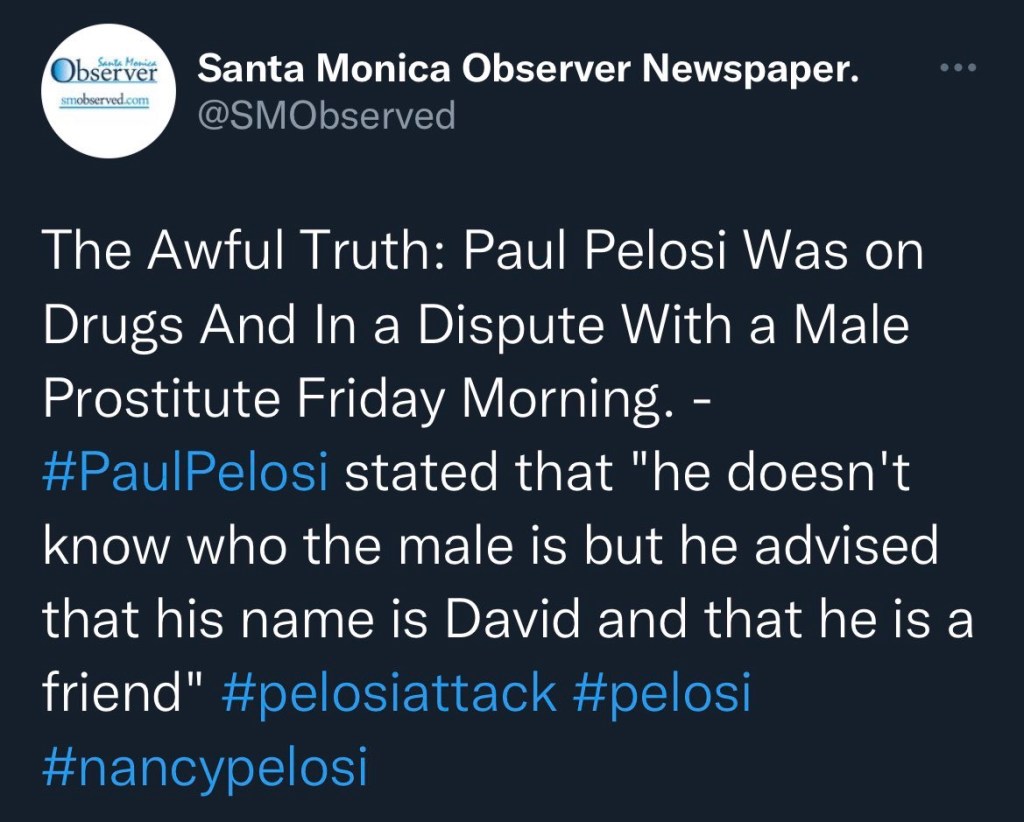
Extremists spun a tale in which Paul Pelosi met his attacker in a gay bar, came home drunk, and quarreled with a male prostitute. The perpetrator was not a rightwing extremist, they said, but a follower of Antifa and Black Lives Matter.

The L.A. Times patiently explains that none of these claims are factual.

The Break-in:

DePape told officers in a recorded interview last week that he broke through a glass door in the home using a hammer, according to the criminal complaint. He said Paul Pelosi was in bed at the time and “appeared surprised” by him. DePape allegedly told Paul Pelosi to wake up and that he was “looking for Nancy,” to which Paul Pelosi responded that she wasn’t there.

Police body cameras showed that a glass door in the back of the house was broken.

Paul Pelosi called 911 and said there was an intruder in the house, and the man was waiting for Nancy Pelosi.

DePape told police in a separate interview that once he was inside the home, he wanted to tie up Paul Pelosi so he could sleep because he was “tired from having had to carry a backpack.” DePape allegedly took out zip ties from his pocket so he could restrain Paul Pelosi, but Pelosi moved to another part of the house. DePape allegedly stopped him and they went back into the bedroom.

Paul Pelosi went into the bathroom while they were talking and called 911 on his phone, DePape told police. DePape said he “felt like Pelosi’s actions compelled him to respond” and that there was “no way the police were going to forget about the call.” DePape said he stayed after the 911 call because “like the American founding fathers with the British, he was fighting against tyranny without the option of surrender.”

When police arrived within minutes, they encountered the two men struggling over a hammer.

DePape allegedly pulled the hammer from Paul Pelosi and swung it, hitting him in the head, authorities said. Police restrained DePape; Paul Pelosi appeared to be unconscious.

What was the attacker’s motivations?

DePape allegedly revealed in an interview with police that he “was going to hold Nancy hostage and talk to her,” according to complaint. He would “let her go” if she told the “truth” but if she “lied,” he would break “her kneecaps.” DePape told authorities that he saw Nancy as the “leader of the pack of lies told by the Democratic Party” and that by breaking her kneecaps, she would have to be wheeled into Congress.

Conspiracy theorists assert that Pelosi and his attacker knew one another, and that when the police arrived, the attacker was wearing only his undershorts.

On Sunday night, former President Donald Trump’s son, Donald Trump Jr., retweeted an image of men’s underwear and a hammer, a nod to the unfounded conspiracy.

In their investigation, however, police interviewed a witness who was working as a private security guard at a nearby address, and said that they saw someone in “all black, carrying a large black bag on his back” walking towards the Pelosis’ home. The witness also said they heard banging on the door or the car and then sirens a minute or two later.

On Monday morning, U.S. Rep. Marjorie Taylor Greene suggested in a tweet the attacker knew Pelosi, calling him, “Paul Pelosi’s friend.”

But the indictment directly contradicts several portions of this conspiracy theory.

Paul Pelosi told police while he was being transported to the San Francisco General Hospital that he had never seen DePape before that night and he was asleep when DePape broke into his bedroom, according to the complaint. He also told the dispatcher during the 911 call that he didn’t know the identity of the man who broke into his home, but that the man said his name is David.

DePape also confirmed Pelosi’s account, telling them he broke through a glass door to get access to the house.

Right wingers claim that DePape was actually tied to left wing groups like Black Lives Matter and Antifa, but the reality is that he has posted racist, anti-Semitic, QAnon rants.

DePape is unhinged, like the guy who brought an assault weapon to a pizza parlor in Washington, D.C., believing that Hillary Clinton was a pedophile and had hidden children in the basement. Pure QAnon. Loony Tunes.

But most Republicans believe that Trump won the election in 2020, ignoring the fact that Biden decisively won the electoral college and had seven million votes more than Trump. They believe this even though Trump’s Attorney General told him he lost, as did his White House Counsel.

Where did all these people come from who trash democracy and scoff at free and fair elections?

Blogger Robert Hubbell reports that Justice Any Coney Barrett has won a $2 million advance on a book that explains how her personal views don’t affect her judicial decisions. Tell me another. Must be a very short book.

Hubbell writes:

Why does this feel like a “reward” for overruling Roe v. Wade?

Justice Amy Coney Barret has secured a $2 million advance from Penguin Random House for a book that will reportedly discuss “how judges are not supposed to bring their personal feelings into how they rule.” Given the dissonance between the proposed topic and Justice Barrett’s religiously motivated ruling in Dobbs, it is possible that the book is intended to be satirical, but there is little evidence that Barrett has a sense of humor.

So, the most reasonable explanations are that Justice Barrett (a) lacks self-awareness and any sense of shame, and (b) the shocking advance is an indirect “reward” for being the final vote necessary to overrule Roe v. Wade. To be fair, Barrett secured the $2 million advance for a book that can be summarized in a sentence fragment before she overruled Roe. To be fairer, there is little evidence that the German conglomerate that owns Penguin Random House has any interest in US politics—apart from monetizing controversy. A group of publishing professionals is calling on Penguin Random House to reconsider its deal with Barrett.

I, for one, cannot wait not to read Justice Barrett’s explanation of how her deeply held faith did not influence her vote to impose Catholic dogma on 320 million Americans. Perhaps future confirmation hearings can ask nominees for the Supreme Court if they intend to accept an obscene advance for writing a book of judicial fairy tales. That will give nominees something else to lie about besides their respect for precedent.

If you read Hubbell’s post, be sure to see his critique of the blunders of the Democratic Party’s Progressive Caucus, which released a statement calling on Biden to negotiate with Putin about ending the war in Ukraine, then withdrawing their statement as a mistake. I agree with Hubbell. Any negotiation that doesn’t include Ukraine is ridiculous. Any negotiation that rewards Putin with Ukrainian territory for his aggression encourages more aggression. I fully support the heroism and courage of the Ukrainian people in resisting Putin’s naked aggression.

Many Twitter users are fearful for the future of the popular social media site since it was purchased by Elon Musk. He is taking the company private and will be the sole proprietor. He has said he is an absolutist on free speech, which raises questions about whether he will tolerate hate speech, lies, propaganda, anti-vaxxers, disinformation, even Donald Trump, who was permanently banned from Twitter for inciting violence.

Now, the concern about Musk was stoked when he retweeted gossip from a free weekly (the Santa Monica Observer) that Paul Pelosi was drunk, high on drugs, and got into a fight with a man he picked up at a gay bar.

Musk posted that there was a “tiny possibility” that this was true. As readers began to react with incredulity that the new owner would spread unsubstantiated gossip, Musk deleted his tweet. Musk has 112 million followers on Twitter.

The San Francisco Chronicle wrote:

Musk responded Sunday at 5:15 a.m. Pacific time with a tweet that said, “There is a tiny possibility there might be more to this story than meets the eye,” and posted a link to a baseless, anti-LGBTQ article in the Santa Monica Observer. By 10:30 a.m. Sunday, the message and link had been retweeted more than 30,000 times and liked more than 110,000 times, before being deleted less than an hour later.

Last year, the Los Angeles Times reported that the Santa Monica Observer was “notorious for publishing false news,” and once claimed “that Hillary Clinton had died and that a body double had been sent to debate Donald Trump.”

Axios posted that the Santa Monica Observer is not a trustworthy site.

Why it matters: Musk linked to an article from the Santa Monica Observer, a website known for years for publishing false stories.

  • The site “is anything but trustworthy,” according to an executive at NewsGuard, a company that uses trained journalists to rate news and information sites.
  • The site has a trust score of 44.5 out of 100 points on NewsGuard’s rating scale for trustworthiness, due to repeatedly publishing numerous conspiracy theories and false claims about politics, the pandemic and more.
  • The site gets a red-rating and a warning for readers that says: “Proceed with caution: This website fails to adhere to several basic journalistic standards.”

Responsible people in the media fact-check. Musk didn’t think it was necessary. This does not bode well for the future of Twitter.

We have had our fill of conspiracy theories in the past six years.

It’s awful to think that the sole owner of Twitter will be a dupe for conspiracy theories and gossip and spread them to his millions of readers.

Just for laughs, read this article in The Intercept, which predicts that Elon Musk will regret his purchase of Twitter.

It begins:

ELON MUSK (and his consortium of much smaller investors) now owns Twitter. We need to take seriously the possibility that this will end up being one of the funniest things that’s ever happened.

That’s because as of this moment, it looks like Musk dug a big hole in the forest, carefully filled it with punji sticks and crocodiles, and then jumped in.

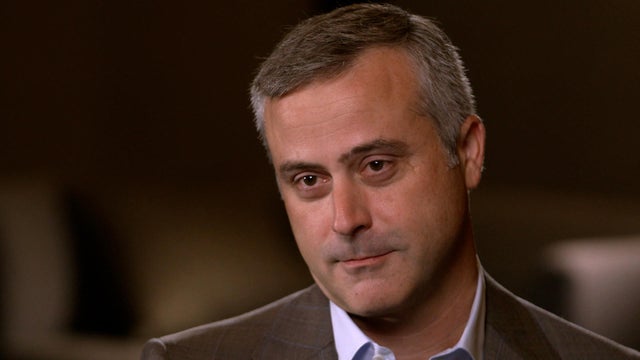
Anderson Cooper interviewed John Poulos, the CEO of Dominion Voting Systems on 60 Minutes about the attacks on the integrity of his company’s voting machines by 2020 election deniers.

Despite a rash of unsubstantiated claims lobbed against his company, the CEO of Dominion Voting Systems, John Poulos, has remained largely silent. That changed Sunday night on 60 Minutes when Poulos sat down with Anderson Cooper, saying irreparable damage has been done to his company and his employees.

“People have been put into danger. Their families have been put into danger. Their lives have been upended and all because of lies,” Poulos said. “It was a very clear calculation that they knew they were lies. And they were repeating them and endorsing them.”

“It’s important to you people admit what they said was wrong?” Cooper asked.

“It’s important to me. It’s important to all the people whose families have been impacted by this. Anderson, my kids still are not allowed to get any package from the front door until we verify that it’s actually from a trusted sender,” Poulos said.

Days after the 2020 presidential election, lawyers supporting then-President Donald Trump, including Sidney Powell and Rudy Giuliani, began spreading unsubstantiated claims that Dominion Voting Systems, an American company, had rigged the election. They said Dominion was backed by Venezuela and that its machines and software switched millions of votes from Donald Trump to Joe Biden.

They never showed any evidence, but that didn’t stop pro-Trump attorneys from making baseless claims, or conservative news networks from giving them plenty of airtime.

Poulos went through a number of their claims with Cooper, dismissing each one…

President Trump first mentioned Dominion in a tweet on November 12, 2020, and recorded a video a few weeks later, posted on Facebook, in which he said: “We have a company that’s very suspect. Its name is Dominion. With the turn of a dial or the change of a chip, you could press a button for Trump and the vote goes to Biden. What kind of a system is this? We have to go to paper. Maybe it takes longer. But the only secure system is paper.”

“We do have paper ballots,” Poulos said. “What the machines do is they count those paper ballots– in a way that makes it very easy for people to verify after the fact through the means of audits and recounts.”

dominionscreengrabs02.jpg
  John Poulos

Dominion makes two types of machines. One is called a ballot marker. It’s a touch screen device that a voter can use to mark their choices and then print the ballot. The second machine is a scanner that reads that paper ballot, counts the vote and immediately stores the ballot securely.

Poulos demonstrated on air how the voting machines work. He explained that his company has no relationship to Venezuela. He has sued various lawyers and FOX News for more than $10 billion. Judges have thus far refused to dismiss the lawsuits.

I hope that those who spread these lies and undermined faith in the integrity of our elections are fined for their deceit and unethical behavior, hopefully to the same extent as the other Big-time liar, Alex Jones.

Apparently Trump lawyers are already planning to claim that the 2022 elections were rigged, if their candidates lose.

The New York Times reported that Supreme Court Justice Samuel Alito assured Senator Ted Kennedy that he would not overturn Roe v. Wade. He said repeatedly that he respects precedent and considered Roe to be settled law. Seventeen years later, Justice Alito wrote the scathing opinion overturning Roe v. Wade and asserting that it was wrong from the start.

How should Americans react when they learn that at least three of the 6 justices who voted to overturn Roe are liars?

Senator Edward M. Kennedy looked skeptically at the federal judge. It was Nov. 15, 2005, and Samuel A. Alito Jr., who was seeking Senate confirmation for his nomination to the Supreme Court, had just assured Mr. Kennedy in a meeting in his Senate office that he respected the legal precedent of Roe v. Wade, the 1973 court decision that legalized abortion.

“I am a believer in precedents,” Judge Alito said, in a recollection the senator recorded and had transcribed in his diary. “People would find I adhere to that.”

In the same conversation, the judge edged further in his assurances on Roe than he did in public. “I recognize there is a right to privacy,” he said, referring to the constitutional foundation of the decision. “I think it’s settled.”

But Mr. Kennedy, a Massachusetts Democrat and longtime supporter of abortion rights, remained dubious that November day that he could trust the conservative judge not to overturn the ruling. He brought up a memo that Judge Alito had written as a lawyer in the Reagan administration Justice Department in 1985, which boasted of his opposition to Roe.

Judge Alito assured Mr. Kennedy that he should not put much stock in the memo. He had been seeking a promotion and wrote what he thought his bosses wanted to hear. “I was a younger person,” Judge Alito said. “I’ve matured a lot.”

The answer did not assuage Mr. Kennedy, who went on to vote against Judge Alito’s confirmation. If the judge could configure his beliefs to get that 1985 promotion, Mr. Kennedy asked in a notation in his diary, how might he dissemble to clinch a lifetime appointment to the nation’s highest court?

Justice Alito wrote the majority opinion this past June in Dobbs v. Jackson Women’s Health Organization, the momentous Supreme Court decision that put aside 50 years of precedent and overturned Roe. Respect for longstanding precedent “does not compel unending adherence to Roe’s abuse of judicial authority,” he wrote. “Roe was egregiously wrong from the start.”

Blogger-teacher Steven Singer lists five big lies about public schools that Republicans are pushing.

Be it noted that he leaves out a sixth big lie about public schools: some GOP nuts claim that public schools are putting litter boxes in classrooms for students who say they are cats. No one has identified a classroom where this has happened, but why should facts get in the way of propaganda?

Singer begins:

Critical race theory, pornographic school books, and other bogeymen haunt their platforms without any evidence that this stuff is a reality.

Doug Mastriano, the GOP nominee for Governor of Pennsylvania, actually promises to ban pole dancing in public schools.

Pole dancing!

“On day one, the sexualization of our kids, pole dancing, and all this other crap that’s going on will be forbidden in our schools,” he says.

Mr. Mastriano, I hate to tell you this, but the only school in the commonwealth where there was anything like what you describe was one of those charter schools you love so much. The Harambee Institute of Science and Technology Charter School in Philadelphia used to run an illegal nightclub in the cafeteria after dark.

But at authentic public schools with things like regulations and school boards – no. That just doesn’t happen here.

Maybe if your plan to waste taxpayer dollars on universal school vouchers goes through you’ll get your wish.

Singer goes on to list the following five lies:

1. Teaching boys to hate themselves.

2. Teaching kids to be gay.

3. Teaching kids to be trans.

Open the link to read about the other two.

They are all smears, lies, and propaganda.

The blog Fourth Estate 48 reports on news from Arizona. The latest news is that Mark Finchem, the Republican candidate for Secretary of State, wants to abolish voting by mail. He peddles the Big Lie that the 2020 election was stolen, and mail-in voting was a source of fraud.

Well, Dillon Rosenblatt checked Finchem’s voting record and found that he regularly votes by mail.

The Secretary of State in every state is in charge of elections. He or she must be a person of the highest integrity and must be nonpartisan.

Rosenblatt writes:

During his Arizona PBS debate for Secretary of State, Republican nominee said he always goes to the polls to vote. He lied.

Up until this year, Mark Finchem, the conspiracy theorist, stop the steal, election denying Republican candidate for Arizona Secretary of State automatically received his ballot via the mail since he was a Libertarian in 2008.

Despite that, Finchem has been a strong advocate of ending no-excuse mail-in voting for all Arizonans which has been in place for decades and used by at least 80% of the electorate. Finchem during his debate against Democratic challenger Adrian Fontes, the former Maricopa County recorder, last month claimed he always votes at the polls. This is a lie.

In another post, Dillon Rosenblatt reported that Republican Candidate for the U.S. Senate, Blake Masters, always votes by mail. But he’s against it, like Finchem.

In last night’s Arizona Senate debate on Arizona PBS between Senator Mark Kelly, the Democrat, Blake Masters, the Republican, and Marc Victor, the Libertarian, Masters went after the state’s vote by mail system –– a system which he utilizes exclusively.

Masters at first said, “I believe in Election Day, not election season,” but his voter file shows he’s never actually voted on Election Day while he was registered to vote in Arizona.

Masters has not lived in Arizona for long, but he has always voted by mail.

Nancy Flanagan taught music for many years in Michigan. She draws on her deep experience in this post to set the record straight about what parents really want from their schools.

Extremist groups funded by rightwing autocrats claim to speak for parents, but they use their platform to spread propaganda and lies. They say they speak for “parental rights,” but they spread fear, distrust and lies.

John Gibbs, the Republican candidate for Congress in western Michigan, said that:

Folks, did you ever think that one day in America, we’d have to worry about schools putting obscene books in their libraries? This is simply insane–we must stop the madness. Voters overwhelmingly oppose sexually explicit books in public school libraries.

Flanagan answers Gibbs:

Well—folks. I’m not worried about obscene or sexually explicit books in public school libraries. Because there is no madness, no insanity, no pornography in school libraries.

Teachers and school leaders also overwhelmingly oppose sexually explicit books in school libraries. The word we use is ‘inappropriate’—materials are selected by trained school media specialists, who know inappropriate when they see it.

The entire slate of MI Republicans running for statewide or national office, not just Gibbs, is hell-bent on insisting that schools have become (in the past two years) hotbeds of sexual orientation and gender identity transformation, not to mention racial tension and guilt-inducement. They are led in this effort by the Republican candidate for Governor, Tudor Dixon.

Gibbs goes on to say, on behalf of Republican candidate for Governor in Michigan, Tudor Dixon:

What Tudor wants to accomplish is very simple and common sense. She wants to get radical sex and gender theory out of our schools, remove classroom instruction of sexual orientation and gender identity for grades K-3, make sure gender specific sports remain gender specific given biological differences in boys vs. girls and post all curriculum online for parents to see and be involved in their child’s education. Every child deserves a world class education and parents should be in charge of it.

Flanagan answers:

So let’s break this down.

Radical sex and gender theory? (Not a part of the curriculum in any school I’ve been in.)

Classroom instruction on sexual orientation or gender identity for the littles? (Likewise—nope, nope.)

Gender specific sports? (The Michigan High School Athletic Association has a policy adopted in 2012 that determines post-season tournament eligibility for transgender athletes on a case-by-case basis. The group received and approved 10 applications in the past five years—so this is hardly a burning statewide issue.)

Post all curriculum online? (Sure. Most districts post their standards framework—what gets taught, when– and public high schools in Michigan have adapted the Michigan Merit Curriculum.)

Every child deserves a world class education and parents should be in charge of it. (Right out of the Glenn Youngkin playbook, a statement like this, which is mostly true, really resonates.)

But here’s the truth (from 32 years of classroom experience): What bubbles up in classroom discussions and playgrounds is what’s on the minds of the kids in that classroom. This starts early, in Tudor Dixon’s forbidden zone, grades K-3—like this story about the boy who chose a ‘Frozen’ backpack.

Kids are curious and they’re paying attention to what their parents and their screens (and their friends, and their older siblings) are telling them. I taught music and math, two subjects you’d think were pretty straightforward and controversy-free, but can testify that anytime you get a cluster of kids together, provocative issues emerge.

Please open the link and read the rest of this common sense, informed commentary. Parents are not fooled by this fear mingering. They know their children’s teachers, and they trust them.

Alex Jones and his companies Infowars and Free Speech Systems were ordered by a jury in Connecticut to pay nearly $1 billion to some of the parents of victims murdered at the Sandy Hook Elementary School in Newtown, Connecticut, as well as an FBI agent.

Jones falsely claimed that the massacre of children, teachers, and the principal at the school was faked and that the victims were “crisis actors.” He said repeatedly that the purpose of the hoax was to create political pressure for gun control.

Parents and relatives of those who were murdered were harassed and received death threats.

The money will not replace those they lost. The,parents will never hold their babies again. But Jones’ cruel campaign to deny that the massacre ever happened deserved punishment.

This is the second of three trials. Jones has no defense. He maligned the families to make money. Hopefully he will be bankrupted for his sins.

The U.S. Department of Education’s Office of the Inspector General conducted an in-depth audit of the federal Charter Schools Program, which was initiated in 1994 with a few million dollars by the Clinton administration. Thanks to astute lobbying by the charter industry, the modest program grew to $440 million a year with little or no accountability. Betsy DeVos pushed it aggressively to large charter chains, including for-profit chains.

You will be interested in this account of the audit, written by Valerie Strauss on her blog “The Answer Sheet” in the Washington Post, introducing an analysis by Carol Burris, executive director of the Network for Public Education.

This audit demonstrates the power and persistence of the Network for Public Education, a small but smart advocate for public schools. NPE operates with one full-time employee and a small number of part-time employees. Our work is motivated not by greed but by idealism and a passionate commitment to the common good. We believe in well-funded schools with experienced teachers for all children.

The introduction by by Strauss and the analysis by Burris has many links, but none transferred when I copied it. I copied some, but not all of them. I urge you to open the original and find the links.

Strauss begins:

The U.S. Education Department’s Office of Inspector General has released a new audit of the federal Charter School Program that found some alarming results about how charter school networks have used millions of dollars in funding. Among other things, the audit found that charter school networks and for-profit charter management organizations did not open anywhere near the number of charters they promised to open with federal funding. This piece looks at the new audit and what it tells us.


The reason this is not surprising is that investigations into the Charter School Programs by the Network for Public Education, an advocacy group that opposes the growth of charter schools, found that same problem, as well as others and reported it a few years ago. You can read my stories about their “Asleep at the Wheel” here and here. (The second report noted that the state with the most charter schools that never opened was Michigan, home to former education secretary Betsy DeVos, who has pushed to expand charter schools for decades.)


Charter schools are publicly funded but privately managed. The federal charter program, which began in 1994 with the aim of expanding high-quality charters, had bipartisan support for years, but many Democrats have pulled back from the movement, citing the fiscal impact on school districts and repeated scandals in the sector. The Biden administration is making some changes to the program in an effort to stop waste and fraud and provide more transparency to the operation of charters.


This piece was written by Carol Burris, executive director of the Network for Public Education and a former award-winning principal in New York. She has been chronicling the charter school movement and the standardized-test-based accountability movement on this blog for years. The Network for Public Education is an alliance of organizations that advocates for the improvement of public education and sees charter schools as part of a movement to privatize public education.


By Carol Burris


A new report issued by the Office of the Inspector General (OIG) entitled “The Effectiveness of Charter School Programs in Increasing the Number of Charter Schools” documents how states, charter management organizations, and charter developers often make wildly exaggerated claims regarding the number of charter schools they will open or expand to secure large grants.

The OIG, an independent watchdog of the U.S. Department of Education (the Department), found that for grants issued between 2013 and 2016, only 51 percent of the schools promised by Charter School Programs (CSP) recipients opened or expanded.


The OIG audit also exposed the sloppy record keeping and weak oversight that characterize CSP operations. Since 2006, the department has paid a private corporation, WestEd, millions of dollars to compile, check and update CSP records. WestEd’s present CSP contract exceeds $12 million. In total, WestEd has active contracts with the U.S. Department of Education worth more than $27.6 million. Yet an alarming number of grant records could not be found when requested by the OIG auditors. And while the Biden administration is attempting to clean up and reform the CSP, according to the independent OIG, more work needs to be done.


What did the Office of the Inspector General audit?
The audit had three goals. The first was to describe how the department’s Office of Elementary and Secondary Education tracked and reported the number of charter schools that opened and expanded using Charter School Program funds. A second goal was to determine whether CSP grant recipients actually delivered the number of charter schools they promised when they applied for their often multimillion dollar awards. Finally, the audit sought to determine how many schools were still open two years after CSP funding ended.


As its title stated, the audit was an attempt to measure the program’s effectiveness in fulfilling its mission. To conduct the audit, the OIG examined 2013 through 2016 CSP grant records. During that period, the department awarded 103 CSP grants to states, charter management organizations, or individual charter developers. Ninety-four were closely investigated by the OIG. The likely reason these years were chosen was that most grants are for five years. The auditors also found that the department often extends them further when grantees have not spent all of their money. Therefore, more recent grants were excluded because records were likely to be incomplete.

Incomplete and inaccurate records

The auditors noted that while the department, through WestEd, tracked spending and schools while grants were open, the tracking stopped as soon as the grant was complete. Therefore, the department had no way of knowing whether schools remained open beyond the years federal funds propped them up. This speaks to the purpose of the program — to open and expand high-quality charter schools.


When auditors asked the department to define the term high-quality, the department responded that the “CSP office does not determine whether a charter school is high-quality because state rules for determining high quality vary.”


“Additionally,” it said, “the determination of whether a charter school is a high quality is often the responsibility of charter school authorizers.” The department also told auditors that tracking a school’s existence after all money was doled out was not its job.


Even if the department wanted to do a quality check of schools as they were funding and expanding, the OIG found that there was no accurate base of information that they could rely on to determine whether they should continue what was often a multimillion-dollar grant. From the audit:


Although the CSP office created processes for tracking and reporting on charter schools that opened and expanded and charter schools that remained open through the grant performance period end date, those processes did not result in CSP grant recipients reporting precise, reliable, and timely information in their FPRs [final performance reports], APRs [annual performance reports], and data collection forms. The processes also did not result in the CSP office receiving all the necessary information to assess grant recipients’ performance or evaluate the overall effectiveness of the CSP.


Specifically, the department could not produce 13 percent of the required final reports from grantees and 43 percent of the required final data collection sheets. Auditors noted that grantees would report different numbers of schools opened or expanded among required collection forms and final reports. The accuracy of the final documents prepared by WestEd for the department was beyond the scope of the audit.

During our research for our second “Asleep at the Wheel” report, we found that the data collection sheets produced by WestEd and published in 2019 by then Education Secretary Betsy De Vos were replete with errors. Schools that had closed or never opened were reported as open or future. We also noted inaccuracies in recently submitted sheets we received from a Freedom of Information Act request, especially relating to the for-profit management status of the awardee.


But the OIG discovered a far worse problem yet. More than half of the schools that grantees committed to opening or expanding did not open or expand at all.

CSP grantees failed to meet commitments
Grant applicants asked for and received millions of dollars based on their promises to open and expand charter schools. However, when the auditors examined 94 grantee applications, they found that many grantees fell far short of their commitments.

The OIG determined that based on the commitments made in the 94 applications, state education agencies, CMOs, and developers promised to open or expand 1,570 charter schools using CSP funds.


As of July 2021, approximately 75 percent of the grant funding had been spent, yet grantees had only opened or expanded 51 percent of the charters they had promised.


This begs the question, where did millions of tax dollars go? I identified grantees by matching applications on the department website along with numbers in the data set with grant codes in the OIG report.


In its 2016 CSP application, the Florida Department of Education put forth what it called a “bold and ambitious plan to … develop a high-impact system to dramatically improve the opportunities of educationally disadvantaged students. The department said that it would use the grant to “support the creation of 200 new high-quality charter schools over the next five years.”

Florida received $70.7 million to achieve its “bold and ambitious” plan. According to the OIG report, it had only opened 33 percent — or 66 — of the schools it promised to open as of July 2021, although it had spent over 51 percent of the CSP funds.


Colorado’s 2015 application promised that it would open 72 charter schools with its over 24.2 million dollar grant. In the end, it opened fewer than half — just 33 — and expanded three schools. Nevertheless, it spent 87.5 percent of its funds.

Tennessee ambitiously promised to open 114 charter schools. It opened just 16, though it managed to spend 63 percent of its grant. These states are not outliers. The report shows a pattern.

And CMOs also failed to deliver. The KIPP charter network promised 65 schools for its jumbo $48,750,000 grant, one that well exceeded most states. It delivered 34 schools and expanded one.

Finally, there are grants to developers that the department directly provides. The Innovation Development Corporation received a $405,730 CSP grant to open The Delaware Met. It was open for just a few months before it was shut down. It also received and spent $72,000 to open DE Stem. That school was shut down before it even opened. Willow Public School, a Washington charter school, took and spent a $602,875 grant, opened, ran into trouble, changed its name, and then shut down.


The department and the National Alliance for Public Charter Schools attribute the problem to authorizer reluctance and state caps on the number of schools that can open. Really? Every state that got a grant has a state board that can override local rejections of applications. State applicants and the department are also well aware of caps. Take the case of the 2018 $78,888,888 CSP grant to the New York State Department of Education, which was outside the scope of the OIG audit.

In the New York State application review, which you can find here, raters acknowledge that New York State had not even used up its previous grant which was open beyond its terms and that charter expansion would be limited by the state cap on the number of charters. Yet they gave the application high scores, and it was approved. Where did that 2018 money go? Over $10 million went to provide staff development in technology for charter schools.

Jumbo grants

Why do states and charter management organizations ask for jumbo grants knowing they cannot deliver? Because they want the money to fund their charter school operations.


States and charter management organizations get to keep 10 percent of the cut for grant administration and technical assistance to charter schools. The bigger the grant, the bigger the cut.

Therefore, KIPP was allowed to keep nearly $5 million for its charter management organization, even though it fell way short of its commitment. The Florida Department of Education secured over $7 million for administrative services on its grant.
Second, there are no guidelines about how much an individual charter school can get. We have seen grants as low as $250,000 and grants to schools of $1.5 million. When a state realizes it cannot or will not meet its commitment, it just doles out larger amounts.


Third, until President Biden, no prior administration did anything about it over the Charter School Program’s existence. Therefore, states, CMOs, and individual schools realized pretty quickly that they could create grandiose applications, sometimes including falsehoods, and there would be no real consequences if commitments were never met.

The present department has taken a terrible beating for creating modest CSP reform regulations which are still being fought by the charter trade organizations and their proxies, including the Thomas B. Fordham Institute, a charter school authorizer. Challenges include both a lawsuit and a Republican-sponsored bill to overturn the new rules.

But as the OIG audit shows, reforms are desperately needed.

.