Archives for category: Lies

This is a link to a gift article.

Several reporters at The New York Times worked together for months unraveling the secrets of Jeffrey Epstein’s financial success. How did he go from being a high school math teacher to a multimillionaire? His greatest trick, it appears, was cultivating and leveraging friendships among people who were wealthy and powerful. Name-dropping was a tactic. So were lying and boasting, as he rose in elite circles, cultivating contacts, references, women, and friends.

Glenn Kessler spent 15 years as the Washington Post fact-checker. He stepped aside recently and now writes at his Substack blog. For years, he has had the daunting task of counting Trump’s lies. Trump has the unparalleled ability to lie with great sincerity even when he knows he is lying.

He writes:

The hardest part about building a list of Donald Trump’s ten biggest lies in a year is the abundance of material.
When I ran The Fact Checker at The Washington Post, our team counted more than 30,000 false or misleading claims in his first term. That’s more than 20 erroneous claims a day. No one is keeping such a comprehensive list in his second term — it’s a thankless duty — but I’m sure he’s keeping the same pace.

Trump makes many false statements, big and small, and I tried to keep this accounting to substantive issues, both domestic and foreign. Even so, I found myself removing claims that others might consider worthy of inclusion.
For instance, he regularly claimed an executive order he issued on prescription drugs would “slash drug prices by 200 percent, 300 percent, 400 percent, 500 percent, 600 percent, 700 percent, 800 percent.” That’s a mathematical impossibility. A 100-percent cut would mean prices were zero. Trump is surrounded by so many lackeys that no one appears to have the heart to tell him.
Another arithmetic-challenged claim is Trump’s frequent boast that under his leadership the United States has secured nearly $20 trillion in new investments. That’s double the official White House count, which itself is a misleading brew of aspirations and vague promises, not actual investments. One clue this is bogus: Trump’s number is two-thirds of the annual gross domestic product of the United States.
Then there’s Trump’s claim that “Portland is burning to the ground,” apparently because he watched a Fox News report that included B-roll from 2020. This year, a few protesters outside an ICE facility have set some small fires, quickly extinguished. Again, why doesn’t his staff set him straight?
Another runner-up was Trump’s outrageous accusation that Erika McEntarfer, the commissioner of the Bureau of Labor Statistics, had manipulated jobs numbers. He fired her after job-growth estimates were revised downward — a common occurrence. “In my opinion, today’s Jobs Numbers were RIGGED in order to make the Republicans, and ME, look bad,” he fumed on social media, even though the estimates are derived from surveys conducted by professionals many rungs below the director. Trump never offered evidence for his claim.
Readers may have other nominations. Here’s my list for Trump’s biggest lies in 2025, in no particular order. Taken together, these falsehoods demonstrate how Trump governs — impulsively, defiantly, and often detached from reality.
“Instead of taxing our citizens to enrich other countries, we will tariff and tax foreign countries to enrich our citizens.”
Is it a lie if someone appears to firmly believe something? Trump may love tariffs but he’s been lying to himself as well as the American people about the impact. Every economist agrees that tariffs are a tax on consumers — not countries. Yet in his inaugural speech, Trump said the opposite. It is economic nonsense. Trump, of course, made this claim throughout the 2024 campaign (and in his first term), but it merits inclusion on the 2025 list because this lie had such real-world implications. Trump likely circumvented the Constitution by imposing such sweeping tariffs without congressional authorization, though the final verdict will come from the Supreme Court.
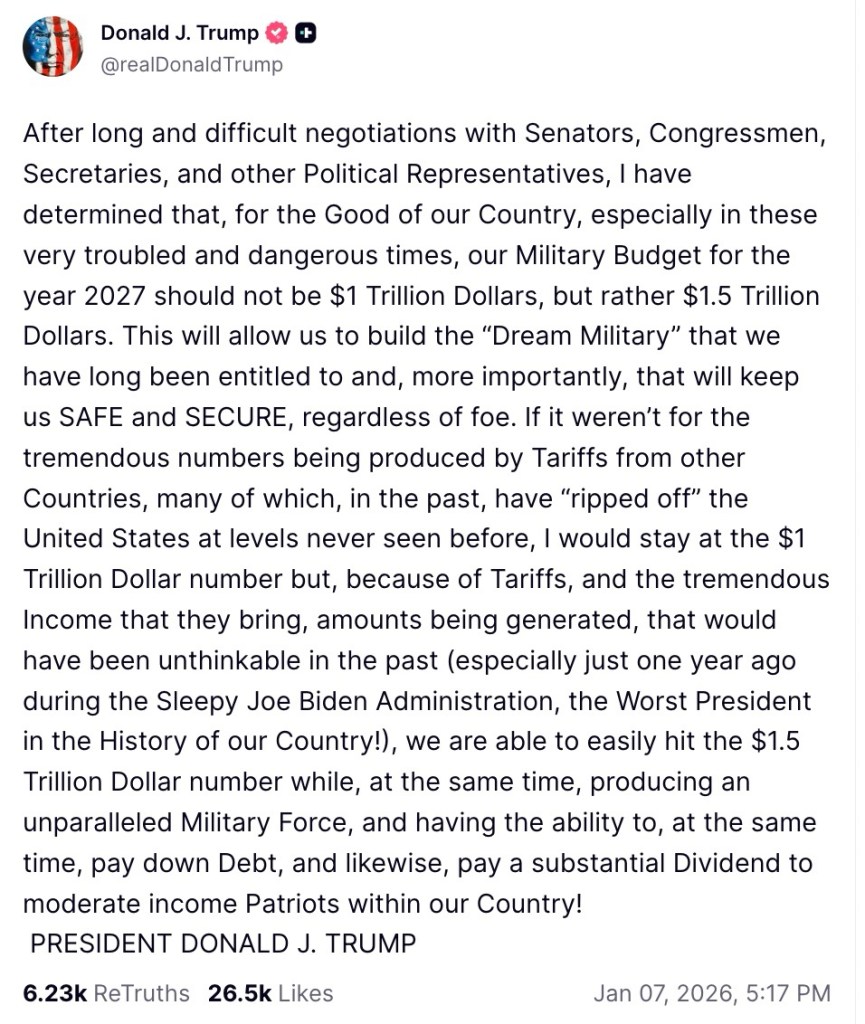
Throughout the year, Trump made many false claims about tariffs — “We’re taking in billions and billions of dollars. … We were losing $2 billion a day. … Now we’re making $3 billion a day” — and offering empty promises to use the “trillions” from tariffs to reduce taxes and pay down the national debt. The money raised from tariffs is not enough to reduce income taxes — and it is in fact another tax — and it won’t pay down the debt. That didn’t stop Trump from falsely claiming in November that tariffs would reduce the federal budget deficit by 25 percent.
By the end of the year, Trump offered $12 billion in aid to farmers hurt by his trade war with China — an unstated acknowledgment that tariffs do have costs for Americans.

“We identified and stopped $50 million being sent to Gaza to buy condoms for Hamas.”
On the face of it, this sounds idiotic, but Trump kept repeating it (and sometimes inflated the figure to $100 million) to justify terminating the U.S. Agency for International Development — an effort led by Elon Musk’s Department of Government Efficiency. But USAID, which distributed condoms to prevent the spread of sexually transmitted disease, spent less than $50,000 on condoms in the entire Middle East in a year — and nothing in Gaza.
In a striking example of the White House’s sloppy staff work, someone appears to have confused Gaza, the Palestinian enclave on the Mediterranean, with the Gaza province of Mozambique in Africa — and then USAID funding with Health and Human Services Department money given to the Elizabeth Glaser Pediatric Aids Foundation for HIV/AIDS prevention. It would be funny if it were not so sad.
Nevertheless, despite such fiction, USAID was dismantled, at great cost to the United States’ global reputation and with little impact on the $7-trillion federal budget. Though Trump in February claimed that DOGE had already saved as much as $500 billion, DOGE itself only tallied $214 billion by December. Of course, that’s also an exaggerated figure. When Politico scrubbed the data in August, it found the savings amounted to less than five percent of the claimed value. That’s because DOGE would count the ceiling value of contracts, which is far more than what the government has agreed to pay.

“You should have never started it. You could have made a deal.”
Trump said this in February about Ukrainian President Volodymyr Zelensky, who has, against the odds, managed to fend off a Russian assault on his country for nearly four years.
Trump, who for some inexplicable reason always tilts toward Russia, echoed the Russian position that it was pushed into the conflict. It’s akin to saying Japan was forced into attacking Pearl Harbor because the United States imposed a trade embargo in 1940, depriving Japan of oil. The trade embargo came after Japan’s provocative actions in the Pacific, such as the 1931 occupation of Manchuria following a Japanese-manufactured incident.
This comment is emblematic of a series of Trump’s lies about Ukraine — that Zelensky admitted U.S. aid is missing, that Zelensky has never said he has been grateful for American assistance, that the United States provided more aid than Europe, and so forth. Despite sometimes suggesting he was exasperated by Russia, Trump throughout the year has consistently favored Moscow over Kyiv in the conflict that, in the 2024 campaign, he claimed he would solve in 24 hours.

“We’ve ended weaponized government where, as an example, a sitting president is allowed to viciously prosecute his political opponent like me.”
Trump made this proclamation in his annual speech to a joint session of Congress, a clear example of a lie of commission. He and his allies already had fired career Justice Department and FBI employees who worked on the Jan. 6 cases or the Trump prosecutions, launched investigations into political groups and donors, and targeted law firms who worked on cases against him.
Soon, Trump ordered the indictments of former FBI director James Comey and New York Attorney General Letitia James, after firing the U.S. Attorney who decided the cases were weak. The cases rested on such shaky ground that they were soon dismissed. But they could be revived and Trump’s point was made — cross him and you will be in the crosshairs.
(For the record, there is no evidence that Joe Biden directed the Justice Department or local prosecutors to pursue the four criminal cases against Trump.)

“Just about everything is down. You know, this whole thing is, they use the word affordability. It’s a Democrat hoax.”
By year’s end, Trump’s approval rating had fallen sharply, largely because Americans perceived he was not focused on “affordability” — the rising cost of goods and services.
As usual, Trump thinks he’s doing great. In December he gave himself a score of “A-plus-plus-plus-plus-plus” for his handling of the economy. When asked by Laura Ingraham why Americans were anxious, he dismissed the concern: “I don’t know they are saying that. The polls are fake. We have the greatest economy we’ve ever had.” Even though grocery prices were up, Trump insisted they were down.
Instead, he lied that any problems faced by Americans were the legacy of Biden’s presidency, claiming that “we inherited from the last administration an economic catastrophe and an inflation nightmare.” In fact, Trump inherited an economy with relatively low unemployment, falling inflation and strong growth. The month before the November election, the Economist newspaper published a cover story declaring that the U.S. economy was “the envy of the world.” Taking office, Trump upended the economy — and sent prices higher — by imposing sweeping tariffs.

“Don’t take Tylenol. Fight like hell not to take it.”
Trump’s news conference in September claiming a link between Tylenol and autism was an appalling display of ignorance and hubris.
He falsely suggested autism rates were soaring — from 1 in 10,000 to 1 in 36 — when in fact the diagnosis of autism has increased because of better detection and expanded definitions. He seized on a disputed report to blame Tylenol, despite decades of research failing to find a causal link. He claimed nonsense that Amish don’t have autism because they refuse vaccinations. Surveys show many Amish vaccinate their children and that there is autism in the community. He cited a “rumor” that Cuba has no autism because the island can’t afford Tylenol. That curious claim was news to Cuba doctors. And then he told American women that they shouldn’t take Tylenol even if they suffer a fever — though fevers can be very harmful to fetuses. (Indeed, it may be fever, not Tylenol, that is linked to autism.)

“I’ve ended eight wars.”
No one can accuse Trump of modesty. In his desperate bid to be awarded the Nobel Peace Prize — Barack Obama won one, after all — Trump over the course of the year has added to his list of “wars” that he claimed he’s ended. But few of these were wars, Trump’s role was often tangential, and the resolution of the conflicts are likely temporary. Many of the pauses require careful follow-up to ensure implementation, and already some are falling back into bloodshed.
Yet that has not stopped Trump from claiming credit and even asserting “we’ve never had a president that solved one war, not one war.” That’s obviously false. Theodore Roosevelt won the Nobel Peace Prize in 1906 for negotiating peace in the 1904-5 war between Russia and Japan, while Jimmy Carter negotiated the Camp David Accords between Israel and Egypt in 1978.
What’s on Trump’s list? Cambodia and Thailand (A border dispute keeps flaring up, and indeed restarted in December); Armenia and Azerbaijan (They signed a U.S.-brokered peace deal in August, with Trump hosting an Oval Office ceremony, but it must be ratified and Armenia needs to change its constitution); Israel and Iran (a ceasefire was declared after a 12-day conflict but the decades-long conflict continues); India and Pakistan (The long-running dispute over Kashmir continues, though a ceasefire was reached in May; Trump’s claim of credit has been rejected by India); Rwanda and the Democratic Republic of Congo (Fighting continues though a peace agreement was signed with U.S. involvement); Egypt and Ethiopia (This is a mystery entry on Trump’s list as the nonviolent dispute is over hydroelectric dam opened by Ethiopia); Serbia and Kosovo (Another mystery entry as tensions have never eased since Kosovo broke off in 2008); Hamas and Israel (Trump pushed Israel to finally agree to a ceasefire in the two-year war, a real accomplishment, though a final resolution to the conflict appears elusive).
As you can see, it’s inflated and rather crass, much like accepting a dubious “world peace award” from FIFA and renaming the U.S. Institute of Peace after himself after the administration fired the staff and destroyed it.

“Every boat that you see get blown up, we save 25,000 – on average – 25,000 lives.”
Trump has been under fire for the administration’s military strikes on alleged Venezuelan drug boats in international waters, and in defense he offered a nonsense figure. Dutifully, other administration officials have echoed the lie.
First of all, the administration had not provided evidence that the boats carried drugs. Trump asserts they were transporting fentanyl but that makes no sense since Venezuela mainly supplies cocaine to Europe. In three months, about 20 vessels have been hit by airstrikes, killing more than 80 people, so using Trump’s math that would mean 500,000 Americans lives supposedly were saved. Yet provisional federal data shows that the total number of U.S. overdose deaths was about 75,000 in the 12 months ending in April (the most recent period available).
In other words, Trump invented these numbers. (The “on average” is an effort at verisimilitude.) It’s not supposed to make sense — just sound good.

“These [Epstein] files were made up by Comey. They were made up by Obama. They were made up by Biden.”
One of the few issues Trump could neither spin nor shrug off centered on demands that his administration release the investigative files on convicted sex offender Jeffrey Epstein, a onetime friend from the 1990s with whom he later fell out. Trump had promised to release the files during the 2024 campaign, but then the Justice Department refused to do so. Pressure built in Congress for passage of a law to force the files’ release, and in July Trump lashed out, claiming the files were all made up by Democrats, name-checking former FBI director James Comey, Obama and Biden.
This claim is simply nuts. The files represent investigative evidence, so nothing was invented. Neither Obama nor Biden were in office when the FBI investigated Epstein — that happened under George W. Bush in 2007-2008 and Trump in 2018 — while Comey wasn’t even in government at the time. Epstein, who molested hundreds of girls, at first received a sweetheart deal that minimized his crimes, and then the case was reopened under Trump after a Miami Herald investigation. He was found dead in his prison cell in 2019 while awaiting trial, an apparent suicide.
Trump’s instinct is to deflect problems onto his opponents, but he wasn’t successful in this instance. Congress passed the law, requiring the files be released by Dec. 19. The Justice Department has indicated it won’t meet the deadline.

“It won’t interfere with the current building. It will be near it but not touching it. And pays total respect to the existing building.”
This was Trump in July, speaking about his plans to add a ballroom to the White House complex.
Then, suddenly, in October, wrecking crews ripped down the entire East Wing of the White House. Trump was unrepentant about the fierce public outcry, dismissing the East Wing as “common brick, little tiny windows, it looked like hell.” (The White House skipped the requirement to submit its demolition plans, claiming the National Capital Planning Commission has no jurisdiction over demolition.)
In July, Trump had said the ballroom would hold 600 to 700 people and cost $200 million; now the plans call for about 1,000 people, the budget ballooned to more than $300 million, and the architect was replaced because he objected to Trump’s grandiose ambitions. The resulting 90,000-square-foot building will overshadow the existing 55,000-square-foot White House structure.
Is there any lie more emblematic of how Trump has approached his second term? He forges ahead, destroying any obstacles in his path, including the truth, while paying little heed to what Americans might think.

Garry Rayno, veteran journalist in New Hampshire, understands the war on public education. He knows that privatization is meant to diminish public education. He knows that it is sold by its propagandists as a way to help the neediest students. He knows this is a lie intended to fool people. He knows that the children who are hurt most by the war on public education are the most vulnerable students.

You might rightly conclude that the war on public education is a clever hoax.

Rayno writes:

“The true measure of any society can be found in how it treats its most vulnerable members.” 

The quote is often attributed to Mahatma Gandhi, but is also similar to words from British UN Ambassador Matthew Rycroft.

What better measure of treating the most vulnerable than the public education system open to all, not just those with the resources to send their children to private or religious schools.

Public education is often called the great equalizer providing the same learning  opportunities to a community’s poorest children to the richest in stark contrast with today’s political climate driven by culture wars and fear of diversity, equality and inclusion.

Public education has provided an educated citizenry for businesses, government and political decision making for several hundred years.

Public education is the embodiment of “the public good,” as it provides a foundation for a well-lived life that is both rewarding and useful to others.

But for the last few decades there has been a war on public education driven by propaganda, ideology and greed.

While the war has intensified in the last decade, it began with the US Supreme Court’s landmark Brown vs. the Board of Education of Topeka decision in 1954 declaring racial segregation in public schools a violation of the 14th Amendment’s equal protection clause.

The decision overturned the court’s earlier Plessy vs. Ferguson decision which established the separate-but-equal provision for public education.

The Brown decision required the desegregation of public schools sending a tidal wave through the south reaching north to Boston.

The southern oligarchs who never really believed the South lost the Civil War soon colluded with others like them to develop a system to bypass their obligation to pay to educate black kids. Instead they established “segregation academies” where their children could learn in a homogeneous setting.

The system was created with the help of libertarian economist James Buchanan who touted the belief that the most efficient government is one run by the wealthy and educated (the oligarchs) because the regular folks are driven by self interest which makes government inefficient, and most importantly, costly through higher taxes.

This philosophy continues today as libertarians and other far right ideologues want to privatize public education because it takes too much of their money in taxes, and a humanities-based public education induces children to develop beliefs different from their parents, which once was the norm for American families.

It is not by happenstance we see parental bills of rights, opt outs, open enrollment and greater and greater restrictions on what may be taught, along with increased administrative work loads piled onto public education by politicians in Concord as they double down on refusing to do the one simple thing the state Supreme Court told them to do 30 years ago, provide each child with an adequate education and pay for it.

Instead they have pushed a voucher system costing state taxpayers well over $100 million this biennium, with 90 percent of it paying for private and religious school tuition and homeschooling for kids who were not in public schools when their parents applied for grants if they ever were in public schools.

Most of the voucher system expansion occurred under the Chris Sununu administration with his back-room-deal appointed Education Commissioner Frank Edelblut.

Edelblut nearly beat Sununu in the 2016 Republican primary for governor for those with short memories.

Sununu sent his children to private schools while he was governor and Edelblut homeschooled his children.

Public education during the eight years of the Sununu administration was not a priority although 90 percent of the state’s children attend public schools.

And it is not coincidence that after the Republican House resurrected House Bill 675 which would impose a statewide school budget cap, that Gov. Kelly Ayotte’s small DOGE team — led by two “successful businessmen” — issued its long awaited report and one category targeted schools following the legislature’s Free State agenda of greater transparency and efficiencies, seeking Medicaid and insurance reimbursements and reforming school audit requirements. 

HB 675 failed to find enough support last session because it violates the once sacred “local control ideal” often touted for local government.

House Majority Leader Jason Osborne, R-Auburn, issued a press release linking the report and the bill.

“HB 675 applies the findings of the report where they matter most. When dollars are committed and taxpayers are on the hook, HB 675 puts power back into the hands of the voter by requiring a higher threshold of consent,” he said.

Yes a higher threshold which means the will of the majority is nullified by a minority.

State lawmakers fail to acknowledge they provide the least state aid to public education of any state in the country. Instead local property taxpayers pay 70 percent of public education costs and should be able to set their school budget and various other realms usurped by state lawmakers without a “higher threshold of consent.”

The battlefield in the war on public education shifts over time. It began with religious and political ideology; moved into gender and sexual identification; parental rights, including who decides whether school materials and books are appropriate; school choice such as open enrollment, which will exacerbate the already great divide between property poor and wealthy school districts; and is now positioned to impact the most vulnerable of public school children, those with disabilities.

Last week special education administrators gathered for their annual meeting and to celebrate 50 years of the Individuals with Disabilities Education Act (IDEA) to improve access to education and to integrate classrooms to include those with disabilities.

Today’s special education services and supports are lights overcoming the darkness of institutionalization or stay-at-home kids separated from their peers in public schools.

Many children with disabilities were told to stay home and not to attend school as there were no specialized services or therapies for them.

But services are expensive as federal lawmakers knew they would be, promising to pay 40 percent of the cost, but reneging on that promise and paying only about 13 percent.

In New Hampshire, most of the remainder is paid by local property taxpayers.

The state pays little until a student’s costs reach three-and-a-half times the state’s per-pupil average or about $70,000.

But state lawmakers have also failed to live up to their  obligation to pay their state of the catastrophic costs, so local school districts are reimbursed at less than 100 percent.

Last session lawmakers approved an 80 percent threshold as the low end of the reimbursement scale.

Special education costs are difficult to predict and a budget can be blown quickly if a couple students needing costly special education services move into a district.

The federal government is potentially moving the Office of Special Education from the Department of Education to the Department of Health and Human Services which local special education administrators said would change the goal from education to a health model which would imply there is a remedy or an illness.

And they said it is the first step back down the road they began traveling 50 years ago when students with disabilities were institutionalized or warehoused in one facility.

Several bills to come before the legislature this session will explore going back to centralized facilities to provide services and supports and explore if the private sector can better provide the services, which is consistent with the libertarian ideal of private education.

Great strides have been made in the last 50 years allowing people with disabilities to lead productive and rewarding lives independently, but that could change as lawmakers focus on costs and greater efficiencies, and the political climate seeks a homogenous environment without minorities, disabilities or vulnerable people.

Garry Rayno may be reached at garry.rayno@yahoo.com.

Distant Dome by veteran journalist Garry Rayno explores a broader perspective on the State House and state happenings for InDepthNH.org. Over his three-decade career, Rayno covered the NH State House for the New Hampshire Union Leader and Foster’s Daily Democrat. During his career, his coverage spanned the news spectrum, from local planning, school and select boards, to national issues such as electric industry deregulation and Presidential primaries. Rayno lives with his wife Carolyn in New London.

Can you tell the difference between truth and lies? How do you know what is true and what is false? Politicians have always boasted about their successes, but how can you tell whether they are exaggerating? That’s the job of fact-checkers, and not many newspapers have them on staff.

Glenn Kessler is a professional fact-checker. That was his job at The Washington Post for many years, where he applied the same rigorous standards to all politicians and elected officials, regardless of party.

He was recently invited to delivered the keynote address at the 2025 #SweFactCheck conference in Stockholm, hosted by the FOJO Media Institute at Linnaeus University.

Kessler posted his speech on his Substack blog. I think it’s a very important piece about our age of disinformation.

Good morning. For nearly fifteen years, I ran The Fact Checker column at The Washington Post. That gave me a front-row seat to the extraordinary rise — and more recently, the uneasy retreat — of fact-checking around the world.

When I began in 2011, political fact-checking felt like a growth industry. At first, there were only a handful of dedicated organizations; a few years later, there were more than four hundred, spanning over a hundred countries — across Europe, Latin America, Africa, and Asia. Many operate where press freedom is fragile. As a member of the advisory board of the International Fact-Checking Network, I helped draft the IFCN’s code of principles — a commitment to check all sides fairly and remain transparent about funding and methodology.

Many of you might have observed the expansion of that movement. You know the energy that drove it: the belief that shining light on falsehoods could raise the cost of lying and strengthen the public square.

During the pandemic, for instance, IFCN members created the Coronavirus Facts Alliance, pooling more than 12,000 fact checks in 40 languages. It allowed researchers to trace how identical myths — from miracle cures to lab conspiracies — jumped continents within days.

I should note that fact-checking is not about scoring points or humiliating politicians. It’s about equipping citizens to make informed choices — to look under the hood before buying what a politician is selling.

But growth in fact-checking has not meant victory over lies. The more fact-checking expanded, the more sophisticated the falsehoods became. It is an arms race between truth and lies, and so far, truth is losing ground.

When several hundred people gathered in Rio de Janeiro earlier this year for the annual IFCN conference, the atmosphere was tense. After a decade of expansion, fact-checking was under fire. Funding was drying up. The political headwinds were stronger. And even as we grew in numbers, so did the wave of misinformation swamping the world.

Consider what has happened in just the past year.

Meta, which after 2016 invested more than $100 million to fund a hundred fact-checking organizations, ended its partnership with U.S. outlets, though it appears Meta will still support non-U.S. fact-checkers through 2026. Google announced it would phase out its ClaimReview program — a system I helped foster — that gave verified fact checks prominence in search results.

The Trump administration dismantled the U.S. Agency for International Development, eliminating grants that supported emerging fact-checkers in Eastern Europe, Africa, Latin America, and Asia.

In the United States, there is no federal government regulation of social platforms. But even nascent regulatory efforts in Europe may falter. The European Union’s Digital Services Act was designed to hold platforms accountable for misinformation. Yet European fact-checkers worry that enforcement could be weakened during trade talks with the current U.S. administration, which opposes such regulation.

Fact checking has even become a dirty word, an epithet scorned by opponents. There have been efforts to rebrand it, though I’m not sure a name change will mean much. The purveyors of falsehoods will still attack anyone who tries to correct the record.

There are many reasons for this global shift, but two stand out.

First, social media allows falsehoods to travel faster than truth can catch up. By the time a claim is debunked, millions may have seen the original post — and few will ever see the correction. We witnessed this during the war between Israel and Hamas, fought both on the ground and across digital networks, where competing narratives raced ahead of verification.

Second, more politicians now feel emboldened to lie with impunity. Autocrats always did, but now elected leaders in democracies deploy the same tactics to energize supporters and delegitimize opponents.

When I started to helm “The Fact Checker,” I focused on statements by politicians and interest groups — claims about jobs, health care, or taxes. But over time I found myself tracing a meme that originated on a fringe website and was recycled into mainstream discourse.

Take the false story that athletes were “dropping dead” from COVID vaccines. It began on obscure Austrian sites linked to a far-right party, written by anonymous authors who did not exist. Those posts were amplified by U.S. outlets, until an American senator repeated the claim on national television. As is typical, there was a kernel of truth — rare cases of heart inflammation — that purveyors of disinformation exaggerated into a global myth.

That example captures our new reality: online falsehoods can leap borders, mutate, and re-emerge in parliaments and news conferences.

My column used a simple device — the Pinocchio scale — to signal degrees of falsehood. One Pinocchio for selective truth-telling, up to four Pinocchios for outright whoppers. It became a kind of reverse restaurant review.

In the early years, the ratings were evenly distributed. Barack Obama, Hillary Clinton, Mitt Romney, Jeb Bush — they all earned Four Pinocchios about fifteen percent of the time.

Politicians might exaggerate, but they generally stayed tethered to facts. When confronted with a bad rating, most dropped the talking point. Campaigns even used fact-checks internally to keep themselves honest.

There were occasional outliers. Representative Michele Bachmann of Minnesota was a frequent visitor to the Four-Pinocchio club, and Joe Biden had his share of numerical stumbles. But these were exceptions. Even in the 2012 campaign, both Obama and Romney took fact-checking seriously. Obama’s team once protested that our Pinocchios were undermining their message — but they changed statistics that caused problems. Romney’s campaign often did the same.

That was the culture of truth a decade ago: politicians disliked being caught in a falsehood and wanted to avoid the embarrassment of being publicly corrected. Fact-checking mattered because credibility mattered.

Back then, the energy was palpable. Fact-checkers were springing up in Argentina, South Africa, India, and South Korea. Chequeado in Buenos Aires inspired others across Latin America. Full Fact in London held news outlets to account. StopFake in Ukraine battled Russian propaganda. It felt like a new frontier for journalism — a global “factcheckathon.”

Then came Donald Trump.

I had never encountered a politician so unconcerned with factual accuracy. During his first campaign in 2016 he earned Four Pinocchios roughly sixty-five percent of the time. In his first term, the pace only accelerated. He claimed that millions of undocumented immigrants voted, that Barack Obama wiretapped him, that he had passed the biggest tax cut in U.S. history. None of it was true.

He repeated falsehoods relentlessly — hundreds of times. At The Washington Post, we tracked them all. By the end of his first term we had catalogued 30,573 false or misleading claims — an average of 21 a day. By his final year, he was averaging 39 a day.

What was most striking was how the nation adjusted to it. Repetition dulled the shock. Lies became expected, even normalized. By his second term, there was little point in counting; people had stopped caring.

Trump rose at the same time social media reached critical mass. The Fact Checker launched in 2007, when Facebook had 50 million users. By 2015, it had 1.6 billion. Twitter gave Trump a direct channel to millions, bypassing traditional gatekeepers. His proposed Muslim ban was the most-shared campaign moment on Facebook that year.

Social media amplified falsehoods faster than fact-checkers could respond. Russian operatives exploited that dynamic in 2016, flooding feeds with fabricated stories. Tech companies eventually enlisted fact-checkers to label misinformation — but the political backlash was fierce. Leaders who benefited from the chaos framed it as censorship.

And now, many of those same platforms are retreating from the fight, often because of pressure from the current American administration.

Trump’s rhetoric that mainstream news organizations are “enemy of the people” and his constant attacks on “fake news” echoed far beyond the United States. Leaders in Hungary, Turkey, the Philippines, and Brazil — under former president Bolsonaro — borrowed that language to delegitimize journalists and sow distrust.

The January 6, 2021 attack on the U.S. Capitol was live-streamed and dissected worldwide. One year later, a near-carbon copy unfolded in Brasília. False claims about Brazil’s election, amplified by some of the same American figures who questioned Trump’s loss, spread through WhatsApp and Telegram groups and inspired the violence that day.

Bolsonaro was recently convicted for his role in the attempted coup. The current Brazilian government insists it will not bow to pressure from Trump to soften oversight of social-media platforms such as X. One Brazilian justice put it succinctly: “Your freedom does not mean being free to go the wrong way and crash into another car.” Self-regulation, she said, has proven a failure.

In Europe, debates about regulating platforms are entangled with trans-Atlantic politics. Officials fear being accused of censorship if they act too forcefully — and of negligence if they don’t. Meanwhile, conspiracy movements that began in one country migrate effortlessly to another, translated overnight into new languages and contexts.

Some European officials have acknowledged the potential danger posed by social media networks controlled by non-Europeans. French President Macron said last month: “We have been incredibly naive in entrusting our democratic space to social networks that are controlled either by large American entrepreneurs or large Chinese companies, whose interests are not at all the survival or proper functioning of our democracies.”

Another threat is the rise of generative AI. Google AI Overview and information chat bots are killing traffic to established news websites like The Washington Post, eroding an economic foundation that was built on search clicks. Few people click to read the sources on which AI builds its summary answers.

The statistics are astonishing. Ten years ago, every two Google searches would result in one click on a website; by the start of this year, it took six Google searches to get one click. With Google’s AI Overview, it now takes 18 searches for one click. It’s even worse with ChatGPT, where it takes almost 400 queries to result in one click.

As a result, organic traffic has plummeted from more than 2.3 billion visits in mid-2024 to fewer than 1.7 billion in mid-2025, with some news organizations suffering double-digit declines in traffic in just a few months. That has led to layoffs and buyouts at many news organizations.
I saw the internal numbers when I still worked at The Post. The so-called Trump bump that the newspaper received in his first term had become a slump in his second term, even though his administration was generating more news than ever.

The danger is that AI based on large language models relies on accurate information to produce its answers — and if it can’t find anything, it hallucinates answers because it must always provide an answer. There’s a possibility of a vicious circle — if news organizations wither, the quality of AI will degenerate too.

Foreign actors also exploit AI. Russia has created an effort called the Pravda Network — a collection of 150 websites that targets 49 countries in dozens of languages. A NewsGuard report this year found the ten largest AI tools on average spread Russian false claims one-third of the time when prompted by the network. That’s because the Russian program infects the AI models with so many false stories that the AI models then rely on and repeat as true.

A few weeks ago, for instance, a Republican member of Congress repeated Russian disinformation claiming Ukrainian president Zelensky was stashing $20 million month in a Middle East bank account. She’d read it in a Bing AI summary. And then of course Russian newspapers were able to report that an American lawmaker had stated this so-called fact.

Since I left The Post, I have been working with an organization called Sourcebase.ai which only relies on verified sources, such as official documents, news organization archives or fact checks produced by verified fact-checking organizations. So there are no hallucinations. The hope is that we can offer an alternative to LLMs — and possibly a way to monetize that information.

The disinformation ecosystem is global. But so, thankfully, is the resistance to it.

All this makes the core mission of fact-checking — establishing an agreed set of facts — far harder. Human psychology compounds the problem.

Studies show that people are receptive to information that confirms their pre-existing views. One experiment gave participants identical sets of numbers — one about a skin-cream study, another about gun control, the third about climate change. When the topic was neutral, both liberals and conservatives interpreted the math correctly. When it was political, accuracy collapsed; people simply made the numbers fit their side of the argument.

Another study found that two-thirds of Americans were uninterested in hearing opposing views, even when offered money to do so. A 2018 experiment discovered that exposure to tweets from political opponents for just a month made participants more polarized, not less.

In fact, in the United States, party identification has become a basic, essential sign of character. In 1960, a survey found that only 4 percent of Democrats or Republicans said they would be disappointed if their child married someone from the opposite political party. Six decades later, a survey found 45 percent of Democrats and 35 percent of Republicans said they would be unhappy if their son or daughter married someone from the other party. Strikingly, a child’s decision to marry someone from a different race, ethnicity or religion raised far less concern.

I’ve seen this firsthand. Criticize Bernie Sanders’s facts and the left attacks. Fact check a Republican and the right piles on. Increasingly, those attacks are personal — aimed not at the argument but at the journalist.

We also see a shift in public values. A decade ago, large majorities of Americans — Republicans, Democrats, and independents — said honesty was essential in a president. By 2018, that share among Republicans had fallen more than twenty points. Many decided dishonesty was acceptable if it served a higher purpose.

When truth becomes optional, democracy becomes negotiable.

In recent years, governments have turned their fire on fact-checkers themselves. In the Philippines, Rappler fought costly legal battles to survive. In Mexico, the government created its own “fact-checking” unit — not to correct falsehoods but to attack reporters.

Even once-respected institutions have joined the fray. The U.S. State Department recently claimed that “thousands” of Europeans had been convicted merely for criticizing their governments — a statement unsupported by evidence. The Homeland Security Department now routinely releases viral — and misleading — videos on immigration, with dramatic footage of alleged failures and violence that happened under Biden. But some of the film was recorded during Trump’s first term — or shows events from other cities. The errors were identified by reporters — but the administration did not remove or correct the videos.

As official bodies repeat distortions once confined to the fringe, the ground beneath us shifts.

At the start of my career forty years ago, reporters could still assume a shared factual baseline. Now every claim — no matter how well-sourced — is instantly questioned by someone quoting a meme.

I’ve seen the growth and contraction of funding for fact-checking. I’ve helped build international standards only to watch them dismissed as “politically biased.” I’ve tracked 30,000 falsehoods from one U.S. president and seen millions celebrate him for it.

And yet I’ve also seen the bravery of colleagues around the world who keep checking facts under threats far greater than a Twitter pile-on. They remind me that truth is not an abstraction; it’s a public service, sometimes even an act of courage.

One reason misinformation spreads so easily is that its authors have no standards. Fact-checkers do. We document sources, explain reasoning, and publish corrections. The other side can fabricate freely. And when we make a rare mistake, that single lapse is weaponized to discredit the entire field.

Not long ago, a partisan website falsely claimed fact-checkers had made political donations — a violation of our ethics code. The allegation was baseless but was retweeted by Elon Musk to millions of followers. It’s a perfect illustration of the asymmetry: accountability for one side, none for the other.

Still, our transparency is our strength. The antidote to cynicism is openness. Explain what you checked, how you checked it, and what you found — again and again, even when you’re tired of repeating it.

Technology has brought enormous benefits. Information is democratized as never before. But it has also shattered the shared public square. Newspapers and evening newscasts once gave citizens a common set of facts. Now we curate our own realities — our own feeds, our own algorithms, our own truths.

We seem richer in information, but poorer in understanding. Sometimes it feels as if the more data we have, the less we agree on what any of it means.

I always urge people to diversify what you read and follow. If you’re a liberal, read some conservatives. If you’re a conservative, read liberals. Seek out voices that challenge your assumptions. It’s the only antidote to the intellectual isolation that algorithms create.

In my nearly three decades at The Washington Post, I wrote or edited some 3,000 fact-checks. I’ve seen the best and worst of public discourse. I’ve seen how a single fact check can change a debate — and how a dozen fact checks can still be drowned out by a lie that confirms what people want to believe.

The fight for truth has never been easy, and it will not get easier. Our goal should not to try to eliminate falsehoods — that’s impossible — but to make truth visible, persistent, and credible enough to matter.

Fact-checking may feel like pushing a rock up a hill, but every verified claim, every contextual note, every correction is a brick in the foundation of civic trust. We are not just checking facts; we are defending the conditions that make democracy possible.

This is the war on truth. It’s not a war we chose, but it’s one we cannot afford to lose.

Department after department, agency after agency, in the Federal government has been killed or destroyed by the Trump administration. Foreign aid, which had decades of bipartisan support, was virtually eliminated, meaning certain death for hundreds of thousand of children and families who count on the U.S. for food and medicine. The Department of Defense is now called the Department of War, without Congressional approval. The Consumer Financial Board is gone. The Department of Education has been eviscerated. Civil rights enforcement has been turned upside down, to exclude vulnerable groups for which it was intended.

Jan Resseger is a brilliant, thoughtful analyst of education. I encourage you to sign up for her blog. Here she takes a deep dive into what this chaos means for public schools and students:

Despite that the federal government shutdown has ended, SNAP funds are being distributed, and airplanes are returning to their expected schedules, many of us are feeling disoriented and troubled by the way the federal government seems to be operating under Donald Trump’s leadership. We have been observing the Trump administration violating core principles we learned in civics class are at the heart of our democratic society. And we thought the Constitution was supposed to protect every one of us. In today’s post, I’ll try to name and explore some of the principles that President Trump seems to be violating as he attempts to dismantle the U.S. Department of Education. On Thursday, in Part 2, I’ll explore three serious constitutional violations. All of this is undermining the well-being of our nation’s massive institution of K-12 public schools, the leaders of 13,000 public school districts, over three million public school teachers, and more than 50 million students enrolled.

NY Times economic reporter Tony Romm reflects on the deeper meaning of the recent federal government shutdown: “(T)he president has frequently bent the rules of (the) budget, primarily to reap political benefits or exact retribution. He has found new and untested ways to spare certain Americans, like the military, from the pain of the government closure, while claiming he has no power to help others, including low-income individuals who rely on benefits like SNAP. The result is a shutdown unlike any other, one that has posed disparate and debilitating risks for those unlucky enough to depend on the many functions of government that Mr. Trump has long aspired to cut… At the heart of Mr. Trump’s actions is a belief that the president possesses vast power over the nation’s spending, even though the Constitution vests that authority with Congress. Mr. Trump and his budget director, Russell T. Vought have dismantled entire agencies, fired thousands of workers and canceled or halted billions of dollars in federal spending—all without the express permission of lawmakers.” Romm is not writing about public education, but you will recognize that his concerns apply to public schools and all the rest of our society’s primary institutions.

Trump Seizes the Power of the Purse

The NY Times Editorial Board enumerates three ways the President has grabbed power from Congress  by violating “the power of the purse” granted to Congress in the Constitution: “First, he has refused to spend money that Congress allocated… Second, Mr. Trump has spent money that Congress has not allocated… Third, the president has taken steps that effectively overturn Congress’s spending decisions. In these cases, he has not added or subtracted federal funds, but he has taken other steps that make it so an agency cannot carry out the mission that Congress envisioned for it.”

All year, and at a new and radical level during the recent federal shutdown, President Trump has ordered Education Secretary Linda McMahon and his other appointees in the Department of Education to usurp the power of the purse primarily by slashing the expenditure of Congressionally appropriated funds to staff the department, along with announcing the goal of eliminating the department and its federal role altogether.  The administration’s imposition of permanent layoffs during the federal shutdown focused on firing the professionals responsible for carrying out the very reason a U.S. Department of Education was established back in the fall of 1979, during President Jimmy Carter’s administration: to gather together and administer programs that equalize opportunity for students across the states, where there had historically been unequal protection of students’ rights depending on children’s family income, race, primary language, immigrant status, sexuality or disability.  Huge grant programs like Title I and IDEA and myriad smaller programs ensure that public schools, no matter where a student lives, meet the specific learning needs of all students including those whose primary language is not English and students with disabilities.

During the shutdown, the Trump administration appeared intent on violating the power of the purse at the U.S. Department of Education by radically reducing the staff who do the work—impounding funds congressionally appropriated for paying the staff who enable the Department of Education to fulfill its primary mission.  For example, Education Week‘Brooke Schultz examines the implication of the shutdown staff cuts for the Office for Civil Rights, on top of massive staff cuts last spring: “Though the latest layoffs are on hold, an enforcement staff that had 560 members spread across 12 offices… will shrink by more than 70% if they go through… Experts worry that without federal enforcement, a fractured interpretation of civil rights laws and protections could take shape across the country—leading to conflicting and politicized handling of cases depending on where students live and what laws are on the books. They worry students in one state might not have the same protections at school as students in another… (S)ome state lawmakers are worried about civil rights complaints not being handled at all.”

During the shutdown, the Trump administration also eliminated most of the remaining staff in the Office for Elementary and Secondary Education who administer the huge and essential Title I grants for school districts serving concentrations of students living in poverty. Trump and McMahon also reduced staff in the Office of Special Education Programs, which oversees IDEA grants, from around 200 to five.  Everyone has understood those proposed shutdown layoffs as the Trump administration’s threat to move special education programming from the Department of Education to the Department of Health and Human Services, despite that the mission of that department emphasizes treatment instead of education. During the shutdown, Federal District Court Judge for the Northern District of California, Susan Illston temporarily blocked the proposed permanent staff layoffs and their implications for undermining the mission of the U.S. Department of Education, though, of course her pause on the staff firings had no effect while the shutdown continued.

The end of the shutdown did temporarily end all the shutdown layoffs. We shall have to wait a couple of months to see what happens. K-12 Dive‘s Kara Arundel explains: “The continuing resolution signed into law Wednesday funds federal education programs at fiscal year 2025 levels. This temporary spending plan expires Jan. 30, unless Congress agrees to a more permanent budget before that deadline.  The deal nullifies the reduction-in-force notices sent to 465 agency employees on Oct. 10. The Education Department is also prohibited from issuing additional RIFs through the end of January and must provide back pay to all employees who did not receive compensation during the shutdown.” Clearly Trump and Vought’s power grab to eliminate much of the staff in a department established and funded by Congress has been blocked only temporarily.

Education Week‘Mark Lieberman addsthat prior to the shutdown, “The Government Accountability Office, a nonpartisan federal watchdog funded by Congress, had been investigating more than 40 instances of the Trump administration potentially violating the Nixon-era federal law that prohibits the executive branch from impounding… funds appropriated by Congress… The GAO had already published decisions before Oct. 1 finding that the administration broke the law by withholding funding from programs supporting school infrastructure upgrades, library and museum services, Head Start, and disaster preparation.”

Supreme Court Gives Trump Power through the Shadow Docket

We have also watched all year as Federal District Court judges have temporarily blocked Trump’s executive orders, but lacked the power to declare them permanently unconstitutional or in violation of federal law. Only the U.S. Supreme Court can do that. These cases then become part of “the shadow docket”— cases decided temporarily on an emergency basis but awaiting a full hearing and final decision. The number of these cases derailed to “the shadow docket” has grown rapidly in this first year of Trump’s second term.

In March, the Department of Education fired nearly 2,200 of its 4,133 staff.  After a Federal District Court judge blocked the layoffs temporarily, the case was subsequently appealed. On July 15, Diane Ravitch reported in her blog: “Yesterday, the Supreme Court ruled 6-3 that the President could continue to lay off the employees of the Department of Education while leaving aside the legal question of his power to destroy a Department created by Congress 45 years ago… If the Supreme Court ever gets around to deciding whether Trump has the legal authority to abolish the Department of Education, it will already be gone.”

After a Federal District Court case is appealed, the Supreme Court releases a temporary, emergency decision, putting off a formal hearing, oral arguments, and what the NY Times‘ Adam Liptak calls, “an explanation of the court’s rationale” until some future time when the case could be scheduled for hearings on what Liptak calls the Supreme Court’s “merits docket.” Liptak explains: “The question of whether the nation’s highest court owes the public an explanation for its actions has grown along with the rise of the ’emergency docket,’ which uses truncated procedures to produce terse, provisional orders meant to remain in effect only while the courts consider the lawfulness of the challenged actions. In practice, the orders often effectively resolve the case.” His implication here is what Diane Ravitch worries about. By the time the Supreme Court fully considers and decides the case, perhaps years from now, it may be too late.

The shutdown has ended, but it is not clear what will happen to the U.S. Department of Education and the many federal programs that support public school equity across our nation.  Part 2 of this post on Thursday will explore what appear to be serious constitutional violations as they impact children and public schools.

Descendants of the celebrated painter Norman Rockwell wrote an article in USA Today protesting the Trump administration’s selective use of his work to portray an all-white America. The Department of Homeland Security has issued propaganda that includes Rockwell paintings to illustrate that the U.S. has no racial diversity. Whites only.

His children, grandchildren and great-grandchildren wrote this article.

If Norman Rockwell were alive today, he would be devastated to see that his own work has been marshalled for the cause of persecution toward immigrant communities and people of color.

The Rockwell family

A group of mostly White Americans stands beneath a billowing national flag, right hands to their hearts. Construction workers crawl ant-like over a close-up of the upraised torch in the hand of the Statue of Liberty. A craggy Daniel Boone in raccoon-skin cap gazes off into the distance against a purple background, cradling his rifle.

These are three Norman Rockwell paintings that recently appeared without authorization in social media posts by the U.S. Department of Homeland Security. They bore these labels: “Protect our American way of life,” “Manifest Heroism” and a quote from Calvin Coolidge, “Those who do not want to be partakers of the American spirit ought not to settle in America.”

Norman Rockwell – our father, grandfather and great-grandfather – painted more than 4,000 works during his career, many of them depicting what are considered classic scenes from 20th century American life: Boy Scouts, doctor visits, squabbling couples, soda shops, soldiers returning from war, linemen and so much more.

From 1916 to 1963, he regularly painted covers for the Saturday Evening Post, which by and large depicted only White people. The scarcity of people of color in Rockwell’s paintings has led those who are not familiar with his entire oeuvre to draw the conclusion that his vision was of a White America, free of immigrants and people of color. But nothing could have been further from the truth.

Norman Rockwell used art to confront racism, injustice in America

Rockwell was profoundly shaken by the injusticestoward Black Americans that were brought to the forefront during the Civil Rights Movement. He felt an urgent need to raise his voice against the racism and injustice he witnessed all around him.Need a news break? Check out the all new PLAY hub with puzzles, games and more!

In January of 1964, just one month shy of his 70th birthday, his iconic painting “The Problem We All Live With” appeared in Look magazine. The painting was inspired by the experiences of Ruby Bridges, a 6-year-old girl who had been escorted by U.S. Marshals to desegregate her New Orleans school in 1960.

“The Problem We All Live With”–Norman Rockwell

The painting focuses on a young Black girl in a white dress walking to school surrounded by unmistakable signs of racism and violence. A horrifying epithet scrawled across a wall dotted by rotten tomatoes recently hurled and the burly bodies of the four U.S. Marshalls accompanying her all point to the horrifying historical moment depicted in the scene. But perhaps most haunting of all is that title: “The Problem We All Live With,” an eternal present tense, inviting us to engage with the ravages of racism in our society, to open our eyes to the injustice and violence.

“I was born a White Protestant with some prejudices that I am continuously trying to eradicate,” Rockwell said in an interview in 1962. “I am angry at unjust prejudices, in other people and in myself.”

His efforts to eradicate prejudices both within himself and others led him to explore issues of racism, violence and segregation well into his 70s: “Golden Rule” (1961), “Murder in Mississippi” (1965) and “New Kids in the Neighborhood (Negro in the Suburbs)” (1967) all demonstrate his deep commitment to equality and anti-racism.

“New Kids in the Neighborhood” Norman Rockwell

If Norman Rockwell were alive today, he would be devastated to see that not only does the problem Ruby Bridges confronted 65 years ago still plague us as a society, but that his own work has been marshalled for the cause of persecution toward immigrant communities and people of color.

We ‒ as his eldest son, grandchildren and great-grandchildren ‒ believe that now is the time to follow in his footsteps and stand for the values he truly wished to share with us and all Americans: compassion, inclusiveness and justice for all.

***********************************

In addition to the contested use of Rockwell’s paintings, the Trump administration’s Department of Labor has used the retro images below as part of its recruitment/branding campaign (slogans like “Make America Skilled Again,” “Build America’s Future,” “American Workers First,” “Your Nation Needs You”). The DOL ran them on social media (USDOL posts on X/Twitter, Facebook and Instagram). The posters present America as an all-white nation of male workers. No diversity. Broad shoulders. Blonde hair. Open-collar. He-men. Red-blooded white American men. No Rosie the Riveter.

Shareholders of Tesla just endorsed a contract with Elon Musk worth $1 trillion!

The dramatic inequality of wealth and income in the U.S. upsets many people, even middle-class people. The pain is spreading. In the past few months, many thousands of workers and corporate executives were laid off. What does the future hold for them?

The party in charge of the federal government has closed down the government rather than continue health insurance benefits for millions of their fellow citizens. The Republicans have gone to court and fought to cut off SNAP–food stamps–to feed the poorest Americans.

Yesterday, a federal Judge ordered the Trump administration to fully fund SNAP. The Trump administration is going to a higher court in hopes of reversing the order. Let the hungry eat cake!

All the while, Speaker Mike Johnson sent House members home to avoid negotiating any changes in a cruel budget. When asked, he lies and says that Republicans are fighting to save the very programs they are killing. Lying seems to come naturally to him.

Here is the Trump ideal: Stockholders of Tesla just voted to award $1 trillion to Elon Musk if the company continues to prosper.

The New York Times reported:

Tesla shareholders on Thursday approved a plan that could make Elon Musk the world’s first trillionaire, two days after New Yorkers elected a tax-the-rich candidate as their next mayor.

These discrete moments offered strikingly different lessons about America and who deserves how much of its wealth.

At Tesla, based in the Austin, Texas, area, shareholders have largely bought into a winner-takes-all version of capitalism, agreeing by a wide margin to give Mr. Musk shares worth almost a trillion dollars if the company under his management achieves ambitious financial and operational goals over the next decade.

But halfway across the country, in the home to Wall Street, Zohran Mamdani’s victory served as a reminder of the frustrations many Americans have with an economic system that has left them struggling to afford basics like food, housing and child care.

Is this the American Dream?

The lies come so thick and fast that it’s hard to sort them out. Fortunately, historian Heather Cox Richardson does it for us.

She read the full transcript of the recent interview of Trump by Norah O’Donnell of “60 Minutes.” The final interview was heavily edited, which is standard practice. The actual interview lasts for about an hour, but only 20 minutes is aired. If you recall, Trump sued CBS for $10 billion for airing an edited version of the “60 Minutes” interview with Kamala Harris. He claimed that the interview was intended to hurt his candidacy, a totally meritless claim, since editing is routine and he suffered no injury. Rather than fight for its most prestigious news team, CBS caved and paid Trump $16 million. The corporation paid off Trump so that its merger with Paramount would be okayed by the FCC, which is the hands of a Trump flunkie.

Not mentioned by HRC was that O’Donnell asked Trump if he pressured Pam Bondi to prosecute James Comey and Letitia James. He denied it. She let it pass instead of showing the tweet in which he directed her to prosecute them. She should have asked why he did it, not whether he did it. The evidence was public.

HRC wrote:

At the end of her interview with President Donald J. Trump, recorded on October 31 at Mar-a-Lago and aired last night, heavily edited, on 60 Minutes, Norah O’Donnell of CBS News asked if she could ask two more questions. Trump suggested previous questions had been precleared when he mused aloud that if he said yes, “That means they’ll treat me more fairly if I do—I want to get—It’s very nice, yeah. Now is good. Okay. Uh, oh. These might be the ones I didn’t want. I don’t know. Okay, go ahead.”

O’Donnell noted that the Trump family has thrown itself into cryptocurrency ventures, forming World Liberty Financial with the family of Steve Witkoff, Trump’s special envoy to the Middle East. In that context, she asked about billionaire Changpeng Zhao, the co-founder and former chief executive officer of Binance. Zhao is cryptocurrency’s richest man. He pleaded guilty in 2023 to money laundering, resigned from Binance, paid a $50 million fine, and was sentenced to four months in prison.

Trump pardoned him on October 23.

O’Donnell noted that the U.S. government said Zhao “had caused ‘significant harm to U.S. national security,’ essentially by allowing terrorist groups like Hamas to move millions of dollars around.” She asked the president, “Why did you pardon him?” 

“Okay, are you ready?” Trump answered. “I don’t know who he is. I know he got a four-month sentence or something like that. And I heard it was a Biden witch hunt. And what I wanna do is see crypto, ‘cause if we don’t do it it’s gonna go to China, it’s gonna go to—this is no different to me than AI.

“My sons are involved in crypto much more than I—me. I—I know very little about it, other than one thing. It’s a huge industry. And if we’re not gonna be the head of it, China, Japan, or someplace else is. So I am behind it 100%. This man was, in my opinion, from what I was told, this is, you know, a four-month sentence.”

After he went on with complaints about the Biden administration—he would mention Biden 42 times in the released transcript—O’Donnell noted, “Binance helped facilitate a $2 billion purchase of the Trump family’s World Liberty Financial’s stablecoin. And then you pardoned [Zhao].” She asked him: “How do you address the appearance of pay for play?”

Trump answered: “Well, here’s the thing. I know nothing about it because I’m too busy doing the other….” O’Donnell interrupted: “But he got a pardon….” Trump responded: “I can only tell you this. My sons are into it. I’m glad they are, because it’s probably a great industry, crypto. I think it’s good. You know, they’re running a business, they’re not in government. And they’re good—my one son is a number one bestseller now.

“My wife just had a number one bestseller. I’m proud of them for doing that. I’m focused on this. I know nothing about the guy, other than I hear he was a victim of weaponization by government. When you say the government, you’re talking about the Biden government.” And then he was off again, complaining about the former president and boasting that he would “make crypto great for America.”

“So not concerned about the appearance of corruption with this?” O’Donnell asked.

Trump answered: “I can’t say, because—I can’t say—I’m not concerned. I don’t—I’d rather not have you ask the question. But I let you ask it. You just came to me and you said, ‘Can I ask another question?’ And I said, yeah. This is the question….”

“And you answered…” O’Donnell put in.

“I don’t mind,” Trump said. “Did I let you do it? I coulda walked away. I didn’t have to answer this question. I’m proud to answer the question. You know why? We’ve taken crypto….” After another string of complaints about Biden, he said: “We are number one in crypto and that’s the only thing I care about.”

If, among all the disinformation and repetition Trump spouted in that interview, he did not know who he was pardoning, who’s running the Oval Office?

It appears House speaker Mike Johnson (R-LA) doesn’t want to know. At a news conference today, journalist Manu Raju noted: “Last week…you were very critical of Joe Biden’s use of the autopen…[you said] he didn’t even know who he was pardoning. Last night, on 60 Minutes…Trump admitted not knowing he pardoned a crypto billionaire who pleaded guilty to money laundering. Is that also concerning?”

Johnson answered: “I don’t know anything about that. I didn’t see the interview. You have to ask the president about that. I’m not sure.”

Pleading ignorance of an outrage or that a question is “out of his lane” has become so frequent for Johnson that journalist Aaron Rupar of Public Notice, who is very well informed about the news indeed, suggested today that journalists should consider asking Johnson: “Do you ever read the news, and do you agree it’s problematic for the Speaker to be so woefully uninformed?”

Johnson continues to keep the House from conducting business as the government shutdown hit its 34th day today. Tomorrow the shutdown will tie the 35-day shutdown record set during Trump’s first term. Representative Adelita Grijalva (D-AZ), whom voters elected on September 23, is still not sworn in. She has said she will be the 218th—and final—vote on a discharge petition to force a vote requiring the Department of Justice to release the Epstein files.

Trump and Johnson continue to try to jam Democratic senators into signing on to the Republicans’ continuing resolution without addressing the end of premium tax credits that is sending healthcare premiums on the Affordable Healthcare Act marketplace soaring. They continue to refuse to negotiate with Democrats, although negotiations have always been the key to ending shutdowns.

To increase pressure, they are hurting the American people.

The shutdown meant that funding for Supplemental Nutrition Assistance Program (SNAP) benefits on which 42 million Americans depend to put food on the table ran out on October 31. Although previous administrations—including Trump’s—have always turned to contingency funds Congress set aside to make sure people can eat, and although the Trump administration initially said it would do so this time as usual, it abruptly announced in October that it did not believe tapping into that reserve was legal. SNAP benefits would not go out.

On Friday, U.S. District Judge John McConnell of the District of Rhode Island ordered the administration to fund payments for SNAP benefits using the reserve Congress set up for emergencies. Since that money—$4.65 billion—will not be enough to fund the entire $8 billion required for November payments, McConnell suggested the administration could make the full payments by tapping into money from the Child Nutrition Program and other funds, but he left discretion up to the administration.

Today the administration announced it would tap only the first reserve, funding just 50% of SNAP benefits. It added that those payments will be delayed for “a few weeks to up to several months.” The disbursement of the reserve, it continued, “means that no funds will remain for new SNAP applicants certified in November, disaster assistance, or as a cushion against the potential catastrophic consequences of shutting down SNAP entirely.”

“Big ‘you can’t make me’ energy,” Talking Points Memo’s Josh Marshall noted. It’s also an astonishing act of cruelty, especially as grocery prices are going up—Trump lied that they are stable in the 60 Minutes interview—hiring has slowed, and the nation is about to celebrate Thanksgiving.

The shutdown also threatens the $4.1 billion Low-Income Home Energy Assistance Program (LIHEAP) that helps families cover the cost of utilities or heating oil. Susan Haigh and Marc Levy of the Associated Press note that this program started in 1981 and has enjoyed bipartisan support in Congress ever since. Trump’s budget proposal for next year calls for cutting the program altogether, but states expected to have funding for this winter. Almost 6 million households use the program, and as cold weather sets in, the government has not funded it.

When the Republicans shredded the nation’s social safety net in their budget reconciliation bill of July, the one they call the “One Big Beautiful Bill Act,” they timed most of the cuts to take effect after the 2026 midterm elections. But the shutdown is making clear now, rather than after the midterms, what the nation will look like without that safety net.

In the 60 Minutes interview, O’Donnell noted an aspect of Trump’s America that is getting funded during the shutdown. She said, “Americans have been watching videos of ICE tackling a young mother, tear gas being used in a Chicago residential neighborhood, and the smashing of car windows. Have some of these raids gone too far?”

“No,” Trump answered. “I think they haven’t gone far enough because we’ve been held back by the—by the judges, the liberal judges that were put in by Biden and by Obama.” (In fact, a review by Kyle Cheney of Politico on Friday showed that more than 100 federal judges have ruled at least 200 times against Trump administration immigration policies. Those judges were appointed by every president since Ronald Reagan, and 12 were appointed by Trump himself.)

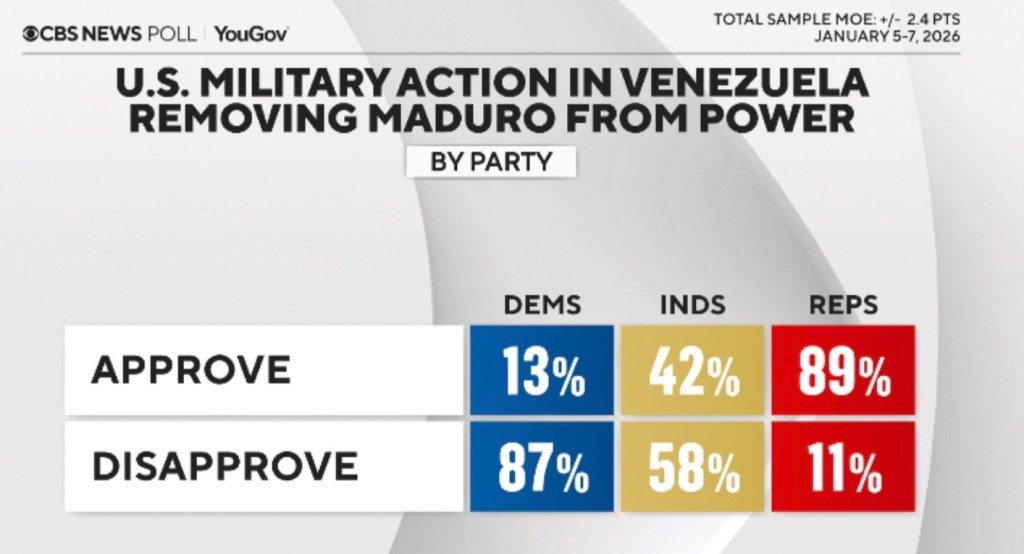
It appears that the administration did indeed ignore today’s deadline for congressional approval of the ongoing strikes against Venezuela, required under the 1973 War Powers Act. It is taking the position that no approval is necessary since, in its formulation, U.S. military personnel are not at risk in the strikes that have, so far, killed 65 people.

Notes:

Bluesky:

acyn.bsky.social/post/3m4qdgkqed22n

atrupar.com/post/3m4domocjc72x

atrupar.com/post/3m4b632yykk2i

ronfilipkowski.bsky.social/post/3m3um25txms2t

atrupar.com/post/3m3pkxrl5js2e

atrupar.com/post/3m4qdxzawp22v

muellershewrote.com/post/3m3n4v5ryak2l

joshtpm.bsky.social/post/3m4qrclpi4s2i

acyn.bsky.social/post/3m4rlvxp5el2l

Glenn Kessler continues to report on Trump’s lies. Recently, he demonstrated how Trump’s staff has filled the website with vicious partisan attacks, demeaning every Democratic President.

He writes:

Every White House puts its own spin on the official website. Trump 2.0 is pretty full of itself, even by White House standards, declaring “AMERICA IS BACK’ on the landing page.

But now the official historical timeline is corrupted, with partisan sections that could have been written by social media trolls. Check out the various elements added to the history of the White House as part of an effort to defend Trump’s destruction of the East Wing for a ballroom.

After straightforward accounts of the construction of the White House and various additions to the White House complex, this suddenly appears.

Yes, this happened. Presumably its inclusion is justified by the reference of “Oval Office trysts.” But it’s pretty jarring.

This is just stupid — and false.

Obama himself did not meet with Muslim Brotherhood officials. In the aftermath of the Arab Spring, White House staffers met in April 2012 with a delegation after the Muslim Brotherhood became a political force in Egypt, following President Hosni Mubarak’s resignation in the face of mass protests. Mohamed Morsi, a former Brotherhood leader, was elected president in June 2012. (A year later, he was ousted in a coup.)

The photo of Obama is especially trollish. The image is not from Obama’s presidency. In 2006, as a senator, he visited Kenya and wore a Somali white turban and a wraparound white robe presented to him by elders in Wajir, in northeastern Kenya.

This is also false. There is no evidence tying Hunter Biden to the plastic bag containing cocaine found in the White House entrance lobby. The “speculation” was fanned by then-candidate Donald Trump. Hunter was not near the complex in the period in question and by all accounts had been sober and drug-free since June 2019. The Secret Service never identified a culprit.

False again! Joe Biden did not schedule Trans Day of Visibility on Easter. It always falls on March 31 — and in 2024, that happened to coincide with Easter. Biden first marked the occasion in 2021. As for Rose Montoya, a trans model and activist who exposed herself during a Pride celebation, the Biden White House said she had been banned from future events after the incident.

Add to all this misinformation a spurious claim that Obama demolished significant parts of the White House in order to build a basketball court. Snopes rated this claim FALSE.

Glenn Kessler, recently retired as the Washington Post’s fact checker, has his own blog at Substack. He now dedicates his time to fact-checking Trump’s lies. That’s a full-time job.

He writes about a forgotten episode in Trump’s past that foreshadows his demolition of the East Wing of the White House and his demolition of foreign aid and entire departments:

Donald Trump’s dismantling of parts of the White House’s East Wing to make way for a gargantuan $250 million ballroom — without any forethought or architectural approvals — has been cited by critics as a metaphor for what he is doing to American democracy.

To me, Trump’s second-term approach to governing has its roots in a similarly shocking display of developer hubris — his destruction, 45 years ago, of the Bonwit Teller limestone bas-relief sculptures of two nearly naked women to make way for Trump Tower.

After Trump, 33 at the time, purchased the bankrupt retailer’s 11-story building, he promised to donate the 15-foot-high Art Deco sculptures to the Metropolitan Museum of Art. He also agreed to donate a six-by-nine-meter, geometric-patterned bronze latticework that hung over the entrance.

But then one day, he woke up and decided he would break his promise.

He ordered crews to separate the architectural treasures from the walls with jackhammers and break them off with crowbars. The friezes, located near the top of the building, were thrown down by workers, shattering them to bits. The latticework was removed with blow torches and mysteriously went missing.

By the time New Yorkers realized what was happening, the deed was done — and that was that.

I couldn’t stop thinking about the Bonwit Teller friezes when the U.S. Agency for International Development — a lifeline for many countries in the Global South — was dismantled earlier this year in the blink of an eye.

Trump knew that by the time the lawsuits wended their way through the courts, it would be too late to rebuild USAID, Voice of America and so many other agencies that he’s destroyed.

They’ve been broken down into a million pieces, just like the Bonwit Teller sculptures.

In 1980, The New York Times put the news of Trump’s betrayal on the front page, under the headline: “Developer Scraps Bonwit Sculptures.” (Trump was not yet famous.)

The story has all the earmarks of a classic Trump tale.

First, the shock: “The destruction of the Art Deco panels stunned some art appraisers and elicited expressions of surprise and disappointment from officials of the Met, where they were to have been installed by the department of 20th-century art. One appraiser placed their value at several hundred thousand dollars.”

Then the spin: “John Baron, a vice president of the Trump Organization, said after the demolition yesterday that the company had decided not to preserve the sculptures because ‘the merit of these stones was not great enough to justify the effort to save them.’ Mr. Baron said the company had got three independent appraisals of the sculptures. These, he said, had found them to be ‘without artistic merit’ and worth less than $9,000 in ‘resale value.’ He said it would have cost $32,000 to remove them carefully and would have delayed demolition work by a week and a half and perhaps longer because of the need for cranes and municipal permits.”

We now know that “Baron” was none other than Trump himself — and that the numbers and appraisals were entirely fabricated.

Next, the shock at the spin: Ashton Hawkins, vice president and secretary of the Met’s board of trustees, was flabbergasted by the claims. “Can you imagine the museum accepting them if they were not of artistic merit?” he asked.

Preservation News reported that Robert Miller, an art dealer with a gallery across from Bonwit Teller, estimated the sculptures were worth $200,000 —or $800,000 in today’s dollars — and that “they could have been safely removed in little time.”

Finally, the Trump double-down: After days of controversy, Trump stopped hiding behind his faux spokesman and offered reporters an even more ridiculous figure. He asserted removal of the sculptures would have cost more than $500,000 in taxes, demolition delays and other expenses. The figure, conveniently, was higher than the reported valuation of the sculptures in news reports.

On top of that, Trump claimed he was motivated by his concern for “the safety of people on the street below…If one of those stones had slipped, people could have been killed. To me, it would not have been worth that kind of risk.”

Somehow, that concern didn’t apply when workers were ordered to hurl the frieze fragments down from the eleventh floor.
Almost half a century has passed. We’re still watching the same movie.