Archives for category: Librarians

NBC reports that North Dakota may impose a ban on sexually explicit books, especially those that refer to gender identity, on public libraries. Librarians who ignore the proposed ban will be subject to 30 days in jail. Since the bill was introduced by the House Majority Leader, it may pass.

Books containing “sexually explicit” content — including depictions of sexual or gender identity — would be banned from North Dakota public libraries under legislation that state lawmakers began considering Tuesday.

The GOP-dominated state House Judiciary Committee heard arguments but did not take a vote on the measure, which applies to visual depictions of “sexually explicit” content and proposes up to 30 days imprisonment for librarians who refuse to remove the offending books….

Library Director Christine Kujawa at Bismarck Veterans Memorial Public Library said the library has a book with two little hamsters on the cover. At the end of the book, the hamsters get married, and they are both male.

“It’s a cute book,” Kujawa said — but it would be considered pornography under the bill because the book includes gender identity.

Facing criminal charges for keeping books on shelves is “something I never thought I would have to consider during my career as a librarian,” Kujawa added.

In addition to banning depictions of “sexual identity” and “gender identity,” the measure specifies 10 other things that library books cannot visually depict, including “sexual intercourse,” “sexual preference” and “sexual perversion,” — though it does not define any of those terms. The proposal does not apply to books that have “serious artistic significance” or “materials used in science courses,” among other exceptions.

Thanks to Christine Langhoff for suggesting this article.

David C. Berliner is one of the most honored researchers in the field of education.

He sent the following reflections on censorship. His thoughts reflect my views about censorship and abortion. If you are opposed to certain books, don’t read them. If you oppose abortion, don’t have one. Don’t impose your views on others.

Dr. Berliner wrote:


I was asked some time ago to write about censorship for the Horace Mann League. My explorations of the topic led me first to a personal statement:

“It is the right of people to not listen to, and not read, anything they find offensive. But this right is limited: it does not give them the right to limit what others choose to hear or read. It gives concerned citizens absolutely no right to forbid anyone else to listen to or read what they choose.

The only exception to this statement is with one’s own children. Parents do have both a right, and an obligation, to react to what their children are listening to and reading.

But that right and obligation is limited to their own children—not mine! I will make such decisions for myself. And I happen to trust school teachers, and librarians, to act for me, to act in “locus parentis.”

And I hope that every librarian and teacher is thoughtful enough to remember that merely avoiding certain discussions is itself a form of censorship!”

David C. Berliner

Some of the thoughts of others that I thought worth thinking about follow:

“The real heroes [in our society] are the librarians and teachers who at no small risk to themselves refuse to lie down and play dead for censors.”
― Bruce Coville

“What is freedom of expression? Without the freedom to offend, it ceases to exist.”
― Salman Rushdie

“There are worse crimes than burning books. One of them is not reading them.”
― Joseph Brodsky

“Free societies…are societies in motion, and with motion comes tension, dissent, friction. Free people strike sparks, and those sparks are the best evidence of freedom’s existence.”
― Salman Rushdie

“Everyone has the right to freedom of opinion and expression; this right includes freedom to hold opinions without interference and to seek, receive and impart information and ideas through any media and regardless of frontiers.”
― United Nations, Universal Declaration of Human Rights

“Censorship, like charity, should begin at home; but unlike charity, it should end there.”
― Clare Luce Booth

“Don’t join the book burners. Don’t think you’re going to conceal faults by concealing evidence that they ever existed. Don’t be afraid to go in your library and read every book…”
― Dwight D. Eisenhower

“If all printers were determined not to print anything till they were sure it would offend nobody, there would be very little printed.”
― Benjamin Franklin

“Censorship is telling a man he can’t have a steak just because a baby can’t chew it.”
― Mark Twain

[I]t’s not just the books under fire now that worry me. It is the books that will never be written. The books that will never be read. And all due to the fear of censorship. As always, young readers will be the real losers.”
― Judy Blume

“Books cannot be killed by fire. People die, but books never die. No man and no force can abolish memory… In this war, we know, books are weapons. And it is a part of your dedication always to make them weapons for man’s freedom.”
― Franklin D. Roosevelt

“If you can’t say “Fuck” you can’t say, “Fuck the government.”
― Lenny Bruce

“Censorship is the child of fear and the father of ignorance.”
― Laurie Halse Anderson

“All censorships exist to prevent anyone from challenging current conceptions and existing institutions. All progress is initiated by challenging current conceptions, and executed by supplanting existing institutions. Consequently, the first condition of progress is the removal of censorship.”
― George Bernard Shaw, Mrs. Warren’s Profession

“[Public] libraries should be open to all—except the censor.
[Response to questionnaire in Saturday Review, October 29 1960]”
― John F. Kennedy

I

“Only the nonreader fears books. ”
― Richard Peck

“Censorship of anything, at any time, in any place, on whatever pretense, has always been and always will be the last resort of the boob and the bigot.”
― Eugene Gladstone O’Neill

“If there’s one American belief I hold above all others, it’s that those who would set themselves up in judgment on matters of what is “right” and what is “best” should be given no rest; that they should have to defend their behavior most stringently. … As a nation, we’ve been through too many fights to preserve our rights of free thought to let them go just because some prude with a highlighter doesn’t approve of them.”
[Bangor Daily News, Guest Column of March 20, 1992]”
― Stephen King

“When the Washington Post telephoned me at home on Valentine’s Day 1989 to ask my opinion about the Ayatollah Khomeini’s fatwah, I felt at once that here was something that completely committed me. It was, if I can phrase it like this, a matter of everything I hated versus everything I loved. In the hate column: dictatorship, religion, stupidity, demagogy, censorship, bullying, and intimidation. In the love column: literature, irony, humor, the individual, and the defense of free expression. Plus, of course, friendship—though I like to think that my reaction would have been the same if I hadn’t known Salman at all. To re-state the premise of the argument again: the theocratic head of a foreign despotism offers money in his own name in order to suborn the murder of a civilian citizen of another country, for the offense of writing a work of fiction. No more root-and-branch challenge to the values of the Enlightenment (on the bicentennial of the fall of the Bastille) or to the First Amendment to the Constitution, could be imagined. President George H.W. Bush, when asked to comment, could only say grudgingly that, as far as he could see, no American interests were involved…”
― Christopher Hitchens,

“The important task of literature is to free man, not to censor him, and that is why Puritanism was the most destructive and evil force which ever oppressed people and their literature: it created hypocrisy, perversion, fears, sterility.”
― Anaïs Nin, The Diary of Anaïs Nin, Vol. 4: 1944-1947

“Every burned book or house enlightens the world; every suppressed or expunged word reverberates through the earth from side to side.”
― Ralph Waldo Emerson, Essays: First Series

“Fear of corrupting the mind of the younger generation is the loftiest form of cowardice.”
― Holbrook Jackson

“Censors never go after books unless kids already like them. I don’t even think they know to go after books until they know that children are interested in reading this book, therefore there must be something in it that’s wrong.”
― Judy Blume

“The fact is that censorship always defeats its own purpose, for it creates, in the end, the kind of society that is incapable of exercising real discretion. In the long run it will create a generation incapable of appreciating the difference between independence of thought and subservience.”
― Henry Steele Commager

“Our freedoms are vanishing. If you do not get active to take a stand now against all that is wrong while we still can, then maybe one of your children may elect to do so in the future, when it will be far more riskier — and much, much harder.”
― Suzy Kassem

“I also hold very strong personal convictions about censorship. I don’t believe in forbidden knowledge.”
― Andrea Cremer
Political battles over book are heating up in Missouri. This seems to be the right time to ban books like 1984, The Handmaid’s Tale, and Slaughterhouse Five. Will Fahrenheit 451 be banned too? Why is it missing?

The Missouri law on banning books was enacted in August. Missouri law 775 sets the guidelines, starting on page 51. The law prohibits books with visual representations of sexual activity a.k.a. pornography. It is a very specific definition.

Legislators visual representations only (not “art” or “anthropological”). They lost the CRT battle and needed something like this in law. They avoided the battle over the written word and content, just pictures. Graphic novels took the hit. Teachers and any school adult can be charged for distributing a censored book.

The conservative strategy is get the door open for book banning and then it will swing wide open to written word and content this year.

Below are four articles – St. Louis Post Dispatch (with lists) and KC Star

Of course, there were no guidelines from the State.

Sept 27 https://www.stltoday.com/news/local/education/kirkwood-parents-speak-out-against-book-bans/article_2c3dc6bd-2dd2-58a9-9d4c-30d48ec81e1a.html

KIRKWOOD — About 15 parents and students spoke out Monday against the Kirkwood School District’s recent book bans, including a comic book adaptation of George Orwell’s “1984,” the cautionary tale about government mind control.

At least 114 book bans have been enacted in schools across St. Louis this fall in response to a new state law prohibiting “explicit sexual material” — defined as any visual depiction of sex acts or genitalia, with exceptions for artistic or scientific significance — provided to students in public or private schools.

Sept 25    https://www.stltoday.com/news/local/education/suburban-school-districts-in-st-louis-area-more-likely-to-ban-books-under-new-law/article_db89ae4d-f559-56e7-929a-8b1af4c374d5.html#tracking-source=in-article   

‘Handmaid’s Tale,’ ‘Slaughterhouse-Five’: KC area schools now ban these books and more BY SARAH RITTER UPDATED OCTOBER 03, 2022 9:39 AM

https://www.kansascity.com/news/local/education/article266556371.html#storylink=cpy

ST. LOUIS — The 97 books banned in schools across St. Louis this fall cover topics like anatomy, photography and the Holocaust. There are books that are also popular TV series, including “Game of Thrones,” “The Handmaid’s Tale,” “The Walking Dead” and “Watchmen.”

And as life imitates art, Kirkwood School District banned a comic book adaptation of George Orwell’s “1984,” the cautionary tale about government mind control.

Aug 25  https://www.stltoday.com/news/local/education/blythe-bernhard-on-the-new-state-law-impacting-school-librarians-inside-the-post-dispatch/article_5e824824-818a-5706-96fd-9306231e7664.html#tracking-source=in-article

JEFFERSON CITY — With a new crop of hard-right Republicans expected to join the Missouri Senate, some Democrats are worried that the upper chamber’s priorities will swing more to the right in the next legislative session.

Conservative wish list items such as bans on transgender student athletes and legislation that targets school curriculum have failed to pass in previous years amid infighting among Republicans. But Senate Democrats say those policies could have enough momentum in the coming years with more hard-right members joining the upper chamber.

For months now, a handful of books dealing with LGBTQ themes have been targeted by Kansas City area conservative parent groups and politicians.

Conservative groups have demanded the removal of books on LGBTQ themes from public school libraries, but the censorship is expanding to other titles that someone finds objectionable. The Handmaid’s Tale, for example, has no LGBTQ content. It’s about a dystopian society in which women have no rights. But it’s being pulled from library shelves, and librarians are facing stiff fines if they defy the law.

But facing a new Missouri law, some schools have now removed a much wider array of books from library shelves, including “Slaughterhouse-Five,” “Watchmen” and “The Handmaid’s Tale.”

The law, which bans sexually explicit material from schools and went into effect in late August, is tucked into a larger bill addressing sexual assault survivors’ rights. Librarians or other school employees who violate the law could be charged with a misdemeanor, risking up to a year in jail or a $2,000 fine.

In response, several school libraries have pulled at least 20 book titles in districts on the Missouri side of the Kansas City metro, according to reports provided to The Star through open records requests.

The legislation specifically prohibits images in school materials that could be considered sexually explicit, such as depictions of genitals or sex acts. As a result, most of the banned books are graphic novels. The law does provide some exceptions, such as for works of art or science textbooks.

Proponents argue the legislation will protect children from inappropriate content and indoctrination. “In schools all across the country, we’ve seen this disgusting and inappropriate content making its way into our classrooms,” state Sen. Rick Brattin, R-Harrisonville, said in a statement after the legislation passed. “Instead of recognizing this as the threat it is, some schools are actually fighting parents to protect this filth. The last place our children should be seeing pornography is in our schools.”

But others warn that such bans violate students’ First Amendment rights and mainly target books that feature LGBTQ relationships, people of color and diverse viewpoints.

“You don’t see people trying to ban any books that are on the far conservative end. So I think at this point, what we’re seeing is a kind of protracted political strategy,” said Joe Kohlburn, chair of the Missouri Library Association’s Intellectual Freedom Committee. “It feels very targeted to folks who identify as LGBTQ, or (people of color) or women. If you see your library is removing ‘Handmaid’s Tale,’ that tells you something very specific. And I don’t think that’s an accident.”

Before the bill’s passage, conservative politicians, action committees and parent groups in the Kansas City metro spearheaded challenges to school library books, mostly featuring racially diverse or LGBTQ characters. It’s a trend seen across the country, with the American Library Association reporting that the number of attempts to ban or restrict books this year is on track to exceed last year’s total, which was the highest in decades.

Librarians have raised concerns over harassment, with some questioning whether to stay in their jobs. Tom Bastian, with the American Civil Liberties Union of Missouri, called the book challenges an attempt to “whitewash viewpoints and perspectives of historically marginalized communities.”

Read more at: https://www.kansascity.com/news/local/education/article266556371.html#storylink=cpy

Nancy Flanagan taught music for many years in Michigan. She draws on her deep experience in this post to set the record straight about what parents really want from their schools.

Extremist groups funded by rightwing autocrats claim to speak for parents, but they use their platform to spread propaganda and lies. They say they speak for “parental rights,” but they spread fear, distrust and lies.

John Gibbs, the Republican candidate for Congress in western Michigan, said that:

Folks, did you ever think that one day in America, we’d have to worry about schools putting obscene books in their libraries? This is simply insane–we must stop the madness. Voters overwhelmingly oppose sexually explicit books in public school libraries.

Flanagan answers Gibbs:

Well—folks. I’m not worried about obscene or sexually explicit books in public school libraries. Because there is no madness, no insanity, no pornography in school libraries.

Teachers and school leaders also overwhelmingly oppose sexually explicit books in school libraries. The word we use is ‘inappropriate’—materials are selected by trained school media specialists, who know inappropriate when they see it.

The entire slate of MI Republicans running for statewide or national office, not just Gibbs, is hell-bent on insisting that schools have become (in the past two years) hotbeds of sexual orientation and gender identity transformation, not to mention racial tension and guilt-inducement. They are led in this effort by the Republican candidate for Governor, Tudor Dixon.

Gibbs goes on to say, on behalf of Republican candidate for Governor in Michigan, Tudor Dixon:

What Tudor wants to accomplish is very simple and common sense. She wants to get radical sex and gender theory out of our schools, remove classroom instruction of sexual orientation and gender identity for grades K-3, make sure gender specific sports remain gender specific given biological differences in boys vs. girls and post all curriculum online for parents to see and be involved in their child’s education. Every child deserves a world class education and parents should be in charge of it.

Flanagan answers:

So let’s break this down.

Radical sex and gender theory? (Not a part of the curriculum in any school I’ve been in.)

Classroom instruction on sexual orientation or gender identity for the littles? (Likewise—nope, nope.)

Gender specific sports? (The Michigan High School Athletic Association has a policy adopted in 2012 that determines post-season tournament eligibility for transgender athletes on a case-by-case basis. The group received and approved 10 applications in the past five years—so this is hardly a burning statewide issue.)

Post all curriculum online? (Sure. Most districts post their standards framework—what gets taught, when– and public high schools in Michigan have adapted the Michigan Merit Curriculum.)

Every child deserves a world class education and parents should be in charge of it. (Right out of the Glenn Youngkin playbook, a statement like this, which is mostly true, really resonates.)

But here’s the truth (from 32 years of classroom experience): What bubbles up in classroom discussions and playgrounds is what’s on the minds of the kids in that classroom. This starts early, in Tudor Dixon’s forbidden zone, grades K-3—like this story about the boy who chose a ‘Frozen’ backpack.

Kids are curious and they’re paying attention to what their parents and their screens (and their friends, and their older siblings) are telling them. I taught music and math, two subjects you’d think were pretty straightforward and controversy-free, but can testify that anytime you get a cluster of kids together, provocative issues emerge.

Please open the link and read the rest of this common sense, informed commentary. Parents are not fooled by this fear mingering. They know their children’s teachers, and they trust them.

The voters of Jamestown Township in Michigan voted to defund their library because it contained books with a LGBT theme. The library needed to raise $245,000 to keep its doors open for another year. Many donations arrived but the biggest surprise was a $50,000 check from Nora Robert, a fabulously successful romance novelist. She sent a check for $50,000, which put the library over the top in their goal. The library has more books by Roberts than books about gay themes. She has written more than 225 books and sold more than 500 million books.

It could make a great final chapter of a book: A doomed library is saved by the small checks of book lovers, and one huge donation from an internationally known author whose novels are among the most popular on the library’s shelves.

Romance novelist Nora Roberts donated $50,000 Sunday to help keep the doors open at a Michigan library that was defunded in early August in a spat over LGBTQ-themed books.

The famous author’s donation pushed the cumulative total raised by two GoFundMe campaigns over $245,000, the amount the Patmos Library was expected to lose in 2023 because of the loss of taxpayer funding in Jamestown Township, in Ottawa County. The outpouring of donations followed Bridge Michigan’s account of the taxpayer revolt.

In a comment left Sunday on the GoFundMe page which she contributed to, Roberts wrote that she would have donated more, but “50k is the limit GoFundMe allows for donations. If you’re short of your goal, please contact me. I’ll make up the rest.”

Donations made so far by more than 4,000 people from as far away as Australia should be enough to pay utilities and staff salaries at least into 2024..

On Aug. 2, an operating millage to support the township library was defeated 62 percent to 37 percent. That millage — a tax on property owners — provides 84 percent of the Patmos Library’s annual budget. Without the $245,000 that millage provides annually, the library was expected to have to close by the fall of 2023.

A “vote no” campaign was organized by community members upset by LGBTQ-themed graphic novels in the library. One, “Gender Queer: A Memoir,” is the story of the author’s coming of age as nonbinary, and includes illustrations of sex acts. Several other books community members protested against, including “Kiss Number 8” and “Spinning,” are stories of teens in same-sex relationships, but do not include illustrations of sex acts.

.

I wrote recently about Amanda Jones, the librarian in Louisiana who is fighting back against censorship and harassment in court.

One of our regular readers said she belongs on the honor roll of this blog. He’s right.

Amanda Jones joins the honor roll for her courage and integrity in fighting censorship!

Her GoFundMe page is raising money for her legal defense. Consider helping her fight for free thought!

In Louisiana, a middle school librarian has said. “Enough is enough.” She is standing up and fighting against the vigilantes who have targeted school libraries.

Amanda Jones has filed a lawsuit against two men who have harassed her and other librarians.

Amanda Jones, a librarian at a middle school in Denham Springs, Louisiana, filed a defamation lawsuit Wednesday, arguing that Facebook pages run by Michael Lunsford and Ryan Thames falsely labeled her a pedophile who wants to teach 11-year-olds about anal sex.

Jones, the president of the Louisiana Association of School Librarians, was alarmed and outraged by the verbal attacks, which came after she spoke against censorship at a Livingston Parish Library Board of Control meeting. She said she’s suing the two men because she’s exhausted with the insults hurled at educators and librarians over LGBTQ materials.

“I’ve had enough for everybody,” Jones said in an interview. “Nobody stands up to these people. They just say what they want and there are no repercussions and they ruin people’s reputations and there’s no consequences.”

Lunsford did not respond to requests for comment. Thames declined to comment.

Nationwide, school districts have been bombarded by conservative activists and parents over the past year demanding that books with sexual references or that discuss racial conflict, often by authors of color or those who are LGBTQ, be purged from campuses. Those demands have slowly moved toward public libraries in recent months.

Thank you, Amanda Jones!

Ruth Ben-Ghiat writes a post on her blog about threats to democracy. One of this is described in this post: the threats to libraries and librarians by extremists who want to ban books.

This essay is dedicated to librarians and library staff across America, and to a family member who worked as a library clerk in an elementary school for many years.

“It felt like a knife in my heart,” said Audrey Wilson-Youngblood, a Texas library services coordinator, of the flood of accusations from parents that she and other library staff in the Keller Independent School District harmed students by having books on LGBTQ themes in their collections.

Across the country, librarians in school and municipal libraries feel that knife being turned. Activist parents, sometimes working in conjunction with GOP politicians or right-wing groups such as Moms for Liberty, are waging an authoritarian-style assault on libraries and librarians.

When illiberal forces are on the march, the education system and any public institution that encourages independent thinking and pluralism become targets. In Texas and elsewhere, the spread of censorship, and harassment meant to silence library workers –including by labeling them as pedophiles — models the authoritarian culture the right is trying to install in America school by school and town by town.

It’s not surprising that libraries and librarians trigger the enemies of our democracy. Public libraries are places where community members of all backgrounds, political beliefs, and economic situations gather, and where elderly and lonely people can find a sense of companionship. This is why social scientists single out libraries as antidotes to the conditions that harm civic life and ultimately degrade democracy: political polarization, disinformation, economic inequality, and isolation.

School and public libraries also have long provided refuge to people of all ages with difficult home situations, and librarians can become trusted mentors and guides.

My weekly visits as a child to my own town library set me on a path of learning. The library also became a personal anchor for me when I went through a difficult period as a teenager, to the point where I took a job there as a messenger clerk, as did a close friend (who is now a member of the Lucid community).

Shelving and straightening the books, and seeing how they were treated with such care, instilled a lifelong respect for the craft of writing and a commitment to intellectual freedom that sustain me today. As my friend notes, the library was “a safe space to think and dream.”

Of course, thinking and dreaming are activities that run counter to authoritarianism: “Believe, Obey, and Fight” was the Fascist slogan. Books become threatening objects, as centuries of bookburnings by repressive political and religious entities attest.

In the US, myriad state laws and book bans seek to remove the history of White racism, slavery, and Fascist genocides from view, along with writings about LGBTQ identities and experiences. In the Keller, Texas, school system alone, as of March almost three dozen books had been sent for review by a district-formed book committee on the grounds that they are “pornographic” or will create “emotional distress.”

Florida Governor Ron DeSantis, an expert in authoritarian double-speak, calls his version of such censorship “curriculum transparency.” Yet there is nothing transparent about the process by which books are removed. As Carolyn Foote, a retired Texas librarian and co-founder of the advocacy group FReadom Fighters notes, these aggressions are about “breaking that contract of trust” between librarians and the public and degrading professional ethics.

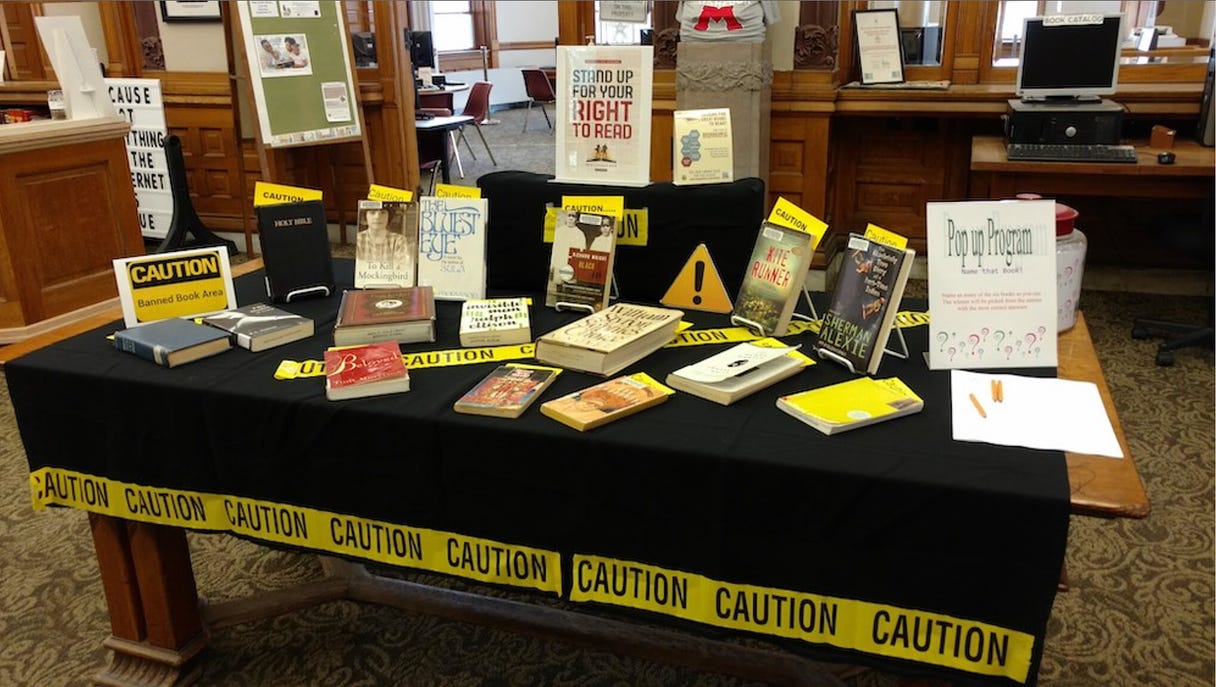
A display protesting book bans and restrictions at a local library. Charles Hickley/CC BY 2.0

The goal is not just to create a hostile work environment for library staff, but also to pressure administrators to submit to corrupt tactics such as banning books on spurious grounds and accepting slanderous speech used against their colleagues.

For right-wing parents and politicians aren’t just going after books. They are also personally attacking library employees as “groomers” who encourage inappropriate behaviors and relationships with children.

Associating LGBTQ individuals and their allies with pedophilia is an established strategy among the global right, including in Viktor Orban’s Hungary. And Vladimir Putin uses fake sex-crime charges to imprison researchers who are writing about things he wants buried.

Ideological fanaticism spurs attempts to dig into librarians’ private lives and harass them so they will resign. In Virginia Beach, GOP state representative Tim Anderson filed a FOIA Act request in May 2022 to learn the identities of librarians at schools that had materials some parents saw as sexually explicit.

It also lies behind attempts to criminalizelibrarians. In Clinton Township, NJ, the police department received a request for criminal charges to be made against librarians whose institutions had books with “obscene” content. And some states are challenging laws that shield teachers, researchers and librarians from prosecution. An Oklahoma law removed exemptions for teachers and librarians “from prosecution for willful violations of state law prohibiting indecent exposure to obscene material or child pornography.”

Unsurprisingly, many librarians have left their jobs. Some have resigned, others have been fired for refusing to remove books from their collections. Wilson-Youngblood, a 19-year veteran of the Keller school district, resigned due to the stress of working in a hostile environment. In small towns such as Vinton, Iowa, the library itself has had to close for lack of staffing.

Vinton’s fate may portend the future, since the number of groups targeted for censorship is bound to expand. In Vinton, right-wing activists not only objected to the presence of LGBTQ staff and LGBTQ-themed books, but displays of books by Vice President Kamala Harris and First Lady Jill Biden. For radicalized Republicans, Democrats are not just people with different opinions, but political enemies whose ideas should be banned.

Luckily, the digitization of books makes it hard for total bans on content for children to stick. The Brooklyn Public Library’s Books UnBannedprogram offers a free library card to people aged 13 to 21 across the U.S. so they can check out books digitally.

Yet libraries and librarians urgently need our support. Contacting your town or school administration to express solidarity and approval with current policies is one way you can push back. Another is to step up as a volunteer or even run for office on a town or school board that has oversight on library issues.

What Amanda Litman, executive director and co-founder of Run For Something, said about school boards in our interview is also true of libraries. They play “a foundational role in determining the kinds of citizens that kids ultimately become.” Libraries, and librarians, are essential to a healthy democratic society.

The Wall Street Journal, owned by billionaire RupertMurdoch (who also owns Fox News), runs a steady diet of anti-public school editorials. Sometimes they bash public schools. Sometimes they praise charter schools and vouchers. Sometimes they do all of this in the same editorial. While an opinion piece that expresses a dissenting opinion occasionally gets published, it’s fair to say that the WSJ does not like public schools. In my last book, Slaying Goliath, I praised retired Austin librarian Sara Stevenson for responding to every WSJ vilification of public schools.

Peter Greene responded to the opinion piece by law professor Philip Hamburger, who claimed that public schools are not “constitutional” because they suppress parents’ freedom of speech, that is, their ability to ensure that their children hear, read, and learn only what their parents want them to learn.

Greene begins:

Last Friday, the Wall Street Journal (Fox News’ upscale sibling) published an op-ed from Philip Hamburger, a Columbia law professor and head of the New Civil Liberties Alliance, a Koch-funded pro bono firm that takes cases primarily to defend against the “administrative state.” It’s a hit job on public education with some pretty bold arguments, some of which are pretty insulting. But he sure says a lot of the quiet part out loud, and that makes this worth a look. Let me walk you through this. (Warning–it’s a little rambly, and you can skip to the last section if you want to get the basic layout)

Hamburger signals where he’s headed with the very first paragraph: The public school system weighs on parents. It burdens them not simply with poor teaching and discipline, but with political bias, hostility toward religion, and now even sexual and racial indoctrination. Schools often seek openly to shape the very identity of children. What can parents do about it?

Hamburger offers no particular evidence for any of this catalog of arguable points. Various surveys repeatedly show that the majority of parents approve of their child’s public school. The rest is a litany of conservative complaints with no particular evidence, but Hamburger needs the premise to power the rest of his argument.

So here comes Hamburger’s bold assertion:

Education is mostly speech, and parents have a constitutional right to choose the speech with which their children will be educated. They therefore cannot constitutionally be compelled, or even pressured, to make their children a captive audience for government indoctrination. Conservative talking points about public education routinely assert and assume that public education is a service provided to parents, rather than to the students or society at large. It’s case I’ve never seen them successfully make. At the same time, society’s stake in educated members is clear and the entire rationale behind having non-parent taxpayers help pay the cost of public education. In any other instance where the taxpayers subsidize a private individual’s purchase of goods or service (e.g. food stamps, housing), some conservatives say the social safety net is a Bad Thing, so it’s uncharacteristic for them to champion public education as, basically, a welfare program for parents when they want to dramatically reduce all other such programs to bathtub-drowning size (spoiler alert: they’d like to do that with public education, too).

But Hamburger has taken another step here, arguing that speech to children somehow belongs to their parents. It’s a bold notion–do parents somehow have a First Amendment right to control every sound that enters their children’s ears? Where are the children’s rights in this? Or does Hamburger’s argument (as some angry Twitter respondents claim) reduce children to chattel?

Hamburger follows his assertion with some arguments that don’t help. He argues that public education has always attempted to “homogenize and mold the identity of children,” which is a huge claim and, like much of his argument, assumes that schools somehow have the power to overwrite or erase everything that parents have inculcated at home. But then, for the whole argument currently raging, it’s necessary to paint public schools as huge threat in order to justify taking dramatic major action against them….

But “education is speech” is not the really bold part of his argument. That really bold part is where he goes on to say “therefor, parents should have total control over it.” I have so many questions. Should parents have total control over all speech directed at or in the vicinity of their children, including books, and so would I be violating a parent’s First Amendment rights if I gave their child an book for Christmas? And where are the child’s rights in this? Would this mean that a parent is allowed to lock their child in the basement in order to protect that parent’s First Amendment right to control what the child is exposed to?

Hamburger’s argument has implications that he doesn’t get into in his rush to get to “do away with them and give everyone vouchers.” The biggest perhaps is that he has made an argument that non-parent taxpayers should not have to subsidize an education system. I’m betting he’s not unaware of that.

Please open the link and read the rest of the article.

John Merrow has some good suggestions in this essay about the month of May and how to use it wisely and well:

May has been an educational ‘dead zone’ for years. Because of our national obsession with standardized test scores, teachers–particularly in low income areas–spend class time showing students how to guess at answers, giving practice tests, and even teaching children how to fill in bubbles for the standardized, multiple choice ‘bubble’ tests that await them. These activities come with a huge opportunity cost for students, because they are of no educational benefit whatsoever and probably set their learning back; for teachers, they are an insult to their profession. And school districts spend billions of dollars buying, administering, and grading the bubble tests required by their states and the federal government.

When I was reporting I occasionally heard people complaining–in song–about “the morbid, miserable month of May,” riffing off an old Stephen Foster tune, “The Merry, Merry Month of May.” As I recall, the expression surfaced in 2003 or 2004, which is when the unintended consequences of the 2001 federal “No Child Left Behind” law became apparent. Because NCLB penalized schools that didn’t achieve what it called ‘adequate yearly progress’ on standardized tests, many districts eliminated art, music, drama, journalism, and even recess in order to concentrate on ‘the basics.’

That’s when the month of May became a ‘morbid’ dead zone, educationally speaking.

I don’t remember where I first heard the expression. It might have been in the suburban North Carolina elementary school that held ‘pep rallies’ in advance of the upcoming state exams, or in Richmond, Virginia, where a veteran middle school teacher told me “Teaching and learning are done; now it’s all test prep.” Or perhaps it was the Chicago high school teacher who confessed that he vomited in his wastebasket when he saw his students’ scores, or the custodian in a Success Academy charter school in New York City who said he rinsed out classroom trash cans every night because students regularly threw up in them during testing. Another possibility is the Washington, DC, parent whose young son couldn’t sleep because his teacher said she’d get fired if they didn’t do well on the tests.

The good news is that May 2020 does not have to be ‘morbid,’ ‘miserable,’ or ‘malignant.’ Because schools are closed and state standardized testing has been cancelled, May is a blank slate–and an opportunity for us to make it ‘magical’ and ‘memorable.’

News reports indicate that many parents are unhappy in the role of ‘teacher at home.’ (They are also coming to realize just how hard it is to be an effective teacher!) Teachers are frustrated because nothing in their training prepared them for teaching remotely. And so, because the March-April experiment in ‘remote learning’ hasn’t been a rousing success and because May is a tabula rasa, let’s embrace ‘out of the box’ thinking. Stop thinking like educators whose jobs depend on high test scores. Think differently!

(An earlier blog post about librarians, swimming instructors, highway engineers, and gardeners is here.)

Imagine for a moment that you don’t have a captive audience (because right now you don’t). IE, think like a librarian. Public libraries are different from schools in one important way: they do not have required attendance. But even though no one is forced to attend the library, library usage continues to climb. To survive and prosper, librarians have had to identify their audiences and find ways to draw them into their buildings and electronic networks. For the most part, they’ve succeeded without pandering. That’s what’s called for in education at this moment.