On July 1, Steve Bannon will report to prison. His last best hope just evaporated. The Supreme Court rejected his appeal with one sentence. He was found guilty of contempt of Congress for refusing to testify to the January 6 Committee. Bannon will be in prison for four months.
Archives for category: Justice
I’m curious. Regarding the Georgia election case, where – exactly – is the Fanni Willis “conflict” that may have impaired, impinged or otherwise impacted the rights of those accused in that case?
The Associated Press reported this:
“A Fulton County grand jury in August indicted Trump and 18 others, accusing them of participating in a sprawling scheme to illegally try to overturn the 2020 presidential election in Georgia. Four defendants have pleaded guilty after reaching deals with prosecutors, but Trump and the others have pleaded not guilty…Trump and eight other defendants had tried to get Willis and her office removed from the case, arguing that a romantic relationship she had with special prosecutor Nathan Wade created a conflict of interest. McAfee in March found that no conflict of interest existed that should force Willis off the case, but he granted a request from Trump and the other defendants to seek an appeal of his ruling from the state Court of Appeals.”
So, again, what EXACTLY is the “conflict” that infringes on the rights of the accused in the Georgia, some of whom have already – in fact pleaded guilty.
CNN reported this:
“In March, after what amounted to a mini-trial where attorneys for Trump and his co-defendants sought to prove their case against Willis and Wade, McAfee found there was not enough evidence to firmly prove Willis financially benefited from the relationship.”
So, the prosecutors were put on trial and the judge found that there wasn’t evidence to say that Willis got some kind of financial favor from Wade. But even if she HAD, where is the “conflict” that harms the right of the accused?
The Washington Post put it like this:
“McAfee ruled that Trump and the others had ‘failed to meet their burden’ of proving Willis’s romantic relationship with special prosecutor Nathan Wade and allegations that she was financially enriched by trips the two took together were enough of a ‘conflict of interest’ to disqualify her from the case..
To put it differently, the “conflict” in this case was that Willis and Wade slept together and sometimes took trips together– they were “bad” — and thus that should disqualify them from the case. But, What. About. The. Case? What about the facts of the case? What about the specific charges and the charges to which others have pled guilty?
Sydney Powell – yes, her – pled guilty to “conspiracy to commit intentional interference with the performance of election duties.” She also agreed to help prosecutors in other cases.
Guess who was involved in the conspiracy and the other cases?
Kenneth Chesebro, charged with seven felony counts, pled guilty to “one felony count of conspiracy to commit filing false documents. ” False documents to be used to overturn the election results. Guess on whose behalf Chesebro filed those false documents? Chesebro agreed to cooperate with prosecutors in other cases too.
Trump attorney Jenna Ellis pleased guilty in Georgia “to a charge of aiding and abetting false statements and writings, a felony. She has already written an apology letter to the citizens of Georgia, and she agreed to cooperate fully with prosecutors as the case progresses.”
So, there’s a pattern here.
But where – exactly – is the “conflict” in the other cases? The cases of the ringleader Trump, and dirty trickster Mike Roman? The cases of Rudy Giuliani and John Eastman? Of Mark Meadows and Jeffrey Clark and the rest?
Meanwhile, the findings of fact in the Colorado court decision by Sarah Wallace that declared Trump an insurrectionist, which relied heavily on the January 6 Committee Report and included testimony by officers attacked in the January 6 riot, have gone unchallenged by any credible evidence, including that put forth by Trump or his attorneys. As noted in the decision,
“while Trump spent much time contesting potential biases of the Committee members and their staff, he spent almost no time attacking the credibility of the Committee’s findings themselves. The Hearing provided Trump with an opportunity to subject these findings to the adversarial process, and he chose not to do so, despite frequent complaints that the Committee investigation was not subject to such a process. Because Trump was unable to provide the Court with any credible evidence which would discredit the factual findings of the January 6th Report, the Court has difficulty understanding the argument that it should not consider its findings which are admissible under C.R.E. 803(8).”
The Colorado Supreme Court found that because Trump was – in fact – an insurrectionist, he could not be on the Colorado ballot because the United States Constitution explicitly prohibited it under Article 3 of the Fourteenth Amendment, which states that
“No person shall be a Senator or Representative in Congress, or elector of President and Vice-President, or hold any office, civil or military, under the United States, or under any State, who, having previously taken an oath, as a member of Congress, or as an officer of the United States, or as a member of any State legislature, or as an executive or judicial officer of any State, to support the Constitution of the United States, shall have engaged in insurrection or rebellion against the same, or given aid or comfort to the enemies thereof. But Congress may by a vote of two-thirds of each House, remove such disability.”
Seems pretty clear: “no person shall…hold any office, civil or military, under the Constitution who, having previously taken an oath, as a member of Congress, or as an officer of the United States…to support the Constitution of the United States, shall have engaged in insurrection or rebellion against the same…”
The United States Supreme Court ignored the findings of fact in the Colorado trial court and overturned the Colorado Supreme Court decision to take Trump off the ballot. The Court said “We conclude that States may disqualify persons holding or attempting to hold state office. But States have no power under the Constitution to enforce Section 3 with respect to federal offices, especially the Presidency.”
According former federal appellate judge Michael Lutting and constitutional scholar Lawrence Tribe, this was “a grave disservice to both the Constitution and the nation…Our highest court dramatically and dangerously betrayed its obligation to enforce what once was the Constitution’s safety net for America’s democracy.”
Three members of the Supreme Court were – in fact – appointed by a seditionist, an insurrectionist, who took lots of help from Russian intelligence agencies to win* the 2016 election, and tried to violently overturn the 2020 results. One other justice flies seditionist flags over his houses, and another has a wife who is an open seditionist.
It appears to me that the “conflicts” some people, mostly Republicans, are worried about are the absolutely entirely wrong conflicts.
Michelle Davis writes a blog called Lone Star Left, where she opines on the struggle to reverse the hold of fascists on the state of Texas. She previously reported on the state convention of the Texas GOP, which cherishes the “right to life” for fetuses but wants to impose the death penalty on women who seek or obtain an abortion. Women who want an abortion apparently have NO right to life.
In this post, Davis reports on the Texas Democratic Party platform, which is the polar opposite of the GOP. She loves it!
She writes:
Okay, we’re finally to it. The Texas Democratic Party Platform and the proposed changes went through the Platform Committee. The Texas Democratic Party (TDP) platform is a critical document that outlines the party’s values, principles, and policy goals. It serves as a roadmap for Democratic candidates and elected officials, providing a clear vision for the future of Texas. The platform reflects the collective voice of party members and sets the agenda for the party’s legislative priorities.
The platform also plays a significant role in mobilizing voters. It provides a comprehensive guide to what the Democratic Party stands for, making it easier for voters to understand its positions on critical issues. (Or at least that’s how it’s supposed to work.)
If you missed the previous articles about the TDP’s updated rules and resolutions:
- Key Rule Changes at the Texas Democratic Party’s 2024 Convention
- Equality, Inclusivity, And Justice: Inside the Texas Democratic Party’s Resolutions
Personally, I love the Texas Democratic Party Platform and have kept up with its evolution over the years. The previous platform is online, which you can see here:
Loving a party platform? That’s weird.
Earlier this week, I was mindlessly scrolling on TikTok, and I came across some dipshit from Los Angeles who has several hundred thousand followers; her video was all about how “both parties are the same,” and she was discouraging people from voting. The privileged position of living in a blue state, right?
People like this piss me off because NO Democrats and Republicans are not the same.
While the Republican Party of Texas debated giving women who have abortions the death penalty, this week, the Texas Democratic Party added a platform plank that says, “Restore the right of all Texans to make personal and responsible decisions about reproductive health.”
Republicans want unfettered end-stage capitalism with no healthcare, no public education, no Social Security, no Medicaid, and vast wealth inequality. Democrats want universal healthcare, well-funded public education, robust social safety nets, and economic equality.
The Texas Democratic Party platform is a testament to our commitment to creating a fairer, more just society for all Texans. Seeing such misinformation spread online is frustrating, especially when it can lead to voter apathy. However, our platform represents a clear and progressive vision for the future.
It’s a comprehensive document outlining our priorities for a better Texas. We must continue to show these differences between the blue and the red to counteract the cynicism and misinformation that is prevalent today.
What are some of the positive highlights?
Education:
The platform changes maintained the emphasis on protecting and improving Texas public education. They also retained strong language prohibiting school choice scams, such as using vouchers, including special education vouchers, and opposed these programs. The platform kept the requirement that every class have a teacher certified to teach that subject. It clarified that teachers should not be expected to provide financial support through classroom supplies and other essentials at their own expense.
Some of the planks I thought were good:
- Oppose discriminatory policies affecting special education funding. (It’s an ongoing problem in the Republican-led legislature.)
- Offer dual credit and early college programs that draw at-risk students into vocational, technical, and collegiate careers.
- Ensure all public school children are provided free school meals.
Higher education:
The TDP platform includes several favorable planks in higher education to make college more accessible and affordable. These include advocating for student loan debt relief, providing free college tuition for low-income qualified students, and offering paid internships and debt-free apprenticeship programs. Additionally, the platform supports eliminating standardized testing requirements like the SAT and ACT for college admissions.
Voting and elections:
The platform supports electronic voting systems that utilize paper backups and an auditable paper trail, ensuring election integrity. This particular plank led to some debate. While some supported it for ensuring election integrity, others were wary of potential vulnerabilities and preferred more traditional voting methods. Ultimately, it passed.
Another fundamental plank supported the establishment of a limit on campaign donations in Texas elections to ensure fairness and transparency. We badly need campaign finance reform in Texas. Democrats see this need and are taking it seriously.
They also supported establishing a code of judicial ethics for the Supreme Court of the United States and efforts to recalibrate the court by tying the number of justices to the number of federal circuit courts (13).
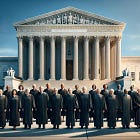
The Case For Expanding The Supreme Court
·FEB 14 Read full story
Healthcare:
If you missed my previous article, the Texas Democratic Party Resolution supports universal healthcare. This has also been part of their platform for several years. Unfortunately, we’re still fighting for basic healthcare access in Texas, so it’s a part of the Texas Democratic Party platform that doesn’t get enough attention.
Here are some (not all) other interesting planks added this year:
- Protect doctors and hospitals from politically motivated attacks that hinder them from providing the best care possible.
- Legalize and expand access to harm reduction supports such as fentanyl testing strips, Narcan, and safe syringe programs.
- Support policies that reduce pollution and protect clean air and water.
- Ensure that veterans have access to high-quality mental health services and support for substance use disorders.
Reproductive healthcare:
We all know what the GOP is doing. Besides restoring the right of Texans to make personal and responsible decisions about reproductive health, other new TDP platform planks include:
- Protect the right to access in vitro fertilization (IVF) treatment.
- Uphold the right to travel to another state for legal medical services.
- Offer comprehensive, age-appropriate sex education.
- Hold medical providers accountable for withholding information about a pregnancy based on their presumption that the pregnancy would be terminated.
- Safeguard reproductive health and gender-based care patient privacy, including protection from law enforcement.
The environment and climate.
Sometimes, I wonder if we spend enough time talking about this issue. It’s terrible right now, and the next several months could bring devastating weather.

Issues regarding the environment and climate change are life-threatening, and with Texas being the number one producer of greenhouse emissions in America, it’s an issue that Texans should take very seriously.
The new planks, which add to the TDP’s previous commitments to clean energy, address many of these concerns. Including supporting policies that develop clean energy resources, promoting alternative fuel vehicles, promoting more energy-efficient buildings and appliances, streamlining the permitting process for building new electric transmission lines, and adding charging stations for electric cars at all state highway rest stops.
Dawn Buckingham, the Texas Land Commissioner, and oil and gas shill has promised to fight the federal administration from connecting offshore windmills to Texas. However, the TDP platform supports federal legislation to share offshore wind lease and production revenues with Texas and other states, incentivizing state and local governments to facilitate successful siting processes and funding coastal infrastructure and flood resiliency projects.
They also emphasized creating and enforcing stringent state and federal regulations on oil and gas operations, including methane release monitoring and enforcement without exceptions.
All of these planks are fantastic, and maybe by the time the 2026 Convention rolls around, we’ll be ready to add support for legislation that holds fossil fuel companies responsible for climate change.
Criminal justice reform.
The TDP platform includes significant changes in the criminal justice reform plank, stressing a more humane approach to law enforcement. The platform proposes raising the minimum age of criminal responsibility from 10 to 13 years, ending the prosecution of juveniles in adult courts, and closing the remaining youth prison facilities while investing in community infrastructure to support children. Additionally, it aims to enforce the constitutional mandate against imprisoning individuals for debt, promote alternatives to incarceration for non-threatening offenses, and eliminate mandatory minimum sentences to allow for judicial discretion—notably, the platform advocates for abolishing the death penalty and instituting a moratorium on executions.
There is more. Open the link to finish her post.
What happens in Texas doesn’t stay in Texas. It spreads to other GOP extremists. Stay informed.
There is something about the MAGA movement that is corroding the moral and ethical standards of our country. Evidence occurred when two members of the Capitol Police who defended the U.S. Capitol on January 6, 2021, appeared before the Pennsylvania legislature recently. Some members of the GOP booed; some walked out.
What kind of lawmakers are they? Don’t they take an oath to defend the U.S. Constitution? Did they want the mob to seize the Capitol and take hostages? Did they want the mob to hang Mike Pence? Does the oath allow disgruntled people to try to overthrow the government?
No, this is what the Pennsylvania Constiturion says:
 "I do solemnly swear (or affirm) that I will support, obey
     and defend the Constitution of the United States and the
     Constitution of this Commonwealth and that I will discharge the
     duties of my office with fidelity."
The Washington Post reported:
Two former law enforcement officers who defended the U.S. Capitol from rioters during the Jan. 6, 2021, insurrection were jeered by state GOP lawmakers as they visited Pennsylvania’s House of Representatives on Wednesday, according to several Democratic lawmakers present.
Former U.S. Capitol Police officer Harry Dunn and former sergeant Aquilino Gonell were introduced on the floor Wednesday as “heroes” by House Speaker Joanna McClinton (D) for having “bravely defended democracy in the United States Capitol against rioters and insurrection on January 6.”
As the two men — both of whom were injured by rioters on Jan. 6 — were introduced, the House floor descended into chaos. According to Democratic lawmakers, several GOP lawmakers hissed and booed, with a number of Republicans walking out of the chamber in protest.
“I heard some hissing and I saw about eight to 10 of my Republican colleagues walk out angrily as they were announced as police officers from the U.S. Capitol on January 6,” state Rep. Arvind Venkat (D) said in a phone interview Thursday. “I was shocked and appalled,” he added. According to Venkat, the commotion lasted about five minutes. Fewer than 100 lawmakers, evenly divided between Republicans and Democrats, were present in the chamber before the chaotic scene unfolded, he said.
Stephen Colbert is a very funny guy. In his deadpan style, he cracks some good jokes about the conviction of Trump on 34 counts. Trump’s blaming the outcome on Joe Biden, but the decision to convict him was made by a dozen jurors, a jury of his peers. All the jurors were approved by Trump’s legal team.
Two years after the horrendous massacre of 19 students and two teachers at Robb Elementary School in Uvalde, Texas, the families are suing the corporations that fed the warped mind of the young man who perpetrated the murder. They hired the lawyer who successfully represented the Sandy Hook families and won a $73 million settlement for them.
SAN ANTONIO — The lawyer who won a record-setting settlement for Sandy Hook families announced two lawsuits Friday on behalf of Uvalde school shooting victims against the manufacturer of the AR-15-style weapon used in the attack, as well as the publisher of “Call of Duty” and the social media giant Meta.
The lawsuits against Daniel Defense, known for its high-end rifles; Activision, the manufacturer of first-person shooter game “Call of Duty”;” and Meta, the parent company of Facebook, may be the first of their kind to connect aggressive firearms marketing tactics on social media and gaming platforms to the actions of a mass shooter.
The complaints contend the three companies are responsible for “grooming” a generation of “socially vulnerable” young men radicalized to live out violent video game fantasies in the real world with easily accessible weapons of war.
The wrongful death suits were filed in Texas and California against Meta, Instagram’s parent company; Activision, the video game publisher; and Daniel Defense, a weapons company that manufactured the assault rifle used by the mass shooter in Uvalde. The filings came on the second anniversary of the shooting.
A press release sent on Friday by the law offices of Koskoff, Koskoff & Bieder PC and Guerra LLP said the lawsuits show that, over the past 15 years, the three companies have partnered in a “scheme that preys upon insecure, adolescent boys…”
The first lawsuit, filed in Los Angeles Superior Court, accuses Meta’s Instagram of giving gun manufacturers “an unsupervised channel to speak directly to minors, in their homes, at school, even in the middle of the night,” with only token oversight.
The complaint also alleges that Activision’s popular warfare game Call of Duty “creates a vividly realistic and addicting theater of violence in which teenage boys learn to kill with frightening skill and ease,” using real-life weapons as models for the game’s firearms.
[Salvador] Ramos played Call of Duty – which features, among other weapons, an assault-style rifle manufactured by Daniel Defense, according to the lawsuit – and visited Instagram obsessively, where Daniel Defense often advertised.
Thom Hartmann is convinced that We, the People, must find a way to restrict the Supreme Court’s devotion to the financial interests of the wealthiest Americans. There is a way, he writes, but note that it will require Democratic control of both houses of Congress. Another reason to vote and make sure your friends and family vote.
Hartmann writes in The Daily Kos:
Is there a way to reverse the decision by five Republicans on the Supreme Court that it’s OK for billionaires and big corporations to bribe politicians?
Americans are watching with increasing shock and dismay:
— President Biden tried to knock up to $20,000 off the debt of every person in the country with a student loan. Republicans decided this might somehow, someday mean fewer profits for banks — who financially support the GOP — so they sued at the Supreme Court. The Republican appointees on the Court, over the objections of the three Democratic appointees, killed the president’s effort without providing any cogent constitutional rationalization.
— Scientists have developed lab-grown meat that is healthier, easier on the planet, and, when manufactured at scale, cheaper than beef, pork, or chicken. The animal ag industry freaked out and threw a bunch of cash at Republican members of Congress, who are now trying to outlaw the product before the companies developing it can get to scale. Even the buggywhip makers back in the day didn’t think the way to protect their industry was to buy off politicians (of course that was before five corrupt Republicans on the Supreme Court legalized political bribery).
— Climate change is devastating our planet and fine particle emissions from trucks cause hundreds of thousands of deaths and illnesses from heart disease, COPD, asthma, and cancer every year. To solve the problem, the EPA put forward new truck emission standards that will phase in between 2027 and 2032. This week, twenty-seven Republican-controlled states whose politicians take money from the fossil fuel industry sued to block the rules and protect the profits of the trucking and petroleum industries.
— Title IX of the federal code, which forbids gender-based discrimination in education, is being extended by the Department of Education to protect members of the queer community. Rightwing Christian groups, which provide billions of dollars and millions of votes to Republicans, pinged state-level politicians, so now Texas, Louisiana, Alabama, Tennessee, and Oklahoma have filed suit before hand-picked rightwing judges to allow schools to legally trash LGBTQ+ students.
— The Consumer Finance Protection Bureau (CFPB) promulgated a new rule limiting credit card late fees to $8 each, protecting America’s most vulnerable families. The banks pulled the GOP’s chain and Republican senators Tim Scott, John Thune, John Barrasso, Jerry Moran, John Boozman, Steve Daines, Mike Rounds, Thom Tillis, Marsha Blackburn, Kevin Cramer, Mike Braun, Bill Hagerty, and Katie Britt introduced legislation to reverse the policy and allow banks to again screw low-income people.
— In 2003, George W. Bush signed legislation to privatize Medicare through the so-called Medicare Advantage scam, which last year overcharged our government more than $140 billion while denying millions of claims from Americans unfortunate enough to have signed up for it. Republicans on the take from the insurance industry are now pushing a plan to gut or even shut down real Medicare, leaving all seniors to the tender mercies of this predatory industry.
— Ultra-processed foods are accused of causing obesity, diabetes, cancer, and host of other illnesses both physical and mental: American children, who consume as much as two-thirds of their calories from these products, are experiencing an epidemic of obesity and diseases associated with it. With Republican politicians running interference for them, the processed food industry has now succeeded in getting their ultra-processed “food” products placed in thousands of school lunch programs, paid for with our tax dollars. As The Washington Post noteda few months ago, “Republicans have continued to fight stricter standards” and, “Some Republicans are now threatening to block the USDA from further limiting sodium and reducing added sugar in milk…”
Increasingly, Americans are realizing the cancer eating our democracy is the power of great wealth and Supreme Court-legalized political bribery. And Sam Alito flying his flag upside-down in support of Trump’s coup and Clarence Thomas openly taking bribes are their ways of saying they think they’re completely immune from accountability.
In a 1978 Republican-only decision written by Lewis Powell (author of the notorious “Powell Memo” which told rich people how to take over our politics, schools, media, and courts), five corrupt members of the Supreme Court ruled that corporations are “persons” with full access to the Bill of Rights, including the First Amendment right of free speech. They added that money is the same thing as “free speech,” legalizing political bribery by both billionaires and giant corporations.
In 2010, five other Republicans on the Court doubled down on that Bellottidecision with Citizens United, which overturned hundreds of good government and anti-bribery laws, some dating all the way back to the 19th century. As a result, it’s almost impossible to prosecute any but the most obvious and egregious examples of bribery (see: Menendez) of both American politicians and judges, including billionaires and religious corporations blatantly bribing Supreme Court justices.
Clarence Thomas and Sam Alito openly flaunt the gifts they receive from wealthy interests with business before the Court, as Trump fangirl Aileen Cannon and hundreds of other federal and state court judges are routinely wined and dined at luxury resorts. As long as they continue to rule the way the morbidly rich want and bribery continues to be legal, it appears the gravy train will never end.
Unless we do something about it.
Every single one of these problems — and hundreds more — continue to exist in the face of overwhelming public disapproval because one or another industry or group of rightwing billionaires has been empowered by the Supreme Court’s Bellotti and Citizens United decisions to bribe politicians and judges.
Democrats in Congress must reverse those bizarre, democracy-destroying decisions with a new law declaring an end to this American political crime spree. If they retake the House and hold the Senate and White House this fall, it’ll be their opportunity to re-criminalize bribery of elected officials.
To do that, they need to defy the Court’s declaration that money is “free speech” and corporations are “persons.” That defiance requires something called “court-stripping.”
Republicans understand exactly what I’m talking about: Since the 1950s, they’ve introduced hundreds of pieces of court-stripping legislation. They tried to do the same thing most recently in 2005 with the Marriage Protection Act, which passed the House of Representatives on July 22, 2004.
That law, designed to override Supreme Court protections of LGBTQ+ people, contained the following court-stripping paragraph:
“No court created by Act of Congress shall have any jurisdiction, and the Supreme Court shall have no appellate jurisdiction, to hear or decide any question pertaining to the interpretation of, or the validity under the Constitution of, section 1738C or this section.”
In other words, Congress wrote, the Supreme Court has no say in the matter of this particular legislation.
The Marriage Protection Act died in the Senate, but it’s one of hundreds of pieces of court-stripping legislation introduced — almost all by Republicans (House Whip Tom Delay was the master of this) — in the wake of the Supreme Court’s decisions in Brown v Board and Roe v Wade.
This process of “court-stripping” is based in Article 3, Section 2 of the US Constitution, which says:
“[T]he supreme Court shall have appellate Jurisdiction, both as to Law and Fact, with such Exceptions, and under such Regulations as the Congress shall make.”
Regulations? Exceptions?!?
Turns out, the Constitution says Congress can regulate the Court by, for example, expanding the number of its members, determining if Court hearings must be public/televised, or if they must live by a Judicial Code of Conduct (among other things).
Congress should be doing all these things as soon as possible.
Additionally, Congress can create what the Constitution calls “Exceptions” to the things the Court can rule on.
In today’s crisis, Congress could say, “Supreme Court, you may no longer rule on whether money in politics is ‘free speech.’ We’re taking that power from you because the Constitution gives it to us and you have screwed it up so badly.”
And, it turns out, Congress has already gone there, most recently creating exceptions to what our courts may do in a law that waspassed and signed by President Bush the very next year: The Detainee Treatment Act of 2005.
That law explicitly strips from federal courts — including the Supreme Court — their power to hear appeals against the Bush administration detaining, torturing, imprisoning in Guantanamo, or even killing suspected Muslim terrorists. It says:
“[N]o court, justice, or judge shall have jurisdiction to hear or consider an application for a writ of habeas corpus filed by or on behalf of an alien detained by the Department of Defense at Guantanamo Bay, Cuba…”
And that’s just the beginning. There’s even, as the Brennan Center notes, a court-stripping provision in the PATRIOT act of 2001. I lay out dozens of other examples and a history of court-stripping that extends back to the presidency of Thomas Jefferson — an outspoken advocate or reducing the power of the Supreme Court — in The Hidden History of the Supreme Court and the Betrayal of America.
As House Speaker Tom Delay said back in the days of his court-stripping Marriage Protection Act: “Judges need to be intimidated” and “Congress should take no prisoners in dealing with the courts.”
Putting forward such a law would highlight how Citizen United’s SCOTUS-legalized political bribery is at the core of our political dysfunction, even if it doesn’t pass Congress or even if the Court itself strikes it down.
Rightwing oligarchs and giant corporations have now taken total control of the entire GOP and corrupted more than a few Democrats, all while polluting our public discourse with their think tanks and media outlets: such legislation would, at the very least, highlight this and pressure the Court to change their policies. “Intimidate” the Court, to quote Tom Delay.
Congress must stand up for what’s right and is consistent with American values: Legally bribed politicians and judges aren’t that.
It’s high time to end the bribery and get something done for We the People.
Judges and justices are supposed to be impartial arbiters of conflicting claims. Supreme Court Justice Samuel Alito is not. The New York Times reported that an upside-down flag flew in front of Justice Alito’s home after the 2020 election. That symbolism was adopted as a protest by Trump’s zealous and disappointed fans. Alito was one of them. He blamed his wife, as if he had no decisions about what flag was flying in his front yard. How can he be expected to rule impartially on cases about that election?
After the 2020 presidential election, as some Trump supporters falsely claimed that President Biden had stolen the office, many of them displayed a startling symbol outside their homes, on their cars and in online posts: an upside-down American flag.
One of the homes flying an inverted flag during that time was the residence of Supreme Court Justice Samuel A. Alito Jr., in Alexandria, Va., according to photographs and interviews with neighbors.
The upside-down flag was aloft on Jan. 17, 2021, the images showed. President Donald J. Trump’s supporters, including some brandishing the same symbol, had rioted at the Capitol a little over a week before. Mr. Biden’s inauguration was three days away. Alarmed neighbors snapped photographs, some of which were recently obtained by The New York Times. Word of the flag filtered back to the court, people who worked there said in interviews.
While the flag was up, the court was still contending with whether to hear a 2020 election case, with Justice Alito on the losing end of that decision. In coming weeks, the justices will rule on two climactic cases involving the storming of the Capitol on Jan. 6, including whether Mr. Trump has immunity for his actions. Their decisions will shape how accountable he can be held for trying to overturn the last presidential election and his chances for re-election in the upcoming one.
“I had no involvement whatsoever in the flying of the flag,” Justice Alito said in an emailed statement to The Times. “It was briefly placed by Mrs. Alito in response to a neighbor’s use of objectionable and personally insulting language on yard signs.”
Judicial experts said in interviews that the flag was a clear violation of ethics rules, which seek to avoid even the appearance of bias, and could sow doubt about Justice Alito’s impartiality in cases related to the election and the Capitol riot.
Thom Hartmann writes here about the nefarious role played by former Attorney General William Barr in his two different stints, first, when he worked as Attorney General for President George H.W. Bush, and later when he protected Trump from the damning findings of the Mueller Report about Russian interference in the election of 2016; Barr sat on it, summarized its conclusions inaccurately, and misled the public. Bill Barr was, Hartmann writes, “the master fixer” for “the old GOP.”
He writes:
Congressman Jim Jordan wanted revenge on behalf of Donald Trump against Manhattan DA Alvin Bragg for charging Trump with election interference in Manhattan.
He threatened Bragg with “oversight”: dragging him before his committee, threatening him with contempt of Congress; putting a rightwing target on Bragg’s back by publicizing him to draw sharpshooters from as far away as Wyoming or Idaho; and facing the possibility of going to jail if he didn’t answer Jordan’s questions right. Jordan, James Comer, and Bryan Steil — three chairmen of three different committees — wrote to Bragg:
“By July 2019 … federal prosecutors determined that no additional people would be charged alongside [Michael] Cohen. … [Y]our apparent decision to pursue criminal charges where federal authorities declined to do so requires oversight….”
They were furious that Bragg would prosecute Trump for a crime that the federal Department of Justice had already decided in 2019 and announced that they weren’t going to pursue.
But why didn’t Bill Barr’s Department of Justice proceed after they’d already put Michael Cohen in prison for a year for delivering the check to Stormy Daniels to keep her quiet at least until after the election, and then lying about it? Why didn’t they go after the guy who ordered the check written, the guy who’d had sex with Daniels, the guy whose run for the presidency was hanging in the balance?
Why didn’t the Department of Justice at least investigate (they have a policy against prosecuting a sitting president) the then-president’s role in the crime they put Cohen in prison for but was directed by, paid for, and also committed by Donald Trump?
Turns out, Geoffrey Berman — the lifelong Republican and U.S. Attorney appointed by Trump to run the prosecutor’s office at the Southern District of New York — wrote a book, Holding the Line, published in September, 2022, about his experiences during that era.
In it, he came right out and accused his boss Bill Barr of killing the federal investigation into Trump’s role of directing and covering up that conspiracy to influence the 2016 election. Had Barr not done that, Trump could have been prosecuted in January of 2021, right after he left office. And Jim Jordan couldn’t complain that Alvin Bragg was pushing a case the feds had decided wasn’t worth it.
As The Washington Post noted when the book came out:
“He [Berman] says Barr stifled campaign finance investigations emanating from the Cohen case and even floated seeking a reversal of Cohen’s conviction — just like Barr would later do with another Trump ally, Michael Flynn. (Barr also intervened in the case of another Trump ally, Roger Stone, to seek a lighter sentence than career prosecutors wanted.)”
Which is why Manhattan DA Alvin Bragg had to pick up the case, if the crime was to be exposed and prosecuted.
After all, this crime literally turned the 2016 election to Trump. Without it, polling shows and political scientists argue, Hillary Clinton would have been our president for at least four years and Trump would have retired into real estate obscurity.
But Bill Barr put an end to Berman’s investigation, according to Berman. The DOJ pretended to be investigating Trump for another few months, then quietly announced they weren’t going to continue the investigation. The news media responded with a shrug of the shoulders and America forgot that Trump had been at the center of Cohen’s crime.
In 2023, the New York Times picked up Bill Barr’s cover story and ran with it, ignoring Berman’s claims, even though he was the guy in charge of the Southern District of New York. The article essentially reported that Main Justice wouldn’t prosecute because Cohen wouldn’t testify to earlier crimes, Trump might’ve been ignorant of the law, and that the decision was made by prosecutors in New York and not by Barr.
Incomplete testimony and ignorance of the law have rarely stopped prosecutors in the past from a clear case like this one appears to be (Trump signed the check and Cohen had a recording of their conversation, after all), but the story stuck and the Times ran with it.
In contrast, Berman wrote:
“While Cohen had pleaded guilty, our office continued to pursue investigations related to other possible campaign finance violations [including by Trump]. When Barr took over in February 2019, he not only tried to kill the ongoing investigations but—incredibly—suggested that Cohen’s conviction on campaign finance charges be reversed. Barr summoned Rob Khuzami in late February to challenge the basis of Cohen’s plea as well as the reasoning behind pursuing similar campaign finance charges against other individuals [including Trump]. …
“The directive Barr gave Khuzami, which was amplified that same day by a follow-up call from O’Callaghan, was explicit: not a single investigative step could be taken, not a single document in our possession could be reviewed, until the issue was resolved. …
“About six weeks later, Khuzami returned to DC for another meeting about Cohen. He was accompanied by Audrey Strauss, Russ Capone, and Edward “Ted” Diskant, Capone’s co-chief. Barr was in the room, along with Steven Engel, the head of the Office of Legal Counsel, and others from Main Justice.”
Summarizing the story, Berman wondered out loud exactly why Bill Barr had sabotaged extending their investigation that could lead to an indictment of Trump when he left office:
“But Barr’s posture here raises obvious questions. Did he think dropping the campaign finance charges would bolster Trump’s defense against impeachment charges? Was he trying to ensure that no other Trump associates or employees would be charged with making hush-money payments and perhaps flip on the president? Was the goal to ensure that the president could not be charged after leaving office? Or was it part of an effort to undo the entire series of investigations and prosecutions over the past two years of those in the president’s orbit (Cohen, Roger Stone, and Michael Flynn)?”
In retrospect, the answer appears to be, “All of the above.”
And that wasn’t Barr’s only time subverting justice while heading the Justice Department. Berman says he also ordered John Kerry investigated for possible prosecution for violating the Logan Act (like Trump is doing now!) by engaging in foreign policy when not in office.
Barr even killed a federal investigation into Turkish bankers, after Turkish dictator Erdoğan complained to Trump.
Most people know that when the Mueller investigation was completed — documenting ten prosecutable cases of Donald Trump personally engaging in criminal obstruction of justice and witness tampering to prevent the Mueller Report investigators from getting to the bottom of his 2016 connections to Russia — Barr buried the report for weeks.
He lied about it to America and our news media for almost a full month, and then released a version so redacted it’s nearly meaningless. (Merrick Garland, Barr’s heir to the AG job, is still hiding large parts of the report from the American people, another reason President Biden should replace him.)
While shocking in its corruption, as I noted here last month, this was not Bill Barr‘s first time playing cover-up for a Republican president who’d committed crimes that could rise to the level of treason against America.
He’s the exemplar of the “old GOP” that helped Nixon cut a deal with South Vietnam to prolong the War so he could beat Humphrey in 1968; worked with Reagan in 1980 to sell weapons to Iran in exchange for holding the hostages to screw Jimmy Carter; and stole the 2000 election from Al Gore by purging 94,000 Black people from the voter rolls in Jeb Bush’s Florida.
Instead of today’s “new GOP,” exemplified by Nazi marches, alleged perverts like Matt Gaetz, and racist rhetoric against immigrants, Barr’s “old GOP” committed their crimes wearing $2000 tailored suits and manipulating the law to their advantage…and still are.
For example, back in 1992, the first time Bill Barr was U.S. Attorney General, iconic New York Times writer William Safire referred to him as “Coverup-General Barr” because of his role in burying evidence of then-President George H.W. Bush’s involvement in Reagan’s scheme to steal the 1980 election through what the media euphemistically called “Iron-Contra.”
On Christmas day of 1992, the New York Times featured a screaming all-caps headline across the top of its front page: Attorney General Bill Barr had covered up evidence of crimes by Reagan and Bush in the Iran-Contra “scandal.” (see the bottom of this article)
Earlier that week of Christmas, 1992, George H.W. Bush was on his way out of office. Bill Clinton had won the White House the month before, and in a few weeks would be sworn in as president.
But Bush Senior’s biggest concern wasn’t that he’d have to leave the White House to retire back to one of his million-dollar mansions in Connecticut, Maine, or Texas: instead, he was worried that he may face time in a federal prison after he left office, a concern nearly identical to what Richard Nixon faced when he decided to resign to avoid prosecution.
Independent Counsel Lawrence Walsh was closing in fast on Bush and Reagan, and Bush’s private records, subpoenaed by the independent counsel’s office, were the key to it all.
Walsh had been appointed independent counsel in 1986 to investigate the Iran-Contra activities of the Reagan administration and determine if crimes had been committed.
Was the criminal Iran-Contra conspiracy limited, as Reagan and Bush insisted (and Reagan said on TV), to later years in the Reagan presidency, in response to an obscure hostage-taking in Lebanon?
Or had it started in the 1980 presidential campaign against Jimmy Carter with treasonous collusion with the Iranians, as the then-president of Iran asserted? Who knew what, and when? And what was George H.W. Bush’s role in it all?
In the years since then, the President of Iran in 1980, Abolhassan Bani-Sadr, has gone on the record saying that the Reagan campaign reached out to Iran to hold the hostages in exchange for weapons.
“Ayatollah Khomeini and Ronald Reagan,” President Bani-Sadr told the Christian Science Monitor in 2013, “had organized a clandestine negotiation, later known as the ‘October Surprise,’ which prevented the attempts by myself and then-US President Jimmy Carter to free the hostages before the 1980 US presidential election took place. The fact that they were not released tipped the results of the election in favor of Reagan.”
That wouldn’t have been just an impeachable and imprisonable crime: it was every bit as much treason as when Richard Nixon blew up LBJ’s 1968 peace talks with North and South Vietnam to win that November’s election against Vice President Hubert Humphrey.
Please open the link to finish reading this fascinating article.
Six conservative Supreme Court justices overruled Roe v. Wade, discrediting a decision that had been in force for half a century. Before the Dobbs decision, American women were able to get an abortion. Today one of every three American women lives in states where abortion has been banned.
Here is what the six Justices said about Roe v.Wade at their Senate confirmation hearings.

 Diane Ravitch's blog