The New York Times published a leaked plan to reorganize the Trump State Department; Rubio disowned it. Its goal is to align the State Department and foreign policy with Trump’s “America First” agenda. It’s a very scary vision of Fortress America, cut off from the rest of the world, with no concern for democracy, climate change, human rights, or Africa.
The Times reported:
A draft of a Trump administration executive order proposes a drastic restructuring of the State Department, including eliminating almost all of its Africa operations and shutting down embassies and consulates across the continent.
The draft also calls for cutting offices at State Department headquarters that address climate change and refugee issues, as well as democracy and human rights concerns.
The purpose of the executive order, which could be signed soon by President Trump, is to impose “a disciplined reorganization” of the State Department and “streamline mission delivery” while cutting “waste, fraud and abuse,” according to a copy of the 16-page draft order obtained by The New York Times. The department is supposed to make the changes by Oct. 1.
Some of the proposed changes outlined in the draft document would require congressional notification and no doubt be challenged by lawmakers, including mass closures of diplomatic missions and headquarters bureaus, as well as an overhaul of the diplomatic corps. Substantial parts of it, if officials tried to enact them, would likely face lawsuits.
Elements of the executive order could change before final White House review or before Mr. Trump signs it, if he decides to do so. Neither the State Department nor the White House National Security Council had immediate comment on the draft order early Sunday.
Secretary of State Marco Rubio wrote a short comment on social media after this article was published calling it “fake news…”
Major structural changes to the State Department would be accompanied by efforts to lay off both career diplomats, known as foreign service officers, and civil service employees, who usually work in the department’s headquarters in Washington, said current and former U.S. officials familiar with the plans. The department would begin putting large numbers of workers on paid leave and sending out notices of termination, they said.
The draft executive order calls for ending the foreign service exam for aspiring diplomats, and it lays out new criteria for hiring, including “alignment with the president’s foreign policy vision.”
The draft says the department must greatly expand its use of artificial intelligence to help draft documents, and to undertake “policy development and review” and “operational planning.”
The proposed reorganization would get rid of regional bureaus that help make and enact policy in large parts of the globe.
Instead, the draft says, those functions would fall under four “corps”: Eurasia Corps, consisting of Europe, Russia and Central Asia; Mid-East Corps, consisting of Arab nations, Iran, Pakistan and Afghanistan; Latin America Corps, consisting of Central America, South America and the Caribbean; and Indo-Pacific Corps, consisting of East Asia, Southeast Asia, India, Bangladesh, Sri Lanka, Nepal, Bhutan and the Maldives.
One of the most drastic proposed changes would be eliminating the bureau of African affairs, which oversees policy in sub-Saharan Africa. It would be replaced by a much smaller special envoy office for African affairs that would report to the White House National Security Council. The office would focus on a handful of issues, including “coordinated counterterrorism operations” and “strategic extraction and trade of critical natural resources.”
The draft also said all “nonessential” embassies and consulates in sub-Saharan Africa would be closed by Oct. 1. Diplomats would be sent to Africa on “targeted, mission-driven deployments,” the document said.
Canada operations would be put into a new North American affairs office under Mr. Rubio’s authority, and it would be run by a “significantly reduced team,” the draft said. The department would also severely shrink the U.S. embassy in Ottawa.
Thomas L. Friedman is the foreign affairs opinion writer for The New York Times. In this post, he excoriates Trump for his arrogance and stupidity in handling the tariffs issue, and especially for his arrogance and stupidity in dealing with China. First, he insisted that he would “hang tough” on his plan to impose draconian tariffs. When the stock and bond markets crashed, he decided to put a 90-day pause on tariffs, exempting China.
He has alienated our allies and outraged China. His arrogance has isolated us in the world as a faithless bully. It seems that Trump’s “art of the deal” consists of bullying, threatening, insulting, and humiliating the other party. It doesn’t work in the international stage. Trump dissipated long-standing alliances and has made us look foolish in the eyes of the world. In less than three months, he has squandered good will, scorned close relationships, and thrown away our reputation as “leader of the free world.” The emperor has no clothes. He stands naked before the world as a stupid and reckless man.
It’s important to remember that Trump was never a successful businessman. He went bankrupt six times. No American bank would extend loans to him because of his abysmal record. Yet his MAGA cult believes in his business acumen because he played a successful businessman on TV. He is a performer who knows nothing about foreign trade, economics, or history.
How will we survive four years of Trump’s demented whims?
Friedman wrote:
I have many reactions to President Trump’s largely caving on his harebrained plan to tariff the world, but overall, one reaction just keeps coming back to me: If you hire clowns, you should expect a circus. And my fellow Americans, we have hired a group of clowns.
Think of what Trump; his chief knucklehead, Howard Lutnick (the commerce secretary); his assistant chief knucklehead, Scott Bessent (the Treasury secretary); and his deputy assistant chief knucklehead, Peter Navarro (the top trade adviser), have told us repeatedly for the past weeks: Trump won’t back off on these tariffs because — take your choice — he needs them to keep fentanyl from killing our kids, he needs them to raise revenue to pay for future tax cuts, and he needs them to pressure the world to buy more stuff from us. And he couldn’t care less what his rich pals on Wall Street say about their stock market losses.
After creating havoc in the markets standing on these steadfast “principles” — undoubtedly prompting many Americans to sell low out of fear — Trump reversed much of it on Wednesday, announcing a 90-day pause on certain tariffs to most countries, excluding China.
Message to the world — and to the Chinese: “I couldn’t take the heat.” If it were a book it would be called “The Art of the Squeal.”
But don’t think for a second that all that’s been lost is money. A whole pile of invaluable trust just went up in smoke as well. In the last few weeks, we have told our closest friends in the world — countries that stood shoulder to shoulder with us after Sept. 11, in Iraq and in Afghanistan — that none of them were any different from China or Russia. They were all going to get tariffed under the same formula — no friends-and-family discounts allowed.
Do you think these former close U.S. allies are ever going to trust getting into a trench with this administration again?
This was the trade equivalent of the Biden administration’s botched exit from Afghanistan, from which it never quite recovered. But at least Joe Biden got us out of a costly no-win war for which America, in my opinion, is now much better off.
Trump just put us into a no-win war.
How so? We do have a trade imbalance with China that does need to be addressed. Trump is right about that. China now controls one-third of global manufacturing and has the industrial engines to pretty much make everything for everyone one day if it is allowed to. That is not good for us, for Europe or for many developing countries. It is not even good for China, given the fact that by putting so many resources into export industries it is ignoring the meager social safety net it offers its people and its even more threadbare public health care system.
But when you have a country as big as China — 1.4 billion people — with the talent, infrastructure and savings it has, the only way to negotiate is with leverage on our side of the table. And the best way to get leverage would have been for Trump to enlist our allies in the European Union, Japan, South Korea, Singapore, Brazil, Vietnam, Canada, Mexico, India, Australia and Indonesia into a united front. Make it a negotiation of the whole world versus China.
Then you say to Beijing: All of us will gradually raise our tariffs on your exports over the next two years to pressure you to shift from your export economy to a more domestic-oriented one. But we will also invite you to build factories and supply chains in our countries — 50-50 joint ventures — to transfer your expertise back to us the way you compelled us to do for you. We don’t want a bifurcated world. It will be less prosperous for all and less stable.
But instead of making it the whole industrial world against China, Trump made it America against the whole industrial world and China.
Now, Beijing knows that Trump not only blinked, but he so alienated our allies, so demonstrated that his word cannot be trusted for a second, that many of them may never align with us against China in the same way. They may, instead, see China as a better, more stable long-term partner than us.
What a pathetic, shameful performance. Happy Liberation Day.
David Sanger wrote an article in the New York Times about Trump’s “Experiment in Recklessness.” His plan is no plan at all. His approach is no more than “burn-it-down-first,” figure what to do later. His article appeared on Wednesday, before Trump announced a 90-day pause in his incomprehensible plan to tax every nation–even uninhabited islands–but exempt Russia, Belarus, North Korea, and Cuba. Even desperately impoverished Lesotho–where the average pay is $5 a day–was subject to Trump’s tariffs.
Our government is run by a cabal of people who are either evil or stupid or both. Probably both. People will die and are dying now because of their actions. Government agencies are being ripped apart. A generation of scientists has been ousted from important jobs in the government and in universities, where their federal grants have been terminated. All federal efforts to address climate change have been cancelled.
Where Trump goes, chaos , destruction and death go with him.
Sanger writes:
As the breadth of the Trump revolution has spread across Washington in recent weeks, its most defining feature is a burn-it-down-first, figure-out-the-consequences-later recklessness. The costs of that approach are now becoming clear.
Administration officials knew the markets would dive and other nations would retaliate when President Trump announced his long-promised “reciprocal” tariffs. But when pressed, several senior officials conceded that they had spent only a few days considering how the economic earthquake might have second-order effects.
And officials have yet to describe the strategy for managing a global system of astounding complexity after the initial shock wears off, other than endless threats and negotiations between the leader of the world’s largest economy and everyone else.
Take the seemingly unmanaged escalation with China, the world’s second largest economy, and the only superpower capable of challenging the United States economically, technologically and militarily. By American and Chinese accounts, there was no substantive conversation between Mr. Trump and China’s top leader, Xi Jinping, or engagement among their senior aides, before the countries plunged toward a trade war.
Last Wednesday, Mr. Trump’s hastily devised formula for figuring out country-by-country tariffs came up with a 34 percent tax on all Chinese goods, everything from car parts to iPhones to much of what is on the shelves at Walmart and on Amazon’s app.
When Mr. Xi, predictably, matched that figure, Mr. Trump issued an ultimatum for him to reverse the decision in 24 hours — waving a red flag in front of a leader who would never want to appear to be backing down to Washington. On Wednesday, the tariff went to 104 percent, with no visible strategy for de-escalation.
If Mr. Trump does get into a trade war with China, he shouldn’t look for much help from America’s traditional allies — Japan, South Korea or the European Union — who together with the United States account for nearly half of the world economy. All of them were equally shocked, and while each is negotiating with Mr. Trump, they seem in no mood to help him manage China.
“Donald Trump has launched a global economic war without any allies,” the economist Josh Lipsky of the Atlantic Council wrote on Tuesday. “That is why — unlike previous economic crises in this century — there is no one coming to save the global economy if the situation starts to unravel.”
The global trading system is only one example of the Trump administration tearing something apart, only to reveal it has no plan for how to replace it.
State Department officials knew that eliminating the U.S. Agency for International Development, the nation’s premier aid agency, would inevitably cost lives. But when a devastating earthquake struck central Myanmar late last month and took down buildings as far away as Bangkok, officials scrambled to provide even a modicum of help — only to discover that the network of positioned aid, and the people and aircraft to distribute it, had been dismantled.
Having dismantled a system that had responded to major calamities before, they settled on sending a survey team of three employees to examine the wreckage and make recommendations. All three were terminated from their jobs even while they stood amid the ruins in the ancient city of Mandalay, Myanmar, trying to revive an American capability that the Department of Government Efficiency — really no department at all — had crippled.
Secretary of State Marco Rubio was unapologetic about the paltry American response when he talked to reporters on Friday: “There are a lot of other rich countries, they should also pitch in and help,” he said. “We’re going to continue to do our part, but it’s going to be balanced with all of the other interests we have as a country.”
Similarly, there was no plan for retrieving a Maryland man who was wrongfully deported to a notoriously dangerous Salvadoran prison, a move a judge called “wholly lawless” and an issue the Supreme Court is expected to take up in the next few days. A Justice Department lawyer in the case was placed on administrative leave, apparently for conceding that the man never should have been sent to the prison.
Mr. Trump has appeared mostly unmoved as the knock-on effects of his policies take shape. He has shrugged off the loss of $5 trillion in the value of the American markets in recent days. Aboard Air Force One on Sunday night, he said: “Sometimes you have to take medicine to fix something.”
To finish reading the article, click here. It should be a gift article.
Friends, we are in a whole lot of trouble. Trump is not a businessman. He played one on TV. He is a performer. He is in way over his head. He called Elon Musk a “genius.” Musk called Trump’s trade advisor Peter Navarro “a moron.” Trump allowed Musk to tear almost every federal agency apart, destroying vital programs and firing essential personnel.
We have to push back as hard as we can. Trump and his minions have retreated on some of their stupid actions (like purging Harriet Tubman and the Jnderground Railroad of its role in helping slaves escape). Little victories like this should encourage wider protests against the chaos that Trump has unleashed. Is he doing it for Putin’s benefit? Does he suffer from dementia?
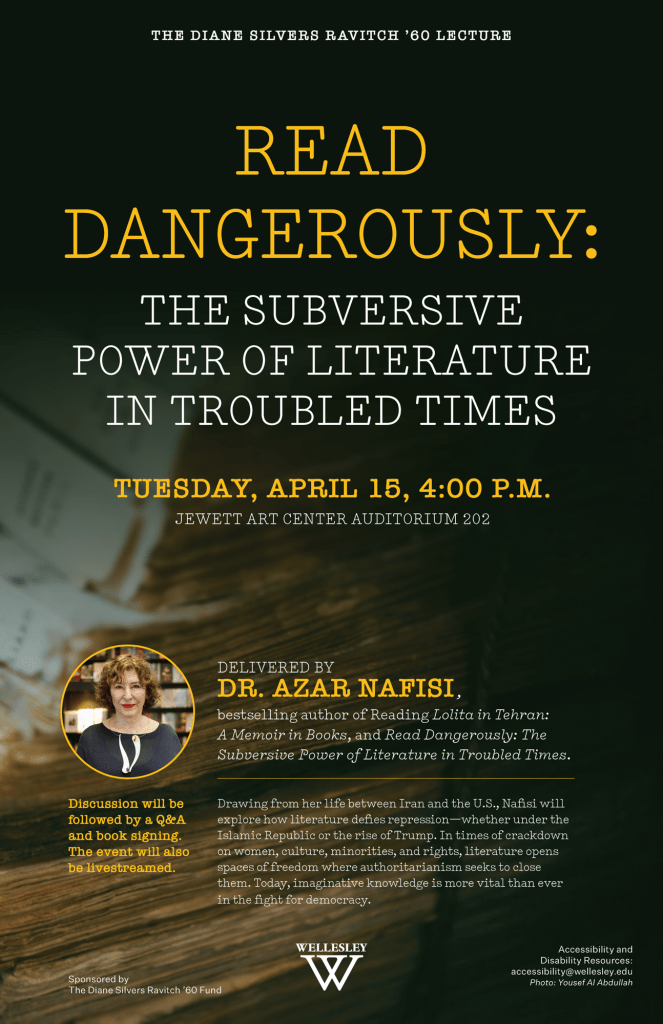
Dr. Azar Nafisi, author of the mega-bestseller Reading Lolita in Tehran, will speak at Wellesley College on April 15 at Wellesley College at 4 p.m. in the Jewett Arts Center. Admission is free.
Please mark the date on your calendar. She is speaking in a lecture series that I endowed several years ago. The lecture will be available eventually on the archive website of the College.
The book, which was a sensation upon its publication for its depiction of life under the mullahs, has recently been made into a film.
This review of the film was published by The Atlantic and written by Arash Azizi. At present, the film can be seen only at film festivals.
He wrote:
The past few years may well be remembered as the nadir of Iranian-Israeli relations, and the first occasion when the two countries attacked each other directly. But they were also a golden period for Iranian-Israeli collaboration in cinema. In 2023, Tatami was the first-ever film to be co-directed by an Israeli (Guy Nattiv) and an Iranian (Zar Amir). And in 2024 came Reading Lolita in Tehran, directed by Eran Riklis, who is Israeli, and adapted from a book by an Iranian author, with an almost entirely Iranian cast. The film premiered at the Rome Film Fest last year and is now starting to tour the United States.
Anyone old enough to remember cultural life at the beginning of this century will know the book. Azar Nafisi’s memoir came out in 2003, spent 36 weeks on the New York Times best-seller list, and quickly developed a cult following. A reviewer for The Nation confessed to missing a dental appointment, a business lunch, and a deadline just because she couldn’t put the book aside.
Literary scholars—Nafisi is an English professor—are not known for their page-turning thrillers. But Nafisi’s story and prose are captivating. She’d gone to Iran shortly after the 1979 revolution in the hope of putting her American education to use by teaching English at a university. Instead, she was hounded out of the classroom by authorities hostile to Western literature. She wound up holding clandestine seminars for young women in her living room, delving into the masterpieces that the Islamic Republic forbade: the Vladimir Nabokov novel that gives the memoir its name, alongside the works of Henry James and Jane Austen, as well as one of Nafisi’s favorites, F. Scott Fitzgerald’s The Great Gatsby. Nafisi brings these classics into dialogue with the real-life stories of young Iranians in the heady decades following the 1979 revolution. Her book isn’t just about reading and teaching literature under a repressive regime, but about how literature in and of itself could serve as an antidote to all that the regime stood for.
Despite its global fame and translation into 32 languages, Reading Lolita in Tehran was never turned into a film before now, mostly because Nafisi didn’t like the proposals she’d received. Then, seven years ago, Riklis came around, as he recounted to a New York audience on January 13, after a special screening of the film. The Israeli director managed to convince Nafisi of his vision—and then to secure the funding, assemble a suitable Iranian cast, and settle on Rome as the shooting location, given that Tehran was not an option.
When the book was initially released in 2003, the American zeitgeist, shaped by 9/11 and the Bush administration’s global War on Terror, was rife with debates about the representations of Muslim women and life in the Middle East. Nafisi’s was one of several popular memoirs by Iranian women published during this period, including Firoozeh Dumas’s Funny in Farsi (2003) and Marjane Satrapi’s Persepolis series (2000–03). And perhaps inevitably, given its success, Nafisi’s book became the subject of political scrutiny, much of it bearing little relation to the book’s content. Although Nafisi opposed the Iraq War, some critics lumped her in with neoconservatives because she portrayed the travails of Iranians under an anti-American regime. One scholar even proclaimed that he saw no difference between her and American soldiers convicted of abusing prisoners in Iraq.
More than 20 years later, Riklis’s loyal adaptation has opponents just as the book did, and even more so because of the nationality of its director. In Tehran, the regime media have denounced the film as furnishing a “pretext for attacking Iran” and called its Iranian actors “traitors working with Zionists.” One outlet claimed that the film peddled a “violent, anti-culture, anti-art, and anti-human view of Iran and Iranians.”
The idea that Reading Lolita in Tehran is anti-Iranian because of its portrayal of the Islamic Republic, and of the life of women under its rule, was always patently ridiculous. The claim bears up particularly poorly in 2024, two years after women-centered protests rocked Iran under the slogan “Women, Life, Freedom.” What Nafisi does best, and the reason her work has endured, is precisely to refuse cartoonish portrayals and basic morality plays.
In Riklis, known for his empathetic depiction of Israelis and Palestinians in films such as Lemon Tree and Dancing Arabs, her book finds an able interpreter who has stayed true to its ethos. The film isn’t neutral. It vividly tells the story of how puritanical Islamist goons attacked universities in the early years after 1979, imposed mandatory veiling on women, and banned books they didn’t like. But neither is it a simple story of scary Islamists versus heroic women resisters.
The film captures the atmosphere of Iran in the 1980s and ’90s remarkably well for having been shot in Italy and directed by an Israeli who has never set foot in the country. The dialogue is mostly in Persian, a language Riklis doesn’t speak; he was able to pull this off with the help of a carefully chosen cast of diasporic Iranians. Golshifteh Farahani, perhaps the best-known Iranian actor outside the country, is at her height as Nafisi, whom she plays as confident but humane, by turns brazen and vulnerable.
The young women of the clandestine class include Sanaz (Zar Amir), who has survived imprisonment and torture; Mahshid (Bahar Beihaghi, in one of the film’s most delightful performances), who, unlike most of her classmates, wore the Islamic veil even before the revolution and defends an ideal of modesty as virtue; and Azin (Lara Wolf), whose multiple divorces make her an object of fascination to the less experienced students, but who turns out to be suffering from domestic abuse.
In Nafisi’s apartment, the students are far from the prying eyes of the regime and also of men (even the professor’s husband is barred from their meetings). They construct for themselves, in that all-female room, a little literary republic that survives the years of war and revolution. In one memorable scene, Nafisi has the students practice a Jane Austen–era dance as part of their study of Pride and Prejudice, drawing parallels between the stifling rules of courtship in Victorian England and those of some contemporary families in Iran.
The film also ventures beyond that cloistered space. Bahri (Reza Diako), a devout 1979 revolutionary, is nevertheless an avid student in Nafisi’s class at the university before it is shut down. Despite their diametrically opposed politics, Nafisi and Bahri form a bond. Early in the story, she tells him his essay on Huckleberry Finn is the best she’s ever received from a student, even in America. The two reconnect when Bahri returns from the Iran-Iraq War of 1980–88, having lost an arm. He has used his family connections to the regime to obtain a surprise gift for his old professor: two tickets to The Sacrifice, by Andrei Tarkovsky, showing at the Tehran film festival. The connection between Nafisi and Bahri is presented with complexity and without sentimentality, neither papering over political differences nor caricaturing Bahri as a generic revolutionary.
In this way, both film and book avoid didacticism. And in doing so, they demonstrate exactly the point Nafisi explores with her students, which is the power of literature to stir empathy across seemingly unbridgeable divides. When the group discusses The Great Gatsby, Nafisi insists on understanding the forbidden love that Daisy Buchanan, the married socialite, has for Jay Gatsby as a true human feeling, not a symbol of Western perfidy, as some of her more revolutionary students claim it to be. The latter advocate banning the book. Nafisi organizes a mock trial for the novel in her class, with students divided into teams for and against.
Nafisi calls on students on both sides of the political divide to treat each other with humanity. When she catches some in her class expressing glee at the wartime deaths of pro-regime peers, she enjoins them not to become like their oppressors. And she is no dogmatic opponent of Islam, only of religiously inspired repressive government: At one point Nafisi tells Bahri, “My grandmother was the most devout Muslim I knew. She never missed a prayer. But she wore her scarf because she was devout, not because she was a symbol.” (I am not the only critic with a Muslim background who found this line powerful.)
The point here isn’t just to repeat the liberal platitude that “the problem isn’t with Islam but with its repressive enforcement.” Rather, Nafisi is rejecting the revolutionaries’ tendency to treat all that surrounds them as a field of symbols. People are worth more than that, she tells them and us, as though echoing the Kantian dictum to treat one another “as an end, never merely as a means.”
This message about the humane power of literature makes Reading Lolita in Tehran a work of art rather than an exercise in sloganeering. And the fact that now, more than two decades after the book’s release, and at a time of regional tension, an Israeli filmmaker has worked with Iranians to adapt Nafisi’s book to the screen gives the film a special power.
The audience at the screening I attended, at a Jewish community center on the Upper West Side, included American Jews, Israelis, and Iranians. What we had in common was the experience of being gripped by a story about the capacity of literature to reveal us to one another as ends rather than as means. The setup might sound mawkish. But I recommend avoiding the temptation of cynicism and embracing the film as truly one for these times.
Rex Huppke writes opinion columns for USA Today. In his latest column, he muses about Trump’s on balance as most Americans watch their retirement savings melt away.
He has a way of finding the humor in gut-wrenching events. Recently he has been writing about Trump’s demolition of the global economy. Don’t worry if your life savings is shrinking. Trump isn’t worried. Trump promises a future of plenty, someday. Trust him at your own risk.
It’s important to remember that Trump was never a successful businessman. He filed for bankruptcy six times. American banks would not lend him money because he was not credit-worthy. His “Trump University” was required by the courts to pay former students $25 million for defrauding them. People forget that he played a businessman on TV. If they knew that, they might be reluctant to support his decision to impose tariffs on every nation (except Russia, North Korea, Cuba, and Belarus.) He literally doesn’t know what he’s doing.
He thinks we should not have any deficits. I heard a law professor explain how crazy that idea is. He said, “I shop at my local grocery store and have spent thousands of dollars there. They don’t buy anything from me. I have a large trade deficit with that store.” Nuts.
Thanks, buddy. As we await whatever fresh hell Monday’s stock market brings and brace for the global response to the ludicrous tariffs you slapped on pretty much everyone, including some random penguins, we’ll do our best to hang tough, comforted by the fact that you and your assorted weirdo billionaires had a lovely weekend.
And I’d almost be able to swallow the maddening absurdity of it all if Trump and his Republican barnacles would just straight up admit their galactic-level hypocrisy.
What if a Democratic president had done this?
None of what Trump is doing with tariffs is a surprise. He told us over and over that he was going to do this. He has repeatedly demonstrated that he doesn’t care about anyone other than himself.
But imagine an America where a Democratic president got fixated on tariffs while clearly not understanding how tariffs work. An America where that Democratic president needlessly triggered a trade war, watched the stock market plummet for two days, then trotted off for a golf weekend during which he profited off people partying at his resort.
Would Fox News preach patience if a Democrat tanked the economy?
In this scenario, Republicans would have already impeached the Democratic president – twice. Pitchfork sales among right-leaning Americans would have skyrocketed, and the Treasury secretary would have had to flee the country. Fox News would have wall-to-wall coverage painting this hypothetical president as a literal demon and demanding he step down because he’s insane or a communist or both.
That would bring a third impeachment from Republicans, and Fox News itself, along with the entire right-wing media ecosystem, would explode with enough ferocity to open a portal to another dimension.
Imagine if Biden did even a fraction of the damage Trump has done.
That hypothetical is 1,000% accurate. You know it. I know it. Republicans know it, and Fox News sure as hell knows it.
If Joe Biden, as president, intentionally murdered the stock market, it would have ended his presidency. Period. Biden, instead, made our economy the envy of the world and Republicans still wanted to end his presidency. So don’t tell me any of what Trump is doing would be even momentarily tolerated if Trump were a Democrat.
This point is not debatable.
I’m sick of people shrugging off GOP hypocrisy – they need to own it
So all I ask, as my 401(k) shrivels like a raisin and rich jerks keep telling me to suck it up, is that Trump and his Republican bootlickers and all the little goobers on Fox News and Newsmax and the Illustrious King Trump Mighty Genius Appreciation Network (I might’ve made that last one up) muster the decency to admit they’re giant freakin’ hypocrites.
I’m talking about apex hypocrites. These are unrivaled practitioners of the dark art of hypocrisy.
And they need to own it.
Better to be poor and honest than poor and a liar, right?
C’mon, tough guys. Show a modicum of courage and tell us what we already know.
What do you have to lose? Your guy is in charge. He’s taking a wrecking ball to America, and there’s little people like me can do other than come up with clever opposition slogans for protest signs.
As the markets crash and the imaginary factories Trump keeps babbling about never come and regular Americans start Googling recipes that can stretch a pack of bologna out for a full week, Republicans need to say it loud and say it proud: “We are total hypocrites and we’re only OK with this mess because a Republican created it!”
You may end up as broke as the rest of us, but at least you’ll be able to tell your pauper children that, in the end, you were honest.
This important article appeared on the blog called “Inside Medicine,” which appears on Substack. It describes the terrible consequences of Elon Musk’s decision to eliminate USAID. Many of us are still wondering how he got the authority to dismantle an agency authorized and funded by Congress. Many of us wonder why the Republicans in Congress ceded their Constitutional powers to this one man.
Musk said merrily that he was “feeding it to the woodchipper.” He strutted onstage at a Trump rally, waving a bejeweled chainsaw to flaunt his power. What a cruel and callous man he is. How little he cares about human life. He tells us we must procreate (I think he means whites), yet he is completely uncaring about the people who will die because he cut off medical services, medicine, and food to those in need.
Inside Medicine is written by Dr. Jeremy Faust, MD, MS, a practicing emergency physician, a public health researcher, writer, spouse, and girl Dad. He blends his frontline clinical experience with original and incisive analyses of emerging data to help readers make sense of complicated and important issues. Thanks for supporting it!
This past week, Dr. Atul Gawande briefed US Senators on the effects that the destruction of USAID is already having. Here are the facts we need to know.
Over the last couple of months, the Inside Medicine community has been fortunate to hear and learn about USAID directly from Dr. Atul Gawande.
Today, I’m sharing the first public release of Dr. Gawande’s latest update provided to members of the United States Senate, remarks that were delivered in person in Washington, D.C. last week.
This is essential and up-to-date information that we all need to know. When people ask what the human costs of this administration’s brazen actions have been, we must respond with facts. Well, here they are…
First, a quick reminder: Inside Medicine is 100% supported by reader upgrades.
Thank you!👇
(And, as always, if you can’t upgrade due to financial considerations, just email me and it’s all good).
Do you have any idea where things stand with USAID? With everything else going on, I realized that even I needed an update. So, I again reached out to our friend Dr. Atul Gawande, who, until noon on January 20, 2025, ran global health for USAID.
Here’s where things stand: While the Supreme Court ruled last month that the Trump administration still has to pay its bills for work already completed by USAID contractors, that was not exactly a high bar to clear—and even that decision was a narrow 5-4 ruling. Meanwhile, all of the contract terminations and personnel purges have been permitted to go through while the overall issues are litigated. Therefore, the reality is that even if the courts eventually determine that the complete gutting of USAID was not lawful, it will already be a fait accompli—that is, practically impossible to reverse.
So, what of USAID’s crucial work remains, and what has—in Elon Musk’s own words—already been ‘fed to the wood chipper’? In testimony to members of the US Senate this past week, Dr. Gawande summarized what has already been destroyed by callous and brutal DOGE-directed terminations since January. We are only just beginning to be able to estimate the number of deaths these cuts will cause in the coming months and years, but unless something changes, it will surely amount tomillionsof human lives lost. A particularly depressing aspect is that these are senseless deaths (not to mention other suffering from disease and poverty), without reasonable or accurate justifications, as Dr. Gawande explicitly delineated in his presentation.
I’m grateful that Atul has provided his remarks for publication here in Inside Medicine. Please read his words and share them.
Senate Roundtable on The Dangerous Consequences of Funding Cuts to U.S. Global Health Programs.
Tuesday, April 1 from 2:30-3:30PM. U.S. Senate Visitors’ Center, Room 200/201.
Testimony of Atul Gawande, MD, MPH:
I was the Assistant Administrator for Global Health at USAID during the last administration. It was the best job in medicine most people haven’t heard of. I led 800 health staff in headquarters working alongside more than 1600 staff in 65-plus countries. With less than half the budget of my Boston hospital system – about $9 per U.S. household – they saved lives by the millions and contained disease threats everywhere.
Before my departure on January 20, I briefed this committee about several major opportunities ahead for the next few years. Among them were three breakthroughs. The journal Science had just declared one of them the scientific breakthrough of 2024. American scientists had developed a drug called Lenacapavir that could prevent or treat HIV with a single injection that lasted six months and perhaps even a year. Deploying this game-changer in high-risk communities through PEPFAR could finally bring an end to HIV as a devastating public health threat.
Similarly, USAID launched a trial of a four-dose pill that could prevent tuberculosis in exposed individuals and dramatically reduce cases – while three TB vaccines complete testing.
And USAID was just about to scale up a novel, inexpensive package of existing drugs and treatments that was found to reduce severe hemorrhage after childbirth – the leading cause of maternal death – by 60%.
American companies, nonprofits, and scientists played key roles in these breakthroughs, and they were poised to transform global health over the next five to ten years. The next administration had no reason not to pursue these objectives. Congress had already funded them. There was nothing partisan about them at all.
But instead of saving millions of lives, we got surgery with a chainsaw. The new administration not only shuttered this work, they fired the staff of the entire agency, terminated 86% of its programs, and kneecapped the rest – all against Congressional directives. They dismantled the US’s largest civilian force advancing global stability, peace, economic growth, and survival. And they have done it in a way maximized loss of life and mismanagement of taxpayer dollars.
Here are few specific examples of the global health damage:
● Our 50-country network for stronger surveillance to deadly diseases from bird flu to swine fever – gone.
● Our emergency response system that cut response times to global outbreaks from >2 weeks to <48 hours – gone.
● AIDS programs to prevent new cases of HIV in high-risk populations – gone.
● Programs for preventing child and maternal deaths that reached 93 million women and children under 5 in 2023 and added 6 years of life on average – cut 92%.
● Lifesaving tuberculosis programs – cut 56%.
● Lifesaving water and sanitation programs – cut 86%.
● Funding for Gavi, the global vaccine alliance, which was set to vaccinate half a billion children — terminated and, if not restored, will cost 500,000 lives a year and drive higher exposure to measles in the US.
The damage is already devastating. And it is all part of a larger dismantling of America’s world-leading capacity for scientific discovery, health care delivery, and public health that goes well beyond USAID. They are using the same playbook to purge staff and destroy programs in across our entire domestic infrastructure in government, universities, and medical center. And they are inserting political controls on NIH science research, FDA approvals, and CDC guidance.
For the sake of power, they are destroying an enterprise that added more than 30 years to US life expectancy and made America the world leader in medical technology and innovation. We need you in Congress to stop this process. USAID cannot be restored to what it was. But we must salvage what we can of our health, science, and development infrastructure and stop the destruction.
For years, the world watched as Russia systematically kidnapped tens of thousands of Ukrainian children, erasing their identities and forcing them into Russian families. This isn’t just a war crime—it’s genocide in real time.
Now, Trump’s regime is actively helping Russia cover up this genocide. His State Department quietly terminated a crucial contract that was facilitating the transfer of evidence on Russia’s mass abduction of Ukrainian children to European law enforcement, according to The New Republic.
This decision cripples efforts to track and recover abducted children, making it harder to hold Russia accountable for what international courts have already labeled a war crime. By cutting off this support, Trump’s regime is not just abandoning Ukraine—they are actively obstructing justice.
This isn’t just inaction—it’s complicity in one of the most horrific acts of genocide and war crimes.
Russia’s War Crime: The Mass Kidnapping of Ukrainian Children
Under Putin’s direct orders, at least 20,000 Ukrainian children—though the real number may be much higher—have been stolen from Ukraine and transported to Russia. Many have been ripped from orphanages and hospitals in occupied territories, while others—despite having living relatives—have been abducted and placed in “re-education” camps designed to erase their Ukrainian identity. These children are tortured, subjected to psychological reprogramming, and stripped of their Ukrainian heritage, culture, and language. They are then forcibly granted Russian citizenship and placed with Russian families as part of an illegal state-run program aimed at assimilating them into Russian society and erasing their Ukrainian identity forever.
Russia does not even attempt to hide these hideous crimes. Grigory Karasin, head of the international committee in Russia’s upper house of parliament, openly boasted that 700,000 children from illegally occupied territories in Ukraine have been taken to Russia. The sheer scale of this state-sponsored mass abduction is staggering—one of the largest forced deportations of children in modern history. This is not just a war crime— it is clear evidence of Russia’s genocidal intent to erase Ukrainian identity by targeting children, severing them from their families, their culture, and their homeland.
The International Criminal Court recognized this as a war crime as investigations continue. In March 2023, the ICC issued arrest warrants for Vladimir Putin and Maria Lvova-Belova, Russia’s Commissioner for Children’s Rights, for the “unlawful deportation and forced transfer of Ukrainian children.” This systematic abduction is not just a violation of international law—it is genocide. Russia is not merely stealing children but destroying Ukraine’s future by erasing an entire generation.
And now, Trump, Musk, and Rubio are actively helping Russia cover up the genocide and war crimes.
Trump’s State Department Blocks Efforts to Track Abducted Ukrainian Children
Since Russia’s full-scale invasion, the U.S. State Department funded a Yale research team that tracked kidnapped Ukrainian children using satellite imagery and open-source intelligence. Their work was crucial in exposing Russia’s state-run program of forced deportation and illegal adoption, providing undeniable evidence of war crimes committed against Ukrainian children.
Now, that work is under threat. Trump’s Secretary of State, Marco Rubio, has canceled the program, cutting off funding and blocking the transfer of key evidence to European law enforcement. Without this support, it will be significantly harder to locate and rescue kidnapped children, hold Russia accountable for genocide and war crimes, and ensure that stolen children are returned to Ukraine.
The Humanitarian Research Lab at Yale worked with Ukrainian President Volodymyr Zelenskyy’s Bring Kids Back UA campaign, which has helped track and locate hundreds of abducted children, successfully repatriating approximately 1,240 so far. With funding cut off, these efforts are now at risk.
Genocide and War Crimes: What’s at Stake
Under the Genocide Convention, the forced deportation and assimilation of children meets the legal definition of genocide, as it involves forcibly transferring children from one group to another with the intent to erase their identity, conducting mass deportations under state policy, and destroying cultural, linguistic, and familial ties. The International Criminal Court has already taken action by issuing arrest warrants, but its ability to prosecute and hold Russia accountable depends on cooperation from governments like the United States.
Instead of aiding these efforts, Trump is actively sabotaging them, cutting off crucial funding for investigations and making it harder to track abducted children and bring perpetrators to justice. Even the U.S. Congress, led by Rep. Susan Wild (D-PA-7), recognizing the horror of this crime, overwhelmingly passed a resolution in 2024 condemning Russia’s abduction and forced transfer of Ukrainian children.
Yet, Trump’s regime is doing the opposite—helping obstruct justice while aligning itself with Russia’s war crimes.
Trump’s Loyalty to Moscow
This isn’t an isolated incident—it’s part of Trump’s broader fealty to the Kremlin and his regime’s Russia-aligned policies. From cutting off military aid to amplifying Kremlin propaganda, Trump continues to systematically weaken Ukraine’s ability to defend itself while strengthening Russia’s position. Every move he makes advances Russia’s strategic goals, further undermining Ukraine’s sovereignty and the West’s ability to hold Russia accountable.
We all saw as JD Vance ambushed Zelensky in the Oval Office meant to send a clear message that the U.S. is no longer a reliable partner. Trump echoes Kremlin propaganda at every opportunity, falsely branding Zelensky a “dictator” and insisting that Ukraine must hold elections immediately—a demand that directly serves Russia’s interests, as Moscow has repeatedly attempted to assassinate Zelensky and would exploit an election to further destabilize Ukraine.
Trump’s so-called “peace plan” is nothing more than a thinly veiled attempt to force Ukraine into surrender, as he insists that Kyiv must “negotiate”—a demand that would strip Ukraine of its sovereignty and hand Putin exactly what he wants.
Meanwhile, Trump’s State Department is actively obstructing efforts to hold Russia accountable for war crimes, cutting off support for investigations into the kidnapping and forced deportation of Ukrainian children. At every turn, Trump is working to weaken Ukraine, embolden Russia, and dismantle any accountability for Russia’s crimes—all while seeking to reestablish financial deals with Moscow and prioritizing his personal and political interests.
As part of carrying out Russia’s agenda, Trump is also attacking NATO and attempting to dismantle alliances that have kept America safe, further isolating the U.S. while handing Putin exactly what he wants.
What Can We Do?
We cannot stay silent while the U.S. government helps Russia cover up genocide. And if Trump is willing to excuse war crimes against children, what won’t he justify?
Please call your members of Congress and demand answers. Ask them why the State Department cut funding for tracking abducted Ukrainian children and why the U.S. is turning its back on accountability for Russian war crimes.
Yesterday after the stock market closed, Trump held a press conference to announce his much-ballyhooed tariff plan. He used the opportunity to insult other nations, as is his custom. Commentators noted that he slapped tariffs on uninhabited islands. Trump believes that the greatest period in the American economy ended in 1913, when the federal government adopted the income tax. When I was a junior in high school in high school, I learned that the enactment of a federal income tax was progressive because it reduced the vast gap between the very rich and everyone else. I also learned about the Smoot-Hawley tariffs, which set off a global trade war and contributed to the Great Depression. Apparently, these topics were not taught in Trump’s elite military academy. His history classes must have been taught from the perspective of the robber barons.
President Donald Trump said Wednesday that he will impose a new 10 percent tariff on all imported goods along with higher import taxes tailored for each of about 60 countries that his advisers say maintain the largest barriers against U.S. products, in a sharp turn toward the kind of protectionism that the United States abandoned nearly a century ago.
To impose the new tariffs, the president declared a national emergency, citing the annual merchandise trade deficit that the United States has run each year since 1975.
“For decades, our country has been looted, pillaged, raped and plundered by nations near and far, both friend and foe alike,” Trump said. “But it is not going to happen anymore.”
The tariff increases that the president announced had little modern precedent and would erect towering impediments to products from dozens of foreign countries, many of them poor nations that embraced exporting as a tool to escape grinding poverty….
Speaking in blunt, sometimes intemperate language, the president assailed the nation’s trading partners, including some of its closest allies, as “foreign cheaters” and “foreign scavengers” who had “ripped off Americans” for 50 years. Trump’s tone echoed the dark portrait of “American carnage” that he had sketched in his first inaugural address in 2017….
“In the short run, the effect is probably a recession. It’s going to raise the price of so many goods that can’t be made in the United States,” said economist Brad Setser of the Council on Foreign Relations. “In the long run, it’s a vision of the U.S. that is very isolated from the world.”
Jay Timmons, president of the National Association of Manufacturers, warned that his members operate on thin profit margins and cannot absorb the tariffs. Small businesses and restaurant owners issued statements decrying their added costs.
“This is catastrophic for American families,” said Matt Priest, president of the Footwear Retailers and Distributers of America.
********************************
Daniel Dale of CNN fact-checked only a few of Trump’s outlandish statements during his press conference about his tariffs. He imposed tariffs on uninhabited islands, populated only by penguins.
President Donald Trump made a series of false claims about tariffs and trade – most of which he has made before – in the Wednesday speech in which he announced a sweeping set of global tariffs.
Here is a fact check of some of Trump’s remarks.
Canada’s dairy tariffs
Trump correctly noted that Canada has tariffs exceeding 250% on some US dairy products. However, he falsely claimed that merely “the first little carton of milk” exported to Canada faces a “very low price,” but “then it gets up to 275, 300%.”null
In reality, Canada has guaranteed that tens of thousands of metric tons of imported US milk per year, not merely a single carton, will face zero tariffs at all; Canada conceded a certain guaranteed level of tariff-free US access to its dairy market as part of the United States-Mexico-Canada Agreement (USMCA) that Trump’s own first administration negotiated.
Trump also didn’t mention something the US dairy industry acknowledges: The US is not hitting its zero-tariff maximum level of exports to Canada in any category of dairy product, so the Canadian tariffs aren’t being applied; with regard to milk in particular, the US isn’t even at half of the tariff-free quota. (There is a vigorous US-Canada debate about why the US is so far from the maximum, with each country blaming the other. Regardless of who’s right, the tariffs aren’t hitting US milk.)
Trump has persistently omitted key facts about Canada’s dairy tariffs. You can read more here from a previous CNN fact check.
US trade deficit with Canada
Trump, claiming “we subsidize a lot of countries,” falsely said “it’s close to $200 billion a year” with Canada. Trump has repeatedly used this $200 billion figure to describe the US trade deficit with Canada in particular, which is actually far lower than $200 billion; official US statistics show the 2024 deficit with Canada in goods and services trade was $35.7 billion and $70.6 billion in goods trade alone.
Trump didn’t mention the trade deficit in particular this time, but even if he was intending to use the word “subsidize” more broadly, there is no basis for the claim.
Who pays tariffs
Trump repeated his frequent false claim that, because of the tariffs he imposed on China during his first term, the US “took in hundreds of billions of dollars” that “they paid.” In fact, US importers, not foreign exporters like China,make the tariff payments, andstudy after studyhas found that Americans bore the overwhelming majority of the cost of Trump’s first-term tariffs on China; it’s easy to findspecific examplesof companies that passed along the cost of the tariffs to US consumers.
Previous presidents’ tariffs on China
Trump also repeated his frequent false claim that, before his first presidency, China “never paid 10 cents to any other president” from tariffs. Aside from the fact that US importers make the tariff payments, the US was actuallygenerating billions per year in revenuefrom tariffs on Chinese imports before Trump took office; in fact, the US has had tariffs on Chinese imports since1789. Trump’s predecessor, President Barack Obama,imposed additional tariffson Chinese goods.
US wealth
Touting the supposed benefits of tariffs, Trump claimed that “the United States was proportionately the wealthiest it has ever been” from 1789 to 1913, when tariffs made up a higher percentage of federal revenue before the passage of a 1913 law reestablishing the federal income tax.
Trump didn’t explain what he meant by “proportionately the wealthiest,” but by standard measures, the US is far wealthier today than it was in the early 20th century and prior. Per capita gross domestic product isnow many times higherthan it was then.
Douglas Irwin, a Dartmouth College economics professor who studies the history of US trade policy, said in February after Trump had made similar claims, that if Trump’s unclear comments are interpreted to be about per capita income, as “economists usually take this,” it is “obviously not true,” since “real per capita income and standards of living are so much higher today than the past. … It is nice to have indoor plumbing, running water, not outhouses, etc.”
This is only part of the article. Open the link to finish reading. Dale reviews inflation, the cost of gasoline, and other issues.
The cruelty and sheer meanness of the Trump administration can never be overestimated. As the administration closes down USAID, without Congressional authorization, it announced a series of cuts that will kill millions of people. Having an ardent opponent of vaccines in charge of Heakth and Human Services removes any advocacy to distribute proven methods to save lives and prevent epidemics.
The Trump administration intends to terminate the United States’ financial support for Gavi, the organization that has helped purchase critical vaccines for children in developing countries, saving millions of lives over the past quarter century, and to significantly scale back support for efforts to combat malaria, one of the biggest killers globally.
The administration has decided to continue some key grants for medications to treat H.I.V. and tuberculosis, and food aid to countries facing civil wars and natural disasters.
Those decisions are included in a 281-page spreadsheet that the United States Agency for International Development sent to Congress Monday night, listing the foreign aid projects it plans to continue and to terminate. The New York Times obtained a copy of the spreadsheet and other documents describing the plans.
The documents provide a sweeping overview of the extraordinary scale of the administration’s retreat from a half-century-long effort to present the United States to the developing world as a compassionate ally and to lead the fight against infectious diseases that kill millions of people annually.
The cover letter details the skeletal remains of U.S.A.I.D. after the cuts, with most of its funding eliminated, and only 869 of more than 6,000 employees still on active duty.
In all, the administration has decided to continue 898 U.S.A.I.D. awards and to end 5,341, the letter says. It says the remaining programs are worth up to $78 billion. But only $8.3 billion of that is unobligated funds — money still available to disburse. Because that amount covers awards that run several years into the future, the figure suggests a massive reduction in the $40 billion that U.S.A.I.D. used to spend annually.
A spokesperson for the State Department, which now runs what is left of U.S.A.I.D., confirmed the terminations on the list were accurate and said that “each award terminated was reviewed individually for alignment with agency and administration priorities, and terminations were executed where Secretary Rubio determined the award was inconsistent with the national interest or agency policy priorities.”
The memo to Congress presents the plan for foreign assistance as a unilateral decision. However because spending on individual health programs such as H.I.V. or vaccination is congressionally allocated, it is not clear that the administration has legal power to end those programs. This issue is currently being litigated in multiple court challenges.
Among the programs terminated is funding for the United Nations Food and Agriculture Organization, which conducts surveillance for diseases that can be transmitted from animals to humans, including bird flu, in 49 countries. Some major programs to track and fight malaria, one of the world’s top killers of children, have also been ended.
Dr. Austin Demby, the health minister of Sierra Leone, which relies on Gavi’s support to help purchase vaccines, said he was “shocked and perturbed” by the decision to terminate U.S. funding and warned that the ramifications would be felt worldwide.
“This is not just a bureaucratic decision, there are children’s lives at stake, global health security will be at stake,” he said. “Supporting Gavi in Sierra Leone is not just a Sierra Leone issue, it’s something the region, the world, benefits from.”
“The guiding principle of my work is ‘go there.’ I want to hear directly from the people who are affected by disease, or lack of access to a new drug. I’ve been writing about global health for 30 years and have reported from more than 80 countries.”
In addition to trying to reach all children with routine immunizations, Sierra Leone is currently battling an mpox outbreak, for which Gavi has provided both vaccines and critical support to deliver them, he said.
“We hope the U.S. government will continue to be the global leader it always been — putting money in Gavi is not an expenditure, it’s an investment,” Dr. Demby said
Gavi is estimated to have saved the lives of 19 million children since it was set up 25 years ago. The United States contributes 13 percent of its budget.
The terminated grant to Gavi was worth $2.6 billion through 2030. Gavi was counting on a pledge made last year by President Joseph R. Biden Jr. for its next funding cycle.
The loss of U.S. funds will set back the organization’s ability to continue to provide its basic range of services — such as immunization for measles and polio — to a growing population of children in the poorest countries, let alone expand to include new vaccines.
By Gavi’s own estimate, the loss of U.S. support may mean 75 million children do not receive routine vaccinations in the next five years, with more than 1.2 million children dying as a result.
Mujib Mashal wrote in The New York Times about the desperate starvation facing the Rohingya refugees as a result of the shutdown of U.S. foreign aid. They escaped Myanmar’s “ethnic cleansing” and now live in a United Nations camp, where their survival depends on donations of food from benevolent nations. The U.S., thanks to billionaires Trump and Musk. They should take a tour of the camps and see for themselves why foreign aid is impirtant.
Mashal writes:
More than a million people in the world’s largest refugee camp could soon be left with too little food for survival.
In the camp in Bangladesh, United Nations officials said, food rations are set to fall in April to about 18 pounds of rice, two pounds of lentils, a liter of cooking oil and a fistful of salt, per person — for the entire month.
The Trump administration’s freeze on aid has overwhelmed humanitarian response at a time when multiple conflicts rage, with aid agencies working feverishly to fill the void left by the U.S. government, their most generous and reliable donor. Many European nations are also cutting humanitarian aid, as they focus on increasing military spending in the face of an emboldened Russia.
The world is left teetering on “the verge of a deep humanitarian crisis,” U.N. Secretary General António Guterres warned on a visit to the Rohingya refugee camp in southeastern Bangladesh on Friday.
“With the announced cuts in financial assistance, we are facing the dramatic risk of having only 40 percent in 2025 of the resources available for humanitarian aid in 2024,” he said, addressing a crowd of tens of thousands of Rohingya refugees. “That would be an unmitigated disaster. People will suffer, and people will die.”
At the refugee camp at Cox’s Bazar, overcrowded warrens of bamboo and tarp huts on mounds of dirt house more than a million Rohingya people driven from their homeland, Myanmar, by a campaign of ethnic cleansing that intensified in 2017.
Fenced off from the rest of Bangladesh, and almost entirely cut off from opportunities to find work or integrate into the country, the Rohingya refugees remain entirely at the mercy of humanitarian aid. The United Nations, with the help of the Bangladeshi government and dozens of aid organizations, looks after the needs of the traumatized people — education, water, sanitation, nutrition, medical care and much more.
The sudden drop in humanitarian aid threatens a wide range of programs and communities around the world, but the plight of the Rohingya is unusual in its scale and severity.
“Cox’s Bazar is ground zero for the impact of budget cuts on people in desperate need,” Mr. Guterres said. “Here it is clear budget reductions are not about numbers on a balance sheet. Funding cuts have dramatic human costs.”
Even at the current food allowance of $12.50 per person, per month, more than 15 percent of the children at the camp are acutely malnourished, according to the United Nations — the highest level recorded since 2017, when hundreds of thousands of refugees arrived after a sharp escalation of violence in Myanmar.
When a funding shortfall slashed the monthly food allowance to $8 in 2023, malnutrition and crime soared. People tried to flee the camp by embarking on dangerous and often fatal boat journeys.
During Mr. Guterres’s visit to the camp, U.N. officials had set up on a table sample food baskets showing what refugees currently get at $12.50 per person, and what that will be slashed to next month if, as they now project, the allotment falls to $6, barring a last-minute rescue.
Pointing to the sparse basket marked “$6,” Dom Scallpelli, the Bangladesh country director for the World Food Program, said, “If you give only this, that is not a survival ration.”
Even the $6 diet expected for the month of April would be made possible only because the United States unfroze its in-kind contribution, agreeing to send shipments of rice, beans, and oil, Mr. Scallpelli said. The cash contributions — the United States provided about $300 million to the Rohingya response last year, a little over half the entire response fund — remain halted.
“If we didn’t even have that, it would have been a total nightmare situation,” Mr. Scallpelli said about the in-kind donations. “At least we are thankful to the U.S. for this.”
Abul Osman, a 23-year-old refugee who arrived at Cox’s Bazar in 2017, said the refugees were already struggling with the bare minimum and the slashing of rations would be devastating for a population with no livelihood options. The Rohingya in Bangladesh are only allowed schooling inside the camp, and are not allowed access to higher education or jobs outside.
Pregnant women and children will suffer the most from dire food shortages, but the resulting mental health crisis will affect everyone, he said.
“It’s a threat to our survival,” he said.
People will die. Many thousands will die. Should we care? Our government claims to be Christian. What is the Christian response to a humanitarian catastrophe?