Archives for category: Honor Roll

A high school student in Idaho peaceably performed a quiet but powerful protest against censorship at her graduation ceremonies. For her courage, her commitment to freedom to read, and her sheer chutzpah, I add the name of Annabelle Jenkins to the honor roll of this blog.

An Idaho high school graduate staged an unusual form of protest at her graduation when she offered a book to the school district’s superintendent, who had banned it months earlier.

Annabelle Jenkins was one of 44 graduates to have her name called during the Idaho Fine Arts Academy graduation ceremony on May 23.

After she shook hands with administrators on the stage, Jenkins paused in front of West Ada School District Superintendent Derek Bub and pulled out “The Handmaid’s Tale” from the sleeve of her graduation gown.

Bub stood firm with his arms crossed and declined the book, leaving Jenkins to drop it at his feet as she moved across the stage.

The graphic novel version, written by Margaret Atwood and Renee Nault, was one of 10 the school district banned from its libraries earlier in the academic year over its graphic imagery, deemed unsuitable for the student body.

I hope that Annabelle read the full text version of the book, in addition to the banned graphic novel.

I am a native Texan. I was born and raised in Houston. I attended Houston public schools from kindergarten until my high school graduation. The public schools of Texas gave me a strong foundation, and I will always be grateful to my teachers and my schools.

The public schools in Texas will be harmed by vouchers. Yet Governor Greg Abbott is demanding that the Legislature endorse vouchers, so that the public will subsidize every student who goes to private and religious schools. No wonder he campaigned for vouchers by visiting private and religious schools.

Some Republican legislators know that vouchers will hurt their public schools.

Governor Abbott has spent millions of dollars to defeat those brave Republican legislators who oppose vouchers.

The primary is March 5.

Funded by oil and gas billionaires and by Jeff Yass, a Pennsylvania billionaire, Abbott has tried and repeatedly failed to pass a voucher bill. He failed because these Republican legislators stood up for their communities and their public schools.

These legislators know their local teachers. They are friends and neighbors. The legislators know they are hard-working dedicated teachers. They teach the children; they don’t “indoctrinate” them, as Governor Abbott falsely claims. Many have taught in the same schools for decades, raising up the children in the way they should go.

The teachers are underpaid, and the school buildings need upgrades. But the Governor won’t put another penny into paying teachers and funding public schools unless he gets his vouchers.

In every state that has vouchers, most of them are used by students who never attended public schools. Vouchers are nothing more than a public subsidy for students already attending private and religious schools.

Voucher schools are free to discriminate and are excused from all accountability.

These heroic and principled legislators deserve your thanks and your vote on March 5:

  • Steve Allison, District 121, San Antonio
  • Ernest Bailes, District 18, Shepherd
  • Keith Bell, District 4, Forney;
  • DeWayne Burns, District 58, Cleburne;
  • Travis Clardy, District 11, Nacogdoches
  • Drew Darby, District 72, San Angelo
  • Jay Dean, District 7, Longview
  • Charlie Geren, District 99, Fort Worth
  • Justin Holland, District 33, Rockwall
  • Ken King, District 88, Canadian
  • John Kuempel, District 44, Seguin
  • Stan Lambert, District 71, Abilene
  • Glenn Rogers, District 60, Mineral Wells
  • Hugh Shine, District 55, Temple
  • Reggie Smith, District 62, Sherman
  • Gary VanDeaver, District 1, New Boston

For their courage in defending their community schools, their teachers, their parents, and their students, I place them on the blog’s Honor Roll.

Now get out there and vote for them!

Jeanne Kaplan was a tireless champion of public schools in Denver. She was elected to two terms on the Denver school board. She fought for better, more equitable, fully funded schools. She opposed charter schools because they drained funding from public schools. She was a long-time crusader for civil rights, and she appalled by the takeover of the Denver schools by charter interests, who flew a false flag, pretending to care about equity.

Jeannie learned that she had lung cancer last April. Her medical treatment did not slow the disease. She died yesterday. She was 78.

I met Jeannie in Denver in 2010 as I was traveling the country to promote my book The Death and Life of the Great American School System: How Testing and Choice Are Undermining Education. When I met her, we became fast friends. We were on the same page, and she told me about the damage that charter schools were doing to Denver’s public schools. Candidates for the Denver school board were funded by Dark Money, privatizers, and out-of-state billionaires. It was almost impossible for a parent to raise the money to be competitive with the corporate reform candidates.

Jeannie was a warm and caring person who inspired others to get involved, despite the odds crested by Big Money. She started her own blog called “Kaplan for Kids,” and I reposted some of them here.

I think the best way to honor her memory here is to post what seems to be her last commentary, which overflows with wisdom, candor, experience, and common sense. I humbly add her name to the honor roll of the blog.

Jeannie Kaplan wrote:

CHARTERS, CHOICE, and COMPETITION = CLOSURES, CHAOS, and CHURN Principles of Privatization

Posted on November 1, 2022 by Jeannie Kaplan

Reap what you sow and the chickens come home to roost. The elephant in the room.  Aphorisms appropriate to describe what is happening in public education in Denver. 

After 20 years,  more than 5  superintendents, and 11 different school boards, the results of education reform in Denver have become clear, and they aren’t pretty. After opening 72 charters in the last 20 years, 22 of which have closed, the declining enrollments in neighborhood schools have forced the prospect of school closures.  Who knew opening 26 privately run elementary charter schools in competition with district-run schools would ultimately force the district to make some hard financial decisions?  And who knew that ignoring its own 2007 data showing stagnant population growth would lead to less demand for elementary school seats in the 2020s?  Apparently, not those with the power for the last 20 years.  And, as an ironic aside, many of the same people who were the decision-makers in the past and who were unable to make substantive change then, have now decided they will somehow make these previously unattainable changes from their outside “oversight” committee, EDUCATE Denver. In fact one of the co-chairs, Rosemary Rodriguez, was a DPS board member when on March 16, 2017, a Strengthening Neighborhoods Resolution passed, stating:

NOW, THEREFORE, BE IT RESOLVED, that a citywide committee be formed to review changing demographics and housing patterns in our city and the effect on our schools and to make recommendations on our policies around boundaries, choice, enrollment and academic programs in order to drive greater socio-economic integration in our schools.

BE IT FURTHER RESOLVED, that in the face of the sharp decline in the number of school-aged children in gentrifying neighborhoods, the committee is also charged with how to think about school choice and school consolidation to ensure that our schools are able to offer high-quality, sustainable programs for our kids.

These former school board members and former and current civic leaders have formed a “shadow school board” to evaluate and oversee the current superintendent and school board.  Why?  It appears they don’t like what they are seeing being proposed by the current superintendent. What don’t they like?  It appears they have determined the current superintendent is not committed enough to their reform agenda.  You know – the one that has been in place when they were in power, the one that has produced the biggest gaps in the nation, more segregation, and more resource inequity.

As school closures have risen to the fore this week Chalkbeat disclosed these statistics:

“Over the past 20 years, Denver Public Schools has added a lot of schools. It has added students, too — but at a much slower rate.

  • The number of public schools in Denver grew 55% between the 2001-02 and 2021-22 school years, while the number of students grew just 12%.
  • Denver went from having 132 schools serving about 72,000 students in 2001-02 to 204 schools serving nearly 89,000 students in 2021-22.
  • The number of elementary schools in Denver grew 23% over the past 20 years, while the number of students grew just 4%.”

Through expensive marketing and often false narratives, charter schools have had free reign to prey on susceptible families resulting in DPS losing 7400 elementary school students who would have otherwise most likely attended a neighborhood school. Then add in:

  • a state law that prohibits a district from shutting down low enrollment charters, 
  • a district that has ignored demographic information predicting declining enrollment, 
  • a district that employs “attendance zones” and a secretive CHOICE system to often force place students into heavily marketed, often unwanted CHARTER SCHOOLS, and 
  • a competitive financial model called Student Based Budgeting (SBB – money follows the kid) to fund schools, depending on student needs, the goal of which is to close the achievement and resource gaps.  The 2010 Denver Plan/ Strategic Vision and Action Plan describes SBB this way:  
  • Established student-based budget formulas that increase dollars for middle and high school students, special education, English language learners, gifted and talented programs, and students living in poverty. Resource distribution is now more closely aligned with the costs of serving these students. p. 51
  • Refine Student-Based Budgeting formulas to ensure they are best meeting the needs of all of the district’s students. Continue to evaluate and adjust student-based budgeting formulas to 1) meet student needs, 2) make progress on closing the achievement gap, and 3) grow the number of high school graduates and college-ready students. p. 53

No one should be surprised the DPS superintendent is saying schools must be closed (new word is UNIFIED but it still means CLOSURE), given the quagmire he entered.  What would you expect to happen when 72 new charter schools are opened in a landscape of stagnant or declining population growth? Who should be held responsible for the chaos and churn caused by this over-expansion of new charter schools? 

I know, I know. One isn’t supposed to talk about charters any more. But it is the elephant in the room. Education “reformers” want you to believe charters are an irrevocable fact of life in public education, stare decisis if you will. But as we have recently witnessed, that precedent is non-binding. So let’s use it to the advantage of neighborhood school advocates. Let us not assume charters are inevitable, especially given the chaos and poor academic outcomes charters are producing. Denver isn’t the only place experiencing the madness of so many charters. Just this week lifelong educator Arthur Camins wrote:

It is time for Democrats–voters and the politicians who represent them–to abandon charter schools as a strategy for education improvement or to advance equity. Charter schools, whether for- or non-profit, drain funds from public schools that serve all students, increase segregation, and by design only serve the few.

It is worth repeating that in 20 years, DPS has added 72 charter schools, 22 of which have closed.  As students of public education repeatedly attest to, charters have been particularly harmful to neighborhood schools for they gut these schools of resources. Charters have also been disruptive to communities and have contributed to increasing inequity and segregation in our schools. It is not possible to have an honest conversation without addressing that elephant in the room.  Charter schools along with their partners – choice and competition – have had their chance in Denver and their biggest accomplishment has been to pressure neighborhood schools to close.

Let us not overlook the demographic projections DPS has been aware of since the mid 2000’s. 

“It’s really simple, we’ve seen a slow down in births,” said Elizabeth Garner, demographer for the state. “Starting back in 2007, that was our peak birth year, we’ve seen a slowing in births ever since. So with fewer kiddos, that means lower school enrollment.”

Let us not overlook who was supporting and approving this unchecked expansion.  DPS had strong indicators from as early as 2007 onward the population of the city and the number of school-age children was flattening, and yet the district with the strong support of many of the aforementioned  “oversight committee”, EDUCATE Denver, pushed for this proliferation of new charter schools without giving demographics its proper due.

Loss of students = loss of funding (SBB) = loss of programming and supports = closure

Superintendent Alex Marerro has been charged with improving student outcomes and reducing gaps by implementing his strategic plan.  School unifications are one way he has chosen to start this process.  He inherited a district suffering from years of “feel good” oversight from boards and the nonprofit world determined to paint a rosy picture of reform education success, a district more focused on good public relations stories than actual educational outcomes. Now he has to try to provide solutions to problems that have not been dealt with honestly for years. And yes, “unification” has raised as many questions as it has provided answers such as how transportation and language services will be provided and what will be done with these empty buildings. And there is the elephant in the room – again.  Charter schools. Why are they not included in his recommendations? Again, he has no authority to recommend closing them, even though several are also suffering from declining enrollment.  Given this reality, it will be interesting to see how he chooses to address this issue. In the end, how can the board fairly evaluate him according to measures both they and he just agreed on, if it rejects his operational ideas?

As for what neighborhoods these closures would most heavily affect – What would one expect to happen when new charters are opened in neighborhoods heavily populated by families of color and families struggling economically?  Why is there any surprise that most of the schools on the “unification” list affect these neighborhoods?  How could it be otherwise when these are the sites of uncontrolled, privately run options to public schools.  Sadly, it only makes sense that these are the neighborhoods that would suffer the highest impact of school closures.

Few like to close schools.  It is a heart-wrenching, disruptive, negative process. But given the lack of thoughtful planning and oversight for 20 years, what is the better option? Keeping schools open without the financial ability to provide necessary services and supports, or providing unified schools with the money to provide language support,  art, music, nurses, librarians, psychologists, speech therapists?  

Imagine a great school district that had paid attention to population warnings and  hadn’t opened so many charter schools over the last 20 years. Imagine all those charter school children filling those neighborhood schools.

The chickens have come home to roost.

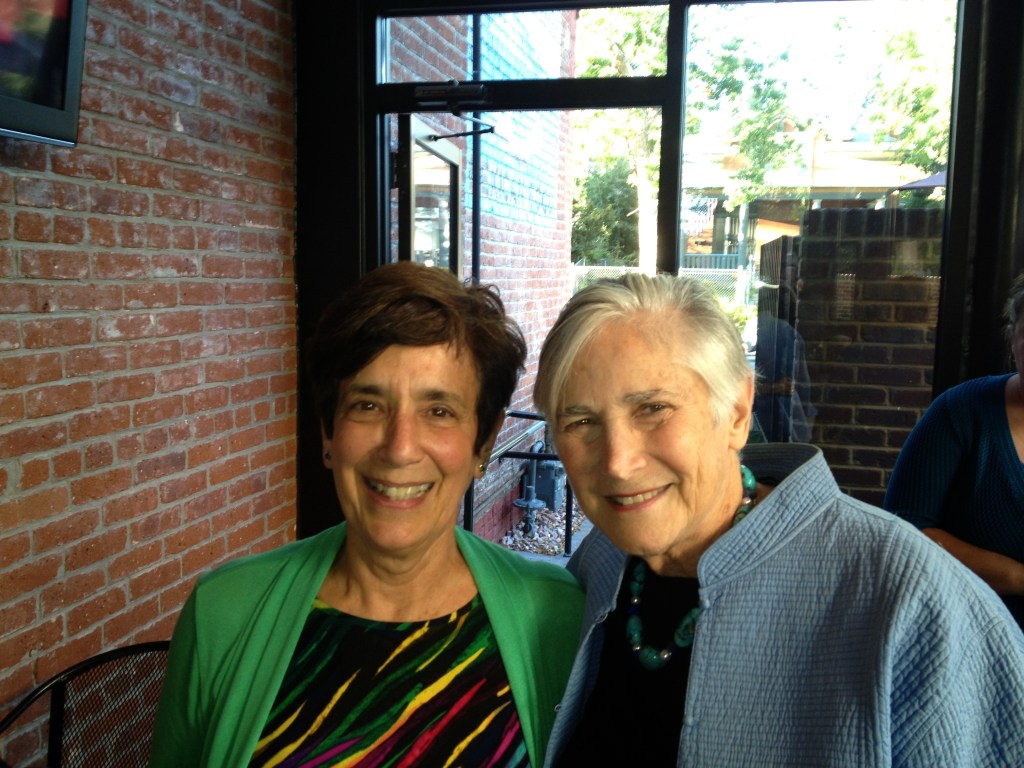
Jeannie and I in Denver, 2013.

James Talarico is a state legislator in Texas who stands up for public schools. He is a Democrat who supports gun control and expanded health care (he calls it “health care for y’all)”). He graduated from public schools in Round Rock, Texas, then earned his BA at the University of Texas and his MA in education policy at Harvard. He joined Teach for America and taught at a middle school in San Antonio, where his class had 45 students.

I’m usually skeptical about TFA teachers, but knowing Gary Rubinstein—an early TFA corps member—has taught me not to be so judgmental.

Talarico is a phenomenon. He’s an effective, outspoken opponent of vouchers. If you are still on Twitter (aka X), watch his powerful debunking of voucher myths. Vouchers are not “school choice,” because schools choose, and they can discriminate against anyone they want, for any reason.

Talarico recently co-sponsored a bill called “Fully Fund Our Schools,” which increases funding for the state’s public schools and provides a $15,000 raise for every teacher. Texas can afford it; the state has a $33 billion budget surplus.

Politico wrote about Talarico a few months ago and suggested that he might be the Democrat who is able to win a statewide office. He might run against Greg Abbott for governor in 2026. Talarico Represents a better future for Texas.

Talarico is a devout Christian. As the Politico story explains, he is taking classes at a seminary and hopes to be ordained as a pastor. He is steeped in Biblical knowledge, and he can respond to bigoted evangelicals and fundamentalists with the sense of love, hope, kindness, and charity that represents progressive Christian thought.

For his leadership, for his determined support for the public schools attended by 5 million students, for his enlightened support for progressive values, I am pleased to add James Talarico to the honor roll of this blog.

Yesterday was the tenth anniversary of Mercedes Schneider’s wonderful blog!

I learned about it last night, too late to mark the actual blog birthday.

Mercedes is one of the sharpest, smartest voices of the Resistance to privatization. She is a hero of the Resistance thanks to her incisive, brilliant exposés of “reform” hoaxes.

She is a high school English teacher in Louisiana. She has a Ph.D. in statistics and research methodology. She could have been a professor but she wanted to teach high school students.

I started my blog in April 2012; she started hers in January 2013. We exchanged emails, and we met when I came to speak in Louisiana. We became fast friends. Mercedes has been a regular at annual conferences of the Network for Public Education, where she most recently gave lessons on how to obtain tax forms and other public data about “reform” groups, which sprout like weeds, with new names, lots of money, and the same set of actors.

Mercedes is relentless. While teaching and blogging, she wrote four books over the past decade.

In 2014, her first book was A Chronicle of Echoes: Who’s Who in the Implosion of Public Education, a vivid portrayal of the cast of characters who pursued privatization and teacher-bashing while calling themselves “reformers.” Might as well have called themselves “destroyers,” because that’s what they are.

In 2015, she published Common Core Dilemma: Who Owns Our Schools?, with a foreword by Carol Burris, executive director of the Network for Public Education.

In 2016, she published School Choice: The End of Public Education?, with a foreword by Karen Lewis, the late and much-loved President of the Chicago Teachers Union.

In 2020, she gathered her advice about research and published A Practical Guide to Digital Research: Getting the Facts and Rejecting the Lies.

In her blogday post, she reflected on some positive developments in the past decade

Of course, the fight continues, but allow me to celebrate a few realities:

  • Bobby Jindal is no longer governor of Louisiana, and his 2016 presidential ambitions were a flop.
  • John White is no longer Louisiana state superintendent. In fact, he is not a superintendent anywhere at all.
  • Michelle Rhee is no longer DC school chancellor. She, too, is chancellor of nowhere at all.
  • Hanna Skandera is no longer NM school chief. She, too, is school chief of nowhere at all.
  • Joel Klein holds no sway over NYC schools. Chief of nowhere.
  • Teach for America (TFA) is losing its luster. Though it tries to reinvent itself, the bottom line is that the org depends upon class after class of willing recruits– a well that appears to be hitting bottom.

Yes, the fight continues. But today– today I take a moment to celebrate just a wee bit.

Happy Blogday to me.

I celebrate Mercedes too and happily name her to the honor roll of this blog.

Love you, Mercedes! May you keep on making a difference.

Melanie Stansbury was elected to Congress in New Mexico to fill the seat of Deb Haaland after she was named Secretary of the Interior. Stansbury had one audacious goal: she wanted the federal government to fund the construction of a new school for a tribal school in her district.

Jennifer bender of Huffington Post explains the saga of one Congresswoman’s quest to keep her promise:

WASHINGTON — Buried in the 4,155-page omnibus spending bill unveiled in the Senate on Tuesday is a single sentence that’s likely to go unnoticed by almost everyone — except the first-term congresswoman who fought for it with everything she had for the last year and a half.

“For an additional amount for ‘Education Construction,’ $90,465,000, to remain available until expended for necessary expenses related to the consequences of flooding at the To’Hajiilee Community School.”

It’s the only line item in the bill under a section titled “Bureau of Indian Education, Education Construction.” It’s money to rebuild a K-12 school in TóHajiilee, New Mexico, a remote community about 35 miles west of Albuquerque.

This school was built on a floodplain. For decades, walls of water have poured down from a nearby canyon and drowned the campus. School officials here routinely pull children from their classes and race to get them onto a bus to shuttle them to safety. Teachers scramble to move their cars to higher ground before they get washed away.

The constant flash floods have left the buildings in appalling disrepair. In March, the high school was abruptly vacated and shut down because it was literally sinking into mud, and its foundation was crumbling. The walls had visible cracks. Water poured through the roof every time it rained. There was nowhere else for the high school students to go, so they went home, where their teachers, somehow, carried on teaching virtual classes that previously involved hands-on work in chemistry labs, culinary arts classes and in woodworking classrooms.

The To’Hajiilee Community School has been neglected and massively underfunded since its founding. It’s one of 183 K-12 schools overseen by the Bureau of Indian Education (BIE), responsible for providing education to more than 48,000 Native American children around the country. Of these schools, 86 are in “poor condition,” and 73 don’t have the money for needed repairs, according to BIE data from 2021. An additional 41 of these schools are in “fair condition.”

The school isn’t just substandard; it’s a site that carries historical trauma. Like many of today’s BIE schools, the To’Hajiilee Community School is also a former Indian boarding school. For about 150 years, the U.S. government forced tens of thousands of Indigenous children to attend these schools to try to assimilate them into white culture. As a result, these kids endured physical, psychological and sexual abuse. Some died. Others disappeared.

Despite having such few resources, the To’Hajiilee Community School has still managed to thrive culturally, said Rep. Melanie Stansbury (D-N.M.), who represents this district. School officials have reclaimed the space and built a strong community around it, grounding its activities in Indigenous language and cultural revitalization.

Stansbury has made it her number-one priority to find money for the school ever since she won a special election in June 2021 to fill the House seat vacated by now-Interior Secretary Deb Haaland. And if anyone knows how the congressional appropriations process works, it’s Stansbury.

The lawmaker previously worked on BIE’s budget at the Office of Management and Budget and was a staffer on the Senate Committee on Energy and Natural Resources. For the last 18 months, Stansbury has been aggressively, if desperately, lobbying anyone who has a say in tribal school funding — House appropriators, congressional leadership, White House officials, Interior Department officials — to fund the To’Hajiilee Community School adequately.

Over the past few weeks, as lawmakers scrambled to get their priorities into the $1.7 trillion year-end spending bill, Stansbury says she spent “every day, all day long,” dogging House and Senate appropriators, Hill leaders and administration officials to include money for the school. She didn’t know until Tuesday morning, when the bill was publicly released and she pored over its text, that her efforts had paid off.

“We’ve been working so hard on this, for so long, I literally woke up … and bawled my eyes out,” Stansbury told HuffPost in an emotional interview on Tuesday. “I invested everything I had to get funding for this school. The To’Hajiilee community is only a short distance from Albuquerque, but the people out there have so much need, and the community hasn’t had its needs and priorities met. It’s just so huge for this community.”

Good work, Cong. Stansbury. I’m pleased to add you to the honor roll of this blog at the urging of a member of our blog community.

Donna Mace recently died, unexpectedly, and the public schools of the United States and Florida lost a dear friend.

Sandy Stenoff wrote this tribute to Donna, who taught elementary school students for 35 years, then became an outspoken activist for public schools and against the overuse of standardized testing. Of course, she was a BAT.

She concluded:

Donna Mace made the world a better place by being a force for good. She was a class act, approaching life’s challenges with courage, grace, humility, humor, and optimism, We all benefited from Donna’s wisdom, gained from her experience as a lifelong educator and a life well lived. She really was the best of us.

To the Mace family: Our thoughts are with you now and we send you love, gratitude, and a wish that your fondest memories will bring you peace and comfort.

I am sadened that we have lost Donna Mace. Many were inspired by her and will follow in her footsteps, never abandoning the struggle to do what is right for children. I hereby add her name to the honor roll, a list of distinguished fighters for public schools and children.

Dear Mitchell,

I want to congratulate you for your courage in running for the Michigan State Board of Education and double-congratulate you for winning! You have been a faithful member of the Network for Public Education, and I have been proud to post your writings here.

You entered the race knowing that it was supposed to be a bad year for Democrats. You jumped in anyway because you thought you could make a difference. You will!

You entered knowing that you, a professor of music education at Michigan State University, would be pitted against the billionaire DeVos machine. I’m thrilled to see that the entire Democratic ticket swept the State Board of Education and both houses of the Legislature.

You beat Betsy DeVos!

When frustated educators ask me what they can do, I tell them I can think of two options: join your state union (if you have one) and fight back or run for office, for local board, state board or the legislature.

You did it and you won! I know you are thrilled to be part of Michigan’s blue wave. You inspire the rest of us.

I am happy to add you to the honor roll of this blog for your courage, your persistence, and your devotion to Michigan’s children and their public schools.

Diane

This is a thrilling story, reported by The Intercept.

THE NATIONWIDE CAMPAIGN to stifle discussions of race and gender in public schools through misinformation and bullying suffered a reversal in Idaho on Monday, when a high school senior vocally opposed to book bans and smears against LGBTQ+ youth took a seat on the Boise school board.

The student, Shiva Rajbhandari, was elected to the position by voters in Idaho’s capital last week, defeating an incumbent board member who had refused to reject an endorsement from a local extremist group that has harassed students and pushed to censor local libraries.

Rajbhandari, who turned 18 days before the election, was already well-known in the school district as a student organizer on climate, environmental, voting rights, and gun control issues. But in the closing days of the campaign, his opponent, Steve Schmidt, wasendorsed by the far-right Idaho Liberty Dogs, which in response helped Rajbhandari win the endorsement of Boise’s leading newspaper, the Idaho Statesman.

Rajbhandari, a third-generation Idahoan whose father is from Nepal, was elected to a two-year term with 56 percent of the vote.

In an interview, Rajbhandari told The Intercept that although he had hoped people would vote for him rather than against his opponent — “My campaign was not against Steve Schmidt,” he said — he was nonetheless shocked that Schmidt did not immediately reject the far-right group’s endorsement. “I think that’s what the majority of voters took issue with,” Rajbhandari said.

The Idaho Liberty Dogs, which attacked Rajbhandari on Facebook for being “Pro Masks/Vaccines” and leading protests “which created traffic jams and costed [sic] tax payers money,” spent the summer agitating to have books removed from public libraries in Nampa and Meridian, two cities in the Boise metro area.

But, Rajbhandari said, “that’s the least of what they’ve done. Last year, there was a kid who brought a gun to Boise High, which is my school, and he got suspended and they organized an armed protest outside our school.”

Rajbhandari, who started leading Extinction Rebellion climate protests in Boise when he was 15, is familiar with the group’s tactics. “We used to have climate strikes, like back in ninth grade, and they would come with AR-15s,” he said, bringing rifles to intimidate “a bunch of kids protesting for a livable future.”

So when the Idaho Liberty Dogs called on Boise voters to support Schmidt — and a slate of other candidates for the school board who, ultimately, all lost — Rajbhandari told me he texted his rival to say, “You need to immediately disavow this.”

“This is a hate group,” Rajbhandari says he told Schmidt. “They intimidate teachers, they are a stain on our schools, and their involvement in this election is a stain on your candidacy.” Schmidt, however, refused to clearly reject the group, even after the Idaho Liberty Dogs lashed out at a local rabbi who criticized the endorsement by comparing the rabbi to Hitler and claiming that he harbored “an unrelenting hatred for white Christians.”

While the school board election was a hyperlocal one, Rajbhandari is aware that the forces he is battling operate at the state and national level. “Idaho is at the center of this out-of-state-funded far-right attack to try to undermine schools, with the end goal of actually abolishing public education,” Rajbhandari told me. “There’s a group, they’re called the Idaho Freedom Foundation, and they actually control a lot of the political discourse in our legislature. Their primary goal is to get rid of public education and disburse the money to charter schools or get rid of that funding entirely.”

For his courage and candor, he won the endorsement of The Idaho Statesman.

This is a remarkable young man with a bright future ahead of him. I am happy to add him to the honor roll of this blog.

Read the rest of the story by opening the link. Rajbhandari is a force to be reckoned with. He is a good omen of the bright, dedicated young people who stand up for their teachers and for environmental activism, who fight for gun control and against censorship. Best wishes to him!

The superintendent of schools in Granbury, Texas, made clear that he didn’t want any books about LGBT characters or LGBT issues in the school library. He agreed with the angry conservatives who showed up at school board meetings to demand book-banning.

Superintendent Jeremy Glenn has previously emphasized to the district’s librarians that their community was “very, very conservative” and that any school employee who does not possess conservative beliefs “better hide it.” While he started by saying he didn’t care if the books were about homosexuality or heterosexuality, he spoke explicitly about banning books with LGBTQ content.

“And I’m going to take it a step further with you. There are two genders. There’s male, and there’s female. And I acknowledge that there are men that think they’re women. And there are women that think they’re men. And again, I don’t have any issues with what people want to believe, but there’s no place for it in our libraries.”

But then a parent with a child in the Granbury schools got up and pointed out that the folks who were complaining the loudest did not have any children in the schools. And she let them have it for their effort to impose their religion on her child’s public school.

Adrienne Quinn Martin went to the podium and let it rip.

“We know that books are continuing to be purged. We know student library aides have been banned. We know that a group of non-parents have pushed for these removals and continue to do so,” she began. “So, being a taxpayer does not grant special privileges over students, staff, and parents. I do not want random people with no education background or experience determining what books my child can read, what curriculum they learn, and what clubs they can join.”

“Just because you can get up at every meeting and rant and rave does not give you authority over my child’s education.”

“Your personal religious beliefs, people in this room and on this board, should not have an effect on my child’s education either. Our school are not to be used for personal political agendas and our children are here for education, not religious indoctrination,” she told the room as she looked various board members and attendees directly in the eye.

“I implore the board to put an end to attempts to appease these extremists. Focus on retaining staff, providing excellent public education and a safe and welcoming learning space for all students. The speakers speaking about what great Christians they are? Great. Go tell your pastor. Our schools are not your church.”

And as the room erupted in applause for her bold speech, Martin gathered up her papers and, with a nod, left the podium. The superintendent did not reply.

If you want to see her speech, it’s on her Twitter account @Mrsamartini

For her courage and common sense, I add her to the honor roll of this blog.