Archives for category: Higher Education

Most people are aware that the cost of higher education has dramatically escalated in recent years, for a variety of reasons. Some students do not enroll in college because they can’t afford it. Others graduate with crushing debt, based on student loans. It’s hard to believe that some European nations have made college either free or affordable.

President Biden has tried repeatedly to find ways to help students pay off their college debt. His most ambitious plan was overturned by the Supreme Court in 2023.

Biden devised a new plan, and yesterday the Supreme Court temporarily blocked that one today.

Adam Lipton and Abby VanSickle of The New York Times told the story:

The Supreme Court on Wednesday temporarily blocked a new effort by President Biden to wipe out tens and perhaps hundreds of billions of dollars of student debt.

The plan was part of the president’s piecemeal approach to forgiving debt after the Supreme Court rejected a more ambitious proposal last year that would have canceled more than $400 billion in loans. Mr. Biden has instead pursued more limited measures directed at certain types of borrowers, including people on disability and public service workers, and refined existing programs.

The decision leaves in limbo millions of borrowers enrolled in a new plan, called Saving on a Valuable Education, which ties monthly payments to household size and earnings.

The emergency application was one of two related to the program that the justices decided on Wednesday. The brief order did not give reasons, which is typical, and no public dissents were noted.

Republican-led states had filed a number of challenges to the plan, including a lawsuit in the U.S. Court of Appeals for the Eighth Circuit, in St. Louis, which earlier this summer issued a broad hold on the loan plan while it considers the merits of the case.

That case could soon make its way back to the justices, who indicated that they expected the lower court to act swiftly on the matter.

The Biden administration had argued the new program was authorized by a 1993 law that allowed the secretary of education to fashion “income contingent repayment” plans. The law authorizes the secretary to determine repayment schedules based on “the appropriate portion of the annual income of the borrower.”

Over the years, the secretary has invoked that law several times to relax repayment requirements. The latest plan, the subject of the Supreme Court’s order, was the most generous one.

It reduced the required payments for undergraduate loans to 5 percent from 10 percent of the borrower’s discretionary income, and it redefined discretionary income to be above 225 percent of the poverty line. People making less than that pay nothing. Loans of $12,000 or less are canceled after 10 years — down from 20 or 25 years — so long as the borrower made payments if required to do so.

The SAVE program, issued in June 2023, was challenged nine months later by the attorneys general of 11 Republican-led states, who said it was flawed in ways similar to the one the justices rejected last year. The 1993 law, they said, contemplates repayment rather than actual or effective forgiveness.

In the administration’s Supreme Court brief in response to one of the challenges, Solicitor General Elizabeth B. Prelogar wrote that the new plan “relies on a different statute with different language to provide a different set of borrowers with different assistance from the one-time loan forgiveness the court held invalid.”

The old plan invoked the Higher Education Relief Opportunities for Students Act of 2003, often called the HEROES Act. That law, initially enacted after the terrorist attacks on Sept. 11, 2001, gave the secretary of education the power to “waive or modify any statutory or regulatory provision” to protect borrowers affected by “a war or other military operation or national emergency.”

In its decision last year, the Supreme Court ruled by a 6-to-3 vote that the 2003 law did not authorize forgiving the loans at issue there. That same day, President Biden vowed to find other ways to provide debt relief.

“Today’s decision has closed one path,” Mr. Biden said. “Now we’re going to pursue another.”

The new program was based on a federal law that contemplated reduced payments based on income.

In the Eighth Circuit lawsuit, filed in Missouri, the appeals court temporarily blocked the entire SAVE plan. The Biden administration had asked the justices earlier this month to clear the way for the plan to take effect.

The administration initially estimated that the SAVE plan would cost $156 billion over 10 years, but that amount assumed that the Supreme Court would uphold the earlier plan. The real cost of the new plan, the states challenging it said, is $475 billion over 10 years. The administration says the real number is smaller, particularly as parts of the SAVE plan have not been blocked.

Dean Baker published a terrific article in The New Republic, called “The Biggest Success Story the Country Doesn’t Know About.” Baker is a  macroeconomist who co-founded the Center for Economic and Policy Research(CEPR) with Mark Weisbrot.

He wrote:

Over the last few weeks, an extraordinary series of events has altered the course of an election that previously seemed to have few surprises in store. Eight days after Donald Trump survived an assassination attempt, President Joe Biden announced his historic decision to withdraw from the presidential race and cast his support for Vice President Kamala Harris to run in his stead. It will be some time before we know all the political ramifications of these events, but whatever they may be, they will not change the past.

What can the past tell us about what’s to come? Perhaps the most critical element of a candidate’s platform is their approach to the economy. In assessing Harris as a presidential candidate, people will want to look at the economic track record of the Biden-Harris administration. As always, the president takes the lead role in setting the economic course for the administration, but throughout Biden’s term in office, Harris was standing alongside him. The Republicans will surely blame her for everything that went wrong and many things that didn’t. On the other hand, Harris can take credit for what went right, and there is much here to boast about. Indeed, she can (and should) run on the outstanding—and criminally underappreciated—economic record of the Biden administration.

Under Biden, the United States made a remarkable recovery from the pandemic recession. We have seenthe longest run of below 4.0 percent unemployment in more than 70 years, even surpassing the long stretch during the 1960s boom. This period of low unemployment has led to rapid real wage growth at the lower end of the wage distribution, reversing much of the rise in wage inequality we have seen in the last four decades. It has been especially beneficial to the most disadvantaged groups in the labor market.

The burst of inflation that accompanied this growth was mostly an outcome of the pandemic and the invasion of Ukraine. All other wealthy countries saw comparable rises in inflation. As of summer 2024, the rate of inflation in the United States has fallen back almost to the Fed’s 2.0 percent target. Meanwhile, our growth has far surpassed that of our peers.

Furthermore, the Biden administration really does deserve credit for this extraordinary boom. Much of what happens under a president’s watch is beyond their control. However, the economic turnaround following the pandemic can be directly traced to Biden’s recovery package, along with his infrastructure bill, the CHIPS Act, and the Inflation Reduction Act, all of which have sustained growtheven as the impact of the initial recovery package faded. While the CARES Act, pushed through when Trump was in office, provided essential support during the shutdown period, it was not sufficient to push through the recovery.

Finally, the negative assessment that voters routinely give the Biden administration on the economy seems more based on what they hear from the media or elsewhere. They generally rate their own financial situation positively and say that the economy in their city or state is doing well. It is only the national economy, of which they have no direct knowledge, that they rate poorly.


Let the Good Times Roll!

Before going through what is positive about the Biden economy, I’ll just state the obvious. Tens of millions of people are struggling to get by, or not getting by at all. This is a horrible situation, which we should be trying to change every way we can. However, this has always been the case. We have a badly underdeveloped system of social supports, so that people cannot count on getting the foodhealth care, and shelter they need.

It’s also the case that the spurt of inflation in 2021 and 2022 was a shock after a long period of low inflation. People found themselves paying considerably more for foodgasshelter, and other essentials, and in many cases their pay did not keep up, especially at the time these prices were soaring.

But the Biden administration has taken important steps to directly improve the situation for low- and moderate-income people, notably by making the subsidies in the exchanges created by the Affordable Care Act, or ACA, more generous and expanding the Child Tax Credit, or CTC. He increased the benefitsin the Supplemental Nutrition Assistance Program, or SNAP, by 21 percent. Unfortunately, the expansion of the CTC, which was included in the initial recovery package, was only temporary. It expired at the end of 2021, and Biden has been unable to get the support needed in Congress to extend it.

While we should always recognize the enormous work left to be done, we need as well to acknowledge when we are making progress, and we have made an enormous amount of progress in improving living standards during Biden’s presidency. Also, the suffering of tens of millions of people at the lower end of the income distribution can’t possibly be the explanation for negative views of the economy. People at the bottom were suffering at least as much in 2019, when most people gave the economy high marks.

Shortly after Senator Ben Sasse left the U.S. Senate, he accepted the presidency of the University of Florida. Silas Morgan of the Orlando Sentinel relied on reporting by the student newspaper, the Independent Florida Alligator, to describe how former Senator Sasse upped the budget for his office by millions of dollars.

The University of Florida’s student newspaper reported Monday that former university president Ben Sasse spent millions of the school’s money to hire GOP political allies.


Sasse, a former Republican U.S. Senator from Nebraska, gave several one-time Senate staff members and other GOP officials lucrative remote positions at UF, according to records obtained by the Independent Florida Alligator.


Among the Senate staffers who joined him at UF are his former chief of staff, Raymond Sass; his former communications director, James Wegmann; his former press secretary, Taylor Silva; and three other former staffers. Both Sass and Wegmann worked remotely from the Washington D.C. area.


Sass’ salary, at $396,000, was more than double his Senate salary. Wegmann’s new position at UF earned him $432,000, while his predecessor in the position had made $270,000.

The hirings contributed to a $4.3 million increase in presidential salary expenses, part of a tripling of his office’s spending compared to what his predecessor, Kent Fuchs, spent during his last year in office, the Alligator reported. Sasse’s office employed more than 30 staff members, while Fuchs had fewer than 10.


Sasse also hired former Tennessee Education Commissioner Penny Schwinn, who worked remotely from Nashville, in a newly-created position that paid a starting salary of $367,500 and U.S. Senator Lindsey Graham’s former scheduler, Alice James Burns, who also worked remotely and was paid $205,000.


A report obtained by the Alligator says Sasse spent over $20,000 flying his employees to UF between April 29 and July 29. The only hire who lives in Florida received a $15,000 stipend to relocate to Gainesville.


UF hasn’t responded to requests from the Alligator for a complete log of Sasse’s travel expenses. His travel expenses rose to $633,000 over his first full fiscal year, more than Fuchs spent on travel in eight years.

He also spent $7.2 million on consulting contracts, nearly two-thirds of which went to consulting giant McKinsey and Company, where he used to work as an advisor on an hourly contract. This amounts to more than 40 times what Fuchs spent on consulting in eight years.

Sasse abruptly resigned at the end of July, citing his wife’s failing health. The Alligator says the university did not respond to questions about what would happen to the hires now that Sasse is gone. Fuchs has returned as interim president until the UF Board of Trustees can hire a permanent replacement for Sasse.


Sasse’s hiring by the Board in 2022 resulted in the UF Faculty Senate passing a no confidence resolution in Sasse’s presidential search process due to transparency issues. Legislation passed by Florida’s GOP-controlled legislature earlier in 2022 made records relating to public university presidential searches exempt from Florida’s open public meetings and public records requirements.

His appointment by the board of trustees also generated controversy among parts of the student body, especially the LGBTQ+ community, for political positions Sasse had taken while in the Senate.

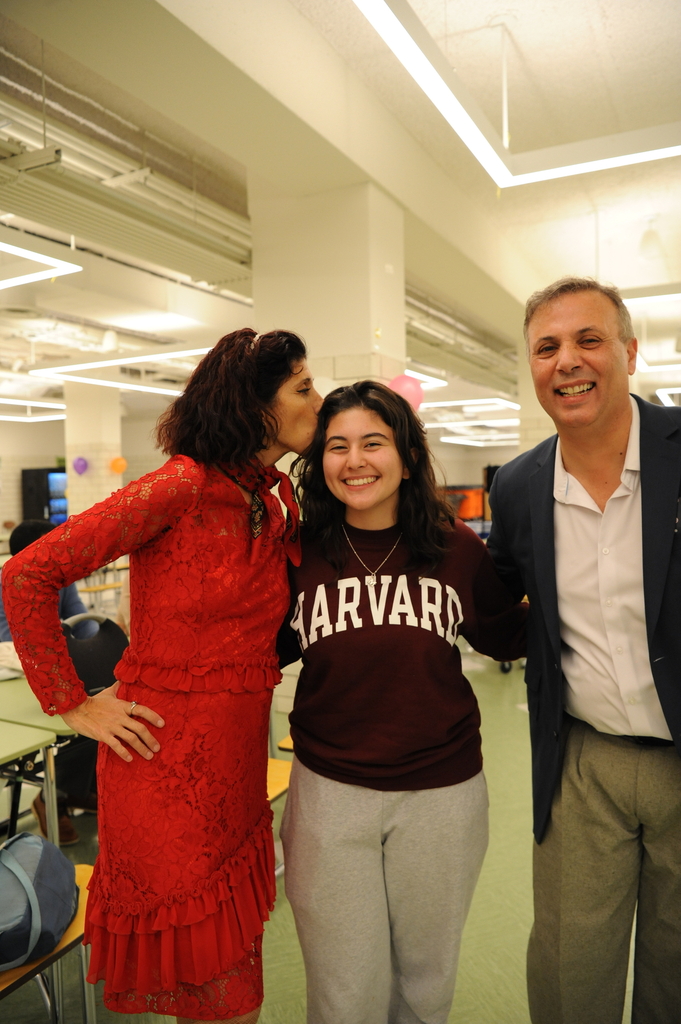
Malena Galletto, the daughter of immigrants from Argentina, was accepted at 28 colleges, including all eight Ivy League colleges. Malena attended the Bronx High School of Science, one of the city’s most selective high schools, where she had a 97% average. Malena is the first in her family to attend college.

Malena has decided to go to Harvard.

When you hear Donald Trump rant about immigrants, accuse them of horrible criminal behavior, think of Malena.

It is 7 p.m. on March 28th, 2024. Malena Galletto ’24 sat in her dad’s car on their way to a family friend’s house for a long weekend. In the back seat, Galletto sat with her laptop opened to the eight college portals that released their decisions. Dartmouth, Brown, Cornell, Harvard, Yale, Princeton, Columbia, and University of Pennsylvania. 

Having received an encouraging letter from Columbia a few weeks prior, Galletto opened the Columbia decision first. She rejoiced at her first acceptance of the day. She then opened Dartmouth, followed by Brown and Cornell, and eventually Harvard, Yale, University of Pennsylvania, and Princeton. By the end of the night, Malena had gotten into all eight ivies.  

In total, Galletto applied to 28 colleges in the United States, hopeful that she would get into at least one of them. She was accepted to all 28 universities that she applied to. Galletto is an Argentinian-American who grew up in Washington Heights, and she embraces her Latin culture. Growing up, she was strongly immersed in the Tango community. 

Galletto: “My mom loves dancing. I spent so much time watching her and her friends Tango, that dancing is just a part of me. I think that I probably learned to Tango before I learned to walk.” 

Galletto’s culture is one of the most important things for her. Galletto believes that preserving Argentinian culture through celebrating the traditional dance of Tango is crucial for keeping it alive and thriving. Growing up in Washington Heights in Manhattan, Galletto had a first hand account of how the pandemic negatively impacted the Tango community. Due to social distancing, cultural activities and showcases were canceled, giving a devastating blow to the whole community.  

Galletto: “Despite these challenges, over the past couple of years, we have been focused on ensuring that Argentinian cultural heritage remains active. Efforts to keep the community engaged have been paramount, as we are continuing to find innovative ways to connect and celebrate our traditions, despite the restrictions. This includes everything from increasing our outreach to hosting virtual concerts. As I was preparing for college applications, this commitment to cultural preservation was a significant part of my application, since it is such a big part of who I am and my story.”

Throughout her fight for preserving her culture and maintaining her passions for education, Galletto recognizes her mom as her biggest cheerleader and motivation. 

Despite being the valedictorian of her high school, Galletto’s mother did not get the opportunity to attend college. 

Galletto: “My mom was the valedictorian of her high school, and she has always emphasized the importance of education. She believes that education opens up a world of opportunities, and she has always pushed me to prioritize my education. This has been crucial for me, as I have been looking to strike the perfect balance for maintaining my grades and also to continue fighting for what I believe in.”

Galletto: “Being first-generation and of low-income, navigating the complexities of college was daunting. I did not have the generational wisdom passed down by parents who attended college, so not understanding the process felt a little like stumbling in the dark. However, the process was made a lot less challenging thanks to the generosity of the Bronx Science Foundation. Their abundance of resources helped me decipher the intricacies of the applications, financial aid, and campus life. For someone like me, the first person in my family to attend college, those resources were not just helpful — they were transformative. They empowered me to chase my dreams despite the odds stacked against me.”

The Boston Globe reported on Harvard’s decision to ban mandatory diversity statements. In recent years, many universities required applicants to the faculty to write a statement demonstrating their fealty to diversity, equity and inclusion. One of Harvard’s most prominent African-American professors—Randall Kennedy of the Harvard Law School—wrote an opinion piece in the campus newspaper opposing the requirement as a breach of academic freedom. Other universities, including MIT and the University of North Carolina, have already dropped the diversity pledge, likening it to a loyalty oath.

Less than five years ago, Harvard University’s Faculty of Arts and Sciences followed a trend that was then sweeping across American higher education. It instituted a requirement that professors who wished to work at Harvard submit an essay explaining how they would advance “diversity, inclusion, and belonging” in their work.

On Monday, the university’s largest division announced it had reversed course, eliminating the requirement after receiving “feedback from numerous faculty members” who were concerned about the mandatory statements.

A seemingly routine part of academic hiring, diversity statements have become the focus of intense scrutiny as universities grapple with the question of whether well-intentioned efforts to diversify the elite ranks of American institutions have sometimes collided with other core values of academia.

“By requiring academics to profess — and flaunt — faith in DEI, the proliferation of diversity statements poses a profound challenge to academic freedom,” Randall Kennedy, a scholar of race and civil rights at Harvard Law School, wrote in an April op-ed in the Harvard Crimson, the student newspaper.

That essay was widely read in academic circles. It was also cited approvingly in a recent Washington Post editorial that criticized mandatory diversity statements and praised the recent decision by the Massachusetts Institute of Technology to ban their use…

In an announcement Monday, dean of faculty affairs Nina Zipser, said that going forward candidates for tenure-track positions would be required to provide a more broadly focused “service statement,” instead of a statement focused specifically on “diversity, inclusion, and belonging.” A service statement could include a candidate’s efforts to promote diversity and inclusion, but is not required to focus on those topics….

Ryan Enos, a Harvard political scientist and director of the Center for American Political Studies, said he generally pays little attention to diversity statements when vetting candidates. “You got the impression that they reflected more about candidates knowing the right things to say rather than an actual commitment to improving the department on diversity and other matters,” he said.

Of course, critics of the decision complained that universities were backing down from their commitment to diversity due to political harassment by rightwing politicians who object to diversity. But where values are deeply embedded, they are unlikely to disappear.

After months of heated controversy over the war in Gaza, Harvard University has adopted a policy of “institutional neutrality,” asserting that the core function of the university is to protect free speech and debate and to advance learning, not to take sides. Other universities are considering following Harvard’s lead.

I personally think that this is the proper path for institutions of higher education. They should be places where debates about public policy may occur without intimidation by students or wealthy donors.

The Boston Globe reports:

After months of controversies tied to the Israel-Hamas war, Harvard University said Tuesday that its administration would no longer issue official statements about public matters that “do not directly affect the university’s core function.”

The school made the announcement more than a month after an Institutional Voice Working Group was established to consider the matter. It come as conversations around the country debate whether to issue public statements on divisive issues of the day.

“The integrity and credibility of the institution are compromised when the university speaks officially on matters outside its institutional area of expertise,” the working group said in a report, which was accepted by Harvard’s administration….

Harvard was engulfed last fall in controversies over what to say about the Israel-Hamas war. A growing chorus of professors and administrators proposed a simple solution: silence.

At Harvard and other universities, momentum has been building for “institutional neutrality,” the principle that university leaders should refrain from taking positions on weighty social and political matters. That idea was, until recently, a fairly obscure concept debated within the academy.

But after the Oct. 7 Hamas attack on Israel plunged many American universities into turmoil, and thrust their leaders into debates over an intractable conflict, schools from Cambridge to California are considering adopting institutional neutrality as a matter of official policy.

Interim Harvard president Alan Garber assembled the working group to study the matter. Columbia’s University Senate recently adopted institutional neutrality in a unanimous vote. Faculty groups at the University of Pennsylvaniaand Yale University are pushing their leaders to do the same.

Proponents argue that adopting neutrality will make universities more governable and protect their mission of fostering open inquiry. Universities, they say, should be forums for debates, not participants in them. But critics say the idea of a neutral university is a chimera. Endowments invest in fossil fuel stocks and some schools accept donations from representatives of autocratic regimes. Neutrality, critics say, is a way to deflect scrutiny and avoid taking morally correct but inconvenient stands…

However, in its report, the Harvard working group said that “the university is not a neutral institution.”

“It values open inquiry, expertise, and diverse points of view, for these are the means through which it pursues truth,” read the report. “The policy of speaking officially only on matters directly related to the university’s core function, not beyond, serves those values.”

Speaking at a private fundraising event, Donald Trump said that he would put a quick end to campus protests against Israel’s war in Gaza. When Trump was president, he moved the American Embassy to Jerusalem, which previous presidents refused to do and took other actions that endeared him to Prime Minister Netanyahu, like canceling the multinational Iran nuclear deal, which Israel opposed. Netanyahu called Trump “the best friend Israel has ever had in the White House.”

According to The Washington Post:

Former president Donald Trump promised to crush pro-Palestinian protests on college campuses, telling a roomful of donors — a group that he joked included “98 percent of my Jewish friends” — that he would expel student demonstrators from the United States, according to participants in the roundtable event with him in New York.


“One thing I do is, any student that protests, I throw them out of the country. You know, there are a lot of foreign students. As soon as they hear that, they’re going to behave,” Trump said on May 14, according to donors at the event.


When one of the donors complained that many of the students and professors protesting on campuses could one day hold positions of power in the United States, Trump called the demonstrators part of a “radical revolution” that he vowed to defeat. He praised the New York Police Department for clearing the campus at Columbia University and said other cities needed to follow suit, saying “it has to be stopped now.”

From the beginning of the pro-Palestinian campus protests, I have objected to the students’ one-sided support of one side—Hamas. Their chant of “from the river to the sea” implicitly endorses Hamas’ demand to eliminate the state of Israel and to “Islamicize” all the land that includes Israel. With a better knowledge of history, the students would have condemned Hamas’ terrorism and Israel’s Prime Minister Netanyahu, who has launched a campaign of intimidation and terror against the civilian population of Gaza, who have been victims of not only mass bombing but famine.

The Washington Post reported that the campus protests have failed to win the support of the American public. Perhaps they remember 9/11 or the USS Cole or any number of other terrorist attacks where the victims were Americans.

Multiple polls in recent weeks have shown relatively little sympathy for the protesters or approval of their actions. And notably, large numbers of Americans have attached the “antisemitic” label to them.

The most recent data on this come in the form of a striking poll in New York, a hotbed of the protests at Columbia University, in particular.
The Siena College poll shows residents even of that blue-leaning state — Democrats tend to sympathize more with the Palestinian cause — agreed 70 percent to 22 percent that the protests “went too far, and I support the police being called in to shut them down.”

Public sentiment has encouraged Republicans to politicize the issue by harassing university presidents for their failure to close down the student protests. There is something richly ironic about the new-found Republican interest in anti-Semitism. If they really cared about Jew-hatred, they would ask Trump to testify about his relationships to known anti-Semites and neo-Nazis.

But no. Their audiences want to see them pillory the presidents of elite universities, to please their base. The most aggressive of the questioners, Rep. Elise Stefanik, is a graduate of Harvard University. Her low tactics are a disgrace to her university.

Yesterday, members of Congress, mostly Republicans, harangued three university presidents for ignoring anti-Semitism displayed by campus protestors who support Palestinians, and in some cases, the terrorist group Hamas.

Three university leaders were accused on Thursday, during a congressional hearing, of turning a blind eye to antisemitism on their campuses, while capitulating to “pro-Hamas” and “pro-terror” student groups.

During more than three hours of grueling questioning, Northwestern University President Michael Schill, Rutgers University Jonathan Holloway and UCLA Chancellor Gene Block were often bullied and taunted by members of the House Committee on Education & the Workforce for not cracking down more forcefully on anti-Israel protesters who had set up unauthorized encampments on their campuses.

“Each of you should be ashamed of your decisions that allowed antisemitic encampments to endanger Jewish students,” said Chairwoman Virginia Foxx, a Republican from North Carolina.

Schill and Holloway bore the brunt of the wrath of the Republican-controlled committee for also cutting deals with the protesters rather than calling in police to clear the encampments. Seven Jewish members of a committee tasked with fighting antisemitism at Northwestern resigned in protest at the concessions made by their university president to the protesters.

Neither university agreed to an academic boycott of Israel, but they promised to hold discussions in the future on the possibility of divesting from companies with ties to Israel. As part of its agreement, Northwestern also promised to take in students from Gaza displaced by the war, while Rutgers agreed to form a partnership with Birzeit University in the West Bank.

“I think your performance here has been very embarrassing to your school,” U.S. Representative Jim Banks, a Republican from Indiana, told Schill after the president of Northwestern refused to answer questions about a journalism professor at his university who had participated in the protests and scuffled with police.

When asked by Banks whether he allows professors at Northwestern to praise Hamas, Schill, who is Jewish, responded: “They have all the rights of free speech.”

Banks retorted: “Four billion dollars have gone to your university. We should not give you another taxpayers’ dollar for the joke your university has become.”

Elise Stefanik, the Republican congresswoman from New York, was especially hostile, accusing Schill of “unilateral capitulation to the pro-Hamas, anti-Israel, antisemitic encampment.

When he tried to clarify a point, Stefanik – who has been fashioning herself as a leading voice against the pro-Palestinian student protests – cut him off. “I’m asking the questions here,” she said angrily.

When asked by Stefanik if it was true that he had asked the director of the Hillel chapter at Northwestern whether it was possible to hire an ant-Zionist rabbi as university chaplain, Schill responded emphatically that he had never made such an inquiry.

“That’s not true according to the whistleblowers who’ve come forth to this committee,” retorted Stefanik.

Holloway was interrogated by Congressman Bob Good, a Republican from Virginia, about a think tank at Rutgers that has referred to Israel’s government as genocidal, among other anti-Israel statements it has issued in recent months. When asked, Holloway said he had no intention of closing down this Center for Security, Race and Rights.

Good: “Do you think Israel’s government is genocidal?

Holloway: “Sir, I don’t have an opinion about Israel in terms of that phrase.”

Good: “You do not have an opinion as to whether or not Israel’s government is genocidal?”

Holloway: “No, sir. I think Israel has a right to exist and protect itself.”

Good: “Do you think Israel’s government is genocidal?”

Holloway: “I think Israel has a right to exist and protect itself, sir.”

Good: “But you will not say that Israel’s government is not genocidal? You can’t say that?”

Holloway: “Sir, I believe the government . . . “

Good: “Are you in a position to answer any questions? Do you have an opinion on anything?

Later on in the hearing, Holloway was given a second chance to address the question, phrased somewhat differently. When asked by Congressman Eric Burlison, a Republican from Missouri, whether they believed Israel was genocidal, all three university leaders responded that they did not.

The Los Angeles Times reported that officials at Berkeley reached an agreeement with pro-Palestinian protestors:

Pro-Palestinian protesters at UC Berkeley took down all but a few tents on a central campus plaza Tuesday, in an agreement that appears to end for now one of the largest and longest student encampments in the country as Chancellor Carol Christ said she would consider demands for the university to divest from weapons companies. Christ said that the university would examine complaints of discrimination against Palestinians and others in academic partnerships and that she supported examining Berkeley’s investments in firms involved in the weapons manufacturing, mass incarceration and surveillance industries. But the university will not support divestment or academic boycotts aimed at Israel.

Anand Giridharadas is a brilliant writer and thinker who blogs at The Ink. In this post, he interviews Michael Roth, the President of Wesleyan College in Connecticut, who describes how he has handled student protests without calling in the police or trampling on free speech rights. Just days ago, Roth wrote an article in The New York Times advising that the best college choice is one where you don’t fit in; go outside your comfort zone. Be a nonconformist.

Anand writes:

In recent weeks, the wave of antiwar protest that began at Columbia University spread across the country, as did the backlash against it.

Many university leaders responded by shutting down student speakerscanceling commencement ceremonies, and ultimately calling in police to clear encampments and campus building occupations with mass arrests. Thousands of students, professors, and other protestors have been arrested nationwide; meanwhile, protests are ongoing, the House Committee on Education and the Workforce continues its fishing-expedition investigation of higher education, and the domestic battle over the campus protests continues to distract attention from the ongoing war in Gaza.

What is right here? Should universities crack down on students who disrupt campus life, even if their cause is just? Are there steps student groups could take to more clearly separate their movements from elements of antisemitism? Can the rest of society muster enough historical memory and thick enough skin to remember that students are often telling us something that we need to hear, even if we don’t want to?

One university leader has been grappling with these questions in an especially thoughtful way, in part because, in addition to running a university, he is a scholar of universities and of education. That grounding shows. Under Michael Roth, Wesleyan University has cut a different path from many campuses, by clearly and calmly reiterating students’ right to protest peacefully, as Roth did in this letter:

The students there know that they are in violation of university rules and seem willing to accept the consequences. The protest has been non-violent and has not disrupted normal campus operations. As long as it continues in this way, the University will not attempt to clear the encampment.

At the same time, Roth has been clear about the importance of keeping people’s focus on the underlying war, not elite campuses; on the very real problem of antisemitic elements in and around the protests; and about the need to sustain campuses as places where students and teachers and others expect a mix of safety and challenge.

We caught up with Roth the other day for a conversation you won’t want to miss if you’ve been following not only the war but the fight over the war and are craving, as we have been, more light and less heat.


A request for those who haven’t yet joined us: The interviews and essays that we share here take research and editing and much more. We work hard, and we are eager to bring on more writers, more voices. But we need your help to keep this going. Join us today to support the kind of independent media you want to exist.

And today we’re offering new paying subscribers a special discount of 20 percent. You will lock in this lower price forever if you join us now!

Get 20% off forever


Your statement of Wesleyan’s position on the continuing protests is notable for its simple recognition of the rights and responsibilities of all parties. 

Can you talk about the decisions that went into your statement and why such statements have been so rare?

I am happy to talk about my statement, but I really want to emphasize that we need to turn more political energy toward demanding that the U.S. force a humanitarian ceasefire in Gaza, a return of the hostages, and, then, negotiations toward a sustainable peace.

As for protests at Wesleyan University: We could have immediately closed down the encampment because the protesters hadn’t gotten advance permission for tents, or because they were writing messages on the adjacent buildings in chalk. But in the context of national protest movements, it seemed wrong to me to use “time and place restrictions” other schools have cited as reasons for shutting down protests. 

Over the last week, I’ve gotten many notes from alumni, parents, and strangers chastising me for not making the protesters “pay a price” for breaking the rules.

So why haven’t I made them feel those consequences? Cops don’t always give people tickets for going a few miles over the speed limit. Context matters, whatever Congresswoman Elise Stefanik says.

In this case, I knew the students were part of a broad protest movement, and protest movements often put a strain on an institution’s rules. They are meant to do that. The encampment was “non-violent and has not disrupted normal campus operations,” I wrote, and “as long as it continues in this way, the University will not attempt to clear the encampment.” I added that we would “not tolerate intimidation or harassment of students, staff, or faculty,” and that the protesters, as far as I could tell, were not moving in those directions. I want to emphasize that this can change and that if the protesters choose to more seriously disrupt our work as an educational institution, they will face much more significant repercussions.

Last Tuesday we saw two very different conclusions to major campus protests; at Columbia, the administration — claiming it had “no choice” — called in the NYPD, made multiple arrests and cleared the Hamilton Hall occupation and lawn encampment. (Yale, UCLA, and others did similarly.) Reportedly, Columbia has arranged for the NYPD to remain on campus through the conclusion of the term on May 17. On the other hand, student protestors at Brown finally reached an agreement with the Corporation of Brown University to dismantle their encampment in exchange for a vote on divestment from firms connected to the Israeli military campaign. Admittedly, I am asking you to speculate, but can you think through what the process behind these different decisions might have been? 

At Columbia, the combination of outside participants, intimidating antisemitic chants, and — most importantly — the destructive occupation of a building necessitated a much stronger response than has been necessary elsewhere. Administrators seemed to judge that the university couldn’t safely continue to operate. If that was the case — and I know there remain significant disputes about the facts — the protesters had to be cleared, and the penalties on offenders, I suspect, will be severe. 

At UCLA, early indications are that police allowed counter-protesters to engage in violence. At other schools, students and administrators have been able to decide to do something positive for the situation in Gaza without engaging in empty but symbolically satisfying gestures. Divestment is a distraction. There is little indication that it has the desired effects, even in the long run. Gazans need a ceasefire and massive humanitarian aid now.

I’m curious as to how your scholarly work might have informed your thinking on this. Several of your books speak pretty directly to what’s happening (I think in particular of Beyond the UniversitySafe Enough Spaces,and The Student: A Short History). How does your work as a theorist of liberal education figure into your response to these protests?

All my scholarship is animated by a pragmatist approach, which means that I have a general suspicion of abstract principles and a commitment to working through problems so as to be in a better position to pursue one’s most important goals. My work before these education books was heavily influenced by Hegelian and Freudian models of thinking: an expectation that conflict is necessary for any important change and that unconscious motivations are always in play in crises. To put it simply: I expect conflict, and I expect acting out. 

I believe that liberal education in America is always connected to civic engagement. We want our students to learn how to be better citizens while they come to understand the ideas and the contexts of whatever field they study. In Safe Enough Spaces, I argue that civic preparedness (to use Danielle Allen’s term) develops when students value free speech and political participation in contexts that prohibit violence and intimidation. Students don’t need to be protected from offensiveness, but they do need to be educated in situations in which they learn to think for themselves in the company of others. That’s what I call “practicing freedom.”

That’s why ideally we can make crisis moments like ours educational for the students. This does not mean we pander to them. On the contrary, they learn from teachers who resist their popular but dumb ideas, and who help students understand better how to pursue meaningful objectives over time.

Leave a comment

The House Education Committee has now called three more university presidents — for the first time, three men, and two of them leading public universities: Peter Salovey, president of Yale University; Gene Block, chancellor of the University of California at Los Angeles; and Santa Ono, president of the University of Michigan.

It seems quite clear that the committee’s animus towards the elite universities isn’t actually about the threat of antisemitism, protecting free-speech rights, or even ensuring student safety. What do you think the goal actually is for Foxx, Stefanik, and the other Republican members?

Despite my many years working on Freud and psychoanalysis, I don’t understand the deep motivations behind people who on some days cozy up to Replacement Theory and Christian Nationalism and on other days paint themselves as anti-antisemites.

For over a century, one has said that antisemitism is the socialism of fools. Today, anti-antisemitism has become the conservatism of knaves.

The political motivations of extreme right politicians are clear: they are riding the anti-elites train, the wave of rejecting people with expertise and credentials. By attacking so-called cultural elites, the extreme right avoids talking about economic elites. It distracts people with real grievances from the profound issues of inequality that plague this country. Rather than deal with child poverty, the so-called conservatives attack Ivy Leaguers; rather than force billionaires to pay their fair share of taxes, they turn our attention to protesters on campus.

Some news coverage has described university actions against protesters as driven by these Congressional hearings. Is that the case? What about donors or boards? Are you feeling any such pressure? 

No.

What do you make of the charge that the protesters are antisemitic? Do you have a sense that there are actual connections among opposition to Israeli military action, anti-Zionism, and antisemitism? Or are we seeing a toxic mixture of bad-faith political entrepreneurship and angry, less-than-fully-informed student groups?

Of course, one can be anti-Zionist and not be antisemitic. It is clear that many Jewish students have joined the protests and that one can be very much opposed to the politics of Israel’s government (I am) and not be antisemitic (I am not).

I also think it’s pretty obvious that some of the protesters use antisemitic tropes, and that some of them don’t consider it possible for a Jew to be an innocent civilian. Hamas, which some protesters applaud, is viciously antisemitic. It considers the rape of Jewish women and the killing of Jewish babies not just tactics of war but an occasion for ecstatic rejoicing. It doesn’t get more antisemitic than that. 

I remain appalled (but, alas, no longer shocked) that many protesters don’t seem to be concerned about their association with this terrorist organization. They don’t care. Although only a small minority of protesters might be overtly antisemitic, it is far too easy for many to accept Jewish deaths as the price for someone to be free.

This doesn’t have to be explicit for it to be hateful, especially from people who not long ago were concerned with microaggressions against other groups. Antisemitism enables far too many to accept the cheapening of Jewish life; it’s classic scapegoating. This is a very old story on the right, and also for more than fifty years among people who want to be thought of as progressive. If Israel changed its ways, would these people still be antisemitic? Yes. The thrill of being part of a movement trumps their basic moral sense.

Speaking of Trump, of course this will help him. If his people were smart enough to instigate the protests to divide the left and to whip up anger at kids on campus, they couldn’t have done a better job. My hope is that the civic preparedness that may be enhanced by young folks’ involvement in this movement will energize them to protect democracy in the fall.

Share

What are the protesters’ specific demands at Wesleyan? What’s your sense of their actual overall motivations?

Also, what do you make of the common media framing of the protesters as “pro-Palestinian” versus counterprotestors who are “pro-Israel?” If we’re making the 1968 comparison, why not “antiwar” instead, since in a practical context they are mainly pushing for a ceasefire at this point?

The demands at Wesleyan resemble the BDS demands of some years ago. Very little to do with Gaza in particular; the demands have to do with isolating Israel economically and culturally. I would hope that students will turn their attention to having an impact on U.S. foreign policy and not the “cancellation” of a complicated country with a complex history.

As for being antiwar, I wish there was more of that idealism across the country. I prefer that good old naivete to what one hears from many in today’s movement. Many in today’s movement seem to think war (violence) is justified as long as you are “on the right side of history,” which today for them means the “anti-colonial” side. This is insipid, lazy thinking, and it leads to some of the self-righteous, close-minded rhetoric of people who in other moods might be defending free speech, democracy, and the development of the rule of law. It also leads to the same vicious moral callousness that the U.S. displayed in, say, Iraq and that Israel displays today in Gaza. People who had “God on their side” have done lots of damage, as will people who think they have “history on their side” today.

One thing I’ve been wondering is whether everyone is making a mistake by thinking of this movement in light of 1968. Is there built-in hyperbole here — on the left, seeing a protest movement as a looming problem for the Democratic convention, as a threat to a second Biden term; on the right, the useful specter of 60s-style counterculture opposition — that works against peaceful resolution of the conflict, regardless of how the students might see themselves? I don’t see as much media comparison to the actions against apartheid of the 1980s, which seems more useful (and in many cases then, university administrators either ignored or came to terms with the student movement).

Some of the opposition to the students is based on procedures. They are in the wrong space at the wrong time. Other opposition is based on the clear indications from many protesters that Israel should not exist as a state. These protesters have yet to opine as far as I know about the legitimacy of other states in the region.

Yes, I think the protests are a problem for politics in the fall unless young people take the political energies they’ve experienced and turn those energies toward building coalitions at home to win the next round of elections and to pass legislation that might facilitate the creation of a more just and peaceful world. 

But at a time when we should be putting our full attention on getting a humanitarian ceasefire in Gaza, we are instead talking about fancy college campuses. At some schools, protesters seem more interested in investment policies or in campus disruption than in doing anything meaningful for Gazans. The media finds it easier to cover Columbia than Rafah. Let’s instead pay attention to the right things: We need a ceasefire and a return of the hostages now, and we need to get aid to Gaza.