Archives for category: Higher Education

Only yesterday, I posted a notice about the planned lecture by Dr. Azar Nafisi at Wellesley College on April 15.

Overnight, we agreed that the lecture would be postponed because of a non-tenure track faculty strike on campus. I fervently hoped the strike would be finished before the lecture, but the two sides are currently not close to a settlement.

Non-tenure track faculty voted to unionize as the Wellesley Organized Academic Workers, or WOAW with the United Auto Workers. The strike began March 27.

Dr. Nafisi will not cross a picket line, and neither will I.

The lecture will be rescheduled.

Three noted scholars of history, philosophy, and fascism at Yale University announced that they are moving to a university in Canada. One, Jason Stanley, made clear that he was leaving because of his fear that the U.S. was dangerously close to becoming fascist under Trump.

The Yale Daily News reported:

Three prominent critics of President Donald Trump are leaving Yale’s faculty — and the United States — amid attacks on higher education to take up positions at the University of Toronto in fall 2025.

Philosophy professor Jason Stanley announced this week that he will leave Yale, while history professors Timothy Snyder and Marci Shore, who are married, decided to leave around the November elections. The three professors will work at Toronto’s Munk School of Global Affairs and Public Policy. 

Stanley wrote to the Daily Nous that his decision to leave was “entirely because of the political climate in the United States.” On Wednesday, he told the Guardian that he chose to move after seeing how Columbia University handled political attacks from Trump. 

After the Trump administration threatened to deport two student protesters at Columbia and revoked $400 million in research funding from the school, Columbia agreed on Friday to concede to a series of demands from the Trump administration that included overhauling its protest policies and imposing external oversight on the school’s Middle Eastern studies department.

“When I saw Columbia completely capitulate, and I saw this vocabulary of, well, we’re going to work behind the scenes because we’re not going to get targeted — that whole way of thinking presupposes that some universities will get targeted, and you don’t want to be one of those universities, and that’s just a losing strategy,” Stanley told the Guardian…

Yale has not released a statement addressing the revocation of Columbia’s funding. Yale College Dean Pericles Lewis has told the News that he does not anticipate any changes in Yale’s free expression and protest policies. University President Maurie McInnis previously said that she is prioritizing lobbying for Yale’s interests in Washington over issuing public pronouncements.

Shore wrote that the Munk School had long attempted to recruit her and Snyder and that the couple had seriously considered the offers “for the past two years.” Shore wrote that the couple decided to take the positions after the November 2024 elections. However, a spokesperson for Snyder told Inside Higher Ed that Snyder’s decision was made before the elections, was largely personal and came amid “difficult family matters.” The spokesperson also said that he had “no desire” to leave the United States. 

Shore wrote that her and Snyder’s children were factors in the couple’s decision.

Snyder and Shore both specialize in Eastern European history and each has drawn parallels between the fascist regimes they have studied and the current Trump administration. Stanley, a philosopher, has also published books on fascism and propaganda, including the popular book “How Fascism Works.”  

In 2021, Stanley and Snyder co-taught a course at Yale titled “Mass Incarceration in the Soviet Union and the United States.” Earlier this week, Stanley and Shore joined nearly 3,000 Jewish faculty across the U.S. to sign a letter denouncing the arrest of a Columbia student protester and urging their respective institutions to resist the Trump administration’s policies targeting colleges.

The Daily Nous wrote about Jason Stanley’s decision:

In an email, he writes that “the decision was entirely because of the political climate in the United States.” He had had an offer from Toronto, and decided to accept it last Friday night after Columbia’s capitulation to the Trump administration’s demands…

Stanley writes that he has been “very happy at Yale, with the department and the university,” but that he wants “to raise my kids in a country that is not tilting towards a fascist dictatorship.”

Jason Stanley was even more outspoken in an interview with The Guardian:

A Yale professor who studies fascism is leaving the US to work at a Canadian university because of the current US political climate, which he worries is putting the US at risk of becoming a “fascist dictatorship…”

He said in an interview that Columbia University’s recent actions moved him to accept the offer. Last Friday, Columbia gave in to the Trump administration by agreeing to a series of demands in order to restore $400m in federal funding. These changes include crackdowns on protests, increased security power and “internal reviews” of some academic programs, like the Middle Eastern studies department.

“When I saw Columbia completely capitulate, and I saw this vocabulary of, well, we’re going to work behind the scenes because we’re not going to get targeted – that whole way of thinking pre-supposes that some universities will get targeted, and you don’t want to be one of those universities, and that’s just a losing strategy,” he said.

Stanley added: “You’ve got to just band together and say an attack on one university is an attack on all universities. And maybe you lose that fight, but you’re certainly going to lose this one if you give up before you fight.

“Columbia was just such a warning,” he said. “I just became very worried because I didn’t see a strong enough reaction in other universities to side with Columbia. I see Yale trying not to be a target. And as I said, that’s a losing strategy.”

Stanley said he wasn’t concerned about his ability to continue his scholarship at Yale, but the broader climate against universities played a role. He praised other faculty at Yale for standing up against the attacks on their profession and said he wished he could stay and fight with them.

“But how could you speak out loudly if you’re not an American citizen?” he questioned. “And if you can’t speak out loudly if you’re not an American citizen, when will they come for the American citizens? It’s inevitable.”

Social media posts spread on Wednesday, noting the alarm sounded by a scholar of fascism leaving the country over its political climate. Nikole Hannah-Jones, the journalist and creator of the 1619 Project, wrote on the social media platform Bluesky: “When scholars of authoritarianism and fascism leave US universities because of the deteriorating political situation here, we should really worry.”

In a statement, Yale said it remains a “home to world-class faculty members who are dedicated to excellence in scholarship and teaching”.

“Yale is proud of its global faculty community which includes faculty who may no longer work at the institution, or whose contributions to academia may continue at a different home institution,” the university said. “Faculty members make decisions about their careers for a variety of reasons and the university respects all such decisions.”skip past newsletter promotion

He said he considered leaving the US in 2017, but that the second Trump administration has “definitely” proved worse than the first. Stanley’s profile has also risen since then after the publication of several books on propaganda and fascism. The Munk school is building a program with the view that there’s an “international struggle against democracy” and provides a “very exciting intellectual opportunity”, he said.

“I don’t see it as fleeing at all,” he said. “I see it as joining Canada, which is a target of Trump, just like Yale is a target of Trump.”

What does it say that a scholar of fascism is leaving the US right now? Said Stanley: “Part of it is you’re leaving because ultimately, it is like leaving Germany in 1932, 33, 34. There’s resonance: my grandmother left Berlin with my father in 1939. So it’s a family tradition.”

ICE has become the American Gestapo. They are snatching foreign students on American campuses and whisking them away, often to undisclosed locations, with no hearings, no due process.

The latest snatch-and-grab occurred yesterday at Tufts University in Massachusetts.

The Boston Globe reported:

The Trump administration’s campaign against pro-Palestinian activists reached the Boston area Tuesday evening when an international PhD student at Tufts was arrested by masked federal immigration agents on a residential street and sent to a detention facility in Louisiana, according to federal immigration records and the student’s attorney.

Plainclothes officers handcuffed Rumeysa Ozturk, a 30-year-old Turkish national in the US on a student visa, and loaded her into an unmarked SUV with tinted windows as she pleaded for explanations, according to video of the arrest. She was transferred to Louisiana despite a federal judge ordering US Immigration and Customs Enforcement Tuesday night not to remove Ozturk from Massachusetts without prior notice.

The precise timing of Ozturk’s transfer to Louisiana and the issuance of the judge’s order was unclear.

It was also unclear why the government targeted Ozturk, who is doctoral candidate at Tufts department of child study and human development. She had voiced support for the pro-Palestinian movement at Tufts, but was not known as a prominent leader. Her lawyer said she is not aware of any charges against her.

“I don’t understand why it took the government nearly 24 hours to let me know her whereabouts,” her lawyer, Mahsa Khanbabai, said. ”Why she was transferred to Louisiana despite the court’s order is beyond me. Rumeysa should immediately be brought back to Massachusetts, released, and allowed to return to complete her PhD program.”

A spokesperson for the Department of Homeland Security asserted Ozturk “engaged in support of Hamas,” a US-designated terror group behind the Oct. 7 attack on Israel that led to Israel’s retaliatory military campaign in Gaza, but did not provide evidence of that claim.

“A visa is a privilege not a right. Glorifying and supporting terrorists who kill Americans is grounds for visa issuance to be terminated,” the spokesperson said.

A screen grab from a video shows Tufts graduate student Rumeysa Ozturk, in white coat, being approached by federal immigration authorities before being detained on Tuesday, March 25 in Somerville.

Ozturk is the latest international student arrested by the Trump administration, which has vowed to deport non-citizen pro-Palestinian activists whom it accuses of engaging in antisemitic or illegal protests. That campaign is part of Trump’s wider crackdown on elite universities, including funding cuts, bans on diversity programs, and investigations over schools’ alleged inaction on antisemitism.

Earlier in March, Trump’s antisemitism task force canceled $400 million of federal funding for Columbia University. The administration also arrested Mahmoud Khalil, a recent Columbia graduate and Algerian citizen who was a leader of the school’s pro-Palestinian movement. Officials are trying to deport him, too, after Secretary of State Marco Rubio declared his continued presence in the United States was detrimental to US foreign policy.

Agents have also arrested a researcher at Georgetown University from India and sought the arrest of another Columbia student, an immigrant from South Korea, as President Trump vowed that Khalil’s detention was “the first arrest of many to come.”

The administration recently told dozens of schools, including Tufts, they may face sanctions for failing to protect Jewish students from antisemitic harassment.

Ozturk’s lawyer said information about her client was recently added to Canary Mission, a website that compiles information about pro-Palestinian students and professors, and which activists say has led to harassment and doxxing. The website noted Ozturk co-wrote an op-ed in the Tufts student newspaper last year criticizing the university’s response to the pro-Palestinian movement, urging Tufts to “end its complicity with Israel insofar as it is oppressing the Palestinian people and denying their right to self-determination.”

Pro-Palestinian activists and free speech advocates have decried the arrests as unconstitutional repression of political speech.

Massachusetts Attorney General Andrea Campbell called the footage of the arrest “disturbing.”

“Based on what we now know, it is alarming that the federal administration chose to ambush and detain her, apparently targeting a law-abiding individual because of her political views. This isn’t public safety. It’s intimidation that will, and should, be closely scrutinized in court,” Campbell said.

Ozturk’s arrest took place slightly after 5 p.m. Tuesday on Mason Street in Somerville near Tufts, according to a resident who witnessed the arrest and spoke with the Globe on condition of anonymity due to fear of retaliation by the government, as well as security camera footage obtained by the Globe.

While walking his dog, the witness said, he saw a woman screaming outside a house. Half a dozen officers in plainclothes and wearing masks surrounded her, he said. As they handcuffed her, she cried and said, “OK, OK, but I’m a student,” he recalled.

Then they placed her in an unmarked SUV with tinted windows….

Reyyan Bilge, an assistant teaching professor in psychology at Northeastern University, told the Globe she has known Ozturk for more than a decade since Bilge taught Ozturk at Şehir University in Istanbul. Ozturk came to the United States to get her master’s degree at Columbia as a Fulbright scholar, Bilge said.

She graduated in 2020 from the developmental psychology program at Columbia Teacher’s College, according to a 2021 social media post by the school.

Bilge described Ozturk as soft-spoken and kind. “If you were to actually have a chat with her for about five minutes, you would understand how kind and how decent a person she is,” she said….

Tufts University president Sunil Kumar disclosed the arrest in a campus-wide message Tuesday night.

The university “had no pre-knowledge” of the arrest, he said, and Tufts did not share information with authorities, adding that the location of the arrest was not affiliated with the university.

The university was told Ozturk’s visa status was “terminated,” Kumar said in the email.

“We realize that tonight’s news will be distressing to some members of our community, particularly the members of our international community,” he said.

In a three-page order issued Tuesday, federal Judge Indira Talwani ordered ICE to submit a written explanation for relocating Ozturk and notify the court 48 hours before any effort takes place to allow the judge time to review the added information.

Ozturk’s lawyer filed a habeas petition in court on Tuesday asking for her release. Talwani also directed ICE officials to respond to the petition by Friday.

All of Ozturk’s family is in Turkey, and she only has friends here in the United States, Bilge said.

Bilge said Ozturk would never say anything to hurt anyone. “She’s not antisemitic,” Bilge said. But like many other Muslims, Bilge said, Ozturk is concerned about the human rights of Palestinian people. “But that’s freedom of speech,” Bilge said. “That’s just being human.”

On Wednesday evening, more than 2,000 people rallied insupport of Ozturk at a park near Powder House Square and the Tufts campus. Among them were students from Tufts and Harvard, as well as residents from the surrounding neighborhoods. Some wore keffiyehs, a patterned scarf associated with Palestinian nationalism. Others wore yarmulkes, the Jewish skullcap. “Stand up, fight back!” they chanted.

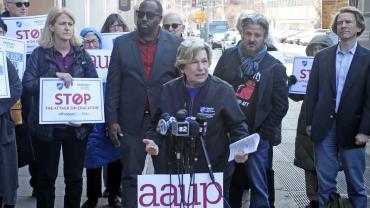
A protest letter is circulating among Jewish faculty and students in response to the Trump administration’s attacks on American universities. The specific complaint is that the attacks are cloaked as an effort to “fight anti-Semitism.” The first assault was the federal government’s suspension of $400 million in research grants to Columbia Unicersity on the grounds that the university has failed to root out and punish anti-Semitism. More than 500 Jewish academics have signed a petition denouncing this action as a fraud.

Trump’s war on higher education is not intended to curb anti-Semitism. If anything, it will encourage anti-Semitism by making Jews responsible for the hostile behavior of the Trump administration. Make no mistake: this president responded to an anti-Semitic riot in Charlottesville by saying that there were “very fine people on both sides.” The marchers chanted “Jews will not replace us.” Trump rallies have attracted people wearing swastikas and festooned with Nazi paraphernalia. Trump has attracted the allegiance of Nazis and neo-Nazis. His co-president, Elon Musk, gave the Nazi salute at Trump’s inauguration–not once but twice; right hand on heart, then arm thrust out. Musk has encouraged the rise of car-right and neo-Nazi parties in Europe.

Most Jewish scholars support everything Trump opposes: freedom of the press, academic freedom, freedom to teach, freedom to learn, freedom of speech, and freedom to study diversity, equity, and inclusion in all its forms.

I gladly signed the petition #398). The Trump administration is boldly trying to control the curriculum of higher education and boldly asserting control of intellectual freedom at both public and private universities. Not in my name.

If Trump wants to tamp down anti-Semitism, he could start by denouncing the Nazis and neo-Nazis who are in his MAGA movement. Clean his own Augean stables.

If you wish to add your name, use this link.

Open letter in response to federal funding cuts at Columbia

On March 7th, the Trump administration announced the immediate cancellation of approximately $400 million in federal grants and contracts to Columbia University. This includes funding from the Department of Justice, the Department of Education, and the Department of Health and Human Services, which suggests cuts to funding for scholarship and research in law, education, and healthcare. The university was told that these funds were being withheld because they had not done enough to suppress antisemitism, and the same rationale has been since used to propose further cuts to other universities and colleges across the U.S. In other words, the federal government claims it is taking these extraordinary measures in order to protect Jewish students from discrimination.

We are Jewish faculty, scholars, and students at U.S. universities — representative of the community that this administration purports to be protecting from antisemitism on campuses. Let us be clear: These actions do not protect us.

There are many issues on which we, as a group, disagree. We have diverse views on Israel and Gaza, on American politics, and on the Trump administration. We have diverse views on the administration of Columbia University, and on the way it has responded to protests. What unites us is that we refuse to let our Jewish identities be used as a pretext for destroying institutions that have long made America great – American universities and the research and knowledge they produce.

Together, we say: Not on our behalf. Harming U.S. Universities does not protect Jewish people. Cutting funding for research does not protect Jewish people. Punishing researchers and scholars does not protect Jewish people. These actions do, however, limit opportunities for students and scholars – within the Jewish community and beyond – to receive training, conduct research, and engage in free expression.

In fact, harming universities makes everyone less safe, including Jews. History teaches us that the loss of individual rights and freedoms for any group often begins with silencing scientists and scholars, people who devote their lives to the pursuit of knowledge — a pursuit that is core to Jewish culture. Moreover, destroying universities in the name of Jews risks making Jews in particular less safe by setting them up to be scapegoats. Once it becomes clear how much knowledge, and how much human potential, has been lost in the name of combating antisemitism, Jews may be blamed.

U.S. universities have partnered with the U.S. government since 1941, when university research began receiving federal funding and was integral to winning the Second World War. By expanding this partnership after the war, the U.S. has created the best research infrastructure in the world, which has, in turn, enabled the most scientific and technological progress in human history. Do not dismantle this partnership, especially not on the pretense of protecting Jewish people.

The following statement was drafted and signed by faculty at Teachers College, Columbia University.

The Trump administration is cynically using the pretext of “fighting anti-Semitism” to attack universities and control them. It has withheld $400 million from Columbia University and demanded changes to its curriculum and other policies.

This is outrageous. It is fascistic. It is an attack on academic freedom. Columbia University is a private university, one of the best in the nation. It should rebuff this repellent effort to strip it of its independence and academic freedom.

A Statement by Teachers College, Columbia University Faculty

The Attack on American Education, from our Perspective as Teachers College Faculty

March 19, 2025

We are a group of Teachers College faculty with expertise in the areas of education, health, and psychology. We write in response to the attacks by the federal government on Columbia University, and education. Teachers College is an independent institution, with its own charter, president, board of trustees, and regulations, yet we are also affiliated with Columbia University and are thus deeply affected by the current moment. We emphasize that this statement is not an official response by Teachers College, and represents only the views of its authors.  

As researchers and teachers, we share with our colleagues in higher education a deep concern about the many ways that higher education is under threat at this moment. But as scholars at a graduate school of education, whose work covers the lifespan, from infants to elders, we have a distinct perspective. We see the attack on Columbia as part of a larger offensive by the Trump administration and the Republican party against education at all levels. An attack on academic freedom and the First Amendment is taking place on multiple fronts, all of which impact the basic human activity of learning in all of its forms and meanings. 

Efforts to dismantle Diversity, Equity, and Inclusion (DEI) initiatives, erase curricular content that speaks to our nation’s true and difficult past and its ongoing inequities, and intrude into the processes by which educational institutions from local school districts to universities make decisions on what and how to teach: all are connected to a desire to stifle critical thinking and prevent us from actively participating in our democracy. The intention of the Trump administration is clear. By gutting important systems of education, they can shape our thoughts and words, creating a new generation without the skills required to actively participate in our democracy and push back against oppression.

 At Columbia University specifically, the Trump administration has cancelled over $400 million in research and intervention funding and is threatening further action unless the university caves to a series of demands that would radically transform the institution and undermine its fundamental role in a democracy, as our colleagues in the Columbia chapter of the AAUP detail in this letter. Such actions also violate the constitutional law and the substance and process of TItle VI, as detailed by several of our colleagues in the Columbia Law School.

The broad strategies of the administration’s attack on higher education were outlined earlier in Project 2025, but the particular tactics have been shaped by both world and local events since the October 7, 2023 Hamas attack on Israel and the Israeli war on Gaza that followed and continues. The accusation that Columbia is unable and unwilling to protect its Jewish students is being used to strip it of funding, especially for research in its medical school, as well as other areas of the institution. Several funded projects in education, health, and psychology at Teachers College have already been cancelled, affecting research and programs ranging from higher education access, graduate training for much-needed school psychologists, social services  for students, and more.

We recognize that Columbia, like many institutions, has much ongoing work to do to ensure campus is a place that can foster and support everyone’s learning, by actively addressing antisemitism, Islamophobia, and all forms of discrimination and hatred. Yet the disproportionate response to anti-war protest on our campus must be acknowledged. We take note of the “Palestine exception,” which blocks discourse by treating Palestine and Palestinians as topics beyond First Amendment and academic freedom protections. Such a pattern has barred necessary speech and difficult dialogues on our campuses, causing division and fear amongst students, staff, and faculty members. To be sure, maintaining space for anti-war protest and other forms of political dissent within a community needs to be done with sensitivity and care, alongside respect for the rights of students to challenge one another and express ideas, including deeply controversial ones.

While this week’s education news has been dominated by Columbia, previous weeks focused on the K-12 landscape. Developments included the appointment of a Secretary of Education with no education expertise, unable even to correctly identify the IDEA (Individuals with Disabilities Education Act) – one of our nation’s largest pieces of federal education and civil rights legislation, which she is charged by Congress to administer. The administration laid off half of the Department of Education’s workforce. The firings have all but shuttered the more than 150 year old National Center for Education Statistics, on which countless areas of education research, including “The Nation’s Report Card” via the National Assessment of Educational Progress and studies that focus on measuring equity, rely. These are the staffpeople who ensure that Congressionally-approved funds for Title I of the Elementary and Secondary Education Act (for children living in poverty), the IDEA and Section 504 of the Rehabilitation Act for disabled students, and federal financial aid to higher education make their way to their intended students, families, and communities. Major staff reductions at the Department of Education’s Office of Civil Rights intentionally impede this division from ensuring equitable treatment of children in our nation’s schools. 

As in higher education, the Trump administration not only seeks to usurp the Congressional power of the purse but does so in the name of false and misleading representations of the state of our educational institutions. Whatever claims to the contrary, American public education is governed chiefly by state constitutions and local school districts. They decide what students learn, how teachers teach, and how student success is measured. When, for example, executive orders seek to disregard that law and tradition, we applaud leaders who, like Maine Governor Janet Mills, respond with “See you in court!”.

As experts on teaching and learning, we know that the most profound moments of learning are usually uncomfortable, as they may lead people to question taken-for-granted assumptions about themselves and the society they inhabit. The goal of good teaching is not to eliminate that discomfort, but to give it a productive use. The barrage of Executive Orders, threats to the Department of Education, and mandates such as the March 13 letter are aimed at restricting discourse and generating fear in teachers and students, especially those most vulnerable: non-US citizens, racially or ethnically minoritized populations, gender and sexually diverse and expansive people, and disabled people. Teaching and learning are much more difficult when one is afraid, and pedagogy can easily turn to rote memorization and repetition in order to avoid controversy.

While the White House accuses elementary and secondary schools as well as higher education of indoctrinating students, against the evidence, what we see is an attack on the capacity for criticism — paving the way for authoritarianism and fascism. The idea that directing criticism at the US or its geopolitical allies is un-American runs counter to much of the history of this nation. As James Baldwin once stated, “I love America more than any other country in the world and, exactly for this reason, I insist on the right to criticize her perpetually.” It is extremely hard, if not impossible, for people of any age to do the difficult work of learning, of understanding multiple perspectives on an issue, of offering counterpoints to commonly assumed views, when people are scared of losing their livelihoods and/or their visas, being arrested or deported, or being deemed enemies of the state by the highest office in the land.

As educators and researchers concerned with justice and equity, we cannot stay silent.  What becomes of the University if it succumbs to the demands of a political party or leader and cedes its rights of free speech, free expression, and free inquiry? What becomes of research if its pursuit of truth is shaped by what faculty are not allowed to say, and the topics they cannot investigate? What becomes of our students if they are only permitted to think, speak, and be in ways that follow the political winds? 

We call on university leaders, on our campus and beyond, to use all of the tools at their disposal, including collective efforts across the sector and litigation, to stand for academic freedom, and for First Amendment rights of free speech, inquiry, and debate, and thus to stand for our democracy.

And we pledge, as faculty members in an institution of higher education, to recognize that the challenges facing us are not unique to our institution or to higher education. They are shared challenges that at this moment link us to all those devoted to education and to learning at all stages across the life span. We celebrate the efforts such as the suit filed by the National Education Association and the American Civil Liberties Union to stop Trump administration efforts to curtail diversity, equity, and inclusion in education. We must find ways to work with one another for our students, our communities, and our still-developing democracy. 

Daniel Friedrich, PhD, Associate Professor of Curriculum, Department of Curriculum and Teaching

Ansley Erickson, PhD, Associate Professor of History and Education Policy, Department of Education Policy and Social Analysis

Melanie Brewster, PhD, Professor of Counseling Psychology, Department of Counseling and Clinical Psychology

Ezekiel Dixon-Román, PhD, Professor of Critical Race, Media, and Educational Studies Director, Edmund W. Gordon Institute for Advanced Study. 

Kay James, PhD, Associate Professor of Neuroscience & Education, Department of Biobehavioral Sciences

Additional signatures, added at 6pm daily. 

Anonymous (11)

Jennifer Lena, PhD, Associate Professor of Arts Administration, Department of Arts and Humanities

Brandon Velez, PhD, Associate Professor of Counseling Psychology, Department of Counseling and Clinical Psychology

Luis A. Huerta, PhD, Professor of Education and Public Policy; Chair, Department of Education Policy and Social Analysis

James Borland, PhD, Professor of Education, Department of Curriculum and Teaching

Nathan Holbert, PhD, Associate Professor of Communication, Media, and Learning Technologies Design

Sonali Rajan, EdD, Professor of Health Promotion and Education, Department of Health Studies and Applied Educational Psychology

Carolyn Riehl, PhD, Associate Professor of Sociology and Education Policy 

Beth Rubin, PhD, Professor of Education, Department of Arts & Humanities

Lucy Calkins, PhD, Robinson Professor of Children’s Literature, Department of Curriculum & Teaching

Gita Steiner-Khamsi, PhD, William H. Kilpatrick Professor of Comparative Education, Department of International and Comparative Education

Mark Anthony Gooden, PhD, Christian Johnson Endeavor Professor of Education Leadership, Department of Organization & Leadership

Sandra Schmidt, PhD, Associate Professor of Social Studies Education, Department of Arts & Humanities  

Haeny Yoon, PhD, Associate Professor of Early Childhood Education, Department of Curriculum and Teaching

Judith Scott-Clayton, PhD, Professor of Economics & Education, Department of Education Policy & Social Analysis

Alex Eble, PhD, Associate Professor of Economics & Education, Department of Education Policy & Social Analysis

Prerna Arora, PhD, Associate Professor of Psychology and Education, Department of Health Studies & Applied Educational Psychology

Megan Laverty, PhD, Professor of Philosophy and Education, Department of Arts and Humanities 

Ioana Literat, PhD, Associate Professor of Communication, Media and Learning Technologies Design, Department of Math, Science, and Technology

Yolanda Sealey-Ruiz, Ph.D, Professor of English Education, Department of Arts and Humanities

David Kurtz of Talking Points Memo writes about the Trump administration’s bullying of Columbia University. Under the guise of fighting “anti-Semitism,” Trump has singled out Columbia for extreme punishment. Not only has he frozen $400 million in federal funds for research, he is now threatening Columbia unless it removes certain international studies from its curriculum. Trump has no authority to do this. Columbia is sure to sue and should prevail. This is Trump’s basic authoritarianism showing and portent of worse to come. He wants the nation to bow to his whims and bigotry, and only the courts have stood in his way.

Kurtz writes:

If you still harbored any doubt that President Trump’s ongoing attack on Columbia University – a private institution – is drawn straight from the authoritarian playbook, then the latest development should be clarifying.

The Trump administration – specifically the Department of Education, HHS, and GSA – sent a letter yesterday to Columbia attempting to extortan array of concessions in how the university is run before it may consider restoring some $400 million in frozen federal funding.

Imposing an arbitrary March 20 deadline, the Trump administration demanded that Columbia complete a laundry list of internal restructurings, policy changes, and submissions to federal authority. Among the most alarming demands: put the Middle East, South Asian, and African Studies department in what it calls “academic receivership” for at least five years.

If Columbia complies by the deadline, then and only then will the Trump administration “open a conversation about immediate and long-term structural reforms” at the university. If it’s not clear, it sure should be: Even if Columbia submits to this extortion letter, it doesn’t get federal funding restored. It merely sets itself up for a later round of bullying, exorbitant demands, and more extortion.

The extortion letter came the same day DHS agents executed search warrants at the residences of two Columbia students. “According to the sources, it was part of the Trump administration’s crackdown on individuals it has described as espousing the views of Hamas and threatening the safety of Jewish students,” ABC News reported.

This all transpired as Columbia graduate and pro-Palestinian protest leader Mahmoud Khalil remained in federal detention as the Trump administration attempts to deport him even though he’s a legal permanent resident. His lawyers amended their filings as they obtained new information about his detainment. In an interview with NPR, a top DHS official could not articulate what wrongdoing Khalil was being accused of.

Meanwhile, The Atlantic reported that the Trump administration had targeted at least one other person at the same time as Khalil:

It turns out Secretary of State Marco Rubio identified a second individual to be deported, and included that person alongside Khalil in a March 7 letter to the Department of Homeland Security. Both were identified in the letter as legal permanent residents, The Atlantic has learned. …

The officials did not disclose the name of the second green-card holder, and did not know whether the person is a current or former Columbia student, or had been singled out for some other reason. The person has not been arrested yet, the U.S. official said.

The Trump administration’s bullying of a private university is being done under the guise of rooting out antisemitism. But the real authoritarian move here is to bring higher education under the thumb of the president. Columbia’s not the only example, but it’s the most extreme.

“So far, America’s leading universities have remained virtually silent in the face of this authoritarian assault on institutions of higher education,” the Harvard student newspaper editorialized.

Julian Vasquez Heilig is a scholar of equity. Until recently, he was provost at Western Michigan Hniversity. He stepped back to his role as a scholar, and he now speaks his mind freely and forcefully.

He wrote on his blog “Cloaking Inequity” about the choice facing the leaders of higher education: either stand up for academic freedom or hide in fear. His post is about “The White Flag of Cowardice.”

This is a fascinating article about an “academic” organization with shallow roots but a prestigious name. It was created in 2022. It confers awards on award-worthy recipients and on fringe academics. Its purpose seems to be to add luster to the latter.

Take the recent Trump nominee to lead the National Institutes of Health:

On October 24, an organization called the American Academy of Sciences and Letters (AASL) honored Stanford University Professor and health economist Dr. Jay Bhattacharya with its Robert J. Zimmer Medal for Intellectual Freedom. 

Announcing the award, the group praised the professor for “resolutely” resisting “enormous pressure to compromise his scientific findings” and risking “his own personal and professional self-interest, repeatedly, without hesitation, to take a stand for the public’s right to unrestricted scientific discussion and debate.” A few days later, The New York Post picked up the story, running it with the headline, “Scientist who battled for COVID common sense over media and government censors wins top award.” 

“Few in the media seemed eager to attend a ceremony last week in Washington, D.C., where the prestigious American Academy of Sciences and Letters was awarding its top intellectual freedom award,” the article began. “The problem may have been the recipient: Stanford Professor Dr. Jay Bhattacharya.”

It is true that Bhattacharya is a controversial figure for his contrarian stance on the COVID-19 pandemic. He first burst onto the national scene in 2020 as the co-author of an inaccurate and bias-prone, but influential, seroprevalence study that significantly underestimated the dangers of the SARS-CoV-2 virus. Later, he was one of three authors of The Great Barrington Declaration, awidely rebuked document that outlined the failed pandemic herd immunity strategy embraced by the Trump administration. Since then, the professor has been a go-to expert for Republican politicians and right-wing groups working to politicize public health and government efforts to control COVID. He has taken to claiming that he was censored by the federal government for his views and even unsuccessfully sued the Biden administration over his claims.

Bhattacharya has also cultivated alliances with anti-vaxxers. Last month, a health policy symposium he organized at Stanford came under fire for featuring a number of them along with minimizers and lab leak enthusiasts. He spoke at the Robert Kennedy Jr. campaign’s vice presidential announcement, has been proposedby RFK Jr. for a leadership role in CDC, and is currently listed on Kennedy’s Make America Healthy Again website as a potential pick for director of the National Institutes of Health.

But Bhattacharya’s reputation is not the only explanation for the lack of media attention given to the award ceremony, which took place in the vaunted Library of Congress. Another is the fact that the AASL is largely unknown. The group only emerged in 2022, fueled by the private family foundation of an investment fund CEO. A closer look at AASL and its origins and activities provides a disturbing window into how wealthy business interests are working to reshape academia in support of their agenda.

You should read the rest of the article. Can money buy prestige? Read on.

AASL borrows prestige by honoring well-known figures in the arts, sciences, and letters, then confers prestige on rightwing academics who have been scorned by the mainstream.

This is the story of the takeover of a city and a political party and a state by the farthest right fringe of the Idaho Republican Party. These extremists want to defund education. They want to control everything, not just education.

The article focuses on one community college that they targeted, North Idaho College, which may lose its accreditation, not because of academic or financial problems but because its board is in chaos.

The extremists target all public education. They think education is indoctrination. They think it’s dangerous, even vocational and technical education.

Here are a few illustrative paragraphs:

The charter violations that kicked off this accreditation scandal four years ago never had anything to do with academics. The two-year community college offers a solid education and features the top nursing program in the state. Their finances are stable too. No, NIC might go under because the Board of Trustees has existed in a state of toxicity, chaos, and dysfunction ever since the far right gained a board majority four years ago.

It is difficult to overstate how catastrophic disaccreditation would be for the people of North Idaho. With a price tag 65 percent lower on average than four-year state institutions, community colleges place higher education within reach of the least advantaged Americans; over a third of their students make less than $20,000 per year. At NIC, 57 percent of students
receive financial aid. Local businesses depend on the college for employee training on everything from office software to forklift operation. High school students can enroll in dual credit programs, which let students get a head start on their first year of college and allow homeschoolers to obtain official transcripts….

How could this happen? The problem goes far beyond a three-person majority on the trustee board of a small community college. NIC and many other institutions are in danger because, over the last decade and a half, a core group of extremists has slowly taken over the Idaho Republican Party in the same way that a parasitic wasp slowly takes over its host. This required no astroturfing or Koch-fueled cash infusions, just a regular, everyday indifference to hyperlocal politics. The tactic is underway elsewhere, but Idaho got a head start. This crisis is what happens when insurgency bears fruit….

The consequences of that agenda go far beyond NIC’s accreditation crisis. Idaho’s abortion laws are among the strictest in the country; citing difficulty recruiting doctors given the risk of criminalization, two hospitals have already closed their labor and delivery departments, leaving many rural Idahoans hours from maternal care. Armed militia members have shown up in the children’s section of libraries looking for pornography, and libraries are limiting service due to legislation that holds librarians criminally liable for books deemed inappropriate. Idaho’s primary and secondary schools are literally falling apart; it spends less per student than any other state and ranks 43rd in education quality.

This “parasitic wasp” is at work in other red states.

A group of professors in Florida filed a federal lawsuit against the 2023 state law banning teaching about diversity, equity, and inclusion, claiming that it restricts freedom of speech.

The law was enacted as part of Governor Ron DeSantis’s war on “woke,” meaning any teaching about or practice related to DEI.

The Orlando Sentinel reported:

TALLAHASSEE — A group of Florida university professors on Thursday filed a federal lawsuit challenging a 2023 state law and related regulations that prevent colleges from spending money on diversity, equity and inclusion initiatives, saying the restrictions are “punishing educators and students for expressing differing and disfavored viewpoints.”


The lawsuit, filed by the American Civil Liberties Union of Florida and Gibson, Dunn & Crutcher LLP on behalf of six professors, alleges that the restrictions violate educators’ and students’ speech rights and is chilling expression in public universities. It targets the 2023 law (SB 266) and rules passed last year by the state university system’s Board of Governors.


“Continuing its effort to police the marketplace of ideas, the Florida Legislature again passed vague, viewpoint-discriminatory legislation that broadly restricts academic freedom and imposes the state’s favored viewpoints on public higher education, punishing educators and students for expressing differing and disfavored viewpoints,” the lawsuit said.


The restrictions ban funding for programs or campus activities that advocate for diversity, equity, or inclusion or that engage in “political or social activism.”

One of the rules defines DEI as “any program, campus activity, or policy that classifies individuals on the basis of race, color, sex, national origin, gender identity, or sexual orientation and promotes differential or preferential treatment of individuals on the basis of such classification.” Colleges and universities risk losing funding if they violate the restrictions.
The lawsuit alleged that the regulations’ definitions are “ambiguous, inconsistent, and far too broad to provide any real guidance other than indicating the Legislature’s and the BOG’s (Board of Governors’) intent to disfavor certain speech.”


The restrictions “have left instructors and students fearful for the future of not only education, but also free thought and democracy in Florida,” the professors’ lawyers wrote.
The rules have “stripped hundreds of university courses” from being designated as “general education” courses, according to the lawsuit. Universities also have denied scholarship and research money to faculty and students who have received it in the past.