Archives for category: Gender

Justice Ruth Bader Ginsberg’s adult children objected to the selection of people chosen to receive an award named for her. The five honorees included four men, although Justice Ginsberg wanted the award to be bestowed on women who had made outstanding contributions.

The New York Times reported:

When Justice Ruth Bader Ginsburg, a champion of liberal causes whose advocacy of women’s rights catapulted her to pop culture fame, helped establish a leadership award in 2019, she said she intended to celebrate “women who exemplify human qualities of empathy and humility.”

But this year, four of the recipients are men, including Elon Musk, the tech entrepreneur who frequently lobs tirades at perceived critics; Rupert Murdoch, the business magnate whose empire gave rise to conservative media; and Michael Milken, the face of corporate greed in the 1980s who served nearly two years in prison. It has prompted family members and close colleagues of Justice Ginsburg to demand that her name be removed from the honor, commonly called the R.B.G. Award.

In a statement, her daughter, Jane C. Ginsburg, a law professor at Columbia University, said the choice of winners this year was “an affront to the memory of our mother.”

“The justice’s family wish to make clear that they do not support using their mother’s name to celebrate this year’s slate of awardees, and that the justice’s family has no affiliation with and does not endorse these awards,” Ms. Ginsburg said….

In the past, the award was called the Ruth Bader Ginsburg Woman of Leadership Award. This year, the award will be bestowed by the Dwight D. Opperman Foundation on one woman and four men. The foundation said it wanted to honor gender equality.

The recipients, who also include the businesswoman Martha Stewart and the actor Sylvester Stallone, will receive the Justice Ruth Bader Ginsburg Leadership Award in April at the Library of Congress, where there is typically a ceremony and gala…

Reflecting on the awards, Justice Ginsburg’s son pointed to the timing of the announcement.

“Today would have been Mom’s 91st birthday,” said James S. Ginsburg, the founder of Cedille Records, a classical music recording company. “So it would be a perfect day to correct the record on this insult to her name and legacy.”

Voters in Orange County, California, ousted two culture warriors, making clear their dissatisfaction with the attacks on curriculum, books, teachers, and students.

Howard Blume reports in The Los Angeles Times:

Voters in the city of Orange appear to have ousted two conservative school board members who had spearheaded policies widely opposed by advocates for LGBTQ+ youth in a recall election viewed as a local bellwether for the culture wars in education.


The fiercely contested recall election in the Orange Unified School District intensified with the board majority’s approval in the fall of a parent-notification policy requiring educators to inform parents when a student requests “to be identified as a gender other than that student’s biological sex or the gender listed on the birth certificate or any other official records.”


A legal battle over the issue is playing out as California Atty. General Rob Bonta pursues a court challenge of such policies enacted by a handful of conservative-leaning school boards. His lawsuit asserts that the rules put transgender and gender-nonconforming students in “danger of imminent, irreparable harm” by potentially forcibly “outing” them at home before they’re ready…

The recall came to be an early litmus test on the resonance with voters of issues that have roiled school boards throughout the nation: the teaching of racism and Black history, the rights of LGBTQ+ youth versus the rights of their parents, restrictions on LGBTQ+ symbols and related curriculum, and the removal of library books with sexual content — especially LGBTQ+ content — from school libraries.

Critics of Governor DeSantis’s “Don’t Say Gay” law reached a settlement with the State of Florida about the limits of the law, striking out its most hateful provisions. A spokesman for DeSantis declared “victory,” but he was trying to salvage the governor’s reputation. The reality is that the settlement is a sharp rebuke to DeSantis and his puppet legislature. Unless there are two lawyers with the same name, the litigants were represented by the same lawyer who represented E. Jean Carroll.

The purpose of the law was to make LGBT people disappear by pretending they don’t exist. DeSantis lost.

If you can open the article, it contains the language of the settlement.

Leslie Postal of The Orlando Sentinel reported:

TALLAHASSEE —  Students and teachers can discuss sexual orientation and gender identity in classrooms under a proposed settlement reached Monday between the state and lawyers for LGBTQ advocates who sued over what they call the “Don’t Say Gay” law.

Activists say the deal clarifies vague language about what the law allows, while lawyers for Gov. Ron DeSantis says it keeps the Parental Rights in Education Act on the books.

The settlement agreement says the state “restricts only classroom instruction on particular subjects — “sexual orientation” and “gender identity.”  It doesn’t prohibit references to LGBTQ people, doesn’t discriminate against them or prohibit anti-bullying policies based on sexual orientation or gender identity, either.

“This settlement … re-establishes the fundamental principle, that I hope all Americans agree with, which is every kid in this country is entitled to an education at a public school where they feel safe, their dignity is respected and where their families and parents are welcomed,” Roberta Kaplan, the lead attorney for the plaintiffs, told the Associated Press. “This shouldn’t be a controversial thing.”

It also protects the legitimacy of gay student groups, safeguards against hate and bullying and allows LGBTQ students and teachers to display pictures of their partners and families. It also says library books are not subject to the law.

Filed with the U.S. 11th Circuit Court of Appeals, it requires the Florida Board of Education to send the agreement to all 67 school districts and make clear “the settlement reflects the considered position of the State of Florida on the scope and meaning of this law.”

The governor’s office, without offering any evidence, said the ruling was “a major win against the activists who sought to stop Florida’s efforts to keep radical gender and sexual ideology out of the classrooms of public-school children in kindergarten through third grade” because it kept the law intact.

“We fought hard to ensure this law couldn’t be maligned in court, as it was in the public arena by the media and large corporate actors,” said Florida General Counsel Ryan Newman. “We are victorious, and Florida’s classrooms will remain a safe place under the Parental Rights in Education Act.”

Despite arguing that the bill didn’t prevent people from talking about sexual orientation or gender identity in school, or even having materials that mentioned those topics, the law led to widespread confusion. Schools across the state banned gay-themed books, Gay Pride events, dances and LGBTQ support groups, even to the point of taking down rainbow stickers and other LGBTQ messages.

Central Florida school districts were among those that removed library books for fear they violated the law. The Seminole County school district, for example, last year decided “Jacob’s New Dress,” a storybook about a boy who wants to wear a dress to school, could not be available in primary grade libraries.

The Lake County school district removed three books from school libraries last school year, including “And Tango Makes Three,” a picture book based on a true story of two male penguins in Central Park Zoo who raised a chick together. That was “done in compliance with Florida state law, specifically 2022 House Bill 1557,” a district attorney wrote.

Lake schools reversed its decision on “And Tango Makes Three” after attorneys for the state, in another lawsuit, wrote that the law applied only to “formal” classroom instruction and not to library books. But that opinion, embedded in a memorandum filed in federal court in late 2022, was not necessarily widely known.

The deal came after two years of court hearings. U.S. District Judge Allen Winsor in Tallahassee twice threw it out on grounds the plaintiffs had no standing.

The plaintiffs appealed Winsor’s decision and agreed to a settlement because the appeals process would have taken years.

Under the deal, the law also doesn’t prohibit “incidental references in literature to a gay or transgender person or to a same-sex couple. Such references, without more, are not ‘instruction on’ those topics.”

References to gay or transgendered individuals are not instruction “on sexual orientation or gender identity any more than a math problem asking students to add bushels of apples is ‘instruction on’ apple farming,” the agreement said.

Typical classroom discussion and schoolwork don’t count as instruction, the settlement said, “even if a student chooses to address sexual orientation or gender identity.”

The statute allows teachers to “respond if students discuss their identities or family life … “provide grades and feedback” if a student chooses “LGBTQ identity” as an essay topic, and answer “questions about their families.”

It also doesn’t require the removal of safe space stickers or safe spaces for LGBTQ students.

It doesn’t prohibit Gay-Straight Alliances, book fairs that include LGBTQ+ focused books, gay-themed musicals or plays, or other extracurricular activities including dances, wearing gay-themed clothing, and non-conforming garb.

To say that opposite-sex attraction was the norm or that “heterosexuality is superior or that gender identity is immutable based on biological traits,” would be equally prohibited under the statute, the agreement states.

Staff writer Leslie Postal and the Associated Press contributed to this report.
At DeSantis’s urging, the Florida legislature passed a law known as “Stop Woke.” The law restricts teaching about race and gender in the state’s classrooms and bans “diversity, equity, and inclusion” programs in the workplace. Several employers sued to block the law, calling it a restriction on free speech. The employers won in the federal District Court, and the state appealed the decision. Today the 11th Circuit Court of Appeals overturned the Stop Woke Act as applied to employers. It remains in effect for schools.

The Orlando Sentinel reported:

TALLAHASSEE — A federal appeals court Monday rejected restrictions that Gov. Ron DeSantis and Republican lawmakers placed on race-related issues in workplace training, part of a 2022 law that DeSantis dubbed the “Stop WOKE Act.”


A three-judge panel of the 11th U.S. Circuit Court of Appeals said the restrictions violated First Amendment rights.


“This is not the first era in which Americans have held widely divergent views on important areas of morality, ethics, law and public policy,” the 22-page opinion said. “And it is not the first time that these disagreements have seemed so important, and their airing so dangerous, that something had to be done. But now, as before, the First Amendment keeps the government from putting its thumb on the scale.”


The panel upheld a preliminary injunction issued in 2022 by Chief U.S. District Judge Mark Walker of Tallahassee against the restrictions. The law was challenged by Primo Tampa, LLC, a Ben & Jerry’s ice-cream franchisee; Honeyfund.com, Inc., a Clearwater-based technology company that provides wedding registries; and Chevara Orrin and her company, Collective Concepts, LLC.

Orrin and her company provide consulting and training to employers about issues such as diversity, equity and inclusion.


Walker also separately issued a preliminary injunction against part of the law that would restrict the teaching of race-related concepts in universities. The state has appealed that decision.


The workplace-training part of the law listed eight race-related concepts and said that a required training program or other activity that “espouses, promotes, advances, inculcates, or compels such individual (an employee) to believe any of the following concepts constitutes discrimination based on race, color, sex, or national origin.”


As an example, the law targeted compelling employees to believe that an “individual, by virtue of his or her race, color, sex, or national origin, bears personal responsibility for and must feel guilt, anguish, or other forms of psychological distress because of actions, in which the individual played no part, committed in the past by other members of the same race, color, sex, or national origin.”

The state disputed that the law violated speech rights, saying that it regulated “conduct.” It said businesses could still address the targeted concepts in workplace training but couldn’t force employees to take part.


But the appeals court flatly rejected such arguments Monday. It described the law as the “latest attempt to control speech by recharacterizing it as conduct. Florida may be exactly right about the nature of the ideas it targets. Or it may not. Either way, the merits of these views will be decided in the clanging marketplace of ideas rather than a codebook or a courtroom.”

Jess Piper is a Democratic activist in rural Missouri. She is a fierce advocate for rural communities and public schools. She lives on a farm where she and her husband raise hogs and chickens. She blogs, she makes videos for TikTok, she tweets, she hosts a podcast called Dirt Road Democrats and is executive director of Blue Missouri. She taught American literature for 16 years. She often writes about the absurdity of vouchers and school choice. In this post, she goes to towns in her district to gather signatures to restore abortion rights in Missouri..

I live at the tippy top of NWMO on a small 7 acre farm in a 125 year old farmhouse with a few dogs, a couple cows, a gaggle of kids and grandkids, and a miniature donkey. Everyone perks up when I mention the donkey…he’s 36 inches high and his name is Augustus.

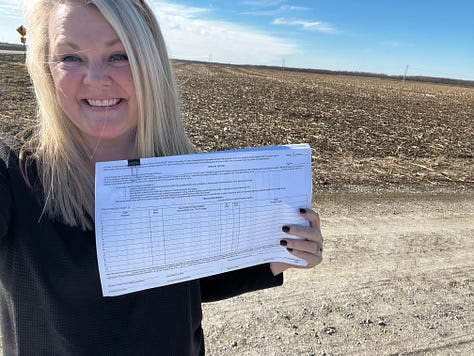
I drive across the state often these days and I am usually headed to a small town and this week was no different—I visited Chillicothe (the home of sliced bread), Carrolton, and Marceline and you’ll never guess why. I was getting rural folks and their Bible groups to sign the petition to restore abortion rights in Missouri.

Dirt Road organizing.

Missouri is in the process of putting abortion on the ballot and I have the petition—I have to tell you it’s kind of hard to get a petition, so I was excited to get them and also overwhelmed. I have to get this out to rural folks, and it’s not as easy as it would seem. 

First, there is the opposition to the petition—the Missouri Right to Life (Right to force others to gestate and deliver) has a literal snitch line to report folks accepting signatures. Now, I have no idea what they plan to do if they find us accepting signatures. I was raised to take care of myself and they shouldn’t mess with me, and I’m not the least bit intimidated, but I don’t want them to harass other rural folks who are signing quietly.

Second, folks have written off my congressional district—even some progressives who need signatures on a ballot initiative. They assume that we are too red to get enough signatures, so what’s the point, right? I’ll tell you the point: it creates excitement and solidarity in rural spaces. It acts to uplift us living in among MAGA extremists. It gives us hope.

Chillicothe was my first stop, and it is a pretty big town at over 9K folks. Chilli is also known for having a “patriot” group who have been successful in putting their extremists on the local health board — they also regularly object to school library books. Folks were on long text chains to get others to the event. I was able to gather about 30 signatures on a Tuesday at 9am. 

I was directing folks to the petition and how to fill it in correctly. One woman filled it out, stood up, and started texting. She told me, “I’m reminding my Bible group to come sign.” 

Wait…what?

The second place I drove was Carrolton, with a population of about 3,400. Still not tiny, but small. I sat in the basement of the library for almost 2 hours with…wait for it…a local pastor. A woman pastor. She signed the petition and then stayed the length of the signing event and visited with every single person who came in. Several folks attended her church or a neighboring church. 

Are you seeing a theme here?

My last stop of the day was in Marceline, population 2,100. I sat in the fire station with a local Dem organizer and we accepted signatures a few feet from the active train crossing. I met with a local candidate running for state house and again, folks signed, stood up, texted friends and relatives and their church community, and then headed back out to their farms and rural life.

This is why I organize in rural spaces across the state. This is why I drive 5 or 6 or 10 hours to meet with rural folks. They matter—we matter.

When we cede ground because it’s too red, because it’s too evangelical, because it’s too far of a drive, we create a self-fulfilling prophecy. It’s become more red, more uncontested. When we tell rural folks that their votes and signatures don’t matter because there aren’t enough of them, they agree and stop showing up. When we say Democrats and progressives support everyone, yet fail to have a presence in rural spaces, they notice…they know it’s a lie.

We can’t win Missouri if we avoid rural parts of the state. Missouri is 1/3 rural…33% of the state is outstate. 

I’m here and so are thousands of my friends. If state-level organizers will remember us, we can bring sanity back to the entire state.

Dirt Road Democrats are here.

~Jess

Dan Rather analyzed Trump’s primary wins and spots signs that he is vulnerable because his well-defined base is limited. Due to his extremism, he is not able to have a big tent that would attract independents and even dissident Democrats. Even more telling is that Trump is not unifying the Republican Party. As soon as Trump won the South Carolina, he proclaimed that he had never seen the Republican Party more united. As Rather explains, that’s not really true.

He writes:

NBC’s “Meet The Press” this morning characterized Donald Trump’s South Carolina primary victory as “delivering a crushing blow to [Nikki] Haley in her home state on Saturday, trouncing her by 20 points with nearly 60 percent of the vote. The former president dominated nearly every key group.”

While he did indeed win handily, a deep dive into the numbers provides some interesting context. 

The part of the story missing from many news reports is that Trump is slipping from his 2020 numbers. His support is strongest among his MAGA base, which pollsters put at no more than 33% of the electorate. Clearly, he will need more than MAGA to win the White House again. 

President Biden won the South Carolina Democratic primary with 96.2% of the vote. Trump, who is essentially an incumbent up against a novice at running for national office, could not muster even 60% of his party’s vote. Exit polls from Saturday night should have GOP leaders nervous. 

The makeup of South Carolina’s Republican voters does not mirror the country. They are heavily weighted with hard-right “conservatives,” older, white, male, evangelical election deniers. Trump won overwhelmingly among them. But Haley won among independents, moderates, and those who care about foreign policy. And that’s the crux of it.

To win the presidency again, Trump will need to bring all Republicans into the tent. Gallop estimates that 41% of the electorate identifies as Republican. Then it gets really tough. He has to convince a large number of independents and Democrats to vote for him. But how?

  • Not by favoring a 16-week national abortion ban 
  • Not by threatening to pull out of NATO
  • Not by defunding Ukraine and supporting Putin’s invasion
  • Not by promising “ultimate and absolute revenge” against his political opponents 
  • Not by refusing to accept the results of elections he’s lost
  • Not by promising to be a dictator on day one of his second term

Not by saying things like: “These are the stakes of this election. Our country is being destroyed, and the only thing standing between you and its obliteration is me.”

Trump is winning primaries while underperforming. Dan Pfeiffer, a former adviser to President Obama and current host of “Pod Save America,” writes: “You cannot win the White House with the coalition that Trump is getting in these primaries. He must expand his coalition, persuade people who aren’t already on board and get beyond the Big Lie-believing MAGA base. Through three primary contests, Trump has gained no ground.”

Polls also indicate a majority of voters in swing states would be unwilling to vote for Trump if he’s convicted of a crime. That could happen as soon as April or May. 

As Axios writes: “If America were dominated by old, white, election-denying Christians who didn’t go to college, former President Trump would win the general election in as big of a landslide as his sweep of the first four GOP contests.” Fortunately, it is not. America is a rich tapestry of heritages, races, and creeds. Immigrants have long been one of our strengths.

But the likely GOP nominee continues to feed fears about immigration using language tailored to his MAGA base. “They’re coming from Asia, they’re coming from the Middle East, coming from all over the world, coming from Africa, and we’re not going to stand for it … They’re destroying our country,” Trump said Saturday at CPAC, a conference of extreme-right Trump supporters.

“No, Mr. Trump, they’re not,” is the answer of many Americans. There is strong public opinion that what is tearing our country apart is the divisiveness and rancor that comes from Trump, the Republican Party, and their right-wing media machine.

The mainstream press may begin to offer more of this context and perspective as we get deeper into the presidential campaign. One of the things Steady was created to do was offer reasoned context and perspective to news stories. This writing is an example.

Trump remains a real and present threat to win the presidency again in November. But that is not assured. Not nearly, as a deep analysis of early primary results indicates.

There is still a long way to go and many rivers to cross for both major candidates.

The editorial board of the Orlando Sentinel spoke out against a bill that would declare fetuses to be persons from the instant of conception. Not only would this extend Florida’s draconian six-week ban on abortion, it would outlaw abortion for any reason—rape, incest, the life of the mother. Even if a woman learns early in her pregnancy that the fetus will be born without a brain or has some other fatal defect, she will not be able to terminate the pregnancy. At this time, the Florida Supreme Court is deciding whether to allow a referendum on abortion to proceed; its sponsors have collected over one million signatures. Will the people of Florida have a chance to express their views?

The editorial board wrote:

For Floridians who are already deeply uneasy about women losing the right to control their own bodies, what happened Wednesday in the House Judiciary Committee was truly terrifying. One by one, lawmakers voted yes on legislation that would, for the first time, declare fetuses to be people from the moment of conception — turning wombs into war zones before most people even know they are pregnant.

Bill sponsor Jenna Persons-Mulicka, R-Fort Myers, did her best to hide the radical nature of her legislation, which creates civil liability for anyone who causes the “wrongful death” of a fetus in utero. But everyone in that committee hearing room — and those watching remotely — knew exactly what was at stake. Conveying full rights on a fetus would be a shattering blow to reproductive independence for Floridians capable of becoming pregnant, reaching past debates over viability and bans on abortion at a specified number of weeks. HB 651 would kick in at the very start of a pregnancy, and create an easy stepping stone from wrongful deaths (including from abortions) to anything that threatens the health of a fetus, even if it is meant to benefit the mother’s health.

Floridians should bombard their state senators and representatives with messages letting them know that this potential law is far too radical for anyone who cares about freedom. Then they should turn to their congressional representatives and call on them for legislation to nip this hazardous movement in the bud.

They can start by letting lawmakers know they see through the pretense here. Persons-Mulicka pointed out, more than once, that the language of her legislation (HB 651) specifically excludes a pregnant person. But that’s a nearly negligible speed bump, especially if Florida’s Supreme Court picks up this theme and uses it to obliterate abortion rights in Florida.

Think they won’t? Think again. Justice Carlos Muniz was already hinting in that direction last week, during oral arguments over a ballot question that would (with voters’ approval) explicitly protect abortion rights in Florida.

But advocates of so-called “fetal personhood” think they’ve found a way around that language. By declaring a fetus to be a person, the Legislature and/or court would at best set up a collision course between two competing interests that just happen to share a body — along with the well-being of medical personnel being asked to care for both.

Because the fetal personhood bill does not protect the doctors, nurses and other people who perform abortions, even if the procedure is otherwise legal. Taken in context, that looming threat is clearly a large portion of the intention behind this bill…

Well, that was fast!!

At 9 a.m. I posted about a New York Times article published yesterday revealing that Trump wanted a 16-week ban on abortions. Since 93% of abortions are performed by the 13th week of abortion, that would essentially render the Dobbs decision ineffective.

But Trump’s anti-abortion pals got wind of his intention and let it be known that they will play every trick in the book—including reviving an 1873 law—to make abortion illegal everywhere.

The New York Times reports today:

Allies of former President Donald J. Trump and officials who served in his administration are planning ways to restrict abortion rights if he returns to power that would go far beyond proposals for a national ban or the laws enacted in conservative states across the country.

Behind the scenes, specific anti-abortion plans being proposed by Mr. Trump’s allies are sweeping and legally sophisticated. Some of their proposals would rely on enforcing the Comstock Act, a long-dormant law from 1873, to criminalize the shipping of any materials used in an abortion — including abortion pills, which account for the majority of abortions in America.

“We don’t need a federal ban when we have Comstock on the books,” said Jonathan F. Mitchell, the legal force behind a 2021 Texas law that found a way to effectively ban abortion in the state before Roe v. Wade was overturned. “There’s a smorgasbord of options.”

Mr. Mitchell, who represented Mr. Trump in arguments before the Supreme Court over whether the former president could appear on the ballot in Colorado, indicated that anti-abortion strategists had purposefully been quiet about their more advanced plans, given the political liability the issue has become for Republicans.

“I hope he doesn’t know about the existence of Comstock, because I just don’t want him to shoot off his mouth,” Mr. Mitchell said of Mr. Trump. “I think the pro-life groups should keep their mouths shut as much as possible until the election….”

In policy documents, private conversations and interviews, the plans described by former Trump administration officials, allies and supporters propose circumventing Congress and leveraging the regulatory powers of federal institutions, including the Department of Health and Human Services, the Food and Drug Administration, the Department of Justice and the National Institutes of Health.

The effect would be to create a second Trump administration that would attack abortion rights and abortion access from a variety of angles and could be stopped only by courts that the first Trump administration had already stacked with conservative judges.

“He had the most pro-life administration in history and adopted the most pro-life policies of any administration in history,” said Roger Severino, a leader of anti-abortion efforts in Health and Human Services during the Trump administration. “That track record is the best evidence, I think, you could have of what a second term might look like if Trump wins.”

When an education story is featured by a major media outlet like CNN, you can bet it’s captured mainstream attention.

Many educators have worried about the pernicious agenda of “Moms for Liberty,” which arrived on the scene in 2021 with a sizable war chest.

What is that agenda? Defaming public schools and their teachers. Accusing them of being “woke “ and indoctrinating students to accept left wing ideas about race and gender. Banning books they don’t like. Talking about “parental rights,” but only for straight white parents who share their values.

M4L got started in Florida, as do many wacky and bigoted rightwing campaigns, but it has been shamed recently by the sex scandal involving one of its co-founders, Brigitte Ziegler. The two other co-founders dropped her name from their website, but the stain persists.

CNN reports that this rightwing group is encountering stiff opposition from parents who don’t share their agenda and who don’t approve of book banning.

The story begins:

Viera, FloridaCNN —

In Florida, where the right-wing Moms for Liberty group was born in response to Covid-19 school closures and mask mandates, the first Brevard County School Board meeting of the new year considered whether two bestselling novels – “The Kite Runner” and “Slaughterhouse-Five” – should be banned from schools.

A lone Moms for Liberty supporter sat by herself at the January 23 meeting, where opponents of the book ban outnumbered her.

Nearly 20 speakers voiced opposition to removing the novels from school libraries. One compared the book-banning effort to Nazi Germany. Another accused Moms for Liberty of waging war on teachers. No one spoke in favor of the ban. About three hours into the meeting, the board voted quickly to keep the two books on the shelves of high schools.

RELATED ARTICLEOusted Florida GOP leader Christian Ziegler won’t be charged with sexual battery

“Why are we banning books?” asked Mindy McKenzie, a mom and nurse who is a member of Stop Moms for Liberty, which was formed to counter what it calls a far-right extremist group “pushing for book banning and destroying public education.”

“Why are we letting Moms for Liberty infiltrate our school system?”

The Orlando Sentinel editorialized about the DeSantis administration’s effort to kill a voter referendum that would put reproductive rights into the state constitution. Last year, Governor DeSantis signed a highly restrictive ban on abortion—that it was prohibited after six weeks of pregnancy, when few if any women realize they are pregnant.

Let it be noted that Republican legislators in Mississippi are also trying to block a state referendum on abortion. They are afraid it will pass, and they are not willing to take that chance.

The Orlando Sentinel editorial board wrote:

Next week, Attorney General Ashley Moody will come before the state Supreme Court and argue that Floridians can’t be trusted to understand a ballot initiative that would protect abortion rights in Florida — and because of that, they should be stripped of the right to demand them.

Moody is asking the state’s high court to crush an abortion rights initiative that’s already supported by nearly 1 million Floridians (and counting). If it makes the ballot, it’s likely to pass: Most polls show that voters support abortion rights, regardless of party. Without this amendment, the Legislature has already shown it will do everything in its power to destroy those rights.

Voters in six states, including solidly conservative Kentucky and Kansas, have already voted to project abortion rights. At least a dozen other states could vote on abortion this year.

That’s why Florida voters deserve to have their say — and why Florida’s anti-reproductive-rights leaders are so desperate to make sure they don’t.

Here’s what voters will see on the ballot:

No law shall prohibit, penalize, delay, or restrict abortion before viability or when necessary to protect the patient’s health, as determined by the patient’s healthcare provider. This amendment does not change the Legislature’s constitutional authority to require notification to a parent or guardian before a minor has an abortion.

The DeSantis administration insists that voters won’t understand this amendment so should not be allowed to vote on it.

One million Floridians have already signed a petition to put it on the ballot.

The DeSantis administration is afraid that voters will understand it and pass it.

Will the conservative state Supreme Court of Florida allow the people to decide?