Scott Dworkin, a prominent leader in the resistance to the Orange Menace, watched Trump’s self-glorifying rant and reports on it here. I subscribe to his Substack commentary, where this appeared. Just think: we will have to listen to this self-obsessed know-nothing for the next four years. I’m glad to let someone else do it for me.
He wrote:
Yesterday, unhinged madman Donald Trump held what he calls a “press conference.” They’re actually dangerous propaganda sessions.
In order to fight back, we have to stay aware and engaged at a constant. But I don’t want you to have to watch or listen to this bozo, so I summed up what happened for you here.
Donald spent some time pointlessly attacking President Biden. He once again admitted to lying about bringing down grocery prices, and mused that Facebook is likely doing away with fact-checking due to his threats.
He lied about Jack Smith executing people, whined like a baby for being prosecuted for his crimes, and railed against judges who are just doing their jobs. Trump complained about electricity itching—or something—and said he was going to change the name of the Gulf of Mexico to “Gulf of America.” Very original.
“The windmills are driving the whales crazy,” Donald said at one point, for no reason whatsoever.
He even went on some bizarre tirade about water pressure. “It’s called rain,” he blabbed. “It comes down from heaven. And they want to do no water comes out of the shower. It goes drip, drip, drip. So what happens? You’re in the shower 10 times as long.” There are so many things wrong with that word salad.
Trump lied and said Hezbollah was responsible for the violence on Jan 6th—when we all know Donald and his rabid cult followers are to blame. He also nonchalantly promised “major pardons” for the rioters who attacked the Capitol—possibly even for those who assaulted police officers. What a disgrace.
Donny “Cheap Suit” then rambled incoherent threats about using military force to take over Greenland and the Panama Canal, and economic attacks to absorb Canada.
The orange ogre replied to a question about his plans for Gaza negotiations saying, “all hell will break out in the Middle East,” if hostages aren’t released before January 20th. Are you kidding me? That’s not even a “concept of a plan.”
And one of the looniest things that came out of his blubbering mouth was: “We did nothing wrong on anything,” related to the crimes he committed. Remember that every Trump denial is an admission.
This is the sort of unhinged nonsense we will be dealing with as long as Trump is around. And I’ll be right here keeping an eye on him, so you don’t have to.
We’ll be sharing this article with millions of people on 10 social media networks, so we aren’t just singing to the choir.
Carol Burris, executive director of the Network for Public Education, writes in The Progressive about the hidden purpose of “school choice.” It’s not to educate children better; it’s not to save money. It’s to destroy your child’s right to a free public education.
She begins:
In 2017, PBS released School Inc., a rightwing billionaire-funded documentary created by the late Andrew Coulson, a conservative author and former director of the libertarian Cato Institute’s Center for Educational Freedom. School Inc. showcased Coulson’s theory that for-profit schooling, funded by parents without government involvement, is the best delivery model for education. In a review for the long-running Answer Sheet blog in The Washington Post, the education historian Diane Ravitch and I criticized Coulson’s romanticization of the era of American schooling before public education, during which children were homeschooled, church-schooled, or taught by private tutors—except for the poor, who, if they were lucky, were trained in charity schools.
The “school choice movement,” which Coulson’s documentary promoted, has always been a classic bait-and-switch swindle: Charter schools were the bait for vouchers, and vouchers the lure for public acceptance of market-based schooling. While narrow debates about accountability, taxpayer costs, and the public funding of religious schools raise important concerns, the gravest threat posed by the school choice movement is its ultimate objective: putting an end to public responsibility for education.
This goal is not a secret. The libertarian right has openly dreamed of ending public education for the past seventy years—the economist Milton Friedman advocated for school choice as early as 1955, and his acolytes have continued to do so ever since.
And they have made extraordinary progress. During the past few years, the traditional voucher model championed by the right has morphed into the Education Savings Account (ESA). In exchange for promising not to enroll their child in public schools, parents receive funds to “shop” for services, including private school tuition, tutoring, and luxury purchases, including trips to Disney World, televisions, and waterskiing lessons. Nearly all recent state ESA programs have either no or high-income caps, and few have sensible protections.
The libertarian right embraces this flagrant waste because it helps them achieve their ultimate objective of shifting all of the responsibility and costs to families. By approving universal ESA programs, they are creating a vested interest among middle and upper-income families in pay-as-you-go education. Frivolous spending is tolerated because it aligns with Friedman and Coulson’s objective of putting parents in charge of education without government responsibility or concern.
The America First Policy Institute, where Trump’s Secretary of Education nominee Linda McMahonserves as board chair, states in its recent policy agenda that “the authority for educating children rests with parents.” As public responsibility for schooling shifts to parents, educational subsidies will be gradually reduced until Friedman and Coulson’s dream of a fully for-profit marketplace that competes for students is achieved.
Please open the link to finish reading this important article.
Today is the fourth anniversary of the worst act of insurrection in our nation’s history. Urged on by President Donald Trump, who insisted that he actually won the election of 2020, a large mob stormed the United States Capitol in hopes of stopping the certification of the election of Joe Biden.
To be clear, Trump is a world-class liar and a very sore loser. He simply refused to admit that he lost the election, fair and square. Biden won the electoral vote and the popular vote. Trump’s lawyer challenged the voting results in multiple states. They filed more than 60 lawsuits, appealed twice to the U.S. Supreme Court, and lost every time. They lost in courts where the judge was appointed by Trump, as well as by other Presidents.
Still, he refused to concede his loss. He spent the past four years claiming that he had been cheated, even though he never produced a scintilla of evidence to support his lies. Several of his lawyers were disciplined or disbarred. His personal lawyer Rudy Giuliani was disbarred and also fined $148 million for defaming two election workers in Georgia. Although he had declared that he is bankrupt, Giuliani continues to turn over his assets to the women he defamed. Trump cannot pardon civil judgments, so Giuliani is likely to lose not only his law license but all of his assets.
Yet Trump survived, having persuaded his faithful base that he had been cheated in 2020, despite his lack of evidence and multiple indictments and convictions.
History will say this about Trump:
He was the first President who refused to participate in the peaceful transfer of power to the winner of the election.
He was the first President to inspire an insurrection against the government.
He will be the first convicted felon ever to serve as President.
His insurrection and his name will live forever in infamy.
Quite an ignominious legacy.
To read an excellent article by Robert Reich on the same topic, open this link.
Alexandra Petri is the resident humorist at The Washington Post. She has the knack of taking wacky ideas in the world of politics and exposing them as bizarre. In this post, she shows the absurdity of sanewashing extremism in the guise of finding a “middle ground” with crackpot ideas. The “middle ground,” she cautions, may actually mean “giving ground” to very bad and deadly ideas. Sometimes there is no middle ground between a good idea and a dangerous idea.
She writes:
“As a Democratic member of Congress, I know my party will be tempted to hold fast against Mr. Trump at every turn: uniting against his bills, blocking his nominees and grinding the machinery of the House and the Senate to a halt. That would be a mistake. Only by working together to find compromise on parts of the president-elect’s agenda can we make progress for Americans who are clearly demanding change in the economy, immigration, crime and other top issues.”
— “Let’s Try Something Different in How We Deal With Trump,” Rep. Tom Suozzi (D-New York), in a New York Times op-ed
Look, some people are still naive enough to believe that polio is, for lack of a better word, “bad.” And recent signs haven’t been encouraging! It seems like the disease wants to do exactly what it did last time: cripple children and put them in iron lungs. But what if instead of fighting it, we … didn’t?
When I look at how people voted this election, I am forced to conclude: Some of you want polio. Who am I to stand against that desire? Someone with values?
Do I think polio is good? No! Of course not. But some people do, and I just think it would be a mistake not to give them the opportunity to set the course of vaccine policy for the next four years. Which, again, isn’t what I want. But compromise is important. That was why people voted for me, someone who said he didn’t like polio, so that I could surprise them by wanting to hear polio out. That’s just good politics.
It’s not only polio. Everywhere you look, there are battles that once felt existentially important in which you can just surrender, as I’m sure Donald Trump is eager to tell Ukraine. And I am ready to start doing that work — first on polio, then on everything else.
Listen, I’m not naive. I know that every indication so far has been that only one side is willing to compromise on anything. That gives us bargaining power! Or is it the other side that gets the bargaining power … ? Hang on, let me go look this up. This feels important to get right! Well, let me keep going with my argument, but I will come back and look this up. Don’t let me forget!
Where was I? Right: Having core values means that sometimes you have to stand up for them, even when it feels like an uphill battle. For instance, the belief that trans people deserve protection from those who would legislate them out of public spaces and eliminate their right to medical self-determination — a bottom line that I would never budge on, except to completely throw away that principle if I ever decide it’s politically expedient. Which I think I might just have done! Whoops!
But, hey, that’s what principles are: inconvenient. Except for my bedrock principle: that those who want the opposite of what I stand for and who refuse to work with me on any issue probably know something that I don’t, and I should listen to them. That I will never abandon.
When I see someone who wants to put polio back on the map, I just see one more opportunity for compromise. Why, if enough of us say, “You know what, in all that ranting about fluoride, I heard one word that made a kind of sense! Say more! I bet we can find common ground!” maybe the other side will stop believing what they believe and change their entire worldview! Isn’t that what happened to Scrooge? It’s not? Well, never mind.
If I just listen hard enough and agree to find common ground, I am certain the other party will be the one to change. That’s usually what makes people change: when you give up defending your position completely! Then they budge. I hope! That’s certainly what I’m counting on for the next four-plus years!
When I read the sentence “Unless enough people find the spine to oppose his appointment, Robert F. Kennedy Jr. will soon be in charge of the Department of Health and Human Services,” what I see is not a call to find some spine (impossible) and remind others of the stakes of not doing so. When has anyone found a congressional spine, except RFK Jr. while out on one of his weekly Hikes in Search of Surprising Things to Put Into His Freezer?
No, what that sentence means is: We need to start thinking of ways to compromise now! Compromise public health, compromise public safety, compromise all of our principles! Because that’s what the country needs: more things to be compromised.
Joyce Vance is a veteran federal prosecutor; she was the U.S. Attorney for the Northern district of Alabama from 2009-2017. She writes a blog called “Civil Discourse with Joyce Vance.” She usually writes about the law, the justice system, and Trump’s efforts to avoid accountability for his misdeeds. But in this post, she addresses the root cause of his appeal: low-information voters who are hoodwinked by his lies and believe he will fight for them. Ha. Not funny.
She writes:
It’s no wonder that Project 2025 calls for putting an end to the Department of Education. Trump’s electoral success depended on so-called low-information voters, members of the electorate who couldn’t or didn’t distinguish between the tough talk and tough guy image the candidate portrayed and the reality of the policies that come with his win. That’s often true for MAGA candidates, who are inexplicably able to attract the voters who are harmed by the policies they subsequently pass, as with tax cuts for the extremely wealthy and the working-class voters who didn’t benefit from them, but made them possible.
The Washington Post had this story today about the hopes of low-income voters who went for Trump in 2024, like a single mom who said she sometimes has to choose between buying toilet paper and milk and told reporters, “He is more attuned to the needs of everyone instead of just the rich … I think he knows it’s the poor people that got him elected, so I think Trump is going to do more to help us.” So far, that’s not looking good.
This very predictable reporting about voters suffering from buyers’ remorse is emerging even before Trump takes office. These people hope he won’t do exactly what he said he would during the campaign and has been focused on during his transition with programs like the Department of Government Efficiency, Elon Musk’s DOGE—cut government spending that they depend on. Whether it’s low-income people, mixed-status immigrant families, people who rely on Social Security, or parents with immune-compromised kids who rely on immunized classrooms, people voted against their own self-interest and are now facing that reality.
There are no do-overs in presidential elections. Successful disinformation campaigns or campaigns where image trumps consequences have lasting effects.
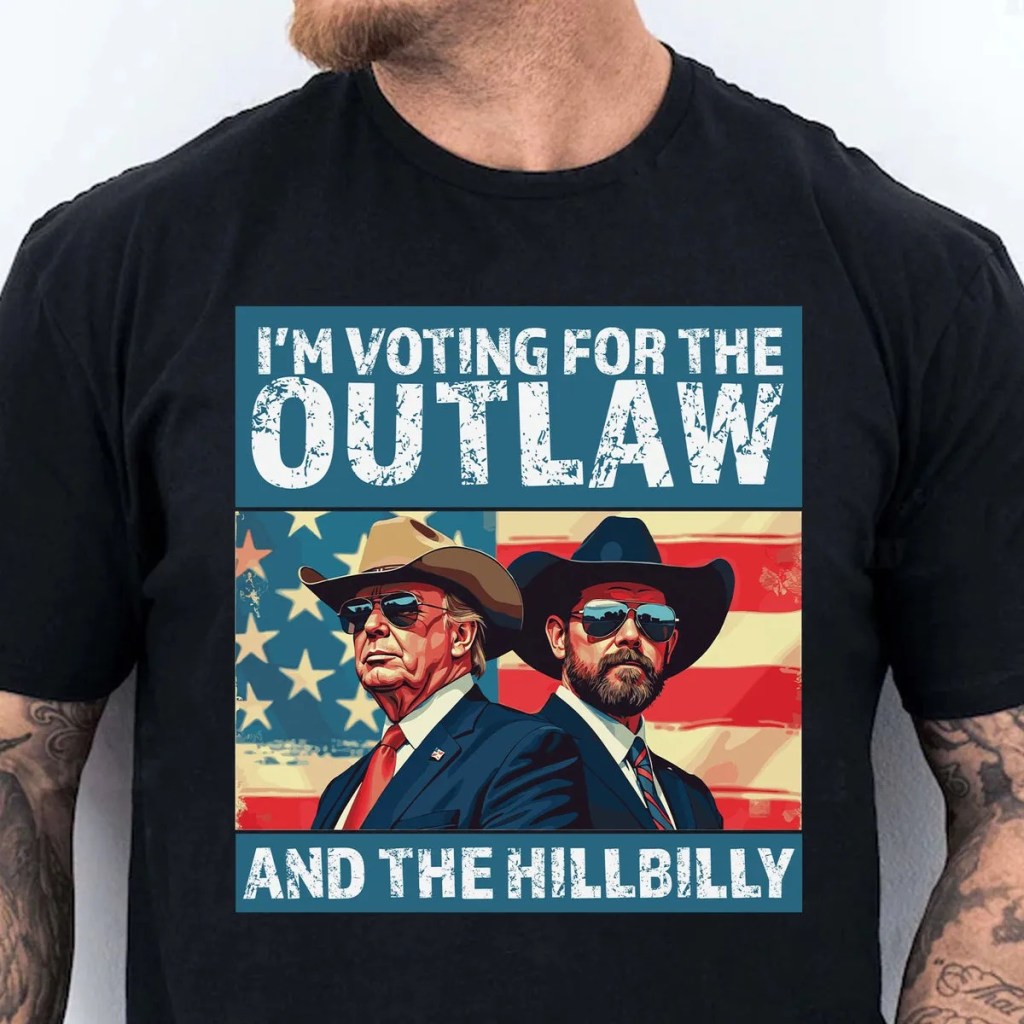
But spin, or disinformation—however you want to characterize it—designed to redirect voters away from focusing on bad facts about candidates can work, and this past election proved it. This T-shirt ad that the algorithm fed me earlier this week is an example of how Trump’s criminal conviction was sold to voters: the mythical outlaw, not the corrupt criminal. It’s hard to believe Americans fell for that, but they did, giving Trump a pass and letting him cultivate an image that was one step further out there than Sarah Palin’s maverick.
Voters who lack the backbone of a solid education in civics can be manipulated. That takes us to Trump’s plans for the Department of Education.
Stepping on education and staunching the flow of information is a key goal for any authoritarian. Remember when Trump told an evangelical group during the campaign that if they voted in 2024 it would be the last time they had to vote? That’s something that Americans, hopefully, will not fall for, because the 2026 midterms will be key. If guardrails are going to be rebuilt, that’s where an important part of it will happen. And while we’re all burned out from the last election, this next one will matter; we will need to reengage, because a big Democratic win could staunch the bleeding from unfettered acquiescence by the legislative branch to Trump, who currently commands majorities in both chambers. That means the provision of accurate information and accurate analysis of that information to voters who will put it to use is important. But what does that look like in a country that voted for Trump?
One thing that is clear from the ease with which Trump seems to have stripped so many voters of their common sense is the need to restore civics education in this country. That’s a long-term plan and a big topic that we need to take on over time, but it’s not too early for us to begin to think about what we can do in the coming year ahead of the midterms. For one thing, if it’s right for you, even if it’s a stretch, consider running or seeking appointment to a school board. Republicans got the jump on Democrats in this arena. It’s time to catch up. Or, if that’s not in your lane, make the time to show up at school board meetings and demand civics education in our schools. Progress in this area will take time, but we can all set a good example and encourage people around us to do a better job of understanding what matters in government. Ironically, if 2017 is any indication, people caught off guard (although who knows how) by some of the worst excesses Trump is likely to engage in will be ready to be better informed and reengage in democracy. Capturing that moment will be important.
One of the goals of Project 2025 is terminating the Department of Education. There is growing Republican support for that plan at the state level by leaders who want to restore state control (much like conservatives sought restoration of abortion policy to the hands of red state officials in Dobbs). Enter Trump’s nominee to head the Department, Linda McMahon, who ran the Small Business Administration (SBA) for him from 2017 to 2019.
Trump’s appointment of the professional wrestling magnate has drawn little comment as the media has focused on Matt Gaetz, Pete Hegseth, and others. Suffice it to say she does not appear to possess much of a background in public education. She was on the Connecticut Board of Education for one year, but there has been reporting she received that appointment after lying about having a degree in education. When that report came to light while McMahon was running, unsuccessfully, for a Connecticut Senate seat, she said that “she mistakenly thought her degree was in education because she did a semester of student teaching, and that she had written to the governor’s office the previous year to correct the error after another newspaper noticed the mistake.” (I, too, did some student teaching in college, but I was always clear my degree was in political science and international relations.)
McMahon is a longtime Trump ally and financial backer, apparently key qualifications for the job. After two years at the SBA, she stepped aside to run Trump’s America First Action PAC. Other qualifications: Yahoo News reported that “Donald Trump’s nominee for education secretary was once pile-driven by a 7ft wrestler and feigned being drugged unconscious while her husband cheated on her.” Yahoo went on to recount that “Mr. Trump served as a sponsor and host for WWE events in Atlantic City in the late 1980s and years later appeared in the ring himself, when he took a razor to the head of Ms. McMahon’s scandal-ridden husband, Vince, as the wrestling boss wailed. In 2013, WWE inducted Mr. Trump into its hall of fame.”
The National Education Association ran an editorial opposing McMahon’s confirmation. They called her “unqualified” and wrote that she “spent years pushing policies that would defund and destroy public schools.” That sounds like a good fit if your agenda involves destroying the Department of Education. Start at the top.
NEA President Becky Pringle said, “McMahon’s only mission is to eliminate the Department of Education and take away taxpayer dollars from public schools, where 90% of students – and 95% of students with disabilities – learn, and give them to unaccountable and discriminatory private schools.”
So while we begin to think about ways to repair democracy, medium-term goals like winning midterm elections, and long-term goals like restoring civics education, spare a moment for some short-term plans: write to your senators about McMahon’s nomination. It’s flying largely under the radar screen, and it should not be. Do not obey in advance, and do not make it easy for Trump to destroy democratic institutions like the Department of Education with the complicity of your state and federal elected officials. We have a lot of work to do when it comes to public education. We have to insist that free, publicly funded, high-quality education is available to every child. Our engagement as citizens is everything. Let’s get to work.
There’s online speculation that the Senate is warning to Robert F. Kennedy Jr., despite his reputation as an opponent of vaccines. RFK thinks he knows more than scientists and physicians, but he is a crank and a crackpot with no medical or scientific training.
Timothy Snyder is the conscience of America. He has written books on tyranny, on democracy, and on the history of Europe. He cares passionately about the survival of democracy.
Imagine that the day has come for your brain surgery. You are lying, immobilized and vulnerable, on the operating table. Something is wrong, but you hope that it can be repaired. As the anesthesia sets in, you reflect. To be sure, your brain hasn’t always performed the way you wished it had. You have made some mistakes, and done some stupid things, regrettable things, wrong things. But still, it is the brain that allows for a reconsideration of all that, to adjust, to have some hope and some possibility of doing better next time. Your brain keeps you going, keeps you in touch with the world. Hopefully, yours can be repaired, and you can get back to thinking, being, becoming. You could get better. As darkness descends, you catch a glimpse of a person dressed as a surgeon, approaching your head with a knife and a smile. It’s Tulsi Gabbard. Hope gives way to horror.
This dark fantasy suggests, on a very small scale, the national trauma that lies before us. Gabbard is Donald Trump’s choice to operate American intelligence. In the intelligence system, a kind of national brain, the Director of National Intelligence oversees and coordinates the work of agencies charged with knowing the world, protecting the integrity of digital systems, anticipating and preventing terrorism, and evaluating national security threats. Gabbard is the opposite of qualified for such a role: she is a disinformer and as an apologist for the war crimes of dictatorships.
Gabbard appears on the world stage as a defender of a million violent deaths.
She is an apologist for two of the great atrocities of the century: the Russian-Syrian suppression of the Syrian opposition to the Bashar al-Assad dictatorship, which has taken about half a million lives, most of them civilians, some of them by chemical weapons; and the Russian invasion of Ukraine, which has also taken about half a million lives, and has brought the destruction of whole cities, the kidnapping of children, mass torture, and the large-scale execution of civilians.
That is it. That is her profile. Disinformer and apologist. Beyond the United States, in the larger world that US intelligence agencies are tasked to understand, she is associated with her pro-Assad and pro-Putin positions. (In third place, I suppose, would be her propensity to provide the Chinese state media with useful sound bites).
Until 2014, Gabbard said nothing remarkable about foreign affairs. In 2015, just before Putin intervened to save Assad, she began her extraordinary journey of apology for atrocity. In September of that year, Putin sent Russian mercenaries, soldiers, and airmen to Syria to defend Assad. The great advantage Putin could bring to Assad was to multiply the regime’s air strikes, which were turned against hospitals and other civilian targets. Hospitals were and remain a Russian specialty.
In June 2015, as a congresswoman from Hawai’i, Gabbard visited Syria. During her stay, she was introduced to girls who had been burned from head to toe by a regime air strike. Her reaction to the situation, according to her translator, was to try to persuade the girls that they had been injured not by Syrian forces, but by the resistance. But this was impossible. Only Syria (at the time of her visit) and Russia (beginning weeks later) were flying planes and dropping bombs.
Either Gabbard was catastrophically uninformed about the most basic elements of the theater of war she was visiting, or she was consciously spreading disinformation. Those are the two possibilities. The first is disqualifying; the second is worse.
And if she was spreading disinformation consciously, she was also doing so with a pathological ruthlessness. Anyone who would lie to the child victims of an air strike to their burned faces would lie to anyone about anything. In January 2017, she visited Syria again, this time to speak to Assad. She began thereafter to deny that his regime had used chemical weapons on its own people. That was a very big lie.
In Washington, in speeches in Congress, Gabbard showed an uncanny ability to turn almost any issue into a justification for defending the Assad regime. In 2016, concern for Christians in Syria was a pretext to defend the Assad regime. In 2017, she presented worries about terrorism as a reason to defend of the Assad regime. In 2018, the anniversary of 9/11 was her prompt for defending the Assad regime. In 2019, she found her way from the genocide of Armenians a century earlier to the need to defend the Assad regime. She even worked hard to segue from the lack of affordable housing in Hawai’i to the need to defend the Assad regime. Gabbard’s support of Assad was so well known that her colleagues, Republican and Democratic alike, were worriedthat she would reveal the identity of a Syrian photographer brought to Congress to testify about Assad’s atrocities.
For Russia, Syria was a testing ground for Ukraine. The atrocities perpetrated by Russians in Syria were repeated in Ukraine. In 2021, the largest donor to Gabbard’s PAC was an apologist for Putin. When the Russian full-scale invasion of Ukraine began in February of the following year, Gabbard, a consumer of Russian propaganda, was immediately ready as a channel for the Russian line, including obvious Russian disinformation. Again and again, over and over, her public statements were strikingly similar to Putin’s,
Amidst the farrago of lies that Russia used to justify its full-scale invasion invasion was the completely bogus claim that Ukraine was site of American biolabs that were testing which infections would be most harmful to Slavs (and thus Russians). This lie originates in Russia and was spread by Russian media, along with some Chinese and Syrian echo chambers, and with a set of western helpers — one of whom was Tulsi Gabbard. She also urged, “in the spirit of Aloha,” that Ukraine react to the invasion by surrendering its sovereignty to Russia. She later justified Russia’s invasion of Ukraine by the notion, common in Moscow, that Russia was the victim of American attempts to overthrow Putin. She was specifically thankedby Russian state media for defending Russian war propaganda.
To be sure, the wars and the regions are complex. Even if Assad falls, as now looks increasingly likely, Syria will be a mess, with unsavory and dangerous people in power. There is, of course, room for disagreement about American foreign policy, including with respect to Assad and Putin and their twinned atrocities. That can all be taken for granted, and provides no excuse whatever for Gabbard’s very unusual behavior. It is strange, to say the least, that Gabbard says nothing about these regimes that they have not first said about themselves, and that she uses her platform to spread their own very specific disinformation.
One feature of disinformation is that it is factually incorrect: and so the very least (or most?) that can be said about Gabbard is that she is consistently wrong on matters of the greatest moral and political significance. But the other element of disinformation is that it is consciously and maliciously designed to confuse. These memes (biolabs!) are tested and perfected before they are released. Disinformation is the opposite of an innocent mistake: it is concocted to make rational reflection and sensible policy difficult. Disinformation, in other words, is a weapon that one regime tries to spread within another society or — in the dream of a hostile spy chief — within another society’s intelligence service. That is part of what Gabbard offers America’s enemies, and it is bad enough, because it means that systems meant to protect Americans instead put them in danger. It goes without saying that American allies would be unable to cooperate with the United States, and that patriotic intelligence officers would resign in droves. Informers around the world would cease their work. The US government would be cut off from the world.
As Director of National Intelligence, Gabbard would do enormous harm, unwillingly or willingly. She is not just completely unqualified for this role — she is anti-qualified. She is just the sort of person enemies of the American republic would want in this job. This is not a hypothetical — Gabbard is the specific person that actual enemies of the United States do want in the job. The Russian media refers to Tulsi Gabbard as a “Russian agent” and as “girlfriend,” with good reason.
Gabbard is worse than unfit. Her public record is as a disinformer and apologist for mass murderers. And there is nothing on the other side of the ledger. There are no positive qualifications. (Yes, she wrote a bestselling book. It became a bestseller because she scammed her followers into donating to a PAC which bought the book in bulk.)
Gabbard is just as qualified to operate on your brain as she is to operate the national intelligence services. Would you let her? She clearly wants to take up the knife. Whose idea, one wonders, was that?
Imagine, because it is true, that the day will soon come when we name the person who will operate the national intelligence services. To be sure, like our own minds, the intelligence services of the United States haven’t always performed well. There have been mistakes, and manipulation, and downright evil. But there has also been learning, and some recent, impressive showings, as in the precise and public prediction of the Russian invasion of Ukraine. Intelligence services are a central part of government. Just as a brain might need surgery, American intelligence needs reform. But it does not need to be butchered for the pleasure of enemies.
The New Republic writes about how easy it will be to bribe Trump. The emoluments clause in the Constitution has been rendered meaningless–the one that says the President can’t profit from his office. In his first term, nations and lobbyists paid him off by renting luxury suites at the Trump hotel near the White House. Now the possibilities are much greater.
In addition, the U.S. Supreme Court has given Trump absolute immunity for criminal acts he performs while acting as President. So we can expect to see the President selling watches, Bibles, sneakers, NFT trading cards, perfume, and whatever in nightly addresses from the Oval Office.
Imagine a Presidential press conference where Trump has commercial breaks to sell his merch!
Just one more norm to break!
The story begins:
I know what you’re thinking. How can I, a 98-pound weakling, DEREGULATE my industry or win fat GOVERNMENT CONTRACTS? But after last week’s election, there’s NEVER been a better time to BRIBE THE PRESIDENT! As a candidate, Donald Trump said that, if elected, he would put his second term UP FOR SALE! Contribute to my campaign, he told oil and gas industry representatives, and REGULATORY RELIEF IS YOURS!
But wait, you say. Aren’t there emoluments clauses in the Constitution that FORBID this? Isn’t BRIBERY of public officials AGAINST THE LAW? Not really, thanks to EXCITING NEW OPPORTUNITIES opened up by Supreme Court rulings and the Trump team’s own thrilling CULTURE OF IMPUNITY!
The Pre-Election Presidential Transition Act requires major-party nominees for president to submit, before the election, a Memo of Understanding to the General Services Administration articulating an ethics policy to avoid conflicts of interest. Trump signed the MOU last time. He hasn’t submitted one this time, even though the deadline was October 1. Until he does, Trump is barred from carrying out certain transition functions. Probably he’ll sign eventually, but once he does the GSA will impose a $5,000 limit on private contributions to his transition and a disclosure requirement, neither of which is really the Trump way. Presumably Trump will tap many of the same donors who gave to him last time, including AT&T, General Electric, Microsoft, Exxon Mobil, and JPMorgan Chase. Meanwhile, no dollar limits inhibit contributions to Trump’s inaugural committee, which last time included $5 millionfrom the late Sheldon Adelson. Adelson’s finances are now in the hands of his widow, Miriam, whom Trump will likely tap again.
Am I saying any of these corporations or individuals extracted promises back in 2016 in exchange for their contributions? I am not. Back then they were deterred by fear of prosecution. But they have much less to fear now, because last June, in the latest of its rulings to render the federal bribery statute completely unenforceable, the Supreme Court ruled that a politician who gets paid off by the beneficiary of some past action is accepting a legal gratuity and not an illegal bribe. Less than one month after this decision (Snyder v. United States) came Trump v. United States, where the court ruled that a president couldn’t be prosecuted for any act performed as part of his official duties. The combined effect is that the highest court in the land is practically inviting you to bribe your president. You might risk offending it if you turn this fabulous offer down! The Supreme Court’s lassitude about bribery, however, bumps up against its lassitude about presidential immunity in an interesting way that I’ll discuss in a bit.
As for the emoluments clauses (two of which apply to the president; a third is for members of Congress), the Supreme Court long ago made clear it had no intention of enforcing those. In 2020 the high court declined to hear an emoluments case (Blumenthal v. Trump) brought by members of Congress, thereby upholding a lower-court ruling that Congress lacked standing. In 2021 the court dispensed with two other emoluments cases (Citizens for Responsibility and Ethics (CREW) v. Donald J. Trump and the District of Columbia v. Trump), both filed way back in 2017, by delaying action until five days after Joe Biden was inaugurated president and then declaring the lawsuits moot.
The high court resorted to this evasion because any ruling on the cases’ merits would have had to acknowledge that Trump, serially and flagrantly, violated the emoluments clauses both foreign (“no Person holding any Office of Profit or Trust … shall, without the Consent of the Congress, accept of any present, Emolument, Office, or Title, of any kind whatever, from any King, Prince, or foreign State”) and domestic (“The President shall … not receive … any other Emolument from the United States, or any of them”).
There’s a rich literature on the many and varied ways Trump made mincemeat of the emoluments clauses during his first term, including tworeports by the Democratic staff of the House Committee on Oversight and Accountability, one on foreign emoluments and one on domestic, and an update to the foreign emoluments report by CREW. According to CREW, Trump’s businesses received $13.6 million in payments from foreign governments during his presidency, including $5.7 million from China (mostly stays at Trump hotels), nearly $4 million from the United Kingdom (tax bailouts for two money-losing Trump golf resorts in Scotland), $1.1 million from Qatar (purchase of four units in Trump World Tower in New York City plus hotel stays at the now-defunct Trump International in Washington), and $885,000 from Saudi Arabia (which since 2001 has owned the 45thfloor of Trump World Tower; the Saudis also logged many stays at the Trump International). This tally excludes a reported $10 million campaign contribution that Trump’s 2016 campaign accepted from Egyptian President Abdel Fatah El-Sisi. Such a contribution, if it was given, would be illegal. A Justice Department investigation of the alleged contribution was shut down by Trump Attorney General William Barr.
On the domestic front, federal and state officials spent, over just an 11-month period, more than $163,000 on rooms at the Trump International, including eight people Trump appointed ambassador and three people Trump appointed to the federal bench. Meanwhile, the Secret Service paid $1.4 million to various Trump properties in the United States so that it might carry out its duties to protect the president and his family from physical harm, at rates as much as 4.5 times the federal per diem. In some instances the Secret Service paid more than Trump charged members of the Qatari royal family. The Secret Service isn’t trying to bribe Trump, of course, but because its stays were paid from the Treasury they violated the domestic emoluments clause, which is triggered by the expenditure of government money.
Since Trump’s first term, opportunities to fill Trump’s pockets have proliferated. Truth Social is a money-losing social-media platform whose stock price is up 180 percent since late September. As I’ve noted before, Trump’s fans are much more interested in buying shares in his social-media platform than in using it, not because they can make money off it but because Trump can. Trump owns a $3.5 billion stake in the company even though he’s never invested in it and can sell that stake any time he wishes. Trump insists he isn’t selling, but more than half of Trump’s net worth of $5.9 billion is tied up in Truth Social, and he’s still burdened by hundreds of millions in debt. The presidency may be the only thing standing between Trump and personal bankruptcy. That reality makes Trump even more susceptible to payoffs of various kinds. “How much Truth Social stock do you own?” could easily become a routine question Trump poses to anybody seeking a political appointment or some other favor. If that’s established to be part of his “official duties,” no prosecutor can touch him. Maybe Trump’s new bestie Elon Musk will buy Truth Social and merge it with Twitter/X. The two platforms aren’t so different, and maybe Trump would agree to stop criticizing EVs in return.
Trump also has a cryptocurrency business, World Liberty Financial (WLF). He doesn’t own it, and neither he nor any family member works for it or sits on its board of directors. As with Truth Social, Trump has not invested in the company. Yet Trump and his family are poised to receive as much as 75 percent of net revenues from the company. When you pay your bribe, don’t forget to make it in WLF tokens!
The Trump International Hotel opened in Washington’s Old Post Office less than two months before the 2016 election, and with Trump’s victory it established the District of Columbia as a latter-day equivalent of Pottersville in It’s A Wonderful Life. Trump paid too much for his lease on this federal building in 2012, lost a fortune on it—and then sold it at a profit in 2022 under mysterious circumstances that I puzzled over two years ago. Some of the mystery cleared up after Forbes reported that Trump lent the new owner $28 million to take it off his hands. By last summer, though, the new owners—of what was now a Waldorf Astoria hotel—had defaulted, and in August the property quietly sold for $100 million at a foreclosure auction.
Since then, Trump has licensed his name to three developments in Oman, Saudi Arabia, and the United Arab Emirates, including a Trump Tower Dubai and an Intercontinental Hotel, sparing the governments of those countries the inconvenience of traveling to the United States to shovel petrodollars down Trump’s pants. The Saudis’ LIV Golf League has already hosted six tournaments at Trump properties and will doubtless now step up the pace.
At the risk of spoiling the party, I must point out one potential bullkill. Josh Chafetz, professor of law at Georgetown and author of a forthcoming Yale Journal of Law and the Humanities article about the Supreme Court and political corruption, noted recently to Adam Liptak of The New York Times that the high court’s definitions of what constitute “official acts” lack consitency. In McDonnell v. United States, a 2016 bribery case involving a corrupt wingnut Virginia governor, Chief Justice John Roberts defined an official act narrowly as “a formal exercise of government power,” and on those grounds he vacated the bribery conviction. But in July’s Trump v. the United States, Roberts defined an official act broadly as anything occurring “within the outer perimeter of … official responsibility,” and on those grounds he shielded Trump from prosecution. The only logic these two definitions shared was the chief justice’s motive not to prosecute corrupt Republican politicians.
President-elect Trump appointed a man who has actively sabotaged global health to be in charge of our nation’s public health system. Robert F. Kennedy Jr. is a dangerous quack, whose conspiracy theories put millions of lives at risk.
Why did Trump choose a man to lead HHS whose ideology subverts public health? Well, he promised RFK Jr. the job in exchange for his endorsement. Why does Trump fill key positions at HHS with others whose views or experience are derided by mainstream scientists? Clearly, he is being advised by RFK Jr., so he can surround himself with like-minded people.
The effect of these appointments on the career scientists and physicians at HHS will be devastating. There is sure to be a brain drain. Trump could cripple our nation’s public health system for years to come.
Robert F. Kennedy Jr., who is in line to lead the Department of Health and Human Services in the next Trump administration, is well-known for promoting conspiracy theories and vaccine skepticism in the United States.
But Mr. Kennedy, an environmental lawyer, has also spent years working abroad to undermine policies that have been pillars of global health policy for a half-century, records show.
He has done this by lending his celebrity, and the name of his nonprofit group, Children’s Health Defense, to a network of overseas chapters that sow distrust in vaccine safety and spread misinformation far and wide.
He, his organizations and their officials have interfered with vaccination efforts, undermined sex education campaigns meant to stem the spread of AIDS in Africa, and railed against global organizations like the World Health Organization that are in charge of health initiatives.
Along the way, Mr. Kennedy has partnered with, financed or promoted fringe figures — people who claim that 5G cellphone towers cause cancer, that homosexuality and contraceptive education are part of a global conspiracy to reduce African fertility and that the World Health Organization is trying to steal countries’ sovereignty.
One of his group’s advisers, in Uganda, suggested using “supernatural insight” and a man she calls Prophet Elvis to guide policymaking. “We do well to embrace ethereal means to get ahead as a nation,” she wrote on a Ugandan news site this year.
These people, more than leading scientists and experienced public health professionals, have existed in Mr. Kennedy’s orbit for years. The ideas spread by him and his associates abroad highlight the unorthodox, sometimes conspiratorial nature of the world occupied by a man who stands to lead America’s health department, its 80,000 employees and its $1.8 trillion budget.
This is a first, to my knowledge. Parents in Massachusetts filed a class action lawsuit seeking damages from Lucy Calkins and others who installed the “Whole Language” reading curriculum in their public schools. The parents claim that Calkins and others purposely sold a defective product that ignored “the science of reading” and caused their children to need tutors and other assistance in learning to read.
For the record, I don’t approve of this lawsuit. As far as I’m concerned, it’s far too early to reach a definitive judgment about the efficacy of either Whole Language or the “science of reading.” The phonics-based approach was tried more than two decades ago in a federal program called Reading First. RF was created by No Child Left Behind and cost $6 billion. The program was tainted with scandal, and the evaluations were unimpressive.
I was never a fan of Whole Language but I do not believe that its adherents intended to deceive. I knew many of its advocates, and they sincerely believed that Whole Language was the best way to learn to read.
Furthermore, I do not think that this issue should be resolved in a court of law. Nor do I think that the issue of access to medical care by a pregnant woman or the parents of transgender youth should be decided by courts. But my opinion doesn’t count. We will see if this lawsuit goes anywhere.
In what appears to be a first-of-its-kind consumer protection lawsuit, two Massachusetts families are suing famed literacy specialists Lucy Calkins, Irene Fountas, and Gay Su Pinnell, their companies, and their publishers, alleging the former teachers used “deceptive and fraudulent” marketing practices to sell curriculums that ignored the scientific consensus about the importance of phonics to early reading.
The lawsuit, filed Wednesday in Suffolk Superior Court, alleges three minors, identified in the complaint by their initials, suffered developmental and emotional injuries, while their parents, identified as Karrie Conley of Boxborough and Michele Hudak of Ashland, suffered financial losses, having paid for tutoring and private school tuition to compensate for the flawed reading curriculums used by their children’s public schools.
“I trusted that when I was sending my children off to school, they were getting instruction that had been tested and proven effective,” Conley said during a virtual press conference Wednesday morning. “… This isn’t some luxury we’re asking for. This is reading.”
The lawsuit, shared with the Globe in advance, alleges the defendants ignored a plethora of research demonstrating the importance of phonics, or the relationship between letters and sounds, in creating, marketing, and selling their early literacy products and services. The omission of phonics from their curriculums was intentional, despite widely known evidence of its importance, the complaint alleges.
“Defendants denigrated phonics at worst and paid mere lip service to phonics at best,” the lawsuit reads.
A 2023 Globe investigation found more than one-third of all Massachusetts districts, including Amherst, Brookline, and Cambridge, were using the defendants’ curriculums in their elementary schools.
A lawsuit represents only one side of a complaint. Representatives for the defendants did not return an immediate request for comment, though Calkins, Fountas, and Pinnell have in the past denied any wrongdoing.
The Massachusetts lawsuit represents a new step in the early literacy advocacy movement and could spur new complaints like it nationwide. It follows several years of heightened debate surrounding the “science of reading,” a broad body of research demonstrating how the brain learns to read and which shows a firm grasp on phonics to be key to early reading success.
At issue in the complaint is whether the literacy authors knowingly ignored scientific research and purposely sold “defective and deficient” curriculums to school districts across Massachusetts. The lawsuit argues the authors and their publishers did and in doing so broke a state consumer protection law.
“Defendants knew or should have known they were committing unfair and deceptive acts,” the complaint reads.
Rather than emphasizing phonics, or the sounding out of words, Fountas and Pinnell, longtime publishing partners, and Calkins have come under increasing scrutiny for their curriculums’ cueing directions, which instruct children to, for example, look at a picture for context in helping determine an unknown word. In Calkins’s curriculum, Units of Study, this skill has been called “picture power.”
The Massachusetts Department of Elementary and Secondary Education, which considers the defendants’ curriculums to be low quality, has doled out millions of dollars in grant money to help local school districts purchase new materials grounded in reading science. A 2023 Globe investigation found nearly half of all school districts in the state were using a low-quality curriculum in their elementary schools, and, of those, nearly 3 in 4 were using either Calkins’s or Fountas and Pinnell’s materials.
In addition to the authors, the lawsuit, which seeks class action status, names as defendants Calkins‘s company, The Reading & Writing Project at Mossflower; the board of trustees of Teachers College at Columbia University, which used to house Calkins‘s curriculum work; Fountas and Pinnell LLC; New Hampshire-based Heinemann Publishing; and HMH Education Co., a Boston-based publisher.