Archives for category: For-Profit

We have all wondered about Trump’s remarkable ability to dodge accountability for his scandals. He promoted an insurrection that sent a violent mob to attack the U.S. Capitol. The mob pummeled law enforcement officers. People died. Trump escaped accountability. He escaped impeachment. Twice. He brought home boxes of highly confidential documents that belonged in the National Archives. A friendly judge whom he appointed threw out the case.

Trump has escaped accountability all his life. Tomorrow, Election Day, is the last chance to hold him accountable. Will he hoodwink the American public again?

Peter Baker, chief White House correspondent for The New York Times, wrote about Trump’s lifelong escape act. He is the Harry Houdini of politics.

Baker wrote:

When the history of the 2024 election is written, one of the iconic images illustrating it will surely be the mug shot taken of Donald J. Trump after one of his four indictments, staring into the camera with his signature glare. It is an image not of shame but of defiance, the image of a man who would be a convicted felon before Election Day and yet possibly president of the United States again afterward.

Sometimes lost amid all the shouting of a high-octane campaign heading into its final couple of weeks is that simple if mind-bending fact. America for the first time in its history may send a criminal to the Oval Office and entrust him with the nuclear codes. What would once have been automatically disqualifying barely seems to slow Mr. Trump down in his comeback march for a second term that he says will be devoted to “retribution.”

In all the different ways that Mr. Trump has upended the traditional rules of American politics, that may be one of the most striking. He has survived more scandals than any major party presidential candidate, much less president, in the life of the republic. Not only survived but thrived. He has turned them on their head, making allegations against him into an argument for him by casting himself as a serial victim rather than a serial violator.

His persecution defense, the notion that he gets in so much trouble only because everyone is out to get him, resonates at his rallies where he says “they’re not coming after me, they’re coming after you, and I’m just standing in the way.” But that of course belies a record of scandal stretching across his 78 years starting long before politics. Whether in his personal life or his public life, he has been accused of so many acts of wrongdoing, investigated by so many prosecutors and agencies, sued by so many plaintiffs and claimants that it requires a scorecard just to remember them all.

His businesses went bankrupt repeatedly and multiple others failed. He was taken to court for stiffing his vendors, stiffing his bankers and even stiffing his own family. He avoided the draft during the Vietnam War and avoided paying any income taxes for years. He was forced to shell out tens of millions of dollars to students who accused him of scamming them, found liable for wide-scale business fraud and had his real estate firm convicted in criminal court of tax crimes.

He has boasted of grabbing women by their private parts, been reported to have cheated on all three of his wives and been accused of sexual misconduct by more than two dozen women, including one whose account was validated by a jury that found him liable for sexual abuse after a civil trial.

He is the only president in American history impeached twice for high crimes and misdemeanors, the only president ever indicted on criminal charges and the only president to be convicted of a felony (34, in fact). He used the authority of his office to punish his adversaries and tried to hold onto power on the basis of a brazen lie.

Mr. Trump beat some of the investigations and lawsuits against him and some proved unfounded, but the sheer volume is remarkable. Any one of those scandals by itself would typically have been enough to derail another politician. Joseph R. Biden Jr.’s first bid for the presidency collapsed when he lifted some words from another politician’s speech. George W. Bush came close to losing after the last-minute revelation of a long-ago drunken-driving arrest. Hillary Rodham Clinton fell short at least in part because of an F.B.I. investigation into emails that led to no charges.

Not Mr. Trump. He has moved from one furor to the next without any of them sinking into the body politic enough to end his career. The unrelenting pace of scandals may in its own way help him by keeping any single one of them from dominating the national conversation and eroding his standing with his base of supporters.

He even turned that mug shot into a marketing tool, selling T-shirts, posters, bumper stickers, coffee mugs and even beverage coolers with the image and the slogan, “NEVER SURRENDER.” And victory next month may yet help him escape the biggest threat of all — potentially prison.

Nonetheless, the full record stands out.

Making and Losing Money

Mr. Trump got an early start learning how to cut corners. As a high school student at New York Military Academy, he knowingly borrowed a friend’s dress jacket with a dozen medals attached to wear for his yearbook photo, in effect appropriating medals that he did not win himself, according to a new book, “Lucky Loser,” by Russ Buettner and Susanne Craig of The New York Times.

He likewise cheated to get into college, according to his estranged niece, Mary L. Trump. The future president paid a friend to take the SAT for him, Ms. Trump asserted in her own book, earning a score that later helped him transfer to Wharton business school at the University of Pennsylvania, a credential he has boasted about ever since. (A spokeswoman for Mr. Trump has denied this, and the widow of a man with the name cited by Ms. Trump as the test-taking friend said that she was confident her husband did no such thing.)

After graduating from Pennsylvania in 1968, however, the former military academy cadet had no interest in serving in the real military and risked being sent to fight in Vietnam. He managed to avoid the draft with a diagnosis of bone spurs in his heels — a diagnosis that evidently was obtained as a favor from a podiatrist in Queens who rented his office from Mr. Trump’s father, Fred C. Trump. Two daughters of the podiatrist, who died in 2007, have said that he often told them about saving the younger Mr. Trump from Vietnam as a courtesy to his landlord.

Freed from military obligations, Mr. Trump went into the family business, helping run his father’s empire of rental apartment buildings in the outer boroughs. Even in those early days, he came under suspicion of misconduct. In 1973, the Justice Department sued the Trump family company for racial discrimination in renting apartments. Applications from Black applicants were marked C for “colored.” Mr. Trump fought the matter in court but ultimately agreed to a settlement that the Justice Department at the time called “one of the most far-reaching ever negotiated.”

His business career vaulted him to fame, and he had notable successes, perhaps most prominently the rehabilitation of the Commodore Hotel and the construction of Trump Tower. But he often reached further than he was able to deliver. His record in business was pockmarked with plenty of failures.

The Trump Shuttle airline? Failure. His dreams of building a Television City in Manhattan? Failure. A United States Football League franchise? Failure. The Trump Plaza Hotel and Casino, Trump Taj Mahal, Trump’s Castle Casino Resort, Trump Mortgage, Trump Vodka, Trump University, Trump Steaks, GoTrump.com? All failures.

His most spectacular flameouts came in the gambling mecca of Atlantic City, where he overextended himself building or buying three casinos that ultimately cannibalized each other’s clientele as he failed to keep up with enormous debt payments. He filed bankruptcy for the Taj Mahal in 1991 and then for the other two casinos in 1992. He also filed bankruptcy in 1992 for the Plaza Hotel.

Even after recovering from that debacle, Mr. Trump failed again. His casino company filed for bankruptcy in 2004 and then again in 2009, for his sixth trip into that process. In his various bankruptcies, he was compelled to sell assets, and creditors were forced to write off some of his debt. But Mr. Trump has boasted that he still made money in Atlantic City even after leaving a trail of losses for nearly everyone else involved, including workers who lost jobs.

Mr. Trump played the game along the edge, and sometimes over the line, of propriety. To grease his path, he would hire a governor’s son or a federal prosecutor’s brother. Along the way, he was investigated time and time again. Federal, state and local authorities looked into his ties with the Mafia, found violations of money laundering laws and penalized him for skirting stock trade rules.

At one point when Mr. Trump was strapped for cash to make an interest payment, his father sent a lawyer to one of the son’s casinos to buy $3.5 million in chips without placing a bet. New Jersey’s casino regulators imposed a $65,000 fine for what amounted to an illegal loan.

But Mr. Trump makes a point of not admitting misdeeds or mistakes. Even his failures he portrays as triumphs. “I made a lot of money in Atlantic City,” he once said, “and I’m very proud of it.”

For years, Mr. Trump’s personal life was full of scandal, too, enough to make him a frequent topic of the gossip columns of the era. He did not mind. There was almost no headline too scandalous for him. “There’s no bad press unless you’re a pedophile,” he said in front of his campaign manager later in life.

After marrying the Czech model Ivana Zelnickova in 1977 and fathering three children, Mr. Trump began carrying on an affair with a younger model, Marla Maples. He and Ivana fought out their divorce battle in the news media, at one point making the tabloid front pages 11 days running. He even maneuvered The New York Post into running a banner headline “Best Sex I’ve Ever Had”supposedly describing Ms. Maples’s assessment of their bedroom life.

While living with Ms. Maples, he boasted of infidelity to a reporter during a call when, bizarrely, he impersonated a spokesman for himself and insisted that Mr. Trump had “three other girlfriends” in addition to the woman sharing his home. He and Ms. Maples later married anyway and had a daughter before divorcing, too.

He met Melania Knauss, a Slovenian model, and married her in 2005. But he was not always faithful to her either, according to other women. Stephanie Clifford, a porn film actor who goes by the name Stormy Daniels, claimed to have had a tryst with Mr. Trump in 2006, four months after Melania Trump gave birth to his fifth child.

Karen McDougal, a former Playboy Playmate of the Year, said she had a 10-month fling with Mr. Trump around the same time. Michael D. Cohen, then Mr. Trump’s lawyer and self-described fixer, arranged for six-figure payments to be made to both Ms. Clifford and Ms. McDougal in 2016 to ensure their silence before the presidential election, hush-money that would later come back to haunt Mr. Trump.

His view of women and his belief in his right to pursue them with impunity ultimately was put on display before that election anyway. The now-famous “Access Hollywood” tapeposted by The Washington Post weeks before the final balloting revealed his belief that he could “do anything” with women because he was famous. “When you’re a star, they let you do it,” he said. “Grab ’em by the pussy. You can do anything.”

While he later dismissed that as mere “locker room banter,” Mr. Trump has been a one-man #MeToo magnet, accused by two dozen or so women of sexual misconduct that goes well beyond banter. One said he grabbed her breasts and tried to run his hand up her skirton an airplane. Another said he kissed her while she worked for him, and at least two others said he groped them at the U.S. Open. Perhaps most famously, E. Jean Carroll, a writer, said he raped her in the dressing room of the Bergdorf Goodman department store in Manhattan in the 1990s.

He has consistently denied all charges, suggesting that all of these women, one after the other, simply made it up. “Every woman lied,” he said in 2016. In a couple of instances, he has dismissed the allegations, not by saying that he would never do such a thing but by saying that he would never do such a thing with those particular accusers because of their looks. “She would not have been the chosen one,” he said last month about one of them.

In the only time one of these allegations made it to a verdict in court, a New York jury last year did not establish that he raped Ms. Carroll but did unanimously find that he sexually abused and defamed her and ordered him to pay her $5 million. Another jury earlier this year found that he continued to defame her and ordered Mr. Trump to pay Ms. Carroll $83.3 million. He is appealing both judgments.

No president in American history has been wealthier than Mr. Trump. And no president in the modern era, at least, paid less in federal income taxes in their first year living in the White House.

Tax documents obtained by The Times in 2020 showed that Mr. Trump paid only $750 in federal income taxes in 2016, the year he originally ran for president, and only $750 again in 2017, the first year of his presidency. In fact, in 11 of the 18 years examined by The Times, Mr. Trump paid no income taxes to the federal government whatsoever.

Mr. Trump and his accountants have proved to be master manipulators of the tax code, bending it to benefit him in ways that would usually be damaging to a politician. The self-proclaimed billionaire, currently estimated to be worth $5.5 billion by Forbes magazine, managed year after year to pay less in income taxes than at least half of American taxpayers through creative bookkeeping if not more questionable tactics.

One after another, judges and juries found against Mr. Trump, branding him a fraudster, a sexual abuser and, through his real estate firm, a tax cheat. The two verdicts on behalf of E. Jean Carroll have left him on the hook for nearly $100 million including interest. The tax fraud conviction of the Trump Organization made him the first president to head a criminal company.

According to a Times investigation in 2018, Mr. Trump and his siblings took a real estate empire from his father that banks a few years later would value at nearly $900 million and, through favorable appraisals, paid taxes on it as if it were worth just $57 million. Buildings given by Fred Trump to his children were valued low by the Trump family for tax purposes and high for other purposes, turning a potential $10 million tax bill into a charge of just over $700,000, The Times reported.

He has even gotten the Internal Revenue Service to send him large amounts of cash. By declaring large losses on paper at least, he collected more than $90 million in local, state and federal refunds. Even Mr. Trump was astonished. “He could not believe how stupid the government was for giving ‘someone like him’ that much money back,” Mr. Cohen, his former lawyer, recalled in congressional testimony.

Mr. Trump constantly found ways of getting around paying taxes. At one point, an invoice padding scheme allowed Mr. Trump’s family to sell supplies to itself to get out of gift taxes. At another point, he shifted ownership of a failed Chicago tower to another partnership that he also owned to try to claim additional losses for tax purposes, according to an I.R.S. inquiry, a double-dipping scheme that effectively allowed him to claim the same losses twice.

Unlike every other modern president, Mr. Trump refused to voluntarily release his tax forms, going all the way to the Supreme Court in an ultimately futile effort to shield them from public view. But he has made no apology for avoiding taxes where he can. “That makes me smart,” he famously said in 2016.

The tax forms that did eventually become public highlighted the disparity between his public claims of business conquests and his private claims of business setbacks. In the same year that he published “The Art of the Deal,” his iconic best seller promoting himself as a masterful business mogul, his core businesses reported $45 million in losses on his tax returns.

Mr. Trump relied heavily on his father’s fortune to assemble his own. While he likes to say that he parlayed a $1 million loan from his father into his own empire, the Times investigation in 2018 found that his father had begun giving him $200,000 a year in inflation-adjusted dollars starting at age 3 and that over the course of his career he received $413 million in today’s dollars from his father’s real estate business. (Mr. Trump disputes this.)

The future president was not content to exploit his own inheritance. He got into a legal battle with his own niece and nephew, who accused him of cheating them out of their share of Fred Trump’s estate. Mary Trump and her brother Fred Trump III, the children of Donald’s late brother, Fred Trump Jr., argued that they were originally supposed to split a 20 percent share of their grandfather’s estate, worth millions, upon his death. Instead, under a revised will, the two were each offered a one-time payment of $200,000.

When they sued, the future president retaliated by cutting his niece and nephew out of the family’s medical insurance fund at a time when the younger Fred Trump was using it to pay for care for his severely ill infant son. “I was angry because they sued,” Donald Trump later explained to The Times. Fred and Mary eventually settled, but were embittered that their uncle would betray them in what seemed like a bid to find cash to pay his debts.

“He was willing to squeeze his own niece and nephew and manipulate his father’s wishes, all to try and stop his own creditors from collecting the money he legally owed them,” Fred Trump wrote in “All in the Family,” a memoir published in July. “If that meant screwing his late brother — well, so be it. If it meant raiding the inheritance of his brother’s two children — well, OK.”

Mr. Trump’s relatives were not the only ones who considered themselves bilked. Over the years, so did contractors, bankers, business partners, customers and competitors, among others. By the time he first ran for president in 2016, he had been involved in 4,095 lawsuits, according to a count by USA Today, although in many of them he was the plaintiff.

Not counting personal injury lawsuits, which are common for many businesses, Mr. Trump or his firms were the defendants in at least 1,026 of those cases, accused of not paying taxes, not paying overtime, not paying companies he had hired, not paying back golf club fees that were to be refunded and not abiding by contracts. He won many of those fights but lost or settled others.

His educational and philanthropic enterprises were also seen as shams. Just after he was elected president in 2016, Mr. Trump agreed to pay $25 million to studentsof his defunct Trump University who accused him of defrauding them. Two years later, New York state authorities found “a shocking pattern of illegality” at the Donald J. Trump Foundation, which functioned “as little more than a checkbook to serve Mr. Trump’s business and political interests.”

And in 2022, one of his tax schemes came unraveled when the Trump Organization, a family-owned business that he controlled, was convicted in criminal court of 17 countsof tax fraud, a scheme to defraud, conspiracy and falsifying business records for doling out off-the-books perks to some of its top executives. The company was given the maximum fine of $1.6 million.

Scandal followed him to the White House, so much so that he called it “the cloud” and complained that it was getting in the way of governing.

The most consuming scandal of his time in office stemmed from the investigation into Russia’s interference in the 2016 election. While U.S. intelligence agencies determined that Russia sought to tip the contest to Mr. Trump, the newly sworn-in president refused to believe that and took any inquiry into the matter as an attack on his legitimacy.

Along the way, he escalated the matter by firing James B. Comey, the F.B.I. director leading the investigation into whether his campaign had any ties with the Russians, and then told visiting Russian officials the very next day that doing so had “taken off” what he called “great pressure.” Actually, it did not. Instead, it led to the appointment of Robert S. Mueller III as special counsel.

After nearly two years of investigating, Mr. Mueller concluded that the Russians did interfere on Mr. Trump’s behalf, and he uncovered a stunning array of contacts between people in the president’s orbit and Russian figures. But Mr. Mueller reported that he did not establish any illegal coordination between Russia and the campaign and that “the evidence was not sufficient to charge” anyone with criminal conspiracy.

At the same time, he outlined more than 10 instances where Mr. Trump might have committed obstruction of justice by trying to thwart the investigation — including the dismissal of Mr. Comey. Mr. Mueller said he did not decide if charges were warranted because Justice Department policy precluded prosecution of a sitting president. Mr. Trump insisted this amounted to “total exoneration,”although Mr. Mueller explicitly said he was not exonerating the president.

The investigation and media attention on what he called “the Russia hoax” embittered Mr. Trump, and during his four years in the White House he expanded the use of government power to target perceived enemies in ways not seen since Watergate. While other presidents shied away from giving the impression that they were wielding the authority of their office for political vengeance, Mr. Trump was open about going after his adversaries.

Time and again, he publicly pressed his attorneys general — first Jeff Sessions and then William P. Barr — to prosecute Democrats or government officials who angered him. At various times, he called for the prosecution of Mr. Biden, Ms. Clinton and former President Barack Obama and lashed out when advisers resisted.

He grew particularly obsessed with prosecuting certain people, like former Secretary of State John Kerry. Mr. Trump was fixated on the former top diplomat for talking with the Iranians with whom Mr. Kerry had negotiated a nuclear agreement from which Mr. Trump withdrew the United States. In meeting after meeting, Mr. Trump repeatedly badgered Mr. Barr to charge Mr. Kerry, according to a memoir by John R. Bolton, his former national security adviser.

Mr. Bolton’s memoir was another example of Mr. Trump pushing the bounds of the presidency to punish someone. Angered that Mr. Bolton had criticized him, Mr. Trump pressured the Justice Department to block his former aide from publishing his book. The decision to go to court to squelch a memoir prior to publication after it had been initially cleared for classified information by a career official was seen as so beyond the pale that the assistant attorney general who filed the suit on White House orders, Jody Hunt, immediately resigned.

Mr. Trump tried to put so many people who irritated him in the cross hairs of the legal system that it is hard to maintain a thorough list. He wanted prosecutors to investigate Mr. Comey as well as Andrew G. McCabe, his acting successor, and other F.B.I. officials who participated in the Russia investigation, including Peter Strzok and Lisa Page.

The president was so determined to revoke security clearances for John O. Brennan, the former C.I.A. director, and James R. Clapper Jr., the former director of national intelligence, who both criticized him on television, that his chief of staff John F. Kelly estimated that Mr. Trump raised the matter between 50 and 75 times.

He also sought to use his power to help specific companies he favored and penalize those that angered him. He told aides to instruct the Justice Department to block the merger of Time Warner with AT&T, which would include the CNN network, one of the biggest thorns in his side. The Justice Department unsuccessfully sought to stop the merger in court, although officials insisted they acted on their own initiative, not at the behest of the White House.

Mr. Trump also tried to penalize Amazon, whose founder Jeff Bezos owns The Washington Post, another media irritant, by pressing for increases in U.S. postal rates for the company and by blocking a $10 billion Pentagon cloud computing contract.

But he monetized the presidency for himself, as his Trump International Hotel in Washington and other properties became magnets for money from people and institutions currying favor, including the governments of Saudi Arabia, Turkey, Kuwait, the United Arab Emirates and the Philippines. Critics took him to court charging him with violating the emoluments clause of the Constitution barring the acceptance of gifts from “any king, prince, or foreign state,” although the Supreme Court threw out legal challenges.

Most notably, Mr. Trump sought to use his office to strong-arm another country to deliver dirt on Mr. Biden, a political rival. The president suspended military aid to Ukraine and leaned on its president, Volodymyr Zelensky, to “do us a favor” by announcing an investigation into supposed corruption involving Mr. Biden and other Democrats.

For that, the House ultimately impeached Mr. Trump for abuse of power on a largely party-line vote, making him only the third president ever to be charged with high crimes, although the Senate failed to reach the two-thirds vote necessary for conviction.

Mr. Trump made prolific use of his presidential pardon power to help friends and political allies — and particularly figures who he might have had reason to fear would turn against him by talking with prosecutors if faced with prison time. Critics argued that dangling pardons amounted to an attempt to obstruct investigators.

Among others, Mr. Trump gave pardons or commutations to Paul Manafort, his onetime campaign chairman; Stephen K. Bannon, his former chief strategist; Roger J. Stone Jr., his friend and political adviser, all of whom had been in the cross hairs of prosecutors looking at Mr. Trump. In the final weeks of his presidency, he also used his clemency power to help convicted felons who paid people close to him to lobby for them.

Mr. Trump’s presidency ended in violence as a result of his concerted effort to overturn the 2020 election that he lost so that he could hold onto power despite the will of the voters. He filed dozens of lawsuits and pressured state officials, members of Congress, the Justice Department and his own vice president to help reverse his defeat, something no president has ever done before. And when the crowd of supporters he told to march on Congress stormed the Capitol on Jan. 6, 2021, to try to stop the finalization of Mr. Trump’s defeat, he sat in the White House watching on television without trying to stop it for 187 minutes.

The House impeached him again as a result, accusing him of inciting the riot, with 10 Republicans joining Democrats. Never before had a president been impeached a second time. The Senate ultimately acquitted him again, but this time seven Republicans voted for conviction and several others said they voted no only because he was already out of office by the time of the trial.

The explosive finale of the Trump presidency did not bring an end to the Trump scandals. On the contrary, it opened a new and unprecedented chapter in the epic and still-unresolved struggles between the 45th president and the American law enforcement system.

In the months after he departed the White House, authorities in Washington, New York, Georgia, Florida and Michigan opened investigations that ultimately led them to Mr. Trump. Civil lawsuits also mounted. Mr. Trump became a target or defendant in so many courthouses that his post-presidency has become a full-employment act for defense attorneys.

A separate civil lawsuit brought by the New York State attorney general, Letitia James, went to the heart of Mr. Trump’s self-image as a tycoon of Olympian proportions. Mr. Trump’s practice of valuing properties according to his needs came back to bite him when a judge found him liable for sweeping business fraud, ruling that he illegally inflated his net worth in securing loans. The judge not only hit him with penalties that could top $450 million, he also barred Mr. Trump from leading any business in his original home state for three years. Mr. Trump is appealing.

While that judgment in itself was a first in presidential history, it barely seemed to register compared with the criminal cases brought against Mr. Trump. In what was then a stunning move, the F.B.I. conducted a search of his Mar-a-Lago estate in Florida to find classified documents that Mr. Trump took with him when he left the White House and then refused to give back even when subpoenaed. That, too, was a first.

And then came what might have once been unthinkable — criminal charges against a former president. Mr. Trump was indicted not once, not twice, not three times but four times. While other presidents like Ulysses S. Grant, Warren G. Harding, Richard M. Nixon and Bill Clinton were not without their own scandals, none of them were ever charged with felonies.

The first indictment centered on those hush-money payments to Stormy Daniels. Alvin L. Bragg, the district attorney for Manhattan, charged Mr. Trump with falsifying business records to cover up the affair and the payments. The second indictment came in federal court in Florida where the special counsel Jack Smith charged Mr. Trump with mishandling classified documents and obstructing authorities trying to retrieve them.

The third and fourth indictments both stemmed from Mr. Trump’s efforts to overturn the 2020 election that he lost. Mr. Smith brought an election interference case against him in federal court in Washington, while Fani T. Willis, the district attorney of Fulton County, Ga., brought a racketeering case against Mr. Trump for trying to switch Georgia’s electoral votes. The Michigan attorney general, for her part, named Mr. Trump an unindicted co-conspirator in her own election case. He has pleaded not guilty to all charges and blamed Democrats for coming after him for partisan reasons.

The drumbeat of hearings and appeals and procedural fights that have followed may have numbed the shock value, but these cases will stand out in those future history books. He has gone to trial on only one of the four indictments so far, Mr. Bragg’s hush-money case, and the jury unanimously found him guilty of 34 felony counts. Sentencing has been pushed off until after the election.

The other three cases are in various states of limbo in part because of aggressive and successful defense moves by Mr. Trump’s lawyers aimed at delaying or undercutting the charges against him. The Georgia case was sidetracked by revelations that Ms. Willis had a personal relationship with the prosecutor she chose to manage the case.

The Florida case was thrown out in July by U.S. District Judge Aileen M. Cannon, a Trump appointee, not because she found Mr. Trump innocent but because she considered Mr. Smith’s appointment as special counsel to be procedurally improper, a decision that stunned legal experts. Mr. Smith is appealing, and the charges could be reinstated.

The federal election case was thrown off track for months by Mr. Trump’s assertion that he had immunity as president. The Supreme Court largely accepted the argument, ruling for the first time in history that presidents have substantial immunity for crimes related to official acts. Now Judge Tanya S. Chutkan must determine whether Mr. Trump’s actions in trying to overturn the election to hold onto power constituted official acts, a process that could stretch out for months.

In the end, she may not get a chance. If Mr. Trump is elected next month, he could pull the plug on the federal prosecutions, and even the state cases in New York and Georgia may be frozen while he is in office again. He knows that, and he is counting on it. As he said earlier this year, “The real verdict is going to be Nov. 5, by the people.”

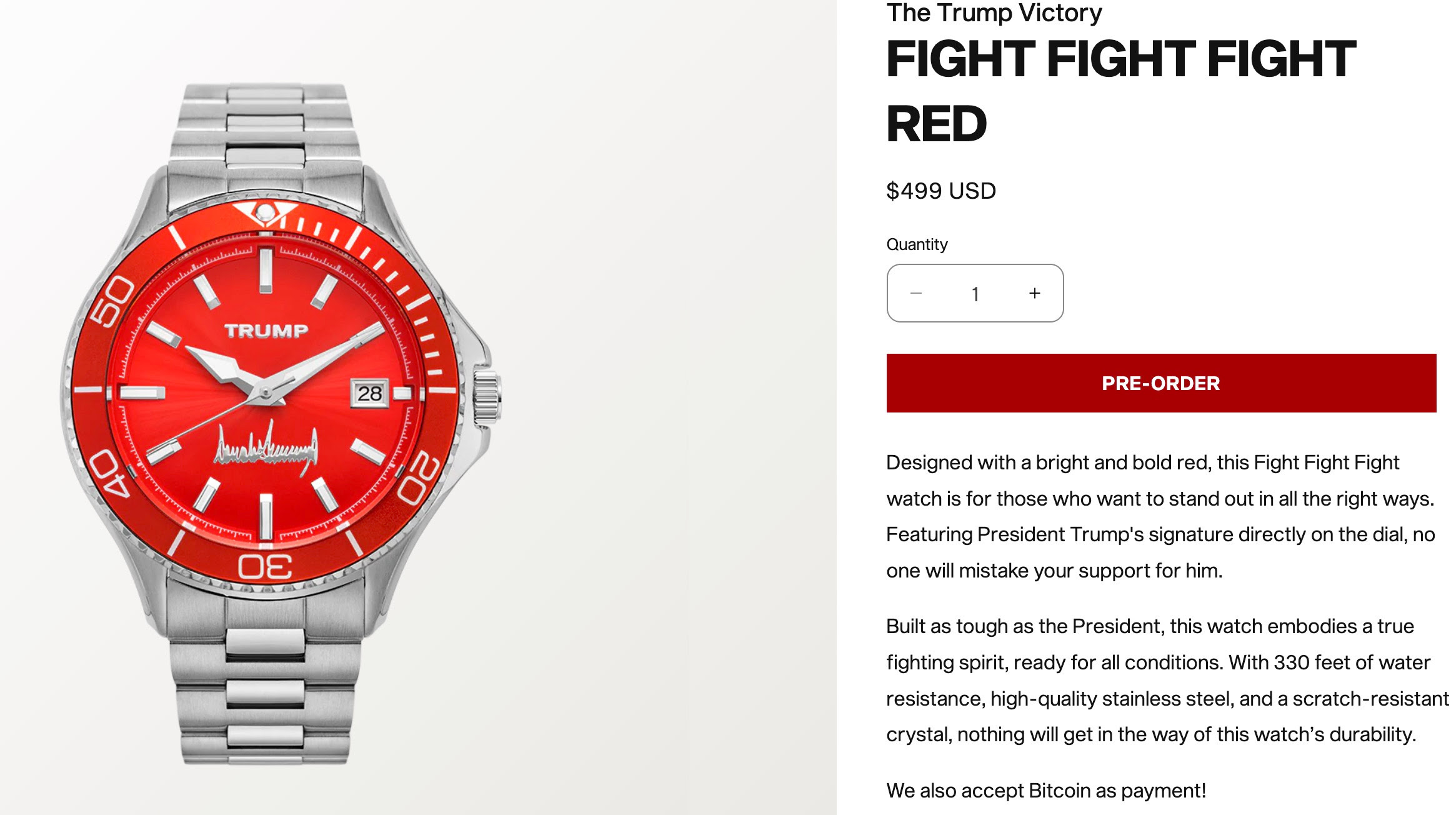
Donald Trump is using his campaign as a platform to sell Bibles, sneakers, and other stuff. The revenues go to him, not the campaign. He made a video to plug “Trump watches” to his fans. The least expensive is $400, the most expensive is $100,000. The ad says they were made in Switzerland. CNN tried to trace their origin and ended up at a building in Wyoming that is the mailing address for hundreds of other businesses. Is it just another grift?

All of these corporations share the same “organizer,” Andrew Pierce, whose company serves as the registered agent and as the gatekeeper for more details about the business Trump is promoting in the final weeks of his third White House bid.

The Hollywood Reporter interviewed watch experts, and they suspected that the Trump watches are made in China and vastly overpriced.

Jonathan V. Last of The Bulwark has performed a public service by dissecting the actual cost of the brand-new Trump watches, which Trump is advertising and selling online. The top of the line sells for $100,000, the least expensive is $499. All profits, of course, go to Trump personally, not to his campaign. Trump is cashing in on the gullibility of his cult.

Last shows in his post that the actual cost of putting together the $100,000 all-gold with inlaid diamonds watch (engraved with Trump’s name on is face) is $20,000. The actual cost of the $499 watch with Trump’s name on its face is $60.

He writes:

How much are these watches worth, really?

Let’s take the $499 version, which is a red-dial steel dive watch. It has an automatic date movement of unspecified origin. (Translation: China.) It has a mineral crystal with an aluminum bezel. The clasp does not appear to have micro-adjustments.

The internet is full of off-brand watches like this. Here’s how you build one:

Everything you need comes from China using AliExpress. First you buy a steel case and bracelet for, say, $30. Like this one.

You engrave the caseback using laser etching working off an .svg file. Maybe that costs $5. Then you buy the cheapest possible automatic movement with a date function. Here’s one for $9. Pop the movement into the case and all that’s left are ial and handset. Hands are super-cheap.

And sunburst dials—even with applied markers—are not terribly expensive, either.

The final step is actually the most expensive: You have to pay someone to machine the “TRUMP” and signature bits and glue them to the dial. This is the first truly custom step and maybe, if the manufacturer wants to spend a little more money, they’re having a fourth-party make the dials for them out of sunburst blanks.

All told we’re in the neighborhood of $60. And that’s if you’re just trying to build a single watch without bulk purchasing power.

Reminder: They’re selling it for $499.

Last determined that Trump will pocket millions of dollars from the sale of these watches.

Here is his description of the $100,000 watch:

Enough with the plebe beater watches. I want to know about the $100,000 Trump “Victory” watch!

At least these aren’t from Ali Express.

Almost the entirety of the cost for the Victory models comes in the material cost for the “solid gold” case and bracelet. Trump claims there’s 200 grams of 18K gold in each watch. If true, the spot price of gold puts that cost near $13,000.¹ That’s real money.

The tourbillon movement inside these watches also appears to be an off-the-shelf product, but at least it’s a high shelf.² If I had to bet, I’d guess the Victory uses something from Olivier Mory, who sells “Swiss Made” tourbillon movements that generally run around $3,000.

How does Mory keep costs down? “Swiss Made” is like “Broadway”—it sounds like a colloquial description, but it’s actually a legal term of art.³Swiss Made means that 60 percent of the manufacturing costs and 50 percent of the “essential manufacturing step” must occur in Switzerland. Mory sources as many parts of his movement as he can from outside Switzerland—while still maintaining his “Swiss Made” status. And he streamlines his build process so that he can assemble 1,000 movements per month while keeping half of the “essential manufacturing step” in country.⁴

I can’t speak to the cost of the diamonds because there’s no information about the total karat weight involved but they appear to be quite small, in the <1mm range. For the sake of argument let’s say that the diamonds add another $1,000.

We’re now talking about a total production cost in the neighborhood of $20,000—and possibly much less—for a watch offered at $100,000.

As a point of reference, the list price on a solid gold Rolex Submariner is $40,600. In the Submariner you get an in-house, state-of-the-art movement running at COSC spec inside a bullet-proof case. The fit and finish will be superlative. And even though you’re paying over the odds for the Rolex name, you’re getting 10x the watch for 40 percent of the price of a Trump Victory.

Did I mention that the Trump Victory can’t get wet? From the Trump website: “The Tourbillon watches are not intended for water exposure.

Which watches does Trump own?

Last writes:

Trump is not a watch nerd, exactly, but he knows that Big Rich Guys should wear expensive gold watches. So he has a Patek Philippe Golden Ellipse ($17,500), a gold Rolex President Day-Date ($40,000), and a Vacheron Constantin Historiques Ultra-Fine ($20,000). It’s a small, understated collection and if I’m being honest, it’s impressive in its own way. These are beautiful watches from serious watchmakers and they suggest an elevated taste that I would not have expected from Trump.

The website for Trump watches includes this advisory:

Trump Watches are not designed, manufactured, distributed or sold by Donald J. Trump, The Trump Organization or any of their respective affiliates or principals. TheBestWatchesonEarth LLC uses the “Trump” name, image and likeness under a paid license agreement which may be terminated or revoked according to its terms. Trump Watches are intended as collectible items for individual enjoyment only, not for investment purposes. 
The images shown are for illustration purposes only and may not be an exact representation of the product.
These watches are not political and have nothing to do with any political campaign.

Panelists on MSNBC’s “Morning Joe” agreed that it’s become very expensive to be a follower of Trump. The Trump Bible. The Trump commemorative coins. The Trump NFT. The Trump sneakers. Now the Trump watch.

And there is much more for sale at Trumpstore.com.

Gotta make money while there’s still time.

Profiteering off your candidacy is tawdry and undignified.

There has never before been a presidential candidate who used his position to make a profit. Usually all fundraising and sales of merchandise go into the campaign’s coffers. But now, Trump is turning his campaign into a major grift. He has been marketing products throughout the campaign, meant to enrich himself, not the campaign. What next? Selling locks of his golden mane for $50,000 a snip? Making money has been his lifetime preoccupation. Win or lose, Trump will still be selling stuff to unwary buyers.

Step right up! Be the first!

Just days ago, Trump announced a new business venture. He is going into the cryptocurrency business. Should he be elected, his new business will be regulated by whoever he appoints as head of the SEC (Securities and Exchange Commission). The new Trump business will be called “World Liberty Financial.” The possibilities for conflict of interest have never deterred Trump. During his Presidency, Trump owned the hotel closest to the White House, where foreign nations booked the most expensive suites to impress him.

On Saturday, Trump released a video of him hawking a $100 commemorative coin, which includes his “very beautiful face.” He assures you it is a “limited edition” coin. Don’t accept substitutes. Go to “PatriotTakes” on Twitter to buy your own Trump coin.

Philip Bump wrote about Trump’s profit making businesses in The Washington Post:

One of the defining characteristics of Donald Trump’s rallies is the emergence of an ad hoc marketplace of Trump-related merchandise. If it is made of cloth, is red and carries the name “Trump,” it’s there and it’s for sale.

A businessman like Trump might be expected to have mixed feelings about such a display. On the one hand, it’s a demonstration of the extent of enthusiasm of his supporters. On the other, it’s a lot of money being made from his name going into other peoples’ pockets.

But then, he’s still making a lot of money off his own name, too. In fact, he seems to be making an increasing amount of money selling the Trump brand — at the potential expense of the Trump candidacy.

On Tuesday, for example, Trump announced the fourth collection of his non-fungible token (NFT) trading cards — digital images that are theoretically constrained to increase their value. You may recall the flurry of excitement around NFTs a few years ago, with similar images inexplicably selling for thousands of dollars before plunging in value. Trump was late to this game, but he’s stuck with it, probably because Trump’s NFTs offer something more than a poorly photoshopped image of Trump dressed up as a cowboy: They offer access to Trump.

If you are one of the first 25 people to buy 250 of these new NFTs, the website proclaims, you get a staggering package of goodies: two VIP dinners with Trump and two cocktail receptions, as well as three pairs of signed sneakers (more on those in a second) and some actual physical trading cards, among other things. All for the low price of … let’s see, each card retails for $99, so: $24,750.

This package, mind you, does not include the commemorative card that is adorned with a piece of the suit Trump wore during his debate with President Joe Biden earlier this year. For that particular relic, you need to spend about $1,500 on 15 trading cards.

The money Trump is encouraging his supporters to spend doesn’t go toward getting him elected. The website insists that “these Digital Trading Cards are not political” — sure — “and have nothing to do with any political campaign.” The company simply “uses Donald J. Trump’s name, likeness and image under paid license from CIC Digital LLC, which license may be terminated or revoked according to its terms.”

CIC Digital LLC is a wholly owned subsidiary of the Donald J. Trump Revocable Trust, the entity established when Trump won the presidency to theoretically separate himself from his business interests.

CIC Digital LLC is different from CIC Ventures LLC, also a subsidiary of the Trump Trust. (The “CIC” here is presumably short for “commander in chief,” which would perhaps not be how the Founding Fathers expected that title to be used.) CIC Ventures is the partner of the aforementioned sneaker salespeople.

Want shoes showing a stylized image of Trump immediately after he was shot last month? $299. Want the gold ones, titled “Never Surrender” after Trump’s response to having been arrested in Georgia? $499. The Timberland-style boots are $199. The orange bitcoin/Trump shoes are apparently sold out; they went for $299 as well. (You will notice, as we go through all of this, that cryptocurrency is an undercurrent. That’s not a coincidence.)

Perhaps you’re simply looking to impress the guys at the frat house with your support for Trump. The sneaker people have an array of products designed for you: sandals/slides ($149), a cooler ($299) and Trump-branded cologne, titled “Victory” ($119).

Trump also recently plugged a Telegram channel for something called “World Liberty Financial,” a cryptocurrency-oriented group with an unclear goal. Among the sparse posts at Telegram, though, there was an offered warning: “Please be aware of scams and fake tokens claiming to be associated with ‘Defiant Ones,’ ‘World Liberty,’ or similar names. Do not engage with these tokens!” Scams? In crypto??

There are, of course, plenty of offerings for Trump’s more traditional base of support. There’s the Trump Bible, retailing for about $60. (The website also helpfully explains what to do if your Bible’s pages are sticking together.) And there are the other quasi-religious Trump books any true supporter will have to flesh out his or her library.

The newest is “Save America,” which Trump touted as “a FANTASTIC new Book” for which he “hand-selected every Photo, from my time in the White House, to our current third Campaign for President of the United States.” It’s only $99 — unless you want it signed, which tacks on $400.
For $399, you can get a signed copy of the book “Letters to Trump,” which is what it sounds like. The first book published by the firm responsible for these tomes, called Winning Team Publishing, was “Our Journey Together,” which is now only $74.99. If you want the full “Our Journey Together” bundle — including a special edition of the book, one of Donald Trump Jr.’s books and a “Make America Great Again” hat — you only need to shell out $999. (Donald Trump Jr. is a co-founder of Winning Team Publishing.)
If you only want a MAGA hat, Winning Team has those, too, though it doesn’t appear that sales of these explicitly campaign-oriented hats actually kick anything back to the campaign. They retail for about $30, the same as the Donald Trump-shaped Bluetooth speaker also sold on the website.

Trump’s fancier supporters might be in the market for higher-end products. A standard-sized bottle of Trump wine, from Trump Winery, retails for as much as $94.99 — though the person who benefits would be Trump’s son Eric. For that same price, you can also buy (as of writing) almost five shares of Trump Media & Technology Group stock. Whether that stock or the NFTs are a better investment is a question better answered by economists, but it’s been an unalloyed boon for Trump himself.

Further along the income scale, the Trump Organization still offers memberships at its clubs and golf courses — more expensive than buying 250 NFTs but a better way to ensure face time with Trump on a regular basis. Trump’s Mar-a-Lago Club/home now welcomes new members for only $700,000 a year. But hurry; the price will reportedly jump to $1 million in October. No wonder profits at Mar-a-Lago have quadrupled since Trump left office.

Almost all of this — the NFTs, the sneakers, the memberships, the books — kicks some portion of what customers pay back to Trump in one form or another. (He made $300,000 from the Bibles, for example.) All while his campaign complains in fundraising emails to supporters about being outpaced by Vice President Kamala Harris.
This is the contradiction that’s lingered around Trump since he announced his 2016 candidacy: He wants to be both a businessman and a candidate at the same time. Except Trump, it seems, doesn’t see it as much of a contradiction at all.

Historian Heather Cox Richardson weaves together the events of the past few days and demonstrates the submission of the Republican Party to one angry man. At the Republican National Convention, the party’s elders were notably absent. No Bush or Cheney; no Romney. Trump put his daughter-in-law, Lara, in charge of the Republican National Committee. It’s the Trump party now, and he controls all its levers of power. Note below that he hasn’t stopped hawking merchandise, even in the middle of his campaign. If you can open a tweet, this is an example of Trump turning his campaign into a money-maker for himself.

She writes:

…Trump began the day by posting an advertisement for the fourth “series of Trump digital trading cards,” or NFTs (which are unique digital tokens) featuring heroic images of Trump. People who buy 15 or more of them—at $99 apiece—get a physical trading card as well. Trump said that the physical card has a piece of the suit he wore at the presidential debate, and Trump promises to sign five of them, randomly. Up to 25 people who buy $25,750 worth of the cards with cryptocurrency will be invited to a gala next month at his Jupiter, Florida, golf club.

In the ad, Trump made it a point to emphasize his enthusiasm for cryptocurrency, an emphasis that dovetails with Trump’s recent promotion of an “official” cryptocurrency project. He linked to a Telegram channel run by his sons Don Jr. and Eric that, at the time, was called “The DeFiant Ones” but has been renamed “World Liberty Financial.” While there is little public information about the project, the channel has almost 50,000 subscribers.  

Hawking merchandise was an odd move for a presidential candidate, and it suggested his focus is elsewhere than on the election. Also today, Trump announced that he plans to make former Democrats Robert Kennedy Jr. and Tulsi Gabbard, both of whom have endorsed him, honorary members of his transition team. Kennedy told right-wing personality Tucker Carlson that he would “help pick the people who will be running the government…” 

And then, this evening, Quil Lawrence and Tom Bowman of NPR explained the story behind the surprising photos of Trump on Monday giving a thumbs-up over a grave in Arlington National Cemetery. The reporters wrote that “[t]wo members of Donald Trump’s campaign staff had a verbal and physical altercation Monday with an official” at the cemetery, where “[f]ederal law prohibits political campaign or election-related activities.” When a cemetery official tried to prevent Trump campaign staff from entering the section where the grave was located, “campaign staff verbally abused and pushed the official aside.” A Trump campaign spokesperson said the official who tried to prevent the staff from holding a political event in the cemetery was “clearly suffering from a mental health episode.” 

The elephant in the room these days is that most Republicans, along with many pundits, are pretending that Trump is a normal presidential candidate. They are ignoring his mental lapses, calls for authoritarianism, grifting, lack of grasp on any sort of policy, and criminality, even as he has hollowed out the once grand Republican Party and threatens American democracy itself.

It’s hard to look away from the reality that the Republican senators could have stopped this catastrophe at many points in Trump’s term, at the very least by voting to convict Trump at his first impeachment trial. At the time, Senator Ted Cruz (R-TX) said, “Out of one hundred senators, you have zero who believe you that there was no quid pro quo. None. There’s not a single one.” Republican senators nonetheless stood behind Trump. “This is not about this president. It’s not about anything he’s been accused of doing,” then–majority leader Mitch McConnell (R-KY) told his colleagues. “It has always been about November 3, 2020. It’s about flipping the Senate.”

When the Framers wrote the Constitution, they did not foresee senators abandoning the principles of the country in order to support a president they thought would enhance their own careers. Assuming that lawmakers would jealously guard their own power, the Framers gave to the members of the House of Representatives the power to impeach a president. To the members of the Senate they gave the sole power to try impeachments. They assumed that lawmakers, who had just fought a war to break free of a monarch, would understand that their own interests would always require stopping the rise of an authoritarian leader. 

But the Framers did not foresee the rise of political partisanship. 

In the modern era, extreme partisanship has led to voter suppression to keep Republicans in power, the weaponization of the filibuster to stop Democratic legislation, and gerrymandering to enable Republicans to take far more legislative seats than they have earned. The demands of this extreme partisanship also mean that members of one of the nation’s major political parties have lined up behind a man whom, were he running this sort of a campaign even ten years ago, they would have dismissed with derision. 

Finally, devastatingly, the partisanship that made senators keep Trump in office enabled him to name to the Supreme Court three justices. Those three justices were key to making up the majority that overturned the nation’s fundamental principle that all people must be equal before the law. In July 2024 they ruled that unlike anyone else, a president is above it.  

In May 2016, South Carolina Republican senator Lindsey Graham famously observed: “If we nominate Trump, we will get destroyed…….and we will deserve it.”

Pierre Tristam is the editor of FlaglerLive in Flagler County, Florida. In this brilliant article, he describes vouchers as welfare for the rich, a new kind of state socialism. He points out that vouchers are destroying public schools.

I want to acknowledge that I cribbed the article from the blog of the Network for Public Education, which you should subscribe to. It’s free, and it’s curated by the great Peter Greene. If you have a passion for public schools, sign up.

Tristam writes:

It would be absurd, I think we can all agree, if Paul Renner, our esteemed Speaker of the House and Flagler’s chief pork slabber, were to champion a bill entitling every citizen to take out $2,000 from their local policing budgets so they can have their own private security and call it “Police Choice.” After all, don’t we all pay taxes? Shouldn’t we have a choice how that money is spent? Don’t we free Floridians know best? Sheriff Rick Staly would be the first to tell Renner he’s out of his mind. 

It would be absurd, I think we can all agree, if Renner, claiming that taxpayers shouldn’t have their park choices limited to Holland and Ralph Carter Park, were to champion a bill entitling every household to take out $1,000 from the parks and rec budget so they could help subsidize their Disney and Universal experiences and call it “Park Choice.” Even Renner’s chamber of commerce courtesans would tell him he’s out of his mind. 

But not too many people told Renner he was out of his mind when he did exactly that to public schools: he championed a bill entitling every child in Florida to $8,000 a year to spend on private education, at the public school system’s expense, and called it “school choice.” The few who did were themselves told they’re out of their mind. 

“School choice” is an orchestrated demolition of public schools and the social contract. The focus-group euphemism masks the thieving of tax dollars to subsidize private schools, transforming what was once an aspiration of  fringe Christian and anti-government militants into state doctrine. “I hope to see the day when, as in the early days of our country, we won’t have public schools,” the televangelist and founder of the Moral Majority Jerry Falwell said in a 1979 sermon. “The churches will have taken them over again and Christians will be running them. What a happy day that will be.” Falwell lived long enough to see Jeb Bush’s Florida reopen that door. Renner swung the wrecking ball. 

Flagler County schools are losing close to $11 million this year to “choice,” siphoned out so 1,250 students can get their $8,000 either for private school or home school. True, not every one of these students was attending Flagler schools before, so it’s not a net loss of 1,250 students. But very few of these students were either qualifying or getting taxpayer subsidies before. Exactly 136 did in Flagler just four years ago, costing the district less than $1 million. Now anyone qualifies, including millionaire families, and every dollar going to them is a dollar diverted from public education. 

That figure of 1,250 students is for the first full year of this “choice” being in effect. Coming years will only accelerate the drain on public schools, because if you have children you’d be out of your mind not to take the $8,000-per-child handout, especially since most of you aren’t paying anywhere near $8,000 in school taxes each year. The rest of us, and even more so businesses and renters, are subsidizing the swindle. 

Advocates of the swindle have come up with a couple of defenses: first, that they’re taxpayers who should choose where their money is spent–the untenable argument that would then support “police choice” and “park choice,” and if you push that logic far enough, “war choice,” as in: you may spend my money on the Ukraine war but not the genocide of Palestinians. But in our social contract how our taxes are spent is not an a-la-carte option, though Boomer narcissists who can’t see past the hedge of their gated community think it should be.

Second, the advocates claim the dollars “follow the child,” as if public money going to private subsidies were new money that doesn’t affect public school budgets. It’s excellent propaganda. But it’s a double-barreled lie–double-barreled, because not only is every student lost to the public schools a loss of $8,000, but every student who was never enrolled in  public school but is now getting the $8,000 compounds that loss, since these are public dollars that would have otherwise been allocated to public schools. 

Incidentally, we don’t say that people receiving food stamps are on “food choice.” We don’t say that people getting Temporary Assistance for Needy Families are on “poverty choice.” When people get free money from the government, we call it welfare. Ditching the ordurous school-choice euphemism and applying the language’s proper definition–school welfare–exposes the state’s fabrications.

Facts do the rest. The welfare kings and queens this time are much richer than those on food stamps. As the Miami Herald reported Sunday, “Last school year, the average income of families who provided income data and received scholarships for a family of four was $86,000.” (To be eligible for food choice this year a family of four can’t have a household income above $62,400.) 

According to Step Up for Students, the state’s arm administering school welfare, 82 percent of handouts went to students attending religious schools–madrassas–like one in Palm Coast that boasts of “raising champions for Christ” and still sports a crusader for a mascot, which is no less offensive to a few hundred million people than if it flew the Confederate or Nazi flags. Our tax dollars are subsidizing that kind of bigotry. 

More perniciously: When Bush started the welfare-to-school wagon he limited it to the disabled and the needy. Minorities benefited disproportionately. It was a form of segregation in reverse, like affirmative action. Renner’s scheme, like so much under Gov. Ron DeSantis, revives pre-Brown v. Board of Education segregation. By eliminating eligibility barriers, wealthier families use the subsidy as a bridge to very expensive public schools whose tuition keeps the riff raff out, even with $8,000 subsidies. A family might’ve afforded a $9,000 school but couldn’t afford a $15,000 school. So clever schools adjust their tuition just so as a barrier to undesirables and to make extra profit, thus cashing in twice over: in dollars and in whitening their own “choice” of who gets in. Et voilà. Jerry Falwell’s jolly jowly ideal realized. 

Finally, to make sure the dagger cuts deeply and fatally, the state makes it mandatory for school districts to advertise school welfare on their websites. Districts like Flagler must make it as easy as possible for parents to apply for the money and get out of the district, while the state provides a detailed list of private schools to choose from, including, of course, every madrassa under the sky. State and districts could not be shouting louder: Public schools suck. Here’s $8,000. $16,000. $24,000. Now leave.

As students continue to be bribed out, public schools will be left with less money, all the responsibilities for higher standards, more challenging students, crumbling buildings and, revoltingly, school board members and superintendents in full Stockholm Syndrome mode. You hear them in board meetings not only talking about school welfare but praising it, pandering to it, the way the condemned suck up to their executioner. 

There are exceptions. Our own Colleen Conklin for years has been sounding the alerts about the swindle, starting with the charter schemes. She thankfully kept a few of those out of the district, back when local school boards had a say. They no longer do. And Conklin is leaving in November. Our remaining board members love the school welfare swindle and are probably trying to figure out how to cash in with their own kids without looking like public school traitors. 

But as Jerry Falwell implied, it’s a matter of time before those school board members are surplus property, like public school buildings, like buses, for that matter like teachers, counselors, paraprofessionals, bus drivers and administrators, all of whom are already treated like disposable obstructions in the way of school welfare and the cult known as “parental rights.”

Shortly after Senator Ben Sasse left the U.S. Senate, he accepted the presidency of the University of Florida. Silas Morgan of the Orlando Sentinel relied on reporting by the student newspaper, the Independent Florida Alligator, to describe how former Senator Sasse upped the budget for his office by millions of dollars.

The University of Florida’s student newspaper reported Monday that former university president Ben Sasse spent millions of the school’s money to hire GOP political allies.


Sasse, a former Republican U.S. Senator from Nebraska, gave several one-time Senate staff members and other GOP officials lucrative remote positions at UF, according to records obtained by the Independent Florida Alligator.


Among the Senate staffers who joined him at UF are his former chief of staff, Raymond Sass; his former communications director, James Wegmann; his former press secretary, Taylor Silva; and three other former staffers. Both Sass and Wegmann worked remotely from the Washington D.C. area.


Sass’ salary, at $396,000, was more than double his Senate salary. Wegmann’s new position at UF earned him $432,000, while his predecessor in the position had made $270,000.

The hirings contributed to a $4.3 million increase in presidential salary expenses, part of a tripling of his office’s spending compared to what his predecessor, Kent Fuchs, spent during his last year in office, the Alligator reported. Sasse’s office employed more than 30 staff members, while Fuchs had fewer than 10.


Sasse also hired former Tennessee Education Commissioner Penny Schwinn, who worked remotely from Nashville, in a newly-created position that paid a starting salary of $367,500 and U.S. Senator Lindsey Graham’s former scheduler, Alice James Burns, who also worked remotely and was paid $205,000.


A report obtained by the Alligator says Sasse spent over $20,000 flying his employees to UF between April 29 and July 29. The only hire who lives in Florida received a $15,000 stipend to relocate to Gainesville.


UF hasn’t responded to requests from the Alligator for a complete log of Sasse’s travel expenses. His travel expenses rose to $633,000 over his first full fiscal year, more than Fuchs spent on travel in eight years.

He also spent $7.2 million on consulting contracts, nearly two-thirds of which went to consulting giant McKinsey and Company, where he used to work as an advisor on an hourly contract. This amounts to more than 40 times what Fuchs spent on consulting in eight years.

Sasse abruptly resigned at the end of July, citing his wife’s failing health. The Alligator says the university did not respond to questions about what would happen to the hires now that Sasse is gone. Fuchs has returned as interim president until the UF Board of Trustees can hire a permanent replacement for Sasse.


Sasse’s hiring by the Board in 2022 resulted in the UF Faculty Senate passing a no confidence resolution in Sasse’s presidential search process due to transparency issues. Legislation passed by Florida’s GOP-controlled legislature earlier in 2022 made records relating to public university presidential searches exempt from Florida’s open public meetings and public records requirements.

His appointment by the board of trustees also generated controversy among parts of the student body, especially the LGBTQ+ community, for political positions Sasse had taken while in the Senate.

Big Pharma makes big profits in the U.S., but has mastered the accounting trick of paying little or no taxes. Thanks to Trump’s big corporate tax cut in 2017, most of these corporations are able to transfer their profits to other countries where the tax rates are lower.

Although they receive the bulk of revenue from sales in the U.S. and report large overall profits, most large U.S.-based pharmaceutical companies don’t pay any taxes in the country.

A new analysis of corporate taxes paid by the largest U.S. pharma companies by the Council on Foreign Relations found that in 2023, the top seven based on revenue had a combined U.S. tax obligation of (-)$250M.

The duo also noted that, based on 10-K filings, many pharmas reported losses in the U.S. in 2023. Among them: Pfizer, $4.4B; AbbVie, $3.5B; Merck, $15.6B; and Johnson & Johnson $2B.

However, Setser and Weilandt estimated that Eli Lilly (LLY) reported a $0.9B U.S. profit.

Gilead Sciences (GILD) is an outlier among large biopharmas. It is the eighth largest U.S. biopharma by revenue, yet reported paying $3B in U.S. taxes in 2023.

Setser and Weilandt explain how pharmas can book U.S. profits overseas to save on paying U.S. taxes. The first reason is the Tax Cuts and Jobs Act of 2017, which the pair say provided for lower taxes on foreign profits than U.S. profits, providing an incentive for companies to book more profits overseas.

Second, since many drugs sold in the U.S. market are actually made abroad, pharma companies decide to book those profits in the country of manufacture.

Finally, many pharmas have moved their intellectual property to wholly owned subsidiaries in locations with more favorable tax rates than the U.S.

Open the link to read the rest of the article.

Former President Trump recently discovered that members of his administration had produced a set of plans for his next term. They did this under the guidance of the Heritage Foundation, the Republican Party’s ideological center. If you believed that Trump knew nothing about this 900-page guidebook, I know of a bridge in Brooklyn to sell you.

Project 2025 is a handbook of extremism. It represents the far-right Republicans’ desire to eliminate many federal programs and, as right winger Grover Norquist one memorably said, “Shrink it so it can be drowned in a bathtub.”

North Carolina public school advocates Patty Williams and David Zonderman are public school graduates and parents. They wrote the following about Project 2025:

In the Spring of 2023, the Heritage Foundation released Mandate for Leadership: The Conservative Promise, aka Project 2025. Now, more than a year later, it is finally getting the serious attention that it demands. In its early pages, the Foundation claims to “have gone back to the future—and then some.” We are warned that, “The federal government is a behemoth, weaponized against American citizens and conservative values, with freedom and liberty under siege as never before.” To fight this supposed incubus sucking the life out of the republic, a growing number of conservative organizations have joined the Heritage Foundation in supporting this project and intend to assemble an army to march on Washington to “deconstruct the Administrative State.”


Project 2025 is both breathtaking and scary in its scope. It envisions a far-right rewriting of government missions, policies, and procedures, ranging from the White House, through all Cabinet-level departments, to the Federal Reserve and other independent regulatory agencies.  Tens of thousands of federal employees could be fired or subject to politically-inspired loyalty tests, gutting almost 150 years of civil service reform, and erasing institutional memory, knowledge, and expertise. Whole federal departments—including the Department of Education—and the funding that goes with them could be left on the cutting room floor, with disastrous consequences for the least among us.


This far-right “Playbook” is a frontal assault on honest and competent government, and the underpinnings of our 248-year-old democracy. Project 2025 flips the script on our nation’s foundation of liberty, prosperity, and the rule of law by inverting and perverting fact and data about how government actually functions to protect the environment, ensure safe workplaces, and provide some safety net for those in poverty. 


Project 2025 may appear to come from the right-wing fever swamp, which conjures up something out of science fiction. Indeed, it does remind us of a legendary Rod Serling Twilight Zone episode, first televised in March of 1962. In “To Serve Man,” earth is visited by the Kanamits. Enormously tall aliens, they appear frightening at first, but are eventually welcomed by humans. The Kanamits help end famine, eliminate war, and provide unlimited energy supplies for the betterment of the planet. 


Seemingly altruistic in their efforts, the Kanamits leave a book behind at the United Nations, which a decoding expert, Hero Chambers and his able assistant, Pat, begin to translate. Meanwhile, the Kanamits invite enthusiastic Earthlings to visit their planet, and flight reservations fill up quickly. Only when Pat races up to a space ship about to lift off does she reveal to Chambers that the title of the book—To Serve Man—is a cookbook. A recipe for disaster.


Project 2025 also proclaims to serve man, perhaps not literally on a silver platter like the Kanamits; but it may also cannibalize our government, our nation, and our democracy. Unlike the hapless denizens of earth in the Twilight Zone, we don’t need a decoding expert to see through the myths and deceptions that seek to dismantle our enduring republic and its Constitutional rights.


Let’s not wait until it’s too late and our collective goose is cooked. It’s time to stir the pot. Encourage your friends and family to vote as though their democracy depends on it—because it does.


Many questions have been raised about the $2 billion that the Saudis gave Jared Kushner, Trump’s son-in-law, to invest in profitable deals. Now we know about one of them, thanks to veteran journalist Michael Isikoff, writing at SpyTalk.

After weathering criticism over its reliance on a gusher of Saudi cash, Jared Kushner’s investment fund made its first big splash last month when it announced it had signed a $500 million deal with the Serbian government to develop a high end real estate project in downtown Belgrade on the site of a bombed down army building destroyed during the 1999 Kosovo war.

But the fine print of the deal includes a commitment that seems destined to stir up even more international controversy: a pledge by Kushner’s firm, Affinity Partners, to construct a “memorial dedicated to all the victims of NATO aggression”— an allusion to the U.S.-backed bombing campaign that brought the Serbian government of Slobodan Milosevic to its knees a quarter century ago in response to its relentless campaign of repression and savage massacres of ethnic Albanians in Kosovo. 

Among those exercised over the Kushner deal is retired Gen. Wesley Clark, who served as NATO Supreme Allied Commander during the war. 

While he has no objection to a U.S. firm investing in Serbia, the planned revisionist memorial—officially proclaiming America’s adversary in the war to have been a victim of  “aggression”— “is worse than a reversal” of U.S. policies in the region, said Clark in an interview with SpyTalk. “It’s a betrayal of the United States, its policies and the brave diplomats and airmen who did what they could to stop Serb ethnic cleansing.” 

Just as concerning as the whitewashing of Serbian war crimes, Clark said, is the just announced deal between Kushner’s firm and the Serbian government of Aleksander Vučić, a pro-Russian hardliner who once served as minister of information in Milosevic’s government. The memorial project needs to be viewed in a wider geopolitical context: It serves the Kremlin’s core interests in undermining NATO at a time the alliance is engaged in resisting Russian aggression in Ukraine.

“This is part of a broader Russian intelligence movement to split, discredit and weaken NATO,” Clark said. “It’s Russian imperial pushback…Should Kushner participate in this? Of course he should not.”

Neither Kushner nor representatives of his Miami-based firm responded to requests for comment. But the remarks by Clark are likely to draw further attention to a project that has generated strong  criticism from Serbian opposition leaders as well as questions about potential conflicts of interest if Kushner’s father in law, Donald Trump (for whom he is once again raising money) is elected president in November.

Kushner’s partner in the deal is Richard Grenell, who was Trump’s Ambassador to Germany and who hopes to become Trump’s Secretary of State in a new administration.