The online charter sector not only has abysmal academic records, but it’s ripe pickings for scammers. The founders of Epic charter schools in Oklahoma are charged with multiple counts of embezzlement, racketeering and other crimes.
Epic Charter Schools’ founders, who were arrested Thursday, shifted millions of school dollars to company credit cards, which were used to make political campaign donations, fund a lobbyist and pay personal expenses like vacations, the Oklahoma State Bureau of Investigation alleges in court documents.
Following a yearslong investigation into alleged embezzlement of taxpayer funds, the co-founders of the state’s largest online school were arrested Thursday, along with the longtime chief financial officer, court records show.
David Chaney, 43, Ben Harris, 46, and Josh Brock, 40, were booked into the Oklahoma County Detention Center Thursday morning. Each is charged with racketeering, embezzlement, obtaining money by false pretense, conspiracy to commit a felony, violating the Oklahoma Computer Crimes Act, submitting false documents to the state and unlawful proceeds.
Investigators said the men ran a complicated criminal enterprise using the online charter school and a for-profit company, Epic Youth Services.
The scheme has cost the state more than $22 million, according to the OSBI.
The charges involve co-mingling of funds, excessive and unnecessary management fees, use of Oklahoma tax dollars in California, political influence, concealment of profits, submission of false invoices and the illegal use of employees.
One of the school’s largest recruitment tools, the learning fund, was used to conceal illegal purchases, agents alleged. For the learning fund, Epic makes at least $1,000 available to each student annually in a virtual account. Parents can allocate those dollars for curriculum, laptops and extracurricular activities.
Parents don’t receive the money directly. Instead, they request a purchase from Epic and the school transfers the money to Epic Youth Services, which pays the vendor.
Chaney and Harris used a separate bank account to make learning fund purchases, and investigators found Chaney and Harris didn’t return unused learning fund dollars.
The account received nearly $145 million between 2015 and 2021. More than 50 times, Chaney, Harris and Brock transferred public funds from the learning fund account to the private bank account for Epic Youth Services, which was then used to pay a lobbying firm. Capital Gains, a lobbying firm run by Robert Stem, a longtime friend of Harris’, was paid more than $500,000.
Please open the link to read the rest of the story. Campaign contributions go a long way towards avoiding accountability.
Governor Bill Lee of Tennessee is working overtime to destroy public schools in his state with charters and vouchers.
Pastors for Tennessee Children has stood up to him and the legislature, mobilizing public opinion against privatization.
PTC needs our help!
It’s a tumultuous time for public education in Tennessee. There are currently over 130 school privatization lobbyists working the legislature. Their intent is to replace public schools with charters, vouchers and homeschools. The Tennessee Public Education Coalition and Pastors for Tennessee Children have been actively working together to protect our students and teachers. These organizations blocked dangerous legislation including bills to expand vouchers, to allow charter schools to buy publicly owned properties for only one dollar, and to allow the mayoral takeover of elected school boards.
Pastors for Tennessee Children filed an amicus brief in the voucher lawsuit, which is still pending. They have shared our message in op-eds that have run in newspapers statewide and in live news interviews. They met with legislators and became active on social media. In short, They have done outsized work for an organization composed of a small number of committed volunteers who care about our public schools.
Bernie O’Neill (R-29, Bucks) is a former special education teacher for more than 25 years and a 16-year former member of the Pennsylvania House of Representatives.
Eugene DePasquale is former Auditor General of Pennsylvania and former member of the state General Assembly, (D-95, York). He presently serves as a Resident for the Keystone Center for Charter Change at the Pennsylvania School Boards Association.
They wrote:
Our roles as former elected officials from both of the major political parties have given us unique perspectives into not only Pennsylvania’s political process, but also its public education system, particularly charter schools.
Charter schools in the state have grown tremendously in the 24+ years in which they have existed. It is estimated that nearly 170,000 children will attend a brick and mortar or cyber charter school in the current school year and that Pennsylvania taxpayers will spend an estimated $3 billion to fund charter schools.
Despite being in operation for more than two decades, Pennsylvania’s Charter School Law (CSL) has never undergone any significant revision, other than allowing the creation of cyber charter schools in 2002, even though there are numerous glaring problems with the law. That’s not because the General Assembly hasn’t studied and introduced a myriad of legislative proposals each year to enact meaningful reforms. However, the state’s legislative body seems to be unwilling or unable to fix the problems.
Reforming the CSL should be a bipartisan issue. At its core, charter school reform would 1) ensure that public education funds are spent efficiently and appropriately; 2) that charter schools are as accountable and transparent as other public schools; and 3) preserve and strengthen educational choice by bolstering the law to ensure only quality charter school options are available to students and families.
Choice in public education is well-established in Pennsylvania. However, the status quo results in taxpayers sending hundreds of millions of public education dollars more than what charter schools need to provide an education. This is especially true for cyber charter schools, which do not maintain a physical school building and for all charter schools when it comes to well-documented overpayments for special education services. There’s a word for this type of spending – wasteful. And residents across the state feel the impact of these overpayments when their local school districts are forced to raise property taxes because of these costs.
Charter schools are supposed to be public schools. However, the boards that operate charter schools are not elected and are not required to include any representation from the community which they serve. Further, charter schools can contract with for-profit companies to run virtually all operations of the school. Once a charter school enters into one of these contracts, the public loses the ability to see how their money is being spent.
For years, proficiency on state assessments and graduations rates at charter schools have, on average, been substantially lower than those of traditional local public schools. While there are many high-performing charter schools, the current CSL makes it very difficult to close poor performers. Look no further than the fact that every cyber charter school has been identified by the state Department of Education as being in need of improvement for many years.
The bottom line is this: we owe it to our children and to the taxpayers to make sure that we are doing everything possible so that students are getting the best education available and that we are getting the best return on investment for our tax dollars. That’s something that all legislators should be able to support no matter which side of the aisle they’re on.
It is time to end the paralysis in Harrisburg, stop the practice of passing off charter school expansion proposals that fail to address serious funding flaws and contain little accountability as real reform, and finally work in a bipartisan manner to fix the law.
An economics and business writer at the New York Times named Peter Coy wrote an article titled “This Company Knows How to Increase Test Scores.” The article celebrates a study of a for-profit company called Bridge International Academies (renamed NewGlobe) that operates a large number of schools in Africa. Coy says the study by various American economists finds that the NewGlobe schools produce remarkable test score gains. What he doesn’t say is even more important. Civil society groups from across Africa and elsewhere urged the World Bank to stop investing in for-profit schools. The World Bank announced three months ago that it would no longer invest in the company praised in this article.
Coy begins:
Some of the world’s most successful educational techniques are being applied today in Kenya, Uganda, Liberia, Nigeria, Rwanda and India, in schools serving poor children that are run or advised by NewGlobe Schools, a company founded by Americans with headquarters in Nairobi, Kenya. These techniques deserve to be applied more widely, including in wealthy nations such as the United States.
A new study led by a Nobel laureate economist, Michael Kremer of the University of Chicago, found that in Kenya, enrolling in schools run by NewGlobe for two years increased test scores by an amount equal to being in school for an additional 0.89 year for primary school pupils, and to being in school an extra 1.48 years for pre-primary pupils. The poorest children improved the most.
The secret of NewGlobe’s success? Standardization. Every lesson is completely scripted and standardized. The teachers are told what to say and they say it. Most of the teachers are not high school graduates; they are not certified. They are paid less than union teachers. Yet the students get higher test scores! A reformer’s dream!
Coy compares these privately-run schools to the large KIPP chain (which, as I understand it, having visited KIPP schools, is not standardized, and whose results are not always as good as regular public schools) and to New York City’s Success Academy, a chain that has very high test scores but also very high student attrition and very high teacher turnover.
Coy writes:
“The test score effects in this study are among the largest observed in the international education literature, particularly for a program that was already operating at scale, exceeding the 99th percentile of treatment effects of large-scale education interventions,” Kremer and his colleagues found.
NewGlobe clearly has built a better mousetrap, but it has taken a while for the world to beat a path to its door. It has encountered multiple obstacles, including from the U.S. Congress, although it is gradually winning followers.
One reason for the slow uptake in the early going was resistance from teacher unions, including the Kenyan National Union of Teachers. During the period studied, NewGlobe paid teachers only one-third to one-fifth of what Kenyan public school teachers were earning. Many of its initial recruits didn’t have teaching certificates. (NewGlobe says it adapted to the government requirements as they changed over time.)
Here is the study. The title: “Can Education Be Standardized?” The authors believe it can and should be.
Here is the abstract:
We examine the impact of enrolling in schools that employ a highly-standardized approach to education, using random variation from a large nationwide scholarship program. Bridge International Academies not only delivers highly detailed lesson guides to teachers using tablet computers, it also standardizes systems for daily teacher monitoring and feedback, school construction, and financial management. At the time of the study, Bridge operated over 400 private schools serving more than 100,000 pupils. It hired teachers with less formal education and ex- perience than public school teachers, paid them less, and had more working hours per week. Enrolling at Bridge for two years increased test scores by 0.89 additional equivalent years of schooling (EYS) for primary school pupils and by 1.48 EYS for pre-primary pupils. These effects are in the 99th percentile of effects found for at-scale programs studied in a recent survey. Enrolling at Bridge reduced both dispersion in test scores and grade repetition. Test score results do not seem to be driven by rote memorization or by income effects of the scholarship.
Here are a few quotes from the Kremer et al study:
Three-quarters of teachers in public and private schools had acquired more than a secondary school education compared to just under one-quarter of teachers in Bridge schools. Relative to public school teachers, Bridge teachers were younger, less experienced, and more likely to be novice (first-year) teachers. On average, their total compensation amounted to between one fifth and one third of the average public school teachers total compensation and approximately the same as teachers in other private schools serving this population. They worked longer hours, including Saturdays...
Subsequent to the period analyzed in our study, Bridge’s parent company NewGlobe reduced the number of private schools operated by Bridge from 405 to 112, and launched a new model in which it primarily acts as a service provider to governments. Under this model, which now accounts for the bulk of students reached by NewGlobe, teacher qualification, compensation, and working conditions follow standard public sector guidelines; governments similarly set curricular, school infrastructure, and child safety standards, and costs of standardization are covered by the state rather than through fees to parents.
Note that Bridge has changed its main model, the one lauded by the Kremer study and Peter Coy. Why is Coy waxing enthusiastic about a model that has been downsized? Bridge dramatically reduced the number of for-profit private schools (where families had trouble paying $5 or more a month, and students were suspended for non-payment of fees). Instead it now has inserted its standardized model into the public sector, where its costs are paid by the government, not families, and it has to meet standards set by the government. But its costs are far beyond what these governments can afford to pay. Coy missed that detail.
Another study of Bridge schools in Liberia was discouraging for Bridge. The condition of the free public schools in Liberia was dismal, which paved the way for outsourcing of schools to private management. About 25% of students in fifth grade could not read a single word in the public schools. It should not be hard to beat that low bar. The study found:
Outsourcing the management of 23 randomly-selected government primary schools in Liberia to Bridge International Academies led to learning gains of 0.35σ after three years, equivalent to reading roughly 2.2 additional words per minute. Beyond learning gains, Bridge increased dropout by more than half and reduced transition to secondary school (overall, Bridge had a -6.53 percentage point effect on the probability of being enrolled in any school after three years). Bridge had no statistically significant impact on corporal punishment and failed to reduced sexual abuse. Overall, any assessment of outsourcing public schools to Bridge must weigh its modest learning gains against its high operating costs and negative effects on access to education via increased dropout.
Bridge raised test scores, but the dropout rate was high, which probably increased test scores. Bridge was too expensive for the Liberian government: in its first year, it cost $640 per year. By year three, the Bridge cost was down to $161 per pupil. The Liberian government’s goal is $50 per pupil per year. This model does not look like the money-maker that its sponsors envisioned.
I first learned about Bridge International Academies when I read an article in the New York Times Magazine called “Can a Tech Start-Up Successfully Educate Children in the Developing World?” An American couple, Shannon May and her husband Jay Kimmelman, along with a third partner, had the audacious idea that a company that provided $5 a month private schools could dramatically disrupt education in Africa while creating a billion-dollar corporation. What was not to like?
Just as titans in Silicon Valley were remaking communication and commerce, Bridge founders promised to revolutionize primary-school education. ‘‘It’s the Tesla of education companies,’’ says Whitney Tilson, a Bridge investor and hedge-fund manager in New York who helped found Teach for America and is a vocal supporter of charter schools.
The Bridge concept — low-cost private schools for the world’s poorest children — has galvanized many of the Western investors and Silicon Valley moguls who learn about the project. Bill Gates, the Omidyar Network, the Chan Zuckerberg Initiative and the World Bank have all invested in the company; Pearson, the multinational textbook-and-assessment company, has done so through a venture-capital fund.…
The company’s pitch was tailor-made for the new generation of tech-industry philanthropists, who are impatient to solve the world’s problems and who see unleashing the free market as the best way to create enduring social change.
The basic idea of the Bridge Schools was standardization. The lessons were written by charter school teachers in Cambridge, Massachusetts, then read out loud by Bridge teachers on an e-reader in their classroom. Every teacher taught the same lesson at the same time in the same way, as instructed.
The new study says the concept works. However, it has run into political obstacles. The Bridge idea is opposed not only by teachers’ unions but by every civil society organization in Africa, which opposed the concept of privatizing African public schools. No matter how poorly resourced they are now, they will be destroyed by privatization. If the private companies can”t make money, how long will they stay?
I shared the new Kremer paper with an eminent economist, who responded, in part:
This approach seems crazy to me. Read section 9 of the paper which describes and explains the dramatic downsizing of the endeavor. That section confirms my initial response that the Bridge approach is ultimately likely to do far more harm than good. Shouldn’t young children have an opportunity to learn through play and personal engagement? Moreover, how does the approach deal with the fact that children develop at different rates and have different talents? And why would anyone who cares about children want to teach in such an environment? This is all very scary and disturbing.
Bill Gates and Mark Zuckerberg can’t be pleased to see that the model they funded has been reduced from 405 schools to 112 schools. The pupils it is supposed to serve can’t afford the fees. Nor can the governments in the nations where they are located.
Peter Coy should read more carefully before he touts an experiment that has already failed.
We are told again and again by libertarians that the free market solves all problems.
In Africa, it failed to provide better education at a price that families or governments can afford. Africa desperately needs more money for education, not for profits.
Bridge (NewGlobe) is not a model for American schools or the schools of any other nation.
Standardization is for electrical outlets and machines, not for children, teachers and education.
Perhaps you remember the A3 charter scam in California. The online charter chain managed to collect hundreds of millions of dollars from the state for ghost students. Its leaders were eventually arrested, charged, and convicted. They are still repaying their ill-gotten gains.
An additional $18.8 million has been paid to San Diego County as restitution for the statewide A3 charter school scam in which the state was defrauded of hundreds of millions of school dollars, the San Diego County District Attorney announced Wednesday.
Sean McManus of Australia, along with Jason Schrock of Long Beach, led a statewide charter school scheme from 2016 to 2019 in which they used a network of mostly online charter schools to defraud the state of approximately $400 million and used $50 million of that amount for personal use. They did so by falsely enrolling students and manipulating enrollment and attendance reporting across their schools to get more money per student than schools are supposed to, prosecutors said.
In total, about $240 million of the $400 million has been recovered. The District Attorney’s Office said it is not trying to get back all of the $400 million because some of the money ended up going to noncriminal actors, such as teachers, youth programs and others, who provided services for the A3 schools and who did not know the money was obtained illegally.
Of the $240 million that has been recovered, about $95 million has been returned to the state treasury, with an additional $90 million expected to be returned to the state within the next few months.
More than $37 million in fines has been paid to San Diego County as part of a court judgment stemming from a charter school fraud scheme that took millions in public school funds and led to criminal charges against 11 people, the San Diego County District Attorney’s Office announced Wednesday.
The total fine amount includes $18.75 million recently paid by Sean McManus, CEO and president of A3 Education, who pleaded guilty to stealing more than $50 million in public funds and was sentenced to four years in prison.
Prosecutors say McManus and co-defendant Jason Schrock directed subordinates to open up 19 “A3 charter schools” in San Diego County and elsewhere across the state, and collected state funds by alleging students were enrolled in programs run by the schools.
The District Attorney’s Office, which called the case “one of the nation’s largest fraud schemes targeting taxpayer dollars intended for primary education,” said the men paid for student information and used the info to enroll children in summer school programs at their online campuses. Prosecutors say some parents were unaware their children were enrolled in a charter school at all.
The defendants then took measures to inflate the amount of money the state paid the charter schools by falsifying documentation, which included backdating documents to indicate that students were enrolled in the charter schools for longer than they were or switching students between different A3 schools to increase funding per student or per school beyond legal limits, prosecutors said.
The perpetrators were very clever and very, very rich until they were caught.
In a curious coincidence, I had breakfast at a hotel in January 2019 in Newport Beach, California, with a friend. At the table next to us sat a man and woman discussing education and a business transaction. I tried not to eavesdrop, yet found myself fascinated by the curious combination of topics. As they got up to leave, I stopped the man and said, “Excuse me, but I wonder if you are in the charter school business.” He responded, “Yes, I am Sean McManus, and I run a chain of charter schools.” The boom fell not long after.
This is a letter from Robert Weissman of Public Citizen, an organization that’s trying to fix our broken nation.
There was a time — not that long ago — when America’s gun manufacturers did not advertise assault weapons to the general public.
But for the past 20 years or so, the gun industry has been aggressively marketing military-grade munitions to the American people — with ads specifically invoking race-based fear, twisted notions of masculinity, and distorted ideas about “patriotism.”
This has fed some very bad and deadly trends:
The United States is the only country on the entire planet with more guns (at least 400 million and counting) than people (335 million). No other country has even half as many guns per capita as we do.
The number of guns manufactured in America has nearly tripled over the past two decades, from 3.9 million in 2000 to 11.3 million in 2020. (And it’s not as if guns wear out like light bulbs, refrigerators, or cars.)
We endure more mass shootings than all other developed countries combined. It’s not even close.
The frequency — and body count — of mass shootings has increased as well.
13 of the 20 deadliest mass shootings since 1982 happened in just the past decade.
There were 118 school shootings in 2018, doubling the previous record of 59. Then 119 in 2019. Then 114 in 2020. Then 249 (not a typo) in 2021. And already 137 so far in 2022 (with more than half the year still to go).
The 3 deadliest years for school shootings in the past half-century are 2018, 2021, and 2022 (which, again, isn’t quite halfway over yet).
Guns have become the leading cause of death among children in our country. Not disease. Not malnutrition. Not accidents. (Auto accidents had been the leading cause of death among children for decades until overtaken by guns in 2020.)
And all the while, gun industry profits have exploded.
Look, America’s gun manufacturers may well be beyond listening to reason. There are, after all, more people to scare — and more profits to be made — no matter the carnage.
But let’s make them hear us — our pain, our fury, our disgust — anyway.
Michael Hiltzik is a brilliant columnist for The Los Angeles Times. This article is the single best analysis of gun control that I have read anywhere. In it, Hiltzik demonstrates the fallacies of those who oppose gun control. The Second Amendment does not give unlimited rights to own guns. Gun control is supported by majorities. Effective gun control saves lives. Why should the right to own a gun be more sacred than the right to life?
Hiltzik writes:
Another massacre, another outpouring of political balderdash, flat-out lies about gun control and cynical offers of “thoughts and prayers” for the victims.
I haven’t commented on the slaughter of 19 children and two adults in Uvalde, Texas, by an assault rifle-wielding 18-year-old before now, hoping that perhaps the passage of time would allow the event to become clarified, even a bit more explicable.
But in the week since the May 24 massacre, none of that has happened. The news has only gotten worse. It’s not merely the emerging timelines that point to the inexcusable cowardice of local law enforcement at the scene, but the ever-growing toll of firearm deaths across the country.
The right secured by the Second Amendment is not unlimited.
— Justice Antonin Scalia, District of Columbia vs Heller
There have been 17 mass shootings nationwide since Uvalde, including 12 on Memorial Day weekend alone. A mass shooting is defined by the Gun Violence Archive as one in which four people or more are killed or wounded, not including the shooter.
What is most dispiriting about this toll is the presumption that campaigning to legislate gun safety is fruitless, because gun control is unconstitutional, politically unpopular, and useless in preventing mass death.
These arguments have turned the American public into cowards about gun control. Voters seem to fear that pressing for tighter gun laws will awaken a ferocious far-right backlash, and who wants that?
Yet not a single one of these assertions is true, and repeating them, as is done after every act of mass bloodshed, doesn’t make them true. The first challenge for those of us concerned about the tide of deaths by firearms in America is to wean the public and public officials from their attitude of resignation.
We’ll skip lightly over a few of the more ludicrously stupid claims made by politicians and gun advocates about Uvalde.
For example, that the disaster could have been averted if the school had only one door, says Sen. Ted Cruz (R-Texas); apparently Cruz is ignorant of the Triangle Shirtwaist Factory disaster, in which 146 garment workers died, many because they could not escape the factory through its locked doors.
But that happened in 1911, and who can expect a Senator to remain that au courant?
Or the assertion by Texas Gov. Greg Abbott and many others that the problem leading to Uvalde isn’t the epidemic of assault weapons, but mental illness. This is nothing but an attempt to distract from the real problem.
“Little population-level evidence supports the notion that individuals diagnosed with mental illness are more likely than anyone else to commit gun crimes,” a team from Vanderbilt University reported in 2015.
Finally, there’s the argument that the aftermath of horrific killings is not the time for “politics.” In fact, it’s exactly the time for politics. Mass death by firearm is the quintessential political issue, and there’s no better time to bring it forward than when the murders of children and other innocents is still fresh in the public mind.
Let’s examine some of the other common canards about gun violence and gun laws, and start thinking about how to move the needle.
The 2nd Amendment
For 217 years after the drafting of the Bill of Rights, which included the 2nd Amendment, courts spent little effort parsing its proscription that “A well regulated militia, being necessary to the security of a free state, the right of the people to keep and bear arms, shall not be infringed.”
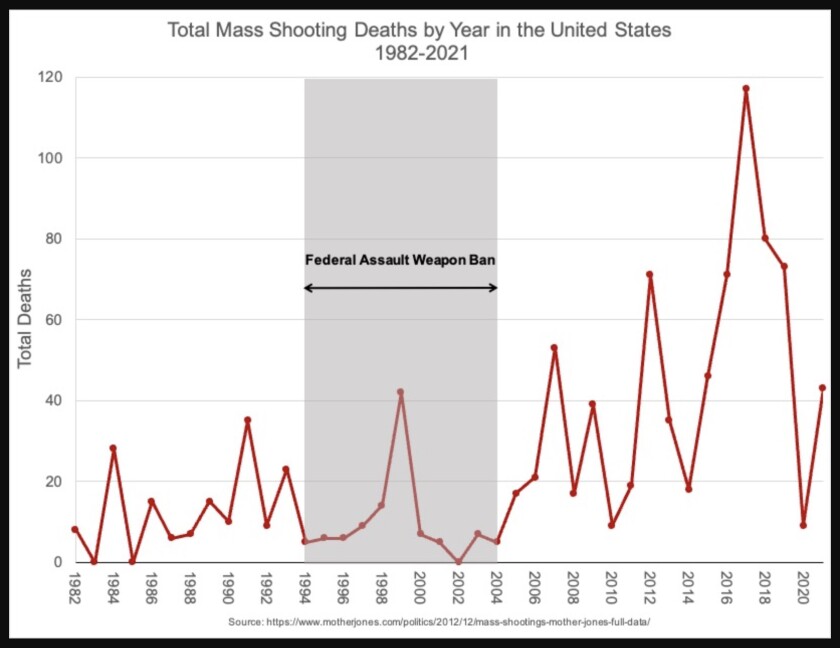
Since the federal ban on assault weapons expired in 2004, mass shootings with those weapons has climbed. An assault weapon was used in the Uvalde massacre of May 24. (Mother Jones)
That changed in 2008, with the Supreme Court’s ruling in the so-called Heller case overturning the District of Columbia’s ban on possession of handguns in the home. Since then, the impression has grown — fostered by the National Rifle Assn. and other elements of the gun lobby — that Heller rendered virtually any gun regulation unconstitutional.
But Justice Antonin Scalia’s 5-4 majority opinion said nothing of the kind. Indeed, Scalia explicitly disavowed such an interpretation. “The right secured by the Second Amendment is not unlimited,” he wrote. The Constitution does not confer “a right to keep and carry any weapon whatsoever in any manner whatsoever and for whatever purpose.”
There was, and is, no constitutional prohibition against laws prohibiting the carrying of concealed weapons, he found. Nothing in his ruling, he wrote, should “cast doubt on longstanding prohibitions on the possession of firearms by felons and the mentally ill, or … the carrying of firearms in sensitive places such as schools and government buildings,” or conditions on gun sales.
The problem with the D.C. law, Scalia wrote, was that it went too far by reaching into the home and covering handguns, which were popular weapons of defense in the home. “The Constitution leaves the District of Columbia a variety of tools” for regulating handguns, as well as other firearms, he wrote.
The federal assault weapons ban, which was enacted in 1994 and expired in 2004, repeatedly came under attack in federal courts, and prevailed in every case. Not a single one of those challenges was based on the 2nd Amendment. Since the expiration of the ban, mass shooting deaths in the United States have climbed steadily.
“Heller has been misused in important policy debates about our nation’s gun laws,” wrote former Supreme Court clerks Kate Shaw and John Bash in a recent op-ed. “Most of the obstacles to gun regulations are political and policy based, not legal.” Shaw and Bash worked on the Heller decision as clerks to Scalia and John Paul Stevens, the author of the leading dissent to the ruling, respectively.
So let’s discard the myth that gun control laws are unconstitutional.
The NRA
By any conventional accounting, the NRA is a shadow of its former self. Its leadership has been racked with internal dissension, its resources have been shrinking and it has faced a serious legal assault by New York state. Attendance at its annual convention last week in Houston drew only a few thousand members, even with former President Trump on hand to speak.
Yet the organization still carries major political weight. To some extent that’s an artifact of its political spending. Even in its straitened circumstances it’s a major political contributor, having handed out more than $29 million in the 2020 election cycle. Some of the politicians taking resolute pro-gun stands are beneficiaries of this largess, mouthing “thoughts and prayers” for the victims of gun massacres while pocketing millions from the NRA.
The NRA also has played a lasting role in blocking funds for research into gun violenceby federal agencies such as the Centers for Disease Control and Prevention, an obstacle that remained in place for some two decades until Congress restored funding in 2019. But the gap in research still hampers gun policymaking. It’s long since time to curb this organization’s blood-soaked influence on our politics.
Debate? What debate?
Part of the knee-jerk news coverage of the aftermath of gun massacres is the notion that the American public is deeply divided over gun regulations. This is a corollary of the traditional claim that American society is “polarized,” which I showed last year to be absolutely false. The truth is that large majorities of Americans favor abortion rights, more COVID-related restrictions and, yes, gun regulations.
More than 80% of Americans favor instituting universal background checks on gun buyers and barring people with mental illness from owning guns, according to a Pew Research Center poll. More than 60% favor banning assault weapons and high-capacity ammo magazines.
The poll was taken last September; it’s a reasonable bet that the majorities would be larger now. To put it another way, the “debate” is over — most Americans want to bring gun sales and ownership under greater control.
Gun regulations work
One claim popular among pro-gun politicians is that gun regulations don’t serve to quell gun violence. (A common version of this trope is that proposed regulations wouldn’t have stopped the latest newsworthy massacre.)
This is a lie, as statistics from the CDC show. States with stricter gun laws have much lower rates of firearm deaths than those with lax laws. The first category includes California (8.4 deaths per 100,000 population) and Massachusetts (3.7). The second group includes Louisiana (26.3) and Texas (14.2, and the highest total gun-related mortality in the country, at 4,164 in 2020).
Texas even loosened its gun regulations just months before the Uvalde massacre. When Missouri repealed its permit regulations for gun ownership in 2007, gun-related homicides jumped by 25% and gun-related suicides by more than 16.1%. When Connecticut enacted a licensing law in 1995, its firearm homicide rate declined by 40% and firearm suicides by 15.4%.
Make them vote
Perhaps the most inexplicable argument justifying congressional inaction over gun laws is that tough laws have no chance of passage, so it’s pointless even to try. Defeatism in the face of urgent need is inexcusable.
The resistance of Republicans to voting for gun laws is precisely the very best reason for bringing those bills to the floor. There’s no reason to give Republican obstructionists a free pass — make them stand up and take a vote.
Make them explain what it is about making Americans safer in schools and workplaces that they find objectionable, and why they think that voting against measures supported by 80% of the public is proper. Bring the fight to them, and show voters the character of the people they’ve placed in high office.
Show the pictures
Americans have become inured to gun violence in part because our culture minimizes its horrors. We’re awash in the most visceral depictions of shootings in movies and television, but at their core those depictions are unthreatening — indeed, in most cases they’re meant for entertainment.
Even our news programs revel in gore — the classic dictum of local news broadcasting has long been “If it bleeds, it leads.”
These conditions have inoculated us against the horror of firearm injuries as they occur in real life — especially those caused by assault weapons such as the AR-15. There’s a big difference between hearing the words “gunshot wound” and learning what actually happens to the organs of victims of AR-15 assaults. They don’t look anything like what we see on TV, and we need to have a true, visceral sense of the difference.
“These weapons are often employed on the battlefield to exact the maximum amount of damage possible with the strike of each bullet,” radiologist Laveil M. Allen wrote last week for the Brookings Institution. “Witnessing their devastating impact on unsuspecting school children, grocery shoppers, and churchgoers is unfathomable. The level of destruction, disfigurement, and disregard for life that a high-powered assault rifle inflicts on the human body cannot be understated. Placed into perspective, many of the tiny Uvalde victims’ bodies were so tattered and dismembered from their ballistic injuries, DNA matching was required for identification because physical/visual identification was not possible.”
You’ll hear the argument that showing photographs of real victims or the scenes of massacres will only be more traumatizing. For some people, including the victims’ families, that may be true. But that only underscores my point — we have not been sufficiently traumatized, and the creation of a truly effective mass movement for gun laws requires that we be traumatized.
Because we experience the horror of gun massacres at a remove, they tend to drift out of public consciousness in a distressingly short time span. Even after the Sandy Hook killings, which took the lives of 20 children ages 6 and 7 less than 10 years ago, there was something distancing about reportage of the event. Photos of some of the murdered children have been made public, but they are photos from life, showing the children smiling at birthday parties or gamboling about the playground.
Let’s face it — few Americans were thinking about the Sandy Hook killings until May 24, when the Uvalde massacre brought them bubbling back to public consciousness. Would our reaction be different had we seen photographs of classrooms slathered in blood, of children’s bodies ripped to pieces by Adam Lanza’s assault rifle?
You bet it would. Those images would not easily be forgotten. Every time a GOP senator or representative stood up to declare that the right to own assault weapons trumped the right of those children to live their lives, someone should have produced one of those photographs and said, “Justify this.”
Our risk is that Uvalde will be just another Sandy Hook. Soon to move off the front burner, or soon buried under the choruses of “We can’t pass this” or “This won’t work” or “This is the path we’ve chosen.” We need to change the terms of discussion, or Uvalde will just be the latest massacre of a long line, not the last massacre of its kind.
Valerie Strauss is an outstanding journalist who writes “The Answer Sheet” blog about education for The Washington Post. She understands the great heist that is being foisted on American public education by privatizers and their powerful lobbyists. She knows better than the editorial boards of the nation’s leading newspapers that school choice exacerbates the problems of American education and that test scores are not a worthy measure of the worth of a school.
In this article, she offers valuable advice to President Biden about the absurd claims made by the charter industry about the regulations proposed by the Department of Education to reform the federal Charter Schools Program. That program doles out $440 million a year to underwrite new charter schools. Biden has not cut it (even though it is not necessary, since new charters are supported by many billionaires, including the Walton family, Charles Koch, Betsy DeVos, Bill Gates, Reed Hastings, John Arnold, Dan Loeb, and Michael Bloomberg.)
The Department offered modest regulations, like barring for-profit corporations from applying for federal funding and asking those who seek federal funding for new charters to do an impact analysis of why their charter is needed and whom it would serve. The charter industry and its allies reacted with lamentations, outrage, and hysterical denunciations of Biden (even though Biden said during the 2020 campaign that he would stop funding for-profit charter management organizations).
Strauss writes:
The Biden administration recently released proposed reforms to a nearly 30-year-old federal program that has provided billions of dollars in grants for charter schools, and predictably some charter supporters have launched an unrestrained attack.
The bipartisan charter lobby alleges, among other things, that President Biden wants to “gut” the Charter School Programs, is kowtowing to unions and is willfully harming marginalized students. One magazine piece has this headline: “Biden Abandons the Obama Legacy on Charter Schools” — as if that were something to behold — and this subtitle: “The Education Department chooses teachers unions over poor kids.”
That’s not what’s happening — for one thing, the administration hasn’t proposed cutting a dime from the program — but that hasn’t stopped the attacks on the proposals, which are being supported by Roberto Rodriguez, a strong charter school supporter who was an education adviser to President Barack Obama and is now Biden’s assistant education secretary for planning, evaluation and policy development.
“There is a bit of a mythology that this is an attempt to do away with charter programs or curb the programs or curb the growth of charter schools,” said Rodriguez in an interview. Sure, he could have turned against charters, but he hasn’t: “The administration supports high-quality schools, including high-quality charter schools.”
Charter schools are funded by the public but privately operated. They are not monolithic — no more than schools in traditionally operated public districts are. Each state has its own rules, some resulting in better-quality charter schools than others.
Before the coronavirus pandemic began in March 2020, about 6 to 7 percent of U.S. schoolchildren attended charter schools. Enrollment jumped during the pandemic — with most of the gain in virtual charters, which are the worst-performing schools in the sector — but new data shows the increases starting to fall.
The White House has been silent about the over-the-top protests — including an actual protest outside 1600 Pennsylvania Ave. NW with charter school students. The Education Department published tweets last week that, instead of calling out its critics for promoting falsehoods about its proposed reforms of the program, tried to explain what it was doing by saying, essentially, “It’s not as bad as you think.”
So here’s what Biden should have said to charter school supporters who are savaging the proposed changes to the Charter School Programs, which should be made final in the next few months after consideration of public comment:
Hey guys:
Look, I didn’t expect you to love the changes my administration is proposing to the Charter School Programs. You have never been good at accepting criticism — but really, isn’t your reaction a bit much?
A bunch of you said I want to “gut” the program. Gut the program? Charter critics would love that, but that’s not what I’m doing. I have proposed to Congress that we keep funding at the same amount as last year — $440 million. So much for gutting.
I’ll add that the Education Department, even under Education Secretary Betsy DeVos, couldn’t spend all of the money allocated to the program by Congress in 2019. That’s when more than $12 million was reallocated from the program to other federal education priorities due to a lack of demand for new charter schools in state and individual grants. During the coronavirus pandemic, some program money was allowed to be used for other purposes.
I have said my administration supports high-quality charters because it does. Charter opponents would rather we didn’t, but we do. But there are a lot of problems in the charter sector, and we can’t find any acknowledgment of that in your scorched-earth assault on us.
I expect that from Republicans — as George Will showed in a Washington Post column — that falsely said charters must “get permission” from a traditional public school to operate if our proposed reforms become official. They don’t — but let’s not let the truth get in the way.
And I expect that from the National Alliance for Public Charter Schools, which sent out missives to supporters to speak out against the proposed reforms and launched media ads that accuse my administration of proposing changes that will hurt students of color.
Unfortunately, Democrats for too long have been part of this let’s-never-admit-there’s-a-charter-school-problem chorus. I read the op-ed that Colorado Gov. Jared Polis, a Democrat who started a charter school network in 2004, wrote in The Washington Post, which alleged that our proposed reforms would “create chaos and limit public school choice by instituting new rules that would gut” the program. As we said, we haven’t proposed cutting a dime, but, legally the money has to be paid out annually, whether there are good proposals for charters or not. We know full well that some applications that don’t adhere to all of the priorities we have set out in the proposed reforms will get federal money anyway. I also read the letter that three Democratic senators, Cory Booker (N.J.), Dianne Feinstein (Calif.) and Michael F. Bennet (Colo.) sent, along with Republicans, to my education secretary, Miguel Cardona, warning that our proposed program reforms “would make it difficult, if not impossible” for charter schools to build new facilities or expand. Love bipartisanship, but that’s just wrong.
I’ve also read editorials from charter school-supporting editorial departments. A Wall Street Journal editorial accused the Biden administration of sabotaging charter schools; a Washington Post editorial accused the administration of pandering to teachers’ unions and school district leaders. The headline of that piece calls our proposed changes to the charter funding program a “sneak attack.” A sneak attack in broad daylight?
I expect Republicans to accuse us of caving to teachers’ unions, but we’ve never understood the same from Democrats. My wife, Jill, and I, are big union supporters — she proudly belongs to the National Education Association — but let’s not kid ourselves about the power of the unions. If they had their way, do you think schools would look the way they do? Would teachers be forking out money of their own to buy basic supplies? Would we be worrying about Republicans — many of them racist — taking over Congress this fall? Would schools have broken HVAC systems and, in some places, unconscionably low teacher pay? Knock it off.
Do Democrats really think it’s a good time — with crucial midterm elections coming up — to ignore reality and falsely accuse a Democratic president of wanting to harm marginalized kids to kowtow to unions? Your union accusations make it sound like unions are the only ones that support our changes. Far from it. House Appropriations Committee Chair Rosa L. DeLauro (Conn.) wrote a public comment letter about what she called a “well-funded misinformation campaign incorrectly claiming” that a proposed reform “would prevent federal funds from going to any charter school that uses a contractor for any discrete service” — another claim by the charter lobby. Civil rights organizations such as the Southern Education Foundation have weighed in to support the proposed program changes; the foundation wrote:
Public funds are intended for public education, so we must invest in the charter schools that will serve their communities, provide equal access to high-quality instruction, and collaborate with the public school system to share successful innovations in teaching and learning that improve outcomes and opportunity for all students.
You talk about charters as if they were all the same, and you know they aren’t. Some are great. Some are awful. In 2016, the National Alliance for Public Charter Schools, called for better regulation of virtual charter schools, a rare acknowledgment of big problems in the charter sector, but we haven’t heard much since.
Bottom line: The Charter School Programs division needs reform. I have read reports by a nonprofit advocacy group that say since 2019, up to a billion dollars of federal taxpayer money has been wasted on charter schools that did not open or were shut down — and that the Education Department failed to adequately monitor federal grants to these schools. The advocacy group, the Network for Public Education, opposes charter schools. But that doesn’t make their research any less valid. If you want to take the time, you can read about that here and here.
If you don’t care for that, you can read the report the NAACP — one of the longest-standing civil rights organizations in the country — wrote after it called for a ban on charter school expansion until the charter sector is reformed and traditional public school districts are not financially harmed by the spread of charter schools. It says in part:
“Charter schools were created with more flexibility because they were expected to innovate and infuse new ideas and creativity into the traditional public school system. However, this aspect of the promise never materialized. Many traditional inner city public schools are failing the children who attend them, thus causing parents with limited resources to search for a funded, quality educational alternative for their children. …With the expansion of charter schools and their concentration in low-income communities, concerns have been raised within the African American community about the quality, accessibility and accountability of some charters, as well as their broader effects on the funding and management of school districts that serve most students of color.”
By the way, despite some of your protestations, charter schools are draining critical funding from some school districts with policies that make little sense. In Oklahoma, for example, numerous school district leaders got furious about a funding decision made last year by the state Board of Education that forced them to share funding for school buildings with virtual charter schools that don’t have school buildings. Meanwhile, states including New York, Pennsylvania and New Jersey public school districts must pay tuition to charter schools costing them far more than they would pay if the student stayed in the district. Districts have lost millions of dollars in funding that has been sent instead to charter schools. Pennsylvania law funds charter schools as if 16 percent of all of their students are in special education — which costs more than students not in special education — but charters aren’t required to count so nobody really knows. School districts count each special education student.
So let’s talk about what my administration is trying to do with the federal Charter School Programs and why. The changes, as Washington Post education reporter Laura Meckler wrote in a piece we read about the proposed reforms, “go a long way to fulfilling” a vow that Biden made while running for president. He said he wanted to eliminate federal funding of for-profit charter schools because that part of the charter sector has been riddled with financial scandal, private enrichment and other problems. The biggest change we are proposing would affect for-profit management companies that often run charter schools. We want those companies that run entire charter operations to be ineligible for grants.
Scandals in the for-profit sector of charters have contributed to some that disillusionment; for example, you can read here about how many for-profit management companies evade state laws banning for-profit charters — by setting up nonprofit charters and then directing the schools’ business operations to related corporations.
In our proposed charter program changes, we also would like to see applicants for federal grants prioritize charter schools that already have their charter school approved — yes, as it is now, applicants can get federal money without an actual school — and that would collaborate with school districts.
My education team and I know there is a great deal of discontent over our priority that charter school funding applicants show that there is some interest in the community for a new or expanded charter school — which, really, doesn’t seem unreasonable. Why should the public fund a school where there is no demand? School districts don’t do that.
The “community impact analysis” we would like to see from applicants includes a priority that the charter would not further school segregation. You say we are insisting that charters serve diverse student populations. We’d like that, but let’s be clear what the proposed reform actually says: that an application from “racially and socioeconomically segregated or isolated communities would still be eligible for funding.”
You may not realize this — or just don’t publicly admit it — but in some places, charter schools are being used as white-flight academies, like decades ago when the 1954 Brown v. Board of Education Supreme Court ruling said segregated schools were unconstitutional.
In 2018, the federal Charter School Programs awarded a grant of $26.6 million to North Carolina to support “high-quality schools focused on meeting the needs of educationally disadvantaged students.” Thirty of the 42 charter schools that received CSP grants via the North Carolina Department of Education reported demographic information — and of those schools, more than one-third have significant overrepresentation of White students or a significant underrepresentation of Black students compared with the population of the public school district in which they are located. One overwhelmingly White private school, located near a public school with mostly Black students, was turned into a charter with the help of federal funding after making a pitch to families that included: “No current law forces any diversity whether it be by age, sex, race, creed.”
I think it makes sense to ensure that federal funding isn’t being used to create white-flight academies. Do you?
There’s a lot more we could talk about that we haven’t addressed in our regulations. For example: Charter schools are supposed to be open to all students, but many of them employ more than a dozen tactics that allow them to shape their student enrollment. And did you know charter schools can be bought and sold and people can get rich from the sale of publicly funded schools?
So, finally, can we move forward and keep our eye on the prize: making sure that America’s schoolchildren all go to high-quality schools? That’s what my administration and I are trying to do.
A progressive media-watch organization called FAIR (Fairness and Accuracy in Reporting) criticized New York magazine writer Jonathan Chait for failing to report his wife’s role in the charter industry when writing about (and defending) charter schools and attacking teachers’ unions.
On several occasions, Chait has written about education issues, usually to defend charter schools, although he is a political journalist with no particular expertise about education policy. He claims that he doesn’t have to disclose his wife’s role in the charter industry, because he is an opinion writer. FAIR does not consider that an appropriate justification for not disclosing his conflict.
It’s strange to see a journalist who calls himself “liberal” attack teachers’ unions. As a rule, liberals are not anti-union.
Chait’s article at the center of the controversy criticized President Biden and his Department of Education for proposing regulations that would prohibit for-profit charter management organizations from receiving federal funds. For-profit charters are typically low performing and should be an embarrassment to the entire sector, yet the charter industry lobbyists have rallied round the sleaziest of the charter chains. Since Joe Biden promised during his campaign to eliminate federal funding for for-profit charters, no one should be surprised that he is following through.
The proposed regulations also ask charter operators to submit an impact analysis, summarizing the likely effect of their charter on the existing public schools and the need for the new charter, as well as spell out their plans to collaborate with the district where they would locate. The charter lobbyists consider this idea of collaboration with district schools to be abhorrent.
FAIR did not analyze the argument about the value or harm of the regulations. It did address Chait’s failure to disclose his wife’s connection to the federal Charter Schools Program.
FAIR wrote:
NPE executive director Carol Burris, in a post on fellow education expert Diane Ravitch’s blog (5/13/22), laid out a convincing case that Chait’s latest article oversteps even the limited disclosure he had put in the article’s footnote aside.
[Burris wrote]:
Now let’s talk about what Jonathan Chait failed to disclose as he opposed the CSP regulation reforms, using the same misinformation that has appeared in other op-eds.
His wife worked for Center City Charter Schools as a grant writerwhen that charter chain received two grants from the Charter School Program (CSP), the program whose loose rules he is now defending. Download the 2019 database that you can find here and match the years of dispersion to the resume of Robin Chait. But the undisclosed conflict continues to this day. Since 2018, Robin Chait has worked for WestEd, which evaluated the CSP during the Betsy De Vos era. And her employer, WestEd, once got its own $1.74 million grant from CSP.
FAIR’s research confirmed—and expanded upon—those claims.
WestEd, where Robin Chait has worked since October 2018, has received CSP funding from the Department of Education, most notably an open grant that’s already paid out $8.1 million to evaluate CSP and work with grantees. The contract, issued in September 2020, is one of a number of high-value DOE grants received by WestEd.
Also objectionable, although FAIR does not discuss it, was Chait’s characterization of the Network for Public Education as an organization funded by the teachers’ unions, which is false. That was his way of disparaging NPE, although for the life of me, I see nothing objectionable about taking funding from unions representing the nation’s teachers. It’s not like taking money from foundations of billionaires pushing privatization of the nation’s public goods, like the Waltons, Charles Koch, Michael Bloomberg, and Betsy DeVos.
Andrea Gabor is Bloomberg Professor of Business Journalism at Baruch College of the City of New York. She writes often for the Bloomberg website, where this article appears. Michael Bloomberg has written in opposition to Biden’s proposed regulations for the federal Charter School Program. Hopefully, he will read this article and change his views. The National Aliance for Public Charter Schools has been running a full-fledged panic attack in opposition to the sensible regulations, claiming falsely that they are a mortal threat to all charter schools; they are not. The lobbyists have even paid for ads on MSNBC, paid for by one of their billionaire funders, assailing the regulations.
Gabor is the author of “After the Education Wars: How Smart Schools Upend the Business of Reform.” It contains one of the best—maybe the best—analyses of what happened to New Orleans after Hurricane Katrina.
Andrea Gabor explains why the regulations will improve the charter sector.
She writes:
Forget the battle over critical race theory. The latest salvos in the public-school culture wars are being fired over the federal charter schools program and the sensible guidelines that are being proposed by the administration of President Joe Biden.
Congress extended the program in March, approving $440 million for state agencies to help charters with startup expenses such as staffing and technology. Almost immediately, the White House is received a barrage of criticism for issuing guidelines intended, most importantly, to rein in charter-school funding abuses.
In particular, the proposed regulations would prevent for-profit management companies that run nonprofit charters from accessing federal funds. Even ardent charter supporters shun for-profit charters, which significantly underperform traditional public schools, and the new guidelines would close loopholes that have fostered fraud nationwide and especially in states including Arizonawhere loose regulations have emboldened legislators to enrich themselves on the taxpayer’s dime.
That kind of common-sense rule should serve as a first step toward a truce in the decades-long conflict over the role of charters in public education. Alas, it probably won’t.
The debate about charter-school regulations has become a proxy for a wider and even higher-stakes fight over the proper role of government. Since at least the era of President Ronald Reagan, conservatives have seen privatization as a way to undermine public schools and teachers unions, rejecting guardrails and often ignoring the original mission of charters to foster educational innovation.
Meanwhile, public-school advocates have been so busy defending the traditional public-school system, which they correctly argue is essential to democracy, that they rarely focus on finding ways to improve it.
Indeed, rancor between charter and public-school proponents is so toxic that a potentially mutually beneficial Biden proposal for granting funding to charter schools — that they demonstrate collaboration with a public school or district — seems almost impossible to achieve.
That’s a shame because the new guidelines offer quite a few possibilities to find common ground; ways to strengthen the charter sector while also protecting public schools.
Consider the proposed requirement that new charters reflect the movement’s original promise of promoting teacher innovation and “robust family and community engagement.” Such an approach could rebuild public trust in charter-friendly cities like New Orleans, which dismantled its public school system and replaced it with private operators over 15 years ago following Hurricane Katrina and, in the process, alienated much of its African-American community.
Instead of engaging local families, officials began by firing the city’s mostly African-American teachers — a sizeable swath of its middle class — and replacing them with inexperienced Teach-for-Americarecruits, most of whom only lasted a year or two. At the same time, charter authorizers recruited out-of-state charter-management organizations that established a harsh-discipline schooling model that often worked against the interests of New Orleans’s poorest and most vulnerable children. The authorizers explicitly excluded even well-regarded local groups from winning charters.
Given no say in the new education system, community groups rebelled — not just in New Orleans, but in Indianapolis, Kansas City and other cities where the same model was being imposed.
New Orleans belatedly and reluctantly recognized the need for community engagement and eventually made room for a handful of independent, community-led charters like Morris Jeff, which fought an uphill battle for authorization and funding and was launched with the express intention of allowing teachers to unionize and have a say in school policies. The well-regarded school offers an international baccalaureate program and is among a minority of integrated schools, but New Orleans is still dominated by large charter management organizations.
Increasing community engagement would mean supporting more schools like Morris Jeff and inviting more family input. It should also mean giving teachers a role in school decision-making, which has been shown to improve both public and charterschools. To that end, charter schools should reserve a percentage of governing-board seats for family members elected by parent-teacher organizations, as well as teachers elected by colleagues. (Unlike public schools, which have elected boards, charters have appointed boards and sometimes exclude family members from serving.)
The new guidelines also could be used to promote racial integration. Charters “can be a great vehicle” for doing so by drawing on students from multiple neighborhoods and appealing to students of diverse backgrounds, said Halley Potter an educational researcher at the Century Foundation.
There are also important elements of the White House guidelines that predictably inflame charter advocates. For example, they might keep some charters from opening when they threaten the stability of nearby public schools as they have in the East Harlem neighborhood of New York City. There, high concentrations of charters led regular public elementary and middle schools to enroll double and sometimes triple the proportion of special-needs kids of nearby charter schools, which often discourage special-needs applicants.
Traditional public schools still educate the vast majority of American children. The hostility to almost every aspect of the Biden guidelines is sad confirmation of the animosity toward this vital institution itself. It also shows the difficulty of finding common ground that could quell the education wars and foster improvements across sectors.