The Trump administration, enabled by complicit Republicans in Congress, has betrayed our Constitution repeatedly.
Such as, sending troops to peaceful cities, against the wishes of their elected officials.
Allowing masked ICE agents to snatch people from their homes, their workplaces, and the streets without a warrant.
Allowing ICE agents to use unnecessary force.
Taking “the power of the purse” away from Congress, whose Republican majority has willingly abandoned its Constitutional role.
Establishing tariffs based on Trump’s whims, not only disrupting the global economic order, but hurting American farmers and increasing inflation for all Americans.
Enriching himself and his family by making real estate deals with foreign powers, selling crypto to receive tribute of billions of dollars, selling Trump merchandise, and accepting a gift of a $400 million jet plane from a foreign power (an act forbidden as an emolument by the Constitution).
Politicizing the Justice Departnent as a personal Trump vendetta campaign against those his enemies.
Purging veteran career civil servants who won’t bend their knee to Trump.
Twisting civil rights enforcement to be the opposite of the law’s intent. Instead of protecting people of color and other minorities who have suffered from generations of discrimination, civil rights protection now applies to whites, who allegedly suffer whenever any institution tries to help minorities advance (DEI).
Firing any government lawyers who were assigned to investigate his criminal activities.
The list goes on and on.
Trump acts as if he is a king. The U.S. Supreme Court, dominated by six conservatives, have granted him “absolute immunity” from prosecution for anything he does as President. Nothing in the U.S. Constitution allows this grant of royal power.
And that is why we must show to express the wishes of the people: NO KINGS!
Trump and Secretary Linda McMahon want to do something that is not only wrong but illegal. They want to mess with the history and social studies that are taught in the nation’s schools. They want schools to teach students only what is great about the U.S., while overlooking the shameful events of the past, like slavery, segregation, the forced removal of Native Americans from their homelands, discrimination against people because of their race, national origin, religion.
Federal law explicitly prohibits any attempt to influence the curriculum of public schools by any federal officer.
If you think it’s a terrible idea to whitewash history, take note of this chance to send a message:
Federal Dept of Education: Please Submit a Comment – Especially Social Studies Teachers – it is worth it. Federal Dept of Education is holding its public comment period for Sec. McMahon’s new supplemental priority, “Promoting Patriotic Education,” until this Friday. at 11:59pm Share your thoughts on why a “patriotic” education, especially as defined by the Trump administration, is harmful! As the National Coalition on School Diversity points out, this grant prioritization mobilizes deeply racist and harmful executive orders such as January’s Ending Radical Indoctrination in K-12 Schooling and March’s Restoring Truth and Sanity to American History
Here is where to submit the comment – look at the comment checklist
Russia has a recurring mystery: very rich and prominent men keep falling to their deaths, with no explanation. Just recently, the publisher of Pravda suffered the same unfortunate fate.
Vyacheslav Leontyev, 87, had been the publisher of Pravda since 1984. It is believed that he jumped from the window of his fifth-floor apartment. Police officials think he had a “nervous breakdown.”
There have been around two dozen mysterious deaths of Russian top businessmen and other officials since the Kremlin launched its full-scale invasion of Ukraine in 2022.
Pravda, which means Truth, was the official newspaper of the ruling Communist Party until the collapse of the Soviet Union in December 1991
In July, Roman Starovoit, a transport minister, was found dead in a reported suicide just hours after the Kremlin had announced his dismissal. Police said he shot himself with a handgun. Unconfirmed Russian media reports say that he was under investigation over the theft of at least one billion roubles (£9.3 million), which was allocated for the construction of defences on the border with Ukraine.
Last month, a former Russian state property and customs official who was facing years in prison over corruption charges is said to have killed himself after escaping a courtroom in St Petersburg. Boris Avakyan, who held an Armenian passport, fled to the Armenian consulate and was discovered dead in a lavatory there, police said.
Also last month, the headless body of Alexey Sinitsyn, a leading Russian business manager, was found under a bridge in Kaliningrad, Russia’s Baltic exclave. A car tow rope was reportedly attached to his body and a police source told Vedomosti, a Russian newspaper, that he may have committed suicide. The source did not clarify how.
Our reader Christine Langhoff discovered an excellent analysis of the “compact” that the Trump administration has offered to several universities. A “compact” usually refers to an equitable agreement between two parties. The Trump “compact” is a harsh threat: sign or die.
Christine writes:
Here’s UCLA Law professor Joseph Fishkin on the so-called compact the administration want universities to accept.
Any lawyer—really, any careful reader—who makes it through even the first paragraph of the document can see that this is incorrect. The “compact” is quite explicit: Universities that do not sign on to this thing thereby “elect[] to forego federal benefits.” What benefits? Well, that same first paragraph lists quite a few specific “benefits”: “(i) access to student loans, grant programs, and federal contracts; (ii) funding for research directly or indirectly; (iii) approval of student and other visas in connection with university matriculation and instruction; and (iv) preferential treatment under the tax code,” which means 501(c)(3) status. This compact is a “reward” in exactly the same sense that it is “rewarding” to purchase protection from the Mafia. The compact is an open, explicit threat.
It nonetheless does represent a tactical shift on the part of the Trump Administration. The Trump team’s goal has not changed. They want an unprecedented—and flagrantly unconstitutional—degree of government oversight and control over American universities. So far they are having some trouble obtaining it. Their initial strategy, to roll up the sector from the top, starting with Harvard, through bespoke negotiated dealmaking with individual schools, has turned out to be slower going—and I suspect, simply more labor-intensive—than I am guessing they expected. (I use the rollup metaphor to evoke how a monopolist takes over a sector by buying out one firm after another, gaining more leverage over holdouts as they go. So far it has not worked.) Meanwhile, federal district courts have dealt a series of significant blows to the government’s ability to, for example, arbitrarily withdraw federal scientific research grants. So the administration is pivoting to a new tactic, which seems to be to roll up the higher ed sector from what you might call the upper middle. Instead of starting at the very top with the high-stakes confrontation with Harvard and working their way down, the new tactical approach is to start with whichever prestigious schools seem likeliest—for various reasons—to be amenable to the government’s overtures. It is no accident that many of the schools May Mailman’s team first approached about this “compact” have interim presidents, who are inherently weak, sometimes because a prior president was successfully forced out through political agitation by the right.
Greg Olear implores us not to allow Trump’s militarized violence against our fellow citizens to become normalized. Trump and Kristi Noem have organized a lawless army of thugs to terrorize us on the streets, in our workplaces, in our homes. This is not normal!
I’m excerpting his long article. Open the link and read it.
He writes:
I. #FTK, Origin Story: The ICE Gestapo Invades Chicago
I first heard about the ICE Gestapo’s military-style raid on the five-story apartment building on Chicago’s South Shore at 9:21 am on October 2, the morning after it happened. A concerned Chicago resident was kind enough to send me an email, alerting me to this disturbing development. He wrote:
ICE Agents Rappel From Black Hawk Helicopters Into Chicago for Major Raid
Trump has officially started “using” our own cities as “training grounds for the US Military.”
Federal agents rappelled from a Black Hawk helicopter onto the rooftops of Chicago residential buildings, launching a sweeping immigration enforcement operation targeting suspected Tren de Aragua gang members, according to NewsNation.
The FBI confirmed on Tuesday morning that they were helping U.S. Border Patrol, under the direction of Attorney General Pam Bondi.
It was hardly a “surprise raid”. This was for show—for intimidation—for TERROR. A large helicopter makes a LOT of noise—and many people ran. But those who stayed, because they had no reason to fear authorities, were given the criminal treatment instead.
My first instinct was to not believe it. I mean, Black Hawk helicopters? Over Chicago? In the middle of the night? Surely this must be one of those “fake news” stories designed to “trigger” the libs—a prank originating from some troll farm in Minsk. It can’tbe authentic, I assured myself. No no no.
Even after I searched the headline he’d sent, and found the story in Newsweek, I remained skeptical; that magazine is not what it used to be. But the second part of the email contained a lot more detail—way too much to invent. I verified the story, which came from ABC7, the local news affiliate in Chicago:
“My building is shaking. So, I’m like, ‘What is that?’ Then I look out the window, it’s a Blackhawk helicopter,” witness Dr. Alii Muhammad told ABC7 News.
Building resident Alicia Brooks said, “As I got to my unit to stick my key in the door, I was grabbed by an officer. And, I said, ‘What’s going on? What’s going on?’ He never actually told me. He said I was being detained.”
Neighbors like Eboni Watson say they ducked for cover as they heard several flash bangs.
“They was terrified. The kids was crying. People was screaming. They looked very distraught. I was out there crying when I seen the little girl come around the corner, because they was bringing the kids down, too, had them zip tied to each other,” Watson said. “That’s all I kept asking. What is the morality? Where’s the human? One of them literally laughed. He was standing right here. He said, ‘f*** them kids.’”
I sat at my laptop, dumbfounded, as both my blood and my coffee went cold. I knew it was real, but couldn’t quite believe it was real. So many horrific things have happened since January 20th that I’ve lost count, but nothing so far has affected me quite like this. I mean, “Fuck them kids?”
Watson said trucks and military-style vans were used to separate parents from their children. Other neighbors said agents destroyed property to get in the building.
Marlee Sanders said, “They had the Black people in one van, and the immigrants in another van.” Her boyfriend was taken in the raid. Officials have not released the number of arrests there were made, but witnesses estimate 30 to 40 people were taken.
ABC7 spoke to Pertissue Fisher, a woman who lives in the building. She said ICE agents took everyone in the building, including her, and asked questions later.
“They just treated us like we were nothing,” Fisher said.
Fisher said she came out to the hallway of her apartment complex on the corner of 75th and South Shore Drive in her nightgown around 10 p.m. Monday only to find armed ICE agents yelling “Police.”
“It was scary, because I had never had a gun in my face,” Fisher said. “They asked my name and my date of birth and asked me, did I have any warrants? And I told them, ‘No,’ I didn’t.”
Fisher said she was handcuffed before being released around 3 a.m., and she was told that if anyone had any kind of warrant out for them, even if it was unrelated to immigration, they would not be released.
Destruction was left behind inside the apartment complex, with doors blown off their hinges and holes left in the wall.
“They had a big, 15-inch chainsaw with round blade on it, cutting this fence down,” said witness Darrell Ballard. “We’re under siege. We’re being invaded by our own military.”
When I ran a Google search,1 I found that no one else seemed to have picked up the story. The big legacy-media outlets were yammering about God knows what, none of it remotely as important as this illegal operation.
Make no mistake: The ICE Gestapo raid was nothing less than an act of state-sanctioned terror—a loud-and-clear announcement that democracy, as we knew it, was officially over.
And still—still—I didn’t want to believe it.
But it really happened. Not only did it really happen, the Department of Homeland Security, which oversees ICE, didn’t even have the common decency to deny it. On the contrary, DHS produced a slick video clip bragging about it, making it seem cinematic, heroic, cool—like a video game come to life. Dog-killing fascist Kristi Noem, who tweeted out the abominable thing, was clearly proud of this. Her post was ominous:
“Chicago,” she wrote, “we’re here for you.”
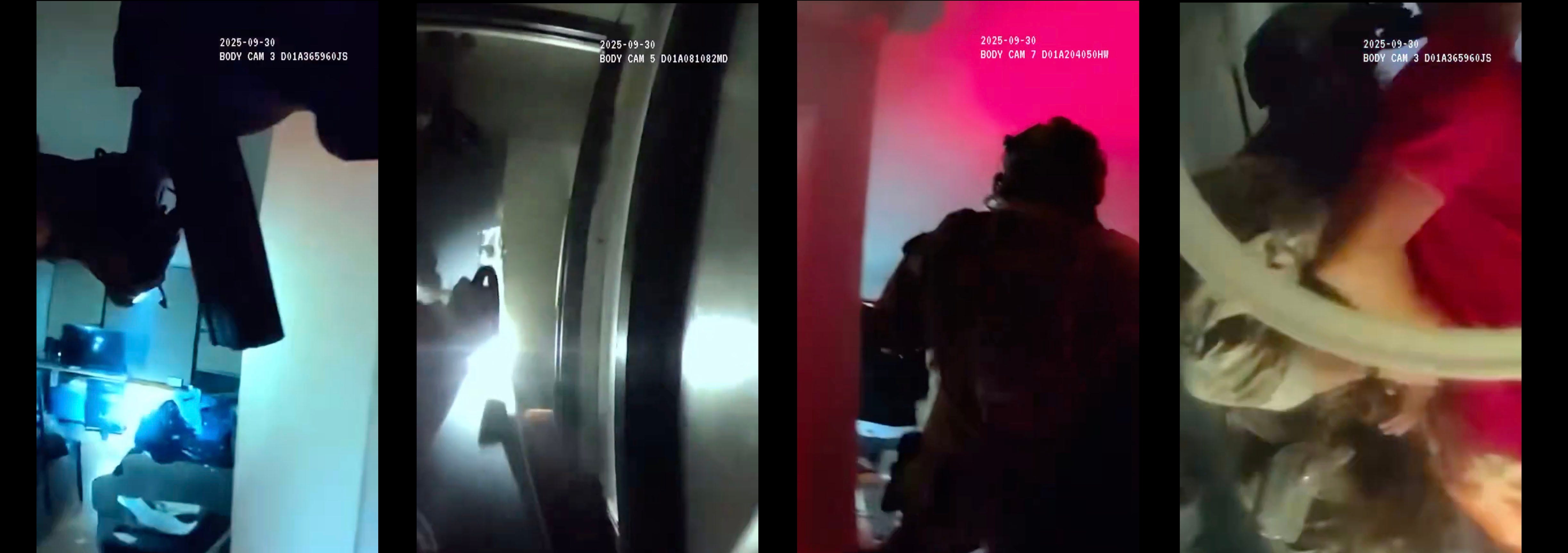
Here are some screenshots of the raid, which I encourage you to look at carefully:
It was all true: the Black Hawk helicopters, the dudes in military gear rappelling down, the mass arrests, the doors being broken down, the zip-ties, the public humiliation. In the video, DHS shows the faces of the men the ICE agents arrested, which no doubt will help their defense attorneys (assuming they are granted access to defense attorneys—no longer a safe assumption with Stephen Miller in charge).
But the damage has already been done.
I mean, little children were among those herded out of the apartments. Some of those children had theirhands zip-tied, too—by grown men decked out in enough military gear to occupy Fallujah.
And when a woman—an American citizen, not in any way affiliated with a gang, guilty of nothing more than living in Chicago, a city Trump hates because Obama’s from there—called out the ICE agents on their egregious lack of humanity, she was given the dismissive three-word response:
Fuck them kids.
The Trump regime has crossed yet another Rubicon. Now, the government can break down the front door of your house, drag you out of bed, zip-tie your hands behind your back, herd you into a van, and leave you there for hours and hours, without cause, without Miranda rights, without charge.
This is not fear-mongering. This is not speculation about what the Trump regime might do. This is happening. This has already happened. Here, in America. Nine months into the Trump Redux, and right on schedule, the fascist baby has been born.
Reading about this expression of brutal state tyranny, I was reminded of a passage in Defying Hitler, the Sebastian Haffner memoir about 1933 Germany:
The internal process was repressive terror: cold, calculated, official orders, directed by the state and carried out under the full protection of the police and the armed forces. It did not take place in the excitement following a victorious battle or danger successfully overcome — nothing of the kind had happened. Nor was it an act of revenge for atrocities committed by the other side — there had been none. What happened was a nightmarish reversal of normal circumstances: robbers and murderers acting as the police force, enjoying the full panoply of state power, their victims treated as criminals, proscribed and condemned to death in advance.
What we are seeing in Chicago the past 24 hours is a mere prelude. The official numbers of agents is nothing compared to the prisoners private contractors are releasing to kidnap, disappear and kill their fellow Americans. This suggests the covered faces are less about protecting the contractors and more about hiding from the public that prisoners are being used for this. Armed and set loose upon their fellow denizens on our streets.
This has yet to be confirmed by other news sources—but are other news sources, all of them owned by MAGA oligarchs, even interested at this point?
Plus, I mean, does it seem implausible? It’s clear ICE is staffed by poorly-trained, undisciplined, out-of-shape dipshits who barely know how to use their weapons. These losers have to come from somewhere.
But back to 1933 Germany. Haffner continues:
An example that became public knowledge because of its scale occurred some months later in the Cöpenick area of Berlin, where a Social Democratic trade unionist defended himself, with the help of his sons, against an SA patrol that broke into his home at night to “arrest” him. In obvious self-defense he shot two SA men. As a result, he and his sons were overcome by a larger troop of SA men and hanged in a shed in the yard that same night. The next day, the SA patrols appeared in Cöpenick, in disciplined order, entered the homes of every known Social Democrat, and killed them on the spot. The exact number of deaths was never made public.
Reading about masked men breaking down doors in the middle of the night and terrorizing an entire apartment complex, the Nazi-executed Social Democratic trade unionist is what sprung to mind.
Then they came for the trade unionists And I did not speak out Because I was not a trade unionist
This is the path we’re headed down—and it is paved with the skulls of the dead.
Fuck them kids.
It occurred to me that those three words perfectly sum up the priorities of Donald Trump and the soulless ghouls running his administration: RFK, Jr., Stephen Miller, Kristi Noem, Russ Vought, and so on. Indeed, FUCK THEM KIDS might as well be Trump’s 2028 campaign slogan.
Those three words will, I hope, be (figuratively) seared onto the forehead of every member of this MAGA Nazi administration, like Aldo Raine carving up swastikas in Inglorious Basterds.
Herd immunity means that enough people in a group or area have achieved immunity (protection) against a virus or other infectious agent to make it very difficult for the infection to spread. Immunity happens in multiple ways: through natural infection, vaccination or passive transfer. Vaccination is the best way.
Every person who has immunity makes it harder for the infection to spread to other people. If you’re vaccinated, it’ll be harder for the virus to use you to infect other people or to mutate into a new variant. Higher numbers of immune people are needed to stop the spread if a virus is very infectious.
To achieve herd immunity, studies show, 95 percent of a given population must be vaccinated. But since Trump’s first term, vax rates have been declining.
“During the 2024-2025 school year, vaccination coverage among kindergartners in the U.S. decreased for all reported vaccines from the year before,” reads a report by the CDC, “ranging from 92.1% for diphtheria, tetanus, and acellular pertussis vaccine (DTaP) to 92.5% for measles, mumps, and rubella vaccine (MMR) and polio vaccine.”
Ninety-two seems like a high number—but it’s not high enough for herd immunity. In many communities, especially in rural areas and in red states, where MAGA disinformation is most effective, communities are no longer protected from the scourge of long-conquered childhood diseases.
And that was before Trump put the deranged, whale-beheading gourd husk known as RFK, Jr. in charge of the country’s public health policy.
Bobby is an antivaxxer. He’s already contributed to the 2019 measles outbreak in Samoa, where 83 people, most of them young children, died (in a country with a population of 200,000 people), when he traveled there and stoked antivax hysteria, with his prestigious Kennedy name and his noxious Kremlin talking points.
In a related story, Donald and Bobby have Made Measles Great Again. Per the CDC:
As of September 30, 2025, there have been a total of 1,544 confirmed measles cases reported in the United States. Among these, 1,523 measles cases were reported by 42 jurisdictions: Alabama, Alaska, Arizona, Arkansas, California, Colorado, Florida, Georgia, Hawaii, Idaho, Illinois, Indiana, Iowa, Kansas, Kentucky, Louisiana, Maryland, Michigan, Minnesota, Missouri, Montana, Nebraska, New Jersey, New Mexico, New York City, New York State, North Dakota, Ohio, Oklahoma, Oregon, Pennsylvania, Rhode Island, South Carolina, South Dakota, Tennessee, Texas, Utah, Vermont, Virginia, Washington, Wisconsin, and Wyoming. A total of 21 measles cases were reported among international visitors to the U.S.
There have been 42 outbreaks reported in 2025, and 86% of confirmed cases (1,333 of 1,544) are outbreak-associated. For comparison, 16 outbreaks were reported during 2024 and 69% of cases (198 of 285) were outbreak-associated.
These outbreaks will only get worse, as the federal government continues to adopt antivax positions. South Carolina is only the latest state to have a measles outbreak.
This is a lot of data, I realize. A lot of statistics and numbers. But all you really need to know is this: In 2000, the World Health Organization declared that measles was eliminated in the United States—because of the success of the vaccines. Twenty-five years later, little children are once again dying of it.
The new conditions for federal funding the Trump administrationoffered to MIT put the school in a no-win situation, people on the Cambridge campus and throughout academia said Friday: Agree to the federal government’s terms and surrender some academic freedom, or refuse and risk further punishment.
The White House’s proposed “Compact for Academic Excellence in Higher Education” — sent to MIT and eight other top-tier universitiesthis week — ties access to federal moneyto a string of conditions that, if agreed to,would effectuate the most substantial changes MIT has seen to dateand fundamentally transform an economic powerhouse of Greater Boston.
The 10-point document asks the list of schools — which also includes Brown and Dartmouth — to cap international student enrollment, freeze domestic tuition rates for five years, and commit to strict definitions of gender.Some of those requests, such as reducing tuition and the number of international students, are popular with many Americans. But others, including one to limit the speech of university employees, strike at the heart of freedom and independence that universities have long prized.
While MIT declined to comment, on campus and in academia, there doesn’t appear to be much inclination to make a deal with the White House.
The offer amounts to “a loyalty oath to the federal government,” said Catherine D’Ignazio, an MIT professor of urban studies and planning.
“They’re asking us to sacrifice science. They’re asking us to sacrifice international students. They’re asking us to sacrifice our trans students. They’re asking us to sacrifice our whole idea of shared governance,” D’Ignazio said. “No amount of money is worth that great long list.”
The mandate also says that universities should transform or abolish “institutional units that purposefully punish, belittle, and even spark violence against conservative ideas.” That’s troubling, said Tyler Coward lead counsel for government affairs at the Foundation for Individual Rights and Expression, because it conflates allowing speech with condoning violence.
“This mandate basically forces these institutions to remain silent in order to secure some government benefit,” Coward said. “I think that is a problem, a First Amendment problem.”
MIT is the birthplace for countless startup companies, forms the backbone of Kendall Square, and serves as a first landing place for many students — roughly 30 percent of whom come from abroad — who stay and build careers in Massachusetts.
Federal money plays a key role in seeding all that. Last year, MIT collected $648 million in government funding for sponsored activities, including research, which federal agenciescould simply choose to award elsewhere.
The provisions in the compact, said Sandy Baum, a higher education finance expert with the think tank The Urban Institute, amount to “dramatic requests” of MIT from a dollars-and-cents perspective.
MIT is already bracing for a $300 million reduction in its central budget from the newfound 8 percent tax on its endowment and potential losses of federal science funding that powers much of its massive research arm, university administrators said in a September staff forum. (A recording of the meeting was reviewed by the Globe.)
In the spring, MIT saved roughly $100 million by freezing hiring and instituting a 5 percent cut to department budgets. It plans to close the remaining $200 million gap by terminating some real estate leases and seeking outside private funding for some academic priorities, including climate change, life sciences, and artificial intelligence, according to details shared at the staff forum. Administrators said that they may also withhold merit raises for employees next year.
“We do need to treat the $300 million amount as a permanent burden on the central budget that requires a permanent budgetary solution,” Glen Shor, MIT’s executive vice president and treasurer said at the September meeting. “Even if power at some point changes hands in Washington, we can’t count on these policies being reversed.”
Meanwhile, signing onto the compact could impact the number of international students at MIT, who make up around 10 percent of its undergraduate population — less than the limit set in the agreement. (Around 40 percent of MIT graduate students are from abroad.) Many international students pay full price to attend MIT, which can cost nearly $90,000 between tuition, housing, and other expenses. MIT would also pledge to cover the cost of attendance for all students studying hard sciences, such as physics, chemistry, and biology.
“If [MIT] had to freeze tuition and limit [the] number of international students, that would be a huge hit,” said Baum, the university finance expert.
Multiple MIT student organizations signed a letter Friday asking MIT to “firmly refuse” to sign the document, claiming that “accepting such a compact would effectively destroy the institutional culture of MIT as we know it.”
Nadia Zaragova, a material sciences PhD student and vice president of the graduate student union, said it would give the federal government “undue oversight over what we do here at the university, including our classrooms, what we study, what we research.”
And Governor Maura Healey, who has proposed $400 million in state funding to help make up for lost federal funds to Massachusetts universities, urged MIT to stand strong, describing the White House offer as “yet another attempt by President Trump to silence speech.”
MIT supporters note the university has already taken up some measures pushed by the Trump administration, including winding down its Institute Community and Equity Office and taking disciplinary actions against students — including a commencement speaker — who participate in pro-Palestinian protests.
Indeed, MIT was chosen among the schools who received the compact because they are seen as “good actors,” according to May Mailman, senior adviser for special projects at the White House.
“They have a president who is a reformer or a board that has really indicated they are committed to a higher-quality education,” she said to The Wall Street Journal.
But Ian Hutchinson, an MIT emeritus professor and co-president of its Council of Academic Freedom, said that even those in favor of those moves have sour feelings about the new offer from the administration.
“Many of us on the council think that the modern academy needs to reform and [is] beginning to do so and that the compact has the risk of alienating a large fraction of the faculty,” he said.
Others fear that some professors could leave entirely, should the school sign onto the compact.
A better approach, Hutchinson added, would be if “the government makes clear what it is interested in funding in the way of research and what it is not interested in funding.”
The compact also frames preserving “single-sex spaces” such as bathrooms and locker rooms as necessary for “women’s equality” and stipulates institutions must commit to defining gender “according to reproductive function and biological processes.”
Mila Halgren, an MIT postdoctoral associate, said including such language is an affront to what the values of American higher education should be.
“In a personal capacity, every moment MIT even considers this compact is a betrayal of every marginalized group on campus,” she said. “That MIT did not immediately reject a proposal which defines trans people out of existence is shameful.”
Two scholars–Kimberlé Crenshaw and Jason Stanley–explain why Trump is censoring exhibits at the Smithsonian. He has also imposed censorship of signage and exhibits at other federal sites, including national parks. He has enlisted the U.S. Department of Educatuon to organize rightwing groups to create a “patriotic” civics course.
Kimberlé Crenshaw is an American civil rights advocate and a scholar of critical race theory. She is a professor at the UCLA School of Law and Columbia Law School, where she specializes in race and gender issues
Jason Stanley is the Bissell-Heyd Chair in American Studies in the Munk School of Global Affairs & Public Policy at the University of Toronto and the author of Erasing History: How Fascists Rewrite the Past to Control the Future
Trump and his far-right cabal are l trying to revise history and memory. Unless he abolishes or rigs future elections, all this tinhorn fascist censorship will be swept away by his successors. He will rightly be judged, when that day comes, as the closest thing this country has ever seen to having a dictator. He will be portrayed in the Smithsonian and the textbooks as a buffoon and a tyrant.
In a letter sent to Smithsonian secretary, Lonnie G Bunch III, on 12 August, the Trump administration announced its plan to replace all Smithsonian exhibits deemed as “divisive” or “ideological” with descriptions deemed as “historical” and “constructive”. On 21 August, just nine days later, the White House published a list of said offending fixtures – the majority of which include exhibits, programming and artwork that highlight the Black, Latino and LGBTQ+ perspectives on the American project. Included in his bill of particulars was an exhibit that rightly depicts Benjamin Franklin as an enslaver, an art installation that acknowledges race as a social construct and a display that highlights racist voter suppression measures, among others.
The assault on the Smithsonian comes wrapped, as it were, as part of a broader attack on democracy, scenes of which we see playing out every day. The federal occupation of Washington DC, the crackdown on free speech on campus, the targeting of Trump’s political opponents, the gerrymandering of democracy – these are interwoven elements of the same structural assault. So with many fires burning across the nation, concerned citizens who are answering the call to fight the destruction of democracy may regard his attack on history and memory as a mere skirmish, a distraction from the herculean struggle against fascism unfolding in the US. But this is a mistake. Trump’s attack on American museums, education and memory, along with his weaponization of racialized resentment to package his authoritarian sympathies as mere patriotism, is a critical dimension of his fascist aims. The fight for democracy cannot avoid it, nor its racial conditions of possibility.
Fascism always has a central cultural component, because it relies on the construction of a mythic past. The mythic past is central to fascism because it enables and empowers a sense of grievance by a dominant racial or ethnic group whose consent is crucial to the sustainability of the project. In Maga world, the mythic past was pure, innocent and unsullied by women or Black leaders. In this kind of politics, the nation was once great, a byproduct of the great achievements of the men in the dominant racial group. In short, the assault on the Smithsonian and, more broadly, against truthful history and critical reflection is part of the broader fascist attack on democracy.
From this vantage point, racial equality is a threat to the story of the nation’s greatness because only the men of the dominant group can be great. To represent the nation’s founding figures as flawed, as any accurate history would do, is perceived, in this politics, as a kind of treason.
The success of the fascist dismantling of democracy is predicated on the widespread systematic failure to see the larger picture. The anti-woke assault that is a key pillar of Trumpism is part of that failure, partly due to the racial blinders and enduring ambivalence of too many in positions of leadership in the media and elsewhere. Those who sign on to the attack on “wokeness” but regard themselves as opponents of the other elements of the fascist assault are under the mistaken assumption that these projects can be disaggregated. In fact, the dismantling of democracy and of racial justice are symbiotically entangled. To support one is to give cover for the others.
It is no coincidence that this ‘proper’ ideology Trump exposes is constitutive of a more well-known strand of fascism – nazism
It is clear that the Trump administration understands this relationship and fully weaponizes racist appeals as a foundational piece of its fascist agenda. And if this was once the quiet part, it is now pronounced out loud in official government documents. In an executive order issued on 27 March 2025 titled “Restoring Truth and Sanity to American History”, Trump reveals that his mandate to ban “improper ideologies” targets core commitments repudiating a scientific racism that historically naturalized racial hierarchy thereby neutralizing resistance. According to Trump, the problem with the Smithsonian American Art Museum’s exhibit The Shape of Power: Stories of Race and American Sculpture was that it promoted the idea that “race is a human invention”.
The understanding that race is a social construct as opposed to a biological fact is perhaps the most fundamental advance in repudiating enslavement, genocide and segregation. Rejecting the idea that racial inequality is natural or pre-ordained – a claim that grounded enslavement and dispossession in America – forms the cornerstone of the modern commitment to a fully inclusive democracy. Trump’s declaration that this cornerstone is “improper” is an effort to turn the clock back, upending the entire American postwar project. It is no coincidence that this “proper” ideology Trump exposes is constitutive of a more well-known strand of fascism – nazism. How else can we understand why Maya Angelou was purged from the Naval Academy library while Adolf Hitler remains?
The fight against fascism in the US must be as robust in its embrace of racial equality as Trump’s embrace of outdated ideas about race and racism. The defense of memory, of truthful history, of telling the whole American story rather than ascribing agency in history to the deeds of “great men” is vital to the American democratic project. A pro-democratic education fosters the agency of its citizens by teaching about social movements that overturned entrenched hierarchies which blocked democratic equality and imposed racial tyranny. The story of how ordinary Americans lived and struggled and remade America is essential knowledge in developing and sustaining a multiracial democracy. The Smithsonian has been a vital institution in making this knowledge accessible to the masses. The National Museum of the American Latino and the National Museum of the American Indian, for example, provide artifacts and perspectives about the nation’s westward expansion that challenge the myth of unoccupied territory and manifest destiny. The National Museum of African American History and Culture brings forward the global scale of enslavement as well as its infusion across national institutions, culture and politics.
Someday, somehow, there will be another President of the United States, and his name won’t be Trump. That future President might well be a Democrat. That President might be in a position to exercise unchecked power, thanks to the acquiescence of the current Congress and Supreme Court, which are allowing Trump to exercise the powers of a dictator. The second and third branches of our government have willingly wiped out the separation of powers and ceded their authority to the President.
Congress has voted to give its power of the purse to King Donald. The Supreme Court (the Supine Court) has stood aside and approved of whatever the King wants, regardless of precedent. Justice Thomas said recently that precedent was irrelevant; he is no longer an originalist.
Now comes what might be considered the most important question. May the President send in troops–either the state’s National Guard, the National Guard of other states, or even the regular military–to cities that he believes need to be suppressed?
A Trump-appointed federal judge ruled that he could not. Justice Karin Immergut, appointed by Trump, ruled that Trump could not send troops to Portland, because it is not “war-ravaged,” as he claimed, or in a state of rebellion. In other words, you can’t just make sh-t up to do whatever you want, even if you are the President.
Constitutional lawyer Steve Vladeck, a scholar at the Georgetown University Law Center, noted that Trump’s advisors are claiming that the President doesn’t need approval of the courts before using the troops on American soil. He explains here why the President can’t ignore the judiciary.
Welcome back to “One First,” an (increasingly frequent) newsletter that aims to make the U.S. Supreme Court more accessible to all of us. If you’re not already a subscriber, I hope you’ll consider becoming one (and, if you already are, I hope you’ll consider upgrading to a paid subscription if your circumstances permit):
I wanted to put out a quick issue this morning in light of Judge Karin Immergut’s remarkable ruling yesterday, granting a temporary restraining order against President Trump’s federalization of members of the Oregon National Guard to quell the “violence” in “war-ravaged Portland.” That ruling has prompted a slew of claims this morning from the President’s advisers and outside supporters that federal courts, in general, lack the power to halt domestic deployments of the military.
Before this claim makes it too far, it seems worth helping to educate folks about a key early precedent that, in my view, cuts entirely in the other direction—and that provides powerful evidence, to those who care about such things, that the Founding-era understanding not only tolerated a robust judicial role in such cases, but, for a time, actually required one. That’s not to say Judge Immergut’s specific analysis in this case is correct (although I’m sympathetic); it’s to say that there is nothing categorically inappropriate about federal courts reviewing—and, where necessary, halting—domestic uses of the military while they are ongoing. Indeed, it would be striking if it were otherwise.
***
The modern-day Insurrection Act traces its lineage all the way back to a statute Congress enacted on May 2, 1792—which has often been referred to as the Calling Forth Act or First Militia Act. That statute was designed to carry into effect the Constitution’s grant of power to Congress, in Article I, Section 8, Clause 15, “[t]o provide for calling forth the Militia to execute the Laws of the Union, suppress Insurrections and repel Invasions.”
The idea was that Congress would identify the circumstances in which military power could be used domestically—and would thence delegate that power to the President. As Justice (Robert) Jackson would remind us in his concurring opinion in Youngstown, the Clause’s “limitation on the command power, written at a time when the militia rather than a standing army was contemplated as the military weapon of the Republic, underscores the Constitution’s policy that Congress, not the Executive, should control utilization of the war power as an instrument of domestic policy.”
But how, exactly, should that delegation work? This question was the subject of a rich debate in the Second Congress—one that culminated with the 1792 statute. I’ve summarized that debate elsewhere; for present purposes, the key point is that Congress’s principal concern was not with the last two circumstances in which it was to delegate power to the President (“to suppress Insurrections and repel Invasions”), but with the first circumstance (“to execute the Laws of the Union”). And the way Congress addressed its concerns was to delegate the authority to use the military, but with meaningful procedural checks.
Here’s the full text of section 2 of the act, image first; block quote second, with the key provisions highlighted:
[W]henever the laws of the United States shall be opposed, or the execution thereof obstructed, in any state, by combinations too powerful to be suppressed by the ordinary course of judicial proceedings, or by the powers vested in the marshals by this act, the same being notified to the President of the United States, by an associate justice or the district judge, it shall be lawful for the President of the United States to call forth the militia of such state to suppress such combinations, and to cause the laws to be duly executed. And if the militia of a state, where such combinations may happen, shall refuse, or be insufficient to suppress the same, it shall be lawful for the President, if the legislature of the United States be not in session, to call forth and employ such numbers of the militia of any other state or states most convenient thereto, as may be necessary, and the use of militia, so to be called forth, may be continued, if necessary, until the expiration of thirty days after the commencement of the ensuing session.
In other words, unlike section 1 (which dealt with insurrections and invasions), section 2 imposed two procedural requirements on domestic use of the military to carry out the laws of the union: a district judge or Supreme Court justice had to make the requisite factual findings before the President could do anything;¹ and, if out-of-state militia were used, there was a baked-in sunset.
The 1792 act was written as a temporary experiment. Congress decided to delegate comparable authority on a permanent basis in 1795—and, alas, removed the ex ante judicial review requirement. But there was no suggestion at the time, and I’m unaware of any since, that the provision was eliminated for constitutional reasons—as opposed to Congress’s broader (if, alas, myopic) view that the checks weren’t needed in light of how responsibly President Washington had behaved during the Whiskey Rebellion.
Thus, although there are later examples of courts issuing injunctions against domestic uses of the military (Youngstown itself stands out as a fairly prominent example), the relevant point for present purposes is that there was no Founding-era aversion to a robust judicial role in these cases. The first statute Congress ever enacted on the subject required such a role, and there was no contemporaneous suggestion that the Constitution forbade it.
I am, as regular readers of this newsletter likely know, no great fan of “originalism” as a conclusive methodological approach to constitutional interpretation. Thus, the way that I tend to think about these things, the existence of the judicial review provision in the Calling Forth Act of 1792 is useful evidence of how the Constitution was understood at the time, but nothing more. Rather, the argument for judicial review being available to halt, where necessary, unlawful domestic uses of the military rests on a lot more, in my view, than what some folks believed more than 230 years ago.
But for those who ascribe to the view that we are, today, bound by how the Constitution was understood then, I do not see how one can reconcile the 1792 precedent with any claim that prospective judicial review is categorically precluded when it comes to domestic use of the military. And given current and recent events, such review, if anything, seems more important than ever—whatever its outcome.
This is nuts. With federal funding, Harvard scientists have produced major breakthroughs in medicine, engineering, and science. To break Harvard, as the administration wants to do, would cripple American innovation.
The Boston Globe reported:
The Department of Health and Human Services’ Office of Civil Rights on Monday formally recommended barring Harvard University from receiving federal funding, three months after it accused the university of violating civil rights laws by failing to protect Jewish and Israeli students on campus.
In a news release, the office said it would refer Harvard to the office that is responsible for “suspension and debarment decisions” and that it notified Harvard of its right to an administrative hearing. The university has 20 days to notify the office of its decision.…
The 57-page notice relied heavily upon Harvard’s own report on antisemitism and anti-Israeli bias that it released earlier this year, which followed high-profile protests at Harvard and other campuses against the war in Gaza in 2023 and 2024.
The Trump administration’s move this week to choke off Harvard University’s access to future federal funding came after a scathing letter from the college accusing the administration of distorting evidence to show that the school violated civil rights laws by allowing antisemitism to persist on campus.
The brewing feud represents an escalation of tensions between Harvard and the administration, which just weeks ago seemed on the verge of agreeing on a deal to keep federal funds flowing to the university.
In a strongly worded, 163-page letter with attachments on Sept. 19, which has not been previously reported, Harvard assailed the government’s findings. The university accused investigators at the Health and Human Services Department of relying on “inaccurate and incomplete facts,” failing to meet a single legal requirement to prove discrimination and drawing sweeping conclusions from a survey of one-half of 1 percent of the student body.
Harvard painted a picture of a chaotic Trump administration rushing to leverage federal power against the university. For instance, it noted that the health department had chided the college for failing to produce certain records. But Harvard’s documents showed that the records in question had been provided in response to a request from the Education Department. Harvard said the health department never asked for those records.
Harvard said the health department’s decision to refer its findings to the Justice Department was “based on a fabricated and distorted interpretation of the record.”
The stark language was a departure from months of mostly measured tones from Harvard as the university has resisted the administration’s pressure campaign to impose President Trump’s political agenda on the nation’s elite colleges.
Mr. Trump and his administration have sought to exert control over who universities can hire, which students they should admit and what subjects should be taught by leveraging huge sums of federal research money. Those moves, which Harvard has maintained violate the college’s First Amendment rights and infringe on the nation’s long-held ideals of academic freedom, are aimed at shifting the ideological tilt of the higher education system, which the administration sees as hostile to conservatives and intent on perpetuating liberalism.
The administration’s reply to Harvard’s letter came on Monday, when the health department initiated a process to cut off Harvard from future federal research funding, which has increasingly become the lifeblood for the nation’s largest private and public colleges. In 2022, the health department accounted for nearly 81 percentof $41.6 billion in federal funding for research into agricultural science, environmental science, public health and other life sciences, according to government records.
President Trump said Tuesday that his administration was close to reaching a multimillion-dollar agreement with Harvard University, which would end a monthslong standoff that had come to symbolize the resistance to the White House’s efforts to reshape higher education.
Harvard, which would become the latest university to strike a deal with the Trump administration, has been seeking an end to a thicket of investigations that the government opened as part of its wide-ranging efforts to bring the university in line with Mr. Trump’s agenda.
“We are in the process of getting very close,” President Trump said in an appearance from the Oval Office. He added that the details were being finalized and said, “They would be paying about $500 million.”
Mr. Trump said that the education secretary, Linda McMahon, was “finishing up the final details.” He added that the plan was for Harvard to operate trade schools.
“They are going be teaching people to do A.I. and a lot of other things — engines, lots of things,” he said. “We need people in trade schools.”