Archives for category: Fascism

Have you heard of Horst Wessel? He was a 22-year-old member of the Nazi paramilitary who was assassinated in 1930 by two Comminists. After his death, his name became a propaganda prop for the Nazi party. Lyrics that Wessel had written were turned into the Nazi anthem and called “The Horst Wessel Song.”

I thought of Wessel when I saw how the Trump administration is turning Charlie Kirk into a symbol of leftwing, liberal perfidy that must and will be punished.

Charlie had extremist views about race, immigration, and gender, but he was no Nazi.

I discovered that I was not the only person who was struck by the parallel between Wessel and Kirk, not in what they did, but in how their legacy was used by powerful men. Benjamin Cohen and Hannah Feuer wrote in the Forward, an independent Jewish journal, about the comparison. They interviewed Daniel Siemens, a historian who wrote a book about Wessel. Siemens insisted that the two men should not be compared because Wessel engaged in violence and Kirk did not.

Cohen and Feuer conclude:

The rush to invoke Horst Wessel’s name reflects two realities. On the right, there’s a dangerous willingness among some extremists to valorize Nazi symbols. On the left, a fear that Kirk’s death will be used to erode civil liberties.

It is time to worry about the erosion of civil liberties.

Today, JD Vance became host of “The Charlie Kirk Show.” Among his guests was Stephen Miller, Trump’s Deputy Chief of Staff and Chief ideologue. Miller is known for his hatred of immigrants.

The New York Times just reported that they discussed their plans to crack down on liberal groups, whom they hold responsible for the murder of Charlie Kirk. They believe this even though no evidence has emerged tying the alleged assassin Tyler Robinson to any group, right or left. No one can say whether Tyler moved to the left or to the right of Kirk. The Utah governor said Tyler had a “leftist ideology,” but Kirk had lately been feuding with far-right white nationalist Nick Fuentes, who accused Charlie of being too moderate, a sell-out.

Without any evidence, Vance and his colleagues are forging ahead on the assumption that liberal groups indoctrinated and funded Tyler Robinson.

Katie Rogers and Zolan Kanno Youngs wrote in today’s Times:

Trump administration officials on Monday responded to the activist Charlie Kirk’s assassination by threatening to bring the weight of the federal government down on what they alleged was a left-wing network that funds and incites violence, seizing on the killing to make broad and unsubstantiated claims about their political opponents.

Investigators were still working to identify a motive in Mr. Kirk’s killing, but the Republican governor of Utah, Spencer Cox, has said that the suspect had a “leftist ideology” and that he acted alone.

The White House and President Trump’s allies suggested that he was part of a coordinated movement that was fomenting violence against conservatives — without presenting evidence that such a network existed. America has seen a wave of violence across the political spectrum, targeting Democrats and Republicans.

On Monday, two senior administration officials, who spoke anonymously to describe the internal planning, said that cabinet secretaries and federal department heads were working to identify organizations that funded or supported violence against conservatives. The goal, they said, was to categorize left-wing activity that led to violence as domestic terrorism, an escalation that critics said could lay the groundwork for crushing anti-conservative dissent more broadly.

Open the link to finish reading.

I wonder which groups will be targeted. The ACLU? Marc Elias’s “Democracy Docket”? Bloggers like those at The Contrarian, The Bulwark, Rick Wilson, Paul Krugman, Joyce Vance, Heather Cox Richardson, Mary Trump, Norman Eisen of Citizens for Responsibility and Ethics in Washington (CREW), and dozens of others. Will they try again to shut down Act Blue, which many Democrats use as their primary fundraising platform?

Hang on to your hat. Our political system is in for some difficult, challenging times.

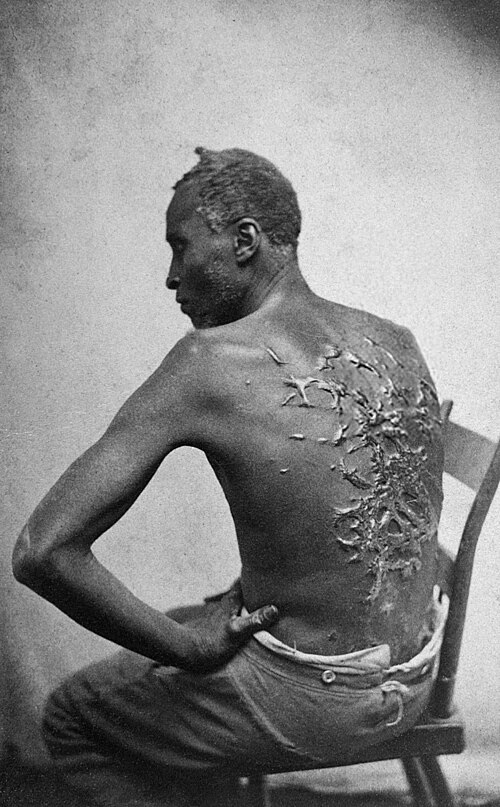
The Trump administration is well on its way to re-enacting George Orwell’s novel 1984, where unwanted facts and history disappeared down a memory hole. The Washington Post reported that officials have ordered the removal of all signage, exhibits, and photographs that depict slavery. Trump intends to eliminate history that he does not like.

Most notably, museums and parks have been told to remove an iconic photograph from 1863 of a slave showing deep scars on his back.

Jake Spring and Hannah Natanson wrote:

The Trump administration has ordered the removal of signs and exhibits related to slavery at multiple national parks, according to four people familiar with the matter, including a historic photograph of a formerly enslaved man showing scars on his back. The photo is called “The Scourged Back.” It is reproduced in many high school American history textbooks. Will they be revised too to cancel unpleasant parts of history?

“The Scourged Back”

The individuals, who spoke on the condition of anonymity because they were not authorized to speak with the media, said the removals were in line with President Donald Trump’s March executive order directing the Interior Department to eliminate information that reflects a “corrosive ideology” that disparages historic Americans. National Park Service officials are broadly interpreting that directive to apply to information on racism, sexism, slavery, gay rights or persecution of Indigenous people.

Following Trump’s order, Interior Department officials issued policies ordering agency employees to report any information, including signage and gift shop items, that might be out of compliance. Trump officials also launched an effort asking park visitors to report offending material, but they mostly received criticisms of the administration and praise for the parks.

The latest orders include removing information at Harpers Ferry National Historic Park in West Virginia, two people familiar with the matter said, where the abolitionist John Brown led a raid seeking to arm slaves for a revolt. Staff have also been told that information at the President’s House Site in Philadelphia, where George Washington kept slaves, does not comply with the policy, according to a third individual.

Is there anything that Trump does that will be found unconstitutional by this supine Supreme Court?

ICE “roving patrols” have stopped and detained people who looked Hispanic, on suspicion that they might be “illegals.” Some were U.S. citizens.

Lower courts said such practices violated the Fourth Amendment.

The Supreme Court’s rightwing majority overruled the lower courts.

CNN reported:

The Supreme Court on Monday backed President Donald Trump’s push to allow immigration enforcement officials to continue what critics describe as “roving patrols” in Southern California that lower courts said likely violated the Fourth Amendment.

The court did not offer an explanation for its decision, which came over a sharp dissent from the three liberal justices.

At issue were a series of incidents in which masked and heavily armed Immigration and Customs Enforcement agents pulled aside people who identify as Latino – including some US citizens – around Los Angeles to interrogate them about their immigration status. Lower courts found that ICE likely had not established the “reasonable suspicion” required to justify those stops.

The decision deals with seven counties in Southern California, but it has landed during a broader crackdown on immigration by the Trump administration – and officials are likely to read it as a tacit approval of similar practices elsewhere.

A US District Court in July ordered the Department of Homeland Security to discontinue the practice if the stops were based largely on a person’s apparent ethnicity, language or their presence at a particular location, such as a farm or bus stop. The 9th US Circuit Court of Appeals largely upheld that decision, which applied only to seven California counties.

But the Supreme Court disagreed with that approach. 

The majority claim to be “originalists” who adhere to the letter of the Constitution and its original meaning.

But they are originalists only when it suits their political goals.

The Fourth Amendment protects people from unreasonable search and seizure. It reads:

The right of the people to be secure in their persons, houses, papers, and effects, against unreasonable searches and seizures, shall not be violated, and no Warrants shall issue, but upon probable cause, supported by Oath or affirmation, and particularly describing the place to be searched, and the persons or things to be seized.

To stop and search and seize people because they look Hispanic or they are not white is the very definition of “unreasonable search and seizure.”

Shame on the six members of the U.S. Supreme Court who joined this egregiously bad opinion.

Richard Rothstein recently wrote a book about how to resist the illegal, unjust, and tyrannical actions of the Trump regime. Protests and marches are good but not enough, he argues. It’s time to find more powerful ways to express opposition to tyranny, to dictatorship, to a police state.

Please share this article with friends and social media. And please suggest your own ideas for direct action.

He writes:

My 2017 book, The Color of Law, showed that “de facto,” accidental, neighborhood segregation is a myth; in truth, government purposely enforced it, creating racial inequality in wealth, education, employment, health, and criminal justice. Readers asked, “What can we do about it now?”

So in 2023, Leah Rothstein and I published a sequel, Just Action, that showed how community groups could remedy this unconstitutional system. Intended for normal times, its suggestions for direct action have become urgent when Trump’s unlawful policies in housing and other sectors call for resistance. Just Action and follow-up articles describe how to create diverse committees that can embrace all who seek to preserve democracy.

Trump has taken full control of federal power—executive, legislative, and judicial—to:

  • destroy our already inadequate safety net;
  • gut health and environmental protections;
  • promote racial and ethnic inequality;
  • threaten the security of immigrants and their citizen children;
  • suppress free speech and independent journalism; and
  • prohibit schools from teaching historical truth.

He’s now moved to rig elections in 2026 and 2028, so will no longer depend on popular support. Marches, rallies, and media outrage remain necessary but insufficient. We are now called upon to do more than protest, but to act. What John Lewis called “good trouble, necessary trouble” becomes essential. As Trump “floods the zone” with so many illegal policies that we can’t keep up, so should resistance emerge in many sectors and communities to throw his authoritarianism off balance.

Most resistance will be law-abiding, some with civil disobedience. A decent society won’t be restored from Washington. A movement with a strong popular base can only begin with committees that pursue opportunities in their own neighborhoods, towns, and cities.

Here are two from Just Action, with details and many more examples in the book:

  • Regional housing centers have insufficient resources to uncover much discrimination and Trump has made it worse by defunding them. Volunteers can do the uncovering, then bypass the Justice Department by taking cases directly to court. They can campaign to force apartment owners and realtors who discriminate to commit to reform and organize boycotts of those who refuse.
  • The administration no longer deems policies unlawful if they unintentionally but needlessly harm historically disadvantaged groups. For example, property assessments usually create higher tax rates for homeowners and landlords who live in lower-income areas. Community groups can campaign to make county assessment practices fair.

Committees with actions like these will develop experience that builds toward resistance in other sectors and a national movement.

After Just Action’s publication, Washington State challenged the federal refusal to remedy housing discrimination. Volunteers documented 80,000 home deeds that banned residents who weren’t considered “white,” causing large wealth gaps between descendants of white people and others. A statewide organizing campaign won a state subsidy for home purchases by members of the previously excluded groups; 300 households have now received assistance, averaging over $100,000 each. Leah Rothstein has described how the reform was won. Groups elsewhere can mobilize for similar victories.

  • The Justice Department has cancelled settlements that required police to end abusive practices. Local groups can organize “blue ribbon” commissions to adopt the agreements and then campaign to grant them legal power to monitor and enforce compliance.
  • The administration has threatened public schools that teach “divisive” history, such as slaves’ suffering, Native Americans’ extermination, Japanese Americans’ World War II internment, or racial inequality’s origins. Local committees can organize support for teachers told to avoid these topics and for school board candidates who have pledged to protect truth in curriculum.
  • The Greyhound bus company will not permit warrantless or suspicionless immigration arrests on buses or in its stations. The Los Angeles Dodgers prohibits ICE from entering its parking lots without a warrant. Retail stores, markets, and restaurants should post signs announcing a similar prohibition. Customers can organize to ensure that it is advertised and enforced.

Campaigning for democratic practices starts by inviting friends and associates to plan. But we mostly interact only with people like ourselves. That’s no formula for successful resistance. Just Action begins by describing those who reached beyond their bubbles. We report on a Chicago artist who photographed pairs of nearly identical homes, one in a North Side white area, the other in a South Side Black one. She then invited residents to meet their “map twins.” Many agreed and were astonished by how much they had in common. We also recount six churches in Winston-Salem—three white and three Black—whose ministers created an interracial discussion and social group of 40 parishioners, divided equally by race. It eventually took direct action, successfully campaigning for a police review board and school curriculum reform.

Leah Rothstein reported recently on a project that organizes monthly dinner meetings of 25 residents from Marin City, California—with a mostly Black population—and 25 from its predominantly white suburbs. Reforms resulted in education, policing, health care, the arts, and housing. They model what diverse resistance cells can achieve.

Indivisible, the organization that led “Hands Off” and “No Kings” rallies this year, has concluded that while vocal opposition to Trump remains necessary, successful resistance must evolve to direct action. Indivisible is now conducting online training to teach and inspire local committees to undertake acts of resistance. You can watch previous sessions and register for subsequent ones here. These should offer more examples of direct actions you could take.

Please click here to share other acts of resistance, so Leah and I can promote them.

James Fallows is a veteran journalist who has been writing about foreign affairs for decades. He notes the symbolism and messaging embedded in the Trump-Putin meeting in Alaska.

Fallows writes:

Those with experience in US-Russian relations have been quick and near-unanimous in pointing out that Vladimir Putin got nearly everything he could have wanted¹ from his encounter yesterday with Donald Trump. And no one else got anything at all. 

-“No one else” includes the people and government of Ukraine; the people and governments of Europe and the broader NATO alliance; and the people of the United States. (Contrast Trump’s obsequiousness to Putin with his open hostility in the Oval Office toward Ukraine’s Volodymyr Zelenskyy six months ago.) 

-It also includes the person who cares about imagery and theatrics more than anything else. But who let himself be owned and mocked by a foreign leader, in a way that people around the world recognized more quickly than he did himself. Of course I am talking about Donald Trump.

Consider the Trump-Putin “press conference” yesterday afternoon that permitted no questions but involved something even stranger than that.

-This was a joint presentation on US soil. Indeed, on a US military base.

-Its two figures were heads of state, of major countries.

-Because this was in the United States, and because a president of the United States is presumptively the most powerful figure at any gathering, the American president should have been unquestionably in charge

In every previous such event I have seen, the American president has always taken control. The president steps first to the microphone and begins the proceedings. He welcomes guests and foreign counterparts. He frames the issues. He expresses American ambitions, values, and interests. 

He acts, in effect, not just as host but also as the boss. No one doubts who is in charge. 

And he does this all in English. Even if he could speak other languages. (Several presidents have been functional in a variety of languages, including Herbert Hoover in Chinese.) He does this because he is in the United States. We are playing by his home country’s rules. In ways stated and unstated, he signals that he is running things.

But yesterday, in every conceivable way, Vladimir Putin was in command. I will mention a surprisingly powerful bit of stage business, through which Putin established his alpha-leader dominance over the eager puppy-like supplicant Trump.


At the joint press event yesterday, Putin spoke first. This may sound like nothing. But it was an enormous power move, which the Trump team must idiotically have agreed to. To my knowledge, no American president has ever let it happen before. 

It would be like a lawyer speaking first at a trial, rather than the judge. Or like a graduate speaking first at commencement, pre-empting the university president. It simply would not occur. Maybe Trump, in his entertainment-world role, was thinking of Putin as the “warm-up act”? I can guarantee that the event was not viewed that way in any foreign ministry around the world. 

Then, after he had kicked off the event by taking the mic, Putin went on to establish even more clearly who was boss. He spoke at great length—more than twice as long as Trump eventually did. Trump’s eventual response was his usual ramble, rather than Putin’s prepared and crafted discourse. Putin can speak English, but he did not deign even to utter a few pleasantries in that language—while speaking on American soil. (He could have said, but didn’t: “I am grateful to the president and the people of the United States”²). Instead he plowed straight ahead, all in Russian. He “framed” the Ukraine issue entirely on Russian terms, starting with its “root causes,” which boil down to his familiar argument that Russia deserves to control Ukraine.

Putin’s last fillip, inviting Trump to have their next meeting in Moscow—seemingly unscripted and delivered in English, so everyone would understand it—clearly caught Trump off guard. With this minor bit of event-planning—who talks when—Putin took a step ahead of Trump’s team, and a thousand steps ahead of Trump himself.

I don’t think I’ve used this word previously in writing. But if I used the vocabulary of a MAGA-style person, I would say that Trump was cucked.

Trump has been threatening to impose severe sanctions of Russia unless Putin agreed to a ceasefire. First, Trump set a deadline of 50 days, then changed the deadline to 10-12 days. No one takes his deadlines seriously because he frequently fails to enforce his threats or forgets them. When he met with Putin last Friday, Trump called the meeting a summit, although he apparently had no demands, no agenda.

Putin got what he wanted: a private visit with Trump on American soil. Respect. Being treated as an equal to the U.S.

Trump did not get the ceasefire he wanted. Or claimed to want. He left the meeting echoing Putin’s agenda: Ukraine must give up Crimea, which Russia seized in 2014, and Ukraine must agreee never to join NATO.

The optics of the meeting were to Putin’s benefit. Trump had American military roll out a red carpet for Putin. Trump got out of Air Fotce One, walked unsteadily down his red carpet, and waited for Putin. The video of Trump walking in a zigzag pattern, unable apparently to walk a straight line, echoed across social media. Then, as he waited for Putin, he clapped for him, repeatedly. Can you imagine Reagan applauding his Soviet counterpart on the tarmac, or any other American President?. His displays of deference towards Putin were passing strange.

Heather Cox Richardson provided an overview:

Yesterday, military personnel from the United States of America literally rolled out a red carpet for a dictator who invaded a sovereign country and is wanted by the International Criminal Court for war crimes including the stealing of children. Apparently coached by his team, Trump stood to let Russia’s president Vladimir Putin walk toward him after Putin arrived at Joint Base Elmendorf-Richardson in Anchorage, Alaska, putting Trump in a dominant position, but he clapped as Putin walked toward him. The two men greeted each other warmly.

This summit between the president of the United States and the president of Russia came together fast, in the midst of the outcry in the U.S. over Trump’s inclusion in the Epstein files and the administration’s refusal to release those files.

U.S. envoy Steve Witkoff had been visiting Moscow for months to talk about a ceasefire between Russia and Ukraine when he heard through a back channel that Putin might be willing to talk to Trump in person to offer a deal. On August 6, after a meeting in Moscow, Witkoff announced that Russia was ready to retreat from some of the land it occupies in Ukraine. This apparent concession came just two days before the August 8 deadline Trump had set for severe sanctions against Russia unless it agreed to a ceasefire.

Quickly, though, it became clear that Witkoff’s description of Putin’s offer was wrong, either because Putin had misled him or because he had misunderstood: Witkoff does not speak Russian and, according to former U.S. ambassador to Russia Michael McFaul, does not use a notetaker from the U.S. embassy. Nonetheless, on Friday, August 8, Trump announced on social media that he would meet personally with Putin in Alaska, without Ukraine president Volodymyr Zelensky.

That the president of the United States offered a meeting to Putin on U.S. soil, ground that once belonged to Russia and that Russian nationalists fantasize about taking back, was itself a win for Putin.

As Jonathan Lemire noted yesterday in The Atlantic, in the week before the meeting, leaders in Ukraine and Europe worried that Trump would agree to Putin’s demand that Ukraine hand over Crimea and most of its four eastern oblasts, a demand that Russian operatives made initially in 2016 when they offered to help Trump win the White House—the so-called Mariupol Plan—and then pressure Ukraine to accept the deal.

In the end, that did not happen. The summit appears to have produced nothing but a favorable photo op for Putin.

That is no small thing, for Russia, which is weak and struggling, managed to break the political isolation it’s lived in since invading Ukraine again in 2022. Further, the choreography of the summit suggested that Russia is equal to the United States. But those important optics were less than Russia wanted.

It appeared that Russia was trying to set the scene for a major powers summit of the past, one in which the United States and the Union of Soviet Socialist Republics (USSR), also known as the Soviet Union, were the dominant players, with the USSR dominating the U.S. Russian foreign minister Sergey Lavrov showed up to Alaska in a sweatshirt with the Russian initials for USSR, a sign that Russia intends to absorb Ukraine as well as other former Soviet republics and recreate itself as a dominant world power.

As Lemire notes, Putin indicated he was interested in broadening the conversation to reach beyond Ukraine into economic relations between the two countries, including a discussion of the Arctic, and a nuclear arms agreement. The U.S. seemed to be following suit. It sent a high-ranking delegation that included Secretary of State Marco Rubio, Treasury Secretary Scott Bessent, Commerce Secretary Howard Lutnick, Special Envoy Witkoff, press secretary Karoline Leavitt, Central Intelligence Agency director John Ratcliffe, White House chief of staff Susie Wiles, deputy White House chief of staff Dan Scavino, and Defense Secretary Pete Hegseth.

Exactly what the White House expected from the summit was unclear. Trump warned that if Putin didn’t agree to a ceasefire there would be “very severe consequences,” but the White House also had seemed to be walking back any expectations of a deal at the summit, downgrading the meeting to a “listening exercise.”

After Trump and Putin met on the tarmac, Trump ushered the Russian president to the presidential limousine, known as The Beast, giving them time to speak privately despite the apparent efforts of the U.S. delegation to keep that from happening. When the summit began, Rubio and Witkoff joined Trump to make up the U.S. delegation, while Putin, his longtime foreign policy advisor Yuri Ushakov, and Lavrov made up the Russian delegation. The principals emerged after a three-hour meeting with little to say.

At the news conference after their meeting, Putin took the podium first—an odd development, since he was on U.S. soil—and spoke for about eight minutes. Then Trump spoke for three minutes, telling reporters the parties had not agreed to a ceasefire but that he and Putin had made “great progress” in their talks. Both men appeared subdued. They declined to take reporters’ questions.

A Fox News Channel reporter said: “The way it felt in the room was not good. It did not seem like things went well. It seemed like Putin came in and steamrolled, got right into what he wanted to say and got his photo next to the president, then left.” But while Putin got his photo op, he did not get the larger superpower dialogue he evidently wanted. Neither did he get the open support of the United States to end the war on his terms, something he needs as his war against Ukraine drags on.

The two and a half hour working lunch that was scheduled did not take place. Both men left Alaska within an hour.

Speaking with European leaders in a phone call from Air Force One on his way home from the summit, Trump said that Putin rejected the idea of a ceasefire and insisted that Ukraine cede territory to Russia. He also suggested that a coalition of the willing, including the U.S., would be required to provide security guarantees to Ukraine. But within hours, Trump had dropped his demand for a ceasefire and instead echoed Putin’s position that negotiations for a peace agreement should begin without one.

In an interview with Fox News Channel personality Sean Hannity after the meeting, Trump said he would not impose further sanctions on Russia because the meeting with Putin had gone “very well.” “Because of what happened today, I think I don’t have to think about that now,” Trump told Hannity. “I may have to think about it in two weeks or three weeks or something, but we don’t have to think about that right now.”

Trump also suggested he was backing away from trying to end the war and instead dumping the burden on Ukraine’s president. He told Hannity that “it’s really up to President Zelensky to get it done.”

Today Chiara Eisner of NPR reported that officials from the Trump administration left eight pages of information produced by the U.S. State Department in a public printer at the business center of an Alaskan hotel. The pages revealed potentially sensitive information about the August 15 meetings, including the names and phone numbers of three U.S. staff members and thirteen U.S. and Russian state leaders.

The pages also contained the information that Trump intended to give Putin an “American Bald Eagle Desk Statue,” and the menu for the cancelled lunch, which specified that the luncheon was “in honor of his excellency, Vladimir Putin, president of the Russian Federation.”

Putin got what he wanted. He didn’t hang around for lunch. He left.

Trump meets today with Ukrainian President Zelensky and European leaders, who are united against Russian aggression.

Ukraine has been bravely resisting the Russian invaders for more than three years. Its cities and towns have been devastated by Russian bombardment. Ukraine wants to align with the West. Putin is determined to bring Ukraine back into the Soviet orbit, even if it requires murdering its people, destroying its historic monuments, obliterating its cultural centers, wiping out hospitals, schools, and homes.

Trump held a meeting with Putin, the aggressor, to discuss next steps. Trump pointedly excluded Zelensky and representatives of the European Union.

When Zelensky visited the White House, Trump and Vance humiliated him for his “lack of gratitude” to Trump. But when Putin–the international pariah– met Putin in Alaska, he rolled out a red carpet. He admires this thug, this mass murderer, this ruthless dictator.

Trump gave Putin all he wanted: no ceasefire, bombs away! “Peace” talks on Putin’s terms. Keep on killing innocent civilians. Keep raining drones on hospitals, shopping malls, apartment buildings, power grids, and schools.

We had no reason to expect a different outcome. Putin is a highly experienced KGB agent who has controlled Russia for many years, and Trump is a television personality. Trump has a schoolboy crush on Putin. When he sees Putin, he is starstruck. I suppose we should be glad that Trump didn’t offer to give Alaska back to Russia as a munificent gift.

Trump stabbed the people of Ukraine in the back. Also in the front. He betrayed our European allies.

What a disgrace is this miserable man. What an embarrassment to our nation.

Thom Hartmann has warned us again and again about Trump’s fascist plans. Now they are turning into action, and there’s no denying that every part of our democracy is being transformed into a tool of Trump’s ambitions for dictatorial power. Every government department is now led by a Trump sycophant. In his first term, Trump appointed some reputable people to burnish his credibility. In his second term, however, he has appointed people who have minimal experience or credibility. The chief qualification of his appointees is personal loyalty to Trump, not competence. E.G., Robert F. Kennedy Jr. was named Secretary of Health and Human Services, despite the fact that his hostility to vaccines and science are well known. Pete Hegseth, FOX News host, was made Secretary of Defense despite his absence of managerial experience. Kristi Noem’s main qualification was her obsequious devotion to Trump. This group will never consider invoking the 25th Amendment to remove Trump.

Thom Hartmann writes;

There’s no sugarcoating the truth: As fascism‘s grip tightens under Trump and the GOP, America’s government no longer operates as a constitutional republic. 

Every federal institution now performs in synchronous mimicry of Dear Orange Leader’s unraveling psyche: false justifications, lop-sided pretenses of accountability, cosplay theater designed more for emotional spectacle than legal legitimacy, accelerating escalation at every turn. 

The ostensible oaths to “support and defend the Constitution” are hollow, a ghost script read aloud while the regime marches America toward authoritarian collapse in the mode of Russia and Hungary. 

Nothing — literally nothing organized or passed by Republicans in the last 44 years — was built to uplift average Americans. It’s all been engineered for power consolidation, GOP single-party rule, the wealth of the morbidly rich, and narrative control.

Consider the Justice Department. Once the nation’s arbiter of lawful conduct, it’s now Trump’s personal legal hit squad. Pam Bondi, who claimed she would end “weaponization” of the DOJ, created the novel “special prosecutor” role and appointed Ed Martin — an extremist QAnon promoter and January 6th fan — to target political enemies like Letitia James and Adam Schiff under what appear to be bogus pretexts. 

The resulting spectacle, the parade of propaganda on rightwing TV and the circumvention of norms are all unconstitutional fascist grandstanding.

Meanwhile, in Washington D.C., a carjacking narrative involving two Black minors and a neo‑Nazi hacker nicknamed “Big Balls,” boosted by Elon Musk and Fox, has been seized upon to manufacture a crime panic. 

It’s strikingly defiant of DOJ data, which confirms a 30‑year low in violent crime in the capital city. Trump harnessed the stunt to justify mobilizing ICE, the FBI, and the National Guard, weaponizing fear and fabrications to execute a federal coup on the city’s civil fabric. 

This isn’t safety, it’s occupation.

At the FBI, Kash Patel is purging anyone not MAGA‑approved: long‑serving agents loyal to the institution, or even just connected to cases that charged Trump or January 6th insurrectionists, are being run out. 

Patel’s attack on federalism reached a chilling new level when the FBI agreed to hunt down Texas Democratic state lawmakers who had fled to prevent mid‑cycle gerrymandering. No federal crime was under investigation, just a brazen attempt to subvert state sovereignty and tilt an election. 

This is not law enforcement; it’s authoritarians seizing our nation’s legal infrastructure.

And then the propaganda arm roars in lockstep. Jesse Watters didn’t even bother to murmur coded dog whistles. He publicly declared the GOP must “kick illegal aliens out of the census,” gerrymander “to the hilt,” and lock Democrats into a “permanent minority.” 

It’s open advocacy for one‑party rule rooted in gaslighting and cultural hatred. There are no quiet parts anymore: every word is a confession.

Public health and science have also been hijacked. Bob Kennedy oversaw the cancellation of 22 federal mRNA vaccine projects — including promising research into cancer and bird flu — with half a billion dollars cut. mRNA vaccines have already saved millions: Stopping that research amid emergent threats isn’t policy, it’s mass eugenics masquerading as public health.

Within the military, Pete Hegseth, a Trump loyalist, is rewriting history and norms: he wants Confederate base names restored, monuments to the traitors resurrected, public prayer institutionalized, and the values of supremacist preacher Doug Wilson — who believes women don’t deserve the vote and empathy is Satanic — amplified throughout the military. 

That this is being done under the flag of “service” is a grotesque betrayal of the constitutional order.

ICE is being transformed into Trump’s personal masked, unaccountable, violent paramilitary. Official tweets now celebrate postings that solicit thugs — no degree required, no age limit — and glorify sadistic enforcement. This isn’t border control; it’s paramilitary recruitment for a fascist secret police force.

And now come the arrests. 

Yes, the political arrests have already begun. In Newark, Mayor Ras Baraka attempted to participate in a congressional oversight visit to Delaney Hall, an ICE concentration camp. Federal agents arrested him. Charges were later dropped, and he is now suing for malicious prosecution and defamation, but the precedent was established. 

At the same event, Congresswoman LaMonica McIver was indicted on three counts of assaulting, impeding, and interfering with federal officers, charges that carry up to 17 years. Her crime? Trying to protect the mayor and uphold legislative oversight. Multiple lawmakers and faith leaders have condemned the prosecution as politically motivated intimidation.

At the same time, Senator Alex Padilla was forcibly detained — assaulted, handcuffed, and violently dragged out — after attempting to question DHS Secretary Kristi Noem. He identified himself as a sitting senator; no charges were filed. Still, the message was clear: dissent has been criminalized and there will be a next time.

Add to that the targeting of a Wisconsin judge, Hannah Dugan. The FBI arrested and indicted her after she tried to help an undocumented immigrant evade arrest. She’s been suspended by the state Supreme Court. This is a judge facing prison for expressing compassion.

And let’s not forget the investigations aimed at AG Letitia James and Senator Adam Schiff. Trump’s federal authorities are now targeting elected officials over their political stances, without a shred of legal basis. These investigations are not about justice: they’re about vengeance, performative brutality, and raw power.

When institutional coercion becomes the norm, when political arrests replace constitutional rule, the democratic state has collapsed. Authoritarian regimes don’t wait until they hold 100% of power; they erode the system until the system can no longer resist them and democracy collapses. That’s exactly what we’re witnessing.

History echoes in every violation. 

Remember Hitler writing Mein Kampf in prison, outlining Lebensraum, cloaking aggression as defense and reunification, always positioning himself as the reluctant warrior. He broke treaties, grabbed territory the way Trump is now threatening Greenland and Central America, and used the language of “peace” — always claiming that was his only goal — to mask aggression. 

Churchill warned early in the 1930s, but was dismissed as a warmonger. Chamberlain chose to believe he could negotiate with a tyrant, and, as Churchill predicted, war followed. 

Trump’s playbook is nearly identical: aggressive power grabs framed as patriotism, defenses against imaginary threats, mythmaking that declares “they made me do it.” And like in the 1930s, the enablers are eating it up.

But here’s the crucial difference: this fight isn’t a continent away; it’s in our towns, our courts, and our statehouses. 

The Greatest Generation fought fascism overseas. Now we must fight it at home, in the institutions built on their sacrifice.

For that, we must act. 

We can’t expect Congress to help: they’re under the control of Republicans completely subservient to their billionaire overlords. 

We can’t expect the media to save us: they folded under Trump‘s threats and even handed him tens of millions of dollars for his personal use. CBS has even installed a “bias monitor” to make sure they don’t offend Trump or his people.

We can’t expect our corporate overlords to rescue our republic: they’ve already sold out for tax breaks, subsidies, and an end to limitations on their monopoly power.

We must become this century’s Greatest Generation: no passive hope, no waiting for saviors. Organize, protest, support independent journalism, call your representatives incessantly, primary the handful of craven “problem solver” Democrats, and support those who are willing to fight. 

In Blue states, support those governors and legislators who are willing to gerrymander and otherwise use partisan power, including voter purges in Republican areas, when that’s what it takes to rescue our country. 

The Republicans never waited for fairness: Democrats have to fight fire with fire.

When they go low, we mustn’t go high: we must fight ferociously, methodically, and effectively. Like the soldiers who landed on Normandy Beach and burned swastikas, we must disrupt, dismantle, and hold accountable every authoritarian ambition.

Trump is in collapse, his psyche fracturing, his infrastructure mirroring his breakdown, his institutions weaponized around his rage. 

The rupture is real, and it’s here, now. There will be no more subtle signals. It’s confrontation or collapse.

Do not go gentle into that good night. Rage, rage against the dying of the light they are trying to force upon us.
Trump and Putin are meeting Friday in Alaska to discuss Ukraine. Ukrainian leader Zelensky was not invited, nor were any representatives of Europe. Trump will hear Putin’s grievances and claims. He will hear no other. After Russia intensified its drone bombing of Ukrainian civilian targets, Trump demanded a ceasefire. Putin ignored him. He gave his a deadline of 50 days (!) to stop the attacks. Putin intensified the attacks. Then Trump said the deadline was 10-12 days. That was two weeks ago. Putin got a face-to-face meeting with Trump on American soil, and his war against Ukraine goes on.

Timothy Snyder is one of the nation’s pre-eminent historians of Europe. He taught at Yale University for many years, but decided to accept an offer to teach at the University of Toronto after Trump was re-elected in 2024. He is the author of many books, including the national bestseller On Tyranny.

Snyder writes:

In the ancient world, people spoke of “Ultima Thule,” a mythical land in the extreme north, the end of the earth.

By venturing north to Alaska to meet Vladimir Putin, Donald Trump reaches his own Ultima Thula, the arctic endpoint of a foreign policy dreamworld.

The premise of Trump’s foreign relations is that foreign leaders can be dealt with like Americans, with fantastic promises and obnoxious bullying.

The fantasies do not function beyond America’s borders. The empty offer of a “beautiful” future does move dictators who commit crimes for their own visions, or affect people who are defending their families from a criminal invasion.

Ukraine has been resisting Russia’s full-scale invasion for three and a half years. Ukrainians fight because Russians invade their land, steal their wealth, kidnap their children and raise them as Russians, torture civilians in basements, murder people with any sort of association with politics or civil society, and destroy their sovereignty.

Putin, for that matter, has his own vision of a beautiful future, and no reason to prefer Trump’s to his own. Putin’s utopia is one of a Ukraine with no government, with a population cowed by torture, with children stolen and brainwashed, with patriots murdered and buried in mass graves, with resources in Russian hands.

Like Trump’s fantasizing, Trump’s bullying also does not work abroad. To be sure, many Americans are afraid of Trump. He has purged his own political party through stochastic violence. He is deploying the US military as a police force, first in California and then in Washington DC.

But foreign enemies apprehend these intimidation tactics differently. In Moscow, deployments of soldiers inside the United States look like weakness. Trump is signalling that he sees the task of the US military as to oppress unarmed Americans. The very move that shocks Americans delights America’s foes.

The tough talk may resonate in America, where we confuse words with actions. But for Russian leaders it covers a weak foreign policy. Trump has made extraordinary concessions to Russia in exchange for nothing at all. Russia has repaid him by continuing the war and seeking to win it — and by laughing at Trump on state-controlled television.

What are those concessions? Just by meeting Putin in Alaska, Trump gives the Russian dictator a chance to spread his own story of his invasion of Ukraine, both to the Americans around Trump and to the American press. By shaking hands with an indicted war criminal, Trump signals that the killings, the tortures, the kidnapings do not matter. 

Even the choice of Alaska is a concession, and an odd one. Russians, including major figures in state media, routinely claim Alaska for Russia. As one of Putin’s special envoys put it, Putin’s journey to Alaska is a “domestic flight.”

Inviting people who claim your territory inside your main military base on that territory to discuss a war of aggression they started without any participation of the country they invaded — well, that is just about as far as a certain logic of fantasy can go. It is Ultima Thule.

It is Ultima Thule, the very end, because Trump has already conceded the more fundamental issues. He does not speak of the need for justice for Russian war criminals, or of the need for Russia to pay reparations. The Trump administration grants that Russia can determine Ukraine’s and America’s foreign policy on the crucial point of NATO membership. They have accepted that Russia’s invasions should lead not only to de facto but also de jure changes in sovereign control over territory.

It would take a longer essay to explain how senseless these concessions are. Accepting that invasion can legally change borders undoes the world order. Granting Russia the right to decide the foreign policy of others encourages further aggression by Russia. Dropping the obvious legal and historical responses to criminal wars of aggression — reparations and trials — encourages war in general.

Trump speaks loudly and carries a small stick. The notion that words alone can do the trick has led Trump to the position that Putin’s words matter, and so he must go to Alaska for a “listening exercise.” Trump’s career has been full of listening to Putin, and then repeating what Putin says.

Trump and Putin are moved by the future perception of their greatness. Putin believes that this can be achieved by war, and an element of this war is the manipulation of the American president. Trump believes that this can achieved by being associated with peace, which, so long as he is unwilling to make policy himself, puts him in the power of the warmaker.

northern lights

Putin is not moved to end the war when his own propaganda is repeated by the president of the United States. He cannot be enticed by a vague vision of a better world, since he has in mind his own very specific atrocity.

In Alaska, Trump reaches his personal Ultima Thula, the limits of his own personal world of magical talk. 

He faces a very simple issue: will Putin accept an unconditional ceasefire or not.

Putin has refused any such thing. The Russians propose an obviously ridiculous and provocative counter: that Ukraine should now formally concede to Russia territory that Russia does not even occupy, lands on which Ukraine has built its defenses. And then Russia can of course attack again, from a far better position. 

Putin knows that Trump wants the Nobel Peace Prize. And so Putin’s obvious move is to suggest to Trump that war will end someday, and Trump will get the credit, if the two of them just keep talking (and while Russia keeps bombing).

If Trump leaves Alaska without Putin having agreed to an unconditional ceasefire, there are two paths that Trump can take. He can continue the fantasy, though it will become ever more obvious, even to his friends and supporters, that the fantasy is Putin’s.

Or Trump can make the policy that will make the war harder for Putin, and thereby bring its end closer.

The United States has not formalized its outlandish concessions to Russia, and could take them back in one press conference. The United States has the policy instruments to change the direction of the war in Ukraine, and could employ them.

Trump has threatened “serious consequences” if Putin does not accept an unconditional ceasefire. Those are words, and thus far the consequences of Trump’s words, for Russia, have been more words. This all becomes clear now, at Ultima Thule, clear to everyone. 

When Trump reaches the border of his fantasy world, what is his next step? Where will he go after Ultima Thule?

Trump and his compliant allies in Congress took pride in the One Big Ugly Bill that they passed in early July. But it offers reasons for shame, not pride. The Trump bill finances tax cuts for the richest Americans by cutting food for schoolchildren and Medicaid for millions of children.

The Republican budget bill locks in benefits for the rich and hunger for children of the poor.

Imagine laughing, applauding, and feeling proud of this heartless bill! I

President Trump Signs His "Big, Beautiful Bill" Into Law And Celebrates Independence Day At The White House

President Donald Trump, joined by Republican lawmakers, signs the One, Big Beautiful Bill Act on July 04, 2025 in Washington, DC. The Congressional Budget Office estimates that the bill will cut federal spending on SNAP by around $186 billion over the next decade. Samuel Corum—Getty Images

Becky Pringle, President of the NEA, writes in TIME magazine about the shamefulness of this legislation.

She writes:

Hunger in America’s public schools is a real problem, and it is heartbreaking. As the head of the largest union of educators in the country, I hear stories almost daily of how kids struggle and how schools and teachers step up to fill the gaps. It’s the school community in Kentucky filling a Blessing Box with foods to help fellow students and families who don’t have enough. It’s the teacher in Rhode Island who started a food “recycling” program to ensure no food goes to waste and to give students access to healthy snacks like cheese sticks, apples, yogurt, and milk.

School meals are more than a budget line item. They are lifelines that help millions of students learn and grow. But as families across America prepare for the new school year, millions of children face the threat of returning to classrooms without access to school meals.

President Donald Trump’s newly-signed tax bill, which Republicans overwhelmingly voted to pass, slashes food assistance benefits via the Supplemental Nutrition Assistance Program (SNAP) by an estimated $186 billion over the next decade—thelargest cut in American history. These devastating reductions will result in an estimated 18 million children losing access to free school meals.

The cuts shift the cost of school lunches to the states, costing them more than they can afford when they are already grappling with tighter budgets and substantial Republican-led Medicaid cuts.Twenty-three governors warned these cuts will lead to millions of Americans losing vital food assistance.

It’s hard to understand if you’ve never faced hunger, but millions of American children do not have access to enough food each day. In a recent survey of 1,000 teachers nationwide, three out of every four reported that their students are already coming to school hungry. 

Our children can’t learn if they are hungry. As a middle-school science teacher for more than 30 years, I have seen the pain that hunger creates. It’s the student who skips breakfast so she can give it to her little brother. It’s the student who misbehaves because his stomach is rumbling. It’s the students who struggle in class after a weekend where they didn’t have a single full meal. Educators see this pain everyday, and that’s why they go above and beyond—buying classroom snacks with their own money—to support their students. 

Free school meals represent commonsense and cost-effective public policy. They don’t just prevent hunger, they help kids succeed. Decades of research reviewed by the Food Research & Action Center shows that when students participate in school breakfast programs, behavior, academic performance, and academic achievement go up and tardiness goes down. When I stand in a room of bright and curious children, it breaks my heart that some of them are going without the food they need to learn and thrive—not because America can’t afford to feed them, but because adults in Washington decided they’d rather spend the money on tax breaks for the ultra-wealthy.

The cuts from the Republican tax bill will hit hardest in places where families are already struggling the most, especially in rural and Southern states where school nutrition programs are a lifeline to many. In Texas, 3.4 million kids, nearly two-thirds of students, are eligible for free and reduced lunch. In Mississippi, 439,000 kids, 99.7% of the student population, were eligible for free and reduced lunch during the 2022-2023 school year.

These are not abstract numbers. These are real children who show up to school eager to learn but are instead distracted by hunger and uncertainty about when they will eat again. America’s kids deserve better. 

The National School Lunch Act of 1946 laid the foundation that public schools are places where children can receive a free breakfast and lunch each day. This shouldn’t be a partisan issue. For decades, Republican and Democratic administrations alike expanded school lunch programs, operating under the shared understanding that no child should go hungry at school in the richest country in the world.

But the extreme right wing of today’s Republican Party has walked away from that moral consensus—ripping away these programs to give another tax break to billionaires.

The Trump Administration’s authoritarian blueprint outlined in Project 2025 takes the anti-public education attacks even further by attempting to gut the Department of Education and to send tax dollars to private schools, and promoting ideologically-driven book bans and classroom censorship.

And now, as the Trump Administration and its allies work to destroy public education, they also have attempted tointimidate the National Education Association and our 3 million educators. They know we are powerful and vocal advocates for students and a formidable opponent to their attacks on public education. Last month, the relentless efforts of organized educators and our allies got the Trump Administration to release $7 billion in education funds it had tried to withhold.

Together, we will fight forward: for our vision where every student attends a safe, inclusive, supportive, and well-resourced public school, which includes nutritious meals for all students regardless of race or place. 

We are educators. We don’t quit. We will continue to engage with school boards, town halls, state legislatures, and Congress to fight for students. Public education does not belong to politicians trying to dismantle it. It is for every student, parent, and educator who understands it has the power to transform lives.”