Archives for category: Failure


New Orleans is supposed to be the lodestar of the Corporate Reform Movement (or as I call it, the Disruption Movement), but the experiment in privatization is a costly failure, as Tom Ultican demonstrates in this post.

The old, underfunded school system was corrupt and inefficient. The new one is expensive, inefficient, and ethically corrupt because of its incessant boasting about what are actually very poor results.

Comparisons between the old and new “systems” are dubious at best because Hurricane Katrina dramatically reduced the enrollment from 62,000 to 48,000. As Bruce Baker pointed out in reviewing a recent puff study, concentrated poverty was significantly reduced by the exodus of some of the city’s poorest residents, who resettled elsewhere.

Ultican cites Andrea Gabor’s studies of the New Orleans schools to show that the lingering heritage of segregation and disenfranchisement has been preserved in the new all-charter system. The schools that enroll the most white students have selective admissions and high test scores. The majority of schools are highly segregated and have very low test scores.

Be sure to open this link and scroll down to “Individual School Performance,” where you will see that the majority of charter schools in BOLA perform well below the state average.

Do not look to New Orleans for lessons about school reform. But do admire it as a shining example of propaganda and spin paid for by Bill Gates and other billionaires who don’t like public education, democracy, or local school boards.

Rob Levine, a Resistance-to-Privatization blogger in Minneapolis, reports here on the failure of the Bush Foundation’s bold “teacher effectiveness” initiative, which cost $45 million. All wasted.

The foundation set bold goals. It did not meet any of them.

Levine writes:

Ten years ago the St Paul-based Bush Foundation embarked on what was at the time its most expensive and ambitious project ever: a 10-year, $45 million effort called the Teacher Effectiveness Initiative (TEI). The advent of the TEI coincided with the implementation of a new operating model at the foundation. Beginning in 2009 it would mostly would run its own programs, focusing on three main areas: .

  • “developing courageous leaders and engaging communities in solving problems”
  • “…supporting the self-determination of Native nations”
  • “…increasing the educational achievement of all students”

Bush foundation president Peter Hutchinson told a news conference that the initiative would “increase by 50 percent the number of students in Minnesota, North Dakota and South Dakota who go to college.”

The Teacher Effectiveness Initiative was the foundation’s real-world application of its broad educational philosophy. Peter Hutchinson, the foundation’s president at the time, told a news conference announcing the plan that the initiative would “increase by 50 percent the number of students in Minnesota, North Dakota and South Dakota who go to college.” How was this miraculous achievement to be done? By “[enabling] the redesign of teacher-preparation programs” at a range of higher educational institutions where teachers are educated in the three-state area.

The foundation also said that, through “Consistent, effective teaching” it would “close the achievement gap.” It would achieve these goals by “producing 25,000 new, effective teachers by 2018.”

Not only was the Bush Foundation going to do all these things, but they would prove it with metrics. It contracted with an organization called the Value Added Research Center (VARC) to expand its Value Added Model (VAM) to track test scores of students who were taught by teachers graduated from one of its programs. The foundation, which paid VARC more than $2 million for its work, would use those test scores to rate the teachers ‘produced’ – even giving $1,000 bonuses to the programs for each ‘effective’ teacher.

10 years later: Fewer students in college, ‘achievement gap’ unchanged

By just about any measure the Teacher Effectiveness Initiative was a failure. Some of the top-line goals were missed by wide margins. The promise of 50% more college students in the tri-state area over the 10 years of the project? In reality, in Minnesota alone the number of post-secondary students enrolled actually dropped from almost 450,000 in 2009 to 421,000 in 2017 – a decline of about six percent.

Just one more example of the complete and utter failure of the hoax of “reform,” which was always about privatization and union-busting, not improving schools or helping students.


The definition of insanity: funding an experimental education program, discovering that it failed, then funding it some more and expecting different results.

Another definition of insanity: funding a voucher program that depresses student achievement, then demanding more voucher funds so more students can fall behind.

Why fund failure?

Despite Poor Academic Results Groups Sue to Grow Private School Voucher Program

A few weeks ago a pro-school privatization organization, Institute for Justice, announced a lawsuit against the State of Nevada over the impact of AB 458 to private school vouchers recipients, scholarship granting organizations and businesses receiving tax incentives.

Though pro-voucher advocates are framing the suit as “saving vouchers,” in reality, the voucher program did not lose funding. The controversy over some students losing their scholarships is actually the result of a single scholarship granting organization interpreting a law passed this legislative session (AB 458) differently than all other scholarship organizations. Certain families who went through this organization for their voucher funds were the only ones whose funds were not renewed, leaving those students in limbo as the law’s purpose is clarified by the State.

To be clear, AB 458 did NOT cancel funding for the voucher program but only ended the requirement that funding for the controversial program grow by 10% each year. Given that growth in public education funding often struggles just  to keep up with inflation (approximately 2%), automatically growing a voucher program with scant accountability and poor results just doesn’t make sense.

Businesses are also suing on the claim that they would not be able to increase their contributions to vouchers because there is no increase in tax incentives. However ,they could choose to continue supporting private school tuition through donations without having to receive any incentive if it’s a cause that they deem so critical.

Ultimately, the courts will decide if the legal argument holds water, but the policy and evidence behind limiting the program’s growth is sound.

Voucher programs don’t work – both in Nevada and nationwide. The latest results from the Nevada Department of Education showed that more voucher recipient scores decreased than increased year-to-year, mirroring similar trends across the nation. For example, Louisiana has seen consistent abysmal results – with voucher recipients performing worse and numerous private schools fraught with poor school ratings, fraud, and cheating scandals.

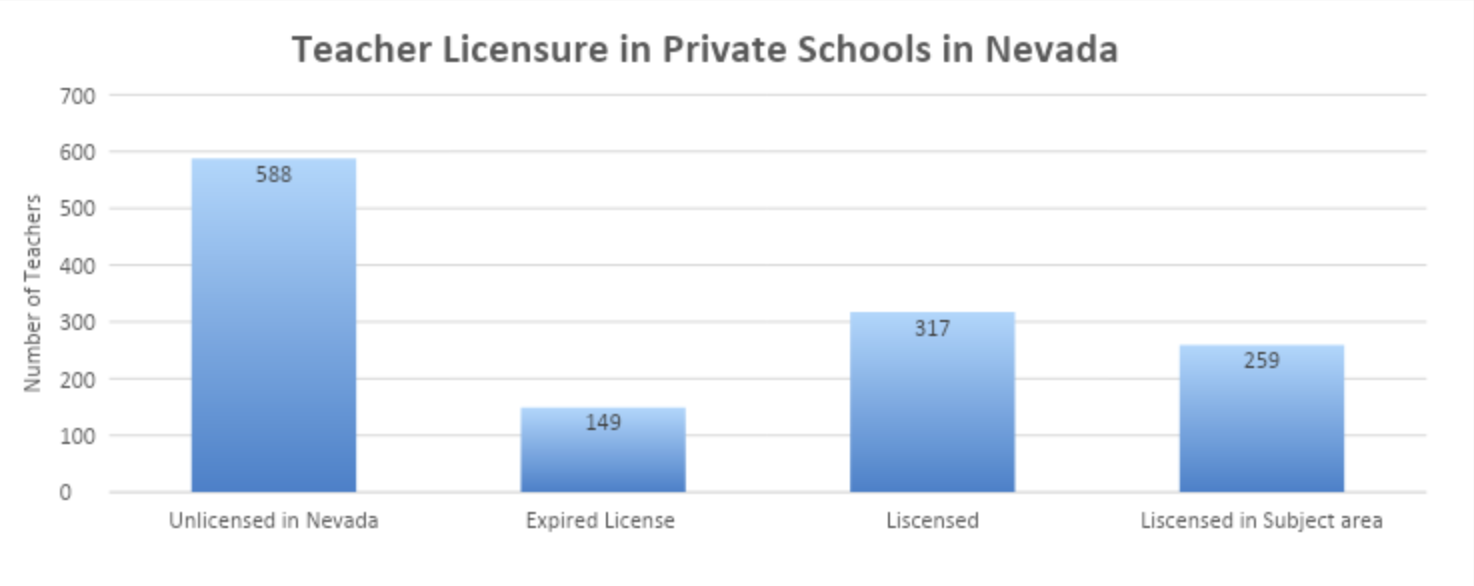
Lack of accountability in voucher programs has continued to raise red flags. Nevada private schools have no requirement that their teachers be licensed. An analysis by ENN found that of the schools that made the information available, less than 50 percent of teachers were ever credentialed in the state of Nevada, while some schools had no staff with Nevada licenses.

A look at the number of teachers who are licensed at private schools that have Opportunity Scholarship students enrolled. **This chart only includes data from schools who make staff information publicly available. Numbers exclude theology teachers and support staff.**

And the overwhelming lack of accountability – uniform testing, treatment of students with unique needs (private schools are less likely to accept students with an IEP), anti-discrimination, and other issues closely monitored in our public schools – means poor outcomes and underqualified staff may only be the tip of the iceberg.  North Carolina, for example, is grappling with testing issues, discrimination against LGBTQ students, and questionable academic content (with one popular textbook claiming the KKK was fighting to protect morality and slaves were treated well by their slave owners). One can argue that teacher quality, curriculum, or treatment of students is the prerogative of these schools because they are private, but if private schools are now operating using public taxpayer dollars, we must demand more.

Ultimately efforts would be better spent advocating for increased dollars for our public schools to ensure all our students have access to a quality education regardless of religion, sexual preference, gender, race or income.


To learn more about national efforts to fight private school vouchers, check out the new Public Funds Public Schools campaign supported by Education Law Center, Southern Poverty Law Center and the SPLC Action Fund.


About Educate Nevada Now
The Rogers Foundation, a Nevada leader in support of public education, joined with local, state and national partners to launch Educate Nevada Now (ENN) in 2015. The organization is committed to school finance reform and improved educational opportunities and outcomes for all Nevada public school children, especially English language learners, gifted and talented students, students with disabilities or other special needs, and low-income students.

More information about ENN can be found at www.educatenevadanow.com
###

Politico Education reports that Secretary Betsy DeVos and her political appointees are fanning out across the country to promote charters, vouchers, and educational “freedom” from public schools. She will be in Indiana and Ohio, which already have vouchers and charters, most of which are low-performing.

Under DeVos, the official  mission of the U.S. Department of Education is to destroy and privatize public schools.


DEVOS HEADS TO INDIANA, OHIO: The Education secretary begins Day 2 of the Trump administration’s “back to school” tour with stops in Indiana and Ohio today.

— DeVos will visit Purdue Polytechnic High School, a public charter school in Indianapolis, in the morning where she’ll meet with students and faculty and tour STEM classes, according to the department. The administration said the school is a good example of an approach to education that breaks down the silos among K-12 and higher education and businesses.

— In the afternoon, DeVos will head to Cleveland. She’ll tour the Great Lakes Science Center and a specialized high school, MC2STEM High School, which is part of the Cleveland Metropolitan School District. DeVos will then visit EDWINS Leadership and Restaurant Institute, “where formerly incarcerated individuals are given the tools they need to transition home, including the opportunity to learn a skilled and in-demand trade in the culinary arts,” the department said.

— Several other top Education Department officials are also fanning out across the country today as part of the administration’s nationwide tour to promote its “rethink school” agenda.

— Deputy Education Secretary Mick Zais will be in Montana. He’ll tour schools and meet with officials in Pryor and Billings along with Montana Superintendent of Public Instruction Elsie Arntzen.

— Johnny Collett, assistant secretary for special education and rehabilitative services, will head to Missouri. He’ll tour an elementary school in Belton and meet with students and faculty at the University of Missouri-Kansas City.

— Scott Stump, the assistant secretary for career, technical, and adult education, will be in New Mexico. He’ll tour a high school in Albuquerque in the morning and Santa Fe Community College in the afternoon.

Stephen Dyer, former legislator and Senior fellow at Innovation Ohio, reviews Ohio’s school report cards here.

http://10thperiod.blogspot.com/2019/09/charter-schools-overrepresentation-of.html

Remember when charter schools were going to “save poor kids from failing public schools”? What happens when public schools outperform charter schools, as happened in 2019?

Remember when charter schools were going to show public schools how to close the achievement gaps? Not going to happen because the charter industry is failing in Ohio.

Dyer writes:

Ohio’s charter schools, which represent about 10 percent of Ohio’s school buildings, make up about 40 percent of Ohio’s school buildinsg that received overall F grades.

Factoring out charter schools shows that among the 3,029 non-charter school buildings made up the remaining 208 F buildings, or not even 7 percent of Ohio’s public school buildings. Ohio’s charter schools? A full 36 percent of them received overall F grades.

But even the degree of F grades are striking. Of the 45 Performance Index percentages that are below the 33rd percentile, 35 are charter schools, which means about 10 pecrent of all charters are below the 33rd percentile on Performance Index scores — the state’s index of proficiency.

Of the 71 school buildings that received zero gap closing points, 45 were charter schools, which means that nearly 13 percent of all charters received zero points for closing achievement gaps.

The opposite trend continues on the positive end — few charters occupy top performance positions.

Of the 281 buildings that received A grades for Performance Index, only 9 were charter schools. Again, charters are about 10 percent of all buildings, but only are 3 percent of the top scoring buildings on proficiency.

Who will “save poor kids from failing charter schools?”

When will the Ohio Legislature stop pushing failing charters and vouchers?


Ohio released its school report cards. Bill Phillis summarizes the results:


Charter schools report card grades dismal
 
If there is any value in the state report card scheme, it is that it reveals the failure of the charter experiment.
 
71 charters or 23% received F grades compared to only seven tenths of one percent of school districts. Six charters or .3% received A grades compared to 5% of school districts. 87 charters or 28% received a D grade compared to 122 districts or 20%. 60 charters or 19% received C grades compared to 281 or 46% of school districts. 158 charters or 51% received D or F grades compared to 126 or 20% for school districts.
 
The $11 billion Ohio charter experiment, that was established to show districts the way to improve student outcomes, is a dud.
 
It is time for state officials to admit failure and cancel the experiment.


Feeling the backlash in a big way, Jeb Bush’s “Chiefs for Change” issued a call to end the “Toxic Rhetoric” about school choice, especially charters. 

Chiefs for Change are strong proponents of privatization. Here are the current members. Is your superintendent a “Chief for Change” who wants to divert money from public schools to the Betsy DeVos agenda of school choice?

They say:

Recent attempts to halt or severely limit school choice—including legislative debates over caps or moratoriums for charter schools—are misguided at best. Effective mechanisms of school choice—those that ensure quality, accountability, equitable access, and equitable funding—provide opportunities that our students need and deserve. 

Families with financial means in America have always been able to choose the school that is best for their child, by moving to a certain part of town or by sending their children to private schools. But most American families do not have that opportunity. The school in their neighborhood may fall short in meeting their child’s needs in any number of ways—but they’re stuck. 

Our nation’s history of redlining to separate both housing and schooling based on race and income, along with local zoning ordinances that restrict and confine affordable housing, alongside the recent wave of “school district secessions” by higher-income neighborhoods, have compounded the problem. Our nation’s children often live in neighborhoods just a short distance from each other but worlds apart in terms of school quality. This is unacceptable. Every child deserves school options where they will learn and thrive. 

That is why today we are calling on policymakers across the nation to end the destructive debates over public charter schools. Proposed caps and moratoriums allow policymakers to abdicate their responsibility to thoughtfully regulate new and innovative public school options: like banning cars rather than mandating seatbelts. They are a false solution to a solvable problem. 

The backlash against school choice, the demand to halt charter expansion, comes from an outraged public that supports their community public schools.

Only 6% of the students in the U.S. attend charter schools, most of which perform no better than or much worse than public schools. An even smaller number of students use vouchers, even when they are easily available, and the research increasingly converges on the conclusion that students who use vouchers are harmed by attending voucher schools.

The claim that poor kids should get “the same” access to elite private schools as rich kids is absurd. Rich parents pay $40,000-50,000 or more for schools like Lakeside in Seattle or Sidwell Friends in D.C. The typical voucher is worth about $5,000, maybe as much as $7,000, which gets poor kids into religious schools that lack certified teachers, not into Lakeside or Sidwell or their equivalent.

Perhaps Chiefs for Change should advocate for for housing vouchers worth $1 million or more so that poor families can afford to live in the best suburban neighborhoods where “families with financial means” live.

But don’t hold your breath waiting for that to happen.

What this press release really means is that the advocates of privatization know that the public is turning against them.

That’s good news.

The public wants to invest its tax dollars in strong, equitable public schools that meet the needs of all students, not in ineffective charters or vouchers that divert money from community public schools.

The Davidson County School Board voted unanimously to close three “Knowledge Academy” charter schools, citing poor academic performance and financial mismanagement.

The charter board will appeal.

When I first started writing this blog in 2012, Louisiana’s then Governor Bobby Jindal was crowing about his new voucher plan. He and his state commissioner John White insisted that vouchers were a wonderful innovation. They would save poor children from failing public schools. They would give poor children the same choices that rich children have. All the DeVos baloney was served up.

We now know that none of this was true. Most of the voucher money went to backwoods evangelical church schools that did not have certified teachers or a real curriculum. Some of the voucher schools relied on the state money to keep their doors open. The “opportunity” was not for the students, but for the schools, which were glad to have the money from the state.

Now an organization called The Center for Investigative Reporting reveals what we anticipated: most students who use vouchers attend schools that are rated D or F by the State Education Department that funds them. The state is subsidizing no-quality education.

Read the article here.

The vouchers are an expensive hoax. They are not saving poor children from failing schools. Most of them ARE failing schools.

This story was produced by FOX8 WVUE, NOLA.com | The Times-Picayune and WWNO New Orleans Public Radio as part of Reveal’s Local Labs initiative, which supports lasting investigative reporting collaborations in communities across the United States.

Louisiana Gov. Bobby Jindal beamed with pride in April 2012, as he signed into law one of the most sweeping school choice expansions in the nation.

The law was lauded by the American Federation for Children, then chaired by future Education Secretary Betsy DeVos, and other school choice advocates. Like Jindal, they said it would free countless lower-income children from the worst public schools by allowing them to use state tax dollars in the form of vouchers to pay tuition at private schools, where they would ostensibly receive a better education.

“Our children do not have time to wait,” Jindal had said as he spent some of his waning political capital on what he felt would become a major part of his political legacy in Louisiana. “They only grow up once, and they have one shot to receive a quality education.”

Seven years later, however, the $40 million-a-year Louisiana Scholarship Program has failed to live up to its billing. The nearly 6,900 students who’ve left public schools have instead been placed into a system with numerous failing private schools that receive little oversight, a monthslong examination by a coalition of local and national media organizations has found.

Two-thirds of all students in the voucher system attended schools where they performed at a D or F level last school year, according to a data analysis by NOLA.com | The Times-Picayune, WVUE Fox 8 News, WWNO and Reveal from The Center for Investigative Reporting.

In the latest Ohio state budget, there are big giveaways to religious and private schools. The Legislature expanded the state’s voucher programs. Originally, vouchers were supposed to “save poor kids from failing public schools,” but in the new expansion, vouchers are available to high school students who never attended a public school. That is, they subsidize students in religious and private schools. Period.

In the only evaluation of the Ohio voucher program, sponsored by the rightwing Thomas B. Fordham Institute, students who used vouchers fell behind students who stayed in the public schools.

These programs are simply a transfer of public dollars frompublic schools to private schools, with no benefit to students.

Jan Resseger writes here about the latest betrayal of the people of Ohio and the public schools that most children attend, despite the availability of many charters and vouchers.

She begins:

Ohio has five voucher programs. Two of them are for students with autism and other disabilities, and their enrollment depends on the incidence of these conditions and parents’ awareness of the availability of voucher funds to pay for private programs. A third voucher program—the Cleveland Scholarship Program—one of the oldest in the country—is for students in Cleveland.

This blog post will focus on the last two—EdChoice and EdChoice Expansion. They are statewide Ohio school voucher programs designed specifically, according to the Republican lawmakers who have designed and promoted these programs, to enable students to escape so-called “failing” schools. It is important to remember that those same legislators have failed adequately to fund the public schools in Ohio’s poorest school districts, and those same legislators have looked at state takeover as another “solution” (besides expanding vouchers and charter schools) for the students in those districts. Ohio education policy for school districts serving very poor children is defined by punishment, not support.

EdChoice and EdChoice Expansion vouchers rob the public schools of essential dollars needed to educate the majority of Ohio’s students who remain in public schools. And the vouchers are used primarily by students enrolled in religious schools. Through EdChoice and EdChoice Expansion vouchers, the state is sending millions of tax dollars out of the state’s public education budget and out of the coffers of local school districts to fund the religious education of students who would likely never have enrolled in public schools in the first place.

The problem just got worse this summer when the Ohio Legislature passed a two year budget which radically expands both programs. The Ohio Association of School Business Officials (OASBO) recently published an update on its website to inform school treasurers about what just happened. OASBO reports: “HB 166 (the new state budget) expanded the EdChoice Scholarship program in multiple ways.”

Changes in the EdChoice voucher program: Although legislators have always said the purpose of vouchers is to provide an “escape” from so-called failing schools, the new budget provides that high school students are no longer required to have been previously enrolled in a public school to qualify for the voucher. OASBO explains: “Generally, students wishing to claim a voucher under the original EdChoice voucher program must have attended a public school in the previous school year. However, HB 166 codifies in law… (that) students going into grades 9-12 need not first attend a public school. In other words, high school students already attending a private school can obtain a voucher.”

Ohio was one of the leading states in the 19th century “Common school movement,” which created the American public school as a guarantee of free public education for every child. It is now leading the movement to demolish that promise and renounce the state’s proud history. It should go without saying that the state’s Republican leaders have never put a referendum on the ballot to ask the people of Ohio whether they approve of this massive diversion of public funds to religious and private schools. They know it would be rejected.

The Ohio State Constitution, Article 6, Section 2 and 3

Text of Section 2:
School Funds

The General Assembly shall make such provisions, by taxation, or otherwise, as, with the income arising from the school trust fund, will secure a thorough and efficient system of common schools throughout the state; but no religious or other sect, or sects, shall ever have any exclusive right to, or control of, any part of the school funds of this state.

Text of Section 3:
Public School System, Boards of Education

Provision shall be made by law for the organization, administration and control of the public school system of the state supported by public funds: provided, that each school district embraced wholly or in part within any city shall have the power by referendum vote to determine for itself the number of members and the organization of the district board of education, and provision shall be made by law for the exercise of this power by such school districts.