After the massacre of children and educators at Sandy Hook Elementary School in Newtown, Connecticut in December 2014, there seemed to be an unstoppable public demand for federal gun control legislation. After the massacre of high school students and teachers at Marjory Stoneman Davis High School in Parkland, Florida, in 2018, the demand for gun control seemed unstoppable, led by students from the school.
Nothing happened. Now American students and teachers learn to protect themselves in “active shooter” drills. The opponents of gun control count on potential victims to protect themselves, instead of enacting restrictions on gun owners to protect children.
The same politicians who fight for the rights of gun owners are busily banning books, which they consider dangerous. Book banning is cancel culture at its worst.
Amy Frogge was elected twice to the Nashville Metro school board. She is a lawyer, a public school parent, and executive director of Pastors for Tennessee Children.
As a board member, Amy quickly learned about the big money behind charter schools, especially when she was outspent 5-1 when she ran for office. Tennessee received a grant of $500 million from Arne Duncan’s Race to the Top competition and spent $100 on its “Achievement School District.” The ASD gathered the state’s lowest scoring schools into a new district and handed them over to charter operators. The leader of the ASD promised that within five years, the schools at the bottom would be in the top quarter of schools across the state. The ASD was a complete failure. None of the lowest performing schools reached that goal and remained at the bottom.
Amy Frogge posted the following thread on Twitter about the charter scandals in Tennessee.
Tennessee is considering opening 100 new charter schools, removing ALL local control of charter approvals, and giving charter schools free access to public school buildings. Last week, I shared charters’ dismal performance rates. Now let’s consider 10 horror stories:
1. Memphis Academy of Health Sciences closed after 3 leaders were indicted for stealing $400k for personal use- for Vegas trips, a hot tub, NBA tickets, auto repair, etc. 750 students were displaced.
2. The Executive Director of Legacy Leadership Academy was charged w/2 counts of theft and 3 counts of forgery after the comptroller found she inflated amounts on phony invoices to steal $4595 from the school.
3. New Vision Academy in Nashville shut down after state and federal investigation into financial irregularities and failure to comply with federal laws re: EL students and special needs students. Its leaders- a husband/wife team- earned $563k per year to oversee a school serving only 150 students. New Vision also violated the fire code by cramming too many kids into classrooms.
4. Knowledge Academies in Nashville failed to pay teachers, used uncertified teachers, lost hundreds of thousands in an online phishing scheme, changed grades and transcripts, understaffed the school, forced poor kids to buy expensive uniforms, failed to properly serve. special needs and EL students, ran for-profit businesses out of the school, posted terrible academic results, and more. After $ went missing, its CEO/founder disappeared. Nashville shut it down and THE STATE FORCED IT BACK OPEN. It’s now operating w/a $7.9 million deficit.
5. Two KIPP charter schools in Memphis abruptly closed without notice or community discussion, displacing about 650 students.
6. Gateway University Charter School in Memphis shut down after it falsified grades, used uncertified teachers, gave credits for a geometry class that didn’t exist, and pulled children out of class to clean school bathrooms, classrooms, and hallways. (!)
7. Southwest Early Charter School in Memphis closed after using uncertified teachers, failing to serve special needs students, losing its partnership with a community college and having “no institutional control,”according to the district.
8. Rocketship in Nashville forced open a brand new ASD school, even though its school was in the bottom 3% of schools statewide. (The ASD is supposed to bring up low-performing schools, not open new ones.) This new school closed after only one month. Rocketship, based in CA, is amassing millions in TN tax dollars through substantial management fees, facilities fees and “growth” fees. It also accessed a nearly $8 million tax-free bond for facilities through a back room deal.
9. Drexel Preparatory Academy in Nashville closed after using unlicensed teachers, a carbon monoxide leak that impacted students, and ongoing poor performance.
10. Boys Preparatory Academy in Nashville shut down after only 2 years after district officials found flaws in its special education services, manipulation of enrollment data and “other troubling patterns.” – And this is just a sampling. THERE’S MORE.
Charter schools are unregulated, and there is essentially zero oversight into their use of public tax dollars. Meanwhile, only 5 TN charter schools (out of over 100) has a success rate over 20%, according to the state Report Card.
Wake up, Tennessee! It’s a scam.
Ask our senators to vote no on SB2168. Please contact: Sen. Akbari @SenAkbari; Sen. Mike Bell; Sen. Rusty Crowe @RustyCroweTN; Sen. Farrell Haile; Sen. Joey Hensley @joey_senator; Sen. Brian Kelsey @BrianKelsey; Sen. Jon Lundberg; Sen. Bill Powers; Sen. Dawn White @VoteDawn @MarkWhiteTN
BONUS: A friend reminded me of perhaps the most egregious charter scandal in Nashville- Nashville Global Academy. It was poorly planned from the start and delivered students home after midnight on the first day of school. Then it forgot a student on a bus, leaving the child on the bus parked offsite all day. An investigation of the school revealed poor communication, a non-workable transportation plan, inadequate board oversight, poor administration of exceptional education, failure to meet accepted standards of fiscal management & accounting practices, failure to administer required state assessments, failure to pay teachers, etc. The school misappropriated funds to the tune of $149k and failed to pay food services ($35k), gas charges ($14k), bus leases (over $23k) and employee benefits ($200k). It also failed to reconcile Charter Startup Program Grant funds totaling $81k. It collapsed nearly $500k in debt, leaving the district, teachers and vendors holding the bag. Guess who paid? Us- the taxpayers (not once, but twice).
My comment: Despite this long record of failure and fraud, Tennessee Governor Bill Lee and the Legislature want more charter schools! Gov. Lee has invited conservative Hillsdale College of Michigan to open 50-100 Christian-themed charters. Who knew that Republicans despise local control? Why would they want to outsource Tennessee public education to a Michigan college?
ATHENS, Tenn. (WATE) – An Englewood woman has been indicted on more than 20 sex charges after investigators say she traded items for sexual encounters with male students who attend McMinn Central High School.
Melissa Blair, 38, is charged with 18 counts of aggravated statutory rape, four counts of human trafficking by patronizing prostitution and one count of solicitation. She turned herself in Tuesday and was booked into the McMinn County Jail on a $100,000 bond. She is not, nor has she ever been, a school employee.
This is the same county where the school board voted unanimously to remove the Pulitzer Prize-winning graphic novel MAUS from the curriculum. They said it was inappropriate because, it contained nudity (of mice)
Seems to me that McMinn town officials and parents have a whole lot more to worry about than a book about the Holocaust. The reading list is the least of their troubles.
Remember when Trump bragged about his great skills as a deal maker? Emremember when he ridiculed everyone else who preceded him? Guess what? He was a conman on that claim like so many others, according to Michael Hiltzik of the Los Angeles Times.
The final tally is in, and the numbers are grim: Donald Trump’s huge trade deal with China — the deal he trumpeted as a “transformative” victory for the U.S. — turned out to be a massive bust.
The deal, it may be remembered, required China to make $200 billion in new purchasesof agricultural and manufactured goods, services and crude oil and other energy.
The idea floated by Trump was that the deal would end the trade war he had started with China, while producing a massive infusion of new income for American manufacturers and growers.
Today the only undisputed ‘historical’ aspect of that agreement is its failure.
None of those outcomes happened. Although the trade war stopped escalating, most of the tariffs Trump had imposed on Chinese goods remained in place, as did retaliatory tariffs China imposed.
More to the point, “China bought none of the additional $200 billion of exports Trump’s deal had promised.”
That’s the finding of a study just published by Chad P. Bown of the Peterson Institute of International Economics, who has assiduously tracked China trade since the deal was reached.
Fraud, scandal, embezzlement, failure: Nothing can slow the Republicans’ demand for charters and vouchers. The latest example of charter failure comes from Oklahoma, where the state auditor of Oklahoma reviewed the finances of the Epic charter schools and declared it was the worst abuse of taxpayer funds in the history of the state. And as yet there have been no consequences.
Oklahoma’s state auditor and inspector on Tuesday said mismanagement by co-founders of Epic Charter Schools is “the largest amount of reported abuse of taxpayer funds in the history of this state” — and she has no idea why the attorney general has not brought criminal charges in the case.
“I am shocked this hasn’t been prosecuted yet,” State Auditor Cindy Byrd told lawmakers at a joint meeting of the Oklahoma House of Representatives’ common education committee and Appropriations and Budget education subcommittee. “I do expect charges to be filed — or an explanation for why charges will not be filed….”
Byrd, a Republican serving her first term in elected office, noted that she accepted no campaign funds from education political action committees and has nothing against charter schools, parent choice in education or even free market enterprise.
She likened charter schools like Epic, which she described as “intentionally established” for charter school management companies to milk for profits — as the “Enron of public education.”
North Carolina has been in the forefront of destructive education policies ever since the Tea Party won control of the state’s General Assembly (legislature) in 2010. Charters, vouchers, TFA, high-stakes testing, hostile indifference to teachers, etc.
But the rightwingers in NC wanted more. They wanted their own version of the Tennessee Achievement School District. They knew that Tennessee lawmakers had created a special district containing the state’s lowest-scoring schools; these schools would show dramatic improvement if handed over to charter operators.
The North Carolina legislators ignored the clear evidence that the Tennessee ASD was a failure, despite the state’s investment of $100 million from Race to the Top funding. Failure was no deterrent, no way to dissuade them from launching the magic elixir of privatization.
The Innovative School District was supposed to contain five schools, but every time a school was designated, its district fought to keep the school. The ISD opened with only a single school, and that one school had a principal, a superintendent, and a charter management organization. An awful lot of administrators for one school.
Alex Granados wrote about the collapse of this bad idea in EdNC:
In an experiment, a hypothesis is tested. In the case of the Innovative School District(ISD), the hypothesis was that some of the state’s lowest-performing schools could be improved if they were grouped into one district, given charter school-like flexibility, and turned over to the management of alternative operators.
To judge by the biennium budget passed by the General Assembly in November 2021, North Carolina lawmakers must have concluded that the ISD experiment did not yield the result of improving schools, at least not in the way it was originally conceived. What other conclusion can be drawn from the fact that lawmakers put an end to the project in their two-year spending plan?
Background
The Achievement School District bill was passed during the 2016 General Assembly short session. At the heart of the legislation was the creation of a district that would eventually include five low-performing schools from around the state that could be turned over to charter school operators.
It was originally called the Achievement School District and its first superintendent, Eric Hall, said at the time that it was modeled after similar experiments from other states that had “mixed results.”
“We have an opportunity as a state to redefine what it means in North Carolina,” Hall told the State Board of Education in 2017. But that redefinition never quite came to be.
A single school
The initial plan was that all five schools in the ISD would be up and running by the 2018-19 school year. It is now the 2021-22 school year, and there is still only one school. That is thanks to, in large part, massive resistance from some of the districts approached by the state.
The single school that was taken over as part of the ISD was Southside-Ashpole Elementary School in Robeson County. And it’s been a tough journey both for the school and for the district — since its inception, the ISD has had four superintendents and the school has had three principals.
Current ISD Superintendent Ron Hargrave told the State Board of Education in December 2021 about visiting a kindergarten class at Southside-Ashpole on his first day. A teacher said to him: “‘Well, you’ll be number four,’ and she was talking about the number of superintendents who’ve come through there,” he said.
Hargrave replied, “I’m going to do everything in my power to make sure you don’t need a number five, because I’m here to stay.”
But turnover hasn’t been the only issue.
The nonprofit charter organization that was running the operation was ultimately relieved of its responsibilities by the State Board of Education. You can read about the difficulties with that organization, Achievement for All Children (AAC), in N.C. Policy Watch here and here.
‘No common ground’
Did Southside-Ashpole improve? According to data, no.
Trip Stallings, whose team conducted the external evaluation of the ISD when he was with the Friday Institute for Educational Innovation, said that a single school’s performance can’t really tell us anything about how well the ISD concept might work as a multi-school turnaround program.
“Because they only had one school in three years, you can’t really use that experience to validate or disprove the ISD approach,” he said. But there are a number of issues evident from even the experience of a single school that may have weakened the ISD structurally, according to Stallings.
One issue was that the legislation that created the ISD assumed there would be a wide variety of Charter Management Organizations (CMOs) vying to manage schools in the ISD. Instead, only three CMOs applied to manage Southside-Ashpole. The State Board of Education asked all three to resubmit their original proposals and, ultimately, the revised proposal from AAC was accepted.
“The real question is, ‘Why did other CMOs not apply?’” Stallings said.
Former ISD Superintendent Eric Hall presents to the State Board of Education Thursday, April 5, 2018. Alex Granados/EducationNC
Another problem, according to Stallings, was the disconnect among the operator, the State Board of Education, and the state Department of Public Instruction (DPI) regarding how the ISD as a program should be implemented and managed.
“For example, none of the parties really reached agreement on the question of what this ‘charter-like flexibility’ means,” he said.
As a result, a superintendent, principal, and CMO leader all tried to assert separately how the single school in the district needed to operate. This led to confusion and dysfunction, he said.
Finally, Stallings said that the remote nature of the program was a “significant handicap.” DPI, AAC, and the school were all in separate locations and remote from each other not just geographically, but also culturally.
“They didn’t see many things in the same way,” he said. “For some issues, there was no common ground.”
According to the budget, Southside-Ashpole Elementary School will continue as part of the ISD until 2023-24 at the latest, when it will be returned to the Public Schools of Robeson County.
Craig Horn, a former Republican state representative from Union County, said this is terrible news. Not because he was a big fan of the ISD — he said he wasn’t — but because it is indicative of how the General Assembly operates.
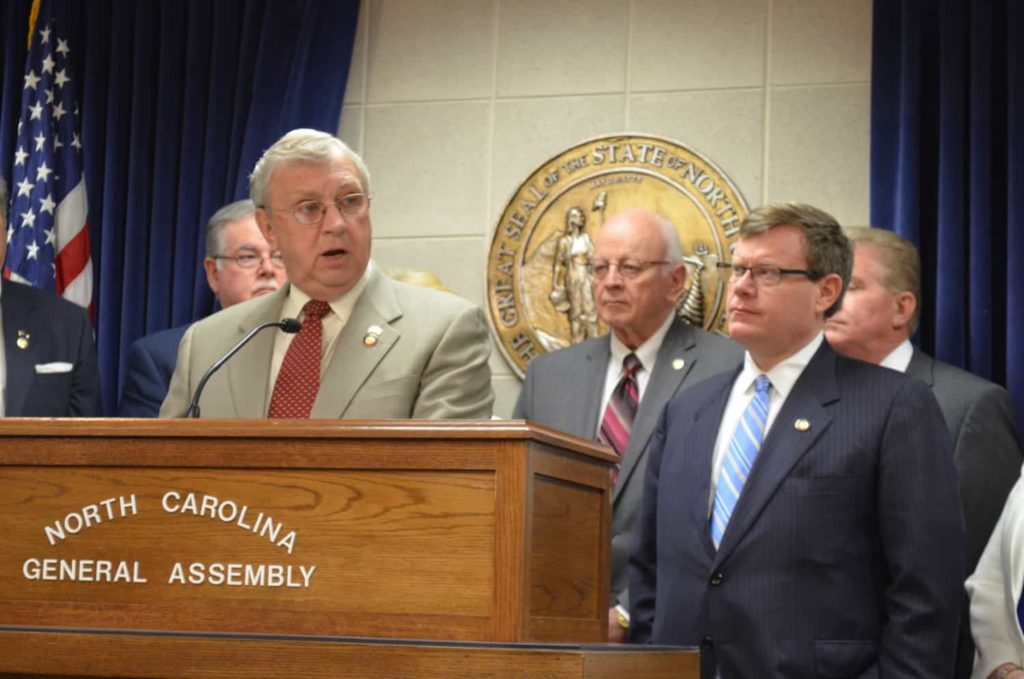
Rep. Craig Horn, R-Union, talking about the education portions of the budget at a 2017 press conference. Alex Granados/EducationNC
Horn, an influential legislator when it came to education, lost his seat when he ran for the state superintendent position and lost to Catherine Truitt in 2020. He was there for the inception of the ISD.
“I’m going to suggest that rather than sit down and work out the problems, it’s easier and faster to say, ‘Ok, we’re done. We’re not doing it,’” he said.
Horn had a lot of problems with the ISD program, but said that if it has failed, he hopes lawmakers have done their homework to understand why.
“If we can say that we did our homework, we actually talked to the people inside, we actually talked to parents and students, we actually made some adjustments and we’re still failing, OK, then we made an informed decision,” he said. “But my experience with the General Assembly is they don’t always make informed decisions.”
Preparing for transition
The State Board of Education heard from the current leaders of the ISD and Southside-Ashpole at the December 2021 meeting.
Derrick Jordan, associate superintendent of agency schools, told the Board that efforts to improve the school are still happening.
“There is absolutely still work to be done, but there is an unwavering commitment to improving outcomes for the students at Southside-Ashpole,” he said.
And Hargrave stressed to Board members that the students in that school are “full of potential.”
“It is a school full of children who desire to be loved and desire to be taught, and they have a hunger for learning,” he said.
Freddie Williamson, superintendent of the Public Schools of Robeson County, said the district is ready to have the school back and is already working with the school and the ISD to prepare for a “smooth, seamless transition.”
There isn’t yet a timeline for the transition, but when Southside-Ashpole does return back to the control of Robeson County schools, State Board of Education member Olivia Oxendine said she hopes it keeps innovation a priority. She said innovation takes a long time, and whatever the ISD, the new teachers, new principal, or the community have done, it should continue.
“Whatever is beginning to happen called innovation, let’s carry it forward,” she said.
Nothing on the record shows that there was either innovation or achievement at the one school in the experimental district. But whatever it is, says Ms. Oxendine, keep doing it, even though it yielded no improvement.
The full story of North Carolina’s failed experiment is fascinating. The bill to create the state’s Innovative School District was sponsored by Republican Rob Bryan. The money to promote the bill was supplied by an ultra-conservative businessman from Oregon named John Bryan (no relation to the legislator). After the bill passed, the state Board of Education selected Achievement for All Children (AAC) as the charter operator, although it had no experience turning around low-performing schools.
Mecklenburg County Republican Senator Rob Bryan sponsored the bill as a member of the House in 2016 that became law and created the ISD. That law specifies that the ISD can have up to five schools, selected from the lowest-performing in North Carolina.
Bryan argued at the time that the new district would provide much-needed reforms, but the following year, as Policy Watch reported, he received at least $5,000 as a “stipend” for his work with AAC.
Several other low-performing schools, including two in Durham, were targeted for state takeover in 2017, but resisted the move. Then-ISD Superintendent Eric Hall ended his pursuit of those schools.
That left Southside-Ashpole, which began operating as the state’s first and only school within the Innovative School District at the start of the 2018-19 school year. Southside-Ashpole has an enrollment of 270, 95% of whom are students of color: Black, Latinx and American Indian.
In its first year as an ISD school, there was a wholesale house cleaning at Southside-Ashpole: After Superintendent Allen abruptly left, the State Board of Education hired Ellerbe to replace her. School principal Bruce Major also suddenly resigned, and AAC then hired Bowen.
It remains unclear whether the changes were due to job performance.
Meanwhile, there has also been a major upheaval within AAC’s business partner, TeamCFA, a Charlotte-based nonprofit that provides financial, instructional and management support to more than a dozen schools in North Carolina and four in Arizona.
TeamCFA is AAC’s curriculum partner, according to the ISD website.
TeamCFA was started by John Bryan (no relation to Rob Bryan), a retired Oregon businessman who has used his wealth to promote school choice causes.
John Bryan is also a major contributor to Republican lawmakers and was instrumental in helping to pass the North Carolina law that created the ISD. From 2013 to 2016, Rob Bryan’s campaign received more than $22,000 in contributions from John Bryan, state reports show. John Bryan also contributed to then-Gov. Pat McCrory, Lt. Gov. Dan Forest, NC House Speaker Tim Moore and Senate President Pro Tem Phil Berger.
Raleigh’s News & Observer reported in October that Bryan and the Challenge Foundation, which Bryan also formed, stopped funding TeamCFA. In his final founder’s letter, Bryan talked about passing on the responsibility to other private investors and philanthropists.
TeamCFA had received as much as 95% of its annual revenue from Bryan and the Challenge Foundation, the paper reported. TeamCFA also receives $510,000 annually from the Charles Koch Foundation.
The NC Republican leadership was heavily funded by John Bryan from Oregon. Bryan was the funder of TeamCFA. TeamCFA was the partner of the only charter operator that applied to manage the district that was created by legislation funded by John Bryan.
What happened to the 270 students in the one school in the Innovative school District? Well, they have had a constant turnover of principals and superintendents. They were Guinea pigs for legislators who don’t know them and apparently don’t care about them.
Gary Rubinstein began his career as a Teach for America recruit in 1991 and got to know many of the key figures in the corporate reform movement. He is currently a career high school teacher of mathematics in a New York City public school. Over time, he became disillusioned with the phony promises of TFA and charter schools and became one of the most tenacious critics of their hypocrisy.
KIPP, he notes, is considered the gold standard of charter schools. The organization has about 250 charter schools across the nation. It benefited from being featured in the nefarious film “Waiting for ‘Superman'” as a school that was able to “save” kids who were allegedly trapped in failing public schools. The implication of the film was that charter schools had some magic knowledge that enabled them to transform children who had been faring poorly in school. Mostly, that claim is a hoax, but it is good marketing for recruitment of students.
In the cities of Memphis and Nashville, TN there are a lot of charter schools fueled, in part, by the Race To The Top money they received while Teach For America alumni were in leadership positions at the Tennessee Education Department. By 2019, they had grown to seven KIPP schools in Tennessee. In 2020 the network announced that they were shutting down two of those seven schools. The headline from the Chalkbeat, TN article contains the quote from the network ‘‘We’ve been unable to fulfill our academic promise’. So as of 2020 they were down to five schools in Tennessee.
According to a new article in Chalkbeat, TN, this coming Tuesday, January 25th, the Shelby County school system will vote on whether or not to shut down two of the remaining KIPPs: KIPP Memphis Academy Middle School and KIPP Memphis Collegiate Elementary.
Rubinstein researched the remaining five KIPP schools [including the two at risk of closure] in Tennessee and discovered that none of them is successful.
The fact that the schools are even at risk of getting shut down for poor performance definitely should convince anyone that the ‘Waiting For Superman’ narrative that if you give charters flexibility in exchange for accountability, they will outperform the ‘failing’ public schools. But there might be some people who say “There’s bound to be a few bad apples in any bunch so maybe these are just some outliers and the ‘average’ KIPP is still very good.’
To see if that was true in Tennessee I went to the state web portal and looked up the test scores and the growth scores for all five of the remaining KIPP schools there. What I found was that not only did those schools have very low test scores, but all of them had the lowest possible ‘growth’ score (a 1 out of 5). Now I know that sometimes this ‘growth’ score is not the most accurate calculation but if reformers are going to use them to label some public schools as failing, then they would have to label all the KIPPs in Tennessee as failing too.
Three-year TN Ready test averages from the 2016-17 to 2018-19 school years show only about 6% of KIPP Memphis Academy Middle students reached or approached mastery in math, according to district records. During the same time period, about 10% of students reached or approached mastery in English.
At KIPP Memphis Collegiate Elementary, about 10% of students reached or approached mastery in English and 18% in math, during the same period.
The CEO of KIPP Memphis defends the low test scores and low growth scores by pointing to the students’ disadvantaged backgrounds.
Rubinstein points out the irony of a charter school using this excuse:
The response from KIPP comes from the CEO of KIPP Memphis schools, Antonio Burt. According to the article “Antonio Burt, CEO of KIPP Memphis Schools, said he’s not satisfied with the two schools’ academic performance, but said many KIPP students come from economically disadvantaged backgrounds and often face greater learning challenges.” This is striking to me. The whole narrative of charter schools was that unionized teachers believe ‘poverty is destiny’ and use the economic status of students as an ‘excuse’ for low expectations and for low performance but that charters are ‘no excuses’ and will certainly not say that the students underperformed because of these ‘greater learning challenges.’ But Antonio Burt is saying what he can since he has to give the school board some reason to vote to not close these two schools.
The article in Chalkbeat noted that some board members were inclined to give Antonio Burt more time because he “received national acclaim for his work turning two low-performing Memphis schools into models of student achievement.”
That line was an invitation to Rubinstein to discover Antonio Burt’s prowess as a turnaround specialist who had received “national acclaim for his work.”
Rubinstein goes to the record and checks the data for the schools that Burt led in Memphis. Both of them were and remain among the lowest performing schools in the state.
Gary traces Burt’s career path and can’t find any schools that have been turned around by Burt.
So I see Antonio Burt as someone who has spent 2 years at one school, 3 years at another, then a year and a half overseeing eight schools. He hasn’t turned around any of those schools in any kind of lasting way yet he is hailed as a turnaround guru who will likely use that inaccurate title as a way to save the two KIPP schools from being shut down because they now finally have an expert to improve them.
On Tuesday, January 25, the Shelby County School board will decide whether to close the two failing KIPP schools or to leave them open.
You may recall that charter schools are supposed to be more accountable than public schools. When public schools post low scores, they are closed. When charters fail, they too are supposed to close. Let’s see whether that happens in Memphis. Or are charter schools–especially KIPP charter schools–held to a different (and lower) standard than public schools?
Paul Waldman is an opinion columnist for The Washington Post. In this article, he criticizes Democrats for failing to stand up to Republican slanders and lies about public schools. He raises an important point: Why aren’t Democrats fighting Republican lies about the schools? Why aren’t the billionaires who claim to be liberal speaking out against this vicious campaign to destroy our public schools? One reason for the silence of the Democrats: Arne Duncan derided and insulted public schools and their teachers as often as Republicans.
Waldman wrote recently:
For the last year or so, Republicans have used the “issue” of education as a cudgel against Democrats, whipping up fear and anger to motivate their voters and seize power at all levels of government.
Isn’t it about time Democrats fought back? Republicans have moved from hyping the boogeyman of critical race theory to taking practical steps to criminalize honest classroom discussions and ban books, turning their manufactured race and sex panic into profound political and educational change. Meanwhile, Democrats have done almost nothing about it, watching it all with a kind of paralyzed confusion.
Look no further than Florida Gov. Ron DeSantis, who is pushing legislation with the colorful name of the Stop Woke Act. As the Republican governor told Fox News this weekend, we need to allow people to sue schools over their curriculums, not only because of CRT but also because “there’s a lot of other inappropriate content that can be smuggled in by public schools.”
If you liked the Texas bill that effectively banned abortion in the state, you’re in luck. Republicans apparently want to use a version of that bill’s tactic — putting enforcement in the hands of private vigilantes — to make teachers and school administrators live under the same fear as abortion providers.
It’s happening elsewhere, too. A bill in Indiana allows the same kind of lawsuits. And last week, during a hearing on the bill, a GOP state senator got in trouble for saying that “I believe that we’ve gone too far when we take a position” on things like Nazism, because in the classroom, “we need to be impartial.” The state senator, Scott Baldwin, previously attracted attention when it was revealed that he made a contribution to the far-right Oath Keepers (though he claims he has no real connection to the extremist group).
Everywhere you look, Republicans are trying to outdo one another with state laws forcing teachers to parrot far-right propaganda to students. A Republican bill in Oklahoma would ban teachers from saying that “one race is the unique oppressor” or “victim” when teaching the history of slavery in America; its sponsor says that would bring the appropriate “balance” to the subject.
So ask yourself: What are Democrats telling the public about schools? If you vote for Democrats, what are you supposed to be achieving on this issue? If any voters know, it would be a surprise. We’re seeing another iteration of a common Republican strategy: Wait for some liberal somewhere to voice an idea that will sound too extreme to many voters if presented without context and in the most inflammatory way possible, inflate that idea way beyond its actual importance, claim it constitutes the entirety of the Democratic agenda and play on people’s fears to gin up a backlash.
That was the model on “defund the police.” Now it’s being used on schools, which Republicans have decided is the issue that can generate sufficient rage to bring victory at the polls. Devoted as they are to facts and rational argumentation, liberals can’t help themselves from responding to Republican attacks first and foremost with refutation, which allows Republicans to set the terms of debate. So their response to the charge that critical race theory is infecting our schools is something like this: “No, no, that has nothing to do with public education. It’s a scholarly theory taught mostly to graduate students.”
But that doesn’t allow for this response: “Republicans want to subject our kids to fascist indoctrination. Why do they want to teach our kids that slavery wasn’t bad? Why are they trying to ban books? Who’s writing their education policy, David Duke? Don’t let them destroy your schools!”
That, of course, would be an unfair exaggeration of what most Republicans actually want. Is a state senator who worries that public school teachers might be biased against Nazism really representative of the whole Republican Party? Let’s try to be reasonable here.
Or maybe being reasonable isn’t the best place to start when you’re being overrun. Maybe Democrats need to begin not with a response to Republican lies about what happens in the classroom, but an attack on what Republicans are trying to do to American education.
After Glenn Youngkin won the Virginia governorship with a campaign largely focused on schools, Republicans everywhere decided that nurturing a CRT-based White backlash is the path to victory. That is their plan, whether Democrats like it or not.
This isn’t just coming from national Republicans. At the state and local level, far-right extremists are taking over education policy, leaving teachers terrified that if they communicate the wrong idea to students — like, apparently, being too critical of Nazis — they might get sued.
The implications of the GOP war on schools and teachers are horrifying, and with some exceptions, Democrats are watching it happen without anything resembling a plan to do anything about it. It might be time for all the party’s clever strategists to give it some thought.
Gary Rubinstein has been following the sad career of Tennessee’s Achievement School District for a decade. The ASD was created with $100 million in Race to the Top funding, a portion of the $500 million won by the state in Arne Duncan’s competition.
The ASD was launched in 2012, when advocates of privatization earnestly believed that charter schools performed miracles. The mere act of turning a low-scoring public school over to a private operator would free the school from regulation and bad teachers and inevitably produce high test scores. Over the years, this assumption has been proven untrue, and the ASD is a leading example of great promises that produced failure.
Gary has tracked the failure of the ASD to transform low-scoring public schools into high-performing charter schools. The irony, as he notes in this overview, is that many states have copied the Tennessee ASD despite its failure to achieve its goals.
Gary writes:
The mission of the ASD was to take schools in the bottom 5% and within 5 years ‘catapult’ them into the top 25%. They started with six schools and over a period of about five years expanded into around 30 schools. The plan was to turn the schools over to charter operators and then after the schools had been successfully catapulted, they would return to the original school district.
After five years, it was clear that at least five of the original six school were still in the bottom 5%. The other one had maybe risen into the bottom 10%. Barbic resigned, Huffman resigned, the ASD changed their mission to something a lot more vague.
There is no reason to celebrate the failure of a school, especially one enrolling vulnerable children. But there is every reason to point to the P.T. Barnum School of Charter School Propaganda. in did not achieve its goals. It disrupted the lives of children, parents, and teachers.
How shallow are the promoters of these grand plans that tear apart communities, then move on to another gig.
Denis Smith was a teacher and an administrator in West Virginia. He moved to Ohio where he worked in the State Education Department. His last position before retiring was in the office of charter schools (misleadingly called “community schools” in Ohio, even when they operate for profit).
The link works but doesn’t permit me to copy any print.
Here’s the basic story. The Republican legislature passed a charter law, and the Republican Governor (billionaire Jim Justice) signed it, despite promising the state’s teachers he would veto it.
He appointed cronies to the state’s new West Virginia Charter School Board. The board picked five new charter operators. One of the charter operators is Ron Packard, CEO of Accel, former CEO of K12 Inc., which is listed on the New York Stock Exchange. Accel has charter operations in many states. Its teachers are paid less than the national average but its CEO collected $19 million in a four-year period. Its bottom line is profit, not education or community, writes Smith.
Circuit Judge Jennifer Bailey of Kanawha County issued an injunction barring the schools from opening because they violate state constitution. She ruled that the creation of a new school district within an existing school district is unconstitutional, unless a majority of voters in the existing district approve in an election.
Smith writes that the West Virginia law is “a flagrant attempt” to use public funds for private profit. He writes that public schools are democratic institutions owned by the community and operated by elected school boards. The initiation of charter schools is a blatant effort to destroy the public schools, a radical and wasteful decision that was never put to voters.


 Diane Ravitch's blog