Steve Hinnefeld writes about the very expensive and ineffectual voucher program in Indiana, which is based on a lie. On several lies, actually. The promoters of vouchers claimed that vouchers would save poor kids from failing public schools. He shows in this post that most vouchers are used by students who never attended a public school, who are not poor, and who are not getting a better education than students in public schools. The advocates said it would save money, but the cost this year is nearly a quarter billion dollars.
He writes:
Indiana awarded $241.4 million in the 2021-22 school year to pay tuition and fees for students to attend private schools. That’s 44% more than the state spent on vouchers the previous year.
The increase, detailed in a Department of Education report, isn’t surprising. The Indiana General Assembly in 2021 vastly expanded the voucher program, opening it to families near the top of the state’s income scale and making the vouchers significantly more generous.
Nearly all the 330 private schools that received voucher funding are religious schools. Some discriminate against students, families and employees because of their religion, disability status, sexual orientation or gender identity. Indiana is bankrolling bigotry.
And many of the families receiving vouchers could pay private school tuition without public assistance. Some 20% of voucher households last year had an income of $100,000 or more, well above Indiana’s median household income of about $58,000.
The voucher program, created in 2011, was sold as a way to help children from poor families opt out of “failing” public schools. Mitch Daniels, Indiana’s governor at the time and a leading voucher advocate, said students should attend a public school for two semesters to qualify, giving public schools a chance to show what they could do.
But the two-semester requirement fell by the wayside. Students now have nine pathways by which they can qualify. If a family meets the income requirement, which is laughably lax, a private school can find a way to get them vouchers.
When the program started, supporters said it wouldn’t cost anything, because, if the students didn’t have vouchers, the state would be paying for them to attend public schools. They don’t even pretend to believe that anymore. In 2021-22, 70% of voucher students had no record of having attended a public school in the state. Most voucher funding is going to families that intended all along to send their kids to private schools — and often had the means to do so.
The program initially served both low- and middle-income families. Last year, the legislature threw the door open to high-income families. Now, a family of five making $172,000 can receive vouchers worth over $5,400 on average per child. For about half of all voucher students, the award covers the full cost of tuition and fees at their private school.
Voucher participation had stalled, but with last year’s expansion, the number of voucher students exploded: 44,376 students had vouchers in 2021-22, up 24.3% from the previous year.
Over the years, Indiana’s voucher population has grown whiter and markedly less poor. Nearly 60% of voucher students are white, an overrepresentation considering the program is most pervasive in urban areas, where there are many Black and Hispanic students. Only 10.5% of voucher students are Black, compared to 13.5% of Indiana public and charter school students.
The program might still seem justifiable if Indiana private schools were academically superior. They aren’t. Researchers at the universities of Kentucky and Notre Dame found that students who received vouchers fell behind their peers who remained in public schools.
Indiana policymakers no longer care about that either. They’ve embraced the idea that parents should have complete control over their children’s schooling and the public funds that pay for it. In a world of unrestricted school choice, state money will “follow the child,” wherever that may lead. Standards, accountability and academic quality don’t matter.
The point of privatization is not to help needy students but to destroy the public schools.
Talk about cheesy! Talk about hypocrisy! Talk about weasels! Talk about betrayal of the public! Talk about disdain for democracy!
The people of Arizona voted overwhelmingly against vouchers, but the Koch-controlled GOP majority in the legislature is promoting a dramatic expansion of vouchers. Voters be damned!
To buy the support of public school parents, the legislators added a big increase in public school funding, but the new funding is available only if the vouchers are enacted.
Arizona has 1.1 million students, but only 11,775 have used vouchers to leave public schools. Now the Republicans want to fund vouchers for every student in the state. Does it matter that multiple academic studies have found that vouchers do not improve education? Of course not.
Do you think these guys know how repellent they are?
Four years after voters rejected a similar move, Republican lawmakers are pushing ahead with a plan to let any of the 1.1 million students in public schools get vouchers to attend private and parochial schools.
And they are holding a plan to boost aid to public schools hostage until they get what they want.
HB 2853, approved Wednesday by the House Ways and Means Committee on a 6-4 party-line vote, would remove all restrictions on who can get what are called Empowerment Scholarship Accounts. Backers say this ensures that parents get to decide what is the best option for their youngsters.
That assertion was disputed by Beth Lewis, executive director of Save Our Schools.
She said that unlike public schools, private schools can pick and choose who they want to accept. Lewis said those schools, many of which are for-profit corporations, accept those who will cost them the least, meaning the highest achievers and students who do not have special needs.
Republicans said they are not ignoring the needs of public schools, voting Wednesday for HB 2854, which would increase state aid to schools by $400 million, above another $250 million additional already planned.
But there’s less there than meets the eye.
First, only half of that additional cash is permanent. And it is weighted so the districts with the most students in financial need would get more.
Beyond that, schools would have to wait until the 2023-24 school year for the one-time $200 million infusion.
And there’s something else.
House Majority Leader Ben Toma, R-Peoria, who crafted both measures, included a “poison pill” of sorts: It says that if the vouchers do not become law, the public schools don’t get any of that $400 million.
That is designed to deter the education community from doing to HB 2853 what they did to a similar voucher expansion measure approved by GOP lawmakers in 2017.
They collected sufficient signatures to put the expansion on the 2018 ballot. And voters overruled the legislation by a margin of close to 2 to 1…
And Lewis told Capitol Media Services that supporters of public education won’t be deterred, vowing to go to the ballot once again if the Republican-controlled legislature approves universal vouchers. She said while that would mean the loss of $400 million — or, really, $200 million of ongoing funds — that is nowhere near the amount that public schools need in Arizona.
She pointed out that voters in 2020 approved Proposition 208 to infuse another nearly $1 billion into public education. That was sidelined after the Arizona Supreme Court ruled the tax could not be levied because it bumped up against a constitutional limit on education spending.
Lewis, the education community and their Democratic allies are not alone in saying schools need more than HB 2854 is offering.
Sen. Paul Boyer, R-Glendale, said he is holding out for an amount close to that $1 billion figure. And with only 16 Republicans in the 30-member Senate, the plan cannot get final approval without his vote.
Wednesday’s votes come as school districts won a significant legal victory, with a judge saying they are entitled to pursue claims that the legislature shorted them billions of dollars.
North Carolina has a problem. The public consistently chooses to put its children in public schools, but the Tea Party-dominated General Assembly (legislature) favors privatization. No matter how poorly the charter schools and voucher schools perform, the General Assembly wants more of them. I wonder why? Is is campaign contributions or just hostility to anything public?
After strong criticism of remote learning during the pandemic by the NC General Assembly and repeated legislative efforts to encourage districts to return to in-class instruction, it would be natural to think that the NC virtual charter schools, which are 100% remote, should come under increased scrutiny.
Instead, the opposite happened. Last week, SB671, Edition 3 (Virtual Educ./Remote Acad./Virtual Charters) was introduced, which if passed into law, would allow NC’s two virtual charter schools to be upgraded to full charter status with NO REVIEW. The bill passed through the House with little discussion. As part of SB671, the “two pilot virtual charter schools…shall be deemed to be approved as charter schools by the State Board of Education.” In addition, they are allowed to increase enrollment by 20% each year based on their 2021-22 enrollment for the next five years, when their charter may be renewed for 10 more years.
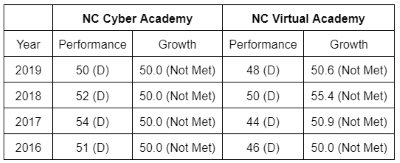
In the 2017-18 SY, two virtual charter schools, North Carolina Cyber Academy(formerly NC Connections Academy) and NC Virtual Academy opened as pilot projects. Because similar virtual charter schools had seen poor outcomes in other states, NC did not want to grant full charter status until the schools had proven themselves. The experiment has not gone well. In the years for which there is performance data (see NC School Report Cards), neither school achieved above a D performance grade or higher than 55 in growth. The NC Cyber Academy earned the lowest possible growth score (50) all four years.
In addition, both schools currently serve a lower percentage of economically disadvantaged students than the state overall and have much lower four-year graduation rates.
2020-21 Economically Disadvantaged Students
State: 38.9%
NC Cyber Academy: 31.5%
NC Virtual Academy: 32.4%
2020-21 Four-Year Graduation Rate
State: 87.0%
NC Cyber Academy: 54.9%
NC Virtual Academy: 77.5%
In a classic example of the privatization of public education, The NC Virtual Academy is powered by Stride K-12, an online learning company traded on the NY stock exchange. While the company’s investors may be getting good returns on their investment, the NC taxpayers are not.
SB671 also introduces an option for public school districts to apply to the State Board of Education for approval to operate small virtual academies enrolling no more than 15% of their students. The bill lists seven required elements for a district’s plan including (#3) Hardware, software, and learning mgmt. platforms that support online learning, (#5) The professional development that will be provided to those teaching in the remote academy related to the pedagogy of providing remote instruction, and (#6) The identified characteristics for successful remote learning…. In addition, clear evaluation guidelines are set out to ensure that the remote academies do not provide a sub-standard education. These and other elements of SB671 are steps that could allow public schools flexibility to meet the needs of their students.
The past few years have given NC educators, students, and parents plenty of opportunities to see the positive and negative aspects of virtual instruction. Implementing lessons learned and evaluating results as we move forward are critical next steps. SB671 does the NC virtual charter schools a disservice by excluding them from an evaluation of their pilot stage performance
Since the massacre at Robb Elementary School in Uvalde, Texas, blame has been shifted to the school district’s police chief, Pete Arredondo, who led a force with six officers. He didn’t have a radio, he didn’t know that children in the locked classrooms were calling 911 for help, he didn’t have a key to the classrooms. More than 100 local, state, and federal law officers converged on the scene, and it was assumed that he was in charge. My own guess, from very far away, was that there was no command structure, and no one knew who was in charge. Nineteen officers congregated outside the connected classrooms where the killer was left alone for more than an hour. The Texas Tribune, a small, independent journal, got the first interview with the school district police chief.
Only a locked classroom door stood between Pete Arredondo and a chance to bring down the gunman. It was sturdily built with a steel jamb, impossible to kick in.
He wanted a key. One goddamn key and he could get through that door to the kids and the teachers. The killer was armed with an AR-15. Arredondo thought he could shoot the gunman himself or at least draw fire while another officer shot back. Without body armor, he assumed he might die.
“The only thing that was important to me at this time was to save as many teachers and children as possible,” Arredondo said.
The chief of police for the Uvalde school district spent more than an hour in the hallway of Robb Elementary School. He called for tactical gear, a sniper and keys to get inside, holding back from the doors for 40 minutes to avoid provoking sprays of gunfire. When keys arrived, he tried dozens of them, but one by one they failed to work.
“Each time I tried a key I was just praying,” Arredondo said. Finally, 77 minutes after the massacre began, officers were able to unlock the door and fatally shoot the gunman.
In his first extended comments since the May 24 massacre, the deadliest school shooting in Texas history, Arredondo gave The Texas Tribune an account of what he did inside the school during the attack. He answered questions via a phone interview and in statements provided through his lawyer, George E. Hyde.
Aside from the Texas Department of Public Safety, which did not respond to requests for comment for this article, Arredondo is the only other law enforcement official to publicly tell his account of the police response to the shooting.
Arredondo, 50, insists he took the steps he thought would best protect lives at his hometown school, one he had attended himself as a boy.
“My mind was to get there as fast as possible, eliminate any threats, and protect the students and staff,” Arredondo said. He noted that some 500 students from the school were safely evacuated during the crisis.
Arredondo’s decisions — like those of other law enforcement agencies that responded to the massacre that left 21 dead — are under intense scrutiny as federal and state officials try to decide what went wrong and what might be learned.
Whether the inability of police to quickly enter the classroom prevented the 21 victims — 19 students and two educators — from getting life-saving care is not known, and may never be. There’s evidence, including the fact that a teacher died while being transported to the hospital, that suggests taking down the shooter faster might have made a difference. On the other hand, many of the victims likely died instantly. A pediatrician who attended to the victims described small bodies “pulverized”and “decapitated.” Some children were identifiable only by their clothes and shoes.
In the maelstrom of anguish, outrage and second-guessing that immediately followed the second deadliest school shooting in American history, the time Arredondo and other officers spent outside that door — more than an hour — have become emblems of failure.
As head of the six-member police force responsible for keeping Uvalde schools safe, Arredondo has been singled out for much of the blame, particularly by state officials. They criticized him for failing to take control of the police response and said he made the “wrong decision” that delayed officers from entering the classroom.
Arredondo has faced death threats. News crews have camped outside his home, forcing him to go into hiding. He’s been called cowardly and incompetent.
The Texas Tribune thanks its sponsors. Become one.
Neither accusation is true or fair, he says.
“Not a single responding officer ever hesitated, even for a moment, to put themselves at risk to save the children,” Arredondo said. “We responded to the information that we had and had to adjust to whatever we faced. Our objective was to save as many lives as we could, and the extraction of the students from the classrooms by all that were involved saved over 500 of our Uvalde students and teachers before we gained access to the shooter and eliminated the threat.”
Arredondo’s explanations don’t fully address all the questions that have been raised. The Tribune spoke to seven law enforcement experts about Arredondo’s description of the police response. All but one said that serious lapses in judgment occurred.
Most strikingly, they said, by running into the school with no key and no radios and failing to take charge of the situation, the chief appears to have contributed to a chaotic approach in which officers deployed inappropriate tactics, adopted a defensive posture, failed to coordinate their actions, and wasted precious time as students and teachers remained trapped in two classrooms with a gunman who continued to fire his rifle.
Hyde, Arredondo’s lawyer, said those criticisms don’t reflect the realities police face when they’re under fire and trying to save lives. Uvalde is a small working-class city of about 15,000 west of San Antonio. Its small band of school police officers doesn’t have the staffing, equipment, training, or experience with mass violence that larger cities might.
His client ran straight toward danger armed with 29 years of law enforcement experience and a Glock 22 handgun. With no body armor and no second thoughts, the chief committed to stop the shooter or die trying.
77 minutes
One of Arredondo’s most consequential decisions was immediate. Within seconds of arriving at the northeast entrance of Robb Elementary around 11:35 a.m., he left his police and campus radios outside the school.
To Arredondo, the choice was logical. An armed killer was loose on the campus of the elementary school. Every second mattered. He wanted both hands free to hold his gun, ready to aim and fire quickly and accurately if he encountered the gunman.
Arredondo provided the following account of how the incident unfolded in a phone interview, in written answers, and in explanations passed through his lawyer.
He said he didn’t speak out sooner because he didn’t want to compound the community’s grief or cast blame at others.
Thinking he was the first officer to arrive and wanting to waste no time, Arredondo believed that carrying the radios would slow him down. One had a whiplike antenna that would hit him as he ran. The other had a clip that Arredondo knew would cause it to fall off his tactical belt during a long run.
Arredondo said he knew from experience that the radios did not work in some school buildings.
But that decision also meant that for the rest of the ordeal, he was not in radio contact with the scores of other officers from at least five agencies that swarmed the scene.
Almost immediately, Arredondo teamed up with a Uvalde police officer and began checking classrooms, looking for the gunman.
As they moved to the west side of the campus, a teacher pointed them to the wing the gunman had entered. As Arredondo and the Uvalde police officer ran toward it, they heard a “great deal of rounds” fired off inside. Arredondo believes that was the moment the gunman first entered adjoining classrooms 111 and 112 and started firing on the children with an AR-15 rifle.
Arredondo and the Uvalde officer entered the building’s south side and saw another group of Uvalde police officers entering from the north.
Arredondo checked to see if the door on the right, room 111, would open. Another officer tried room 112. Both doors were locked.
Arredondo remembers the gunman fired a burst of shots from inside the classroom, grazing the police officers approaching from the north. Some of the bullets pierced the classroom door, and others went through the classroom wall and lodged in the wall adjacent to the hallway, where there were other classrooms. The officers on the north end of the hallway retreated after being shot, but they weren’t seriously injured and returned shortly after to try to contain the gunman.
Because the gunman was already inside the locked classroom, some of the measures meant to protect teachers and students in mass shooting situations worked against police trying to gain entry.
Arredondo described the classroom door as reinforced with a hefty steel jamb, designed to keep an attacker on the outside from forcing their way in. But with the gunman inside the room, that took away officers’ ability to immediately kick in the door and confront the shooter.
Arredondo believed the situation had changed from that of an active shooter, to a gunman who had barricaded himself in a classroom with potential other victims.
Texas Department of Public Safety officials and news outlets have reported that the shooter fired his gun at least two more times as police waited in the hallway outside the classrooms for more than an hour. And DPS officials have said dispatchers were relaying information about 911 calls coming from children and teachers in the classrooms, begging the police for help.
Arredondo said he was not aware of the 911 callsbecause he did not have his radio and no one in the hallway relayed that information to him. Arredondo and the other officers in the hallway took great pains to remain quiet. Arredondo said they had no radio communications — and even if they’d had radios, his lawyer said, they would have turned them off in the hallway to avoid giving away their location. Instead, they passed information in whispers for fear of drawing another round of gunfire if the shooter heard them.
Finding no way to enter the room, Arredondo called police dispatch from his cellphone and asked for a SWAT team, snipers and extrication tools, like a fire hook, to open the door.
Arredondo remained in the hallway for the rest of the ordeal, waiting for a way to get into the room, and prepared to shoot the gunman if he tried to exit the classroom.
Arredondo assumed that some other officer or official had taken control of the larger response. He took on the role of a front-line responder.
He said he never considered himself the scene’s incident commander and did not give any instruction that police should not attempt to breach the building. DPS officials have described Arredondo as the incident commander and said Arredondo made the call to stand down and treat the incident as a “barricaded suspect,” which halted the attempt to enter the room and take down the shooter. “I didn’t issue any orders,” Arredondo said. “I called for assistance and asked for an extraction tool to open the door.”
Officers in the hallway had few options. At some point, Arredondo tried to talk to the gunman through the walls in an effort to establish a rapport, but the gunman did not respond.
With the gunman still firing sporadically, Arredondo realized that children and teachers in adjacent rooms remained in danger if the gunman started shooting through the walls.
The Texas Tribune thanks its sponsors. Become one.
“The ammunition was penetrating the walls at that point,” Arredondo said. “We’ve got him cornered, we’re unable to get to him. You realize you need to evacuate those classrooms while we figured out a way to get in.”
Lights in the classrooms had also been turned off, another routine lockdown measure that worked against the police. With little visibility into the classroom, they were unable to pinpoint the gunman’s location or to determine whether the children and teachers were alive.
Arredondo told officers to start breaking windows from outside other classrooms and evacuating those children and teachers. He wanted to avoid having students coming into the hallway, where he feared too much noise would attract the gunman’s attention.
While other officers outside the school evacuated children, Arredondo and the officers in the hallway held their position and waited for the tools to open the classroom and confront the gunman.
At one point, a Uvalde police officer noticed Arredondo was not wearing body armor. Worried for the chief’s safety, the Uvalde officer offered to cover for Arredondo while he ran out of the building to get it.
“I’ll be very frank. He said, ‘Fuck you. I’m not leaving this hallway,’” Hyde recounted. “He wasn’t going to leave without those kids.”
Without any way to get into the classroom, officers in the hallway waited desperately for a way to secure entry and did the best they could to otherwise advance their goal of saving lives.
“It’s not that someone said stand down,” Hyde said. “It was ‘Right now, we can’t get in until we get the tools. So we’re going to do what we can do to save lives.’ And what was that? It was to evacuate the students and the parents and the teachers out of the rooms.”
Tools that might have been useful in breaking through the door never materialized, but Arredondo had also asked for keys that could open the door. Unlike some other school district police departments, Uvalde CISD officers don’t carry master keys to the schools they visit. Instead, they request them from an available staff member when they’re needed.
Robb Elementary did not have a modern system of locks and access control. “You’re talking about a key ring that’s got to weigh 10 pounds,” Hyde said.
Eventually, a janitor provided six keys. Arredondo tried each on a door adjacent to the room where the gunman was, but it didn’t open.
Later, another key ring with between 20 and 30 keys was brought to Arredondo.
“I was praying one of them was going to open up the door each time I tried a key,” Arredondo said in an interview.
None did.
Eventually, the officers on the north side of the hallway called Arredondo’s cellphone and told him they had gotten a key that could open the door.
The officers on the north side of the hallway formed a group of mixed law enforcement agencies, including U.S. Border Patrol, to enter the classroom and take down the shooter, Arredondo said.
Ten days after the shooting, The New York Times reported that a group of U.S. Border Patrol agents ignored a directive spoken into their earpieces not to enter the room. The Times has since reported that Arredondo did not object when the team entered the room.
Hyde said if a directive delaying entry was issued, it did not come from Arredondo, but the Times reported that someone was issuing orders at the scene. Hyde said he did not know who that person was. The Border Patrol declined to comment.
At 12:50 p.m., as the officers entered the classroom, Arredondo held his position near the south classroom door in the hallway, in case the gunman tried to run out that door.
At last, the shooter, Salvador Ramos, 18, was brought down. A harrowing standoff rapidly became an effort to find the wounded and count the dead.
Once the officers cleared the room, Border Patrol agents trained to render emergency medical service assessed the wounded. Arredondo and other officers formed a line to help pass the injured children out of the hallway and to emergency medical care.
Expert analysis
A police officer intentionally ditching his radio while answering a call? “I’ve never heard anything like that in my life,” said Steve Ijames, a police tactics expert and former assistant police chief of Springfield, Missouri.
The discarded radio, the missing key and the apparent lack of an incident commander are some of questions raised by experts about the response of Arredondo and the various agencies involved.
Officers are trained never to abandon their radios, their primary communication tool during an emergency, said Ijames. That Arredondo did so the moment he arrived on scene is inexplicable, he said.
Ijames added that it is “inconceivable” that Arredondo’s officers did not have a plan to access any room or building on campus at any moment, given that the school district makes up the entirety of the tiny force’s jurisdiction.
The Texas Tribune thanks its sponsors. Become one.
The experts, which included active-shooting researchers and retired law enforcement personnel, homed in on the moment officers entered the school and found the doors to rooms 111 and 112 locked. Three said this moment afforded Arredondo a chance to step back, regroup and work with other officers to devise a new strategy.
“It takes having someone who has the wherewithal to come up with a quick, tactical plan and executing it,” said former Seguin police Chief Terry Nichols. “It may not be the best plan, but a plan executed vigorously is better than the best unexecuted plan in the world.”
Nichols, who teaches classes on active-shooter responses, said he understands the instinct for command staff to want to confront a gunman themselves. But he said commanders must not lose focus of their role in an emergency.
“We have to — as leaders, especially as a chief of police — step back and allow our men and women to go do what they do, and use our training and experience where they’re needed, to command and control a chaotic situation,” Nichols said.
Active-shooter protocols developed after the 1999 shooting at Columbine High School, where a slow police response delayed medical care that could have saved several victims, train police to confront shooters immediately, without waiting for backup and without regard for their personal safety. An active-shooting training that Uvalde school district police attended in March stressed these tactics, warning that responders likely would be required to place themselves in harm’s way.
“The training that police officers have received for more than a decade mandates that when shots are fired in an active-shooter situation, officers or an officer needs to continue through whatever obstacles they face to get to the shooter, period,” said Katherine Schweit, a retired FBI agent who co-wrote the bureau’s foundational research on mass shootings. “If that means they go through walls, or go around the back through windows, or through an adjoining classroom, they do that.”
Bruce Ure, a former Victoria police chief, said drawing conclusions about police conduct during the shooting is premature since the authorities have not completed their investigations. He said he believes Arredondo acted reasonably given the circumstances he faced.
Ure disagreed that Arredondo should have retreated into a command role once other officers arrived, since most active-shooter events last mere minutes. He argued that no amount of ad-hoc planning outside would have changed the outcome of the massacre once the shooter got inside the classrooms.
He said attempting to breach windows or open classroom doors by force were unrealistic options that would have exposed police and children to potentially fatal gunfire with little chance of success. Officers’ only choice, he said, was to wait to find a key, which he agreed should not have taken so long.
Hyde said attempting to enter through windows would have “guaranteed all the children in the rooms would be killed” along with several officers. He said this “reckless and ineffective” action, when police could not see where the shooter was, would have made officers easy targets to be picked off at will.
Ure, who as an attendee was wounded in the hand during the 2017 Las Vegas concert shooting that killed 60 people, acknowledged the post-Columbine wisdom that immediately confronting shooters is paramount. But he said the scene inside Robb Elementary presented a “perfect storm” of an active shooter barricaded with hostages.
“There’s no manual for this type of scenario,” Ure said. “If people need to be held appropriately accountable, then so be it. But I think the lynch-mob mentality right now isn’t serving any purpose, and it’s borderline reckless.”
Questions over command
The day after the shooting, Arredondo and other local officials stood behind Gov. Greg Abbott and DPS Director Steve McCraw as they held their first major news conference to address the slaughter.
Abbott lauded law enforcement agencies for their “amazing courage” and said the actions of police officers were the reason the shooting was “not worse.” McCraw said a school resource officer had “engaged” the shooter outside the building but was unable to stop him from entering.
To Arredondo, that information did not ring true. Arredondo turned to a DPS official, whom he declined to identify, and asked why state officials had been given inaccurate information.
In a stunning reversal at a news conference the next day, the DPS regional director for the area, Victor Escalon, retracted McCraw’s initial claim and said the gunman “was not confronted by anybody” before entering the school.
The Texas Tribune thanks its sponsors. Become one.
At a third news conference the following afternoon, Abbott said he was “livid” about being “misled” about the police response to the shooting. He said his incorrect remarks were merely a recitation of what officers had told him.
Hyde said the inaccurate information did not come from Arredondo, who had briefed state and law enforcement officials about the shooting before the first press conference. Abbott on Wednesday declined to identify who had misled him, saying only that the bad information had come from “public officials.”
McCraw also told reporters that Arredondo, whom he identified by his position rather than his name, treated the gunman as a “barricaded suspect” rather than an active shooter, which McCraw deemed a mistake. In the news conference, McCraw referred to Arredondo as the shooting’s “incident commander.”
Hyde said Arredondo did not issue any orders to other law enforcement agencies and had no knowledge that they considered him the incident commander.
The National Incident Management System, which guides all levels of government on how to respond to mass emergency events, says that the first person on scene is the incident commander. That incident commander remains in that charge until they relinquish it or are incapacitated.
Hyde acknowledged those guidelines but said Arredondo’s initial response to the shooting was not that of an incident commander, but of a first responder.
“Once he became engaged, intimately involved on the front line of this case, he is one of those that is in the best position to continue to resolve the incident at that time,” Hyde said. “So while it’s easy to identify him as the incident commander because of that NIMS process, in practicality, you see here he was not in the capacity to be able to run this entire organization.”
With no radio and no way to receive up-to-date information about what was happening outside of the hallway, Hyde said, another one of the local, state and federal agencies that arrived at the scene should have taken over command.
The Texas Tribune thanks its sponsors. Become one.
Nichols, the former Seguin police chief, dismissed the idea that another officer would seamlessly adopt the incident commander role simply because Arredondo never did. He said decisive commanders are especially important when multiple agencies respond to an incident and are unsure how to work together.
“You know the facility. You’re the most intimately knowledgeable about this,” Nichols said of Arredondo. “Take command and set what your priorities need to be, right now.”
On May 31, officials with DPS, which is investigating the Uvalde shooting, told news outlets that Arredondo was no longer cooperating with the agency. The agency’s investigative unit, the Texas Rangers, wanted to continue talking with the police chief, but he had not responded to the agency’s request for two days, DPS officials said.
Hyde said Arredondo participated in multiple interviews with DPS in the days following the shooting, including a law enforcement debriefing the day of the attack and a videotaped debriefing with DPS analysts and the FBI the day after.
He’d also briefed the governor and other state officials and had multiple follow-up calls with DPS for its investigation.
But after McCraw said at a press conference on May 27 that Arredondo made the “wrong decision,” the police chief “no longer participated in the investigation to avoid media interference,” Hyde said.
The Rangers had asked Arredondo to come in for another interview, but he told investigators he could not do it on the day they asked because he was covering shifts for his officers, Hyde said.
“At no time did he communicate his unwillingness to cooperate with the investigation,” Hyde said. “His phone was flooded with calls and messages from numbers he didn’t recognize, and it’s possible he missed calls from DPS but still maintained daily interaction by phone with DPS assisting with logistics as requested.”
Hyde said Arredondo is open to cooperating with the Rangers investigation but would like to see a transcript of his previous comments.
“That’s a fair thing to ask for before he has to then discuss it again because, as time goes by, all the information that he hears, it’s hard to keep straight,” Hyde said.
Children visited the memorial at Robb Elementary on May 28. Hundreds of people waited in line holding flowers and one another to pay their respects there. Credit: Kaylee Greenlee Beal for The Texas Tribune
“They loved those kids”
When the gunman was dead, police had another grim task: moving the tiny bodies of injured children out of the room and getting them emergency medical care as soon as possible.
A line was formed to gently but quickly move them out. Each child passed through Arredondo’s arms.
Later that night, Arredondo went to the Uvalde civic center, where families waited desperately for news that their loved ones had survived, or had at worst been taken to the hospital for treatment.
For Arredondo, his lawyer said, telling families that “no additional kids were coming out of the school alive was the toughest part of his career.”
The chaotic law enforcement response to the shooting by local, state and federal agencies is under investigation by the U.S. Department of Justice and the Texas Department of Public Safety. It is the subject of an investigative committee of the Texas Legislature and will be the source of months of scrutiny by public officials, survivors and the families of the deceased. Survivors and the families of victims have started contacting lawyers for potential legal action.
Arredondo’s role will be central to all of those probes.
For now, he is avoiding the public eye, having left his home temporarily because it is under constant watch by news reporters.
But he’s also been unable to mourn with his community.
Arredondo grew up in the community and attended Robb Elementary as a boy. He started his career at the Uvalde Police Department and spent 16 years there before moving to Laredo for work.
He returned to his hometown in 2020 to head up the school district’s police department. He and his police officers loved high-fiving the schoolchildren on his visits to the schools, Hyde said.
“It was the highlight of his days,” Hyde said. “They loved those kids.”
Arredondo’s ties to the shooting are also familial. One of the teachers killed by the gunman, Irma Garcia, was married to Arredondo’s second cousin, Joe Garcia. Garcia died suddenly two days after his wife’s death.
Arredondo grew up with Joe Garcia and went to school with him. But when the funeral services started, Arredondo said he opted against attending because he didn’t want his presence to distract from the Garcias’ grieving loved ones.
His small police department is also suffering.
Eva Mireles, another teacher killed by the gunman, was married to Uvalde Consolidated Independent School District police officer Ruben Ruiz.
“They lost a person that they consider family,” Hyde said.
The Texas Tribune thanks its sponsors. Become one.
To relieve his grieving officers, Arredondo has picked up extra shifts at the police department.
And he’s received death threats and negative messages from people he does not know.
“Those are people who just don’t know the whole story that are making their assumptions on what they’re hearing or reading. That’s been difficult,” he said. “The police in Uvalde, we’re like your family, your brothers and sisters. We help each other out at any cost, and we’re used to helping out the community, period, because that’s what most public servants are about.”
Arredondo said he remains proud of his response and that of his other officers that day. He believes they saved lives. He also believes that fate brought him back home for a reason.
“No one in my profession wants to ever be in anything like this,” Arredondo said. “But being raised here in Uvalde, I was proud to be here when this happened. I feel like I came back home for a reason, and this might possibly be one of the main reasons why I came back home. We’re going to keep on protecting our community at whatever cost.”
Disclosure: The New York Times has been a financial supporter of The Texas Tribune, a nonprofit, nonpartisan news organization that is funded in part by donations from members, foundations and corporate sponsors. Financial supporters play no role in the Tribune’s journalism. Find a complete list of them here.
Samantha Steckloff, a member of the state’s House of Representatives, tweeted that the House defeated vouchers by 56-51. Steckloff represents Michigan’s 37th district.
@SamSteckloff tweeted:
Public tax dollars for private vouchers FAILED the Michigan House! Majority of us agree that public dollars should go to public schools and public institutions!
Michael Hiltzik is a brilliant columnist for The Los Angeles Times. This article is the single best analysis of gun control that I have read anywhere. In it, Hiltzik demonstrates the fallacies of those who oppose gun control. The Second Amendment does not give unlimited rights to own guns. Gun control is supported by majorities. Effective gun control saves lives. Why should the right to own a gun be more sacred than the right to life?
Hiltzik writes:
Another massacre, another outpouring of political balderdash, flat-out lies about gun control and cynical offers of “thoughts and prayers” for the victims.
I haven’t commented on the slaughter of 19 children and two adults in Uvalde, Texas, by an assault rifle-wielding 18-year-old before now, hoping that perhaps the passage of time would allow the event to become clarified, even a bit more explicable.
But in the week since the May 24 massacre, none of that has happened. The news has only gotten worse. It’s not merely the emerging timelines that point to the inexcusable cowardice of local law enforcement at the scene, but the ever-growing toll of firearm deaths across the country.
The right secured by the Second Amendment is not unlimited.
— Justice Antonin Scalia, District of Columbia vs Heller
There have been 17 mass shootings nationwide since Uvalde, including 12 on Memorial Day weekend alone. A mass shooting is defined by the Gun Violence Archive as one in which four people or more are killed or wounded, not including the shooter.
What is most dispiriting about this toll is the presumption that campaigning to legislate gun safety is fruitless, because gun control is unconstitutional, politically unpopular, and useless in preventing mass death.
These arguments have turned the American public into cowards about gun control. Voters seem to fear that pressing for tighter gun laws will awaken a ferocious far-right backlash, and who wants that?
Yet not a single one of these assertions is true, and repeating them, as is done after every act of mass bloodshed, doesn’t make them true. The first challenge for those of us concerned about the tide of deaths by firearms in America is to wean the public and public officials from their attitude of resignation.
We’ll skip lightly over a few of the more ludicrously stupid claims made by politicians and gun advocates about Uvalde.
For example, that the disaster could have been averted if the school had only one door, says Sen. Ted Cruz (R-Texas); apparently Cruz is ignorant of the Triangle Shirtwaist Factory disaster, in which 146 garment workers died, many because they could not escape the factory through its locked doors.
But that happened in 1911, and who can expect a Senator to remain that au courant?
Or the assertion by Texas Gov. Greg Abbott and many others that the problem leading to Uvalde isn’t the epidemic of assault weapons, but mental illness. This is nothing but an attempt to distract from the real problem.
“Little population-level evidence supports the notion that individuals diagnosed with mental illness are more likely than anyone else to commit gun crimes,” a team from Vanderbilt University reported in 2015.
Finally, there’s the argument that the aftermath of horrific killings is not the time for “politics.” In fact, it’s exactly the time for politics. Mass death by firearm is the quintessential political issue, and there’s no better time to bring it forward than when the murders of children and other innocents is still fresh in the public mind.
Let’s examine some of the other common canards about gun violence and gun laws, and start thinking about how to move the needle.
The 2nd Amendment
For 217 years after the drafting of the Bill of Rights, which included the 2nd Amendment, courts spent little effort parsing its proscription that “A well regulated militia, being necessary to the security of a free state, the right of the people to keep and bear arms, shall not be infringed.”
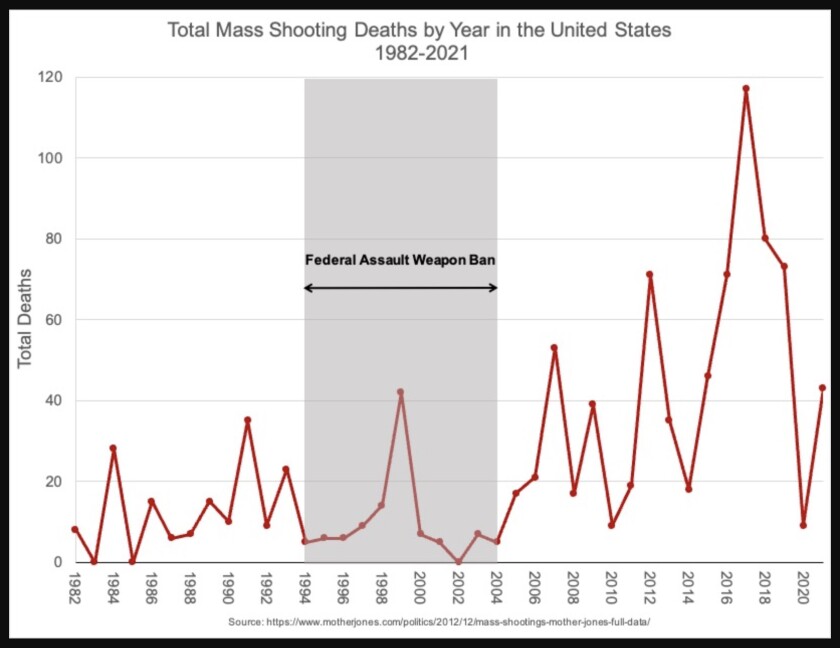
Since the federal ban on assault weapons expired in 2004, mass shootings with those weapons has climbed. An assault weapon was used in the Uvalde massacre of May 24. (Mother Jones)
That changed in 2008, with the Supreme Court’s ruling in the so-called Heller case overturning the District of Columbia’s ban on possession of handguns in the home. Since then, the impression has grown — fostered by the National Rifle Assn. and other elements of the gun lobby — that Heller rendered virtually any gun regulation unconstitutional.
But Justice Antonin Scalia’s 5-4 majority opinion said nothing of the kind. Indeed, Scalia explicitly disavowed such an interpretation. “The right secured by the Second Amendment is not unlimited,” he wrote. The Constitution does not confer “a right to keep and carry any weapon whatsoever in any manner whatsoever and for whatever purpose.”
There was, and is, no constitutional prohibition against laws prohibiting the carrying of concealed weapons, he found. Nothing in his ruling, he wrote, should “cast doubt on longstanding prohibitions on the possession of firearms by felons and the mentally ill, or … the carrying of firearms in sensitive places such as schools and government buildings,” or conditions on gun sales.
The problem with the D.C. law, Scalia wrote, was that it went too far by reaching into the home and covering handguns, which were popular weapons of defense in the home. “The Constitution leaves the District of Columbia a variety of tools” for regulating handguns, as well as other firearms, he wrote.
The federal assault weapons ban, which was enacted in 1994 and expired in 2004, repeatedly came under attack in federal courts, and prevailed in every case. Not a single one of those challenges was based on the 2nd Amendment. Since the expiration of the ban, mass shooting deaths in the United States have climbed steadily.
“Heller has been misused in important policy debates about our nation’s gun laws,” wrote former Supreme Court clerks Kate Shaw and John Bash in a recent op-ed. “Most of the obstacles to gun regulations are political and policy based, not legal.” Shaw and Bash worked on the Heller decision as clerks to Scalia and John Paul Stevens, the author of the leading dissent to the ruling, respectively.
So let’s discard the myth that gun control laws are unconstitutional.
The NRA
By any conventional accounting, the NRA is a shadow of its former self. Its leadership has been racked with internal dissension, its resources have been shrinking and it has faced a serious legal assault by New York state. Attendance at its annual convention last week in Houston drew only a few thousand members, even with former President Trump on hand to speak.
Yet the organization still carries major political weight. To some extent that’s an artifact of its political spending. Even in its straitened circumstances it’s a major political contributor, having handed out more than $29 million in the 2020 election cycle. Some of the politicians taking resolute pro-gun stands are beneficiaries of this largess, mouthing “thoughts and prayers” for the victims of gun massacres while pocketing millions from the NRA.
The NRA also has played a lasting role in blocking funds for research into gun violenceby federal agencies such as the Centers for Disease Control and Prevention, an obstacle that remained in place for some two decades until Congress restored funding in 2019. But the gap in research still hampers gun policymaking. It’s long since time to curb this organization’s blood-soaked influence on our politics.
Debate? What debate?
Part of the knee-jerk news coverage of the aftermath of gun massacres is the notion that the American public is deeply divided over gun regulations. This is a corollary of the traditional claim that American society is “polarized,” which I showed last year to be absolutely false. The truth is that large majorities of Americans favor abortion rights, more COVID-related restrictions and, yes, gun regulations.
More than 80% of Americans favor instituting universal background checks on gun buyers and barring people with mental illness from owning guns, according to a Pew Research Center poll. More than 60% favor banning assault weapons and high-capacity ammo magazines.
The poll was taken last September; it’s a reasonable bet that the majorities would be larger now. To put it another way, the “debate” is over — most Americans want to bring gun sales and ownership under greater control.
Gun regulations work
One claim popular among pro-gun politicians is that gun regulations don’t serve to quell gun violence. (A common version of this trope is that proposed regulations wouldn’t have stopped the latest newsworthy massacre.)
This is a lie, as statistics from the CDC show. States with stricter gun laws have much lower rates of firearm deaths than those with lax laws. The first category includes California (8.4 deaths per 100,000 population) and Massachusetts (3.7). The second group includes Louisiana (26.3) and Texas (14.2, and the highest total gun-related mortality in the country, at 4,164 in 2020).
Texas even loosened its gun regulations just months before the Uvalde massacre. When Missouri repealed its permit regulations for gun ownership in 2007, gun-related homicides jumped by 25% and gun-related suicides by more than 16.1%. When Connecticut enacted a licensing law in 1995, its firearm homicide rate declined by 40% and firearm suicides by 15.4%.
Make them vote
Perhaps the most inexplicable argument justifying congressional inaction over gun laws is that tough laws have no chance of passage, so it’s pointless even to try. Defeatism in the face of urgent need is inexcusable.
The resistance of Republicans to voting for gun laws is precisely the very best reason for bringing those bills to the floor. There’s no reason to give Republican obstructionists a free pass — make them stand up and take a vote.
Make them explain what it is about making Americans safer in schools and workplaces that they find objectionable, and why they think that voting against measures supported by 80% of the public is proper. Bring the fight to them, and show voters the character of the people they’ve placed in high office.
Show the pictures
Americans have become inured to gun violence in part because our culture minimizes its horrors. We’re awash in the most visceral depictions of shootings in movies and television, but at their core those depictions are unthreatening — indeed, in most cases they’re meant for entertainment.
Even our news programs revel in gore — the classic dictum of local news broadcasting has long been “If it bleeds, it leads.”
These conditions have inoculated us against the horror of firearm injuries as they occur in real life — especially those caused by assault weapons such as the AR-15. There’s a big difference between hearing the words “gunshot wound” and learning what actually happens to the organs of victims of AR-15 assaults. They don’t look anything like what we see on TV, and we need to have a true, visceral sense of the difference.
“These weapons are often employed on the battlefield to exact the maximum amount of damage possible with the strike of each bullet,” radiologist Laveil M. Allen wrote last week for the Brookings Institution. “Witnessing their devastating impact on unsuspecting school children, grocery shoppers, and churchgoers is unfathomable. The level of destruction, disfigurement, and disregard for life that a high-powered assault rifle inflicts on the human body cannot be understated. Placed into perspective, many of the tiny Uvalde victims’ bodies were so tattered and dismembered from their ballistic injuries, DNA matching was required for identification because physical/visual identification was not possible.”
You’ll hear the argument that showing photographs of real victims or the scenes of massacres will only be more traumatizing. For some people, including the victims’ families, that may be true. But that only underscores my point — we have not been sufficiently traumatized, and the creation of a truly effective mass movement for gun laws requires that we be traumatized.
Because we experience the horror of gun massacres at a remove, they tend to drift out of public consciousness in a distressingly short time span. Even after the Sandy Hook killings, which took the lives of 20 children ages 6 and 7 less than 10 years ago, there was something distancing about reportage of the event. Photos of some of the murdered children have been made public, but they are photos from life, showing the children smiling at birthday parties or gamboling about the playground.
Let’s face it — few Americans were thinking about the Sandy Hook killings until May 24, when the Uvalde massacre brought them bubbling back to public consciousness. Would our reaction be different had we seen photographs of classrooms slathered in blood, of children’s bodies ripped to pieces by Adam Lanza’s assault rifle?
You bet it would. Those images would not easily be forgotten. Every time a GOP senator or representative stood up to declare that the right to own assault weapons trumped the right of those children to live their lives, someone should have produced one of those photographs and said, “Justify this.”
Our risk is that Uvalde will be just another Sandy Hook. Soon to move off the front burner, or soon buried under the choruses of “We can’t pass this” or “This won’t work” or “This is the path we’ve chosen.” We need to change the terms of discussion, or Uvalde will just be the latest massacre of a long line, not the last massacre of its kind.
In the run-up to the 2022 primaries and election, they made a big show of “protecting the children.”
They obsessed about the danger of transgender children, even insisting on criminalizing parents’ efforts to get medical help for their children. They obsessed about teachers allegedly “grooming” children for lives of deviant sexual behavior. They obsessed about “obscene” books that might normalize sexual behavior they—these men of high righteousness— deplored. They obsessed about “critical race theory” and demanded the banning of books that taught children about racism, whether past or present, or anything about human sexuality.
Yes, the children of Texas would be protected from any teaching about race or sexuality.
But they would not be physically protected. They would not be protected from an 18-year-old with two AR15s.
When the bad man with a powerful weapon came into their classroom, the children were left to fend for themselves while 19 police officers stood in the hallway. The bad man killed their teachers. He killed children. Little girls called 911 and begged for help. One said 8 or 9 children were still alive. But the police remained in the hallway.
The parents in the schoolyard pleaded with the police to save their children, but the police had their instructions: keep the parents away.
Almost an hour passed before the police broke into the classroom and shot the murderer.
The Governor called a press conference , where he commended the police for their courage and bravery. He commended the men who waited in the hallway for almost an hour, while the children were dying, one after another.
Hooks writes:
Texas, a friend used to say, is hard on women and little things. That would come to mind over the years when reporting seemed to bear it out. In 2015, I watched a foster mother testify in court, via telephone from her daughter’s hospital bedside, that state cuts to the Medicaid acute therapy program were having disastrous consequences for her child’s incurable, debilitating genetic disorder. In 2021, an eleven-year-old boy in Conroe suffocated from carbon monoxide poisoning after seeing snow for the first time, as his family tried to keep their home warm after the collapse of a horribly mismanaged electrical grid. And then there were the perennial horror stories from the state’s spike-pit child welfare system—a three-year-old found dead, bleeding from the ears, after his day care repeatedly warned state agents about signs of abuse by his foster parents; a teenage girl who killed herself the moment she could despite orders that she was never to be left alone; and countless others who survive through the heavy prescription of psychotropic meds before being kicked out to the streets at the age of eighteen.
Each revelation of new misery brings a new wave of revulsion, but—I hate to say this—as you learn more about how the social safety net works in Texas, the revulsion starts to fade, and it becomes a dull undercurrent to an awareness of the world instead of something sharp that pokes through. As it fades, so comes the realization that it has faded in the same way for those in power—and that nothing gets fixed because leaders have been immunized from caring to an even greater degree. The grid remains unsteady; children in foster care still get abused. Legislators make a show of passing partial, temporary fixes and resist looking at problems head-on. The Texas Legislature, with all its self-regard and jocularity and pride in itself as an institution, turns out to be suffused with a very dull and banal kind of evil.
On Tuesday, though, something poked through. For me, it wasn’t the knowledge that there had been another school shooting. Who could be surprised by that? Every detail was familiar. A once-bullied eighteen-year-old, two AR-15s, 22 dead, and 19 injured. The thing that shocked was the pictures of the dead when they lived. They were so little! Do you remember what it was like to have a body that small? A round fired by an AR-15 at close range enters the human body at three times the speed as those fired by a handgun, disintegrating and liquefying bones and organs around it. “It’s like a grenade goes off in there,” one trauma surgeon told Wired. Parents had to submit DNA samples so their kids could be accurately identified.
This spectacular violence, it sometimes feels, has not left much of us. At his initial press conference, Governor Greg Abbott wore his traditional white disaster-response shirt and offered details of the massacre as if reading a weather report. At a press conference the next day, where the governor sat alongside Texas senator Ted Cruz and Lieutenant Governor Dan Patrick, Abbott told Texans that the disaster “could have been worse,” and the primary flash of anger shown by elected officials came when Beto O’Rourke, who appeared in the crowd, tried to talk over them.
Appearing on Newsmax TV the day of the shooting, state attorney general Ken Paxton suggested that more armed guards at schools would help, “because it’s not going to be the last time.” Can you believe that, as a response from one of the most powerful elected officials in the state to a massacre of fourth graders? “It’s not going to be the last time.” There used to be at least a perfunctory mourning period, some hugs given in front of cameras, before those in power turned to one another other and shrugged. But in truth, leaders are only handling this the way they think about the foster care system they oversee, and every other death trap run by the state. The revulsion dulls, the novelty fades, and it becomes normal.
The shooting took place on the day of the Texas primary runoff. The composition of the Legislature and the rest of state government for the next two and a half years was set that night, barring extraordinary circumstances, by the conclusion of the Republican primary, which in Texas is more influential than the general election. Paxton, who had shrugged off the Uvalde shooting on Newsmax while wearing a campaign T-shirt, won renomination and almost certainly a third term in office.
It is a grotesque and cruel irony that the Republican primary this year, and several years of political activity before it, have been dominated by an all-consuming and comically misdirected argument about the “protection” of children and by a war on public schools. There was essentially no policy contested in the GOP primary that could affect the practical and economic circumstances of all Texans. (There rarely is.) There was, however, ceaseless argument about the well-being of children, their morals, their internal lives.
The most acute panic was over transgender children. In February, Paxton’s office issued a formal opinion holding that the prescription of puberty blockers to transgender children represented “child abuse.” Shortly after, Abbott tasked the Texas Department of Family and Protective Services, an overworked and underfunded agency he had overseen for close to eight years, with investigating the families of transgender children for child abuse.
The more widespread crisis concerned books. The panic was conjured by parents and elected officials in equal measure. The first target was books with “divisive” material about race. Then, elected officials began to panicabout “pornography” in schools, a category that mostly included literature featuring queer characters and sexuality. Lawmakers proposed lists of books to be banned. In November, Abbott ordered the Texas Education Agency to investigate cases of “obscene material” in public schools and prosecute those responsible “to the fullest extent of the law,” because, as he wrote, it had to be a top priority to “protect” Texas students.
Public school teachers and children’s librarians—two professions that offer a strongly beneficial service to society for little pay—became villains for parents and candidates alike. They were called “groomers” and pedophiles on social media. In a press release, Abbott called for criminal charges to be brought if librarians were found to have put “pornography” in front of children. In Granbury, southwest of Fort Worth, half a year later, one woman lodged a criminal complaint against the librarians of Hood County ISD, prompting a police investigation. At a subsequent school board meeting, she condemned the fact that a committee brought together to review troublesome books had “too many” librarians instead of “people with good moral standards.”
The deterioration spread. A record number of public school teachers, already weary from the pandemic and now faced with a sort of siege, started quitting en masse—and forfeiting their licenses, indicating they probably wouldn’t come back. “I’m tired of getting punched. It shouldn’t be like this,” ninth grade math teacher Gloria Ogboaloh told Texas Monthly. As more teachers left, the quality of life for remaining educators got worse. Then, just four months after ordering that libraries be investigated, Abbott ordered the TEA to create a task force to investigate why so many teachers were quitting.
Hooks goes on to describe politicians who are liars, braggarts, cruel, indifferent to the safety of children, callous. How long can they continue to fool people with their charade and their fake concern? They don’t care about thechildren
Denis Smith retired from the Ohio Department of Education, where he worked in the charter school office and saw fraud after fraud. Ohio’s charter schools (which the state calls “community schools,” which they are not) are unusually low-performing; a large number are failing schools.
At its May meeting, the State Board of Education voted to employ Steve Dackin as Ohio’s new Superintendent of Public Instruction. But the hiring of the veteran school administrator has raised some concerns that require further reflection.
The state board’s decision occurred in the middle of National Charter Schools Week and prompted questions about the processes used in the appointment and the search that led up to the board’s action.
To those familiar with the behavior of some charter school boards, where the members are usually hand-picked by the school’s operating company and where tales of conflicts of interest and self-dealing are legion, the state board’s action will need to be more closely examined lest it acquire the same reputation of so many conflicted charter school boards.
In covering the search process and appointment of a new state superintendent of schools, the Cleveland Plain Dealer summarized the situation succinctly:
“Steve Dackin was vice president of the State Board of Education and led the search for a vacant superintendent position before resigning and applying for the job three days later. The deadline to apply was the following day.”
You don’t have to read that Plain Dealer paragraph again to realize there was something wrong in the practices of a state board that allowed a board member to conduct the search for a superintendent, resign so that he could apply at the deadline for the position, add his resume to those already received from other candidates, and then months later be hired for the very position he oversaw as vice president of the board and head of the search committee that was charged with filling the position.
If a public board is concerned about optics, its actions might demonstrate that in addition to suffering from myopia, it’s also tone deaf as shown by its hiring of the new state superintendent.
Catherine Turcer, who directs Common Cause Ohio, an organization which promotes “transparency and accountability in government,” also examined the process that led up to Dackin’s candidacy and had concerns.
“The thing that’s important about this is that we have as much transparency as possible so that we can understand what happened and whether he was attempting to get himself the job inappropriately,” she said. “Right now, we have a lot of questions and things look odd. It’s not enough to do the pro forma, ‘I put my resignation in before I applied.’ You dotted one ‘i’ but what about all the ‘t’s?’ she told the Plain Dealer.
The appointment of a new state superintendent during National Charter Schools Week drew praise from the state charter school lobby, including kind words from the Thomas B. Fordham Institute, an organization that promotes these publicly funded, privately operated, underregulated entities and, like the schools it promotes, is conflicted in its purposes. That makes Fordham a comfortable and perfect fit in the midst of charter world.
The conflict that is Fordham was described last year in the Ohio Capital Journal. Fordham serves simultaneously as a charter school authorizer, promoter, and so-called “think tank,” crafting studies that unsurprisingly promote public school privatization, which it calls school choice. But with all of its “think tank” research, apparently Fordham hasn’t studied one of the major design flaws in charter schools.
That flaw doesn’t allow the democratic election of board members by qualified voters in a community. Instead, in many instances we have seen self-dealing by hand-picked board members, conflicts-of-interest by operators, and all of the ethical issues that surround organizations that are not fully transparent in their operations.
The most classic example of this was seen several years ago, where the chairman of a charter school board was also a part-owner of the company which owned the building where the school was located. The school made an overpayment of $478,000 to the company without any board approval. A number of individuals associated with the charter school were indicted, including the school founder, his wife and brother, the board chairman and school treasurer.
Which brings us back to the recent action of the State Board of Education in choosing a new state superintendent.
Because of a history of scandal in the state charter school industry, where more than $1 billion in public funds alone went to ECOT in the largest online charter school scandal in the country, and where the wreckage of more than 300 closed Ohio charters have further depleted the state treasury due to lax oversight caused by few controls, the State Board of Education itself should not be acting like a challenged and conflicted charter school board with few rules, policies, or any sense of institutional memory.
Moreover, the enthusiasm for Dackin’s appointment expressed by the charter school industry and the Fordham Institute should also raise even more concerns.
As someone who has experience in providing oversight of charter schools as well as service on non-profit boards, it is my view that the processes used in the Dackin appointment are troublesome. For example, some boards have policies that require at least a one-year separation by a board member before applying for employment with the organization. Such a board policy protects an organization and lessens the possibility of a conflict or self-dealing situation by any member.
And what about the State Board of Education? Why isn’t there policy which prohibits the employment of a former board member for an extended period of time after separation from the board? For that matter, are there any state boards that have a “time-out” policy before a board or advisory committee member seeks employment?
The Ohio Ethics Commission and its three-page review of the situation before the state board’s hiring of the new superintendent was, to put it mildly, inadequate for the circumstances in the Dackin situation. The appearance of a conflict of interest or any ethical question related to actions that employ past board members recently separated from a public board should be a serious issue.
There is no doubt that the State Board of Education can do better at policy formulation and practice. So too can the Ohio Ethics Commission, which should start a discussion about strengthening its guidelines to go beyond minimalist interpretations of statute and offer more robust models to boards and public agencies that promote greater transparency and accountability.
After all, a state public board by its actions should not mimic charter school boards that love to receive public money but hate regulation.
A video was posted on Facebook showing Uvalde parents pleading with police officers in the school grounds to enter the school and stop the shooting. Some wanted to charge into the building on their own. They yelled, they cursed, pleaded, to no avail. The response from the officer they encountered was to push them back. The video is posted on this article in The Washington Post. It will undoubtedly be all over the other news sites soon. (I’m not on FB.)
The police seemed to have no plan. They sat in their patrol cars, waiting for instructions.
As more and more law officers arrived—local, state, and federal—their confusion about what to do and who was in charge must have grown intense.
There was one evil guy with an AR15 and (as the saying goes among gun advocates) more than 100 good guys who had weapons, maybe even their own AR15s. Without action, their presence was not enough to save the 21 souls in the classroom the evil one entered. No one even tried to save them. The decision was made by someone to isolate the classroom instead of entering it.
This is not a time to take pride or offer congratulations on a fast response. This is a time for grief and shame. Grief for those who died at the hands of a heartless killer. Shame for the officials who failed to develop action plans to save those in danger.
Reader Christine Langhoff sent a warning that the Massachusetts Department of Elementary and Secondary Education is poised to take control of the Boston Public Schools. This would be a mistake. No state takeover has ever led to better education. The state is not wiser than the city. If anything, the state education department is far removed from daily practice, as it is simply another bureaucracy. The current board is dominated by advocates of choice. Apparently they are unaware that the root cause of low test scores is poverty. The best the board could do would be to reduce class sizes and to promote the creation of community schools, which makes the school the hub of valuable services for children and families. Such proven strategies are unfamiliar to choice advocates. They prefer a failed approach.
Christine Langhoff wrote:
It seems that MA DESE is poised to place Boston’s public schools under receivership, perhaps by a vote as soon as May 24. Doing so would fulfill the Waltons’ wet dream which has been frustrated since the defeat of ballot Question 2 in 2016, which would have eliminated the charter cap.
The board is appointed by Governor Charlie Baker, whose donors are, of course, the Waltons and the Kochs. Four members of the board have day jobs tied to the Waltons: Amanda Fernández, Latinos for Education; Martin West, Education Next; Paymon Rouhanifard, Propel America; and Jim Peyser, New Schools Venture Fund and the Pioneer Institute. Baker is a lame duck, which may explain the haste to pull this off.
No state takeover has yet been successful, and once a system enters receivership, there is no exit. BESE has pointed to low MCAS scores to say our schools are failures, but Boston’s scores, invalid as they may be during the covid pandemic, are higher that in the three districts the state runs: Lawrence, Holyoke and Southbridge.
The Boston Teachers Union has an action letter if anyone is so inclined to support public education in the city where it originated:


/https://static.texastribune.org/media/files/0b22ff1684446eb4bb16e79b520a32f4/Crosses%20Memorial%20KGB%20TT%2001.jpg)

 Diane Ravitch's blog