Earlier this year, Florida Governor announced the creation of an “election police” unit, to arrest former felons who voted illegally. The unit arrested 20 people. A Miami judge just dismissed the case against one of them, the third consecutive loss on this count.
A Miami judge has tossed out another voter fraud case brought by Gov. Ron DeSantis’ elections police, the third case to fall apart since the governor announced the arrests.
On Wednesday, Circuit Judge Laura Anne Stuzin reached the same conclusion as another Miami judge did in a different voter’s case, saying that statewide prosecutors didn’t have the ability to bring charges against Ronald Lee Miller.
Because he was convicted of second-degree murder in 1990, Miller, 58, was ineligible to vote. But after his voter registration application was cleared by the Florida Department of State, Miami-Dade’s supervisor of elections issued him a voter ID card, and he voted in November 2020.
Florida’s voting laws are ‘broken,’ felon advocates say following fraud arrests DeSantis held a high-profile news conference in August to tout the arrests of Miller and 19 others who were all ineligible to vote because of past murder or felony sex offense convictions but who had all voted after applying for and receiving voter ID cards. DeSantis oversees the Department of State.
Josh Cowen has demonstrated repeatedly that vouchers are a very bad public investment. The students who use vouchers fall behind their peers in public schools. He has cited the research behind his conclusions. He maintains that facts and evidence matter. But many state officials don’t know the facts or just want to assuage the people who want the state to subsidize their private school tuition.
One elected official who should look at the facts and the evidence is Josh Shapiro, who was recently elected to be governor of Pennsylvania. During his campaign, he expressed support for a voucher program because it would provide “opportunity” for some students.
Josh Cowen says the evidence is clear: Vouchers do not help students. They hurt.
He wrote:
Josh Shapiro — like Katie Hobbs in Arizona and Gretchen Whitmer in Michigan — is part of a class of Democratic candidates who this month won the key to the governor’s office for the next four years.
As a professor of education policy, I was struck by how public schools became a prominent issue in each of their campaigns, especially the debate over school vouchers — the use of tax dollars to fund tuition for private schools.
Unlike Hobbs and Whitmer, however, Shapiro has expressed some cautious support for vouchers — including (at least in principle) the “Lifeline Scholarship” bills that have already been introduced by the current legislature.
And since it appears that a Democratic majority in the Pennsylvania House is razor-thin, and Republicans will keep the Senate, Shapiro may be pressured or even encouraged by some to move forward with that support.
The governor-elect has defended his position by saying, “It’s what I believe,” and that vouchers provide students with additional avenues to “help them achieve success.”
Unfortunately, the data show exactly the opposite.
I used to be a cautious supporter, too. But I’ve been studying school vouchers for 17 years now, and I can say, without reservation, that study after study show that vouchers hurt academic achievement for children. That is especially true of the low-income students who would be eligible under the currently proposed plans in Pennsylvania to which Shapiro gave qualified support.
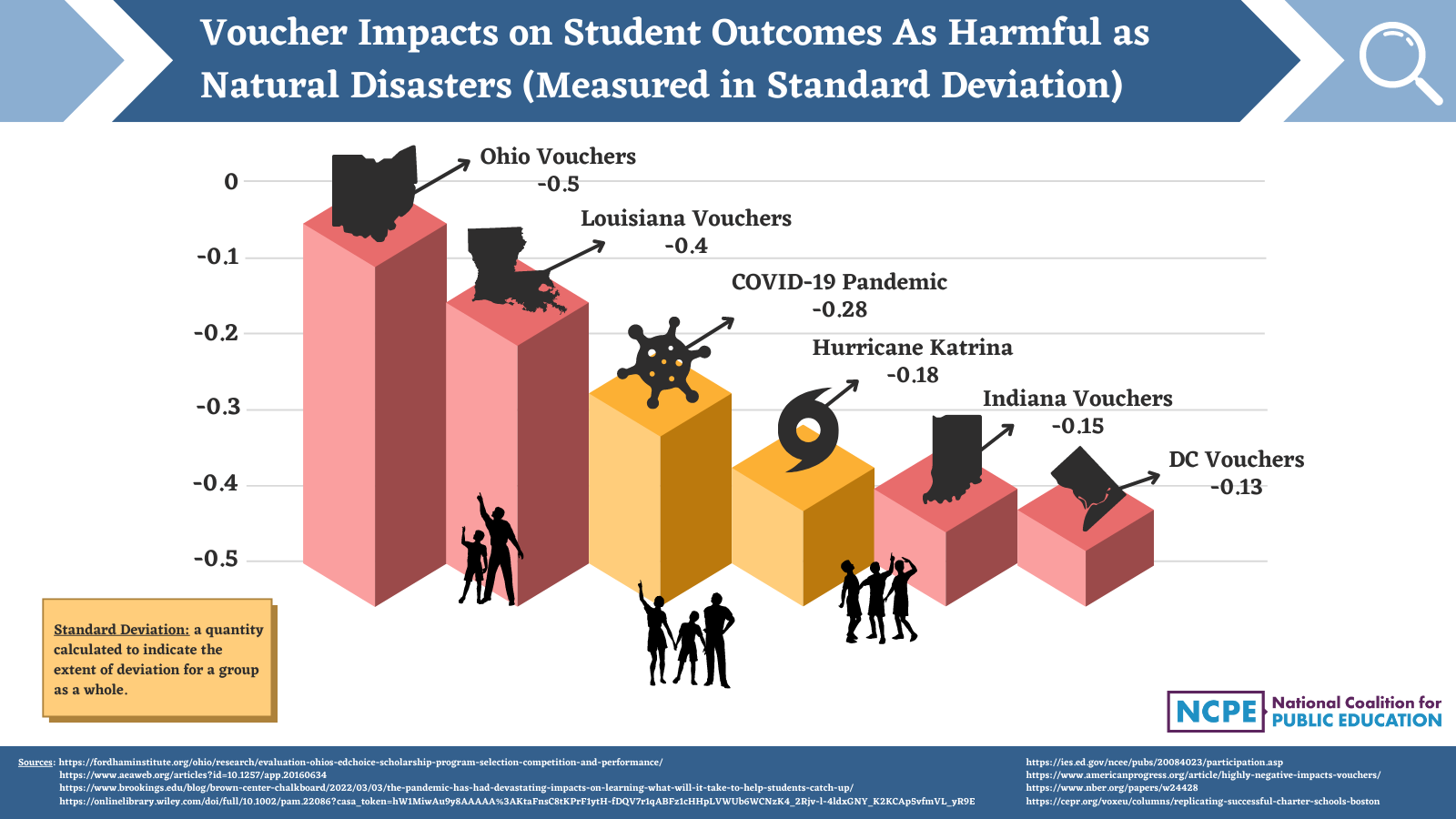
How bad are vouchers? Think about what the COVID-19 pandemic did to standardized test scores.
How bad are vouchers for students? Think about what the COVID-19 pandemic did to standardized test scores. Independent studies of voucher programs in Washington, D.C., Indiana, Louisiana, and Ohio have all shown catastrophic impacts on student achievement, with few-to-no offsetting gains on other measures such as educational attainment.
Some of the worst results have been found in Ohio, where voucher impacts on student learning were roughly twice the impact of the pandemic on academic outcomes.
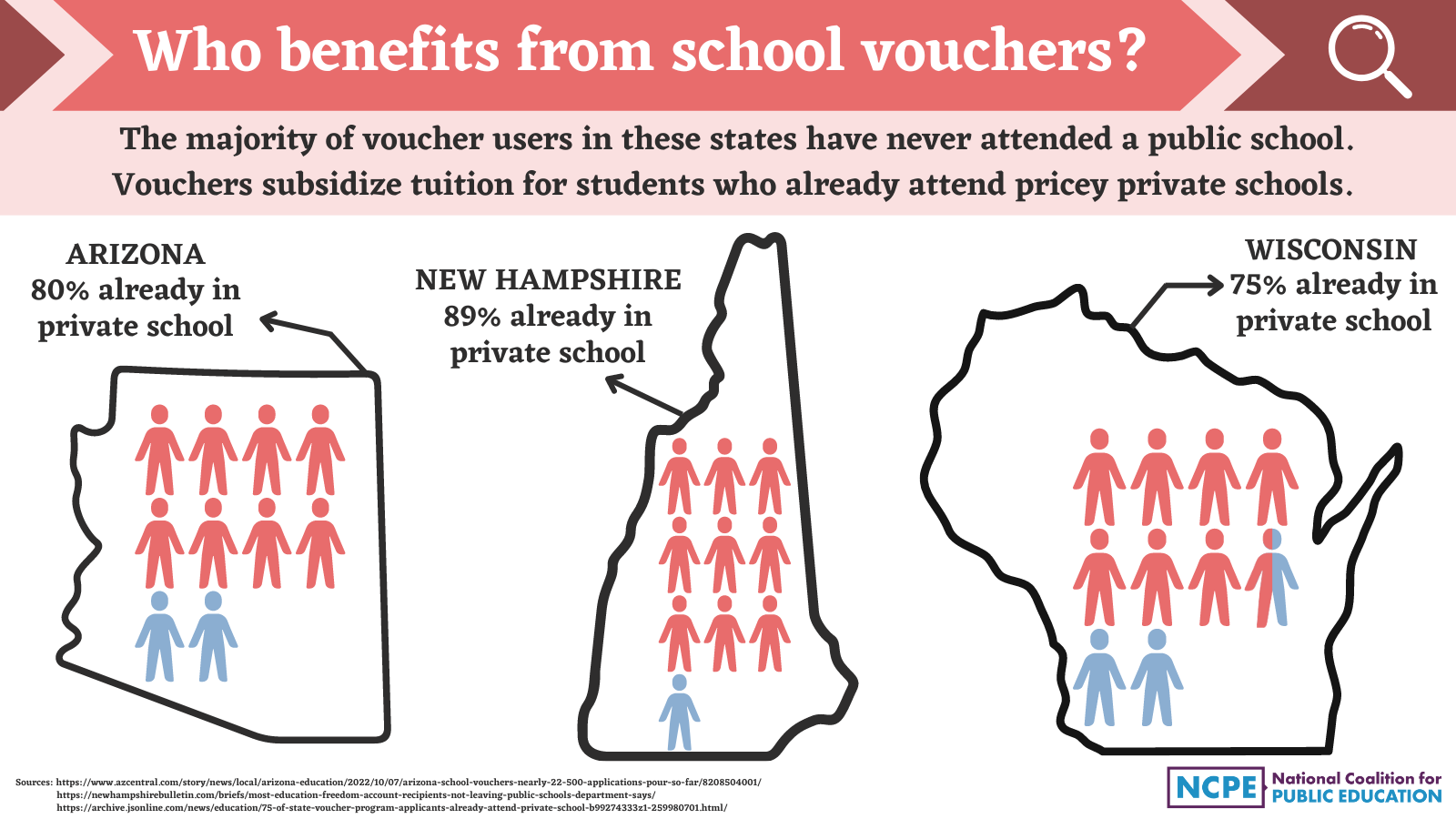
Here’s another problem: Vouchers mostly just provide tax breaks to families whose kids are already in private school. In places such as Arizona, New Hampshire, and Wisconsin, we know that more than 75% of voucher applicants were in private schools anyway by the time they applied for state funding. Even those in low-income families.
As a practical matter, that could be fixed in Pennsylvania by tying voucher eligibility to time in public school first, as well as capping the fiscal loss public districts faced when students transferred to private schools — as one current proposal has done. But that’s a short-term strategy.
Over the long term, vouchers simply represent new budgetary obligations for Pennsylvania taxpayers. The governor-elect has said he doesn’t view vouchers and support for public schools as a choice — that these positions are not a mutually exclusive “either/or.”
That’s a false hope. As the experience in other states shows, there is no way that long-term commitments to funding public schools can be reconciled with commitments to underwriting vouchers.
And unlike the devastating impacts that vouchers have on kids, we know that major investments in public schools have sustained and positive effects on learning and nonacademic outcomes, such as reductions in crime.
Side by side, the evidence says investments in public schools pay off, while investments in vouchers push kids further behind.
Perhaps the only remaining argument for vouchers is simply faith-based: that tax dollars should support religious education, even if the evidence says those programs harm academics. The U.S. Supreme Court essentially did just that this summer with its ruling in Carson v. Makin, which found that voucher programs could not exclude religious schools. That ruling was in line with the court’s long-held position that vouchers can exist constitutionally.
But just because we can doesn’t mean we should.
Looking from outside the state at the Pennsylvania gubernatorial campaign, it was refreshing to hear someone like Josh Shapiro stand up for something he says he believes in — even if it rankles some supporters.
But at some point belief has to give way to facts. And the facts from across the country say vouchers are more of an anchor than a lifeline for kids.
William Phillis, former deputy state superintendent of education in Ohio, is appalled by the waste and corruption in the charter sector. The state constitution requires a common school system, and charter schools and vouchers violate the state constitution. Ohio has had some of the biggest financial scandals in charter world (think ECOT), yet the Republican legislature continues to demand more funding for charters and vouchers. In this post, he likens charters to the one-room schools that were closed down long ago. He also notes that half of the 600 charters authorized in Ohio have closed.
William Phillis writes:
Charter Schools Conceptually and In Practice Are a Scourge on the Education Landscape In Ohio
Not all charter schools and their management companies are rife with fraud and corruption. Nor are all charters low-performing. Nor do all of them shortchange students to stack-up shameless profits. Nor do all of them practice nepotism in hiring, cherry-picking students, and closing without notice. However, the charter industry, as a whole, is rife with all of the above. Even if the charter industry would be free of all these negatives (and more), the concept and practice of chartering is wrong-headed.
The charter industry is inefficient within its own parameters and causes the whole of provisions for education to be inefficient. Historically the state has allocated between 34 to 45 percent of its General Revenue Fund (GRF) to K-12 education. Currently, about 40% of the state GRF is allocated to K-12 education.
Due to the demands of other state programs and services, the percentage of the state General Revenue Budget allocated to K-12 education will not likely increase substantially in the future.. Tax funds siphoned away from school districts for charters (and vouchers) duplicates facilities and programs which causes inefficient use of tax funds and reduces educational opportunities for students in both districts and charters.
Since 1900, the state forced school districts to consolidate to expand educational opportunities and to use tax dollars more efficiently. In 1900 there were about 3500 school districts. Ten thousand one room school buildings were in operation. Now there are 612 districts and no one room schools in operation. However, the state has issued more than 600 charters to private individuals, 300 or so of which have closed. Most charters serve less students than the school districts that the state forced to close. If smaller is finer, then why doesn’t the state force deconsolidation of school districts?
The smaller charter enrollments typically reduce breadth of programs and opportunities for students. The charters duplicate programs and services which exacerbates the inefficiencies. What are state officials thinking?
Charter schools are largely deregulated. For the sake of students and taxpayers there is no justification for a differential between public schools and charters in the matter of regulations. The original idea of chartering was that some teachers and parents would propose to a board of education that they would create innovative, creative programming and demonstrate better results in exchange for reduced regulations. As an industry, charters have been neither creative nor innovative. Nor has the charter industry outpaced traditional public schools in academic performance; however, reduced regulations have spawned fraud and corruption coupled with little or no accountability and transparency.
Charter schools have no constitutional basis.
The charter school experiment in Ohio has been rife with fraud and corruption and low performance. Billions in tax funding has been stolen and wasted. The experiment is a failure. There is no justification for this experiment to continue.
School board elections: Even though school board races are nonpartisan, the Nov. 8 elections for Round Rock and Wylie independent school sistrict trustees drew high-profile endorsements from the Republican Party of Texas.
But in both districts, every candidate endorsed by the Republican Party of Texas, a total of nine, lost. In Round Rock, the races weren’t even close, with one candidate, Tiffanie Harrison, beating her opponent by 25 percentage points.
While Texas Republicans largely swept Tuesday’s elections and GOP-backed school board trustees made gains elsewhere in the state, the results in Round Rock and Wylie raise questions about the current conservative strategy in suburban school districts and the appeal of an agenda built on culture war issues.
One of the primary targets for conservatives running for school board seats has been critical race theory, a college-level discipline that examines racism within social and legal structures within the United States. It is not taught in elementary or secondary public schools in Texas, but Republicans have used the term to target how students are taught about race in schools.
Republicans leaned on a strategy modeled after one used in Tarrant County, where in May, a slate of 11 conservative, anti-CRT candidates won races in school boards. But the GOP was unable to mimic the occurrence in the midterm elections cycle.
Jill Farris, a Round Rock school board candidate endorsed by the Texas GOP who lost her race, attributed the results to a changing electorate that is more liberal than in previous years.
“Maybe we were all kind of relying a little bit on this red wave and thought that parents were just as angry as we were,” Farris said. “At least now, we know where the community stands and we can move forward.”
This post is so important that it is the only one I have scheduled today. Please read it and share it with your friends, your local newspaper, your local radio station, your elected representatives, social media, anyone who cares about the future of our society. This is not a reprint. The author, Josh Cowen, wrote this post for this blog.
Josh Cowen, a professor at Michigan State University, has been studying vouchers for more than 20 years. He has been a member of the teams conducting major studies of vouchers. When I read his article in The Hechinger Report, where he declared that he was convinced that vouchers were disastrous for students who use them, I wanted to know more about him and his experience. I wanted to ask him, “Why did you change your mind?” That’s the question that’s been asked of me hundreds of times. I have a simple answer and a complicated answer: the simple answer is “I was wrong.” The complicated answer is contained in my recent books, starting with The Death and Life of the Great American School System: How Testing and Choice Are Undermining Education.
I invited Josh to explain his views for my blog, and he graciously accepted. I consider this piece to be one of the most important statements I have posted in the decade this blog has been live. Please note two points he makes:
One, vouchers harm the children who leave public schools to use them.
Two, most of the early voucher research was conducted by researchers who were partisan supporters of vouchers.
Josh Cowen writes:
It’ll be a few more days for the final election results to be tallied nationwide, but it seems clear that with midterm wins by voucher supporters in places like Oklahoma, Texas and even Pennsylvania—where even the Democratic gubernatorial victor is on record in cautious favor—voucher opponents are going to have to keep working hard to block public funding of private and religious schools.
School vouchers have devastating effects on student outcomes. Full stop. That’s something even the nation’s voucher advocate-in-chief Betsy DeVos has had to admit, because the data are so stark.
Large-scale independent studies in D.C.,Indiana, Louisiana, and Ohio show that for kids who left public schools, harmful voucher impacts actually meet or exceed what the pandemic did to test scores. That’s also a similar impact in Louisiana to what Hurricane Katrina did to student achievement back in 2005.
Think about that next time you hear a politician or activist claim we need taxpayer support for private schools to offset what the pandemic did to student learning. Here, their cure would in test score terms be quite literally worse than the disease.
There’s another data point you need to know up front: vouchers overwhelmingly fund children who were already in private school without them. In states that have released those numbers—Arizona, New Hampshire, and Wisconsin—we know more than 75% of voucher applicants came from private schools.
The bottom-line: most kids using vouchers didn’t need them to go to private school, and the few kids who actually did use vouchers to transfer sectors schools suffer average test score drops on par with what a once-in-a-generation pandemic did to test scores too.
If you’re a picture person, our friends at the National Coalition for Public Education were kind enough to put their considerable talents into two graphics based on these data I provided to them.
Notice the citations these graphs include. They’re the same as the hyperlinks above. These data come from independent sources and from non-partisan journalists. That’s a critically important part of this story.
And then there’s this, before we get into the details: the same people pushing vouchers are the same people working to undermine fair elections and the right to vote.
None of these are metaphors, and this is not a drill.
So how did we come to this?
1. A Quick History of Voucher Research
First let’s talk about the evidence.
I came into the school voucher research community early. It was around 2001 or so, as a young graduate student assistant for a study of privately funded vouchers led by the conservative professor Paul E. Peterson who was based at both Harvard and the conservative Hoover Institution at Stanford (never heard of Hoover? Think Condoleeza Rice.)
Peterson and his protégé Jay Greene had already done one study of Milwaukee’s publicly funded voucher program, as well as the one in Cleveland that was about to be the subject of the U.S. Supreme Court’s first favorable ruling on voucher funding. That work generally showed positive results for vouchers. As did the research of a young academic named Cecilia Rouse, who is now President Biden’s chief economist.
But they were small programs. What policymakers and researchers call a “pilot phase.” Back then when both parties cared at least nominally about evidence, you wouldn’t expand a program like vouchers without testing it. So those early tests seemed somewhat positive.
The first research I joined was Peterson and team’s next project: multi-site studies in Dayton, New York City, and Washington D.C. Those programs were also pilot-size. And the New York site in particular showed some limited evidence of voucher success. But overall the lead researchers focused as much on things like parental satisfaction and measures of civic engagement as metrics. That work resulted in a book called The Education Gap. You can find my name in the credits if you own a copy. If you don’t own one, don’t waste your money.
No one knew it at the time, but the mixed results documented in The Education Gap were to be the best vouchers were ever going to do—and ever have done since by an academic based team looking at voucher test scores.
Just a short time later in 2005, I joined a new voucher evaluation led by Patrick Wolf, another Peterson protégé and contributor to The Education Gap. Wolf was by then ensconced with Jay Greene at the University of Arkansas Department of Education Reform, a Walton Family-funded academic group that was about to train a new generation of voucher advocates. Most notably Corey DeAngelis, now at Betsy DeVos’s 501(c)4 voucher lobbying group American Federation for Children.
The Milwaukee evaluation, which was officially done for the state of Wisconsin, lasted from 2005-2010. We found no evidence in five years that voucher kids outperformed public school kids. Two exceptions: we found limited evidence that graduation rates and college enrollment were somewhat higher for the voucher kids. We also found that voucher kids improved when the state required private schools to participate in the same No Child Left Behind-style accountability systems as public schools. In particular once voucher schools knew their performance would be made public they—shockingly!—improved their outcomes.
At the same time as the Milwaukee evaluation, Patrick Wolf and other Arkansas colleagues were working on a new evaluation of Washington D.C.’s federally funded voucher program. That study showed no difference in test scores, but large positive graduate results.
That pattern of “no test score benefits, some attainment benefits” has stuck in the research narrative even among voucher skeptics. But as I recently explained in a piece for the Brookings Institution, it’s just that: a narrative. Other studies in New York, Louisiana and Florida all show no real advantages for vouchers on educational attainment.
And certainly nothing to offset the cataclysmic results that began to come out after the early-stage evaluations I just described. The newer D.C.,Indiana, Louisiana, and Ohio studies that took place after 2013 and have showed pandemic and Katrina-sized harm to student test scores are all of at-scale voucher programs.
What do I mean by “at scale?” I mean that despite limited evidence in those pilot programs, vouchers have been steadily expanding across the country, and within states. So those D.C., Indiana Louisiana and Ohio studies represent our best understanding to date of what happens when you expand vouchers beyond the initial test phase. The answer: horrific impacts on student outcomes.
There are a number of reasons this could be, but I tend to argue we need not overthink this. Vouchers just don’t work. The kids who stand to gain from private schooling were and are already there. For the vast majority of kids, they’re better off in public schools. That’s what the latest voucher research shows.
As an example of what I mean: consider that in Wisconsin (which has not had a statewide study since ours ended in 2010), 41% of voucher-receiving schools have opened and then closed and failed since public funding began in the early 1990s.
That’s what happens when policymakers divert tax dollars to private schools: it’s like venture capitalism for education. It’s like Theranos but for private schooling. New providers race to gobble up new taxpayer money, but most of them have no business near kids.
Now, to fully understand why these terrible policies exist and in fact have never spread faster and further than they are today, we need to understand the politics. And to understand the politics, we need to understand the money.
On the one hand it’s pretty simple. Once you understand that the same people pushing vouchers are the same people funding groups that insist Donald Trump won the election and are now organizing a similar “Big Lie” for 2022’s results, you understand a lot. But read on.
2. Funding Vouchers, Funding Election Lies
It’s difficult to tell how much money has been spent to advocate for school vouchers over the years. But we know perhaps the biggest single funder—perhaps even larger than Betsy DeVos herself—is the Lynde and Harry Bradley Foundation. The Bradley Foundation is a little-known group based in Wisconsin and they’ve given tens of millions of dollars to voucher activism over the years.
Bradley not only funds voucher activism, it funds voucher research too. It was a major funder of the Milwaukee evaluation I was part of and described above. I don’t think they directly influenced our results, but generally speaking you don’t want activism and research funding to mix. Think about it this way: should the Sackler family fund research on the addictive properties of oxycontin? Should Exxon fund studies about the existence of climate change?
For me though, the real problem today is that the Bradley Foundation is hardly limiting itself to supporting research and political advocacy for private schooling. As the New Yorker’s Jane Mayer has meticulously documented in her reporting on financing behind Big Lie activism sowing doubts about President Biden’s 2020 victory, the Bradley Foundation is the convening funder around those activities—the “extraordinary force”, in Mayer’s words, funding and coordinating the Big Lie and other efforts to undermine the integrity of democratic elections.
Bradley is not alone. The Heritage Foundation, a right-wing organization known for its pro-voucher advocacy is, according to Mayer, “working with the American Legislative Exchange Council (ALEC)—a corporate-funded nonprofit that generates model laws for state legislators—on ways to impose new voting restrictions.”
In recent months, Heritage has also distributed talking points that under the guise of objective research attack school diversity and inclusion and directly question health care support for LGBTQ children. Heritage has recently released a report-card style rubric rating state laws on a so-called “Education Freedom” index for tax-supported private tuition. That report card includes the extent to which issues like diversity or sexual preference are components of public school teaching curricula.
The author of each of these documents is a Heritage Senior Fellow named Jay P. Greene. The same Jay Greene who while a conservative scholar at the University of Arkansas was co-director of that Bradley-funded voucher project that hired me back in 2005.
Greene is not alone in the Heritage-Bradley nexus. Cleta Mitchell, a lawyer who participated in Donald Trump’s infamous phone call to the Georgia Secretary of State demanding evidence that would overturn the state’s election results, was actively training poll watchers to question voters leading up to the 2022 midterms in places like my own state of Michigan. The night before the election, the New York Times even ran a story about Mitchell’s work in Michigan. The headline read: “Fueled by Falsehoods, a Michigan Group is Ready to Challenge the Vote.”
Mitchell is a known elections conspiracy theorist, according to CNN, and figures prominently in Mayer’s New Yorker reporting on broader election-related organizing. In her spare time Mitchell is on the Board of Directors of—wait for it!—the Lynde and Harry Bradley Foundation. She’s actually an officer on the Board too.
Michigan is important because we have a voucher proposal waiting to go to the state legislature—even though voucher opponent Gretchen Whitmer has won reelection. That proposal, backed by billionaire and privatization advocate Betsy DeVos, exploits a quirk in the state law allowing lame-duck Republicans to pass the voucher plan without the governor’s signature.
The spokesman for the DeVos voucher campaign is a man named Fred Wszolek. Wszolek is also the strategist for a group that tried unsuccessfully to prevent abortion access from becoming enshrined in the Michigan state constitution. And he heads a political action committee (PAC) called Michigan Strong, which has worked to elect now-defeated DeVos-backed GOP gubernatorial candidate Tudor Dixon.
Also working for Dixon was Kyle Olson of the Education Action Group, an entity devoted to right-wing education reform that’s received money from Charles Koch, the DeVos Family and Harry Bradley—he of the Bradley Foundation.
That’s just one example, but you get the idea: the same people working to push school vouchers are the same people working to undermine elections. And in some cases even reproductive rights.
3. So Why Now?
I’ve spent the last six months writing column after column in opinion pages across the country trying to warn ordinary readers who aren’t education lifers about the dangers of vouchers. You can read samples here or here or here or here if you like. There are more than 10 in all.
Because of my long career working in the middle of all these voucher advocates and researchers, I’ve been asked multiple times what changed my mind. Or, more specifically, why am I speaking out today?
I hope the story I’ve told you above answers some of that. But the reality is, I was also doing other things. I had a young family, other research interests, and other professional tasks like editing the country’s premier education policy journal.
Most of all I had a naïve sense that the facts would speak for themselves. Remember, those pandemic-sized voucher failures began appearing back in 2013. I was an associate professor then, newly arrived at Michigan State University after receiving tenure at the University of Kentucky.
To me, after a decade of mixed-at-best results that I outlined here, I assumed that catastrophic results like those in Louisiana—and then confirmed in Indiana, Ohio, and D.C.—would have killed vouchers a thousand times over.
It’s sort of quaint now, that assumption of mine. In my research community, which is centered in the Association for Education Finance and Policy, we talk a lot about using evidence to inform policy. It’s a nice idea, but vouchers are the big, glaring and alarming counterpoint. We have never seen such one-sided, consistently negative research results as we have for school vouchers in the education research community.
And yet they thrive.
To me, the piece to that puzzle is politics. Negative voucher results aren’t the only thing to happen since 2013.
2016 happened. Donald Trump happened. January 6th happened. Dobbs v. Jackson happened.
Voucher advocates are overwhelmingly on one side of those events. And they’ve racked up some wins.
We know voucher programs exist today not for how they might help some kids, but for how they might exclude others. We know private schools taking public money can and often do discriminate against certain children. In Florida for example, one private school barring LGBTQ kids has received $1.6 million so far in taxpayer funding. In Indiana, more than $16 million has gone to schools refusing to admit LGBTQ kids—or even kids with LGBTQ parents!—or about 1 out of every 10 private schools on the taxpayer dime.
I wish I had come around earlier to the level of alarm I’m raising today. Others have even without having to take a kind of road to Damascus like I did.
I’m a tenured full professor now. I’ve had a successful career working hard to bring evidence to public policy. I firmly believe that school vouchers are a fundamental threat not just to student learning, but also to democracy and to human rights.
So on vouchers I’ve come to the same view any number of us would if we stumbled onto a massive fraud in our workplace, or if we saw a young child being bullied simply for being who they are. None of it is okay.
And if you see something, you have to say something.
Back in 2014, a prominent charter school leader in Connecticut resigned after it was revealed that he had been convicted of felonies many years earlier, and that he did not have a doctorate, although he claimed he did. Michael Sharpe resigned as CEO of Jumoke Academy, which ran charter schools in Connecticut and planned to expand to Louisiana.
Sharpe was part of a management organization called Family Urban Schools of Excellence or FUSE, created in 2012. The state had given millions of dollars to Jumoke to take over low-performing schools and turn them around.
The controversy over Sharpe was embarrassing to Democratic Governor Dannell Malloy, who was a cheerleader for charter schools. Malloy chose Stefan Pryor to be the State Commissioner of Education. Pryor had no experience in the classroom but was a co-founder of the no-excuses charter chain Achievement First. Charter schools in the state were allowed to have only 30% of their staff with state certification. The charter industry was strong in Connecticut due to the financial power of hedge funders and the Sackler Family (of opioid fame), which launched Conn-CAN, a charter advocacy group, which became the national 50CAN.
Sharpe was convicted of kidnapping and faces a sentence of 25-100 years in prison. The statute of limitations had expired on the sexual assault charges. Sharpe’s DNA was found at the four scenes. The case was solved by the state’s cold case unit.
Dr. Sharpe is president of the Connecticut Charter School Association and founding member of the Legacy Project and Family Urban Schools of Excellence (FUSE). He also sits on the boards of the National Charter School Leadership Council, St. Agnes Home, Inc., the CT Chapter of Lupus Foundation of America and Connecticut Landmarks.
Dr. Sharpe began work at Jumoke Academy in 1998 and was appointed its CEO in 2003. Under his leadership, Jumoke Academy’s middle and elementary schools were cited for three consecutive years as one of the top ten performing urban schools in the State of Connecticut.
Jumoke Academy is committed to developing the whole child, and as such, offers programs that ensure our children become competent in the arts, humanities, civic and social responsibilities, and that they understand the value and importance of good character.
In 2015, after Sharpe had resigned, civil rights attorney Wendy Lecker wrote about the strange trajectory of Jumoke Academy, FUSE, and Michael Sharpe.
Earlier this month, the Connecticut Department of Education quietly distributed a scathing investigative report on the Jumoke/FUSE charter chain, conducted by a law firm the department retained. The report reads like a manual on how to break every rule of running a non-profit organization.
The investigators found that although FUSE and Jumoke were supposed to be two separate, tax-exempt organizations, both were run by Michael Sharpe alone. FUSE, formed in 2012, never held board of directors’ meetings until after the public revelations in the spring of 2014 of Michael Sharpe’s felony record for embezzlement and falsification of his academic credentials. FUSE entered into contracts with the state to run two public schools without approval by its board. In fact, it is unclear that FUSE even had a board of directors then. Jumoke, too, played fast and loose with board meetings. Jumoke’s board gave Sharpe “unfettered control” over every aspect of the organization. Even after he left Jumoke for FUSE, Sharpe still ran Jumoke, leaving day-to-day operations to his nephew, an intern there.
Hiring and background checks were in Sharpe’s sole discretion. He placed ex-convicts in the two public schools run by Jumoke, Hartford’s Milner and Bridgeport’s Dunbar. Dunbar’s principal, brought in by Sharpe, was recently arraigned on charges of stealing more than $10,000 from the school.
Nepotism was “rampant.” Sharpe’s mother founded Jumoke. Sharpe moved from paraprofessional to CEO in 2003, with no additional training. His unqualified daughter and nephew were hired, as well as his sister.
The investigation found extreme comingling of funds and of financial and accounting activities, noting that it “would be difficult to construct a less appropriate financial arrangement between two supposedly separate organizations.”
Jumoke/FUSE used state money to engage in aggressive real estate acquisition, some not even for educational purposes, and some inexplicably purchased above its appraised value. Properties were collateral and/or were mortgaged for one another. Loan rates were excessive. To date, loans are guaranteed by FUSE, which is not operational.
Jumoke leased Sharpe part of a building who, violating the lease, sublet it and collected rent. Sharpe hired Jumoke’s facilities director’s husband to perform costly renovations on the parts of the building, his bedroom and bathroom, paid by Jumoke.
These are just some of the misdeeds that occurred without oversight by the State Board of Education or the State Department of Education. The board approved contracts to run two public schools without verifying that FUSE had no board of directors. It approved millions to be paid to FUSE/Jumoke to buy non-educational buildings, charge excessive consulting fees to public schools and engage in possibly fraudulent activities. Worse still, the board allowed Jumoke/FUSE to run Milner schoolinto the ground, jeopardizing the education of Milner’s vulnerable students.
“Dr. Sharpe’s” Linked-In profile has not been updated. It’s very impressive.
Jeanne Kaplan served two terms as an elected board member in Denver. She has watched the board’s frenIed embrace of “reform” with dismay. open the link and read the full article, which appears on her blog. I am not putting the post into italics since she uses italics.
She writes:
Reap what you sow and the chickens come home to roost. The elephant in the room. Aphorisms appropriate to describe what is happening in public education in Denver.
After 20 years, more than 5 superintendents, and 11 different school boards, the results of education reform in Denver have become clear, and they aren’t pretty. After opening 72 charters in the last 20 years, 22 of which have closed, the declining enrollments in neighborhood schools have forced the prospect of school closures. Who knew opening 26 privately run elementary charter schoolsin competition with district-run schools would ultimately force the district to make some hard financial decisions? And who knew that ignoring its own 2007 data showing stagnant population growth would lead to less demand for elementary school seats in the 2020s? Apparently, not those with the power for the last 20 years. And, as an ironic aside, many of the same people who were the decision-makers in the past and who were unable to make substantive change then, have now decided they will somehow make these previously unattainable changes from their outside “oversight” committee, EDUCATE Denver. In fact one of the co-chairs, Rosemary Rodriguez, was a DPS board member when on March 16, 2017, a Strengthening Neighborhoods Resolution passed, stating:
NOW, THEREFORE, BE IT RESOLVED, that a citywide committee be formed to review changing demographics and housing patterns in our city and the effect on our schools and to make recommendations on our policies around boundaries, choice, enrollment and academic programs in order to drive greater socio-economic integration in our schools.
BE IT FURTHER RESOLVED, that in the face of the sharp decline in the number of school-aged children in gentrifying neighborhoods, the committee is also charged with how to think about school choice and school consolidation to ensure that our schools are able to offer high-quality, sustainable programs for our kids.
These former school board members and former and current civic leaders have formed a “shadow school board” to evaluate and oversee the current superintendent and school board. Why? It appears they don’t like what they are seeing being proposed by the current superintendent. What don’t they like? It appears they have determined the current superintendent is not committed enough to their reform agenda. You know – the one that has been in place when they were in power, the one that has produced the biggest gaps in the nation, more segregation, and more resource inequity.
“Over the past 20 years, Denver Public Schools has added a lot of schools. It has added students, too — but at a much slower rate.
The number of public schools in Denver grew 55% between the 2001-02 and 2021-22 school years, while the number of students grew just 12%.
Denver went from having 132 schools serving about 72,000 students in 2001-02 to 204 schools serving nearly 89,000 students in 2021-22.
The number of elementary schools in Denver grew 23% over the past 20 years, while the number of students grew just 4%.”
Through expensive marketing and often false narratives, charter schools have had free reign to prey on susceptible families resulting in DPS losing 7400 elementary school students who would have otherwise most likely attended a neighborhood school. Then add in:
a state law that prohibits a district from shutting down low enrollment charters,
a district that has ignored demographic information predicting declining enrollment,
a district that employs “attendance zones” and a secretive CHOICE system to often force place students into heavily marketed, often unwanted CHARTER SCHOOLS, and
a competitive financial model called Student Based Budgeting (SBB – money follows the kid) to fund schools, depending on student needs, the goal of which is to close the achievement and resource gaps.
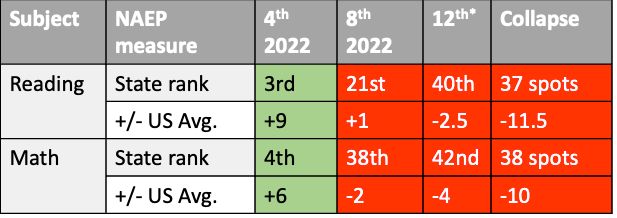
Billy Townsend, Florida blogger, has reported regularly on Florida’s gaming of NAEP scores. He writes here that Governor Ron DeSantis is carrying out Jeb Bush’s old trick to inflate 4th grade NAEP scores. He calls the governor Ron Jebsantis. The trick is third grade retention, which ensures that the lowest scoring third graders never take the fourth grade NAEP test (the kids who take the NAEP test are selected at random).
Thus, DeSantis put out a flashy press release celebrating fourth grade NAEP scores in the test scores recently released. But, as usual, DeSantis neglects to mention the collapse of eighth grade NAEP scores. Somehow the kids who were retained in third grade managed to skip fourth grade and rejoin their classmates by eighth grade.
Here are his numbers, drawn from NAEP reports:
With that in mind, here is a view of Florida’s 2022 NAEP scores peaking in elementary school and dramatically worsening with the older cohorts —- which is ALL of the red numbers after the green baseline.
I personally put no stock in the twelfth grade numbers (which Billy extrapolated) because NAEP stopped testing seniors a decade ago. Seniors know that NAEP doesn’t count and they don’t do their best. Some don’t even try. Their answer sheets had doodles, or some just picked the (A) answer to every question or some were blank.
But the stark drop from fourth grade to eighth grade says something’s fishy in Florida.
It is time for Democrats–voters and the politicians who represent them–to abandon charter schools as a strategy for education improvement or to advance equity. Charter schools, whether for- or non-profit, drain funds from public schools that serve all students, increase segregation, and by design only serve the few. Continuation of tax generated funds for charter schools, all of which are privately governed, support the current broader assault on democracy. That should not be the way forward for democracy loving Democrats. In addition, public support for private alternatives to public education suborns the lie that government cannot be the agency for solving problems.
The United States is tilting sharply toward, if not rushing headlong into, a less equitable, less democratic, more authoritarian, more racially divided, and meaner way of governing and living together. Out-for-youselfism is alarmingly rampant. Sadly, continued bipartisan state and federal support for charter schools that pit parents against one another for limited student slots reflects those tendencies.
We have been heading in that direction for decades, led by pro-wealth, anti-regulation billionaires and corporations allied with Christian religious extremists and ideological libertarians. Exacerbating extant racist, xenophobic, and misogynistic resentment is their core strategy. It is represented by a Republican Party whose only moral compass is power and for whom democracy is an expendable inconvenience.
Republican opposition to equity advances for all people, such as the National Labor Relations Act, Unemployment Insurance, Social Security, and Medicare, is nothing new. However, until the emergence of the Republican-light Democratic Leadership Council, there was a strong pro-government, pro-worker, if frequently inconsistent, opposition political party. In the absence of an explicit effort by Democrats to articulate a rationale for a multi-racial, working-class coalition, resentment flourished. Instead, many Democrats embraced deregulation and campaign cash, including contributions from the charter school industry.
This Republican-light Democratic shift could not have come at a worse time, as globalization and automation threatened the livelihood of many Americans, shaking the foundations of post-WWII perception of security, especially for many white working- and middle-class Americans. As scarcity and inequity came to be accepted as the unalterable norm, advances for some–left-out people of color, recent immigrants, and women–came to seen as coming at the expense of others. In that context, charter schools appealed social and economic insecurity.
Nonetheless, Democratic politicians from Bill Clinton to Barrack Obama embraced charter schools. The essential notion was that take-all-comers schools governed by locally elected school boards for the common good were an old-school failure. The supposed evidence was the failure to close the achievement gaps between kids from poor and well-off households. The fact that family socio-economic status explains most of the achievement gaps was ignored in favor of a blame-the-teacher and their unions ethos and test-driven blame. In supporting charter schools Democrats implicitly endorsed a competitive watch–out-for-my-own kid ethos. It is time for a new direction.
Even with substantial evidence of rampant corruption and increased segregation, national Democratic leadership has yet to fully abandon the belief in charter schools as an improvement strategy. In doing so, they abet the ongoing Republican claim that government and democracy are incapable of effective problem solving. Opposition to for-profit charter school and vouchers is insufficient. Increased oversight and rejection of for-profit charter schools is, of course, a positive step. However, the notion of schools as primarily a personal rather than a social benefit and that market-competition as an improvement driver remains intact.
Step away from charter schools, Democrats. Instead, embrace full equitable funding for all schools. Embrace professional salaries, respect, and working conditions for teachers. Embrace union protection. Embrace community schools to meet the needs of children and their families. Embrace small class size so every child can get the academic, social, and emotional supportthey need. Embrace schools to develop socially responsible citizens for a democratic equitable society.
That is the way forward for Democrats and Democracy!
The ever wise Jan Resseger points out that the Ohio House overwhelmingly voted 82-10 to end the policy of holding back third graders who don’t score proficient on the state reading test. Now, she hopes that the State Senate will complete the elimination of this disastrous experiment. The idea that children will become better readers if they are failed is nonsense. Years of experience and research shows that failure leads to negative consequences, causing a loss of confidence, a sense of failure and higher dropout rates in later years.
She writes:
Ohio’s Third Grade Guarantee, enacted by the legislature in 2012 and implemented beginning in the 2013-2014 school year, requires that students who do not score “proficient” on the state’s third grade reading test must be retained for another year in third grade. Brown reports that,”Ohio has retained around 3,628 students per year.”
Jeb Bush and his ExcelInEd Foundation have been dogged promoters of the Third Grade Guarantee, but last May, the Columbus Dispatch’s Anna Staver traced Ohio’s enthusiasm for the Third Grade Guarantee to the Annie E. Casey Foundation: “In 2010, the Annie E. Casey Foundation released a bombshell special report called ‘Early Warning! Why Reading by the End of Third Grade Matters.’ Students, it said, who don’t catch up by fourth grade are significantly more likely to stay behind, drop out and find themselves tangled in the criminal justice system. ‘The bottom line is that if we don’t get dramatically more children on track as proficient readers, the United States will lose a growing and essential proportion of its human capital to poverty… And the price will be paid not only by the individual children and families but by the entire country.’”
But it turns out that promoters of the Third-Grade Guarantee ignored other research showing that when students are held back—in any grade—they are more likely later to drop out of school before they graduate from high school. In 2004, writing for the Civil Rights Project, Lisa Abrams and Walt Haney reported: “Half a decade of research indicates that retaining or holding back students in grade bears little to no academic benefit and contributes to future academic failure by significantly increasing the likelihood that retained students will drop out of high school.” (Gary Orfield, ed., Dropouts in America, pp. 181-182)
Why does holding children back make them more likely to drop out later? In their book, 50 Myths & Lies That Threaten America’s Public Schools, David Berliner and Gene Glass explain the research of Kaoru Yamamoto on the emotional impact on children of being held back: “Retention simply does not solve the quite real problems that have been identified by teachers looking for a solution to a child’s immaturity or learning problems…Only two events were more distressing to them: the death of a parent and going blind.” Berliner and Glass continue: “Researchers have estimated that students who have repeated a grade once are 20-30% more likely to drop out of school than students of equal ability who were promoted along with their age mates. There is almost a 100% chance that students retained twice will drop out before completing high school.” (50 Myths & Lies That Threaten America’s Public Schools, pp. 9-97)
In a recent report examining the impact of Third-Grade Guarantee legislation across the states, Furman University’s Paul Thomas explainsthat short term gains in reading scores after students are held back are likely to fade out in subsequent years as students move into the upper elementary and middle school years. But, Thomas quotes the National Council of Teachers of English on how the lingering emotional scars from “flunking a grade” linger: “Grade retention, the practice of holding students back to repeat a grade, does more harm than good:
“retaining students who have not met proficiency levels with the intent of repeating instruction is punitive, socially inappropriate, and educationally ineffective;
“basing retention on high-stakes tests will disproportionately and negatively impact children of color, impoverished children, English Language Learners, and special needs students; and
“retaining students is strongly correlated with behavior problems and increased drop-out rates.”
Here is what Thomas recommends instead: “States must absolutely respond to valid concerns about reading achievement by parents and other advocates; however, the historical and current policies and reforms have continued to fail students and not to achieve goals of higher and earlier reading proficiency by students, especially the most vulnerable students who struggle to read.” Specifically, Thomas urges policymakers to eliminate: “high-stakes policies (retention) around a single grade (3rd) and create a more nuanced monitoring process around a range of grades (3rd-5th) based on a diverse body of evidence (testing, teacher assessments, parental input)…. Remove punitive policies that label students and create policies that empower teachers and parents to provide instruction and support based on individual student needs.”

 Diane Ravitch's blog