Multiple federal court decisions have frozen key portions of Ron DeSantis’ campaign against lesbian, gay, bisexual and transgender rights in recent weeks, complicating the Florida governor’s efforts to present himself as a conservative champion with a track record of winning cultural battles over LGBTQ causes.
DeSantis’ agenda has hit other roadblocks, with judges blocking portions of his plans to control teaching and training on gender identity in schools and workplaces. The governor also faces ongoing litigation over his efforts t0 ban transgender athletes from competing on sports teams of their declared gender and to restrict access to school books, including those with LGBTQ themes.
His pressure on private industry has faced challenges, as well, with Disney — one of the state’s largest employers — suing the governorclaiming he overstepped his power in taking punitive action against the company over its opposition to policies the company viewed as hostile to the LGBTQ community. DeSantis is pushing for the federal trial to start after the 2024 presidential election. In the meantime, Disney will host a major LGBTQ conferencein Florida this September that promotes diversity, equity and inclusion initiatives.
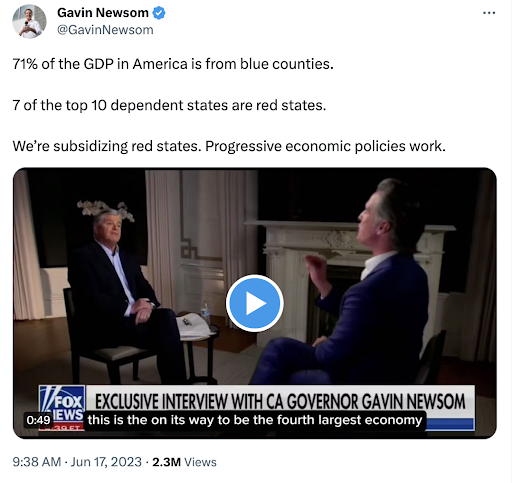
California Governor Gavin Newsom recently had a debate with FOX host Sean Hannity, where he schooled him on the issues.
Gavin just sent out this newsletter:
Dear Diane,
Want the truth? Here’s the truth:
But that is not all.
8 of the 10 states with the highest murder rates are red and gun deaths are almost 2x as high in red states.
The Supreme Court has stripped women of their liberty and let red states replace it with mandated birth.
They ban books, silence teachers and make it harder to vote in red states.
The reason Republicans like Ron DeSantis are fanning the flames of culture wars is to distract from the fact that Florida has higher murder rates, worse education and worse health care outcomes than states like California.
Nora de la Cour writes in Jacobin about the damage done to children by our politicians’ obsession with high-stakes standardized testing. They do not test what was taught; they encourage teaching to the tests; the results come back too late to be helpful; they distort teaching and learning.
Nora de la Cour writes:
When I taught at an alternative public school for kids with exceptional social-emotional, behavioral, and learning needs, one of my students — I’ll call him Dante — got As in every class he took. School staff would frequently elevate Dante’s extraordinary focus and commitment as an example for his peers.
In the spring of Dante’s senior year, his counselor informed him he’d earned the status of valedictorian. His beaming smile of pride after hearing the news affirmed everything I love about public education. When his mother found out, she burst into tears of joy.
Then, abruptly, we were informed that there had been a mistake. Because Dante’s exceptional learning needs made it impossible for him to pass the Massachusetts Comprehensive Assessment System (MCAS) — the standardized tests that Massachusetts requires high school students to pass prior to graduation — he would not receive a diploma. Without a diploma, he couldn’t be valedictorian — even though, according to his grades and the unanimous judgment of his teachers, he clearly deserved the honor. A wave of incredulity rippled through the staff as we tried to resign ourselves to this obviously cruel, unfair reality. For Dante, the news was devastating.
Even before the “giant federal wrecking ball” (to borrow leading education policy analyst Diane Ravitch’s phrasing) known as education reform, evidence from diverse fields had demonstrated a scientific concept known as Campbell’s Law: the more we base social decision-making on a specific quantitative measure, the more likely it is that that measure will become distorted, ultimately corrupting the processes it’s intended to monitor.
Just so, in the two decades since Congress reauthorized the 1965 Elementary and Secondary Education Act (ESEA) as George W. Bush’s No Child Left Behind Act (NCLB), researchers have collected a mountain of data showing that in the long run, attaching high-stakes, or punishments, to student standardized test scores does not improve educational outcomes. Instead, it results in a hostofperverseconsequences, with poor, minority, and disabled kids like Dante experiencing the greatest harms. This last point makes a lot of sense when you consider that standardized testing was first developed by eugenicists looking to organize people into racist taxonomies based on perceived ability.
But despite these serious problems — and the persistent, bipartisan unpopularity of the high-stakes testing regime inaugurated by NCLB — our current, Obama-era iteration of the ESEA (the Every Student Succeeds Act or ESSA) still requires states to impose inappropriate test-based accountability on students and school communities.
When we sort children into “proficient” and “failing” categories based on test scores, we’re not solving the opportunity gaps that show up in public education; we’re creating new ones. No one is helped, and many people are hurt, when we give students, teachers, and schools an impossible assignment and then sanction them for failing to complete it. Looking forward to the ESEA’s now overdue reauthorization, it’s high time we built accountability systems that nurture the humanity and potential of all kids — rather than placing artificial roadblocks in their way.
Please open the link and read the article in full. FYI, in addition to referring to NCLB as a “giant wrecking ball,” I have also called it the “Death Star of American education.” If left without modifications, it would have caused the closure of almost every school in the nation. No national legisislature ever passed such a dumb law.
If you read only one article today, read this one. It’s powerful and poignant. The article was written by Forrest Wilder and appears in the Texas Monthly, a terrific publication.
To understand why Republican legislators from rural districts helped to defeat vouchers in Texas, read this article about the schools of Fort Davis in Jeff Davis County in rural West Texas. The superintendent is a bedrock conservative who is dead set against vouchers. His schools are on the verge of bankruptcy due to the state’s Byzantine school-finance system. The state government doesn’t care. At the end, you will understand Governor Abbott’s long-term goal: to eliminate property taxes and completely privatize education.
Texas doesn’t have a mile-high city, but Fort Davis comes close at 4,892 feet. The tiny unincorporated town is nestled in the foothills of the Davis Mountains, where bears and mountain lions and elk stalk among pine-forested sky islands. Fort Davis is the seat of Jeff Davis County, whose population of 1,900 is spread among 2,265 square miles, 50 percent bigger than Rhode Island. The sparsely populated desert country of Mongolia has nearly seven times the population density of Jeff Davis County. Odessa, the nearest city to Fort Davis, is two and a half hours away. The state Capitol is six and a half.
For Graydon Hicks III, the far-flunged-ness of Fort Davis is part of its appeal. He likes the high and lonesome feel of his hometown—the “prettiest in Texas,” he says. But these days, it has never felt further from the state’s political center of gravity.
For years, Hicks, the superintendent of Fort Davis ISD, has been watching, helplessly, as a slow-motion disaster has unfolded, the result of a flawed and resource-starved public-school finance system. Over the last decade, funding for his little district, which serves just 184 K–12 students, has sagged even as costs, driven by inflation and ever-increasing state mandates, have soared. The math is stark. His austere budget has hovered around $3.1 million a year for the past six years. But the state’s notoriously complex school finance system only allows him to bring in about $2.5 million a year through property taxes.
Hicks has hacked away at all but the most essential elements of his budget. More than three-quarters of Fort Davis’s costs come in the form of payroll, and the starting salary for teachers is the state minimum, just $33,660 a year. There are no signing bonuses or stipends for additional teacher certifications. Fort Davis has no art teacher. No cafeteria. No librarian. No bus routes. The track team doesn’t have a track to train on.
But Hicks can’t cut his way out of this financial crisis. This school year, Fort Davis ISD has a $622,000 funding gap. To make up the difference, Hicks is tapping into savings. Doug Karr, a Lubbock school-finance consultant who reviewed the district’s finances, said Fort Davis ISD was “wore down to the nub and the nub’s all gone. And that pretty much describes small school districts.”
“I am squeezing every nickel and dime out of every budget item,” Hicks said. “I don’t have excess of anything.” When I joked that it sounded like he was holding things together with duct tape and baling wire, he didn’t laugh. He said: “I literally have baling wire holding some fences up, holding some doors up.”
The district’s crisis comes at a time when the state is flush with an unprecedented $33 billion budget surplus. Hicks is a self-described conservative, but he thinks the far right is trying to destroy public education. For years, the state has starved public schools of funding: Texas ranks forty-second in per-pupil spending. And yet Governor Greg Abbott is spending enormous political capital on promoting a school voucher plan, which would divert taxpayer funds to private schools. Public education, Abbott has repeatedly said, will remain “fully funded,” though public-education spending is lower now than when he took office in 2015, and the Legislature recently passed a $321.3 billion budget with no pay raise for teachers and very little new funding for schools. Unable to get his voucher plan through the regular legislative session, Abbott is threatening to call lawmakers back to Austin until he gets his way.
Lieutenant Governor Dan Patrick, long a champion of vouchers, is backing legislation that would attempt to appease rural Republican legislators—a bloc long wary of vouchers—by offering $10,000 to districts that lose students to private schools. Hicks can barely contain his anger when he hears such talk. He has been lobbying state leaders for years to fix the crippling financial shortages that plague districts like his. “Take your assurances and shove ’em up your ass,” he says, before softening a bit. “I’m so tired. I’m so frustrated. We have tried. I have fought and fought and fought.”
With each passing month, his rural district inches closer to financial ruin. If nothing changes by next summer or fall, Fort Davis will have depleted its savings. He doesn’t know the exact day that his school district will go broke, but he can see it coming.
It’s easy enough to grasp the basic problem in Fort Davis. But what’s going on beneath the surface is another story.
During my twenty years of reporting on Texas politics, I’ve often heard that only a handful of people in the state understand the school-finance system, with its complicated formulas, allotments, maximum compressed tax rates, guaranteed yields, and “golden pennies.” A former colleague of mine, who once spent months trying to make sense of the topic, warned me against writing about it. Karr, the school finance consultant, compares the process of making sense of our public education funding to encountering a fire at a roadside cotton gin on some lonely West Texas highway. “You drive off into that smoke and you might never drive out,” he said. “You might end up getting killed.”
A thorough explanation of the system is the stuff of graduate theses, but the broad strokes are straightforward enough. How a school district is funded begins with two key questions: How much money is the district eligible for? And who pays for it?
Here it’s helpful to use a venerable school finance analogy: buckets of water. The size of a school district’s bucket—how much money it’s entitled to—is largely determined by the number of students in attendance. Every district receives at least $6,160 per pupil, an amount known as the basic allotment, an arbitrary number dreamed up by the Legislature and changed according to lawmakers’ whims.
At this point in the article, Wilder goes into the intricacies of school finance in Texas. Very few people understand it. All you need to know is that some districts are lavishly funded while others, like Fort Davis, are barely scraping by and may go bankrupt.
Hicks is not alone in thinking the opaqueness is intentional. “They make it just as complicated as they can,” he said of state officials. “Because how do you explain something so complicated to the average voter?” In other words, if constituents can’t easily grasp the perplexing and unnecessarily knotty framework, it’s tougher to hold officials accountable for budget decisions.
Though the spreadsheets may be head-spinning, they tell a story. In a state where some wealthy suburban communities build $80 million high school football stadiums, Fort Davis ISD is one of many rural communities literally struggling to keep the lights on.
I first heard from Hicks in March 2021, when he emailed state officials and journalists with a dire message: “What, exactly, does the state expect us to do? What more can we do? What more do our children need to be deprived of? At what point does our community break?” Hicks has received few answers, even as his situation has grown more desperate.
When I visited him in April, we met in his office, where he keeps a book on Texas gun laws, a photo of his West Point 1986 graduating class (which included Donald Trump’s secretary of state Mike Pompeo), and a list of quotes from General George Patton (“Genius comes from the ability to pay attention to the smallest details”). Hicks, who’s stout and serious and talks in a sort of shout-twang because of partial hearing loss, wore a cross decorated in the colors of the American flag. He was eager to show me the fine line he walks between fiscal prudence and dilapidation. The first lesson came as he stood from his desk and I noticed the holstered handgun on his hip. The district, he explained, can’t afford to hire a school security officer, so he and eleven other district employees carry firearms.
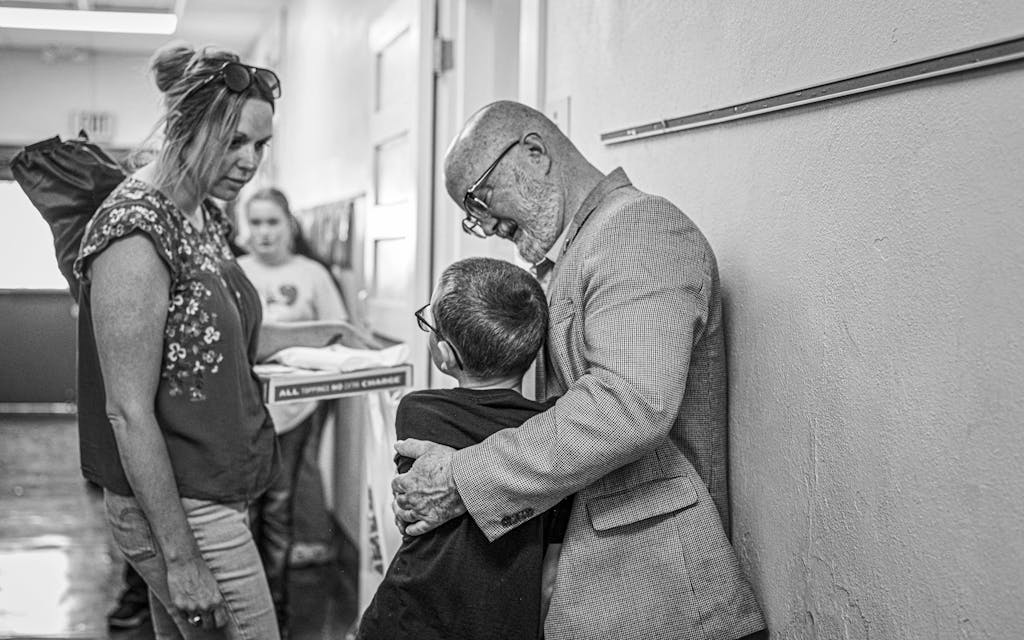
His family has been in the area since the 1870s, when federal soldiers still pursued Comanche and Apache from the town’s namesake garrison. His great uncle was one of the first superintendents of Fort Davis ISD. (At one point, Hicks showed me a copy of his great-uncle’s 1942 master’s thesis, “The Early Ranch Schools of the Fort Davis Area.”) Later, as we were walking around campus, Hicks’s ten-year-old grandson, a thin fourth-grader wearing blue-rimmed glasses and blue jeans tucked into a pair of cowboy boots, ran up to Hicks and gave him a hug.
Superintendent Hicks hugs his grandson in the hallway at Dirks-Anderson Elementary School in Fort Davis.Photograph by Maisie Crow
Both the elementary school and the high school—where Hicks graduated in 1982—were built in 1929, Hicks explained. Walking through their timeworn hallways is to step back in time. In places, the plaster is flaking off the original adobe walls. The elementary school gym floor is bubbling up because of a leak under the foundation. The wooden seats in the high school auditorium have never been replaced. The urinals in the elementary school are original too. The newest instructional facility, a science lab, was built in 1973. In the summer, Hicks mows the football field, the same one he played on five decades ago. “Every bit helps,” he said.
The funding challenges create all manner of ripple effects. Hicks has trouble recruiting and retaining teachers, and some students drift away from school without extracurriculars to hold their interest. “You lose teachers, then you start losing kids, and then your funding gets worse,” he said. “It’s a circle-the-drain kinda thing. And it’s really speeding up for Fort Davis.”
The first problem is the size of the district’s bucket. For the last decade, TEA has calculated that Fort Davis’s Tier I annual allotment is between $2 million and $2.5 million, well short of its already spartan $3.1 million budget.
And then there’s the matter of how that bucket is filled. In the 2011–2012 school year, the state covered two-thirds of Fort Davis’ entitlement, about $2.1 million. Today, it chips in about $150,000, a 93 percent decrease. How to explain that change?…
In June 2019, the Big Three figures in state government—Abbott, Patrick, and then–House Speaker Dennis Bonnen—gathered at an elementary school in Austin for an almost giddy bill-signing ceremony. As a bipartisan group of lawmakers watched, Abbott signed into law House Bill 3, an $11.6 billion package of property tax cuts and education funding that had received near-unanimous support in both the House and Senate, a rarity in the highly polarized Legislature. “This one law does more to advance education in the state of Texas than any law that I have seen in my adult lifetime,” said Abbott.
For almost a year, an appointed commission of experts had met to discuss how to overhaul the school-finance system, issuing a report in December 2018 that called on the Lege to “redesign the entirety of our state’s funding system to reflect the needs of the 21st century.” HB 3 was the by-product of that prompt. Lawmakers rejiggered many of the system’s outdated formulas, offered pay raises to teachers, fixed some of the most glaring inequities, and reduced the amount of money recaptured by the state from property-wealthy districts. Most important, HB 3 represented a much-needed infusion of cash for struggling schools. The basic allotment was raised from $5,140 to $6,120 per student.
But HB 3 also exacerbated disparities among property-wealthy and property-poor districts. Because of changes to the way Tier II enrichment funding works, some communities were able to cut tax rates and generate significant new revenues from their tax base. For others, a minority of districts, HB 3 actually created new problems. Around 10 percent of districts saw a decrease in formula funding. This year, Alpine has $220,000 less than it would have had under the old system, even as some of the richest districts in the state—tiny West Texas communities with lots of oil wealth—saw their funding explode. Rinehart contrasts Alpine, which has almost no mineral wealth, with Rankin ISD, 130 miles northeast in the Permian Basin oil patch. While Alpine’s funding went down 2 percent, Rankin’s went up 339 percent. Even though Rankin is projected to return close to $100 million in recapture payments to the state this year, the district is fabulously wealthy. “Alpine’s budget is $10 million,” Rinehart points out. “Rankin’s is $14 million. We educate a thousand kids and they educate three hundred kids. So they are a third of our size and have a budget 40 percent larger than ours.”
Rinehart doesn’t begrudge Rankin’s wealth—she recently served as assistant superintendent there—but uses the Alpine–Rankin comparison as a “wild” example of how HB 3 exacerbated inequities, making the rich richer and the poor poorer.
Hicks, too, has noticed. “Rankin just built a whole new school,” he told me. “They got a new fieldhouse, a new gym. Two new science labs. A turf practice field, a turf game field. A new track, a new stadium. And my buildings were built in 1929.” Rankin is planning to build ten new “teacherages”—district-funded housing for teachers, important to attracting and retaining talent in areas with scant or affordable residences.
Jeff Davis County, on the other hand, has no oil and gas and very little industry; any school debt would thus be borne by homeowners through bonds. Hicks’s district has never issued a bond, in part because it would be unlikely to pass; the voters wouldn’t support a tax increase. The school’s ag barn was built in 2019 with local donations. The band program, suspended for nine years as a cost-saving measure, was only revived in 2023 after a philanthropist left his estate to the school.
To be sure, Alpine and Fort Davis are outliers. Most districts saw an immediate boost to their finances from HB 3, and advocates celebrated a meaningful investment in public education after $5.4 billion in devastating cuts in 2013. But even for those districts, the sugar rush from HB 3 didn’t last long. According to Chandra Villanueva, the director of policy and advocacy at the progressive nonprofit Every Texan, the $1,000 increase in the basic allotment was “roughly enough to cover one year of inflation….”
The property tax system and the school finance system are inextricably linked, Rube Goldberg–style. Twist a dial here and a light will come on over there. Slip a gear here and spring a leak there. As state lawmakers have prioritized tax cuts over public education funding, the trade-offs have grown clearer. This year represents a potential turning point. But rather than trying to solve the problem using the $33 billion budget surplus—a generational bonanza—Abbott and Patrick have overwhelmingly focused their attention on property tax cuts and a school-voucher plan loathed by almost everyone in public education, in part because it would threaten to strip even more funding from school districts.
The just-completed regular session was a bloodbath. The 88th Legislature began in January with the governor and lieutenant governor promising to pass a transformative voucher program and a record-setting $17 billion in property-tax cuts. Funding for public education, often a banner issue, was scarcely discussed. Even the House, the friendlier chamber toward public education, only proposed raising the basic allotment by $140, from $6,160 to $6,300 per student—far less than the $1,500 increase needed to keep up with inflation since 2019, according to the Texas American Federation of Teachers. But in the end, teachers and public schools got virtually nothing.
Teachers and administrators were stunned. Zeph Capo, the president of Texas AFT, called it a “joke.” HD Chambers, the executive director of the Texas School Alliance, accused Patrick and Abbott of playing a “hostage game” with Texas’s teachers and public school students by tying education funding to vouchers. “It’s pretty simple. The governor and Senate says, ‘If you don’t give us the kind of vouchers we want, we’re not giving you any money.’” The House refused to budge, and the regular session concluded without a deal on property tax relief, vouchers, and other GOP priorities.
Now, the governor has promised to convene multiple special sessions to take up the unresolved issues. The first special session began three hours after the regular one ended, and effectively wrapped up less than 24 hours later, with the House rejecting the Senate property-tax plan, passing its own program consisting solely of property-tax compression, and then abruptly adjourning. Abbott threw his support behind the House plan. The message to the Senate was clear: take it or leave it. If the Senate yields, the House version would push some school districts down to as low as $0.60 per $100, with no new source of revenue to backfill for the reduced funding in case of a bad economy.
Abbott has said his goal is to completely eliminate the main school property tax. In such a scenario, Texas’s thousand-plus school districts would be at the mercy of the Legislature for funding—a troubling scenario, says Villanueva. She suspects vouchers would then become inevitable. “At that point, it’s like, ‘You know what, we don’t have the money to fund schools. Everyone take five thousand bucks, figure it out for yourselves.’”
That day, if it ever comes, may still be far off. But the education system is in crisis right now, and unlike previous hard times, the state is flush with cash. The pain, Chambers says, is being intentionally inflicted by Abbott and Patrick. “Because of this one pet project that the governor has”—vouchers—“they are purposely creating a financial environment where every school district in Texas is being set up to fail.”
The result is that Texas schools, already operating on “shoestring budgets,” will have a harder time attracting and retaining educators, said Josh Sanderson, the deputy executive director of the Equity Center, a nonprofit that represents six hundred Texas school districts. They will run up deficits. They may have to cut extracurriculars and athletic programs. Some, like Fort Davis, may become insolvent and be forced to consolidate with another district, an often painful process.
As we were sitting in his red pickup with the engine idling outside his office, Hicks told me that he’d given up on lobbying the Legislature. He mentioned again that Patrick and other GOP lawmakers are trying to destroy public education by using vouchers to privatize schools, and he said that most other politicians “don’t give a shit about West Texas.” But for the time being he was still fighting: writing op-eds, firing off plaintive missives, asking concerned citizens to contact their legislators.
Toward the end of our visit, I asked Hicks what’s going to happen to his schools. “I don’t know,” he said. “I’m not patient enough to spend time with assholes in Austin, and I’m not rich enough to buy any votes.” TEA has suggested consolidating with another district—most likely nearby Valentine ISD—but Hicks said this would harm both Fort Davis and the other district.
He seemed resigned to his role as a Cassandra warning of impending doom, destined to be ignored. He reminded me that his grandson goes to school here, and that the painful road ahead feels both personal and existential. “If you don’t have a school,” he said, “you don’t have a community.”
Two months later, Hicks called me with some news. He’d decided to resign this summer, joining the mass exodus of school leaders that have fled the profession in the past few years. To anyone who closely follows public education in Texas, his reasoning was tragically familiar: He said he was too tired to fight anymore.
I thought I would ignore the story you have read about in every publication: the unprecedented indictment of a former President of the United States. Special Counsel Jack Smith released the indictment yesterday, and I read every word. It is a dramatic narrative of a man who was determined to hold onto state secrets, storing them in public spaces, hiding them when necessary, completely indifferent to the law governing classified documents. The irony, as the indictment points out, is that Trump repeatedly lambasted Hillary Clinton in 2016 for being careless with state secrets and promised to enforce the law if elected.
If you haven’t read the indictment, please do so. At the least, it may make you wonder how Republicans can bring themselves, even now, to echo Trump’s claims that he is the victim of a witch-hunt.
Heather Cox Richardson summarizes the events of the past 24 hours and the underlying issues: can a former President be forgiven for taking home highly classified documents and refusing to give them back when asked? For not only refusing to return them but hiding them from those authorized to collect them? What were his motives? Just to show them off to prove what a big man he is? Or to sell them to foreign agents? Vanity or greed?
And my question: Why are Republicans stridently defending a man who knowingly put the lives of our military at risk and endangered our national security? Have they no shame? Why do they put their loyalty to Trump (or fear of him) above the nation’s security and their oath of office?
She writes:
At 3:00 today, Washington D.C., time, Special Counsel Jack Smith delivered a statement about the recently unsealed indictment charging former president Donald J. Trump on 37 counts of violating national security laws as well as participating in a conspiracy to obstruct justice.
Although MAGA Republicans have tried to paint the indictment as a political move by the Biden administration over a piddling error, Smith immediately reminded people that “[t]his indictment was voted by a grand jury of citizens in the Southern District of Florida, and I invite everyone to read it in full to understand the scope and the gravity of the crimes charged.”
The indictment is, indeed, jaw dropping. It alleges that during his time in the White House, Trump stored in cardboard boxes “information regarding defense and weapons capabilities of both the United States and foreign countries; United States nuclear programs; potential vulnerabilities of the United States and its allies to military attack; and plans for possible retaliation in response to a foreign attack.” The indictment notes that “[t]he unauthorized disclosure of these classified documents could put at risk the national security of the United States, foreign relations, the safety of the United States military, and human sources and the continued viability of sensitive intelligence collection methods.”
Nonetheless, when Trump ceased to be president after noon on January 20, 2021, he took those boxes, “many of which contained classified documents,” to Mar-a-Lago, where he was living. He “was not authorized to possess or retain those classified documents.” The indictment makes it clear that this was no oversight: Trump was personally involved in packing the boxes and, later, in going through them and in overseeing how they were handled. The employees who worked for him exchanged text messages referring to his personal instructions about them.
Mar-a-Lago was not an authorized location for such documents, but he stored them there anyway, “including in a ballroom, a bathroom and shower, an office space, his bedroom, and a storage room.” They were stacked in public places, where anyone—including the many foreign nationals who visited Mar-a-Lago—could see them. On December 7, 2021, Trump’s personal aide Waltine Nauta took two pictures of several of the boxes fallen on the floor, with their contents, including a secret document available only to the Five Eyes intelligence alliance of the U.S., Australia, Canada, New Zealand, and the United Kingdom, spilled onto the floor.
The indictment alleges that Trump showed classified documents to others without security clearances on two occasions, both of which are well documented. One of those occasions was recorded. Trump told the people there that the plan he was showing them was “highly confidential” and “secret.” He added, “See, as president I could have declassified it….Now I can’t, you know, but this is still a secret.”
This recording undermines his insistence that he believed he could automatically declassify documents; it proves he understood he could not. In addition, the indictment lists Trump’s many statements from 2016 about the importance of protecting classified information, all delivered as attacks on Democratic presidential nominee Hillary Clinton, whom he accused of mishandling such information. “In my administration,” he said on August 18, 2016, “I’m going to enforce all laws concerning the protection of classified information. No one will be above the law.”
The indictment goes on: When the FBI tried to recover the documents, Trump started what Washington Post journalist Jennifer Rubin called a “giant shell game”: he tried to get his lawyer to lie to the FBI and the grand jury, saying Trump did not have more documents; worked with Nauta to move some of the boxes to hide them from Trump’s lawyer, the FBI and the grand jury; tried to get his lawyer to hide or destroy documents; and got another lawyer to certify that all the documents had been produced when he knew they hadn’t.
Nauta lied to the grand jury about his knowledge of what Trump did with the boxes. Both he and Trump have been indicted on multiple counts of obstruction and of engaging in a conspiracy to hide the documents.
Eventually, Trump had many of the boxes moved to his property at Bedminster, New Jersey, where on two occasions he showed documents to people without security clearances. He showed a classified map of a country that is part of an ongoing military operation to a representative of his political action committee.
Trump has been indicted on 31 counts of having “unauthorized possession of, access to, and control over documents relating to the national defense,” for keeping them, and for refusing “to deliver them to the officer and employee of the United States entitled to receive them”: language straight out of the Espionage Act. Twenty-one of the documents were marked top secret, nine were marked secret, and one was unmarked.
These documents are not all those recovered—some likely are too sensitive to risk making public—but they nonetheless hold some of the nation’s deepest secrets: “military capabilities of a foreign country and the United States,” “military activities and planning of foreign countries,” “nuclear capabilities of a foreign country,” “military attacks by a foreign country,” “military contingency planning of the United States,” “military options of a foreign country and potential effects on United States interest,” “foreign country support of terrorist acts against United States interests,” “nuclear weaponry of the United States,” “military activity in a foreign country.”
Smith put it starkly in his statement, “The men and women of the United States intelligence community and our armed forces dedicate their lives to protecting our nation and its people. Our laws that protect national defense information are critical to the safety and security of the United States and they must be enforced. Violations of those laws put our country at risk.”
On Twitter, Bill Kristol said it more clearly: “These were highly classified documents dealing with military intelligence and plans. What did Trump do with them? Who now has copies of them?” Retired FBI assistant director Frank Figliuzzi noted that there is a substantial risk that “foreign intelligence services might have sought or gained access to the documents.”
There is also substantial risk that other countries will be reluctant to share intelligence with the United States in the future. At the very least, it is an unfortunate coincidence that the Central Intelligence Agency in October 2021 reported an unusually high rate of capture or death for foreign informants recruited to spy for the United States.
Since Trump supporters have taken the position that Trump’s indictment over the stolen documents is the attempt of the Biden administration to undermine Trump’s presidential candidacy, it is worth remembering that Trump’s early announcement of his campaign was widely suspected to be an attempt to enable him to avoid legal accountability. Attorney General Merrick Garland appointed Special Counsel Jack Smith precisely to put arms length between the administration and the investigations into Trump. Smith noted today, “Adherence to the rule of law is a bedrock principle of the Department of Justice. And our nation’s commitment to the rule of law sets an example for the world. We have one set of laws in this country, and they apply to everyone. Applying those laws. Collecting facts. That’s what determines the outcome of an investigation. Nothing more. Nothing less. “The prosecutors in my office are among the most talented and experienced in the Department of Justice. They have investigated this case hewing to the highest ethical standards. And they will continue to do so as this case proceeds.”
Smith added: “It’s very important for me to note that the defendants in this case must be presumed innocent until proven guilty beyond a reasonable doubt in a court of law. To that end, my office will seek a speedy trial in this matter. Consistent with the public interest and the rights of the accused. We very much look forward to presenting our case to a jury of citizens in the Southern District of Florida.”
Likely responding to MAGA attacks on the FBI and the rule of law, Smith thanked the “dedicated public servants of the Federal Bureau of Investigation, with whom my office is conducting this investigation and who worked tirelessly every day upholding the rule of law in our country,” before closing his brief statement.
The indictment revealed just how much detailed information Smith’s team has uncovered, presenting a shockingly thorough case to prove the allegations. Trump’s lawyers will have their work cut out for them…although the team has shifted since this morning: two of Trump’s lawyers quit today. The thoroughness of the indictment also suggests that Trump and his allies might have reason to be nervous about Smith’s other investigation: the one into the attempt to overturn results of the 2020 election.
Some of Trump’s supporters are calling for violence. After Louisiana representative Clay Higgins appeared to be egging on militias to oppose Trump’s Tuesday arraignment, Democratic senate majority leader Chuck Schumer (D-NY) and House minority leader Hakeem Jeffries (D-NY) issued a joint statement calling for “supporters and critics alike to let the case proceed peacefully in court.” Legal scholar Joyce White Vance noted that it was “extremely sad for our country that this isn’t a bipartisan statement being made by leaders from both parties.” — Notes: https://www.justice.gov/opa/speech/special-counsel-jack-smith-delivers-statement https://www.cnn.com/2023/06/09/politics/walt-nauta-trump-indicted/index.html
As Greene notes, the biggest financial scandals in charter world are connected to virtual charters. ECOT in Ohio collected $1 billion over 20 years before it declared bankruptcy to avoid repaying the state $80 million for phantom students. At last report, the A3 virtual chain had bilked California for a sum between $80 million and $200 million. Oklahoma lost tens of millions to EPIC’s founders. Yet the game continues because politicians are easily purchased. You can also read Greene’s analysis of virtual charters ripping off taxpayers and students in Pennsylvania here.
Greene writes:
Cyber charters’ many issues have been well-documented. Academically, they fall far short of public schools. When the General Accounting Office studied them last year, they found a system of schools that resists oversight, presents “increased financial risks” to states, and produces poor student results. Even leaders in the charter school movement have found “well-documented, disturbingly low performance by too many full-time virtual charter public schools” and called for a radical overhaul (more than once).
Virtual charters are highly profitable, and that pile of money, combined with lax oversight and accountability, has resulted in a number of high profile fraud cases sometimes to the tune of tens of millions of dollars. Notable cases include the A3 charter school network, Epic charter schools, California Virtual Academy (CAVA), and Ohio’s Electronic Classroom of Tomorrow (ECOT), which owed the state of Ohio $80 million dollars in tuition reimbursement.
But while much has been learned about what happens with students while they’re enrolled, nobody has really looked at what happens to students after their time in cyber charters. Now “Virtual Charter Students Have Worse Labor Market Outcomes as Young Adults,” a new working paper from the Anenberg Institute at Brown University, reveals that the problems of cyber charters extend beyond the school years.
Virtual charter students have substantially worse high school graduation rates, college enrollment rates, bachelor’s degree attainment, employment rates, and earnings than students in traditional public schools.
The study found that virtual charter attendance was associated with a lower likelihood of high school graduation or GED, lower likelihood of college enrollment, and a lower likelihood of employment up to six years after high school—and those employed made, on average, 17 percent less than students from public schools.
The study is looking at samples from twelve to eighteen years ago. The researchers are clear that their results are “providing descriptive evidence rather than as strictly causal estimates.” In other words, correlation is not causation.
Nevertheless, it’s clear once again that when it comes to the quality of virtual charters, the numbers do not look good.
During the darkest days of the pandemic, Sweden garnered widespread attention for its approach to COVID. Its leading specialist advised the government to let life go on as usual: no lockdowns, open schools, no mandates. The goal was “herd immunity,” in which enough people are infected so that the disease doesn’t spread. Sweden was often held up as a model by those who hated the lockdowns, which crippled economic activity and closed down schools.
Throughout much of the pandemic, Sweden has stood out for its ostensibly successful effort to beat COVID-19 while avoiding the harsh lockdowns and social distancing rules imposed on residents of other developed nations.
Swedish residents were able to enjoy themselves at bars and restaurants, their schools remained open, and somehow their economy thrived and they remained healthy. So say their fans, especially on the anti-lockdown right.
A new study by European scientific researchers buries all those claims in the ground. Published in Nature, the study paints a devastating picture of Swedish policies and their effects.
“The Swedish response to this pandemic,” the researchers report, “was unique and characterized by a morally, ethically, and scientifically questionable laissez-faire approach.”
The lead author of the report, epidemiologist Nele Brusselaers, is associated with the prestigious Karolinska Institutet in Stockholm; her collaborators are affiliated with research institutes in Sweden, Norway and Belgium.
The details of Swedish policies as described by Brusselaers and her co-authors are horrifying. The Swedish government, they report, deliberately tried to use children to spread COVID-19 and denied care to seniors and those suffering from other conditions.
The government’s goal appeared geared to produce herd immunity — a level of infection that would create a natural barrier to the pandemic’s spread without inconveniencing middle- and upper-class citizens; the government never set forth that goal publicly, but internal government emails unearthed by the Swedish press revealed that herd immunity was the strategy behind closed doors.
Explicit or not, the effort failed. “Projected ‘natural herd-immunity’ levels are still nowhere in sight,” the researchers wrote, adding that herd immunity “does not seem within reach without widespread vaccinations” and “may be unlikely” under any circumstances.
That’s a reproach to the signers of the Great Barrington Declaration, a widely criticized white paper endorsing the quest for herd immunity and co-written by Martin Kulldorff, a Sweden-born Harvard professor who has explicitly defended his native country’s policies.
The country’s treatment of the elderly and patients with comorbidities such as obesity was especially appalling.
“Many elderly people were administered morphine instead of oxygen despite available supplies, effectively ending their lives,” the researchers wrote. “Potentially life-saving treatment was withheld without medical examination, and without informing the patient or his/her family or asking permission.”
In densely populated Stockholm, triage rules stated that patients with comorbidities were not to be admitted to intensive care units, on grounds that they were “unlikely to recover,” the researchers wrote, citing Swedish health strategy documents and statistics from research studies indicating that ICU admissions were biased against older patients.
These policies were crafted by a small, insular group of government officials who not only failed to consult with experts in public health, but ridiculed expert opinion and circled the wagons to defend Anders Tegnell, the government epidemiologist who reigned as the architect of the country’s approach, against mounting criticism.
The bottom line is that Swedes suffered grievously from Tegnell’s policies. According to the authoritative Johns Hopkins pandemic tracker, while its total death rate from February 2020 through this week, 1,790 per million population, is better than that of the U.S. (2,939), Britain (2,420) and France (2,107), it’s worse than that of Germany (1,539), Canada (984) and Japan (220).
More tellingly, it’s much worse than the rate of its Nordic neighbors Denmark (961), Norway (428) and Finland (538), all of which took a tougher anti-pandemic approach.
Anti-lockdown advocates continue to laud Sweden’s approach even today, despite the hard, cold statistics documenting its failure.
The right-wing economic commentator Stephen Moore, a reliably wrong pundit on many topics, preened over Sweden’s death rate compared to other countries that imposed more stringent lockdowns: “Sweden appears to have achieved herd immunity much more swiftly and thoroughly than other nations,” Moore wrote.
Sadly, no.
According to Johns Hopkins, on Feb. 17, the day that Moore’s column appeared in the conservative Washington Examiner, Sweden’s seven-day average death rate from COVID was 5.25 per million residents.
That was better than the rate of 6.84 in the U.S., where lockdowns had been fading and had always been spotty, and in Denmark (5.65), but worse than France (3.97), Germany (2.23), Britain (2.23), Canada (2.03) and Norway (0.92).
Moore also declared, “What is clear today is that the Swedes saved their economy.”
The Organization for Economic Cooperation and Development, or OECD, of which Sweden is a member, isn’t quite so sanguine.
The OECD found that in terms of pandemic-driven economic contraction, Sweden did marginally better than Europe as a whole, but markedly worse than its Nordic neighbors Denmark, Norway and Finland, “despite the adoption of softer distancing measures, especially during the first COVID wave.” COVID-19, the OECD concludes, “hit the economy hard.”
The Nature authors show that Swedish government authorities denied or downplayed scientific findings about COVID that should have guided them to more reasoned and appropriate policies.
These included scientific findings that infected but asymptomatic or pre-symptomatic people could spread the virus, that it was airborne, that the virus was a greater health threat than the flu and that children were not immune.
The Swedish policymakers “denied or downgraded the fact that children could be infectious, develop severe disease, or drive the spread of the infection in the population,” the Nature authors observe. At the same time, they found, the authorities’ “internal emails indicate their aim to use children to spread the infection in society.”
So the government refused to counsel the wearing of masks or social distancing or to sponsor more testing — at least at first. One fact that tends to be glossed over by anti-lockdown advocates is that Sweden did eventually tighten its social distancing regulations and advisories, though only after the failure of its initial policies became clear.
At first, in early March when other European countries went into strict lockdowns, Sweden only banned public gatherings of 500. Within weeks, it reduced the ceiling to 50 attendees. The state allowed no distance learning in schools at first, but later permitted it for older pupils and university students.
In June 2020, Tegnell himself acknowledged on Swedish radio that the country’s death rate was too high. “There is quite obviously a potential for improvement in what we have done in Sweden,” he said, though he backtracked somewhat during a news conference after the radio interview aired.
And in December 2020, King Carl XVI Gustaf shocked the country by taking a public stand against the government’s approach: “I think we have failed,” he said. “We have a large number who have died and that is terrible.”
He was correct. If Sweden had Norway’s death rate, it would have suffered only 4,429 deaths from COVID during the pandemic, instead of more than 18,500.
What may be especially damaged by the experience is Sweden’s image as a liberal society. The pandemic exposed numerous fault lines within its society — notably young versus old, natives versus immigrants.
The Nature authors underscore the irony of that outcome: “There was more emphasis on the protection of the ‘Swedish image’ than on saving and protecting lives or on an evidence-based approach.”
The lesson of the Swedish experience should be heeded by its fans here in the U.S. and in other lands. Sweden sacrificed its seniors to the pandemic and used its schoolchildren as guinea pigs. Its government plied its people with lies about COVID-19 and even tried to smear its critics.
These are features of the policies of the states that have been least successful at fighting the pandemic in the U.S., such as Florida — sacrifices borne by the most vulnerable, scientific authorities ignored or disdained, lies paraded as truth. Do we really want all of America to face the same disaster?
The Miami Herald editorial board wonders why the state’s leaders devote all their time fighting WOKE but ignoring the dramatic rise in insurance rates.
Ron DeSantis and the Republicans in the legislature have spent an entire session battling drag queens, gays, trans kids, public schools, Black history, librarians, and academic freedom. They have given each other high fives, but homeowners will get hikes in their insurance, which was not on the political agenda.
We know all too well that Florida property insurance costs have been skyrocketing, with no end in sight. Now there’s a new study that shows just how bad it’s gotten, and it’s even worse than we thought.
According to the data analysis company LexisNexis Risk Solutions, the state’s property insurance costs are up by an incredible 57% since 2015 — nearly triple the national average of 21%, as the Miami Herald reported.
If that weren’t enough misery, Florida distinguished itself in another way: Insurance costs have been rising faster in Florida than in any other state.
Given all of that, you might expect to see the governor and Legislature running around as though their hair was on fire, trying to come up with fixes for our crippled insurance market before regular, non-rich Floridians are forced out and lawmakers get blamed for destroying the middle class.
Lawmakers distracted
But that’s the kind of logic that worked in saner times. In 2023, Florida’s leaders are so busy trying to get Gov. Ron DeSantis into the White House — with a legislative session tailored to his agenda, no matter the cost — that they can’t be bothered to spend much time on insurance, even though it’s a complicated and important issue that affects regular people.
No, in Florida, the long-running and worsening property insurance crisis has been buried under an avalanche of anti-woke measures, the ones DeSantis seems to think will carry him to Washington.
That’s a dangerous strategy. As the Florida governor hits the campaign trail in places like Iowa, he leaves himself vulnerable to charges that he’s not taking care of business at home.
For example, on Wednesday, the governor was set to visit the U.S. southern border. It’s a clear attempt to generate more headlines on immigration, following another taxpayer-financed stunt in which Florida flew migrants from Texas to California. Meanwhile, Floridians back home will be facing record hikes in flood insurance — an average hike of 131%. Where’s the governor’s outrage on that?…
The state is facing a property insurance crisis. Where are our leaders?
Edward B. Fiske was the education editor of the New York Times and editor of the Fiske Guide to Colleges. Helen F. Ladd is a nationally prominent economist of education and professor emeritus at Duke University. They are married, a power couple of American education. This article appeared on the website of WRAL in North Carolina.
Forty years ago this spring a national commission charged with evaluating the quality of American education issued a blistering report entitled “A Nation at Risk.” It cited a “rising tide of mediocrity” in the country’s schools and declared that the country’s failure to provide high quality education “threatens our very future as a Nation and a people.”
North Carolina leaders took this warning to heart. They began investing heavily in public education and even became a model for other states in areas such as early childhood education. Significantly, the state was making progress toward fulfilling its obligation under the North Carolina Constitution to provide a sound, basic education for all students.
The situation started to change, however, in 2012 when Republicans came to power and began an assault on public education that continues to this day.
When it comes to public education, North Carolina is now “A State at Risk.”
The Republican assault has taken multiple forms, starting with inadequate funding. North Carolina now ranks 50th in the country in school funding effort and 48th in overall funding. Despite widespread teacher shortages, the Republicans have kept teacher salaries low — $12,000 below the national average – and they have failed to provide adequate funding for the additional support staff that schools need.
In addition, they have permitted significant growth in the number of charter schools. Such schools divert much-needed funds from traditional public schools and make it difficult for local boards of education to operate coherent education systems.
The Republican-controlled Legislature is currently working hard to weaken public education by politicizing the process. Pending legislation would regulate how history and racism are taught, give a commission appointed mainly by lawmakers the job of recommending standards in K-12 subjects, and transfer authority to create new charter schools from the State Board of Education to a board appointed by the General Assembly.
The problem is about to get even worse. The Legislature is now poised to expand the earlier Opportunity Scholarship program, which had provided public funds for low income children to attend private schools, into a much larger universal voucher program that would make all children eligible regardless of family income – at an estimated cost of more than $2 billion over the next 10 years.
Given that private schools are operated by private entities typically with no public oversight and no obligation to serve all children, why in the world would it ever make sense to use taxpayer dollars to support private schools?
A common argument has been that voucher systems raise achievement levels of the children who used them. While some early studies of small scale means-tested voucher programs in places like Milwaukee showed small achievement gains in some cases, recent studies of larger voucher programs in places such as Ohio, Louisiana and Indiana consistently show large declines in average achievement — often because of the low quality of the private schools that accept vouchers.
Supporters also argue that vouchers provide more schooling options for children and that having more choices is a good thing. But in the context of education policy that need not be the case. Americans support public education – and make schooling mandatory – not only for the benefits it generates for individual children but also for collective benefits such as the creation of capable workers and informed citizens. What matters is the quality of education for all the state’s children.
An expanded voucher program would lead to a substantial outflow of funds from traditional public schools to privately operated schools, with the potential for a significant loss in the quality of our public schools, and subsequent vitality in the state’s economy.
A strong public education system – from elementary and secondary schools to the nation’s first public university, the University of North Carolina – has long been pivotal to our state’s cultural, political and economic success. We must stop the current assaults on public education and reaffirm our commitment to one of North Carolina’s great strengths.
Back in 1983 when the education system of the nation was “at risk,” President Ronald Reagan – who had earlier been lukewarm in his support of public education — took the warning seriously and began touring the country to talk about the problem. His successors from both parties then took up the cause and continued to make the case that a strong public education system is essential for a vibrant economy, and importantly, to make the policy changes needed to strengthen it.
Let’s hope that our current Republican leaders in this state can muster the wisdom and courage to follow the example of President Reagan and other leaders from both parties in pushing for strong public education. In the absence of such wisdom, we will indeed continue to be “A State at Risk.”
It’s not often that I have the opportunity to repost something written years ago. John Thompson, teacher and historian, summarized Mike Miles’s disastrous three years in Dallas. At the time I posted John’s analysis, I didn’t know how to embed links. His commentary starts in the second paragraph of the linked post.
Miles is a military veteran. He has no experience as a teacher or principal. Yet somehow he thinks he knows how to reform schools. That conceit is a hallmark of the Broad Academy.
Miles was recently selected by the Texas Commissioner of Education Mike Morath—also not an educator—to be the superintendent of schools in Houston, one of the nation’s largest school districts. The state took control of The Houston Independent School District because one school—Wheatley High School—received failing scores for several years in a row. This past year, its state score rose to a C, but the state didn’t care. These are Republicans who don’t believe in local control or democracy.
Mike Miles arrived in Dallas after a stint as superintendent of a tiny district in Colorado. He’s a know-it-all. He arrived with an attempt at a Broadway show performance in which he was the star (the video was deleted).
He quickly set numerical goals that everyone was expected to meet. He alienated teachers, who left DISD in record numbers. He had no appreciation for words like “trust,” “respect,” “collaboration,” “teamwork.” It was his way or the highway.
It was not surprising that Miles’s first action as superintendent in Houston under the state takeover was to fire every member of the staff at 29 schools and invite them to reapply for their jobs. So what if this creates instability for students? Miles doesn’t care. He also plans to evaluate teachers in part by test scores, a well-discredited method.
He is a razzle-dazzle guy who likes to take bold actions, no matter who he hurts or what chaos he creates for the students and the professionals.
One of Mike Miles’ worst actions in Dallas was the time he called the police to arrest a school board member who was visiting a school in her district. That tells you the kind of guy he is: arrogant, insensitive, tough, mean.
Soon after he arrived in Dallas, his family moved back to Colorado because Mike was such a toxic guy. Hopefully, this time they stayed in Colorado.
Education doesn’t need military leaders. It doesn’t need people who don’t give a hoot for the morale of the teachers.
Miles was booted out of Dallas after three years of failure.
The question now is why Mike Morath, who was on the Dallas school board when Miles wreaked his damage on the district, decided to install him in Houston. Was it to punish Houston? Houston public schools today are performing better than Dallas. Why didn’t Morath take control of Dallas and give Miles another chance to ruin that district?
Broadies have a very bad track record. They were taught to be top-down, decisive, arrogant, indifferent to others. This is not an approach that blends well with students, teachers, teaching and learning.
Great educational leaders have experience in the classroom. They attract dedicated teachers and protect them. They understand that every child is precious to someone, whatever their test scores. They care about education more than test scores. They listen.
Mike Miles is not that guy.
Here are a few other commentaries about Niles while he was in Dallas:

 Diane Ravitch's blog