The extended shutdown of the Federal government was caused by the Democrats’ efforts to save the Affordable Care Act, known as Obamacare. Unless Republicans agree, the price of subsidies for these policies will soar. Many who can’t afford the health insurance are likely to drop their policy and have none at all.
Republicans have wanted to kill Obamacare for years. Not because it doesn’t work, but because it does. They want to eliminate any Democratic successes. Trump hates Obama and always has. First, because Obama was more popular than Trump, and second, because Obama is Black and more popular even now than Trump.
This documentary is fascinating. It shows young Bobby’s idyllic childhood at the family’s sprawling, luxurious compound in Virginia. He grew up in a world of joy, fun, and privilege.
You can see how deeply he was scarred by the murder of his father, with whom he was very close. This was an experience no child should endure.
He is sent away to a boarding school, where he is soon kicked out. Then another, then Harvard, which was a given, in light of his name. At Harvard, he becomes addicted to drugs and a drug dealer. Pot, cocaine, heroin.
He goes to law school, flunks the bar exam, but eventually passes. He marries an eligible young woman, has children, divorces her. Still a drug addict. Meets a beautiful Catholic girl, marries her, has four children. He begins to find his niche as an environmental lawyer. Life is looking up. But he’s a sex addict and he keeps a record of his conquests–at least 37. His wife finds the record and hangs herself.
He believes he is destined for greatness. He is a Kennedy so he keeps looking for the vehicle that will catapult him to fame. He discovers angry mothers who are looking for the cause of their children’s autism. He latches on to the issue and becomes their champion. He also becomes a prominent anti-Vaxxer and conspiracy theorist.
He briefly runs for president in 2024 but soon realizes that his prospects are nil. Trump offers a big job if he joins his campaign. Bobby accepts his offer, to the dismay of his family.
Bobby speaks to large, adoring crowds. He loves it.
Trump appoints him to lead the government’s public health agency–Health and Human Services. His family is appalled. They know he is unqualified. They know he has no respect for science. He promises the Senate committee that he won’t stop vaccines, despite his long history as a critic of them. He wins approval.
He begins to fire prominent scientists and thousands of experienced employees. He throws the agency into turmoil.
Judge J. Michael Luttig was appointed to the Fourth Circuit Court of Appeals in 1991 by President George H.W. Bush, where he served until 2006. He was a prominent conservative jurist, but was repulsed by the Trump regime, especially Trump’s contempt for the Constitution and the rule of law. He became one of the most outspoken critics of Trump. In this post, he criticized the Supreme Court for ignoring death threats to judges who disagreed with Trump.
This week, David French and I have both addressed the death threats on the lives of the federal judges who dare to rule against Donald Trump.
David did so this morning in the chilling piece in the New York Times linked below, and I did so on Tuesday in an hour-long interview with Meghna Chakrabarti of NPR’s On Point, one of the most thoughtful, intelligent interviewers I have ever had the pleasure to talk with.
During my conversation with Meghna, she played on air the actual audio of the death threat made to Federal Judge John McConnell referenced in David’s article. It was bone chilling. When Meghna asked for my reaction to the threat, I first thanked her on behalf of the entire Federal Judiciary for playing the audio for all of America to hear and then said “America is weeping at this moment, Meghna. America is weeping. I wish you could send this audio to the Supreme Court of the United States.”
I went on to say that the unconscionable attacks on the federal courts and individual federal judges by Donald Trump and his Attorney General will not only continue, but will continue to escalate until Chief Justice John Roberts and the Supreme Court of the United States denounce the President and the Attorney General for their unconscionable threats against the nation’s Federal Judiciary.
I explained that up to now, the Chief Justice and the Supreme Court have acquiesced in these assaults on the federal courts, tacitly condoning them, when the Chief Justice and the Court have no higher obligation under the Constitution of the United States of America than to denounce these attacks.
After my interview with Meghna, I forwarded the audio of the death threat to Judge McConnell to a number of the national media, with a note saying simply that “if the national media would saturate the American public with this chilling death threat against Judge McConnell, it could change the course of history.”
David French:
“Have you ever written words that you thought might get you killed? Have you ever written words that you worry might get someone you love killed?
That’s the reality that federal judges are facing across the nation. Our awful era of intimidation and political violence has come for them, and it represents a serious threat to the independence and integrity of the American judiciary.”
In Pennsylvania school board races, extremists who provoked battles over culture war issues were ousted. One winner said that parents looked forward to the days when school board meetings were “boring,” not divisive.
A slate of Democratic candidates won four seats on the Pine-Richland school board last night and unseated one incumbent with ties to a statewide movement of conservative education leaders.
The sweep capped an Election Day marked by Democratic victories in school board races statewide.
Pine-Richland electee Randy Augustine and his peers on the Together for PR slate won over voters with slogans like “excellence over extremism.”
“School board positions are theoretically supposed to be non-partisan, non-political positions,” Augustine said. “A number of the school board members were trying to push a political agenda, focusing on culture war issues, not focusing on the students.”
The Republican-led school board initiated policies that gave board members the final say over which books were included in school libraries and challenged books with LGBTQ characters. The district’s teachers union issued a vote of no confidence in the majority of school board members this spring.
“ It was becoming toxic, and the turmoil, I think, was spreading,” said fellow Together for PR winner Melissa Vecchi. “People just wanted to see it back to boring.”
She read the full transcript of the recent interview of Trump by Norah O’Donnell of “60 Minutes.” The final interview was heavily edited, which is standard practice. The actual interview lasts for about an hour, but only 20 minutes is aired. If you recall, Trump sued CBS for $10 billion for airing an edited version of the “60 Minutes” interview with Kamala Harris. He claimed that the interview was intended to hurt his candidacy, a totally meritless claim, since editing is routine and he suffered no injury. Rather than fight for its most prestigious news team, CBS caved and paid Trump $16 million. The corporation paid off Trump so that its merger with Paramount would be okayed by the FCC, which is the hands of a Trump flunkie.
Not mentioned by HRC was that O’Donnell asked Trump if he pressured Pam Bondi to prosecute James Comey and Letitia James. He denied it. She let it pass instead of showing the tweet in which he directed her to prosecute them. She should have asked why he did it, not whether he did it. The evidence was public.
HRC wrote:
At the end of her interview with President Donald J. Trump, recorded on October 31 at Mar-a-Lago and aired last night, heavily edited, on 60 Minutes, Norah O’Donnell of CBS News asked if she could ask two more questions. Trump suggested previous questions had been precleared when he mused aloud that if he said yes, “That means they’ll treat me more fairly if I do—I want to get—It’s very nice, yeah. Now is good. Okay. Uh, oh. These might be the ones I didn’t want. I don’t know. Okay, go ahead.”
O’Donnell noted that the Trump family has thrown itself into cryptocurrency ventures, forming World Liberty Financial with the family of Steve Witkoff, Trump’s special envoy to the Middle East. In that context, she asked about billionaire Changpeng Zhao, the co-founder and former chief executive officer of Binance. Zhao is cryptocurrency’s richest man. He pleaded guilty in 2023 to money laundering, resigned from Binance, paid a $50 million fine, and was sentenced to four months in prison.
Trump pardoned him on October 23.
O’Donnell noted that the U.S. government said Zhao “had caused ‘significant harm to U.S. national security,’ essentially by allowing terrorist groups like Hamas to move millions of dollars around.” She asked the president, “Why did you pardon him?”
“Okay, are you ready?” Trump answered. “I don’t know who he is. I know he got a four-month sentence or something like that. And I heard it was a Biden witch hunt. And what I wanna do is see crypto, ‘cause if we don’t do it it’s gonna go to China, it’s gonna go to—this is no different to me than AI.
“My sons are involved in crypto much more than I—me. I—I know very little about it, other than one thing. It’s a huge industry. And if we’re not gonna be the head of it, China, Japan, or someplace else is. So I am behind it 100%. This man was, in my opinion, from what I was told, this is, you know, a four-month sentence.”
After he went on with complaints about the Biden administration—he would mention Biden 42 times in the released transcript—O’Donnell noted, “Binance helped facilitate a $2 billion purchase of the Trump family’s World Liberty Financial’s stablecoin. And then you pardoned [Zhao].” She asked him: “How do you address the appearance of pay for play?”
Trump answered: “Well, here’s the thing. I know nothing about it because I’m too busy doing the other….” O’Donnell interrupted: “But he got a pardon….” Trump responded: “I can only tell you this. My sons are into it. I’m glad they are, because it’s probably a great industry, crypto. I think it’s good. You know, they’re running a business, they’re not in government. And they’re good—my one son is a number one bestseller now.
“My wife just had a number one bestseller. I’m proud of them for doing that. I’m focused on this. I know nothing about the guy, other than I hear he was a victim of weaponization by government. When you say the government, you’re talking about the Biden government.” And then he was off again, complaining about the former president and boasting that he would “make crypto great for America.”
“So not concerned about the appearance of corruption with this?” O’Donnell asked.
Trump answered: “I can’t say, because—I can’t say—I’m not concerned. I don’t—I’d rather not have you ask the question. But I let you ask it. You just came to me and you said, ‘Can I ask another question?’ And I said, yeah. This is the question….”
“And you answered…” O’Donnell put in.
“I don’t mind,” Trump said. “Did I let you do it? I coulda walked away. I didn’t have to answer this question. I’m proud to answer the question. You know why? We’ve taken crypto….” After another string of complaints about Biden, he said: “We are number one in crypto and that’s the only thing I care about.”
If, among all the disinformation and repetition Trump spouted in that interview, he did not know who he was pardoning, who’s running the Oval Office?
It appears House speaker Mike Johnson (R-LA) doesn’t want to know. At a news conference today, journalist Manu Raju noted: “Last week…you were very critical of Joe Biden’s use of the autopen…[you said] he didn’t even know who he was pardoning. Last night, on 60 Minutes…Trump admitted not knowing he pardoned a crypto billionaire who pleaded guilty to money laundering. Is that also concerning?”
Johnson answered: “I don’t know anything about that. I didn’t see the interview. You have to ask the president about that. I’m not sure.”
Pleading ignorance of an outrage or that a question is “out of his lane” has become so frequent for Johnson that journalist Aaron Rupar of Public Notice, who is very well informed about the news indeed, suggested today that journalists should consider asking Johnson: “Do you ever read the news, and do you agree it’s problematic for the Speaker to be so woefully uninformed?”
Johnson continues to keep the House from conducting business as the government shutdown hit its 34th day today. Tomorrow the shutdown will tie the 35-day shutdown record set during Trump’s first term. Representative Adelita Grijalva (D-AZ), whom voters elected on September 23, is still not sworn in. She has said she will be the 218th—and final—vote on a discharge petition to force a vote requiring the Department of Justice to release the Epstein files.
Trump and Johnson continue to try to jam Democratic senators into signing on to the Republicans’ continuing resolution without addressing the end of premium tax credits that is sending healthcare premiums on the Affordable Healthcare Act marketplace soaring. They continue to refuse to negotiate with Democrats, although negotiations have always been the key to ending shutdowns.
To increase pressure, they are hurting the American people.
The shutdown meant that funding for Supplemental Nutrition Assistance Program (SNAP) benefits on which 42 million Americans depend to put food on the table ran out on October 31. Although previous administrations—including Trump’s—have always turned to contingency funds Congress set aside to make sure people can eat, and although the Trump administration initially said it would do so this time as usual, it abruptly announced in October that it did not believe tapping into that reserve was legal. SNAP benefits would not go out.
On Friday, U.S. District Judge John McConnell of the District of Rhode Island ordered the administration to fund payments for SNAP benefits using the reserve Congress set up for emergencies. Since that money—$4.65 billion—will not be enough to fund the entire $8 billion required for November payments, McConnell suggested the administration could make the full payments by tapping into money from the Child Nutrition Program and other funds, but he left discretion up to the administration.
Today the administration announced it would tap only the first reserve, funding just 50% of SNAP benefits. It added that those payments will be delayed for “a few weeks to up to several months.” The disbursement of the reserve, it continued, “means that no funds will remain for new SNAP applicants certified in November, disaster assistance, or as a cushion against the potential catastrophic consequences of shutting down SNAP entirely.”
“Big ‘you can’t make me’ energy,” Talking Points Memo’s Josh Marshall noted. It’s also an astonishing act of cruelty, especially as grocery prices are going up—Trump lied that they are stable in the 60 Minutes interview—hiring has slowed, and the nation is about to celebrate Thanksgiving.
The shutdown also threatens the $4.1 billion Low-Income Home Energy Assistance Program (LIHEAP) that helps families cover the cost of utilities or heating oil. Susan Haigh and Marc Levy of the Associated Press note that this program started in 1981 and has enjoyed bipartisan support in Congress ever since. Trump’s budget proposal for next year calls for cutting the program altogether, but states expected to have funding for this winter. Almost 6 million households use the program, and as cold weather sets in, the government has not funded it.
When the Republicans shredded the nation’s social safety net in their budget reconciliation bill of July, the one they call the “One Big Beautiful Bill Act,” they timed most of the cuts to take effect after the 2026 midterm elections. But the shutdown is making clear now, rather than after the midterms, what the nation will look like without that safety net.
In the 60 Minutes interview, O’Donnell noted an aspect of Trump’s America that is getting funded during the shutdown. She said, “Americans have been watching videos of ICE tackling a young mother, tear gas being used in a Chicago residential neighborhood, and the smashing of car windows. Have some of these raids gone too far?”
“No,” Trump answered. “I think they haven’t gone far enough because we’ve been held back by the—by the judges, the liberal judges that were put in by Biden and by Obama.” (In fact, a review by Kyle Cheney of Politico on Friday showed that more than 100 federal judges have ruled at least 200 times against Trump administration immigration policies. Those judges were appointed by every president since Ronald Reagan, and 12 were appointed by Trump himself.)
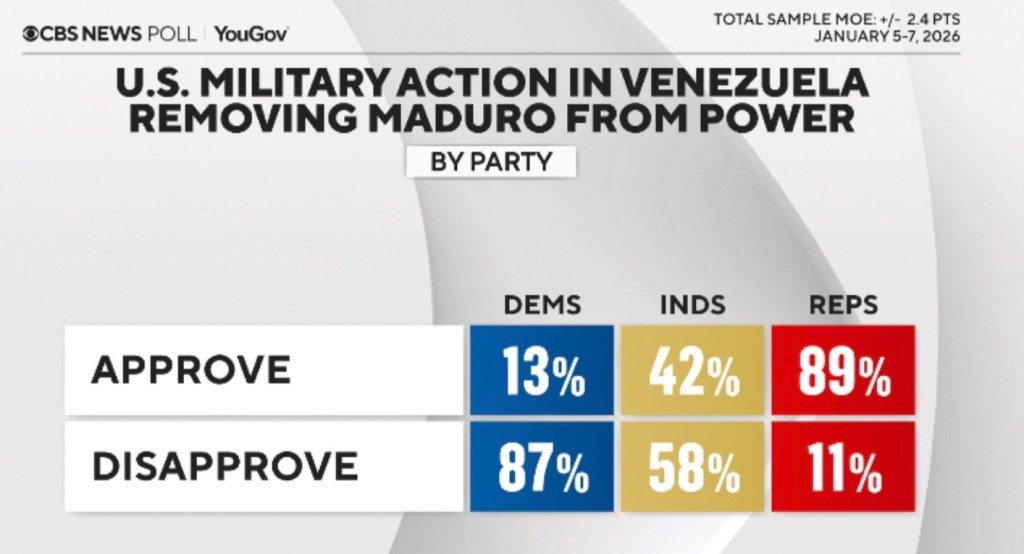
It appears that the administration did indeed ignore today’s deadline for congressional approval of the ongoing strikes against Venezuela, required under the 1973 War Powers Act. It is taking the position that no approval is necessary since, in its formulation, U.S. military personnel are not at risk in the strikes that have, so far, killed 65 people.
Jamelle Bouie is a columnist for The New York Times. He is my favorite. He has a broad and deep knowledge of politics and history. He writes about what he’s reading and what he’s cooking.
In this column, he explains that the Constitution prohibits any President from serving a third term. Since Trump loves to scoff at the Constitution, he’s been dropping hints that he will run again or maybe be president for life.
The polls are not encouraging. He currently is at 42% approval, and 52% disapproval. Polls can change, of course. But Trump is as impulsive, arrogant, and vengeful as ever.
Jamelle Bouie reminds us that it was Republicans who insisted on a two-term limit for the Presdency:
It does not come as a great surprise to see that less than a year into his second term in office, President Trump is already thinking about a third.
“I would love to do it,” he told reporters on Air Force One this week.
He has, in fact, been thinking about a third term for years.
“We’re going to win four more years in the White House,” he said in 2020. “And then after that, we’ll negotiate, right? Because we’re probably — based on the way we were treated — we are probably entitled to another four after that.”
And earlier this year, he told NBC News that he wasn’t “joking” about serving a third term. “There are methods which you could do it,” he said.
The obvious response to Trump’s musings is that the Constitution limits each president to two full terms. “No person shall be elected to the office of the president more than twice, and no person who has held the office of president, or acted as president, for more than two years of a term to which some other person was elected president shall be elected to the office of the president more than once,” reads the 22nd Amendment, ratified in 1951.
But allies of the president insist that there is a plan — a loophole — that might allow Trump to circumvent the Constitution and serve another four years or more.
“Trump is going to be president in ’28, and people just ought to get accommodated with that,” said Steve Bannon last week. “At the appropriate time, we’ll lay out what the plan is.”
This sounds plausible, but it is wrong. First, it treats the Constitution as a language game whose meaning depends less on the text, structure, history and purpose of the document and more on whether you can use the fundamental indeterminacy of language to brute-force your preferred outcome.
But that is not how you should read the Constitution, which isn’t a rigid set of instructions to be gamed by clever lawyers, but a political document meant to structure the rules of self-government in the United States. The 22nd Amendment was written to change one of those rules and limit the president’s term of office, regardless of the circumstances. Any apparent “loophole” is a mirage produced by a basic misunderstanding of what it is that the Constitution set out to accomplish. A quick look at the history and debate behind the amendment makes this clear.
Two terms in office had been the norm for American presidents since George Washington declined to stand for a third in 1796, instead handing the reins to his vice president, John Adams. In 1940, Franklin Roosevelt became the first president to run for and win a third term of office. He continued the streak in 1944, winning another term but dying in office just a few months after he delivered his fourth Inaugural Address.
In the following midterm elections, Republicans won a House and a Senate majority for the first time since the early 1930s. And at the top of the agenda for the 80th Congress was a constitutional amendment to make the two-term tradition a formal rule of American politics. Although this was a clear response to Roosevelt, congressional arguments in favor of the two-term limit emphasized the vast scope of presidential power and the threat it might pose to American democracy if left in the hands of one man over an extended period of time.
“If long tenure of office of the president was a threat to our republican form of government as stated by President Jefferson nearly 140 years ago, with his limited powers, small disbursements, small Army and Navy and a small number of appointees, how much greater must that threat be to our republican form of government and to the liberties of the American people today?” asked Representative John Marshall Robsion of Kentucky during floor debates over the amendment in 1947.
“I favor this proposed amendment,” said Representative John Jennings Jr. of Tennessee. “Only by its adoption can the people be assured that we shall never have a dictator in this land. Without such a limit on the number of terms a man may serve in the presidency, the time may come when a man of vaulting ambition becomes president.” Backed by a “subservient Congress,” continued Jennings, such a man “could well name to the Supreme Court of the United States men of his political faith and economic thinking” who could “sweep aside and overthrow the safeguards of the Constitution” and “overrule the settled states of law that have been declared and recognized for a hundred years.”
“Almost all of the rest of the world has slipped away from the foundations of freedom and skidded dangerously close to the shoals of executive domination, one-man rule, dictatorship and ruthless tyranny,” declared Representative Karl Earl Mundt of South Dakota. “Let us consolidate our gains in self-government by passing this resolution to prevent any president hereafter — Republican or Democratic — from perpetuating himself in office.”
The overriding concern among congressional supporters of the 22nd Amendment was to limit the president’s overall tenure of office. They did not parse the difference between service and election; they did not intend to create some special scenario by which, if a president followed the right steps, he could circumvent the restriction. They meant, simply, to restrict the president to two full terms for fear of what might be if presidential power fell into the wrong hands.
“To grant extended power to any one man would be a definite step in the direction of autocracy, regardless of the name given the office, whether it be president, king, dictator, emperor or whatever title the office may carry,” Senator Chapman Revercomb of West Virginia said during his chamber’s debate over the proposed amendment. “It would be a definite step toward the destruction of real freedom of the people.”
Yesterday I wrote that President Donald J. Trump’s celebration of his new marble bathroom in the White House was so tone deaf at a time when federal employees are working without pay, furloughed workers are taking out bank loans to pay their bills, healthcare premiums are skyrocketing, and Supplemental Nutrition Assistance Program benefits are at risk, that it seemed likely to make the history books as a symbol of this administration.
But that image got overtaken just hours later by pictures from a Great Gatsby–themed party Trump threw at Mar-a-Lago last night hours before SNAP benefits ended. F. Scott Fitzgerald’s 1925 novel The Great Gatsby skewered the immoral and meaningless lives of the very wealthy during the Jazz Age who spent their time throwing extravagant parties and laying waste to the lives of the people around them.
Although two federal judges yesterday found that the administration’s refusal to use reserves Congress provided to fund SNAP in an emergency was likely illegal and one ordered the government to use that money, the administration did not immediately do as the judge ordered.
Trump posted on social media that “[o]ur Government lawyers do not think we have the legal authority to pay SNAP,” so he has “instructed our lawyers to ask the Court to clarify how we can legally fund SNAP as soon as possible.” Blaming the Democrats for the shutdown, Trump added that “even if we get immediate guidance, it will unfortunately be delayed while States get the money out.” His post provided the phone number for Senate minority leader Chuck Schumer’s office, telling people: “If you use SNAP benefits, call the Senate Democrats, and tell them to reopen the Government, NOW!”
“They were careless people,” Fitzgerald wrote, “they smashed up things and creatures and then retreated back into their money or their vast carelessness or whatever it was that kept them together, and let other people clean up the mess they had made.”
This afternoon, Ellen Nakashima and Noah Robertson of the Washington Post reported that the administration is claiming it does not have to consult Congress to continue its attacks on Venezuela. The 1973 War Powers Act says it does.
In 1973, after President Richard M. Nixon ordered secret bombings of Cambodia during the Vietnam War, Congress passed the War Powers Resolution to reassert its power over foreign wars. “It is the purpose of this joint resolution to fulfill the intent of the framers of the Constitution of the United States and insure that the collective judgment of both the Congress and the President will apply to the introduction of United States Armed Forces into hostilities, or into situations where imminent involvement in hostilities is clearly indicated by the circumstances, and to the continued use of such forces in hostilities or in such situations,” it read.
On September 4, 2025, Trump notified Congress of a strike against a vessel in the Caribbean that he said “was assessed to be affiliated with a designated terrorist organization and to be engaged in illicit drug trafficking activities.” The letter added: “I am providing this report as part of my efforts to keep the Congress fully informed, consistent with the War Powers Resolution.”
Monday will mark 60 days from that announcement, but the administration does not appear to be planning to ask for Congress’s approval. It has been reluctant to share information about the strikes, first excluding senior Senate Democrats from a Senate briefing, then offering House members a briefing that did not include lawyers and failed to answer basic questions. The top two leaders of the Senate Armed Services Committee, Roger Wicker (R-MS) and Jack Reed (D-RI), have both said the administration has not produced documents, attack orders, and a list of targets required by law.
Representative Gregory W. Meeks (D-NY), the top Democrat on the House Foreign Affairs Committee, told Nakashima and Robertson: “The administration is, I believe, doing an illegal act and anything that it can to avoid Congress.”
T. Elliot Gaiser, who leads the Office of Legal Counsel under Trump, told a group of lawmakers this week that the administration is taking the position that the strikes on unnamed people in small boats do not meet the definition of hostilities because they are not putting U.S. military personnel in harm’s way. It says the strikes, which have killed more than 60 people, have been conducted primarily by drones launched off naval vessels.
Brian Finucane, who was the War Powers Resolution lawyer at the State Department under President Barack Obama and during Trump’s first term, explained: “What they’re saying is anytime the president uses drones or any standoff weapon against someone who cannot shoot back, it’s not hostilities. It’s a wild claim of executive authority.”
If the administration proceeds without acknowledging the Monday deadline for congressional approval, Finucane said, “it is usurping Congress’s authority over the use of military force.”
Thom Hartmann explains why the shutdown continues. The Republicans in the Senate have the votes to end it.
He writes:
— The GOP’s dirty little secret exposed, courtesy of Donald Trump: Republicans in the Senate could have ended the shutdown anytime they wanted. Ever since the shutdown started, I’ve been shouting into the wilderness that Senate Majority Leader Republican John Thune (who now holds the position Mitch McConnell held for so long) could reopen the government with the GOP’s so-called “clean continuing resolution” or “clean CR” any time he wanted. All it takes to suspend or even eliminate the filibuster rule — which is neither in the Constitution nor any law, but merely a Senate rule — is 51 votes. Republicans have 53 senators and the Vice President adds a 54th, so it shouldn’t be a particularly heavy lift. I pointed it out on Ali Velshi’s program, and a few days later Congressman Ro Khanna and I discussed it on my program; he went on to point it out over on Fox “News” (the host thought he was discussing reconciliation; they don’t hire the best and the brightest over there). But virtually none of the mainstream media have bothered to point out this simple reality; instead, they go along with the story that Republicans are essentially helpless victims of evil Democrats who are holding the nation hostage. Finally, though, Trump himself let the bomb drop in a posting on his Nazi-infested social media site, writing: “WE are in power, and if we did what we should be doing, it would IMMEDIATELY end this ridiculous, Country destroying ‘SHUT DOWN’… It is now time for the Republicans to play their ‘TRUMP CARD,’ and go for what is called the Nuclear Option — Get rid of the Filibuster, and get rid of it, NOW!” I’ve argued for years that the filibuster helps the GOP and special interests far more than Democrats, and Schumer, et al, should have nuked it years ago when they had the power to do so. Hell, it was originally put into the Senate rules back in the early 19th century to protect against the passage of legislation outlawing slavery! Thune could suspend the filibuster for a single bill or blow it up altogether; either would be an improvement over the status quo. Yes, it would enable Republicans to pass more of their toxic and destructive legislation over the short term, but it would — importantly — also let Americans see the unvarnished consequences of Republican policies. And when Democrats come back into power, they could get a lot more done without the filibuster, including rolling back Citizens United and establishing an absolute right to vote. Let your Republican senators know (202-224-3121) they should take Trump’s advice and end the filibuster!
— Epstein, Rubio, or ego? What’s really behind Trump’s Venezuela madness? What the hell is going on with Trump’s provocations against Venezuela? It sure looks like he’s trying to gin up a war or regime change, neither of which are popular with the American people or consistent with Trump’s outspokenly loud anti-interventionist anti-nation-building campaign rhetoric. And he’s trying to do it the same way he tore down the East Wing of the White House: in secret until it’s such a done deal that nobody can undo it. But why? I’ve posited that — like Reagan and both Bush presidents — he thinks he needs a “little war” to distract us from his crimes, corruption, Epstein, and the weakness of the economy. But it’s also possible that this is being driven by Secretary of State “Lil” Marco Rubio and Secretary of Defense “Whiskey Pete” Hegseth. Rubio rose to political power in Florida by lying for years that his parents were Cuban refugees who fled Castro and communism (in fact, they came to the US in May, 1956, more than 2 years before the Cuban revolution), and has long harbored anti-Latin-communist sentiments. It’s entirely possible that he still nurtures presidential aspirations and thinks taking down Maduro might be his ticket to the GOP nomination in 2028 (assuming there’s an election that year). Hegseth is a dry (?) drunk apparently doped up on testosterone who gets giddy every time he can use the words “lethal” or “kill” in a sentence; it’s a safe bet that he’d be orgasmic over the chance to murder more than just a few dozen people in small boats. Yesterday, the Miami Herald reported: “The Trump Administration has made the decision to attack military installations inside Venezuela and the strikes could come at any moment, sources with knowledge of the situation told the Miami Herald…” Adding to the intrigue, the DOD gave a secret briefing to the Senate Intelligence Committee and — get this — only allowed Republicans into the room. The committee’s senior Democrat, Mark Warner, called the unprecedented decision by Republicans “bullshit” and over in the House, where Democrats were allowed in, Democrat Seth Molton said: “What I heard here today was a tactical brief. I heard no strategy, no end game, no assessment of how they are going to end the flow of drugs into the United States…” Every day it seems more and more evident that this has little to nothing to do with drugs, which raises the question: “Why?” Why take such a chance by attacking a country with mutual defense agreements with Russia and China? Why risk war in our hemisphere? Why put our soldiers, sailors, marines, and airmen at such risk? Is it Epstein? Rubio‘s ambitions? Inquiring minds — and American patriots who care about our military and our reputation around the world — want to know.
— Trump’s new refugee policy: white, wealthy, and welcome. In a major change of a refugee policy that stretches back to the 1920s, the Trump administration has announced that only 7,500 people will be allowed into the US this year, and priority won’t go to Afghans who helped our troops or brown immigrants who’ve served in America’s military. Instead, the entire front of the line will be filled by white South Africans like Elon Musk’s father (who was in Moscow this week for a party with Putin). The white supremacy credentials of the Trump administration — including widespread layoffs of Black employees — are now absolutely impeccable.
— Hispanics not welcome either, unless they worked for one of Trump’s shabby golf motels. Alejandro Juarez illegally crossed the US border 22 years ago, and soon thereafter became one of Trump’s many undocumented workers (like the Poles who built Trump Tower, for example). ICE picked him up a few weeks ago and put him on a deportation flight to Mexico before, apparently, somebody from the Trump organization noticed he was missing. DHS is now frantically trying to find the valued worker and bring him back to the US so he can apply for long-term residency and a work permit. Irony of ironies…
— “Judge Boxwine” Pirro, recently recruited from Fox “News” for a federal judgeship, apparently demanded prosecutors delete the word “mob” to describe a member of the mob that attacked the US Capitol on January 6th. George Orwell famously wrote, “Those who control the present, control the past and those who control the past control the future.” It now appears that we’re falling deeper and deeper into an Orwellian world where Trump redefines the past so he can rewrite the future, much as the remnants of the Confederacy did with their Lost Cause mythology when Reconstruction collapsed in 1877. Pirro won’t explain why the description was excised, nor why the two prosecutors who wrote it into a sentencing recommendation have been relocated, perhaps in anticipation of being fired. But anybody with half a brain can figure this one out…
— Tear gassing trick-or-treaters: Noem’s new definition of American values. Puppy killer Noem refused to pause operations in Chicago so children can trick or treat. What have we become? Brutal is probably a good word, to begin with. In another example of the Trump regime’s frantic efforts to harass, imprison, and deport brown people — and perhaps to gin up an insurrection that could justify suspending elections — Noem denied Illinois Governor Pritzker’s request to hold off on the tear gas and masked terror operations for Halloween. When ICE recently raided a Chicago apartment building, they then trashed multiple apartments, ripping up furniture, smashing windows, breaking and scattering possessions, and removing and carting away phones and laptops. No warrants signed by judges were presented and one ICE thug, when asked about the shivering zip-tied American citizen kids standing in the freezing cold, said, “Fuck the children.” Setting aside the invocation of Epstein (and Trump?) the phrase immediately brings to mind, the brutal sentiment appears to be one embraced by ICE Barbie herself…
— From firebrand to outcast: Marjorie Taylor Greene’s midlife MAGA crisis. What’s happening with MTG? The MAGA firebrand appears to be undergoing some sort of a conversion experience, most recently calling out “pathetic Republican men” who she says are essentially telling her to sit down and shut up. Prior to that, she posted on social media: “Democrats did this with Obamacare 15 yrs ago and Johnson says Republicans have a mystery plan that is yet to be revealed to fix it. But no one knows what it is and we’re told to stay home in our districts.” Either Greene is in trouble politically in her district as she looks at an upcoming primary or next year’s midterm election, or she’s finally figured out that she’s been being played for a sucker by Trump and his Republicans all these years (along with so many others) and is no longer willing to play the game. I’ve invited her on my program for a friendly discussion; we’ll see if she shows up…
Heather Cox Richardson draws together the seams of a story that is unfolding piece by piece. Trump’s popularity is plummeting; he is obsessed with his poll numbers. At the same time, he is assembling military forces to control Democratic-run cities where there are no riots, no disorders that can’t be handled by local police. Does he really believe that the nation’s cities are engulfed by a massive crime wave?
The only terrifying development that she did not include in her summary is Trump’s declaration that he intends to resume nuclear testing, a practice abandoned in 1992.
As I read her piece below, I was reminded that Trump said at a rally, “Vote for me now, and you will never have to vote again.” He often says the quiet part out loud.
House speaker Mike Johnson (R-LA) continues to try to pin the upcoming catastrophic lapse in Supplemental Nutrition Assistance Program (SNAP) funding on the Democrats. But with the U.S. Department of Agriculture sitting on $6 billion in funds Congress appropriated for just such an event, the Treasury finding $20 billion to prop up Trump ally Javier Milei in Argentina, Johnson refusing to bring the House into regular session to negotiate an end to the government shutdown, and President Donald J. Trump demanding $230 million in damages from the American taxpayer, bulldozing the East Wing of the White House to build a gold-plated ballroom that will dwarf the existing White House, and traveling to Asia, where South Korean leadership courted him by giving him a gold crown and serving him brownies topped with edible gold, blaming any funding shortfall on Democrats is a hard sell.
According to a Washington Post–ABC survey, more Americans blame Trump and congressional Republicans for the shutdown than blame Democrats by a margin of 45 to 33, and Trump’s approval rating continues to move downward, with the presidential approval average reported by Fifty Plus One at 41.3% approval and 55.1% disapproval, a –14 split. G. Elliott Morris of Strength in Numbers noted on October 24 that polls show Americans now trust Democrats more than Republicans to handle the economy well.
Trump ran in 2024 with a promise to bring down inflation, which was then close to the Federal Reserve’s target of 2.0%; now core inflation is at 3%, having gone up every month since April. Halloween candy—on people’s minds today—is at 9.8% inflation and costs 44% more than it did in 2019. Federal Reserve Board chair Jerome Powell sure sounded like he was describing stagflation—a condition when the economy stagnates despite inflation—when he said yesterday: “In the near term, risks to inflation are tilted to the upside, and risks to employment to the downside, a challenging situation.”
Treasury Secretary Scott Bessent said today that while the stock market has done well this year, a better economy is going to “start flowing through to working Americans next year.”
Meanwhile, on Tuesday, in a rambling and disjointed speech in Japan, Trump told U.S. military personnel that he is federalizing National Guard troops and sending them into Democratic-led cities “because we’re going to have safe cities.” In the same speech, Trump repeatedly attacked former president Joe Biden and insisted yet again that the 2020 presidential election was rigged. (It was not.)
When asked by a reporter later to clarify his remarks, Trump referred back to the Insurrection Act, saying that if he invoked it, “I’d be allowed to do whatever I want. But we haven’t chosen to do that because we’re…doing very well without it. But I’d be allowed to do that, you understand that. And the courts wouldn’t get involved. Nobody would get involved. And I could send the Army, Navy, Air Force, Marines. I can send anybody I wanted.”
In fact, a president can invoke the accurately named Insurrection Act only in times of insurrection or rebellion. Neither of those conditions exists.
But the administration is working hard to create the impression that they do. Drew Harwell and Joyce Sohyun Lee of the Washington Post reported yesterday that the videos the Department of Homeland Security has been publishing to demonstrate the administration’s triumph over crime in U.S. cities as its agents work “day and night to arrest, detain and deport vicious criminals” have been doctored. They do not represent current actions, but rather are a hash of video from different states and different times.
When the reporters asked the White House about the misleading footage, spokesperson Abigail Jackson told them that “the Trump administration will continue to highlight the many successes of the president’s agenda through engaging content and banger memes on social media.”
There are signs the administration is not just trying to give the impression that Americans are rioting, but is trying to push them to do so.
Aaron Glantz of The Guardian reported yesterday that on October 8, Major General Ronald Burkett, who directs the Pentagon’s National Guard bureau, ordered the National Guard in all the states, U.S. territories, and the District of Columbia to form “quick reaction forces” trained in “riot control.” Most states are required to train 500 National Guard personnel, for a total nationwide of 23,500. The forces are supposed to be in place by January 1, 2026.
In his order, Burkett relied on an executive order Trump signed on August 25, calling on the secretary of defense to “immediately begin ensuring that each State’s Army National Guard and Air National Guard are resourced, trained, organized, and available to assist Federal, State, and local law enforcement in quelling civil disturbances and ensuring the public safety and order,” and “ensure the availability of a standing National Guard quick reaction force that shall be resourced, trained, and available for rapid nationwide deployment.”
In August the administration planned for two groups of 300 troops to be stationed in Alabama and Arizona as a “Domestic Civil Disturbance Quick Reaction Force.” Now that number is 23,500, and the troops will be in every state and territory.
The establishment of a domestic quick reaction force to quell civil disturbances at a time when there are no civil disturbances that can’t be handled easily by existing law enforcement suggests the administration is expecting those conditions to change.
That expectation might have something to do with Monday’s story from Anna Giaritelli of the Washington Examiner that the White House is reassigning ICE field officers and replacing them with officers from Customs and Border Patrol (CBP). Greg Wehner and Bill Melugin of Fox News reported that the shift will affect at least eight cities, including Los Angeles, San Diego, Phoenix, Denver, Portland, Philadelphia, El Paso, and New Orleans.
White House officials, presumably led by White House deputy chief of staff Stephen Miller, who has said the administration intends to carry out “a minimum” of 3,000 arrests a day, are frustrated by the current pace of about 900 a day. So those officials, including Homeland Security Secretary Kristi Noem, special government employee and Noem advisor Corey Lewandowski, and Greg Bovino, a Border Patrol sector chief who has been overseeing the agency’s operations in Los Angeles and Chicago, have decided to ramp up those deportations by replacing ICE officials with far more aggressive CBP leaders.
Tripling arrests will likely bring pushback.
Michael Scherer, Missy Ryan, and Ashley Parker of The Atlantic reported today that political appointees Stephen Miller, Kristi Noem, Defense Secretary Pete Hegseth, and Secretary of State Marco Rubio have moved onto military bases.
The designs of the anti-immigrant leaders in the administration dovetail with Trump’s political designs. Trump has talked a lot about serving a third term in the presidency, most recently talking about it to reporters on Air Force One earlier this week. The Twenty-Second Amendment to the Constitution prohibits a third term, but Trump ally Stephen Bannon told The Economist last week that “Trump is going to be president in ‘28 and people just ought to get accommodated with that.” Bannon claimed, “There’s many different alternatives” to get around the Twenty-Second Amendment. Trump keeps “Trump 2028” campaign hats on bookshelves outside the Oval Office.
Janessa Goldbeck, the chief executive officer of the nonprofit Vet Voice Foundation, told Guardian reporter Glantz that Burkett’s recent order shows “an attempt by the president to normalize a national, militarized police force.” Such a force has not just military but also electoral power: it could be used in Democratic-led states to suppress voting. In a worst-case scenario, Goldbeck said, “the president could declare a state of emergency and say that elections are rigged and use allegations of voter fraud to seize the ballots of secure voting centers.”
Today, Buckingham Palace announced that King Charles has “initiated a formal process to remove the style, titles and honours of Prince Andrew” over his relationship with convicted sex offender Jeffrey Epstein and participation in activities surrounding Epstein. Andrew will be stripped even of his title of “prince” and will be forced to leave the home he has shared for more than 20 years with his ex-wife, Sarah Ferguson, at Royal Lodge, a 30-room mansion located in Windsor Great Park. The palace said: “These censures are deemed necessary, notwithstanding the fact that he continues to deny the allegations against him.”
Today Jim Acosta reported that survivors of Epstein’s sex trafficking enterprise have written a letter to Speaker Johnson demanding that Representative-elect Adelita Grijalva (D-AZ) be sworn into office. Voters elected Grijalva on September 23, but Johnson has steadfastly refused to swear her in. Grijalva has said she will provide the last signature necessary on a discharge petition to force a vote on the public release of the Epstein files, an outcome that threatens to expose how and why Trump was named in those files.
The survivors write that Johnson’s “continued refusal to seat her is an unacceptable breach of democratic norms and a disservice to the American people. Even more concerning to us as survivors, this delay appears to be a deliberate attempt to block her participation in the discharge petition that would force a vote to unseal the Epstein/Maxwell files. The American public has a right to transparency and accountability, and we, as survivors, deserve justice. Any attempt to obstruct a vote on this matter—by manipulating House procedure or denying elected members their seats—is a direct affront to that right and adds insult to our trauma.”
If you’re reading this, you feel it. You see federal troops on American streets as a political tool. You see a multi-front assault on our elections. You see the machinery of government — from a supercharged ICE to a weaponized Department of Justice — being wielded against those the regime dislikes. You see courts wavering, Congress cowering, and other institutions choosing accommodation over confrontation. The danger is real, and the exhaustion is profound.
But it’s not just the individual threats that weigh on us. It’s the sheer volume. The autocrat’s playbook isn’t just about single acts of repression; it’s about creating a dozen crises at once. This is not incompetence; it is a strategy. As strategists from Sun Tzu onward have counseled, stretch an opponent’s defenses, exhaust them, and strike where they are then unprepared. By flooding the zone with outrages, they keep us perpetually reactive, divided, and off-balance. Our attention is their battleground, and they are winning by forcing us to fight on a thousand fronts at once.
The goal of this chaos is twofold. First, to spread us thinly so our responses are less effective. Second, to exhaust us and make the defense of democracy feel so futile that its defenders simply give up. Despair is a political weapon.
I’m not writing to tell you that you’re wrong to feel this way. I’m writing to tell you that this feeling is a designed part of the assault we’re facing. And I’m writing to tell you that we are not the first to stand in this spot, staring into what looks like an abyss. In the history of those who came before us, we can find a map not for a specific strategy but for a resilient mindset.
The long defeat as enduring hope
The phrase “the long defeat” comes from J.R.R. Tolkien, who has Galadriel speak of “fighting the long defeat” in The Lord of the Rings. That evil may never be fully vanquished and therefore that even victories against it are temporary. For Tolkien, a devout Catholic, it carried a tragic but defiant realism: History is a process of entropy, yet the fight for beauty, justice, and truth is still worth waging.
Over time, the idea that even in a period of decline doing the right thing remains a strategic and moral imperative has migrated from literature into political and theological commentary. Dissidents under Soviet rule, activists resisting authoritarianism, and modern democratic leaders have invoked versions of this concept to capture the paradox of resistance.
Victory may lie invisibly over some horizon, or may never be final. Setbacks are inevitable, and yet the very act of persevering is itself a form of hope.
To “fight the long defeat” is not to surrender to futility but to locate dignity and meaning in the struggle itself — and to recognize that what feels like defeat in one moment may seed the victories of another. Indeed history is replete with examples.
Lessons from a Polish winter
Consider Poland in the winter of 1981. The vibrant Solidarity movement was met with martial law. (If you don’t know the history of Solidarity, we’re planning to write about it later this week — stay tuned.) Its leaders were jailed; its organization shattered.
The pro-democracy cause appeared utterly defeated by the full weight of a Soviet-backed state.
What did they do when open confrontation became impossible? They didn’t stop. They began a patient, underground campaign — sustained organizing, covert communications, and cultural work that kept civic life alive. They understood that when you cannot win on the state’s terms, you must refuse to let the state define the terms of reality. They focused on keeping the idea of a free Poland alive. Through underground publishing and clandestine lectures — continuing traditions like the “Flying University” — they maintained a shared understanding of truth in the face of a regime dedicated to lies.
For roughly eight years they persisted. They were not just an opposition; they were the custodians of a democratic ideal. When a crack in the regime appeared in 1989 — with the Round Table Talks and semi-free elections — they were ready because they had never surrendered the moral and intellectual foundations of a free society.
Their lesson for us is this: When the machinery of the state is captured, the most critical ground to defend is our shared commitment to truth and democratic values. Doing so is necessary to be ready to seize the opening when it inevitably comes.
Clarity in our own history
We can find a similar lesson in our own history. Think of the lawyers and activists of the Civil Rights Movement in the 1950s and ’60s. They faced a legal and political system built to exclude them. The courts, the police, and the law itself were instruments of a brutal racial hierarchy.
Every institution that was supposed to deliver justice was instead architected to deny it. Their response was not to meet every injustice with a scattered, reactive defense
It was to maintain an unwavering focus on the core principle at stake: the moral and constitutional bankruptcy of segregation. They possessed profound strategic patience, persistence, and powerful moral clarity. Their fight reminds us that in an environment of institutional failure and constant attack, the most potent weapon is a disciplined focus on the fundamental principles being violated.
But history also shows that change can come with surprising speed. Consider the movement for marriage equality in the immediate aftermath of the 2004 election. Voters approved bans in 11 states that year, amending constitutions to prohibit same-sex marriage, and President George W. Bush — who supported a federal marriage amendment — was reelected. The political consensus was so strong that even in 2008, the Democratic nominee for president recanted his previous support for marriage equality. Yet within just a few years, everything shifted: in 2011 the Obama administration stopped defending the Defense of Marriage Act in court; in 2012 the president endorsed marriage equality; and public opinion moved rapidly until marriage equality was recognized in the Constitution. While we know that victory is now facing its own backlash, that moment is a powerful reminder that political winds can shift with breathtaking speed.
A moment of seeming hopelessness can be the prelude to a breakthrough.
A mindset for a hard moment
The history of these movements does not offer us an easy comfort or a simple to-do list. It offers us a way to think, a framework for how to situate ourselves and endure.
Find the signal in the noise — We must resist the autocrat’s strategy of distraction. We cannot respond en masse to every fire. Instead, we must anchor our work in the foundational principles at stake: the rule of law, the integrity of elections, and the ultimate sovereignty of a free people. By focusing on the core pillars of democracy, we refuse to have our attention fragmented and our energy dissipated.
Cultivate strategic readiness — This isn’t just about passively enduring a long winter. It is about actively preparing for a change in the weather and doing what we can to bring it about. We cannot ultimately control when the political winds will shift or when an unexpected event will create an opportunity. But we can control our readiness. The work of a hard moment is to get the sails ready. It is the time to lay the legal groundwork, build the coalitions, refine the strategies, and organize the resources. Our task is to be so prepared that when a crack of daylight appears, we are ready to sail through it with maximum force and not be caught scrambling.
Uphold a common truth — In an era of rampant disinformation, the simple act of insisting on objective reality is a profound form of resistance. The authoritarian project depends on breaking our collective understanding of facts. By committing ourselves to defending the institutions and norms that discern truth — in journalism, in science, in law — we are defending the very possibility of a self-governing society.
Bolster each other — In moments that feel like we’re spiraling backwards, when the forces of unfreedom are on the march, a common tendency is for the forces of freedom to fall into infighting. Rather than gaining strength from each other, our fears and anxieties and anger lead us to turn on each other. But in that reaction are the seeds of ultimate defeat; whereas movements that come together in times of adversity water the seeds of renewal.
There is no question we are being tested — as a country, as a movement, and as individuals. But we are not the first to have faced such tests and we will not be the last. Many who preceded us faced tests like this and even harder ones, and we have their example to remind us that whatever happens, no matter how dark the night, the world keeps turning and eventually comes the dawn.
Personally, I’m more optimistic than Tolkien. I don’t think human history bends towards decay. I’m partial to Martin Luther King’s vision that it bends towards justice. But what’s powerful about the idea of the long defeat is that it is agnostic about one’s optimism or pessimism — it simply reminds us that the task of being human (or elf) is to do right and to do good and to embrace beauty where we can find it.
And if I can play my small role in lifting you up in this difficult moment, it’s to remind us all to remember that. And to act on it.