Archives for category: Extremism

Since the Florida Supreme Court released dual decisions about abortion, there’s been some confusion. Five of the seven justices were appointed by DeSantis.

One decision upheld a fifteen-week ban on abortion, with the understanding that it would be superseded on May 1 by a six-week ban, already signed into law by Governor DeSantis. A six-week ban is the equivalent of a total ban, since few (if any) women realize they are pregnant at that point. The ban was approved by a vote of 6-1.

The second decision allowed a referendum this November that would guarantee the protection of abortion rights in the state constitution. This decision was approved by a vote of 4-3.

Are these two decisions in conflict? Well, yes. And there is a catch. The state constitution includes a guarantee that “all natural persons’ have a right to life and liberty.” Are fetuses “natural persons?” Some of Florida’s Supreme Court justices think so.

Our reader Democracy espies a scheme behind the scene:

In the oral arguments over the Florida abortion amendment to the state constitution, the chief justice of the Florida Supremes – Carlos G. Muñiz – asked specifically about fetal rights. As Bloomberg reported,

“Florida Supreme Court Chief Justice Carlos G. Muñiz asked during Feb. 7 oral arguments on an amendment that would protect abortion in the state whether the Florida Constitution’s guarantee that all ‘natural persons’ be ‘equal before the law’ can apply to fetuses. Muñiz questioned whether justices must first decide this before determining whether the proposed amendment protecting abortion until fetal viability was misleading.”

Meredith L. Sasso, a DeSantis appointee, raised the issue of fetal rights in voting NOT to allow the amendment on the ballot.  Renatha Francis, another DeSantis appointee, did the same.

Jamie R. Grosshans, ALSO appointed by DeSantis, wrote the opinion finding that in Florida privacy does NOT apply to abortion, also said this when voting AGAINST the abortion amendment’s placement on the ballot:

“The voter may think this amendment results in settling this issue once and for all. It does not.”

Is it too cynical to believe that the Florida Supreme Court would approve a referendum that they intend to invalidate?

Columbia University emerged as the national epicenter of student (and faculty) protests against Israel in its war against Hamas. William McGurney of the Wall Street Journal reported on a notable contradiction:

Meet the surprising president-elect of the student body of the School of General Studies, one of Columbia University’s four undergraduate colleges. Her name is Maya Platek. She is a proud Israeli who once worked for the Israel Defense Forces spokesperson’s unit.

Anyone watching the goings-on at the university’s Morningside Heights campus these past two weeks might easily mistake Columbia for a wholly owned subsidiary of Hamas Inc. Ms. Platek’s election throws a wrench into the protester narratives. It signals that at least some at Columbia want students to be able to walk the campus without harassment—and life to get back to normal.

“I am always willing to listen,” Ms. Platek says, “but also very good at speaking up when I think something’s wrong.”

She isn’t shy either. Ms. Platek is a member of Students Supporting Israel, a national organization whose mission is “to be a clear and confident pro-Israel voice on college campuses.” It also aims for something Columbia plainly needs: “to reassure students who oppose the demonization of the State of Israel on campus that they are not alone.”

This isn’t Ms. Platek’s first rodeo. In October, she posted a petition onChange.org seeking to remove Joseph Massad, a Columbia professor who teaches modern Arab politics and intellectual history. She directed attention to his Oct. 8 article for an online publication called the Electronic Intifada celebrating the “stunning victory” against Israel the day before.

Mr. Massad is still there, a melancholy fact several congressmen brought up during Columbia President Nemat Shafik’s grilling two weeks ago before the House Education Committee. But Ms. Platek’s petition fleshed out what people mean when they complain that Columbia tolerates antisemitism.

In a speech captured on video a few months back, Ms. Platek spoke about Columbia students and faculty who “manipulate history in order to demonize” Jews. She made clear she isn’t intimidated.

“They choose to advocate for our removal off of this campus over our nationality,’’ Ms. Platek said. “That is discrimination. They choose to regurgitate Nazi Germany’s talking points. They choose to argue that they are righteous to advocate for our death. Wake up!”

In most of America, her objections wouldn’t be controversial. At Columbia they are bracing. They are also a refreshing counterweight to the crowds chanting “Globalize the intifada!” and “From the river to the sea, Palestine will be free!”

Rick Perlstein writes in The American Prospect about a conversation with a friend who is a journalist in Texas. His friend describes how his native state is run by men who are determined to stamp out every last vestige of democracy in Texas. The Republican Party keeps moving to the extreme and crushing reasonableness and sanity. The result is a fascist state where all power is concentrated in the hands of Gregg Abbott, Dan Patrick, and far-right fascists.

Perlstein writes:

I made a friend a few years back, a young journalist at a newspaper in a smaller Texas city, bored with his work and seeking out conversation on the kind of things I write about. As time went on, however, he just wanted to talk about escape. “A local city I cover, as a matter of habit, appeals every single public records request,” went a typical plaint. “In a state that hasn’t completely lost its mind, maybe the solution is to reach out to the AG’s office. Except in Texas, you’re trying to get an indicted man who might have helped with January 6 to act on behalf of the public.”

At the end of that year, he approached me on the horns of a dilemma: take a job offer as a beat reporter at a daily in a big Texas city, or quit journalism and find some job at a do-gooder nonprofit. The guy’s dog was named “Molly Ivins.” I told him I didn’t think he had much choice. Alas, he took this graybeard’s advice. Things since have been hardly more rewarding.

One day: “Working on a deep dive into how the state of Texas fails to protect intellectually disabled people from predatory guardians. Depressing stuff.”

Another day: “A thing that really irks me about covering conservative dustups is how profoundly dishonest the whole thing is … When it comes time to write, you have two options. Either cut through the BS and call it what it is; then they’ll tell you you’re just biased. Or you can try to finesse it and sound insane.”

Another: “I also just finished a story about how domestic violence homicides are through the roof in Texas (even as overall homicide rates have declined), but we don’t have the infrastructure to really know how bad conditions have become. It turns out when you turn women into second-class citizens and make guns easily accessible, that doesn’t go well.”

A couple of weeks back, he shared with me a dark epiphany: He no longer felt hope. Thought it might be high time to get the hell out of his native state forever. He asked if there was anything out there that gave me hope. Having reached the “Forget it, Jake, it’s Chinatown” stage of my relationship with the United States (in part thanks to his testimony from the front lines), I had no comfort to offer.

I did, however, have a suggestion. He could tell me about what all this was like. I could let you listen in. Forthwith, an edited and annotated transcript of my conversation with a man I’ll call Lonely Star. Though it’s not so much that he’s lonely; he has manyanguished compatriots who feel the same way. It’s just that they feel like there’s less they can do about it with every passing day.

Please open the link and read their conversation. It’s enlightening and frightening.

Robert Hubbell summarizes Trump’s goals, as he explained them to TIME magazine in an interview. They sound remarkably fascistic. All power to the imperial President. No checks or balances. Remember and ask yourself: is this the country we want to live in? I suppose we should be glad that Trump is turning 80 this year. With any luck, he won’t have time to abolish the Constitution and make himself President-for-life.

Hubbell writes:

On a day of many important stories, the most important news came from Donald Trump’s interview with Time Magazine. See Donald Trump on What His Second Term Would Look Like | TIME. In the interview, Trump confirmed that he will attempt to exercise dictatorial powers in a second term.

We have been warned.

We ignore Trump’s threats at our peril and the peril of our democracy.

In describing his fever dream of autocratic powers, Trump said he would take (or allow) the following actions:

  • Allow states to monitor the pregnancies of women to ensure they comply with abortion bans (a grotesque violation of liberty, privacy, and dignity).
  • Fire US attorneys who refuse to prosecute defendants targeted by Trump (a violation of US norms dating to the creation of the Department of Justice).
  • Initiate mass deportations of alleged illegal immigrants using the US military and local law enforcement (neither of which are authorized to enforce US immigration law).
  • Pardon insurrectionists who attacked the Capitol on January 6.
  • Prosecute President Biden (for unspecified and non-existent crimes).
  • Deploy the National Guard to cities and states across America—likely those with predominately Democratic populations (presumably under the Insurrection Act, a deployment would violate the terms of the Act and implementing regulations).
  • Withhold funds from states in the exercise of his personal discretion (a violation of the Impoundment Control Act of 1974).
  • Abandon NATO and South Asian allies if he feels the countries are not paying enough for their own defense.
  • Shutter the White House pandemic-preparedness office.
  • Fire tens (hundreds?) of thousands of civil servants and replace them with Trump acolytes with dubious qualifications (other than loyalty to Trump).

Most readers of this newsletter understand the seriousness of Trump’s threats and are working tirelessly to prevent a second Trump term. But tens of millions of Americans seem oblivious or apathetic in the face of an imminent and dire threat.

If elected, will Trump succeed in achieving any of his stated goals? No—not if Democrats continue their resistance in the courts, in Congress, in state legislatures, and in the hearts and minds of most Americans.

However, whether Trump succeeds in achieving his stated objectives is beside the point. He will attempt to do so—and his attempts will tear at the fabric of democracy and destroy legal norms that have served as the bedrock of our republic since its founding.

To be clear, I am not attempting to frighten readers of this newsletter. To the contrary, I believe that we can and will defeat Trump—or outlast him, whatever it takes. But the interview confirms that we are not frantic alarmists exaggerating the threat posed by Trump.

No, far from it.

When we challenge the milquetoast, both-siderism reporting of the media or the normalization of Trump by spineless politicians, we are not overreacting. We are sounding the alarm in a responsible, necessary way. For reasons that defy comprehension, our warnings have been unheeded—often dismissed, minimized, or patronized.

We must redouble our efforts. Commit the above list to memory. Copy the URL so you can forward this newsletter or the Time Magazine article to friends, colleagues, and complete strangers who doubt that Trump is a danger to democracy. Pick two or three issues and be prepared to discuss them when the moment arises. We have been warned—and we must act accordingly. 

Florida’s six-week ban on abortion went into effect today.

A reader who calls him/herself Quickwrit posted the following excellent thoughts about anti-abortion laws:

THE NINTH AMENDMENT that gives Clarence Thomas the constitutional right to live in an interracial marriage also gives women the constitutional right to abortion: The 9th Amendment says that rights, like the right to interracial marriage and the right to abortion, do not have to be stated in the Constitution in order to be constitutional rights because The Ninth Amendment says: “The enumeration in the Constitution of certain rights shall not be construed to deny or disparage others retained by the people.”

The current Supreme Court ruling on abortion not only violates the 9th Amendment, it violates the religious rights of many citizens. The ruling is supportive of the teaching of the Roman Catholic Church to which the six majority Justices belong.

The Bible gives commandments on a very, very long list of more than 600 laws on everything from divorce to gluttony or stealing — yet the Bible says nothing about abortion. Why is that? If abortion was even as important as gluttony and stealing, it would have been mentioned in the Bible.

Out of more than 600 laws of Moses, which includes the 10 Commandments, NONE — not one — comments on abortion. In fact, the Mosaic law in Exodus 21:22-25 clearly shows that causing the abortion of a fetus is NOT MURDER. Exodus 21:22-25 says that if a woman has a miscarriage as the result of an altercation with a man, the man who caused miscarriage should only pay a fine that is to be determined by the woman’s husband, but if the woman dies, the man is to be executed: “If a man strives with a woman with child, so that her fruit depart from her, and yet there is no harm to the woman, he shall be punished according to what the woman’s husband determines and he shall pay as the judges determine.” So, the miscarriage is treated like the destruction of property, not murder.

There are Christian denominations that allow abortion in most instances; these Christian denominations include the United Church of Christ and the Presbyterian Church USA. The United Methodist Church and Episcopal churches allow abortion in cases of medical necessity, and the United Universalist Association also allows abortion.

Most of the opposition to abortion comes from fundamentalist and evangelical Christians who believe that a full-fledged human being is created at the instant of conception. But that is a religious BELIEF and religious beliefs cannot be recognized by the government under the Establishment Clause of the First Amendment of our Constitution. Moreover, the belief that a fetus is a human person, complete with a soul, is a Christian interpretation of the Jewish Bible — the Old Testament. But, Jewish scholars whose ancestors wrote the Old Testament and who know best what the words mean say that is a wrong interpretation of their writings.

Christians largely base their view that a fetus is a complete human being and that abortion is murder on the Jewish Bible’s Psalm 139: “You knit me together in my mother’s womb…You watched me as I was being formed in utter seclusion as I was woven together in the dark of the womb. You saw me before I was born.”

But who better to translate the accurate meaning of Psalm 139 than the Jews who wrote it? And Jewish scholars point out that Psalm 139 merely describes the development of a fetus and does not mean that the fetus has a soul and is a person. In fact, the Jewish Talmud explains that for the first 40 days of a woman’s pregnancy, the fetus is considered “mere fluid” and is just part of the mother’s body, like an appendix or liver. Only after the fetus’s head emerges from the womb at birth is the baby considered a “nefesh” – Hebrew for “soul” or “spirit” – a human person.

The idea that full-fledged human life begins at conception is a sectarian religious belief that isn’t held by the majority of religions, including a number of mainstream Christian religions.

Therefore, any local, state, or federal law that holds that full-fledged human life begins at conception is unconstitutional because such laws are made in recognition of an establishment of religion and violate the Establishment Clause of the First Amendment.

THE COURT BENDS THE FACTS: The University of London scientist whose research is cited by the Supreme Court in its ruling to take away abortion rights says that his research has been misinterpreted by Justice Alito and the Supreme Court’s activist conservative majority. Neuroscientist Dr. Giandomenico Iannetti says that the Court is ABSOLUTELY WRONG to say that his research shows that a fetus can feel pain when it is less than 24 weeks of development. “My results by no means imply that,” Dr. Iannetti declares. “I feel they were used in a clever way to make a point.” And Dr. John Wood, molecular neurobiologist at the University, points out that all serious scientists agree that a fetus can NOT feel pain until at least 24 weeks “and perhaps not even then.” Dr. Vania Apkarian, head of the Center for Transitional Pain Research at Chicago’s Feinberg School of Medicine, says that the medical evidence on a fetus not feeling pain before 24 weeks or longer has not changed in 50 years and remains “irrefutable”.

LIFE OF WOE: In its 1973 Roe v. Wade ruling upholding abortion rights, the Supreme Court set “viability” — the point at which a fetus can survive outside of the womb — as the dividing line after which some restrictions can be imposed on abortion rights. The pending ruling by current activist conservative majority on the Court will do away with the concept of viability, yet even with all of today’s medical miracles to keep a prematurely born or aborted fetus alive, of all the tens of thousands of cases, 90% OF FETUSES BORN AT 22 WEEKS DO NOT SURVIVE, and data shows that the majority of those that manage to be kept alive live the rest of their lives with a combination of BIRTH DEFECTS that include mental impairment, cerebral palsy, breathing problems, blindness, deafness, and other disorders that often require frequent hospitalizations during their lifetimes.

As I write this, I’m watching the New York Police Department remove protestors from Hamilton Hall at Columbia University. On CNN, a retired federal judge, who was a student at the university in 1968, compares then and now. She says that the students in Hamilton Hall will likely be charged with trespassing, vandalism, maybe disorderly conduct or resisting arrest. As defined by the ACLU, the university has the right to define time, place, and manner of demonstrations and protests. Breaking into a building, smashing windows, and occupying it are not expressions of free speech.

Columbia University has about 36,000 students; possibly 500 were protesting, not all of them students.

Which brings me to the question that is the subject of this post:

“Are the campus protests advancing peace in the Middle East?”

I believe the answer is a resounding “NO!”

I believe that students should be protesting against both Israel and Hamas, for different reasons. Neither wants peace.

Students are right to condemn the Netanyahu government for its relentless bombardment of Gaza, causing tens of thousands of deaths, destroying buildings, schools, universities, homes, hospitals, mosques, and other cultural sites. Students are right to demand an end to the killing and bloodshed.

But students should recognize that Hamas is a terrorist organization that is not worthy of their acclaim. Hamas is dedicated to the eradication of the state of Israel. Both its 1998 charter and its 2017 charter make clear that its purpose is to eliminate the state of Israel:

“20. Hamas believes that no part of the land of Palestine shall be compromised or conceded, irrespective of the causes, the circumstances and the pressures and no matter how long the occupation lasts. Hamas rejects any alternative to the full and complete liberation of Palestine, from the river to the sea…” (2017)

“27. A real state of Palestine is a state that has been liberated. There is no alternative to a fully sovereign Palestinian State on the entire national Palestinian soil, with Jerusalem as its capital.” (2017)

Students should demand the return of all the Israeli hostages, alive and dead.

Students should call for an early election in Israel to allow Israelis to hold the Netanyahu regime accountable, first, for its failure to protect the Gaza border from invasion; second, for its brutal tactics in Gaza; and third, for Netanyahu’s failed policy of placating Hamas, passing along subsidies to it, expecting that it would abandon terrorism. At the same time, he has tried to cripple the PLO, which is the government of the West Bank Palestinians and was a party to the Oslo accords, in which the PLO and Israel agreed to begin planning for two states. Netanyahu courted Hamas and undermined the PLO to prevent any movement towards a two-state solution.

This disastrous policy came to fruition on October 7. A senior Hamas official pledged to repeat the atrocities of October 7 “again and again” until Israel is destroyed.

Both sides must eventually accept a plan to cease hostilities. Both sides must eventually agree to an exchange of Israeli hostages for Hamas prisoners. Both sides must eventually agree to a two-state solution. Other states—Egypt, Jordan, Saudi Arabia, the U.S., France, Germany, and the UK— must guarantee the borders and security of the two states, as well as the reconstruction of Gaza.

The only way this war will end is if both parties agree to sit down and negotiate a settlement. Are the pro-Hamas, pro-Palestinian demonstrations making such negotiations more or less likely? My own view is that the protestors’ one-sided embrace of Hamas makes Hamas less willing to negotiate because with every passing day, they win the public opinion war.

Politically, the demonstrations hurt President Biden. Sympathizers of the protesters may choose not to vote. Michigan, with its significant Muslim population, may go to Trump. The irony is that Trump, the beneficiary of the protests, sought a total ban on Muslim immigration after his inauguration, and he is very close to Netanyahu and his far-rightwing coalition.

If I could send one message to all the demonstrators, it would be this: Seek peace, not a Hamas victory. Put pressure on both sides to end this terrible war and to pursue a just and stable peace.

Chris Tomlinson, a columnist for The Houston Chronicle, writes here about the audacious, mendacious plan of Lt. Governor Dan Patrick to destroy public schools. Patrick was a talk-show host like Rush Limbaugh before he entered politics. In Texas, the Lt. Governor has more power than the Governor, so his actions must be closely scrutinized.

Dan Patrick hates public schools. He wants to abolish them and replace them with vouchers.

Tomlinson explains Dan Patrick’s malevolent plan:

Lt. Gov. Dan Patrick’s fantasy of abolishing property taxes would set the state up for financial failure and end public education as we know it by placing a greater burden on low- and medium-income Texans.

The most powerful man in Texas politics wants you to believe he’s looking out for homeowners, but there’s always an unacknowledged goal for significant initiatives like this one. You need only look at who deposited $3 million in Patrick’s campaign account and who gave the record $6 million donation to Gov. Greg Abbott to boost private religious schools.

As lieutenant governor, Patrick appoints the leaders of Senate committees, sets their agendas and decides whether a piece of legislation gets a vote. Patrick also rewards senators who appease him and punishes those who don’t with his fat campaign war chest.

Last week, the lite guv ordered the Senate Finance Committee to “determine the effect on other state programs if general revenue were used to fully replace school property taxes, particularly during economic downturns.”

Rising property taxes are directly correlated to the growing cost of housing in Texas. When home or apartment values go up, so do taxes, and the two combined create a crisis across the country.

Median property taxes in Texas rose 26% between 2019 and 2023, according to data from real estate research firm CoreLogic, and first reported by Axios, an online news agency. In four years, the median payment rose to $4,916 from $3,900 as property values nationwide grew 40%.

Texas has crazy property taxes due to a convoluted system that protects the wealthy and pushes the burden of paying for government services onto low- and middle-income families.

To understand how and why, Texans must remember that we pay for schools through property taxes levied by school districts. The state is forbidden from collecting a property tax, so the Legislature depends primarily on sales taxes and severance taxes levied on oil and gas production.

The Texas Constitution also forbids an income tax, perpetuating the myth Texas is a low-tax state. The wealthy, who spend less of their income on retail purchases and real estate, get off easier than in other states. But the half of Texans who struggle to make ends meet pay a higher proportion of their income in sales and property taxes.

Most states rely on the proverbial three-legged stool of income, property and sales taxes to fairly charge families and businesses based on their ability to pay. Texas relies on only two legs, and Patrick is talking about kicking away one of them.

Patrick’s command comes less than a year after the Legislature took $18 billion from sales taxes and oil and gas severance taxes to pay down school taxes. Most of that money came from high crude oil and natural gas prices and a roaring economy that generated huge sales tax returns. The move marked the first tax reduction paid by most property owners in decades.

Ending property taxes is part of the Republican Party of Texas platform, but it would require collecting $73.5 billion from the remaining leg of the stool, the sales tax.

The state sales rate is 6.25%, while local authorities can collect up to 2% more. The Texas Taxpayers and Research Association in 2018 calculated the sales taxes would need to reach 25% to replace property taxes.

Right-wing fantasists will point at Texas’ colossal budget surplus last year as proof that lawmakers will only need to raise sales taxes a tiny bit. However, anyone who’s lived in Texas for a decade or more knows the fossil fuel business goes through boom-and-bust cycles.

During a bust in 2011, Texas lawmakers slashed school funding by $4 billion. When the money runs out, the Republicans who control every lever of power in Texas do not hesitate to sacrifice public education to avoid raising taxes. Even with last year’s windfall, they refused to give teachers a raise.

This is where school vouchers and property taxes collide. The billionaires backing Abbott and Patrick believe public schools are Marxist, woke indoctrination factories. They want to give parents vouchers to choose Christian nationalist indoctrination factories exempted from state or federal oversight.

The vouchers, though, are insufficient to cover private school tuition, so families must pay the difference. The GOP hopes to create a system in which the state pays a defined amount and normalizes parents’ paying the rest.

Don’t be fooled by promises of lower taxes; this is about killing public schools by underfunding them and shifting more of the burden onto young families and off the wealthy.

This malicious proposal could be politically palatable. There are some five million public school students in Texas. There are more than six million privately owned homes. The population of Texas is majority-minority, like the public school students. The Republican-dominated legislature is overwhelmingly white. Do the math. The people with the power, the people who pay the most property taxes, are white. Do they want to pay property taxes for other people’s children?

Award-winning opinion writer Chris Tomlinson writes commentary about money, politics and life in Texas. Sign up for his “Tomlinson’s Take” newsletter at houstonhchronicle.com/tomlinsonnewsletter or expressnews.com/tomlinsonnewsletter.

The next frontier of the abortion debate is rapidly approaching. It is the movement to legislate that life begins at the instant of conception, and that fetuses in the womb (or stored in a tank in an In Vitro Fertilization clinic) are human beings, with the same rights as other human beings. Thus, to kill a fetus for any reason (e.g., to save the life of the mother, or because the pregnant girl is a 10-year-old victim of rape, or because the fetus has fatal abnormalities) is murder.

Are fetuses “natural persons?” Some people think so. They have the right to believe whatever they want, but they should not have the right to impose their beliefs on others.

But they are trying.

One-third of states have laws defining “fetal personhood.” In Georgia, individuals can claim a $3,000 tax deduction for an unborn child. The deduction applies even if there is a stillbirth or miscarriage. State auditors may have to dig into medical records to verify claims.

Critics complain that the state of Georgia is hypocritical: “This was not necessarily a good faith attempt to support people in pregnancy because, at the same time as this was being passed, we were still fighting to expand Medicaid coverage for pregnant people beyond 60 days after delivery,” [Kwajelyn Jackson, executive director of the Feminist Women’s Health Center in Atlanta] said. She also stressed the need to improve Georgia’s maternal mortality rates, which are the worst in the country, and address systemic racism within health care, which results in Black maternal mortality rates being twice as high as white women in the state.”

In Texas, a woman who was given a ticket for driving alone in the HOV lane claimed that she shouldn’t have to pay the ticket because she was 34 weeks pregnant. But Texas has not yet passed a fetal personhood law, so she was required to pay the ticket.

In several high-profile murder cases, men have been charged with a double homicide when they killed their pregnant wife.

Planned Parenthood is keeping watch on Republican efforts to pass a federal law recognizing “fetal personhood.”

Similar to what we’ve seen on the state level, anti-abortion members of Congress have pushed ”fetal personhood” attacks for years, and fights are expected to continue this spring. Federal lawmakers trying to ban abortion have tried to embed personhood language in maternal health bills, birth control bills, tax codes, child support laws, college savings plans, COVID-19 relief packages, and essential safety-net programs like Temporary Assistance for Needy Families. And they aren’t stopping. Like other personhood attacks, if taken to its most extreme, this language could affect birth control — including the pill, IUDs, and emergency contraception.

Currently, 125 members in the House, including Speaker Mike Johnson, support the Life at Conception Act, a federal personhood bill that would extend all inalienable rights afforded to Americans by the Constitution to apply at all stages of life, including to fetuses and embryos. Last year, during the first full Congress since Dobbs, as many as 166 members signed on as co-sponsors.

This attempt to legally define when personhood begins would make all abortion illegal nationwide. And, like the legislation proposed at the state level, would have grave implications for a range of sexual and reproductive health care, including some forms of contraception, infertility treatment, and miscarriage and ectopic pregnancy management. This language could also, in some circumstances, subject health care providers to criminal charges. “Personhood” language in our federal code would take away people’s ability to make safe and healthy choices about their reproductive futures and well-being. 

Laws of this kind are troubling because they turn religious beliefs into legal mandates. They inject Big Government into the most intimate details of people’s private lives. And, they are profoundly hypocritical. The states that insist on “fetal personhood” are the very ones that oppose almost every federal or state program to improve the lives of children. They are states that reject the expansion of Medicaid, leaving large numbers of people without medical insurance; they are states that weaken child labor laws, allowing teens to work long hours in dangerous jobs. They are states whose elected representatives oppose extending the child tax credit, which cut child poverty in half during the year in which it was in effect. Almost any legislation you can think of that would have improved the lives of born children has been opposed by the same people who insist on “fetal personhood.”

What’s the lesson in all this? Each of us may see it differently.

Here’s what I conclude:

Republicans care passionately about fetuses and unborn children. Once they are born, the children are on their own.

In a historic first, a Qatari Minister agreed to be interviewed by Israeli journalists. The interview is fascinating because the minister is directly involved in negotiations between Hamas and Israel. The interview appeared in Haaretz. You will find more critical views in Haaretz than in American media.

DOHA – Dr. Majed Al-Ansari, adviser to the Qatari prime minister and spokesperson for Qatar’s Foreign Ministry, has become a well-known figure in recent months. 

In a special interview – the first he has given to an Israeli news outlet, he says – Al-Ansari discusses Qatar’s frustration with both Hamas and Israel’s conduct in talks to reach a cease-fire/hostage release deal, and the need to reach an agreement as soon as possible to prevent further harm to the hostages.

The conversation in Doha, which took place after the Qatari prime minister said he was “re-evaluating” the country’s role in negotiations, occurred amid reports in Israel that another proposal is being examined by both Israel and Hamas, amid fierce demonstrations within Israel designed to pressure Prime Minister Benjamin Netanyahu to show greater flexibility and go for a deal.

The interview with Al-Ansari took place at a complex located not far from where Israel’s delegation has gathered in recent months for negotiations.

The decision to be interviewed by Haaretz at this moment (alongside an interview with Israeli news outlet Kan), and to allow a journalist with Israeli citizenship to have his passport stamped at the local airport, indicates a change in direction: Amid a tainted relationship with Netanyahu, Qatar is showing increased openness to engaging in direct dialogue with the Israeli public.

In your opinion, is it still possible to reach a hostage release deal?

“Well, you know, we’ve been working tirelessly from day one on this. We reached out directly on October 8 to both sides. As soon as we knew that there were hostages, as we knew that there were lives at stake, we immediately reached out to both sides, and since that day, our negotiations have not stopped. Looking for every possible way, every possible venue for every idea. 

“Also in the first deal that collapsed after seven days, we understood that we needed a more robust agreement between both sides that would return all the hostages back home to their families and help us save lives on both sides, and we were hoping to see much more flexibility, much more seriousness, much more commitment on both sides, all through the the process, from day one.

“And I think we’ve been positively engaging with the negotiating teams here in Doha. We believe that there was a lot of sincerity in the process itself, in offering ideas and understanding ideas and taking back ideas. Sadly, that did not materialize to this day, and that certainly led us to reassess our mediation, reassess the commitment to both sides, and reassess the seriousness of both sides.”

Al-Ansari declines to assess the chances that talks will move foward. 

“Let me tell you what I can share on this. We are now at the point where the talks have effectively stopped and both sides are entrenched in their positions, and therefore it would be very difficult to get any calculations on the numbers or other things right now. But if there is a renewed sense of commitment on both sides, I’m sure we can reach a deal that would be able to bring more people home to their families.”

When you say you are re-evaluating your role in the talks, do you really think it’s possible that Qatar will step back from the part it plays in the mediation efforts between Israel and Hamas?

“Well, in the end, our role is based on finding a way to reach a deal between both sides, to reach peace, and to end this discomfort. We have been doing this since 2006 when the U.S. approached us and asked us to open a channel of communication with Hamas, especially and precisely for this kind of scenario. We’ve conducted countless mediations since then, especially since 2014.

“We absolutely understand that a paradigm shift has happened since the attacks of October 7 and this is a totally different reality. But we believe that the way towards peace is through talking, is through mediation, and through getting the hostages back to their families. This can only be done through our efforts in the mediation process with all our partners in the region.

“However, if we see that it’s a hopeless endeavor, then we need to reassess our position and see how we can be useful in the process itself. Because to be honest, we do not want to be used as part of prolonging this conflict.”

Do you feel that you’ve been used?

“Of course. As I said, we are reassessing the commitment of both sides, and one of the main reasons for this is that we’ve gotten all of these statements that contradict the show of commitment to the talks themselves.

One of the critics of your conduct is the prime minister of Israel.

“I don’t want to talk about certain individuals, because I think this is bigger than the people themselves. We were surprised by a lot of the statements coming out, because most of them came from people who know the process, who know our role in the process, and for years those people have worked with us on it, it has accomplished a lot of peace throughout the years and has accomplished the return of 109 hostages during the current conflict.”

Al-Ansari did not directly name Netanyahu as the object of criticism at any point during the interview, but the strained relationship between the Israeli prime minister and Qatar’s leadership has become visible in recent months. Netanyahu’s public calls to urge Qatar to exert pressure on Hamas are seen in Doha as an expression of ill faith in their efforts thus far.

During a meeting with the families of hostages in January, Netanyahu claimed that Qatar was more problematic than the UN and the Red Cross, and said that he did not trust them. In February, he called on the leaders of Jewish communities in the U.S. to pressure Qatar to use its leverage over Hamas.”Qatar has the ability to put pressure on Hamas more than others. They host Hamas’ leaders, Hamas depends on them financially,” Netanyahu said at the time.

Do you feel that Netanyahu or other senior Israeli officials are trying to scapegoat Qatar because the deal is not progressing?

“Well, there is a lot of political posturing and I can say very clearly that our feeling is that a lot of these statements have to do with very narrow political ambitions, and that Qatar is being used as a political punching bag for those who are looking either to safeguard their political futures or to find more votes in the next elections. 

“Sadly, while we have in front of us and as the main driver behind everything we do human lives that are being lost as a result of this conflict, we believe at times that narrow political calculations deliver these statements, with disregard for the lives of both Israeli and Palestinians.”

In February, you harshly criticized Netanyahu, claiming that his calls to urge Qatar to exert pressure on Hamas were “an attempt to prolong the fighting for obvious reasons.” What did you mean?

“Well, as I said, these statements are impeding the mediation. I mean, I could tell you that since we started working with both sides on this for many years now. And our relationship, especially with the security establishment in Israel over mediation and over ending all of these conflicts and escalations that have taken place throughout the years, has always been productive. 

“We have always been able to engage in a very open way and engage very sincerely, but right now, what we are seeing is that every time we get close to a deal, every time we find new ideas to present to the table, there is sabotage talking place, and that sabotage is in the form of statements or actions that, of course, impede the message.”

From the Israeli side?

“From both sides. And this is why we were hoping that with our help, and with the help of the international community, we could pressure both sides.”

But do you also believe that Netanyahu prefers to continue the war rather than reach an agreement at this point in time?

Al-Ansari considers his answer. 

“If it walks like a duck, and talks like a duck. It the end, these statements do not show us a real commitment to end this conflict as soon as possible. 

“I don’t think [this current conflict is] in anybody’s interest. It’s not in the interest of the Israeli people, its not in the interest of the Palestinian people, not in the interest of all the peace-loving people in the region here for this war to continue, or for a regional spillover to result in the region. 

“It is all of our duty together to our peoples to end this conflict in a peaceful manner and to reach a situation where the security of the Israeli people and the security of the region as a whole is the paramount concern, not narrow political calculations.”

Al-Ansari expressed great concern in the inteview over the possibility that an Israeli operation in Rafah will cause harm to the Israeli hostages and the mass killing of innocent people in the area.

“We have the same point of view that we have always had all through this process: Every escalation on the ground impedes the process. Every escalation on the ground puts the hostages lives at risk. Every escalation on the ground means more death for civilians in Gaza. 

“We know for sure that such an operation will result in countless civilian deaths, and we have voiced our concern along with our partners in the U.S., and Europe, all around the world, that this needs to stop now.

“This needs to stop now and there is no other option than sitting around the table and getting a deal done.”

Qatar-based Hamas leader Ismail Haniyeh speaks to journalists in Doha in December.Credit: Iranian Foreign Ministry/AFP

Is Hamas interested in a deal?

“We were hoping to see more commitment and more seriousness on both sides. We are, with the help of our international partners, hoping that we can pressure both sides to an agreement, but right now we are seeing from both sides a lot of lack of commitment to the process itself and to the mediation.”

Senior Israeli officials portray Qatar as a terror-supporting country.

“We did not enter into a relationship with Hamas because we wanted to. We were asked by the U.S. We reviewed that request in 2006. 

“At the time, it was very clear to us that this was a role that could only be done by us. That there was very little appetite for everybody else to enter into that arena, and that if we shy away because of narrow political calculations from our side – although we understood the heat that would come as an result of this – this would mean less chance for peace, and more conflict and more escalation in the Palestinian territories and Israel. 

“As a result, we took – and, I think, our leadership – a brave decision to take on the political responsibility of being mediators and the channel of communication between both sides. That has accomplished and affected [things] so many times right now, so it has proved its success, and it is the only option we have right now.”

How does Qatar define Hamas’ attack against Israel on October 7? Is it terrorism? Is Hamas a terrorist organization?

“We have made it very clear since the beginning of this that we condemn any targeting of civilians in any way, anyhow, for any reason. There is absolutely no possible justification for killing civilians in any kind of conflict, regardless of who is doing the killing or who is being killed. A human life is a human life. Whether it is Israeli, Palestinian, or anywhere else. 

“We cannot accept in our country – this is a peaceful country, one of the most peaceful countries in the world. We cannot accept the images of civilians being killed as the result of political conflict, military conflict or otherwise, and therefore we have made it very clear that we condemn these attacks and we condemn the killing of civilians, as we are condemning now the killing of Palestinian civilians in the war.”

Al-Ansari rejects the claims made by Netanyahu and other senior Israeli officials that Qatar needs to increase pressure on Hamas in the negotiations and that it is not doing enough to encourage the organization to be flexible and adopt the proposals that have put on the table thus far.

“One needs to understand the role of a mediator in any kind of mediation. If you are impartial in mediation, then obviously it will succeed.

“You need tactical neutrality, you need to be able to show both sides that you are addressing their concerns, that you understand their point of view and you are working to reach a situation where both sides can sit at the table and agree on a formula that will not be the formula that both sides are asking for. 

“Your job is not to push one agenda over the other. Your job is to find a way of reaching a deal that will protect people’s lives.

“I don’t think that language is suitable within the mediation process. We are applying all the pressure that we can as mediators on both sides. We don’t have special leverage over Hamas or special leverage over Israel. The only leverage we have is the fact that we are willing to undertake the mediation and pay the political cost for this mediation. 

“But we have been doing all that we can. I mean, if you talk to our negotiating team, they have been working 24/7, day and night, for more than six months now, with very little time off. The only time they get to go back to their families is when the talks stop. We have been totally invested in this process and we hope that we find the same sincerity and the same commitment from both sides as we have seen in our negotiating team.”

Have you asked yourself, with hindsight after October 7, whether the money you transferred to the Gaza Strip for many years was a mistake? Was the money ultimately used for terrorist activities?

“First of all, let’s clarify a couple of things: One is we have never been passive mediators. The easiest way of doing mediation is by doing absolutely nothing except for exchanging messages between both sides. 

“When we mediated for peace in Lebanon, part of the deal that we reached was Qatar committing to reconstruction in south Lebanon. When we mediated between the separate and central government in Khartoum, part of the agreement that was reached was Qatari reconstruction and social programs, and development programs in that form.

“And when we started mediating between Hamas and Israel, part of the commitment from our side was to help reconstruct Gaza and to provide the Palestinians with a future of hope, living in peace and prosperity, and that was done, of course, through the reconstruction committee in Gaza. 

“When it comes to our aid to Gaza, it was done in complete coordination with the Israeli government and institutions, and the consecutive administrations that have come through since we started these programs agreed that construction funding would be done through two avenues. 

“One was buying fuel – which was done in coordination with the international agencies where fuel was bought in Israel – which then goes into Gaza. There were technicalities that guaranteed that none of that fuel gets misplaced. It goes directly to the electricity stations, and it’s sealed and opened there. And the fuel guarantees that the two million people living in Gaza have electricity for more than a couple of hours, which would happen if that fuel did not go in.

“The other side of it was the humanitarian system that was given to the most needy families, which amounted to $100 per family – which barely sustains the life of a family of three in any place in the world. That money was also carried out through Israel and in coordination with the Israeli government and across Israeli institutions. 

“Every family was vetted by the Israeli side before it got the funding, and proof of receipt of the funding was sent back immediately to the Israeli side, and that process was overseen by Israeli institutions for many years. As a matter of fact, we were asked to increase that aid, and on a number of times, we were asked to continue that aid when we were reconsidering providing aid to Gaza by the Israeli government. 

“I would be very surprised if people who had been party to this process throughout the years would criticize the process itself when they were overseeing it as it was happening. 

“You know, as I said, many times before: If you are going to attack Qatar by saying that Qatar funded Hamas – our partner in this funding was the Israeli government. And therefore questions need to be also asked over, but then, we believe in our role.

“We believe in the aid that was entered into Gaza and we believe that it has helped sustain the lives of innocent individuals and civilians in Gaza, and that as a result of having that reconstruction and that aid, lives but also hope in Gaza were saved. For people without hope.”

Still – did the money end up in the wrong hands?

“We are completely confident in the process that was in place. We believe that the checks that were in place were sufficient and that, as I said, the oversight by the Israelis and international agencies guaranteed that none of that money was leaked anywhere, and as I said, we stand by our policy, a policy based on humanitarian reasons.”

Al-Ansari speaks in general terms only when he tries to explain how Qatar sees the leadership in Gaza the day after the war.

“We have a long-standing commitment to the two-state solution as the only way to end this conflict. We believe in the two state solution, we believe in the peace process. We have been party to the Arab peace solution and the other peace initiatives. And I believe that the only way forward out of this is not more conflict, because our main concern here is the security of the people in the region – the security of our people, and the people of Israel and the Palestinians is based on finding an end to this conflict. 

“There were a lot of ideas that were thrown out throughout the past years. What we see right now makes it very clear that we need an end result, we need to end this conflict and we need to provide the Palestinians with hope and Israelis with security, for all of us in the region to enjoy the security and the prosperity that we need.”

So you don’t see it happening in the near future, as opposed to the possibility that Saudi Arabia may join the agreements?

“If there is a partner for peace, and if from the terrible events of what we have experienced now we can come up with a new chance for peace – everything is possible.”
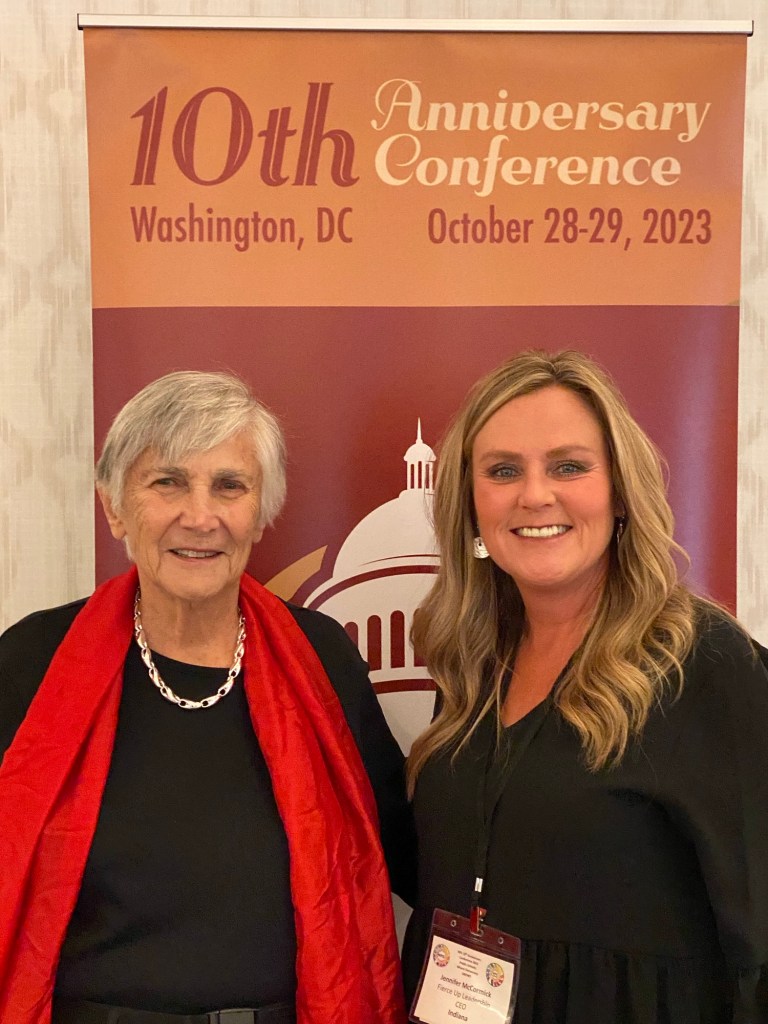
Indiana has plunged headlong into privatization of its-once-beloved public schools.

Fortunately, there is a knowledgeable candidate for Governor who has promised to stop the destruction of public education.

Jennifer McCormick is a career educator who began as a special education teacher, then became a language arts teacher, a principal and a district superintendent.

She was elected Indiana State Superintendent of Public Instruction in 2016; she ran as a Republican. She served out her four-year term and switched parties in 2021.

McCormick wrote on Twitter:

Indiana GOP’s school privatization efforts have diverted 1.6B of tax dollars away from public schools, and the majority of communities do not have families and/or private schools participating. As governor, I will champion for Indiana to pause funding school privatization.

At the NPE conference in D.C. in 2023, JenniferMcCormick and me.