Archives for category: Evil

Trump, being Trump, turns everything into a story about him. When the news first came out that Hollywood icon Rob Reiner and his wife Michelle were murdered in their home in Los Angeles, Trump posted a callous, cruel comment about their deaths. He wrote the following comment on Monday morning before the police arrested their son Nick.

Trump attributed their deaths to their hatred of him. What?

“A very sad thing happened last night in Hollywood. Rob Reiner, a tortured and struggling, but once very talented movie director and comedy star, has passed away, together with his wife, Michele, reportedly due to the anger he caused others through his massive, unyielding, and incurable affliction with a mind crippling disease known as TRUMP DERANGEMENT SYNDROME, sometimes referred to as TDS. He was known to have driven people CRAZY by his raging obsession of President Donald J. Trump, with his obvious paranoia reaching new heights as the Trump administration surpassed all goals and expectations of greatness, with the Golden Age of America upon us, perhaps like never before. May Rob and Michele rest in peace!”

Trump’s message was so cynical and self-serving that several Republicans criticized his heartlessness.

Politico mentioned several Republicans who were taken aback by Trump’s narcissism.

Rep. Marjorie Taylor Greene said that the deaths of Reiner and his wife were “a family tragedy, not about politics or political enemies.”

Rep. Mike Lawler said that Trump’s comments were “wrong,” and that their deaths deserved “sympathy and compassion from everyone in our country, period.”

Rep. Thomas Massie of Kentucky said Trump’s post was “inappropriate and disrespectful”; he challenged “anyone to defend it.”

Jenna Ellis, who was one of Trump’s personal lawyers who defended him after he lost the election in 2020, criticized Trump’s post.

The New York Times wrote about her reaction:

“A man and his wife were murdered last night. This is NOT the appropriate response,” Jenna Ellis, Mr. Trump’s former lawyer who is now a conservative radio host, wrote on social media on Monday. “The Right uniformly condemned political and celebratory responses to Charlie Kirk’s death. This is a horrible example from Trump (and surprising considering the two attempts on his own life) and should be condemned by everyone with any decency.”

Trump shows who he is without shame or guile. He has no empathy, no compassion, no sense of propriety. Every issue, every interaction, every event boils down to his self-interest. Nothing else matters.

Back in the days when the Republican Party was actually conservative, Republicans believed in small government. They said repeatedly that the federal government should not interfere with decisions made by local governments and private institutions.

The Trump administration is not conservative. It believes that it should impose its ideology on every kind of institution and every level of government.

Trump’s personal hatred of immigrants, of affirmative action, of any kind of program to help members of historically disadvantaged groups knows no bounds. His administration is on the hunt to stamp out anything that promotes diversity, equity, and inclusion. In addition to satisfying his (and Stephen Miller’s) personal hatreds, the war on DEI appeals to unsuccessful white men who think that underrepresented groups got advantages unavailable to them.

Here is the latest intrusion: Trump officials want to stamp out any reference to DEI in college admission essays. Students who have prevailed over adversity should be careful not to mention it, especially if they are Black or immigrants. Colleges are wondering how they will pay for this new federal demand.

This student was warned not to write about her life!

Mo Marie Lauyanne Kouame, 18, dreams of being an aerospace engineer and building spacecraft. This fall, she applied to MIT, Princeton, and Columbia. 

For one college essay, she wrote about being homeless at 8 years old, when she came to the United States from France. 

She recalled watching her parents fight for help from the Department of Transitional Assistance and sleeping in hospital beds at Boston Medical Center when they didn’t know where else to go. That early experience changed her, she said. 

“Homelessness,” she wrote, “taught me resilience.”

Kouame’s essay, which recounts how she learned to thrive as a low-income student of color “surrounded by classmates whose lives felt worlds apart from mine,” is about overcoming adversity. 

That’s a theme the White House has identified as a problem in its campaign against diversity, equity, and inclusion. Over the past year, the federal government has flagged “cues” such as personal essays, along with narratives about “overcoming obstacles” and “diversity statements,” as being potentially unlawful: a stand-in for talking about race.

More than two years have passed since the Supreme Court ended race-conscious affirmative action, and the Trump administration has since demanded colleges submit data proving they don’t consider race in admissions. It has also expanded what it sees as “discriminatory admissions processes” to include considering a student’s sexual orientation, gender identity, ethnicity, nationality, political views, and religious associations.

For Kouame, not writing about her identity felt “impossible,” she said in a Zoom interview, “because the things that I’ve gone through in life make me who I am now.” 

Other students are weighing the pros and cons, said Ethan Sawyer, founder of College Essay Guy, which offers one-on-one coaching and free online resources through the admissions process. He added the key is “to step back and take stock” of what colleges are actually looking for. Essentially: “How will you be a valuable, contributing member of the community?” 

Navigating the college admissions landscape has never been easy, but for the class of 2030 it’s particularly fraught. Plenty of advisers can be hired for a fee: Private consulting is a $3 billion industry, with parents paying tens and even hundreds of thousands of dollars to give their kids an edge. Community organizations, college-prep programs, and high schools are also on hand to assist students. 

There’s no question it’s an uneven playing field, though this year there is one equalizer in the college admissions game: No one really knows what’s coming next.

At the start of the second Trump administration, Trump unilaterally created a fake “Department of Government Efficiency,” led by Elon Musk. Only Congress can create or eliminate Departments. According to the Constitution, the House of Representatives is responsible for funding and defunding the federal government.

Trump ignored the Constitution and Congress and let Musk and his team ransack the Federal Government, fire thousands of civil servants, and close agencies at will. DOGE decisions were made not by experts but by Musk and his team, most of whom were young men in their 20s, even a teenagers. From their point of view, their greatest accomplishment was to copy massive amounts of personally identifiable data from the Treasury Department and the Social Security Administration.

While DOGE slashed and burned agencies and Departments with abandon, the cruelest cut of all was the near-total elimination of foreign aid. Millions of people in impoverished countries relied on U.S. AID for food, medicine, and medical care. The aid is gone. Hundreds of thousands of people died. If you say it in the active tense, Trump and Musk murdered “hundreds of thousands of people” whose lives depended on US AID. The food aid was more than a humanitarian impulse: American farmers lost at least $2 billion that was used to pay them to supply food for US AID.

Matt Johnson wrote for MS NOW:

“We spent the weekend feeding USAID into the wood chipper,” Elon Musk boasted in February, shortly after President Donald Trump gave him permission to hack his way through the federal government. As a “special government employee” with no oversight running the “temporary organization,” the Department of Government Efficiency, or DOGE, Musk destroyed the 64-year-old humanitarian agency in a matter of days, abruptly halting deliveries of lifesaving medicine, emergency food aid and many other forms of support to the poorest people on the planet. This was done in the name of DOGE’s mission to “maximize governmental efficiency and productivity.”

Musk claimed that DOGE would slash government spending by “at least $2 trillion,” but it ended up saving a microscopic fraction of that figure. Now that DOGE has been disbanded, Musk claims “We were a little bit successful” — but admits that he wouldn’t do it again

Musk tried his hand at government, shrugged and moved on. The same can’t be said for the people who are dead and dying thanks to the DOGE-led onslaught on the U.S. Agency for International Development. “No one has died as [a] result of a brief pause to do a sanity check on foreign aid funding,” Musk declared in March. According to models created by Boston University epidemiologist Brooke Nichols, hundreds of thousands of people have in fact died as a result of eliminated and disrupted aid. 

It’s impossible to calculate the ultimate human toll of shuttering USAID. The U.S. was responsible for 40% of the total foreign aid tracked by the United Nations in 2024, and much of the infrastructure that delivered this aid has now been destroyed. Beyond the frozen payments for active aid projects, partner organizations have closed, supply chains for medicine and food deliveries have been severed and staff who administered and monitored programs have been fired. Early warning systems for starvation and infectious diseases have shut down. 

The individual stories are harrowing. A South Sudanese child with HIV died from pneumonia because he didn’t receive the medication necessary to sustain his immune system. People participating in studies were abandonedwith experimental drugs in their systems and medical devices in their bodies. Cases of acute malnutrition at refugee camps have surged

In the MAGAverse, none of this is true because USAID was never an aid organization to begin with. Mike Benz, a right-wing influencer who has accused the agency of being a terror organization and subverting governments around the world, was a big influence on Musk’s assault on USAID, which Benz called the “Terror Titanic.” Like Musk before him, Benz has now been appointed as a special government employee to investigate his allegations that USAID was a massive covert influence operation and front for the CIA. 

Benz’s campaign is just the latest example of MAGA propaganda using USAID as a convenient political scapegoat. DOGE viewed the takeover of USAID as an opportunity to find instances of “viral waste,” which could be broadcast to the American people as a justification for its other cost-cutting efforts. One example cited by White House Press Secretary Karoline Leavitt was the “50 million taxpayer dollars that went out the door to fund condoms in Gaza.” Trump later declared that the money had been “sent to Gaza to buy condoms for Hamas.” 

There was just one problem: The money was actually for family planning in a province of Mozambique called Gaza….

This is not the full article. Open the link to read the rest.

Today, many of us are following the news about a terror attack at Brown University, where a gunman walked into a large classroom, murdered two students, and wounded at least a dozen more. A suspect is in custody. And we are following the news about a massacre at Bondi Beach in Sydney, Australia, where terrorists fired on a large crowd of Jews celebrating the first day of Chanukah. At least 16 people died, and many more were wounded.

It happens to be the 13th anniversary of the massacre at Sandy Hook Elementary School in Newtown, Connecticut. A mentally deranged young man killed his mother, then went to the school, where he killed 20 children–first- and second-grade students–and six staff members, the principal and teachers. Then the murderer killed himself.

The children were babies.

The nation was in a state of shock. I remember being glued to the television as the extent of the horror was revealed. I remember the weeping parents, the shell-shocked survivors, children and teachers.

For many, it seemed that Congress was sure to enact meaningful gun control. Certain to limit access to deadly weapons.

But, not long after the event, the conspiracy theories began to roll out. The vile Alex Jones said that there was no massacre. No one was killed. The parents and students were “crisis actors.” It was all staged to create momentum for gun control. President Obama was in on the hoax. One of this blog’s readers sent me a video created to “prove” that Sandy Hook was a lie. It was shocking and sickening.

Some Newtown parents sued Alex Jones for his lies, which caused them extreme pain and suffering. The parents won their case and were awarded more than $1 billion from Alex Jones. Jones, however, declared bankruptcy and through legal maneuvers has paid little to those he defamed.

Sandy Hook was supposed to be the tragedy that would compel Congress to enact strict control. Needless to say, gun enthusiasts blocked any efforts to strengthen gun control laws. Then, with Trump’s addition to the U.S. Supreme Court, the Court decided that guns should not be controlled at all, citing their interpretation of the Second Amendment.

Then there was the massacre at Robb Elementary School in Uvalde, Texas, on May 24, 2022. Nineteen children and two teachers were murdered by an 18-year-old man with an assault weapon. Nearly 400 law officers from local, state, and federal agencies arrived on the scene, where they crowded the hallways and did nothing. They waited 77 minutes before confronting and killing the gunman.

Gun advocates would have you believe that gun control has never happened and can never happen. That’s not true.

During the Clinton administration, Congress passed the Federal Assault Weapons Ban in 1994. The law, called the Violent Crime Control and Law Enforcement Act of 1994, had a 10-year sunset clause for the ban on assault weapons. It expired in September 2004, during the George W. Bush administration, and was not renewed.

The current Supreme Court opposes gun control. So here we are.

Peter Greene wrote today:

You can be forgiven for not having noticed that today is the anniversary of the Sandy Hook shootings, the murder of 26 human beings, 20 of them children. There’s not the usual wave of retrospective stories, perhaps because we’re busy catching up on the latest US campus shooting from the weekend.

It makes me angry, every day. Sandy Hook stands out among all our many various mass murders in this country, all our long parade of school shootings, because Sandy Hook was the moment when it finally became clear that we are not going to do anything about this, ever. “If this is not enough to finally do something,” we thought, “then nothing ever will be.”

And it wasn’t.

“No way to prevent this,” says only Nation Where This Regularly Happens is the most bitter, repeated headline The Onion has ever published. We’re just “helpless.”

Today was the 13th anniversary of the shooting that established that we aren’t going to do a damned thing about it, other than blaming the targets for not being hard enough. Need more security. Arm the (marxist untrustworthy) teachers. And somehow Alex Jones and Infowars have not been sued severely enough for them to STFU.

One thing that has happened over the past several years is a huge wave of folks expressing their deep concern about the children.

A whole industry of political activism has been cultivated around the notion that children– our poor, fragile children– must be protected. They must be protected from books that show that LGBTQ persons exist. They must be protected from any sort of reference to sexual action at all. They must be protected from any form of guilt-inducing critical race theory. They must be protected from unpatriotic references to America’s past sins. And central to all this, they must be protected from anyone who might challenge their parents’ complete control over their education and lives.

Well, unless that person is challenging the parents’ rights by shooting a gun at the child.

The Second Amendment issue is the issue that combines so poorly with other issues. We may be pro-life and insist that it be illegal to end a fetus– but if the fetus becomes an outside-the-womb human that gets shot at with a gun, well, nothing we can do about that. Students should be free to choose whatever school they like–but at any of those schools, people still have the right to shoot at them with a gun. We must protect children from all sorts of evil influences–but if someone wants to shoot a gun at them, well, you know, nothing we can do about that.

The other ugly development has been the ever-growing school security industry, peddling an ever-growing array of products that serve no educational purpose but are supposed to make schools safe, harden the target. Lots of surveillance. Lots of stupid mistakes, like the Florida AI reading a clarinet as a weapon. Lots of security layers that now make entering a school building much like entering a prison. It is what NPR correctly called the “school shooting industry,” and it is worth billions.

That’s not counting the boost that gunmakers get after every school shooting. The panic alarm goes off and the weapons industry sells a ton more product as the usual folks holler, “They’ll use this as an excuse to take your guns” even though in the 26 years since Columbine, the government hasn’t done either jack or shit about taking anybody’s guns. I expect that part of that sales bump is also from folks saying, “Now that I’m reminded that the government isn’t going to do anything about keeping guns out of the hands of homicidal idiots, I guess I’d better arm myself.”

Miles of letters have been strung together to unravel the mystery of why this country so loves its guns and why none of the factors used as distraction (mental health, video games, bad tv shows) could possibly explain the prevalence of gun deaths in this country because every other country in the world has the same thing without having our level of gun violence.

We are great at Not facing Problems in this country, and there is no problem we are better at Not facing than gun deaths. Hell, we can’t even agree it’s an actual problem. The “right” to personally possess the capability to kill other human beings is revered, and more beloved than the lives of actual human children.

And if some of our fellow citizens and leaders are unwilling to make a serious effort to reduce gun violence and these folks insist that the occasional dead child is just the cost of liberty (particularly the liberty to conduct profitable business), well, how can we expect them to take seriously other aspects of young humans’ lives, like quality education and health care.

It is a hard thing to know, every day, that we could do better, and we aren’t going to. We have already taken a long hard look at this issue, and we have decided that we are okay with another Sandy Hook or Uvalde. A little security theater, a little profiteering on tech, a few thoughts and prayers just to indicate that we aren’t actually happy that some young humans were shot dead (talk about virtue signaling), and that pivot quickly to defending guns. Send letters, make phone calls, get the usual platitudes back from elected representatives, who will never, ever pay an election price for being on the wrong side of rational gun regulation.

The whole dance is so familiar and well-rehearsed that we barely have to pay attention any more. It’s exhausted and exhausting, and yet I am still angry.

Stories have circulated for years about a young woman who claimed that Trump raped her when she was 13. After the case was filed, the young woman–who used the pseudonym “Katie Johnson”–withdrew the charges and was never heard from again.

There are two possibilities:

  1. The story was withdrawn because it was fraudulent.
  2. The complainant was offered money to shut up or was threatened with violence if she didn’t shut up.

Now Andy Borowitz revives the story in a podcast with a philosophy professor at Cornell University who was determined to find out what happened. He interviewed her on a podcast.

Andy Borowitz wrote:

Davidoff Studios/Getty Images

(Warning: This post contains upsetting content.)

Last week on my podcast, I interviewed the writer Kate Manne about the disturbing case of Katie Johnson.

Although Johnson’s accusations have never been adjudicated, her account is extremely detailed and, in my opinion, credible.

I interviewed Manne about this case because she has spent a significant amount of time researching it. She also created a transcript of Johnson’s testimony, something that corporate media, which have largely ignored the story, have never done.

After the podcast episode went live, I received many requests from paid subscribers asking me to remove its paywall so that the story of Katie Johnson could reach a larger audience. I have done so, and you can now access it for free here

In video testimony recorded in 2016, the pseudonymous Johnson alleged that she was trafficked by Jeffrey Epstein and raped by Donald Trump when she was thirteen. 

It is, as I’ve warned, an extremely upsetting story, but I think it’s important that people know about it. Please consider watching it and sharing it. And thanks, as always, for your support.

What do you think?

Make no mistake. Trump is Putin’s ally. Putting Trump in charge of negotiations to end the war in Ukraine is akin to putting the fox in charge of guarding the henhouse. On more than one occasion, Trump has sent his emissaries to devise a “peace plan” without asking Ukraine or the representatives of Europe to participate in the discussions.

Trump campaigned by claiming that he could end the war in a single day. All that was required would be a phone call to his good friend Putin.

That hasn’t happened, but Trump continues to threaten to cut off all aid to Ukraine unless Zelensky capitulates to Putin’s demands. These demands would give Putin everything he wants.

Max Boot spelled out the situation in The Washington Post:

Russia’s barbaric assault on Ukraine continues: A single Russian drone and missile strike on an apartment block in western Ukraine last week killed at least 31 civilians. Meanwhile, Russia is ramping up its campaign of sabotage in Europe: Polish authorities blamed the Kremlin for a Nov. 15 explosion on a rail line used to transport supplies to Ukraine. As German Chancellor Friedrich Merz said recently, Europe “is not at war” but it is also “no longer at peace” with Russia.

The growing threat from Vladimir Putin’s despotic, expansionist regime calls for Churchillian resolution, unity and strength on the part of the transatlantic alliance. Instead, Neville Chamberlain-style irresolution and confusion reigns on both sides of the Atlantic. The situation is far more concerning in the United States than in Europe, with the Trump administration having seemingly endorsed, at least for now, a “peace plan” that would give Russia a victory at the negotiating table that it hasn’t earned on the battlefield.

The Europeans have stepped up, providing weapons and funding to Ukraine as U.S. support has dried up. The European Union has a plan to do even more by sending Kyiv some $200 billionin frozen Russian assets as a “loan” that would likely never be repaid. Obviously, given the current corruption scandal in Kyiv, safeguards on the disbursement of the money would be needed. But this is a vital — indeed, irreplaceable — source of funding that can keep Ukraine afloat for years. Yet tiny Belgium, where most of the funds are frozen, is wringing its hands and holding up the plan. There is no Plan B: Europe has to send the Russian funds or else Ukraine will run out of money. So why dither and delay?

As for the peace plan floated by the White House last week: The 28-point plan amounts to a holiday wish list from the Kremlin. It would require Ukraine to cede the entire Donbas region — even the parts that Russian troops have been unable to conquer — and to cut the size of its armed forces by roughly a third. Ukraine would not be allowed to join NATO, and NATO would not be allowed to dispatch peacekeeping troops to Ukraine. Ukraine would hold elections within 100 days and “all Nazi ideology” would be “prohibited”; this is Kremlin code for toppling the Zelensky government. Russia isn’t being asked to limit the size of its armed forces or to hold elections; all the demands are on Ukraine.

What does Ukraine get in return? A separate draft agreement specifies that in the event of renewed Russian aggression, the United States could respond with “armed force, intelligence and logistical assistance, economic and diplomatic actions.” But the U.S. wouldn’t be compelled to do anything. Ukraine would be left to rely on a worthless Russian pledge of “nonaggression” — something it already promised in the 1994 Budapest Memorandum.

This isn’t a peace plan. It’s a blueprint for Ukraine’s capitulation. If implemented, it would turn this pro-Western, democratic nation, which has been courageously resisting Russian aggression since 2014, into a Kremlin colony….

In the New York Times, Thomas Friedman was scathing in his view of the Trump-Putin “peace plan.”

He predicted that Trump would not get the Nobel Peace Prize, which he covets, but would certainly win the ““Neville Chamberlain Peace Prize” — awarded by history to the leader of the country that most flagrantly sells out its allies and its values to an aggressive dictator.”

He wrote:

This prize richly deserves to be shared by Trump’s many “secretaries of state” — Steve Witkoff, Marco Rubio and Dan Driscoll — who together negotiated the surrender of Ukraine to Vladimir Putin’s demands without consulting Ukraine or our European allies in advance — and then told Ukraine it had to accept the plan by Thanksgiving…

If Ukraine is, indeed, forced to surrender to the specific terms of this “deal” by then, Thanksgiving will no longer be an American holiday. It will become a Russian holiday. It will become a day of thanks that victory in Putin’s savage and misbegotten war against Ukraine’s people, which has been an utter failure — morally, militarily, diplomatically and economically — was delivered to Russia not by the superiority of its arms or the virtue of its claims, but by an American administration…

He was the British prime minister who advocated the policy of appeasement, which aimed to avoid war with Adolf Hitler’s Germany by giving in to his demands. This was concretized in the 1938 Munich Agreement, in which Chamberlain, along with others in Europe, allowed Germany to annex parts of Czechoslovakia. Chamberlain boasted it would secure “peace for our time.” A year later, Poland was invaded, starting World War II and leading to Chamberlain’s resignation — and his everlasting shame.

To all the gentlemen who delivered this turkey to Moscow, I can offer only one piece of advice: Be under no illusions. Neither Fox News nor the White House spokeswoman Karoline Leavitt will be writing the history of this deal. If you force it upon Ukraine as it is, every one of your names will live in infamy alongside that of Chamberlain, who is remembered today for only one thing:

This Trump plan, if implemented, will do the modern equivalent. By rewarding Putin’s unprovoked invasion of Ukraine based on his obsession with making it part of Mother Russia, the U.S. will be putting the whole European Union under Putin’s thumb. Trump’s message to our allies will be clear: Don’t provoke Putin, because as long as I am commander in chief, the United States will pay no price and we will bear no burden in the defense of your freedom.

Which is why, if this plan is forced on Ukraine as is, we will need to add a new verb to the diplomatic lexicon: “Trumped” — to be sold out by an American president, for reasons none of his citizens understand (but surely there are reasons). And history will never forget the men who did it — Donald Trump, Steve Witkoff, Marco Rubio, Dan Driscoll — for their shame will be everlasting.

As a Wall Street Journal editorial on Friday put it: “Mr. Trump may figure he can finally wash his hands of Ukraine if Europe and Ukraine reject his offer. He’s clearly sick of dealing with the war. But appeasing Mr. Putin would haunt the rest of his presidency. If Mr. Trump thinks American voters hate war, wait until he learns how much they hate dishonor. … A bad deal in Ukraine would broadcast to U.S. enemies that they can seize what they want with force or nuclear blackmail or by pressing on until America loses interest.”

Mind you, I am not at all against a negotiated solution. Indeed, from the beginning of this war I have made the point that it will end only with a “dirty deal.” But it cannot be a filthy deal, and the Trump plan is what history will call a filthy deal.

Even before you get to the key details, think of how absurd it is for Trump to strike a deal with Putin and not even include Ukraine and our European allies in the negotiations until they were virtually done. Trump then declared it must be accepted by Thursday, as if Ukraine’s president, Volodymyr Zelensky, who has a parliament that he needs to win acceptance from, could possibly do so by then, even if he wanted to.

As my Times colleague David Sanger observed in his analysis of the plan’s content: “Many of the 28 points in the proposed Russia-Ukraine peace plan offered by the White House read like they had been drafted in the Kremlin. They reflect almost all Mr. Putin’s maximalist demands.”

Ukraine would have to formally give Russia all the territory it has declared for itself in eastern Ukraine’s Donetsk and Luhansk regions. The United States would recognize that as Russian territory. No NATO forces could be based inside Ukraine to ensure that Russia could never invade again. The Ukrainian military would be capped at 600,000 troops, a 25 percent cut from current levels, and it would be barred from possessing long-range weapons that could reach Russia. Kyiv would receive vague security guarantees from the U.S. against a Russian re-invasion (but who in Ukraine, or Moscow, would trust them coming from Trump?).

Under the Trump plan, $100 billion in frozen Russian assets would be put toward U.S.-led efforts to rebuild and invest in Ukraine, and the U.S. would then receive 50 percent of the profits from that investment. (Yes, we are demanding half of the profits generated by a fund to rebuild a ravaged nation.)

Trump, facing blowback from allies, Congress and Ukraine, said Saturday that this was not his “final offer” but added, if Zelensky refuses to accept the terms, “then he can continue to fight his little heart out.” As always with Trump, he is all over the place — and as always, ready to stick it to Zelensky, the guy fighting for his country’s freedom, and never to Putin, the guy trying to take Ukraine’s freedom away.

What would an acceptable dirty deal look like?

It would freeze the forces in place, but never formally cede any seized Ukrainian territory. It would insist that European security forces, backed by U.S. logistics, be stationed along the cease-fire line as a symbolic tripwire against any Russian re-invasion. It would require Russia to pay a significant amount of money to cover all the carnage it has inflicted on Ukraine — and keep Moscow isolated and under sanctions until it does — and include a commitment by the European Union to admit Ukraine as a member as soon as it is ready, without Russian interference.

This last point is vital. It is so the Russian people would have to forever look at their Ukrainian Slavic brothers and sisters in the thriving European Union, while they are stuck in Putin’s kleptocracy. That contrast is Putin’s best punishment for this war and the thing that would cause him the most trouble after it is over.

This would be a dirty deal that history would praise Trump for — getting the best out of a less than perfect hand, by using U.S. leverage on both sides, as he did in Gaza.

But just using U.S. leverage on Ukraine is a filthy deal — folding our imperfect hand to a Russian leader who is playing a terrible one.

There is a term for that in poker: sucker.

James Traub wrote anoter excellent analysis of Trump’s “peace plan.” It would be worth your while to open the link and read in full.

He concludes:

My first reaction on reading the Trump Administration’s 28-point peace plan for Ukraine was shame. That’s a different emotion from the anger I feel when Trump does something deplorable at home, like use the Justice Department to terrorize his enemies. When he abandons people elsewhere I feel ashamed of my country before the world.

This latest exercise in coercive diplomacy does not merely give the Russians what they want and deprive the Ukrainians of what they need. What is extra specially Trumpian, and thus shameful, about the proposal is that its second beneficiary is the United States. Point 10 guarantees the United States “compensation” for the completely unspecified security guarantees alluded to in Point 5. From whom? The plan doesn’t say, but presumably the answer is Ukraine, from which Trump demanded a preposterous $500 billion earlier this year in exchange for ongoing support. So we will profiteer off Ukraine’s subjection….

If the United States walks away, we will have vindicated Putin’s belief that in the end nothing matters except force. We will leave Europe to live in fear of an emboldened Russia. We will have washed our hands of a democratic and patriotic nation.

We have seen many repulsive sights in the Oval Office since Trump was sworn in last January. The covering of the room in fake gold ornaments is an abomination. Trump’s rude treatment of Zelensky was an outrage.

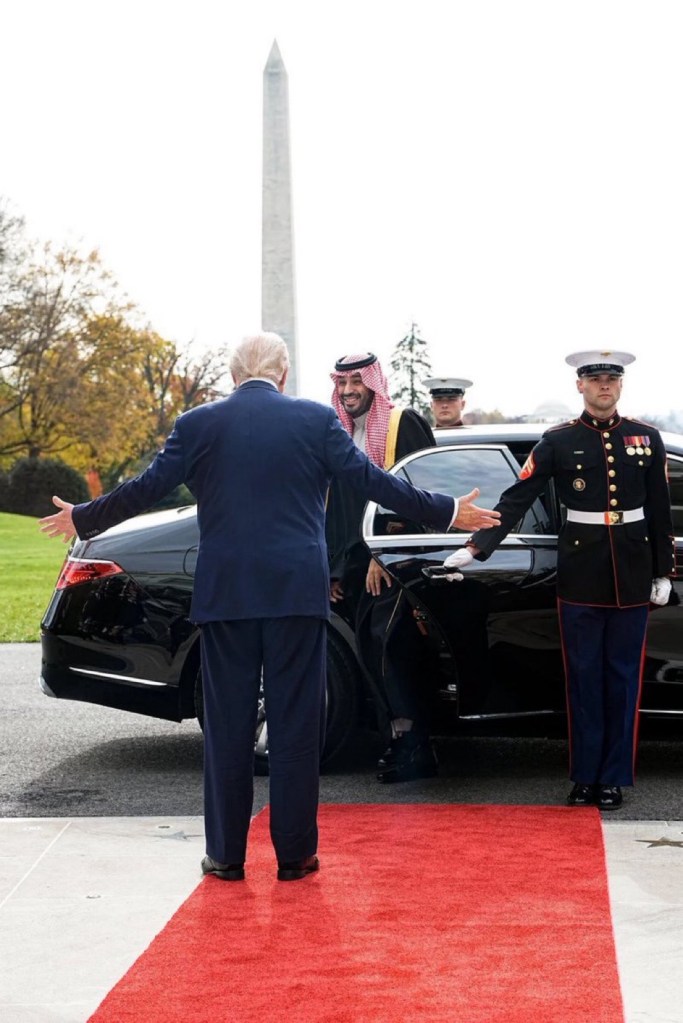
But the top abomination, at this moment, was his loving embrace of Saudi Arabia’s Crown Prince Mohammed bin Salman, who should be reviled for his brutal murder of journalist Jamal Khashoggi.

What next? A Presidential Medal of Honor for Putin?

Trump has many personal commercial ties to Saudi Arabia. Cynically speaking, Trump is building alliances by making personal deals with potentates who increase his family wealth. Surely, we cannot forget that MBS arranged to give Son-in-law Jared Kushner $2 billion after Trump left office in 2021. Kushner had no experience in financial investing. His background was real estate. Now, Trump’s real estate buddies Steve Witkoff and Howard Lutnick, are Trump’s envoys to Russia, the Middle East, and other hotspots. They too (and their children) are taking in millions and billions, because they are in “the room where it happens.”

The New York Times wrote recently about how Lutnick’s sons are making lucrative deals , which are helped by the fact that their father is Secretary of Commerce. “But never in modern U.S. history has the office intersected so broadly and deeply with the financial interests of the commerce secretary’s own family, according to interviews with ethics lawyers and historians…”

The New York Times also chronicled the ways that billionaire Steve Witkoff’s sons are cashing in with investments in the Middle East and in cryptocurrency, building on their father’s connection to Trump.

This is not what the Founders intended.

But maybe those of us who worry about abstract ideas like ethics and laws are in the wrong. Maybe the best way to make a deal with the devil is to get in bed with him, speak his language, and buy his friendship. That’s Trump’s way. And nobody does it better.

Sabrina Haake writes:

Trump just threw a lavish state party to welcome a Saudi murderer. He defended the murderer’s crime, blamed the victim, and viciously attacked a reporter for asking the question on everyone’s mind: What about Jamal Khashoggi?

Of all the shameful metaphors for the corruption, ignorance, and rot presently infecting the White House, this one wears the Trump crown.

A brutal regime dismembers its critic

Jamal Khashoggi was a US resident and journalist for the Washington Post during its halcyon years, before it fell to corporate interests that now serve Trump.

Khashoggi was also a frequent critic of the Saudi government. He frequently criticized the royal ruling family, not for their lavish lifestyles, but for their suppression of dissent, their refusal to allow free speech among the Saudi people, and their widespread human rights abuses.

On Oct. 2, 2018, Khashoggi was murdered in Istanbul. He had gone to see about a visa for his Turkish fiancée at the Saudi consulate’s office, where he was attacked, stangled, and dismembered.

A recording made by Turkish intelligence agents in the building captured the whole gruesome ordeal: Khashoggi could be heard struggling against Saudi guards of the royal Crown Prince as his killing was recorded, complete with screams, the sounds of strangulation, then quiet, before a bone saw was heard dismembering his body.

US Intelligence knows bin Salman did it

In 2021, US intelligence reports concluded that Saudi Arabia’s Crown Prince Mohammed bin Salman, aka “the Bone Saw Prince,” had personally ordered the operation.

The US Director of National Intelligence supplied reasons supporting that conclusion, including:

· bin Salman’s total control of decision-making in the Saudi Kingdom;

· The direct involvement of bin Salman’s key adviser in the brutal attack, along with members of his personal security team; and

· bin Salman’s stated support for using violence to silence critics of the Saudi government abroad, including Khashoggi.

US intelligence added that, “Since 2017, the Crown Prince has had absolute control of the Kingdom’s security and intelligence organizations, making it highly unlikely that Saudi officials would have carried out an operation of this nature without the Crown Prince’s authorization.”

Despite these publicly available facts, Trump treated bin Salman to an unusually lavish state reception, complete with military officers in full dress carrying both Saudi and American colors. As the US taxpayer-funded Marine band played, Trump and Mr. Bone Saw were treated to a fly-over of advanced fighter jets, samples of the 48 F-35 jets Trump already sold to Saudi Arabia, despite national security concerns that China would be able to steal the aircraft’s advanced technology.

Trump courts a murderer to line his own pockets

Trump’s personal wealth has increased by over $3 billion since his return to office, largely from ethics-adjacent crypto schemes, foreign real estate deals, meme coins that have no value, and overt pay to play transactions. His lavish courtship of bin Salman fits neatly into the same corrupt pattern, promoting Trump’s illegal,private, for-profit interests.

The Trump Organization now has multiple, large-scale projects pending in Saudi Arabia, including a new Trump Tower and a Trump Plaza development in the works in Jeddah, along with two other projects planned in Riyadh. These deals are publicly known; it’s likely billions more are exchanging hands under the table.

Trump is also in private partnership with the Saudi-owned, “International Luxury Real Estate Developer,” Dar Global. There’s also a separate $2 billion deal where an Abu Dhabi-based, UAE-backed investment firm used a cryptocurrency from the Trump family’s venture, World Liberty Financial, to invest in another crypto exchange, profiting Trump royally.

And no one has forgotten Trump’s son in law, Jared Kushner’s, $2 billion private “investment” fee from the Saudis, packaged when Saudi Arabia’s Public Investment Fund (PIF) announced a $55 billion acquisition. Kushner’s fee is widely regarded as payment for providing political cover and guaranteeing Trump’s regulatory protection. After the PIF’s own advisors initially rejected the deal, bin Salman personally overruled them and pushed it through.

Trump didn’t mention these deals this week when he rolled out the red carpet on taxpayers’ dime, but claimed instead with trademark ambiguity that the Saudis were going to “invest as much as $1 trillion in the US.”

Trump endorses the unthinkable

Journalists around the world, not to mention Khashoggi’s family, had to endure the nightmare of watching Trump fawn all over bin Salman. In every photo from the mainstream media, Trump couldn’t keep his hands off him, as if Trump were absorbing Saudi wealth through his fingers.

Tuesday, when journalist Mary Bruce asked bin Salman about intelligence reports concluding that he ordered the Khashoggi murder, Trump jumped in, answering for him. “He knew nothing about it! You don’t have to embarrass our guest by asking something like that.”

Trump then suggested Khashoggi got what he had coming for criticizing the government, saying, “A lot of people didn’t like that gentleman (Khashoggi) that you’re talking about, whether you like him or didn’t like him, things happen.”

After sending this chilling message to his critics, Trump then attacked Bruce for asking a “horrible,” insubordinate,” and “just a terrible question,” dressing her down in garbled syntax before cameras of the world with, “You’re all psyched up. Somebody psyched you over at ABC and they’re going to psych it. You’re a terrible person and a terrible reporter,” and later demanded that ABC lose its broadcast license.

Saudi Arabia’s Crown Prince Mohammed bin Salman is condemned throughout the civilized world as a brutal 5th Century pariah. Trump just spent a taxpayer fortune to rebrand him “one of the most respected people in the world” to elevate and promote Trump’s own private business ventures.

It is fitting that Trump committed this atrocity in a formerly dignified room recently desecrated with tacky gold medallions. The Oval Office is now a bordello whose pimp is selling America to the highest bidder, and we, his trafficked victims, are letting him do it.

Sabrina Haake is a columnist and 25+ year federal trial attorney specializing in 1st and 14th A defense. Her Substack, The Haake Take, is free.

Karen Attiah was the editor at The Washington Post for Saudi dissident Jamal Khashoggi. She recently left the Post, objecting to its obeisance to Trump.

Trump’s warm welcome for Saudi Arabia’s leader, Crown Prince Mohammad bin Salman, outraged her, as it outraged everyone who remembered what happened to Khashoggi.

Khashoggi was a journalist, author, and dissident in Saudi Arabia. He fled Saudi Arabia in September 2017 and settled in the U.S. He was hired by Karen Attiah to write an opinion column for The Washington Post. On October 2, 2018, Khashoggi went to the Saudi Consulate in Istanbul, Turkey, to get a marriage license. Fifteen Saudi security personnel were waiting for him. They strangled him, and a surgeon in their group dismembered his body. It was never recovered. The CIA later determined that he was killed by direct order of Crown Prince MBS.

Since 2018, MBS has been in disrepute in the West. A few days ago, MBS was an honored guest at the White House. Trump spread a red carpet, praised him lavishly, and commended his record on human rights. He was almost as obsequious to MBS as he is to Putin.

A Warm Welcome for an Assassin

When a reporter asked about Khashoggi, Trump angrily said that the victim was “controversial” and “some people didn’t like him,” and reporters should not ask such disrespectful questions.

Trump cannot plead ignorance about what happened. He was President in 2018, when Khashoggi was murdered.

If you are on BlueSky, you might want to read Karen Attiah’s reaction to Trump’s defense of MBS.

In one of her comments, she wrote:

I will never forget having to edit Jamal’s final, posthumous piece for the Washington Post, after he was murdered.

He was calling for free expression in the Arab world. You can read it here :

A note from Karen Attiah, Global Opinions editor

I received this column from Jamal Khashoggi’s translator and assistant the day after Jamal was reported missing in Istanbul. The Post held off publishing it because we hoped Jamal would come back to us so that he and I could edit it together. Now I have to accept: That is not going to happen. This is the last piece of his I will edit for The Post. This column perfectly captures his commitment and passion for freedom in the Arab world. A freedom he apparently gave his life for. I will be forever grateful he chose The Post as his final journalistic home one year ago and gave us the chance to work together. 

I was recently online looking at the 2018 “Freedom in the World” report published by Freedom House and came to a grave realization. There is only one country in the Arab world that has been classified as “free.”

That nation is TunisiaJordanMorocco and Kuwait come second, with a classification of “partly free.” The rest of the countries in the Arab world are classified as “not free.”

As a result, Arabs living in these countries are either uninformed or misinformed. They are unable to adequately address, much less publicly discuss, matters that affect the region and their day-to-day lives. A state-run narrative dominates the public psyche, and while many do not believe it, a large majority of the population falls victim to this false narrative. Sadly, this situation is unlikely to change.

The Arab world was ripe with hope during the spring of 2011. Journalists, academics and the general population were brimming with expectations of a bright and free Arab society within their respective countries. They expected to be emancipated from the hegemony of their governments and the consistent interventions and censorship of information. These expectations were quickly shattered; these societies either fell back to the old status quo or faced even harsher conditions than before.

My dear friend, the prominent Saudi writer Saleh al-Shehi, wrote one of the most famous columns ever published in the Saudi press. He unfortunately is now serving an unwarranted five-year prison sentence for supposed comments contrary to the Saudi establishment. The Egyptian government’s seizure of the entire print run of a newspaper, al-Masry al Youm, did not enrage or provoke a reaction from colleagues. These actions no longer carry the consequence of a backlash from the international community. Instead, these actions may trigger condemnation quickly followed by silence.

As a result, Arab governments have been given free rein to continue silencing the media at an increasing rate. There was a time when journalists believed the Internet would liberate information from the censorship and control associated with print media. But these governments, whose very existence relies on the control of information, have aggressively blocked the Internet. They have also arrested local reporters and pressured advertisers to harm the revenue of specific publications.

There are a few oases that continue to embody the spirit of the Arab Spring. Qatar’s government continues to support international news coverage, in contrast to its neighbors’ efforts to uphold the control of information to support the “old Arab order.” Even in Tunisia and Kuwait, where the press is considered at least “partly free,” the media focuses on domestic issues but not issues faced by the greater Arab world. They are hesitant to provide a platform for journalists from Saudi Arabia, Egypt and Yemen. Even Lebanon, the Arab world’s crown jewel when it comes to press freedom, has fallen victim to the polarization and influence of pro-Iran Hezbollah.

Who attended the White House dinner for Mohammed bin Salman November 19, 2025

The Arab world is facing its own version of an Iron Curtain, imposed not by external actors but through domestic forces vying for power. During the Cold War, Radio Free Europe, which grew over the years into a critical institution, played an important role in fostering and sustaining the hope of freedom. Arabs need something similar. In 1967, the New York Times and The Post took joint ownership of the International Herald Tribune newspaper, which went on to become a platform for voices from around the world.

My publication, The Post, has taken the initiative to translate many of my pieces and publish them in Arabic. For that, I am grateful. Arabs need to read in their own language so they can understand and discuss the various aspects and complications of democracy in the United States and the West. If an Egyptian reads an article exposing the actual cost of a construction project in Washington, then he or she would be able to better understand the implications of similar projects in his or her community.

The Arab world needs a modern version of the old transnational media so citizens can be informed about global events. More important, we need to provide a platform for Arab voices. We suffer from poverty, mismanagement and poor education. Through the creation of an independent international forum, isolated from the influence of nationalist governments spreading hate through propaganda, ordinary people in the Arab world would be able to address the structural problems their societies face.

Department after department, agency after agency, in the Federal government has been killed or destroyed by the Trump administration. Foreign aid, which had decades of bipartisan support, was virtually eliminated, meaning certain death for hundreds of thousand of children and families who count on the U.S. for food and medicine. The Department of Defense is now called the Department of War, without Congressional approval. The Consumer Financial Board is gone. The Department of Education has been eviscerated. Civil rights enforcement has been turned upside down, to exclude vulnerable groups for which it was intended.

Jan Resseger is a brilliant, thoughtful analyst of education. I encourage you to sign up for her blog. Here she takes a deep dive into what this chaos means for public schools and students:

Despite that the federal government shutdown has ended, SNAP funds are being distributed, and airplanes are returning to their expected schedules, many of us are feeling disoriented and troubled by the way the federal government seems to be operating under Donald Trump’s leadership. We have been observing the Trump administration violating core principles we learned in civics class are at the heart of our democratic society. And we thought the Constitution was supposed to protect every one of us. In today’s post, I’ll try to name and explore some of the principles that President Trump seems to be violating as he attempts to dismantle the U.S. Department of Education. On Thursday, in Part 2, I’ll explore three serious constitutional violations. All of this is undermining the well-being of our nation’s massive institution of K-12 public schools, the leaders of 13,000 public school districts, over three million public school teachers, and more than 50 million students enrolled.

NY Times economic reporter Tony Romm reflects on the deeper meaning of the recent federal government shutdown: “(T)he president has frequently bent the rules of (the) budget, primarily to reap political benefits or exact retribution. He has found new and untested ways to spare certain Americans, like the military, from the pain of the government closure, while claiming he has no power to help others, including low-income individuals who rely on benefits like SNAP. The result is a shutdown unlike any other, one that has posed disparate and debilitating risks for those unlucky enough to depend on the many functions of government that Mr. Trump has long aspired to cut… At the heart of Mr. Trump’s actions is a belief that the president possesses vast power over the nation’s spending, even though the Constitution vests that authority with Congress. Mr. Trump and his budget director, Russell T. Vought have dismantled entire agencies, fired thousands of workers and canceled or halted billions of dollars in federal spending—all without the express permission of lawmakers.” Romm is not writing about public education, but you will recognize that his concerns apply to public schools and all the rest of our society’s primary institutions.

Trump Seizes the Power of the Purse

The NY Times Editorial Board enumerates three ways the President has grabbed power from Congress  by violating “the power of the purse” granted to Congress in the Constitution: “First, he has refused to spend money that Congress allocated… Second, Mr. Trump has spent money that Congress has not allocated… Third, the president has taken steps that effectively overturn Congress’s spending decisions. In these cases, he has not added or subtracted federal funds, but he has taken other steps that make it so an agency cannot carry out the mission that Congress envisioned for it.”

All year, and at a new and radical level during the recent federal shutdown, President Trump has ordered Education Secretary Linda McMahon and his other appointees in the Department of Education to usurp the power of the purse primarily by slashing the expenditure of Congressionally appropriated funds to staff the department, along with announcing the goal of eliminating the department and its federal role altogether.  The administration’s imposition of permanent layoffs during the federal shutdown focused on firing the professionals responsible for carrying out the very reason a U.S. Department of Education was established back in the fall of 1979, during President Jimmy Carter’s administration: to gather together and administer programs that equalize opportunity for students across the states, where there had historically been unequal protection of students’ rights depending on children’s family income, race, primary language, immigrant status, sexuality or disability.  Huge grant programs like Title I and IDEA and myriad smaller programs ensure that public schools, no matter where a student lives, meet the specific learning needs of all students including those whose primary language is not English and students with disabilities.

During the shutdown, the Trump administration appeared intent on violating the power of the purse at the U.S. Department of Education by radically reducing the staff who do the work—impounding funds congressionally appropriated for paying the staff who enable the Department of Education to fulfill its primary mission.  For example, Education Week‘Brooke Schultz examines the implication of the shutdown staff cuts for the Office for Civil Rights, on top of massive staff cuts last spring: “Though the latest layoffs are on hold, an enforcement staff that had 560 members spread across 12 offices… will shrink by more than 70% if they go through… Experts worry that without federal enforcement, a fractured interpretation of civil rights laws and protections could take shape across the country—leading to conflicting and politicized handling of cases depending on where students live and what laws are on the books. They worry students in one state might not have the same protections at school as students in another… (S)ome state lawmakers are worried about civil rights complaints not being handled at all.”

During the shutdown, the Trump administration also eliminated most of the remaining staff in the Office for Elementary and Secondary Education who administer the huge and essential Title I grants for school districts serving concentrations of students living in poverty. Trump and McMahon also reduced staff in the Office of Special Education Programs, which oversees IDEA grants, from around 200 to five.  Everyone has understood those proposed shutdown layoffs as the Trump administration’s threat to move special education programming from the Department of Education to the Department of Health and Human Services, despite that the mission of that department emphasizes treatment instead of education. During the shutdown, Federal District Court Judge for the Northern District of California, Susan Illston temporarily blocked the proposed permanent staff layoffs and their implications for undermining the mission of the U.S. Department of Education, though, of course her pause on the staff firings had no effect while the shutdown continued.

The end of the shutdown did temporarily end all the shutdown layoffs. We shall have to wait a couple of months to see what happens. K-12 Dive‘s Kara Arundel explains: “The continuing resolution signed into law Wednesday funds federal education programs at fiscal year 2025 levels. This temporary spending plan expires Jan. 30, unless Congress agrees to a more permanent budget before that deadline.  The deal nullifies the reduction-in-force notices sent to 465 agency employees on Oct. 10. The Education Department is also prohibited from issuing additional RIFs through the end of January and must provide back pay to all employees who did not receive compensation during the shutdown.” Clearly Trump and Vought’s power grab to eliminate much of the staff in a department established and funded by Congress has been blocked only temporarily.

Education Week‘Mark Lieberman addsthat prior to the shutdown, “The Government Accountability Office, a nonpartisan federal watchdog funded by Congress, had been investigating more than 40 instances of the Trump administration potentially violating the Nixon-era federal law that prohibits the executive branch from impounding… funds appropriated by Congress… The GAO had already published decisions before Oct. 1 finding that the administration broke the law by withholding funding from programs supporting school infrastructure upgrades, library and museum services, Head Start, and disaster preparation.”

Supreme Court Gives Trump Power through the Shadow Docket

We have also watched all year as Federal District Court judges have temporarily blocked Trump’s executive orders, but lacked the power to declare them permanently unconstitutional or in violation of federal law. Only the U.S. Supreme Court can do that. These cases then become part of “the shadow docket”— cases decided temporarily on an emergency basis but awaiting a full hearing and final decision. The number of these cases derailed to “the shadow docket” has grown rapidly in this first year of Trump’s second term.

In March, the Department of Education fired nearly 2,200 of its 4,133 staff.  After a Federal District Court judge blocked the layoffs temporarily, the case was subsequently appealed. On July 15, Diane Ravitch reported in her blog: “Yesterday, the Supreme Court ruled 6-3 that the President could continue to lay off the employees of the Department of Education while leaving aside the legal question of his power to destroy a Department created by Congress 45 years ago… If the Supreme Court ever gets around to deciding whether Trump has the legal authority to abolish the Department of Education, it will already be gone.”

After a Federal District Court case is appealed, the Supreme Court releases a temporary, emergency decision, putting off a formal hearing, oral arguments, and what the NY Times‘ Adam Liptak calls, “an explanation of the court’s rationale” until some future time when the case could be scheduled for hearings on what Liptak calls the Supreme Court’s “merits docket.” Liptak explains: “The question of whether the nation’s highest court owes the public an explanation for its actions has grown along with the rise of the ’emergency docket,’ which uses truncated procedures to produce terse, provisional orders meant to remain in effect only while the courts consider the lawfulness of the challenged actions. In practice, the orders often effectively resolve the case.” His implication here is what Diane Ravitch worries about. By the time the Supreme Court fully considers and decides the case, perhaps years from now, it may be too late.

The shutdown has ended, but it is not clear what will happen to the U.S. Department of Education and the many federal programs that support public school equity across our nation.  Part 2 of this post on Thursday will explore what appear to be serious constitutional violations as they impact children and public schools.

Stephen Dyer is a former legislator who keeps watch on the ways that Ohio Republicans have cheated public school students. Ohio Republicans love charters and vouchers, even though taxpayers have been ripped off repeatedly for years by grifters.

He writes on his blog Tenth Period:

Look, I like Greg Lawson as a guy. We’ve been on panels together and fought over things on the radio and in other places. 

But man, he really, really thinks y’all are stupid.

In an op-ed he had published in the Columbus Dispatch yesterday where he argued that public school districts whine too much about money, he made the following claim:

“State K-12 spending in 2023 was 39.5% higher than in 2010 — and school spending in 2024 and 2025 shows no sign of cooling off: “State funding for primary and secondary education totaled $11.64 billion in FY 23; was $13 billion in FY 24 (a $1.36 billion or 11.7% increase); and is estimated at $13.42 billion in FY 25, the second year of the state budget (a $415.8 million or 3.2% increase).”

See, Greg wants you to conclude something from these numbers: that public school districts are swimming in money and their griping over vouchers and his budget-sucking agenda is bullshit. It’s those greedy bastards in your local school districts that are causing your property taxes to skyrocket.

What he leaves out is that the numbers he’s using to make the districts-swimming-in-money claim include money for charter schools and vouchers

That’s right. 

He’s writing an entire article complaining that school districts whine too much about vouchers taking away money from public school kids by citing K-12 expenditure data that … includes money going to vouchers and charter schools.

Can’t make it up.

I’ll break down his ridiculous claim in two parts. 

Part I — Overall K-12 Funding

First, let’s look at the overall claim — massive increases to K-12 spending. Forget about the fact that the voucher and charter money need to be deducted out of that number. 

Let’s just look at Greg’s topline claim — the state’s spending tons more now than 15 years ago on K-12 education, so quit whining! 

Yes. Spending is up. But you know what else is up? 

Inflation

See, in the 2009-2010 school year, the state spent a total of $7.9 billion on K-12 education. In the 2024-2025 school year, that number was $11.5 billion. 

Big jump, right?

Well, if you adjust for 2025 dollars, that $7.9 billion spent on K-12 education in 2009-2010 is the equivalent of $11.9 billion, or about $400 million less than what the state spent on K-12 education last school year.

Let me repeat that.

The state is spending the equivalent of $400 million less on K-12 education than they did 15 years ago, adjusted for inflation.

Funny Greg didn’t mention that.

Part II — Privatizers Force Property Tax Increases

Now let’s look at charters and vouchers. Let’s just set aside how poorly charters prepare kids, or how the EdChoice program is an unconstitutional scheme that provides not a single dollar to a parent or child and voucher test scores aren’t great either, compared with school district counterparts.

Let’s just look at the money.

In the 2009-2010 school year, Ohio sent $768 million to charter schools and vouchers. 

Last school year, that number was $2.3 billion. 

For those of you scoring at home, that’s a more than 100% increase in funding for these privatization efforts … above inflation!

So while in 2009-2010 the state spent about same percentage of their K-12 spend on the percentage of kids who attended public schools at the time, last year the state spent 77% of their K-12 spend on the 84% of kids who attended public schools.

This cut in the share of state funding going to public school students can be directly tied to the state more than doubling the inflationary increase on charter schools and vouchers over the last 15 years.

Bottom line: What has this meant in funding for Ohio’s public school kids?

Well, in 2009-2010, the state, after deducting charter school and voucher funding, provided $7.1 billion for Ohio’s public school students. 

Adjusted for inflation, that’s $10.7 billion in today’s dollars. 

(I would also like to add that the 2009-2010 school year was the first year of the Evidence Based model of school funding that I shaped as the Chairman of the Primary and Secondary Education Subcommittee on the Ohio House Finance Committee. We pulled off this investment — greater than last school year’s investment, adjusted for inflation — in the middle of the Great Recession. So it’s not like we had shit tons of money lying around the way lawmakers do nowWhich should tell you about the priorities back then vs. today.)

I digress.

Last school year, Ohio’s public school students received $9.1 billion.

That means that Ohio’s public school students are receiving $1.6 billion less, adjusted for inflation, than they did 15 years ago.

Should I mention here that not a single penny of the more than $1 billion going to vouchers is publicly audited to ensure the money goes to educate kids rather than Lambos for Administrators?

Anyway.

Put another way: If Ohio lawmakers and governors had simply kept the same commitment to charter schools and vouchers that they did 15 years ago and kept pace with inflation on their K-12 spend, Ohio’s public school students would have received $1.6 billion more last year than they actually did. 

In other words, we’d have a fully funded Fair School Funding Plan.

I’m not asking the legislature or Governor to do anything crazy here. No elimination of vouchers and charters. 

This is simply doing inflationary increases and making sure the percentage of state funding going to each sector (public, charter and voucher) matched the percentage of kids attending each sector. 

Yes, ladies and gentlemen, if the state had actually let “money follow the child”, Ohio’s public school students would have a fully funded Fair School Funding Plan and there would stillhave a $1.2 billion charter and voucher program!

Instead, state leaders have so overvalued private school vouchers and charter schools that now we have an unconstitutional EdChoice voucher program that doesn’t send a single dollar to a parent or student, charter schools that spend about double the amount per pupil on administration that public schools spend while tragically failing to graduate students, and a school funding formula that’s severely underfunded for the 84% of students who attend public school districts. 

While Greg might tell school districts, “Quit your bitching!”, I might humbly suggest that school districts haven’t bitched enough.

So when people complain about property taxes, directly point fingers at the Ohio legislature and Governor because they’re doing what they’ve always done — force you to fund the only thing — public schools — the Ohio Constitution requires them to fund. 

It’s governmental malpractice. And our kids are the ones who suffer.