As we head toward the November election, Policy Matters Ohio’s Bailey Williams exposes recent history that has been little reported. In The Great Ohio Tax Shift, Williams explores simply and clearly the data showing that Ohio’s new billion dollar private school tuition voucher expansion is not the only factor that has threatened public school funding. For two decades now, legislators have been cutting taxes and reducing investment in public services, including public schools. And Ohio’s legislature has increased the tax burden on Ohio’s poorest citizens and made life easier for our state’s wealthiest citizens.
Even though Ohioans have watched the legislature toss a tax cut into budget after budget instead of funding needed services, the cumulative effects Baily presents in the new report are astounding:
“Ohio families with the least resources—those making less than $24,000—pay more annual taxes on average today than they did before 2005.
The average household among the top 1 of Ohio earners, with incomes above $647,000, now contribute over $52,000 per year less than they once did.
The result is a loss of about $12.8 billion a year in revenue….
Ohioans of color are significantly more likely to pay a higher share of their incomes in taxes… while white Ohioans are more likely to have benefited….
71% of the total value of personal income tax cuts has gone to the richest 20% of households….
Changes to sales taxes, excise taxes, and business taxes have, on average, increased taxes for the bottom 99% of Ohio’s households.
Changes to sales taxes, excise taxes, and business taxes have, on average, allowed the richest 1% of Ohio tax filers to pay nearly $600 per year less than they did before 2005.”
Bailey reminds us why we pay taxes and explains what has been sacrificed in Ohio: “Through the state tax system, Ohio can ensure every child gets a world-class education, every community is vibrant and healthy, and every Ohioan, of every race and gender, has a secure economic foundation on which to build our futures. But for a generation, lawmakers have instead used tax policy to create loopholes for the wealthy and influential, and provide special treatment for powerful corporations… The politicians who write state tax policy often justify their decisions with promises that when billionaires’ pockets overflow with profits, the benefits will trickle down to working families. Year after year—now decade after decade—the consequences have been clear: The people with the lowest incomes are paying a little more, the wealthy are paying much less, and Ohio has too few resources to serve its purpose: creating a state where everyone has what they need to live a good life.”
Ohio’s legislature has reduced progressive taxation as it has reduced dependence on income taxes and increased regressive sales, excise and business taxes: “Ohio policymakers have made significant changes to personal income taxes over the two decades, lowering rates and making our tax structure more regressive. Since 2005, almost every biennial budget passed by the Ohio state general assembly has included some form of reduction to the personal income tax, generally through broad tax rate cuts and elimination of top tax brackets. Some changes have benefited low-paid Ohioans: Increasing the threshold at which households begin to pay taxes means households with income below $26,050 don’t pay state income tax…. The creation of a 30% Earned Income Tax Credit has helped low-paid Ohioans.” However, “Other regressive changes in the tax code have completely erased the meager benefits of income tax cuts for the lowest-paid Ohioans. In fact, the lowest-income 20% now pay more on average in taxes than they did before the legislature began its tax cutting spree in 2005. Sales, excise, and business taxes now cost that group more each year on average—more than cancelling out the annual average $122 in income tax cuts this group benefits from….”
Most Ohioans are not prepared to gather and analyze this kind of technical information. Thanks to Bailey Williams and Policy Matters Ohio for this technical analysis. We have spent this year learning about the fiscal implications of the Legislature’s voucher expansion in the current biennial budget; now we are better prepared to understand why, in addition to perpetual voucher expansion, it has been such a struggle to press the Legislature to enact Ohio’s new public school funding formula, the Fair School Funding Plan, to rectify years of inadequate and inequitably distributed public school funding. Legislators have insisted on a slow, three-budget phase-in of the new formula and even now have been unwilling to commit to completing the full launch of the new plan in the budget they will begin negotiating in January. Many of us have realized that the Fair School Funding Plan’s delayed rollout has derived from perennial tax cutting in addition to the enactment of what’s turning out to be an annual billion dollar voucher explosion. Williams’ analysis, released last week, provides information essential to our grasping the complex fiscal realities that will be part of the upcoming state budget debate.
Please open the link to get the full picture of the tax-cutting that has helped the richest Ohioans, hurt the poorest, and undermined public services.
At the recent Vice-Presidential debate, JD Vance engaged in sanewashing and normalizing Trump, falsely claiming that Trump tried to improve or salvage Obamacare. He lied, as LA Times’ Pulitzer-Prize winning columnist Michael Hiltzik shows. In fact, Trump and most other Republicans tried to kill Obamacare. Trump was also responsible for incompetent management of the federal response to COVID, which increased the death toll.
Every newspaper should either have its own Michael Hiltzik or repost his columns.
I love it more today than ever, because it applies so perfectly to how we must respond to the campaign claims of Donald Trump and JD Vance. Especially Trump’s assertions about his role — heroic, in his vision — in “saving” the Affordable Care Act and fighting the COVID pandemic.
I’ve written before about the firehouse of fabrication and grift emanating from the Trump campaign like a political miasma. On these topics, he has moved beyond his habit of merely concocting a false reality about, say, immigration and crime to deliberately concocting a false reality about himself.
Donald Trump could have destroyed [Obamacare]. Instead, he worked in a bipartisan way to ensure that Americans had access to affordable care.
— JD Vance, flagrantly lying about Trump’s management of the Affordable Care Act
To start by summarizing: Trump did everything in his power to destroy the Affordable Care Act, starting on the very first day of his term in 2017. On COVID, he did everything in his power to make America defenseless against the spreading pandemic.
Let’s take them in order.
Here’s what Trump said about the Affordable Care Act during his Sept. 10 debate with Kamala Harris: “I had a choice to make when I was president, do I save it and make it as good as it can be? Never going to be great. Or do I let it rot? … And I saved it. I did the right thing.”
This was the prelude to his head-scratching assertion that he has “concepts of a plan” to reform healthcare in the U.S. I examined what that might mean in a recent column, in which I explained that it would turn the U.S. healthcare system to the deadly dark ages when people with preexisting medical conditions would be either denied coverage or charged monstrous markups.
“Donald Trump has said that if we allow states to experiment a little bit on how to cover both the chronically ill, but the non-chronically ill … He actually implemented some of these regulations when he was president of the United States. And I think you can make a really good argument that it salvaged Obamacare. … Donald Trump could have destroyed the program. Instead, he worked in a bipartisan way to ensure that Americans had access to affordable care.”
Here’s what Trump actually did to the Affordable Care Act during his presidency. He had made repealing the ACA a core promise of his 2016 presidential campaign, stating on his website, “On day one of the Trump Administration, we will ask Congress to immediately deliver a full repeal of Obamacare.” (Thanks are due to the indispensable Jonathan Cohn of Huffpost for excavating the quote.)
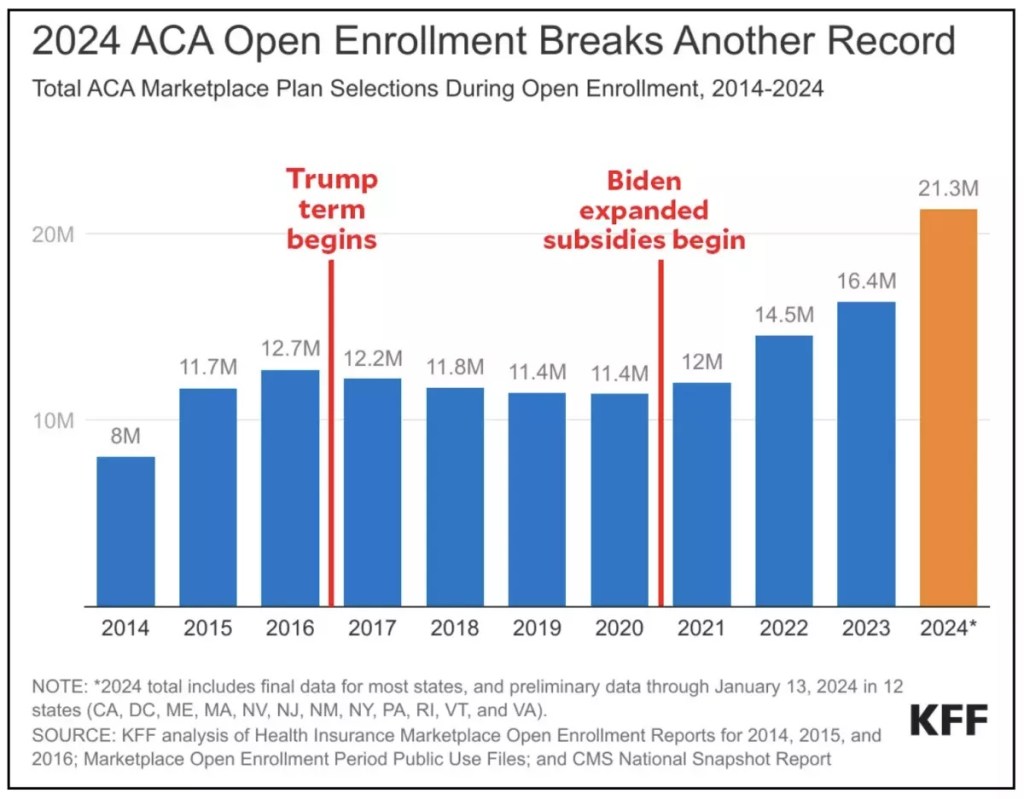
Trump drove down Obamacare enrollment every year he was in office; when Biden removed Trump’s obstacles, enrollment soared.
(KFF / Kevin Drum)
On Inauguration Day, Trump issued an executive order instructing the entire executive branch to find ways to “waive, defer, grant exemptions from, or delay the implementation of any provision or requirement” of the ACA.
During his presidency, he never abandoned the Republican dream of repealing Obamacare, even after July 28, 2017, when the late Sen. John McCain (R-Ariz.) strode to the Senate well and delivered a thumbs-down coup de grace to a GOP repeal bill.
Trump never ceased slandering the ACA as a “disaster.” He returned to the theme during last month’s debate: “Obamacare was lousy healthcare,” he said. “Always was. It’s not very good today.” As president, he threatened to make it “implode,” and used every tool he could get his fingers on to do so.
In September 2017 he slashed the advertising budget for the upcoming open enrollment period for individual insurance policies by a stunning 90%, to $10 million from the previous year’s $100 million. He also cut funds for nonprofit groups that employ “navigators,” those who help people in the individual market understand their options and sign up, by roughly 40%, to $36.8 million from $62.5 million.
Just after taking office, he abruptly canceled the customary last-minute advertising blitz to encourage enrollments in Obamacare plans before open enrollment ended on Jan. 31. The last minute surge in enrollments, which had occurred every previous year, vanished. The drop-off was particularly devastating because it was concentrated among the healthiest potential enrollees — those who often wait until the last minute to sign up and whose premiums generally subsidize older, less healthy patients.
The impact these policies had on enrollment was inescapable. In the three years before Trump took office, ACA marketplace plans experienced annual enrollment increases, to 12.7 million enrollees in 2016 from 8 million in 2014. During every year of the Trump administration, enrollment declined, falling to 11.4 million in 2020.
Every year since Joseph Biden took office, enrollment has increased, reaching a record 21.3 million this year — an 86% increase over Trump’s last year.
As for Vance’s fatuous claim that Trump “worked in a bipartisan way to ensure that Americans had access to affordable care,” you have the right to ask what Vance has been smoking.
The only bipartisanship on the ACA during the Trump years, Cohn observes, were the actions of GOP senators such as McCain and Lisa Murkowski of Alaska to cooperate with Democrats to stave off their fellow Republicans’ anti-ACA vandalism.
Now onto Trump’s fantasy vision of his role in fighting the COVID pandemic. Speaking in a low-energy, exhausted monotone at a speech Tuesday in Milwaukee and reading at times from a binder, he praised himself for instituting Operation Warp Speed, which funded COVID vaccine development in record time and got them rolled out in January 2021.
“We did a great job with the pandemic. Never got the credit we deserved,” he said. He then veered into blaming China for the pandemic, a familiar topic. He said bluntly that the pandemic was “caused by the Wuhan lab. I said that from the beginning, came from Wuhan. And the Wuhan lab, it wasn’t from bats in a cave that was 2,000 miles away. … It’s really the China virus.”
As for the rest of his COVID performance, he said this: “We did a great job with the ventilators, the masks and the gowns and everything. … When we got here the cupboards, our cupboards, I used to say our cupboards were bare. … No president put anything in for a pandemic.” Then he segued into praising himself for a big tax cut, and COVID was forgotten.
A few points about this spiel:
Trump is correct that Operation Warp Speed was a significant achievement. But he didn’t follow up by advocating for its product, the COVID vaccine. Instead, he has thrown in his lot with fanatical anti-vaccine agitators such as Robert F. Kennedy. He has repeated an anti-vax mantra, promising, “I will not give one penny to any school that has a vaccine mandate or a mask mandate.” This is a formula for exposing children to vaccine-preventable diseases such as measles and even polio.
Trump’s reference to the Wuhan Institute of Virology as the source of SARS-CoV-2, the virus that causes COVID, underscores how closely the so-called lab-leak theory of COVID’s origins is tied to right-wing partisan politics. The theory originated with Trump acolytes at the State Department, who saw the accusation as a convenient weapon in Trump’s economic war with China.
To this day, not a speck of evidence has been produced to validate this claim; scientists versed in the relevant disciplines of virology and epidemiology say the evidence overwhelmingly supports the hypothesis that the virus reached humans via the wildlife trade, and that its journey may well have started with bats thousands of miles from Wuhan, China.
Trump is lying when he says his predecessors in the White House left him without resources. The truth is that Trump himself hobbled pandemic response from the start.
In 2016, in the wake of the Ebola epidemic in Africa, President Obama had established the the Directorate for Global Health Security and Biodefense at the National Security Council “to prepare for and, if possible, prevent the next outbreak from becoming an epidemic or pandemic,” in the words of its senior director, Beth Campbell. Trump dissolved it in 2018.
Due to these steps, the U.S. was fated to sleepwalk into the pandemic. The COVID death toll in the U.S. stands at more than 1.2 million, and its reported death rate from COVID of 341.1 per 100,000 population is the highest in the developed world.
Ventilators, masks and gowns? Trump placed the procurement of this essential personal protective equipment in the hands of his son-in-law, Jared Kushner, who handled the task incompetently. Kushner turned away urgent appeals from state and local officials for those supplies.
“The notion of the federal stockpile was it’s supposed to be our stockpile, it’s not supposed to be states’ stockpiles that they then use,” Kushner said at a briefing.
Following his remarks, the website of the government’s national strategic stockpile of medicines and supplies was changed from asserting that its purpose was to “support” the emergency efforts of state, local and tribal authorities by ensuring that “the right medicines and supplies get to those who need them most.” The new language redefined the stockpile’s role as “to supplement state and local supplies … as a short-term stopgap.”
Supplies of ventilators, masks and gowns remained scarce through the first months of the pandemic. A procurement official at a Massachusetts hospital system told me of having had to cut a deal with a shadowy broker offering 250,000 Chinese-made masks at an inflated price, completing the transaction for $1 million at a darkened warehouse five hours from home.
Trump made anti-science incompetence and disregard for the welfare of Americans part of our history. The same thing, or worse, looms on the horizon in a second Trump term.
My comment: who can forget that dramatic moment in 2017 when the late Senator John McCain strode down to the well of the Senate to cast the deciding vote not to repeal Obamacare by dramatically extending his good arm and showing a thumb’s down gesture? Trump forgot.
As to COVID, why didn’t Trump take credit for the vaccines produced by Iperatuon Warp Speed? If the scientists had called it “the TRUMP vaccine, he probably would have boasted about it. Instead, he threw his support to the anti-VAXX conspiracy theorists, which surely contributed to the death toll.
Rachel Maddow often manages to come up with a very different take on the news as compared to other talk show hosts. She is fascinated with history, so she often takes her viewers down new paths.
When she was trying to figure out JD Vance, she discovered two of the men who influenced his views. One is a podcaster named “Jack Murphy,” whose real name is John Goldman. He is known for racism, misogyny, and his association with the alt-right. He is very big on the idea of women’s submission to men. He even wrote a book about it.
The other is a man named Curtis Yarvin, a podcaster who is known for his anti-democratic, anti-egalitarian views.
Mother Jones published an excellent article by Reverend Rob Schenck about how he became a leader of the Christian nationalist movement and why he decided to leave it. He recalls when real estate developer and playboy Donald Trump was first introduced to the world of evangelicals. And he describes his own role in connecting rich donors to Republican Supreme Court justices.
Reverend Schenck begins:
In 2014, at an elegant gala inside the Supreme Court’s gilded Great Hall, a tuxedoed Justice Clarence Thomas turned to me and voiced his approval for my work. I glanced over to where Chief Justice John Roberts and his wife, Jane, were entertaining two of my associates, trustees of the Supreme Court Historical Society, a private, nongovernmental entity for which Roberts served as honorary chair. At that moment, I knew the secretive operation I had run, aimed at emboldening Thomas and his conservative colleagues to render the strongest possible decisions in favor of our right-wing Christian agenda, had succeeded.
My organization, Faith and Action in the Nation’s Capital, had created an initiative we called “Operation Higher Court” that trained wealthy couples as “stealth missionaries,” befriending Thomas and his wife, Ginni; Samuel and Martha-Ann Alito; and Antonin and Maureen Scalia—lavishing them with meals at high-end restaurants and invitations to luxurious vacation properties. Alongside these amenities, our ministry offered prayers, gift Bibles, and the assurance that millions of believers thanked God for the decisions this trio of justices rendered on abortion, health care, marriage, and gun ownership….
But Reverend Schenck began to understand that his activities and beliefs were toxic to democracy. What triggered his change? Perhaps it was his late-in-life doctoral studies, when he read about the German Christian movement in the 1930s, which supported the Nazi party. He wrote: One of the most respected Bible scholars of that period, Paul Althaus, declared Hitler’s ascent to the chancellorship to be a “gift and miracle from God.”
He was shaken by his research. He began to change his views. He wondered whether Christian evangelicals in the U.S. were on the same dangerous path.
Following the insurrection of January 6, when Christian banners, Bibles, and prayers in Jesus’ name appeared in the assault on the Capitol, I felt even greater urgency in warning my fellow evangelicals of the grave danger Trump and his MAGA cult posed to Christianity and US democracy.
My change of course so late in life has been painful, disorienting, and costly. Besides losing decades-long friendships and enduring menacing threats, my wife and I have faced a significantly reduced income. I’ve even driven Uber to cover household expenses. One night, I picked up an organizer of the National Prayer Breakfast, an event in which I had once played a significant role. I was wearing a mask and said little, but then, with trepidation, I realized I would be dropping him at the home of a congressman I had worked with closely for more than 20 years. When my passenger got out, I was relieved to have gone unrecognized. Still, I’ve never questioned the decisions that brought me to that moment.
In my third conversion, I realized that when religion is placed at the service of a political party, it corrupts both. To claim that one political figure uniquely represents God’s will for the body politic is a form of anti-Christian idolatry. To elevate one set of spiritual beliefs above another and do it by force of law removes a nonnegotiable tenet of evangelical faith—free will. We are born again when we choose to believe in the Lord Jesus Christ, not when we’re forced to do so.
Because it is immoral, I believe Christian nationalism is inevitably doomed. But in the meantime, the pain, suffering, and injury it will inflict will be enormous—just consider women facing difficult pregnancies, trans children seeking care, librarians attacked for certain books. “We want to fill our culture again with the Christian spirit. We want to burn out all the recent immoral developments in literature, in the theater, and in the press—in short, we want to burn out the poison of immorality, which has entered into our whole life and culture as a result of liberal excess.” This may sound familiar—maybe some overheated Republican talking points. In fact, it’s what Adolf Hitler promised the German people in 1933.
Half an hour into Tuesday night’s vice-presidential debate, JD Vance lodged a whiny protest.
“Margaret,” he said to moderator Margaret Brennan of CBS News, “the rules were that you guys weren’t going to fact check!”
It was a lie on top of another lie, supplemented by a pair of other lies, in support of an even bigger lie.
There was no “rule” against fact-checking. And Vance had just told a whopper. He had alleged that, in Springfield, Ohio, “you’ve got schools that are overwhelmed, you’ve got hospitals that are overwhelmed, you have got housing that is totally unaffordable because we brought in millions of illegal immigrants.”
There is no “open border,” Kamala Harris isn’t the president, and the thousands of Haitian migrants to which Vance was referring have legal status, which Brennan had accurately pointed out. But Vance claimed that “what’s actually going on” was that the Haitian migrants are there as part of “the facilitation of illegal immigration” — and he kept going until the moderators shut off the candidates’ microphones.
From the sidelines, Donald Trump cheered on his running mate. “Margaret Brennan just lied again about the ILLEGAL MIGRANTS let into our Country by Lyin’ Kamala Harris, and then she cut off JD’s mic to stop him from correcting her!” he posted on Truth Social.
The up-is-down moment was all the worse because it was in response to Vance’s original libels about the Haitian immigrants in Springfield: that they were bringing crime, disease and, yes, eating the cats and dogs of the town’s residents. Vance declined to walk back that calumny during the debate, instead saying: “The people that I’m most worried about in Springfield, Ohio, are the American citizens who have had their lives destroyed by Kamala Harris’s open border.”
It feels entirely appropriate that CBS chose to hold the vice-presidential debate in a studio once home to “Captain Kangaroo.”
For three decades beginning in the mid-1950s, the Captain, along with Mr. Green Jeans, Mr. Bunny Rabbit, Mr. Moose and other friends, regaled children with fantastic stories, a Magic Drawing Board, and cartoons featuring the likes of Tom Terrific, a shape-shifting boy who lived in a tree house and could transform himself into anything he wanted by using the funnel-shaped hat that sat on his head.
But Captain Kangaroo never conjured a figure quite so outlandish as JD Vance.
This shape-shifting boy has gone from being a never-Trump author who in 2016 compared the “reprehensible” Trump to Adolf Hitler, to a venture capitalist who in 2020 said Trump “thoroughly failed to deliver,” to the junior senator from Ohio who, as Trump’s running mate in 2024, worships the ground the former president walks on.
Vance has used his own Magic Drawing Board to create a whimsical portrait of reality in this election season. He has embraced the fiction that Trump won the 2020 election. He has falsely claimed that Democrats were responsible for two assassination attempts against Trump. He has seconded Trump’s routine lies about crime, jobs, tariffs and the border. He has slandered his vice-presidential opponent, Minnesota Gov. Tim Walz, accusing him of “stolen valor” after Walz’s 24 years of honorable military service. And he has led the vile demonization of the Haitians in Springfield.
“If I have to create stories so that the American media actually pays attention to the suffering of the American people, then that’s what I’m going to do,” he admitted last month on CNN.
And that’s just what he did during the debate. Walz wasn’t a particularly skilled debater; he tripped over words and at one point said, “I’ve become friends with school shooters” when he was referring to the families of school-shooting victims. But even if Walz had been quicker on his feet, there wouldn’t have been a way to keep up with the fictions Vance submitted.
The senator said Harris “became the appointed border czar.” She received no such appointment. He said “over $100 billion” of Iranian assets were unfrozen “thanks to the Kamala Harris administration.” Not so.
On abortion, he said he “never supported a national ban.” When running for the Senate two years ago, he said he “certainly would like abortion to be illegal nationally.”
On health care, he served up the howler of the night when he said that Trump “saved” the “collapsing” Affordable Care Act. Instead of destroying Obamacare, Vance said, “Donald Trump worked in a bipartisan way to ensure that Americans have access to affordable care.” In reality, of course, Trump tried his best to kill Obamacare. (John McCain famously thwarted the effort in the Senate.)
Vance capped the night by saying that Trump “peacefully” surrendered power four years ago. When Walz asked him point-blank whether Trump had lost that election, Vance would not answer.
Throughout the debate, Vance pretended that Harris was the president, referring to “Kamala Harris’s open border” and “Kamala Harris’s atrocious economic record.” He claimed that “Kamala Harris let in fentanyl” and “enabled the Mexican drug cartels to operate freely in this country.”
And on Truth Social, Trump added still zanier claims. “Tim Walz wants to abolish ICE. … I SAVED our Country from the China Virus. … CBS is LYING AGAIN about the 2020 Election.” And best of all: “JD Vance just CRUSHED Tampon Tim with the FACTS.”
Fact check: Half true. JD Vance just crushed the facts.
Eugene Robinson is a regular columnist for The Washington Post. He is baffled that the election is so close. He finds one demographic where Trump holds a decisive lead. This group is loyal to Trump. They think he cares about them and empathizes with them. He does care about separating them from their hard-earned cash. He does care about getting their votes. He does care about exploiting their grievances, their resentment about being left behind. It’s hard to remember what precisely he did for them during his four year term in office.
It is absolutely, completely, totally ridiculous that this election is even close. But here we are.
The choice between Vice President Kamala Harris and former president Donald Trump should not be a tough call. Harris is a former prosecutor; Trump, a felon. Harris gives campaign speeches about her civic values; Trump rants endlessly about his personal grievances, interrupting himself with asides about sharks and Hannibal Lecter. Harris has outlined a detailed set of policy proposals for the economy; Trump nonsensically offers tariffs as a panacea, describing this fantasy in terms that make it clear he doesn’t understand how tariffs work.
Also, Harris never whipped thousands of supporters into a frenzy and sent them off to the Capitol, where they smashed their way into the citadel of our democracy, injuring scores of police officers and threatening to hang the vice president, in an attempt to overturn the result of a free and fair election. Trump did.
Yet polls tell us that either candidate could win. The Post’s polling average has Harris ahead by 2 percentage points nationally. The Post also finds that Harris holds leads in four of the seven crucial swing states — 3 percentage points in Wisconsin and Pennsylvania, 2 points in Michigan, less than a point in Nevada — but adds a note of caution: “Every state is within a normal-sized polling error of 3.5 points and could go either way.”
So how is it possible that this is not a done deal? I’m not sure there’s a definitive answer, but I can throw out a few theories.
One obvious potential factor is that Harris would be the first woman to serve as president and commander in chief. It amazes me that the preceding sentence can be written in 2024 — decades after the careers of Margaret Thatcher, Indira Gandhi, Golda Meir and so many other women who have led their nations in peace and war. But, again, here we are.
Harris and her advisers have made the decision not to lean into the history-making aspects of her candidacy, which I think is wise — if only because Trump so desperately wants to have a fight over gender and race. Trump and his running mate, Sen. JD Vance (Ohio), are trying hard to win the votes of men who equate manhood with cartoonish machismo — men who somehow feel that their status and prospects are threatened because they are men.
An Associated Press poll released on Thursday found that about 4 in 10 Americans believe Harris’s gender “will hurt her chances of getting elected this fall,” which suggests the manly-men act by Trump and Vance might be having some impact. Then again, the issue of reproductive rights, along with gratuitous insults such as Vance’s “childless cat ladies” slur, might be driving enough women into Harris’s corner to offset Trump’s harvest of dudes. I find it hard to conclude that gender alone answers the question of why Harris doesn’t have a bigger lead.
Deep in the numbers, you can find other hypotheses. Trump got 74 million votes in the 2020 election. Joe Biden got 81 million — thankfully — and won the electoral vote 306-232. But Trump’s showing means he started his 2024 campaign with a big base of support, and it has remained loyal.
White voters without a college degree are a key component of Trump’s base, and two recent polls — one by the New York Timesand one by CNN — showed Harris with a huge deficit of roughly 35 points to Trump among this segment. That is worse than Biden did against Trump in 2020, when he lost this big demographic by 32 points, according to a Pew Research Center analysis. Whites without a college degree make up 42 percent of the electorate — meaning that if Harris were matching Biden’s performance with this group, she would add a full point to her overall national lead.
This might suggest that Trump’s red-meat-to-the-base campaign strategy is not as crazy as it looks. His vicious demagoguery on immigration — the lies he keeps telling about Haitian immigrants eating cats and dogs, for example — invites working-class Whites to see their jobs and communities as under threat. That kind of tribal appeal likely does not win Trump many new voters, but it might keep some of the old ones on his side.
Still, though, how does any of this overcome Trump’s manifest unfitness? How does any of it erase his pathetic performance in the debate? How does it nullify the fact that he awaits sentencing by a New York judge after 34 guilty verdicts in a criminal trial? If the answer is buried somewhere in some poll, I can’t find it.
The truth about the election might be simple: It is what it is. Look at the trend lines in the polling averages. Trump had a narrow but consistent lead over Biden. Soon after Harris became the candidate, the lines crossed, and she took a lead over Trump. Since taking that lead, she has not surrendered it. In fact, she has slowly expanded it.
It is possible that Harris could pull ahead decisively. But it is also quite possible that this race will still be too close to call on Election Day. And at that point, the question we face will not be theoretical, but urgently practical: With Democrats’ huge advantage in money and volunteers, will they be able to turn out their supporters in numbers big enough to overwhelm any hidden population of Republican voters that the pollsters might be missing?
The people, not the pollsters, will give that answer.
When I first heard about the sex scandal swirling around Corey DeAngelis, I didn’t believe it. As I did more digging through links on the Internet, my disbelief turned to amazement. I never met Corey, but he used to harass me on Twitter until I blocked him.
How could someone who had inveighed against “the woke agenda” and urged the adoption of vouchers to escape that agenda have done what the rumors said? I didn’t think I would touch it with a ten-foot pole. I don’t care what others do in their private lives. I believe in Tim Walz’s credo: “Mind your own damn business.” But I was troubled by the hypocrisy.
Corey worked for Betsy DeVos and was her leading salesman for vouchers. DeVos and her family are rabidly anti-LGBT. For years, they have funded anti-LGBT organizations like the Family Research Council, Focus on the Family, and Alliance Defending Freedom. Yet the rumor was that Corey had performed in gay porn, and there were many videos online to prove it.
One of the alleged virtues of vouchers was that they enable students to escape pedophile teachers and to attend schools that ban LGBT students. I couldn’t make sense of these two lives.
Peter Greene wrote about Corey’s apparent double life.
Peter began:
I’m old enough to remember when you could have a reasonably civilized conversation with Corey DeAngelis on social media, and everyone is old enough to remember when his main social media function was to lead a small army of trolls against anyone who dared to oppose the right wing school privatizing culture panic crowd (we can all remember that because it was as recent as about a week ago).
Those days are gone, of course, now that DeAngelis has become the sixty-gazzilionth person to discover that the internet is not a private place, as he’s been outed as a featured performer in a bunch of gay porn under the name Seth Rose. Since the story was broken (in a far right website of all places), DeAngelis has been erased from several websites of the many thinky tanks and advocacy groups that employed this chief evangelist for choice.
The pro-public school crowd has been largely quiet about the news, and big time education media hasn’t picked it up yet. Andy Rotherham has a piece about it, which is appropriate– Rotherham and Bellwether have been unique in the right-tilted reformster edusphere in not jumping on the culture panic bandwagon.
There is no reason for any of us to care what an adult human person does. Lord knows we could have some more useful conversations right now if folks weren’t wasting so much time panicking over other peoples’ business.
And yet this parade of personal scandal– the Zieglers, Mark Robinson, Seth Rose–matters for several reasons….
I don’t wish DeAngelis ill, even though he so often wished people ill straight to their faces. At the same time, I don’t wish him to be spared the karma that he has so richly and ambitiously earned; he used cultural panic over LGBTQ persons to help him sell vouchers and troll armies to try to silence anyone who dared to disagree with him. He had a choice to pursue his ambitions without being awful to other human beings, and he chose being awful. And you can’t spread toxins all around you without getting soaked in it yourself.
You should open the post and read Peter’s measured views.
Trump says he will deport 11 million illegal immigrants. He says his deportation program will be unlike anything the nation has ever seen. He is right.
Actually, the deportations were started in 1930 and reached a peak in 1931, before FDR was elected. Estimates for the numbers of those deported ranged from 300,000-2 million, about half of whom were American citizens. President Herbert Hoover approved the deportation program on the belief that Mexicans were taking jobs from white people. Most of the deportation was implemented by local and state governments.
What would it look like to deport 11 million people?
First, they would have to be rounded up in massive raids. Imagine the terror as federal agents arrived at the homes of immigrants and raided them, carrying away families–men, women and children.
Where to put 11 million people?
Then, the federal government would have to build thousands, tens of thousands of detention camps. Every state would have detention centers. This would be a massive undertaking, because the camps would need to be constructed and supplied with beds, food, personnel, doctors and nurses.
Trump has suggested that the deportees would each have a serial number. Would it be tattooed on their arms?
Inevitably, families would be torn apart, people would die, women would give birth in the camps.
The images sent around the world of detention camps for millions of people would humiliate our country as a cruel, heartless place.
Someone should drape a hood over the Statue of Liberty, so that she does not see what is happening as she lifts her lamp “beside the golden door.”
On the base of the Statue of Liberty, “The New Collosus,” by Emma Lazarus.
Give me your tired, your poor, Your huddled masses yearning to breathe free, The wretched refuse of your teeming shore. Send these, the homeless, tempest-tossed to me, I lift my lamp beside the golden door!
No more. Stay home. We are full. No more room. Not at this inn.
Eighteen months ago, I described the case of law professor Amy Wax at the University of Pennsylvania. She had made statements that were deemed bigoted. I defended her speech, even though it was vile. That post began:
The question I posed to readers was whether they thought that her statements were protected speech or should be sanctioned. A lively discussion ensued.
The University of Pennsylvania just announced sanctions against Professor Wax but did not fire her or strip her of tenure. The student newspaper, The Daily Pennsylvanian, reported the decision:
Penn has upheld sanctions against University of Pennsylvania Carey Law School professor Amy Wax following her history of discriminatory remarks and two years of disciplinary proceedings with little precedent.
“These findings are now final, following a determination by the Faculty Senate’s Committee on Academic Freedom and Responsibility that the proper process was followed,” a University spokesperson wrote in a statement to The Daily Pennsylvanian.
The new ruling, first reported by The Philadelphia Inquirer, comes after the Faculty Senate Committee on Academic Freedom and Responsibility upheld sanctions that were initially recommended by a Faculty Senate hearing board on June 21, 2023 and strikes down an appeal filed by Wax and her lawyer, David Shapiro, this past February.
The sanctions mark the first time in recent history that a tenured University professor has been sanctioned through Faculty Senate procedures. Neither Wax nor her lawyer responded to requests for comment in time for the publishing of this article.
The DP previously reported that the recommended sanctions against Wax included a one-year suspension at half pay, the removal of her named chair and summer pay, and a requirement for Wax to note in public appearances that she is not speaking on behalf or as a member of Penn Carey Law.
Penn will announce the decision in Tuesday’s edition of the Penn Almanac. The decision will include a letter of reprimand from Provost John Jackson Jr.
“Academic freedom is and should be very broad. Teachers, however, must conduct themselves in a manner that conveys a willingness to assess all students fairly,” Jackson wrote in a copy of the letter obtained by the DP. “They may not engage in unprofessional conduct that creates an unequal educational environment.”
Interim Penn President Larry Jameson added that Wax must refrain from “flagrantly unprofessional and targeted disparagement of any individual or group in the University community … for so long as [she is] a member of the University’s standing faculty.”
In a June 2023 letter to former Penn President Liz Magill, the hearing board noted that they “do not dispute the protection” that Wax holds over her views, but said that the way she presents these views violate widely acknowledged “behavioral professional norms” when presented as “uncontroverted.”
The hearing board “unanimously” found that the facts presented throughout the hearing “constitute serious violations of University norms and policies,” according to the letter. The hearing board also concluded that Wax’s behavior “has created a hostile campus environment and a hostile learning atmosphere.”
When determining sanctions, the hearing board decided that the University should issue a public reprimand, but it did not suggest that Wax should be fired or stripped of tenure. Separate from the sanctions, the hearing board suggested that the University and Penn Carey Law should consider having Wax co-teach her classes with another faculty member, and that Wax teach her classes outside of Penn Carey Law buildings.
The board wrote that it found Wax “in dereliction of her scholarly responsibilities, especially as a teacher” in part due to her “reliance on misleading and partial information,” which results in her drawing “sweeping and unreliable conclusions.”
But the sanctions, which reportedly take effect for the 2025-26 school year, won’t have an impact on her teaching plans this semester — which, according to a course syllabus obtained by the DP, include an invite of American Renaissance magazine editor Jared Taylor to deliver a guest lecture at Dec. 3 meeting of LAW 9560: “Conservative and Political Legal Thought.” The invitation would mark at least the third appearance by Taylor at Wax’s class in four years, after his visit last fall sparked a protest outside Wax’s classroom and a rare schoolwide emailfrom Penn Carey Law Dean Sophia Lee addressing the “bounds of academic freedom.”
Weeks before Taylor comes to campus, Wax is scheduled to speak at a conference in Tennessee alongside multiple people who have reportedly espoused white supremacist, neo-Nazi, and racist views.
Tuesday’s Almanac will also include an Aug. 11, 2023 letter from Magill in which she accepted the sanctions initially recommended by the hearing board.
Jameson provided an introduction for Magill’s letter, summarizing the disciplinary process against Wax and confirming he was implementing Magill’s decision.
Magill wrote in her letter that the board considered arguments such as the “critical point” regarding academic freedom and used a “well-developed” factual record to make its decision.
While she said she was “mindful of the limit of my authority as established by our policy,” Magill accepted the major sanctions suggested from the board’s report.
The letter from Magill prompted Wax to file a Aug. 29, 2023 appeal to SCAFR, in which Wax’s lawyer argued that there were “several procedural defects” which gave the respondent the right to appeal.
Shapiro wrote that that the most significant “defect” was that the hearing board made the decision “about the breadth and extent of a tenured professor’s contractually guaranteed right to academic freedom,” rather than SCAFR.
The appeal also alleged that Magill and the hearing board applied an unfair speech standard. Shapiro wrote that Wax was punished under an “incoherent standard, never before articulated, or applied to any Penn faculty member.”
The standard used to punish Wax has drawn scrutiny from the Foundation for Individual Rights and Expression, a national civil liberties group which said on Monday that Penn had mustered “zero evidence” that Wax discriminated against her students.
“Faculty nationwide may now pay a heavy price for Penn’s willingness to undercut academic freedom for all to get at this one professor,” FIRE Vice President Alex Morey wrote in a statement. “After today, any university under pressure to censor a controversial faculty member need only follow Penn’s playbook.”
Wax’s history of discriminatory statements has included her claiming that Black students never graduate at the top of the Penn Carey Law class and that “non-Western groups” are resentful towards “Western people.” Wax has also faced criticism for hosting white nationalist Jared Taylor for a guest lecture and allegedly telling a Penn Carey Law student that she was only accepted into the Ivy League “because of affirmative action.”
In June 2022, former Penn Carey Law Dean Ted Ruger filed a complaint to the Faculty Senate recommending a “major sanction” against Wax. At the time, he cited numerous student and faculty accounts of Wax’s conduct that he believed warranted disciplinary action. Ruger asked the Faculty Senate to appoint a hearing board of five professors from across the University to evaluate his complaint, conduct a full review of Wax’s conduct, and impose sanctions in line with the University’s policy for punishing tenured faculty members.
“Academic freedom for a tenured scholar is, and always has been, premised on a faculty member remaining fit to perform the minimal requirements of the job,” Ruger wrote in his report to the Faculty Senate. “However, Wax’s conduct demonstrates a ‘flagrant disregard of the standards, rules, or mission of the University.’”
Both Trump and Harris sought the endorsement of the International Brotherhood of Teamsters. Its board decided, no endorsement. This surprised many people, because the Biden administration was the most pro-union presidency in decades, and the Trump administration was loudly anti-union.
The Teamsters were set to endorse Biden, but withheld their endorsement from Kamala Harris. Why? Was it racism? One of the readers of the blog pointed to a story in The Guardian about Teamster leader Sean O’Brien paying $2.9 million for racial discrimination.
Teamsters in battleground states are endorsing Harris, ignoring the lead of their national union. The Washington Post reported Kamala endorsements by Teamsters in Michigan, Pennsylvania, New York, Nevada, and Wisconsin. And added: “As of Thursday, at least eight regional councils, covering active Teamsters members in some 14 states, as well as 10 union locals, had endorsed Harris. The regional councils alone represent more than 500,000 Teamsters members.
No regional or local Teamsters organizations have endorsed Trump.”
Inside the boardroom, it was no endorsement. Outside, some of the board members endorsed Harris.
Yesterday’s headline, of course, was that the Teamsters had decided to make no endorsement in this year’s presidential race. That depended, however, on which Teamsters you’re talking about, and whether or not they were still in a meeting chaired by union president Sean O’Brien.
To be sure, the international’s general board voted by a 14-to-3 margin to affirm O’Brien’s clear preference for a position that would require the union to avoid having to campaign for Kamala Harris and against Donald Trump. O’Brien had previously given Trump a boost by delivering the prime-time address on the first night of the Republican National Convention.
But almost as soon as the general board adjourned, some of those 14, including New York’s Gregory Floyd and the West Coast region’s Chris Griswold made clear that their own regional bodies were endorsing Harris. Indeed, within 24 hours of the union proclaiming its neutrality, regions and locals representing more than 500,000 of the Teamsters’ 1.3 million members (of whom a little more than 100,000 are in Canada) announced that they were backing Harris.
Before yesterday’s meeting, the Teamsters General Board had met with Harris, Trump, and Robert Kennedy Jr. Commendably, a group of eight Teamster rank-and-filers also were allowed to attend all of those meetings, and asked questions of the candidates. After the last of those meetings, which was with Harris, those eight unanimously stated that they favored her. Their judgment, apparently, didn’t filter up to the General Board members (at least when convened as the General Board, though it was clearly in accord with a number of those members once they’d left the meeting).
In fairness, none of those eight rank-and-filers nor any General Board members save O’Brien attended his one-on-one meeting with Trump at Mar-a-Lago earlier this year.
What could have prompted the rank-and-filers and so many regional Teamster leaders to support Harris? Herewith, a few plausible reasons.
First, of course, is the general record of the Biden-Harris administration, which has been the most pro-union in American history. Both Biden and Harris have walked picket lines with striking union workers.
Second, Harris voted in favor of the PRO Act, which neither any Republican member of Congress, nor Trump himself, supported. The act would levy actual penalties on employers who illegally violate the National Labor Relations Act by routinely firing workers seeking to organize their workplace. It would also require a mediator to impose a first contract at companies where the workers have won union recognition but the employer refuses to come to terms on a contract—a very frequent occurrence, says John Palmer, one of the three General Board members who voted to endorse Harris rather than join the room’s no-endorsement majority, and has declared that he’ll run against O’Brien in the Teamsters’ next presidential election.
Third, last year, the Biden appointees on the National Labor Relations Board reinstated the “joint employer” rule, under which the major companies that employ contractors to do their core work are liable for those contractors’ labor law violations. Trump’s appointees on the NLRB had struck that rule down in 2020. Just last month, following the reinstated ruling of the Biden NLRB, an administrative judge ruled that Amazon was responsible for inflicting a host of illegal labor practices on its delivery drivers in Palmdale, California, even though those drivers (who were required to wear Amazon uniforms and drive Amazon trucks) were nominally employed by a company that had contracted with Amazon to deliver its goods. Such contractors, called Delivery Service Partners (DSPs), employ 280,000 Amazon drivers, according to a Teamster press release that hailed the administrative judge’s ruling. The release went on to note that the ruling would encourage other such drivers to vote to join the Teamsters, as the Palmdale drivers had.
And in the several weeks since then, hundreds of drivers in the New York area have done just that. Had the Trump appointees to the NLRB still constituted the majority on the Board (i.e., had Trump been re-elected), Amazon would be immune to such pressures. As O’Brien has repeatedly stated, Amazon is the union’s primary target of organizing, which might suggest that having a majority of NLRB members appointed by Harris rather than by Trump would be a matter of considerable concern to Teamsters who wanted their union and workers in their industry to thrive.
Perhaps surprisingly, one group that has not been heard from since the no-endorsement decision is Teamsters for a Democratic Union, a generally progressive group that has been around for nearly half a century. TDU first arose in opposition to the union’s then-mobbed-up leaders and has been a voice for a more democratic union since then. Well over a year before O’Brien ran and won an insurgent campaign for the Teamster presidency in 2022, he secured TDU’s endorsement, even though he had frequently attacked the group in previous years.
Since he took office, however, a number of TDU former leaders, including Tom Leedham, who was TDU’s candidate for the Teamster presidency in 1998, 2001, and 2006, and Dan La Botz, who was one of TDU’s founders in 1976, have expressed concern that TDU has become an O’Brien cheering section in return for having been given staff and secondary leadership positions. As Leedham and La Botz wrote in CounterPunch, they are “disturbed and concerned to see TDU’s recent change over the last few years as it has subordinated itself to Sean O’Brien’s administration.”
“Beyond that,” they added, “O’Brien’s gestures of support for Donald Trump and other MAGA Republicans, suggest a turning away from the democratic, egalitarian, and inclusive values that inspired TDU.”
In fairness, the current leaders of TDU have never claimed that their primary mission requires them to be Teamsters for a (small-d) democratic America.

 Diane Ravitch's blog