Archives for category: Ethics

Greg Olear is a novelist, journalist, author, and blogger. He has a long memory and thinks clearly. When I read his work, I hear echoes of what I’m thinking.
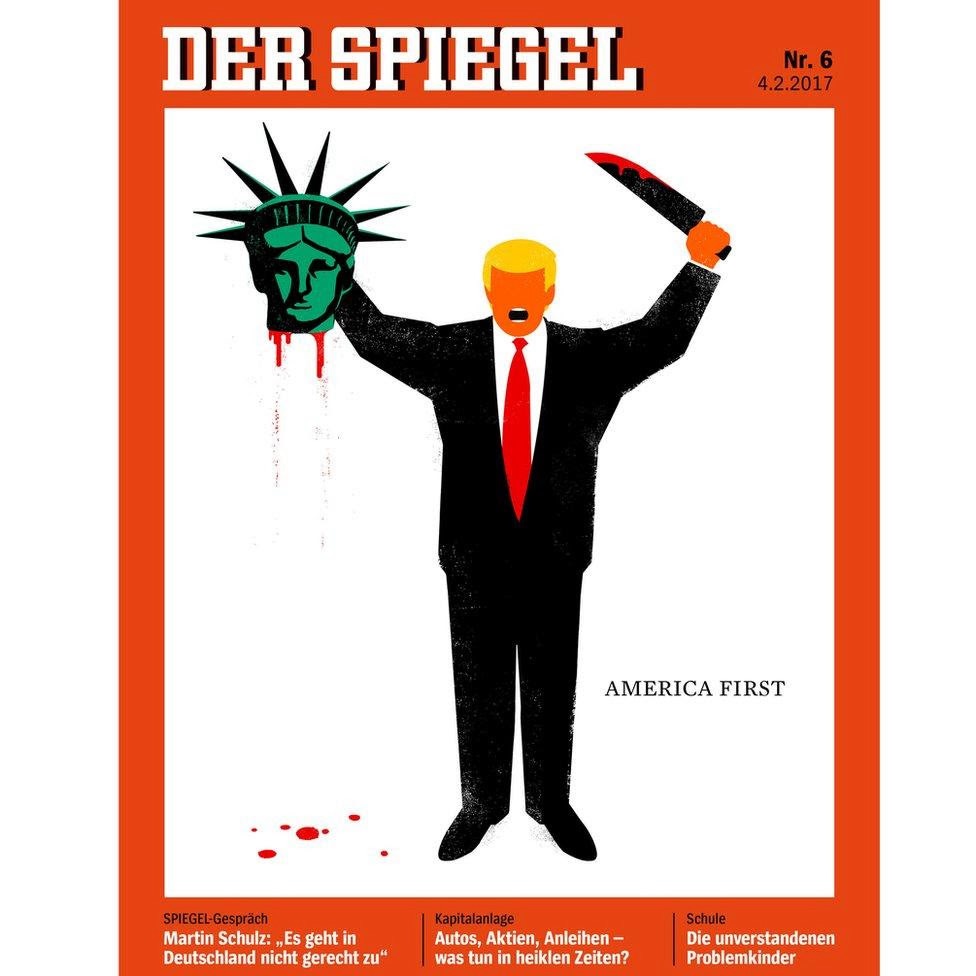
He writes:

We are a few days removed from an orange guillotine slicing through the neck of American democracy. The chicken that is our body politic, already dead but in denial, is running around with its head cut off, and will continue to do so until January 20, when Donald the Conqueror picks up that severed head with his tiny hands and holds it up for all the bewildered world to behold, in triumph. Trump and triumph have the same Latin root word, the English major in me is compelled to point out.

This year, post-election pieces that use the word “autopsy” and “post-mortem” will not be doing so metaphorically—although most of the pundits writing those pieces have not come to terms with this yet. I haven’t, not really, and unlike the legacy media pundits, I wrote a book this year covering all of the horrible things the new regime has promised to do, will try to do, will do.

(JD Vance—who I’ve been warning for months is an actual fascist—is among the numerous Dark Enlightenment thought leaders who use the word “regime” to mean the Deep State, so it is not without irony that these same Nazis will be replacing the bureaucracy that is the lifeblood of our country with an actual regime—regime, from rex, for king.)

Already the Trump Reich is licking its chops (literally as well as figuratively, one imagines), preparing to implement its ugly mass deportation program. That this idea polled well with Americans, and was supported enthusiastically by Latino men in particular, boggles the mind. Mass deportation is a quaint euphemism for genocide. If the new regime has its way, this will be more of a pogrom than a program. The suffering will be unimaginable; the effect on the economy Trump voters claim to care so much about, devastating.

And the new regime will seek vengeance upon its enemies. The loyalists who will actually be running the country after the professional civil servants are purged—angry, sadistic men like Mike Davis and Stephen Miller and Mike Flynn and Steve Bannon and Kash Patel—have been promising this for months. Trump’s perceived enemies, everyone from Jack Smith to Adam Schiff to Taylor Swift, are potentially in real danger. The generals who tried to warn us about him, the leaders of the intelligence community who know what he really is, his political rivals—these stalwarts of democracy may well end up at the wrong end of a firing squad. I am not exaggerating. Ivan Raiklin, Flynn’s Renfield, fancies himself the Minister of Retribution. Vengeance, more than anything, is what the new king wants, and vengeance he will have. 

President Biden, for all the good he’s done, has failed for four years to fully grasp the dire threat we face from the despotic MAGA forces and their allies in Moscow, Beijing, Silicon Valley, Wall Street, and legacy and social media. Putin has been openly waging war on the West since 2014, when he invaded and occupied the Crimea—a violation of the international order President Obama essentially chose to ignore. Like Neville Chamberlain, Obama did not want a war, and like Neville Chamberlain, he did not understand the nature of the psychopath he was up against; unlike Neville Chamberlain, he was not leading a country recently removed from four years of brutal war, and unlike Neville Chamberlain, he had the precedent of Neville Chamberlain to learn from. It’s only gotten worse from there.

The real tragedy is: We didn’t need to send in troops to beat the Russians. All we needed to do was treat the information war Moscow was waging on us as an actual front in an actual war, and give Ukraine as many weapons as it needed to do the dirty work for us. Biden did neither, and his entire legacy, all the good work he’s done, may wind up meaningless because of these failures.

Unless he’s working behind the scenes with the DOJ to clean up the mess—and nothing the somnambulant Merrick Garland has done, or rather not done, these past four years gives me any confidence that he is—Biden has already waved the white flag.

“Yesterday, I spoke with President-elect Trump to congratulate him on his victory,” Biden said yesterday. “And I assured him that I would direct my entire administration to work with his team to ensure a peaceful and orderly transition. That’s what the American people deserve.” That’s what we deserve, you see—our elected officials to lead us into the abattoir while assuring us, as Biden also did, that “[t]he American experiment endures, and we’re going to be okay” as long as we “keep going” and “keep the faith.”

Even worse is this: “Setbacks are unavoidable, but giving up is unforgivable. We all get knocked down, but the measure of our character, as my dad would say, is how quickly we get back up. Remember, a defeat does not mean we are defeated. We lost this battle.” A transition to permanent Nazi rule looms, and Biden wants us to jam to “Tubthumping.”

Jim Stewartson, who has been shouting from the rooftops about the threat of Trump’s muscle for years now—and who is certainly in the crosshairs of Flynn and Raiklin—articulated this perfectly, in his open letter to Biden:

You had the power to fix this. You should have had the information to understand the threat that we were facing. Instead you treated it like just another Democratic presidency, hoping that if the economy were good enough it would fix the problem with all the “MAGA extremists.”

You were wrong. You didn’t listen to those of us who told you who tried to steal the election from you in 2020. You let your DOJ and FBI drag their feet with the perfect timing to let Donald Trump and his co-conspirators go free. You prosecuted all the foot soldiers and never went after the “generals.” You prioritized “norms” and the “independence” of the DOJ over us. You failed to lead, to demand accountability — from Merrick Garland, Chris Wray and the others who let this happen on your watch.

I hear you talking now about “all that we accomplished” in your “historic administration” as if that will have any impact on the psychopaths who will destroy everything that you have done. You could have been the inflection point to preserve our world and make it better, instead you presided over a transition into an authoritarian global nightmare.

Sadly, Biden did not, as Stewartson laments, understand the threat we were, and are, facing—even though he is old enough that he was alive during World War II, and thus should be able to recognize Nazis when he sees them. What was done to counter Russian propaganda? To stop Elon Musk, Putin’s buddy and an enemy of democracy, from buying and destroying Twitter? From eradicating the cancer that is Fox News from its position of journalistic authority?

The historian Heather Cox Richardson had this to say about the election in her own post-partem piece

But my own conclusion is that both of those things [inflation and racism/sexism] were amplified by the flood of disinformation that has plagued the U.S. for years now. Russian political theorists called the construction of a virtual political reality through modern media “political technology.” They developed several techniques in this approach to politics, but the key was creating a false narrative in order to control public debate. These techniques perverted democracy, turning it from the concept of voters choosing their leaders into the concept of voters rubber-stamping the leaders they had been manipulated into backing. 

In the U.S., pervasive right-wing media, from the Fox News Channel through right-wing podcasts and YouTube channels run by influencers, have permitted Trump and right-wing influencers to portray the booming economy as “failing” and to run away from the hugely unpopular Project 2025. They allowed MAGA Republicans to portray a dramatically falling crime rate as a crime wave and immigration as an invasion. They also shielded its audience from the many statements of Trump’s former staff that he is unfit for office, and even that his chief of staff General John Kelly considers him a fascist and noted that he admires German Nazi dictator Adolf Hitler.

Trump admires Hitler, but he’s not Hitler—not even America’s Hitler, as the VP-Elect once called him. He is more Marshal Pétain or Vidkun Quisling: the nominal head of a Nazi puppet regime. As I explained a month before Russia invaded Ukraine, Putin is Hitler. Trump’s return to the White House is, among other things, the end of American exceptionalism, the end of American hegemony, the end of the Pax Americana. You know—setbacks.

Cue up the “U-S-A” chants, we are soon to become a Kremlin vassal state! Maybe the idea that the United States is better than everyone else, that the moral arc of the American universe always bends towards justice, is an obvious myth we choose to believe in despite ample evidence to the contrary—kind of like how the media doesn’t dispute that the woman who went to the polls with Trump on Election Day wearing dark oversized sunglasses was the real Melania.

Ken White, aka Popehat, in his superb piece on Wednesday, suggests that we “reconsider any belief in innate American goodness,” writing:

Are Americans inherently good, freedom-loving, devoted to free speech and free worship, committed to all people being created equal? That’s our founding myth, and isn’t it pretty to think so? But a glance at history shows it’s not true. Bodies in graves and jails across America disprove it. We’re freedom-loving when times are easy, devoted to speech and worship we like with lip service to the rest, and divided about our differences since our inception. That doesn’t make us worse than any other nation. It’s all very human. But faith in the inherent goodness of Americans has failed us. Too many people saw it as a self-evident truth that the despicable rhetoric and policy of Trump and his acolytes was un-American. But to win elections you still have to talk people out of evil things. You can’t just trust them to reject evil. You must persuade. You must work. You have to keep making the same arguments about the same values over and over again, defend the same ground every time. Sometimes, when people are afraid or suffering and more vulnerable to lies, it’s very hard. Trump came wrapped in the flag and carrying a cross (upside down, but still) and too many people assumed their fellow Americans would see how hollow that was. That assumption was fatal.

Not a setback, you see. Fatal. Fatal. Nazis are destroyers, and the new regime is here to destroy, just like their Uncle Ted wanted:

It will be objected that the French and Russian Revolutions were failures. But most revolutions have two goals. One is to destroy an old form of society and the other is to set up the new form of society envisioned by the revolutionaries. The French and Russian revolutionaries failed (fortunately!) to create the new kind of society of which they dreamed, but they were quite successful in destroying the old society.

That’s Ted as in Ted Kaczynski. These people worship at the altar of the Unabomber!

The best time to defeat Nazis is before they gain any power, as any cursory glance at the history of 20th century Europe makes clear. From Warsaw, in a country that was ravaged by the Third Reich like no other, Dustin Du Cane points out an awful truth in his piece today, “Four Wasted Years”: “Hitler wasn’t defeated by voting, ground roots campaigning, sanctions or sending Poland a tank a week,” he writes. “He was defeated by propaganda, curtailing the free speech of Nazis, by a war machine and by millions of men in boots with rifles, tanks and bombers.”

And as I’m not the first to point out—someone else tweeted this, and I can’t remember who—the Germans at least had the good sense to put Hitler in jail after his failed coup attempt, before handing him the keys to the kingdom. Us? We threw the book at some Proud Boys and let Trump, Flynn, Roger Stone, Alex Jones, and the rest of the coup plotters continue to strut around broadcasting their hate, rubbing our noses in their stinky MAGA shit. As documented indefatigably by Stewartson, my friend Gal Suburban, and very few members of the legacy media, the coup plotters spent four years telling us what they planned to do, like the bad Bond villains they are, while the DOJ basically ignored them. But hey, at least Merrick Garland went after Ticketmaster.

In terms of analyzing why Kamala Harris lost, Noah Berlatsky wrote the best post-mortem piece I came across, for Aaron Rupar’s Public Notice. There was a lot in his piece to be optimistic about—if not for the fact that we are capitulating to a vengeful sexual predator who has been granted full immunity by his fellow fascists on the Supreme Court for any “official act,” up to and including siccing the military on civilians and executing his perceived enemies. Berlatsky says:

Democrats hoped to stave off fascism in the Trump era by never losing elections. That was never feasible, and now that it has failed, we are all facing the miserable consequences of not prosecuting Trump immediately, and vigorously, after January 6.

Those consequences will be real, devastating, and long lasting. But it’s important to realize that the Republicans have not established a permanent or even solid mandate for all of Trump’s ugly orange dreams. As they won, so they can lose — which is why one of MAGA’s core goals going forward will be to subvert free and fair elections. Fighting for democracy, as well as helping each other survive the coming fascist assault, will be key in the years ahead.

To have a free election, candidates have to be free to run without fear of reprisal from the ruling party. Even if the Orange Grover Cleveland vouchsafes us midterm elections in 2026—and we cannot assume that he will—how comfortable will the opposition party be in exercising its free speech as it campaigns against him?

If we continue on this path, and Biden sits back and watches as Trump dismantles the federal regulatory agencies, and the FBI, and the CIA, we do have a few things working in our favor:

First, unlike Russia and other states where dictatorships have arisen, the United States has a long history of democratic rule (aspirational democratic rule, but still). We have that to fall back on.

Second, Trump is old and uninterested in governance and unlikely to last long in office, because of retirement, death, or the 25th Amendment. Vance is worse, because he’s younger and smarter and more ideological, but he lacks the political “rizz” necessary to maintain a cult of personality. This is a guy who plausibly fucks couches. Even when enabled by Peter Thiel and Musk, can he really hold onto power?

Third, most Americans—not many; most—will hate the stuff the new regime will roll out, including the mass deportations they once cheered on. As my friend Nina Burleigh, whom no one ever accused of peddling “hopium,” wrote on Wednesday, we Americans

are also fickle. After four more years of the right running amok, when Trump 2.0 kleptocrats have not delivered the fantasies Orange has peddled of prosperity for all, it will dawn on enough Americans that this regime will never fill the deep and endless yearning for our birthright—HAPPINESS. Because: Who can? And then, angry again, we will give this claque of oafs, orcs, rapists, misogynists, fake Christians, racists, neo-Nazis, and liars the boot they deserved last night.

The question is whether enough Americans will rise up to do so, or if they will just blame all the failures on Biden, as Fox News and Facebook will instruct them to do, and go back to watching football. Me, I like to think even the gun-toting MAGA won’t like it when the jackboots come for their friends and family members.

For me, the real glimmer of hope is that the leaders of the Blue States seem prepared for the fight ahead, and, unlike Biden, willing to take it on. Kathy Hochul and Leticia James, the governor and attorney general of my state of New York, were particularly reassuring about this. The latter, no fan of Trump, said this:

As Attorney General, I will always stand up to protect New Yorkers and fight for our rights and values. My office has been preparing for a potential second Trump Administration, and I am ready to do everything in my power to ensure our state and nation do not go backwards. During his first term, we stood up for the rule of law and defended against abuses of power and federal efforts to harm New Yorkers. Together with Governor Hochul, our partners in state and local government, and my colleague attorneys general from throughout the nation, we will work each and every day to defend Americans, no matter what this new administration throws at us. We are ready to fight back again.”

The governor of Massachusetts, Maura Healey, issued similar sentiments, vowing not to allow state police to participate in federal mass deportation programs. Gavin Newsom and JB Pritzker are also being proactive, as the New York Times reports:

In California, Gov. Gavin Newsom called lawmakers on Thursday into a legislative special session next month “to safeguard California values and fundamental rights in the face of an incoming Trump administration.”

In Illinois, Gov. JB Pritzker said on Thursday he would ask his state’s legislators, possibly as soon as next week, to address potential threats from a second Trump term. “You come for my people,” Mr. Pritzker said at a news conference, “you come through me.”

That is the kind of leadership we need—not platitudes about setbacks and “we’ll get ‘em next time.”

There is no commandment etched in stone and delivered from the Almighty that says the American experiment will forever endure—nor is the union of all 50 states immutable and unbreakable. The Balkanization of the United States is a long-term goal of the Kremlin, I’m well aware, but I would argue that turning into Yugoslavia is preferable to turning into Hungary, which is just the first step in turning into Russia.

The time to take on the Kremlin was four years ago. Unless Biden does something unexpected in the next 70-whatever days—a Jayden Daniels “Hail Maryland” completion to save democracy—that moment has passed. Putin will soon have his puppet back in the White House, this time with the backing of the Supreme Court, the Senate, probably the House, and a staff of bloodthirsty fascist true believers; that is a far bigger victory for Moscow than the U.S. making like the USSR and disbanding. Sorry, Abe Lincoln, but I would rather live in a smaller democracy than a Trump dictatorship.

And as much as I’d like to think otherwise—and I assure you, I’ve spent the last few days trying—it’s foolhardy to believe that the immediate future will be anything but a Trump-branded sneaker stomping on a human face. Nazis don’t stop being Nazis because you show them decency and respect, as Biden and Harris have both stupidly chosen to do. We cannot expect that Trump or anyone in his regime will be anything other than what they are, or will do anything other than what they’ve told us they plan to do.

Again this week, I quote the German poet Kurt Tucholsky: “My life is too precious to put myself under an apple tree and ask it to produce pears.”

Glenn Kessler is the fact checker for The Washington Post. He describes what it is like to check the nation’s most notorious prevaricator.

Kessler writes:

In my 14 years as The Washington Post Fact Checker, nine have been devoted to dissecting and debunking claims made by Donald Trump. Indeed, no person has been fact-checked more often than Trump, as he has bested or outlasted foes — Hillary Clinton, Joe Biden and Kamala Harris — who drew their share of fact checks. And no other person has consistently earned Four Pinocchios — the badge of a committed liar — day after day, week after week.


I first covered Trump as a business reporter in the 1980s, so I was very familiar with his long history of exaggeration and bravado when he burst onto the political stage in 2015 (not counting his brief flirtation with the Reform Party in 2000). “Businessman Donald Trump is a fact checker’s dream … and nightmare,” I wrote in the fact check of his speech announcing that he would seek the presidency.


Now, he has convincingly won a second term via the electoral college and is even on track for the first time in three tries to win the popular vote. After his first two races, I wrote analyses that, in retrospect, misjudged the Trump phenomenon.

In 2016, I noted that “based only on anecdotal evidence — emails from readers — one reason that Trump’s false statements may have mattered little to his supporters is because he echoed things they already believed.” But I expressed hope that “now that Trump will assume the presidency, he may find that it is not in his interest to keep making factually unsupported questions.”

As an example, I noted that during the campaign he had claimed that the unemployment rate was 42 percent, rather than the 5 percent in official statistics. I suggested that he might find himself embarrassed to be contradicted by the official data once he took office.


I was wrong. He embraced the numbers as his own — and then bragged that he had created the greatest economy in American history, even though he had inherited it from Barack Obama.
When Trump was defeated in 2020, my analysis carried a headline that is embarrassing in retrospect: “Fact-checking in a post-Trump era.” I wrote that “his defeat by Democrat Joe Biden suggests that adherence to the facts does matter.”


The Fact Checker documented more than 30,000 false or misleading claims that Trump made during his presidency. Indeed, through that term, Trump was the first president since World War II to fail to ever win majority support in public opinion polls. A key reason was that relatively few Americans believed he was honest and trustworthy, an important metric in Gallup polls. Gallup has described this as “among his weakest personal characteristics.”

As evidence that Trump was hurt by falsehoods, I pointed to Biden’s narrow victories in Arizona and Georgia: “It’s quite possible that at least 9,000 people in Arizona and 5,000 in Georgia were upset enough at Trump’s continued false attacks on native sons Sen. John McCain (R) and Rep. John Lewis (D), even after they died, that they decided to support Biden over Trump.”

The essay appeared before Trump embarked on a months-long campaign to claim that Biden won only through election fraud — a lie debunked in court ruling after court ruling. The Jan. 6, 2021, attack on the Capitol, inspired by his rhetoric, appeared to be an indelible stain. Yet from 2020 on, Trump used his false claim to maintain his Republican support and build a base for his comeback.


In this election campaign, Trump once again resorted to false claims and sometimes outrageous lies, especially on immigration and the economy. He rode a wave of discontent about inflation — a problem in every industrialized country after the pandemic — to falsely claim that the economy was a disaster, despite relatively low unemployment, falling inflation and strong growth.


Last month, the Economist magazine published a cover story declaring that the U.S. economy was “the envy of the world.” Yet exit polls show that two-thirds of voters said the economy was in bad shape.


I do not write fact checks to influence the behavior of politicians; I write fact checks to inform voters. What voters — or politicians — do with the information in the fact checks is up to them.

Trump certainly benefits from an increasingly siloed information system — a world in which people can set their social media feeds or their television channel so they receive only information that confirms what they already believe. It’s perhaps not an accident that Trump’s rise in politics coincides with the rise of social media, which he adeptly used to first attract attention by elevating (false) questions about Obama’s birth certificate.


In this campaign, Trump made many promises that will be difficult to achieve, such as reducing the national debt and cutting energy prices in half. He also said he would reduce inflation, though that’s already been mostly achieved, and many economists say his plan to impose large tariffs on imported goods might spark inflation again.


No matter what happens, or how many fact checks are written, this time I won’t doubt his ability to convince his supporters that it’s all good news — or that the problem is the fault of someone else, facts notwithstanding.

Everyone knew it would be a close election. Few anticipated Trump’s sweeping victory over Kamala Harris. The New York Times editorial board endorsed Kamala Harris. This is their next-day reaction.

By 

American voters have made the choice to return Donald Trump to the White House, setting the nation on a precarious course that no one can fully foresee.

The founders of this country recognized the possibility that voters might someday elect an authoritarian leader and wrote safeguards into the Constitution, including powers granted to two other branches of government designed to be a check on a president who would bend and break laws to serve his own ends. And they enacted a set of rights — most crucially the First Amendment — for citizens to assemble, speak and protest against the words and actions of their leader.

Over the next four years, Americans must be cleareyed about the threat to the nation and its laws that will come from its 47th president and be prepared to exercise their rights in defense of the country and the people, laws, institutions and values that have kept it strong.

It can’t be ignored that millions of Americans voted for a candidate even some of his closest supporters acknowledge to be deeply flawed — convinced that he was more likely to change and fix what they regarded as the nation’s urgent problems: high prices, an infusion of immigrants, a porous southern border and economic policies that have flowed unequally through society. Some cast their votes out of a profound dissatisfaction with the status quo, politics or the state of American institutions more broadly.

Whatever drove this decision among these voters, however, all Americans should now be wary of an incoming Trump administration that is likely to put a top priority on amassing unchecked power and punishing its perceived enemies, both of which Mr. Trump has repeatedly vowed to do. All Americans, regardless of their party or politics, should insist that the fundamental pillars of the nation’s democracy — including constitutional checks and balances, fair-minded federal prosecutors and judges, an impartial election system and basic civil rights — be preserved against an assault that he has already begun and has said he would continue.

At this point, there can be no illusions about who Donald Trump is and how he intends to govern. He showed us in his first term and in the years after he left office that he has no respect for the law, let alone the values, norms and traditions of democracy. As he takes charge of the world’s most powerful state, he is transparently motivated only by the pursuit of power and the preservation of the cult of personality he has built around himself. These stark assessments are striking in part because they are held not just by his critics but also by those who served most closely with him.

We are a nation that has always emerged from a crucible with its ideals intact and often toughened and sharpened. The institutions of our government, hardened by nearly 250 years of disputation, turmoil, assassinations and wars, held firm when Mr. Trump assailed them four years ago. And Americans know how to counter Mr. Trump’s worst instincts — actions that were unjust, immoral or illegal — because they did so, over and over, during his first administration. Civil servants, members of Congress, members of his own party and people he appointed to high office often stood in the way of the former president’s plans, and other institutions of our society, including the free press and independent law enforcement agencies, held him accountable to the public.

Mr. Trump and his movement have all but taken over the Republican Party. Yet it is also important to remember that Mr. Trump can’t run for another term. From the day he enters the White House, he will be, in effect, a lame-duck president. The Constitution limits him to two terms. Congress has the power — and for some ambitious Republicans, perhaps the political incentive — to set a course away from Mr. Trump’s antidemocratic agenda, if it chooses to pursue it.

Governors and legislatures across the nation have spent months shoring up their state laws and Constitutions to protect civil rights and liberties, including access to reproductive and gender-affirming health care. Even states that voted overwhelmingly for Mr. Trump, including Kentucky, Ohio and Kansas, have rejected the most extreme positions on abortion. Other institutions of American civil society will play a crucial role in challenging the Trump administration in the courts, in our communities and in the protests that are sure to return.

The rest of the world, too, has no illusions about the leader who will soon again represent the United States on the world stage. The countries of the NATO alliance were shocked, during the first Trump administration, by his willingness to undermine that long and valuable partnership. But European nations, defying Mr. Trump’s predictions, not only came together with the United States in the face of Russia’s invasion of Ukraine but also expanded their ranks right up to Russia’s border.

For the Democratic Party, rear-guard action as the political opposition will not be enough. The party must also take a hard look at why it lost the election. It took too long to recognize that President Biden was not capable of running for a second term. It took too long to recognize that large swaths of their progressive agenda were alienating voters, including some of the most loyal supporters of their party. And Democrats have struggled for three elections now to settle on a persuasive message that resonates with Americans from both parties who have lost faith in the system — which pushed skeptical voters toward the more obviously disruptive figure, even though a large majority of Americans acknowledge his serious faults. If the Democrats are to effectively oppose Mr. Trump, it must be not just through resisting his worst impulses but also by offering a vision of what they would do to improve the lives of all Americans and respond to anxieties that people have about the direction of the country and how they would change it.

The test for members of this new Congress will begin soon after they take their oath. The president-elect has promised to surround himself in his second term with enablers prepared to pledge loyalty to him, who will be willing to do whatever he commands. But a president needs the Senate to approve many of those appointments. Senators can stop the most extreme or unqualified candidates from taking cabinet positions like defense secretary and attorney general, as well as seats on the Supreme Court and the federal bench. They can act to keep clearly unfit candidates from holding any powerful position. The Senate did that in 2020, when it blocked Mr. Trump’s attempts to seat unqualified people on the board of the Federal Reserve, and the chamber should not hesitate to do so again.

Perhaps the most important responsibility lies with all of those who will serve in a second Trump administration. Those he appoints as attorney general, as secretary of defense and to other top leadership roles should expect that he may ask them to carry out illegal acts or violate their oaths to the Constitution on his behalf, as he did in his first term. We urge them to recognize that whatever pledge of loyalty he may demand, their first loyalty is to their country. Standing up to Mr. Trump is possible, and it is the duty of every American public servant when appropriate.

But the final responsibility for ensuring the continuity of America’s enduring values lies with its voters. Those who supported Mr. Trump in this election should closely observe his conduct in office to see if it matches their hopes and expectations, and if it does not, they should make their disappointment known and cast votes in the 2026 midterms and in 2028 to put the country back on course. Those who opposed him should not hesitate to raise alarms when he abuses his power, and if he attempts to use government power to retaliate against critics, the world will be watching.

Benjamin Franklin famously admonished the American people that the nation was “a republic, if you can keep it.” Mr. Trump’s election poses a grave threat to that republic, but he will not determine the long-term fate of American democracy. That outcome remains in the hands of the American people. It is the work of the next four 

The Daily Beast has a scoop. Michael Wolff, author of the 2018 bestseller Fire and Fury, interviewed Jeffrey Epstein for over 100 hours. Epstein had some very interesting observations. He said that Trump could be “charming,” that he was a great salesman, and that they were “best friends” for years. He also said that Trump knew nothing except construction–no history, nothing. And that if Trump performed an act of kindness, it was an accident.

It’s unclear why Wolff waited so long to release this story. Not is it clear why it has not been reported in the MSM (Mainstream Media).

Everything Epstein says is on tape. Some of the tapes are online.

One of Trump’s favorite activities, Epstein says, was bedding the wives of his best friends. He thought it was hilarious.

Wolff interviewed Epstein in his Manhattan townhouse. Epstein showed him a bunch of photos of Trump at Epstein parties with a topkess young woman on his lap. The FBI raided Epstein’s house in 2019 and confiscated all Epstein’s stuff, including the videotapes that show who visited him and what happened, as well as all photographs. These have never been released.

Epstein told Wolff that he was afraid of Trump.

Epstein died in a bleak cell in Manhattan in 2019. The medical examiner ruled his death a suicide. Many people wondered why the two guards, who were supposed to protect this high-profile prisoner, did not notice.

After Jeff Bezos, billionaire owner of The Washington Post, stopped publication of the editorial board’s endorsement of Kamala Harris, digital subscribers revolted. According to a report in The Post, at least 250,000 canceled their subscriptions.

Past and present journalists at the newspaper urged readers not to cancel. Loss of revenue means future layoffs.

Even with the cancellation of the endorsement, the Post remains the most forthright and persistent critic of Trump and his racism, misogyny, xenophobia, as well as his all-around unfitness for office.

Those who look for a future with a stable, functioning two-party system–post-MAGA–should resubscribe.

This post appeared originally in the Louisville Courier-Journal. It has since been posted by The Network for Public Education, whose contents are curated by Peter Greene.

Liam Amick: Trinity won’t let me write about Amendment 2. Here’s why I’m against it.

Liam Amick is a senior at Trinity High School, a Catholic school in Kentucky, where vouchers are on the ballot next week in Amendment 2, a proposed amendment to the state constitution that would okay vouchers. Trinity has made support of the Amendment mandatory. Amick would like to disagree, and does so in the Courier Journal.

Every day when I drive into school, I’m greeted by yard signs blazing with the message “YES on 2!” To see these put up at Trinity, a school that generally requests little political discussion at school, was quite a shock.

I’m a “private school kid.” I went to St. Francis of Assisi for first through eighth grades, and I am now a senior at Trinity High School. I will always be indebted to those schools for providing me with fantastic educations and experiences in the most formative years of my life. But to say I am disappointed with Trinity’s stance on Amendment 2 — a Kentucky ballot measure that would allow public tax funding to be used for private schools — would be an understatement.

An even bigger disappointment has been Trinity’s and the Archdiocese of Louisville‘s responses to criticism of their position. When both Trinity’s Student Government and Faculty Senate asked if the “YES on 2!” signs could be taken down, they were told that the archdiocese had asked us to put them up and there was absolutely no chance of them being taken down. Also, the administration doesn’t allow our school journalism program to report on any political topics and or criticisms of Trinity and its policies, so I felt that to share my views I had to look outside of the school.

In my opinion, the desire of non-public schools to support Amendment 2 is logical, but closed-minded. What’s important to remember is that, in Kentucky, 65% of non-public schools are found in Louisville, Lexington and the general Northern Kentucky area. Out of 120 counties in Kentucky, 89 have no access to a non-public school, and well-run, accredited non-public schools aren’t going to magically appear in those counties after the passage of Amendment 2. So, the “school choice” amendment would in fact offer students in these areas no “choice” to go to a different school.

Supporters of Amendment 2 often bring up Kentucky’s 2023 $1 billion budget surplus, claiming that that money will be used to provide funding to public schools and said schools will lose no money. However, that surplus money already has a destination. According to House Appropriations and Revenue Chair Jason Petrie, the extra money has “provided the opportunity to invest more than $2.7 billion over the next two years to improve road, rail, river, air, and water infrastructure.” Although Petrie claims they are also making “targeted investments in school facilities,” the bottom line is that significantly fewer tax dollars would go to public schools, leaving no replacement funding in their wake.

Read the full op-ed here. You can view the post at this link : https://networkforpubliceducation.org/blog-content/liam-amick-trinity-wont-let-me-write-about-amendment-2-heres-why-im-against-it/

Jonathan V. Last writes at The Bulwark, the always interesting gathering spot for Never Trumpers. He wrote that he has been stewing about the intervention of Jeff Bezos, billionaire owner of The Washington Post, to stop the editorial board from endorsing Kamala. after Bezos locked the editorial, three of the 10-member editorial board stepped down.

He wrote:

ON FRIDAY, after the Washington Post’s publisher announced that the paper was suddenly abandoning the practice of the editorial page endorsing presidential candidates, news leaked that—on the very same day—Donald Trump met with executives from Blue Origin.

Blue Origin, of course, is the rocket company owned by Jeff Bezos, who also owns the Washington Post.

What we witnessed on Friday was not a case of censorship or a failure of the media. It had nothing to do with journalism or the Washington Post. It was something much, much more consequential. It was about oligarchy, the rule of law, and the failure of the democratic order.

This was neither a coincidence nor a case of Bezos and Trump being caught doing something they wished to keep hidden. The entire point of the exercise, at least for Trump, was that it be public.

When Bezos decreed that the newspaper he owned could not endorse Trump’s opponent, it was a transparent act of submission borne of an intuitive understanding of the differences between the candidates.

Bezos understood that if he antagonized Kamala Harris and Harris became president, he would face no consequences. A Harris administration would not target his businesses because the Harris administration would—like all presidential administrations not headed by Trump—adhere to the rule of law.

Bezos likewise understood that the inverse was not true. If he continued to antagonize Trump and Trump became president, his businesses very much would be targeted.

So bending the knee to Trump was the smart play. All upside, no downside.

What Trump understood was that Bezos’s submission would be of limited use if it was kept quiet. Because the point of dominating Bezos wasn’t just to dominate Bezos. It was to send a message to every other businessman, entrepreneur, and corporation in America: that these are the rules of the game. If you are nice to Trump, the government will be nice to you. If you criticize Trump, the government will be used against you.

Which is why Trump met with Blue Origin on the same day that Bezos yielded. It was a demonstration—a very public demonstration.

But as bad as that sounds, it isn’t the worst part.

The worst part is the underlying failures that made this arrangement possible.


My friend Kristofer Harrison is a Russia expert who runs the Dekleptocracy Project. This morning he emailed,

America’s oligarch moment makes us more like 1990s Russia than we want to believe. Political scientists can and will debate what comes first: oligarchs or flaccid politicians. 1990s Russia had that in spades. So do we. That combination corroded the rule of law there, and it’s doing so here.

Russian democracy died because their institutions and politicians were not strong enough to enforce the law. Sound familiar? I could identify half a dozen laws that Elon Musk has already broken without enforcement. Bezos censored the Post because he knows that nobody will enforce the law and keep Trump from seeking political retribution. And on and on. The corrosive effect on the rule of law is cumulative.

The Bezos surrender is our warning bell about entering early-stage 1990s Russia. No legal system is able to survive when it there’s a class not subject to it because politicians are too cowardly to enforce the law.

And that’s the foundational point. The Bezos surrender isn’t just a demonstration. It’s a consequence. It’s a signal that the rule of law has already eroded to such a point that even a person as powerful as Jeff Bezos no longer believes it can protect him.

So he has sought shelter in the embrace of the strongman.

Bezos made his decision because he calculated that Trump has already won—not the election, but his struggle to break the rule of law.


Yesterday, Timothy Snyder issued a call to Americans to not obey in advance. He is correct, of course. We should continue to resist fascism as best we can. The stakes have not changed.

If Trump wins? Well, I suppose we’ll burn that bridge when we come to it.

What should change is our understanding of where our democracy currently sits on the continuum. We are not teetering at the precipice of a slide into autocracy. We are already partway down the slope. And that’s even if Harris wins.

But Bezos and Trump have just taught America’s remaining small-d democratic leaders: The time for normal politics, where you try to win bipartisan majorities by focusing on “kitchen-table” issues is past. The task in front of us will require aggressive, systemic changes if we are to escape terminal decline.

The hour is later than we think.

I did not cancel my subscription to the Washington Post despite the fact that I was outraged by billionaire Jeff Bezos’s censorship of the editorial board, which intended to endorse Kamala Harris.

I expected that the response of the editorial board and the opinion writ were a would double down on their contempt for the insurrectionist, lying former president.

As this editorial today shows, the editorial board will not be silenced. In this editorial, it draws a straight line between democracy and civility, a character trait that Trump knows not.

Unless Bezos replaces the editorial board with MAGA types, the WaPo editorials will dole out contempt for Trump every day that remains of the campaign. The last paragraph, in particular, is a gem.

Think of it as slow-walking its endorsement of Kamala.

Democracy depends on many things: institutions, traditions, public legitimacy and, yes, a culture of civility. The peaceful transfer of power requires people to have at least a minimum degree of trust in their fellow citizens — that the stakes are not existential. In this regard, former president Donald Trump showed, in his closing argument at a raucous rally at Madison Square Garden, that whether he wins or loses on Nov. 5, he has already done severe damage to American politics by coarsening and corroding public discourse.

Seeking to limit the fallout after a rally speaker referred to Puerto Rico as “a floating island of garbage in the middle of the ocean,” campaign spokeswoman Karoline Leavitt lamented on Monday on Fox News: “It’s sad that the media will pick up on one joke that was made by a comedian rather than the truths that were shared by the phenomenal list of speakers that we had.”

Here are some of the “truths” from the other “phenomenal” speakers, none of which the Trump campaign disavowed: Businessman Grant Cardone likened Vice President Kamala Harris to a prostitute. “Her and her pimp handlers will destroy our country,” he said. David Rem, billed as a childhood friend of Mr. Trump’s, called Ms. Harris the “Antichrist” and “devil” while waving a cross onstage.

Radio host Sid Rosenberg called Hillary Clinton a son of a b—- and dropped an f-bomb as he said that all Democrats are “degenerates … lowlifes.” Rudy Giuliani, disbarred over his misconduct as a lawyer for Mr. Trump’s effort to block the 2020 election results, said Ms. Harris is “on the side of the terrorists” in the Israel-Gaza conflict. Donald Trump Jr. claimed Democrats want to “replace” Americans with immigrants.

The stand-up comedian who made that nasty crack about Puerto Rico, Tony Hinchcliffe, made other tasteless ethnic jokes about African Americans, Latinos and Jews. The Bulwark reported that Trump campaign staffers reviewed a script of Mr. Hinchcliffe’s routine in advance and asked him to excise only a line that referred to Ms. Harris as a “c—.”

Even so, a pro-Trump group funded by Elon Musk, who also spoke at Sunday’s rally, posted on X, the platform he owns, and later deleted a video that referred to Ms. Harris as the c-word. After some innuendo, the video’s narrator clarifies that they mean she’s a communist.

To be sure, Mr. Trump has been destabilizing civil discourse since even before he started his 2016 campaign: It was in 2011 that he started voicing support for the false notion that President Barack Obama was not born in the United States. Yet in the final weeks of this election, he seems to be making the normalization of incivility one of his campaign’s de facto objectives.

He opened a rally this month in Latrobe, Pennsylvania, by commenting on the size of golfer Arnold Palmer’s genitalia. Mr. Trump told the crowd that night that his wife, Melania, has urged him to use less foul language and that evangelical leader Franklin Graham wrote him a letter pleading the same case. His punchline is that he cannot help himself because Ms. Harris has been a “s—” vice president and everything she touches turns to “s—.” The crowd started chanting “s—” in Latrobe. A top-selling shirt outside his rallies describes Ms. Harris as a “hoe.”

True, Mr. Trump’s campaign is not only a cause of this society’s spreading incivility but a consequence of it. Moreover, norms regarding profanity follow a cultural dynamic separate from politics, and the culture is more permissive about such things than it once was. This may explain why Ms. Harris has also occasionally been using four-letter words on the stump. She swore up a storm in a Rolling Stone interview and said being vice president has made her more profane. Her running mate, Tim Walz, called Mr. Musk “a dips—” during a rally last week. Not a great example. But Mr. Trump’s Madison Square Garden rally and events like it are in a class by themselves, not least in their threatening tone.

When he finally took the stage on Sunday, the former president declared without irony: “The Republican Party has really become the party of inclusion.” Then, over 80 minutes, he promised to invoke the 1798 Alien Enemies Act to deport undocumented immigrants, called Democrats “the enemy within” and the mainstream media “the enemy of the people,” described the United States as “an occupied country,” and predicted Nov. 5 will bring “Liberation Day.” Even without a vulgarity, it was the most offensive language of all.

We used to expect our Presidents to be role models. We encouraged our children to emulate them. We hoped that our children would learn from their example of service, valor, and dedication to principle. Sometimes we airbrushed their flaws or mythologized them. But we expected them to act and speak with dignity, as befits the Office.

But not Donald Trump. He has made a mockery of the Presidency. Imagine Abe Lincoln or Harry Truman or Dwight D. Eisenhower hawking tennis shoes or watches for his personal profit in the middle of his campaign.

Worse, however, is his crude language. He has brought locker-room talk onto the public stage, which no other American President has ever done. It is literally impossible to imagine any previous President talking in public with admiration about the size of Arnold Palmer’s genitals. Trump and his campaign hit a new low at the infamous event at Madison Square Garden.

The New York Times noticed:

Four-letter words were flying everywhere. One speaker flipped his middle finger at the opposition. Another made what was interpreted as an oral sex joke regarding Vice President Kamala Harris. Another suggested she was a prostitute. Still another discussed the supposed sexual habits of Latinos rather explicitly.

All in all, former President Donald J. Trump’s rally at Madison Square Garden on Sunday was a cornucopia of crudeness, punctuated by the kind of language that once would have been unthinkable for a gathering held to promote the candidacy of a would-be president of the United States. But among the many lines that Mr. Trump has obliterated in his time in politics is the invisible boundary between propriety and profanity.

Mr. Trump has always been more prone than any of his predecessors in the White House to publicly use what were once called dirty words. But in his third campaign for the presidency, his speeches have grown coarser and coarser. Altogether, according to a computer search, Mr. Trump has used words that would have once gotten a kid’s mouth washed out with soap at least 140 times in public this year. Counting tamer four-letter words like “damn” and “hell,” he has cursed in public at least 1,787 times in 2024

What minimal self-restraint Mr. Trump once showed in his public discourse has evaporated. A recent New York Times analysis of his public comments this year showed that he uses such language 69 percent more often than he did when he first ran for president in 2016. He sometimes acknowledges that he knows he should not but quickly adds that he cannot help himself.

He often relates that Franklin Graham, the evangelical leader and son of the Rev. Billy Graham, has chided the former president about his language. “I wrote him back,” Mr. Trump said at a rally this month where he discussed the golfer Arnold Palmer’s penis size and invited the crowd to shout out a four-letter word to describe Ms. Harris. “I said, I’m going to try to do that, but actually, the stories won’t be as good. Because you can’t put the same emphasis on it. So tonight, I broke my rule.”

The crowd typically does not mind; quite the opposite. The thousands on hand at Madison Square Garden cheered and laughed at the F-bombs, S-bombs and other bombs thrown out by the various speakers and warm-up acts for Mr. Trump. It clearly is part of the testosterone-driven appeal: Real men curse. Mr. Trump is a real man. What they want is a real man for president.

In total, a computer search of 17 of the speakers at Madison Square Garden found epithets used at least 43 times. One of the most prolific was Sid Rosenberg, a conservative radio host. “What a sick son of a bitch,” he said of Hillary Clinton. “The whole fucking party, a bunch of degenerates, lowlives, Jew haters and lowlives. Every one of them.”

Scott LoBaido, an artist, flipped the bird to the Democrats and called Mr. Trump “the greatest fucking president in the world.”

Tony Hinchcliffe, the comic who made insulting jokes about Latino sexual practices, likewise disparaged Jews and Palestinians and called Puerto Rico “a floating island of garbage,” the only comment the Trump campaign later disavowed.

Mr. Trump himself was somewhat more reticent at Madison Square Garden, deploying an “ass,” a couple of “damns,” eight “hells” and a “shit.” But at other recent rallies, he has called Ms. Harris “a shit vice president” and used the same word at a Catholic charity dinner in front of New York’s cardinal.

At one appearance in February before the Conservative Political Action Conference, Mr. Trump spiced his speech with no fewer than 44 epithets. “I got indicted four times by this gang of thugs for nothing, or as I say respectfully to the people from foreign countries, for bullshit,” he said at one point.

The computer analysis showed that Mr. Trump’s use of curses has been on the rise particularly in the past few months as the campaign heated up. But Mr. Trump, now 78, did not resort to such language nearly as much during the final months of the 2020 campaign, according to the analysis, and some experts point to his increased profanity as an example of “disinhibition,” a trait often found with aging as people become less restrained in what they say.

Alexandra Petri is the humorist for The Washington Post. In her column, she endorsed Kamala Harris. She called her column “It Has Fallen to Me, the Humor Columnist, to Endorse Kamala Harris for President.” This is why I didn’t cancel my subscription to The Washington Post. I want to see many ways the opinion writers devise to torture Jeff Bezos.

She wrote:

The Washington Post is not bothering to endorse a candidate in the 2024 presidential election. (Jeff Bezos, the founder of Blue Origin and the founder and executive chairman of Amazon and Amazon Web Services, also owns The Post.)

We as a newspaper suddenly remembered, less than two weeks before the election, that we had a robust tradition 50 years ago of not telling anyone what to do with their vote for president.

It is time we got back to those “roots,” I’m told!
Roots are important, of course. As recently as the 1970s, The Post did not endorse a candidate for president. As recently as centuries ago, there was no Post and the country had a king! Go even further back, and the entire continent of North America was totally uninhabitable, and we were all spineless creatures who lived in the ocean, and certainly there were no Post subscribers.

But if I were the paper, I would be a little embarrassed that it has fallen to me, the humor columnist, to make our presidential endorsement. I will spare you the suspense: I am endorsing Kamala Harris for president, because I like elections and want to keep having them.

Let me tell you something. I am having a baby (It’s a boy!), and he is expected on Jan. 6, 2025 (It’s a … Proud Boy?). This is either slightly funny or not at all funny. This whole election, I have been lurching around, increasingly heavily pregnant, nauseated, unwieldy, full of the commingled hopes and terrors that come every time you are on the verge of introducing a new person to the world.

Well, that world will look very different, depending on the outcome of November’s election, and I care which world my kid gets born into. I also live here myself. And I happen to care about the people who are already here, in this world. Come to think of it, I have a lot of reasons for caring how the election goes. I think it should be obvious that this is not an election for sitting out.

The case for Donald Trump is “I erroneously think the economy used to be better? I know that he has made many ominous-sounding threats about mass deportations, going after his political enemies, shutting down the speech of those who disagree with him (especially media outlets), and that he wants to make things worse for almost every category of person — people with wombs, immigrants, transgender people, journalists, protesters, people of color — but … maybe he’ll forget.”

“But maybe he’ll forget” is not enough to hang a country on!

Embarrassingly enough, I like this country. But everything good about it has been the product of centuries of people who had no reason to hope for better but chose to believe that better things were possible, clawing their way uphill — protesting, marching, voting, and, yes, doing the work of journalism — to build this fragile thing called democracy. But to be fragile is not the same as to be perishable, as G.K. Chesterton wrote. Simply do not break a glass, and it will last a thousand years. Smash it, and it will not last an instant. Democracy is like that: fragile, but only if you shatter it.

Trust is like that, too, as newspapers know.
I’m just a humor columnist. I only know what’s happening because our actual journalists are out there reporting, knowing that their editors have their backs, that there’s no one too powerful to report on, that we would never pull a punch out of fear. That’s what our readers deserve and expect: that we are saying what we really think, reporting what we really see; that if we think Trump should not return to the White House and Harris would make a fine president, we’re going to be able to say so.

That’s why I, the humor columnist, am endorsing Kamala Harris by myself!