Archives for category: Ethics

Annie Martin and Leslie Postal of the Orlando Sentinel have repeatedly exposed the fraud baked into Florida’s voucher program. It began in 1999 with the modest ambition of offering choice to low-income students in “failing schools.” It expanded to provide vouchers for students with disabilities. In past articles, they surveyed voucher schools and identified academic deficiencies, such as uncertified teachers and principals, and Bible-based textbooks. Now, they report on what happened after the state removed all income limits in 2023. Florida now offers money for all students, regardless of family income.

Most of the students getting the voucher money are not low-income, do not have disabilities, and are not escaping bad public schools.

The students getting vouchers are already enrolled in private schools. They don’t need the extra money but they are happy to take it.

They write:

A block from Winter Park’s tony Park Avenue sits St. Margaret Mary Catholic School, where tuition can top $14,000 a year for a K-8 education.

But at this school in the heart of one of Central Florida’s wealthiest communities, about 98 percent of students used taxpayer-funded scholarships worth roughly $8,000 to help pay tuition last year.

Only three percent of St. Margaret Mary’s students got that state financial aid just one year earlier.

The change – repeated at schools around the state – is one powerful measure of how a 2023 Florida law has supercharged a school voucher initiative that was already the nation’s largest.

Once reserved for low-income students and those with disabilities, state scholarships, often called vouchers, are now available to all – and they’re fueling an unprecedented pipeline of public money, estimated at $3.4 billion this year, into private, mostly religious schools across the Sunshine State.

All that money is doing more than just expanding Florida’s voucher program. The new rules are transforming it.

Since their emergence as a conservative educational talking point four decades ago, vouchers have been pitched as a way to provide “school choice” – the opportunity for families who couldn’t otherwise afford private education to escape a substandard neighborhood public school.

But when lawmakers dropped the income limits on Florida’s programs, the key element of the 2023 law, the system became something else:

Choice for lower-income families plus a wide-open taxpayer subsidy for the better off.
More than 122,000 new students started using vouchers for the first time in the 2023-24 school year, and nearly 70 percent were already in private school, many in some of Florida’s priciest institutions, according to data from Step Up For Students, the nonprofit that administers most of the state’s scholarships. About 40 percent came from families too wealthy to have qualified previously.

So in many cases the new law did not expand these new families’ options. Instead, it provided state subsidies for the choices they had previously made and were able to afford on their own.

The implications of that shift are vast, an Orlando Sentinel analysis has found.

• Voucher use has jumped by 67% since the new law was approved.
• Individual private schools are seeing even bigger surges, creating new reliance on taxpayer funding. The Sentinel found nearly 250 schools where the number of students using vouchers jumped by at least 100 children in the first year after the law changed. At St. Margaret Mary, the growth pushed total annual voucher funding from $65,000 to $3.5 million – in just one example of the multi-million dollar windfalls.
• A significant amount of the money is flowing to Florida’s most expensive private schools, many of which served few voucher students in the past: Campuses that advertise annual tuition of $15,000 or more added more than 30,000 voucher students last year.
• The proportion of private school students with state scholarships has topped 70% this school year. Ten years ago it was less than a third.
• More Florida students use vouchers — a total of 352,860 — to attend private campuses than are enrolled in public schools in Osceola, Orange and Seminole counties combined.

Program critics say Florida is now spending an inordinate amount of its education resources on the wrong people – rather than focusing on system improvements that would be good for all students.


“This is just a subsidy for wealthier people — people who already have the advantage,” said state Rep. Kelly Skidmore, a Democrat from Boca Raton who voted against the expansion.


Skidmore is among those who fear the impact of the voucher explosion on public schools – which are losing money as students shift to private education – and the implications of handing millions in taxpayer dollars to private schools over which the state has little control.


These schools are free, as the Sentinel has reported previously, to hire teachers without college degrees, teach history and science lessons outside mainstream academics and discriminate against LGBTQ students and staff. They do not face the same accountability requirements as their public counterparts, whose students’ test scores and graduation rates are publicly reported. Without such numbers for private schools, it’s difficult to assess the impact of Florida’s voucher program on the quality of education students receive.

Nevertheless, the voucher push shows no signs of abating, with more than 10% of all K-12 students in Florida now receiving the subsidy.

On Jan. 10, Gov. Ron DeSantis celebrated Florida’s “choice revolution” at Trinity Christian Academy in Jacksonville, which now enrolls more than 1,200 voucher students.

“The debate about school choice I think is over. Clearly you’re better offering choice than not offering choice,” DeSantis said.

An Orlando mother of four sent them to The First Academy, affiliated with First Baptist Church of Orlando, where high school tuition is more than $24,000 a year. Nearly 90% of the students use vouchers now, up from about 20% two years ago. She paid the full cost for her two oldest, who graduated, and can afford to pay for her two youngest, but is delighted to take the state subsidy.

Florida is spending $3.4 billion annually to subsidize the state’s most affluent families.

Is it surprising that Florida’s NAEP scores fell to their lowest point in 20 years? The state is not investing in its public schools, which enroll the overwhelming majority of its students.

Facing multiple criminal charges for corrupt activities, Mayor Eric Adams flew to Mar-A-Lago to discuss his problems with Trump. Adams agreed not to impede ICE roundups. Trump ordered the federal prosecutor in the Southern District of New York to drop the charges and not to investigate Adams any more. This office–the SDNY– has a sterling reputation for its independence from politics.

The top prosecutors resigned, rather than follow Trump’s order. Among the resignations was that of Danielle Sassoon, whom Trump had appointed as the acting U.S. Attorney on January 21, the day after his inauguration. Sassoon is a 38-year-old conservative Republican, a member of the Federalist Society. She clerked for Justice Antonin Scalia. Her devotion to the law was stronger than her loyalty to Trump, so she tendered her resignation.

The Wall Street Journal reported:

NEW YORK—The Justice Department’s order to dismiss charges against New York City Mayor Eric Adams triggered a series of resignations Thursday and ignited a feud between top Trump appointees and career prosecutors.

The departures started with Danielle Sassoon, a longtime federal prosecutor who refused to comply with the demand to drop the Adams case. President Trump had elevated Sassoon to be the acting Manhattan U.S. attorney after he took office. 

Others followed suit, including Kevin Driscoll, the senior-most career official in the Justice Department’s criminal division, and John Keller, head of the department’s public-integrity section. They left when it became clear they would be ordered to dismiss the case after Sassoon refused, people familiar with the matter said. Three other supervisors in the Justice Department’s public-integrity unit also resigned Thursday, one of the people said.

Sassoon wrote in a letter Wednesday to Emil Bove, the acting No. 2 official at the Justice Department: “Because the law does not support a dismissal, and because I am confident that Adams has committed the crimes with which he is charged, I cannot agree to seek a dismissal driven by improper considerations.”

Bove shot back in a letter Thursday saying he had stripped the Adams case from the New York office and criticizing her for disobeying orders. He said he was putting two main Adams prosecutors on leave and opening an investigation into their conduct—and Sassoon’s.

“Under your leadership, the office has demonstrated itself to be incapable of fairly and impartially reviewing the circumstances of this prosecution,” Bove wrote.

“The Justice Department will not tolerate the insubordination and apparent misconduct reflected in the approach that you and your office have taken in this matter,” he wrote. Both letters were viewed by The Wall Street Journal.

Sassoon is a profile in courage.

The youngest member of Elon Musk’s team of “expert” evaluators is Edward Coristine whose online moniker is “Big Balls.”

Young Mr, Coristine is a 19-year-old high school graduate. He has key roles at the State Department, DHS, FEMA, and USAID, despite being unvetted.

The Washington Post wrote about the young man’s large portfolio:

He is a “senior adviser at the State Department and at the Department of Homeland Security, raising concerns among some diplomats and others about his potential access to sensitive information and the growing reach of his tech billionaire boss into America’s diplomatic apparatus, said U.S. officials familiar with the matter who spoke on the condition of anonymity to discuss a sensitive issue.

Edward Coristine, who briefly worked for Musk’s brain chip start-up Neuralink, was recently posted to the State Department’s Bureau of Diplomatic Technology, a critical hub for data both sensitive and nonsensitive, officials said. Coristine, who also holds positions at the U.S. DOGE Service and the Office of Personnel Management, has attracted significant attention across Washington for his edgy online persona and the relative lack of experience he brings to his new federal roles.

But his new position — and similar roles at DHS and other agencies — could give him visibility into far more than just tech.

Some U.S. officials expressed alarm about Coristine’s new perch at the bureau, which serves as the IT department for Washington’s diplomatic apparatus. All of the department’s IT and data management functions were centralized at the bureau during an overhaul before President Donald Trump returned to office, making it a treasure trove of information.

“This is dangerous,” said one of the U.S. officials, noting Coristine’s age and a report by Bloomberg News that he was fired for leaking a data security firm’s information to a competitor.

A State Department official said Coristine’s position probably would not be confined to the Bureau of Diplomatic Technology.

Eddie is 19. He worked briefly for Musk’s Neuralink. He is a “senior advisor” to multiple departments. He has access to highly confidential at the State Department and the Office of Personnel Management. He was fired for leaking data from a data security firm to a competitor. He apparently was never vetted.

What could possibly go wrong?

In his interview with Brett Baier on FOX News, Trump revealed that he is making a deal with Ukraine in exchange for our continuing to support their fight against Russian aggression. He demands control and ownership of Ukraine’s natural resources. He says Zelensky agreed.

Imagine Trump as president when World War II begins. Winston Churchill begs him to help stave off Hitler s attacks. Europe is being overrun. Bombs are hitting central London. Churchill calls Trump and pleads for help, for arms and men. Trump says, “What’s in it for us?” Whatever Churchill offers is not enough. Trump says, “We will sit this one out.” Hitler overruns Europe and England, as Trump watches from afar.

We entered the war to protect Ukraine after it was invaded by Russia. Ukraine was striving to join the West, to join the European Union, perhaps even NATO. President Biden thought it was in our national interest to prevent Putin from conquering a country that aspired to be a democracy. Most of the arms shipped to Ukraine were made in America; no American troops were deployed. It made sense to stop Putin’s aggression. It never occurred to Biden or his State Department to demand a price from a nation that was suffering daily from massive bombardments that wiped out schools, hospitals, transportation, the electrical grid, apartment buildings, museums, and whole cities, as well as thousands of innocent civilians.

Politico has the story. No paywall.

American support for Ukraine has a price tag: $500B worth of mineral riches, said U.S. President Donald Trump.

In the second part of an interview with Fox News that aired late Monday, the Republican said the U.S. should get a slice of Ukraine’s vast natural resources as compensation for the hundreds of billions it has spent on helping Kyiv resist Russia’s full-scale invasion.

“I told them [Ukraine] that I want the equivalent like $500B worth of rare earth. And they’ve essentially agreed to do that so at least we don’t feel stupid,” Trump said.

“Otherwise, we’re stupid. I said to them we have to — ‘we have to get something. We can’t continue to pay this money,’” he added.

Ukraine holds huge deposits of critical elements and minerals, from lithium to titanium, which are vital to manufacturing modern technologies. It also has vast coal reserves, as well as oil, gas and uranium, but much of this is in territories under Russian control.

The far-right forces behind Trump have been planning their assault on democracy and the rule of law for years. Decades even, if you consider ALEC and other rightwing groups, like the Heritage Foundation. Project 2025 was the plan, and one of its author is now director of the powerful Office of Management and Budget.

A central part of their plan was to overwhelm the public and the media with a flurry of executive orders. They call it “flooding the zone.” It’s nearly impossible to react to three or four outrages a day. Who can even catalogue all of them?

Heather Cox Richardson tries to pull it together for her readers. Yesterday there were multiple court orders, more than she has room to report. And multiple executive orders, including one suspending enforcement of the Foreign Corrupt Practices Act, which prohibits U.S. firms from bribing foreign officials; Trump thinks it puts American businesses at a disadvantage if they can’t bribe foreign officials as their competitors do. There were multiple DOGE assaults on federal agencies. Even HRC has to be selective. But it’s easy to feel overwhelmed.

That’s exactly what the Trump enablers want. They want the public to feel as though resistance is futile. It’s not. The courts keep telling them “you can’t do that.” So now, through JD Vance, the Trump team is hinting that they might ignore the courts.

Repeat after me. “We will not give up. We will resist. We will work with others. We will join Indivisible or some other resistance group. We will resist.”

She writes:

As soon as President Donald Trump took office, his administration froze great swaths of government funding, apparently to test the theory popular with Project 2025 authors that the 1974 law forbidding the president from “impounding” money Congress had appropriated was unconstitutional. The loss of funding has hurt Americans across the country. Today, Daniel Wu, Gaya Gupta, and Anumita Kaur of the Washington Post reported that farmers who had signed contracts with the U.S. Department of Agriculture to improve infrastructure and who had paid up front to put in fences, plant different crops, and install renewable energy systems with the promise the government would provide financial assistance are now left holding the bag.

With Republicans in Congress largely mum about this and other power grabs by the administration, the courts are holding the line. Chief Judge John McConnell of the U.S. District Court for the District of Rhode Island today found that the Trump administration has refused to disburse federal funding despite the court’s “clear and unambiguous” temporary restraining order saying it must do so. McConnell said the administration “must immediately restore frozen funding” and clear any hurdles to that funding until the court hears arguments about the case. This includes the monies withheld from the farmers.

This evening, Massachusetts U.S. District Judge Angel Kelley blocked the Trump appointees at the National Institutes of Health from implementing the rate change they wanted to apply to NIH grants. But, as legal analyst Joyce White Vance notes, the only relief sought is for the twenty-two Democratic-led states that have sued, keeping Republican-dominated states from freeloading on their Democratic counterparts. As Josh Marshall noted today in Talking Points Memo, it appears a pattern is emerging in which Democratic-led states are suing the administration while officials from Republican-led states, which are even harder hit by Trump’s cuts than their Democratic-led counterparts, are asking Trump directly for help or exceptions.

As soon as he took office, Trump’s director of the Office of Management and Budget, Russell Vought, who was a key author of Project 2025 and who is also acting as the head of the Consumer Financial Protection Bureau, announced he was shuttering the agency. That closure was a recommendation of Project 2025, which called the consumer protection agency “a shakedown mechanism to provide unaccountable funding to leftist nonprofits.” Immediately, the National Treasury Employees Union sued him, saying that Vought’s directive to employees to stop working “reflects an unlawful attempt to thwart Congress’s decision to create the CFPB to protect American consumers.”

MAGA loyalists, particularly Vice President J.D. Vance, have begun to suggest they will not abide by the rule of law, but before Trump and Vance took office, Supreme Court Chief Justice John Roberts called out Vance’s hints that he would be willing to defy the rulings of federal courts as “dangerous suggestions” that “must be soundly rejected.”

Today the American Bar Association took a stand against the Trump administration’s “wide-scale affronts to the rule of law itself” as it attacks the Constitution and tries to dismantle departments and agencies created by Congress “without seeking the required congressional approval to change the law.”

“The American Bar Association supports the rule of law,” president of the organization William R. Bay said in a statement. “That means holding governments, including our own, accountable.” He cheered on the courts that “are treating these cases with the urgency they require.”

“[R]efusing to spend money appropriated by Congress under the euphemism of a pause is a violation of the rule of law and suggests that the executive branch can overrule the other two co-equal branches of government,” Bay wrote. “This is contrary to the constitutional framework and not the way our democracy works. The money appropriated by Congress must be spent in accordance with what Congress has said. It cannot be changed or paused because a newly elected administration desires it. Our elected representatives know this. The lawyers of this country know this. It must stop.”

He called on “elected representatives to stand with us and to insist upon adherence to the rule of law…. The administration cannot choose which law it will follow or ignore. These are not partisan or political issues. These are rule of law and process issues. We cannot afford to remain silent…. We urge every attorney to join us and insist that our government, a government of the people, follow the law.”

Today, five former Treasury secretaries wrote an op-ed in the New York Times that also reinforced the legal lines of our constitutional system, warning that “our democracy is under siege.” Robert E. Rubin and Lawrence H. Summers, who served under President Bill Clinton; Timothy F. Geithner and Jacob J. Lew, who served under President Barack Obama; and Janet L. Yellen, who served under President Joe Biden, spoke up about the violation of the United States Treasury’s nonpartisan payment system by political actors working in Elon Musk’s “Department of Government Efficiency.”

That DOGE team “lack training and experience to handle private, personal data,” they note, “like Social Security numbers and bank account information.” Their involvement risks exposing highly sensitive information and even risks the failure of critical infrastructure as they muck around with computer codes. The former Treasury secretaries noted that on Saturday morning, a federal judge had temporarily stopped those DOGE workers from accessing the department’s payment and data systems, warning that that access could cause “irreparable harm.”

“While significant data privacy, cybersecurity and national security threats are gravely concerning,” the former secretaries wrote, “the constitutional issues are perhaps even more alarming.” The executive branch must respect that Congress controls the nation’s money, they wrote, reiterating the key principle outlined in the Constitution: “The legislative branch has the sole authority to pass laws that determine where and how federal dollars should be spent.”

The Treasury Department cannot decide “which promises of federal funding made by Congress it will keep, and which it will not,” the letter read. “The Trump administration may seek to change the law and alter what spending Congress appropriates, as administrations before it have done as well. And should the law change, it will be the role of the executive branch to execute those changes. But it is not for the Treasury Department or the administration to decide which of our congressionally approved commitments to fulfill and which to cast aside.”

That warning appears as Trump indicates that he is willing to undermine the credit of the United States. Yesterday, on Air Force One, he told reporters that the members of the administration trying to find wasteful spending have suggested that they have found fraud in Treasury bonds and that the United States might “have less debt than we thought.” The suggestion that the U.S. might not honor its debt is a direct attack on the Fourteenth Amendment to the Constitution, which says that “[t]he validity of the public debt of the United States, authorized by law, including debts incurred for payment of pensions and bounties for services in suppressing insurrection or rebellion, shall not be questioned.” That amendment was written under similar circumstances, when former Confederates sought to avoid debt payments and undermine the power of the federal government.

Lauren Thomas, Ben Drummett, and Chip Cutter of the Wall Street Journal reported yesterday that “for CEOs and bankers, the Trump euphoria is fading fast.” Consumers are losing confidence in the economy, and observers expect inflation, while business leaders find that trying to navigate Trump’s on-again-off-again tariffs is taking all their attention.

Meanwhile, Trump has continued his purge of government employees he considers insufficiently loyal to him. On Friday he tried to get rid of Ellen Weintraub of the Federal Elections Commission, who contended that her removal was illegal. He also fired Colleen Shogan, the Archivist of the United States, head of the National Archives and Records Administration (NARA), the government agency that handles presidential records. The archivist is the official responsible for receiving and validating the certified electoral ballots for presidential elections—a process Trump’s people tried to corrupt after he lost the 2020 presidential election.

It was NARA that first discovered Trump’s retention of classified documents and demanded their return, although Shogan was not the archivist in charge at the time.

The courts happened to weigh in on the case of the retained classified documents today, when U.S. District Judge Beryl Howell ruled that the FBI must search its records in response to a Freedom of Information Act request from journalist Jason Leopold after Leopold learned that Trump had allegedly flushed presidential records down the toilet when he was president, and later brought classified documents to Florida. The judge noted that the Supreme Court ruling in Trump v. United States that the president cannot be prosecuted for crimes committed as part of his official duties and is “at least presumptive[ly] immune from criminal prosecution for…acts within the outer perimeter of his official responsibility” means that there is no reason to hold back information to shield him from prosecution. Indeed, Howell notes, that decision means that the FOIA request is now the only way for the American public to “know what its government is up to.”

Howell highlighted that the three Supreme Court justices who dissented from the Trump v. United States decision described it as “mak[ing] a mockery of the principle, foundational to our Constitution and system of Government, that no man is above the law.” In a footnote, Howell also called attention to the fact that presumptive immunity for the president does not “extend to those who aid, abet and execute criminal acts on behalf of a criminally immune president. The excuse offered after World War II by enablers of the fascist Nazi regime of ‘just following orders’ has long been rejected in this country’s jurisprudence.”

Today, Trump fired David Huitema, director of the Office of Government Ethics, the department that oversees political appointments and helps nominees avoid conflicts of interest.

On Friday, Trump fired the head of the Office of Special Counsel, U.S. Special Counsel Hampton Dellinger. That office enforces federal whistleblower laws as well as the law that prohibits federal employees from engaging in most political activity: the Hatch Act. Congress provided that the special counsel can be removed only for “inefficiency, neglect of duty, or malfeasance in office,” and today Dellinger sued, calling his removal illegal.

Tonight, Judge Amy Berman Jackson blocked Dellinger’s firing through Thursday as she hears arguments in the case.

What exactly is Elon Musk’s DOGE team doing? Who are they? This article in The New York Times seeks to answer those questions.

The article was written by Theodore Schleifer, Nicholas Nehamas, Kate Conger, and .

At the end of his third week bulldozing through the federal government, Elon Musk sat down to give Vice President JD Vance a 90-minute briefing on his efforts to dismantle the bureaucracy. Mr. Musk was not alone.

Invited to join him on Thursday morning in Mr. Vance’s stately ceremonial office suite in the Eisenhower Executive Office Building, next to the White House, were a clutch of young aides whose presence at federal agencies has served as a harbinger of the upheaval that would follow them.

Across the federal government, civil servants have witnessed the sudden intrusion in the last two weeks of these young members of the billionaire’s team, labeled the Department of Government Efficiency. As Mr. Musk traipses through Washington, bent on disruption, these aides have emerged as his enforcers, sweeping into agency headquarters with black backpacks and ambitious marching orders.

While Mr. Musk is flanked by some seasoned operatives, his dizzying blitz on the federal bureaucracy is, in practice, largely being carried out by a group of male engineers, including some recent college graduates and at least one as young as 19.

Unlike their 20-something peers in Washington, who are accustomed to doing the unglamorous work ordered up by senior officials, these aides have been empowered to break the system.

Of the roughly 40 people on the team, just under half of them have some previous ties to the billionaire — but many have little government experience, The New York Times found. This account of their background and activities is based on public records, internal government databases and more than 20 people familiar with their roles, who spoke on the condition of anonymity out of fear of retaliation.

Some on the Musk team are former interns at his companies. Others are executives who have served in his employ for as long as two decades. They all appear to have channeled his shoot-first, aim-later approach to reform as they have overwhelmed the bureaucracy.

A 23-year-old who once used artificial intelligence to decode the word “purple” on an Ancient Greek scroll has swiftly gained entree to at least five federal agencies, including the Centers for Medicare and Medicaid Services, where he has been seeking access to sensitive databases. He was part of a group that helped effectively shutter the United States Agency for International Development, joined by the 19-year-old, a onetime Northeastern student who was fired from a data security firm after an investigation into the leaking of internal information, as Bloomberg first reported.

In the past week, his aides have descended upon the Education, Energy, Housing and Urban Development, Health and Human Services, Transportation and Veterans Affairs Departments, along with the National Oceanic and Atmospheric Administration, the Federal Emergency Management Agency and the Consumer Financial Protection Bureau, according to people familiar with their activities.

Mr. Musk has praised his team as talented and relentless, defending its work as crucial to rooting out what he perceives as wasteful spending and left-wing ideology in the federal government.

“Time to confess,” he wrote on X this week. “Media reports saying that @DOGE has some of world’s best software engineers are in fact true.”

Mr. Musk did not respond to a request for comment.

On Friday, Mr. Trump told reporters that he was “very proud of the job that this group of young people, generally young people, but very smart people, they’re doing.

“They’re doing it at my insistence,” he added. “It would be a lot easier not to do it, but we have to take some of these things apart to find the corruption.”

Even as Mr. Musk’s team members upend the government, their identities have been closely held, emerging only piecemeal when the new arrivals press career officials for information and access to agency systems.

The opacity with which they are operating is highly unusual for those working in government. Aside from those conducting classified or intelligence work, the names of public employees are not generally kept secret.

Harrison Fields, a White House spokesman, said the cost-cutting team has gone through the same vetting as other federal employees, but declined to say what the vetting consisted of or whether Mr. Musk’s aides have security clearances.

The Times identified members of Mr. Musk’s initiative through internal emails identifying their roles and interviews with employees across the government who have interacted with them. None of the Musk aides responded to requests for comment.

The secrecy, Musk allies have said, is necessary so the team members do not become targets.

Several of Mr. Musk’s aides have resisted being listed in government databases out of fear of their names leaking out, according to people familiar with the situation. Others have worked to remove information about themselves from the internet, scrubbing résumés and social media accounts.

When their names have been made public by news organizations such as Wired, they have been scrutinized by online sleuths. Mr. Musk has asserted, falsely, that the exposure of their roles is a “crime,” and X has removed some posts and issued suspensions to those who publicize their identities.

One Musk aide whose name surfaced, Marko Elez, a 25-year-old former employee of X, resigned on Thursday, according to a White House official, after The Wall Street Journal revealed that he had made racist posts on X, writing in one message that “you could not pay me to marry outside of my ethnicity.” Mr. Elez, a former employee at both X and xAI, Mr. Musk’s artificial intelligence company, was one of two staff members affiliated with Mr. Musk’s team who had gained access to the Treasury Department’s closely held payment system.

Mr. Elez was among those who had been invited to attend Mr. Musk’s meeting with the vice president before he resigned, according to documents seen by The Times. On Friday, Mr. Musk called for The Journal reporter to be fired and said he was reinstating Mr. Elez, a move that both the president and the vice president said they supported. “We shouldn’t reward journalists who try to destroy people,” Mr. Vance posted on X.

A spokesman for Mr. Vance declined to comment.

Some of Mr. Musk’s top advisers are more seasoned. Senior players include Brad Smith, a health care entrepreneur and an official during President Trump’s first term; Amy Gleason, a former U.S. Digital Service official who has been helping at the Centers for Medicare and Medicaid Services; and Chris Young, a top Republican field operative whom Mr. Musk hired as a political adviserlast year. Others bring extensive private sector backgrounds, including from firms like McKinsey and Morgan Stanley.

But Washington is a town where much is run by twentysomethings. And much of Mr. Musk’s handiwork — gutting federal websites, demanding access to internal systems, sending late-night all-staff emails and asking veteran employees to justify their jobs — is being executed by young aides, some of them pulling all-nighters as they burrow into agencies.

Last week, young representatives of Mr. Musk’s team with backpacks stuffed with a half-dozen laptops and phones arrived at the headquarters of U.S.A.I.D., demanding access to financial and personnel records. On Friday, a dozen stayed into the night, powered by a bulk order of coffee. The next day, the agency’s website went dark.

At the Education Department alone, as many as 16 team members are listed in an employee directory, including Jehn Balajadia, who has effectively served as Mr. Musk’s assistant for years.

At the Office of Personnel Management, the nerve center of the federal government’s human resources operation, a small group of coders on Mr. Musk’s team sometimes sleep in the building overnight. They survive on deliveries of pizza, Mountain Dew, Red Bull and Doritos, working what Mr. Musk has described as 120-hour weeks.

At the General Services Administration, another central hub for Mr. Musk’s aides, beds have been installed on the sixth floor, with a security guard keeping people from entering the area.

While most senior employees wear suits, the aides favor jeans, sneakers and T-shirts, sometimes under a blazer, with one sporting a navy-blue baseball cap with white lettering reading “DOGE.”

The culture clash is evident. Perhaps unsurprisingly, career employees who have worked for decades in the government have bristled at taking orders from the young newcomers. One coder has openly referred to federal workers as “dinosaurs.” Some staff members at the personnel office, in turn, derisively call the young men “Muskrats.”

As they assess the workings of the government, Mr. Musk’s aides have been conducting 15-minute video interviews with federal workers. Some of their questions have been pointed, such as querying employees about whom they would choose to fire from their teams if they had to pick one person. At times, the aides have not turned on their cameras or given their last names, feeding suspicion.

In one video interview heard by The Times, a young team representative who introduced himself by his first name said he was an “adviser” to government leadership and a startup founder. He pressed the interviewee to describe their contributions with “highest impact” and to list any technical “superpowers.”

It is not always clear which employees are formally part of the team. Even the putative head of the department, Steve Davis, a decades-long lieutenant of Mr. Musk who has accompanied the billionaire on his meetings in Washington, has not been formally announced.

Many of Mr. Musk’s aides, including Mr. Davis, hold multiple roles simultaneously, working for one of the team’s central hubs — the personnel office or the General Services Administration — while also maintaining email addresses and offices at other agencies.

Luke Farritor, who won the award for using artificial intelligence to decipher an ancient scroll, joined Mr. Musk’s initiative after dropping out of the University of Nebraska-Lincoln to pursue a fellowship funded by the billionaire PayPal founder Peter Thiel. A former SpaceX intern, Mr. Farritor, in preparation to join the team, started learning COBOL, a coding language considered retrograde in Silicon Valley but common in government.

He and Rachel Riley, a former McKinsey consultant who works closely with Mr. Smith, are now both listed as employees in the Office of the Secretary at the Department of Health and Human Services. This week, they requested access to payment systems at the Medicare agency, according to a document seen by The Times.

Mr. Farritor, who also has email accounts at the General Services Administration, the Education Department and the Centers for Disease Control and Prevention, was at the Energy Department on Wednesday, and has told others that he is getting deployed to additional agencies. He is one of about a half-dozen aides who are holed up in a corner around the G.S.A. administrator’s offices, interviewing tech staff members about their work.

Other figures often on hand include Ethan Shaotran and Edward Coristine, who have been accompanying a top Musk ally, Thomas Shedd, who oversees the agency’s tech division. Mr. Shaotran, a 22-year-old Harvard student, was part of a team that was the runner-up in a hackathon competition run by xAI last year.

Mr. Coristine, 19, graduated from high school in Rye, N.Y., last year, according to a school magazine that noted his outstanding performance on the Advanced Placement exams. Nowadays, he has an email address at the Education Department.

Before joining the government, Mr. Coristine was fired in June 2022 from an internship at Path, an Arizona-based data security company, after “an internal investigation into the leaking of proprietary company information that coincided with his tenure,” the company said in a statement Friday.

One Musk acolyte has leaned into his new status as a Washington celebrity.

Gavin Kliger, a newly minted senior adviser at the personnel office, wrote a Substack post this week titled “Why DOGE: Why I gave up a seven-figure salary to save America” — and asked users to pay a $1,000-per-month subscription fee to read it.

The post behind the paywall appeared to have been left intentionally blank, according to users who saw it.

Mr. Kliger, 25, a software engineer, amplified a message posted on X in December by Nick Fuentes, one of the country’s most prominent young white supremacists, which mocked those who celebrate their interracial families. The post was removed from Mr. Kliger’s page after The Times inquired about it. He did not respond to requests for comment.

Mr. Kliger and Mr. Farritor were among those who obtained access to U.S.A.I.D. websites and tried to get into a secure area at the agency before being turned away by security last week, according to people familiar with the matter. After midnight on Monday, Mr. Kliger sent an email from a U.S.A.I.D. email account informing thousands of staff members that the agency’s headquarters would be closed.

On X, Mr. Kliger has defended cuts to the agency. He also responded to one person who criticized him as “one of the men carrying out Musk’s coup.”

“A ‘coup’ is when a duly elected president wins a democratic election and delivers on campaign promises,” Mr. Kliger wrote on X on Monday. “Got it.”

Reporting was contributed by Maggie Haberman, Mattathias Schwartz, Edward Wong, Erica L. Green, Madeleine Ngo, Zach Montague, Christopher Flavelle, Andrew Duehren, Brad Plumer, Kellen Browning and Aric Toler. Kitty Bennett contributed research.
Many federal government websites went dark after Trump took office. Medical and scientific professionals were concerned when websites containing research were shut down. One reason for the lights out was the Trump administration’s determination to remove any research that contained language that referred to diversity, equity or inclusion and any research that related to sexuality, especially references to transgender or bisexual or any LGBT issues. The Trump administration has stated that there are only two genders–male and female–and that’s it.

The news was reported by The Washington Post:

The Centers for Disease Control and Prevention removed or edited references to transgender people, gender identity and equity from its website Friday, racing to meet a late-afternoon deadline imposed by the federal Office of Personnel Management.

Whole pages about HIV testing for transgender people, guidelines for use of HIV medication and information on supporting LGBTQ+ youth health were no longer available late Friday. The page that lists vaccines recommended by the CDC’s vaccine advisory committee was also no longer available. The vaccine to protect against mpox virus is recommended for groups including transgender, nonbinary or gender-diverse people.

By Saturday, the page of vaccine-specific recommendations was back online, with no mention of the mpox vaccine.

The blog Inside Medicine reported on the pall of censorship by the feds across the scientific community. Its report included the words that triggered the DEI censors.

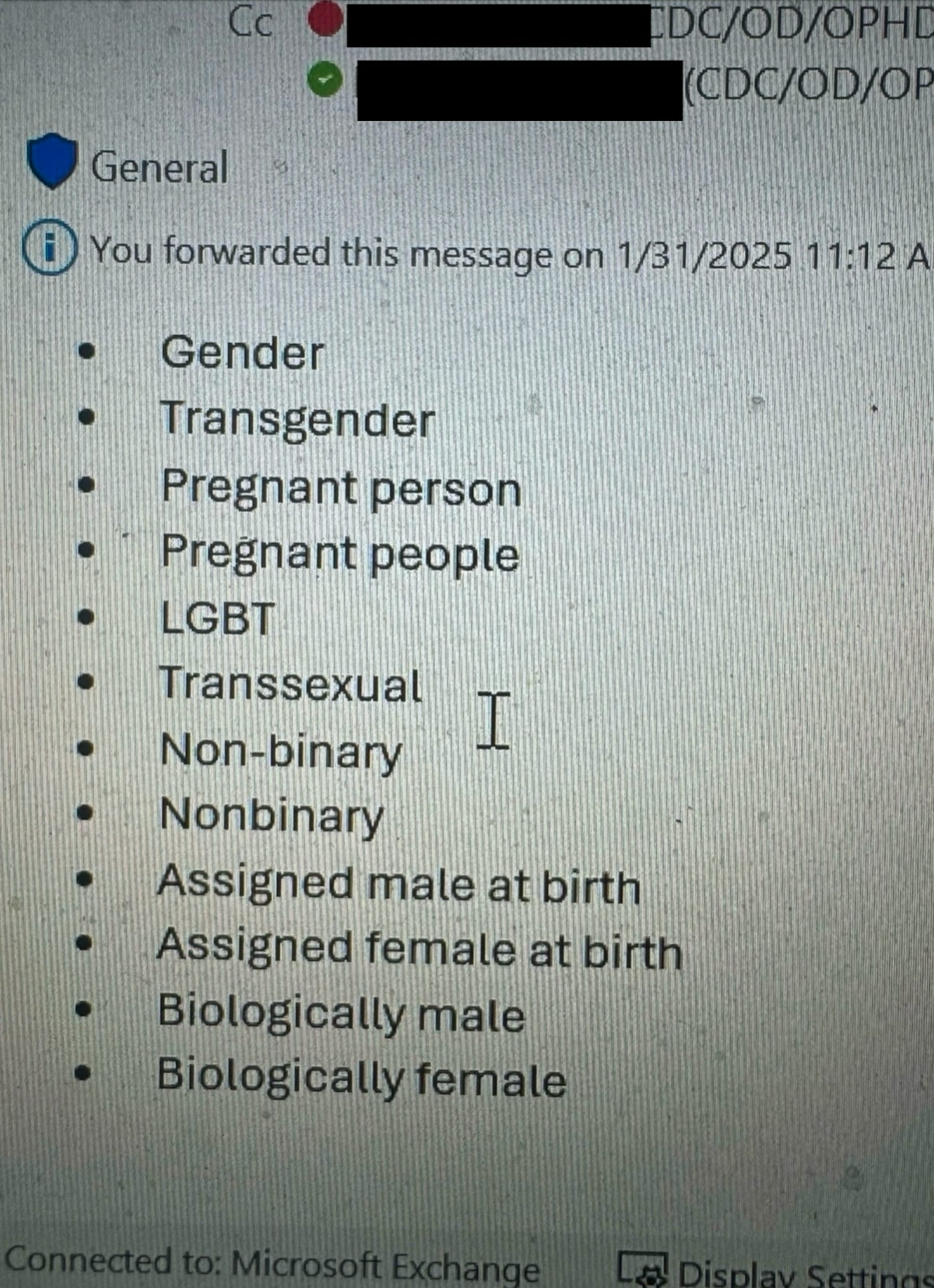
In the order, CDC researchers were instructed to remove references to or mentions of a list of forbidden terms: “Gender, transgender, pregnant person, pregnant people, LGBT, transsexual, non-binary, nonbinary, assigned male at birth, assigned female at birth, biologically male, biologically female,” according to an email sent to CDC employees (see below).”

A screenshot of a CDC email shared with Inside Medicine of a list of terms that must be removed from any CDC-authored manuscript being seriously considered or “in press” (but not yet online or in print) at any medical or scientific journal.

An expansion of an emerging censorship regime at the CDC. 

The policy goes beyond the previously reported pause of the CDC’s own publications, including Morbidity and Mortality Weekly Report (MMWR), which has seen two issues go unreleased since January 16, marking the first publication gap of any kind in approximately 60 years. Emerging infectious Diseases and Preventing Chronic Disease, the CDC’s other major publications, also remain under lock and key, but have not yet been affected because they are monthly releases and both were released as scheduled in January, prior to President Trump’s inauguration. The policy also goes beyond the general communications gag order that already prevents any CDC scientist from submitting any new scientific findings to the public.

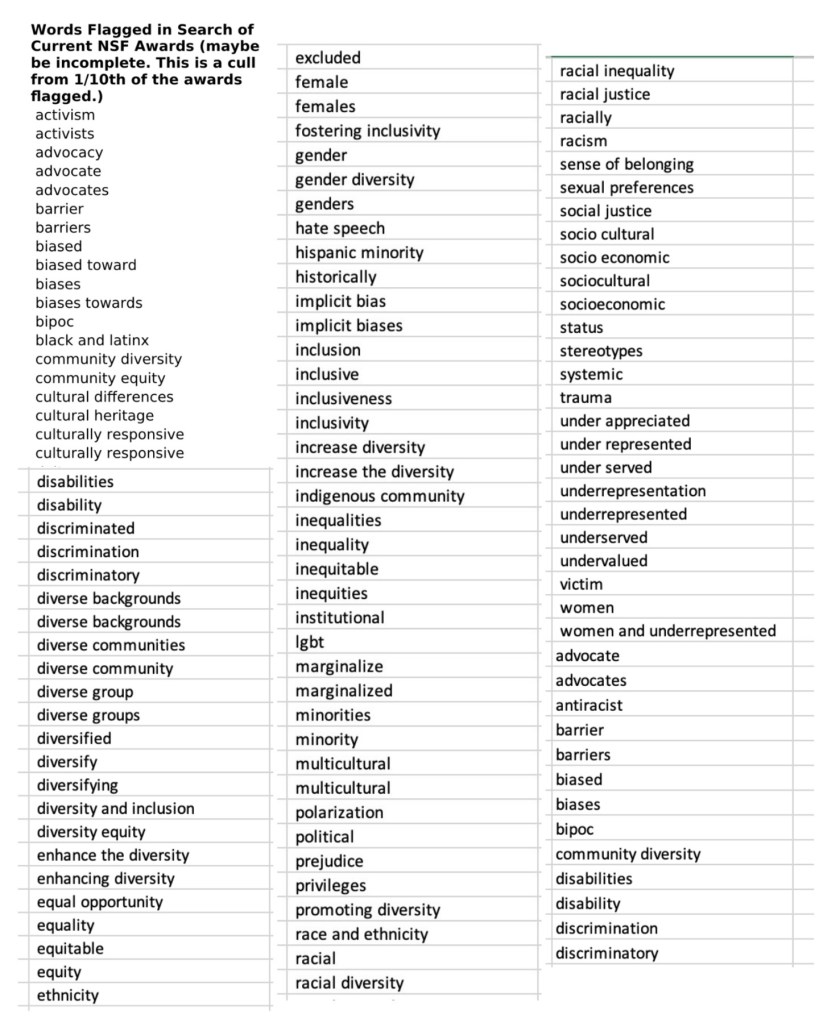
The National Science Foundation was directed to screen papers submitted for funding; it uses a list of words to flag papers that might offend the new administration.Being flagged means that the research needs a closer review to be sure that the topic is inoffensive.

Here is the NSF list:

Judd Legum and Rebecca Crosby of the blog “Popular Information” reported on censorship at the National Secutity Agency.

They wrote:

A memo distributed by NSA leadership to its staff says that on February 10, all NSA websites and internal network pages that contain banned words will be deleted. This is the list of 27 banned words distributed to NSA staff:

Anti-Racism
Racism
Allyship
Bias
DEI
Diversity
Diverse
Confirmation Bias
Equity
Equitableness
Feminism
Gender
Gender Identity
Inclusion
Inclusive
All-Inclusive
Inclusivity
Injustice
Intersectionality
Prejudice
Privilege
Racial Identity
Sexuality
Stereotypes
Pronouns
Transgender
Equality

The memo acknowledges that the list includes many terms that are used by the NSA in contexts that have nothing to do with DEI. For example, the term “privilege” is used by the NSA in the context of “privilege escalation.” In the intelligence world, privilege escalation refers to “techniques that adversaries use to gain higher-level permissions on a system or network.”

DOGE swept into the Institute of Education Sciences at the U.S. Department of Education and, following its advice, the Trump administration canceled $900 million in contracts. Bear in mind, this is the team of 20-somethings who knows a lot about software and coding. It’s unlikely that they know anything about education research.

This is the agency that I ran 30 years ago when I was Assistant Secretary of Education in the first Bush administration. At that time it was called the Office of Education Research and Improvement. I could have suggested some cuts, but certainly not $900 million!

What really bothers me is that this group of kiddies could not possibly know enough to judge the quality of the work they were canceling. Not in a day. Impossible. This was just a slash and burn operation.

ProPublica reported:

The Trump administration has terminated more than $900 million in Education Department contracts, taking away a key source of data on the quality and performance of the nation’s schools.

The cuts were made at the behest of Elon Musk’s cost-cutting crew, the Department of Government Efficiency, and were disclosed on X, the social media platform Musk owns, shortly after ProPublica posed questions to U.S. Department of Education staff about the decision to decimate the agency’s research and statistics arm, the Institute of Education Sciences.

A spokesperson for the department, Madi Biedermann, said that the standardized test known as the nation’s report card, the National Assessment of Educational Progress, would not be affected. Neither would the College Scorecard, which allows people to search for and compare information about colleges, she said.

IES is one of the country’s largest funders of education research, and the slashing of contracts could mean a significant loss of public knowledge about schools. The institute maintains a massive database of education statistics and contracts with scientists and education companies to compile and make data public about schools each year, such as information about school crime and safety and high school science course completion.

Its total annual budget is about $815 million, or roughly 1% of the Education Department’s overall budget of $82 billion this fiscal year. The $900 million in contracts the department is canceling includes multiyear agreements.

Heather Cox Richardson points out that Trump’s desire to cut the federal budgets threatens to undermine cancer research. Cutting cancer research? Yes. Is cancer research a “Marxist radical lunatic” or DEI activity?

Cancer research is important for all of us, regardless of our political views, or lack thereof. Why in the world would Trump want to cut its funding?

Yesterday the National Institutes of Health under the Trump administration announced a new policy that will dramatically change the way the United States funds medical research. Now, when a researcher working at a university receives a federal grant for research, that money includes funds to maintain equipment and facilities and to pay support staff that keep labs functioning. That indirect funding is built into university budgets for funding expensive research labs, and last year reached about 26% of the grant money distributed. Going forward, the administration says it will cap the permitted amount of indirect funding at 15%.

NIH is the nation’s primary agency for research in medicine, health, and behavior. NIH grants are fiercely competitive; only about 20% of applications succeed. When a researcher applies for one, their proposal is evaluated first by a panel of their scholarly peers and then, if it passes that level, an advisory council, which might ask for more information before awarding a grant. Once awarded and accepted, an NIH grant carries strict requirements for reporting and auditing, as well as record retention.

In 2023, NIH distributed about $35 billion through about 50,000 grants to over 300,000 researchers at universities, medical schools, and other research institutions. Every dollar of NIH funding generated about $2.46 in economic activity. For every $100 million of funding, research supported by NIH generates 76 patents, which produce 20% more economic value than other U.S. patents and create opportunities for about $600 million in future research and development.

As Christina Jewett and Sheryl Gay Stolberg of the New York Times explained, the authors of Project 2025 called for the cuts outlined in the new policy, claiming those cuts would “reduce federal taxpayer subsidization of leftist agendas.” Dr. David A. Baltrus of the University of Arizona told Jewett and Stolberg that the new policy is “going to destroy research universities in the short term, and I don’t know after that. They rely on the money. They budget for the money. The universities were making decisions expecting the money to be there.”

Although Baltrus works in agricultural research, focusing on keeping E. coli bacteria out of crops like sprouts and lettuce, cancer research is the top area in which NIH grants are awarded.

Anthropologist Erin Kane figured out what the new NIH policy would mean for states by looking at institutions that received more than $10 million in grants in 2024 and figuring out what percentage of their indirect costs would not be eligible for grant money under the new formula. Six schools in New York won $2.4 billion, including $953 million for indirect costs. The new indirect rate would allow only $220 million for overhead, a loss of $723 million.

States across the country will experience significant losses. Eight Florida schools received about $673 million, $231 million for indirect costs. The new indirect rate would limit that funding to $66 million, a loss of $165 million. Six schools in Ohio received a total of about $700 million; they would lose $194 million. Four schools in Missouri received a total of about $830 million; they would lose $212 million.

Trump has rolled out multiple executive orders that violate the law. He has installed submissive officials in key departments (like Justice) who will defend his law-breaking. The Republicans (who called Joe Biden a dictator) defend Trump’s reign of lawlessness. They have gleefully given Trump their Constitutional powers. Without a peep.

Dans Milbank advises Democrats: Don’t help him. He doesn’t need your vote.

He writes:

So, here’s a shocker: It turns out that, if you elect a felon as president of the United States, he will continue to break laws once he’s in office.

Who knew?

Ultimately, it will be up to the courts to determine which of President Donald Trump’s actions are illegal. But a case can be made — indeed, many cases already have been made in federal courts — that the new administration over the course of the last fortnight has violated each of the following laws. See if you can say them in one breath. In reverse chronological order of first enactment:

The Protecting Americans from Foreign Adversary Controlled Applications Act of 2024. The Administrative Leave Act of 2016. The Federal Information Security Modernization Act of 2014. The Affordable Care Act of 2010. The Foreign Affairs Reform and Restructuring Act of 1998. The Religious Freedom Restoration Act of 1993. The Computer Fraud and Abuse Act of 1986. The Inspector General Act of 1978. The Privacy Act of 1974. The Impoundment Control Act of 1974. The Rehabilitation Act of 1973. The Federal Advisory Committee Act of 1972. The Immigration and Nationality Act of 1952. The Administrative Procedure Act of 1946. The Public Health Service Act 1944. The Antideficiency Act of 1870.

That’s a century and a half of statutes shredded in just over two weeks. And those don’t include the ways in which Trump already appears to be in violation of the Constitution: The First Amendment’s protections of free speech and association; the Fifth Amendment’s guarantee of equal protection and due process; the Eighth Amendment’s prohibition against cruel and unusual punishment; the 14th Amendment’s promise of birthright citizenship; Article I’s spending, presentment, appropriations and bicameralism clauses; Article II’s take-care clause; and the separation of powers generally.

“The Trump administration so far has been the Advent calendar of illegality,” says Norman Eisen, whose group, State Democracy Defenders Action, has been filing lawsuits against the administration. At least seven federal judges appointed by presidents of both political parties have already blocked Trump’s moves to freeze federal funding, end birthright citizenship, extend a dubious buyout offer to government employees and deny treatment to transgender inmates.

Benjamin Wittes, who runs the popular Lawfare publication, predicts that, of the dozens of instances in which Trump is in conflict with existing law, he will ultimately lose 80 percent of the cases when they eventually arrive at the Supreme Court after 18 months or so of litigation. But that’s a long time to wait while the president’s lawlessness causes chaos and suffering. And even if the pro-Trump majority on the Supreme Court hands him a victory only 20 percent of the time, that could still fundamentally reshape the U.S. government, reducing Congress to irrelevance.

Republicans in Congress have for years asserted their Article I authority, and they howled about encroaching dictatorship when President Joe Biden did nothing more nefarious than forgive student-loan debt. (The Supreme Court struck that down.) So what are they doing about Trump usurping the powers of Congress? They’re applauding.

Sen. Thom Tillis, a North Carolina Republican, acknowledged that what Trump and Elon Musk are doing to cut off congressionally mandated funding “runs afoul of the Constitution in the strictest sense.” But, he told reporters this week, that’s “not uncommon” and “nobody should bellyache about that.”

House Speaker Mike Johnson, at a news conference Wednesday, was asked by Fox News’s Chad Pergram about the “inconsistency” of Republicans who are now “ceding Article I powers to the executive branch under Elon Musk.”

“I think there’s a gross overreaction in the media,” Johnson replied, with a forced chuckle. He admitted that what Trump is doing “looks radical,” but went on: “This is not a usurpation of authority in any way. It’s not a power grab. I think they’re doing what we’ve all expected and hoped and asked that they would do.”

These are not the words of a constitutionally designated leader of the legislative branch. These are the words of a Donald Trump handmaiden. And it is time for Democrats to treat him as such.

Democrats have been negotiating in good faith on a deal to fund the government for the rest of fiscal year 2025; the government shuts down in five weeks if funding isn’t extended. There’s no doubt that Rep. Tom Cole (R-Oklahoma), chairman of the House Appropriations Committee, and Sen. Susan Collins (R-Maine), chairwoman of the Senate Appropriations Committee, are also negotiating in good faith.

But the whole thing is not on the level. Trump has shown that he will ignore the spending bills passed by Congress and fund only those programs he supports — the Constitution, and the law, be damned. And Johnson has made clear that this is “what we’ve all expected and hoped and asked that they would do.”

In a letter to his Democratic colleagues this week, House minority leader Hakeem Jeffries said he told House GOP leaders that Trump’s efforts to cut off programs funded by Congress “must be choked off in the upcoming government funding bill, if not sooner.” But even if Democrats extracted from Republicans language in the spending bill that the programs must be funded as Congress specifies, Trump has already made clear that such a law wouldn’t be worth the paper it’s written on. And Johnson made it clear he has no intention of obliging Democrats with such a guarantee anyway; he said at his Wednesday news conference that Jeffries’s letter “laid out the foundation for a government shutdown.”

Clearly, there is no hope of good-faith negotiation with Trump, or with Johnson. Republicans control the House, Senate and White House. Let them pass a 2025 spending bill on their own. Let them raise the debt ceiling on their own. Let them enact Trump’s entire agenda on their own. They have the votes. Democrats ought not give them a single one.

Good parenting uses the idea of “natural consequences”: If your child refuses to wear her coat, let her be cold for the day. Either way, the voters will provide the consequences: FAFO. Trump knows what this means: He posted a picture of himself next to a FAFO sign, to deliver the message to Colombia’s president during their recent deportation standoff.

Democrats, by withholding their votes, will be giving Trump and Johnson some good parenting. Republicans can shut the government down. Or they can enact the sort of devastating cuts to popular programs that they like to talk about. Either way, the voters will provide the natural consequences.


The third week of the Trump presidency has been just as chaotic as the first two. Trump, who won the 2024 election promising to end wars and to put “America First,” now proposes to take over Gaza and to spend American taxpayer dollars to dismantle bombs and make it a “Riviera” on the Mediterranean. (He later clarified that Israel would handle the forced resettlement of the 2 million Palestinians there — “people like Chuck Schumer” — and then cede the Palestinian land to the United States.) The Trump-appointed chairman of the Federal Communications Commission is using his agency to assist Trump in his personal vendetta against CBS News, forcing the network to hand over unedited tapes of an interview with Kamala Harris that are the subject of a lawsuit Trump filed against CBS.

Funding was shut off to some Head Start programs for preschoolers. And the administration, though it isn’t deporting any more migrants than the Obama administration did, stepped up efforts to humiliate them and is now sending deportees to Guantánamo Bay.

Meantime, the world’s wealthiest man runs amok through the federal bureaucracy, and he appears to have access to private records of all Americans and highly classified information such as the identities of CIA operatives. He is reportedly doing this with a group of unvetted men in their early 20s — as well as a 19-year-old heir to a popcorn fortune who recently worked as a camp counselor. Musk, though he seems to be running much of the country, has exempted himself from all government disclosure and ethics requirements. But fear not: If Musk, whose companies get billions of dollars in federal contracts, “comes across a conflict of interest,” said White House press secretary Karoline Leavitt, he will — Scout’s honor — recuse himself. The administration’s attempt to induce federal employees to take a legally dubious buyout came in the form of an email with the same subject line — “fork in the road” — that Musk used to drive Twitter employees to quit.

The South Africa-born Musk, fresh from his encouragement of far-right extremists in Germany, replied “yes” this week to a post on X that said “we should allow more immigration of White South Africans.”

Musk moved to dismiss staff and shut down the U.S. Agency for International Development, which Musk calls “evil.” Maybe that’s because USAID’s inspector general was investigating the activities of Musk’s Starlink in Ukraine. But the administration and its allies rushed to justify the decision — by fabricating propaganda. At the White House, Leavitt told reporters that she was “made aware that USAID has funded media outlets like Politico. I can confirm that more than $8 million … has gone to subsidizing subscriptions.” Trump inflated the fiction further, to suggest “BILLIONS” went to “THE FAKE NEWS MEDIA AS A ‘PAYOFF’ FOR CREATING GOOD STORIES ABOUT THE DEMOCRATS.” In reality, $44,000 of USAID money went to Politico over several years — not from “payoffs” or “subsidies” but from officials subscribing to Politico Pro, as they did throughout the government (hence the $8 million). On Capitol Hill, Johnson provided a different fabrication, crediting Trump and Musk for stopping USAID from funding “transgender operas in Colombia,” “drag shows in Ecuador” and “expanding atheism in Nepal.” But it appears USAID did not fund any of those things.

The willy-nilly cancellation of all foreign aid would end lifesaving programs and various counterterrorism and counternarcotics efforts, dealing a lethal blow to U.S. soft power and driving countries into the arms of China and Russia, while hurting American farmers in the bargain. But it’s not just USAID. Trump and Musk, with their reckless and unfocused attack on federal workers, are raising the likelihood of any number of crises, at home and abroad. Their hollowing-out of the FBI and the Justice Department (with the notable exception of activities targeting Trump critics and migrants) raises the likelihood of a terrorist attack and foreign infiltration, not to mention more crime domestically. Their attempt to drive workers to quit at the CIA and NSA jeopardizes national security. Depleting the ranks of food-safety inspectors and bank regulators poses obvious dangers, as would Trump’s idea of abolishing FEMA. The administration tried to reduce personnel at the FAA — but last week’s plane crash in D.C. suddenly made it discover we need more air traffic controllers.

Yet Republican leaders on Capitol Hill either salute Trump or look the other way. They’re on their way to confirming all of Trump’s nominees, including vaccines opponent Robert F. Kennedy Jr. to run the federal government’s health programs; Tulsi Gabbard, who has a bizarre fondness for Russia, to oversee intelligence; and Kash Patel, Trump’s agent of vengeance, to run the FBI.

Senate Majority Leader John Thune (R-South Dakota) said the sort of thing Trump and Musk are doing to USAID is “probably true of any administration when they come in.” Handmaiden Johnson even welcomed the proposed U.S. takeover of Gaza, saying, contrary to reality, that it was “cheered by, I think, people all around the world.”

A few Republicans are raising objections. Collins doesn’t think Musk’s upending of USAID “satisfies the requirements of the law,” and she pronounces herself “very concerned.” But what’s the senator from Maine going to do about it? Apparently, nothing.

That will have to be up to Democrats. The out-of-power party has been bashed in the news media and by progressives for doing too little to stand up to Trump. Then, when Democratic lawmakers protested outside USAID headquarters, they were criticized for doing too much. “You don’t fight every fight,” Rahm Emanuel told Politico.

In truth, Democrats have almost no ability to stop Trump, but they do have the power, and the obligation, to stand in lockstep opposition to what the president is doing. Some of them might argue that the only way to protect certain programs, and the vulnerable people who need them, is to cut a deal with Trump and Republicans. But Trump has demonstrated abundantly that he will try to use unconstitutional means to kill off those programs regardless of what Congress does.

But if Democrats can’t stop a reckless president from creating unnecessary crises and harming millions of Americans, they certainly don’t need to give a bipartisan veneer to the atrocity. Let Republicans own the consequences of breaking government. Don’t save Trump from himself.