You hear sometimes, now that we know the sordid details of the lives of some of our leading figures, that America has no heroes left.
When I was writing a book about the Wounded Knee Massacre, where heroism was pretty thin on the ground, I gave that a lot of thought. And I came to believe that heroism is neither being perfect, nor doing something spectacular. In fact, it’s just the opposite: it’s regular, flawed human beings choosing to put others before themselves, even at great cost, even if no one will ever know, even as they realize the walls might be closing in around them.
It means sitting down the night before D-Day and writing a letter praising the troops and taking all the blame for the next day’s failure upon yourself in case things went wrong, as General Dwight D. Eisenhower did.
It means writing in your diary that you “still believe that people are really good at heart,” even while you are hiding in an attic from the men who are soon going to kill you, as Anne Frank did.
It means signing your name to the bottom of the Declaration of Independence in bold print, even though you know you are signing your own death warrant should the British capture you, as John Hancock did.
It means defending your people’s right to practice a religion you don’t share, even though you know you are becoming a dangerously visible target, as Sitting Bull did.
Sometimes it just means sitting down, even when you are told to stand up, as Rosa Parks did.
None of those people woke up one morning and said to themselves that they were about to do something heroic. It’s just that when they had to, they did what was right.
On April 3, 1968, the night before the Reverend Doctor Martin Luther King Jr. was assassinated by a white supremacist, he gave a speech in support of sanitation workers in Memphis, Tennessee. Since 1966, King had tried to broaden the Civil Rights Movement for racial equality into a larger movement for economic justice. He joined the sanitation workers in Memphis, who were on strike after years of bad pay and such dangerous conditions that two men had been crushed to death in garbage compactors.
After his friend Ralph Abernathy introduced him to the crowd, King had something to say about heroes: “As I listened to Ralph Abernathy and his eloquent and generous introduction and then thought about myself, I wondered who he was talking about.”
Dr. King told the audience that if God had let him choose any era in which to live, he would have chosen the one in which he had landed. “Now, that’s a strange statement to make,” King went on, “because the world is all messed up. The nation is sick. Trouble is in the land; confusion all around…. But I know, somehow, that only when it is dark enough, can you see the stars.” Dr. King said that he felt blessed to live in an era when people had finally woken up and were working together for freedom and economic justice.
He knew he was in danger as he worked for a racially and economically just America. “I don’t know what will happen now. We’ve got some difficult days ahead. But it doesn’t matter…because I’ve been to the mountaintop…. Like anybody, I would like to live a long life…. But I’m not concerned about that now. I just want to do God’s will. And He’s allowed me to go up to the mountain. And I’ve looked over. And I’ve seen the promised land. I may not get there with you. But I want you to know tonight, that we, as a people, will get to the promised land!”
People are wrong to say that we have no heroes left.
Just as they have always been, they are all around us, choosing to do the right thing, no matter what.
Wishing you all a day of peace for Martin Luther King Jr. Day 2025.
President-elect Donald J. Trump and his family on Friday started selling a cryptocurrency token featuring an image of Mr. Trump drawn from the July assassination attempt, a potentially lucrative new business that ethics experts assailed as a blatant effort to cash in on the office he is about to occupy again.
Disclosed just days before his second inauguration, the venture is the latest in a series of moves by Mr. Trump that blur the line between his government role and the continued effort by his family to profit from his power and global fame. It is yet another sign that the Trump family will be much less hesitant in this second term to bend or breach traditional ethical boundaries.
Mr. Trump himself announced the launch of his new business on Friday night on his social media platform, in between announcements about filling key federal government posts. He is calling the token $Trump, selling it with the slogan, “Join the Trump Community. This is History in the Making!”
The venture was organized by CIC Digital LLC, an affiliate of the Trump Organization, which already has been selling an array of other kinds of merchandise like Trump-branded sneakers, fragrances and even digital trading cards.
But this newest venture brings Mr. Trump and his family directly into the world of selling cryptocurrency, which is regulated by the Securities and Exchange Commission. Mr. Trump recently disclosed he intended to name a cryptocurrency advocate as S.E.C. chairman.
A disclosure on the website selling the tokens says that CIC Digital and its affiliates own 80 percent of the supply of the new Trump tokens that will be released gradually over the coming three years and that they will be paid “trading revenue” as the tokens are sold.
The move by Mr. Trump and his family was immediately condemned by ethics lawyers who said they could not recall a more explicit profiteering effort by an incoming president.
“It is literally cashing in on the presidency — creating a financial instrument so people can transfer money to the president’s family in connection with his office” said Adav Noti, executive director of Campaign Legal Center, a nonprofit ethics group. “It is beyond unprecedented.”
Trump’s greed cannot be restrained. And there are no boundaries because the U.S. Supreme Court has already ruled that he has “absolute immunity” while he is president.
Greg Olear is simply amazing. Read the post here and perhaps you will agree. He is wise, smart, learned, insightful, and inspiring. I know of no other writer who weaves together politics, literature, and history as seamlessly as Olear. He writes at Substack and charges no fee.
Dear Reader,
The great British historian Eric Hobsbawm wrote an indispensable series of books in which he divides the 20 decades after the French Revolution into historical “ages.” The period from the 1789 storming of the Bastille to the uprisings sweeping across Europe in 1848 he termed the Age of Revolution. Eighteen forty-eight until the end of the Great Boom circa 1875 is the Age of Capital. The Age of Empire spanned from the mid-1870s until the start of the Great War in 1914. And the “short twentieth century,” a term he coined, was dubbed the Age of Extremes, and ran from the assassination of the archduke until 1991.
Ever since I discovered his books in 2012, the year of his death, I’ve often wondered what Hobsbawm would have called the fifth historical “age”—the one that began in 1991. That was the year of the first Gulf War, and the banishment from Saudi Arabia of Osama bin Laden that kickstarted his Al Qaeda movement; the mysterious death of Robert Maxwell—friend to the British royal family, mentor to Jeffrey Epstein, business partner of the Russian mobster Semion Mogilevich, and Israeli spy—who fell off his yacht off the coast of the Canary Islands; the repeal of the apartheid laws in South Africa, where Errol Musk made his fortune; the rollout of the WorldWideWeb; and the breakup of the Soviet Union—on Christmas, no less, capitalism’s holiest of holy days.
Today, a mere 24 hours and change before we hand the federal government off to a hateful confederacy of Nazis, mobsters, Opus Dei weirdos, white Christian nationalists, and billionaire dorks, I think I know not only the name of the period after the Age of Extremes, but also its termination date. As I type this, we are living in the last few hours of the Age of Unreality. It ends tomorrow at noon.
Something else happened in 1991, you see—something that likely eluded Eric Hobsbawm. Producers at MTV were developing a TV show that would begin filming in February of 1992. It was called The Real World: New York. It was the first reality TV show—or, at least, the seminal reality TV show of the subsequent reality TV explosion. Riding the reality TV wave was a British producer named Mark Burnett, who would give us Survivor in 2000, and, four years later, what wound up being the most historically significant reality TV show of all time, The Apprentice.
Although I confess to having enjoyed a few seasons of The Surreal Life, back when our eldest son was a baby—Flavor Flav does not disappoint!—I have never liked reality TV shows, encouraging, as they often do, the very worst of human behavior. I don’t like meanness. I don’t like ruthlessness. I don’t like watching anyone being voted off the island. I don’t like when people are fired. I don’t like talentless humans. I don’t like Kardashians. Most of all, I don’t like the unscripted-but-very-much-scripted fluff that has replaced actual shows written by actual writers. By encouraging us to believe in a heavily-retouched fictional universe presented as the real world—or, I suppose, The Real World—reality TV has left us more susceptible to Russian disinformation, to deep fakes, to conspiracy theories, to manufactured media narratives, to tech-bro charlatans, to pseudo-scientific arguments against vaccines, and to mendacious politicians who have supercharged lying to a form of warfare.
I have often grumbled, half in jest, that reality TV would bring about the end of Western civilization. I did not think it would also bring about the end of Western democracy. To paraphrase Don DeLillo: Reality TV has given us Joe Rogan; that alone warrants its doom.
(Is this the real life? Is this just fantasy? Freddie Mercury died in—when else?—1991.)
One of the most significant, world-altering events in this Age of Unreality was, of course, 9/11. In response to the WTC attacks, the FBI shifted its focus from transnational organized crime, which was already operating in the United States and growing more powerful by the day—a genuine threat to our society—to Islamic extremist terrorism, which involved not very many crazy people mostly living in caves far, far away from New York. In response to 9/11, we have to subject ourselves to TSA search before boarding an airplane. In response to 9/11, Bush and Cheney launched a long and expensive war on Saddam Hussein, who had nothing whatsoever to do with the attacks, while simultaneously cutting taxes for their wealthy benefactors—two actions that, in tandem, starved the U.S. treasury and put the country so far into the red that it may never recover. In Britain, meanwhile, Tony Blair’s blind loyalty to Bush—a foreshadowing, perhaps, of Joe Biden’s blind loyalty to Bibi Netanyahu—paved the way for BREXIT and the series of hapless prime ministers that followed the disastrous decision to LEAVE.
Five days after 9/11, Anthony Lane, the New Yorker’s savagely witty film critic, published what remains one of the finest pieces of writing on the attacks, a short essay called “This Is Not a Movie.” I go back and revisit it every once in a while, when the mood strikes me. Reading it now, I see that Lane perfectly articulates the paradox of the Age of Unreality, the uneasy blur between fact and fiction, when he comments on “the degree to which people saw—literally saw, and are continuing to see, as it airs in unforgiving repeats—that day”—that is, September 11, 2001—“as a movie.” He notes that the elapsed time between the initial hijackings and the collapse of the north tower was “a little over two hours;” the length of a summer blockbuster disaster film.
Lane writes:
We are talking…of the indulgence that will always be extended to an epoch blessed with prosperity—one that has the leisure, and the cash, to indulge its fancies, not least the cheap thrill of pretending that the blessing could be wiped out. What happened on the morning of September 11th was that imaginations that had been schooled in the comedy of apocalypse were forced to reconsider the same evidence as tragic. It was hard to make the switch; the fireball of impact was so precisely as it should be, and the breaking waves of dust that barrelled down the avenues were so absurdly recognizable—we have tasted them so frequently in other forms, such as water, flame, and Godzilla’s foot—that only those close enough to breathe the foulness into their lungs could truly measure the darkening day for what it was.
There are echoes of this in the fires that have ravaged Los Angeles. Looking at those horrific images, it is impossible not to describe the fiery scenes as something from a movie—or, rather, a limited series, because, unlike with 9/11, the L.A. fires did not confine themselves to a movie-length running time. They began last Tuesday, almost two full weeks ago, and are still ongoing. If 9/11 was, as Lane suggests, a disaster film come to life, the fires are a combination of disaster film and horror movie: not just the fires themselves but the hundred-mile-an-hour winds and the dread of the fires spreading. Only those close enough to breathe the foulness into their lungs could truly measure the darkening days for what they are. My heart breaks for everyone in L.A., even as I know I can never fully understand their ordeal.
The fires are not a movie, just like 9/11 was not a movie. The fires are all too real.
As a country, we have not even begun to comprehend the extent of the damage, or its impact on all those hundreds of thousands if not millions of people in the Pacific Palisades and Altadena and beyond, much less the effect the fires will have nationally, culturally, societally—not least because the recovery will ultimately be overseen by an incoming administration not much known for its compassion, its competence, or its love for Hollywood.
The last paragraph of Lane’s essay is achingly, hauntingly beautiful. Many, many people wrote about 9/11 in the days that followed it, and it always struck me as both unlikely and somehow appropriate that a film critic would offer the purest take:
To be forced to disdain the ideal in favor of the actual is never a pleasant process. Even at its worst, however, it can deliver a bitter redemption. We gazed upward, or at our TV screens, and we couldn’t believe our eyes; but maybe our eyes had been lied to for long enough. Thousands died on September 11th, and they died for real; but thousands died together, and therefore something lived. The most important, if distressing, images to emerge from those hours are not of the raging towers, or of the vacuum where they once stood; it is the shots of people falling from the ledges, and, in particular, of two people jumping in tandem. It is impossible to tell, from the blur, what age or sex these two are, nor does that matter. What matters is the one thing we can see for sure: they are falling hand in hand. Think of Philip Larkin’s poem about the stone figures carved on an English tomb, and the “sharp tender shock” of noticing that they are holding hands. The final line of the poem has become a celebrated condolence, and last Tuesday—in uncounted ways, in final phone calls, in the joined hands of that couple, in circumstances that Hollywood should no longer try to match—it was proved true all over again, and, in so doing, it calmly conquered the loathing and rage in which the crime was conceived. “What will survive of us is love.”
Larkin, the poet who wrote that line—and who is, like Lane, British—was not at all a sentimental sort. His stuff is gloomy, sourpuss, almost defeatist. Throughout his poems we see a struggle between, on the one hand, recognizing the futility of life, and on the other, being paralyzed by the fear of death. It is his poem “This Be The Verse,” about how our parents “fuck us up,” that the pub owner quotes, somewhat incongruously, in Ted Lasso:
Man hands on misery to man. It deepens like a coastal shelf. Get out as early as you can, And don’t have any kids yourself.
Sunny stuff, right? Larkin’s entire worldview is neatly encapsulated in this line from “Aubade,” a title that indicates this is a poem about the dawn:
And so it stays just on the edge of vision, A small unfocused blur, a standing chill That slows each impulse down to indecision. Most things may never happen: this one will, And realisation of it rages out In furnace-fear when we are caught without People or drink. Courage is no good: It means not scaring others. Being brave Lets no one off the grave. Death is no different whined at than withstood.
The antecedent of the “it” in the first line is “death.” But we may just as well substitute “Trump,” and the lines work just as well: the standing chill, the furnace-fear and the rage, the necessity of other people and a good stiff drink, the futility of courage.
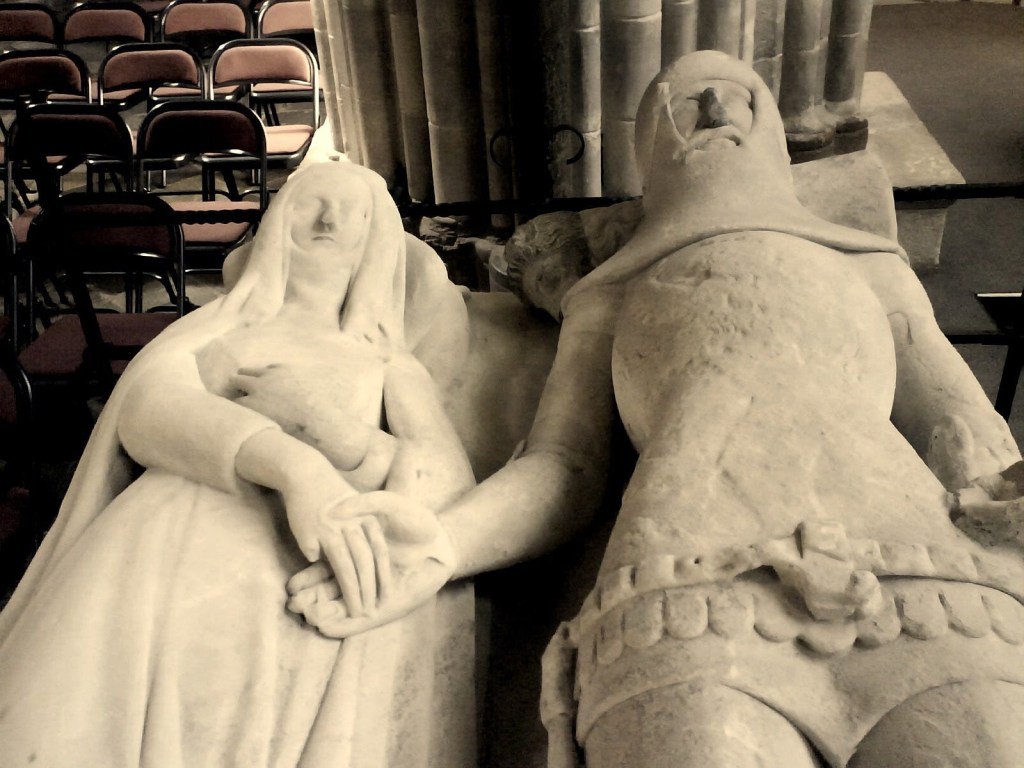
The poem that Lane quotes is called “An Arundel Tomb.” At Arundel, a medieval British town, is the tomb of Richard FitzAlan, the tenth Earl of Arundel, who died in 1371, and that of his second wife, Eleanor of Lancaster, who predeceased him by a few years. The tomb is capped by stone statues of the couple, who are, surprisingly, holding hands:
Side by side, their faces blurred, The earl and countess lie in stone,
Larkin, a dour librarian and bemoaner of the decline of civilization who seems not to have believed in love (even as he juggled three women for most of his adult life), calls bullshit on this romantic display:
They would not think to lie so long. Such faithfulness in effigy Was just a detail friends would see: A sculptor’s sweet commissioned grace
In other words, while the holding of stony hands has stood the test of time, the love it represents was probably a figment of the artist’s rosy imagination. (Note the double meaning of “lie.”)
How soon succeeding eyes begin To look, not read. Rigidly they
Persisted, linked, through lengths and breadths Of time. . .
Until,
Now, helpless in the hollow of An unarmorial age. . . Only an attitude remains:
Time has transfigured them into Untruth. The stone fidelity They hardly meant has come to be Their final blazon, and to prove Our almost-instinct almost true: What will survive of us is love.
Larkin is saying that what the statues represent isn’t real—that our “almost-instinct” is to believe in the much-ballyhooed power of love, and that the “stone fidelity” of the earl and his wife is so compelling as to make said love-power “almost true.” Almost true is not true; almost true is AI true—a lie we want badly to believe in. The entire poem is him expressing his deep, nasty cynicism. The oft-quoted last line is intended to be ironic—a fitting epitaph for our Age of Unreality.
Even so, what survives of Larkin is “What will survive of us is love.” And I like to think, as Lane does, that, whatever the poet’s intention, the Arundel sentiment is real.
The Age of Unreality began in 1991, when all the ingredients of the historical cocktail were thrown into the shaker: the fall of the Soviet Union, the rise of the Russian mafia, the ascendance of Jeffrey Epstein, the dawn of reality TV, the end of apartheid, and the last time that a coalition of Western democracies repulsed an attempt by a despot to invade a sovereign nation—thus upholding the tenets of the Westphalian order. Out of that cocktail shaker, cold as ice, was poured Jeffrey Epstein and Semion Mogilevich, Elon Musk and Peter Thiel, Vladimir Putin and Donald Trump.
Tomorrow, that mindfuck age draws to a close, and a new one begins. What it has in store for us is anyone’s guess. Will the last barriers between fantasy and reality be worn away, or, as Lane poetically puts it, have our eyes been lied to for long enough? Will democracy really die, as the fascism scholars have been warning us for years, or will the Trump power-grab finally wake up the American people and restore our love of liberty? Will generative AI destroy all art, or will a new analog artistry emerge? What will happen to our beloved Hollywood, to which Trump has named meathead Sylvester Stallone, rightwing wacko Jon Voigt, and radical Catholic weirdo Mel Gibson his MAGA “ambassadors?”
I take some small solace in knowing that we’ve been here before. As Hobsbawm notes in The Age of Capital, the United States in the late nineteenth century—the America Trump wants us to return to—was marked by
the total absence of any kind of control over business dealings, however ruthless and crooked, and the really spectacular possibilities of corruption both national and local—especially in the post-Civil War years. There was indeed little that could be called government by European standards in the United States, and the scope for the powerful and unscrupulous rich was virtually unlimited. In fact, the phrase ‘robber baron’ should carry its accent on the second rather than the first word, for, as in a weak medieval kingdom, men could not look to the law but only to their own strength—and who were stronger in a capitalist society than the rich? The United States, alone among the bourgeois world, was a country of private justice and armed forces….
Our current crop of robber barons is orders of magnitude worse than its forebears—but maybe the abject awfulness of these despicable people will make their reigns shorter, their fall more humiliating, and their historical impact less profound.
Even so, for all my optimistic tendencies, I fear tomorrow as surely as Larkin feared death, which he describes as
The sure extinction that we travel to And shall be lost in always. Not to be here, Not to be anywhere, And soon; nothing more terrible, nothing more true.
Death is permanent and absolute, but dictatorships are neither; moreover, Donald isn’t a dictator yet, and may well never be. Even as I have witnessed the poltroonish capitulation of our political leaders, our robber barons, our media figureheads, even our Snoop Doggs, I have faith that we will somehow find a better way, that we will repulse this ugly MAGA incursion, that the moral arc of the universe will bend towards justice, that the better angels of our nature will prevail. My faith will be tested, surely. But it will remain.
Nothing more true than this: What will survive of us is hope.
Paul Krugman, Nobel Prize-winning economist, no longer writes a column for The New York Times. Instead, he has a blog on Substack where he writes whatever strikes his fancy.
In this post, he ponders what billionaires want. Why aren’t they satisfied to have “only” $500 million? Or “only” $1 billion? I always thought that their insatiable desire for more stemmed from competitiveness, from obeisance to the maxim “He who dies with the most toys wins,” attributed to magazine publisher Malcolm Forbes. Who has the most houses? Who has the biggest superyacht? Who has a yacht to follow his superyacht?
Krugman has a different take.
He writes:
Today’s newsletter will be a bit different from my usual. In general, I do data-driven posts, mainly about economics — and that will remain the norm. But right now, as some of the worst people in America are about to take power, doesn’t feel like the time for charts from FRED. So this entry will be informal and impressionistic, based partly on things I’ve seen, partly on speculation.
So: Much of the political and business world is prostrating itself at the feet of the least-qualified man, morally and intellectually, ever to occupy the White House.
It’s understandable if not excusable why many of those declaring fealty are doing so. If you look at what has happened to Liz Cheney or Adam Kinzinger you realize that Republican politicians who stand up to Trump destroy their political careers and put themselves at real personal risk. Many businesspeople — including media owners — fear that they will suffer monetarily if they cross the new regime.
But what’s truly extraordinary is the way billionaires have been abasing themselves before Donald Trump, a spectacle highlighted by Ann Telnaes’s now-famous cartoon — the one Jeff Bezos spiked, causing her to quit the Washington Post:
PS: I strongly urge everyone to show Ann Telnaes some love by reading her Substack, getting a paid subscription if you can afford it.
Why is this self-owning by billionaires so extraordinary? Well, ask yourself: What’s the point of being rich?
Past a certain level of wealth, it can’t really be about material things. I very much doubt that billionaires have a significantly higher quality of life than mere multimillionaires.
To the extent that there’s a valid reason for accumulating a very large fortune, I’d say that it involves freedom, the ability to live your life more or less however you want. Indeed, one definition of true wealth is having “fuck you money” — enough money to walk away from unpleasant situations or distasteful individuals without suffering a big decline in your living standards. And some very wealthy men — most obviously Mark Cuban, but I’d at least tentatively include Bill Gates and Warren Buffett — do seem to exhibit the kind of independence wealth gives you if you choose to exercise it.
The likes of Jeff Bezos and Mark Zuckerberg, however, surely have that kind of money, yet they’re prostrating themselves before Trump. They aren’t stupid; they have to know what kind of person Trump is and understand — whether or not they admit it to themselves — the humiliating nature of their behavior. So why do they do it?
The answer, I believe, is that many (not all!) rich men are extraordinarily insecure. I’ve seen this phenomenon many times, although I can only speculate about what causes it. My best guess is that a billionaire, having climbed to incredible heights, realizes that he’s still an ordinary human being who puts his pants on one leg at a time, and asks, “Is this all there is?”
So he starts demanding things money can’t buy, like universal admiration. Read Ross Douthat’s interview with Marc Andreessen, in which the tech bro explains why he has turned hard right. Andreessen says that it’s not about the money, and I believe him. What bothers him, instead, is that he wants everyone to genuflect before tech bros as the great heroes of our age, and instead lots of people are saying mean things about him and people like him.
Of course, Trump’s victory won’t do anything to restore the adulation he misses, so I can confidently predict that Andreesen and others in his set will keep on whining — that there will be so much whining that we’ll get sick of whining. Actually I already am.
Or consider the Elon Musk gaming scandal. Many people in the gaming world, which is huge, believe that Musk, who claims to be an avid and expert gamer, has been faking it, either by having someone else play for him or by using a more skilled player’s account.
It’s a deeply embarrassing story, if true. And while I don’t know anything about gaming, the accusations seem credible — and completely consistent with Musk’s behavior in areas I do know something about. His attempts to pose as a budget guru and a macroeconomist have, for those familiar with even the most basic facts, been as cringeworthy as his apparent fakery in video games — although for sheer cringe value nothing matches Mark Zuckerberg’s talk about “masculine energy.”
What the gaming story suggests is something I already suspected: Musk’s frenetic interventions on behalf of right-wing, racist politicians around the world are doing real harm — he definitely helped Trump win, his influence is one reason horrible people like Pete Hegseth will probably be confirmed for office, and sooner or later Musk will end up inspiring violence. But they shouldn’t be seen as a coherent political strategy. They are, instead, efforts to fill the emptiness inside.
But what about Bezos and Zuckerberg? Both made bids to define themselves as more than their wealth, Bezos by buying the Washington Post, Zuckerberg by unveiling Threads as an alternative to Nazified Twitter. But both lost their nerve. Bezos, initially seen as the Post’s savior, ended up trashing its reputation (and readership) with his political cowardice. Zuckerberg implemented an algorithm that made Threads uncontroversial and hence irrelevant, then lobbied hard and successfully to block efforts to protect children from the clear harm social media does.
So now they are defined by their wealth and nothing more, which I believe explains their submission to Trump. Trump would probably be able to damage their businesses if they didn’t bend the knee, but that would still leave them immensely wealthy, just possibly no longer among the wealthiest men on the planet.
The problem for them is that their status as the richest of the rich is, in ego terms, all they have left, which leaves them far more vulnerable than they would be if they were just run-of-the-mill billionaires.
So as I said in this post’s subtitle, fuck-you money has become fuck-me money. And the cravenness of billionaires will have dire consequences, not just for their reputations, but for the rest of us.
Heather Cox Richardson is wise not to put titles on her posts. They combine several topics. But this day’s posting has a common thread: the next four years will see a changed focus: from the public interest to private greed. Please read it all!
She writes:
Shortly before midnight last night, the Federal Trade Commission (FTC) published its initial findings from a study it undertook last July when it asked eight large companies to turn over information about the data they collect about consumers, product sales, and how the surveillance the companies used affected consumer prices. The FTC focused on the middlemen hired by retailers. Those middlemen use algorithms to tweak and target prices to different markets.
The initial findings of the FTC using data from six of the eight companies show that those prices are not static. Middlemen can target prices to individuals using their location, browsing patterns, shopping history, and even the way they move a mouse over a webpage. They can also use that information to show higher-priced products first in web searches. The FTC found that the intermediaries—the middlemen—worked with at least 250 retailers.
“Initial staff findings show that retailers frequently use people’s personal information to set targeted, tailored prices for goods and services—from a person’s location and demographics, down to their mouse movements on a webpage,” said FTC chair Lina Khan. “The FTC should continue to investigate surveillance pricing practices because Americans deserve to know how their private data is being used to set the prices they pay and whether firms are charging different people different prices for the same good or service.”
The FTC has asked for public comment on consumers’ experience with surveillance pricing.
FTC commissioner Andrew N. Ferguson, whom Trump has tapped to chair the commission in his incoming administration, dissented from the report.
Matt Stoller of the nonprofit American Economic Liberties Project, which is working “to address today’s crisis of concentrated economic power,” wrote that “[t]he antitrust enforcers (Lina Khan et al) went full Tony Montana on big business this week before Trump people took over.”
Stoller made a list. The FTC sued John Deere “for generating $6 billion by prohibiting farmers from being able to repair their own equipment,” released a report showing that pharmacy benefit managers had “inflated prices for specialty pharmaceuticals by more than $7 billion,” “sued corporate landlord Greystar, which owns 800,000 apartments, for misleading renters on junk fees,” and “forced health care private equity powerhouse Welsh Carson to stop monopolization of the anesthesia market.”
It sued Pepsi for conspiring to give Walmart exclusive discounts that made prices higher at smaller stores, “[l]eft a roadmap for parties who are worried about consolidation in AI by big tech by revealing a host of interlinked relationships among Google, Amazon and Microsoft and Anthropic and OpenAI,” said gig workers can’t be sued for antitrust violations when they try to organize, and forced game developer Cognosphere to pay a $20 million fine for marketing loot boxes to teens under 16 that hid the real costs and misled the teens.
The Consumer Financial Protection Bureau “sued Capital One for cheating consumers out of $2 billion by misleading consumers over savings accounts,” Stoller continued. It “forced Cash App purveyor Block…to give $120 million in refunds for fostering fraud on its platform and then refusing to offer customer support to affected consumers,” “sued Experian for refusing to give consumers a way to correct errors in credit reports,” ordered Equifax to pay $15 million to a victims’ fund for “failing to properly investigate errors on credit reports,” and ordered “Honda Finance to pay $12.8 million for reporting inaccurate information that smeared the credit reports of Honda and Acura drivers.”
The Antitrust Division of the Department of Justice sued “seven giant corporate landlords for rent-fixing, using the software and consulting firm RealPage,” Stoller went on. It “sued $600 billion private equity titan KKR for systemically misleading the government on more than a dozen acquisitions.”
“Honorary mention goes to [Secretary Pete Buttigieg] at the Department of Transportation for suing Southwest and fining Frontier for ‘chronically delayed flights,’” Stoller concluded. He added more results to the list in his newsletter BIG.
Meanwhile, last night, while the leaders in the cryptocurrency industry were at a ball in honor of President-elect Trump’s inauguration, Trump launched his own cryptocurrency. By morning he appeared to have made more than $25 billion, at least on paper. According to Eric Lipton at the New York Times, “ethics experts assailed [the business] as a blatant effort to cash in on the office he is about to occupy again.”
Adav Noti, executive director of the nonprofit Campaign Legal Center, told Lipton: “It is literally cashing in on the presidency—creating a financial instrument so people can transfer money to the president’s family in connection with his office. It is beyond unprecedented.” Cryptocurrency leaders worried that just as their industry seems on the verge of becoming mainstream, Trump’s obvious cashing-in would hurt its reputation. Venture capitalist Nick Tomaino posted: “Trump owning 80 percent and timing launch hours before inauguration is predatory and many will likely get hurt by it.”
Yesterday the European Commission, which is the executive arm of the European Union, asked X, the social media company owned by Trump-adjacent billionaire Elon Musk, to hand over internal documents about the company’s algorithms that give far-right posts and politicians more visibility than other political groups. The European Union has been investigating X since December 2023 out of concerns about how it deals with the spread of disinformation and illegal content. The European Union’s Digital Services Act regulates online platforms to prevent illegal and harmful activities, as well as the spread of disinformation.
Today in Washington, D.C., the National Mall was filled with thousands of people voicing their opposition to President-elect Trump and his policies. Online speculation has been rampant that Trump moved his inauguration indoors to avoid visual comparisons between today’s protesters and inaugural attendees. Brutally cold weather also descended on President Barack Obama’s 2009 inauguration, but a sea of attendees nonetheless filled the National Mall.
Trump has always understood the importance of visuals and has worked hard to project an image of an invincible leader. Moving the inauguration indoors takes away that image, though, and people who have spent thousands of dollars to travel to the capital to see his inauguration are now unhappy to discover they will be limited to watching his motorcade drive by them. On social media, one user posted: “MAGA doesn’t realize the symbolism of [Trump] moving the inauguration inside: The billionaires, millionaires and oligarchs will be at his side, while his loyal followers are left outside in the cold. Welcome to the next 4+ years.”
Trump is not as good at governing as he is at performance: his approach to crises is to blame Democrats for them. But he is about to take office with majorities in the House of Representatives and the Senate, putting responsibility for governance firmly into his hands.
Right off the bat, he has at least two major problems at hand.
Last night, Commissioner Tyler Harper of the Georgia Department of Agriculture suspended all “poultry exhibitions, shows, swaps, meets, and sales” until further notice after officials found Highly Pathogenic Avian Influenza, or bird flu, in a commercial flock. As birds die from the disease or are culled to prevent its spread, the cost of eggs is rising—just as Trump, who vowed to reduce grocery prices, takes office.
There have been 67 confirmed cases of the bird flu in the U.S. among humans who have caught the disease from birds. Most cases in humans are mild, but public health officials are watching the virus with concern because bird flu variants are unpredictable. On Friday, outgoing Health and Human Services secretary Xavier Becerra announced $590 million in funding to Moderna to help speed up production of a vaccine that covers the bird flu. Juliana Kim of NPR explained that this funding comes on top of $176 million that Health and Human Services awarded to Moderna last July.
The second major problem is financial. On Friday, Secretary of the Treasury Janet Yellen wrote to congressional leaders to warn them that the Treasury would hit the debt ceiling on January 21 and be forced to begin using extraordinary measures in order to pay outstanding obligations and prevent defaulting on the national debt. Those measures mean the Treasury will stop paying into certain federal retirement accounts as required by law, expecting to make up that difference later.
Yellen reminded congressional leaders: “The debt limit does not authorize new spending, but it creates a risk that the federal government might not be able to finance its existing legal obligations that Congresses and Presidents of both parties have made in the past.” She added, “I respectfully urge Congress to act promptly to protect the full faith and credit of the United States.”
Both the avian flu and the limits of the debt ceiling must be managed, and managed quickly, and solutions will require expertise and political skill.
Rather than offering their solutions to these problems, the Trump team leaked that it intended to begin mass deportations on Tuesday morning in Chicago, choosing that city because it has large numbers of immigrants and because Trump’s people have been fighting with Chicago mayor Brandon Johnson, a Democrat. Michelle Hackman, Joe Barrett, and Paul Kiernan of the Wall Street Journal, who broke the story, reported that Trump’s people had prepared to amplify their efforts with the help of right-wing media.
But once the news leaked of the plan and undermined the “shock and awe” the administration wanted, Trump’s “border czar” Tom Homan said the team was reconsidering it.
In the past, I have referred to Mr. Kennedy as a crackpot. I was wrong. He’s more than a crackpot. He’s a dangerous man, whose non-scientific ideology has the potential to kill thousands of people. He should not be confirmed as Secretary of Health and Human Services. His views are lethal. If a new form of COVID or some other contagious disease were to emerge, we would all be in danger.
Robert F. Kennedy Jr., President-elect Donald J. Trump’s choice to lead the nation’s health agencies, formally asked the Food and Drug Administration to revoke the authorization of all Covid vaccines during a deadly phase of the pandemic when thousands of Americans were still dying every week.
Mr. Kennedy filed a petition with the F.D.A. in May 2021 demanding that officials rescind authorization for the shots and refrain from approving any Covid vaccine in the future.
Just six months earlier, Mr. Trump had declared the Covid vaccines a miracle. At the time Mr. Kennedy filed the petition, half of American adults were receiving their shots. Schools were reopening and churches were filling.
Estimates had begun to show that the rapid rollout of Covid vaccines had already saved about 140,000 lives in the United States.
The petition was filed on behalf of the nonprofit that Mr. Kennedy founded and led, Children’s Health Defense. It claimed that the risks of the vaccines outweighed the benefits and that the vaccines weren’t necessary because good treatments were available, including ivermectin and hydroxychloroquine, which had already been deemedineffective against the virus.
Heather Cox Richardson wrote the following brilliant article about the machinations of the Republican Party in North Carolina. Since winning control of the General Assembly (legislature) in 2010, the state GOP has gerrymandered Congressional districts and state districts to hold onto power. Democrats win statewide races, as they did in 2024, but the legislature strips the powers of the Governor and the state Attorney General.
It’s a shocking story .
She writes:
Almost ten weeks after the 2024 election, North Carolina remains in turmoil from it. Voters in the state elected Donald Trump to the presidency, but they elected Democrat Josh Stein for governor and current Democratic representative Jeff Jackson as attorney general, and they broke the Republicans’ legislative supermajority that permitted them to pass laws over the veto of the current governor, Democrat Roy Cooper. They also reelected Justice Allison Riggs, a Democrat, to the state supreme court.
Republicans refuse to accept the voters’ choice.
In the last days of their supermajority, under the guise of relieving the western part of the state still reeling from the effects of late September’s Hurricane Helene, Republican legislators stripped power from Stein and Jackson. They passed a law, SB 382, to take authority over public safety and the public utilities away from the governor and prohibited the attorney general from taking any position that the legislature, which is still dominated by Republicans, does not support.
The law also radically changes the way the state conducts elections, giving a newly elected Republican state auditor power over the state’s election board and shortening the amount of time available for the counting of votes and for voters to fix issues on flagged ballots.
Outgoing governor Cooper vetoed the bill when it came to his desk, calling it a “sham” and “playing politics,” but the legislature repassed it over his veto. Now he and incoming governor Stein are suing over the law, saying it violates the separation of powers written into North Carolina’s constitution.
There is an important backstory to this power grab. North Carolina is pretty evenly split between Democrats and Republicans. In 2010, Republican operatives nationwide launched what they called Operation REDMAP, which stood for Redistricting Majority Project. The plan was to take control of state legislatures across the country so that Republicans would control the redistricting maps put in place after the 2010 census.
It worked. In North Carolina, Republicans took control of the legislature for the first time in more than 100 years. They promptly redrew the map of North Carolina’s districts so that the state’s congressional delegation went from a split of 7 Democrats and 6 Republicans in 2010 to a 9–4 split in favor of Republicans in 2012 despite the fact that Democrats won over 80,000 more votes than their Republican opponents. By 2015 that split had increased to 10–3.
The same change showed in the state legislature. North Carolina’s House of Representatives has 120 seats; its Senate has 50 seats. In 2008, Democrats won the House with 55.14% of the vote to the Republicans’ 43.95%. And yet in 2012, with the new maps in place, Republicans won 77 seats to the Democrats’ 43. The North Carolina Senate saw a similar shift. In 2008, Democrats won 51.5% of the vote to the Republicans’ 47.4%, but in 2012, Republicans held 33 seats to the Democrats’ 17.
When they held majorities in both chambers, Democrats passed laws that made it easier to vote, and voter turnout had been increasing with more Black voters than white voters turning out in 2008 and 2012. But in 2012, Republicans used their new power to pass a sweeping new law that made it harder to vote.
When courts found those maps unconstitutional because of racial bias, the state legislature wrote a different map divided, members said, not according to race but according to political partisanship, despite the overlap between the two.
“I’m making clear that our intent is to use the political data we have to our partisan advantage,” said state representative David Lewis, who chaired the redistricting committee. “I propose that we draw the maps to give a partisan advantage of 10 Republicans and three Democrats because I do not believe it’s possible to draw a map with 11 Republicans and two Democrats.” Lewis declared: “I think electing Republicans is better than electing Democrats. So I drew this map to help foster what I think is better for the country.”
That map, too, skewed representation. Although Democrats won a majority of votes for both the state House and the state Senate in 2018, Republicans held 66 out of 120 seats in the House and 29 of 50 seats in the Senate. Although they had lost the majority of the popular vote, Republican leaders claimed “a clear mandate” to advance their policies.
The fight over those maps went all the way to the Supreme Court, which said in Rucho v. Common Cause that the federal courts could not address partisan gerrymandering. Plaintiffs then sued under the state constitution, and in late 2019 a state appeals court agreed that the maps violated the constitution’s guarantee of free elections. A majority on the state supreme court agreed.
The court drew a new map that resulted in an even split again in the congressional delegation in 2022 (North Carolina picked up an additional representative after the 2020 census). But Republicans in that election won two seats on the North Carolina Supreme Court. In late spring 2022 the new right-wing majority said the state courts had no role in policing gerrymandering. The state legislature drew a new congressional map that snapped back to the old Republican advantage: in 2024, North Carolina sent to Congress 10 Republicans and 4 Democrats.
But they also reelected Justice Allison Riggs, a Democrat, to the North Carolina Supreme Court, by 734 votes. Her challenger, Republican Jefferson Griffin, has refused to concede, even after the two recounts he requested confirmed her win. He is now focusing on getting election officials to throw out the ballots of 60,000 voters, retroactively changing who can vote in North Carolina.
There has been a fight over whether the case should be heard in federal or state court; Griffin wants it in front of the state supreme court, which has a 5–2 majority of Republicans. Last Tuesday the state supreme court temporarily blocked the state elections board from certifying Riggs’s win while it hears arguments in the case.
As Will Doran of WRAL News explains, Republicans currently have a court majority, but three of the seats currently held by Republicans are on the ballot in 2028. Taking a seat away from Riggs would ensure Democrats could not flip the court, leaving a Republican majority in place for redistricting after the 2030 census.
The Princeton Gerrymandering Project gives North Carolina an “F” for its maps. In states that are severely gerrymandered for the Republicans, politicians worry not about attracting general election voters, but rather about avoiding primaries from their right, pushing the state party to extremes. In December, Molly Hennessy-Fiske of the Washington Post noted that Republican leaders in such states are eager to push right-wing policies, with lawmakers in Oklahoma pushing further restrictions on abortion and requiring public schools to post the Ten Commandments, and those in Arkansas calling for making “vaccine harm” a crime, while Texas is considering a slew of antimigrant laws.
This rightward lurch in Republican-dominated states has national repercussions, as Texas attorney general Ken Paxton in December sued New York doctor Margaret Daly Carpenter for violating Texas law by mailing abortion pills into the state. Law professor Mary Ziegler explains that if the case goes forward, Texas will likely win in its own state courts. Ultimately, the question will almost certainly end up before the U.S. Supreme Court.
In the United States today, a political minority has used the mechanics of government to take power and is now using that power to impose its will on the majority. The pattern is exactly that of the elite southern enslavers who in the 1850s first took over the Democratic Party and then, through it, captured the Senate, the Supreme Court, and the White House and tried to take over the country.
The story of the 1850s centered around the determination of southern planters to preserve the institution of human enslavement underpinning the economy that had made them rich and powerful, and today we tend to focus on the racial dominance at the heart of that system. But the political machinations that supported their efforts came from the work of New York politician Martin van Buren, whose time in the White House from 1837 to 1841 ultimately had less effect on the country’s politics than his time as a political leader in New York.
In the early 1800s, van Buren recognized that creating a closed system in the state of New York would preserve the power of his own political machine and that from there he could command the heavy weight of New York’s 36 electoral votes—the next closest state, Pennsylvania, had 28, after which electoral vote counts fell rapidly—to swing national politics in the direction he wanted. Van Buren’s focus was less on reinforcing enslavement for racial dominance—although he came from a family that enslaved its Black neighbors—but on money and power.
Van Buren set up a political machine known as the Albany Regency, building his power by taking over all the state offices and judgeships and by insisting on party unity. He opposed federal funding of internal improvements in the state, recognizing that such improvements would disrupt the existing power structure by opening up new avenues for wealth. Elected to the U.S. Senate in 1820, he used his machine to elect Andrew Jackson to the White House on a platform promising “reform” of the federal government calling for economic development, a government the Democrats claimed had fallen into the hands of the elite. Once in power, Jackson used the federal government to benefit the enslavers who dominated the southern states.
That focus on preserving power in the states to keep political and economic power in the hands of a minority is a key element of our current moment. After the 1950s, as federal courts upheld the power of the federal government to regulate business and promote infrastructure projects that took open bids for contracts, they threatened to disrupt the economic power of traditional leaders. While state power reinforces social dominance as a few white men make laws for the majority of women and racial, gender, and religious minorities, it also concentrates economic power in the states, which in turn affects the nation.
When a Republican in charge of state redistricting constructs a map based on his idea that “electing Republicans is better than electing Democrats,” and when a Republican candidate calls for throwing out the votes of 60,000 voters to declare victory in an election he lost, they have abandoned the principles of democracy in favor of a one-party state that will operate in their favor alone.
Laurence Tribe and Kathleen Sullivan report in The Contrarian on a momentous event that was ignored by the media: The U.S. Constitution has a new amendment. In one of his last acts as President, Joe Biden made the Equal Rughts Amendment official.
Critics claimed that the time limit for the ERA had passed, but Tribe and Sullivan explain why the critics were wrong.
With three days left in his presidency, Joseph R. Biden ensured that the United States Constitution, the oldest on earth, would finally include an explicit guarantee of sex equality. In truth, the Equal Rights Amendment should have been recognized as part of our Constitution nearly half a dozen years ago, when Virginia became the 38th state to ratify it on January 27, 2020.
By proclaiming, in effect, “Yes, Virginia, you have made history by repairing a glaring omission in our most fundamental law,” President Biden made official a reality that many Americans failed to recognize at the time: that Article V of the Constitution expressly makes any proposed Amendment to that document “Part of this Constitution, when ratified by the Legislatures of three fourths of the several States.” Nothing in Article V makes the Constitution’s binding contents depend on any further official action by any branch of the federal government, whether Congress or the Judiciary or indeed the Executive.
What makes this action controversial is, of course, the decades that have elapsed since Congress saw fit to propose the ERA to the states for ratification in 1972. But there is no legal basis for treating the ERA as having expired when the arbitrary time limits of 7 and then 10 years set by the House and Senate for the ratification process had run out. The Constitution’s arduous process for amending the document makes it the hardest in the world to revise, with the result that an 18th and 19th century sensibility casts too long a shadow There is no justification for making a uniquely difficult amendment process more difficult by grafting onto it a requirement that amendments must be ratified speedily, a requirement nowhere to be found in the Constitution’s text .
Nor can any such requirement be extrapolated from the history of the amendment process as we have employed it over the years. The most recently ratified amendment, the 27th, was finally approved by the Legislature of Michigan in May 1992, more than two centuries after it was proposed by the First Congress in September 1789. But because its text – unlike that of the 18th, 20th, 21st, and 22nd Amendments – contained no language making it “inoperative unless ratified” by enough states “within seven years of its submission” or indeed within any specified time, that long percolation period made no difference.
So too with the ERA. Congress knew by the date of its submission to the States, March 22, 1972, precisely how to include a shelf date in the text of the amendment , but instead included a time limit only in the advisory resolution . That makes all the difference, because such a resolution is not a binding law, and is not a part of the amendment the States vote whether or not to ratify. Congress recognized as much when it extended that limit by three years in 1982 through a resolution of the two houses.
The Supreme Court, in a case that one of us (Tribe) presented to that court over four decades ago, National Organization For Women v. Idaho, similarly treated the time limit in the resolution as non-binding. And, although five states – Idaho, Kentucky, Nebraska, South Dakota, and Tennessee – attempted to rescind their state legislatures’ earlier ratifications of the ERA between 1972 and 1982, nothing in the Constitution provides for any such turnabout nor tolerates the chaotic and unpredictable legal situation that would be created by permitting states to reverse course as the process proceeds. Ratification is rightly understood as a one-way ratchet.
After careful consideration and consultation with constitutional experts, President Biden – like the American Bar Association last year – concluded that the ERA had met all the requirements for inclusion in the Constitution. He decided that the Oath of Office he took upon assuming the presidency – the Oath to “preserve, protect and defend the Constitution of the United States” – meant that he should formally announce that conclusion to the world.
We welcome debate on the political and moral pros and cons of keeping the ERA alive rather than letting it fade from memory until Congress is again willing to propose similar language for the states to consider – a wait that could be many decades long. And others can debate the implications for the Biden legacy and even the eventual outcome of the multifaceted litigation likely to ensue. Faithful to his Oath and to his duty to execute the laws, this president did not flinch from acting in accord with simple, straightforward, legally impeccable principle.
For that, he deserves our undying gratitude. It is not necessary for the National Archivist to publish the ERA in order for it to be adopted according to the provisions of the Constitution. The President avoided triggering a clash with the Archivist, who recently announced her intention to defy her statutory, and purely ministerial, duty to publish the ERA. The only reason Congress gave the Archivist such a duty nearly a century ago was to ensure that the Nation got word that an amendment was in force, enabling officials at all levels of government to conform their actions to it. In our modern age of broadcast, cable and internet communication, the President’s announcement itself performed that function.
Accordingly, our Constitution now demands that “equality of rights under the law cannot be denied or abridged by the United States or any state on account of sex.”
It’s long past time!
Laurence H. Tribe is Carl M. Loeb University Professor of Constitutional Law Emeritus at Harvard University.
Kathleen M. Sullivan is former Dean of Stanford Law School and professor of law at Harvard and Stanford.
Jan Resseger, who spent many years as an advocate for children and social justice, reviews the effects of Trump’s promise of mass deportations on the children of immigrants. Others look at the economic costs of his promise. Jan considers the human costs. Please open the link to read her post in full.
She writes:
On Tuesday, the NY Times’ Dana Goldstein rather blandly reported that the nation’s largest school district, the New York City Public Schools, has now sent guidance to school principals to prepare them for President-elect Trump’s threatened immigration raids:
“If immigration agents arrive on the doorstep of a New York City public school, principals have been told what to do. Ask the officers to wait outside, and call a school district lawyer. The school system has enrolled about 40,000 recent immigrant students since 2022. Now, as President-elect Donald J. Trump prepares to take office with promises to deport millions of undocumented immigrants, the district has shared with school staff a protocol to try to shield students who have a tenuous legal status. In a December letter to principals, Emma Vadehra, the district’s chief operating officer, wrote, ‘We hope using this protocol will never be necessary.’ Still, New York and some other school districts across the country are readying educators and immigrant families for a potential wave of deportations.”
Goldstein’s interest seems more centered on the challenges these students have presented for the school districts serving new immigrant families, however, than on the coming trauma if Trump’s threatened raids actually become a reality: “Public schools serving clusters of migrant children have already dealt with a dizzying set of challenges in recent years, as an influx of hundreds of thousands of migrants crossed the southern border. Some are educating students who speak Indigenous languages and may have never before been enrolled in formal education. Others are trying to prod teenagers to class, when they may face intense pressure to earn money. And many have assisted newly arrived families with finding shelter, food and winter clothes. Now, these schools are facing an additional challenge: convincing parents to send their children to class when some are so anxious about deportation that they are reluctant to separate from their children for even part of the day.”
Of course, public schools, no matter their location, are expected to provide appropriate services for all the children in the community, and most are prepared with qualified English as a Second Language teachers. While 40,000 new immigrant students would overwhelm most local school districts, the NYC public schools serve approximately a million students every day and were likely well prepared. One wonders if Goldstein remembers the chaos that schools faced during immigration raids back in 2019.
More realistically, Chalkbeat‘s Kalyn Belsha has explored some recent history to remind readers about what happens when a massive immigration raid at a local industry disrupts the community’s public schools and terrifies children and adolescents: “When immigration agents raided chicken processing plants in central Mississippi in 2019, they arrested nearly 700 undocumented workers—many of them parents of children enrolled in local schools. Teens got frantic texts to leave class and find their younger siblings. Unfamiliar faces whose names weren’t on the pick-up list showed up to take children home. School staff scrambled to make sure no child went home to an empty house, while the owner of a local gym threw together a temporary shelter for kids with nowhere else to go. In the Scott County School District, a quarter of the district’s Latino students, around 150 children, were absent from school the next day. When dozens of kids continued to miss school, staff packed onto school buses and went door to door with food, trying to reassure families that it was safe for their children to return. Academics were on hold for weeks, said Tony McGee, the district’s superintendent at the time. ‘We went into kind of a Mom and Dad mode and just cared for kids,’ McGee said. While some children bounced back quickly, others were shaken for months. ‘You could tell there was still some worry on kids’ hearts.’”
In an important December 18, 2024 update that considered President-elect Trump’s threatened immigration raids after he takes office in January, Belsha described the struggle school districts will possibly face: “For three decades, federal policy has limited immigration arrests at or near schools, treating the places where children learn as ‘sensitive’ or ‘protected’ areas. But President-elect Donald Trump likely will rescind that policy soon after his return to the White House, according to recent reporting from NBC News. That could open the door for immigration agents to more frequently stop parents as they drop their kids off at school, or for interactions with school police to lead to students and their parents being detained. Educators and advocates for immigrant children worry that would create an environment of fear that could deter families from bringing their children to school or participating in school events. That could, in turn, interrupt kids’ learning and make it harder for educators to build trusting relationships with immigrant families.”
In her December report, Belsha also provides important context for concern about Trump’ threatened immigration raids: “An estimated 4.4 million U.S.-born children have at least one undocumented parent, and an estimated 733,000 school aged kids are undocumented themselves. Other students may have authorization to live in the United States but hold temporary immigration statuses that Trump has threatened to revoke. Researchers estimate that half a million school-age children have arrived in the U.S. just in the last two years. Federal law generally overrides state and local statutes, and immigration agents have broad authority to detain people they suspect of being in the country illegally.” She adds, however, “Nevertheless, several large school districts already have mapped or expanded policies they crafted during the first Trump administration to reassure students and parents… Trump left the sensitive locations policy intact during his first term, but won re-election with a series of hardline immigration proposals, including a plan for mass deportations.”
Sherrilyn Ifill is a law professor who holds an endowed chair at Howard University. She is a former president and director-counsel of the NAACP Legal Defense Fund.
In this post, she offers sage advice about how to recharge your batteries and re-engage in the struggle for a better society. She wrote this piece soon after the 2024 election. It’s good advice.
….But ours is a subtle strength Potent with centuries of yearning,
Of being kegged and shut away In dark forgotten places. We shall endure To steal your senses In that lonely twilight Of your winter’s grief.
-Pauli Murray, To the Oppressors (1939)
The truth is that things are going to get very bad. America has gone over the cliff’s edge. How hard we land in the ravine below remains to be seen. But we are one week in, and things are already quite dire. Trump’s first round of cabinet nominees, and his insistence that his picks be installed without a vote of Congress is a defining moment. It demonstrates that there will be no bottom with this Administration.
Donald Trump and his coterie of supporters are firmly in control of the most powerful and wealthy country in the world. And because they are in charge of this country – which perhaps undeservedly, has stood as an example throughout much of the world as a symbol of freedom, equality, ethics, the rule of law and democracy – other countries will fall in our wake.
I am saying this now because I have always tried to be honest in my writings and analysis about this country. I say all of this because I have been able over the years to encourage my clients, my colleagues, my staff, my family and community to believe that we can fight and win. I have infected other people with my unshakeable optimism about what we can accomplish to transform this country.
I am going to keep fighting. It’s what I do. But I do not want to lead you astray. Because I do think that many of us – especially those of us in communities likely to be targeted by this Administration – need to see this moment as one in which we are focused on surviving this difficult time. I have faced the fact that we will not be able to move much forward in the next few years. In fact, I expect things to become so dire over the next two years, that we will scarcely recognize the country we live in. I expect that fear and cruelty will become part of our daily diet. We will hear the frightening sound of silence, as those who speak out most boldly against the excesses of the incoming administration, against its policies, against Musk and against Russia, find themselves at cross-purposes with a vindictive and cruel administration with almost unimaginable power to control communications, law, and the sense of reality itself.
Perhaps it won’t be that bad. But we are here in some measure, because far too many failed to imagine that the worst could happen. I have written already about “the nadir,” and I believe we must face it.
And so, our goal now must be first and foremost to survive this dark period with as much of our values, dignity, integrity, work, financial stability and physical and mental health intact as possible. We must also work to protect our families and communities, and to hold in place our most trusted and needed institutions, a modicum of the rule of law, our constitutional commitment to equality and to free expression. As I have said in earlier pieces, this is “planting time.” Planting is work. That work must be aimed at building ideas, theories, paradigms, institutions, skills, practices, and alliances that we can seed now for a future harvest – a fulsome and lush democracy that will reflect the very best of us.
We are not “watching the Trump show” this time. We’ve seen it already. We can dip in every now and then, but we must not become paralyzed watching the train wreck. We will, of course, push back against injustice, and defend our rights and citizenship when necessary in the courts. We will demand that congressional representatives, our Governors and our Mayors, act to protect our democratic rights. Even when we know they will not stand up for what is right, we must not be silent. We must not make it easy for them to be cowards or to take our rights. We must still call, write and email our representatives and show up at town halls and meetings. Remember that those who have fought for us over these past years are tired too. Let them see us in these spaces and hear from us.
But our primary work must be first and foremost to work in our communities – both physical and ideological. To build them up and to share time and ideas with those committed to democracy and justice. We each need a curriculum of local service.
We also need a personal curriculum that will allow us to contribute to the building of the future we dream of for ourselves and our families. That means that our core work must be to commit during this time to do less watching, and more learning and more growing. We need to become better citizens for the democracy we want. That means we must dedicate time to expanding our thinking and our knowledge, and to building up our democratic imagination. That means our work is to imagine, to ally, to experiment, restore, befriend, study, read, write, serve, and create. Every one of us. Even as chaos swirls around us.
I encourage you to show your children and grandchildren real things – nature, animals, how things are built, how to cook from scratch. Teach them cursive writing, so that they have a signature all their own. Take them to live concerts and theater. Go on field trips. Infuse their lives with memories of things that are true and concrete.
If you teach, use primary documents in your teaching, take your students to historic sites, listen to audio of oral arguments and speeches so that they will feel confident in their understanding of history, and know that history was made by human beings not machines.
If you litigate, do it with the expectation that you will win. And act like it. Show out. Be excellent and remain confident. Those who can still feel shame – whether those at your opponents table or those on the bench – will feel it when you hold the standard high. And your clients will never forget it.
If you organize, never stop. Plant those seeds deep in our communities.
If you hold office. Hold it. Do not give up your power. Use your voice. Master every rule. Make a record. I repeat. Make a record–so that the truth might be known.
To protect ourselves and our loved ones, there are also pragmatic things we must do. I’ve thought of a few:
Save some cash. And keep enough in the house for gas and food for a week.
Let yourself imagine what you would do if you lost your job in terms of finding new employment, paying rent/mortgage for several months, and start building what you need to be able to meet that moment if it comes.
Get needed vaccinations in case new HHS policies result in changes or delays in their development or availability. Stock up on COVID tests, and get the most recent COVID booster. Purchase Plan B if it’s available in your area.
Think about tightening security on your electronic devices. Be more thoughtful about social media, and even return to making phone calls and writing letters in some instances. I know it’s old school, but actually memorize the phone numbers of at least two loved ones.
Gird yourself spiritually, through your faith or other meditative practices, as we are all likely to hear or confront many disturbing and ugly interactions. Experience art, go on walks, dance, play Spades, Dominoes, Scrabble. We need resilience.
Walk away when you need to walk away. Challenge when you need to. Try to always have back up.
Take the bystander training offered by groups https://righttobe.org/ so that when you see outrages committed against members of your community or against strangers, you will have practice in how you might intervene or respond.
Get an online subscription to a news service from another country so that you have a reliable sense of what’s going on in the world, and how this country is being perceived.
Are your taxes paid, or more importantly, filed?
Is your passport up-to-date?
If you have money to give – then give to your local library, the food pantry, homelessness services. But also give to cultural institutions. Get a library card and a membership to a museum. Give to organizations working to hold back the worst that this administration may dish out – the NAACP Legal Defense Fund, the ACLU, the National Women’s Law Center, and so many others.
I am going to write more in this space. I hope you’ll subscribe and even pay a nominal fee to sustain the writing. I’m right here, going through this with all of you. And for me there is beauty in our shared walk. Let’s do this together.


 Diane Ravitch's blog