Archives for category: Ethics

Dana Milbank tells the sad story of Elise Stefanik, a promising moderate who was elected to Congress from Upstate New York. But when power beckoned, she threw aside character, ethics, and principle to join the Trump brigade. For this once-moderate member of Congress, there are no bounds to her willingness to go full MAGA. She echoes the Great Donald, walking in lockstep with him and his Big Lie, even endorsing the “great replacement theory” that terrifies MAGA-Carlson voters but inspired a massacre of ten innocent Black people in Buffalo. A week after the massacre of children and teachers in Uvalde, Texas, Stefanik said she opposes gun control, but favors more funding for mental health. Anything for the base. Anything for power. Sad.

When John Bridgeland left a senior position in George W. Bush’s White House and joined Harvard’s Kennedy School of Government in the fall of 2004, an eager undergraduate got assigned to him as a student fellow and facilitator of his seminar.

“She was so excited because I was one of the few Republicans” then at the school’s Institute of Politics (IOP), Bridgeland told me this week. He remembered her as “extremely bright” and “through-and-through public-service-oriented.” She was so impressive in the seminar that he chose her to do a project with him selling Harvard students on the Peace Corps, AmeriCorps and other service opportunities. “I thought the world of her,” Bridgeland said.


The young woman’s name was Elise Stefanik.

Bridgeland secured her a job in the White House when she graduated in 2006, personally appealing to Chief of Staff Josh Bolten and other former colleagues to hire her. Bridgeland later encouraged her to run for Congress, which she did, successfully, in 2014 — and the New York Republican quickly established herself as a leading moderate. “I was so incredibly happy and proud,” Bridgeland said. “I viewed her as the bright light of her generation of leaders. She was crossing the aisle. She was focused on problem-solving. She had the highest character.”


And then, he said, “this switch went off.”
Today, the world sees a much different Stefanik. This past week, after the racist massacre in Buffalo, attention turned to her articulation of “great replacement” theory, the white-supremacist conspiracy beliefs said to have propelled the alleged killer. Before that, she had been a prominent election denier, voting to overturn the 2020 results after the Jan. 6 insurrection, and then using the issue to oust and replace House Republican Conference Chairwoman Liz Cheney (Wyo.) because she refused to embrace President Donald Trump’s election lies.

Now, Stefanik has thrown her support, as the No. 3 House GOP leader, behind a proposal to “expunge” Trump’s impeachment for his role in the insurrection. She has joined a small group of extreme backbenchers as co-sponsors of the resolution, which casts doubt again on Joe Biden’s “seeming” win, citing “voting anomalies.” The resolution has no purpose (there’s no constitutional way to expunge impeachment) other than to sow further distrust of democracy.


It’s a story told a thousand times: Ambitious Republican official abandons principle to advance in Trump’s GOP. But perhaps nobody’s fall from promise, and integrity, has been as spectacular as the 37-year-old Stefanik’s. “I was just so shocked she would go down such a dark path,” said her former champion, Bridgeland. “No power, no position is worth the complete loss of your integrity. It was just completely alarming to me to watch this transformation. I got a lot of notes saying, ‘What happened to her?’ ”
The answer is simple: “Quest for power,” Bridgeland said. “But power without principle is a pretty dark place to go. She wanted to climb the Republican ranks and she has, but … she’s climbed the ladder on the back of lies about the election that are undermining trust in elections, putting people’s lives at risk.”


As a candidate in 2014, Stefanik refused to sign Grover Norquist’s no-tax pledge, a Republican purity test. Then the youngest woman ever elected to Congress, she became a co-chair of the Tuesday Group of Republican moderates. She boasted about being among the most bipartisan lawmakers. She criticized Trump’s “insulting” treatment of women, his “untruthful statements,” and his proposed Muslim ban and border wall.


But Trump’s huge popularity in her upstate New York district changed all that. She became one of Trump’s most caustic defenders during his first impeachment. After Trump’s 2020 loss, she embraced the “big lie,” making a stream of false claims about voter fraud, court actions and voting machines, and urging the Supreme Court to reject the results.

When Bridgeland saw his former protegee’s lies about the election, “I was shattered. I was really heartbroken,” he told me. Alumni of Harvard’s IOP petitioned to remove Stefanik from its advisory committee, and Bridgeland signed it. “I had to,” he said, “because Constitution first.” Stefanik called her removal a “badge of honor” and a decision on the school’s part “to cower and cave to the woke left.”


Bridgeland, a career-long policy innovator who still considers himself a Republican, retains a flicker of hope that his former student might return to her early promise, recant the lies, and prove true Ralph Waldo Emerson’s belief that if a “single man plant himself indomitably on his instincts, and there abide, the huge world will come round to him.”


“People become totally ruined by their failure to stand up for the good and the true, but I do think she has the spark still and could awaken to it,” Bridgeland said. “It’s not too late.”

For our country’s sake, I wish I could believe that.

Denis Smith retired from the Ohio Department of Education, where he worked in the charter school office and saw fraud after fraud. Ohio’s charter schools (which the state calls “community schools,” which they are not) are unusually low-performing; a large number are failing schools.

Smith wrote about the scandalous selection of the new state superintendent in the Ohio Capital Journal.

Smith writes:

At its May meeting, the State Board of Education voted to employ Steve Dackin as Ohio’s new Superintendent of Public Instruction. But the hiring of the veteran school administrator has raised some concerns that require further reflection.

The state board’s decision occurred in the middle of National Charter Schools Week and prompted questions about the processes used in the appointment and the search that led up to the board’s action.  

To those familiar with the behavior of some charter school boards, where the members are usually hand-picked by the school’s operating company and where tales of conflicts of interest and self-dealing are legion, the state board’s action will need to be more closely examined lest it acquire the same reputation of so many conflicted charter school boards.

In covering the search process and appointment of a new state superintendent of schools, the Cleveland Plain Dealer summarized the situation succinctly:

“Steve Dackin was vice president of the State Board of Education and led the search for a vacant superintendent position before resigning and applying for the job three days later. The deadline to apply was the following day.”

You don’t have to read that Plain Dealer paragraph again to realize there was something wrong in the practices of a state board that allowed a board member to conduct the search for a superintendent, resign so that he could apply at the deadline for the position, add his resume to those already received from other candidates, and then months later be hired for the very position he oversaw as vice president of the board and head of the search committee that was charged with filling the position.

If a public board is concerned about optics, its actions might demonstrate that in addition to suffering from myopia, it’s also tone deaf as shown by its hiring of the new state superintendent.

Catherine Turcer, who directs Common Cause Ohio, an organization which promotes “transparency and accountability in government,” also examined the process that led up to Dackin’s candidacy and had concerns.

“The thing that’s important about this is that we have as much transparency as possible so that we can understand what happened and whether he was attempting to get himself the job inappropriately,” she said. “Right now, we have a lot of questions and things look odd. It’s not enough to do the pro forma, ‘I put my resignation in before I applied.’ You dotted one ‘i’ but what about all the ‘t’s?’ she told the Plain Dealer.

The appointment of a new state superintendent during National Charter Schools Week drew praise from the state charter school lobby, including kind words from the Thomas B. Fordham Institute, an organization that promotes these publicly funded, privately operated, underregulated entities and, like the schools it promotes, is conflicted in its purposes. That makes Fordham a comfortable and perfect fit in the midst of charter world.

The conflict that is Fordham was described last year in the Ohio Capital Journal. Fordham serves simultaneously as a charter school authorizer, promoter, and so-called “think tank,” crafting studies that unsurprisingly promote public school privatization, which it calls school choice. But with all of its “think tank” research, apparently Fordham hasn’t studied one of the major design flaws in charter schools. 

That flaw doesn’t allow the democratic election of board members by qualified voters in a community. Instead, in many instances we have seen self-dealing by hand-picked board members, conflicts-of-interest by operators, and all of the ethical issues that surround organizations that are not fully transparent in their operations. 

The most classic example of this was seen several years ago, where the chairman of a charter school board was also a part-owner of the company which owned the building where the school was located. The school made an overpayment of $478,000 to the company without any board approval. A number of individuals associated with the charter school were indicted, including the school founder, his wife and brother, the board chairman and school treasurer.

Which brings us back to the recent action of the State Board of Education in choosing a new state superintendent.

Because of a history of scandal in the state charter school industry, where more than $1 billion in public funds alone went to ECOT in the largest online charter school scandal in the country, and where the wreckage of more than 300 closed Ohio charters have further depleted the state treasury due to lax oversight caused by few controls, the State Board of Education itself should not be acting like a challenged and conflicted charter school board with few rules, policies, or any sense of institutional memory. 

Moreover, the enthusiasm for Dackin’s appointment expressed by the charter school industry and the Fordham Institute should also raise even more concerns.

As someone who has experience in providing oversight of charter schools as well as service on non-profit boards, it is my view that the processes used in the Dackin appointment are troublesome. For example, some boards have policies that require at least a one-year separation by a board member before applying for employment with the organization. Such a board policy protects an organization and lessens the possibility of a conflict or self-dealing situation by any member. 

And what about the State Board of Education? Why isn’t there policy which prohibits the employment of a former board member for an extended period of time after separation from the board? For that matter, are there any state boards that have a “time-out” policy before a board or advisory committee member seeks employment?

The Ohio Ethics Commission and its three-page review of the situation before the state board’s hiring of the new superintendent was, to put it mildly, inadequate for the circumstances in the Dackin situation. The appearance of a conflict of interest or any ethical question related to actions that employ past board members recently separated from a public board should be a serious issue.

There is no doubt that the State Board of Education can do better at policy formulation and practice. So too can the Ohio Ethics Commission, which should start a discussion about strengthening its guidelines to go beyond minimalist interpretations of statute and offer more robust models to boards and public agencies that promote greater transparency and accountability. 

After all, a state public board by its actions should not mimic charter school boards that love to receive public money but hate regulation.

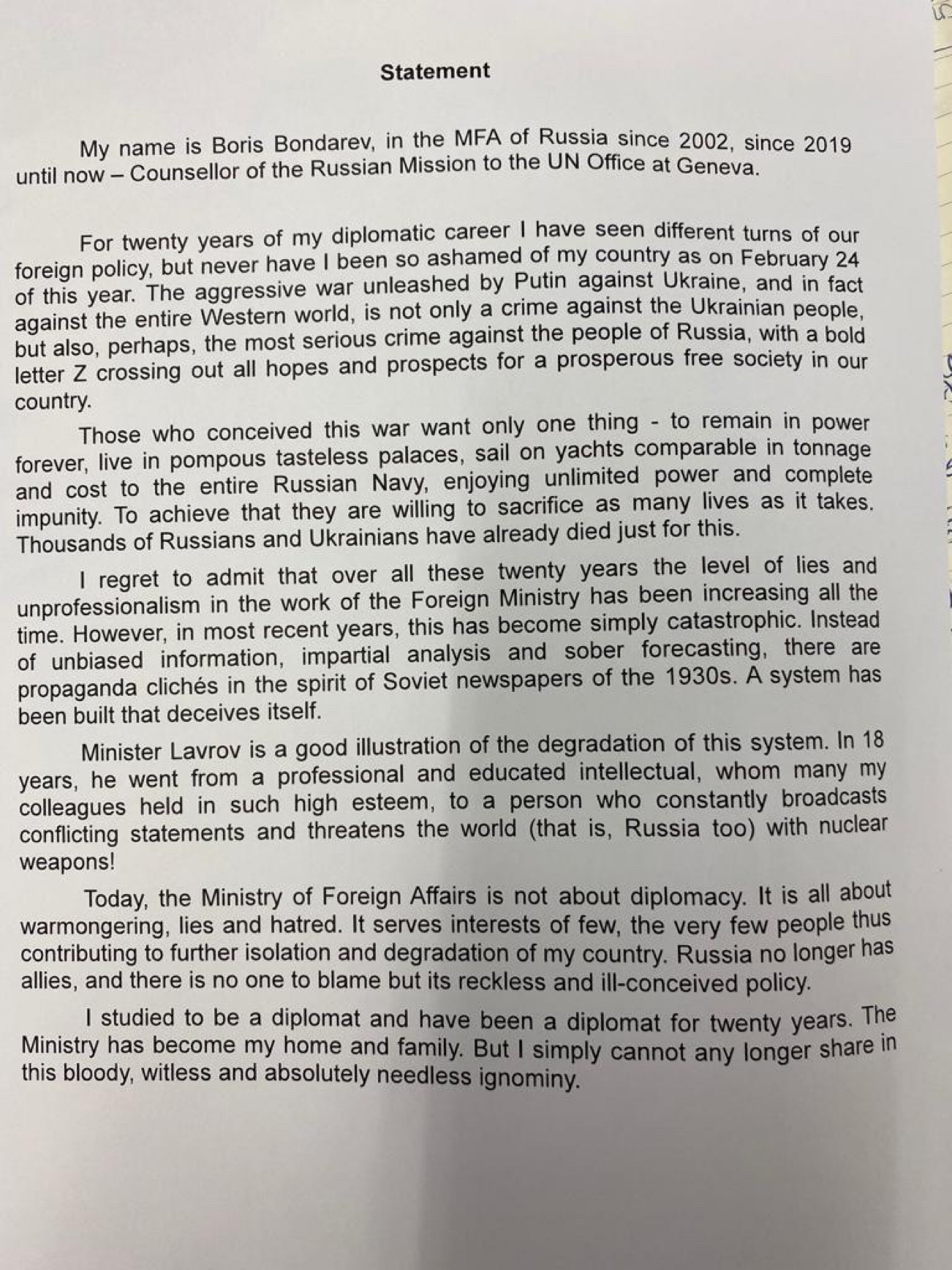
Russia’s Counselor to the United Nations in Geneva resigned. I hope that those few readers of this blog who have been stridently defending Putin and making excuses (“clear out the Nazis,” “it’s NATO’s fault,” etc.) for his brutal, unprovoked invasion of Ukraine will read this.

The New York Times authenticated the letter.

Historian Heather Cox Richardson wrote a fascinating column about Steve Schmidt’s recent revelations about important political figures. Like the good historian she is, she connects the dots.

At home, a big story broke over the weekend, reminding us that the ties of the Republican Party to Russians and the effect of those ties on Ukraine reach back not just to former president Trump, but at least to the 2008 presidential campaign of Arizona senator John McCain.

Late Saturday night, political strategist Steve Schmidt, who worked on a number of Republican political campaigns including McCain’s when he ran for president in 2008, began to spill what he knows about that 2008 campaign. Initially, this accounting took the form of Twitter threads, but on Sunday, Schmidt put the highlights into a post on a Substack publication called The Warning. The post’s title distinguished the author from those journalists and members of the Trump administration who held back key information about the dangerous behavior in Trump’s White House in order to include it in their books. The post was titled: “No Books. No Money. Just the Truth.”

Schmidt left the Republican Party in 2018, tweeting that by then it was “fully the party of Trump. It is corrupt, indecent and immoral. With the exception of a few governors…it is filled with feckless cowards who disgrace and dishonor the legacies of the party’s greatest leaders…. Today the GOP has become a danger to our democracy and our values.” Schmidt helped to start The Lincoln Project, designed to sink Trump Republicans through attack ads and fundraising, in late 2019.

The apparent trigger for Schmidt’s accounting was goading from McCain’s daughter Meghan McCain, a sometime media personality who, after years of slighting Schmidt, recently called him a pedophile, which seems to have been a reference to the fact that a colleague with whom Schmidt started The Lincoln Project was accused of online sexual harassment of men and boys. Schmidt resigned over the scandal.

Schmidt was fiercely loyal to Senator McCain and had stayed silent for years over accusations that he was the person who had chosen then–Alaska governor Sarah Palin as McCain’s vice presidential candidate, lending legitimacy to her brand of uninformed fire-breathing radicalism, and about his knowledge of McCain’s alleged affair with a lobbyist.

In his tweetstorm, Schmidt set the record straight, attributing the choice of Palin to McCain’s campaign director and McCain himself, and acknowledging that the New York Times had been correct in the reporting of McCain’s relationship with the lobbyist, despite the campaign’s angry denial.

More, though, Schmidt’s point was to warn Americans that the mythmaking that turns ordinary people into political heroes makes us unwilling to face reality about their behavior and, crucially, makes the media unwilling to tell us the truth about it. As journalist Sarah Jones wrote in PoliticusUSA, Schmidt’s “broader point is how we, as Americans, don’t like to be told the truth and how our media so loves mythology that they work to deliver lies to us instead of holding the powerful accountable.”

Schmidt’s biggest reminder, though, was that the director of the 2008 McCain campaign was Richard (Rick) Davis, a founding partner of Davis Manafort, the political consulting firm formed in 1996. By 2003, the men were representing pro-Russia Ukrainian oligarch Viktor Yanukovych; in July 2004, U.S. journalist Paul Klebnikov was murdered in Moscow for exposing Russian government corruption; and in June 2005, Manafort proposed that he would work for Putin’s government in former Soviet republics, Europe, and the United States by influencing politics, business dealings, and news coverage.

From 2004 to 2014, Manafort worked for Yanukovych and his party, trying to make what the U.S. State Department called a party of “mobsters and oligarchs” look legitimate. In 2016, Manafort went on to lead Donald Trump’s campaign, and the ties between him, the campaign, and Russia are well known. Less well known is that in 2008, Manafort’s partner Rick Davis ran Republican candidate John McCain’s presidential campaign.

Schmidt writes that McCain turned a blind eye to the dealings of Davis and Manafort, apparently because he was distracted by the fallout when the story of his personal life hit the newspapers. Davis and Manafort were making millions by advancing Putin’s interests in Ukraine and eastern Europe, working for Yanukovych and Russian oligarch Oleg Deripaska. Schmidt notes that “McCain spent his 70th birthday with Oleg Deripaska and Rick Davis on a Russian yacht at anchor in Montenegro.”

“There were two factions in the campaign,” Schmidt tweeted, “a pro-democracy faction and…a pro Russia faction,” led by Davis, who—like Manafort—had a residence in Trump Tower. It was Davis who was in charge of vetting Palin.

McCain was well known for promising to stand up to Putin, and Palin’s claim that she could counter the growing power of Russia in part because “[t]hey’re our next-door neighbors, and you can actually see Russia from land here in Alaska, from an island in Alaska” became a long-running joke (the comment about seeing Russia from her house came from a Saturday Night Live skit).

But a terrific piece in The Nation by Mark Ames and Ari Berman in October 2008 noted: “He may talk tough about Russia, but John McCain’s political advisors have advanced Putin’s imperial ambitions.” The authors detailed Davis’s work to bring the Balkan country of Montenegro under Putin’s control and concluded that either McCain “was utterly clueless while his top advisers and political allies ran around the former Soviet domain promoting the Kremlin’s interests for cash, or he was aware of it and didn’t care.”

Trump’s campaign and presidency, along with Putin’s deadly assault on Ukraine, puts into a new light the fact that McCain’s campaign manager was Paul Manafort’s business partner all the way back in 2008.

Note: Richardson has a list of sources at the end of her post. For some unknown reason, WordPress did not permit me to copy her notes. I inserted some but not all. Open the post to check the links.

Jonathan Chait writes for New York magazine, where his latest article appeared, opposing the U.S. Department of Education’s proposed regulations for the federal Charter Schools Program (CSP). CSP currently spends $440 million annually to underwrite new charter schools. Chait titled his article “Biden Abandons the Obama Legacy on Charter Schools,” but it might as well have been titled “Biden Abandons the Betsy DeVos Legacy on Charter Schools.”

Chait also attacked the Network for Public Education, which had issued two reports (see here and here) documenting the waste, fraud, and abuse in the CSP, based on the Education Department’s own data. NPE found that almost 40% of CSP funding went to charters that either never opened or closed within a few years of opening. In the life of the program, almost $1 billion had been wasted. In addition, NPE pointed out the scandals associated with some high-profile for-profit charter operators, as well as the use of CSP money to open white-flight charters.

This year, for the first time since the CSP was created nearly 30 years ago, the Department proposed to ban the funding of for-profit charter management organizations and of white-flight charters. The regulations also ask applicants for an impact analysis that describes what effect the new charter is likely to have on existing public schools and why the new charter is needed. These sensible reform proposals sent the charter lobbyists into frenzied opposition, claiming falsely that these regulations were meant to destroy all charter schools. This was nonsense because they would have no effect on the thousands of existing charters, only on applicants for new federal funding, that is, charters that do not yet exist.

Congresswoman Rosa DeLauro, chair of the powerful House Appropriations Committee, sharply denounced the lies and misrepresentations of the “trade organization” for the charter industry. But, despite her reproach, the charter industry still promotes dishonest diatribes about the Department’s efforts to reform the CSP.

Carol Burris, the executive director of the Network for Public Education, was incensed when she read Chait’s defense of the charter industry’s effort to protect the for-profit managers who have abused CSP funds and of the operators that have used CSP funding to provide white-flight charters.

She wrote the following response.

In his recent column, “Biden Abandons the Obama Legacy on Charter Schools,” Jonathan Chait is perturbed that the U.S. Department of Education referred Chalkbeat’s Matt Barnum to me for comment on an article he was writing about the Department’s proposed regulations for funding new charter schools. He then scolds Barnum for not disclosing that the Network for Public Education has received donations from unions. He calls Barnum’s story “neutral.” Chait’s source for this big scoop? The National Alliance for Public Charter Schools.

Jonathan Chait then parrots the “wild exaggerations and misrepresentations” that Rosa De Lauro called out last week after expressing her support for CSP reforms during the Education Department’s 2023 budget hearing. The Appropriations Chairwoman noted that “this kind of information campaign is a familiar tactic for the trade organization [National Alliance for Public Charter Schools]. It does represent charter schools that are run by risky low-quality for-profit education management organizations.”

You know those “wild exaggerations.” I wrote about them here. Obviously, Chait did not read the mentioned Barnum piece, which was solid reporting, and he certainly did not read the proposed regulations carefully (which Representative DeLauro described in a letter to Secretary Miguel Cardona about the charter industry’s misrepresentations). Or he just chose to twist facts and truth.

Now let’s talk about what Jonathan Chait failed to disclose as he opposed the CSP regulation reforms, using the same misinformation that has appeared in other op-eds.

His wife worked for Center City Charter Schools as a grant writer when that charter chain received two grants from the Charter School Program (CSP), the program whose loose rules he is now defending. Download the 2019 database that you can find here and match the years of dispersion to the resume of Robin Chait. But the undisclosed conflict continues to this day. Since 2018, Robin Chait has worked for West Ed which evaluated the CSP during the Betsy De Vos era. And her employer, West Ed, once got its own $1.74 million grant from CSP.

But back to NPE funding. During some recent years we got modest donations from unions to bring teachers to our conferences. At our very beginning, we received start-up funds from the Chicago Teachers Union through a fiscal sponsor, Voices for Children. That ended in 2015. We will always be grateful to our friend, the late Karen Lewis, for that jump-start. Karen foresaw the growing attacks on public schools and teachers as an ominous trend and wanted to encourage allies to support a bedrock institution of our democracy.

We appreciate any tax-deductible donations we get. You won’t get favors, but you will always get a thank you. Our income comes from individual donations from our large number of supporters—educators, parents, family foundations, and other citizens who have a deep and abiding love for public schools.

This is not the first time Chait has been called out for not disclosing his wife’s connections with charters. But given the topic and her work in organizations connected with the Charter School Program, this is the worst omission yet. Shame on New York Magazine for not making him disclose and for letting him play fast and loose with the truth. And shame on Chait’s hypocritical critique of Barnum even as he hides the family connections with the program he defends.

As I mentioned in the previous post, the Houston Chronicle won a Pulitzer Prize for its editorial about the Big Lie and the follow-up efforts to suppress voting by those who might vote Democratic. It is a brilliant series, well deserving of a Pulitzer Prize. Here is another editorial that shines a bright light on the state legislature’s dastardly effort to curtail voting rights. How the Republican leaders voted to suppress voting rights while claiming to protect the integrity of elections.

You don’t say.

A voting bill that truly protects people’s rights instead of raiding them doesn’t need a shroud of darkness or legislative chicanery to prevail. It doesn’t run from the sun or shrivel under scrutiny. Only lies do.

The biggest problem Republican lawmakers have in pushing restrictive voting legislation in the name of integrity is that they themselves have none.

The latest example came Thursday, as the House Elections Committee abruptly took up Senate Bill 7, the upper chamber’s main voter-suppression legislation, without any warning and leaving no room for public comment. The bill aids voter intimidation by letting partisans film voters they find suspicious and takes aim at voting innovations that helped increase turnout in blue Harris County, including drive-thru voting.

Chairing the Elections Committee is none other than state Rep. Briscoe Cain, R-Deer Park, a young lawyer who earned his stripes in Texas-style voter integrity politics by proudly tweeting a photo of himself in November, in aviator glasses and a cowboy hat pulled low, announcing that he was headed to Pennsylvania to join Donald Trump’s quest to overthrow the presidential election through baseless allegations of voter fraud.

It surprised many when incoming House Speaker Dade Phelan entrusted Cain with his first chairmanship. It has been less surprising that Cain’s excellent adventure in committee leadership has, well, flunked most heinously. Last week, Cain blindsided fellow lawmakers by introducing a motion to substitute SB 7 with the language of his own bill, HB 6. His move, to hear him reason it, required no public discussion, since the committee had already discussed and approved the House bill.

Cain played it coy as Democrats sought clarification and questioned whether this would gut SB 7 and replace it wholesale with the language in HB 6. “I wouldn’t say that,” he responded.

Lesser and greater evil

HB 6 gives partisan poll watchers almost unlimited freedom inside a polling place and limits when they can be ejected to a narrow set of circumstances. It further criminalizes the electoral process, targeting elections officials who may fear that making a mistake could land them in jail (say, when trying to kick out a disruptive poll watcher). It also puts new burdens on those who assist voters who are elderly, disabled or have limited English proficiency, while also threatening them with a felony for even accidental violations of their oath.

SB 7 also contains broad protection of partisan poll watchers while also giving them the ability to record voters if they think they are violating election law. It increases burdens on volunteers that help people get to the polls, regulates the distribution of polling locations in large urban counties and bans mega voting sites, 24-hour poll locations and drive-thru voting.

Cain, speaking over lawmakers’ objections that they didn’t have time to consider the substituted language, likely would have bullied through if not for his fellow Republican, state Rep. Travis Clardy, of Nacogdoches, refusing to cast a vote.

After the committee reconvened later that day, Clardy supported the measure and the revised SB 7 — to mirror HB 6 — passed on a party-line vote. Still, it was nice that however briefly, at least one Republican on the committee believed that if you claim election bills are about honest elections, you should show a little honesty in discussing them.

In March, Chairman Cain — yet, again — broke with legislative rules in a decidedly less successful scheme. He left about 200 people who traveled to the Capitol to testify on HB 6 twiddling their thumbs after he strayed from procedure in a hasty attempt to block testimony from Rep. Nicole Collier, D-Fort Worth, chair of the Texas Legislative Black Caucus.

In April, the Senate approved SB 7 in the middle of the night — after a slew of amendments that few had a chance to read in full — with few people watching. As reported by the Chronicle, lawmakers adjourned at 1:39 a.m. April 1, then cleverly reconvened one minute later at 1:40 a.m. to declare a new legislative day, complete with a new roll call and a fresh prayer — thus complying with public notice rules without slowing down the bill’s passage.

“If you really think you’re securing the election, do it in the light of day,” says Emily Eby, an attorney with the Texas Civil Rights Project. “If you really think you’re preserving the integrity of the ballot box, do it in front of Texans.”

Of course, Republican lawmakers don’t think anything of the sort. Not if they understand basic math, anyway. An analysis of voter fraud cases by this editorial board found that over the past 15 years and more than 94 million votes cast in Texas elections, the Texas Attorney General’s Office has prosecuted only 155 people, with few of them facing charges serious enough to warrant jail time.

The GOP’s true motivation is not preventing fraud in voting, but preventing broader voting across demographic lines from an electorate that’s growing younger and more diverse. The only threat at the polls is the GOP’s attempt to bar the door.

The NC Pulse reports that another charter school in North Carolina bit the dust under a cloud of financial improprieties.

Office of the State Auditor found that Bridges Academy in Wilkes County falsified student enrollment records, misused charter school money to support a preschool and failed to submit required tax forms in 2019.

State Auditor Beth Wood released the audit of the K-8 school on Wednesday. The school relinquished its charter last summer amid allegations of financial irregularities and what its own board of directors described as “insurmountable financial challenges.”

The state auditor will turn her office’s findings over to the District Attorney’s Office in Prosecutorial District 34. The district includes all of Alleghany, Ashe, Wilkes and Yadkin counties. The findings will also be shared with the Internal Revenue Service and the North Carolina Department of Revenue.

The audit shows that for the 2020-21 school year, Bridges Academy’s director and finance officer falsified student enrollment records by reporting 72 students who were not enrolled in the schools.

The two admitted that they began inflating enrollment eight years earlier, mainly in early grades to avoid detection. Students in grades K-2 aren’t required to take state tests and don’t show up on testing rosters…

Bridges Academy was also found to have used $78,576 in state money intended for the charter school to support the operations of a preschool, despite charging tuition for children to attend the preschool.

“The charter school funding provided by DPI was intended for the education of kindergarten through eighth grade students,” the audit said. “However, at least $78,576 of the funding was used for the operation of the preschool to close the gap between the revenues and expenses.”

In 2019 and 2020, Bridges also failed to report nearly $500,000 in payments to the director, instructional and support staff, the audit found.

That means the IRS likely collected fewer taxes from the organization than was owed

Here are key recommendations made by the Office of the State Auditor:

  • DPI should seek repayment of $404,971 from Bridges Academy, or the Receiver, for the state funds received as a result of the falsified student enrollment records.
  • DPI should consider reviewing the enrollment history of Bridges Academy and determine if the school received funding for falsified students in previous years.
  • DPI should seek repayment of $78,576 from Bridges Academy, or the Receiver, for state charter school funds that were utilized to support the preschool.

In case you wondered, Peter Greene is not a fan of SEL (social-emotional learning). Just because the loathsome Florida Governor Ron DeSantis doesn’t like it is no reason to embrace it. He feels the way about SEL that I always felt about character education. Character education should not be a course or a program; it should implicitly permeate everything you do in teaching honesty, integrity. responsibility, and helpfulness. It must be modeled, expected, reinforced by example, not turned into lessons.

Greene writes:

Social and Emotional Learning is the new target of the GOP attempt to set multiple education brushfires in hopes of stampeding voters towards a Republican victory (as well as one more way for the authoritarian crowd to hammer home their central point of “Trust nobody except Beloved Leader”). The attacks range from overblown to intellectually dishonest to giant piles of bovine fecal matter to the odious, evil charges that the teaching profession is simply a haven for groomers.

And there is irony in these attacks from the right, because SEL is just the latest packaging of what we used to call “soft skills,” and some of the greatest push for getting these into schools has come from the business community (“Hey schools! Fix my meat widgets so they communicate and cooperate better!!”)

All that said, I’m not going to be the one to defend SEL in the classroom.

Perhaps I should say “formal SEL instruction.” SEL has always been in the classroom and always will be, because it’s impossible for an adult teacher to lead a roomful of young humans through learning and education and all the bumps and interactions that come by putting so many human beings in one room–well, you can’t navigate any of that without including SEL. “Don’t interrupt” and “keep your hands to yourself” and every group project ever are part SEL. Everything a teacher imparts, directly or indirectly, about how to work with, talk to, and get along with other humans is SEL. 95% of all the “this teacher changed my life” stories are about SEL and not actual subject content. So it is impossible to remove SEL from a classroom.

But formal SEL is another thing.

As soon as we try to formalize SEL instruction, we run into all sorts of problems. Are we doing it to help people get a better job and better grades or to be a better human being? And if it’s the latter, as it should be, who the heck is going to define what a better human being looks like? And is there just one definition? And if not (as is true), then exactly what sort of assessment are we going to use to measure the “effectiveness” of the program or the social and emotional learnedness of the students? And can you promise me that you aren’t going to record all that data to build some sort of digital social and emotional swellness file on each student? Also, will the program require every teacher to have a trained counselor level of expertise? Every single one of these questions ought to stop the march toward formalized SEL instruction dead in its tracks. But it hasn’t-not any of the times SEL, under various monikers has come trundling down the tracks…

If you spend an hour a week talking about how to be a decent person, and the rest of the week behaving like a lousy person, you’re wasting that hour. And if you spend the week being decent people, what do you need that hour of class for?

And, I would add now, you don’t model character for young humans by engaging in lying and slander to score political points. If 2022 is, as some activists are promising, the year that SEL takes over for CRT as the object of panic du jour, good luck to us all. But just because you call out the throwing of poo, that doesn’t mean you have to support the thing the poo’s being thrown.

We agree.

Please read the letter from the Network for Public Education to the U.S. Department of Zeducation, supporting its proposed regulations for federal funding of charter schools.

The letter was signed by 96 organizations.

On behalf of the undersigned organizations, we submit the following response to the Department of Education’s request for comments related to the proposed priorities, requirements, definitions, and selection criteria of the Charter Schools Program (CSP). We commend the Department for proposing thoughtful and well-reasoned regulations that will end funding to start or expand charter schools managed in whole or substantially by for-profit organizations, provide greater supervision to the program, ensure that the charter school does not increase segregation and via impact analysis, demonstrate that the charter school is truly needed.

The Charter Schools Program (CSP) is a statutorily established grant program that began in 1994 with the purpose of expanding high-quality charter schools when charter schools were experimental and intended to supplement, not supplant, public schools. Since its modest beginnings, the program has expanded as has the charter school sector. The CSP has been responsible, in great part, for the expansion of the charter sector and therefore indirectly responsible for problems in the charter sector that include the frequent closures of charter schools, the drain on public school funding, and the fraud and mismanagement that is frequently reported in the press. We believe that your proposed regulations are a good first step in addressing those problems.

We the undersigned further believe that all charter schools, like public schools, must provide their students with a free education that guards students’ civil rights, provides a rich educational opportunity and protects their health and safety. Further, we believe that any school that is financed by the public must ensure that tax dollars are judiciously spent in compliance with the law. That means we support compliance with open meetings and public records laws; prohibitions against profiteering as enforced by conflict of interest, financial disclosure, and auditing requirements. We believe that all students deserve to be taught by teachers who have met state certification requirements in a classroom where they have an opportunity to engage with their teacher and their peers. We do not support virtual charter schools which are ineffective in meeting the academic and socio-emotional needs of students.

Eliminating CSP Funding to Charter Schools Managed by For-profit Corporations

We strongly support the proposed regulations to ensure that charter schools operated by for-profit corporations do not receive CSP grants.

The federal definition of a public school under IDEA and ESEA is “a nonprofit institutional day or residential school, including a public elementary charter school, that provides elementary education, as determined under State law.” 20 U. S.C. §§ 1401(6) (IDEA), 7801(18) (ESEA) Similarly, the statutes define a “secondary school” as “a nonprofit institutional day or residential school, including a public secondary charter school, that provides secondary education, as determined under State law․” 20 U.S.C. §§ 1401(27) (IDEA), 7801(38) (ESEA).

Former for-profit entities have created non-profit facades that allow the for-profit and its related organizations to run and profit from the charter school, following the judgment of the Ninth Circuit Court of Appeals in Arizona State Bd. For Charter Schools v. U.S. Dept. of Educ. in 2006 (464 F.3d 1003).[i]

Ineffective provisions undermine the present regulations against the disbursement of funds from the federal Charter Schools Program (CSP) to charter schools operated by for-profit entities. We identified over 440 charter schools operated for profit that received grants totaling approximately $158 million between 2006 and 2017, including CSP grants to schools managed with for-profit sweeps contracts.[ii]

The relationship between a for-profit charter school management organization, commonly referred to as an EMO, is quite different from the relationship between a vendor who provides a single service. A school can sever a bus contract and still have a building, desks, curriculum, and teachers. However, in cases where charter schools have attempted to fire the for-profit operator, they find it impossible to do without destroying the schools in the process.

Many for-profit organizations operate by steering business to their for-profit-related entities. They are often located at the same address, and the owner of the management company or a member of the immediate family is the owner of the related entity. Therefore, it is recommended that wherever references to for-profit organizations appear, the phrase “and its related entities” is added.

Recommendations:

(a)   Each charter school receiving CSP funding must provide an assurance that it has not and will not enter into a contract with a for-profit management organization, including a non-profit management organization operated by or on behalf of a for-profit entity, under which the management organization and its related entities exercise(s) full or substantial administrative control over the charter school and, thereby, the CSP project.

Quality Control of Awards and the Importance of Meeting Community Need via Impact Analysis

We strongly support the proposed regulations that seek to bring greater transparency and better judgment to the process of awarding CSP grants. We especially support the inclusion of a community impact analysis.

We are pleased that “the community impact analysis must describe how the plan for the proposed charter school take into account the student demographics of the schools from which students are, or would be, drawn to attend the charter school,” and provide “evidence that demonstrates that the number of charter schools proposed to be opened, replicated, or expanded under the grant does not exceed the number of public schools needed to accommodate the demand in the community.”

More than one in four charter schools close by the end of year five.[iii] A foremost reason for both public school and charter closure and the disruption such closures bring to the lives of children is low enrollment, as seen this past month in Oakland.[iv] In New Orleans, school closures have resulted in children being forced to attend multiple schools during their elementary school years, often traveling long distances. Between 1999 and 2017, nearly one million children were displaced due to the closure of their schools, yet only nine states have significant caps to regulate charter growth.[v]

We applaud language that states, “The community impact analysis must also describe the steps the charter school has taken or will take to ensure that the proposed charter school would not hamper, delay, or in any manner negatively affect any desegregation efforts in the public school districts from which students are, or would be, drawn or in which the charter school is or would be located, including efforts to comply with a court order, statutory obligation, or voluntary efforts to create and maintain desegregated public schools…”

In some states, charter schools have been magnets for white flight from integrated schools.[vi] Other charter schools have attracted high achieving students while discouraging students with special needs from attending.[vii] And, as you know from the letter you received in June of 2021 from 67 public education advocacy and civil rights groups, the North Carolina SE CSP sub-grants were awarded to charter schools that actively exacerbated segregation, serving in some cases, as white flight academies[viii] The information requested by the Department is reasonable and will help reviewers make sound decisions.

In addition to our support for the proposed regulations, we have two additional recommendations to strengthen the impact analysis proposal.

Recommendations: (1) That impact analysis requirements include a profile of the students with disabilities and English Language Learners in the community along with an assurance that the applicant will provide the full range of services that meet the needs of students with disabilities and English Language Learners. (2) That applicants include a signed affidavit provided by district or state education department officials attesting to the accuracy of the information provided.

Regarding proposed rules regarding transparency, we note that in the past, schools were awarded grants without providing even one letter of support[ix], or provided false information indicating support that did not exist.[x]

We also strongly support the requirement state entities provide additional supervision of grants. The Department should require a forensic audit for any charter school applying for CSP consideration. Furthermore, any charter school that does not operate as a classroom-based entity or is operated by a for-profit entity should be barred from being awarded grant money under the CSP. We also believe these requirements can be strengthened by requiring review teams to include at least one reviewer representative from the district public school community and that applications be posted and easily accessible for the public to review and comment upon for a period of no less than 60 days before awarding decisions.

L

Proposed Selection Criterion for CMO Grants

ESSA places the following restriction on grants awarded to State Entities: No State entity may receive a grant under this section for use in a State in which a State entity is currently using a grant received under this section. However, ESSA is silent regarding the awarding of grants to CMOs. This has resulted in CMOs having several active grants at the same time, with new grants being issued without proper inspection of the efficacy of former grants. For example, it has resulted in the IDEA charter CMO receiving six grants in a ten-year period totaling nearly $300 million.[xi] These grants occurred under a leadership structure that engaged in questionable practices, including the attempted yearly lease of a private jet,[xii] related-party transactions, and the rental of a luxury box at San Antonio Spurs games.[xiii]

IDEA received two awards, in 2019 and 2020, totaling more than $188 million even as the 2019 audit of the Inspector General found that IDEA submitted incomplete and inaccurate reports on three prior grants. The IG report also looked at a randomly selected sample of expenses and found that IDEA’s charges to the grants did not always include only allowable and adequately documented non-personnel expenses.

Recommendations:

That department regulations disallow the awarding of grants to any CMO currently using a grant received under the CMO program and that for any grant exceeding $25 million, the Department’s OIG conducts an audit before an additional grant is awarded.

We thank you for the time and thought that went into the proposed regulations.


[i] Arizona State Board for Charter Schools v. Department of Education. No. 05-17349 (9th Cir. 2006)

[ii] Burris, Carol and Darcie Cimarusti. (n.d.) Chartered for Profit: The Hidden World of Charter Schools Operated for Financial Gain. Network for Public Education. Retrieved on March 23, 2022 from   https://networkforpubliceducation.org/chartered-for-profit/

[iii] Burris, Carol and Pfleger, Ryan. (n.d.) Broken Promises: An Analysis of Charter School Closures from 1999-2017. Network for Public Education. Retrieved on March 23, 2022, from https://networkforpubliceducation.org/wp-content/uploads/2020/08/Broken-Promises-PDF.pdf

[iv] McBride, Ashley. (2022, February 9). “Oakland school board votes to close seven schools over the next two years.” The Oaklandside. Retrieved March 23, 2022, from https://oaklandside.org/2022/02/09/oakland-school-board-votes-to-close-seven-schools-over-the-next-two-years/

[v] Burris, Carol and Pfleger, Ryan. (n.d.) Broken Promises: An Analysis of Charter School Closures from 1999-2017. Network for Public Education. Retrieved on March 23, 2022, from https://networkforpubliceducation.org/wp-content/uploads/2020/08/Broken-Promises-PDF.pdf

[vi] Wilson, Erika K. (2019). “The New White Flight.” HeinOnline. Retrieved on March 23, 2022 from https://heinonline.org/HOL/LandingPage?handle=hein.journals/dukpup14&div=8&id=&page=

[vii] Mommandi, Wagma and Kevin Welner. (2021, September 10). School’s Choice: How Charter Schools Control Access and Shape Enrollment. Teachers College Press.

[viii] Letter to Secretary Cardona from 67 education and civil rights advocacy organizations. (2021, June 16). Retrieved on March 23, 2022, from https://networkforpubliceducation.org/wp-content/uploads/2021/07/Letter-to-Secretary-Cardona-re_-North-Carolina-grant-6.16.pdf.

[ix] Strauss, Valerie. (2020, December 3), How a soccer club won a 126 million dollar grant from Betsy Devos’s education department to open a charter school.  The Washington Post. Retrieved March 23, 2022, from https://www.washingtonpost.com/education/2020/12/03/how-soccer-club-won-126-million-grant-devoss-education-department-open-charter-school/

[x] Winerip, Michael. (2012, January, 8). Rejected three times, school may still open soon, and with a grant, too. The New York Times. Retrieved March 24, 2022, from https://www.nytimes.com/2012/01/09/education/hebrew-charter-school-in-new-jersey-has-grant-to-go-with-application.html.

[xi] Office of Elementary and Secondary Education (n.d.). “Charter Schools Program Grants to Charter Management Organizations for the Replication and Expansion of High-Quality Charter Schools (CMO Grants).” U.S. Department of Education. Retrieved on March 23, 2022, from https://oese.ed.gov/offices/office-of-discretionary-grants-support-services/charter-school-programs/charter-schools-program-grants-for-replications-and-expansion-of-high-quality-charter-schools/

[xii] DeMatthews, David and David S. Knight. (2020, February 10). “Commentary: Private jets and Spurs tickets? Texas needs more charter school oversight.” My San Antonio. Retrieved on March 23, 2022, from https://www.mysanantonio.com/opinion/commentary/article/Commentary-Charter-school-backlash-shows-why-15045357.php

[xiii] Carpenter, Jacob. (2020, January 30). “After jet backlash, IDEA charter schools curbing more ‘hard to defend” spending.” My San Antonio. Retrieved on March 23, 2022, from https://www.mysanantonio.com/news/education/article/After-jet-backlash-IDEA-charter-schools-curbing-15019295.php

Our Co-Signers

  • Network for Public Education
  • National Education Association
  • Southern Poverty Law Center
  • National Black Caucus of State Legislators
  • Journey for Justice
  • AFSCME        
  • NCBCP/Black Women’s Roundtable
  • National Indian Education Association (NIEA)
  • In the Public Interest
  • Superintendent’s Roundtable
  • Advancement Project National Office
  • Education Deans for Justice and Equity (EDJE)
  • Education Law Center
  • Asian Pacific American Labor Alliance
  • Horace Mann League
  • Badass Teachers Association
  • The Democracy Collaborative
  • Advocates for Public Education Policy
  • Alliance for Philadelphia Public Schools
  • Alliance for Quality Education
  • Arizona Educators United
  • Arizonans for Charter School Accountability
  • California Teachers Association
  • Citizens for Public Schools
  • Class Size Matters
  • Close the Gap
  • Coalition for Equity in Public Schools
  • Colorado PTA
  • Democratic Public Education Caucus of Florida
  • Economic Opportunity Network
  • Education Voters of PA
  • Educators for Democratic Schools
  • El Paso Alliance for Just Schools
  • Empowering Pacific Islander Communities (EPIC)
  • First Focus on Children
  • Florida BATs
  • Florida Council of Churches
  • ­­­­Frey Evaluation
  • Hillsborough Public School Advocates
  • Indiana Coalition for Public Education
  • Indiana Coalition for Public Education – Monroe County
  • Jobs to Move America
  • Kentucky NAACP
  • Knox DSA
  • Long Beach Alliance for Clean Energy
  • MI Ed Justice
  • Michigan Education Association
  • Missouri Jobs with Justice
  • Moms and Dads Now Enduring Surrealistic Stupidity (#MADNESS)
  • Mon Valley Unemployed Committee
  • New Rochelle Federation of United School Employees (FUSE)
  • newCAP (New Community Action Pac)
  • North Carolina Justice Center
  • Northeast Indiana Friends of Public Education
  • Northwest Ohio Friends of Public Education
  • Oklahoma Parent Legislative Action Committee
  • Opt Out Georgia
  • Oregon BATs
  • Oregon Save Our Schools
  • Our Children/Our Schools
  • Parents Educating Parents Inc
  • Parents for Public Schools, Inc.
  • Parents for Public Schools, Milwaukee
  • Pastors for Florida Children
  • Pastors for Kentucky Children
  • Pastors for Tennessee Children
  • Pastors for Texas Children
  • Paterson Education Fund
  • PowerSwitch Action
  • Progressive Caucus of the North Carolina Democratic Party
  • Public Advocacy for Kids
  • Public Education Partners – Ohio
  • Public Schools First NC
  • Public Trust Alliance
  • Richmond for All
  • Rochester Coalition for Public Education
  • Saphron Initiative
  • Save Our Schools NJ (SOSNJ)
  • Schools and Communities United
  • Stand for Schools
  • Step Up Louisiana
  • STL Not for Sale
  • SUPPORT OUR SCHOOLS
  • Support Our Students
  • Tennessee BATs
  • Texas AFT
  • Texas Kids Can’t Wait!
  • United for Florida Children
  • United Methodist Advocates for Public Schools
  • Virginia BATs
  • Virginia Educators United
  • Virginia Public Education Partners
  • WA BATs
  • Wake NCAE
  • Washington Township Parent Council Network
  • Wear Red for Public Ed
  • Wellstone Democratic Renewal Club
  • Wisconsin Alliance for Public Schools/Wisconsin Public Education Network
Dana Milbank is a columnist for the Washington Post. He is one of my favorites. (I also adore Valerie Strauss and Jennifer Rubin, and of course, Glenn Kessler, the fact-checker). I’m sorry that his many links did not transfer when I copied and pasted. Subscribe to the Post.

He writes:

There were even more vermin than usual in Washington this week. A rabid fox at the Capitol bit at least nine people, including Rep. Ami Bera (D-Calif.). And Democratic National Committee Chair Jaime Harrison attacked Sen. Tom Cotton (R-Ark.) with an insult most entomological.

After Cotton implied that Supreme Court Justice-designate Ketanji Brown Jackson is a Nazi sympathizer, Harrison referred to Cotton as a “little maggot-infested man” on MSNBC’s “Morning Joe.”

Fake news! Cotton may go low, but, at 6-foot-5, he is not little. Also, maggots typically feed on dead things, and Cotton, though stiff, is not currently deceased. The man likes to carry on, but he is not carrion.

Harrison went on to censure the Republican Party as a whole: “It is a party built on fraud, fear and fascism.” Interestingly, a statement from the Republican National Committee taking offense at the “maggot-infested” charge did not dispute the “fraud, fear and fascism” formulation. As your self-appointed fact-checker, I have therefore examined the merits of the accusation.

Fraud


Sixteen months after President Donald Trump’s claims of election fraud failed in some 60 court cases, we have finally found evidence of potential voter fraud. Trump’s White House staff chief, Mark Meadows, reportedly registered to vote in 2020 using the address of a mobile home he never lived in. And former Trump State Department official Matt Mowers, a current congressional candidate, voted twice during the 2016 primaries, in New Hampshire and New Jersey.

The “big lie” about a rigged election, accepted by two-thirds of Republican voters, has spawned new frauds about the dangers of coronavirus vaccines (leading to sharply higher death rates in heavily Republican counties) and the promise, touted by Sen. Ron Johnson (R-Wis.) of the deworming drug ivermectin to treat covid-19; an exhaustive new study finds the drug useless.

Then there are the little everyday frauds. Just days after Rep. Madison Cawthorn (R-N.C.) told the world that his colleagues engage in coke-fueled orgies, Rep. Lisa McClain (R-Mich.) declared at a Trump rally that it was Trump who “caught Osama bin Laden,” record-low unemployment is at a “40-year high” and there weren’t “any wars” during Trump’s presidency. Never mind Syria and Afghanistan.

Fear

Sen. Ted Cruz (R-Tex.) said people like Ketanji Brown Jackson become public defenders because “their heart is with the murderers.” Cotton said Justice Robert H. Jackson “left the Supreme Court to go to Nuremberg and prosecute the case against the Nazis. This Judge Jackson might have gone there to defend them.”

Republican senators used the Jackson confirmation to stir fear of minorities and vulnerable groups with manufactured crises about transgender athletes (of the 200,000 participants in women’s collegiate sports, perhaps 50 are transgender) and “critical race theory” (which isn’t taught in public schools).

Ohio Republican Senate candidate J.D. Vance released an ad saying “Biden’s open border is killing Ohioans, with more illegal drugs and more Democrat voters pouring into this country.”

The Florida legislature approved an “election crimes” police force for Gov. Ron DeSantis (R), with the potential to intimidate voters, while various GOP-led states move forward with new provisions providing residents with incentives to inform on each other.

The newly-revealed text messages of Justice Clarence Thomas’s activist wife, Ginni, show her sharing with the Trump White House her “hope” that the “Biden crime family” as well as elected officials, bureaucrats and journalists would be taken to “barges off GITMO to face military tribunals for sedition.”
**
Is the GOP “a party built on fraud, fear and fascism”? Certainly, not all Republicans think this way. But too many others are subverting democracy, cavorting with white nationalists, spreading racist fears and fantasizing about extrajudicial punishment for political opponents and the media. For them, the jackboot fits