Archives for category: Elections

Jamelle Bouie is one of the best opinion writers at the New York Times. In addition to reading his regular columns, I subscribe to the newsletter he writes, where he shares ideas, tells you what he is reading and what he is cooking.

In this post, he wrote persuasively about why Donald Trump is an insurrectionist and should not be allowed to run for the office he defiled.

Bouie wrote:

Last month the states of Colorado and Maine moved to disqualify Donald Trump as a candidate in the 2024 presidential election, citing Section 3 of the 14th Amendment. In response, Trump has asked the Supreme Court to intervene on his behalf in the Colorado case, and he has appealed Maine’s decision.

There is a real question of whether this attempt to protect American democracy — by removing a would-be authoritarian from the ballot — is itself a threat to American democracy. Will proponents and supporters of the 14th Amendment option effectively destroy the village in order to save it?

It may seem obvious, but we should remember that Trump is not an ordinary political figure. And try as some commentators might, there is no amount of smoke one could create — through strained counterfactuals, dire warnings of a slippery slope or outright dismissal of the events that make the Trump of 2024 a figure very different from the Trump of 2020 — that can obscure or occlude this basic fact.

In 2020, President Trump went to the voting public of the United States and asked for another four years in office. By 51 percent to 47 percent, the voting public of the United States said no. More important, Trump lost the Electoral College, 306 to 232, meaning there were enough of those voters in just the right states to deny him a second term.

The people decided. And Trump said, in so many words, that he didn’t care. What followed, according to the final report of the House select committee on Jan. 6, was an effort to overturn the result of the election.

Trump, the committee wrote, “unlawfully pressured state officials and legislators to change the results of the election in their states.” He “oversaw an effort to obtain and transmit false electoral certificates to Congress and the National Archives.” He “summoned tens of thousands of supporters to Washington for Jan. 6,” the day Congress was slated to certify the election results, and “instructed them to march to the Capitol” so that they could “‘take back’ their country.’” He even sent a message on Twitter attacking his vice president, Mike Pence, knowing full well that “a violent attack on the Capitol was underway.”

In the face of this violence, Trump “refused repeated requests over a multiple hour period that he instruct his violent supporters to disperse and leave the Capitol, and instead watched the violent attack unfold on television.” He did not deploy the National Guard, nor did he “instruct any federal law enforcement agency to assist.”

Trump sought and actively tried to subvert constitutional government and overturn the results of the presidential election. And what he could not do through the arcane rules and procedures of the Electoral College, he tried to do through the threat of brute force, carried out by an actual mob.

Looked at this way, the case for disqualifying Trump through the 14th Amendment is straightforward. Section 3 states that “No person shall … hold any office, civil or military, under the United States, or under any state, who, having previously taken an oath … to support the Constitution of the United States, shall have engaged in insurrection or rebellion against the same, or given aid or comfort to the enemies thereof.”

As the legal scholar Mark A. Graber writes in an amicus brief submitted to the Colorado Supreme Court, “American jurists understood an insurrection against the United States to be an attempt by two or more persons for public reasons to obstruct by force or intimidation the implementation of federal law.” There was also a legal consensus at the time of the amendment’s drafting and ratification that an individual “engaged in insurrection whenever they knowingly incited, assisted or otherwise participated in an insurrection.”

We also know that the framers of the 14th Amendment did not aim or intend to exclude the president of the United States from its terms. In 1870 the Republican-controlled Senate refused to seat Zebulon Vance, the former Confederate governor of North Carolina. It strains credulity to think that the same Republicans would have sat silent if the Democratic Party had, in 1872, nominated a former Confederate leader for the presidency.

Under a plain reading of Section 3 — and given the evidence uncovered by the Jan. 6 committee — Trump cannot stand for the presidency of the United States or any other federal office, for that matter.

The real issue with disqualifying Trump is less constitutional than political. Disqualification, goes the argument, would bring American democracy to the breaking point.

In this line of thinking, to deny Americans their choice of presidential candidate would destroy any remaining confidence in the American political system. It would also invite Trump’s allies in the Republican Party to do the same to Democrats, weaponizing Section 3 and disqualifying candidates for any number of reasons. Disqualification would also give far more power to the courts, when the only appropriate venue for the question of Trump is the voting booth.

But these objections rest on a poor foundation. They treat Trump as an ordinary candidate and Jan. 6 as a variation on ordinary politics. But as the House select committee established, Jan. 6 and the events leading up to it were nothing of the sort. And while many Americans still contest the meaning of the attack on the Capitol, many Americans also contested, in the wake of the Civil War, the meaning of secession and rebellion. That those Americans viewed Confederate military and political leaders as heroes did not somehow delegitimize the Republican effort to keep them, as much as possible, out of formal political life.

What unites Trump with the former secessionists under the disqualification clause is that like them, he refused to listen to the voice of the voting public. He rejected the bedrock principle of democratic life, the peaceful transfer of power.

The unspoken assumption behind the idea that Trump should be allowed on the ballot and that the public should have the chance to choose for or against him yet again is that he will respect the voice of the electorate. But we know this isn’t true. It wasn’t true after the 2016 presidential election — when, after winning the Electoral College, he sought to delegitimize the popular vote victory of his opponent as fraud — and it was put into stark relief after the 2020 presidential election.

Trump is not simply a candidate who does not believe in the norms, values and institutions we call American democracy — although that is troubling enough. Trump is all that and a former president who used the power of his office to try to overturn constitutional government in the United States.

Is it antidemocratic to disqualify Trump from office and deny him a place on the ballot? Does it violate the spirit of democratic life to deny voters the choice of a onetime officeholder who tried, under threat of violence, to deny them their right to choose? Does it threaten the constitutional order to use the clear text of the Constitution to hold a former constitutional officer accountable for his efforts to overturn that order?

The answer is no, of course not. There is no rule that says democracies must give endless and unlimited grace to those who used the public trust to conspire, for all the world to see, against them. Voters are free to choose a Republican candidate for president; they are free to choose a Republican with Trump’s politics. But if we take the Constitution seriously, then Trump, by dint of his own actions, should be off the board.

Not that he will be. The best odds are that the Supreme Court of the United States will punt the issue of Section 3 in a way that allows Trump to run on every ballot in every state. And while it will be tempting to attribute this outcome to the ideological composition of the court — as well as the fact that Trump appointed three of its nine members — I think it will, if it happens, have as much to do with the zone of exception that exists around the former president.

If Trump has a political superpower, it’s that other people believe he has political superpowers. They believe that any effort to hold him accountable will backfire. They believe that he will always ride a wave of backlash to victory. They believe that challenging him on anything other than his terms will leave him stronger than ever.

Most of this is false. But to the extent that it is true, it has less to do with the missed shots — to borrow an aphorism from professional sports — than it does with the ones not taken in the first place.

I wrote a few days ago that Trump should not be removed from the ballot even though he unequivocally plotted to overturn the election he lost and provoked an insurrection against the orderly transfer of power. I was wrong. For me, it was a close call: I wanted him to lose convincingly at the hands of the voters; I predicted he would lose by 10 million votes in 2024.

But it should not have been a close call. Trump should not be allowed to run again. He violated his oath of office. I was persuaded I was wrong by the many comments by readers on this blog, by reading the new insider books by Liz Cheney and Cassidy Hutchinson, and by continuing to read other opinions, like that of Jamelle Bouie, whose columns will follow this one today.

Trump was exactly the kind of office-holder described in Section 3 of the Fourteenth Amendment:

No person shall be a Senator or Representative in Congress, or elector of President and Vice-President, or hold any office, civil or military, under the United States, or under any State, who, having previously taken an oath, as a member of Congress, or as an officer of the United States, or as a member of any State legislature, or as an executive or judicial officer of any State, to support the Constitution of the United States, shall have engaged in insurrection or rebellion against the same, or given aid or comfort to the enemies thereof. But Congress may by a vote of two-thirds of each House, remove such disability.

In the lower federal court in Colorado, Judge Sarah B. Wallace ruled that Trump engaged in insurrection on January 6, 2021, but concluded that the President of the U.S. was not an “officer” as defined in the amendment. This was a bizarre conclusion, and the Supreme Court of Colorado ruled by a vote of 4-3 that Trump should not be allowed to run for President because he did take an oath to support the Constitution, he served as the highest officer of the nation, and he did engage in an insurrection against the Constitution to which he swore an oath. It’s no more complicated than that.

The Supreme Court will review that decision.

Trump continues to tell the Big Lie. Despite the fact that he lost 60 court decisions, including decisions by judges he appointed, including two decisions by the U.S. Supreme Court; despite the fact that his own Attorney General and his White House Counsel told him he lost, he continues to lie.

Trump continues to praise the insurrectionists. He has promised to pardon all of them who were convicted and sent to prison. He calls them “patriots” even though they defiled the U.S. Capitol, the seat of our government, and threatened the lives of Trump’s Vice President Mike Pence and the Speaker of the House Nancy Pelosi and violently attacked police officers.

The members of Congress escaped the chamber where they were counting the electoral vote only minutes before Trump’s devoted followers broke through the doors. Had they broken through only five minutes sooner, there might have been a bloodbath, a massacre of our elected representatives. Some “patriots”!

Judges should not reach a decision based on fear of Trump’s mob.

Either the Constitution means what it says or it means whatever a politically appointed group of justices decide it says in contravention of the words themselves.

Either “no man is above the law” or only one man—named Donald Trump—is above the law.

Trump betrayed Section 3 of the Fourteenth Amendment. He betrayed his oath of office. He incited, provoked, and engaged in an insurrection against the Constitution and the government that he swore to support.

Donald Trump should be removed from the ballot.

Mary L. Trump is Donald’s niece, the daughter of his older brother. She is the author of the best-selling tell-all about her family and her uncle: Too Much and Never Enough: How My Family Created the World’s Most Dangerous Man. She wrote this article after watching Elise Stefanik bulldoze Kristen Welner on “Meet the Press.”

Shameful… Today, Elise Stefanik used NBC’s Meet The Press as her MAGA bullhorn, and “journalist” Kristen Welker just let her get away with it. But we now have tools to fight back.Read on. 👇

Become Paying Supporter Now

I could only watch the clips in short bursts, because each was worse than the last… one of the most egregious (and dangerous) displays of journalistic incompetence I’ve ever seen.

Elise Stefanik Called Jan 6 Insurrections… What??

Elise Stefanik, an opportunistic traitor desperately angling to be Donald’s VP pick with every lie she spews, declared those convicted of January 6 crimes to be “hostages”.

”I have concerns about the treatment of January 6 hostages,” Stefanik stated.

Welker’s response? Crickets. 🦗 No demand for an explanation, e.g. Who is holding them hostage? How is holding people accountable for crimes a hostage situation?

At least Welker could have shown Stefanik this chart from the NY Times:

As former GOP Comms Director Tara Stetmayer (and guest of my latest Deep Dive) put it so eloquently, “No journalist should ever allow any of these MAGAs to call Jan 6th justly-prosecuted thugs, ‘hostages’. What an affront to our rule of law.”

Planning the Next Coup

Welker asked, “Will you certify the results of the 2024 election, no matter what they show?”

Stefanik responded with obfuscation and lies about the 2020 election, before admitting she will NOT certify the election, unless – in her eyes – “it’s constitutional. What we saw in 2020 was unconstitutional.”

Welker pushed back briefly, citing that even two firms hired by Donald said there was NO evidence of election fraud, and Donald’s own officials said it was the most secure election in history. Two points for sanity.

But then Welker allowed Stefanik to negate it all by simply saying, “The American people understand it was not a fair election.” 

And the response from Welker? No follow up. No pushback. Just the classic dreadful tactic used by incompetent journalists… basically, ”Let’s move on.”

No, Ms. Welker. Stefanik just admitted on live television she will attempt another coup after the election if Biden wins – and she will use a string of lies to create her own “facts” to justify her treason. 

Now is NOT the time to move on. Grill Stefanik and other Republicans who continue to lie, obfuscate, and gaslight the American people. Demand evidence. Call out the lies. Force them to disprove officials and independent firms that declared 2020 the most secure election in history. 

Show your audience that the person calling these this traitors “hostages” has zero integrity. Don’t just hand her a fucking bullhorn.

But Kristen Welker will continue to give MAGA the bullhorn.

Here’s why:

Corporate Media vs Substack

Stefanik and right-wing politicians choose to be interviewed by people like Kristen Welker and Chuck Todd for a reason. 

Truth seeking is not high on the priority list for most corporate journalists who see getting clicks as their goal. Corporate media only cares about ratings. 

Insanity sells; negativity sells; and LIES sell. The more viewers these MAGA guests bring, the more ad revenue comes in… enriching both media executives and their advertisers – all at the expense of facts, justice, and American democracy. 

But now, you have an alternative.

The Substack community only serves one person – you. 

From Joyce Vance, to Ruth Ben-Ghiat, to my work here – you have a place where MAGA is called out for their lies – with facts, analysis, and powerful tools that inform your friends & family during a critical election year. 

You can count on me, for one, to do ANYTHING to get out the truth, and thus help get lying traitors like Elise Stefanik and my uncle out of power… no weekends off.

One of the most memorable books I have read is The Spirit Level: Why Greater Equality Makes Societies Stronger, by Richard Wilkinson and Kate Pickett. They argue that the happiest societies are the ones with the most equality. If this is true, and the authors persuaded me that it is, then our economic policies should aim to reduce income inequality and wealth inequality. But we have gone in the other direction, with government policy increasing inequality. Lobbyists for the 1% have funded political campaigns to lower their taxes, gut unions, and protect inherited wealth. Their campaigns on the surface are about culture war issues (abortion, drugs, race, gay rights), but what they are really promoting are tax cuts for the rich.

Thom Hartmann posted this chapter from his book The Hidden History of Monopolies: How Big Business Destroyed the American Dream.

He writes:

As productivity continued to rise, due to increasing automation and better technology, so too would everyone’s wages. Or so went the theory.

The glue holding this logic together was the then-top marginal income tax rate. In 1963, just before the Time article was written, the top marginal income tax rate was 90%. What that did was encourage CEOs to keep more money in their businesses: to invest in new technology, to pay their workers more, to hire new workers and expand.

After all, what’s the point of sucking millions and millions of dollars out of your business if it’s going to be taxed at 90% (or even the 74% that President Lyndon Johnson lowered it to in 1966)?

According to this line of reasoning, if businesses were suddenly to become way more profitable and efficient thanks to automation, then that money would flow throughout the business—raising everyone’s standard of living and increasing everyone’s leisure time, from the CEO to the janitor.

But when Reagan dropped that top tax rate down to 28%, everything changed. Now, as businesses became far more profitable, there was a far greater incentive for CEOs to pull those profits out of the company and pocket them, because they were suddenly paying an incredibly low tax rate.

And that’s exactly what they did.

All those new profits, thanks to automation, that were supposed to go to everyone, giving us all bigger paychecks and more time off, went to the top.

Suddenly, the symmetry in the productivity/wages chart broke down. Productivity continued increasing, since technology continued improving, and revenues and profits kept increasing with it.

But wages stayed flat.

And, again, since greater and greater profits could be sucked out of the company and taxed at lower levels, there was no incentive to reduce the number of hours everyone had to work.

In the 1950s, before that Time magazine article predicting the Leisure Society was written, the average American working in manufacturing put in about 42 hours of work a week. Today, the average American working in manufacturing puts in about 40 hours of work a week. This means that even though productivity has increased 400% since 1950, Americans in manufacturing are working, on average, only two fewer hours a week.

If productivity is four times higher today than in 1950, then Americans should be able to work four times less, or just 10 hours a week, to afford the same 1950s lifestyle when a family of four could get by on just one paycheck, own a home, own a car, put their kids through school, take a vacation every now and then, and retire comfortably.

That’s the definition of the Leisure Society: 10 hours of work a week, and the rest of the time spent with family, with travel, with creativity, with whatever you want. And if our tax laws and our corporate anti-monopoly laws that restrained the worst corporate bad behavior had stayed the same as they were in 1966, we might well be either working 10 hours a week for around $50,000 a year in income, or working 40-hour weeks for over $200,000 a year.

But all of this was washed away by the Reagan tax cuts. Those trillions of dollars that would have gone to workers? They went into the estates and stock portfolios of the top 1%. Combine this with Reagan’s brutal crackdown on striking PATCO (Professional Air Traffic Controllers Organization) members that kicked off a three-decades-long assault on another substantial pillar of the middle class—organized labor—and life today is anything but leisurely for working people in America.

More Unequal than Rome

Instead of leisure, working people got feudalism.

From 1947 to 1981, all classes of Americans saw their incomes grow together; as a result of the Reagan tax cuts, that era ended and a new era of Reaganomics began. Since then, only the wealthiest among us have gotten rich from economic boom times.

Today, workers’ wages as a percentage of GDP are at an all-time low. Yet, corporate profits as a percentage of GDP are at an all-time high.

The top 1% of Americans own 40% of the nation’s wealth. In fact, just 4 Americans own more wealth than 150 million other Americans combined, and they pay lower taxes than anybody in the bottom half of American families economically.30

Walmart, Inc., the world’s largest private employer, personifies this inequality best. It’s a corporation that in 2011 gained more revenue than any other corporation in America. It raked in $16.4 billion in profits. It pays its employees minimum wage.

And the Walmart heirs, the Walton family, who occupy positions six through nine on the Forbes 400 Richest Americans list, own roughly $100 billion in wealth, which is more than the bottom 40% of Americans combined. The average Walmart employee would have to work 76 million 40-hour weeks to have as much wealth as one Walmart heir.

Through some interesting historical analysis, historians Walter Scheidel and Steven Friesen calculated that inequality in America today is worse than what was seen during the Roman era.31 Thus the top 1%, just like the Roman emperors, got their Leisure Society, and they’ve used their financial power to capture the US government to protect their Leisure Society.

Donald Trump released a video portraying himself as a savior made by God to save the world. “God made Trump.”

If it weren’t so serious, it would be hilarious as he talks about how hard he works, from Dawn until past midnight. It was widely reported that he stayed in his residence until noon every day to watch FOX. That was known as “executive time.”

A resort in Kissimmee, Florida, was booked to host a book signing by Marjorie Taylor Greene. She was going to sell signed books for $45 and to offer a personal meeting for $1,000.

But the resort canceled the event when it discovered that it was also a celebration of the sacking of the U.S. Capitol on January 6, 2021.

The event organizers neglected to tell the resort owners that MJT planned to commemorate the siege of the Capitol.

A fundraiser and book signing at a sprawling Central Florida resort featuring U.S. Rep. Marjorie Taylor Greene has been canceled after the resort’s owners discovered the event was also a commemoration of the third anniversary of the Jan. 6 riot at the U.S. Capitol.

“Please be advised that Westgate was not made aware of the purpose of this event when we were approached to host a book signing,” Westgate Vacation Villas Resorts said. “This event has been canceled and is no longer taking place at our resort.”

Requests for further comment were not immediately answered.

First reported by NBC News, the event hosted by the Republican Party of Osceola County invited residents to meet Greene, a Republican from Georgia, Trump supporter and self-described “firebrand,” and get a signed copy of her memoir, “MTG” at the Westgate Convention Center in Kissimmee.

Timothy Snyder, professor of history at Yale University, explains why Trump cannot run for President. Doing so violates the clear language of the Constitution.

He writes:

If you pick up your copy of the Constitution, as I have just done, you can see that its plain language forbids Donald Trump from running for office. Section Three of the Fourteenth Amendment is as clear as can be on this point. Anyone who has taken an oath as an officer of government, and then taken part in an insurrection, may not hold any office thereafter.


I have been travelling in places where Trump has support, reading letters to the editor and editorials in local newspapers, and listening to what people have to say. The three arguments that I hear seem to be pretty much the same ones made by lawyers and in the broader media. I just can’t find any argument that would incline me to ignore what the Constitution clearly states.


The first move people make is to change the subject. It is not the Constitution. It is “the Democrats” who are just trying to keep Trump off the ballot.

The very best text I have read on the topic of Trump’s eligibility for office, the one that initiated this discussion at a level no one else has yet attained, was written by the legal scholars William Baude and Michael Stokes Paulsen. Though I do not know them, I will say with some confidence that these men are not registered Democrats.

This is only worthy of mention, though, because it affirms the hopeful proposition that people who hold various political views can agree about the fundamentals of the Constitution and about the desirability of constitutional rule.

We are all subject to the Constitution and we can all claim rights under it, regardless of those political commitments. To say that we can discard the Constitution because “the Democrats” or “the Republicans” or any other group appeal to it is to defy the document itself and to ignore what it means to have constitutional rule.

The second thing I hear is that in a democracy everyone can run for president.

Certainly one can have a debate about who should be able to run for office. In our constitutional system, however, a candidate for president must be a U.S. citizen, born in the United States, of a certain age, who has resided in the U.S. for a certain period, and who has not previously been an officer of government and taken part in an insurrection (directly or by giving aid and comfort).

Of those five limitations (citizenship, place of birth, age, residence, lack of insurrectionary past), surely the last is the least constricting. The citizenship requirement rules out more than 95% of the people in the world. Place of birth seems a bit unfair. It is not something that people choose. And it excludes people who have actually chosen America by becoming citizens. There are foreign-born citizens who want to run for president, and who would be strong candidates. Age might or might not be reasonable as a limitation — should we really exclude people under 35? And if we do, perhaps we should also exclude people over a certain age?

Compared to these limitations, the ban on insurrectionists seems the least debatable. It involves very few people, has to do with choices they themselves have made, and is motivated more clearly than the other limitations by the protection of constitutional rule as such.

The prior three paragraphs are me debating the merits of what the Constitution says. We can all do this. And perhaps the Constitution should be altered. What we all have to acknowledge, though, is that in our system, not everyone can run for the office of president.

The third point people make is that Trump is not an insurrectionist because he has not been convicted as such in court. I don’t think that this is an argument made in good faith. Trump himself does not contest the facts. Indeed, his purported campaign for president right now is based precisely on his participation in an insurrection, which he advertises in public appearances and in social media.

There are deeper points to be made, though. To read the Constitution in this way, as not executing itself, is to deny it of its basic dignity and purpose. There is also some political common sense to be applied here. When a high officer of the United States takes part in an insurrection, it would be expected that he (in this case it is “he”) would then try to alter lower-court decisions (as Trump in fact has).

In the specific case of section three of the Fourteenth Amendment, the insurrection clause that we are discussing here, it is quite clear that the purpose was to establish a qualification for running for office, not to define a criminal offense. An insurrectionist might or might not also be a convict at the time of an election; either way, he is not eligible to run.

If we believe in the Constitution and in constitutional rule, the issue is clear. Donald Trump cannot run for any federal or state office. We might have strong feelings about this; but the reason we have a Constitution in the first place (and the rule of law in general) is to avoid government by strong feelings.

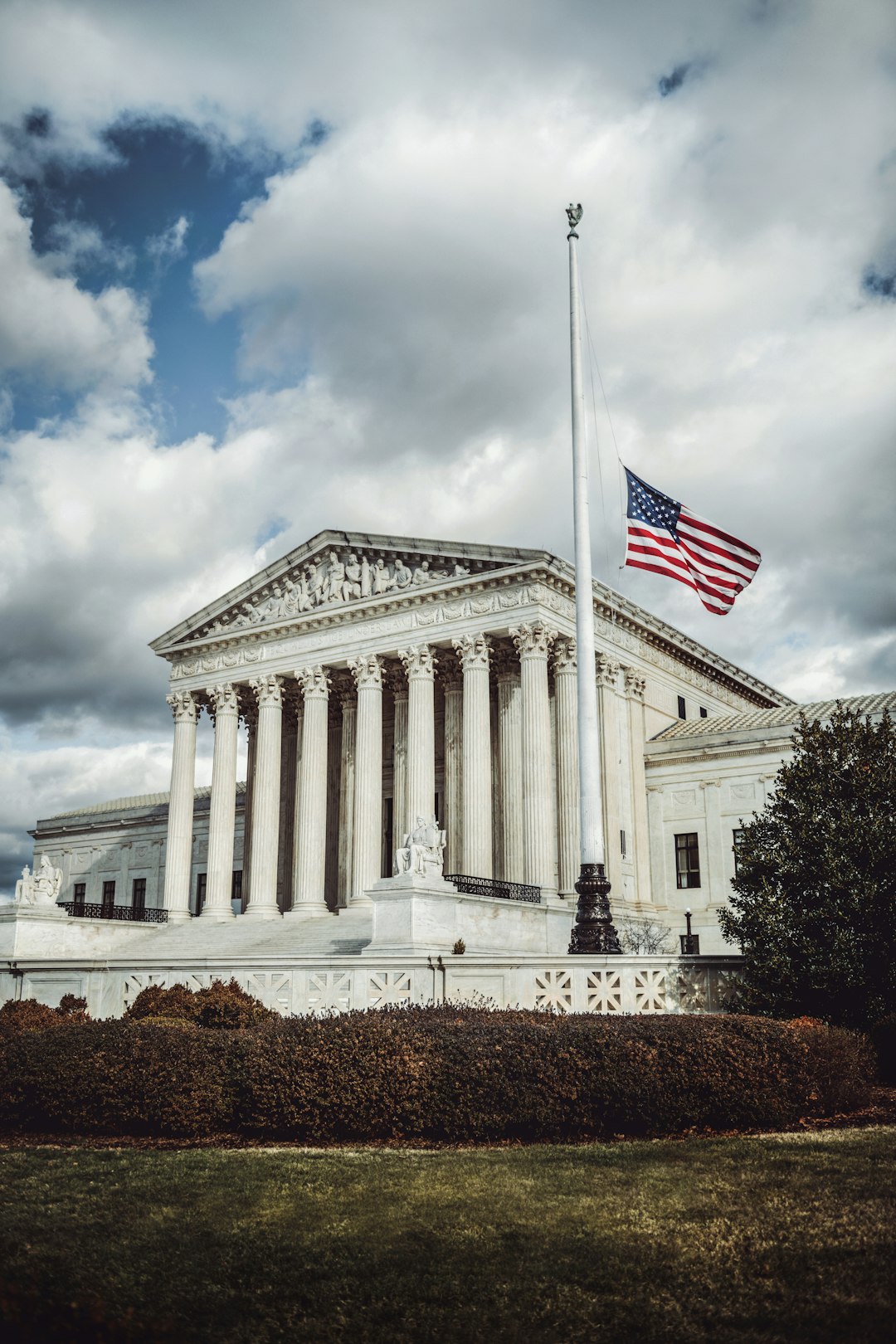
a large building with a flag on top of it

Our Supreme Court is dominated now by justices who claim to care about the plain reading of the Constitution, or the intent of the people who wrote its provisions. This should make this case particularly easy for them.

It is possible, of course, that these justices are simply politicians who espouse their textualism and originalism only when it suits them, in the service of supporting other politicians. Should this prove to be the case, their own office, and indeed the Constitution itself, would be in grave danger (a subject for another article).

We are about to find out.

The following story was published by The Denver Post:

A man shot through a window and broke into the Colorado Supreme Court building early Tuesday morning and caused “significant and extensive” damage in several areas of the building before surrendering to police, according to the Colorado State Patrol.

The man was involved in a crash about 1:15 a.m. near 13th Avenue and Lincoln Street a short time before he forced his way into the Ralph L. Carr Colorado Judicial Center, which houses the Colorado Supreme Court, the Colorado Court of Appeals and several other state agencies, according to a Colorado State Patrol news release.

This comes two weeks to the day after the state Supreme Court ruled Donald Trump cannot appear on the state’s primary ballot based on his actions surrounding the Jan. 6, 2021, U.S. Capitol breach and riot by his supporters, Jacob Factor reports.

Heather Cox Richardson sees something more ominous in Nikki Haley’s failure to mention slavery as “a cause” or “the cause” of the Civil War. She sees the death of what were once Republican Party ideals and the emergence of new style of authoritarianism, closely linked to parties that have effectively squelched the rights of their people.

She writes:

When asked at a town hall on Wednesday to identify the cause of the United States Civil War, presidential candidate and former governor of South Carolina Nikki Haley answered that the cause “was basically how government was going to run, the freedoms, and what people could and couldn’t do…. I think it always comes down to the role of government and what the rights of the people are…. And I will always stand by the fact that, I think, government was intended to secure the rights and freedoms of the people.”

Haley has correctly been lambasted for her rewriting of history. The vice president of the Confederacy, Alexander Stephens of Georgia, was quite clear about the cause of the Civil War. Stephens explicitly rejected the idea embraced by U.S. politicians from the revolutionary period onward that human enslavement was “wrong in principle, socially, morally, and politically.” Instead, he declared: “Our new government is founded upon…the great truth, that the negro is not equal to the white man; that slavery—subordination to the superior race—is his natural and normal condition.” 

President Joe Biden put the cause of the Civil War even more succinctly: “It was about slavery.” 

Haley has been backpedaling ever since—as well as suggesting that the question was somehow a “gotcha” question from a Democrat, as if it was a difficult question to answer—but her answer was not simply bad history or an unwillingness to offend potential voters, as some have suggested. It was the death knell of the Republican Party.

That party formed in the 1850s to stand against what was known as the Slave Power, a small group of elite enslavers who had come to dominate first the Democratic Party and then, through it, the presidency, Supreme Court, and Senate. When northern Democrats in the House of Representatives caved to pressure to allow enslavement into western lands from which it had been prohibited since 1820, northerners of all political stripes recognized that it was only a question of time until elite enslavers took over the West, joined with lawmakers from southern slave states, overwhelmed the northern free states in the House of Representatives, and made enslavement national. 

So in 1854, after Congress passed the Kansas-Nebraska Act that allowed the spread of enslavement into previously protected western lands, northerners abandoned their old parties and came together first as “anti-Nebraska” coalitions and then, by 1856, as the Republican Party. 

At first their only goal was to stop the Slave Power, but in 1859, Illinois lawyer Abraham Lincoln articulated an ideology for the new party. In contrast to southern Democrats, who insisted that a successful society required leaders to dominate workers and that the government must limit itself to defending those leaders because its only domestic role was the protection of property, Lincoln envisioned a new kind of government, based on a new economy.

Lincoln saw a society that moved forward thanks not to rich people, but to the innovation of men just starting out. Such men produced more than they and their families could consume, and their accumulated capital would employ shoemakers and storekeepers. Those businessmen, in turn, would support a few industrialists, who would begin the cycle again by hiring other men just starting out. Rather than remaining small and simply protecting property, Lincoln and his fellow Republicans argued, the government should clear the way for those at the bottom of the economy, making sure they had access to resources, education, and the internal improvements that would enable them to reach markets. 

When the leaders of the Confederacy seceded to start their own nation based in their own hierarchical society, the Republicans in charge of the United States government were free to put their theory into practice. For a nominal fee, they sold farmers land that the government in the past would have sold to speculators; created state colleges, railroads, national money, and income taxes; and promoted immigration. 

Finally, with the Civil War over and the Union restored on their terms, in 1865 they ended the institution of human enslavement except as punishment for crime (an important exception) and in 1868 they added the Fourteenth Amendment to the Constitution to make clear that the federal government had power to override state laws that enforced inequality among different Americans. In 1870 they created the Department of Justice to ensure that all American citizens enjoyed the equal protection of the laws.

In the years after the Civil War, the Republican vision of a harmony of economic interest among all Americans quickly swung toward the idea of protecting those at the top of society, with the argument that industrial leaders were the ones who created jobs for urban workers. Ever since, the party has alternated  between Lincoln’s theory that the government must work for those at the bottom and the theory of the so-called robber barons, who echoed the elite enslavers’ idea that the government must protect the wealthy. 

During the Progressive Era, Theodore Roosevelt reclaimed Lincoln’s philosophy and argued for a strong government to rein in the industrialists and financiers who dominated society; a half-century later, Dwight Eisenhower followed the lead of Democrat Franklin Delano Roosevelt and used the government to regulate business, provide a basic social safety net, promote infrastructure, and protect civil rights. 

After each progressive president, the party swung toward protecting property. In the modern era the swing begun under Richard Nixon gained momentum with the election of Ronald Reagan in 1980. Since then the party has focused on deregulation, tax cuts, privatization, and taking power away from the federal government and turning it back over to the states, while maintaining that market forces, rather than government policies, should drive society. 

But those ideas were not generally popular, so to win elections, the party welcomed white evangelical Christians into a coalition, promising them legislation that would restore traditional society, relegating women and people of color back to the subservience the law enforced before the 1950s. But it seems they never really intended for that party base to gain control.

The small-government idea was the party’s philosophy when Donald Trump came down the escalator in June 2015 to announce he was running for president, and his 2017 tax cuts for corporations and the wealthy indicated he would follow in that vein. But his presidency quickly turned the Republican base into a right-wing movement loyal to Trump himself, and he was both eager to get away from legal trouble and impeachments and determined to exact revenge on those who did not do his bidding. The power in the party shifted from those trying to protect wealthy Americans to Trump, who increasingly aligned with foreign autocrats.

That realignment has taken off since Trump left office in 2021 and his base wrested power from the party’s former leaders. Leaders in Trump’s right-wing movement have increasingly embraced the concept of “illiberal democracy” or “Christian democracy” as articulated by Russian autocrat Vladimir Putin or Hungary’s prime minister Viktor Orbán, who has demolished Hungary’s democracy and replaced it with a dictatorship. On the campaign trail lately, Trump has taken to echoing Putin and Orbán directly.

Those leaders insist that the equality at the heart of democracy destroys a nation by welcoming immigrants, which undermines national purity, and by treating women, minorities, and LGBTQ+ people as equal to white, heteronormative men. Their focus on what they call “traditional values” has won staunch supporters among the right-wing white evangelical community in the U.S.

Ironically, MAGA Republicans, whose name comes from Trump’s promise to “Make America Great Again,” want the United States of America, one of the world’s great superpowers, to sign onto the program of a landlocked country of fewer than 10 million people in central Europe.

MAGA’s determination to impose white Christian nationalism on the United States of America is a rejection of the ideology of the Republican Party in all its phases. Rather than either an active government that defends equal rights and opportunity or a small government that protects property and relies on market forces, which Republicans stood for as recently as eight years ago, today’s Republicans advocate a strong government that imposes religious rules on society. 

They back strict abortion bans, book bans, and attacks on minorities and LGBTQ+ people. Last year, Florida governor Ron DeSantis directly used the state government to threaten Disney into complying with his anti-LGBTQ+ stance rather than reacting to popular support for LGBTQ+ rights. Missouri attorney general Andrew Bailey early this month used the government to go after political opposition, launching an investigation into Media Matters for America after the watchdog organization reported that the social media platform X was placing advertising next to antisemitic content. “I’m fighting to ensure progressive tyrants masquerading as news outlets cannot manipulate the marketplace in order to wipe out free speech,” Bailey said. 

Domestically, the new ideology of MAGA means forcing the majority to live under the rules of a small minority; internationally, it means support for a global authoritarian movement. MAGA Republicans’ current refusal to fund Ukraine’s war against Russian aggression until the administration agrees to draconian immigration laws—which they are also refusing to participate in crafting—is not only a gift to Putin. It also suggests to any foreign government that U.S. foreign policy is changeable so long as a foreign government succeeds in influencing U.S. lawmakers. Under this system, American global leadership will no longer be viable.

When Nikki Haley said the cause of the Civil War “was how government was going to run, the freedoms, and what people could and couldn’t do,” she did more than avoid the word “slavery” to pander to MAGA Republicans who refuse to recognize the role of race in shaping our history. She rejected the long and once grand history of the Republican Party and announced its death to the world. 

Joshua Zeitz is a historian and contributor to Politico. He writes here about Nikki Haley’s failure to admit that slavery was a leading cause, maybe THE leading cause, of the Civil War.

Someone asked her the question at a New Hampshire town meeting. What caused the Civil War? She released a word salad about rights and freedoms but failed to memention the peculiar institution of slavery. The next day, she realized that her omission was a major gaffe, and she insisted that everyone knows that slavery was an important cause of the devastating war, implying that it was not worth mentioning what everyone knew.

Jacob Zeitz wrote an analysis of her omission. He believed she was echoing the “Lost Cause” nostalgia so beloved to sons and daughters of the Confederacy.

As a high school student in the 1950s in Houston, I recall that our American history textbook spouted “Lost Cause” propaganda. Slaves in the South were treated kindly, it said. Plantation owners never wanted to damage their expensive human property. The Civil War was about “states’ rights,” not slavery. Many years later, when visiting an ante-bellum mansion in Charleston, South Carolina, the docent said the slaves were content; she referred to the Civil Was as “the War of Northern Aggression.”

Nikki Haley echoed Lost Cause sentiment.

Zeitz wrote at Politico:

In William Faulkner’s novel, Sartoris, someone asks the title character, Colonel John Sartoris, why he had fought for the Confederacy so many decades before. “Damned if I ever did know,” replied the aging veteran, now a pillar of his community in fictional Yoknapatawpha County, Mississippi.

Of course, we know why Colonel Sartoris raised arms against the United States. So does anyone with a high school diploma — assuming they used up-to-date textbooks. And so did Alexander Stephens, the vice president of the Confederacy, who in 1861 famously asserted that the “cornerstone” of the new Southern nation rested “upon the great truth that the negro is not equal to the white man; that slavery, subordination to the superior race, is his natural and normal condition. This, our new government, is the first, in the history of the world, based upon this great physical, philosophical, and moral truth.”

All of which makes it disappointing, though not surprising, that at this late date — almost 160 years after the Civil War — Nikki Haley, a leading contender for the GOP presidential nomination, shares Colonel Sartoris’ selective amnesia on the topic. When asked a softball question this week about the causes of the Civil War, Haley, a former South Carolina governor, flubbed the answer, calling it a “difficult” question and mumbling on about “basically how government was going to run — the freedoms and what people could and couldn’t do.”

This morning, Haley qualified the comment on a radio show called “The Pulse of New Hampshire,” and followed the clean-up job with a press release, stating: “Of course the Civil War was about slavery. We know that. That’s unquestioned, always the case. We know the Civil War was about slavery. But it was also more than that. It was about the freedoms of every individual. It was about the role of government.”

But as Haley must know — after all, as governor of South Carolina, she presided over the removal of Confederate flags from the Statehouse — many Americans do question the fundamental fact that slavery precipitated the Civil War, and her equivocation played into a long-standing agenda to rewrite American history. Haley was effectively parroting the Lost Cause mythology, a revisionist school of thought born in the war’s immediate aftermath, which whitewashed the Confederacy’s cornerstone interest in raising arms to preserve slavery. Instead, a generation of Lost Cause mythologists chalked the war up to a battle over political abstractions like states’ rights.

With red states doing battle with American history, seeking to erase the legacy of violence and inequality that counterbalance the great good also inherent in our national story, it’s worth revisiting the rise of the Lost Cause, not just to remember how damaging it was, but to confront just how damaging it still is.


In the immediate aftermath of the war,the work of interpreting the rebellion fell to a small group of unreconstructed rebels. The pioneers of Confederate revisionism included wealthy and influential veterans of the Confederacy like Jubal Early, B. T. Johnson, Fitz Lee and W. P. Johnson, who helped formulate the Lost Cause myth that would take hold by the 1880s.

The narrative strains were simple. They painted a picture of Southern chivalry — mint juleps, magnolias and moonlight — that stood in sharp contrast with the North, a region marked by avarice, grinding capitalism and poverty. The rebellion, by this rendering, had been a legal response to the North’s assault on states’ rights — not a violent insurrection to preserve chattel slavery. Even Confederate veterans like Hunter McGuire knew that to admit the war had been about slavery would “hold us degraded rather than worthy of honor … our children, instead of revering their fathers will be secretly, if not openly, ashamed.”

The myth gained steam by the end of the century, largely because of the work of organizations like the United Confederate Veterans (UCV), the United Daughters of the Confederacy (UDC) and the Sons of Confederate Veterans (SCV), groups that offered a compelling story that people could wrap their minds around — including many Northerners, who were eager to put the war behind them. Because the Lost Cause emphasized heroism and honor over slavery, it venerated military figures like Robert E. Lee and swept politicians like Jefferson Davis under the rug. So it was that in May 1890 over 100,000 citizens gathered in Richmond for the dedication of a statue of Lee.

The decade saw hundreds of towns across the former Confederacy raise similar monuments to their heroes and war dead. These marble and steel memorials were often planted in town squares and by county courthouses to help sanitize not only Confederate memory but the new Jim Crow order. After all, if secession had been a noble thing, so was the separation of the races.

The signs of revisionism ranged from subtle to clear. During the war, for instance, Confederate soldiers had keenly embraced the term “reb,” but the new gatekeepers of Southern memory abandoned the term. “Was your father a Rebel and a Traitor?” asked a typical leaflet. “Did he fight in the service of the Confederacy for the purpose of defeating the Union, or was he a Patriot, fighting for the liberties granted him under the Constitution, in defense of his native land, and for a cause he knew to be right?” Equally important was figuring out what to even call the war. It couldn’t be the “Civil War,” which sounded too revolutionary. It couldn’t be “the War of Rebellion” which smacked of treason. In the late 1880s, the UCV and UDC approved resolutions designating the conflict that killed 750,000 Americans the “War Between the States.” The term stuck for generations to come.

It wasn’t just Southerners who suffered willful memory loss in these years. Jaded by the experience of Reconstruction and in the thrall of rising scientific racism, many Northerners were equally eager to remember the war as a brothers’ quarrel over politics rather than a struggle over slavery and Black rights. The jurist Oliver Wendell Holmes Jr., who began the war as a committed abolitionist, later erased the roots of the conflict and celebrated the battlefield valor of both Union and Confederate troops. “The faith is true and adorable which leads a soldier to throw away his life in obedience to a blindly accepted duty,” he said, “in a cause which he little understands, in a plan of campaign of which he has little notion, under tactics of which he does not see the use.”

Of course, historians agree that most Union troops did know why they were fighting. So did Holmes. But years after the fact, he was willing to forget. As were tens of thousands of veterans who attended Blue and Gray reunions well into the 20th century, including a massive camp gathering of 25,000 people who gathered at Crawfish Springs, Georgia, in 1889, near the Chickamauga Battlefield, for a picnic and public speeches. These mass spectacles helped Yankees and Confederates rewrite the history of the 1850s and 1860s, ostensibly in the service of national reunion and regeneration, but also in a way that fundamentally reinforced the emerging culture and politics of Jim Crow.


The Lost Cause mythology was more than bad history. It provided the intellectual justification for Jim Crow — not just in the former Confederacy, but everywhere systemic racism denied Black citizens equal citizenship and economic rights. Its dismantling began only in the 1960s when historians inspired by the modern Civil Rights Movement revisited the era of the Civil War and Reconstruction, adopting the views of earlier Black scholars like W.E.B. DuBois and John Hope Franklin, who always knew what the war was about and had shined a spotlight on the agency of Black and white actors alike.

That’s why the recent retreat to Lost Cause mythos is troubling. One would think that a Republican candidate for the presidency might be proud of the party’s roots as a firmly antislavery organization that dismantled the “Peculiar Institution” and fomented a critical constitutional revolution during Reconstruction — one that truly made the country more free.

With GOP presidential candidates waffling on the Civil War, rejecting history curricula in their states and launching political fusillades against “woke” culture, it remains for the rest of us to reaffirm the wisdom of Frederick Douglass, who in the last years of his life stated: “Death has no power to change moral qualities. What was bad before the war, and during the war, has not been made good since the war. … Whatever else I may forget, I shall never forget the difference between those who fought for liberty and those who fought for slavery.”

Alexander H. Stephens, Vice-president of the Confederacy, described the true purpose of the South’s secession: to preserve slavery. Read his famous Cornerstone speech here.

Here is the key section of his speech:

The new constitution has put at rest, forever, all the agitating questions relating to our peculiar institution African slavery as it exists amongst us the proper status of the negro in our form of civilization. This was the immediate cause of the late rupture and present revolution. Jefferson in his forecast, had anticipated this, as the “rock upon which the old Union would split.” He was right. What was conjecture with him, is now a realized fact. But whether he fully comprehended the great truth upon which that rock stood and stands, may be doubted. The prevailing ideas entertained by him and most of the leading statesmen at the time of the formation of the old constitution, were that the enslavement of the African was in violation of the laws of nature; that it was wrong in principle, socially, morally, and politically. It was an evil they knew not well how to deal with, but the general opinion of the men of that day was that, somehow or other in the order of Providence, the institution would be evanescent and pass away. This idea, though not incorporated in the constitution, was the prevailing idea at that time. The constitution, it is true, secured every essential guarantee to the institution while it should last, and hence no argument can be justly urged against the constitutional guarantees thus secured, because of the common sentiment of the day. Those ideas, however, were fundamentally wrong. They rested upon the assumption of the equality of races. This was an error. It was a sandy foundation, and the government built upon it fell when the “storm came and the wind blew.”

Our new government is founded upon exactly the opposite idea; its foundations are laid, its corner-stone rests, upon the great truth that the negro is not equal to the white man; that slavery subordination to the superior race is his natural and normal condition. This, our new government, is the first, in the history of the world, based upon this great physical, philosophical, and moral truth. This truth has been slow in the process of its development, like all other truths in the various departments of science. It has been so even amongst us. Many who hear me, perhaps, can recollect well, that this truth was not generally admitted, even within their day. The errors of the past generation still clung to many as late as twenty years ago. Those at the North, who still cling to these errors, with a zeal above knowledge, we justly denominate fanatics. All fanaticism springs from an aberration of the mind from a defect in reasoning. It is a species of insanity. One of the most striking characteristics of insanity, in many instances, is forming correct conclusions from fancied or erroneous premises; so with the anti-slavery fanatics. Their conclusions are right if their premises were. They assume that the negro is equal, and hence conclude that he is entitled to equal privileges and rights with the white man. If their premises were correct, their conclusions would be logical and just but their premise being wrong, their whole argument fails.