The State Election Board in Georgia, controlled 3-2 by Trump partisans, recently adopted a requirement that local officials to perform a hand-count of ballots cast on November 5. This, of course, would cause lengthy delays in reaching a result.
Robert C. McBurney is a judge of the Georgia 5th Superior Court District Atlanta Circuit. He was first appointed by Republican Governor Nathan Deal and was subsequently elected. Just days ago, he overturned Georgia’s abortion ban.
A county judge in Georgia on Tuesday blocked a new rule mandating a hand count of election ballots across the state. Enacting such a sweeping change for the November election, he said, was “too much, too late.”
Judge Robert C.I. McBurney did not, however, knock down the rule outright; his decision was confined to the current election, halting the rule from taking effect for 2024 while he further weighs its merits.
The rule, passed last month by the State Election Board, would have required poll workers across Georgia to break open sealed containers of ballots and count them by hand to ensure that the total number of ballots matched the total counted by tabulating machines. (It would not have required officials to tally for whom the ballots were cast.)
But Judge McBurney agreed with challenges from several county election boards that the rule was made too close to the election.
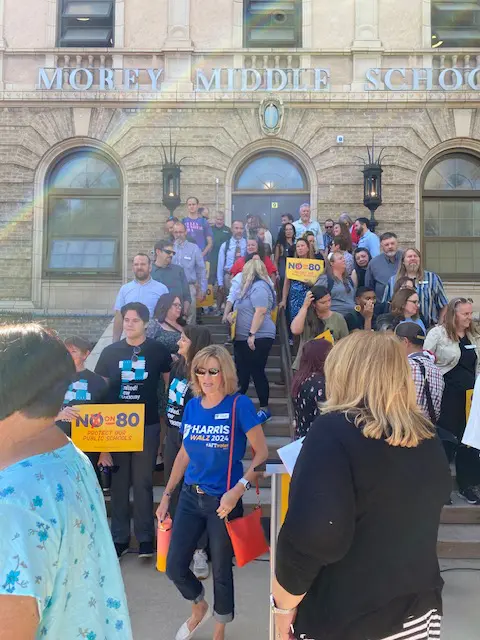
Colorado voters, beware! On the November 5 ballot: an amendment to the State Constitution to protect school choice.
If you want to support public schools and a raid on the state’s treasury by privatizers, defeat it!
This proposed amendment is weird. Ever since the founding of this nation, states have had explicit pledges in their constitution to protect public schools, open to all. Colorado’s state Constitution includes such language as well as language explicitly rejecting public funding for religious schools.
Article 9, Section 2 of the Constitution says:
Section 2. Establishment and maintenance of public schools. The general assembly shall, as soon as practicable, provide for the establishment and maintenance of a thorough and uniform system of free public schools throughout the state, wherein all residents of the state, between the ages of six and twenty-one years, may be educated gratuitously.
Article 8, Section 7 of the Constitution says:
Section 7. Aid to private schools, churches, sectarian purpose, forbidden. Neither the general assembly, nor any county, city, town, township, school district or other public corporation, shall ever make any appropriation, or pay from any public fund or moneys whatever, anything in aid of any church or sectarian society, or for any sectarian purpose, or to help support or sustain any school, academy, seminary, college, university or other literary or scientific institution, controlled by any church or sectarian denomination whatsoever; nor shall any grant or donation of land, money or other personal property, ever be made by the state, or any such public corporation to any church, or for any sectarian purpose.
Now, the privatizers want to cancel that language and replace it with language chartering what was previously forbidden.
On November 5, 2024, Colorado voters will weigh in on a hot topic in education today: school choice. Amendment 80 would make the concept of “school choice” a guaranteed right in the Colorado constitution. The text of the amendment reads as follows:
(1) PURPOSE AND FINDINGS. THE PEOPLE OF THE STATE OF COLORADO HEREBY FIND AND DECLARE THAT ALL CHILDREN HAVE THE RIGHT TO EQUAL OPPORTUNITY TO ACCESS A QUALITY EDUCATION; THAT PARENTS HAVE THE RIGHT TO DIRECT THE EDUCATION OF THEIR CHILDREN; AND THAT SCHOOL CHOICE INCLUDES NEIGHBORHOOD, CHARTER, PRIVATE, AND HOME SCHOOLS, OPEN ENROLLMENT OPTIONS, AND FUTURE INNOVATIONS IN EDUCATION. (2) EACH K-12 CHILD HAS THE RIGHT TO SCHOOL CHOICE.
According to University of Southern California Professor Guilbert Hentschke, “school choice has become a catch-all label describing many different programs that offer students and their families alternatives to publicly provided schools.” Since school choice covers many options, it can be confusing, and it is often the “subject of fierce debate in various state legislatures across the United States.” The critical distinction to make regarding school choice is often whether it affects public or private schools.
School choice has been the mantra for voucher-systems currently enacted in at least twenty states. School choice with voucher-type legislation entails using taxpayer dollars for education savings accounts, opportunity scholarships, tax credits, or actual vouchers so families can choose any type of schooling for their child — private, public or home schooling. This idea represents an emphasis on “funding students instead of funding school systems.”
The focus on school choice has resulted in increased enrollment in charter schools, private schools, and home schooling. At the same time, the school choice movement has also created instability, competition, ideological curricula, resource inequities, increased segregation, loss of community, and reduced funding for public neighborhood schools. In Colorado, of all eligible school-age children, about 76% attend public schools, 15% attend charter schools, 8 percent are in private schools, and 1% are homeschooled.
Advance Colorado is the conservative think tank organization that developed the language for Amendment 80, and they coordinated the expensive signature gathering to secure approval for the measure, originally titled Initiative 138. The backers acknowledge that parents already have the right in state statute to “send their kids to a neighborhood school, charter school, private school, home school, or across district lines.”
Advance Colorado’s solution to the “problem” of legislators promoting charter accountability is to put “the right to school choice in the Colorado Constitution” which they assert will give school choice “legal advantages a normal statute does not have.” Over fifty highly paid lobbyists were assigned to kill the charter accountability bill which was publicly opposed by Governor Polis, and was defeated in the House committee.
Even though Advance Colorado states its goal is to protect the charter schools from future legislative interference, Amendment 80 encompasses “private and home schooling” options. Including “private schools as a guaranteed right” is a plan promulgated by Americans for Prosperity and other conservative think tanks in several red states where voucher bills have been passed or expanded. Fields said he thinks “parents should be in charge of education,” adding “I think it’s easier when they have resources to send their kid to the school that they want to.”
Colorado State board of education members Lisa Escárcega and Kathy Plomer wrote in a September 11 op-ed that Amendment 80 is “not just about school choice.” They cautioned that “Amendment 80, brought by wealthy, in and out-of-state organizations, is part of a nationally coordinated master plan to go around voters in states where voucher proponents have been unsuccessful in passing state voucher laws.” They pointed out that in Colorado, “voters turned down three education voucher ballot initiatives in the 1990s.Voucher and private school proponents then tried the legislative route. The Colorado legislature has turned down any type of voucher or education savings account 18 times just since 2016.” While the amendment doesn’t mention vouchers, the state board members expressed their concern that “If parents have a right to send their children to private schools, then shouldn’t the state pay for it?”
Using public taxpayer dollars for children to attend private schools or for home schooling is not legal in Colorado, nor is it currently popular. (They can get some indirect support.) Kevin Welner of the National Education Policy Center stated that “it would be hard to persuade voters or politicians that Colorado should join the ranks of states that provide taxpayer subsidies for private schools or homeschooling.”
Even though Fields insists this amendment “is not paving the way for a voucher program in Colorado,” the far-right conservative groups providing the money to promote Amendment 80 have tried to enact vouchers in Colorado for years.
Vouchers are not necessarily an effective system to improve student learning and according to recent research, they can hinder state budgets significantly. Josh Cowen, senior fellow at the Education Law Center, pointed to decades of evidence showing private school vouchers have led to some of the steepest declines in student achievement on record. He added that measures similar to Amendment 80 passed in Arizona, Florida and Ohio have led to serious budget cuts.
Who is funding this effort to enshrine “school choice” in the state constitution?
In an op-ed about Advance Colorado last year, Colorado Newsline editor Quentin Young wrote that “Coloradans don’t know who’s supplying its money or their true motivations, because nonprofits don’t have to disclose their donors.” Advance Colorado is the same “dark money group” that gathered signatures for Initiative 108, which would have forced over $3 billion in cuts to services to citizens.
Advance Colorado started as “Unite for Colorado” in 2019, which bankrolled almost every major Republican effort in Colorado in 2020. Unite for Colorado spent over $17 million in 2020 on Republican candidates, and they have “become the most important fundraising entity for conservatives and for Republicans,” said Dick Wadhams, a former chairman of the Colorado GOP. Unite for Colorado changed its name to Advance Colorado Action in 2021 due to questionable conflicts over its spending practices, which are still in litigation.
As a “dark money group,” Advance Colorado receives grants from many sources, most of which are unknown, yet there is evidence that connects Advance Colorado to several conservative organizations. There are also reports that tie the group to Phillip Anschutz, Colorado’s richest billionaire. According to Cause IQ, between 2020-2023, over $28 million was funneled to Unite Colorado/Advance Colorado from the Colorado Stronger Alliance.
Colorado Dawn was formed in 2021 to “support organizations who further the efforts to educate the public about western values and economics,” and it has received over $3 million from Unite Colorado (Advance Colorado). Tax records from the Colorado Dawn’s 2022 990’s list state Board of Education member Steve Durham as chairman, Senator Paul Lundeen as Vice-chairman, and Michael Fields as Treasurer. Lundeen announced in 2022 his hopes that Colorado would enact a voucher program after the Supreme Court “cleared the way for public dollars in a Maine tuition assistance program to flow to private religious schools.” The Colorado Secretary of State’s office indicates that Colorado Dawn spent over $1.3 million to collect signatures for Amendment 80.
On Sept 13, 2024, the CEA announced its opposition to Amendment 80 at a press conference in Denver. A coalition of various representatives from across the state, the National Education Association, and the ACLU described their main reasons for opposing Amendment 80.
The speakers at the press conference emphasized that the amendment is unnecessary because school choice is already protected in law and has been for 30 years. In addition, they stated that the amendment opens the door to taking money from public schools to fund private schools. Speakers stressed that funding private schools would drain money away from rural public schools, private schools pose significant civil rights concerns, and they don’t belong in the Constitution.
In interviews with Chalkbeat, several education experts weighed in on the wording in Amendment 80, indicating it could create years of “litigation” order to interpret the amendment’s misleading language, which Kristi Burton Brown also acknowledged in her interview with KOA radio.
Currently, the following groups are opposing the measure: ACLU of Colorado, AFT Colorado, Colorado Fiscal Institute, CEA, The Colorado Association of School Executives (CASE), AFSCME, Advocates for Public Education Policy, Business and Professional Women of Colorado, Colorado Immigrant Rights Coalition, League of Women Voters Colorado, Soul 2 Soul Sisters, Bell Policy Center, Colorado PTA, One Colorado, United for a New Economy, Colorado Democratic Party, American Association of University Women, Colorado WINS, Colorado AFL-CIO, Stand for Children, and New Era Colorado Action Fund.
Colorado voters will need to decide which rationale they support regarding this school choice amendment. Will they agree with Advance Colorado that a constitutional amendment is necessary to ensure that the legislature will not update current charter school laws? Or will they believe that Colorado does not need to go the route of other states and create a pathway to use public funding for private and home schools?
************************************
Mike DeGuire, Ph.D., has been a teacher, district level reading coordinator, and a principal in the Denver metro area for most of his education career.
As a historian of forced population movements and as an American, I don’t think we are taking the consequences of the Trump-Vance deportation plan seriously enough. The reality will be much more personal and awful, and the politics more transformative and durable, than we might think.
I will write this up soon; but I was moved to do a recording by the urgency of this, and by the desire to catch the end of Hispanic Heritage Month.
Please listen and please share.
You might find it useful to read my thoughts about the thousands or tens of thousands of detention camps that would be needed in every state.
No matter what the problem, the cause is always IMMIGRANTS, in the minds of Trump and Vance. The answer to the problem, to them, is always the same: Round up and expel the immigrants!
Greg Olear wonders about their fixation and concludes that it’s fascistic. Are housing prices going up because of immigrants? How many do they want to deport? 25 million? 13 million? 11 million? What about Trump’s idea of building new cities on empty federal lands? Where are those federal lands?
“O, what a happy, contented land this would be if only we could expel the immigrants!” They say. once they are gone, middle-class Americans could occupy the immigrants’ palatial estates. Housing crisis solved.
At the VP debate…, Margaret Brennan addressed “the top contributor to inflation, the high cost of housing and rent,” asking the candidates, Tim Walz and JD Vance, what they’d do about the “shortage of more than 4 million homes in the United States… [that] contributes to the high housing crisis.”
It’s not all bad news. The homeownership rate is not, as I feared watching the debate, in freefall. On the contrary, it’s in the same two-thirds-give-or-take range it’s occupied for my entire lifetime, as this Federal Reserve chart shows:
The decennial census of 1890 was the first to ask basic housing questions and, in particular, whether one owned or rented. The census data since 1890 show three distinct eras of homeownership in America.
In the 1890-1940 period, the homeownership rate fluctuated in the 43- to 48-percent range. From 1890 to 1920, the homeownership rate fell as immigration and urbanization offset the rise in income. Income growth increased the homeownership rate during the 1920s, but the Depression more than wiped out this gain so that the rate had fallen to a low of 43.6 percent by 1940.
During the 1940-1960 period, the homeownership rate rose by over 18 percentage points, from 43.6 to 61.9 percent. This remarkable transformation was facilitated by higher incomes, a large percentage of households being in prime homebuying age groups, the FHA-led revolution in mortgage financing, the GI bill of rights, improved interurban transportation, and development of large-scale housing subdivisions with affordable houses.
For the middle class, homeownership is a critical metric. We don’t want too many Americans living in rentals owned by private equity firms, and at the mercy of rapacious Wall Street speculators.
But that’s only part of the picture. There is a shortage of housing—and the gap is a lot more than the number Brennan suggested. According to a study by the National Low Income Housing Coalition, the U.S. real estate market is plagued by
a shortage of 7.3 million rental homes affordable and available to renters with extremely low incomes—that is, incomes at or below either the federal poverty guideline or 30% of their area median income, whichever is greater. Only 34 affordable and available rental homes exist for every 100 extremely low-income renter households. Extremely low-income renters face a shortage in every state and major metropolitan area. Among states, the supply of affordable and available rental homes ranges from 14 affordable and available homes for every 100 extremely low-income renter households in Nevada to 57 in South Dakota. In 12 of the 50 largest metropolitan areas in the country, the absolute shortage of affordable and available homes for extremely low-income renters exceeds 100,000 units.
Households throughout the country, particularly those with the lowest incomes, are struggling with the high cost of housing because of decades of underbuilding, high construction costs, and the resulting shortage of homes for sale and for rent, all combined with inadequately funded housing assistance.
So, yes, this is a big problem.
In the debate, Tim Walz proposed rolling out a down-payment assistance plan similar in concept to the GI Bill that helped increase the homeownership rate after the Second World War, as well as incentivizing new construction—boilerplate New Deal-style solutions that will almost certainly work, if Congress could be swayed to vote for them.
But it was JD Vance’s answer to Brennan’s question that gave me pause. The Ohio Senator and eyeliner enthusiast expounded on Donald Trump’s concepts of a plan to tackle the national housing crisis. There were two proposals, if we can call them that, the Republican VP nominee advanced, both of them bone-chilling.
Let’s look at them more closely:
1. Mass deportation of tens of millions of “illegal aliens” to create more housing inventory
“We don’t want to blame immigrants for higher housing prices,” Vance said. “But we do want to blame Kamala Harris for letting in millions of illegal aliens into this country, which does drive up costs, Tim. Twenty-five million illegal aliens competing with Americans for scarce homes is one of the most significant drivers of home prices in the country. It’s why we have massive increases in home prices that have happened right alongside massive increases in illegal alien, alien populations under Kamala Harris’s leadership.”
First—and I only say this because a lot of people who watched the debate are probably unaware of how the federal government works: as Vice President, Kamala Harris has zero authority to do fuck-all. She can break a tie in the Senate, and she can succeed the President Biden if he croaks. That is the comprehensive and unabridged list of her constitutional powers. Can she suggest? Sure. Can she propose? Absolutely. But POTUS is under no obligation to listen to her at all, let alone act on what she says. One can mount an argument that Biden is responsible for the housing crisis, but the idea that Harris is to blame is objectively untrue. So, yeah, Vance lied.
Second: it is troubling to me that the alleged number of “illegal aliens” in the United States seems to rise every time Trump opens his mouth. It was 15 million, then 18 million, then 22. Now it’s 25 million, Vance says. Bear in mind that the total U.S. population is something like 333,000,000. Thus, Couchfucker claims that 7.5 percent of the residents of this country—about one in 13—is here illegally, which is preposterous. The actual number, according to Pew Research, is closer to 11 million:
Are Trump/Vance and their surrogates exaggerating the undocumented population to play up the MAGA fear of a border invasion? Or—and this is the scary part—is that how many U.S. residents they intend to round up and deport? Because, like, 25 million is more people than just those here illegally. A lot more. Over twice as many.
But you gotta give the MAGA braintrust credit. Displacing one thirteenth of the entire U.S. population would indeed make available a lot of housing. The Trump/Vance plan would absolutely work. We know it would work, because that’s literally what the Nazis did in Poland in 1939.
In her incredible and horrifying book The Rape of Europa: The Fate of Europe’s Treasures in the Third Reich and the Second World War, Lynn H. Nicholas explains Hitler’s attitude toward the Poles:
In an extraordinary speech to his highest commanders, delivered on August 22 [1939] just after he had agreed to sign the Russian treaty, Hitler had urged his forces to “act brutally…be harsh and remorseless,” and had encouraged them to “kill without pity or mercy all men, women and children of Polish descent or language” in the coming “invasion and extermination of Poland.”
For Poland was to become Germany’s creature totally. Its culture and peoples were to be eliminated and replaced by Hitler’s “New Order.” The Nazis were only too eager to put their racial theories into actual practice in a place where resistance could be countered with total brutality. They believed without any qualms that Slavs, Christian or otherwise, were so inferior they could not be considered human. They, along with the Jews, were the “degenerate art” of the human race.
The Nazis rounded up anyone they considered undesirable and sent them to the concentration camps, and then they took their suddenly vacant homes—and everything in those homes—for themselves. Housing crisis solved!
I trust that by this point, we’ve all heard enough of Trump’s dehumanizing invective about immigrants—a hateful and fascistic theme of his campaigning since he came down the escalator in 2015—to make pointing out its similarly to stuff Hitler said about the Jews unnecessary. In spirit, Donald is a Nazi.
After the debate, CBS showed a graphic comparing the two housing proposals. Walz: “$25,000 Down Payment Assistance; Tax Incentives for Builders.” Vance: “Changing Regulations & Making Federal Land Available; Mass Deportation to Ease Demand.”
This led the attorney who goes by NYC Southpaw to remark on BlueSky: “This is one that I genuinely think will be printed in history books one day to show how insane American media culture has become. CBS News presenting ethnic cleansing as a housing policy to be compared with home construction tax incentives.”
And if Donald’s housing policy being eerily reminiscent of the Third Reich’s weren’t bad enough, when we consider that Hitler modeled the Nazi conquest of Poland on what the United States did to the Native Americans in the 19th century, that makes the second part of the MAGA plan seem even more ominous:
2. Building new cities on federal land.
“Well,” Vance said, “what Donald Trump has said is we have a lot of federal lands that aren’t being used for anything. They’re not being used for national parks. They’re not being used. And they could be places where we build a lot of housing. And I do think that we should be opening up building in this country. We have a lot of land that could be used. We have a lot of Americans that need homes. We should be kicking out illegal immigrants who are competing for those homes, and we should be building more homes for the American citizens who deserve to be here.”
A former celebrity real estate developer and TV personality, Trump has a long history of outlining audacious new initiatives that are heavy on imagery and light on details. The latest offerings come with a few explanations for how they will be executed.
Trump says he would host a contest for the public to design and then build “Freedom Cities” on a small portion of federal land to “reopen the frontier, reignite American imagination, and give hundreds of thousands of young people and other people, all hardworking families, a new shot at home ownership and in fact, the American Dream.”
(A contest? Everything is a reality show with this ass-clown.)
calls for the creation of new tech-controlled sovereign cities that would essentially act as miniature countries. These independent territories can be created in one of two ways.
The first is called Voice. This route entails using the political system to take over existing city governments through elections. Y Combinator CEO Garry Tan is currently trying the “voice” method in San Francisco, where he is spearheading a tech-funded campaign to capture control of City Hall. (How do I know this is a Network State project? Because Tan has described his project as such.)
The second method is called Exit. The “exit” method involves finding a bare piece of land that can be built up into a new tech city, ideally with tax breaks or other exemptions from “host governments.”
Próspera, on the island of Roatan in Honduras, is an example of this: a tech-run Special Economic Zone where certain rules don’t apply. Próspera has become a mecca for unregulated gene therapy experiments.
And then there’s our local version: California Forever. This proposed tech city in Solano County was supposed to go to voters for approval on November’s ballot, but it has been delayed due to massive community opposition. California Forever denies being a Network State project, but [libertarian tech bro Marc] Andreessen is one of its investors.
In addition, Balaji Srinivasan—the main evangelist of the Network State idea—has strongly suggested that California Forever is a Network State project. (Note: Srinivasan has clearly derived his ideas from J.D. Vance associate Curtis Yarvin, who calls these tech-governed dictatorships “patchworks” or “realms” rather than network states.)
This is an important detail because Andreessen, Srinivasan and Thiel are working closely together to make the Network State a reality.
Peter Thiel, of course, is the very same Sauron-like billionaire who funded JD Vance’s Senate campaign, and before that, his venture capital enterprise. We can safely assume that Vance is nothing more than his whoremaster’s mouthpiece.
To me, this “freedom city” proposal looks less like a solution to the dearth of low-income housing and more like the 21st century version of a medieval stronghold, where well-to-do residents can simply wall off the starving, unhoused hoi polloi: out of sight, out of mind.
Furthermore, the creation of new “network states” run by MAGA puppets would inevitably lead to the creation of new actual states—further gerrymandering the Senate to establish a more permanent minoritarian rule.
Then there’s this vague “federal land” suggestion. Here is a map of all extant federal land:
Most is in Alaska, or in the Western states. The sections in brown are managed by the Bureau of Indian Affairs. Is “federal land” a euphemism for “American Indian reservations?” Donald Trump, remember, hung in the Oval Office a portrait of Andrew Jackson—maniacal conqueror of Native lands, driving force behind the Indian Removal Act of 1830, author of the Trail of Tears, and arguably the most anti-Native American president in U.S. history. Is confiscating more Native American territory how Donald Sr. plans to Make America Great Again?
These MAGA proposals are not just bad policy. They are dangerous, they are Hitlerian, and if implemented, they are sure to bring woe upon tens of millions of human beings.
“That’s never going to happen,” the non-MAGA Trump voters insist. To which I reply: That’s what the Germans said in the 1930s. The only difference is that the Germans in the 1930s didn’t have the Germans in the 1930s as a precedent to learn from.
Heather Cox Richardson pulls together the signs of Trump’s descent into unapologetic fascism. He offers no agenda or policies for the future, but focuses instead of who he will punish. Immigrants, he insists, are the biggest problem facing the nation. He promises to restore the U.S. to its imagined glory of white male Christian supremacy. If elected, he will call out the National Guard or the military to round up not only immigrants but his political enemies. He is a dangerous man. He is increasingly paranoid, determined to punish his enemies. Will he imprison Harris, Biden, Clinton, Obama, Newsom, and others who have opposed him?
She writes:
“He is the most dangerous person ever. I had suspicions when I talked to you about his mental decline and so forth, but now I realize he’s a total fascist. He is now the most dangerous person to this country…a fascist to the core.”
This is how former chairman of the Joint Chiefs of Staff Mark Milley, the nation’s highest-ranking military officer and the primary military advisor to the president, the secretary of defense, and the National Security Council, described former president Donald Trump to veteran journalist Bob Woodward. Trump appointed Milley to that position.
Since he announced his presidential candidacy in June 2015 by calling Mexican immigrants rapists and criminals, Trump has trafficked in racist anti-immigrant stories. But since the September 10 presidential debate when he drew ridicule for his outburst regurgitating the lie that legal Haitian migrants in Springfield, Ohio, were eating their white neighbors’ pets, Trump has used increasingly fascist rhetoric. By this weekend, he had fully embraced the idea that the United States is being overrun by Black and Brown criminals and that they, along with their Democratic accomplices, must be rounded up, deported, or executed, with the help of the military.
Myah Ward of Politico noted on October 12 that Trump’s speeches have escalated to the point that he now promises that he alone can save the country from those people he calls “animals,” “stone cold killers,” the “worst people,” and the “enemy from within.” He falsely claims Vice President Kamala Harris “has imported an army of illegal alien gang members and migrant criminals from the dungeons of the third world…from prisons and jails and insane asylums and mental institutions, and she has had them resettled beautifully into your community to prey upon innocent American citizens.”
Trump’s behavior is Authoritarianism 101. In a 1951 book called The True Believer, political philosopher Eric Hoffer noted that demagogues appeal to a disaffected population whose members feel they have lost the power they previously held, that they have been displaced either religiously, economically, culturally, or politically. Such people are willing to follow a leader who promises to return them to their former positions of prominence and thus to make the nation great again.
But to cement their loyalty, the leader has to give them someone to hate. Who that is doesn’t really matter: the group simply has to be blamed for all the troubles the leader’s supporters are suffering. Trump has kept his base firmly behind him by demonizing immigrants, the media, and, increasingly, Democrats, deflecting his own shortcomings by blaming these groups for undermining him.
According to Hoffer, there’s a psychological trick to the way this rhetoric works that makes loyalty to such a leader get stronger as that leader’s behavior deteriorates. People who sign on to the idea that they are standing with their leader against an enemy begin to attack their opponents, and in order to justify their attacks, they have to convince themselves that that enemy is not good-intentioned, as they are, but evil. And the worse they behave, the more they have to believe their enemies deserve to be treated badly.
According to Hoffer, so long as they are unified against an enemy, true believers will support their leader no matter how outrageous his behavior gets. Indeed, their loyalty will only grow stronger as his behavior becomes more and more extreme. Turning against him would force them to own their own part in his attacks on those former enemies they would now have to recognize as ordinary human beings like themselves.
At a MAGA rally in Aurora, Colorado, on October 11, Trump added to this formula his determination to use the federal government to attack those he calls enemies. Standing on a stage with a backdrop that read, “DEPORT ILLEGALS NOW” and “END MIGRANT CRIME,” he insisted that the city had been taken over by Venezuelan gangs and proposed a federal program he called “Operation Aurora” to remove those immigrants he insists are members of “savage gangs.” When Trump said, “We have to live with these animals, but we won’t live with them for long,” a person in the crowd shouted: “Kill them!”
Officials in Aurora emphatically deny Trump’s claim that the city is a “war zone.” Republican mayor Mike Coffman said that Aurora is “not a city overrun by Venezuelan gangs” and that such statements are “grossly exaggerated.” While there have been incidents, they “were limited to several apartment complexes in this city of more than 400,000 residents.” The chief of the Aurora police agreed that the city is “not by any means overtaken by Venezuelan gangs.”
In Aurora, Trump also promised to “invoke the Alien Enemies Act of 1798.” As legal analyst Asha Rangappa explains, the Alien Enemies Act authorizes the government to round up, detain, and deport foreign nationals of a country with which the U.S. is at war. But it is virtually certain Trump didn’t come up with the idea to use that law on his own, raising the question of who really will be in charge of policy in a second Trump administration.
Trump aide Stephen Miller seems the likely candidate to run immigration policy. He has promised to begin a project of “denaturalization,” that is, stripping naturalized citizens of their citizenship. He, too, spoke at Aurora, leading the audience in booing photos that were allegedly of migrant criminals.
Before Miller spoke, a host from Right Side Broadcasting used the dehumanizing language associated with genocide, saying of migrants: “These people, they are so evil. They are not your run-of-the-mill criminal. They are people that are Satanic. They are involved in human sacrifice. They are raping men, women, and children—especially underaged children.” Trump added the old trope of a population carrying disease, saying that immigrants are “very very very sick with highly contagious disease, and they’re let into our country to infect our country.”
Trump promised the audience in Aurora that he would “liberate Colorado. I will give you back your freedom and your life.”
On Saturday, October 12, Trump held a rally in Coachella, California, where temperatures near 100 degrees Fahrenheit (38 degrees Celsius) sparked heat-related illnesses in his audience as he spoke for about 80 minutes in the apocalyptic vein he has adopted lately. After the rally, shuttle buses failed to arrive to take attendees back to their cars, leaving them stranded.
And on Sunday, October 13, Trump made the full leap to authoritarianism, calling for using the federal government not only against immigrants, but also against his political opponents. After weeks of complaining about the “enemy within,” Trump suggested that those who oppose him in the 2024 election are the nation’s most serious problem.
He told Fox News Channel host Maria Bartiromo that even more troubling for the forthcoming election than immigrants “is the enemy from within…we have some very bad people, we have some sick people, radical left lunatics…. And it should be easily handled by, if necessary, by National Guard, or if really necessary, by the military.”
Trump’s campaign seems to be deliberately pushing the comparisons to historic American fascism by announcing that Trump will hold a rally at New York City’s Madison Square Garden on October 27, an echo of a February 1939 rally held there by American Nazis in honor of President George Washington’s birthday. More than 20,000 people showed up for the “true Americanism” event, held on a stage that featured a huge portrait of Washington in his Continental Army uniform flanked by swastikas.
Trump’s full-throated embrace of Nazi “race science” and fascism is deadly dangerous, but there is something notable about Trump’s recent rallies that undermines his claims that he is winning the 2024 election. Trump is not holding these rallies in the swing states he needs to win but rather is holding them in states—Colorado, California, New York—that he is almost certain to lose by a lot.
Longtime Republican operative Matthew Bartlett told Matt Dixon and Allan Smith of NBC News: “This does not seem like a campaign putting their candidate in critical vote-rich or swing vote locations—it seems more like a candidate who wants his campaign to put on rallies for optics and vibes.”
Trump seems eager to demonstrate that he is a strongman, a dominant candidate, when in fact he has refused another debate with Democratic presidential candidate Kamala Harris and backed out of an interview with 60 Minutes. He has refused to release a medical report although his mental acuity is a topic of concern as he rambles through speeches and seems entirely untethered from reality. And as Harris turns out larger numbers for her rallies in swing states than he does, he appears to be turning bloodthirsty in Democratic areas.
Today, Harris told a rally of her own in North Carolina: “[Trump] is not being transparent…. He refuses to release his medical records. I’ve done it. Every other presidential candidate in the modern era has done it. He is unwilling to do a 60 Minutes interview like every other major party candidate has done for more than half a century. He is unwilling to meet for a second debate…. It makes you wonder, why does his staff want him to hide away?… Are they afraid that people will see that he is too weak and unstable to lead America? Is that what’s going on?”
“For these reasons and so many more,” she said, “it is time to turn the page.”
But we have a candidate for President who constantly encourages violence against enemies and disparages the federal government that he wants to lead.
And we have a political party that wants no restrictions on guns. And here we are.
LAKE LURE, N.C. — Federal emergency response personnel on Saturday had employees operating in hard-hit Rutherford County, N.C., stop working and move to a different area because of concerns over “armed militia” threatening government workers in the region, according to an email sent to federal agencies helping with response in the state.
Around 1 p.m. Saturday, an official with the U.S. Forest Service, which is supporting recovery efforts after Hurricane Helene along with the Federal Emergency Management Agency, sent an urgent message to numerous federal agencies warning that “FEMA has advised all federal responders Rutherford County, NC, to stand down and evacuate the county immediately. The message stated that National Guard troops ‘had come across x2 trucks of armed militia saying there were out hunting FEMA.’”
“The IMTs [incident management teams] have been notified and are coordinating the evacuation of all assigned personnel in that county,” the email added.
Two federal officials confirmed the authenticity of the email, though it was unclear whether the quoted threat was seen as credible. The National Guard referred questions to FEMA when asked about the incident. One Forest Service official coordinating the Helene recovery said responders moved to a “safe area” and at least some work in that area — which included clearing trees off dozens of damaged and blocked roads to help search-and-rescue crews, as well as groups delivering supplies — was paused.
By Sunday afternoon, personnel were back in place, said the official, who spoke on the condition of anonymity.
The setback is one of the latest examples of growing concerns about safety and security in western North Carolina, where many towns were almost wiped off the map after the historic hurricane made landfall two weeks ago. In the weeks since, misinformation and rumors have made the recovery more difficult, targeting multiple federal agencies operating as part of the recovery. Federal officials such as the secretary for the Department of Homeland Security and FEMA’s director of public affairs have been the target of antisemitic attacks.
Chimney Rock, in Rutherford County, has become one of the centers of tension and conflict after a rumor spread on social media that government officials planned to seize the decimated village and bulldoze bodies under the rubble. Authorities and news outlets debunked the assertion, but people still took to social media imploring militias to go after FEMA.
A person familiar with FEMA operations, who spoke on the condition of anonymity, said the agency was working out of an abundance of caution and its teams were operating at fixed locations and secure areas instead of the usual practice of going door to door.
A man named Matthew D. Taylor (@TaylorMatthewD) writes on Twitter about a violent cult called the New Apostolic Reformation. NAR held a rally on Friday on the mall in Washington, DC. It was called the Million women March but it was decidedly anti-feminist. Its members and followers are passionately pro-Trump. The last speech of the day came from a leader who prophesied the election of Trump and described Kamala Harris to Jezebel. The tweets quote the Biblical passage in which Jezebel is thrown out of a window to the ground, where she is trampled by Jehu’s horse, then consumed by hungry dogs.
An illustration shows a pack of dogs consuming the body of a woman of color.
Michael Hiltzik, the business columnist of the Los Angeles Times, read a recent report by the Committee for a Responsible Federal Budget. The report said that Harris’s plans would add $3.5 trillion to the federal debt and Trump’s would add $7.5 trillion. I certainly don’t have the expertise to analyze these numbers, but Hiltzik does. That’s what this column is about. He explains why Trump’s policies would “crater the economy.”
He writes:
If you are wired into the flow of campaign news — as I am, for my sins — you will be inundated this week with reports of a new analysis of the fiscal impact of the economic proposals of Donald Trump and Kamala Harris.
Long story short: Trump’s would be much worse in terms of increasing the federal debt than Harris’. According to the study issued Monday by the Committee for a Responsible Federal Budget, Harris’ policies would expand the debt by $3.5 trillion over 10 years, Trump’s by $7.5 trillion. These are eye-catching figures, to be sure. They’re also completely worthless for assessing the true economic effects of the candidates’ proposals, for several reasons.
One is the committee’s single-minded — indeed, simple-minded — focus on the direct effects of the proposals on the federal deficit and national debt. That’s not surprising, because (as I’ve reported in the past) the CRFB was created to be a deficit scold, funded by the late hedge fund billionaire Peter G. “Pete” Peterson.
For instance, the CRFB has been a consistent voice, as was Peterson, in campaigns to cut Social Security and Medicare benefits on the preposterous grounds that the U.S., the richest country on Earth, can’t afford the expense. (Peterson’s foundation still provides a significant portion of the committee’s budget.)
This focus on the national debt and the federal deficit as a linchpin of economic policy dates back to the 1940s among Republicans and the 1970s among Democrats. Throughout that period it made policymaking more austere and left the country without the resources to address real economic needs such as poverty while increasing inequality.
The harvest, as economist Brad DeLong of UC Berkeley has noted, was the rise of a policy that failed everyone but the rich. Trump would continue that policy; Harris would continue the Biden administration’s effort to return the U.S. to a government that serves all the people.
The worst shortcoming of the CRFB’s analysis is that it’s hopelessly narrow. Its focus is on the first-order effects of the individual proposals on federal income and spending, without paying much attention to the dynamic economic effects of those policies. Would the policy spur more growth over time, or less?
Another problem with the analysis is that the candidates’ proposals are inchoate — as the committee acknowledges. The committee cobbled together their purported platforms from written policy statements, social media posts and dubious other sources and then absurdly claimed that its effort helped to “clarify [the] policy details.”
The committee estimates the direct cost of Harris’ proposal to extend and increase the health insurance subsidies created by the Affordable Care Act and improved by the Biden administration at $350 billion to $600 billion over 10 years; but what would be the gains in gross domestic product from reducing the cost of healthcare for the average household?
The committee barely even acknowledges that this is a salient issue. It says that in some of its estimates it accounts for “dynamic feedback effects on revenue and spending,” but also says, “we do not account for possible changes in GDP resulting from the candidates’ policies.”
The committee’s treatment of Trump’s tariff proposals demonstrate the vacuum at the heart of its analysis. It treats the income from Trump’s proposal — a 10% to 20% tariff on most imported goods and 60% on Chinese imports — as a revenue gain for the federal budget. Economists are all but unanimous in regarding tariffs as a tax on American consumers, however — in other words, a tax transferring household income to the Treasury.
The committee writes: “Such a significant change to trade policy could have economic and geopolitical repercussions that go beyond what a standard tax model would estimate.” As a result, “the true economic impact is hard to predict.” Thanks for nothing.
Uncertainties about the details of the candidates’ proposals resulted in laughably wide ranges in the committee’s fiscal estimates. The effect on the deficit and debt of Harris’ proposals is estimated at zero to $8.1 trillion over 10 years. For Trump’s plans, the range is $1.45 trillion to $15.15 trillion. What are voters or policymakers supposed to do with those figures?
The CRFB also reports a “central” estimate for both — $3.5-trillion expansion of debt for Harris, $7.5 trillion for Trump — but doesn’t say much about how it arrived at those figures, other than to say that sometimes it just split the difference between the high and low estimates, and sometimes relied on estimates of the individual proposals by the Congressional Budget Office and the congressional Joint Committee on Taxation.
I asked the CRFB to comment on the shortcomings listed above, but haven’t received a response.
Despite all that, the CRFB analysis showed up on the morning web pages of major newspapers and other media coast to coast on Monday, as though its conclusions were credible, solid and bankable. (Here at The Times, we passed.)
Consider the CRFB’s treatment of Trump’s deportation policy, which he has called the “largest deportation program in American history,” affecting at least 11 million undocumented immigrants and millions more who are in the U.S. legally.
The committee says that might increase the deficit by anywhere from zero to $1 trillion over a decade, with a middle-of-the-road estimate of $350 billion — “chiefly,” it said, “by reducing the number of people paying federal taxes.” It also cites unspecified “additional economic effects of immigration.”
The CRFB might have profited from reading an analysis of the deportation proposal produced in March by the Peterson Institute for International Economics, which was also funded by Pete Peterson but, staffed by economic eggheads with a wider intellectual horizon, tends to take a more intelligent approach to economic policy.
“The immigrants being targeted for removal are the lifeblood of several parts of the US economy,” the institute observed. “Their deportation will … prompt US business owners to cut back or start fewer new businesses, … while scaling back production to reflect the loss of consumers for their goods.”
The institute cited estimates that a deportation program in effect from 2008 to 2014 cost the jobs of 88,000 U.S. native workers for every 1 million unauthorized immigrant workers deported. Arithmetic tells us that, in those terms, deporting 11 million immigrants would cost the jobs of about 968,000 U.S. natives.
“The disappearance of migrant workers … dries up local demand at grocery stores, leasing offices, and other nontraded services,” the institute reported. “The resulting blow to demand for all workers overwhelms the reduction in supply of foreign workers.”
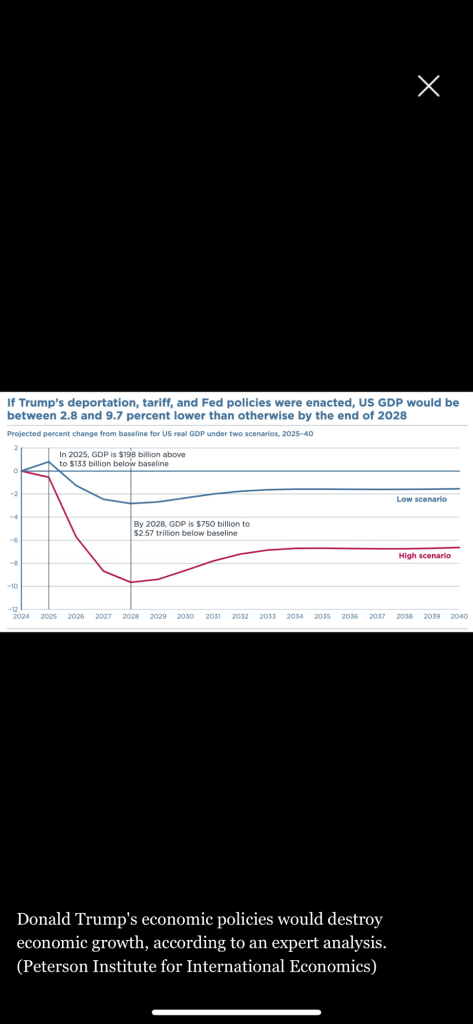
The institute was a lot more free-spoken than the CRFB about the effect of Trump’s proposed policies on economic growth. Considering only the deportations, tariffs and Trump’s desire to exercise more control over the Federal Reserve System, it concluded that by the end of Trump’s term, U.S. GDP would be as much as 9.7% lower than otherwise, employment would fall by as much as 9%, and inflation would climb by as much as 7.4 percentage points.
An overly sedulous focus on deficit reduction as economic policy has caused “real harm [for] the nation’s most vulnerable groups, including millions of debt-saddled and downwardly mobile Americans,” economic historian David Stein of the Roosevelt Institute and UC Santa Barbara wrote last month. When it became Democratic orthodoxy under Presidents Carter and Clinton, the party pivoted to “‘Reagan Democrats’ and suburban white voters at the expense of the labor and civil rights movements.”
As the federal government pulled back, “state budgets were ravaged,” Stein wrote. State and local services were slashed. The efforts to control federal debt forced households to take on more debt.
The deficit scolds are still at it and still have vastly more credibility than they deserve. That’s clear from the CRFB’s analysis and the alacrity with which it was republished as “news” Monday. Efforts to turn policy back to the point that it benefits everyone, not just the rich, still have a long way to go in this country.
Jennifer McCormick was the last elected state superintendent of schools. She switched parties because of the Republicans’ hostility to public schools.
She is running for Governor of Indiana against Senator Mike Braun, who is a far-right Republican. Braun and his running mate, an evangelical extremist, want to get rid of public schools.
The 74 reports:
U.S. Sen. Mike Braun, a conservative Republican, is still ahead in the state’s gubernatorial race but his lead among Indiana voters over Democrat Jennifer McCormick has shrunk in recent weeks.
Polling released this week by the Democratic Governors Association shows Braun just three points in front of McCormick, 44% to 41%. That’s a dropoff from the Sept. 17 results of an Emerson College Polling/The Hill voter survey that had Braun with roughly 45% of the vote and McCormick with 34. Libertarian candidate Donald Rainwater also picked up more support but less dramatically so, going from 5.8% to 8%.
Indiana has not elected a Democratic governor since 2000 and Republican presidential candidate Donald Trump holds a comfortable 14 percentage point lead, 57% to 43%, over Democrat Kamala Harris, according to an ActiVote poll released Tuesday.
If elected to succeed Republican Gov. Eric Holcomb, Braun and his running mate, pastor, podcaster and far-right Christian nationalistMicah Beckwith, have pledged universal school choice for every Indiana family while focusing on parental rights and school safety.
McCormick, a career educator, was the last person elected to the superintendent of public instruction’s office before it became an appointed position in 2021. She seeks to expand affordable child care, fight what she believes is excessive state-mandated testing and call for an equitable school funding formula.
She also wants to place limits on the state’s private school voucher initiative: The program grew to encompass more than 70,000 children in 2023-24, a 31% increase from the year before. The state allocated $439 million in tuition grants to private parochial or non-religious schools last year — up from nearly $312 million the year before.
McCormick said the program, which might have been intended for lower-income children, is often utilized by white suburban families and is too expensive.
“We can’t afford it,” she told The 74, “and it is sucking the resources out of our traditional schools.”
Braun, 70, wants to expand school choice by removing the $220,000 annual family income cap from the voucher program, known as the Choice Scholarship Program, and doubling the $10 millionallocated to the state’s Education Scholarship Account Program. The program, which has also seen tremendous growth in participation, gives special education students and their siblings funds for tuition and support services.
Braun did not make himself available for an interview and attempts to reach various supporters were not successful.
“School choice programs put parents in the driver’s seat, allowing them to choose schools that prioritize their children’s needs,” he states in his education plan. “Providing universal school choice will ensure every Hoosier family has the same freedom to choose their best-fit education.”
A former school board member, Braun also wants to create an Indiana Office of School Safety to streamline the efforts of several departments, including the state police — and implement age-appropriate cyber training for students regarding online safety. He said, too, that the state should limit cellphone use on campus.
Braun wants to increase Indiana’s public teacher base salary — and financially reward educators whose students perform well.
Keith Gambill, president of the Indiana State Teachers Association, said his group endorsed McCormick, 54, because of her commitment to funding traditional public schools.
He noted she did not have the group’s endorsement when she initially ran for the state superintendent’s office as a Republican. But, Gambill said, after filling the role and understanding the state’s educational needs, she switched parties and her values more closely aligned with the union’s.
“She really stood up to members of — at that time — her own party in working toward what was best for our schools,” he said, speaking of her time in office. “And, of course, as soon as they were challenged, they didn’t like that. She realized that if she was going to make a difference in public education, she would have to move in a different direction.”
McCormick aims to secure a minimum base salary of $60,000 for pre-K-12 educators, and adjust veteran teacher salaries to reflect their non-educator peers. She wants to increase academic freedom, safeguard university tenure and protect the ability of teachers unions to collectively bargain for wages and benefits.
Her running mate, Terry Goodin, a former state representative, was a teacher, assistant principal and public school superintendent at Crothersville Community Schools.
Braun, in his education plan, said he wants schools to notify parents about their child’s request to change their name or use different pronouns on campus. He has denounced gender-affirming surgery for minors and opposes transgender students playing on girls’ sports teams. Braun has the backing of Americans for Prosperity and CPAC — and maintains high ratings from the NRA.
Braun was endorsed by Trump in 2023 and won his party’s nomination for governor in May after beating out a crowded field of GOP contenders. He acknowledged last month, according to Axios, that Harris’s presence at the top of the presidential ticket has complicated down-ballot races, including his own.
“I think that’s had an impact,” he said, “but I’m going to plow through that because this is a lot about kitchen table issues once you’re starting to run for governor.”
Trump is weird. He says outrageous things whenever he speaks, and no one is shocked anymore. He lies and makes things up, and it’s another day on the campaign trail. It’s just Trump being Trump.
Trump was furious at CBS “60 Minutes” for allegedly editing Kamala Harris’s comments about Israel. He called it “election interference” and demanded that the FCC strip away CBS license to broadcast. The first question that occurred to me was, how did he know what she said before the conversation was edited (which is customary)?
Former president Donald Trump said Thursday that CBS News should lose a broadcasting license over how it edited a “60 Minutes” interview with Vice President Kamala Harris, even though the federal government does not issue licenses for such television networks.
It was the latest example of Trump calling for media outlets that have angered him to lose their rights to broadcast — a push that evokes government control of media, which is a hallmark of authoritarianism.
Federal Communications Commission Chairwoman Jessica Rosenworcel denounced Trump’s latest call targeting CBS, flatly rejecting an idea the independent agency has ruled out under both the Biden and Trump administrations.
“While repeated attacks against broadcast stations by the former President may now be familiar, these threats against free speech are serious and should not be ignored,” Rosenworcel said in a statement. “As I’ve said before, the First Amendment is a cornerstone of our democracy. The FCC does not and will not revoke licenses for broadcast stations simply because a political candidate disagrees with or dislikes content or coverage.”
CBS declined to comment.
Trump has been fixated for days on Harris’s interview with “60 Minutes,” which came after he backed out of sitting for his own interview with the show, according to the network. Since Harris’s interview aired Monday night, Trump has focused on how it featured a shorter version of Harris’s answer to a question about Israel than was shown in a clip previewing the interview.
It is standard for television networks to edit interviews for broadcast, especially to fit time restraints.
“Her REAL ANSWER WAS CRAZY, OR DUMB, so they actually REPLACED it with another answer in order to save her or, at least, make her look better,” Trump claimed in a post on his social media platform Thursday morning. “A FAKE NEWS SCAM, which is totally illegal. TAKE AWAY THE CBS LICENSE.”
Trump went on to baselessly accuse Democrats of making CBS “do this,” calling it “Election Interference” and saying the party should be forced to concede the election.
He later suggested that all broadcast licenses “should be bid out to the Highest Bidder.”
Trump raised the issue again during an afternoon speech in Detroit, claiming the edited Harris interview “will go down as the single biggest scandal in broadcast history.”
The FCC says on its website that its “role in overseeing program content is very limited.” The agency licenses individual broadcast stations, not networks in their entirety.
“We do not license TV or radio networks (such as CBS, NBC, ABC or Fox) or other organizations that stations have relationships with, such as PBS or NPR, except if those entities are also station licensees,” the FCC website says.
It is not the first time Trump has called for a network to lose its broadcasting license because he was not happy with what aired or with how he was portrayed. Trump last month suggested ABC should lose its license over its moderating of the debate between him and Harris. Rosenworcel also rejected that suggestion at the time.
Even the FCC head during Trump’s presidency, Ajit Pai, had dismissed Trump’s talk of targeting broadcast licenses.
“I believe in the First Amendment,” Pai said in 2017 after Trump suggested NBC should face consequences for critical coverage of his administration. “The FCC, under my leadership, will stand for the First Amendment. Under the law, the FCC does not have the authority to revoke a license of a broadcast station based on the content of a particular newscast.”
Democrats have long criticized Trump over his authoritarian tendencies, both in his public comments and in his affinities for certain foreign leaders. He said last year that he would not be a dictator if he wins the November election — “except for Day 1,” a comment that Harris has continued to highlight through the final weeks of their race.
The “60 Minutes” episode broadcast Monday — a special pre-election episode — sparked controversy in the days before it aired. CBS said Trump pulled out of an interview with the show because it would be fact-checked, per usual. Trump’s campaign said Trump never fully committed to the interview but also acknowledged that fact-checking was an area of dispute.



 Diane Ravitch's blog