Andy Spears reports that the Walmart billionaires are supporting MAGA Marsha Blackburn in the race for Governor of Tennessee.
The Waltons of Arkansas are totally committed to eroding public schools and privatizing public funding, so Blackburn is promising to expand state support for vouchers.
Spears writes:
The youngest son of Walmart founder Sam Walton is now on the Marsha Blackburn bandwagon.
The latest campaign financial report indicates that pro-Blackburn Team Tennessee PAC received $100,000 from Walton in the last reporting period.
The Walton family has long supported private school discount coupons – otherwise known as school vouchers. These schemes divert funds from working-class families to wealthy families to use as tuition discounts at private schools.
Walton joins payday predators Advance Financial, Pennsylvania billionaire and privatization advocate Jeff Yass, the CEO of Jimmy John’s, and General Motors in supporting Blackburn and her reverse Robinhood economic and education agenda.
Blackburn has pledged to further expand Tennessee’s $300 million school voucher scheme if the 74-year-old career politician wins the Governor’s race.
Last week, Trump gave an address to the nation about malign attempts by foreign powers to influence our elections. He said that China was meddling in our elections, but the documents he released pointed to Russia’s efforts to help him. When he ran against Biden in 2020, the documents showed, Russian propaganda tried to portray Joe Biden and his son Hunter as recipients of foreign bribes; multiple investigations never produced any evidence for these claims.
Ironically, MSNOW points out, Trump has eliminated the federal agency that helped protect election security. You have probably never heard of that agency (CISA), so he correctly assumes that you won’t notice.
Now the Department of Himeland Security says it will offer election security only to states that hand over their voter rolls.
It’s important to remember that the U.S. Constitution gives states the power to control their elections, not the President or any federal agency.
President Donald Trump says he is worried about foreign interference in U.S. elections. That was the reason he gave when he released declassified intelligencedocuments last week that ended up undercutting his own baseless claims about rigged elections.
In his primetime address on July 16, Trump said the U.S. “must take urgent action” to protect voting infrastructure against foreign actors. But shortly after taking office last year, Trump gutted a key agency designed to protect America’s elections from exactly that.
It’s called the Cybersecurity and Infrastructure Security Agency — an office created during Trump’s first term. CISA is one of the main federal partners for states on election security, sharing intelligence on potential threats to voting infrastructure and providing quick regional support.
After Trump returned to office, the cyber agency housed under the Department of Homeland Security took a major hit. Elon Musk’s DOGE fired more than 100 workers, including election security advisers. More than 600 others were placed on administrative leave, were reassigned or took buyouts.
Now the Trump administration is telling states they will only receive resources if they hand over voter rolls to be screened through a new federal database that a judge recently deemed unlawful in its current form.
That database is known as the Systematic Alien Verification for Entitlements, or SAVE, which experts and a federal judge are concerned has a high error rate that could disenfranchise voters.
Homeland Security Secretary Markwayne Mullin said CISA will release an “election infrastructure plan” in the next 30 days — barely three months out from the midterms, which will determine which party controls Congress.
“If they participate in the SAVE program, we’ll provide the resources and training to support state election integrity,” Mullin said last week. “We’re not trying to change the outcome.”
‘They’re flying blind’
Multiple current and former senior election and national security officials told MS NOW that they could not recall a time when the federal government held back resources and money meant to secure America’s elections.
And multiple state election officials have said they are not receiving any briefings on possible foreign threats to election security from the federal government. Such briefings were once a regular occurrence, they said.
During the first Trump administration, “we were collaborative — carrots rather than sticks,” said one of the former officials, who was granted anonymity to speak candidly. The second Trump administration is “very much focused on sticks.”
One election official in a swing state said the difference from 2024 is stark, saying that “it’s every state for themselves.” The official spoke on the condition of anonymity over concerns about retaliation from federal officials. During the last cycle, the state official said they had a regional federal cybersecurity expert “on speed dial” who could “see the whole puzzle.”
That doesn’t exist anymore, and without it, the state election official said, “we’re less informed on the pattern of the attackers and are slower to respond.”
“I’ve literally never heard anybody effectively say ‘to keep you safe, you have to give me what I want,’” said the swing state election official, referring to DHS threats to withhold resources if states don’t hand over sensitive voter data.
The risks compound at the local level, they added: “Does [a clerk’s] laptop have the IT infrastructure to defend against an attack from Iran? That’s what keeps me up at night.”
Cait Conley, a West Point graduate and combat veteran who served as the senior adviser to the director of CISA during the Biden administration, accused Trump of gutting the agency and sowing doubt about the security of U.S. elections in his speech last week.
“If Donald Trump were truly concerned about election security, he would not have fired hundreds of federal workers whose jobs were to secure our elections,” she said. Conley is now running for Congress in New York as a Democrat.
I am once again posting a fascinating account of an important district in Texas. The district is Tarrant County. It’s the third largest district in Texas. For a long time, it was reliably red. Now, we learn in Michelle H.Davis’s post, it is close to turning blue.
You can help by sending contributions of any size to candidates she describes. I was moved to send $100 to Alisa Simmons, whom she describes near the end of the post. Any of the candidates mentioned would appreciate $10, $25, whatever you can afford.
The best part of the post is that it gives you a flavor of why these races matter. Like the contest for leadership of the prison, where more than 70 prisoners have died while in custody since 2017.
This is the third installment of this series, where we’re looking at election data from the largest counties to see where we need to be for our hypothetical big blue wave in November. If you missed our previous installments:
Harris and Dallas, the only counties with higher populations than Tarrant, are reliably blue and need to focus on turnout. Tarrant, on the other hand, is where the battleground is. It’s a swing county because Republicans have held the reins of county government for too long. 2026 could be the year that changes.
Twenty years ago, Tarrant County was over 75% white and the largest red county in America.
Tarrant County
And of course, we know that Demographics are not destiny, but we can see in Tarrant County that votes have been trending blue for a long time.
More than that, there’s a heavy burden on Tarrant County, just like Harris and Dallas. In 2024, 7.96% of all Texas Democrats lived in Tarrant County. And in a state as big as Texas, that’s a lot of weight to pull.
And the redistricting, the whole reason Tinderholt is running for Simmons’ seat in the first place, is because the Commissioners Court redrew Precincts 1 and 2, the only Democratic-held seats, and O’Hare admitted on camera it was to lock in a Republican majority. Simmons and her fellow Democratic commissioner had the UCLA Voting Rights Project analyze the new maps, and the conclusion was that every proposed map packed Black and Hispanic voters into a single district to dilute their power everywhere else. Lawsuits were filed. They got dismissed on procedural grounds. The map stands for 2026.
But something has shifted in Tarrant County. Democrats have been sweeping local races, and Taylor Rhemet’s win was the cherry on top.
Last year, Democrats flipped multiple school boards in Tarrant County. This year, they flipped several city council races across the county. And on January 31, Democrat Taylor Rehmet beat Republican Leigh Wambsganss for a state Senate seat that hadn’t gone blue since 1991. Not close, either. 57% to 43%, in a district Trump carried by 17 points just over a year earlier. Wambsganss outspent him by two million dollars. She’s the chief communications officer for Patriot Mobile, the outfit that’s spent the last several years funding the Christian nationalist school board takeovers.
Hispanic voters did that. In some of the heavily Latino precincts on Fort Worth’s north side, Rehmet outperformed Kamala Harris’s 2024 numbers by more than 50 points. That’s a mobilization story, the same one I’ve been telling you about Harris and Dallas counties, except this time it happened in a district that hadn’t elected a Democrat to that seat in 35 years. Rehmet and Wambsganss go at it again in November for the full term, and if Tarrant Democrats can do what they did in January one more time, that seat is gone for good.
Down at the State House, the map is a little friendlier, if you squint.
Five Republican-held House seats anchor themselves in Tarrant County, and depending on how big this wave gets, we could see two of them flip. Maybe four. Maybe all five, though that’s the kind of year Democrats haven’t had here in three decades.
HD93 and HD96 are the two to watch first. HD94 is Tony Tinderholt’s old seat, now open since he’s bailing to run for Simmons’ commissioner spot, and Democrat Katie O’Brien Duzan is running there. HD96 has an open seat left by David Cool, defending against Democrat Ebony Turner, in a district that’s been quietly drifting for years.
HD98, Giovanni Capriglione’s old seat covering Keller, Colleyville, and parts of Southlake and Grapevine, is open too after his retirement, with Democrat Cate Brennan running.
HD94 and HD97 round out the list, the kind of districts that turn competitive the moment turnout ticks up, exactly like it just did in SD9.
Two of these flip in a decent night. Four flip if Tarrant does in November what it just did in January. And if all five go blue, that’s no longer a wave. That’s Tarrant County telling the rest of Texas the fight is already over.
Congressional seats to watch.
Tarrant now sits inside four competitive-adjacent congressional districts, and all four have a name on the ballot worth knowing:
TX24: Beth Van Duyne vs. Kevin Burge, a Marine Corps veteran who worked in the DIA and served in Biden’s White House Situation Room. Not a top-tier flip on paper, but this is the district that got carved through Tarrant’s fastest-diversifying suburbs, and it’s the one to watch for over-performance.
TX12: Craig Goldman vs. Heli Rodriguez-Prilliman, a Fort Worth entrepreneur running her first race. Goldman inherited Kay Granger’s old seat, and this is the most Tarrant-heavy of the four districts.
TX25: Roger Williams vs. Dione Sims, who won her primary runoff outright. This district picks up Arlington and Grand Prairie, the same ground that just delivered Rehmet’s win.
TX06: Jake Ellzey vs. Danny Minton, though only a sliver of this district touches Tarrant at all, it may be the most populated part of the district.
None of these is the marquee pickup Rehmet already delivered. But they’re the four names that turn a good night in Tarrant into a great one down-ballot, and if the county keeps trending the way Rehmet has shown it can, one of them stops being a long shot sooner than people think.
Now let’s talk about Alisa Simmons, because she’s the whole ballgame.
Simmons is the Precinct 2 commissioner Tim O’Hare told to sit down and be quiet, and this November, she’s running to replace him.
Before politics, Simmons spent 12 years as a broadcast journalist and then 18 years running budgets and public safety communications for the Tarrant County 9-1-1 District, the kind of job where you learn exactly how county government works and exactly where it breaks down. She spent ten years as president of the Arlington NAACP, served as second vice president of the Texas NAACP, and sat on the ACLU of Texas board. She ran for HD94 in 2020 and lost, then won her Precinct 2 commissioner seat in 2022. Since then, she’s been the loudest, most consistent voice on that court, demanding accountability from the jail, fighting the defunding of Girls Inc., and opposing the elimination of free rides to the polls.
When O’Hare and his Republican majority redrew her own precinct to make it harder to hold, Simmons ran countywide instead. And on March 3, she didn’t just win the Democratic primary for County Judge, she buried it.
Her platform is exactly what you’d expect from someone who’s spent years watching this county’s dysfunction up close. A full Department of Justice review of jail operations, independent oversight with actual teeth, and a direct reckoning with the 76 lives lost in that facility since 2017. She’s running on affordability, on fiscal responsibility that doesn’t require dipping into reserves to cover basic obligations, and on ending what she calls the constant partisan theater that’s replaced actual governance on that court. In her own words, it’s time for the Tarrant County government to get to work instead of getting into shouting matches.
I expect her to win in November. I’m not just saying that because I like her, although I do, a lot. I’m saying it because the numbers back it up, because O’Hare’s own party is nervous enough about Tarrant that they’re gerrymandering commissioner precincts mid-decade instead of just running on their record, and because Simmons has already shown she can win a race Republicans specifically redesigned to make sure she couldn’t.
So what does it actually take to get there?
Turnout, same as always. Tarrant County has nearly 1.5 million registered voters, and the difference between a good night and a great one lives entirely in the precincts that already agree with us and just haven’t been asked to show up yet.
The Hispanic vote that swung so hard left for Rehmet in January has to swing that way again in November, and it will, if the same organizing that worked in that special election gets replicated at scale.
The Tarrant County Democratic Party fielded its broadest slate of candidates since 1994 this cycle. That’s not an accident either. That’s what happens when people stop waiting for demographics to save them and start building the infrastructure to ensure demographics actually show up.
Tim O’Hare knows what’s coming. That’s why he’s spent his entire tenure trying to outrun it instead of earning it. Alisa Simmons is the one running straight at it.
Tarrant County doesn’t need to wait for a statewide wave to matter.
It needs its own county government back, and it’s closer than it’s been in thirty years.
Rehmet already broke the seal. Simmons is next. Somewhere between two and five House seats are up for grabs. The good old boys know it, which is why they gerrymandered instead of governing.
Show up, and Tarrant stops being the excuse Texas Republicans hide behind. It becomes the county that ends them. And in 2026, Democrats take back Tarrant County.
Greg Olear is a gifted journalist and thinker who has a terrific blog. He writes about politics, literature and whatever he wants.
This is his obituary for Mitch McConnell, who has been a toxic force in our nation’s politics. Mitch is probably not dead yet but we should remember his toxic legacy.
Olear writes:
What with Donald Trump losing wars to Iran, using the Justice Department and the FBI as his vendetta agencies, sic’ing his murderous ICE Gestapo on innocent residents, building concentration camps, hawking presidential pardons, fucking up the global economy, destroying our institutions, bulldozing the White House, bankrupting farmers, plundering on a galactic scale, withholding the money he owes to the woman he raped, fluffing Putin and Netanyahu, spewing crazy shit, and behaving every day like a complete and total asshole…
…and with the erstwhile Senate Majority Leader off the grid for a full month with some undisclosed medical issue and presumed dead…
…and with the media focusing its attention on the Renfieldian Lindsey Graham, who we know for sure bought the farm…
…with all of that, it’s easy to forget just how much demonstrable harm Mitch McConnell has done did to the people of the United States and to American democracy.
Since his funeral appears to be imminent, it’s only right that we give the Turtle his (dead) flowers.
When Donald Trump put his short orange fingers on Lincoln’s Bible in January of 2017, Mitch McConnell was already one of the worst Americans to ever draw breath. As of that date, no individual in my lifetime—not Nixon, not Kissinger, not even Ronald Reagan—had done more damage to the United States than the malevolent Gentleman from Kentucky.
I wrote a short piece about it on my now-defunct online magazine in July of 2017, under the title “Worst Americans: Mitch McConnell.” It read:
Rather than participating in the governance of the country through the time-honored tradition of compromise, he spent eight years as a living, breathing roadblock. The current Senatorial system of obstructionism has his fingerprints all over it.
He engaged in a SCOTUS staring contest with Obama concerning the Merrick Garland nomination and did not blink until Neil Gorsuch, a pro-corporation-anti-human conservative of the worst kind, was sworn in. This will have malefic impact on our country for the rest of my natural life.
When debriefed on the extent to which malignant Russian intelligence forces were compromising the presidential campaigns and the election, he threatened to accuse Obama of playing partisan politics if he went public with the bombshell. Once again, Obama acquiesced. With the election over, and no Constitutional clause for an invalidation of the result, he is in a position to make noise about this act of war by an enemy power. He has done nothing.
His wife, Elaine Chao, is the daughter of the Taiwanese shipping magnate James S.C. Chao, who is responsible for both personally enriching his son-in-law and for contributing to his campaigns, which would be fine if not for the big cocaine bust nobody paid any attention to. Elaine Chao serves in Trump’s cabinet, because of course.
He censured Elizabeth Warren for attempting to read a letter by Coretta Scott King at the confirmation hearing of inveterate racist and Putinist collaborator Jeff Sessions.
He is the prime mover in the Senate of the campaign to repeal Obamacare. The toxic healthcare bill he’s floated would throw 23 million people off insurance and lead to thousands of deaths and bankruptcies. It would also have a deleterious effect on the economy, as many thousands of jobs would vanish if the ACA were repealed. He doesn’t care. At all.
The story of his recovery from polio being financed by the government is bogus, but he did suffer from the disease as a child, and he did recover thanks to a program put in place by FDR. That he is actively seeking to deny medical care to so many sick children (that’s who’s on Medicaid, mostly: children) speaks volumes about his loathsome character.
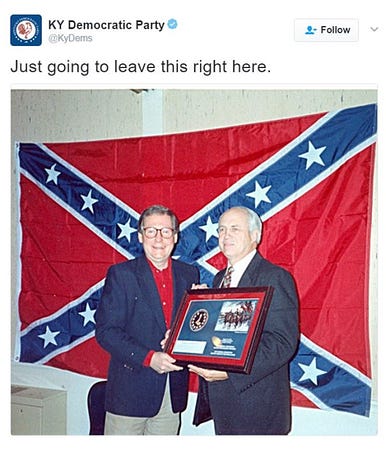
He’s sympathetic to the Confederacy.
Worst of all, and quite unlike almost every Republican involved with Trump, he’s astonishingly good at his job. He wants us to die and go bankrupt and be ruled by the laws of the Christian right and continue to have our elections stolen by the Kremlin. And he’s savvy enough to make it happen. As GOP strategist Rick Wilson said, “Washington is littered with the bodies of people who underestimate Mitch McConnell.”
He’s the worst person in America. And arguably the most dangerous.
That’s hardly an exhaustive list. And it was written far too early to cite the second impeachment, which McConnell handled even more abominably than he did the first.
[O]ur system of government gave the Senate a specific task. The Constitution gives us a particular role. This body is not invited to act as the nation’s overarching moral tribunal. We’re not free to work backward from whether the accused party might personally deserve some kind of punishment….
[F]ormer President Trump is constitutionally not eligible for conviction….But after intense reflection, I believe the best constitutional reading shows that Article II, Section Four, exhausts the set of persons who can legitimately be impeached, tried, or convicted. It’s the president, it’s the vice-president and civil officers. We have no power to convict and disqualify a former office holder who is now a private citizen.
Thus did McConnell concoct a technicality that allowed Trump to run for office again in 2024—even though, as Mitch well knows, under Section 3 of the Fourteenth Amendment, Trump is ineligible to serve.
In December of 2019, in “Obstruction is the New Secession,” one of the first pieces at PREVAIL, I expounded upon McConnell’s role as sand in the gears of democracy:
DEMOCRACY IS NOT, and was never intended to be, a zero-sum game. The winners are not supposed to take everything. Change comes slowly and incrementally—often frustratingly so, for progressives. But the flip side is that the United States has worked pretty damned well for a quarter millennium, becoming arguably the greatest nation the world has ever known, because of the willingness of its political parties to compromise.
In the run-up to the Civil War, Congress bent over backwards brokering one compromise after another, in a valiant attempt to preserve the union. These compromises infuriated Northern abolitionists (“This word compromise, when applied to human rights and constitutional rights, I abhor,” trumpeted Thaddeus Stephens in 1850), just as they vexed the Southern slaveholders. Ultimately, the peace did not hold—the differences between slave and free were irreconcilable—but the point is that, in an era when members of Congress sometimes kicked the shit out of each other, politicians still went to great lengths to compromise.
Compromise only works when both political parties are willing to budge. If one of those parties abdicates its responsibility to represent the American people, if it exists simply to obstruct the work of the other—if it flat-out refuses to compromise, ever, about anything—the US system of government, always a fragile thing, breaks down.
After the election of 1860, the Southern states said, “Fuck it. We’re not working with Abraham Lincoln no mater what,” and they seceded from the Union. After the election of 2008, Mitch McConnell and the Republicans said, “Fuck it. We’re not working with Barack Obama no matter what,” and proceeded to obstruct every single thing he tried to do, large or small, national security be damned. To avoid compromise, the South chose Civil War. To avoid compromise, McConnell allowed Moscow to sabotage the 2016 election. Both acts are tantamount to treason. (That the Party of Lincoln slowly morphed into the Party of Obstruction is a sad irony).
Obama, after spending most of his first year in office coaxing the recalcitrant Republicans to work with him, eventually gave up, and, like Lincoln, used the vast powers of the office to take action without the rival party’s input. This worked, sure, but it was not without consequences. As I wrote in “Obama the Terrible” in February of 2014, after the story broke about the president’s drone strikes on suspected terrorists:
If a terrorist can be blown to smithereens at the whim of a single individual, then so can I, and so can you. If a terrorist can be held indefinitely without trial, then so can I, and so can you….
Today, the man with his finger on the button is the genial Barack Obama, a man I voted for, a man I like and admire, a man whose judgment I trust. The president strikes me as grounded, guarded, pragmatic, and smart. Whatever some may believe, Obama is not Hitler. But the next guy might be. And therein lies the terror. Not recognizing this clear and present danger is Obama’s greatest failing as president.
While he has not yet gone to these terrifying lengths, the despotic Donald Trump has certainly exploited the “executive order” precedents set by the frustrated Obama. The GOP refusal to compromise—to so much as allow a vote on Supreme Court nominees and House bills!—begat both Obama’s executive power grab and the “sweeping and systematic” Russian interference in the 2016 election (in Mueller’s words), which McConnell through his cynical inaction aided and abetted. The result is Donald Trump—corrupt, venal, vain, petty, criminal, installed and controlled by Vladimir Putin—presiding over the most powerful executive branch in recent memory.
Many factors contributed to this outcome, yes. But the root of the problem is the Republicans’ refusal to compromise. The GOP are not small-d democrats any longer. Mitch McConnell and his confederates are the modern heirs of Christopher Memminger, Robert E. Lee, and Jefferson Davis. Which should come as no surprise:
Fortunately, the Confederate States of America did not have a state TV network spewing pro-slavery propaganda to North and South. There was no Fox & Friends to normalize the brutal war crimes of Nathan Bedford Forrest. Sean Hannity was not there to fawn over James Henry Hammond and extol the virtues of the Mudsill Theory. Nor did Jeff Davis have a Rudy Giuliani scurrying around Transylvania, calling into question Robert Lincoln’s ties with the Pullman Palace Car Company. If so, the Civil War might have played out quite differently.
The GOP does not want to Make America Great Again; it wants to make America white again—and, especially, to keep the White House white. This is a tall order. Like the antebellum South, the demographics do not favor the GOP. The country is becoming more diverse each year. White people will soon be a minority in the United States. The demographic shift could well turn Texas blue—which would be the death knell for the Republican Party. A blue Texas plus blue California, New York, Illinois, and New Jersey mean a Democrat POTUS for the foreseeable future.
McConnell surely understands this. He knows he’s running on borrowed time. If he can’t control the executive branch, or Congress, he has to infiltrate the judiciary—the only one of the three branches whose members, conveniently, serve for life. So far, this objective has succeeded beyond his wildest dreams. Obstruction has seen to that.
When it became clear that McConnell would never allow the Senate to vote to confirm Merrick Garland, President Obama should have gotten creative. FDR would have ordered Garland to take the seat after a waiting period of 60 days—something, anything to ensure not only that Garland took his rightful place on SCOTUS, but that the politics of obstruction failed spectacularly. Instead, Obama avoided a fight, assuming that Hillary Clinton would win and it would all be moot. This colossal error, an obvious blunder even at the time, guarantees a conservative judiciary—and perhaps, depending on the fragile health of Ruth Bader Ginsberg, an extremely conservative one—for decades.
The lesson is this: If the new president finds herself with a blue House and a blue Senate, she needs to be relentless. She needs to move quickly, decisively, and fearlessly. Yes, she should attempt to engage the GOP. But at the first whiff of obstruction, she should ignore them completely going forward. It is not her responsibility to beg them to do their fucking jobs. Let the Republicans go to Canossa if they want a seat at the table—and once they are at the table, let them do more than refuse to play along. The politics of obstruction must be eradicated, just as the Confederacy was. Traitors should have no voice in the government of the people, by the people, and for the people.
The irony is, since I wrote that six and a half years ago, Donald Trump has eradicated the politics of obstruction. Ruling by executive order, by decree, by lawfare and intimidation, he has plowed through the feeble roadblocks set up by the opposition. By controlling the executive and judicial branches, he has made Congress moot.
The other irony is, even in semi-death, McConnell continues his life’s work of obstruction.
Yes, Trump has eclipsed Mitch McConnell as the worst American of my lifetime. So have other monsters Donald has empowered: Elon Musk, Peter Thiel, Stephen Miller, etc.
But without Addison Mitchell McConnell III, there would be no Donald Trump. Remember this: Mitch fed the cancer. He nurtured the tumor. He prevented the oncologists and surgeons from administering treatment. And knowing he possessed the singular cure, he chose to sit on his hands as the terminal disease ate away at our democracy.
That is the sum of his life’s work. That is his ignominious legacy.
Andy Borowitz is one of the nation’s most notable humorists. For years, he wrote for The New Yorker. Now, he writes on Substack, where this commentary was posted.
I remember when Senator Graham was Senator John McCain’s best friend. John McCain was a true war hero. He was shot down over Hanoi, and he spent five years as a prisoner of war. He was offered the chance to get an early release, but he said he wouldn’t leave until the other POWs were freed. Graham adored him until he was dead, then attached himself to Trump. Trump mocked McCain, and said McCain was not a hero because he got captured. This from a man who dodged the draft because of “bone spurs.” And Graham forgot his friend.
Like many Americans, I mourn the sudden passing of Lindsey Graham. I had hoped he would live long enough to be tried for treason.
Let me define my terms. A true traitor collaborates with the enemy despite knowing better. For that reason, someone like Sen. Tommy Tuberville could never be considered a traitor, because he knows nothing.
And then there’s Lindsey.
For the better part of a decade, the senior senator from South Carolina was enmeshed in an on-again, off-again—but mainly on-again—bromance with Donald J. Trump.
It began when both men were running for the 2016 Republican presidential nomination. At the time, Graham had some pretty harsh words for his GOP rival.
“There’s only one way to make America great again,” he said. “Tell Donald Trump to go to hell.”
Snap! But Lindsey was just warming up. He’d go on to call Trump “crazy,” “a jackass,” and “a race-baiting, xenophobic religious bigot” who “shouldn’t be commander-in-chief.”
“If we nominate Trump, we will get destroyed,” he said, “and we will deserve it.” Why was he so sure that Trump would lose? “Donald Trump is the most unelectable Republican I’ve seen in my lifetime,” he said.
As for Trump’s mental health, Lindsey offered this succinct diagnosis: “I think he’s a kook. I think he’s crazy.”
Just one year later, when the crazy xenophobic jackass was chain-slurping Diet Cokes in the Oval Office, Graham decided to revise that assessment somewhat.
“What concerns me about the American press is this endless, endless attempt to label the guy as some kind of kook not fit to be president,” he told CNN.
This sort of flip-flop worked so much better before the invention of Google. But Lindsey seemed to hope that by piling praise on the man he once wished would go to hell, we’d forget about all that mean stuff he’d said before. By 2018, Graham was bizarrely claiming that Trump “deserves the Nobel Peace Prize and then some.”
In his quest to suck up to Trump as strenuously as possible, Graham hurled himself into self-abasement as if it were an extreme sport. When Trump relentlessly insulted the memory of John McCain—purportedly Graham’s best friend when they were Senate colleagues—Lindsey responded with astonishing nonchalance.
“I don’t like what he says about John McCain,” Graham told Bloomberg. “But when we play golf, it’s fun.”
Yes, Lindsey apparently lost his moral compass somewhere in the sand trap of the Trump National Golf Club. That’s why it was so striking when he seemed to express genuine outrage on the floor of the Senate after Trump incited the Capitol riot on January 6, 2021.
“Trump and I… we’ve had a hell of a journey,” he said. “I hate it to end this way. Oh my god, I hate it… but today, all I can say is ‘Count me out. Enough is enough.’”
Alas, Lindsey’s appearance on the right side of history turned out to be a head-fake, as his hell of a journey with the insurrectionist-in-chief was far from over. Like his fellow quisling, Mitch McConnell, Graham voted to acquit Trump in his second impeachment trial. And once it became clear that launching a coup against the US government wasn’t a deal-breaker for 99 percent of the GOP, Lindsey was hitting the links with the wannabe junta leader once more.
“I’m trying to keep a relationship with him after the riot,” he told Axios two months after January 6. “I still consider him a friend. What happened was a dark day in American history. And we’re going to move forward.”
Lindsey just couldn’t quit him.
All of the events I’ve recounted thus far are sufficient to qualify Graham as a traitor. His defenders, though, might raise a mitigating factor: his hawkish stance against the President of the Russian Federation, Vladimir Putin.
In this regard, Graham was always on the same page as his Senate pal McCain. Responding to George W. Bush’s gullible assessment of the murderous Russian (”I looked the man in the eye. I found him to be very straightforward and trustworthy. We had a very good dialogue. I was able to get a sense of his soul; a man deeply committed to his country and the best interests of his country.”), McCain quipped, “I looked in Mr. Putin’s eyes and I saw three letters—a K, a G and B.”
But Graham might have topped McCain in his detestation of Putin. Calling him a “war criminal” and “not a legitimate leader,” in 2022 he proposed assassination as the swiftest way to end the war in Ukraine: “I just want him to go…I wish somebody had taken Hitler out in the ‘30s.”
When the International Criminal Court, in a somewhat less draconian measure, issued an arrest warrant for Putin in 2023, Lindsey hailed the decision: “To forgive and forget Putin’s war crimes—that are occurring on an industrial scale—would irrevocably damage the Rule of Law-based world order established at the end World War II.”
That “Rule of Law-based world order” was shredded in the Oval Office last year when Trump and JD Vance disgracefully ganged up on Ukrainian President Volodymyr Zelenskyy for having the audacity to suggest that Putin might not be a trustworthy fellow. Aware of Graham’s longstanding hatred of the man he called a war criminal, I eagerly awaited his rousing statement of support for Zelenskyy.
Instead, Lindsey told reporters, “What I saw in the Oval Office was disrespectful, and I don’t know if we could ever do business with Zelensky again… I have never been more proud of the president. I was very proud of JD Vance standing up for our country.”
That kind of statement made many people wish Lindsey would go to hell. Done.
The GOP knows that it’s in trouble with the voters. Trump’s decision to join Israel in a war against Iran is a disaster. It has caused inflation at a time when voters were already worried about affordability. Trump’s poll numbers are somewhere in the 30s.
His biggest issue, meant to distract voters, is to charge that our elections are fraudulent. He told world leaders that our elections are “rigged,” which is surprising considering that he and his party won the last (rigged?) election.
Marc Elias has led the legal battle to stop Trump’s multiple efforts to take control of voter data and to control state elections. The Constitution clearly says that states control their elections. He and his team of lawyers have fought the federal government in case after case and won.
Trump’s goal is to destroy Americans’ belief in the fairness of elections. The goal is to transfer the public’s trust to authoritarianism.
I doubt Donald Trump thinks Chuck Gray is allowing noncitizens to vote. Indeed, when the Wyoming Secretary of State first ran for the office in 2022, Trump endorsed him. In 2024, Wyoming overwhelmingly voted for Trump for president.
Nevertheless, on Tuesday, Trump’s Department of Justice sent Gray and the chief election officials in the other 49 states a letter warning that they could face criminal prosecution over possible noncitizen voting.
Utah’s top election official, Deidre Henderson, posted on social media that the letter was “truly bizarre behavior.” The Republican Lt. Governor noted that the DOJ “is supposed to be protecting civil rights.”
I can say confidently that neither Gray nor Henderson has anything to worry about. Like their colleagues in the other 48 states, they have done nothing to warrant the insulting correspondence they received.
Though I have profound differences with many Republican chief election officials, I have no doubt they, like their Democratic counterparts, aim to keep noncitizens off their voter rolls and have done nothing remotely criminal.
But keeping noncitizens from voting wasn’t the point of the DOJ’s letter. Nor is it the point of DOJ’s announcement that it is sending “observers” to watch primary elections in fifteen jurisdictions across six states — Arizona, Michigan, Massachusetts, Minnesota, New Hampshire and Virginia.
No, the point of both efforts, like so much in the Trump era, is performative. In lieu of evidence of actual fraud, the administration wants to use these clumsy steps to create the illusion that fraud exists.
This is a tactic Republicans regularly employ when it comes to their attacks on voting. For example, the DOJ has filed thirty lawsuits to gain access to state voter rolls. It has lost all 11 that have been decided. Yet its public posturing around the cases is intended to convey the message that something untoward resides in the data it seeks.
The RNC has followed a similar path, touting new anti-voting lawsuits that are either later dismissed or amount to nothing. Yet the propaganda value of the filing is achieved nonetheless.
There is a second, more dangerous reason why Trump and his allies act this way. They want to desensitize the public to their creeping authoritarianism.
When the DOJ deployed a handful of observers in advance of the 2025 elections, it caused waves. Now it is expanding that program with less fanfare. If, as I expect, it massively increases this behavior in the fall, officials want it to seem like old news.
Sadly, we have seen this work for Trump.
The right wing has made promoting lies about elections its top priority. It shows up in every presidential speech, is embraced by every GOP campaign, and is promoted — at least in part — by every right-wing advocacy effort.
Anyone nominated to the federal bench by this administration is required to adhere to certain norms supporting election denialism. They cannot say Biden won the 2020 election; they must parrot at least some form of voter fraud allegations.
Democrats dismiss these statements but mostly want to discuss other topics — the economy, jobs and healthcare. This makes good campaign sense but leaves a mismatch in the volume of messages Americans hear on the vital topic of democracy.
The legacy media has proven itself unable or unwilling to stay focused on threats to democracy. It feels institutionally compelled to treat the entire issue as a two-sided political contest rather than as an existential threat to the rule of law and the country.
That leaves those of us in the pro-democracy movement. Independent media has made great strides but continues to suffer from a lack of reach and resources necessary to inform the broader public of the nature and extent of the risks.
Voting rights organizations and lawyers do the hard work in the trenches but face Republican officials, a hostile administration and well-funded opponents.
With four months until the election, the challenges I lay out above will only grow. I haven’t even mentioned the role of disinformation, foreign interference, or how the Supreme Court might undercut efforts to protect voting.
But the truth is that we have faced these threats before — in 2020, when Trump tried to overturn the election and then inspired a violent insurrection at the Capitol, and in 2022, when his followers tried to prevent certification of elections.
We can defeat Trump’s authoritarianism. We can protect our elections and our democracy. But it will require all of us working together with a common mission.
That starts with refusing to allow ourselves to become numb to what Trump is doing, and insisting that we remain vigilant for signs that it is getting worse. In short, it requires us not to turn away, but to focus on the threats.
In the weeks and months ahead, there will be opportunities to discuss specific tactics and steps to take. But for now, all I ask is that you stay engaged. It’s okay to be tired and worried. It is not okay, however, to give up hope. That is what Trump wants — and is counting on.
Trump pardoned the convicted criminals who were sentenced because of their actions on January 6, 2021. Those who committed the most serious crimes were accused of seditious conspiracy and did not receive a pardon. They are leaders of the Proud Boys, a group of right wing extremists. They were later pardoned by Todd Blanche.
(CNN) — A federal judge on Friday dismissed the seditious conspiracy case against several Proud Boys members — granting a request from Trump’s Justice Department and undoing one of the Biden administration’s most celebrated victories against those who it said inspired the January 6, 2021, attack on American democracy.
US District Judge Timothy Kelly, a Trump appointee, begrudgingly agreed to drop the case against the four members, saying he “lacks the authority to compel the Executive to pursue a prosecution, full stop.”
“President Trump’s views about the prosecution of those who attacked the U.S. Capitol on January 6—whether those views are based on fact or fiction—are well known, as is his intention to extend clemency to them through the Executive Order,” Judge Kelly said, referring to Trump on his first day back in office signing an order commuting their sentences.
Trump’s order granted pardons to over 1,000 people convicted in the attack but left in place the convictions of the four Proud Boys members — Ethan Nordean, Joseph Biggs, Zachary Rehl and Dominic Pezzola.
In April, the Justice Department under Todd Blanche moved to vacate their convictions.
Dismissing the case against the Proud Boys associates erases some of the most serious convictions from the sprawling investigation of the US Capitol riot, one of the largest federal investigations in US history. Nordean, Biggs and Rehl were found guilty in 2023 of seditious conspiracy and a range of other charges. Pezzola was found not guilty of seditious conspiracy but convicted on other charges related to January 6.
The US district judge who sits in Washington, DC, said in his order that the Trump administration sought to “treat this case essentially the same way it has all January 6 cases, without regard for the seriousness of the conduct at issue or even whether the case was initiated after President Biden took office or, like this one, while President Trump was still in power.”
“The decisions to issue the Executive Order and to abandon this prosecution—even after the Government secured convictions for serious crimes relating to the attack on the Capitol on January 6—are solely the Executive’s,” Kelly continued. “No one should mistake the Court’s granting of the Government’s motion for its agreement with those decisions.”
Rehl, one of the Proud Boys members, celebrated the dismissal in a post on X, saying, “Finally, it’s all over! January 6th can now be a thing of the past for me!”
Enrique Tarrio, the former leader of the group who had also been pardoned by Trump, was also quick to boast on X Friday night: “Justice is served! Proud Boys don’t lose. We win. This is our victory.”
Trump has long lambasted the January 6 prosecutions as an injustice against his supporters, even referring to those in jail as “hostages.”
The president has repeatedly called January 6, 2021, “a day of love and peace” and claimed his supporters posed “zero threat.” His comments are contradicted by hundreds of video clips of Trump supporters beating police with flagpoles, batons, wooden clubs and baseball bats; deploying stun guns and chemical sprays; and engaging in hand-to-hand combat with police officers.
The judge, calling the insurrection “a perilous event,” said it was “an attack on people, including police officers, many of whom were injured. It was an attack on a coordinate branch of government—Congress—that the Founders saw fit to give a place of primacy in Article I of the Constitution. And it was an attack on the Constitution’s mechanism to facilitate the peaceful transfer of power from one president to the next, what President Reagan called ‘nothing less than a miracle.’”
Closing his order with a somber warning, Kelly said, “Moving forward, if this Nation’s experiment in self-government is to last another 250 years, the American people—no matter their partisan preferences—will have to act together to preserve, protect and defend that miracle through our constitutional framework.”
Heather Cox Richardson reviews the new focus in Trump’s actions. He has lost interest in governing. He is fixated on rigging the 2026 elections and redecorating the White House. He wants to leave indelible changes, sort of like the “Kilroy was here” graffiti. But in Trump’s case, he wants to make changes that can’t be wiped away, like tearing down the East Wing before anyone could stop him. His golden ballroom will be his lasting memorial. His successor will quickly strip the Oval Office of the gold kitsch that he plastered all over the walls, making it look like the reception room of Louis XIV.
Richardson writes:
Presumably afraid of investigations into his actions, President Donald J. Trump appears to have abandoned all pretense of governing for the good of the country and is focusing on rigging the 2026 election to keep Republicans in power.
This morning, as the National Association of Realtors reported that U.S. home prices have hit an all-time high, he announced that he will not sign the housing bill, which was designed to address the unaffordability of housing and which passed Congress with strong bipartisan majorities, “in PROTEST over the fact that the United States Senate is not capable of passing THE SAVE AMERICA ACT.”
As the Lincoln Project summed it up, the Republican Party’s message four months before the midterms appears to be, “You’re not getting affordable housing unless you give up your voting rights.”
His demand for the passage of a bill that most observers agree will suppress voting is only one of the ways that Trump is trying to rig the 2026 election.
After federal judges have repeatedly prohibited the administration from seizing state voter lists, apparently to run them through a program designed to identify noncitizens who are not eligible for certain federal programs (something federal judges have also prohibited), Trump’s appointees at the Department of Justice appear to have turned to trying to intimidate election officials.
On Tuesday the Department of Justice confirmed that it has sent letters to election officials in all fifty states and Washington, D.C., warning them that they could be criminally prosecuted if noncitizens vote. The letters came from Assistant Attorney General Harmeet Dhillon, a Trump loyalist, and gave them five days to detail how they will maintain “clean voter lists.”
Utah lieutenant governor Deidre Henderson, a Republican, posted on social media: “Got another love letter this morning from the DOJ sprinkled throughout with threats of criminal prosecution. I’m sure I’m not the only chief election officer of a state who is being targeted for following state and federal laws by resisting DOJ’s demands for private voter data that have thus far been ruled illegal by at least a dozen courts. This is truly bizarre behavior by the federal agency that is supposed to be protecting civil rights.”
Last night, Trump fired the last two Democratic members of the Election Assistance Commission (EAC), an independent federal commission that helps state and local officials make sure elections are smooth and secure. Among other things, it certifies voting machines and maintains the national mail-voter registration forms. The only other current member of the EAC, a Republican, resigned. The fourth member of the EAC, a Republican, resigned earlier this year.
A White House official told Justin Papp of CNBC that the Supreme Court recognized Trump’s authority to fire the agency officials in its June 29 Trump v. Slaughter decision, which overturned more than 90 years of precedent to rubber stamp the president’s right to fire agency officials who are not aligned with his political agenda.
“The President, and head of the Executive Branch, reserves the right to remove individuals that may not be totally aligned with the important task of securing America’s elections and ensuring every legal vote is counted,” the official told Papp. “The Slaughter decision gives the President precedence to do so.”
Legal analyst Harry Litman says this interpretation of the Slaughter decision is a stretch. He noted that “[n]othing in the agency cases held that Trump could simply shut down an agency of Congress’s creation. That’s what he has done with the [E]lection Assistance [C]ommission which now lacks commissioners to act. It’s taking the court’s cases to the ultimate conclusion and just disabling an important agency.”
The nonpartisan, nonprofit League of Women Voters, which works to protect the right to vote, called the removal of the Election Assistance Commission officials “a direct attack on the independence of our nation’s election infrastructure…. The American people deserve elections administered by trusted professionals, not shaped by political interference. This is not a routine personnel decision—it is a dangerous escalation in the effort to weaken the safeguards that protect free and fair elections in the November midterms.”
This is the backdrop for the news from Betsy Klein and Kaitlan Collins of CNN today that the White House is fortifying the White House entrance at the North Portico during Trump’s renovation of the Ionic columns there.
In March, Trump’s appointee to the Commission on Fine Arts, which advises Trump on design matters, urged replacing the historic Ionic columns with more ornate Corinthian columns that would match the ones Trump picked out for his ballroom. The White House says the work on the North Portico is “standard restoration work,” but did not answer CNN’s question about whether there would be more substantial changes to the North Portico. Trump recently posted pictures of the Corinthian columns at his proposed ballroom, boasting that “When completed, there will be nothing like it anywhere in the World!”
While the focus has been on the historic columns and their possible replacement, it is not until now we have learned about the strengthening of the White House door. The portico is now covered with scaffolding that is covered with a drape, and a White House official told Klein and Collins that the renovations will include security enhancements at the request of the U.S. Secret Service.
Dan Diamond of the Washington Post also reported today that under the Trump administration, the Secret Service, the White House, and the Interior Department are seeking to place permanent eight- to nine-foot-tall fencing around Lafayette Square, where tourists and protesters congregate, in front of the White House. They are also considering fencing off the parts of Pennsylvania Avenue near the White House. In the past, when officials believed it was necessary to shut off access to Lafayette Square, they used temporary barriers to avoid the perception that they were restricting public access to what is known as the People’s House.
Eleanor Holmes Norton, the nonvoting congressional representative from the District of Columbia., objected. “More fencing around the President’s Park would send the wrong message to the nation and the world by continuing to transform our democracy from one that is accessible and of the people to one that is exclusive and fearful of its own citizens,” she said.
Tonight, at 11:59 PM, the housing bill became law without the president’s signature.
Graham Platner won the Democratic primary for the Senate, despite troubling allegations by women who questioned his treatment of them. When a woman he had dated said last Monday that he had forced her to have sex without her consent, it was all over for Platner. He was accused of having raped the girlfriend. He denied it, but the air was out of his balloon.
Tonight Platner denied the allegations, blamed the “establishment” for derailing his campaign, but announced that he was suspending his campaign.
The Maine Democratic Party will hold a convention and pick a new candidate.
This is the best outcome. In retrospect, the most damning evidence against Platner came from his wife, who told a campaign leader that her husband had been sexting with other women after they were married. Why would he do that? That’s a career destroyer.
Last night at 10:20 pm, the Post published a vile, disgusting story about Platner that never should have seen the light of day, in my view..
In that article, Lyndsey Fifield, the conservative woman who worked for the Heritage Foundation and was part of a group supporting Kavanaugh for the Supreme Court, made a lewd accusation against Platner that could not be verified or corroborated. She said that when she had sex with Platner, he took off his condom without her consent, even though he knew she did not use birth control. Apparently this happened more than once. She dated him over a three-year period and said he “repeatedly” engaged in sex without a condom.
It started like this:
“An ex-girlfriend of embattled Senate candidate Graham Platner told The Washington Post that he repeatedly removed protection without her consent when they were having sex. “Lyndsey Fifield, who said she dated Platner from 2013 to 2015 in D.C. and has previously accused him of physical abuse, said that she told Platner on multiple occasions that he had to wear condoms during sex because she was not on birth control. “He would pull condoms off,” she said in an interview. “He would do it in a sneaky way. He wouldn’t tell me.” “In a statement in response to questions about Fifield’s allegation, Platner’s campaign called the claim “categorically false and politically motivated.” The statement noted Fifield supported now-Supreme Court Justice Brett M. Kavanaugh when he was accused of sexual assault before his confirmation, an allegation he denied.”
Most of the comments–at least the first 100 or so–attacked Fifield’s credibility and motives. One asked why she didn’t use birth control. Another asked why she continued to have intercourse with him.
My reaction was that the charges should never have been published because a) there was no way to verify her allegations; b) how he had sex with a female friend is irrelevant to his character or fitness for office. Having unprotected sex is dangerous, because it might produce an unwanted pregnancy. But, to my knowledge, it is not criminal.
Rape and sexual assault are criminal acts. They do reflect on one’s fitness for office. We should have learned from Trump’s adjudicated behavior not to trust men who abuse women.
The story was disgusting. The Washington Post should be ashamed to have published this slime.
I’m glad Platner stepped aside. I’m sorry all the allegations about him did not come out long ago.
I hope the Maine Democratic Party picks a strong candidate who can unite the party and beat Susan Collins.
The FBI has assigned 200 agents to pore through the ballots cast in the Presidential election in Georgia in 2020. You may recall that in 2020, Georgia was controlled by Republicans. In January 2, 2021, Trump called Secretary of State Brad Raffensberger and asked him to find 11,780 votes, which was one more than Joe Biden had. Raffensberger wouldn’t do it. The Georgia votes were counted and recounted three times, once by hand. In all three recounts, Trump lost. But Trump is still searching for proof that he won.
What a sore loser!
The Associated Press reported:
ATLANTA (AP) — The FBI has asked its field offices across the country to dedicate more than 200 staffers to its investigation of the 2020 election in Georgia’s Fulton County.
A memo obtained Thursday by The Associated Press calls for the FBI to “surge” 260 investigative analysts and staff operations specialists to the effort, which it described as a “priority investigation.”
It said each of them is to conduct a check of an estimated 708 records by July 17. While the memo does not describe the investigation, people familiar with the matter who insisted on anonymity to discuss internal decision-making confirmed the request was to help with the Georgia 2020 election investigation.
FBI agents in January seized hundreds of boxes containing ballots and other documents related to the 2020 election in Georgia’s most populous county, which is heavily Democratic and includes most of the city of Atlanta. A Fulton County spokesperson declined to comment citing a pending investigation. The contents of the memo were first reported by MS NOW.
President Donald Trump and his allies have made false claims that widespread election fraud cost him the 2020 election. Georgia’s votes in the 2020 presidential race were counted three times, including once by hand, and each count affirmed Democrat Joe Biden’s win.
The Justice Department has previously said it is investigating “irregularities that occurred during the 2020 presidential election in the County.”






 Diane Ravitch's blog