Archives for category: Education Reform

Andrea Gabor is the Bloomberg Professor of Bisiness Journalism at Baruch College of the Coty University of New York.

Nearly all of the 20 largest US school districts will offer online schooling options this fall. Over half of them will be offering more full-time virtual school programs than they did before the pandemic. The trend seems likely to continue or accelerate, according to an analysis by Chalkbeat.

That’s a problem. School closings over the last two years have inflicted severe educational and emotional damage on American students. Schools should now be focusing on creative ways to fill classrooms, socialize kids and convey the joy of collaborative learning — not on providing opportunities to stay home.

Historically, various forces have pushed for online education — not all of them focused on improving education. These include: the quest for cheaper, more efficient modes of schooling; the push to limit the influence of teachers unions by concentrating virtual teachers in non-union states; and a variety of medical and social factors that lead some students and families to prefer online learning.

Since the pandemic, some virtual programs have reasonably stressed medically fragile students. But others are seizing on online education in a rushed effort to shore up public-school enrollments, which plummeted in some cities. The prevalence of these programs in Los AngelesPhiladelphiaDallas and New York is particularly worrying, as they target poor and minority students who are likely to be particularly ill-served by online school options.

A new study shows that while young children, especially, are bouncing back from the pandemic-era academic doldrums, the gap between high-poverty and low-poverty schools remains greater than it was pre-pandemic.

Research, where it exists, shows consistently worse educational outcomes for online schools than for traditional public schools.

Students in cyber schools do their coursework mostly from home and over the internet, with teachers often located in different states and time zones. There is little comprehensive information about the curricula, student-teacher ratios, how much actual teaching occurs, or what if any academic supports are provided by the schools.The adverse impact of the pandemic on the emotional well-being and social skills of children — one-third of school leaders reported a surge in disruptive student behavior during the past school year — is a cautionary lesson for online learning.

Graham Browne, the founder of Forte Preparatory Academy, an independent charter school in Queens, New York, said recently that he saw a sharp increase in “aggressive or threatening” behavior, especially among 6th graders who spent much of the previous two years online.

During a recent multi-day field trip to a camp run by the Fresh Air Fund, Browne said he noticed that during team-building exercises, such as figuring out how to carry a large object over a low bridge, students resorted to screaming at each other. Previously, he said, they would have worked out a strategy for maneuvering the object together.

Equally concerning, when the school offered an online option during the 2020-2021 school year, Browne found that close to half of his highest achieving 8th graders — those taking algebra rather than pre-algebra — selected the option because it gave them the flexibility to pursue academics at their own pace.

“Our school is small, so having such a large portion of high-performing students out of the building has an impact on peer tutoring, student morale, and a culture of team building that we emphasize at school,” Browne said.

Opinion. Data. More Data.Get the most important Bloomberg Opinion pieces in one email.EmailBy submitting my information, I agree to the Privacy Policy and Terms of Service and to receive offers and promotions from Bloomberg.

The most immediate threat, however, comes from the private sector and especially from for-profit virtual charter schools, which are of notoriously poor quality; just 30% met state school-performance standards, compared with 53% for district-run virtual schools before the pandemic. These schools, which spend heavily on advertising, boomed during school lockdowns, when traditional schools were struggling to offer online instruction. At the nation’s largest for-profit network, enrollment grew 45% to 157,000 students during the past year.

What kids need most are robust in-person learning opportunities and the chance to experiment. Schools also need to maintain reassuring safety protocols as Covid-19 variants continue to spread.

This is the time for schools to adopt engaging learning approaches, such those of a high-poverty school in the Bronx that uses the Bronx River as a science laboratory, and of the Leander, Texas school district that turned over the development of an anti-bullying strategy to high school students, in the process building young leaders.

Some of these projects could be adapted to a hybrid format by giving students the option to do some work remotely, while also emphasizing in-person collaboration.

What makes no educational sense is the rush to embrace online schooling. Experience has demonstrated its severe disadvantages. State oversight isn’t strong enough to mitigate them. Before barreling ahead, research should be financed and conducted by independent scholars to pinpoint the potential benefits. Until that happens, schools should do everything they can to keep kids in classrooms.
Hello, Democrats! Wake up!

Journalist Jennifer Berkshire and historian Jack Schneider report that voters in school board elections are not falling for rightwing slanders of their public schools and teachers!

Democrats: your best strategy for the fall elections is to campaign aggressively for public schools.

Berkshire and Schneider write that Democrats were panicked by Glenn Youngkin’s election as Governor in Virginia, which they attributed to his attacks on “critical race theory” in the schools and his pandering to far-right fake parents’ groups. Steve Bannon (and Chris Rufo) claimed that the road to a takeover was by seizing control of local school boards and destroying public schools.

Berkshire and Schneider say that their campaign is failing. Even in Trump territory, voters are supporting their public schools and rejecting the crazies.

They write:

As it turns out, GOP candidates running on scorched-earth education platforms have fared quite poorly in school board elections. In places like Georgia, Montana, New Hampshire and New York, voters have rejected culture warriors running for school board, often doing so by wide margins. A recent Ballotpedia review of more than 400 school board contests in Missouri, Oklahoma and Wisconsin found that race, gender and COVID were indeed influential in determining election outcomes, but not in the way one might expect. As they found, candidates who ran in opposition to a “conflict issue” — sexual education curricula, for instance, or a focus on race in the district — were more likely to lose their races.

Cherokee County, Ga., a rural county northwest of Atlanta, offers an instructive example. The county’s schools made national headlines recently after ProPublica reported on a group of white parents protesting the hiring of a Black educator brought on to serve as the first Diversity, Equity and Inclusion officer. Yet voters in the county, which Trump won by nearly 70 percent in 2020, overwhelmingly rejected hardline candidates for school board. A self-proclaimed family values slate, backed by the national 1776 Project PAC, and which ran in opposition to critical race theory and school district equity plans, failed to pick up a single seat.

Voters in Coweta County, Ga., sent a similar message to another slate of candidates endorsed by the 1776 Project. All four challengers were bested by board incumbents in the May primary, while a fifth — a controversial incumbent who participated in the Jan. 6 insurrection and claimed that students were being indoctrinated with critical race theory through district-provided Chromebooks — was unseated by a landslide in a runoff election in June.

It isn’t that these deep red countries have suddenly begun to turn blue. Instead, the culture war approach is falling short because Americans have direct experiences that contradict what they’re hearing from candidates.

Please open the link and read the good news for yourself.

Ruth Ben-Ghiat writes a post on her blog about threats to democracy. One of this is described in this post: the threats to libraries and librarians by extremists who want to ban books.

This essay is dedicated to librarians and library staff across America, and to a family member who worked as a library clerk in an elementary school for many years.

“It felt like a knife in my heart,” said Audrey Wilson-Youngblood, a Texas library services coordinator, of the flood of accusations from parents that she and other library staff in the Keller Independent School District harmed students by having books on LGBTQ themes in their collections.

Across the country, librarians in school and municipal libraries feel that knife being turned. Activist parents, sometimes working in conjunction with GOP politicians or right-wing groups such as Moms for Liberty, are waging an authoritarian-style assault on libraries and librarians.

When illiberal forces are on the march, the education system and any public institution that encourages independent thinking and pluralism become targets. In Texas and elsewhere, the spread of censorship, and harassment meant to silence library workers –including by labeling them as pedophiles — models the authoritarian culture the right is trying to install in America school by school and town by town.

It’s not surprising that libraries and librarians trigger the enemies of our democracy. Public libraries are places where community members of all backgrounds, political beliefs, and economic situations gather, and where elderly and lonely people can find a sense of companionship. This is why social scientists single out libraries as antidotes to the conditions that harm civic life and ultimately degrade democracy: political polarization, disinformation, economic inequality, and isolation.

School and public libraries also have long provided refuge to people of all ages with difficult home situations, and librarians can become trusted mentors and guides.

My weekly visits as a child to my own town library set me on a path of learning. The library also became a personal anchor for me when I went through a difficult period as a teenager, to the point where I took a job there as a messenger clerk, as did a close friend (who is now a member of the Lucid community).

Shelving and straightening the books, and seeing how they were treated with such care, instilled a lifelong respect for the craft of writing and a commitment to intellectual freedom that sustain me today. As my friend notes, the library was “a safe space to think and dream.”

Of course, thinking and dreaming are activities that run counter to authoritarianism: “Believe, Obey, and Fight” was the Fascist slogan. Books become threatening objects, as centuries of bookburnings by repressive political and religious entities attest.

In the US, myriad state laws and book bans seek to remove the history of White racism, slavery, and Fascist genocides from view, along with writings about LGBTQ identities and experiences. In the Keller, Texas, school system alone, as of March almost three dozen books had been sent for review by a district-formed book committee on the grounds that they are “pornographic” or will create “emotional distress.”

Florida Governor Ron DeSantis, an expert in authoritarian double-speak, calls his version of such censorship “curriculum transparency.” Yet there is nothing transparent about the process by which books are removed. As Carolyn Foote, a retired Texas librarian and co-founder of the advocacy group FReadom Fighters notes, these aggressions are about “breaking that contract of trust” between librarians and the public and degrading professional ethics.

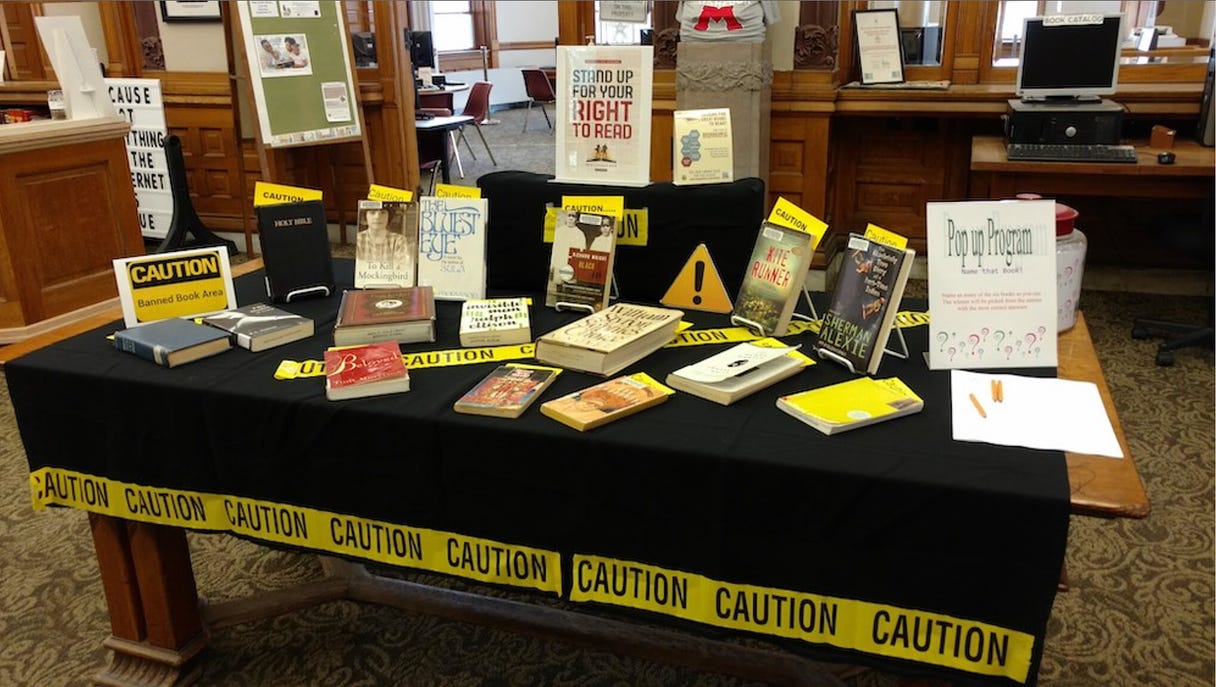
A display protesting book bans and restrictions at a local library. Charles Hickley/CC BY 2.0

The goal is not just to create a hostile work environment for library staff, but also to pressure administrators to submit to corrupt tactics such as banning books on spurious grounds and accepting slanderous speech used against their colleagues.

For right-wing parents and politicians aren’t just going after books. They are also personally attacking library employees as “groomers” who encourage inappropriate behaviors and relationships with children.

Associating LGBTQ individuals and their allies with pedophilia is an established strategy among the global right, including in Viktor Orban’s Hungary. And Vladimir Putin uses fake sex-crime charges to imprison researchers who are writing about things he wants buried.

Ideological fanaticism spurs attempts to dig into librarians’ private lives and harass them so they will resign. In Virginia Beach, GOP state representative Tim Anderson filed a FOIA Act request in May 2022 to learn the identities of librarians at schools that had materials some parents saw as sexually explicit.

It also lies behind attempts to criminalizelibrarians. In Clinton Township, NJ, the police department received a request for criminal charges to be made against librarians whose institutions had books with “obscene” content. And some states are challenging laws that shield teachers, researchers and librarians from prosecution. An Oklahoma law removed exemptions for teachers and librarians “from prosecution for willful violations of state law prohibiting indecent exposure to obscene material or child pornography.”

Unsurprisingly, many librarians have left their jobs. Some have resigned, others have been fired for refusing to remove books from their collections. Wilson-Youngblood, a 19-year veteran of the Keller school district, resigned due to the stress of working in a hostile environment. In small towns such as Vinton, Iowa, the library itself has had to close for lack of staffing.

Vinton’s fate may portend the future, since the number of groups targeted for censorship is bound to expand. In Vinton, right-wing activists not only objected to the presence of LGBTQ staff and LGBTQ-themed books, but displays of books by Vice President Kamala Harris and First Lady Jill Biden. For radicalized Republicans, Democrats are not just people with different opinions, but political enemies whose ideas should be banned.

Luckily, the digitization of books makes it hard for total bans on content for children to stick. The Brooklyn Public Library’s Books UnBannedprogram offers a free library card to people aged 13 to 21 across the U.S. so they can check out books digitally.

Yet libraries and librarians urgently need our support. Contacting your town or school administration to express solidarity and approval with current policies is one way you can push back. Another is to step up as a volunteer or even run for office on a town or school board that has oversight on library issues.

What Amanda Litman, executive director and co-founder of Run For Something, said about school boards in our interview is also true of libraries. They play “a foundational role in determining the kinds of citizens that kids ultimately become.” Libraries, and librarians, are essential to a healthy democratic society.

Michael Tomasky, the editor of The New Republic, summarizes the war against public education and why it is so crucial to our society. Yes, everyone must support public schools, whether or not they have children. Everyone must pay to educate all children. Because doing so is for the good of society!

Tomasky is a public school parent. He read the article about the effort by Free Staters to defund the public schools in Croydon, New Hampshire, and he was appalled. Supporting the public schools for all children is

so obviously essential to civilized life that it’s shocking we even have to defend it. But alas, because the American right wing is so bananas these days, defend it we must.

The Free Staters in New Hampshire want to live without any government. They want to live without a state. They already fired the town’s line police officer. Then they went for the town’s public school budget, proposing to cut its budget in half.

I’ve actually been wondering for many years when the right was going to get around to this line of attack. As matters stand in the United States of America, and as far as I know more or less everywhere in the developed world, education is paid for by the state—either mostly by local governments (the United States), or the national government (France). This web page gives a good summary of how public education is funded around the globe. It’s a fairly recent consensus in historical terms—only in the last half of the twentieth century have countries like Brazil, India, and Colombia come to accept that they have to pay the freight for universal education. But accept it they have. As a result, educational inequality around the world has decreased dramatically.

In the U.S., of course, public education is mostly funded by property taxes and financed by local governments. There are problems with this, as there are with any system invented by imperfect human beings, the main one being that rich districts have a lot more money and thus much better schools; but even still, the good part is that we as a society accept the idea that we all have to contribute. It does not matterwhether you have children in the schools. The principle is that even if you are childless, or your children have grown and gone to college, or you send them to private school, or school them yourself at home, you still pay, and you pay because you benefit from a well-educated populace.

I live in Montgomery County, Maryland, home to great schools and high taxes. My daughter happens to go to a public school that is excellent (and happily just up the street). But even if I had no daughter, or sent her to a private school, I would still agree that it was my responsibility to pay for the great public schools my county offers children. It makes for a better county, a better class of citizen, a better nation.

This is a core principle of civilized society: We all contribute to certain activities that have clear universal social benefit. To use Underwood’s sick terminology, that guy pays for that guy’s child to be educated because the first guy benefits when the second guy’s kid is learning math and science and pondering Hamlet’s soliloquy and being prepared for responsible, productive adulthood. Anyone who can’t see that connection is a selfish prick. And if nothing else, even selfish pricks ought to be able to see that good schools increase the value of their homes.The question of political philosophy is this: What is the common good—what must it include, and what is each citizen’s responsibility toward securing it? We decided in the U.S. a little more than a century ago that universal public education, free to every child and paid for by all of us, was central to any definition of a common good. The world, as I noted above, has largely come to agree.

An educated populace serves all of us. Debates about curricula are another issue, and those debates are legitimate, as long as people aren’t lying (my daughter, who just finished sixth grade in a quite liberal school district, reports that yes, she’s learned all about Rosa Parks and so on, but no teacher has ever tried to make her feel guilty about being white).

But even both sides in that debate accept that the public schools are a common good; they just disagree about what should be taught.

More broadly, conservatives have been trying to undermine public education for 70 years now. This goes back to Brown v. Board of Education, in whose wake many Southern school districts set up all-white segregation academies or in some cases stopped collecting the local taxes that supported public schools (it took a Supreme Court decision in 1968, a full 14 years after Brown,to end the most egregious forms of that racist mischief).

Then, starting in earnest in the 1980s, under Reagan-era education secretary and insufferable moral crusader Bill “Snake Eyes”Bennett, the right promoted school vouchers and charter schools, both of which, numerous studies have found, have simply not been the panacea the right advertised them to be. Right-wing rich people and foundations have spent God knows how many millions since then promoting these private educational alternatives. That’s their right, of course. But imagine if they’d spent those millions trying to shore up public schools in poor districts, or financing early reading programs for poor children from Harlem to eastern Kentucky to the reservations of Arizona. The country would be so much better off.

The Free Staters failed in Croydon. The small population mobilized to save their schools.

I expect the coming years will see the mainstreaming of the argument that people who aren’t parents of public-school children shouldn’t have to pay for schools. Liberals must fight back tooth and nail, and not on some statistical point cooked up by some timid pollster, but at the very philosophical root of the argument. We cannot retreat from a century-old consensus that has done the nation enormous good.

  @mtomasky

Michael Tomasky is the editor of The New Republic.

The Supreme Court’s Holy War Against Public Schools

Katherine Stewart

How Leonard Leo Became the Grey Cardinal of the American Right

I posted that Beto O’Rourke would have a discussion about Educatuon in Lubbock, Texas, tomorrow evening. This is true.

But the meeting will be in-person, NOT ON ZOOM.

If the meeting is recorded, I will post it here.

Former Governor Jim Hunt, a Democrat, is one of the most respected figures in North Carolina on the subject of education. As teacher Justin Parmenter explains in this post, Governor Hunt was a true education reformer who cared about students, teachers, and public schools.

Parmenter writes:

Among others, those initiatives include beginning the Smart Start Pre-K program, putting a full-time teaching assistant in every grade 1-3 classroom, establishing the North Carolina School of Science and Mathematics, and creating the National Board for Professional Teaching Standards (as a personal aside I’d like to add that I am grateful and proud to have been a National Board Certified Teacher since 2006).

Under Hunt’s leadership, teacher pay in North Carolina rose to 19th nationwide, coming within about $2000 of the national average during the 2001-02 school year. The state currently ranks 39th.

Since 2010, North Carolina has been controlled by Tea Party zealots in the legislature, who devoutly believe in charters and vouchers.

Many educators were surprised when Governor Hunt agreed to join a panel that was planning to change the compensation of teachers and tie it to test scores. Perhaps Governor Hunt thought he could steer the group towards sensible solutions, like raising teacher pay to the national average.

But he announced he was quitting the coalition. He must have realized that the state commissioner and her minions were wedded to merit pay.

Parmenter writes:

Governor Jim Hunt has withdrawn as honorary co-chair of the UpliftEd Coalition, a group which will promote a controversial plan to do away with experience-based teacher compensation and replace it with a system of merit pay.

The Pathways to Excellence proposal, currently being worked on by the Professional Educator Preparation and Standards Commission (PEPSC), has proven deeply unpopular with North Carolina educators since it became public earlier this year.

Governor Hunt called on the coalition to draw upon the knowledge of teachers and listen to them.

That’s a novel idea! They are probably listening to the business community, which always complains that teachers are overpaid.

I would recommend that they read my book Reign of Error, in which I thoroughly debunk merit pay. It has been tried again and again for a century, and it has never worked. It’s one of those zombie ideas that never works and never dies.

Dr. Charles Foster Johnson is hosting a conversation with Beto O’Rourke in Lubbock, Texas, on Zoom this Thursday.

4:30-6:00 pm CDT (central time).

They will discuss the future of public education in Texas.

https://www.eventbrite.com/e/a-conversation-about-public-education-with-beto-orourke-tickets-384095880117

The event is free.

A few months ago, Christopher Rufo gave a speech at Hillsdale College that he called “Laying Siege to the Institutions.” I listened and was appalled by his claim that society was in desperate trouble because of the ascendance of 1960’s radicals, that public schools were the root of all evil, that such public schools needed to be replaced by unfettered school choice, and that what we need is to return to the good old days of 1776.

Peter Greene listened to Rufo’s immortal words, and he gave them a close reading. He concluded that Rufo wants to eliminate public schools, oust the radicals who took over all the important institutions, and take charge of them himself with his allies.

Greene ends his piece as follows:

The short form of all this is that radicals from 1968 gave up the violent overthrow of the US and–somehow–a couple dozen of them managed to take over every single institution in the country as well as transforming from scruffy radicals into elites. Rather than chase them out, we should trash the institutions they poisoned and start over, with freedom-loving ordinary people. 

So, several thoughts.

First, why settle on 1968 for your big year, as if you weren’t repeating themes from 1950s McCarthyism or 1930s Red Scares or anarchism freakouts from earlier still. Is your audience conservative Boomers who always hated those long-haired hippy commie weirdos? 

There’s a lot of internal inconsistency here. Some serves a narrative purpose; those shadowy elite ideologues who took over the country need to be both super-powerful (because we need to be justified in Getting Them and also, that beautiful victim card) and a tiny group (there’s more of us Real Americans than them). 

Other inconsistencies aren’t really inconsistencies, but tells. Your side is ideologues; my side has values. When you use the “levers of power” you are oppressive and evil, but when we get our hands on them, we will use them to enforce our will. That is only inconsistent if you think some sort of principle should be involved here, but the only principle involved is “People like me should be empowered to enforce our will on others, because our will is righteous true and serves us.” Break corporations and make them support your view. Fund only the institutions that say what you agree with.  The answer to the oft asked question, “Why is that wrong when I do it but right when you do it” will always be “Because we are right and you are wrong.” 

Or, as Frank Wilhoit puts it:

Conservatism consists of exactly one proposition, to wit: There must be in-groups whom the law protects but does not bind, alongside out-groups whom the law binds but does not protect.

Rufo doesn’t represent any sort of conservatism I recognize, but that’s the mask they’re wearing these days. 

The other thing striking about Rufo is how overtly and deliberately political he is (Politics is “the business of getting power and privilege without possessing merit” –P. J. O’Rourke). All of this is about using words and forming phrases to leverage and accumulate power, taking positions and maneuvering around your opponent. The people on the other side are not actual human beings; they have no good intentions, no legitimate concerns. In fact, none of this has to do with people with actual honest concerns or differences. Rufo doesn’t invoke ordinary people with some sense of who they are and what they want and need, but because invoking them gives an argument some extra weight and helps build a winning frame. 

Certainly there’s no thought about a institution-free society. Rufo talks as if we just cut all the supports and let everyone be free, as if that wouldn’t result in a society in which people were only as free as their bank accounts allowed them to be. Rufo and his crowd would be plenty free.

There’s certainly no concern about the larger effects of these tactics. What happens, for instance, in a society where trust has been systematically crushed and undermined? Nothing good, I’m betting, but Rufo’s perfectly happy to go there, and increasingly others are willing to go there with him (here’s Laura Ingraham calling for an end to public education).

I’ve sparred and chatted with plenty of folks on the other sides of these issues over the years. Over the last decade they have become even less likely to demonize opponents, more likely to see nuance and issues on all sides, even when they disagree. They have been mostly conservatives, with a conservative’s natural tendency to want to preserve things. Maybe I’ve been naive to think that some of them were never going to go this far, even as I’ve understood that much of them have been pointing in this direction, and many of the folks financing the movement wanted exactly this. But I wonder what they think privately of this new slash and burn addition to the crew.

Rufo represents an extreme version of ideas that have long been around, like the idea that public education is just a scam so that the teachers union can get teachers jobs thereby resulting in dues that fill the coffers of the unions which are just fronts for the Democratic party. Or the idea that if government went away (and stopped making me pay taxes to support Those People) then we would all live in a happy paradise of freedom. Or that a bunch of stuff (under the umbrella of anything from evolution to segregation to CRT) is being taught to undermine my view of the world and make my kids think stuff I disagree with. 

Like his buddy DeSantis, Rufo is not so much about conservatism as he is about authoritarianism, about christianist-fueled control or replacement of all institutions (and do notice–Rufo does not distinguish between public institutions and private corporations–he wants to run them all). This is aggressive, smart authoritarianism that only really has one question to ask before it either lifts you up or smashed you– are you on their side? Trumpsim was just some throat-clearing for these folks; soon I’m afraid they’ll be in fuvoice. 

I recommend that you read Greene’s piece in full.

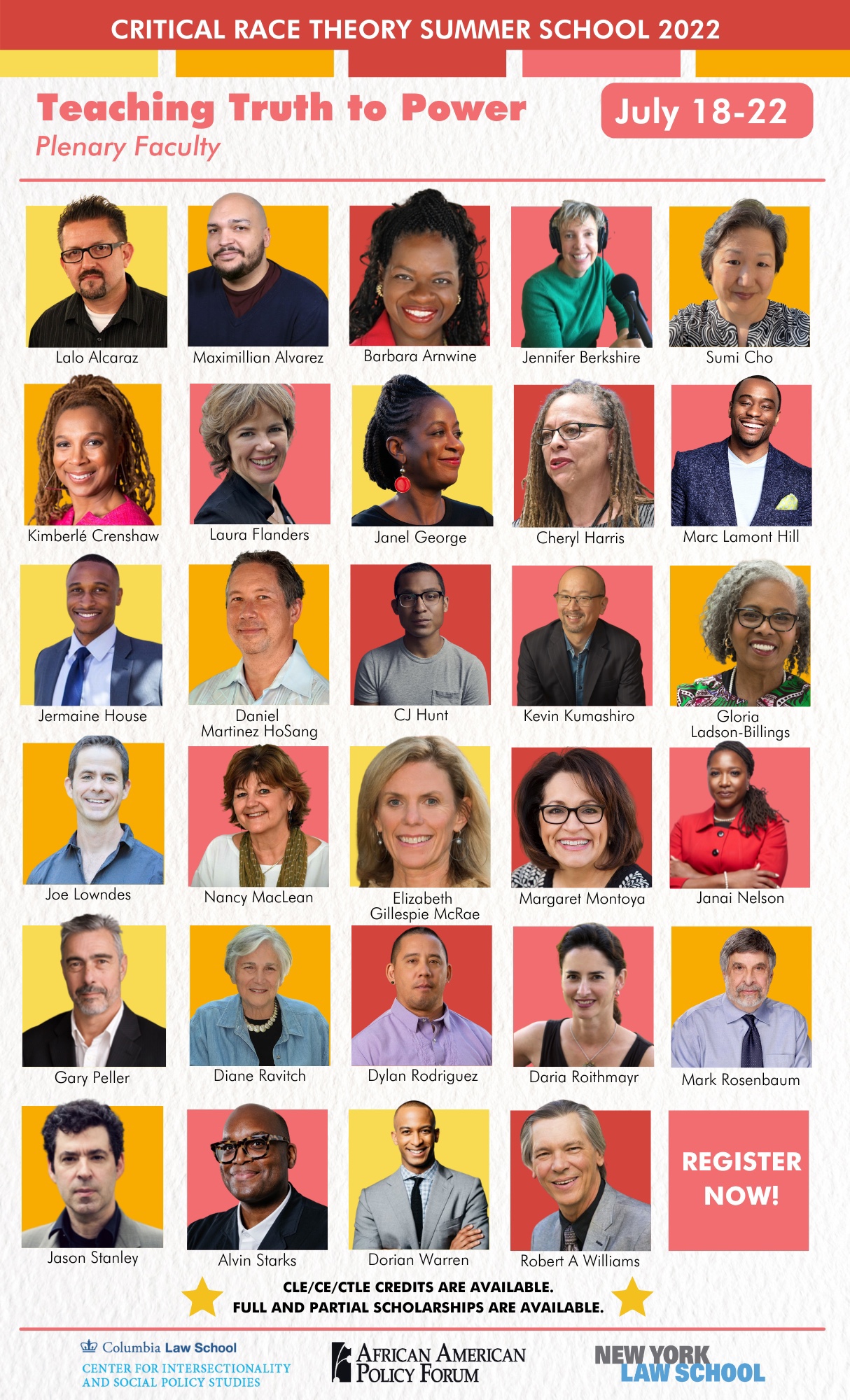
I will be a participant in a summer school program on Critical Race Theory. You are invited to sign up. I am part of the panel on July 20.

Greetings Friends and Colleagues, 

The African American Policy Forum is so excited to be Teaching Truth to Power this year at Critical Race Theory Summer School! It is crucial that we prepare racial justice advocates to defend the right to teach truth in classrooms. This powerful and urgent program runs July 18 to July 22, 2022. 

Seats are limited, so register here today! Events will be held daily between 1 p.m. to 6 p.m. ET throughout the week. Be sure to sign up for our listserv so that you don’t miss any updates. 

CRT Summer School 2022 will include a variety of plenaries, breakout sessions, and networking opportunities aimed to inform, activate, and inspire. We’re inviting parents, educators, students, social workers, legal practitioners, media professionals and concerned community members from all walks of life, because there is something for anyone to learn from the sheer breadth of options available this year! 

Daily Plenary Sessions

July 18 – Everyday CRT: A Commonsense Framework for Racial Liberation

July 19 – Public Schools, Private Agendas: How the Assault on Racial Justice Undermines Education

July 20 – Strange Bedfellows: The Left/Right Convergence that Enabled the Normalization of White Nationalism

July 21 – Define, Do Not Defend: How to Resist the Disinformation Campaign Against CRT

July 22 – Transforming a Moment to a Movement: Building A New Coalition to Secure our Multiracial Democracy

Discounts and Purchase Orders

Group sales (registration in increments of ten and five) are available and yield a 25% discount. For Purchase Orders please contact crt@aapf.org for more information.

Individual recipients of this email are eligible for a 10% discount using the following code during check-out: TSICAF-992000-IWANJ.

Full and partial scholarships are available. For more information visit our website: www.aapf.org/crtsummerschool.

On Demand Content

Great news! This year, all CRT Summer School content will be available to all registrants after the close of the event until Labor Day. You can watch anything you missed or revisit your favorites to ensure that you are a prepared racial justice advocate ready to defend the right to teach truth in schools.

We hope to see you at CRT-SS 2022! Please also share this email with your network – friends, colleagues, and constituents.

Onward,

African American Policy Forum

#TruthBeTold

As a high school teacher in Louisiana, Mercedes Schneider has followed John White’s meteoric career with interest. He started in education as part of Teach for America, then gained a leadership role in TFA. Vaulted up the ladder of success working for Joel Klein’s administration in New York City. Quickly was named Superintendent of Schools in all-charter New Orleans. And in a flash, he was State Superintendent of Education in Louisiana. He insisted he was a “teacher at heart.” But Mercedes now finds that he is selling Common-Core aligned Eureka Math.

She writes:

White is an education opportunist at heart. Prior to his exit as Louisiana state superintendent, White started a nonprofit, Propel America, with fellow TFA alum Paymon Rouhanifard, and while still Louisiana superintendent, contracted with two Louisiana districts to pilot his product and apparently blindsiding then-state board president, Gary Jones, with the decision...

The 2018-19 school year was White’s last full school year as state superintendent. On January 08, 2020, White announced his resignation effective March 11, 2020.

Even as he touted his accomplishments, White, who was leaving mid-school-year, included no mention of a subsequent professional destination.

According to his LinkedIn bio, the Waltons picked up the tab for him, providing income for his as a Walton Family Foundation “fellow” from April 2020 to the present (July 2022).

Of course, White also had his own consulting firm, Watershed Advisors, which provides a place for a number of his former-La.-Dept.-of-Ed. cronies to land (or at least to provide indispensable resume decor to make the floundering professional seem busy climbing some ladder).

White also mentions being a member of the education advisory council to flagship in incompetence at a price, consulting firm, Alvarez and Marsal. Lots of background here. Alvarez and Marsal have their controversial fingerprints on Louisiana, New York, St. Louis, Montana, Rhode Island, and DC….

In DC, Alvarez and Marsal was hired to investigate cheating under then-chancellor (and former TFAer) Michelle Rhee, the March 08, 2012, Washington Post observes, “It is not known how much experience Alvarez and Marsal has in test security.” None. But that is how education opportunism works– just get the contract, charge the fees, offer something (or nothing, or chaos), then leave.

Education opportunism. And the findest of education opportunists, John White, is on this opportunistic business’ education advisory counsel. Perfect resume dressing.

Ahh, but “teacher at heart” White has found his place, in curriculum sales for Common-Core-associated Great Minds.