Archives for category: Education Reform

Robert Hubbell wrote on his blog that pundits predicted that the overturning of Roe v. Wade wouldn’t change anything. Team Red and Team Blue were locked into place. Dobbs wouldn’t make a difference.

Hubbell said: Kansas proved the pundits were wrong.

The old rules no longer apply. While it is still too early to understand the full ramifications of the resounding defeat suffered by anti-choice Republicans in Kansas, this much is clear: Polling models based on “historical data” are broken. Pundits rely on those models at their peril. Three months ago, after the leak of the draft opinion in Dobbs, Sarah Isgur published an op-ed in Politico, Opinion | Abortion Might Not Be the Wedge Issue It Used to Be. Isgur wrote,

          After years of partisan sorting on abortion, there probably aren’t many voters motivated by that issue left to turn out.

Isgur was about as wrong as she could be in her prediction. In her defense, she was undoubtedly applying the “old rules”—the ones that applied before the Supreme Court gave states control over women’s reproductive choices. But Isgur’s failure of imagination prevented her from seeing that “this time is different.” Early data from Kansas proves just how different it is. See Vox, 4 charts that show just how big abortion won in Kansas.

The article in Vox illustrates the many ways in which Isgur (and other pundits) were wrong. The first relates to the mistaken notion that reproductive freedom will not motivate turnout. That myth was dispelled by the largest turnout in Kansas history in a primary election—nearly double the normal turnout. See Chart 1 in Vox. No polling model assumed a 100% increase in turnout. The old rules no longer apply.

The second myth destroyed in Kansas was that “partisan sorting” had divided America into a “red team” and a “blue team” on abortion. Wrong. One reason for the substantial margin of victory for choice in Kansas was that 90,000 Republicans switched from the “red team” to the “blue team” on the abortion issue. Only 25% of voters in Kansas are registered Democrats, but the measure was defeated by 59% to 41%. See Charts 2 and 3 in Vox. The old rules no longer apply.

The third myth destroyed in Kansas was that reproductive choice would not motivate women to register and vote in larger numbers. Wrong, again. The final chart in the Vox article shows that before the leak of the draft opinion in Dobbs, women accounted for 52% of new voter registrations. After the release of the draft, women accounted for 58% of new registrations, and after the release of the final opinion in Dobbs, women accounted for 68% of new voter registrations. It turns out that telling women they are second-class citizens gets their attention. The old rules no longer apply.

The pundit class has risen to its collective defense by dampening expectations that the result in Kansas will apply in the midterms. In pundit-speak, the vote in Kansas was an “issues vote,” while the vote in November will be an “electoral vote,” i.e, a vote on candidates, not on issues. As explained in a Washington Post analysis of the outcome in Kansas,

“There is a big difference between asking people to weigh in on an issue and asking them to weigh in on a candidate who embodies a range of issue positions.

The WaPo analysis concludes with this assertion:

          I have highlighted the key phrase in the WaPo analysis above: “Rarely”—an explicit invocation of history and the “old rules” governing turnout in midterms. Pundits were caught off-guard by what happened in Kansas and are busy tut-tutting and tsk-tsking those who believe that the firmament has shifted. Democrats don’t need a 17% margin of victory (as in Kansas) to overturn “conventional wisdom” in the midterms. A 3% uptick for Democrats will produce a seismic shock in the midterms, leaving the pundits sputtering a new round of excuses and post-facto rationalizations.

“For many on the left, the results in Kansas were a reminder of precisely that point: Turnout matters. But electoral politics are rarely downstream from views on one single issue.”

Here’s my point: The victory in Kansas guarantees Democrats nothing, but it gives us reason to hope and reminds us once again that we are in uncharted waters—where existing maps are useless. Conventional wisdom is dead. We are not prisoners of the past and our choices are not controlled by massive datasets that describe behavior before Dobbs, before Bruen, and before January 6th. We control our fate going forward. Don’t let anyone tell you differently.
Sue Legg, a retired faculty member at the University of Florida and a member of the board of directors at the Network for Public Education, published an article in The Gainesville Sun about Governor Ron DeSantis’s takeover of the state’s civics curriculum. The old-style Republicans believed in leaving teachers alone and letting them to their job. The new-style, Trumpist Republicans believe that they must tell teachers what to teach.

DeSantis is a busy guy, so he has outsourced the Florida civics curriculum to Hillsdale College, the go-to evangelical college that tells conservative leaders what to think and converts it into a school curriculum.

The state’s new civics curriculum is expected to be in place by 2024.

It is difficult to believe that a small college in Michigan could impact Florida’s students at both the K-12 and postsecondary levels, but it has. DeSantis’ measures to revise the state standards for civics (HB 5), K-12 social studies (SB 1108), and postsecondary requirements regarding diversity of opinions (HB 233) are indicators.

Teacher training workshops are held to make the curriculum “more patriotic.” These changes were reviewed and modified by Hillsdale College. A new University of Florida Hamilton Institutewas funded by the Florida Legislature to develop civics courses at the college level. DeSantis has announced the creation of three community college civics career academies to train students to work in local government. 

Count on Ron DeSantis to encourage a “diversity of opinions,” not! When DeSantis gets involved, it is his way or the highway.

Chris Rufo is the rightwing propagandist who has made it his mission to lead the charge against America’s public schools, the schools that educated 90% of the American people, the schools that educated “the greatest generation,” the schools that have enabled people of different races, religions, and ethnic group to join together as one people.

Rufo wants to destroy public schools and replace them with publicly-funded school choice: religious schools, private schools, homeschooling–anything but community-owned and community-led public schools. He wants your public dollars to pay for religious schools that indoctrinate children, for private schools that discriminate against the children they don’t want, and for home schools where education is defined by the knowledge or ignorance of parents. He actually doesn’t care about education at all. He doesn’t want to see young people inspired by knowledgable teachers. His goal is destruction.

He wrote in a recent tweet (@realchrisrufo):

We’re building the narrative that public schools are translating the principles of academic Queer Theory into the K-12 curriculum. Our Portland story generated 25+ million media impressions this week—and we’re going to drop another story every Wednesday through September.

Rufo adds a graphic in which he accuses the Portland, Oregon, school district of indoctrinating students to become LGBT activists in kindergarten through fifth grade. Sample: “Latest: They’re Teaching Five Genders in Kindergarten.” And, “In Portland, the Sexual Revolution Begins in Kindergarten.” Rufo is quoted on the usual rightwing websites and has appeared on FOX News to spew his message of hatred for public schools.

Someone on Twitter referred to Rufo as “the American Goebbels.” I wonder if Rufo knows who that is? He was not well educated. Probably indoctrinated.

Jennifer Berkshire inquires into why so many Democratic leaders and pundits have refused to defend public schools, even though most parents are satisfied with their public schools. As the public schools are blamed for all the evils of modern life by extremists like Chris Rufo, Democrats refuse to stand up for the public schools. She explores why in this article.

Parents are not abandoning the public schools, but Democratic politicians are.

She begins:

Last spring, taking a break from waging conspiratorial campaigns against the republic, an assortment of luminaries associated with the Claremont Institute gathered to lay out a plan to foment a culture war against the nation’s schools. The Clubhouse event, entitled “Building A New Right: Red States vs. Wokeness,” featured a grab bag of Claremont fellows and friends. The star attraction was Manhattan Institute agitprop specialist Christopher Rufo, chief sower of the panics against critical race theory (CRT) and “grooming.”

In a now familiar exercise, Rufo sketched out his campaign to make CRT toxic as part of a larger propaganda war against public institutions. The ultimate goal, he explained, was essentially to do away with those institutions and redirect school funding to families and individuals based on their “values.” Rufo waxed apocalyptic about the scourge of “wokeness,” and yet he struck a hopeful note. After all, he reminded listeners, it had only taken the country a few years to go from the Black Panthers to Nixon.

In the ensuing months, Rufo’s propaganda campaign would grow increasingly lurid, but on this occasion, he urged his audience to raise the discussion to a higher level. Focus on “excellence,” he admonished them, and attack public schools for failing to meet that standard. Conservative communications guru David Reaboi, who helped seed a previous moral panic on the right against the sinister spread of Sharia law, weighed in with some messaging advice of his own: Go full bore against the teachers unions. Do damage.

Today, this coordinated plan to wage a public relations war against the nation’s public schools is an undeniable success. Forty-two states have moved to restrict teaching about oppression, race or gender. According to one estimate, more than one third of students in the country attend school in a state where educators are now subject to some kind of classroom gag order.

The achievement of Rufo and his allies is all the more astonishing, given the deep unpopularity of the policies they champion. Polls consistently show that voters across party lines are repelled by the GOP’s education extremism. Across the chasm of our current political divide, bipartisan majorities are largely in agreement that banning books and gagging teachers is bad.

And for all of the insurgent right’s bold rhetoric about mining parent outrage for electoral gold, the polls that matter most have shown remarkably poor results for candidates running on scorched-earth education platforms. In New Hampshire, New York, Montana, Georgia, Wisconsin and beyond, voters are rejectingright-wing culture warriors, often by wide margins—a movement that might be summed up as “keeping the crazy away from the kids.”

There’s just one problem, though: The leadership of the Democratic party doesn’t seem to have gotten the memo.

The Miami-Dade School Board voted to reject a sex-education textbook for middle- and high school students. The district will have no textbook for this subject for several months—until a new one is located or until the current one is stripped of all offending content.

In a narrowly divided vote, the Miami-Dade School Board Wednesday reversed its decision to adopt a new sex education textbook for the 2022-23 school year — a move that leaves the district with no sexual education curriculum for at least four to eight months.

The 5-4 vote followed an emotionally charged public comment period that included community members being escorted out of the building and a multi-hour board discussion that strongly paralleled the discussion it previously had in April, when members initially adopted the material in a 5-3 vote….

The book, “Comprehensive Health Skills,” which comes with a version for middle school and one for high school classes and offers research-based health education with topics such as nutrition, physical activity and sexually transmitted diseases, would have addressed the district’s units of study for Human Reproduction and Disease Education for grades six through 12.

But the materials soon came under fire from some parents and community members who argued the lessons were not age appropriate and violated the state’s parental rights law, which Gov. Ron DeSantis signed into law in March and which critics have dubbed the ‘Don’t say gay’ bill. They also argued the district’s process lacked transparency.

The pushback included the filing of 278 petitions objecting to the materials and resulted in Miami-Dade Superintendent José Dotres selecting a hearing officer to conduct a public hearing to review the concerns and the materials in question

That hearing, which was conducted on June 8, resulted in the hearing officer recommending the board “deny the petitions and proceed with the adoption process,” according to the district.

This is not the first time school textbooks have been questioned. Earlier this year, the Florida Department of Education announced it was rejecting 54 math textbooks in the state’s public schools, claiming the books contained “prohibited topics,’’ including critical race theory.

“I’m deeply disappointed by today’s decision. I hoped that Miami’s School Board would step up to protect youth in times of crisis,” said Kat Duesterhaus, a board member of Florida NOW and Miami Coalition to Advance Racial Equity. Not only does providing comprehensive sexual education help prevent sexually transmitted diseases, sexually transmitted infections and unwanted teen pregnancy, it’s also important to “building bodily autonomy,” which is important for teens to prevent and identify instances of sexual assault, Duesterhaus said. “We need to equip youth with the ability to navigate their own bodies and consensual situations,” Duesterhaus added. “We’re leaving them ill equipped to have agency of their sexuality and bodies.”

For those who opposed the adoption, the content under question was either inappropriate or “not scientifically factual,” such as vaccinations being the only proven method from viral disease, a notion they would challenge, Alex Serrano, the county director for County Citizens Defending Freedom, told reporters before the meeting Wednesday. Serrano has no children in the district and sends his children to Centner Academy, the Miami private school that last year said teachers and students who got vaccinated for COVID-19 could not interact with students and would risk losing their job.

“We are not against sexual education or human reproduction and sexual education books,” Serrano said. “We are for statutory compliance and age appropriateness in the content … and compliance with parental rights law.” Discussions regarding gender ideology “do not belong” in the books. “That is ideology,” he said. Others who spoke against the adoption also cited their contempt with the books’ discussion of gender identity and sexual orientation as reasons to oppose the materials. But in the board’s decision in April, members agreed to remove the chapter called “Understanding Sexuality” from both middle and high school textbooks, which would have discussed those topics.

More than 40 people — parents, students and community members — signed up to speak on Wednesday. Of those, 38 asked the board to adopt the recommendation given by the hearing officer, according to Vice Chair Steve Gallon III’s count. Just four urged against doing so. “That’s 90% of the speakers that spoke today. You do the math,” he said on the dais. “That data for me provides a greater opportunity to debunk and denounce this narrative that there’s this broad opposition to the board’s adoption of these materials.”

Most people in favor of the textbooks cited the urgent need to provide this information to students. Some pointed to research that found students who receive quality sexual health education choose abstinence longer and have fewer rates of unplanned pregnancies. Others said the materials provide a safe environment for students to learn factual, scientific information and give them the understanding to prevent instances of sexual violence.

Read more at: https://www.miamiherald.com/article263649763.html#storylink=cpy

The school board will meet again to reconsider the issue because the district is now out of compliance with state requirements.

The Miami-Dade County School Board is meeting on Thursday to “assess the potential impact” of its decision to reject the adoption of a comprehensive health and sex-education textbook for middle and high school students. The 5-4 vote effectively removed sexual education curriculum for middle and high school students for at least four to eight months and left the school district out of compliance with curriculum requirements and standards set by the Florida Department of Education….

“The issue at hand, as reflected in the item, is compliance with the Florida Department of Education,” Chairwoman Perla Tabares Hantman said in a statement. The requirements are different for each grade level and everything must be “grade-appropriate.”

Still, she added, “above everything, we must respect parental rights. Parents play an essential role in the education of their children. Parental rights are the bedrock of our school district. Rest assured that this School Board is committed to respecting the rights of parents to make decisions regarding the education of their children.”

The special meeting — scheduled for Thursday at noon — is expected to draw many more parents and community members than last week, said Gina Vinueza, a district parent and one of the organizers behind a petition, Save Sex-Ed in Miami-Dade.

Last week, more than 40 parents, community members and organization representatives flocked to the meeting to speak on the curriculum adoption. Of those who spoke, 38 urged the board to adopt the recommendation given by the hearing officer, according to Vice Chair Steve Gallon III’s count; just four spoke against doing so.

Here is the puzzle: which parent voices count? The board listened to parents opposed to the textbook. The board did not listen to the parents who support the textbook.

Why does the board decide to side with some parents while ignoring others?

Read more at: https://www.miamiherald.com/news/local/education/article263887237.html#storylink=cpy

Andrea Gabor is the Bloomberg Professor of Bisiness Journalism at Baruch College of the Coty University of New York.

Nearly all of the 20 largest US school districts will offer online schooling options this fall. Over half of them will be offering more full-time virtual school programs than they did before the pandemic. The trend seems likely to continue or accelerate, according to an analysis by Chalkbeat.

That’s a problem. School closings over the last two years have inflicted severe educational and emotional damage on American students. Schools should now be focusing on creative ways to fill classrooms, socialize kids and convey the joy of collaborative learning — not on providing opportunities to stay home.

Historically, various forces have pushed for online education — not all of them focused on improving education. These include: the quest for cheaper, more efficient modes of schooling; the push to limit the influence of teachers unions by concentrating virtual teachers in non-union states; and a variety of medical and social factors that lead some students and families to prefer online learning.

Since the pandemic, some virtual programs have reasonably stressed medically fragile students. But others are seizing on online education in a rushed effort to shore up public-school enrollments, which plummeted in some cities. The prevalence of these programs in Los AngelesPhiladelphiaDallas and New York is particularly worrying, as they target poor and minority students who are likely to be particularly ill-served by online school options.

A new study shows that while young children, especially, are bouncing back from the pandemic-era academic doldrums, the gap between high-poverty and low-poverty schools remains greater than it was pre-pandemic.

Research, where it exists, shows consistently worse educational outcomes for online schools than for traditional public schools.

Students in cyber schools do their coursework mostly from home and over the internet, with teachers often located in different states and time zones. There is little comprehensive information about the curricula, student-teacher ratios, how much actual teaching occurs, or what if any academic supports are provided by the schools.The adverse impact of the pandemic on the emotional well-being and social skills of children — one-third of school leaders reported a surge in disruptive student behavior during the past school year — is a cautionary lesson for online learning.

Graham Browne, the founder of Forte Preparatory Academy, an independent charter school in Queens, New York, said recently that he saw a sharp increase in “aggressive or threatening” behavior, especially among 6th graders who spent much of the previous two years online.

During a recent multi-day field trip to a camp run by the Fresh Air Fund, Browne said he noticed that during team-building exercises, such as figuring out how to carry a large object over a low bridge, students resorted to screaming at each other. Previously, he said, they would have worked out a strategy for maneuvering the object together.

Equally concerning, when the school offered an online option during the 2020-2021 school year, Browne found that close to half of his highest achieving 8th graders — those taking algebra rather than pre-algebra — selected the option because it gave them the flexibility to pursue academics at their own pace.

“Our school is small, so having such a large portion of high-performing students out of the building has an impact on peer tutoring, student morale, and a culture of team building that we emphasize at school,” Browne said.

Opinion. Data. More Data.Get the most important Bloomberg Opinion pieces in one email.EmailBy submitting my information, I agree to the Privacy Policy and Terms of Service and to receive offers and promotions from Bloomberg.

The most immediate threat, however, comes from the private sector and especially from for-profit virtual charter schools, which are of notoriously poor quality; just 30% met state school-performance standards, compared with 53% for district-run virtual schools before the pandemic. These schools, which spend heavily on advertising, boomed during school lockdowns, when traditional schools were struggling to offer online instruction. At the nation’s largest for-profit network, enrollment grew 45% to 157,000 students during the past year.

What kids need most are robust in-person learning opportunities and the chance to experiment. Schools also need to maintain reassuring safety protocols as Covid-19 variants continue to spread.

This is the time for schools to adopt engaging learning approaches, such those of a high-poverty school in the Bronx that uses the Bronx River as a science laboratory, and of the Leander, Texas school district that turned over the development of an anti-bullying strategy to high school students, in the process building young leaders.

Some of these projects could be adapted to a hybrid format by giving students the option to do some work remotely, while also emphasizing in-person collaboration.

What makes no educational sense is the rush to embrace online schooling. Experience has demonstrated its severe disadvantages. State oversight isn’t strong enough to mitigate them. Before barreling ahead, research should be financed and conducted by independent scholars to pinpoint the potential benefits. Until that happens, schools should do everything they can to keep kids in classrooms.

Hello, Democrats! Wake up!

Journalist Jennifer Berkshire and historian Jack Schneider report that voters in school board elections are not falling for rightwing slanders of their public schools and teachers!

Democrats: your best strategy for the fall elections is to campaign aggressively for public schools.

Berkshire and Schneider write that Democrats were panicked by Glenn Youngkin’s election as Governor in Virginia, which they attributed to his attacks on “critical race theory” in the schools and his pandering to far-right fake parents’ groups. Steve Bannon (and Chris Rufo) claimed that the road to a takeover was by seizing control of local school boards and destroying public schools.

Berkshire and Schneider say that their campaign is failing. Even in Trump territory, voters are supporting their public schools and rejecting the crazies.

They write:

As it turns out, GOP candidates running on scorched-earth education platforms have fared quite poorly in school board elections. In places like Georgia, Montana, New Hampshire and New York, voters have rejected culture warriors running for school board, often doing so by wide margins. A recent Ballotpedia review of more than 400 school board contests in Missouri, Oklahoma and Wisconsin found that race, gender and COVID were indeed influential in determining election outcomes, but not in the way one might expect. As they found, candidates who ran in opposition to a “conflict issue” — sexual education curricula, for instance, or a focus on race in the district — were more likely to lose their races.

Cherokee County, Ga., a rural county northwest of Atlanta, offers an instructive example. The county’s schools made national headlines recently after ProPublica reported on a group of white parents protesting the hiring of a Black educator brought on to serve as the first Diversity, Equity and Inclusion officer. Yet voters in the county, which Trump won by nearly 70 percent in 2020, overwhelmingly rejected hardline candidates for school board. A self-proclaimed family values slate, backed by the national 1776 Project PAC, and which ran in opposition to critical race theory and school district equity plans, failed to pick up a single seat.

Voters in Coweta County, Ga., sent a similar message to another slate of candidates endorsed by the 1776 Project. All four challengers were bested by board incumbents in the May primary, while a fifth — a controversial incumbent who participated in the Jan. 6 insurrection and claimed that students were being indoctrinated with critical race theory through district-provided Chromebooks — was unseated by a landslide in a runoff election in June.

It isn’t that these deep red countries have suddenly begun to turn blue. Instead, the culture war approach is falling short because Americans have direct experiences that contradict what they’re hearing from candidates.

Please open the link and read the good news for yourself.

Ruth Ben-Ghiat writes a post on her blog about threats to democracy. One of this is described in this post: the threats to libraries and librarians by extremists who want to ban books.

This essay is dedicated to librarians and library staff across America, and to a family member who worked as a library clerk in an elementary school for many years.

“It felt like a knife in my heart,” said Audrey Wilson-Youngblood, a Texas library services coordinator, of the flood of accusations from parents that she and other library staff in the Keller Independent School District harmed students by having books on LGBTQ themes in their collections.

Across the country, librarians in school and municipal libraries feel that knife being turned. Activist parents, sometimes working in conjunction with GOP politicians or right-wing groups such as Moms for Liberty, are waging an authoritarian-style assault on libraries and librarians.

When illiberal forces are on the march, the education system and any public institution that encourages independent thinking and pluralism become targets. In Texas and elsewhere, the spread of censorship, and harassment meant to silence library workers –including by labeling them as pedophiles — models the authoritarian culture the right is trying to install in America school by school and town by town.

It’s not surprising that libraries and librarians trigger the enemies of our democracy. Public libraries are places where community members of all backgrounds, political beliefs, and economic situations gather, and where elderly and lonely people can find a sense of companionship. This is why social scientists single out libraries as antidotes to the conditions that harm civic life and ultimately degrade democracy: political polarization, disinformation, economic inequality, and isolation.

School and public libraries also have long provided refuge to people of all ages with difficult home situations, and librarians can become trusted mentors and guides.

My weekly visits as a child to my own town library set me on a path of learning. The library also became a personal anchor for me when I went through a difficult period as a teenager, to the point where I took a job there as a messenger clerk, as did a close friend (who is now a member of the Lucid community).

Shelving and straightening the books, and seeing how they were treated with such care, instilled a lifelong respect for the craft of writing and a commitment to intellectual freedom that sustain me today. As my friend notes, the library was “a safe space to think and dream.”

Of course, thinking and dreaming are activities that run counter to authoritarianism: “Believe, Obey, and Fight” was the Fascist slogan. Books become threatening objects, as centuries of bookburnings by repressive political and religious entities attest.

In the US, myriad state laws and book bans seek to remove the history of White racism, slavery, and Fascist genocides from view, along with writings about LGBTQ identities and experiences. In the Keller, Texas, school system alone, as of March almost three dozen books had been sent for review by a district-formed book committee on the grounds that they are “pornographic” or will create “emotional distress.”

Florida Governor Ron DeSantis, an expert in authoritarian double-speak, calls his version of such censorship “curriculum transparency.” Yet there is nothing transparent about the process by which books are removed. As Carolyn Foote, a retired Texas librarian and co-founder of the advocacy group FReadom Fighters notes, these aggressions are about “breaking that contract of trust” between librarians and the public and degrading professional ethics.

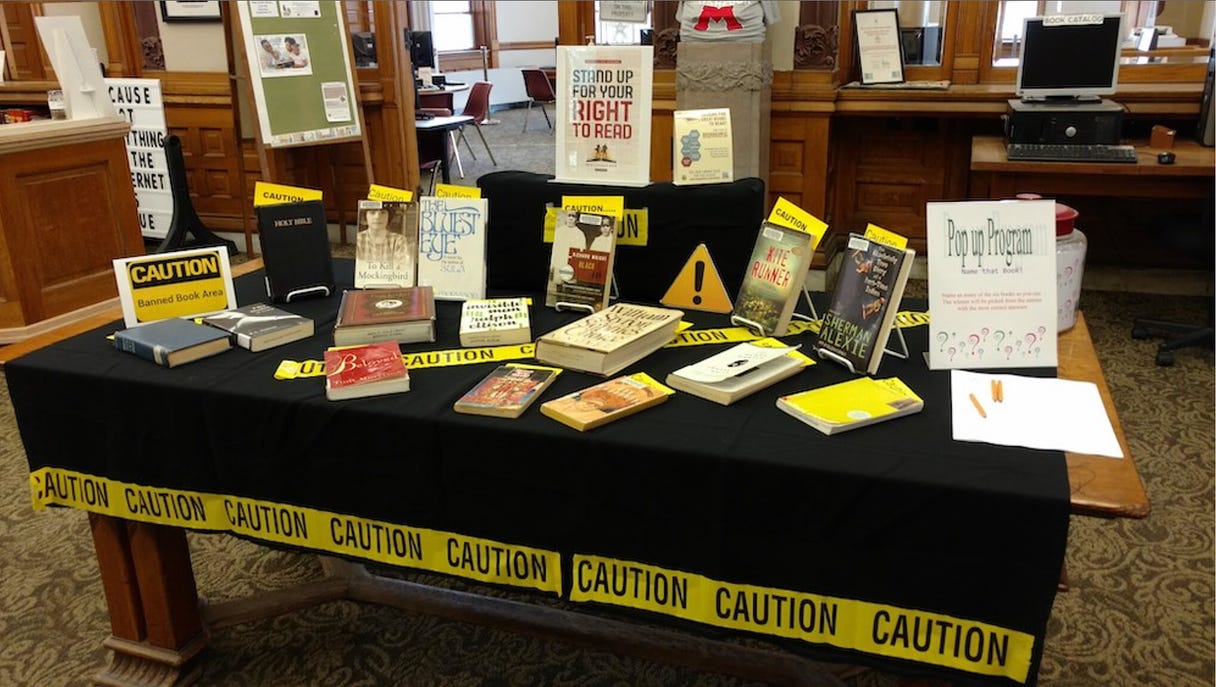
A display protesting book bans and restrictions at a local library. Charles Hickley/CC BY 2.0

The goal is not just to create a hostile work environment for library staff, but also to pressure administrators to submit to corrupt tactics such as banning books on spurious grounds and accepting slanderous speech used against their colleagues.

For right-wing parents and politicians aren’t just going after books. They are also personally attacking library employees as “groomers” who encourage inappropriate behaviors and relationships with children.

Associating LGBTQ individuals and their allies with pedophilia is an established strategy among the global right, including in Viktor Orban’s Hungary. And Vladimir Putin uses fake sex-crime charges to imprison researchers who are writing about things he wants buried.

Ideological fanaticism spurs attempts to dig into librarians’ private lives and harass them so they will resign. In Virginia Beach, GOP state representative Tim Anderson filed a FOIA Act request in May 2022 to learn the identities of librarians at schools that had materials some parents saw as sexually explicit.

It also lies behind attempts to criminalizelibrarians. In Clinton Township, NJ, the police department received a request for criminal charges to be made against librarians whose institutions had books with “obscene” content. And some states are challenging laws that shield teachers, researchers and librarians from prosecution. An Oklahoma law removed exemptions for teachers and librarians “from prosecution for willful violations of state law prohibiting indecent exposure to obscene material or child pornography.”

Unsurprisingly, many librarians have left their jobs. Some have resigned, others have been fired for refusing to remove books from their collections. Wilson-Youngblood, a 19-year veteran of the Keller school district, resigned due to the stress of working in a hostile environment. In small towns such as Vinton, Iowa, the library itself has had to close for lack of staffing.

Vinton’s fate may portend the future, since the number of groups targeted for censorship is bound to expand. In Vinton, right-wing activists not only objected to the presence of LGBTQ staff and LGBTQ-themed books, but displays of books by Vice President Kamala Harris and First Lady Jill Biden. For radicalized Republicans, Democrats are not just people with different opinions, but political enemies whose ideas should be banned.

Luckily, the digitization of books makes it hard for total bans on content for children to stick. The Brooklyn Public Library’s Books UnBannedprogram offers a free library card to people aged 13 to 21 across the U.S. so they can check out books digitally.

Yet libraries and librarians urgently need our support. Contacting your town or school administration to express solidarity and approval with current policies is one way you can push back. Another is to step up as a volunteer or even run for office on a town or school board that has oversight on library issues.

What Amanda Litman, executive director and co-founder of Run For Something, said about school boards in our interview is also true of libraries. They play “a foundational role in determining the kinds of citizens that kids ultimately become.” Libraries, and librarians, are essential to a healthy democratic society.

Michael Tomasky, the editor of The New Republic, summarizes the war against public education and why it is so crucial to our society. Yes, everyone must support public schools, whether or not they have children. Everyone must pay to educate all children. Because doing so is for the good of society!

Tomasky is a public school parent. He read the article about the effort by Free Staters to defund the public schools in Croydon, New Hampshire, and he was appalled. Supporting the public schools for all children is

so obviously essential to civilized life that it’s shocking we even have to defend it. But alas, because the American right wing is so bananas these days, defend it we must.

The Free Staters in New Hampshire want to live without any government. They want to live without a state. They already fired the town’s line police officer. Then they went for the town’s public school budget, proposing to cut its budget in half.

I’ve actually been wondering for many years when the right was going to get around to this line of attack. As matters stand in the United States of America, and as far as I know more or less everywhere in the developed world, education is paid for by the state—either mostly by local governments (the United States), or the national government (France). This web page gives a good summary of how public education is funded around the globe. It’s a fairly recent consensus in historical terms—only in the last half of the twentieth century have countries like Brazil, India, and Colombia come to accept that they have to pay the freight for universal education. But accept it they have. As a result, educational inequality around the world has decreased dramatically.

In the U.S., of course, public education is mostly funded by property taxes and financed by local governments. There are problems with this, as there are with any system invented by imperfect human beings, the main one being that rich districts have a lot more money and thus much better schools; but even still, the good part is that we as a society accept the idea that we all have to contribute. It does not matterwhether you have children in the schools. The principle is that even if you are childless, or your children have grown and gone to college, or you send them to private school, or school them yourself at home, you still pay, and you pay because you benefit from a well-educated populace.

I live in Montgomery County, Maryland, home to great schools and high taxes. My daughter happens to go to a public school that is excellent (and happily just up the street). But even if I had no daughter, or sent her to a private school, I would still agree that it was my responsibility to pay for the great public schools my county offers children. It makes for a better county, a better class of citizen, a better nation.

This is a core principle of civilized society: We all contribute to certain activities that have clear universal social benefit. To use Underwood’s sick terminology, that guy pays for that guy’s child to be educated because the first guy benefits when the second guy’s kid is learning math and science and pondering Hamlet’s soliloquy and being prepared for responsible, productive adulthood. Anyone who can’t see that connection is a selfish prick. And if nothing else, even selfish pricks ought to be able to see that good schools increase the value of their homes.The question of political philosophy is this: What is the common good—what must it include, and what is each citizen’s responsibility toward securing it? We decided in the U.S. a little more than a century ago that universal public education, free to every child and paid for by all of us, was central to any definition of a common good. The world, as I noted above, has largely come to agree.

An educated populace serves all of us. Debates about curricula are another issue, and those debates are legitimate, as long as people aren’t lying (my daughter, who just finished sixth grade in a quite liberal school district, reports that yes, she’s learned all about Rosa Parks and so on, but no teacher has ever tried to make her feel guilty about being white).

But even both sides in that debate accept that the public schools are a common good; they just disagree about what should be taught.

More broadly, conservatives have been trying to undermine public education for 70 years now. This goes back to Brown v. Board of Education, in whose wake many Southern school districts set up all-white segregation academies or in some cases stopped collecting the local taxes that supported public schools (it took a Supreme Court decision in 1968, a full 14 years after Brown,to end the most egregious forms of that racist mischief).

Then, starting in earnest in the 1980s, under Reagan-era education secretary and insufferable moral crusader Bill “Snake Eyes”Bennett, the right promoted school vouchers and charter schools, both of which, numerous studies have found, have simply not been the panacea the right advertised them to be. Right-wing rich people and foundations have spent God knows how many millions since then promoting these private educational alternatives. That’s their right, of course. But imagine if they’d spent those millions trying to shore up public schools in poor districts, or financing early reading programs for poor children from Harlem to eastern Kentucky to the reservations of Arizona. The country would be so much better off.

The Free Staters failed in Croydon. The small population mobilized to save their schools.

I expect the coming years will see the mainstreaming of the argument that people who aren’t parents of public-school children shouldn’t have to pay for schools. Liberals must fight back tooth and nail, and not on some statistical point cooked up by some timid pollster, but at the very philosophical root of the argument. We cannot retreat from a century-old consensus that has done the nation enormous good.

  @mtomasky

Michael Tomasky is the editor of The New Republic.

The Supreme Court’s Holy War Against Public Schools

Katherine Stewart

How Leonard Leo Became the Grey Cardinal of the American Right

I posted that Beto O’Rourke would have a discussion about Educatuon in Lubbock, Texas, tomorrow evening. This is true.

But the meeting will be in-person, NOT ON ZOOM.

If the meeting is recorded, I will post it here.