The New York Times asked 37 education experts to rank the best ideas for reforming schools. This is a gift article. Many of you are current or retired teachers. Please read it and share your thoughts.
The experts were asked to rank the “best ideas” by their effectiveness and their cost.
Among the five “most effective ideas” were:
Small-group tutoring.
Science of reading.
Universal pre-K.
Increase per-student funding.
Increase teacher pay for high-poverty schools.
The authors–Sarah Mervosh, Francesca Paris, and Claire Cain Miller–begin:
U.S. schools are facing a daunting problem. Students simply can’t read or do math as well as they used to.
Student test scores have declined over the last decade, in an academic slump that started before the pandemic and has continued since. Compared with 2015, reading scores are down in 83 percent of districts, and math declines are nearly as pervasive.
But improving student achievement is notoriously difficult. Do schools need more money? Better teachers? More standardized testing? Less?
What could actually help turn things around?
We asked 37 top academics and researchers who study education to rate a range of ideas for both effectiveness and cost, on a scale of 1 to 7.
*****£*******
Overall, no single idea was enough on its own, experts said. And no idea would be successful unless it was executed well. But the results showed there are a number of ideas that can work.
We asked experts to evaluate each idea for its impact on academic achievement, which is generally measured by standardized test scores.
Lots of other things matter, too, including enrichment activities like the arts, teacher work satisfaction, and student excitementabout learning. Children also have other needs beyond academics, including mental health and well-being.
But given the results of the last decade, we were interested in what could lift student achievement, which is tied to many later life outcomes, for students, society and the economy.
Interestingly, the least effective idea was “private school vouchers.” Second, reduced class size. Third, increase all teacher pay.
Among the comments, the most frequent complaint was: “Why didn’t you ask the real experts–the teachers?”
My biggest complaint about the survey and the responses is that it omits the most powerful influences on student performance in the classroom: the effects of poverty, family stability and support, health, and other factors outside the teacher’s control. According to the American Statistical Association, about 1-14% of variation in test scores is under the teachers’ control. This is not to say that teachers don’t make a difference, but that you can’t change a child’s academic performance if he or she is persistently sick, absent, has vision or dental problems, doesn’t get fed regularly, and lives in substandard housing.
I didn’t see any mention of community schools, which address some of these problems, making sure that children have medical check-ups, dental and vision screening, have a food pantry and clothing supply, offer job counseling for parents, etc. That is, the school recognizes that the children’s well-being is a necessary precondition to school performance.
I don’t have all the answers. Some of the ideas in the survey are good; some don’t go far enough. But if this I feel sure: children are at their best when they are healthy, when they are well-nourished, when they don’t worry about the physical safety of themselves or their family, when they have a stable home.
Maybe that is too much to hope for in our highly individualistic society, where everyone is on their own and expected to pull themselves up by their own bootstraps, even if they don’t have any bootstraps.
Recommended reading:
Richard Rothstein, Class and Schools.
Richard Wilkinson and Kate Pickett, The Spirit Level
John Thompson, historian and retired teacher in Oklahoma, asked the obvious question about “education experts”: what is their own experience in teaching? He was prompted to ask the question by a recent article in The New York Times:
The New York Times asked 37 experts to evaluate 30 ideas for their “impact on academic achievement, which is generally measured by standardized test scores.”
That goal seems to be the reason why the panel concluded that the “Science of Reading,” and the Mississippi Miracle,” and accountability-driven reforms were low-cost approaches that produce the most benefits.
But, what are the costs to students? After all, they have endured a couple of decades of test-driven, competition-driven mandates that started with the No Child Left Behind Act, that was launched in 2002, and the teach-to-the-test culture that many advocates for the Mississippi Miracle want to bring back.
At least, the Times reporters “asked researchers to rate effectiveness ‘when done properly.’ In the real world, a lot can fall apart because of the details.”
And, they noted::
Several experts also said that schools should think beyond test scores and focus on making learning less boring and more engaging — less passive listening and memorizing for tests, for example, and more open-ended research and project-based learning.
But, I experienced the disaster that began around 2004 in Oklahoma City’s schools when the NCLB was fully implemented, and worsened after corporate reforms, like Race-to-the-Top, were fully implemented.
So, a big question jumped out to me.
How many of the panelists had experience in what happened in the “the real world” of the highest-challenged schools?
And, I was stunned to read the list of the best known experts that were surveyed.
Being a former academic, I had communicated with several of them who correctly understood how difficult it would be to scale up systemic reforms. That’s why reformers usually said that is why they pushed the more affordable, simplistic, quick fix of test-driven accountability; “Our kids can’t wait.”
I understood why so many of them sought quicker, transformative changes, as opposed to the incremental improvements that followed the failed “Nation at Risk” of the Reagan years, his Supply Side economics that wiped out so many blue collar jobs, and the crack and gangs era.
But, many of the best-known advocates I communicated with, including those who served on the Times survey, seemed like they didn’t know what they didn’t know about public schools.
Often I was told, maybe you are right, and if you are, we’ll run more controls.
Yes, many of them now reject the hypothesis that market-driven policies, alone, could replace the complex reforms that traditional educators and their unions, worked for. But, based on my conversations with reformers, then and recently, they still blame us Baby Boomers for supposedly having “low expectations, and accepting “excuses.”
If those experts had had experience in public schools they might have known that “giving schools a rating, like an A-F letter grade, and requiring underperforming schools to make changes” would create the nightmare that the less-expensive, test-driven, competition-driven reforms produced.
Again, to be fair to the Times, they reported that “several experts also said that schools should “think beyond test scores and focus on making learning less boring and more engaging — less passive listening and memorizing for tests, for example, and more open-ended research and project-based learning.”
And they quoted Chris Torres, an associate professor at the University of Michigan, who asked, “How do we get an education system that promotes high academic achievement, but is also a place where kids really want to be?”
And, their reporting prompted numerous readers’ comments advocating for the policies of Scandinavian countries, like Finland, which “has better schools than the United States because its system focuses on equity, high-level teacher training, and student well-being instead of high-stakes testing,” and where “teachers have total autonomy over their lesson plans and methods.
Another commentator also shared her thoughts about how “none of the experts consulted for this project mentioned an evidence-based school improvement approach called community schools.”
I can’t complain when data-driven advocates provide interpretations that educators like me oppose. But, the surveyed group should have included an equal number data-informed, not data-driven researchers, who have done qualitative research, as well as those who listened to the poorest children of color, like my students, who repeatedly complained they had been “robbed of an education,” by standardized testing.
And that is why I’m focusing on the dangers of the “Mississippi Miracle” where ideology-driven advocates “in recent years, … have used a model of accountability that focuses more on student progress,” hoping that will give “underperforming schools support to improve.” Like so many reforms, Mississippi has produced short-lived 4th grade increases, but not increases in 8th grade reading scores, which likely is due to their failure to improve reading comprehension.
I also googled around twenty members of the survey group who I didn’t know. Several were completely committed to the Science of Reading and/or the Mississippi Miracle. For instance, one claimed that this approach is “affordable, effective, and should be done everywhere.” And another expert that I hadn’t studied before said, “Mississippi’s success offers a proven solution to the reading literacy crisis facing many states – a clear road map for closing early literacy gaps and improving reading outcomes nationwide.”
Through my googling, however, I concluded that there were more panel members, who I didn’t know about, who opposed the “Miracle.” Also, I couldn’t find what a number of the other experts believed about it.
Understandably, the debates have focused on the harms vs. the benefits on student retentions.
But, what I fear will matter the most is the degradation of learning cultures. Increased test prep and placing stats over children could bring back a revival of the destructive school cultures that were, I believe, the most important factor that got us here.
Finally, the Times’ other cost /benefits analyses raised questions about their excessively quantitative approach. When they minimized the attempts to control cell phones, A.I., and other technologies, did they try to estimate the harms to students that will result from turning the clock back to unregulated use of digital products? When they minimize the test score gains due to better funding for teachers and class sizes, how would they estimate the human costs of continuing to abandon teacher autonomy, and retaining teachers? And, if they minimize the benefits of non-academic supports for students, mental health supports, and pre-k because they are too costly, how will they measure the costs of treating kids as more than a test score?
More on the subject of corruption in the Trump administration. Diane Francis–veteran journalist who writes about power, money, tech, and corruption– has more details about business dealings between Putin and the Kushner-Witkoff team sent to negotiate peace between Russia and Ukraine. Kushner and Witkoff left the meeting wreathed in smiles, saying it was a meeting they would always remember. Did they get a peace freak? They had more on their minds than Ukraine.
From Moscow’s oil interests and Albania’s contested coastline to Russian money reaching the president’s family, a troubling pattern raises new questions about private wealth and American diplomacy.
“If men were angels, no government would be necessary.” — James Madison, Federalist No. 51, 1788
Dear Friends,
On March 24, 2026, I published Part I of “The Reckoning of Jared Kushner,” examining how proximity to the presidency, foreign capital, and political influence had become intertwined with his private financial interests. Since then, new information has emerged regarding potential corruption, conflicts of interest, and apparent grift tied to Kushner’s international dealings. The developments in Albania, Russia, and the Middle East are too consequential to ignore. I felt it was important to return to this investigation, follow the new evidence, and examine what it reveals about the ongoing erosion of constitutional accountability. Hope you find this information useful and enlightening.
The Kremlin’s imposing walls, gilded ceilings, and centuries of Russian history offer visitors a powerful reminder of who holds power. Decisions made within its rooms have shaped the course of nations, and American diplomats have entered them knowing that every agreement can reach far beyond the negotiating table. Diplomacy, ambition, and economic power have long been closely intertwined there.
With that said, earlier this month, on September 5th, Jared Kushner and Steve Witkoff met with Vladimir Putin as Russia’s war against Ukraine continued to devastate cities and kill innocent civilians. Their mission was reportedly to pursue a negotiated settlement, but according to subsequent reporting, Putin raised another topic: a proposed multibillion-dollar acquisition of Lukoil’s international assets, one of Russia’s largest oil companies.
The prospective investors reportedly include American billionaire Todd Boehly and Middle Eastern business interests linked to the U.S. negotiators’ families. Among those interests are Qatari businessmen associated with Kushner and Ivanka Trump’s luxury development in Albania. The proposed transaction remains incomplete, and there’s no evidence that Kushner personally stands to profit from it. Nevertheless, the overlap between private business relationships and U.S. diplomatic authority raises questions that cannot be dismissed as ordinary political criticism.
When the story became public, Kremlin envoy Kirill Dmitriev defended Kushner as a peacemaker. Moscow’s endorsement doesn’t prove wrongdoing, but the circumstances are extraordinary… An official from Vladimir Putin’s government is defending the American president’s son-in-law as a peacemaker, even as a potentially lucrative transaction involving Russian assets and his family’s business associates is discussed alongside sensitive diplomatic negotiations.
To understand why this matters, we must look beyond Moscow. The financial relationships surrounding Kushner span from the Persian Gulf to southeastern Europe, where government records reveal how complex the intersection of family wealth and public authority has become.
Along Albania’s Adriatic coastline lies Sazan Island, a former military installation set amid striking Mediterranean landscapes. Nearby, the Vjosa-Narta lagoon is an important refuge for flamingos and other migratory birds. These are among the locations where Jared and Ivanka have pursued ambitious luxury developments, promising substantial foreign investment and transforming Albania into an exclusive tourism destination.
On December 30, 2024, Albania’s Strategic Investment Committee granted Atlantic Incubation Partners strategic-investor status for a proposed resort on Sazan Island. Government records valued the investment at about €1.4 billion and indicated it would cover roughly 45 hectares (~111 acres) of the island. Prime Minister Edi Rama’s government has promoted the project as a means to attract international capital, expand Albania’s tourism industry, and create local jobs.
Ivanka Trump has taken a keen interest in the family’s Albanian investments, visiting the country and meeting with government officials. Yet broader development ambitions near Zvërnec have faced significant opposition over environmental protection, public access, and the ownership of valuable coastal property. The months-long protests, known as the Flamingo Revolution, reflect growing concerns that Albania’s natural heritage is being sacrificed to accommodate wealthy foreign investors.
The government’s own records warrant closer examination. An official investment agency document published in 2026 acknowledged that the Sazan project’s original action plan faced technical, procedural, and legal complications. It also recorded ten negotiation meetings between the developer and Albanian state-linked entities. The agency has acknowledged that portions of the project’s ownership and investment documentation are confidential.
Separate allegations regarding land tied to the family’s broader development plans have drawn additional scrutiny. Albanian prosecutors have reportedly investigated businessman Artur Shehu for suspected money laundering and for disputed property arrangements. Shehu denies wrongdoing, and no evidence has shown that Jared or Ivanka engaged in criminal activity. Nonetheless, the controversy underscores the need for independent ownership verification, transparent commercial agreements, and meaningful environmental safeguards.
The international partnerships behind the Albanian development also merit a closer look. For example, Qatari businessmen Moutaz and Ramez Al-Khayyat have been identified as partners in the venture, and reports about the proposed acquisition of Lukoil’s international assets have also highlighted their wider business network.
That connection brings us back to Moscow, where the sale of Russian energy interests has implications that extend far beyond commercial investment. The United States Treasury sanctioned Lukoil in October 2025 as part of an effort to restrict Russia’s ability to finance the war in Ukraine… The company subsequently announced plans to sell its international operations.
Just last month, on September 18th, Treasury issued General License 131J, allowing negotiations, due diligence, and contingent contracts involving Lukoil’s international assets through October 22nd. Any actual transfer still requires separate authorization. Treasury’s conditions ensure that an approved transaction cuts the acquired businesses’ ties to Lukoil, prevents funds from flowing to Russia, and avoids giving the sanctioned company an immediate financial windfall.
These requirements reflect Washington’s recognition of the national security risks involved in allowing Russian assets to change hands. They also underscore why the American public deserves clear, straightforward answers about how prospective investors are selected, what role U.S. government institutions may play, and whether private relationships could influence decisions about sanctions and Ukraine’s future.
No verified evidence shows that Kushner manipulated the proposed transaction for personal gain. Yet the absence of proven misconduct doesn’t relieve our government of its responsibility to prevent conflicts of interest before they influence public decisions. Economic cooperation can sometimes advance legitimate diplomatic objectives, but it cannot justify allowing politically connected investors to shape our nation’s negotiating position when their financial interests remain insufficiently disclosed.
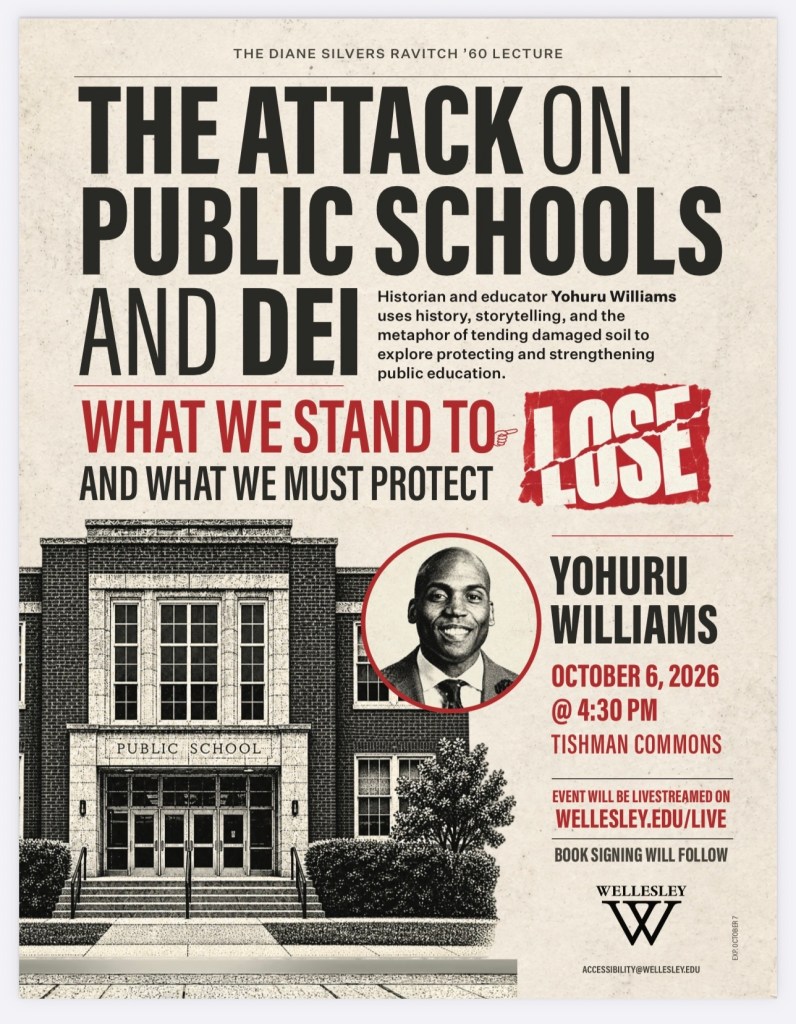
Come to Wellesley College to hear Dr. Yohuru Williams dissect and eviscerate the Trump administration’s attack on “diversity, equity, and inclusion.”
Such policies are meant to broaden opportunity. They take us closer to our professed goals of liberty and justice for all. Yet the Trump administration wants to abolish them. Civil rights protections have already been reversed, so that any effort to help students of color is treated as a violation of this administration’s hostility to DEI.
Yohuru Williams is a leading scholar and public intellectual who has often appeared on public television to expound on African American history. He is Distinguished University Chair and Professor of History and Founding Director of the Racial Justice Initiative at the University of St. Thomas in St. Paul, Minnesota. He is a wonderful speaker.
Join me on October 6 at Wellesley College.
Open to all. Free.
Yohuru Williams is speaking as part of the annual lecture series that I established several years ago.
The event will be live-streamed and available later online.
Freddy DeBoer challenges the oft-repeated claim that American schools are failing. We have heard the same lament since 1983, when the Reagan administration published a pamphlet titled “A Nation at Risk.” That publication, the work of the National Commission on Educational Excellence, proclaimed that America’s schools, once the envy of the world, were caught in “a rising tide of mediocrity.” The report gathered every possible negative statistic about public schools and turned them into a jeremiad.
Governors formed task forces and agreed that what the nation needed most was lots more testing, which eventually turned schools into a cash cow for the testing industry. Worse, it made test scores the goal of education, not a measure.
George W. Bush’s No Child Left Behind law, passed in January 2002, made the pursuit of higher test scores a federal mandate, accompanied by harsh and punitive measures for schools that were unable to produce the ever higher test scores.
NCLB was followed by Obama’s equally punitive Race to the Top in 2010. Not only were schools targeted for not raising test scores, but individual teachers were singled out and punished. Schools were closed, teachers were fired, charter schools became a new panacea–which failed as panaceas tend to do.
The Bush brothers–President George W. and Florida Governor Jeb–claimed that accountability was the ultimate key to success.
But in the absence of dramatic test score gains, Jeb and other Republicans decided that vouchers were the ultimate panacea: no accountability, just choose any school you want, be it religious, private, online, or homeschooling. Quality no longer mattered. Accountability no longer mattered (except for the majority of students who continued to enroll in public schools and continued to take the standardized tests). Just choice.
Go back to the beginning: that infamous report called “A Nation at Risk.” One of the staff members who wrote the report was a young man named James Harvey. In 2023, on the 40th anniversary of the release of that influential report, James Harvey wrote an article declaring that the conclusions of the report were vastly overstated. He wrote an article in The Washington Post about “how we cooked the books.”
Freddy DeBoer probably didn’t read James Harvey’s brilliant and disturbing article. But he writes from the same perspective. Our public schools have been the target of a huge smear job. The smear was a fake. It was used to promote charter schools and vouchers. Many of our public schools are excellent. Some are in desperate need of desperate measures, like reduced class sizes, wraparound services for students and families. They are not worse than they used to be. Ninety percent of our population attended public schools. Their graduates created the most powerful nation in the world. Can we do better? Of course, especially for children with the greatest needs. Are public schools failing? No.
This is what DeBoer thinks:
The belief that American public schools are an international embarrassment, sites of endless failure, is one of the few things our polarized political system seems to agree on. After all, the transition from George W. Bush’s presidential education policy to that of Barack Obama was one of remarkable continuity, based on a shared premise: Our schools were in a broad state of emergency. Today, politicians of both parties still tell that story, as do op-ed pages and nonprofit organizations and bipartisan cable panels. The notion has hardened into an axiom, a claim so familiar that the people making it no longer feel obligated to back it up with evidence. But we don’t have to buy this narrative, and we shouldn’t — because the evidence tells us that the narrative just isn’t true.
The best way to consider a country’s educational performance is in relation to the performance of international peers, and the most authoritative international benchmark is the Organization for Economic Co-operation and Development’s Programme for International Student Assessment (PISA) exam, which tests 15-year-olds across 81 education systems. In the most recent results, from 2022, American students tested better in reading than 68 of the 80 other systems and well above the international average. In science, they bested 56 of 80. Math is our weakest subject, but even there we outscore 43 systems and tie with a dozen more, meaning that on our worst day we still do better than more than half the developed world. Our top performers look particularly good on the PISA; for example, 14 percent of American teenagers scored at the highest level in reading, double the OECD average.
Some critics note that our education system is expensive and say that we should demand better results for our money. But this demand implies that there’s a straightforward relationship between per-pupil spending and test scores; decades of evidence demonstrate that there is not. And the results show that we produce many sterling students for our money.GLOBE STAFF; ROB Z/ADOBE
Indeed, the students at the top of our system aren’t merely fine; they’re the best on earth. American teams have placed in the top three at the International Mathematical Olympiad every year for a decade and won or tied for first in 2015, 2016, 2018, 2019, and 2024. In 2025, all five members of the US physics team won gold at the International Physics Olympiad, making the United States the only country to sweep gold that year. Our chemistry, biology, informatics, linguistics, and other teams collect medals year after year. These are overwhelmingly public-school kids from ordinary suburban and urban districts, outcompeting the best academic talent the world can produce. You rarely read about them because their success doesn’t fit the declinist story.
But scores are dropping, aren’t they? Yes, and that’s exactly why international context matters. The 2022 PISA results showed an unprecedented worldwide collapse, with average scores across the OECD falling roughly 10 points in reading and 15 in math. When students in Germany, Norway, and New Zealand decline in lockstep with students in Arizona and Connecticut, the cause is plainly not American teachers, unions, or curricula. (My own guess is that the smartphone is to blame, but I can’t prove it.) Even as our raw scores fell, our international rank rose in all three subjects because our peers’ scores fell further. Again, when was the last time you heard that in our media?
None of this is to deny that some American schools are in crisis. But those failures aren’t spread evenly across our system; they’re concentrated in a small number of places suffering from poverty, structural racism, and institutional decline. The United States has the highest child-poverty rate in the OECD (roughly a quarter of our children live in poverty, versus less than 10 percent in top-scoring nations like Finland and Denmark) and our socioeconomic and demographic stratification is pronounced. As such, our aggregate scores on assessments like PISA are weighed down disproportionately by disadvantaged students.
In Detroit, which sits at the bottom of every large urban US district tested, two-thirds of students were chronically absent in a recent year, speaking to a lack of stability and resources at the family level. What teachers could succeed in those conditions? Cleveland, Baltimore, districts in the impoverished rural areas of West Virginia — they all tell a similar story. The American schools that struggle the worst share no common curriculum, union contract, or pedagogy. What they share is extreme poverty, segregation, and decades of disinvestment — in local labor markets, transportation, and health care.
Imagine swapping the students of Detroit with those of wealthy Bloomfield Hills next door, where the schools have excellent performance metrics. Does anyone believe the students from Detroit would suddenly excel?
Simply shoveling money at urban schools is not the answer. In fact, poorer, higher-minority schools in the United States receive significantly more per-pupil funding than richer and whiter schools. As it stands, the teachers in the Detroit public school system are asked to achieve similar results to the ones in the Bloomfield system, despite the vast disparities in living and learning environments of the students they teach.
I’m known to be very skeptical about the influence of schools and teachers on test scores, which tend to reflect the socioeconomic conditions of groups and the variation in talent levels between individuals. But you don’t have to share my views in that regard to acknowledge that our worst-performing schools face conditions that no amount of teaching quality can overcome. And consider a fact that’s almost never reported: America’s most disadvantaged students, those in the bottom international decile in socioeconomic status, rank sixth out of 64 comparable nations in math. In other words, even in the midst of all that poverty and dysfunction, our poorest kids outperform almost all of the world’s other poorest kids. The problem is not that our schools fail poor children at an unusual rate. It is that some of our communities are deprived to a scandalous degree.
In sum, our median student does just fine, our best students are the envy of the world, but our worst-performing students drag down our averages in a way that makes our overall performance look much worse than it is — and those extreme negative outliers are almost universally found in communities with intense socioeconomic challenges.
This resolves a puzzle that has baffled pollsters for 40 years. American parents consistently rate the nation’s schools quite poorly while giving their own children’s schools high marks. Average grades for the American school system writ large typically fall in the C or D range, but more than three-quarters of parents typically give their own kids’ schools an A or B. Often this is regarded as a kind of cognitive bias, of irrationality on the part of those parents; surely, they must be viewing their own schools with rose-colored glasses, or so the conventional wisdom has long held. In fact, that attitude makes perfect sense when you reflect on the quantitative reality I’ve described: Most American K-12 schools and students really are doing quite well, which is reflected in the high marks parents give to their own local schools, but like all of us, parents have heard the relentless doomsaying about the country’s schools. Parents judge their own schools from direct experience and the national system from what they see on television. That is, on the question they actually know something about, about which they have the best evidence, they’re quite positive, and they have every reason to be.
The myth of universal failure didn’t come out of nowhere, and for the record I don’t think it was born entirely in bad faith. Some of the people who spread it were no doubt animated by a real and decent impulse to improve the lives of American children, saw the awful conditions in our inner cities, and overextrapolated their impression of school failure. Others were likely so motivated to attack public schools for ideological reasons that they didn’t care much about misrepresenting the data. Whatever the motives, over time it became far too common for politicians, pundits, and members of the media to take data that showed a handful of distressed communities dragging down otherwise strong averages and present it as proof that American education was rotten from root to branch. An honest reading pointed toward investing in poor places and pursuing avenues for shared prosperity other than just schooling; the sensationalist reading pointed toward dismantling public schools. Many people chose the sensationalist one and repeated it until it became something “everybody knew.”
The stakes are significant. If the failures of American education really are systemwide, the response has to be wholesale reform — new national mandates and perhaps a federal takeover of local education policy; even more standardized testing; the criminalization of teacher unions; private school vouchers for all. But the reality is that our educational failure is concentrated, and it’s concentrated in predictable places, which means the remedy must be too: Serious investment for the communities where poverty has done its damage, not merely for the schools that sit inside them, along with an effort to build more pathways to middle class stability for those who are not academically motivated.
There is some evidence that such investment, for example in environmental cleanup or direct financial assistance for poorer families, can improve learning outcomes. There too, though, the evidence is contested and the effects unclear. But this investment offers obvious advantages: Even if bringing more money and development into poor communities does not close academic gaps, the direct economic advantages will endure.
These efforts are both harder and more expensive than yet another round of complaining about teachers and their unions, but they have the advantage of potentially solving real problems. If we have a moral duty to improve our schools, as the school reformers insist, then that begins with a moral duty to tell the truth.
Will the Trump administration permit a Major League Baseball team to build a park in the Grand Tetons National Park?
The idea sounds crazy until you remember that Trump built an Ultimate fighting arena on the White House lawn so he could see several matches without having to travel.
Major League Baseball has approached the Trump administration about hosting a game at a national park, officials from the White House and MLB confirmed Saturday.
The administration has scouted locations in Grand Teton National Park to build a baseball park to host an MLB game, according to two other people familiar with the matter, who spoke on the condition of anonymity because they were not authorized to speak to the media.
Grand Teton is the country’s eighth-most visited national park and is famous for its breathtaking views of the Teton Range of the Rocky Mountains. National parks are among the country’s most protected federal lands, and constructing a sports facility at Grand Teton could set a new precedent for the use of vast national park land in the Western United States.
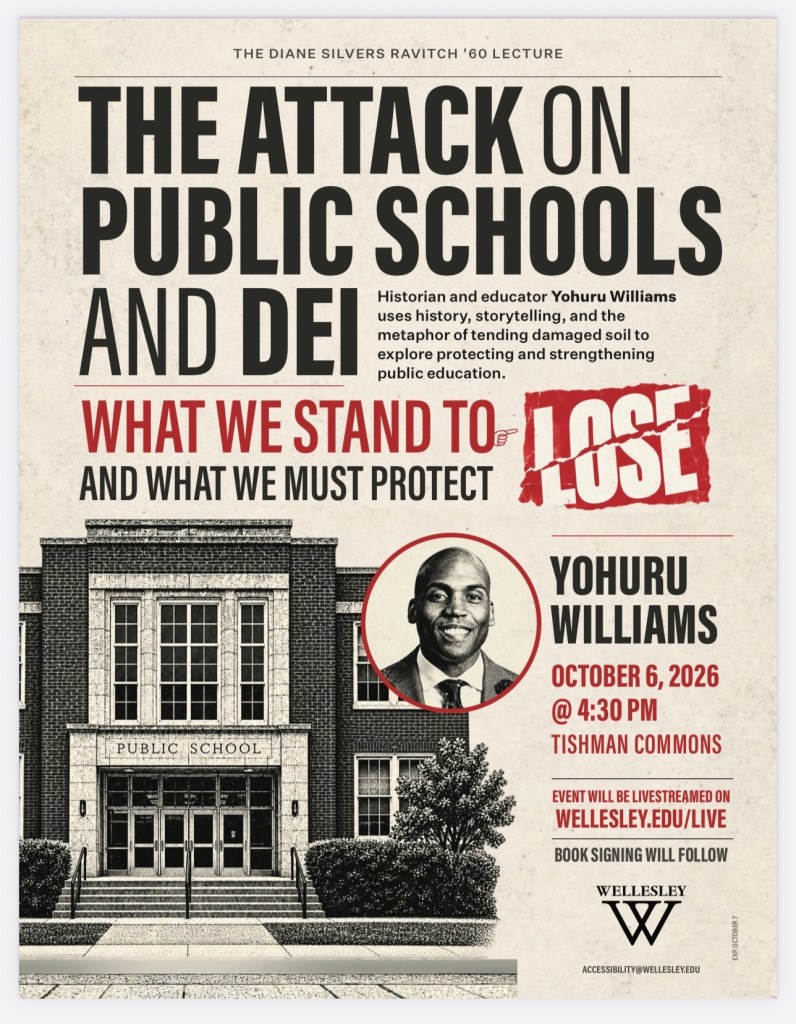
Come to hear Yohuru Williams dissect and eviscerate the Trump administration’s absurd attack on “diversity, equity, and inclusion.”
Such policies are meant to broaden opportunity. They take us closer to our professed goals of liberty and justice for all.
Yohuru Williams is a leading scholar and public intellectual who has often appeared on public television to expound on African American history. He is Distinguished University Chair and Professor of History and Founding Director of the Racial Justice Initiative at the University of St. Thomas in St. Paul, Minnesota.
Join me on October 6 at Wellesley College.
The event will not be livestresmed but will be available later online.
The biggest political news of the past few days is that the nonpartisan, highly respected Siena College poll reported that Democrat Gina Hinojosa is leading rightwing Governor Greg Abbott in Texas by four points, and Democrat James Talarico is leading Republican extremist Ken Paxton by six points in the Senate race.
This is the first major poll that shows the momentum of the Democratic candidates in Texas. if the trend continues, and if Texas flips blue, it would be a political earthquake. It would be a major defeat for Trumpism and the hard-right extremists who have run the state for the past three decades.
Texas is the state to watch in the 2026 election. It is a very conservative state, where political spending is overwhelmingly dominated by oil and gas billionaires and evangelical Christians, a few of whom are oil and gas billionaires. Texas has not elected a Democrat to a statewide office since 1994.
The Governor’s race is exciting. Republican Governor Greg Abbott is running for his fourth term. He is in cahoots with the oil and gas billionaires and with evangelicals. He delivered for both, with tax cuts for the rich and vouchers for religious schools.
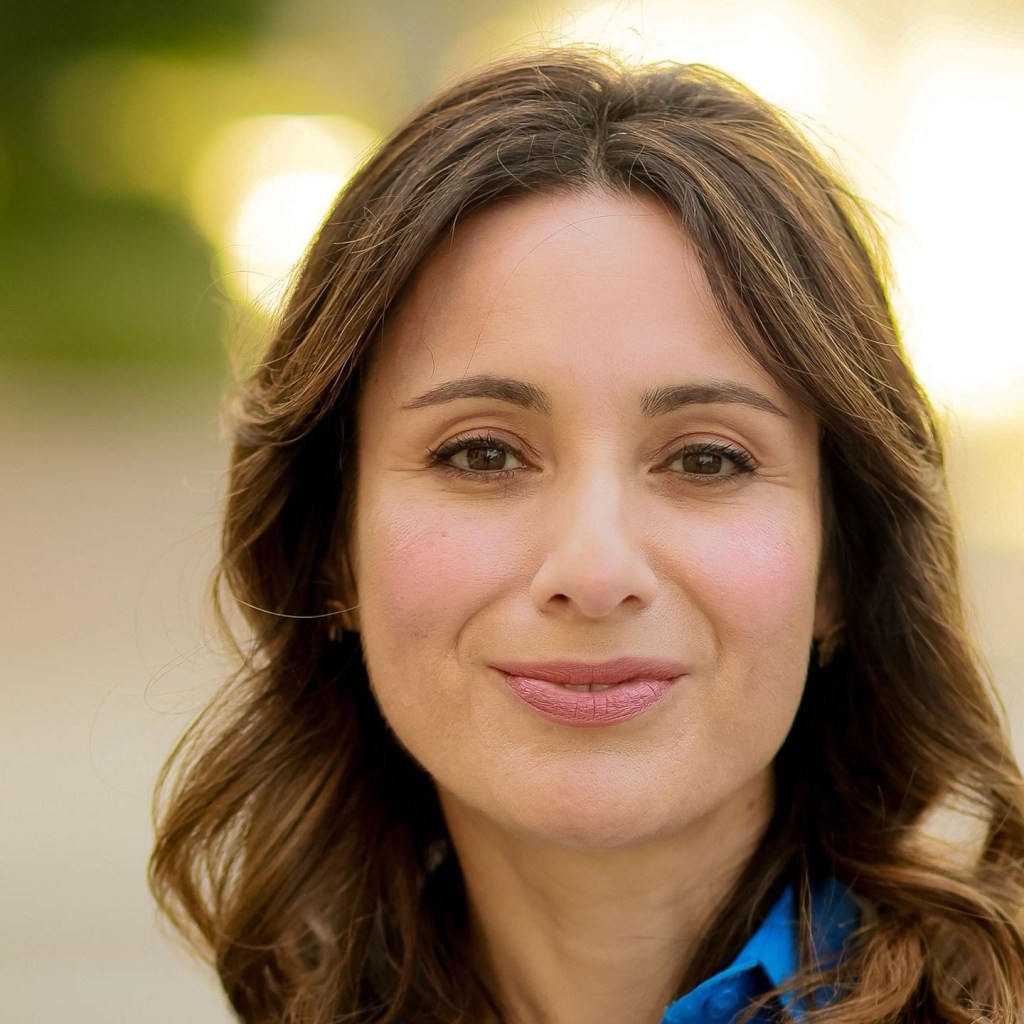
His opponent, Gina Hinojosa, is the real deal–a mom who got into politics when state budget cuts threatened to close her son’s public school. She is the only major candidate in the country who has made public schools the centerpiece of her campaign. She believes that public schools are essential for democracy, and she has built her campaign around that issue. She has received support from MAGA Moms who don’t understand why Governor Abbott is contemptuous of their local public schools. She is also drawing strong support from independents.
Abbott is sitting on a campaign fund of $60 million. Gina has raised $6 million.
In the 36 hours after the Siena poll was released, showing that she has caught up with Abbott, Gina raised over $1 million.
Abbott is running on culture war issues. He opposes transgender athletes in women’s sports. He fought to put the Ten Commandments in every classroom in the state. He fought to get vouchers for anyone who wanted one, regardless of family income. He relentlessly accused public schools of “indoctrinating” students, without a shred of evidence, while his voucher plan pays students to attend religious schools whose very purpose is indoctrination into their faith.
Gina Hinojosa is campaigning on two big issues: saving public schools and affordability for working Texans. She talks about issues that directly affect the quality of life of working families, like health care, rising prices for electricity, the cost of living, and data centers.
Gina wants to bring people together and improve their ability to afford a good life. Abbott wants to target someone they can hate, to distract them from the cost of gasoline, rent, and food.
Gina has opposed data centers, while Abbott first supported them, then said he would conduct a study of their impact on power and water when he saw the bipartisan opposition to them.
Latino men, who supported Trump in 2024, are rejecting the Republican Party and Abbott because of Trump’s anti-immigrant policies and rhetoric. They have seen friends snatched away and disappear. Gina was born and raised in the Rio Grande Valley, which is heavily Hispanic. She is, of course, bilingual and can count on Latino support and excitement about a Latino governor.
Gina’s campaign ads are as fearless as she is. In one, she says: “I’m Gina Hinojosa. My pronouns are Mom, Texan and, soon to be, governor.”
Many people think she can’t win, because Democrats haven’t won in Texas in so many years. Abbott will say she is a “Communist,” a “Socialist,” a “radical leftwinger,” etc. She is none of those things. Abbott will insult and attack because he doesn’t want to discuss the issues that affect people’s lives.
Gina does bring those issues front and center.
The fact that he has so much more money than she does might make you feel pessimistic.
But even though he is sitting on $60 million, even though he is outspending her 10-1, she just surged ahead of him in the polls.
Gina is taking it to the people and telling them the truth: They don’t have to accept corrupt politicians who gin up inane culture war battles and ignore people’s need for good jobs, a decent living wage, high-quality childcare, affordable housing and food, good access to medical care, and strong public schools.
I have contributed to Gina’s campaign (and to James Talarico as well). I will give as much as I can. The corrupt politicians like Governor Greg Abbott, Lieutenant Governor Dan Patrick, and Attorney General Ken Paxton must go. It’s time to elect honest, hardworking people who care about every Texan, not just their billionaire donors.
Audrey Watters is one of the very best writers about education. She specializes in debunking pretentious claims for technology.
In this post, she slices and dices the AlphaSchool, which is the highly-promoted fad of the moment.
AlphaSchool limits academic leaning to only two hours a day. It relies heavily on technology, especially artificial intelligence (AI).
Watters cites other critiques of AlphaSchool and adds her own. All in all, it is a valuable article.
Watters writes:
Perhaps you’ve read Ben Riley’s exposé on AlphaSchool’s “boot camp” — along with his follow-up in which the school provides even more creepy details on the bizarre eight-week training program that high school students enrolled in the private school must complete.
Perhaps you haven’t.
Perhaps you’ve blocked from your memory the whole AlphaSchool insanity: the promise of “two hour learning” – two hours a day spent clicking through AI-mediated educational programming – that seems to have captivated the imagination of the usual crowd of tech investors and evangelists (and sadly, a fair number of journalists). I don’t blame you. Indeed, I congratulate you if you’ve been able to ignore it, as the hype-sters won’t let us go a single day without hammering us with how transformative (and terrible) the “AI” revolution will be.
Or perhaps, like me, you simply cannot believe that we’re still talking about this very ridiculous “AI” revolution and, in particular, this very ridiculous school. (I’m cited in Ben’s piece calling AlphaSchool “snake oil” and I stand by that – the “two hour learning” claim merely the latest in a long history of educational gimmicks and fads where some hustler claims their product will enable buyers to quickly, even instantly, acquire new knowledge.)
Honestly, I felt as though Dan Meyer thoroughly debunked the whole premise of the school – and not just the “two hour learning” with “AI” instead of teachers bullshit – when he first wrote about AlphaSchool over a year ago. Over a year ago.
But instead of letting a bad idea fade away – and yes, we could say that for this whole “AI” brouhaha – there’s a group of very committed people sold on, and in turn, selling the story. It’s exhausting and it’s depressing, particularly as too many decision-makers in too many places still believe there is a magic ed-tech bullet. AlphaSchool keeps expanding to new cities and new states, even though it’s never being able to show that it works for all (or hell, even most) students. Indeed, reporting from Wired and 404 Media (and elsewhere) has underscored that there are all sorts of bad things afoot: both in the AlphaSchool software systems and in the classrooms themselves.
(I’ve noted this before…) There’s a scene that’s been stuck in my head for over a decade now, from a 2012 episode of PBS NewsHour, in which journalist John Merrow explored the promises of “hot new startup/school” of that decade: Rocketship. The charter school chain was also technology-driven (and tech-investor lauded and funded); it also promised to replace teachers with algorithms. Its students, most of them Black and brown children from lower socio-economic backgrounds, sat in colorful cubicles for much of their day, headphones on, bored and isolated and clicking away at their lessons.
For its part, AlphaSchool also has plans to expand into the (historically prettyterrible) virtual charter school territory. But the schools that have made most of the headlines have been its private brick-and-mortar locations – those with tuition that ranges from $10,000 to $75,000 per year. The target population for AlphaSchool aren’t disadvantaged students; and I suppose it might be easy to argue that these more privileged students will be fine even if the two hours of mandated teaching-machine-time is less than ideal, as the rest of their school day (and, of course, the rest of their lives) will be full of fun, enriching activities and opportunities.
“What the hell are we doing to these children?” I thought when I watched PBS NewsHour. To me, Rocketship exemplified the ways in which – despite all the language of “progress” often wielded to make ed-tech seem appealing to schools, to parents, to communities – these technologies and associated practices served to reinforce regimes of surveillance and control, utterly dehumanizing students as it datafied them.
Many of the charter schools that were so popular – then and now, I suppose – with the ed-tech and ed-reform crowds also touted a focus on “character education.” They demanded compliance, indeed often silence, from students. These programs were obsessed with behavior, linking students’ outward expressions to their inward development.
AlphaSchool is eerily similar, even though its private schools are not marketed to low-income or marginalized families. AlphaSchool too operates a regime of surveillance and control. As Ben’s reporting underscores, it too is committed to dehumanization, humiliation, shame. And personalized learning software – whether you market it as “AI” or not – always relies on behavioral engineering.
But the “character education” that AlphaSchool doesn’t demand silence or compliance in the same way – again, the appeal here is to parents who believe their child is the next genius tech entrepreneur billionaire. But it is damaging in its own right. AlphaSchool, as we can see in the details of the bootcamp, actively demands students mold their behavior and their identity, in this case into some sort of John Galt figure. The school’s programming leans into the kind of pseudoscience that litters the pages of bestselling “get rich quick books” – psychological pseudoscience, economic pseudoscience alike – and the ideology of Silicon Valley’s startup hustle. All of this is the kind of messaging you can regularly find on social media, no surprise, since this seems to be a school fixated on the anti-expertise of influencer-culture, the sociopathy of tech-culture: move fast and break things.
“What the hell are we doing to these children?”
“Do not obey in advance.”
I often think about Timothy Snyder’s first lesson in his book On Tyranny – his guidance for protecting democracy. “Do not obey in advance.” It works for fighting fascism; it works for fighting “AI” – they’re inextricable.
This week it seemed as clear as ever that “AI” is being marketed, even by its makers, as a threat. A threat to everything and everyone; a threat to life, to the very idea of future itself.
And sure, it’s a lot of “misleading metaphors” as Melanie Mitchell put it. I don’t think that “AI” is going to kill us all (although the rapacious, climate-destroying commitment to fossil fuels and data centers is sure gonna try). But when “AI” proponents say this, they really do mean it as a threat, even if they don’t necessarily believe it to be an existential one. “AI” is a threat, and they want us to comply. They want us to consume. They want us to obey. They want us to click. They want us to cower. They want us to fear. They want us to be reliant on their machinery, their answers, their ideology.
Of course, as Ryan Broderick put it, “AI is still boring and also bad and also expensive.” Resisting it really shouldn’t be that hard. It sucks. Software sucks. The oligarchs’ vision of the future sucks.
There isn’t really conclusive evidence that asking “good questions” means that you get better answers from “AI.” I know it might seem true. We’re taught that asking good questions – learning to form and ask good questions – is essential to knowledge acquisition, to knowledge expansion. We glorify the Socratic method. We admire people like Terri Gross, for example, because as an interviewer she has a knack for asking very good questions that, in turn, elicit very interesting responses from the guests on her show.
But that is not how LLMs or chatbots function. “Good questions” aren’t necessarily what elicits “good answers” – indeed no amount of “good questions” will consistently lead to a “good answer” from a probabilistic technology. Learning how to type “good questions” into the chatbot, teaching students to think of their inquiry as “prompt engineering” – these involve demanding students bend their thinking, in form and in content, to suit the interface, the machinery of surveillance and extraction.
Sure, asking questions is important. We should all wonder. We should be curious, and we should all have the right and the courage to question. But forming those questions – even outside the chat interface – is just one piece of how we think and learn. The questions themselves are never really the goal; but nor are some sort of finitude in the answers we uncover in turn. And questions are not always framed first or formed fully before understanding starts to happen.
We aren’t machines, so let’s stop instrumentalizing every part of our cognition, constrained by that terrible metaphor.
(We might stop to think too how, in light of all the compliance that the technology industry craves from us, “good questions” – again, whatever that means – are the one place where they promise we will still retain agency and control over “AI.” See? Maybe “good questions” really don’t matter at all.)
Steve Schmidt used to be a prominent Republican strategist. Then came Trump, and Schmidt became a never-Trumper.
In this post, he shares his hope that South Carolina will reject Lindsey Graham’s sister in the race for his Senate seat because she is unfit to be a senator.
I don’t share his optimism. Tommy Tuberville, Ron Johnson, and Marsha Blackburn are senators. Trump is President.
There is a considerable segment of the population that chooses Senators who are dumb, who are unworthy.
Will South Carolina be different?
The choice for South Carolinians: Darline Graham or Dr. Annie Andrews
Darlene Graham is an imbecile — a peerless puppet for the MAGA poltroons.
Here she is on national security:
Despite national security not being “her thing” she also said that Israel is “one of our strongest allies,” and vowed to “continue supporting Israel in any way.”
She is a United States senator.
Think about that.
For the record, here is the Constitutional oath she took — and doesn’t comprehend at any discernible level:
I do solemnly swear that I will support and defend the Constitution of the United States against all enemies, foreign and domestic; that I will bear true faith and allegiance to the same; that I take this obligation freely, without any mental reservation or purpose of evasion; and that I will well and faithfully discharge the duties of the office on which I am about to enter. So help me God.
It is beyond her grasp.
Most things seem to be.…
I have a great friend by the name of Paul with whom I have travelled all over the world. I consider him to be one of the funniest people I have ever known. Everywhere we go, whether it be fishing, rafting, skydiving or anything else, he asks the guide the same question: what is the stupidest question you’ve ever been asked? His dream is to write a book with all of the answers, and trust me, it would be a bestseller.
At any rate, a Montana fishing guide told us about a woman he had taken on a float trip down the Madison River, which starts at point A and finishes at point B.
When this particular trip ended, the woman in question was astounded to see the same vehicle waiting at the end that had dropped her off at the beginning. She declared that she had no idea the river was a circle just like the lazy river at the amusement park.
Americans have long been raised to believe that there are no stupid questions, but that isn’t true. All one need do to understand the flimsiness of the theory is to turn on a Sunday morning show, or watch the White House press corps in action, minus Kaitlin Collins.
Elections are choices, and choices are always rooted in a question.
The last question is a perfect refutation to the idea there are no stupid questions because there are few choices that have ever been more clear, and maybe no two Senate candidates separated by a wider gulf.
While Annie Andrews was at medical school I imagine Darline Graham struggling to interpret the TV guide, and processing the fact that “Will and Grace” wasn’t evidence of sorcery.
Darline Graham doesn’t know anything about the military.
Nothing.
She doesn’t support the troops. They are invisible to her. They matter not in her service to Trump.
Think about the stunning reality that U.S. Army Chief of Staff General Randy George was cashiered by Pete Hegseth for refusing to interfere in the findings of a safety investigation concerning the awful judgement of two army helicopter pilots, who took their $20 million taxpayer-paid-for machine and weapons platform on a joy ride to Kid Rock’s house.
The man who is lining up to replace him is similar to the new CNO Admiral Daryl Caudle, who earned the job the MAGA way — with knee pads on, mouth open, facing Trump’s bruised hands laying gently above his knee, two feet above his engorged ankles.
Let’s just say it is unbecoming, to say the least.
Supporting the troops means appreciating their cause, which is our cause
It is America.
General Mark Milley’s portrait will one day hang in the currently disgraced Pentagon.
Here are the words he spoke that so enraged Trump and his drunken Fox News crackpot Pete Hegseth that led to it being taken down.
The blood we spill pays for our freedom of speech, our right to assemble, our due process, our freedom of press, our right to vote, and all the other rights and privileges that come with being an American.
It is the blood of our fallen, it is the blood of our wounded that sustains our freedom. We should always be inspired by them, we should never forget them, and we should always honor them. We, the American military, never turn our back on those that came before us. And we will never turn our back on the Constitution. That is who we are, and that is why we fight.
Supporting the troops is something Darline Graham will never be accused of doing, and neither will any fool who votes for her. When I say fool, I mean it.
Only a true fool would vote for an imbecile to decide matters of war and peace, life and death, right and wrong on their behalf.
I have another friend, not Paul, who doesn’t believe Lindsey Graham is really dead.
For the record, Paul believes both Mitch McConnell and Lindsey Graham are dead, and burning in hell — which he really doesn’t believe in — but believes those two are now there together, hot tubbing in a vat of sulphuric lava.
Anyway, my other friend’s theory is that since he can’t recall ever having seen Lindsey and Darline together before Lindsey’s early check-out that, in fact, Lindsey has transitioned into Darline with Trump’s full permission and understanding they won’t play golf together again.
You see, at Mar-a-Lago the ladies can chase after golf carts, be assaulted in the locker rooms or on the massage tables, be buried on the first tee, and even tee off on Tuesday afternoons, but playing with the Führer, not so much.
At any rate, as Pope Francis said, “Who am I to judge?”
Lest there be confusion I mean my friend — not Darline, whom I do judge.
She is a perfect puppet because she is a perfect know-nothing, a rubber stamp with no character.
She has no character, not because she is an imbecile, but rather because of her seeming joy in punching down:
Boys do not have any place in girls’ sports, certainly not in the locker room.
She is focused on transgender issues, while we are losing a war with Iran and starting trade wars with China, Canada, and most of our allies.
Babies and toddlers are being abused in concentration camps named Dilley.
The American economy is en route to implosion as the AI bubble pops.
America has become corrupt, weak, mean and dangerous.
We have been disgraced by our own hand and our own choices as a free people.
We have dishonored our ancestors and betrayed our descendants. We are the generation that succumbed to the demagogue whom the founders feared.
We are the generation that elected Donald John Trump to the office first held by George Washington.
We are the generation that has lost the capacity to tell right from wrong, tell the difference between the lie and the truth, and understand the meaning of patriotism.
Or have we?
This is why South Carolina matters.
The choice on the ballot is America or Trump.
The choice is loyalty or betrayal.
The choice is Dr. Annie Andrews because she is exceptional, and Darline Graham is dumb, lazy, ignorant and mean.
The death of Dolly Parton of Locust Ridge, Tennessee, has reverberated around the world because she was a giant whose gospel was kindness and love, not cruelty.
She said this of politics with a big ole’ American smile plastered on her face:
My father was a Republican, my mother was a Democrat, and I’m a hypocrite.
Some people say Dolly Parton stayed out of politics, but I think that misses the mark. Her statement above makes clear she understood the business and America better than almost anyone who holds elected office in it. She chose to be above politics by being a great American.
Darline Graham is an unaccomplished American who has achieved nothing, stood for nothing, fought for nothing, and understands next to nothing about anything that is happening around her.
Her campaign is vicious and small, perfectly molded for a vapid and idiotic electorate that MAGA believes is an impenetrable redoubt.
I’m not so sure.
My money is on better.
My faith is that Dr. Annie Andrews is going to the US Senate because, in the end, I think South Carolina is an American state, not a MAGA colony.