Archives for category: Education Reform

Patrick O’Donnell is one of the best education journalists in the nation. He has covered charter and cyber charter scandals in Cleveland and in Ohio without fear or favor. Ohio, as you may have noticed, is awash in charter corruption.

O’Donnell worked for the Cleveland Plain-Dealer until last weekend, when the newspaper pushed out its leading journalists and told them they could cover far-flung areas if they want to stay employed. The order from on high essentially fired union journalists and gutted the newspaper’s coverage of Cleveland.

The Plain-Dealer is part of Advance Publications, which is owned by the billionaire Newhouse family. Advance is engaged in cost-cutting that will destroy local journalism. It’s all about the Almighty Dollar.

Professor Les Perelman, who taught writing at MIT, recently was honored by the New South Wales Teachers Federation for his successful effort to stop the “robo-grading” of tests in Australia. He demonstrated how easy it was to deceive the machines grading thousands of tests in only seconds.

Perelman speaks here about the importance of public education, critical thinking, and the dangers posed by edubusiness to both of the former.

Perelman is notable as the inventor of the Babel Generator, in which he and his students showed that the “robo-graders” used by ETS and other manufacturers of standardized tests could be easily fooled by gibberish. These automated grading machines would give high scores to papers that were nonsense if the sentences were long enough and contained pretentious words.

If you open the Babel Generator, insert any three words and it will immediately produce an essay that can fool the robot grading machine and get a high score even though it is totally nonsensical.

I wrote about Perelman in SLAYING GOLIATH.

While enthusiasts for online learning predict a boom after the pandemic, as students and teachers get used to learning at home online, the reality is different on the ground. Stress, loneliness, and boredom are typical reactions.

A team of reporters in Los Angeles reports on student reactions to the loss of face-to-face instruction.

A senior at John C. Fremont High School in South L.A., Emilio Hernandez has a class load that is about as rigorous as it gets: AP calculus, physics, design, English, engineering and government. He loves talking to his peers in English class, who make all the readings thought-provoking. He often turns to his math teacher, who has a way of drawing the graphs and walking him through derivatives and complex formulas.

Now, with a borrowed laptop from school and family crowded in the living room, he’s struggling to make school feel like, well, school. He has trouble falling asleep and finds himself going to bed later and later — sometimes as late as 3 a.m.

“Assignments that would normally take me two hours or 30 minutes are now taking me days to complete. I just … can’t focus,” he said. “I don’t have anyone giving me direction. It’s just me reading and having to give myself the incentive to do the work.”

It’s been three weeks since school districts across the state have closed their campuses as the novel coronavirus continues to sweep its way across California — sending more than 6 million students home to navigate online, or distance, learning. What started as an emergency scramble to provide laptops and meals for a few weeks has dramatically shifted to a longer-haul transformation of public education.

“The kids are not going back to their classrooms” this academic year, said Gov. Gavin Newsom, who acknowledged the burden on households with the entire state under his stay-at-home order.

For those who look to school for learning and social structure, the new reality is sinking in: There will be no school as we know it after spring break. No prom. No year-end field trips. No projects to present inside a familiar classroom. Navigating the three months left in the school year, leaders said, calls for patience and dedication from educators, self-motivation from already stressed-out students and swift actions from school districts typically mired in bureaucratic obstacles.

“These aren’t normal circumstances. It’s the most uncharted territory that we’ve been in,” said State Supt. of Public Instruction Tony Thurmond. “We’re stronger together and we can help all of our kids as we work together.”

Many are already rising to the challenge. Yet each step forward means moving past bureaucratic hurdles and cost constraints and taking on persistent problems of student poverty and stubborn achievement gaps…

Overwhelmed. Unmotivated. Stressed. Stressed. Stressed.

These were the words that popped up over and over again on social media and in conversations among students across Los Angeles during a recent virtual town hall with a Times reporter and Heart of Los Angeles, a nonprofit organization in MacArthur Park that provides free after-school programming for underserved youth. About two dozen students shared just how complicated distance learning can be.

Many said that their homes were crowded enough already, and that school and after-school programs were their sanctuaries — a place to escape. Others worried not only about their grades but about the well-being of their families. Some students have been using their own savings to get food for themselves and younger siblings to avoid stressing out family members.

Among the nations of the world, only one is fully prepared for an emergency like the current pandemic: Finland. While the rest of us have lived like grasshoppers, not worrying about possible disasters, the Finns are like ants: storing what is needed for whatever might happen. They long ago decided not to be dependent on the global supply chain for essential equipment.

The New York Times published this story:

STOCKHOLM — As some nations scramble to find protective gear to fight the coronavirus pandemic, Finland is sitting on an enviable stockpile of personal protective equipment like surgical masks, putting it ahead of less-prepared Nordic neighbors.

The stockpile, considered one of Europe’s best and built up over years, includes not only medical supplies, but also oil, grains, agricultural tools and raw materials to make ammunition. Norway, Sweden and Denmark had also amassed large stockpiles of medical and military equipment, fuel and food during the Cold War era. Later, most all but abandoned those stockpiles.

But not Finland. Its preparedness has cast a spotlight on national stockpiles and exposed the vulnerability of other Nordic nations.

When the coronavirus hit, the Finnish government tapped into its supply of medical equipment for the first time since World War II.

“Finland is the prepper nation of the Nordics, always ready for a major catastrophe or a World War III,” said Magnus Hakenstad, a scholar at the Norwegian Institute for Defence Studies.

Though year after year Finland has ranked high on the list of happiest nations, its location and historical lessons have taught the nation of 5.5 million to prepare for the worst, Tomi Lounema, the chief executive of Finland’s National Emergency Supply Agency, said on Saturday.

“It’s in the Finnish people’s DNA to be prepared,” Mr. Lounema said, referring to his country’s proximity to Russia, its eastern neighbor. (Finland fought off a Soviet invasion in 1939.)

In addition, most of its trade goes through the Baltic Sea. That, Mr. Lounema said, is considered a vulnerability because, unlike Sweden, which has direct access to the North Sea on its west coast, Finland has to rely on the security conditions and the running of maritime traffic in the Baltic.

“If there is some kind of crisis, there might be some disturbance” in the supply chain, he explained.

Two weeks ago, as the country’s coronavirus cases ticked up — by Sunday, the country had recorded more than 1,880 cases and 25 deaths — the Ministry of Social Affairs and Health ordered that stored masks be sent to hospitals around the country.

“The masks are old — but they are still functioning,” Mr. Lounema said by phone.

There is little publicly available information on the number of masks and other supplies that Finland has or where exactly they are stored.

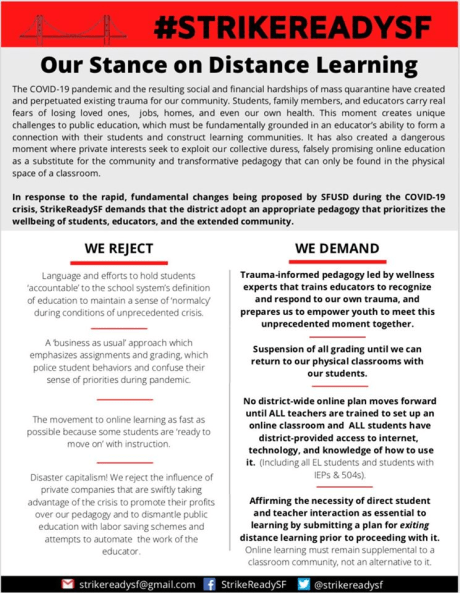
Parents, educators, and community activists in San Francisco formed an organization to protest the inequities in over reliance on distance learning. They call themselves StrikeReadySF. This is their manifesto.

distancelearning

John Thompson writes here about yet another virtual charter scam, this one in Oklahoma.

He writes:

After years of failing to regulate charters, especially online and for-profit charters, Oklahoma is just one state that illustrates how hard it is to catch up and hold virtual schools accountable for either education outcomes or financial transactions.

In July 2019, according to an Oklahoma State Bureau of Investigation search warrant, “[Epic’s co-founders] enticed ghost students to enroll in Epic by offering each student an annual learning fund ranging from $800 to $1,000.” This was despite the fact that Epic knew that the parents of many homeschool students “enrolled their children . . . to receive the $800 learning fund without any intent to receive instruction.”

Epic’s recruitment of “ghost students,” who were technically enrolled but received minimal instruction from teachers, allowed the company to legally divert state funds for their own personal use, while simultaneously hiding low graduation rates to attract more support.

This year, Epic has received over $100 million in taxpayer money. And the company, in an exposé by the Tulsa World, admitted that over the years its “Learning Fund”—which is shielded from public scrutiny—received $50.6 million from the Oklahoma State Department of Education.

Tulsa World estimates the Learning Fund could cost the state about $28 million for 2019-2020. Moreover, the private management company Epic Youth Services receives a “10 percent cut” of the charter’s student funding. Also, state appropriations pay for the millions that Epic spends on advertising and generous contributions to elected officials.

If nothing else, Epic is helping to nail down the case that charters are a tool for privatization.

In this post, Tom Ultican reviews two recent books.

One is Mercedes Schneider’s guide to sleuthing through online records and following the money. It is called A Practical Guide to Digital Research: Getting the Facts and Rejecting the Lies.

Schneider is an expert at “following the money,” and she reveals the secrets of her craft in this book. The book grew out of a presentation that Schneider gave at an NPE conference in Indianapolis in collaboration with Darcie Cimarusti and Andrea Gabor. As Tom Ultican explains, the purpose of the session was to teach a seminar in doing the kind of research that these three have mastered. When Mercedes was asked to summarize her presentation, she realized that it would require a book to do it, and this is that book.

So if you want to dig up the tax records of a pseudo-reform organization, here is the place to start.

The other book that Tom reviews is one that I co-write with veteran educator Nancy E. Bailey. Regular readers of this blog know Bailey as a blogger whose views are grounded in long experience and knowledge. She and I discovered that we both had a fascination with the language now used to misrepresent teaching, schools, and education. And from our online conversations came this book called EdSpeak and Doubletalk: A Glossary to Decipher Hypocrisy and Save Public Schooling.

The book is a glossary with a pro-public education attitude. It aims to identify and describe the lingo of corporate education reform and to decipher the many faux groups that are funded by billionaires to advance privatization. Of course, we think it is an invaluable tool for parents and educators who want to stop the billionaires before they get a foothold. It will help you find your way through the vacant and deceptive vocabulary used by faux reformers to grab your public schools.

As Tom points out, the book has another advantage:

Thanks to the authors and the facilities at Teachers College, this is a living book. At the book’s cyber address, there is a link to a 58 page downloadable supplement as well as an updates tab.

In other words, as new organizations, new flimflam, and new jargon emerges, it will be added to the book online and available to arm you with knowledge.

In the age of the Internet, news travels fast. The story below explains how a doctor in an ultra-Orthodox Jewish community in New York State developed a drug cocktail that has been endorsed by Trump and even the president of Brazil.

Last month, residents of Kiryas Joel, a New York village of 35,000 Hasidic Jews roughly an hour’s drive from Manhattan, began hearing about a promising treatment for the coronavirus that had been rippling through their community.

The source was Dr. Vladimir Zelenko, 46, a mild-mannered family doctor with offices near the village. Since early March, his clinics had treated people with coronavirus-like symptoms, and he had developed an experimental treatment consisting of an antimalarial medication called hydroxychloroquine, the antibiotic azithromycin and zinc sulfate.

After testing this three-drug cocktail on hundreds of patients, some of whom had only mild or moderate symptoms when they arrived, Dr. Zelenko claimed that 100 percent of them had survived the virus with no hospitalizations and no need for a ventilator.

“I’m seeing tremendous positive results,” he said in a March 21 video, which was addressed to President Trump and eventually posted to YouTube and Facebook.

What happened next is a modern pandemic parable that illustrates how the coronavirus is colliding with our fragile information ecosystem: a jumble of facts, falsehoods and viral rumors patched together from Twitter threads and shards of online news, amplified by armchair experts and professional partisans and pumped through the warp-speed accelerator of social media.

Dr. Zelenko’s treatment arrived at a useful moment for Mr. Trump and his media supporters, who have at times appeared more interested in discussing miracle cures than testing delays or ventilator shortages.

Sean Hannity, the Fox News host, quickly promoted Dr. Zelenko’s claims on his TV and radio shows. Mark Meadows, the incoming White House chief of staff, called Dr. Zelenko to ask about his treatment plan. And Rudolph W. Giuliani, Mr. Trump’s personal lawyer, praised him in a podcast interview this week for “thinking of solutions, just like the president.”

Few people have been as hopeful about hydroxychloroquine as Mr. Trump, who has enthusiastically promoted it for weeks as “very effective” and possibly “the biggest game changer in the history of medicine” — even as health experts have cautioned that more research and testing are needed.

That has not deterred Mr. Trump’s supporters, who have vilified public health officials such as Dr. Anthony S. Fauci, the head of the National Institute of Allergy and Infectious Diseases and the most outspoken advocate of emergency virus measures. Instead, some are pinning their hopes on Dr. Zelenko and his unproven treatment plan, which has now been seen by millions.

In a phone interview from his home, where he has been in self-isolation, Dr. Zelenko, who goes by Zev, described a dizzying week filled with calls from media and health officials from countries including Israel, Ukraine and Russia, all seeking information about his treatment. Some world leaders, including Brazil’s president, Jair Bolsonaro, are also talking up some of the same drugs as a cure.

“It’s a very surreal moment,” said Dr. Zelenko, who has been practicing medicine for 16 years. “I’m a simple country doctor, you know. I don’t have connections.”

The online spread of his treatment plan may have real-world consequences as countries consider testing the drugs he recommends on patients. Their popularity has also spurred shortages of hydroxychloroquine, which is used to treat lupus, rheumatoid arthritis and other chronic diseases.

In New York’s tight-knit Hasidic community, Dr. Zelenko’s sudden fame has caused tensions. Shortly after he posted on YouTube, a group of village officials wrote an open letter pleading with him to stop. They said he had exaggerated the extent of the coronavirus outbreak in Kiryas Joel, using a small sample of his patients to predict that as many as 90 percent of village residents would get the virus.

“Dr. Zelenko’s videos have caused widespread fear that has resulted in the discrimination against members of the Hasidic community throughout the region,” the officials wrote, disputing the figure.

Critics have accused Dr. Zelenko of getting ahead of scientific research. Several small studies, including a controversial French one of 20 coronavirus patients, have found that hydroxychloroquine may be effective against the coronavirus. This week, doctors in China said it had helped to speed the recovery of a small number of patients who were mildly ill from the coronavirus. But other studies have contradicted those findings, or have been inconclusive.

“Anyone who tells you these drugs work, or don’t work, is not basing that view on science,” said David Juurlink, the head of the division of clinical pharmacology at the University of Toronto. “There’s reason to be optimistic, and there’s also reason to be pessimistic.”

Dr. Jeff Paley, an internist in Englewood, N.J., who shares some patients with Dr. Zelenko, said it was “irresponsible” for him to promote a treatment without warning people that the combination of hydroxychloroquine and azithromycin can cause severe side effects if not properly administered, especially in patients with pre-existing heart problems.

“I’ve gotten numerous calls from patients demanding the regimen, saying they believe Dr. Zelenko is magically curing his patients,” Dr. Paley said.

Dr. Zelenko, who learned two years ago that he had a rare form of cancer, was not the first doctor to recommend treating the coronavirus with hydroxychloroquine and azithromycin, though he was among the first to recommend that they be given to patients with only mild symptoms. He said that while he was optimistic, it was too early to tell whether the drugs would ultimately work.

But hopes for a miracle cure have ballooned as the coronavirus spreads, and Mr. Trump and his allies are not waiting for the clinical trials to finish. An analysis by Media Matters last week found that Fox News had promoted hydroxychloroquine and chloroquine as a coronavirus cure more than 100 times over three days.

Tech companies have begun cracking down on hyperbolic claims about the drugs. Last week, Twitter removed a tweet by Mr. Giuliani that said hydroxychloroquine was “100% effective” in treating Covid-19, the disease caused by the coronavirus. Facebook and Twitter this week took down a video by Mr. Bolsonaro claiming that the drug “is working in all places.” YouTube later took down Dr. Zelenko’s video, saying it violated the site’s community guidelines.

“It’s a very surreal moment,” Dr. Zelenko said. “I’m a simple country doctor, you know. I don’t have connections.”

Dr. Zelenko, who said he supported Mr. Trump, declined to discuss his politics in detail, saying they were “irrelevant” to his medical findings.

But he appeared to share the president’s initial skepticism about the virus. In early March, he posted several right-wing memes about the coronavirus on Facebook, including one that referred to the pandemic as a “Dem panic” and another that featured Hillary Clinton on a list of “things more likely to kill you than the coronavirus.”

“When I see something funny, I maybe in a juvenile way posted it without much thought,” Dr. Zelenko said of the posts. “I never thought that I would be in the public limelight.”

For more than a decade, Dr. Zelenko has been a fixture in Kiryas Joel, where a sign at the village entrance encourages visitors to “dress and behave in a modest way.” Unlike most of the residents, who belong to the Satmar sect of Orthodox Judaism, Dr. Zelenko is part of the Chabad-Lubavitch movement and does not live in Kiryas Joel itself, which has made him something of an outsider.

Ari Felberman, a patient of Dr. Zelenko’s for years, called him a “phenomenal doctor” and said that if he had exaggerated the coronavirus threat in Kiryas Joel, it was only out of concern for his patients’ health.

“When he spoke about how many people were affected, it was just to shake up the community and say, ‘Don’t take this lightly,’” Mr. Felberman said.

Villagers began experiencing coronavirus symptoms in early March. Days later, after Dr. Zelenko began treating patients with his three-drug combination and saw many of them improving, he created a YouTube account and uploaded his video that addressed Mr. Trump.

“At the time, it was a brand-new finding, and I viewed it like a commander in the battlefield,” he said of the video. “I realized I needed to speak to the five-star general.”

Hydroxychloroquine, which is sold under the brand name Plaquenil, has started selling out at many pharmacies nationwide. Some health systems have begun reserving their supplies for coronavirus patients, depriving those who take it for other conditions. At least four states have restricted hydroxychloroquine prescriptions to prevent hoarding.

HCQ, as hydroxychloroquine is known, is generally considered safe for clinical use. But it can be risky if patients administer the drugs themselves. Last month, an Arizona man died after ingesting a type of fish parasite treatment that listed chloroquine phosphate as one of its ingredients.

“You don’t want people stockpiling this at home,” said Dr. Dena Grayson, a biotech executive who has helped develop drugs for Ebola and other epidemics. “If you do get sick, you need to take this under close supervision of a doctor to make sure you don’t drop dead.”

This week, the F.D.A. issued an emergency use authorization for hydroxychloroquine and chloroquine, allowing doctors to distribute them to coronavirus patients. The agency’s chief scientist, Denise Hinton, wrote in the authorization order that the drugs “may be effective in treating Covid-19.” New York also recently began clinical trials of hydroxychloroquine combined with azithromycin.

While dealing with his newfound fame, Dr. Zelenko, who has been practicing telemedicine from his home office, is working to keep his coronavirus patients alive. He said his team had seen about 900 patients with possible coronavirus symptoms, treating approximately 200 with his regimen. None had died as of Tuesday, he said, though six were hospitalized and three were on ventilators.

He is worried about his own health. One of his lungs was removed as part of his cancer treatment, and chemotherapy has weakened his immune system, putting him in a high-risk category for the coronavirus.

“I have eight children, and I want to live,” he said. “I’m personally motivated to find a solution.”

Dr. Zelenko said he understood the need for clinical trials but added that ignoring a hopeful possibility was also risky.

“I’m a strong supporter of clinical trials,” he said. “But they take time, and that’s one thing we don’t have. The virus is here, it’s World War III, and not everyone has fully comprehended that yet.”

Ben Decker and Alain Delaquérière contributed research.
Here are two contrasting views about what happens when (if?) children return to school in the fall.

In an article in the Washington Post, Mike Petrilli, president of the rightwing Thomas B. Fordham Institute, proposes that all students be held back a grade to make up for the ground they lost when schools closed in March. He also suggests that this is a good time to embrace distance learning.

Jan Resseger, retired social justice director for a religious group, says that this is the right time to recognize the failure of the standards-tests-accountability regime of the past two decades and to develop fresh ideas about children and learning.

Petrilli does not address the many studies (such as CREDO 2015) that show the abject failure of cyber schools. That study found that students lost 44 days in reading and 180 days in math when they were schooled online. Nor does he consider that being “held back” is universally seen as failure. The students haven’t failed. Why should they be punished? Expect a parent revolution if any state or district tries this.

Resseger writes:

Conceptualizing public education as students climbing ladders of curricular standards without missing a rung is only one way to think about education. And while such a theory has been drilled into all of us as a sort of “standards-based accountability conventional wisdom,” it isn’t really how most of us learn. If we want to understand something new, and there is some background we need, most of us look to experts or do some research to fill in the holes. School curriculum is better conceptualized as a spiral instead of a ladder. Children learn some processes and then as they move on to more advanced material, teachers are taught to spiral back—to review and even provide new and previously missed background. Sometimes people apply what they have learned in one discipline to help them understand or enhance what they have learned in another discipline. Remedial classes worry educators because too frequently they trap students in the most basic material—material skillful teachers can introduce and reinforce as children learn more complex material. After schools reopen, acceleration will be preferable to remediation.

To use a different metaphor, the advocates for the status quo see each grade as a measuring cup that must be filled. Some students will get the full measure, some will get less. The standardized tests, they think, can gelll is how much of the cup was filled. This is all nonsense, an outgrowth of a vapid, mechanistic approach to education that explains the failed regime of standards and testing. After twenty years, can anyone seriously claim that NCLB and Race to the Top succeeded? Seriously.

Due to the blinders tightly strapped on our policy makers, we are stuck in a pointless, soul-deadening approach to schooling that kills the joy of teaching and learning, except for those few subversive educators who have found devious ways to escape the dead cold hand of the status quo.

You may have heard the news today that Trump fired the independent Inspector General in charge of monitoring the $2 trillion coronavirus relief fund.

I want to explain why this is a Very Big Deal.

When I worked in the Department of Education many years ago, I learned that the I.G. was nonpartisan and was respected and revered. As a political appointee, you knew that the I.G. was in charge of monitoring ethics and professional standards. He or she was not an omsbudsman, but the keeper of the rules and the law.

Trump fires Inspectors General as if they were his personal employees. Just last Friday, he fired the I.G. for the Director of National Intelligence, presumably for daring to do his duty during the Ukraine investigation. Trump wants everyone in the government to be loyal to him, not to abstract notions of ethics and norms. If anything shows his contempt for the law, it is this. Trump treats the federal bureaucracy as it is were his personal staff. No one dares to do their duty; their duty is to obey their Leader. He aspires to be a tinhorn Dictator of a Banana Republic, and Senate Republicans protect him.

Politico reports:

By KYLE CHENEY and CONNOR O’BRIEN

President Donald Trump has upended the panel of federal watchdogs overseeing implementation of the $2 trillion coronavirus law, tapping a replacement for the Pentagon official who was supposed to lead the effort.

A panel of inspectors general had named Glenn Fine — the acting Pentagon watchdog — to lead the group charged with monitoring the coronavirus relief effort. But Trump on Monday removed Fine from his post, instead naming the EPA inspector general to serve as the temporary Pentagon watchdog in addition to his other responsibilities.

That decision, which began circulating on Capitol Hill Tuesday morning, effectively removed Fine from his role overseeing the coronavirus relief effort, since the new law permits only current inspectors general to fill the position.

“Mr. Fine is no longer on the Pandemic Response Accountability Committee,” Dwrena Allen, a spokeswoman for the Pentagon inspector general’s office, confirmed. She added that Fine will return to his Senate-confirmed post as principal deputy inspector general of the Pentagon.

Fine’s removal is Trump’s latest incursion into the community of independent federal watchdogs — punctuated most dramatically by his late Friday ouster of the intelligence community’s inspector general, Michael Atkinson, whose handling of a whistleblower report ultimately led to Trump’s impeachment.

Trump has also begun sharply attacking Health and Human Services Inspector General Christi Grimm, following a report from her office that described widespread testing delays and supply issues at the nation’s hospitals.

“Another Fake Dossier!” Trump tweeted, mentioning Grimm’s tenure as inspector general during the Obama administration. He didn’t mention, though, that Grimm has been serving as a federal watchdog since 1999, spanning administrations of both parties.

Trump’s targeting of Atkinson drew an unusual rebuke from Michael Horowitz, the inspector general of the Justice Department who also oversees a council of inspectors general. Horowitz said Atkinson handled the whistleblower matter appropriately and defended the broader IG community.