Archives for category: Economy

Media Matters has done a thorough review of the contents of Project 2025, which was written as a playbook for the next Trump administration. It was released and posted on the web in 2023, without fanfare. As more people read it and expressed their indignation, Trump claimed he knew nothing about it. Ever heard of it. Didn’t know who wrote it.

But the authors of the plan included 140 people who had worked in the Trump administration. The plan was developed by the rightwing Heriage Foundation, whose president is Kevin Roberts, a friend of Trump’s.

He knew.

It’s the roadmap for the second Trump term in office.

For education, the main feature of Project 2025 is its strong support for school choice, especially vouchers. It is a formula for directing federal funds to public funding of private and religious schools, as well as home schooling. It’s the Betsy DeVos model. Its purpose is to end public schools.

Writing in The New Republic, Paige Oamek warns that Trump’s economic plans would wreak havoc on the economy.

Donald Trump says he has a plan for the economy, but that doesn’t mean it’s any good. 

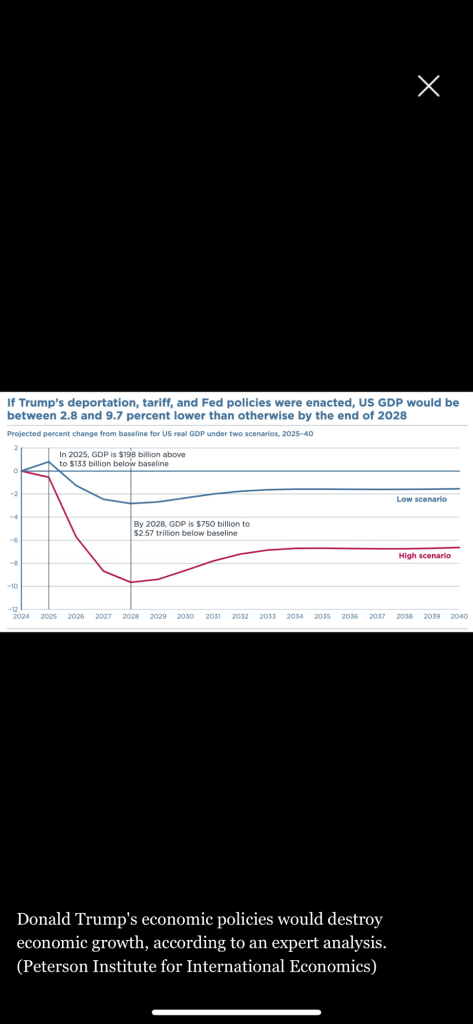
According to independent nonprofit nonpartisan researchers, Trump’s policies on tariffs, deportations, and the Federal Reserve would, if put in action, seriously hike inflation, wipe out jobs, and slow U.S. production and economic growth. 

In even the most generous modeling, inflation would reach 6 percent by 2026 and consumer prices would balloon 20 percent by 2028. 

According to an analysis from the Peterson Institute for International Economicspublished Thursday, the devastating effects on the economy could last through 2040. 

Trump promises to carry out “mass deportations” if elected president. Doing so could “cause a large inflationary impulse and a significant loss of employment (particularly in manufacturing and agriculture) in the US economy,” the researchers found. The deportation plan on its own would provide no economic benefit to Americans. 

Warwick McKibbin, a senior fellow and co-author of the study, told CNN that the institute estimates that deporting undocumented workers would cause a pandemic-like “shock,” especially in the agriculture industry. 

“Can you imagine taking 16 percent out of the labor force in agriculture?” McKibbin said, who noted the ripple effects would include rising cost of food or even permanent loss of supply. 

Trump’s isolationist approach to the economy through deportations and tariffs on U.S. imports would hurt the American people most. “We find that ironically, despite his ‘make the foreigners pay’ rhetoric, this package of policies does more damage to the US economy than to any other in the world,” wrote the authors. 

Of course, the Trump team denied the findings, with Trump campaign senior adviser Brian Hughes telling CNN the exact opposite: “Trump policies will fuel growth, drive down inflation, inspire American manufacturing, all while protecting the working men and women of our nation from lopsided policies tilted in favor of other countries.”

Umair Haque is an economist who writes at a blog called The Issue. He recently addressed an issue that has befuddled me and probably you as well. How is it possible that Trump is tied in the polls with Kamala Harris? He is an embittered old man who spews hate and cares only about himself; she is a vibrant and empathetic woman who wants to make life better for everyone. How can they be tied?

Haque has an answer. Democrats keep talking about how good the economy is, but they don’t speak to the vast number of people who are struggling economically.

He writes:

Day after day now, polls say the same thing.

The election’s deadlocked.

Despite all of it. History, immense spending, speeches, rallies, the drama surrounding Biden stepping down, the euphoria around Kamala.

So: what’s going on here?

What Makes Politics Move in a Capitalist Society?

By now, you should know, because precisely what we’ve discussed over the last few months is coming true.

Kamala and Tim aren’t connecting on the economy.

And yet it’s the Number One Issue for voters.

Let’s recap. America’s a hyper capitalist society. In such a society, the economy is always the top issue. It comes before everything else, because in a place like America, economics is existential. There are no real safety nets. And money, having enough of it, is literally everything.

That’s not so much the case elsewhere. To use the example I always do, the Sorbonne in Paris—Europe’s best university—is free. In America, sending a kid to an Ivy League school costs three times the median income, enough to bankrupt most families.

So the economy is always issue number one. Always.

And that’s why the Dems have a long, long history of losing. Because they are frankly pretty poor at crafting economic agendas which convince Americans, since they won’t admit Americans are in dire economic pain to begin with. Americans, meanwhile, have grown up in an environment which has sort of been poisoned, and any social contract or agenda remotely European or Canadian is instantly called “communism” or “socialism.”

Put those two trends together, and you can explain the Democrats’ long losing record—or why, in America, the default is that the GOP tends to win.

How Long Can the Democrats Keep on Ignoring the Economy?

But in times like these, the economy is…even more important. Crucial. It’s always the decisive factor, but this isn’t a normal era by any stretch of imagination.

The economy is a wreck.

It is doing really, really badly. If the question is: how’s capitalism doing, then the answer is, great. Yes, stock prices are roaring, sure, profits are in rude health, and yeah, CEOs are making out like pirate emperor bandits. But none of that’s the economy.

The economy is how average people are doing, and all the indications are they’re doing pretty terribly. Incomes just now crossed 2019 levels, and that means they fell for five straight years.

Meanwhile, prices exploded.

Before that came a long, long run of stagnation: median incomes for men, for example, are lower today than they were in the 1970s.

So people are struggling. The vast majority live paycheck to paycheck, large percentages struggle to pay bills, and of course, generations are in downward mobility, while “unretirement” is becoming a social trend.

The Democrats continue to make the fatal mistake they always make.

Ignoring all this.


People Trust Trump on the Economy More Because the Democrats Don’t Seem to Actually Care About It

Who was it that reached right into the heart of the working class, and empathized with its misfortunes? It wasn’t the Democrats. It was Trump.

Think of how bizarre that is. Trump’s a guy that likes to flaunt being a billionaire. But because the Democrats ignored the biggest socioeconomic issue of the last half century, he was able to walk away with the whole ballgame.

Let me put that even more sharply.

To this day, Democrats won’t dare mention this damning statistic, that median incomes are where they were, or lower, than half a century ago.

Those really are Roman sorts of social indicators, no exaggeration necessary. A half decade of stagnation is OK, maybe. But a half century?

But the Democrats never, ever even look in this direction. They look away awkwardly.

Their silence is deafening.

Why is Trump still so widely supported?

Because more people trust him on the economy. (And on immigration, which is the same thing, because here there’s a naive theory of economics, that immigrants take our jobs and so forth, which can be true, but in America, has more to do with the reverse, offshoring, etcetera.)

Why do people trust Trump more on the economy?

He empathizes with their pain.

The Democrats don’t even attempt to. They deliberately ignore it. But this is, let me say it again, the single biggest socioeconomic issue in modern history.

What happens when socioeconomics stagnate for long periods of time—like half centuries? Democracies die. People give up on their institutions and leaders. They give up on each other. They turn on one another…

And there’s a good reason why.


How Economic Stagnation Leads to Social Collapse

If the pie’s the same size, or shrinking, as it is for many Americans, then the only option is to try and fight tooth and nail to keep your slice. To have a bigger slice, you need to take it from someone else.

That’s how democracies die by way of stagnant or declining economies.

It isn’t a theory, speculation, opinion: there’s a formal mechanism at work, a kind of vicious cycle, an engine of ruin.

A shrinking pie, a stagnant one, necessitates a less democratic society. I have to take from you. To keep my slice the same size, I need to wrest it away from everyone else.

Thus, democratic norms of peace, equality, justice, and truth soon corrode. They’re replaced by authoritarian fascist norms of violence, domination, hierarchy, and blood-and-soil destiny.

This is how democracies die, and while that’s a phrase you’ll see used a lot, it’s not very well understood even by the columnists and pundits who sort of utter it ad infinitum. This isn’t a game. It’s not a set of platitudes.

This is what happened to America.

And still is.


“Hey, At Least They’re Not the Fascists”

The Democrats just refuse to acknowledge any of this. The long run stagnation. The decline. Any real aspect of it how it’s sort of wrecked the Dream, and destroyed generations of Americans’ fortunes and possibilities.

That leaves a gigantic, truly enormous, vacuum. One that’s big enough for Donald Trump’s ego to fill.

It’s a striking, bizarre thing to see the working and lower middle class support a billionaire, who of course, is also a convicted fraudster. Sort of crazy, right? That happens because nobody trusts the Dems on the economy, and nobody trusts the Dems on the economy because they won’t even admit a glimmer of reality when it comes to the economy.

So what truths can they speak back to people, to gain their trust?

Hence, here we are, sort of half-heartedly supporting them, most of us, knowing that they aren’t going to do a whole lot to really fix much, but hey, at least they’re not the fascists.

Not exactly the stuff of an inspiring politics, is it?


Why the Election’s Closer Than it Should Be

The Democrats still have time to fix this problem, and I say that chuckling, because we all know they won’t.

If anything, it’s probably going to get worse.

People are going to be mystified about why the Democrats think things are great, when they struggle to pay the bills.

They’ll look at Trump, who at least empathizes with them, and says things are bad out there, and it’ll strike a chord in them. Trump will continue to be more credible on the economy, the most important issue, even though he’s, wait for it, a convicted fraudster.

And after a time, Kamala’s grin is going to seem a little off kilter to a lot of people. Why does she keep on smiling, when things are pretty bad for me and mine? Is she for real? What’s the deal here?

I’m not trying to be unkind, I’m just pointing out that being joyous, while it’s fine and nice and good, and even touching, for those who are already true believers, also carries a risk in times like these. It can come across as tone-deaf. These are difficult, difficult days for the vast, vast majority of people, and I know that in statistics like “50% of young people feel numb” or “70% of people feel financially traumatized.”

Given those sorts of social currents, it might be tough to grin your way into the Presidency. In fact, it already is. The contest’s deadlocked. Joy is a tough sell, and at some point, it can verge on Let Them Eat Cake.

Again, those are wicked words, and I’m sorry to write them, but it has to be said, if only for the 0.001% chance the Democrats come to their senses, and begin to actually speak sense, truth, reality, on the Number One Issue to most people, the economy.

People don’t trust them on this issue, and there’s a good reason for that. Not what they want to do. But what they won’t say. The attitude they won’t take. The deafening silence everyone can hear when it comes to admitting how troubled and tough things actually are.

If I wanted you to trust me, and there was smoke billowing from the house, but I kept on telling you the curtains were wonderful, and hey, wait until you see the garage, what would you think of me? This is where the Democrats are heading when it comes to the economy, if they aren’t already, with a whole lot of people.

And that’s why the election’s a lot closer than it should be.

David Dayen, executive editor of The American Prospect, explains how little Trump understands economics or industrial policy. Strange that a graduate of the University of Pennsylvania’s Wharton School of Finance would be economically illiterate. Maybe he was a DEI admit.

Dayen writes:

When Donald Trump is in the room, the truth takes a night off.

Only in this Republican Party can stories about Haitians eating pets leap from 4chan to the presidential debate stage in two days. As Rick Perlstein noted today, when you have religious conviction animating your movement, trivialities like verifying claims are sidelined. As long as something fits into the worldview, it doesn’t need to be true. For all the talk about the damage of young girls being addicted to their cellphones and steps needing to be taken to wean them off, nights like Tuesday remind us that the real damage of internet addiction is occurring among old right-wing men who believe everything put in front of them.

About Kamala Harris’s strategy: The expression du jour is that Harris “baited” Trump into looking insane in front of the public, but I don’t think there was a chance that she would throw out the bait and not reel anything in. This wasn’t a fair fight. This was like the late 19th century, when the servants of some industrialist would stock the lake with hungry fish. The Harris campaign ran an ad on Fox News making fun of Trump about crowd sizes, did everything but fly a giant banner over Trump’s car reading, “We’re going to make fun of you about crowd sizes,” then made fun of him about crowd sizes, and Trump still got angry. Yes, the debate team knew who they’re dealing with, because the subject in question has the emotional self-control of a toddler.

What’s more interesting to me is the cul-de-sac that Trump has stumbled into on tariffs, which now comprise his entire economic policy. It’s indicative of this wall that has been built, not to keep out migrants from Mexico, but to keep out reality.

In 2016, Trump had a rationale for imposing tariffs. He thought cheap Chinese goods entering the country unmolested was hurting the industrial base and causing factories to close. He imposed them to revitalize those left-behind areas, rebuild those factories, lower the trade deficit, and make America great again. And they were not placed across the board outside of China; the tariffs other countries felt were sector-specific.

Somewhere along the way, an aide must have idly read half a page to Trump from Karl Rove’s book about William McKinley, and now tariffs are to him what tax cuts are to every other Republican: a cure for every ailment. (It’s a floor wax and a dessert topping.) Trump’s incoherent-sounding answer at the Economic Club of New York last week about child care was merely Trump seeing tariffs as bringing in enough cash to handle the problem. The way he thinks about this is the way a gangster used to think about protection money: Trump will get rich (oh, and sure, the country will too) by sticking up other countries.

There’s been a lot of dumb talk about tariffs lately, but they aren’t totally outlandish. That’s why, as Trump said in his only somewhat accurate comeback, Biden has kept a lot of the Chinese tariffs on. Lori Wallach and the Rethink Trade crew have a good primer on the purpose of tariffs. They are a trade enforcement tool for critical industries where countries have an economic and national-security imperative to compete. They are attempts to induce that competition fairly. And they are completely justified along those lines.

But that’s only if you combine them with other tools to allow for industrial expansion, like investing in manufacturing sectors or using export controls on certain technologies. The Biden administration has done this, and even added new, targeted tariffs on the same sectors where manufacturing is being encouraged. Because they are using tariffs in the manner in which they should be used, manufacturing construction in critical industries is soaring faster than any time in the last 30 years, private investment has been leveraged manyfold, clean-energy jobs in the U.S. are rising at twice the rate of other jobs, and the expected market share for U.S. semiconductors is now expected to grow after decades in the wilderness.

You’d have to know about this going in, but Harris actually alluded to it a bit when she talked about Trump “selling American chips to China to help them improve and modernize their military.” That was a reversal of Trump’s initial flirtation with export controls. She also highlighted the increase of 800,000 manufacturing jobs, which is frankly a low number, since practically all the factories boosted by the Inflation Reduction Act are still being completed and have yet to bring on production workers.

(I would add that the one area where the Biden administration eased up on including trade enforcement tariffs in its strategy, by delaying for two years solar component penalties, is an area where Chinese dominance is continuing. The suspension of a silicon cell factory in Colorado is the direct result of this failure to use the entire toolbox. The cross-pressure from the solar installation lobby, a trade group that includes the very Chinese companies dominating production, has been very damaging for administration strategy.)

Tariffs are imposed on wholesale prices, becoming part of the input cost. They are not a direct tax added to retail prices, and they are often absorbed into profit margins. But if you’re setting tariffs on everything, from every nation, including goods that have no substitute production in the U.S., then you are likely to get higher prices as a result, because there’s nothing stopping the retailer from passing on that input cost. You can use across-the-board tariffs as a trade enforcement tool to win policy concessions from other countries, but only if you’re willing to take them off if the concessions are won.

None of this is even reckoned with by Trump anymore. If it were, he’d have to admit that his tariffs failed to bring back industrial capacity. So instead, he’s gone deep into his mind and decided that tariffs are just a cheat code that allows you to cut other taxes and fund every need the government has. That means you can’t ever take them off, if they’re your main revenue source.

Thinking about tariffs as revenue is innumerate. Trump had to pay back out almost as much additional tariff revenue that he brought in to help struggling exporters, particularly in agriculture, caught up in his trade war. Tariffs cannot replace the income tax, and fund child care and other priorities, as a mathematical matter. But worse than that, the revenue on across-the-board tariffs, where no industry will rise to pick up the production and higher prices will result, will simply come from working families. Like any sales tax, it’s going to be regressive on those who spend a higher proportion of their income on basic necessities.

By contrast, the Biden strategy shows that industrial expansion and targeted tariffs can coexist with stable inflation, which as of today is down to 2.5 percent over the last year.

The Trump position on tariffs is indicative of the brain-poisoning of an entire party that has left policy construction behind in favor of Reddit rumors. In a fact-free zone, words are mashed together to the point of incoherence, and promises can be big and bold without a thought of whether they’re true and correct.

Do debates matter? They were enough to push one old politician out of the race a couple of months ago. Today, the Republican Party, which once called itself “the party of personal responsibility” is touting internet polls that their minions stormed, and blaming debate moderators for jumping in to say there’s no evidence of Haitians eating cats and dogs in Springfield, Ohio. Republicans have gone beyond any of the rational thoughts that would involve reassessing any of their choices over the last decade.

Whether debates matter for the purposes of collecting votes will not be revealed until November. What I know is that Donald Trump’s success depends entirely on whether he’s convinced enough Americans in swing states to be as ignorant as he is.

Michael Hiltzik is the Pulititzer Prize-winning business columnist for The Los Angeles Times. In this column, he explained that Trump and Vance are wrong to claim that tariffs will produce vast new revenues for the U.S. Treasury. Hiltzik shows that Trump doesn’t know what he’s talking about.

He writes:

Despite strong evidence that the average voter in the presidential election doesn’t care a hoot about international trade policy, Donald Trump and his running mate JD Vance have been promising to step up Trump’s tariff war with China.

As usual, they’re backing their promise with lies and other humbug.

“A tariff is a tax on a foreign country,” Trump asserted at an Aug. 19 rally in Wilkes-Barre, Pa., for example. “That’s the way it is, whether you like it or not. A lot of people like to say it’s a tax on us. No, no, no. It’s a tax on a foreign country.”

Questioned during an appearance on NBC’s “Meet the Press” on Aug. 25 about the effect of Trump’s tariffs on ordinary households — and economists’ conclusion that consumers pay the price — Vance asserted that “economists really disagree about the effects of tariffs.”

They’re wrong on both counts.

In truth, there’s no detectable disagreement among economists. In two polls conducted by the Booth School of Business at the University of Chicago, panels of economists unanimously agreed that American households would pay the price for Trump’s tariffs.

Those opinions held in a March 2018 poll and a May 2019 poll of panels of 43 leading academic economists. (The panels weren’t identical but did overlap; three respondents in the first poll didn’t provide answers and 11 didn’t answer or were “uncertain” in the second.)


The Harris campaign is more forthright about the cost of tariffs to the average consumer, although its specific estimates about the magnitude of the cost of tariffs Trump has proposed for the future — almost $4,000 a year on middle class households — can be questioned.

It’s proper to note, moreover, that although Harris has called the Trump tariffs a “Trump sales tax,” she doesn’t mention that the Biden administration has kept many of Trump’s tariffs in place and has moved to increase some of them.
It’s safe to say that the entire topic of tariffs is fraught with confusion and uncertainty. Here’s what you need to know.


First, the background. Trump launched a trade war, principally with China, in 2018 with a tariff of up to 25% on $50 billion worth of Chinese products. He stepped up the war later in the year with 10% tariffs on $200 billion in goods, and added tariffs of 10% on an additional $112 billion of Chinese imports. Trump also imposed tariffs on aluminum and steel imports from numerous trade partners.


These levies amounted to a tax of some $80 billion a year on American consumers, the nonpartisan Tax Foundation recently calculated. That was tantamount to “one of the largest tax increases in decades,” the foundation said, blaming the tariffs for the loss of the equivalent of 142,000 jobs. The average household paid a price of nearly $300 a year.


Biden kept in place many of the levies on Chinese products and added some of his own, including a 100% tariff on Chinese-manufactured electric vehicles. He replaced the aluminum and steel tariffs on imports from Britain, the European Union and Japan with a tariff quota, meaning that imports up to a certain level are exempt but tariffs remain in place for higher import volumes.

Tariffs are designed to fall on finished exported goods, but those goods often aren’t what consumers buy directly. Aluminum and steel, obviously, are raw materials used by manufacturers in the importing country. Other products subjected to the Trump tariffs are parts that go into American-made cars or other finished products.


The household-level effect of tariffs also depends on what a consumer buys. Consider the effect of tariffs on washing machines imposed by Trump (and allowed to expire by Biden) and the 100% tariff on Chinese-made electric vehicles Biden announced in May.


The EV tariffs will have no effect on American buyers, in the view of economist and economic blogger Noah Smith. That’s because Chinese EVs aren’t a factor in the U.S. market: “If you’re an American, you weren’t buying a Chinese EV yesterday, and now you’re not going to buy one tomorrow either. Nothing will change for you,” Smith observes.

You might, however, be able to buy one at some point in the future. Chinese EV makers including BYD are planning to build factories in Mexico, which would allow them to circumvent the Biden tariff even if the Mexican-made vehicles are bristling with Chinese parts. Some companies may even open factories in the U.S., as BMW, Honda, Toyota and other foreign carmakers have done.

The Trump tariff on washing machines had a measurable effect on the American market, however. Chinese-made machines commanded 80% of the U.S. market in 2018. That January, Trump imposed a 20% tariff on the first 1.2 million imported washing machines per year, and 50% on the excess imports.

Economists at the Federal Reserve and University of Chicago calculated that as a result, the price of washing machines rose by about 11%, or an average of $86.

As it happens, the price of clothes dryers, which weren’t subject to a tariff, also rose, by $92. The reason evidently is that washers and dryers are generally bought as a pair; washer makers taking advantage of the reduction in foreign competition to raise prices on that appliance simply jacked up prices on the package.

Overall, manufacturers passed through more than 100% of the tariff cost to consumers, thanks to the lack of competition and the price increase on dryers. American consumers lost about $1.55 billion because of the washing machine tariffs, the authors found.

The researchers did acknowledge that manufacturing employment in the washing machine sector increased by about 1,200 in the wake of the tariff. But that worked out to a cost of about $815,000 per new job — borne, again, by consumers.

That underscores the fakery purveyed by Trump and Vance about the purported virtues of tariffs. During his “Meet the Press” appearance, Vance claimed that tariff critics overlooked the “dynamic effect when more jobs come into the country. Anything that you lose on the tariff from the perspective of the consumer, you gain in higher wages.”

But there’s scant evidence for Vance’s claim that the tariffs pay for themselves. Certainly the economists polled by the University of Chicago didn’t think so, and the Tax Foundation found that, on balance, the Trump tariffs cost jobs.
The same conclusion was reached by economists at UCLA, UC Berkeley, Yale and Columbia, who found “large consumer losses from the trade war” Trump instigated. They added together the cost of the U.S. tariffs and those of retaliatory tariffs imposed by target countries, especially China.

That leaves the question of the role tariffs should play in overall industrial policy. They’re a tool that can be useful or warranted in specific contexts, but only if they’re carefully calibrated with other measures. Biden accompanied his continuation of Trump’s tariffs on Chinese semiconductor products, for instance, with the 2022 CHIPS and Science Act, which provides for about $280 billion in government funding for semiconductor research and development, including $40 billion in subsidies for chip factories in the U.S.

Viewed in isolation, tariffs are disdained by liberal and conservative economists alike. David Dollar and Zhi Wang of the liberal Brookings Institution warned in 2018 that of the costs of Trump’s trade war, “some … will be borne by American consumers; [and] some by American firms that either produce in China or use intermediate products from China.”

Their conclusions were confirmed by the libertarian Cato Institute, which asserted last month that “Americans bore the brunt” of Trump’s tariffs. Among the drawbacks were “higher tax burdens and prices, loss in wages and employment, reduced consumption, decreased investment, a decline in exports, and overall aggregate welfare.”

History offers its own warnings. During an interview on “Fox News Sunday,” Trump praised the tariffs proposed by William McKinley (R-Ohio) as a member of Congress in 1888. “If you look at McKinley,” Trump told his interviewer, Mark Levin, “he was a great president. He made the country rich.”

During the years following the enactment of the “McKinley Tariff” in 1890, the U.S. suffered four recessions or “panics,” in 1890-91, 1893, 1896 and 1899-1900.

McKinley became president in 1897. By then the McKinley Tariff had been shown to be a political disaster, leading to landslide losses of 83 House seats in the midterm election of 1890 and the loss of the White House in 1892, placing both chambers of Congress and the presidency in Democratic hands.


In other words, if Trump knew history, he would abandon all this tariff talk. But he doesn’t, and he hasn’t.

Springfield, Ohio, has been in the news lately, and not in a good way. At the debate between Trump and Harris, Trump claimed that Haitian immigrants were stealing pets and eating them. The ABC moderator corrected him and told him it wasn’t true. Trump refused to believe him, insisting that he saw it on television.

The next day, Springfield’s City Hall and other facilities were closed due to bomb threats. Municipal authorities released a statement denying Trump’s claim and expressing appreciation for the Haitians’ contributions to the town’s economy. They are legal immigrants.

A father in Springfield whose 11-year-old son was killed in a collision between a school bus and a minivan driven by a Haitian pleaded with Trump, Vance, and other Republican politicians to stop using his son’s name in their campaigns. He was not murdered, he said; he died in a traffic accident. “Please stop the hate,” he said. “In order to live like Aiden, you need to accept everyone, choose to shine, make the difference, lead the way and be the inspiration…Live like Aiden.”

John Legend stepped in to post an article about Springfield on Facebook that was then published by The Columbus (Ohio) Dispatch. He was born in Springfield.

Editor’s note: Springfield native John Legend, an internationally acclaimed performer, took to social media Sept. 12 to address backlash against Haitian immigrants promoted by Republican presidential candidate Donald Trump and his running mate, U.S. Sen. JD Vance of Middletown. His statement is below.

My name is John Legend, and I was born as John. R Stevens from a place called Springfield, Ohio. Springfield, Ohio — you may have heard of Springfield, Ohio, this week.

In fact, if you watch the debate, we were discussed by our presidential candidates, including a very special, interesting man named Donald J. Trump.

Now, Springfield has had a large influx of Haitian immigrants who come to our city.

Now, our city had been shrinking for decades. We didn’t have enough jobs. We didn’t have enough opportunity so people left and went somewhere else.

So, when I was there, we had upwards of 75,000 people and in the last five years we were down to like 60,000 people. 

But of late, during the Biden administration, there have been more jobs that opened up. More manufacturing jobs, more plants, factories that needed employees and were ready to hire people.

So, we had a lot of job opportunities, and we didn’t have enough people in our town of 60,000 people to fill those jobs.

And during the same time, there has been upheaval and turmoil in Haiti. The federal government granted visas and immigration status to a certain number of Haitian immigrants so they could come to our country legally.

Our demand in Springfield for additional labor met up with the supply of additional Haitian immigrants and here we are.

We had about 15,000 or so immigrants move to my town of 60,000.You might say, wow, that’s a lot of people for a town that only had 60,000 before. That’s a 25% increase.

That is correct.

So you might imagine there are some challenges with integrating a new population.

New language, new culture, new dietary preferences. All kinds of reasons why there might be growing pains.

Making sure there are enough services to accommodate the new, larger population that might need bilingual service providers, etc. etc.

So, there are plenty of reasons why this might be a challenge for my hometown.

But the bottom line is these people came to Springfield because there were jobs for them and they were willing to work. 

They wanted to live the American dream, just like your German ancestors, your Irish ancestors, your Italian ancestors, your Jewish ancestors. Your Jamaican ancestors, your  Polish ancestors –  all these ancestors who moved to this country.

Maybe not speaking the language that everyone else spoke.

Maybe not eating the same foods.

Maybe having to adjust.

Maybe having to integrate.

But all coming because they saw opportunity for themselves and their families in the American dream.

And they came here to do that.

Senator Sanders of Vermont is leading a campaign to restore collective bargaining rights. [CORRECTION!]

He wrote today:

As we celebrate Labor Day, 2024, there is some very good news. 

Public approval of labor unions, at 70%, is higher today than it has been in decades. Over the last year major unions like the UAW have won some highly publicized strikes, while many other unions have negotiated trail-blazing contracts for their members. Young people at Starbucks and on college campuses are now more involved in labor organizing than ever before. And, for the first time in American history, a president of the United States, Joe Biden, walked a picket line with striking workers.

It is not an accident as to why we are now seeing more militancy and growth in the labor movement. The working people of our country are increasingly aware of the unprecedented level of corporate greed and power we are now experiencing, and the outrageous level of income and wealth inequality that exists. They understand that never before in American history have so few had so much, while so many continue to struggle. And they are fighting back. They know that workers in unions can negotiate contracts that give them better wages, working conditions and benefits than non-union workers. They appreciate that when you’re in a union you have some power against the arbitrary decisions corporate bosses. 

Working people today are more than aware that, over the last 50 years, there has been a massive transfer of wealth from the bottom 90% to the top 1%. They are disgusted that, despite huge increases in worker productivity, real inflation-accounted for wages for the average American worker are lower now than they were over 50 years ago as 60% of Americans live paycheck to paycheck. They are insulted that CEOs of major corporations make almost 350 times as much as their average employee. They are concerned that the American dream is ending and that their kids may have an even lower standard of living than they do. And they worry that with the rapid growth of Artificial Intelligence and robotics, they have no power as to what will happen to their jobs as the economy undergoes major transformations.

The average American worker also understands that his/her political power has been significantly diminished as billionaires pour huge amounts of money into both political parties as they undermine our democracy. It is no great secret as to who now has the clout in Congress. It is the billionaires, the corporate CEOs, the campaign donors and their well-connected lobbyists.

Bottom line: The average American worker is sick and tired of status quo economics and politics. He/she knows that in the richest country on earth we can and should have an economy and political system that works for all, and not just the wealthy few, and that a strong union movement is the vehicle for bringing about the changes that we need.

On this Labor Day, as we reaffirm our support for the trade union movement and for labor solidarity throughout the world, as we continue to fight the day to day struggles against corporate greed, it’s important that we not lose sight of our vision for the future and what kind of country we want to become. Here, in my view, are just a few components of the agenda we need to fight for. 

We must establish a vibrant democratic political system. One person, one vote. We must end the disastrous Citizens United Supreme Court decision and the billionaire funding of campaigns through super-PACs. We need to move to the public funding of elections and give political power back to ordinary Americans. 

We need to pass the PRO Act and end the ability of companies to illegally intimidate and fire workers who want to join a union. Corporate interests spend an estimated $400 million a year on anti-union consultants who do everything possible, legal and illegal, to fight the right of workers to join unions.

We need to end starvation wages in America and raise the $7.25 an hour federal minimum wage to a living wage. People should not have to work two or three jobs just to pay the bills for their families.

We need trade policies that benefit workers in the U.S. and abroad, not just the CEOs and stockholders of major conglomerates. We need to rebuild our manufacturing sector and create good paying jobs here.

We need to join the rest of the industrialized world and guarantee health care to all people as a human right through a Medicare for All, single payer system. No one should go bankrupt because of a hospital stay. Everyone in America, regardless of income, should have the right to see a doctor. 

We must finally guarantee paid family and medical leave to every worker in America. New moms and dads should be able to spend the first few months after delivery with their newborn child. Family members should be able to care for a loved-one who is sick without having to worry about missing a paycheck. 

Like health care, education and job training must be considered a human right from childcare to graduate school. At a time when, in a highly competitive global economy, we need the best-educated workforce in the world, no one should be forced to go deeply in debt to get the education and training they need to be productive members of our society. 

At a time when 50% of older workers have nothing in the bank for retirement, and 25% of seniors are trying to live on $15,000 a year or less, we must re-establish Defined Benefit Pension plans and increase Social Security benefits. Workers are entitled to a secure and dignified retirement.

And finally, we must address the unprecedented and outrageous level of income and wealth inequality that currently exists. No. It is not acceptable that three multibillionaires own more wealth than the bottom half of American society. It is not acceptable that many billionaires pay an effective tax rate that is lower than truck drivers or nurses. We need a progressive tax system that demands that the wealthiest people in our country finally start paying their fair share of taxes. 

Let’s be clear. None of these progressive concepts are “radical.” While they are opposed by the Big Money interests and marginalized by the corporate media and the political establishment, they are strongly supported by a majority of the American people. Most of these ideas, in one form or another, are already in place in other wealthy countries around the world.

So, on this Labor Day, let us redouble our efforts to grow trade unionism in America and create the kind of grassroots movement we need to take on the power of the Oligarchy. Let us, in the wealthiest nation in the history of the world, create an economy that provides a decent standard of living for all, and not just massive and obscene income and wealth inequality. 

As we enter the last two months of the election season, please contribute $54 to my campaign. I will use the donations we receive to travel the country with trade union and progressive leaders to defeat Donald Trump and to elect the most progressive Congress possible this November. We’ve already had great events in Wisconsin, Minnesota, New Hampshire, Maine and New York. But much more needs to be done. 

If you’ve stored your info with ActBlue, we’ll process your contribution instantly:CONTRIBUTE $54CONTRIBUTE OTHER

And let us never forget: When we stand united, and not let authoritarians and bigots divide us up, there is nothing that we cannot accomplish.

Happy Labor Day! 

Bernie

Today is an ironic holiday. The nation recognizes the day and most offices are closed to honor the dignity of labor. But it was not created in the late nineteenth century to honor labor in general but to honor labor unions.

Why ironic? Because right wingers have always hated labor unions. Today, unions represent about 10-11% of workers. Most unionized workers belong to public sector unions. In the 1950s, about one-third of private-sector workers belonged to a union; now only 6% do. Most people think that the decline in union membership has been bad for the country. They are right.

Why does it matter? Because unions were crucial in building the middle class. Because they have always been a stepping stone from low-wage jobs to better-paying jobs with benefits, including healthcare and pension. Because they promote better working conditions and higher salaries. Because unions are the answer to closing the vast gap between rich and poor. Without unions, there will be more super-billionaires and more living in poverty.

We need more unionized workers and workplaces.

The Department of Labor has a page about the day’s history.

The first Labor Day holiday was celebrated on Tuesday, September 5, 1882, in New York City, in accordance with the plans of the Central Labor Union. The Central Labor Union held its second Labor Day holiday just a year later, on September 5, 1883.

By 1894, 23 more states had adopted the holiday, and on June 28, 1894, President Grover Cleveland signed a law making the first Monday in September of each year a national holiday.

A Nationwide Holiday

Women's Auxiliary Typographical Union

Many Americans celebrate Labor Day with parades and parties – festivities very similar to those outlined by the first proposal for a holiday, which suggested that the day should be observed with – a street parade to exhibit “the strength and esprit de corps of the trade and labor organizations” of the community, followed by a festival for the recreation and amusement of the workers and their families. This became the pattern for the celebrations of Labor Day.

Speeches by prominent men and women were introduced later, as more emphasis was placed upon the economic and civic significance of the holiday. Still later, by a resolution of the American Federation of Labor convention of 1909, the Sunday preceding Labor Day was adopted as Labor Sunday and dedicated to the spiritual and educational aspects of the labor movement.

American labor has raised the nation’s standard of living and contributed to the greatest production the world has ever known and the labor movement has brought us closer to the realization of our traditional ideals of economic and political democracy. It is appropriate, therefore, that the nation pays tribute on Labor Day to the creator of so much of the nation’s strength, freedom, and leadership – the American worker.

Michael Hiltzik is the Pulitzer-Prize winning business columnist for The Los Angeles Times. He explains here that Kamala Harris’s economic plans to help families make sense.

He writes:

Up to now, Kamala Harris’ presidential campaign has been careful about rolling out its policy initiatives, and — at least in political terms — for good reason.

Policy details at this stage of a campaign do little but give opponents and pundits grist for nitpicking. Most voters aren’t very interested in the details of what a given legislative venture will look like once it goes through the Capitol Hill meat grinder. Political journalists, for their part, seem to be chiefly interested in teasing out holes in the proposal.

For Harris’ campaign, this looks like a lose-lose proposition. After grousing incessantly that Harris hadn’t offered policy specifics since becoming the evident Democratic nominee on July 21, the press has moved on to questioning her intentions, sometimes by seizing on misrepresentations of her actual proposals.

That has been happening since Friday, when Harris issued her first policy “agenda.” This was largely devoted to lowering the cost of housing, food, medical services and child-raising for families, and generated a swell of quibbles in the press and the punditocracy. As it happens, however, Harris is right about the burden of those costs, and right about the best ways to address them.

At this point in an election cycle, presidential campaigns are all about themes and impressions. Harris plainly is setting out a theme of help for an American middle class that has rightly felt neglected by government for decades. Donald Trump’s theme is … what, beyond whining about how he’s treated? 

Harris’ professed desire to lower food prices led to a spurt of news articles and columns asserting that she was proposing “price controls.”

It’s hard to know where that idea came from; it peaked even before Harris’ policy brief was issued Friday, when the hand-wringers discovered that she was contemplating nothing of the kind. 

Some commentators, abetted by the right-wing peanut gallery, may simply have extrapolated from indications that she was targeting price gouging, but that’s on them, not her. (The Murdoch-owned New York Post strained so hard to tag her policies as “Kamunism” that one almost fears that it gave itself a hernia.)

The Harris campaign in its formal statement proposed “the first-ever federal ban on price gouging on food and groceries.”

Some commentators pointed out that the average net profit margin for supermarkets is about 1%. They argued that this rules out any indication that Americans had been the victim of gouging by retailers.

Is that so? 

It’s true that retail grocery profit margins are in the very low single digits. They always have been. But food retailing is a high-volume business, so margins below 2% can translate into annual profits of — to take just two examples — $1.3 billion (at Albertsons) and $2.2 billion (at Kroger).

That doesn’t mean that the grocers can’t gouge shoppers. After all, they did so during the pandemic. 

How do we know this? From their own financial disclosures, which show that Albertsons and Kroger jacked up prices well beyond any increases in their costs. 

The pretax profit margin at Albertsons rose from 0.96% in 2019 to 1.62% in 2020 and 2.92% in 2021; it fell back to 2.01% in 2023, once the pandemic appeared to move to the rearview mirror. At Kroger, the margin went from 1.62% in 2019 to 2.54% the following year. It dipped to 1.49% in 2021, but rose again to 1.96% in 2022 and 1.89% last year.

Nothing can explain the pandemic-era spike in profits better than these companies raising prices faster than their costs. In other words, gouging.

The Federal Trade Commission said so, without using the term. It found that food and beverage retailer revenues rose to 7% over total costs during the pandemic, well beyond “their recent peak of 5.6 percent in 2015.” That trend, the FTC reported, “casts doubt on assertions that rising prices at the grocery store are simply moving in lockstep with retailers’ own rising costs.” 

Even beyond the food sector, as I reported earlier, corporate profiteering was unmistakably a significant contributor to inflation over the last few years. That was the conclusion of a team at the Federal Reserve Bank of Kansas City, who reported that markup growth “could account for more than half of 2021 inflation.” The annualized inflation rate reached 5.8% that year.

Notwithstanding the ginned-up controversy over Harris’ anti-gouging initiatives, it’s proper to note that price gouging and its country cousin, price-fixing, have traditionally been a bipartisan concern.

In 2020, Donald Trump issued an executive order to prevent gouging on health and medical resources, which makes his claim that Harris’ initiatives on prices are tantamount to “communism” seem more than a teensy bit hypocritical. 

In the food sector, Republicans and Democrats in Congress last year took aim at price-fixing in the meat packing business. In 2022, StarKist pleaded guilty to price-fixing on tuna and paid a $100-million fine; Bumble Bee had also pleaded guilty and its former chief executive was sentenced to a prison term.

One linchpin of Harris’ attack on food prices is closer scrutiny of consolidation in the food industry. “Vice President Harris will … direct her Administration to crack down on unfair mergers and acquisitions that give big food corporations the power to jack up food and grocery prices,” the campaign stated.

If you’re an executive of Kroger and Albertsons, you can probably figure out that she’s talking about you. Those grocery giants are trying to push through a gargantuan $24.6-billion merger that, like all such mergers, will almost certainly produce higher prices at the checkout conveyor. The Harris campaign telegraphed that she will give the Federal Trade Commission more authority to chase bad actors in the food sector. The FTC already has sued to block the merger, and it’s a fair supposition that under a President Harris the agency won’t be backing off.

On housing, Harris is proposing $25,000 in down-payment assistance for first-time home buyers, with special attention for first-generation buyers. Her campaign didn’t specify how that assistance would be delivered, but did project that more than 4 million first-time buyers would be eligible over four years.

This proposal generated cavils in the chattering classes that it would drive home prices up to absorb the $25,000 grant, putatively keeping homes out of the reach of the beneficiaries. 

A couple of points are germane here. One is that government-sponsored down-payment assistance programs are in place in all 50 states and the District of Columbia. The difference in Harris’ proposal is that it would be federalized and somewhat more generous than many state programs.

Pundits who claim that the proposal would drive prices higher must not know much about how the housing market works. First, fewer than one-third of home buyers are first-time buyers.

Sellers who assume that all their bidders are sitting on $25,000 in government cash risk pricing their homes out of a market in which two-thirds are using their own resources. 

Budget hawks at the Committee for a Responsible Federal Budget, which was founded with money from a hedge fund billionaire, fretted that the down-payment proposal would raise the federal deficit by $100 billion over 10 years, at least. 

To put this in perspective, consider the biggest federal giveaway to homeowners, the mortgage interest deduction from federal income tax.

This deduction costs the Treasury about $30 billion a year; if the increase in the standard deduction enacted in the Republicans’ Tax Cuts and Jobs Act of 2017 expires as scheduled next year, the cost of the mortgage deduction will soar to $84 billion in 2026, according to the congressional Joint Committee on Taxation.

Unlike the down-payment assistance contemplated by Harris, the deduction on home mortgage interest and points is heavily skewed toward the wealthy. 

More than 63% of its claimants in tax year 2018, the most recent for which the IRS provides statistics, had incomes higher than $100,000; the $123 billion of deductible interest and points they reported to the IRS was 73% of the total. 

More to the point, the mortgage interest deduction is a lousy tool for spurring home ownership, which supposedly is the goal of such tax breaks. That’s because it is “targeted at the wealthy, who are almost always homeowners,” as Harvard economists Edward L. Glaeser and Jesse Shapiro observed in 2003. 

For middle- and low-income Americans, on the other hand, the No. 1 obstacle to home ownership is the down payment. Helping those households buy a house is tantamount to the government putting its money where its mouth is. 

During an impromptu encounter with the pressSunday, Harris rightly described her initiatives as investments, not spending. Consider her remarks about the child tax credit, on which she proposes to restore to the level of up to $3,600 per child enacted in the Biden administration’s American Rescue Plan, and to raise to $6,000 for the first year of a child’s life.

“The return on investment in terms of what that will do and what it will pay for will be tremendous,” she said. 

She’s right: In 2021, when the higher credit was enacted, the credit reduced the child poverty rate by about 30%, keeping as many as 3.7 million children out of poverty by the end of that year. When the enhancements expired in January 2022 and the credit fell to $2,000, the child poverty rate spiked to 17% from 12.1%, plunging those 3.7 million children back under the poverty line. 

This is the program that Sen. JD Vance, the GOP candidate for vice president, claims to love. But when a raise in the program came up for a vote in the Senate earlier this month, Vance didn’t even bother to show up to vote.

Jill Lawrence is a veteran journalist who writes now for The Bulwark, a Never-Trumper site. She writes here about the ridiculous epithets hurled at Kamala Harris’s plan to punish price-gouging. After trying out various insulting names, he has settled on “Communist Kamala.” This is ridiculous, of course, but it stirs fear. Apparently anyone who believes that the federal government has a role to play in supporting the general welfare is a Commie. In Trump’ssworld, the purpose of the Feds is to cut taxes on the rich.

She writes:

VICE PRESIDENT KAMALA HARRIS wants to punish companies for price gouging—but only food suppliers and grocery stores, and only if federal or state authorities investigate and determine that they have violated what her campaign calls “clear rules of the road.”

Reaction across the spectrum has run a mild to overheated gamut of negativity, with the proposal being called everything from counterproductive and “not sensible” to “Venezuelan-style” Nixonomics and “a heavy-handed socialist policy” that will fuel former President Donald Trump’s attacks on her as “Comrade Kamala” going “full Communist” by imposing “socialist price controls” that would cause rationing and hunger.

Give me a break, man, as President Joe Biden might say. Communist? Socialist? Nixonesque? Not even close.

“In our country both wholesale and retail prices are established by the government,” Soviet Finance Minister Vasily Garbuzov said in 1960. All of them. By fiat. And quite similar to what President Richard Nixon did eleven years later. “I am today ordering a freeze on all prices and wages throughout the United States,” he said on August 15, 1971.

None of this is remotely akin to the modest scope and due process of what Harris has in mind, per her campaign: writing national rules “to make clear that big corporations can’t unfairly exploit consumers to run up excessive profits on food and groceries,” and authorizing the Federal Trade Commission and state attorneys general to investigate and penalize companies that break those rules.

Many states—those vaunted laboratories of democracy—already have laws that ban price-gouging. At its core, it’s simply consumer protection. And while we don’t yet know the details of the Harris plan, let alone how it would evolve when enacted or what impact it would have, as a political calculation it’s never a mistake to empathize with consumers during inflationary times.

Nixon lifted his price and wage controls right after he was re-elected in 1972. Harris announced her plan last week—less than a month after her sudden rise to the top spot on the Democratic ticket in a contest against Trump, who is manifestly unfit to serve and a proven danger to democracy.

Speaker Emerita Nancy Pelosi helped engineer that candidate switchout, Harris slotted in for a flagging 81-year-old Biden, and it’s the Pelosi campaign mantra that comes to mind these days: Just win, baby. Plus, what’s wrong with politicians signaling in a visceral way that they feel people’s pain at the grocery store? Nothing.

Bill Clinton, the epitome of a feel-your-pain president, signaled both political moderation and emotional connection in two State of the Union speeches—1996 when he was running for re-election and 1997 after he had won a second term—by backing uniform requirements in public schools that wanted them. He argued they could help “break the hold of gangs and violence” and promote “discipline and order and learning” in classrooms.

By scale and historic import, Clinton’s school uniforms push didn’t rank among his administration’s most noteworthy achievements, yet it allowed him to relate to people on a personal, daily-life level, and that’s what Harris needs…

Joe Biden has not gotten the credit he deserves for his economic record. The U.S. economy on his watch has made a stellar recovery from the pandemic. Wages are up, unemployment is way down, the stock market is up, retail sales are up, inflation is down, and as of last week, small business applications were at a record high of 19 million since Biden and Harris took office.Join

Maybe the public hasn’t given Biden credit for all this because inflation has only just shown signs of subsiding. Or maybe it’s because of his age and general unhappiness about a Biden–Trump rematch. But part of it may be, as I have written, that Biden has been playing the long game—setting us up to fight climate change, compete with China, and bring manufacturing home to protect America against future global supply-chain disruptions.

And the investments have been targeted well: renewable energy, high-speed broadband, electric-vehicle battery plants and charging networks, a wave of future-forward manufacturing that studies show has gone largely to red and purple states and congressional districts. Biden will leave the whole country, not just the parts he likes or wins, more self-sufficient and better equipped to take care of the planet.

The concrete results in some cases won’t be apparent for years after Biden leaves office, but progress is happening now—high-speed internet proposals submitted and approved, new jobscoming online, semiconductor manufacturing projects advancing with federal and private-sector financing, and America on its way to producing 30 percent of the world’s semiconductor chips by 2032—up from zero.

Key parts of Biden’s Build Back Better plan largely fell by the wayside in 2022—most notably a care component that included free preschool, paid family and medical leave, child care subsidies, higher pay for home health care workers, an expanded child tax credit, and remedies for what even then was a crisis-level housing shortage. But Biden has not lost sight of any of this, and in fact he revived the family-relief provisions this past spring before exiting the 2024 race.

Harris, whose interest in such policies is longstanding, is now adapting and expanding on the care agenda in ways that mesh with today’s populist economics. She’s doing the same on housing and inflation, informed by her background as a prosecutor and attorney general who protected consumers and their interests, from privacy to home foreclosures.

This is the moment we’re in and Harris is seizing it. That’s the right thing to do in 2024, just as the right thing to do in 2020 was to defend democracy and fight for the soul of the nation. That’s how Biden defeated Trump four years ago and he’s been clear about his objective this year… “Win.”