Archives for category: Disruption

From Day 1 of the Trump administration, the strategy of the Trumpers was to “flood the zone.” That is, to roll out so many new policies that the public could not keep track, and the media couldn’t deal with them all. Trump’s staff had the blueprint in Project 2025, and they were prepared with dozens of executive orders. That, plus the depredations of Elon Musk’s DOGE kids made it seem as if we had suddenly been swarmed by an invasion from outer space of aliens intent on destroying our government.

Now that Congress has passed Trump’s One Big Ugly Bill, we are in the same situation. The near 1000-page bill has so many policy reversals that no one knows all of its contents. The goal seems to be to wipe out anything that Biden or Obama accomplished.

Michael Tomasky, editor of The New Republic, insists that we pay attention to the dramatic increase in funding for ICE. Will we have labor camps spread across the country where detainees can be hired out to farmers to perform the labor they used to be paid for?

Tomasky writes:

One aspect of the Republicans’ big, ugly bill that didn’t get enough attention until Rep. Alexandria Ocasio-Cortez elevated it over the last few days is the massive amounts of money it directs to the apprehension and detention of immigrants. On Thursday, right after the bill passed the House, AOC posted on Bluesky:

I don’t think anyone is prepared for what they just did w/ ICE. This is not a simple budget increase. It is an explosion – making ICE bigger than the FBI, US Bureau of Prisons, DEA,& others combined. It is setting up to make what’s happening now look like child’s play. And people are disappearing.

— Alexandria Ocasio-Cortez (@aoc.bsky.social)July 3, 2025 at 2:58 PM

The next day—the Fourth of July, as fate would have it, when President Trump signed the bill into law—historian Timothy Snyder posted a columnon Substack under the blunt headline “Concentration Camp Labor.” If AOC’s post and Snyder’s headline sound hyperbolic to you, consider what’s actually in this new law.

It includes $170 billion for immigration enforcement: about $50 billion to build a wall on the Southern border; $30 billion for Immigration and Customs Enforcement (ICE); and $45 billion for detention camps.

A little perspective: ICE’s existing annual budget has been around $8 billion, so $30 billion is nearly quadruple. As AOC noted, it will make ICE into a huge police force that will indeed be larger than the FBI ($11.3 billion), the Bureau of Prisons ($9 billion), and the Drug Enforcement Administration ($3.3 billion) combined.

What is ICE going to do with all that money? One thing, obviously, is that it will try to hire enough people to hit MAGA apparatchik Stephen Miller’s target of rounding up 3,000 people a day. That’s a target it apparently still hasn’t even hit. On June 5, NBC News reported that ICE hit a then-record of 2,200 detentions that day. That included hundreds of people who showed up at regional ICE offices to check in as required by the release program they were enrolled in—a program under which these people were deemed not to be threats to public safety and whose movements were already monitored by ankle bracelets or geo-locator apps.

In other words, ICE has already been detaining thousands of people who, yes, entered the United States illegally, but ever since just lived, worked, and even paid taxes. Some may have gotten into some trouble with the law, but they’re wearing monitors and showing up for their appointments. Others have had no scrapes with the law at all. And now ICE is going to have the resources to detain thousands more such people.

And no—the American public emphatically does not support this. A late June Quinnipiac poll found that 64 percent of respondents said undocumented people should be given a path to citizenship, and only 31 percent said they should be deported. And that 64 percent is up from 55 percent last December, meaning that people have watched six months of Trump’s immigration policies in action and turned even more strongly against deporting everyone.

So that’s what ICE is going to do with its $30 billion. Now think about $45 billion for detention camps. Alligator Alcatraz is expected to cost $450 million a year. Right now, a reported 5,000 detainees are being held there. The Trump administration says the new $45 billion will pay for 100,000 beds. So that’s 20 more Alligator Alcatrazes out around the country. But it’s probably even going to be worse than that, because the state of Florida, not the federal government, is footing the bill for that center. If the Trump administration can convince other states to do the same, or pay part of the freight, we’re looking at essentially a string of concentration camps across the United States. Besides, there’s something odd about that $450 million a year price tag. (Here’s an interesting Daily Kos community post asking some good questions about that astronomical cost. The math doesn’t add up.)

Forty-five billion will build a lot of stuff. As a point of comparison: In 2023, the United States budgeted $12.8 billion to build new affordable housing. We’re about to spend nearly four times on detention centers what we spend on housing.

Open the link to finish reading.

It is sickening to realize that the US, our beloved country, is now aligned with Russia and Putin. It is sickening to realize that when the UN took a vote to condemn Putin’s illegal invasion of Ukraine, the U.S. voted “no,” allied with Russia, North Korea, and Iran. It is sickening to realize that the U.S. is now in cahoots with the enemies of freedom and democracy.

It is sickening to see the Justice Department turned into a weapon for Trump’s personal revenge. It is sickening to see Trump’s vicious assault on higher education and academic freedom. It is sickening to watch the arrest and detention of immigrants by masked men without ID without a semblance of due process. It is sickening to see the massacre of civilians in Gaza. It is sickening to see the Trump family scoop up billlions in real estate deals, crytocurrency and other ventures. It is sickening to see the Republican Party pass a budget that cancels the health insurance of millions of low-income Americans to pay for tax cuts for the richest Americans.

One man is responsible: Trump. He worries about Putin’s feelings, not about Russian bombs hitting Ukrainian schools, playgrounds, hospitals, homes, and its energy supply. He plays with tariffs as a way to humiliate other countries, carelessly wiping out the life savings of people who trusted him. Was it by accident that he excluded Russia, North Korea, Belarus, and Cuba from his tariff threats? Trump jokes about turning Gaza into a luxury resort instead of demanding an end to the war. The cruel budget that takes from the poor and gives to the rich was his budget. It is his massive ego that has turned the Department of Justice into his personal revenge and retribution machine.

I wish he could watch Charlie Chaplin in this speech from his film The Great Dictator. It is only three minutes. Please watch. These thoughts are needed today more than at any time since 1945.

The disastrous floods that swept through Hill Country and caused the deaths of 80 or more people were made worse by human error.

The New York Times found that the local branches of the National Weather Service were short on staff; critical positions were empty. The computer specialists who worked for Elon Musk in an operation called DOGE decided that too many people worked for the National Weather Service. Some meteorologists took buyouts, others resigned.

Furthermore the affected area did not have an early warning ststem. Local taxpayers didn’t want to pay for it.

The quasi-libertarian belief that we don’t need government services and we shouldn’t pay for them took a toll on innocent people.

The combination of Musk’s ruthless cost-cutting and local hostility to taxes set the stage for a disastrous tragedy.

The Times reported:

Crucial positions at the local offices of the National Weather Service were unfilled as severe rainfall inundated parts of Central Texas on Friday morning, prompting some experts to question whether staffing shortages made it harder for the forecasting agency to coordinate with local emergency managers as floodwaters rose. 

Texas officials appeared to blame the Weather Service for issuing forecasts on Wednesday that underestimated how much rain was coming. But former Weather Service officials said the forecasts were as good as could be expected, given the enormous levels of rainfall and the storm’s unusually abrupt escalation.

The staffing shortages suggested a separate problem, those former officials said — the loss of experienced people who would typically have helped communicate with local authorities in the hours after flash flood warnings were issued overnight. 

The shortages are among the factors likely to be scrutinized as the death toll climbs from the floods. Separate questions have emerged about the preparedness of local communities, including Kerr County’s apparent lack of a local flood warning system. The county, roughly 50 miles northwest of San Antonio, is where many of the deaths occurred. 

In an interview, Rob Kelly, the Kerr County judge and its most senior elected official, said the county did not have a warning system because such systems are expensive, and local residents are resistant to new spending. 

“Taxpayers won’t pay for it,” Mr. Kelly said. Asked if people might reconsider in light of the catastrophe, he said, “I don’t know.”

The National Weather Service’s San Angelo office, which is responsible for some of the areas hit hardest by Friday’s flooding, was missing a senior hydrologist, staff forecaster and meteorologist in charge, according to Tom Fahy, the legislative director for the National Weather Service Employees Organization, the union that represents Weather Service workers.

The Weather Service’s nearby San Antonio office, which covers other areas hit by the floods, also had significant vacancies, including a warning coordination meteorologist and science officer, Mr. Fahy said. Staff members in those positions are meant to work with local emergency managers to plan for floods, including when and how to warn local residents and help them evacuate.

That office’s warning coordination meteorologist left on April 30, after taking the early retirement package the Trump administration used to reduce the number of federal employees, according to a person with knowledge of his departure. 

Sign up for Your Places: Extreme Weather.  Get notified about extreme weather before it happens with custom alerts for places in the U.S. you choose. Get it sent to your inbox.

Some of the openings may predate the current Trump administration. But at both offices, the vacancy rate is roughly double what it was when Mr. Trump returned to the White House in January, according to Mr. Fahy.

Jan Resseger reports on an unprecedented stoppage in federal funding of Congressionally authorized school programs. School districts across the nation were informed on June 30 that the funding for five important programs would be withheld on July 1 pending further review. The administration really would like to terminate the programs but since they can’t do that under current law, they decided to withhold funding for undetermined reasons for an indeterminate length of time.

She writes:

Last week, this blog reported, “Chaos and Confusion at U.S. Department of Education May Threaten School Programming this Fall.”  This week the situation intensified.

“The U.S. Department of Education told states in a three-sentence memo on Monday afternoon (June 30) that when federal funding for the next school year arrived July 1, as it typically does and is supposed to under federal law, funding for five key programs would not be there.”  Education Week‘s Mark Lieberman published that explanation on Tuesday, July 1, 2025, the day the federal funding failed to arrive.  Lieberman adds: “Those formula programs—worth $6.8 billion in total—are under review, the memo said, without specifying when the review would wrap up, what the review is aiming to determine, or whether the funds will go out once it’s finished.”

The problem is that the funds aren’t merely late; the Trump administration is trying to cancel the programs altogether.  The NY Times‘ Sarah Mervosh and Michael Bender explain: “The administration has suggested that it may seek to eliminate the nearly $7 billion in frozen funding. Russell Vought, the director of the White House Office of Management and Budget, said during a Senate Appropriations Committee hearing last week that the administration was considering ways to claw back the funding through a process known as rescission. The administration would formally ask lawmakers to claw back a set of funds it has targeted for cuts. Even if Congress fails to vote on the request, the president’s timing would trigger a law that freezes the money until it ultimately expires. ‘No decision has been made,’ Mr. Vought said.”

In an article published on Monday afternoon, right after states received the memo declaring that funding would not arrive as scheduled, Education Week‘s Lieberman provides some background: “(I)n an unsigned email message sent after 2 p.m. Monday… the Education Department informed states that the agency won’t be sending states any money tomorrow from the following programs:

  • “Title I-C for migrant education ($375 million),
  • “Title II-A for professional development ($2.2 billion),
  • “Title III-A for English-learner services ($890 million),
  • “Title IV-A for academic enrichment ($1.3 billion),
  • “Title IV-B for before-and after-school programs ($1.4 billion.).”

Lieberman adds: “In a separate email sent (Monday) at 4:27 p.m., the department told congressional staffers that it’s holding back funds from all the programs listed above, as well as grants for adult basic and literacy education ($729 million nationwide). Questions about the changes, the letter says, must go to the Office of Management and Budget, not the Education Department.”

The elimination of these programs had been proposed in the Trump administration’s formal FY 2026 budget proposal for next fiscal year—which, if passed by Congress, would fund public schools beginning in fall 2026. In proposing to cancel the programs this fall, the Trump administration is attempting to eliminate programs already promised under an FY 2025 continuing budget resolution. (To make things even more complicated, it’s important to remember that the “One Big Beautiful” bill is a tax and reconciliation bill and not, in fact, the current year’s FY 2025 federal budget—which remains unaddressed by Congress.)

Last week Mark Lieberman clarified the schedule by which federal public school funding is supposed to be delivered: “The federal fiscal year begins Oct. 1, but for most education programs, half the upcoming year’s allocated funding flows to states each year on July 1. Congress still hasn’t agreed on a final budget for the current fiscal year, even though it’s almost over.  Instead, lawmakers in March approved a continuing resolution bill that broadly carries over funding levels from the previous fiscal year. That means states and schools have been expecting for months that funding levels for key federal programs would closely mirror last year’s numbers. Thousands of school districts and nearly 30 states have already locked in their own budgets for the upcoming fiscal year.”

In his coverage on Monday, June 30, of the complex wrangling behind the holdup of funds for the current school year, Lieberman places responsibility not on Linda McMahon or staff at the Department of Education, but instead on Russell Vought, who was the co-author of the Heritage Foundation’s Project 2025 and who now heads the Office for Management and Budget:

“Lawsuits are likely to follow, as they have for similar funding changes the administration implemented earlier this year. Federal law prohibits the executive branch from withholding congressionally appropriated funds unless it gives federal lawmakers an opportunity to approve or reject the move within 45 days. The U.S. Constitution gives Congress, not the president, the power of the purse—but top administration official Russell Vought, whom Trump appointed to lead the Office of Management and Budget, has said he believes restrictions on impoundment are unconstitutional. On Capitol Hill last week, Vought said the administration hadn’t decided whether to ask Congress for permission to impound education funding.”

Last week, the Washington Post‘s Jeff Stein, Hannah Natanson, Carolyn Johnson, and Dan Diamond predicted that Russell Vought will attempt to interfere with spending as the year continues: “Though billionaire Elon Musk’s U.S. DOGE Service drew significant attention for its speedy cuts, Russell Vought, Trump’s budget director, is expected to be key to the coming fight over spending. Vought has spearheaded the administration’s campaign to assert sweeping executive power over spending, arguing that the Impoundment Control Act, the law at issue now, is unconstitutional. The Trump administration has justified its cost-cutting measures by pointing out that the United States is $36 trillion in debt, although the type of funding that officials have targeted represents a small fraction of the overall budget.”

Although costs for federally funded 21st Century Learning Center after-school programs, federally funded professional development programs for teachers, federally funded classes for English language learners in public schools, federally funded programs for the education of the children of migrant workers, and federally funded academic enrichment programs make up only a minute percentage of the federal budget, the abrupt obliteration of these programs will cause enormous disruption right now as public school leaders are getting crucial programming for their schools in place for fall. Public schools are incredibly complex institutions. In addition to providing special services for disabled students, school boards and school leaders patch together local, state, and federal dollars for programming to serve the specific needs of their students, which differ by region, by the income level of a school district’s families, by the primary languages of the families in their communities, and by enormous inequity in states’ investment in public education.

Clearly Russell Vought neither understands nor cares how the programs he is is cutting will affect students. Clearly he fails to grasp how these cuts will interfere with hiring already underway for the upcoming school year or how the absence of these funding streams will undermine the stability of public school operations come September.

On the other hand, say I, maybe Russell Vought knew exactly what it mean to freeze funds at the last minute. Maybe his intent was to sow chaos and disruption. Maybe he wanted to send a message to Congress: we can withhold funds Congress appropriated without regard to the law. Maybe he wanted to send a message to states and school districts: If the program is important to you, pay for it yourself. Stop expecting the federal government to send you money.

When Trump named Ed Martin as Acting U.S. Attorney for the District of Columbia, those who know his record (and are not faithful Trumpers) were appalled. He had actively defended the January 6 insurrection and had a long record as a Putin apologist, among other things. A strange choice for a very important role in law enforcement. Fortunately, the Republicans who are a majority on the Senate Judiciary Committee rejected his nomination.

Timothy Snyder writes here about the role Ed Martin has played as a mouthpiece for Putin. Another reason not to normalize the Trump regime. Snyder is perhaps the leading scholar of European history, authoritarianism and tyranny. He recently announced that he was leaving Yale University for the University of Toronto.

Snyder writes:

Ed Martin is a major actor in Trump’s attempted regime change to authoritarianism. His particular role is to transform the law into a tool to intimidate Americans. After a stint as interim US Attorney for DC which was marked by unprecedented weaponization of the position, Martin will now continue his work for Trump as the official “weaponization czar.”

This is a new position within the Justice Department, designed by the Trump administration, to punish people who have committed no crimes. Martin was originally placed on the “weaponization working group” seemingly ex officio when he was a US Attorney; he will now continue as its chairman. On Martin’s account, his assignment will be to publicly single out Americans who have not been found guilty of anything, or for that matter even indicted. He says there will be “no limit to the targets.”

Martin’s authoritarian past and loyalties are a matter of public record. He helped build an alternative reality around Trump’s Big Lie and coup attempt, treating the January 6th criminals as heroes deserving of financial support and pardons. As interim US attorney, he described himself as President Trump’s lawyer, and abused his position to send letters to people who displeased the president in some way. He threatened journalists, universities and scientists.

Martin, to use the historical term, is taking an ostentatious part in the ongoing attempt at what the Nazis called a Gleichschaltung of institutions: of dropping the distinction between the law and the leader, and of attempting to force everyone in public life into line with the leader’s latest statements. The reference is not accidental. Martin is on the far right, and an advocate of great replacement theory: the spurious idea that a conspiracy seeks to replace white Americans with immigrants. He had a very supportive relationshipwith a known American Nazi.

The czars, lest we forget, were Russian autocrats. The title “weaponization czar” reminds us that much of happening in the United States under Trump happened first in the home of the czars. In the Russian Federation today, the law is weaponized. Prosecutions follow the whims of Putin and his regime, and that the law will be invoked against them according to the political (and financial) interests of those who hold power. Russian media is full of accusations made by Russian officials that people are criminals or wrongdoers, even before they have been tried or subjected to any judicial procedure.

It is important that we understand that Russian-style authoritarianism is a real possibility in the world, one which Martin not only advocates but represents. Russia is not a comparison for Martin. It is a central part of his career. He has no actual qualifications to serve in the Department of Justice. His role has to do instead with making the law something that it is not supposed to be: a way to protect the powerful and punish the innocent who offend them. He auditioned for this role as a propagandist for Russia’s regime.

The title “weaponization czar” is appropriate because Martin’s most interesting achievements thus far are, in fact, in the service of Russia. He has done more visible work for the Russian state television than for any other institution. Martin, in other words, has already been part of one weaponized legal system for some time. His American career as “weaponization czar” is a natural second step of his Russian career as apologist for both Russian and American weaponizers and authoritarians.

Between 2016 and 2024, Martin was a star of both RT and Sputnik, which are propaganda arms of the Russian state. Putin himself has made this completely clear. One of the central missions of RT and Sputnik is to weaken the standing and power of the United States. Anyone who goes on RT or Sputnik, as Martin did more than a hundred times, knows what he is doing. For eight years, on any issue of the day, Martin was there to spread mendacious propaganda about Americans and to defend Putin and Trump. His Russian work surpassed any media exposure in the United States.

Julia Davis, who does the important work of contextualizing Russian propaganda television available for a global viewership, has made Martin’s appearances visible. With her permission, I am sharing her work in the following paragraph. It provides samples, with video links back to his appearances, of how Ed Martin spreads untruth in the service of Russian and American authoritarians. If you want to take the time to judge more of his appearances than the ones I cite below, here (again thanks to Julia Davis) is a longer compilationof Martin’s appearances on Russian propaganda television.

Trump as American president can do, says Martin on Russian propaganda television, whatever he wants. Martin proposes that we should live in the alternative reality provided by the Russian propaganda he serves, since American media cannot be trusted. He instructs us that American elections are rigged and that the January 6th criminals are political prisoners. (Note that Martin was thereby on Russian propaganda television forecasting his own role in seeking pardons for these people and raising money for them.) Martin denied that Russia interfered in the 2016 US elections, although this was quite blatant — and indeed continuous, right down to the uncontested reports that Russians called in bomb scares to predominantly Democratic precincts in 2024. Martin also quite clear on the American role in the world, which is that the US should serve Putin and his wars. Echoing Russian claims at the time, Martin claimed that US intelligence was wrong about the coming full-scale US invasion of Ukraine, when is in fact it was entirely correct. In his view, the NATOalliance is unnecessary. The United States should be Russia’s ally.

There was a time, not so very long ago, when long service to hostile foreign propaganda networks would have been disqualifying for positions in the federal government. Now, as the head of RT boasts, it seems to be a qualification. Since Trump wants loyalists to him rather than to the United States, willingness to serve foreign countries, at least corrupt dictatorships, would be a useful filter. Repeating Russian propaganda tropes could hardly be offensive to Trump; he does this all the time. Taking part in Putin’s propaganda system would be naturally understood as the right kind of apprenticeship for work on Trump’s own regime change. We know that Trump chooses his people by treating their television appearances as auditions. So why not Russian television appearances? All the better.

No surprisingly, Martin says that his key assignment as weaponization czar will be to punish those who investigated Trump’s very real connections to Russia. This country has paid a huge price for not recognizing Russia’s intervention in the 2016 election for what it was: highly consequential and quite possibly decisive in the moment, and a sign of the coming age of oligarchical cooperation via digital tools to build right-wing regimes. That age is now upon us. There is, unmistakably, something very strange about the Trump’s submissiveness to Russia: appointing its media darlings (the list includes Tulsi Gabbard, who is of all things director of national intelligence); exempting it from tariffs when everyone else was targeted, refusing to pressure Putin to end a war when that is the obvious policy, sending as his envoy to Moscow a man who simply repeats Russian claims and uses Russian translations. Too many of us have allowed ourselves to be intimidated by the fear that Trump will use the word “hoax” when we point to the Russian elements of our present reality: such as, for example, that our “weaponization czar” apprenticed in the role in the service of Russia. With our weaponization of the law and our czars, we have a Russia problem.

Working with Russian institutions will not hurt Martin with Trump’s followers, who have been trained to see Russia not as an actual country with interests but as part of a “hoax,” a conspiracy against Trump. This is the sad convenience of “America First”: it really means “America Only”: no matter how things get, we get to be first, since no other countries exist in our minds. If other countries are meaningless, then MAGA people can rest assured that there is nothing like the complicity of international oligarchs, or the guild of international fascists, or the plans of countries like Russia to destroy the United States from within. If other countries do not matter, then it never seems right to ask: just why is it that Russian propaganda and Trumpian rhetoric so often overlap, to the point that training on one is preparation for mouthing the other? But there are, of course, Republicans who have a notion of the interests of the United States, and of the rule of law. For them, Martin’s services to Russia should matter.

The Russia connection is perhaps most important to opponents of Trump. Speaking of Martin’s connections to Russia is not a way of sloughing off responsibility to another country for our own failings. It is, instead, a way to take responsibility. So long as we see Trump and his loyalists as purely American characters, our American exceptionalism tempts us to normalize what they do. We ask ourselves, over and over again, if this is “really” an attempt to end democracy. But if we take seriously the connections of someone like Martin with a hostile foreign authoritarian power engaged in a genocidal war, we get a sense of where things could be headed. Russia is a real country and, for us, a real possibility. When we recognize that the attempt to make America authoritarian is part of a tawdry global trend, with general patterns that we can recognize, we can better see where we are, and get to work.

The German data company Datapulse released a report showing the vast and growing power of billionaires in the U.S. The report confirms your and my suspicions about the rigging of our economy and our politics. Surely it’s no surprise that Trump’s Cabinet is packed with billionaires. Guess who they are looking out for? Not you.

They cheered on Elon Musk’s ignominious DOGS as they slashed vital government programs. They didn’t complain when Musk closed USAID, causing the ultimate deaths of millions of children and parents because of the halt in US food, medicine and health clinics.

They are thrilled to see Trump send in the troops to halt protests against ICE tactics.

A democracy is supposed to be of the people, for the people, by the people. We are rapidly devolving into an autocratic regime where the rich run the show.

Here is what Datapulse found:

The report, “The Rich Aren’t Just Getting Richer—They’re Running the Show” moves beyond familiar headlines to provide fresh, specific data points on wealth, power, and policy.

Key findings include:

  • The Myth of “Tax Flight”: Contrary to popular narratives, the mega-rich are not fleeing high-tax states. Our data shows that California and New York, states with progressive tax codes, are home to 40% of all U.S. billionaires.
  • Explosive Growth: The number of U.S. billionaires has nearly tripled since 2007, growing from 329 to 877 today. This trajectory is unique to America; China’s billionaire class, by comparison, is stalling.
  • The Rise of the Billionaire Political Class: In the post-Citizens United era, the top 10 political donors, all billionaires, contributed over $420 million in the 2024 cycle alone, directly translating wealth into political influence.
  • Policy for the Few: The study analyzes the direct impact of billionaire-backed policy, such as the House’s 2025 “Big Beautiful Bill,” which could see billionaires gain over $390,000 in annual after-tax income while households earning under $51,000 see their incomes shrink.
  • Concentrated Wealth: Tech and Finance now account for nearly half of all U.S. billionaires, with tech titans alone commanding 37% of total billionaire wealth.

The full study with all 10 interactive charts is available here:
https://www.datapulse.de/en/billionaires-usa/ 

This data provides a new lens through which to view the intersection of wealth and power in America.

The report was compiled by Datapulse.


https://www.datapulse.de/en/
(+49) 30-75437064

Since this is a mostly education blog, I have covered the budget debate by focusing on what the GOP is doing to maim public schools and enrich private (especially religious schools). In the past, Republicans were strong supporters of public schools. But the billionaires came along and brought their checkbooks with them.

The rest of the Ugly bill is devastating to people who struggle to get by. Deep cuts to Medicaid, which will force the closure of many rural hospitals. Cuts to anything that protects the environment or helps phase out our reliance on fossil fuels. Well, at least Senator Schumer managed to change the name of the bill, new name not yet determined.

One Republican vote could have sunk the bill. But Senator Murkowski got a mess of pottage.

David Dayen writes in The American Prospect:

Welcome to “Trump’s Beautiful Disaster,” a pop-up newsletter about the Republican tax and spending bill, one of the most consequential pieces of legislation in a generation. Sign up for the newsletter to get it in your in-box.

By the thinnest of margins, the U.S. Senate completed work on the One Big Beautiful Bill Act on Tuesday morning, after Sen. Lisa Murkowski (R-AK) decided that she could live with a bill that takes food and medicine from vulnerable people to fund tax cuts tilted toward the wealthy, as long as it didn’t take quite as much food away from Alaskans.

The new text, now 887 pages, was released at 11:20 a.m. ET. The finishing touches of it, which included handwritten additions to the text, played out live on C-SPAN, with scenes of the parliamentarian and a host of staff members from both parties huddled together.

At the very end, Senate Minority Leader Chuck Schumer knocked out the name “One Big Beautiful Bill Act” with a parliamentary maneuver, on the grounds that it was ridiculous (which is hard to argue). It’s unclear what this bill is even called now, but that hardly matters. The final bill passed 51-50, with Vice President JD Vance breaking the tie.

Murkowski was able to secure a waiver from cost-sharing provisions that would for the first time force states to pay for part of the Supplemental Nutrition Assistance Program (SNAP). In order to get that past the Senate parliamentarian, ten states with the highest payment error rates had to be eligible for the five-year waiver, including big states like New York and Florida, and several blue states as well. 

The expanded SNAP waivers mean that in the short-term only certain states with average or even below-average payment error rates will have to pay into their SNAP program; already, the language provided that states with the lowest error rates wouldn’t have to pay. “The Republicans have rewarded states that have the highest error rates in the country… just to help Alaska, which has the highest error rate,” thundered Sen. Amy Klobuchar (R-MN), offering an amendment to “strike this fiscal insanity” from the bill. The amendment failed along party lines.

The new provision weakens the government savings for the bill at a time when the House Freedom Caucus is calling the Senate version a betrayal of a promise to link spending cuts to tax cuts. But those House hardliners will ultimately have to decide whether to defy Donald Trump and reject the hard-fought Senate package, which only managed 50 votes, or to cave to their president.

In addition, Murkowski got a tax break for Alaskan fishing villages and whaling captains inserted into the bill. Medicaid provisions that would have boosted the federal share of the program for Alaska didn’t get through the parliamentarian; even a handwritten attempt to help out Alaska on Medicaid was thrown out at the last minute. But Murkowski still made off with a decent haul, which was obviously enough for her to vote yes.

All Republicans except for Sens. Rand Paul (R-KY), Thom Tillis (R-NC), and Susan Collins (R-ME) voted for the bill. Tillis and Collins are in the two most threatened seats among Republicans in the 2026 midterm elections; Tillis decided to retire rather than face voters while passing this bill. Paul, a libertarian, rejected the price tag and the increase in the nation’s debt limit that is folded into the bill.

Other deficit hawks in the Senate caved without even getting a vote to deepen the Medicaid cuts. That could be the trajectory in the House with Freedom Caucus holdouts. But the House also has problems with their handful of moderates concerned about the spending slashes in the bill.

The bill was clinched with a “wraparound” amendment that made several changes, including the elimination of a proposed tax on solar and wind energy production that would have made it impossible to build new renewable energy projects. The new changes now also grandfather in tax credits to solar and wind projects that start construction less than a year after enactment of the bill. Even those projects would have to be placed in service by 2027. The “foreign entities of concern” provision was also tweaked to make it easier for projects that use a modicum of components from China to qualify for tax credits.

The bill still phases out solar and wind tax credits rather quickly, and will damage energy production that is needed to keep up with soaring demand. But it’s dialed down from apocalyptic to, well, nearly apocalyptic. And this is going to be another source of anger to the Freedom Caucus, which wanted a much quicker phase-out of the energy tax credits.

The wraparound amendment also doubled the size of the rural hospital fund to $50 billion. The Senate leadership’s initial offer on this fund was $15 billion. Overnight the Senate rejected an amendment from Collins that would have raised the rural hospital fund to $50 billion. Even at that size—which will be parceled out for $10 billion a year for five years—it hardly makes up for nearly $1 trillion in Medicaid cuts, which are permanent. The hospital system is expected to buckle as a result of this legislation, if it passes.

Some taxes, including a tax on third-party “litigation finance,” were removed in the final bill. But an expanded tax break for real estate investment trusts, which was in the House version, snuck into the Senate bill at the last minute.

The state AI regulation ban was left out of the final text after a 99-1 rejection of it in an amendment overnight.

The action now shifts to the House, where in addition to Freedom Caucus members concerned about cost, several moderates, including Reps. David Valadao (R-CA) and Jeff Van Drew (R-NJ), have balked at the deep spending cuts to Medicaid and other programs.

The American Federation of Teachers released a statement by its President Randi Weingarten:

Contact:
Andrew Crook
607-280-6603
acrook@aft.org

AFT’s Weingarten on Senate’s Big, Ugly Betrayal of America’s Working Families

As we prepare to celebrate our independence, the promise of the American dream, of freedom and prosperity for all, is now further out of reach.’

WASHINGTON—AFT President Randi Weingarten issued the following statement after the Senate passed President Trump’s billionaire tax scam:

“This is a big, ugly, obscene betrayal of American working families that was rammed through the Senate in the dead of night to satisfy a president determined to hand tax cuts to his billionaire friends.

“These are tax cuts paid for by ravaging the future: kicking millions off healthcare, closing rural hospitals, taking food from children, stunting job growth, hurting the climate, defunding schools and ballooning the debt. It will siphon money away from public schools through vouchers—which harm student achievement and go mostly to well-off families with kids already in private schools. It’s the biggest redistribution of wealth from the poor to the rich in decades—far worse, to the tune of hundreds of billions of dollars, than the version passed by the House.

“But if you only listened to those who voted yes, you wouldn’t have heard anything like that. You would’ve heard bad faith attempts to rewrite basic laws of accounting so they could assert that the bill won’t grow the deficit. You would’ve heard false claims about what it will do to healthcare and public schools and public services, which are the backbone of our nation.

“The reality is that the American people have rejected, in poll after poll, this bill’s brazen deception. As it travels back to the House and presumably to the president’s desk, we will continue to sound the alarm and let those who voted for it know they have wounded the very people who voted them into office. But it is also incumbent on us to fight forward for an alternative: for working-class tax cuts and for full funding of K-12 and higher education as engines of opportunity and democracy.

“Sadly, as we prepare to celebrate our independence, the promise of the American dream, of freedom and prosperity for all, is now further out of reach.”

 ###


The AFT represents 1.8 million pre-K through 12th-grade teachers; paraprofessionals and other school-related personnel; higher education faculty and professional staff; federal, state and local government employees; nurses and healthcare workers; and early childhood educators.

Andrew Egger of The Bulwark describes the chaotic atmosphere in which Trump’s precious Big Bad Beastly Budget Bill is being rushed to completion. Most Senators have no idea what’s in the bill. They know only that Trump wants it done by July 4. Why? Because he does. The Bulwark is the home of many Republican Never Trumpers.

Egger writes:

A 9 a.m. newsletter is, apparently, a poor fit for the ungodly timetables of today’s Congress. As of this writing, we don’t know whether Senate Republicans will manage to squeeze through their Frankenstein’s monster of a big beautiful bill. What we do know is that this has been one of the most ridiculous and embarrassing spectacles of “legislating” we’ve ever had the displeasure of witnessing.

There have been three driving forces behind this bill. The first has been the “pass something or everyone’s taxes go up” pressure created by the soon-to-expire 2017 Tax Cuts and Jobs Act. The second has been President Donald Trump, who took a shine to the simplicity of slamming together a bunch of things he wanted done into a single package and who has imposed an artificial deadline of July 4.¹ And the third is the Senate’s utterly dysfunctional procedures surrounding the filibuster, which make it basically impossible for majorities to pass new laws unless they get significant minority buy-in or glue them together into a “budget reconciliation” package that doesn’t need 60 votes.

What we’re left with is a bill that’s bigger than big and anything but beautiful. Although maybe it overstates it to even say we have a bill. As the Senate barrels to a vote (we think) they’re still crafting the actual text of the legislation. There will be no hearings, no comprehensive analysis, and certainly not enough time to read the thing. Whether it will pass now depends on whether Senate leaders can find a sweetener good enough to woo one of the four remaining Republican holdouts. Would any other institution operate in this way?

Yes, it’s common, in our sclerotic era of idiotic megabills, for such packages’ opponents to complain about “the process.” But the BBB has taken that situation to new heights.

It’s Trump’s bill, but even he doesn’t seem to be staying up to speed on what’s in it. He keeps posting that the bill will deliver “NO TAX ON SOCIAL SECURITY FOR OUR SENIORS,” a provision that hasn’t been in the legislation for weeks.²

Massive policy amendments keep getting papier-mâchéd onto the package or peeled off by the Senate parliamentarian. One particularly egregious example is a new tax on wind and solar projects that threatens to bankrupt the entire fledgling renewables sector, which suddenly appeared in the bill during this week’s marathon cram session. Not only were a number of senators taken aback by the provision, many didn’t even know how it made it into the bill.

“I don’t know where it came from,” Budget Committee Chairman Lindsey Graham (R-S.C.) told NBC News yesterday evening.

“It wasn’t part of any consideration,” said Sen. Lisa Murkowski (R-Alaska), one of the holdouts whose consent the bill will likely need to pass. “It’s like, surprise! It’s Saturday night.”

Surprise! We’re just gonna cripple an industry and not tell you who did it!

Whether that provision will remain in the bill remains to be seen, as several amendments have been proposed to blunt it. My personal favorite is from Sen. John Curtis (R-Utah), who would leave the new tax in place but give the treasury secretary broad discretion to suspend it. Just what we need, more policy levers for the White House to pull to inflict or relieve pain on private companies at its discretion! What could go wrong?

Other tentpoles of the bill have remained more or less the same. It still contains a staggering increase in federal immigration enforcement, with only a pittance of new funding for immigration courts—a congressional blessing of the White House’s agenda of arresting every migrant we can now, and figuring out how to get around the courts to deport them later. It still blows a massive new hole in federal deficits: $3.3 trillion over the next 10 years, according to a weekend Congressional Budget Office report. And it will still slash Medicaid funding by nearly $1 trillion, knocking nearly 12 million people off their insurance despite Trump’s own continual promises not to cut the program. (But hey, no tax on tips!)

This last provision has been one of the most interesting to watch play out among Republicans online. As many have noted, the bill’s changes to Medicaid will hit many of Trump’s own supporters, who tend to be poorer and more rural, the hardest. But there’s been no grassroots groundswell against the package. Instead, many Trump supporters seem to be operating on the assumption—this is becoming a theme—that it’s other people whom the cuts will hit. Point out online that Trump’s own base stands to hurt from the provision and you’ll be swamped by a wave of MAGA derision: We see through these media lies! We know they’re only taking Medicaid away from fraudsters and illegals!

If this monstrosity of a bill ever becomes law, it will be interesting to see the unstoppable force of this delusion meet the immovable object of people actually losing their coverage en masse. For the sake of the country, we hope we never get to see it. That would be a mess far bigger than the process of putting this bill together.

Michelle H. Davis writes a thoughtful blog on Substack called “Lone Star Left,” where she reports incisively on politics in Texas. This column explains how white supremacists keep Blacks and Hispanic unrepresented and disenfranchised: gerrymandering voting district. What’s happening in Texas is happening in other states, especially the South.

It’s hard to remember that Congress passed the Voting Rights Act in 1965.

Davis writes:

In the early 1960s, Black residents in Leflore County, Mississippi, comprised two-thirds of the population. Despite that, they had no political representation. In 1962, when voter registration of Black voters increased, the all-white Board of Supervisors (similar to a Commissioners’ Court in Texas) cut off federal surplus food aid, a lifeline for over 20,000 poor Black sharecroppers and farmworkers. This move came to be known as the Greenwood Food Blockade.

This move by the white Board of Supervisors exacerbated widespread poverty-induced hunger and malnutrition among Mississippi Delta sharecroppers. This laid the groundwork for long-term food insecurity, economic marginalization, and ongoing inequality in Mississippi that persists to this day.

This pattern is not new. Every time Black Americans have taken even a step toward political power, white supremacy has moved to snatch it back. In Greenwood, it meant starving families to stop them from voting. In Tarrant County today, it means redrawing district lines to erase Black representation, again, by a white-majority governing body.

What happened in Mississippi in 1962 wasn’t just about food. It was about control. And what happened in Tarrant County today isn’t just about maps. It’s about the same thing.

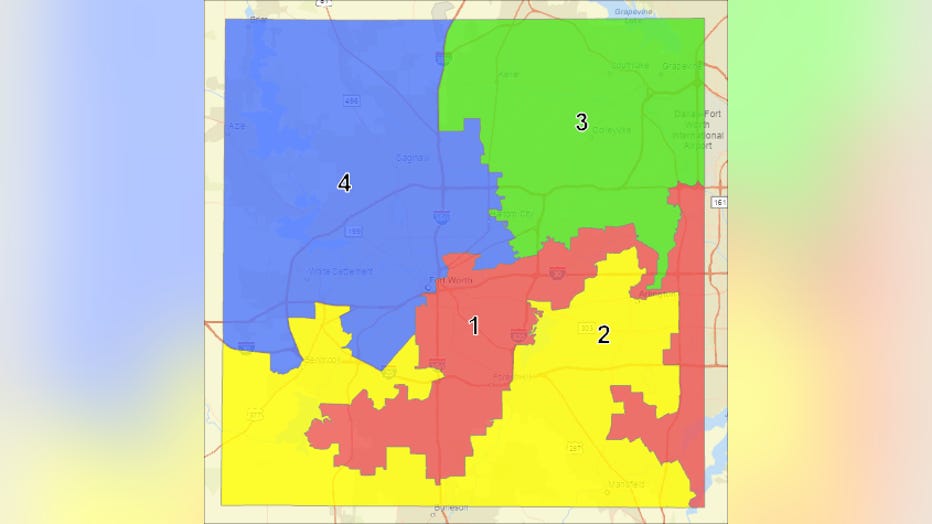
Today, the Tarrant County Commissioners Court voted to approve a redistricting map that effectively eliminates the seat of Commissioner Alisa Simmons, the only Black woman on the court.

It’s not a coincidence. It’s not neutral. It’s not “routine.” It is the calculated removal of a voice that dared to speak up for all of us.

Commissioner Simmons has stood firmly against the racist agenda pushed by Judge Tim O’Hare and the Republican Commissioners on the court. She spoke out against the rise in jail deaths under their watch. She called out the cruelty of defunding Girls Inc., a nonprofit that empowers young women of color. She opposed the elimination of free rides to the polls, which made it harder for working-class people, especially Black and brown voters, to cast a ballot.

And now, she’s being punished for it.

Commissioner Simmons wasn’t just a name on a ballot. She is my commissioner. I voted for her. I campaigned for her. And like thousands of others in Precinct 2, I saw her as a voice for the voiceless, a woman unafraid to shine a light on white supremacy, even when it came dressed in a suit and tie.

That light scared them. So they tried to snuff it out.

What we witnessed today was retaliation. It was white supremacy striking back at a Black woman who told the truth. And just like in Greenwood in 1962, they’re using the tools of power, maps, votes, and bureaucratic language, to do what they couldn’t do in public: silence her.

But we see it. We name it. And we will fight it.

The new map that the County Commissioners voted on today.

The Republican Commissioners and their defenders kept repeating the same excuse over and over again, “This wasn’t about race. It was just about politics.”

They said the map was designed to secure a Republican majority, not to silence Black voters. As if those two things aren’t deeply intertwined.

It’s the same argument Greg Abbott’s lawyers made in Shannon Perez v. Abbott, when Texas was caught racially gerrymandering districts. Their defense?

A direct quote from Greg Abbott: 

“It is not our intent to discriminate against minorities. It is our intent to discriminate against Democrats. If minorities happen to vote Democrat, that is their fault, not ours.”

That’s not a denial. That’s a confession….

Let’s stop pretending this distinction between race and party means anything in Texas. In Tarrant County, in Harris County, across the South, voter suppression by “party” is voter suppression by race. When you target the communities who dare to elect Black women, working-class progressives, young organizers, and civil rights leaders, you are targeting those communities on purpose.

They can say it’s about partisanship all they want. But we know what it’s really about.

Because when Conservatives talk about “conserving” something, they mean it.

They want to conserve white supremacy.

They want to conserve inequality, corporate power, and police brutality.

They want to conserve a system where jails are full, books are banned, teachers are silenced, and women don’t have autonomy.

They want to conserve a Texas where your zip code decides your worth, and where Black and brown voices are only welcome if they stay quiet.

And when people like Alisa Simmons refuse to stay quiet, they get erased.

But erasing her seat won’t erase her power, or ours….

And just when we thought we might get a win, it vanished as quickly as it came.

Yesterday, far-right extremist Tony Tinderholt (R-HD94) announced he would not seek reelection to the Texas House. For a brief moment, there was celebration across Arlington. A man who built his career on cruelty, censorship, and conspiracy was finally stepping aside. But the celebration didn’t last.

Because today, just minutes after the Tarrant County Commissioners voted to dismantle Precinct 2, Tinderholt announced he would run for that very seat, Alisa Simmons’ newly gutted district.

And he didn’t come alone.

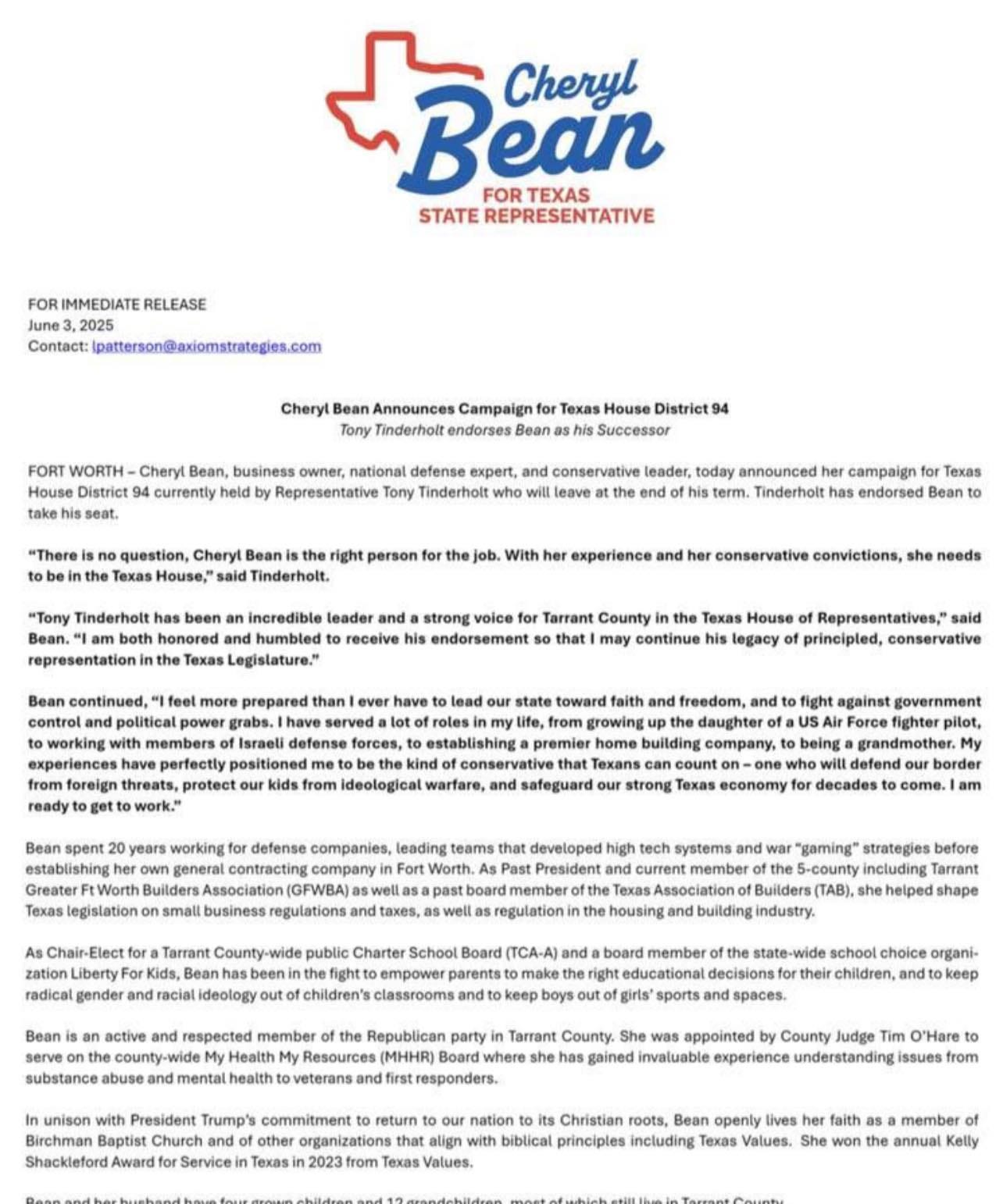
Cheryl Bean, another far-right extremist and ally of Tinderholt, announced her run for the now-open HD94 seat. A seat that was, conveniently, made safer for someone like her under the new maps.

Bean doesn’t even live in the district. She changed her voter registration to a new address inside it—an address she doesn’t own, according to the Tarrant Appraisal District. Her real home? Still outside the district lines. But facts don’t matter when the plan is to bulldoze through communities with precision and arrogance.

This wasn’t a coincidence. It was a coordinated political hit job, plain and simple.

A rigged map. A choreographed retirement. A handoff. A handpicked replacement. All timed to disempower the voices of Black and brown voters in Tarrant County. All orchestrated by Tim O’Hare and the extremist wing of the Republican Party.

They knew Simmons couldn’t be beaten fairly.

So they changed the lines.

They cleared the field.

And then they tried to rewrite the future.

But we see them.

We know the playbook.

And we’re not going to let this go unanswered.

This is part of a broader, coordinated strategy across Texas to suppress the political power of Black and brown communities under the guise of partisan politics…..

To read the post in full, open the link.