Archives for category: Democracy


The distinguished researcher Gene V. Glass writes here about legislation proposed by two Arizona legislators to prohibit the teaching of “social justice” in schools or colleges.


http://ed2worlds.blogspot.com/2017/01/arizona-republicans-want-to-prohibit.html?utm_source=feedburner&utm_medium=email&utm_campaign=Feed%3A+EducationInTwoWorlds+%28Education+in+Two+Worlds%29


Schools found to be in violation would be fined 10% of their state monies.


I am not sure what the definition of “social justice” is. Fairness, equality, equal rights? The Constitution? The Bill of Rights?

Today, the U.S. Senate Health, Education, Labor, and Pensions Committee will consider the nomination of Betsy DeVos as U.S. Secretary of Education. DeVos and her family have devoted many millions of dollars to destroying public schools and turning the clock back by more than a century. She wants the government to pay tuition at religious schools, voucher schools, for-profit schools, any alternative to public schools is her goal.


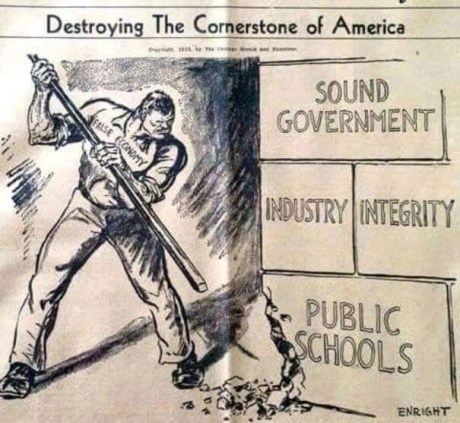
American public education is one of the essential institutions of our democratic society. The guarantee to everyone in this country that they could attend a free public school was a hard-fought victory. First, it required persuading the public to tax themselves to pay for schools for the children of the community. Second, it required separating the schools from religious institutions, which had long been the source of education. Third, it meant expanding access to all: to boys and girls, to children of all races and cultures, to children whose first language was not English, and to children with disabilities.


None of of these changes came easily.


And the struggle to provide good schools is ongoing, since so many states base school funding on property taxes, which privileges those who are already advantaged.


DeVos is ignorant of the history of public education in America and the role of public schools in our society. Her hostility to public schools should disqualify her from consideration for this position.


img_3801

GregPalast.com
Join NAACP Voter Fund
for Facebook LIVE broadcast of my film on
How Trump Stole It


I have a simple request.

I’m asking that, this Thursday, at 8pm ET/5pm PT, you join the NAACP-National Voter Fund, Rainbow/PUSH, Josh Fox of Climate Revolution and many, many more––and “share” the Facebook LIVE broadcast of my documentary––the film that exposes exactly how Trump and his cronies attacked the voting rights of a million minority voters to steal the White House.

That’s all we are asking: Between 8pm and 9pm Eastern, on Inauguration Eve, you “share” the live-stream with your Facebook followers.


The Best Democracy Money Can Buy: A Tale of Billionaires & Ballot Bandits, follows my crew’s undercover investigations for Rolling Stone and BBC-TV.
“…Mainstream journalism has often struggled to cover the manipulation of data and the distortion of reality driven by billionaires like the Koch brothers or even Donald Trump… Palast slices through all the B.S.”
– The Village Voice
Pass this on to your friends, your organizations, and anyone who wants to get un-stupid about the theft of the 2016 election. I’ll be leading an online discussion right after the broadcast: What do we do now?

Starting now you can share and tweet the trailer on Facebook:
https://www.facebook.com/GregPalastInvestigates/videos/10154917384607128/


On Thursday, January 19 at 8pm ET, go to https://www.facebook.com/GregPalastInvestigates/. (If you’re late, you can scroll back to the beginning.)


The film (with the help of my friends Rosario Dawson, Shailene Woodley Ice-T, Willie Nelson and more), tells the story of the GOP’s weapon of mass vote destruction – and exposes the billionaires behind Trump and the vote trickery.


The film was updated just this week. I guarantee: you’ll laugh, you’ll cry, and you’ll get revved up to resist. Trump didn’t win––his billionaire backers swiped it. We can take it back. Will you join me?


– Greg Palast and the investigations team


Greg Palast (Rolling Stone, Guardian, BBC) is the author of The New York Times bestsellers, The Best Democracy Money Can Buy and Billionaires & Ballot Bandits, now out as a major motion non-fiction movie.
Rent or buy the film from Amazon or Vimeo.


Support The Stolen Election Investigation..


Visit The Palast Investigative Fund and keep our work alive.


Or support us by shopping with Amazon Smile.
AmazonSmile will donate 0.5% of your purchases to the Sustainable Markets Foundation for the benefit of The Palast Investigative Fund and you get a tax-deduction! More info.

Follow Palast on Twitter | Like Palast on Facebook | Forward to a friend
Subscribe to Palast’s Newsletter | Podcasts

Share this with Facebook Twitter Digg

I was never fortunate enough to meet Dr. King, but I was a member of the vast crowd that stood on the Mall when he spoke to the March on Washington on August 28, 1963. I became a good friend of his close aide Bayard Rustin, who like Dr. King, was eloquent and passionate about justice.


Dr. King was frequently criticized by friends and foes. The foes thought he was a dangerous agitator who was encouraging rebellion against the social order, which he was. Moderates said he was pushing too hard, too fast, for too much, at the wrong time and the wrong place. Some who should have been his friends said he wasn’t sufficiently radical; they said he was too cerebral, too willing to compromise, out of touch with the masses that were ready to engage in violence. Dr. King believed in nonviolence as a principle, not as a strategy. He believed in justice and equality as principles, not as temporary goals. Some of his erstwhile allies turned to Malcolm X, who did not share Dr. King’s commitment to nonviolence.


On this day set aside to remember Dr. King, read or watch one of his speeches. Think about the courage it required to stand up for the oppressed, to face death every day, and to do so in a spirit of love.


The March on Washington speech


His speech against the war in Vietnam, which caused some of his allies to turn against him.


I have been to the mountaintop speech, his last speech, delivered the day before he was assassinated. At the time, he was in Memphis, where he had come to help sanitation workers who were trying to form a union to advocate for better wages. This speech was prophetic. Whenever someone from the .001% claims that they are engaged in the struggle for civil rights and simultaneously attacking unions, I remember why Dr. King was in Memphis.


And here are more, from a CNN piece that asks whether you can identify any of Dr. King’s speeches other than “I have a dream,” or his “Letter from a Birmingham City Jail,” both of which are taught in school.


Jennifer Berkshire (aka EduShyster) recently raised money by crowd-sourcing so she could spend a week in Michigan learning about the DeVos family and its crusade to privatize public education.


Her article is brilliant. 


She describes Betsy DeVos as “The Red Queen.”


It begins like this:


By the measures that are supposed to matter, Betsy DeVos’ experiment in disrupting public education in Michigan has been a colossal failure. In its 2016 report on the state of the state’s schools, Education Trust Midwest painted a picture of an education system in freefall. “Michigan is witnessing systematic decline across the K-12 spectrum…White, black, brown, higher-income, low-income—it doesn’t matter who they are or where they live.” But as I heard repeatedly during the week I recently spent crisscrossing the state, speaking with dozens of Michiganders, including state and local officials, the radical experiment that’s playing out here has little to do with education, and even less to do with kids. The real goal of the DeVos family is to crush the state’s teachers unions as a means of undermining the Democratic party, weakening Michigan’s democratic structures along the way. And on this front, our likely next Secretary of Education has enjoyed measurable, even dazzling success….


A characteristic DeVos move in Lansing traces a familiar pattern. A piece of legislation suddenly appears courtesy of a family ally. It pops up late in the session, late at night, or better still, during lame duck, when the usual legislative horse trading shifts into overdrive. So it was with a controversial bill that popped up 2013, doubling the limits for campaign contributions—a limit that no one in Michigan was wealthy enough to hit. Well almost no one. The GOP jammed the measure through, Governor Snyder signed it, and it took effect immediately. “The DeVoses then got their whole clan together and held a check writing party,” recalls Jeff Irwin, a democratic state representative from Ann Arbor who was recently term limited out. “It was a love letter to the richest people in Michigan and they delivered with a huge thank you.”


I was captivated by the image of the extended DeVos clan gathered on New Year’s Eve 2013, writing check after check to Republican candidates and caucuses to the tune of more than $300,000, an exercise they would repeat just a few months later. Did they sip champagne as they signed? Did their hands grow weary? For the DeVoses, the ability to give even more money means that they can exert even more influence. “When you empower a billionaire family like that, you give them more power,” Michigan Campaign Finance Network director Craig Mauger told me when I stopped by to see him in Lansing. Just blocks from the Capital, his office is in a part of the city that teems with the lobbyists who hold so much sway here. His building is home to not one, but two different for-profit charter operators. “The DeVoses are tilting the field and changing the structures of politics in Michigan.”


To understand why the DeVoses exert so much influence, and more importantly, why their power has only increased in recent years, a quick session in civics is required. Today’s topic: term limits. Approved in 1992 by voters in a “throw out the bums” state of mind, term limits have radically reordered the state’s political landscape. Legislators here can serve no more than three two-year terms in the House, and two four-year terms in the state Senate—the strictest limits in the country. “They’re in office for such a short time that it doesn’t pay off for them to build a strong base of support in their own districts,” Steve Norton, the head of the public education advocacy group Michigan Parents for Schools, explained to me. Instead, legislators are highly dependent on the party machinery, down to being told which way to vote. “They salute and follow caucus orders,” says Norton. As both the funders of the GOP machine, and its de facto operators, that means that the DeVoses essentially control the legislature these days. “They are the 800 lb gorilla.”


In Michigan, no one says no to the DeVos family. They have bought the legislature. They defeat legislators who dare to say no. They own the state. Is that too strong a statement? Read this blistering, frightening article.


The DeVos family use their money strategically to achieve their goals. They are not just a threat to public education. They are a threat to our democracy.


Nearly 200 education deans from across the nation released a “Declaration of Principles,“calling on Congress and the Trump Administration to advance democratic values in America’s public schools.


Press Release:
Contact:
Dean Kevin Kumashiro: (415) 422-2108, kkumashiro@usfca.edu
Dean Kathy Schultz: (303) 492-6937, katherine.schultz@colorado.edu
William J. Mathis: (802) 383-0058, wmathis@sover.net

 
BOULDER, CO (January 13, 2017) – As the nation watches this month’s transition to a new administration and a new Congress, a growing alliance of deans of colleges and schools of education across the country is urging a fundamental reconsideration of the problems and possibilities that surround America’s public schools.


In a Declaration of Principles released today, 175 deans sounded the alarm: “Our children suffer when we deny that educational inequities exist and when we refuse to invest sufficient time, resources, and effort toward holistic and systemic solutions. The U.S. educational system is plagued with oversimplified policies and reform initiatives that were developed and imposed without support of a compelling body of rigorous research, or even with a track record of failure.” The deans called upon federal leaders to forge a new path forward by:


Upholding the role of public schools as a central institution in the strengthening of our democracy;
Protecting the human and civil rights of all children and youth, especially those from historically marginalized communities;
Developing and implementing policies, laws, and reform initiatives by building on a democratic vision for public education and on sound educational research; and
Supporting and partnering with colleges and schools of education to advance these goals.
Signing the statement are current and former deans of colleges and schools of education from across the United States, as well as chairs of education departments in institutions with no separate school of education.


The statement was authored by Education Deans for Justice and Equity (EDJE) and prepared in partnership with the National Education Policy Center. EDJE was formed in 2016 as an alliance of deans to address inequities and injustices in education while promoting its democratic premises through policy, research, and practice.


The entire Declaration of Principles by Education Deans for Justice and Equity on Public Education, Democracy, and the Role of the Federal Government, as well as an online form for additional education deans to sign on, can be found on the NEPC website at http://nepc.colorado.edu/publication/deans-declaration-of-principles.

Meryl Streep spoke last night at the Golden Globe awards, where she received a lifetime achievement award. She spoke about kindness, decency, compassion. She spoke about the role of the artist and the importance of the arts. She spoke about immigrants and the power of diversity. She urged everyone to support a free press, specifically the Committee to Protect Journalists. She called out an unnamed powerful person who mocked and mimicked a disabled reporter. All in a few minutes.


Please watch.


Donald Trump responded with a tweet, saying that Streep is “overrated” and that she “doesn’t know me but attacked me.”


So one cannot attack Trump’s words or actions unless you “know” him. Hmmm.

The Missouri Education Watchdog blog has collected some frightening news: There is a bipartisan push, funded by the Gates Foundation, to create a national database for every citizen, violating the privacy of every one of us. Until now, this has been illegal. Gates and his allies want to lift the ban.


For anyone who has ever filled out a college application, or scholarship or grant application, you know the incredible amount of personal information these forms require. What if there was a massive database that combined and shared not only all of that personal information, but also answers from surveys you took over the years, social media posts you made, information normally kept protected and isolated in agencies like the Social Security Administration, Health and Human Services, HUD, IRS, and the US Census Bureau. This kind of database, linking (and sharing) data across agencies, with a profile on each individual citizen is something that countries like China has, but it is not legal in the US, currently.


This database is about to happen, not for you parents, but for your kids, starting with students in college.


Who wants it? Bill Gates; Booz Allen and Hamilton; Congressman Paul Ryan; Senator Patti Murray. And the many other corporations who want to pry into the lives of Americans.


There has been a push to create this type of database to track and link student data across agencies for years, and has always been rejected due to privacy or cost concerns. However, this year, a special commission, (created by the passage of this law, HR1381–jointly sponsored by Speaker Paul Ryan (R-WI) and Senator Patty Murray (D-WA), and signed by President Barack Obama on March 30, 2016), has convened for the purpose of lifting the ban on this national database, that they refer to as the student unit record. For background on the push for a national student database/unit record, see this 2013 HigherEd publication where they hoped to lift this ban and link the data, with a previous bill:


“The previous version of the bill called for stitching together state longitudinal databases in order to better track students — a project that some observers said would be technically difficult, perhaps unworkable and take years to accomplish, but which would also avoid confronting a federal ban on a national unit record system.
A unit record database has long been the holy grail for many policy makers, who argue that collecting data at the federal level is the only way to get an accurate view of postsecondary education. But privacy advocates, private colleges and Congressional Republicans, all of whom oppose the creation of such a database, teamed up in opposition the last time the idea was proposed, by the Bush administration in 2005. Then, the opponents succeeded; the 2008 reauthorization of the Higher Education Act included a provision specifically forbidding the creation of a federal unit record data system…


An increasing number of groups, including some federal panels, have called for a federal unit record system since 2006: the Education Department’s advisory panel on accreditation, last year; the Committee on Measures of Student Success, in 2011; and nearly every advocacy group and think tank that wrote white papers earlier this year for a project funded by the Bill & Melinda Gates Foundation on rethinking financial aid.


A federal system, those groups agree, is the only way to accurately measure student success. It would allow the Education Department to account for part-time students, transfers and others not currently captured in the Integrated Postsecondary Education Data System, the clearinghouse of data colleges report to the federal government. And, through linkage with Social Security or other databases, it could track graduates’ wages more accurately than is currently possible.


The Obama administration — unable to create a federal unit record database — has offered states money to construct longitudinal databases of their own, including funding in the 2009 stimulus bill. Nearly all states now have, or are developing, some version of a [ K12, SLDS] database to track students throughout their educational careers.”


Do you value your privacy? Do you want to stop the government and corporations from knowing everything about our lives, from cradle to grave? Read the post in its entirety and then contact Leonie Haimson of the Parent Coalition for Student Privacy.

This is one of the most important–and frightening–articles I have read in a long while. If you care about the future of our democracy, I urge you to read it.


It is about the takeover of North Carolina by the Tea Party, their tactics, their voter suppression aimed at black voters, and their cynical manipulation of anti-gay sentiment. The article doesn’t mention the enactment of school privatization laws, which have been a central plank in the putsch. But it is a cautionary tale.


In North Carolina, Some Democrats See Their Grim Future – POLITICO
https://apple.news/ASZaPmPZ4T-Cz6sPNG5kncg

Reverend William Barber of Raleigh, North Carolina, is one of the great moral forces of our age. He launched the Moral Mondays movement in his state, which brings citizens to the state capitol throughout the legislative session to voice their protests against injustice. Rev. Barber is leader of the state NAACP and a powerful national voice.


Please read his historical analysis of what he calls the Third Reconstruction, which he believes is emerging in response to the rise of the angry Tea Party and the election of Donald Trump.


He begins:


“On election night I felt a great sadness for America — not a Democratic or Republican sadness, but a sadness for the heart and soul of the nation. It is impossible to react to the election of Donald Trump with anything less than moral outrage. Trump is, as David Remnick wrote for The New Yorker, “vulgarity unbounded,” and his election has not only struck fear in the hearts of the vulnerable but also given rise to hundreds of documented cases of harassment and intimidation….


“When Obama broke through in North Carolina in 2008, we witnessed firsthand the whitelash that America is reeling from right now. Some folks are saying we’ll have to wait and see what a Trump administration decides to do. But we’ve already seen it in North Carolina. The blueprint for what it looks like to “take back America” in the 21st century was laid out in the extremist makeover of North Carolina’s government during the 2013 legislative session. What’s the policy agenda of Make America Great Again? I can tell you because we’ve seen it:
Give tax breaks to corporations and to the wealthy, attack public education, deny people access to health care, attack immigrants, attack the LGBTQ community in the name of “religious liberty,” strip environmental protections, and, finally, make it easier to get a gun than it is to vote….


“What have we learned?
“First, we must recognize the need for indigenously led, state-based, state-government focused, deeply moral, deeply constitutional, anti-racist, anti-poverty, pro-justice, pro-labor, and transformative movement building. There’s no shortcut around this. We must build a movement from the bottom up. We must build relationships at the state level because that’s where most of the extremism of the current-day deconstructionists are happening. They see the possibility of a Third Reconstruction, which is why they’re working so hard this time to strangle it in its cradle — and we must know that. We have to recognize that helicopter leadership by so-called national leaders will not sustain a moral movement. What you need are local movements. The nation never changes from Washington, D.C. down. History teaches that it changes from Selma up, from Birmingham up, from Greensboro up.
“Secondly, we need to use moral language, like the devotees of the First and Second Reconstructions. Moral language can re-frame and critique public policy regardless of who’s in power. A moral movement claims higher ground than merely a partisan debate, something that’s bigger than left versus right, conservative versus liberal. We have to begin to re-frame the conversation not to talk about left policies and right policies, but let’s talk about violence. And as people who run for office, are you on the side of violence?


“Why did we allow extremists to say “welfare” is a bad word when welfare is found in the Constitution? It’s right there: “promoting the general welfare.” Why do we still use language like “left” and “right” when it comes from the 17th Century, the French Revolution, when the Right wanted the Monarchy and the Left didn’t. Why do we allow them to put us in boxes? And why, for God’s sake, do we call people “Right” who we think are so wrong?
“Moral language gives you new metaphors. You can say, I’m against this policy not because it’s a conservative policy or a liberal policy, I’m against this policy because it’s constitutionally inconsistent, it’s morally indefensible, and it’s economically insane.
“And then we have to challenge the moral hypocrisy of the so-called Religious Right, which we should not even say because they are so wrong. They are engaging in a form of theological heresy. The greatest sin in the Bible is the sin of idolatry. The second greatest sin that has ever existed whenever people worshiped themselves was injustice toward other people. There are more than 2,000 scriptures in the Bible that deal with the issue of injustice toward women, the stranger, the poor, the sick, the hurting, and the unacceptable. You might have three about homosexuality, and not one of them trumps this scripture: you shall love your neighbor as yourself.
“We can’t succumb to those who bought Christianity. Nor can we yield the moral high ground because we’re angry with them. Deep religious and moral values have been the backbone of every great progressive movement; prophetic imagination must come before we see political implementation. When the social gospel looked at children dying from child labor and people dying without labor rights and people in slums and poverty and not having a minimum wage and they asked, “What would Jesus do?”
“There would have been no labor movement without a social gospel underpinning. There would have been no abolition movement without William Lloyd Garrison and other people of deep faith. Without strong voices from the social gospel movement, there may have never been a New Deal. There would have been no Civil Rights Movement without the moral framework underneath the Civil Rights Movement. There would not have been a critique on poverty and unchecked capitalism, labor rights, healthcare, criminal justice reform, climate change, and raising the minimum wage, without a moral premise underneath it. Moral framing allows us to change the language.
“Finally, we must insist on connecting economic issues with our racial history. Too many people are too easily blaming the rise of Trump on Democrats forgetting the “white working class.” Yes, Trump appealed to real economic fears among working people. But he lost every income bracket below $48,000 and won every group above it, blowing the dog whistles of race to divide poor and working people. Any resistance to Trump that doesn’t address his divide-and-conquer tactics from Wisconsin to Ohio to North Carolina and Alabama cannot offer a real political alternative.
“We need a moral movement to revive the heart of American democracy and build a Third Reconstruction for our time. This work is not easy, and it will not be completed quickly. But we know what is required to move forward together.
“I’ve traveled to 22 states this year to train local leadership in moral fusion organizing and conduct Moral Revival services. This network of state-based moral coalitions will host a National Watch Night Service on December 31st, with the event in Washington, D.C., livestreamed to local gatherings across the nation. As formerly enslaved people were invited to enlist in a struggle for freedom on January 1st, 1863, we will invite all people of conscience to enlist in a Moral Revival Poor People’s Campaign throughout 2017 and 2018.
“We face some difficult days ahead, but don’t let anybody tell you America hasn’t seen worse. Our foremothers and fathers faced far greater odds with far fewer resources. It’s our time now. Arm in arm, we’re moving forward together, not one step back.”