Archives for category: Cruelty

In this post, Jan Resseger discusses Marilyn Robinson’s essay about the new cruel politics in Iowa, which appeared in the New York Review of Books. Iowans are “free” to work for less. Their children are “free”to attend religious schools at public expense and “free” to work at dangerous jobs. This new definition of freedom risks a future of harm to children and general ignorance.

Resseger encourages everyone to learn about the Iowa regression:

In Dismantling Iowa, in the November 2, 2023 New York Review of Books, Marilynne Robinson examines Governor Kim Reynolds’ Iowa as the microcosm of the conservative Republican attack on the rights of children and on the promise of K-12 and university education. Robinson is a novelist and retired professor of creative writing at the University of Iowa; she has been an artist-in-residence at a number of other colleges. Her style contrasts with the writing of policy wonks, but she comes to the same conclusions. Her comments are about today’s politics in Iowa but at the same time reflect on the politics of other states like Florida and Wisconsin and Ohio.

Robinson begins with a bit of history—the sudden rightward turn of states once known for their progressivism. She defines a “liberal” education, the foundational principle of progressive colleges established in the nineteenth century by abolitionists across the Midwest: “American higher education is of the kind historically called liberal, that is, suited to free people, intended to make them independent thinkers and capable citizens. ‘Liberal’ comes from the Latin word liber, meaning ‘free.’ Aristotle, a theorist on this subject of incalculable influence until recently, considered education a natural human pleasure, essential to the perfecting of the self, which he says it is in our nature to desire. Obviously when he taught there was no thought of economic utility that would subordinate learning to the purposes of others, to the detriment of individual pleasure or self-perfection. Training in athletics, music, then philosophy were to be valued because they are liberating.” “(W)e are in a period when the value of education is disputed. Regrettably, it has become expensive enough to be regarded by some as a dubious investment of time and money. Its traditional form and substance do not produce workers suited to the present or the future economy—as these are understood and confidently imagined by its critics.”

At the K-12 level, Robinson prefers free public education to school privatization exemplified by Iowa’s new publicly funded private school tuition vouchers. She examines the provision of education through the lens of equality, one of the principles our society has historically endorsed, but which Robinson believes Governor Reynolds and her legislature have sacrificed: “The governor has been very intent on achieving equality as she understands it for Iowa students. She and her legislature have provided a grant of public money for every child who is approved by the state to attend a private school, the money to be released when the child is accepted there… It should be noted that ‘private’ in this context can mean religious in some—or any—sense of the word. The constitutional issues that might arise from this use of public money seem to be of no concern. As for the character of these schools… the implicit promise seems to be that contact with ideas and people some find problematic can be avoided, that they can be and will be excluded on what are called religious grounds. So public money will be used to deprive some children of the kind of education the governor deems beneficial while other children are deprived of the education that comes with encountering a world not yet structured around polarization.”

Will the state protect the rights of students receiving state support for private school? “State governments can intervene in public schools, hector, threaten, and substantially control them. Private schools are too disparate to be the objects of sweeping denunciation…Now that state money will come into such private schools as there are in Iowa—forty-one of the ninety-nine counties don’t have even one—it will be interesting to see if the governor and her like have a comparable interest in interfering with them. These schools can be selective, which is a positive word now, though the honor and glory of public education is that it does not select… An element in all this is the fact that we have let the word ‘public’ seem to mean something like ‘second-rate.’ This is very inimical to the open and generous impulses that make a society democratic.”

Robinson explores some other legislative actions Iowa has undertaken supposedly to provide freedom from regulation for Iowa’s parents and children: “Consistent with this current ‘conservative’ passion for dismantling things, including gun laws… the governor and the legislature of Iowa are stripping away legal limits on child labor… All this is being done in the name of freedom. It is always fair to ask when rights are being claimed whether they impinge on others’ rights. The question certainly arises here. We know that the employment of children does not reliably bring out the best in employers… Migrant children, unprotected or worse, work under sometimes intolerable conditions… (I)t is jarring that Iowa children will… do work previously prohibited as dangerous, at hours previously prohibited as incompatible with their schooling. They are making the most of a new opportunity, according to the governor, to ‘develop their skills in the workforce.’ Not incidentally, they will also be easing the labor shortage from which the state suffers. The minimum wage in Iowa is $7.25. In Illinois it is $13.00, in Missouri $12.00, in South Dakota $10.80. Surely these figures suggest another possible solution to the shortage of workers, a better way to compete with surrounding states than to expose children to the possibility of injury, or to the costly lack of a high school diploma. There is much talk about choice in Iowa, but many children will find that, for them, important possibilities have been precluded.”

What about the culture wars in public schools? “(T)he Iowa governor and her legislature have launched a campaign to embarrass the public grade schools. Of course there is now great perturbation about what can or cannot be included in their libraries. This intrusion of the state government on traditionally more or less autonomous communities has the tenor of a moral crackdown. New laws have been enacted to bring unruly librarians to heel. Educational standards for new librarians have been lowered. The governor says, of course, that the legislation ‘sets boundaries to protect Iowa’s children from woke indoctrination.’ It is as if parents zipping up their five-year-old’s jacket feel a qualm of fear because of potential classroom exposure to sinister ideas, not because their state now allows permitless concealed and open carry.”

Please open the link to finish the article.

I read the NHInsider regularly to follow the doings of the libertarians and rightwing Republicans who currently control the state. The education articles are written by veteran journalist Gary Rayno. I was very impressed by this article posted yesterday, which aptly summarizes the mess the world is in today, relying on the wisdom of William Butler Yeats. Religious zealots and intolerance are steering events.

He writes:

Turning and turning in the widening gyre

The falcon cannot hear the falconer;

Things fall apart; the centre cannot hold;

Mere anarchy is loosed upon the world,

The blood-dimmed tide is loosed, and everywhere

The ceremony of innocence is drowned;

The best lack all conviction, while the worst

Are full of passionate intensity.

This quote from the William Butler Yeats poem “The Second Coming” — written in 1919 just after World War I — often appears in times like these when the world’s moral order crumbles and more resembles “Lord of the Flies.”

Today human tragedy is on the front pages of newspapers, on television and radio news programs, on Twitter (X) and other social media.

The world is teetering on the edge of World War III as some nations try to pull the world’s superpowers into a conflict that millions of people will not survive.

Today’s conflicts in the Mid East and Europe are made more dangerous by technology that can pinpoint artillery shells to blow up a tank or to kill civilians in large numbers depending on the depravity of the shooters.

The Mid East is the founding place of three of the world’s major religions and has seen its share or wars in the last century not just between Arabs and Israelites, but among Arab nations as well.

The region’s long history of conflicts did not prepare anyone for what happened last week on a Jewish holy day when the terrorist group Hamas, which has controlled the Gaza Strip for years, invaded Israel, killed nearly a thousand people, including families with young children, beheaded some, tortured others and took about 150 hostages back to Gaza to use as bargaining chips.

They not only killed, tortured and maimed Israeli citizens, they used their own citizens as human shields by preventing them from leaving Gaza.

The absence of respect for human life and suffering is inconceivable but all too common in today’s polarized world as the Marjorie Taylor Greenes of the world talk about killing Democrats and Hamas leaders talk about eliminating all Jews.

The Israeli government, as it often does, retaliates with even more force than used against it, and has the stated goal of eliminating Hamas. That objective means lost Palestinian civilian lives seen as collateral damage.

Once the fighting begins, war produces few white hats.

The wars in the Mideast are often both ethnically and religiously driven pitting the Muslim Palestinians against the Jewish Israelites with centuries of history to solidify the beliefs of both sides.

While religion is not the biggest driver for war, intolerance is, it is in the Mideast.

And the problem with religious wars was aptly stated by former President Richard Nixon when he said “In the long term we can hope that religion will change the nature of man and reduce conflict. But history is not encouraging in this respect. The bloodiest wars in history have been religious wars.”

The Mideast conflict has taken the focus away from Russia’s invasion of Ukraine and the atrocities the Russians have inflicted on the Ukrainians and their country.

The war in Eastern Europe is more ethnically driven than religious.

Until Putin decided to expand the Russian empire, Europe had been largely free of conflicts since World War II, but like the Mideast conflict, attempts are to draw the superpowers into the chaos and expand the carnage.

While the world’s eyes are on the Mideast and Eastern Europe, the United States government is being held hostage by a couple dozen extremists, particularly in the US House, but also the Senate, who want to see chaos and ensure the dysfunction of government as we know it.

The Christian Nationalist movement is the foundation of some of the extremists, but not all of them.

The House decided to remove Speaker Kevin McCarthy, and since that time more than a week ago, nothing is moving and that prevents any help to fund the nation’s allies in the two conflicts or to keep government functioning beyond the middle of November.

Republicans and their slim majority in the House cannot agree on a new Speaker and probably won’t until the crisis threatens to explode and Republicans realize they will pay politically for their inability to solve the civil war within their ranks.

One member of the House Republican caucus called it a clown show.

In the Senate a former football coach, Tommy Tuberville, is holding up hundreds of military appointments at this crucial time over the abortion issue, while others like Rand Paul and Ted Cruz are holding up key appointments like ambassadors etc. that will have a direct effect on what is happening in the world’s hot spots, mostly to create chaos and hits on their Twitter accounts.

The Grand Old Party appears to be more interested in creating chaos than governing.

At the state level, 19 Republican governors, and we all know governors are experts in foreign policy, criticize President Biden’s handling of the attacks on Israel including New Hampshire’s own Chris Sununu.

Not that long ago, politics was put aside when the nation faced serious threats such as the terrorist attacks on New York City and Washington DC or the beginning of Desert Storm, but no more.

The head of the National Republican Committee, Ronna McDaniel, referred to the latest conflict in the Mideast as a “great opportunity” to attack Biden.

You did not hear Democrats criticizing President George W. Bush after the 9/11 attack, or President George H. W. Bush after he began Desert Storm.

The nation came together to support their leaders’ actions. And you did not see the demonstrations on college campuses and city streets that happened this weekend pitting Palestinian supporters against those backing Israel.

Like the Palestinians and Israelites, much of what divides the United States has a religious undertone incorrectly based on the notion the United States was established as a Christian country.

That would be very interesting because many early settlers to the “new world” came here to escape religious persecution in nations with state religions.

The Constitution guarantees religious freedom as well as the founding principle of “all men (women) are created equal.”

Many on the right are trying to impose their religious beliefs on issues like abortion or LGBTQ+ rights or what young people can read or watch.

And you don’t have to look to the Mideast to see what can happen when religious beliefs become a driving force in politics.

In Littleton, Theater Up received a $1 million grant to help fix up the town’s aging Opera House, which is on the National Historic Building list, through a long-term lease. The group currently uses the building, but its lease ends in May.

After discussions with the town’s selectmen, one of whom is the state Senator for District 1, Carrie Gendreau, and who objected to murals painted on a private building in town earlier this year saying she objected to its LGBTQ+ theme, the theater group was informed the selectmen were not inclined to help pay for a $2,500 building study to determine what could and could not be done in the historic building.

The decision was due to the group’s affiliation with the LGBTQ+ community and complaints about its production of La Cage aux Follies, the award-winning play about a gay couple, the group was told.

Theater Up was also informed the selectmen continue to explore a ban on public art in the community which would certainly impact the group’s ability to continue its mission.

This is religious oppression in reverse, much like the group that tried to block the state from distributing COVID-19 in a new program serving the elderly two years ago.

This is imposing one’s beliefs on those who do not share them.

The second half of Yeats poem is not so well known as the first, but is more telling about where we might be headed and what a “second coming” could really mean.

Surely some revelation is at hand;

Surely the Second Coming is at hand.

The Second Coming! Hardly are those words out

When a vast image out of Spiritus Mundi

Troubles my sight: somewhere in sands of the desert

A shape with lion body and the head of a man,

A gaze blank and pitiless as the sun,

Is moving its slow thighs, while all about it

Reel shadows of the indignant desert birds.

The darkness drops again; but now I know

That twenty centuries of stony sleep

Were vexed to nightmare by a rocking cradle,

And what rough beast, its hour come round at last,

Slouches towards Bethlehem to be born?

Garry Rayno may be contacted at garry.rayno@yahoo.com.

Distant Dome by veteran journalist Garry Rayno explores a broader perspective on the State House and state happenings for InDepthNH.org. Over his three-decade career, Rayno covered the NH State House for the New Hampshire Union Leader and Foster’s Daily Democrat. During his career, his coverage spanned the news spectrum, from local planning, school and select boards, to national issues such as electric industry deregulation and Presidential primaries. Rayno lives with his wife Carolyn in New London.

Gabriel Arans of the Texas Observer writes about the revival of McCathyism at universities in Texas. Republicans are intent on pushing out professors they think are too liberal.

Arana writes:

Texas A&M University’s disgraceful treatment of celebrated journalism professor Kathleen McElroy should terrify anyone who cares about academic freedom, education, and equality in Texas. The state’s Republican leaders, along with Governor Greg Abbott, have launched a radical, McCarthyite crusade to purge education of liberal bias.

Only in Texas or Florida would decades of experience at the country’s most prestigious newspaper and a track record of championing newsroom inclusivity disqualify someone for a job relaunching A&M’s defunct journalism program, which was shuttered in 2004 after 55 years.

McElroy’s ordeal is just the beginning.

At first, A&M officials seemed to realize how lucky they’d been to snag McElroy, a Black woman who served in various managerial positions at the New York Times for 20 years before completing a doctorate at the University of Texas at Austin, where she served as the director of the School of Journalism and Media and now teaches.

McElroy didn’t want to draw attention to herself, but A&M insisted on a public ceremony to celebrate her appointment as head of the university’s new journalism program. On June 13, she signed an offer accepting a tenured position in front of a crowd gathered at the school’s academic building, pending approval from the Texas A&M University System Board of Regents.

Over the next few weeks, the deal unraveled. After conservative activist site Texas Scorecard published a scare-mongering article about McElroy’s work on newsroom diversity, right-wing ideologues on the board of regents started scrutinizing her hire. Six or seven regents called and texted now-disgraced University President Katherine Banks to express concerns.

“I thought the purpose of us starting a journalism program was to get high-quality Aggie journalist [sic] with conservative values into the market,” regent Jay Graham texted Banks. “This won’t happen with someone like this leading the department.”

Another regent, Mike Hernandez, added that McElroy was “biased and progressive-leaning” and called giving her tenure a “difficult sell” for the board.

Members of a conservative alum group called the Rudder Association and other right-wing Aggies flooded Banks’ office with calls and emails.

Text messages show that Banks—who initially denied any involvement in McElroy’s bungled hiring, then was caught lying—was fully behind conservatives’ efforts to rein in liberal academia: “Kathy [Banks] told us multiple times the reason we were going to combine [the colleges of] arts and sciences together was to control the liberal nature that those professors brought to campus,” Graham wrote.

So Banks watered down the offer to McElroy. Still eager to return to her alma mater to train the next generation of journalists, she agreed to accept a revised five-year, nontenured teaching position, which would not require the regents’ approval.

“You’re a Black woman who worked at the New York Times,” José Luis Bermúdez, the interim dean of the College of Arts and Sciences, warned McElroy. Her hire, he said, had been caught up in “DEI hysteria.”

But then, Banks diluted the offer further, offering McElroy a one-year, “at will” position. McElroy declined and spoke about how the university had treated her with the media.

“I’m being judged by race, maybe gender,” McElroy told the Texas Tribune. “I don’t think other folks would face the same bars or challenges.”

(Editor’s note: McElroy sits on the parent board of the Texas Observer. Because of our editorial independence policy, she has no say in our editorial decisions. Alongside this piece, today the Observerpublished a heartfelt essay from McElroy about her journalism journey and the irony of being the subject of media coverage rather than the one behind it. )


Over the summer, with the governor’s support, the Legislature passed Senate Bill 17 (SB 17), which requires institutions of higher education to do away with all diversity, equity, and inclusion programs and initiatives by 2024. Already, the University of Houston has shut down its Center for Diversity, Equity, and Inclusion as well as disbanding its LGBTQ+ Resource Center (under pressure, however, it appeared to backtrack, but it is only a matter of time before the offices are officially closed). Public universities across the state have formed committees to implement the law and seek input from the academic community. It’s clear, however, that days are numbered for all the offices and programs that help students from different backgrounds.

While the ostensible goal of anti-diversity, equity, and inclusion (DEI) efforts is to prioritize merit over race in higher education—and get rid of all the “divisive” diversity stuff that liberal academics champion—the real intent is to put radical, uppity queers, minorities, and liberals in their place. A key part of the plan is to strip liberal academics of the protections that allow them to pursue research and speak publicly without fear of reprisal; this past session, right-wing legislators tried to get rid of tenure but settled on more modest restrictions. The Senate also passed a ban on “critical race theory,” an academic theory that posits racism is embedded in society, but the House failed to pass the measure….

Anti-DEI hysteria will lead to a brain drain at Texas’ public universities. Academics at most institutions enjoy the freedom to conduct scholarship without interference. To ensure they can pursue ideas that may be unpopular to the public and pursue knowledge for its own sake, they are granted protection after demonstrating excellence in their field. The best scholars don’t want to work in a place where they have to worry that criticizing wingnut politicians will get them put on leave—as A&M did when Lieutenant Governor Dan Patrick complained to administrators about criticism levied against him by opioid expert Joy Alonzo—and the best students from around the country will choose institutions that value academic freedom, openness, and inclusion rather than those under siege by the radical right.

While in Prague, I went with a group of about 25 people to visit Terezin. I wasn’t sure what to expect. I had seen a book of drawings created by the children of Terezin. Years ago, I had visited Auschwitz, which was an extermination camp, with gas chambers and huge ovens for incinerating bodies. The displays of luggage, hair, and other reminders of those who were gassed were gruesome and horrifying.

Terezin was not an extermination camp, though thousands of people died there. Most people sent to Terezin were later shipped to Auschwitz to be killed. I recalled reading that the Nazis used it as a propaganda showplace, where they demonstrated to Red Cross officials that the Jews there were living in a place similar to a resort, under idyllic conditions.

Terezin is one hour outside Prague. There were two parts to it. First was an all-male prison where members of the Czech resistance were held, as well as Jehovah’s Witnesses, homosexuals, and others whom the Nazis hated. This facility was a centuries-old fort with high walls and abysmal living conditions. Many prisoners died of malnutrition or disease.

Then we went to the other part of Terezin, about a mile away. Also known as Terezinstadt, it is a picture-perfect town of colorful houses surrounding a park. The Nazis evicted all its inhabitants and used the town to house Jewish families from Czechoslovakia and Germany and eventually from other countries. There was no barbed wire, though every entrance into the town was guarded.

The town originally had 3,000-5,000 inhabitants. After it was turned into an internment camp for Jews, as many as 60,000 people were crammed into the same buildings. Nazis sent out flyers in Germany and Czechoslovakia portraying Terezin as an idyllic town. Wealthy Jews from Germany paid to go there and were allowed to bring a few pieces of luggage.

Once there, all their possessions were taken away, and they were assigned to a crowded dormitory. Men and women lived in separate dormitories, as did children. Families, of course, were separated. Adults were required to work, and children were mostly confined to their dormitories. Workers were paid in scrip, which they could use to buy clothing that had been confiscated from new arrivals.

Food was scarce, and many died of malnutrition and disease. There were regular transports from Terezin to Auschwitz. Somehow the Jews in Terezin knew that it was very bad to be shipped East, so the Nazis compelled some of those who arrived at Auschwitz to write their friends in Terezin to assure them that Auschwitz was a swell place.

In 1944, the King of Denmark asked the International Red Cross to inspect Terezin because Danish Jews had been sent there. The IRC let the Nazis know that there were coming, and the Nazis selected a date that gave them time to clean up the camp and stage a performance. The chiildren played soccer before an enthusiastic audience. A well-known Czech conductor led an orchestra of imprisoned musicians. The Red Cross issued a report praising conditions at the camp.

A few days after the Red Cross inspection, the orchestra conductor was deported to Auschwitz, along with many of the musicians.

The Terezin museum was fascinating, and I regretted that we had only an hour there. One room was filled with names of children who passed through Terezin. There were 15,000, but only 8,000 names. Names are added whenever anyone is identified. There was a wall of children’s drawings. And there were beautiful poems written by children who knew they were doomed.

The museum also contained a graphic chronology of anti-Semitism in Hitler’s time—such as the Wannsee Conference, where Nazi leaders agreed on the necessity of a “Final Solution” to the Jewish problem: to kill every one of the 11 million Jews then living in Europe.

The architect of the Final Solution was Rudolph Heydrich, who was the deputy head of the Nazi “Protectorate” that included Czechoslovakia. He was assassinated by partisans in 1942.

In retaliation, the Nazis made an example of the towns of Lidice and Lezaky, believing the assassins came from there. The Nazis murdered every man in Lidice and sent the women to the Ravensbruck concentration camp, where most died. Lezaky was totally destroyed, and its inhabitants killed.

In the midst of great beauty and art that we see today in Central Europe, it’s hard to imagine these horrific events. So much death and destruction. Unthinkable. Unimaginable. But true.

As I left the Terezin museum, I saw a copy of a diary written by one of the children who survived both Terezin and Auschwitz: Helga’s Diary. But the shop was closed. I was the last person to exit. I got on the bus and ordered a copy online.

Thom Hartmann wonders why Republican leaders embrace cruelty, why they seem happy to inflict misery on others. This is part 2 of his analysis of libertarianism, and it is compelling.


So, once again, why are Republicans so cruel and why do they seem so fond of libertarianism? Why does Greg Abbott put razor wire in the Rio Grande river? Why does Donald Trump target people for assassination by his followers? Why does Ron DeSantis revel in keeping tens of thousands of low-income Florida children from getting Medicaid?

Yesterday, I laid out the terrible impact Libertarian policies, which have infected the GOP for five decades, have had on the United States. But where did the whole idea of libertarianism come from, and who started the Libertarian Party?

Get ready for a wild ride as we do a deep dive into America’s most bizarre (and phony) political party.

How is it that Republicans so often embrace casual cruelty like tearing mothers from their children or throwing pregnant women in poverty off public assistance? Why have 12 GOP-controlled states refused to this day to expand Medicaid for their 30 million minimum-wage working people when the federal government covers 90 percent of the cost?

Why are Republicans so committed to destroying Medicare and Social Security? Why do they go so far as to use the disrespectful slur “Democrat Party” when there’s no such a thing in America and never has been?

Why are Democratic members of Congress having to armor their own homes, having received over 9000 death threats so far this year, virtually all of them from domestic terrorists who Republicans refuse to repudiate? The FBI still is looking for a Matt Gaetz supporter who threatened to murder Gaetz’s Democratic opponent: why are these people attracted to the GOP?

It turns out this is not just politics; the roots of this brutal movement in today’s GOP run from a 1927 child murderer, through a greedy real-estate lobbying group, to Ronald Reagan putting both of their philosophies into actual practice and bringing morbidly rich rightwing billionaires into the GOP fold.

As a result, Republican policies over the past 42 years not only gutted America’s middle class and transferred $50 trillion from working people to the top 1 percent, but also led straight to the Trump presidency and the attack on the Capitol on January 6th that he led.

The Libertarians

Reporter Mark Ames documents how, back in the 1940s, a real estate lobbying group came up with the idea of creating a new political party to justify deregulating the real estate and finance industries so they could make more money. 

This new “Libertarian Party” would give an ideological and political cover to their goal of becoming government-free, and they developed an elaborate pretense of governing philosophy around it.

Their principal argument was that if everybody acted separately and independently, in all cases with maximum selfishness, such behavior would actually benefit society. There would be no government needed beyond an army and a police force, and a court system to defend the rights of property owners. It was a bizarre twisting of Adam Smith’s reference to the “invisible hand” that regulated trade among nations.

In 1980, billionaire David Koch ran for vice president on the newly formed Libertarian Party ticket. 

His platform included calls to privatize the Post Office, end all public schools, give Medicare and Medicaid to big insurance companies, end all taxation of the morbidly rich, terminate food and housing support and all other forms of “welfare,” deregulate all corporate oversight while shutting down the EPA and FDA, and selling off much of the federal government’s land and other assets to billionaires and big corporations.

Reagan, who won that 1980 election, embraced this view in his inaugural address, saying, “[G]overnment is not the solution to our problem; government is the problem.” He then doubled down on the idea by beginning the systematic process of gutting and crippling governmental institutions that historically had supported working people and the middle class.

The child-killer who inspired a movement

Reagan wasn’t just echoing the Libertarian vision; he was also endorsing Ayn Rand’s “objectivist” view of the world, which traces its roots to a murderous psychopath in 1927.

Back in 2015, Donald Trump told USA Today’s Kirsten Powers that his favorite book was Ayn Rand’s raped-girl-decides-she-likes-it novel, “The Fountainhead.”

“It relates to business, beauty, life and inner emotions,” he told Powers. “That book relates to … everything.”

Ayn Rand’s novels have informed libertarian Republicans like former Speaker of the House of Representatives and current Fox News board member Paul Ryan, who required interns to read her books when they joined his staff.

Powers added, “He [Trump],” told her that he “identified with Howard Roark, the protagonist who designs skyscrapers and rages against the establishment.”

Rand’s hero Roark, in fact, “raged” so much in her novel that he blew up a public housing project with dynamite.

Rand, in her Journals, explained where she got her inspiration for Howard Roark and the leading male characters in so many of her other novels. She writes that the theme of The Fountainhead, for example, is: 

“One puts oneself above all and crushes everything in one’s way to get the best for oneself.”

On Trump’s hero Howard Roark, she wrote that he:

“…has learned long ago, with his first consciousness, two things which dominate his entire attitude toward life: his own superiority and the utter worthlessness of the world. He knows what he wants and what he thinks. He needs no other reasons, standards or considerations. His complete selfishness is as natural to him as breathing.

It turns out that Roark and many of her other characters were based on a real person. The man who so inspired Ayn Rand’s fictional heroes was named William Edward Hickman, and he lived in Los Angeles during the Roaring Twenties.

Ten days before Christmas in 1927, Hickman, a teenager with slicked dark hair and tiny, muted eyes, drove up to Mount Vernon Junior High School in Los Angeles and kidnapped Marion Parker — the daughter of a wealthy banker in town.

Hickman held the girl ransom, demanding $1,500 from her father — back then about a year’s salary. Supremely confident that he would elude capture, Hickman signed his name on the ransom notes, “The Fox.”

After two days, Marion’s father agreed to hand over the ransom in exchange for the safety of his daughter. What Perry Parker didn’t know is that Hickman never intended to live up to his end of the bargain.

The Pittsburgh Press detailed what Hickman, in his own words, did next.

“It was while I was fixing the blindfold that the urge to murder came upon me,” he said. “I just couldn’t help myself. I got a towel and stepped up behind Marion. Then, before she could move, I put it around her neck and twisted it tightly.”

Hickman didn’t hold back on any of these details: he was proud of his cold-bloodedness.

“I held on and she made no outcry except to gurgle. I held on for about two minutes, I guess, and then I let go. When I cut loose the fastenings, she fell to the floor. I knew she was dead.”

But Hickman wasn’t finished:

“After she was dead I carried her body into the bathroom and undressed her, all but the underwear, and cut a hole in her throat with a pocket knife to let the blood out.”

Hickman then dismembered the child piece-by-piece, putting her limbs in a cabinet in his apartment, and then wrapped up the carved-up torso, powdered the lifeless face of Marion Parker, set what was left of her stump torso with the head sitting atop it in the passenger seat of his car, and drove to meet her father to collect the ransom money.

He even sewed open her eyelids to make it look like she was alive.

On the way, Hickman dumped body parts out of his car window, before rendezvousing with Marion Parker’s father.

Armed with a shotgun so her father wouldn’t come close enough to Hickman’s car to see that Marion was dead, Hickman collected his $1,500, then kicked open the door and tossed the rest of Marion Parker onto the road. As he sped off, her father fell to his knees, screaming.

Days later, the police caught up with a defiant and unrepentant Hickman in Oregon. His lawyers pleaded insanity, but the jury gave him the gallows.

To nearly everyone, Hickman was a monster. The year of the murder, the Los Angeles Times called it “the most horrible crime of the 1920s.” Hickman was America’s most despicable villain at the time.

Ayn Rand falls in love with a “superman”

But to Alissa Zinovievna Rosenbaum, a 21-year-old Russian political science student who’d arrived in America just two years earlier, Hickman was a hero.

Alissa was a squat five-foot-two with a flapper hairdo and wide, sunken dark eyes that gave her a haunting stare. Etched into those brooding eyes was burned the memory of a childhood backlit by the Russian Revolution.

She had just departed Leninist Russia where, almost a decade earlier, there was a harsh backlash against the Russian property owners by the Bolsheviks. Alissa’s own family was targeted, and at the age of 12 she watched as Bolshevik soldiers burst into her father’s pharmacy, looted the store, and plastered on her Dad’s doors the red emblem of the state, indicating that his private business now belonged to “the people.”

That incident left such a deep and burning wound in young Alissa’s mind that she went to college to study political science and vowed one day she’d become a famous writer to warn the world of the dangers of Bolshevism.

Starting afresh in Hollywood, she anglicized her name to Ayn Rand, and moved from prop-girl to screenwriter/novelist, basing the heroes of several of her stories on a man she was reading about in the newspapers at the time. A man she wrote effusively about in her diaries. A man she hero-worshipped.

William Edward Hickman was the most notorious man in American in 1928, having achieved the level of national fame that she craved.

Young Ayn Rand saw in Hickman the “ideal man” she based The Fountainhead on, and used to ground her philosophy and her life’s work. His greatest quality, she believed, was his unfeeling, pitiless selfishness.

Hickman’s words were carefully recounted by Rand in her Journals. His statement that, “I am like the state: what is good for me is right,” resonated deeply with her. It was the perfect articulation of her belief that if people pursued their own interests above all else — even above friends, family, or nation — the result would be utopian.

She wrote in her diary that those words of Hickman’s were, “the best and strongest expression of a real man’s psychology I ever heard.”

Hickman — the monster who boasted about how he had hacked up a 12-year-old girl — had Rand’s ear, as well as her heart. She saw a strongman archetype in him, the way that people wearing red MAGA hats see a strongman savior in Donald Trump.

As Hickman’s murder trial unfolded, Rand grew increasingly enraged at how the “mediocre” American masses had rushed to condemn her Superman.

“The first thing that impresses me about the case,” Rand wrote in reference to the Hickman trial in early notes for a book she was working on titled The Little Street, “is the ferocious rage of the whole society against one man.”

Astounded that Americans didn’t recognize the heroism Hickman showed when he proudly rose above simply conforming to society’s rules, Rand wrote:

“It is not the crime alone that has raised the fury of public hatred. It is the case of a daring challenge to society. … It is the amazing picture of a man with no regard whatever for all that society holds sacred, with a consciousness all his own.”

Rand explained that when the masses are confronted with such a bold actor, they neither understood nor empathized with him. 

Thus, “a brilliant, unusual, exceptional boy [was] turned [by the media] into a purposeless monster.”

The protagonist of the book that Rand was writing around that time was a boy named Danny Renahan. In her notes for the book, she wrote, “The model for the boy [Renahan] is Hickman.” He would be her ideal man, and the archetype for a philosophical movement that would transform a nation.

“He is born with the spirit of Argon and the nature of a medieval feudal lord,” Rand wrote in her notes describing Renahan. “Imperious. Impatient. Uncompromising. Untamable. Intolerant. Unadaptable. Passionate. Intensely proud. Superior to the mob… an extreme ‘extremist.’ … No respect for anything or anyone.”

Rand wanted capitalism in its most raw form, uncheck by any government that could control the rules of the market or promote the benefits of society. Such good intentions had, after all, caused the hell she’d experienced in the Bolshevik Revolution.

Ayn Rand, like Hickman, found peace and justification in the extremes of her economic, political, and moral philosophy. Forget about democratic institutions, forget about regulating markets, and forget about pursuing any policies that benefit the majority at the expense of the very rich — the petty political rule-makers and rule-enforcers could never, ever do anything well or good.

Libertarianism and Ayn Rand set the stage for Trumpism

Only billionaires should rule the world, Trump has suggested.

And he tried to put it into place, installing a billionaire advocate of destroying public schools in charge of public schools, a coal lobbyist representing billionaires in charge of the EPA, an billionaire-funded oil lobbyist in charge of our public lands, and a billionaire described by Forbes as a “grifter” in charge of the Commerce Department.

Trump’s chief of staff said that putting children in cages and billionaire-owned privatized concentration camps (where seven died) would actually be a public good.

As Ayn Rand might say, “Don’t just ignore the rules; destroy them.”

Welfare and other social safety net programs were, as Rand saw it, “the glorification of mediocrity” in society. Providing a social safety net for the poor, disabled, or unemployed, she believed, were part of a way of thinking that promoted, “satisfaction instead of joy, contentment instead of happiness… a glow-worm instead of a fire.”

Sociopaths of the world, unite!

Rand, like Trump, lived a largely joyless life. She mercilessly manipulated people, particularly her husband and Alan Greenspan (who brought a dollar-sign-shaped floral arrangement to her funeral), and, like Trump, surrounded herself with cult-like followers who were only on the inside so long as they gave her total, unhesitating loyalty.

Like Trump, McConnell, McCarthy and their billionaire backers, Rand believed that a government working to help out working-class “looters,” instead of solely looking out for rich capitalist “producers,” was throwing its “best people” under the bus.

In Rand’s universe, the producers had no obligations to the looters. Providing welfare or sacrificing one nickel of your own money to help a “looter” on welfare, unemployment, or Social Security — particularly if it was “taken at the barrel of a gun” (taxes) — was morally reprehensible.

Like Trump saying, My whole life I’ve been greedy,” for Rand looking out for numero uno was the singular name of the game — selfishness was next to godliness.

Later in Rand’s life, in 1959, as she gained more notoriety for the moral philosophy of selfishness that she named “Objectivism” and that is today at the core of libertarianism and the GOP, she sat down for an interview with CBS reporter Mike Wallace of 60 Minutes.

Suggesting that selfishness undermines most truly American values, Wallace bluntly challenged Rand.

“You are out to destroy almost every edifice in the contemporary American way of life,” Wallace said to Rand. “Our Judeo-Christian religion, our modified government-regulated capitalism, our rule by the majority will… you scorn churches, and the concept of God… are these accurate criticisms?”

As Wallace was reciting the public criticisms of Rand, the CBS television cameras zoomed in closely on her face, as her eyes darted back and forth between the ground and Wallace’s fingers. But the question, with its implied condemnation, didn’t faze her at all. Rand said with confidence in a matter-of-fact tone, “Yes.” 

“We’re taught to feel concern for our fellow man,” Wallace challenged, “to feel responsible for his welfare, to feel that we are, as religious people might put it, children under God and responsible one for the other — now why do you rebel?”

“That is what in fact makes man a sacrificial animal,” Rand answered. She added, “[Man’s] highest moral purpose is the achievement of his own happiness.”

Rand’s philosophy, though popular in high school and on college campuses, never did — in her lifetime — achieve the sort of mass appeal she had hoped. But today Ayn Rand’s philosophy is a central tenet of the Republican Party and grounds the moral code proudly cited and followed by high-profile billionaires and three former presidents of the United States.

Ironically, when she was finally beginning to be taken seriously, Ayn Rand became ill with lung cancer and went on Social Security and Medicare to make it through her last days. She died a “looter” in 1982, unaware that her promotion of William Edward Hickman’s sociopathic worldview would one day validate an entire political party’s embrace of a similarly sociopathic president.

The result so far is over a million dead Americans from Covid, an epidemic of homelessness, and the collapse of this nation’s working class.

While the ideas and policies promoted by the libertarian wing of the Republican Party have made CEOs and billionaire investors very, very rich in recent decades, it’s killing the rest of us.

A return to sanity

In the 1930s, 1940s, and 1950’s Franklin Delano Roosevelt, Harry Truman, and Dwight Eisenhower put America back together after the Republican Great Depression and built the largest and wealthiest middle class in the history of the world at the time.

Today, 42 years of Ayn Rand’s ideas being put into practice by libertarian Republicans from Reagan to Bush to Trump have gutted the middle class, made a handful of oligarchs wealthier than any king or pharaoh in the history of the world, and brought a whole new generation of criminals, hustlers and grifters into the GOP.

Three men in America today own more wealth than the entire bottom 50 percent of the country, a level of inequality never before seen in the modern developed world.

When America was still coasting on FDR’s success in rebuilding our government and institutions, nobody took very seriously Rand’s or Koch’s misguided idealist efforts to tear it all down.

Now that Libertarians and objectivists in the GOP have had 42 years to make their project work, we’re hitting peak libertarianism and it’s tearing our country apart, pitting Americans against each other, and literally killing people every day.

If America is to survive as a functioning democratic republic, we must repudiate the “greed is good” ideology of Ayn Rand and libertarianism, get billionaires and their money out of politics, and rebuild our civic institutions.

That starts with waking Americans up to the incredible damage that 40 years of Rand’s writings and libertarian “Reagan Republicans” have done to this country.

It will succeed if President Biden can overcome the cynicism and greed celebrated by McConnell, Trump, Gaetz, Greene, Cruz, and Hawley; reclaim the mantle of FDR; and put America back on the upward trajectory the middle class enjoyed before the Reagan Revolution.

Child labor laws have been in place for more than a century. Republican-controlled states are weakening so that children are “free” to earn some money. Florida is the latest state to entertain the idea that children need “freedom” to work, not protection from dangerous working conditions. This is not progress. This is turning back the clock.

The Orlando Sentinel reported:

A proposed Republican bill to loosen child labor laws in Florida is part of a national trend aimed at repealing or weakening workplace protections for young people that have been in place for more than 100 years.

The bill could worsen graduation rates and hurt lower-income families, experts said, and could also be a way to replace some immigrant labor as Florida and other GOP-led states continue to crack down on undocumented workers.

“Are we willing to return to a world where we accept that children of the poorest families are working more than full-time jobs under hazardous conditions?” said Jennifer Sherer, director of the Economic Analysis and Research Network at the nonprofit Economic Policy Institute.

State Rep. Linda Chaney, though, said in a statement that her bill “intends to provide teenagers with the flexibility to work whatever hours they deem fits best with their schedule and financial goals.”

“Families are struggling in the worst economy in decades and I want to do what I can to help by providing opportunity,” said Chaney, R-St. Petersburg. “Government should not be in the way of people wanting to learn skills and make a living.”

The bill (HB 49) would remove all work guidelines for 16- and 17-year-olds, including the current requirements that they can’t work more than eight hours on school nights and more than 30 hours a week during the school year.

It also prevents local governments from passing ordinances stricter than state law.

In addition, the measure includes what Sherer called a “confusing” change to the language about 14- and 15-year-olds.

Where the current law states 14- and 15-year-olds “shall not” work before 7 a.m. or after 7 p.m. for more than 15 hours a week during the school year, or more than three hours per day on school days, the bill would replace “shall not” with “may not.”

Sherer said it was unclear whether the proposed language revision was meant to make work standards for younger teens “optional” rather than mandated.

Terri Gerstein, a fellow at the Center for Labor and a Just Economy at Harvard Law School who testified before Congress earlier this year about child labor, said she couldn’t see any other reason to change it.

“To me, as a normal human being, ‘shall not’ and ‘may not’ sound like the same thing, right?” Gerstein said. But, she added, “‘shall’ is obligatory and ‘may’ is optional. … I can only infer that there’s something nefarious [going on], because otherwise, why would you change the language? It makes no sense…”

Child labor laws were one of the premier achievements of the Progressive Era of the early 1900s, when presidents Theodore Roosevelt and Woodrow Wilson helped usher in major changes to social and public policy at the state and national levels.

Florida passed laws at the time to protect children working in cigar factories and in agriculture. But now, it’s the 16th state in the past few years to have legislation filed to roll back those protections, Sherer said.

“Those are state laws that have often been in place for over a century,” Sherer said. “States began regulating child labor before the federal government did. And they play a really important role in regulating certain aspects of child labor protections that the federal government doesn’t cover.”

The most notable rollback was in Arkansas, where Republican Gov. Sarah Huckabee signed the Youth Hiring Act that repealed a Progressive Era law requiring employers to verify a child’s age, acquire a permit and get parental consent for 14- and 15-year-olds to work.

“The Governor believes protecting kids is most important, but this permit was an arbitrary burden on parents to get permission from the government for their child to get a job,” Sanders’ communications director Alexa Henning told NPR.

Iowa also passed “what is probably the most extreme bill on child labor,” Sherer said, weakening guidelines on which work is considered too dangerous for minors.

“We know that certain jobs have proven dangerous and even fatal more often for youth and teens,” Sherer said. “That’s why those restrictions were put in place decades ago. So it’s a real slippery slope.”

The changes came as the Federal Labor Department has reported a significant increase in child labor violations over the past five years, Gerstein said, including minors working the night shift or being employed at places such as poultry processing plants and construction sites.

A meat-processing plant in Minnesota paid $300,000 in penalties after an investigation showed it employed children as young as 13, while a Michigan meat plant owner pleaded guilty to employing a 17-year-old in a dangerous job. The boy’s hand was severed by a meat grinder.

As I travel through Germany, I am often reminded of the courage of those who stood up against an oppressive regime. Would you have the same courage? Would I? The Nobel Committee awarded its most prestigious honor to an Iranian woman who has demonstrated that she has that courage, that determination to speak out for freedom and human rights, regardless of the danger that faces her. In honoring her, the Nobel Committee also honors the hundreds and thousands of Iranian women who have publicly opposed a repressive, woman-hating regime, some at the cost of their lives. PEN issued the following press release to celebrate the award. To see videos of Narges Mohammadi, please open the link.

Nobel Committee recognizes the immense courage and dedication of PEN America Honoree Narges Mohammadi and all the writers and cultural workers like her in Iran 

FOR IMMEDIATE RELEASE

October 6, 2023

(NEW YORK)— The Nobel Peace Prize awarded today to imprisoned Iranian writer, human rights activist, and 2023 PEN/Barbey Freedom to Write Award honoree Narges Mohammadi recognizes her singular courage in standing against government repression of women, writers, activists, intellectuals, and cultural figures who face unspeakable consequences for daring to speak out or write, PEN America said.

Commenting on the award, PEN America CEOSuzanne Nossel said, “The awarding of the Nobel Peace Prize to Iranian writer and activist Narges Mohammadi is a tribute to her courage and that of countless women and girls who have poured out into the streets of Iran and faced down one of the world’s most brutal and stubborn regimes, risking their lives to demand their rights. For those of us at PEN America, Narges is an inspiration and also a personal friend, a woman whose story of unyielding defiance at crushing personal costs awakens the righteous indignation within each of us. We applaud the Nobel Committee for putting the weight of its Prize behind the struggle of Narges and all Iranian women for their freedom to dress, behave, think, and write as they wish.”

“Narges’ indefatigable will to be heard, even from the darkest, coldest, and most isolated corners of an Iranian prison, is astounding. Shechampioned change in Iran from her jail cell with a passion and bravery that can truly be described as heroic. As a witness to decades of atrocities, she has used her voice as a catalyst to awaken a new generation to understand that their words are one of humanity’s greatest tools. PEN America enthusiastically congratulates Narges Mohammadi and calls for her immediate release.”

PEN America honored Narges Mohammadi with the 2023 PEN/Barbey Freedom to Write Award, which her husband, Taghi Rahmani, accepted on her behalf at the PEN America Literary Gala in New York City in May. Conferred annually, the PEN/Barbey Freedom to Write Award recognizes writers who have been jailed for their expression. PEN America galvanized celebrities including John Mullaney, Colin Jost, Candice Bergen, Diane Sawyer, Alec Baldwin, Chimamanda Ngozi Adichie and others to rally to Mohammadi’s cause, drawing international media coverage and global recognition of her plight. Of the 53 jailed writers who have been honored with the PEN America Freedom to Write Award since its establishment in 1987, 46 have been released from prison within an average of about 18 months due in part to the global attention and pressure generated by PEN America’s recognition. This is not the first time PEN America’s Award has led directly to the conferral of a Nobel Peace Prize. PEN’s 2009 Freedom to Write honoree Liu Xiaobo, the President of the Independent Chinese PEN Center, was awarded the Nobel Peace Prize in 2010, the culmination of a campaign set in motion by PEN America.

Narges Mohammadi has been forced to make unimaginable sacrifices for her work, including currently serving multiple sentences totaling more than 10 years in Iran’s notorious Evin Prison, where she has been threatened, beaten, and kept in periods of solitary confinement, a practice she has termed ‘white torture’ in her books and writings. Additionally, it has been almost nine years since Mohammadi last saw her husband and two children, who are now in exile in France. And yet, despite these arduous circumstances, Mohammadi continues to defend human rights and speak out against authoritarianism from within prison, drawing attention both to ongoing political events and to abuses against her fellow prisoners. “They will put me in jail again,” she wrote in her book, White Torture. “But I will not stop campaigning until human rights and justice prevail in my country.”

Mohammadi’s case is among dozens of cases of writers and activists who have faced political repression in Iran in the last year alone. Starting in September 2022, the country was swept by a widespread protest movement in favor of democracy and women’s rights following the state’s killing of Mahsa (Jina) Amini. In response, the Iranian regime further cracked down on free speech and arrested thousands for their participation in, or support of, the demonstrations. Iran’s literary and creative communities continue to use writing, art, and music as vehicles to express political dissent, even in the face of the brutal government crackdown.

About PEN America

PEN America stands at the intersection of literature and human rights to protect open expression in the United States and worldwide. We champion the freedom to write, recognizing the power of the word to transform the world. Our mission is to unite writers and their allies to celebrate creative expression and defend the liberties that make it possible. To learn more, visit PEN.org.

We are in Passau. The water level on the Danube River is so low that we exited our ship from the top deck, which is not customary. The water level is so low that the ship can’t go to Nuremberg. Passau has experienced dramatic floods and droughts this year. A month ago, the lower part of the town was flooded. Not an unusual occurrence in this town. But only a month later, there is a drought and water levels are very low.

Passau is a beautifully preserved model of a 15th century town. The houses are low-rise. Only the churches rise above the skyline. The streets are paved with cobblestones.

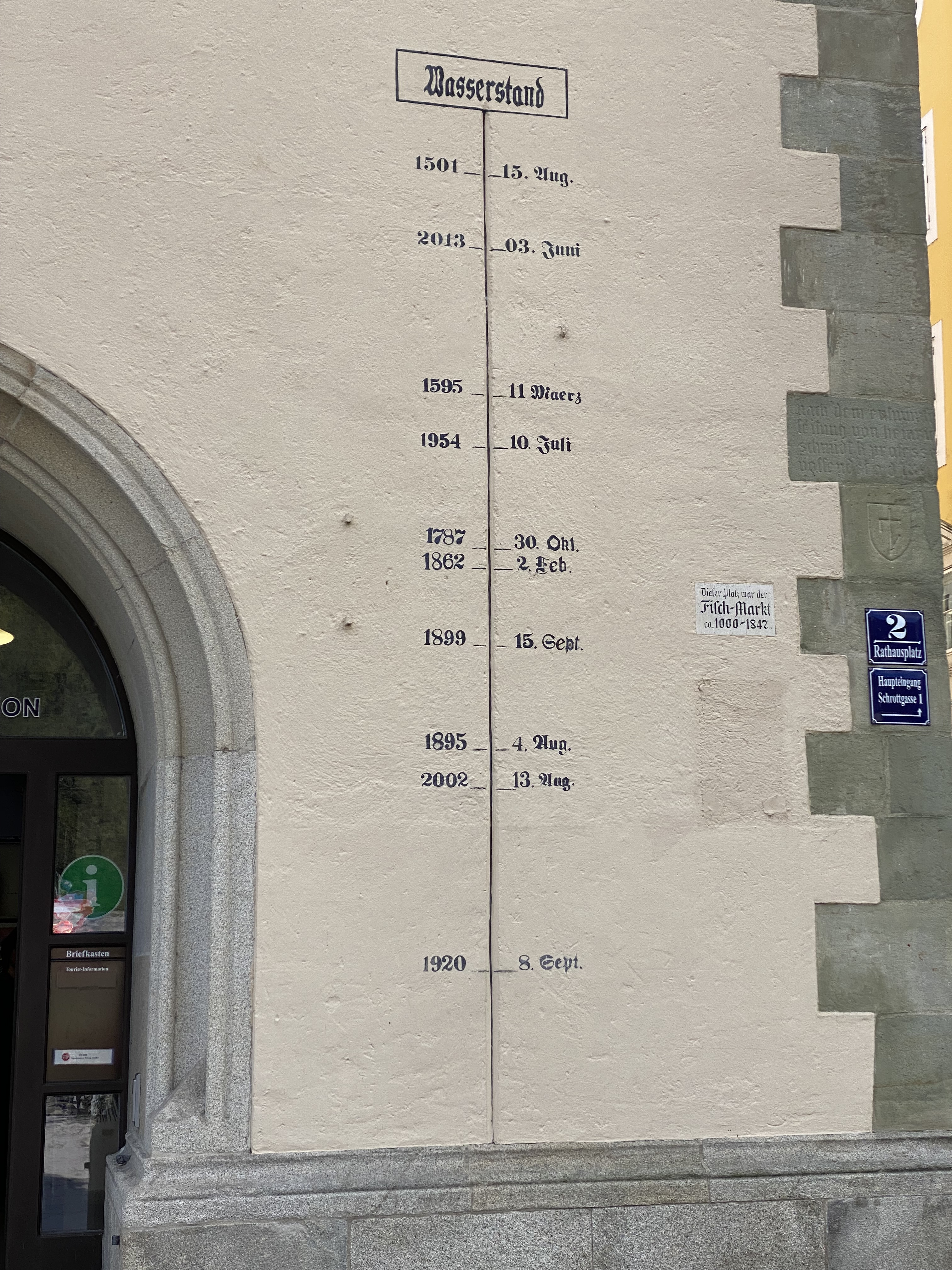
What you see in this photo is the high-water marks of historic floods. The marks are recorded on the City Hall, which fronts the Danube. You can see the marks in comparison to a lofty front door, about 10-12 feet high. The worst flood, it is believed, occurred in 1501. The second worst flood was in 2013, when the water level reached about 15′.

Our guide, a law student, said that all higher education in Germany is tuition-free. But you can’t be admitted without passing an exam. You pass more exams to check your progress. If you don’t pass the exam, you get booted out. Students who are committed to their education are likely to retain their places. Those who are not keeping up are at risk of being kicked out.

I learned that Germans put a high value on education. Parents can send their children to religious and private schools, but such schools must follow the same standards and curriculum as public schools. Home schooling is not permitted.

I asked about Jews in Passau, and our guide–a law student–said the Jews left Passau 500 years ago. Later, I googled and learned that in the fifteenth century, a petty thief confessed that he stole the Host and sold it to Jews. Ten Jews were accused of stabbing the Host until it bled. The Jews were tortured until they confessed, and they were put to death along with their accuser. In the aftermath, the synagogue and Jewish homes were burned. A few dozen Jews converted to Christianity, and the rest of the small Jewish community packed up and left Passau. https://www.jewishvirtuallibrary.org/passau

We visited the main church in town. It was stunning, a magnificent combination of gothic and baroque styles.

In the evening, back on our ship, an oompah band played, and it was delightful. I feel a keen sense of double identity, first, as an American enjoying their performance and singing along with familiar songs and polkas. (“I love to go a wandering, along the mountain track, and as I go, I love to sing, my knapsack on my back.”)

Yet as a Jew, I can’t help looking at these friendly, jovial faces and wondering whose grandfather was a Nazi. None of them? Maybe.

Mary says I’m obsessed with the Holocaust. I don’t think so. But to be in Germany and Austria is to be constantly reminded of the horrors that befell people whose only crime was to be Jewish.

Friday we visit the infamous Treblinka concentration camp in the Czech Republic. I will go there to honor the dead and to pray, “Never again.”

These are measures of how high the flood rose and the year in which it happened. The worst flood occurred in 1501. The second worst was 2013.

Michael Hiltzik, my favorite columnist in the Los Angeles Times, writes about the demands of the House GOP to avert a government shutdown. Their draconian cuts would protect their wealthy donors (by cutting IRS agents) but savage the programs that are essential for the neediest families, adults, and children.

He writes:

It’s all well and good to treat the House Republicans’ careening toward a government shutdown as a cabaret farce staged for our amusement

However, the threat to ordinary Americans, especially those dependent on government programs, is no joke.

As outlined by the Center for American Progress and the Center on Budget and Policy Priorities, two progressive think tanks working from official communications including the budget resolution released Sept. 20 by House Budget Committee Chair Jodey Arrington, they would involve these cuts in the social safety net:

Even if the Republicans don’t provoke the shutdown currently likely to begin at 12:01 a.m. Sunday, the budget cuts House Speaker Kevin McCarthy (R-Bakersfield) has said he would support to meet the demands of his caucus’ far-right wing would devastate government assistance to the most vulnerable Americans.

  • A cut of $14.7 billion, or 77%, in Title I education grants to school districts with high levels of poverty, which fund services and supports for students from low-income or disadvantaged backgrounds. The CBPP calls this funding “a core federal support for K-12 education.”
  • Reduction of the fruit and vegetable benefit in the Agriculture Department’s Special Supplemental Nutrition Program for Women, Infants and Children (WIC)by 56% to 70%, affecting about 5 million participants.
  • Unsustainable reductions in low-income assistance programs for housing and heating.
  • $1.9 trillion in Medicaid cuts over 10 years.

These cuts go well beyond those agreed upon in the debt-ceiling negotiations last May, which McCarthy accepted.

As a sop to the Republicans’ rich patrons, the House caucus would rescind all of the $88 billion in additional funding for the Internal Revenue Service that was enacted as part of last year’s Inflation Reduction Act.

The absurd truth of all this “negotiating” is that it won’t help Speaker McCarthy, America’s most outstanding political invertebrate, get a funding proposal through his chamber that would be even remotely acceptable to the Senate. That includes Senate Republicans, who have signed on to a bipartisan spending scheme.

There are doubts that McCarthy can get any proposal through his caucus, which is effectively controlled by extremists who keep moving the goalposts by insisting on ever more draconian spending cuts. They show every sign of determination to shut the government down this weekend, even though it’s a political article of faith that the public always blames the GOP for shutdowns (as it should), leading to disaster at the ballot box.

The lack of character among congressional Republicans, not excepting those aligned with McCarthy, is truly amazing. These are people who have no compunctions about slandering working Americans while taking every opportunity themselves for slacking off.

Rep. Garret Graves (R-La.), one of McCarthy’s lieutenants, remarked during the debt-ceiling negotiations that Democrats were “willing to default on the debt so they can continue making welfare payments for people that are refusing to work.”

The serene nerviness of this slander was truly impressive, given that the House of Representatives had taken 12 of 20 workdays off in April and 10 of 22 workdays (not counting Memorial Day) off in May. Overall, the House has been scheduled to be in session only 117 days in 2023, fewer than half the 240 days most of the rest of us are at work.

The House took off the entire month of Augustand didn’t return to session until Sept. 12, all while the possible shutdown was looming. The rest were officially designated “district work days,” to which we can only respond, “Oh, sure.”

Graves has resurfaced during the shutdown negotiations, telling the Washington Post that the Republicans’ “bottom line is we’re singularly focused right now on achieving our conservative objectives,” which include “huge savings.”

As the Post toted up the numbers, those savings involved “taking more than $150 billion per year out of the part of the budget that funds child care, education subsidies, medical research and hundreds of additional federal operations.”

If there’s a silver lining in the House GOP’s performative horseplay, it’s that it has cured the political press of treating the standoff as a symptom of congressional dysfunction. It’s not; as is being reported more accurately and sensibly in recent days, it’s a symptom of Republican dysfunction and, more than that, McCarthy’s dysfunction.

McCarthy sold his soul to the Republican extremist in order to win the job of speaker. Now what will he do?

The extremists have made their priorities clear. Protect their rich donors, while slamming the door shut on those who rely on government aid to survive. They are a cruel and shameless lot.

Nick Covington and Chris McNutt of the Human Restoration Project warn that everyone should pay attention to what is happening in Houston. The state takeover of a B-rated majority black-and-brown district demonstrates how far a rightwing governor will go to crush democracy and dissent.

They write:

Houston Independent School District, the largest school district in Texas, is at the center of a controversial state takeover by the Texas Education Agency. After working its way through the legal system for several years, last winter the Texas Supreme Court greenlit the replacement of district superintendent and the locally elected board of trustees by the head of the TEA, appointed directly by the Republican governor of Texas, Greg Abbott. And last month, school was back in session under the newly appointed superintendent, Mike Miles – former US State Department ambassador, charter school CEO, and scandal-ridden Dallas ISD superintendent – amid dozens of pedagogical and policy changes that left teachers, parents, and students confused, frustrated, and afraid.

In an effort to return “back to basics” and reinforce content knowledge to bolster test scores, the district has fundamentally transformed how educators can operate their classrooms in many schools across the district. Despite receiving an acceptable “B” score on the Texas School Report Card, New superintendent Miles stated in a recent district meeting, “We have a proficiency problem, we in HISD have not been able to close [the reading] gap for over 20 years.”

Among the most troubling changes is a strict “multiple-response strategy” where teachers must adhere to a four-minute timer to pause instruction and assess students for understanding – an intervention with seemingly no pedagogical justification. These strategies are paired with heavily scripted activities that are centered on drill and kill: repeat information over and over to memorize content. There has also been an increase in invasive admin walkthroughs to check for compliance with the scripted methods, which teachers and students have described as a distraction from learning. Teachers are required to keep a webcam on in their classroom at all times and their door must remain open. Defending these changes, Miles stated:

“Every classroom has a webcam and a Zoom link, and it’s on 24/7, if a kid is disruptive, we pull that student out of class. We put them in what we call a team center, and they’re being monitored by a learning coach, and they Zoom right back into the class they get pulled from.”

‍Libraries in many schools have been transformed into disciplinary spaces where students are housed for infractions and receive instruction over Zoom. As a result, classrooms are recorded and broadcast at all times. The Houston Education Association and Houston Community Voices for Public Ed have done incredible work documenting dissenting voices. These policies mirror those found in “no excuses” charter schools that police, monitor, and dehumanize students to raise test scores at any cost.

A veteran Houston ISD teacher, who asked to remain anonymous due to fear of administrative backlash, reached out to back up these claims, describing the impact these reforms have had on teachers and students:

…I left to teach at a Title 1 Houston ISD campus, so I’m getting the luxury to watch this mess unfold, and I assure you, there’s definitely ‘something rotten in Denmark” with what’s happening to us.

My school is not NES nor NES-aligned, but Miles has carved his path in such a way that we’re being evaluated multiple times a day, being forced to follow this horrible curriculum in a lesson cycle that as far as my research has found–has no pedagogical roots. It’s literally drill and kill. Apparently this is a trend or something. Miles is something else and when you Google him or any of the administrations around him calling the shots, you’ll not see any pedigree of education, but multi-millionaire board members whose backgrounds are in gentrification projects and such.

I’m exhausted by the end of the day. Texas teachers are evaluated all the same, using the T-Tess system–well except us now. Their move to push through that District of Innovation leads me to believe they simply want to weed anyone who was part of the old system out. It absolutely feels like he’s pushing to make us all quit. We were notified that although we’re given 10 sick days for the year, if we’ve taken 4 days leave by November or so, we will be terminated. We had an impromptu faculty meeting and had to sign that we’d gotten notification of this. Plus that we’ll be evaluated different.

Before the takeover, HISD was told to shape up or that’s the end of the line. We scored a “B” as a district in the last ratings and still are being taken over. The Abbot/Morath/Miles steamroller is moving right along.

Being a District of Innovation will be the coup de gras for us, really. He wants to add weeks to the school year, he’s already firing any teachers who simply ask questions, and he’s even gaming the system in many ways to ensure that he’ll have “results.” Special Education? Accommodations? Support structures for at-risk students? All gutted. It’s hard to believe this stuff is legal.

I’m stressed and miserable. It’s hard to believe some of the insane stories about his demands–but I assure you they are true. Teaching with doors open, such a security risk. Stuff like no snack time in elementary if it’s not tied to a Texas standard. I at least teach…But we all were forced to watch an hour or so musical he put on that would rival anything out of North Korea.

At this pace and the way things are going, I just can’t sustain it. I can’t stand seeing such a grift ruin education as it’s doing. We definitely had issues as a district but this can’t be the best solution. I’ll try to make it this year, but I’m beginning to apply elsewhere. My students were often successful at the state test, but it’s a crazy world when I teach…and am afraid to ask to take a class day to show my students the library and have them check out books. It’s nuts.

Of course please don’t use my name or anything that might come back to bite me… As Miles promised in his introduction to us that “he’d find out whose spreading dissent and act” and by most accounts that’s exactly what’s been occurring.

Parents and community members have flooded school board meetings with accounts from teachers who are similarly afraid to speak out, for fear of losing their jobs, as teachers who question the changes have been labeled “insubordinate” and had their jobs threatened. Parents have also spoken publicly about how the changes have affected their own children, as one mother recounted to the board before having her mic cut-off:

“For the last week, I’ve had a kid that cries every morning and every evening. Crying not to go to school, and beginning not to go in the morning. She says school’s boring, she’s not learning, and she’d rather be homeschooled at this point…She’s miserable. Her confidence is plummeting, and she’s starting to lose her joy for learning.”

At a board meeting on September 14th, a 12-year-old HISD student delivered prepared remarks about the disruptive timers, distracting admin walkthroughs, and palpable teacher stress. The board cut her mic, too:

“Due to the new open door policy, I and many other students have a hard time concentrating due to the many distractions in the hallways. Isn’t it your first priority to have kids in HISD like me learn? Students should be in a place they want to go to inst- (mic is cut off)”

Please open the link and finish reading. Miles apparently wants to turn HISD into a “no-excuses” district.