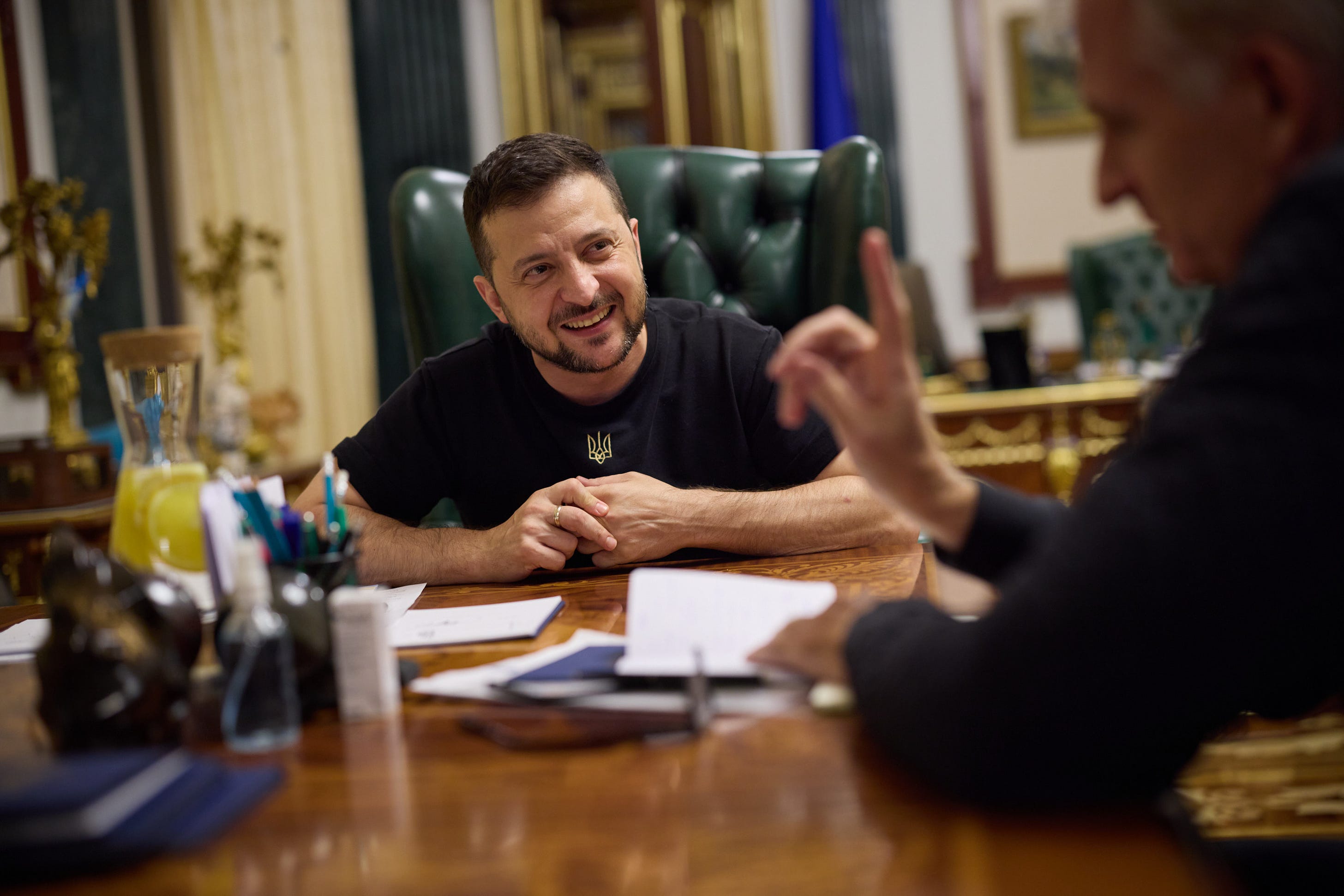
We have seen President Zelensky’s oratory on several occasions, most recently when he addressed the U.S. Congress. He is a master at communicating the plight of his nation, which has been under nonstop assault since last February 24. Putin thought that he would quickly decapitate the leadership, send Zelensky fleeing or kill him, and take control of Ukraine in a matter of days or weeks.
That didn’t happen. Shocking the world, Ukraine pushed Russian forces away from Kyiv, then slowly but surely pushed them out of many of its cities and towns. Now Ukraine endures a daily flood of missiles and drones aimed at destroying its infrastructure—a war crime—intended to cut off power, heat, and water to the civilian population. The point of the Russian onslaught is to terrorize the population.
If you watched the hearings of the January 6 Committee, you might agree that the most compelling testimony came from a young woman named Cassidy Hutchinson, who was a top aide to Mark Meadows, Trump’s chief of staff.
She testified that Trump knew he lost the election. She described Trump’s fury when he heard that Bill Barr said that Trump lost the election: Trump threw his hamburger at the wall and splattered ketchup everywhere. This was not a one-time event, she said. Other times he ripped the tablecloth off, throwing everything on it to the floor.
She described the stories she had heard about Trump demanding to be driven to the Capitol to lead the rebellion, then physically struggling with his driver when the Secret Service wouldn’t let him go.
Her testimony was by far the most dramatic of the hearings.
What we did not know was the prolonged internal struggle that she endured when faced with the decision of whether to tell the truth or to follow the advice of her Trump team lawyer, who advised her to say, “I don’t recall.” If she said nothing, she would have a job in Trump world. She would be taken care of. It sounds like a Mafia movie.
Passantino, Hutchinson testified, told her the goal with her testimony was to “get you in and get you out.”
“Keep your answers short, sweet, and simple, seven words or less,” Passantino said, per Hutchinson’s testimony. “The less the committee thinks you know, the better, the quicker it’s going to go. It’s going to be painless. And then you’re going to be taken care of. You’re going to be done. It’s going to be off your hands.”
She decided she had to tell the truth. She had to have her own lawyer.
Her decision to testify—and the pressure put on her not to testify—is documented in the January 6 report.
Sandy Stenoff wrote this tribute to Donna, who taught elementary school students for 35 years, then became an outspoken activist for public schools and against the overuse of standardized testing. Of course, she was a BAT.
She concluded:
Donna Mace made the world a better place by being a force for good. She was a class act, approaching life’s challenges with courage, grace, humility, humor, and optimism, We all benefited from Donna’s wisdom, gained from her experience as a lifelong educator and a life well lived. She really was the best of us.
To the Mace family: Our thoughts are with you now and we send you love, gratitude, and a wish that your fondest memories will bring you peace and comfort.
I am sadened that we have lost Donna Mace. Many were inspired by her and will follow in her footsteps, never abandoning the struggle to do what is right for children. I hereby add her name to the honor roll, a list of distinguished fighters for public schools and children.
I read this obituary in the Boston Globe, and I found myself wishing that more of us could be like Sabina. By her measure, most of us fall short. But let us honor the incredible example she set. She defines the term “force of nature.”
During two decades as an activist, Sabina Carlson Robillard became a significant leader in humanitarian relief efforts as she insisted that the voices of those being assisted should always be the most prominent in every discussion.
“While you’re listening to me, there are 1.5 million conversations happening on the ground, and I’m here to ask you all how we’re listening to them,” she said at a 2010 conference in Boston about her work in Haiti earlier that year after an earthquake killed more than 200,000 people.
She had turned 22 several weeks before that speech and was a seasoned activist. Years earlier in middle school, she began participating in protests and “was already thinking deeply about people who were suffering throughout the world,” said her father, Ken Carlson.
After being diagnosed with clear cell sarcoma four years ago while she was pregnant, Ms. Robillard, who lived in Cambridge, stayed busier than most of her healthiest colleagues.
She worked as a consultant and an operations officer with humanitarian nonprofits, and helped raise her daughter and stepdaughter while being treated for cancer. Ms. Robillard even texted her academic adviser from her Massachusetts General Hospital room the day before she died on Nov. 16, at age 34, to schedule a meeting a few days later with her Tufts doctoral advisory committee.
“In an unassuming way, she changed the course of how lots of money and people engaged in Haiti,” said her friend Jess Laporte of Waterbury, Vt., a Haitian-American climate and racial justice activist who works with nonprofits.
She worked as a consultant and an operations officer with humanitarian nonprofits, and helped raise her daughter and stepdaughter while being treated for cancer. Ms. Robillard even texted her academic adviser from her Massachusetts General Hospital room the day before she died on Nov. 16, at age 34, to schedule a meeting a few days later with her Tufts doctoral advisory committee.
“In an unassuming way, she changed the course of how lots of money and people engaged in Haiti,” said her friend Jess Laporte of Waterbury, Vt., a Haitian-American climate and racial justice activist who works with nonprofits.
Dan Maxwell, a Tufts University professor who was Ms. Robillard’s academic adviser, first met her when she was a Tufts sophomore.
“She was already well known as a force of nature on campus when she was 18 or 19 years old,” he said.
And though more recently she was a doctoral student, he said, “she was also like a colleague, and in many ways a leader the rest of us followed.”
Ms. Robillard was the lead author for a 2021 report, prepared with Teddy Atim and Maxwell, which called on international relief organizations to adopt a “localization” approach — letting local groups and individuals participate in planning and administration, rather than excluding them, as so often was done in the past.
In October, the US Agency for International Development issued a draft “Policy for Localization of Humanitarian Assistance” that cited the Tufts report and drew upon its findings.
“I was certainly happy to see her live long enough to see that kind of high-level validation of her work,” said Maxwell, who added that Ms. Robillard was defined by her sense of certainty in the field and in her writing.
“She had a North Star,” he said. “She knew where she was going, she knew what was right. While she didn’t force people to agree with her, she could be pretty insistent about what was right and what was wrong.”
The correct approach, she often said, was to listen instead of impose an outsider’s view.
After the January 2010 earthquake in Haiti, “what I saw firsthand was how much Haitians wanted to have their voices heard in the response,” Ms. Robillard wrote for the website of CDA Collaborative Learning Projects, an international nonprofit based in Cambridge for which she worked.
Early on, Ms. Robillard channeled her determination into helping others.
“Sabina was always defined by a tremendous sense of empathy,” her father said. “Her empathy was her sixth sense. She always thought of others before herself, even when she was a very, very young child.”
She also was a multi-instrument musician, an accomplished slam poet, and a leader of Amnesty International and gay-straight alliance groups while in high school.
Initially intending to study creative writing at Tufts, Ms. Robillard was soon involved with humanitarian work, spending months away from the university in 2009 to work as an intern with refugees in South Sudan.
She graduated the following year with a bachelor’s degree in community health and peace and justice studies, and subsequently received a master’s in applied community change and peace building. Tufts later honored Ms. Robillard for her humanitarian work.
For the past dozen years, she worked for nonprofits and aid groups including the International Organization for Migration. She was part of the IOM’s response to the Ebola outbreak in Guinea several years ago, and its response to a cholera outbreak in Haiti.
Fluency in French and Haitian Creole made her particularly effective in Haiti, where she had lived in Cite Soleil, a crowded, impoverished part of the Port-au-Prince metropolitan area. And she used her language skills to elevate the voices of those who lived in Haiti.
A presentation at her memorial service featured her quote: “Why isn’t localized humanitarian aid focused on letting communities determine and lead the work in building their own future?”
Among those she met in Haiti was Louino Robillard, a community leader known as Robi, whom she married in Port-au-Prince in December 2012, and with whom she collaborated.
With marriage came additional roles as stepmother to his daughter, Dayana Robillard, and parent to the couple’s 4-year-old daughter, Anacaona.
Discoloration under Ms. Robillard’s left eye, initially thought to be benign, appeared in 2017. While she was pregnant the following year, tests showed it was a malignant tumor, and the cancer later spread to her lungs.
Continuing to work for four years, even during her final full day alive, “Sabina wrote Ana e-mails over the last four years — 356 e-mails, knowing she wasn’t going to be around,” her mother said.
In addition to her parents, husband, stepdaughter, and daughter, all of Cambridge, and her brother, Ms. Robillard leaves her maternal grandmother, Luba Lepidus of Somerville.
Ms. Robillard’s husband will bring her ashes to Pak Nan Ginen, a park and reforestation project they cofounded in Saint-Raphael, Haiti, where he plans to build a memorial. Because Haiti is severely deforested, “she wished to use her ashes as soil to plant trees,” he said.
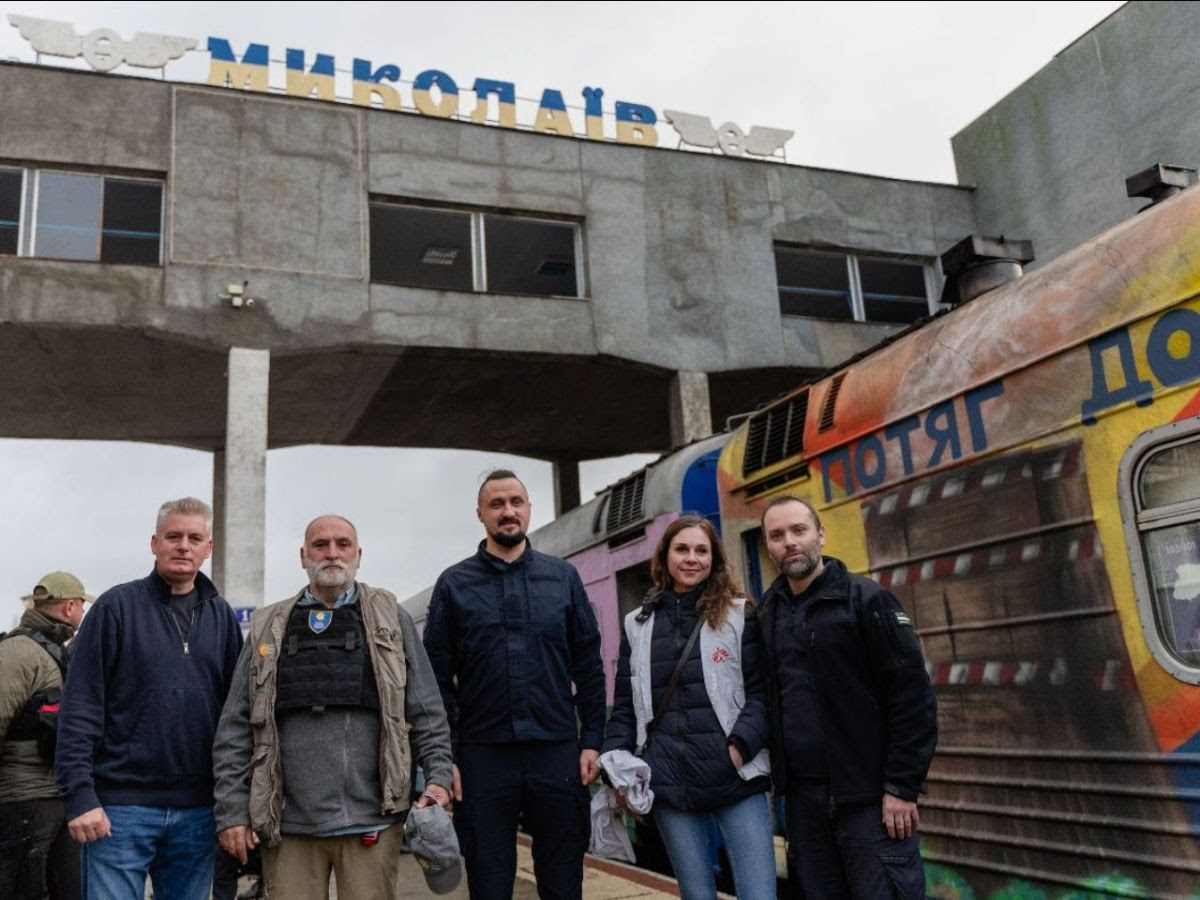
Chef Jose Andres created an organization called World Central Kitchen that goes wherever there is hunger and feeds people. Their mission right now is to serve food and deliver water to the people on the front lines in Ukraine.
Since the invasion of Ukraine began, WCK teams have provided more than 180 million meals to people in need. However, families still need our support as they head into what will likely be the toughest winter of their lives. By fueling our work, you’re helping us bring hope and comfort to communities across Ukraine—and now, a generous WCK donor is matching all gifts up to $10 million made now through December 31 for Ukraine. Make a donation today to double your impact. HELP US CONTINUE OUR EFFORTS IN UKRAINE
Ground report from José in Kherson
On November 11, after eight long months of occupation, the southern Ukrainian city of Kherson was liberated. Having arrived as soon as we were permitted to enter Kherson, WCK local teams were greeted with hugs and tears of joy while delivering food kits. Several days later, José arrived in Ukraine, keeping his promise of returning to Kherson once it was liberated. Below, José shares a ground report from his trip, detailing the growth of our response since WCK first arrived in the newly liberated city.
Yes, WCK has been able to previously support some local restaurants cooking for neighbors in Kherson and safely delivered food kits to frontline communities in the region…we even delivered a generator and fixed the broken water supply for five nearby villages. But no matter how much we wanted to do more, we were unable to reach so many families who were possibly going hungry because of Russia’s brutal occupation. In Kherson, residents lived without basic necessities, cut off from the rest of Ukraine…so many feared for their lives for eight long months. So when Ukraine’s troops entered Kherson on November 11, our WCK team knew we had to be there immediately next to the people, as soon as it was safe to do so.
When I arrived in Kherson on November 16, our WCK team had been delivering food aid each day, working on how we could increase our support every time we returned to the city. What I saw when I first got to Kherson… people celebrating, children were walking the streets with Ukrainian flags, it was a moment I will never be able to describe. But reality sets in as the day goes on and night falls, and people go home without electricity, food, or water. It’s still dangerous too…earlier in the morning a mine left behind exploded inside the train station. Thankfully no one was hurt. During our distribution we also heard shelling as the frontline is not too far away.
Still, when we were doing our food distribution, people remained calm and didn’t mind standing in the rain. I went around and spoke to families who told me they did not have much food at home. This is how WCK meets the needs. We work with the community and everyday we learn and get better.
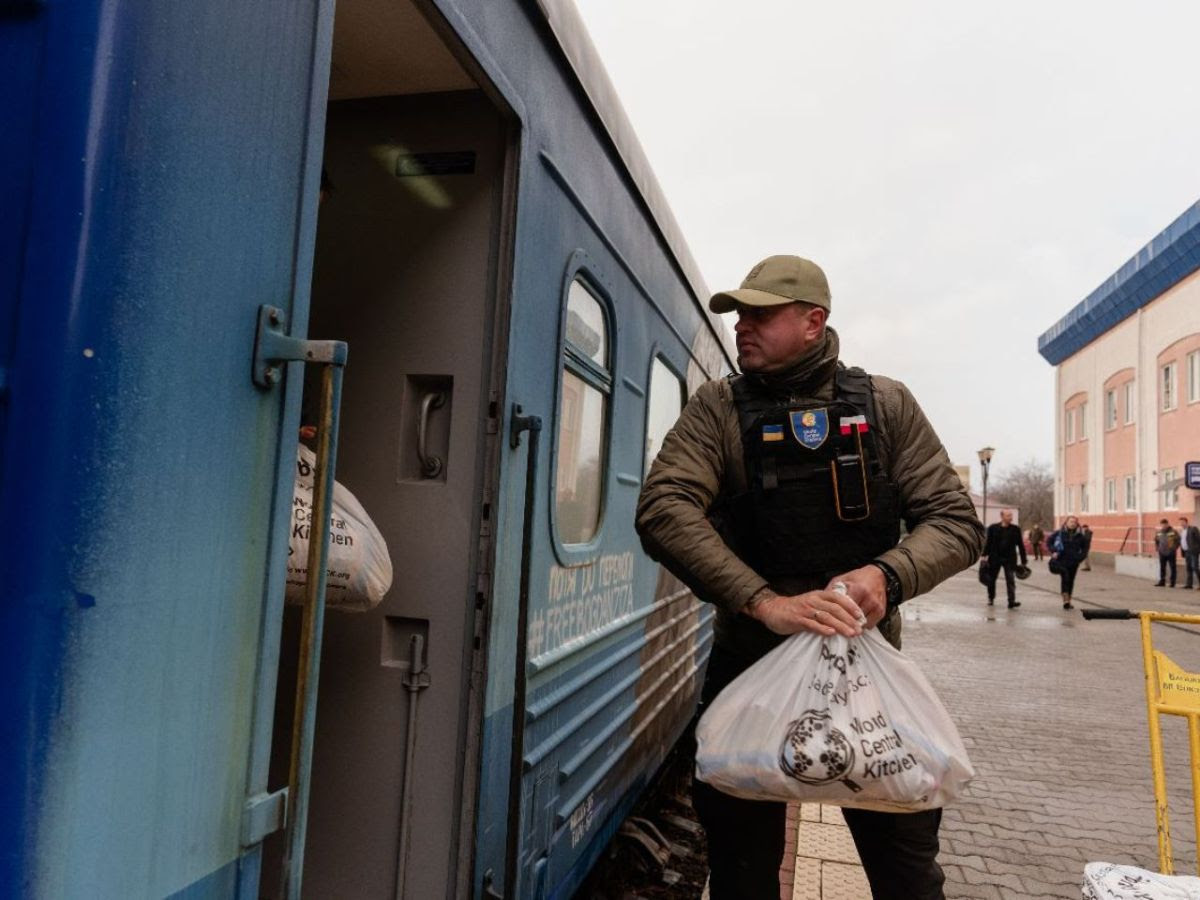
We travel neighborhood by neighborhood, delivering thousands of food kits to families.
Now we’ve been delivering and have been talking to the people, we’re growing our distributions across different neighborhoods to make sure we reach as many families as we can. For residents with gas and able to cook at home, we’re providing 30lb food kits filled with the majority of Ukrainian products. We are also bringing thousands of plates cooked from our WCK Food Truck in Mykolaiv.
WCK’s Food Truck in Mykolaiv has the capacity to cook up to 5,000 meals. Once the food is prepared, we package it for delivery.
It’s been amazing to see how fast our WCK teams in Ukraine have been able to scale and adapt to the challenges of every situation. With safety systems in place, the Relief Team is moving quickly so people are not gathering or staying outdoors for a long time. Delivery has also been difficult because access to Kherson is still limited, roads are destroyed, and rain has made things very muddy, but WCK keeps going no matter what!
Bringing aid to Kherson is challenging—roads are damaged and rain is causing mud.
There is also no water in Kherson and many people are collecting it directly from the Dnipro river. Filling nine large, 5,000 liter barrels, we delivered and installed water distribution sites throughout the city for residents to drink and cook with. In the next few days, we will install more water sites. WCK now has water distribution sites set up across the city, and we’ll keep expanding.
During my trip I also witnessed a special moment in Ukrainian history—the restoration of trains to and from Kherson. As Ukraine continues to fight for freedom and liberty they are sending a powerful message to the world that they can overcome anything. These are trains of hope, connecting Ukraine again.
Throughout our response, WCK has worked closely with our friends at Ukrainian Railways to transport critical supplies across the country, so we were very proud to stand alongside them during this amazing accomplishment. I rode on the first train to Kherson from Mykolaiv with nearly 200 other people. Some were returning home, some were going to see their relatives, but there were also people who simply decided to be there on this beautiful day. And for WCK, we brought along thousands of food kits with us!
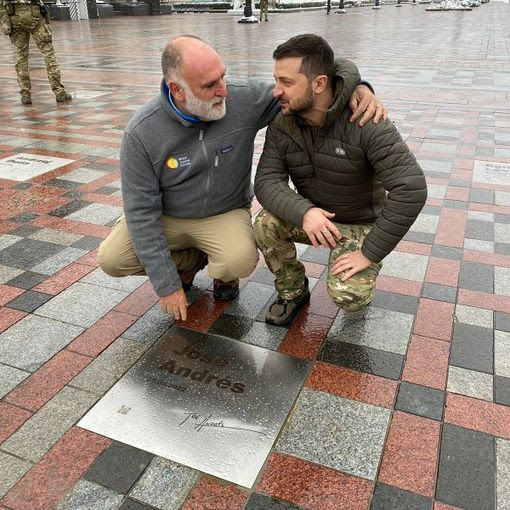
Before I left Ukraine, I took another trainfrom Kherson to Kyiv where I was honored to meet with President Zelenskyy. He presented me with the Order of Merit honor, something that I humbly accepted not for me, but in recognition of the thousands of Ukrainian Food Fighters I get to work with every single day. It is these people who are the heroes behind WCK’s efforts…the people who make the impossible, possible and have been working tirelessly for months under uncertain circumstances to get food to communities in need.
It is why we have been in Ukraine since the very beginning. We know we cannot solve every problem, but the very least WCK can do is make sure that food and water is not another issue people living under attack have to be worried about. We promised the people of Ukraine that as cities become liberated we would be there.
.
So in Kherson, standing shoulder-to-shoulder with WCK teams as they got food and water so fast to families in need, was one of the proudest moments of my life. It is because of WCK Food Fighters and supporters around the world that we are the only large-scale food aid in the city. Together, we will all help Kherson, and other regions around Ukraine, get through the long, hard winter. Thank you for your support and for continuing to believe in our mission.
Former Secretary of Education Betsy DeVos recently spoke at Calvin University in Michigan. As one of the university’s most prominent graduates, her remarks were received with respect.
Dr. John Walcott, a professor of education at Calvin University, wrote an article for the school newspaper in which he expressed respectful disagreement with her ideas. The full article is worth reading. It takes courage for a professor to take issue with a state and national leader such as DeVos, especially in a religion-focused university.
Be sure to open the link and read the comments.
He began:
On Nov. 17, Calvin University hosted an event with Betsy DeVos. DeVos served as Secretary of Education during the Trump administration and is a graduate of Calvin University. In making the announcement, President Boer described the event as part of efforts “to hear from people who bring diverse backgrounds and perspectives to important conversations.”
DeVos served as Secretary of Education during the Trump administration and is a graduate of Calvin University. In making the announcement, President Boer described the event as part of efforts “to hear from people who bring diverse backgrounds and perspectives to important conversations.”
I understand and respect the desire of our university to welcome to our campus a distinguished alum who has a long history of involvement at local, state and national levels. Furthermore, I agree that it is important to provide space for “diverse perspectives” and “important conversations.” We must strive to be a community willing to ask tough questions and engage deeply with important issues in our world.
I believe that an opportunity for additional engagement with these issues is especially necessary because of the problematic nature of much of what Secretary DeVos proposes when it comes to education. For example, her call to support “students and not systems” fails to recognize that student learning can be supported by teachers, curriculum, financial resources, school administrators and, yes, in many cases may even require a building conducive to learning. It is easy to demonize systems, but the use of this sort of false dichotomy is ultimately unproductive.
In that spirit, I suggest that we continue the conversation started at this event. The event used an interview format that did not provide opportunity for the sort of conversation and debate that are required to dig deeply into important issues related to educational policy and the state of education in our nation. Near the close of the event, Secretary DeVos stated her ongoing desire to “debate and advance” the policies for which she advocates. I agree that we need to debate these policies and, as a university community, think deeply about issues that relate to education and political engagement and how God calls us to seek justice and be agents of renewal in our world.
I believe that an opportunity for additional engagement with these issues is especially necessary because of the problematic nature of much of what Secretary DeVos proposes when it comes to education. For example, her call to support “students and not systems” fails to recognize that student learning can be supported by teachers, curriculum, financial resources, school administrators and, yes, in many cases may even require a building conducive to learning. It is easy to demonize systems, but the use of this sort of false dichotomy is ultimately unproductive.
We also need to carefully consider Secretary DeVos’ focus on parental choice and individual rights as the basis of her calls to change our educational system. This perspective ignores the function of our schools as a public good, an institution at the core of our desire to promote democratic values and the flourishing of all students. We need to think carefully about the purpose of education in a democratic society and about the role of public schools that have been part of our nation’s commitment to education since before the writing of the U.S. Constitution. Our call to seek justice and be agents of renewal in our world may push us to prioritize the needs of our community and of the most vulnerable in our society over individual rights.
As an educational scholar and researcher, I recognize the need to carefully examine the impacts of policies that use the language of choice and freedom on student learning and on public schools. For example, advocates for school vouchers, which allow parents to use public education funds for tuition in private schools, argue that these policies can be the key to improving student outcomes while ignoring research that does not support these claims. For example, Dr. Christopher Lubienski (Director of the Center for Evaluation and Policy Analysis at Indiana University), summarizing research since 2015, states that “every study of the impacts of statewide voucher programs has found large, negative effects from these programs on the achievement of students using vouchers.”
A thorough discussion will explore the impact of DeVos-supported policies on school funding. Recent reports from Florida note that this year, school vouchers will divert $1.3 billion from public schools, and reports from states like Arizona, New Hampshire and Wisconsin show that the overwhelming majority (80%, 89% and 75%) of students utilizing vouchers were already in private schools before the programs began. We need to ask if public funds should be given to schools that are in some cases not required to comply with regulations related to special education, federal civil rights laws and curriculum standards. We should engage critically in questions regarding the role of teachers’ unions before dismissing out of hand their role in public education. And we should critically examine the rhetoric that is currently a part of the so-called “culture wars,” especially as it relates to education. I am concerned that Secretary DeVos has contributed to a misrepresentation of critical race theory and may be perceived as aligning with groups and individuals that have advanced a harmful narrative directed at the LGBTQ+ community.
These are just a few of the many complex and vitally important issues that need to be a part of a deeper conversation. I am not criticizing the decision to host Secretary DeVos, a distinguished graduate with years of activism in the public sphere. However, as a faculty member in the School of Education, it is important to me that the broader educational community understands that this does not signal an endorsement of her policies and perspectives by the School of Education. And I remain hopeful that we, as a community, will embrace the opportunity to not only offer diverse perspectives, but also engage deeply in important conversations of what it means to think deeply, act justly and live wholeheartedly as Christ’s agents of renewal in the world.
In an impressive achievement for families and children, New Mexico passed an amendment to its state constitution guaranteeing free childcare to families that need it most. New Mexico is one of the poorest states in the nation. Free childcare will enable mothers to work to support their children. Unlike “reform” programs that emphasize standardized testing, New Mexico’s pioneering emphasis on child wellbeing really does put children first.
New Mexico in May became the first state to offer free child care to most of its residents. Now, after a November referendum, it’s also the first state to enshrine child care funding in its constitution, effectively making the service a universal right – and perhaps offering a model for how other states could serve their youngest residents and working parents.
Nationwide, the average cost of child care for families outpaced the rate of inflation in 2021, according to analysis from Child Care Aware of America. A low-income family should have to spend only 7% of its income on child care, per a federal benchmark based on an average of census data. But the national average cost of child care – $10,600 annually – is roughly 10% of a married-couple family’s average annual income and 35% of a single parent’s income, the analysis found…
The scheme – hatched by a willing governor, state lawmakers and determined child advocates – effectively makes child care free to families making up to 400% of the federal poverty level, or about $111,000 for a family of four. The state’s median household income is $51,243.
At its core, the program aims to provide a safe environment for children at a stage of critical brain growth and development. Further, saving caregivers money on child care lets them invest more in their families, from putting healthy food on the table to home ownership, a key official said….
More than 70% of state voters approved the proposition, which will be funded by oil and gas revenues.
There has been a strong will in New Mexico to improve its slice of the widely broken US child care system, mainly because it is one of the poorest states and consistently ranks among the worst for child well-being, state officials and child advocates say.
Child advocates some 12 years ago sparked the movement to get a permanent funding source for child care enshrined in the state’s constitution. It was a long-game strategy for a coalition of non-profit, grassroots groups, including New Mexico Voices For Children.
That organization in 2010 first brainstormed using funds from oil and gas production revenue to fund child care and early education, said Amber Wallin, its executive director….
Under Democratic Gov. Michelle Lujan Grisham, New Mexico has established a minimum wage for child care workers: Entry-level employees now earn $15 dollars an hour, and more experienced lead teachers earn $20 dollars an hour. The pay raises aim to help improve workforce retention; before the raises, workers could earn a higher wage working at a fast-food restaurant than providing child care, child advocates told CNN.
New Mexico also created the first state agency and cabinet post focused on early childhood education and care. Also, “we were the first state to set our cost of what we reimburse child providers for child care at the actual cost of delivering care, and we were the first state to make child care free for most families,” said Elizabeth Groginsky, the state’s first secretary for early childhood education.
Jeff Bryant writes here about the surprising emergence of Jackson, Mississippi, as a trailblazer for public school reform. Jackson is right now renowned for the failure of its water supply. Jeff also documents years of the state government underfunding its public schools. Racism can be seen is almost every aspect of the relationship between the state and the city. The public schools of Jackson are 95% Black. Under these circumstances, what is happening in the schools is remarkable.
Before it got national headlines about its severe water crisis, Jackson, Mississippi, was much renowned for its potholes. “The amount [sic] of potholes in the city is crazy,” exclaimsthe narrator of “Jackson, Mississippi: The Second Most Dangerous City in America,” a video posted to a popular travel YouTube channel in December 2021. The vlogger continues, “It’s just amazing to me there is a city in America that looks like this. … It’s hard to believe that this is the United States.”
“It is not uncommon to walk through west Jackson and see water flowing out of pipes for weeks,” observed Yoknyam Dabale, a Nigerian immigrant who moved to Jackson, in an op-ed in the Jackson Free Press. “Roads are overrun with potholes and uncleaned gutters.”
“The city says 90 percent of its roads are in poor shape,” television news outlet WLBT reported in 2021. “A Google search pulls up endless complaints, dangerous accidents, and hazardous barricades,” reporter Sharie Nicole wrote. “Local comedians write songs about the potholes; out-of-towners rant about it.”
The steady decay of Jackson’s public infrastructure goes beyond potholes and the water supply.
In 2018, the Mississippi Clarion Ledger reported that Jackson libraries faced a crisis that included “black mold, leaking buildings,” and “chronic flooding issues at two of its main branches.” Jackson libraries have been “suffering from needed repairs,” and some libraries were even facing temporary closure due to lack of money for repairs, according to an August 2022 report in the Northside Sun.
In 2017, the Clarion Ledger, in reporting on the “deteriorating” conditions in the city’s parks and recreation facilities, found a “$1.2 million hole” in the Department of Parks and Recreation budget.
The lack of government investment in Jackson’s public infrastructure, and across the state in general, extends to public schools as well.
Were Jackson schools funded according to state law, the district would receive $11,447,922 more in state funding for the 2022-2023 school year alone, according to the Parents’ Campaign, a parent advocacy group in the state.
Funding for Mississippi students is even worse if they happen to be Black. “Between 1954 and 1960, the state gave Black students more than $297 million less (in 2017 dollars) than white students,” the Sun Herald reported while referring to government data. “And if that number is extended back to 1890, Black students were shortchanged more than $25 billion.”
Jackson Public Schools (JPS) are 95 percent Black, according to the 2019 Better Together Commission (BTC) Findings Report by the nonprofit One Voice. The Better Together Commission is a public-private partnership that included city and state officials, Jackson citizens, and representatives from the W.K. Kellogg Foundation, a private foundation based in Michigan.
As I reported for the Progressive magazine in 2018, BTC was formed as an alternative to a takeover of the district by the state after an audit by the Mississippi Department of Education found a significant number of state regulatory violations by the district. Fearing state takeover would lead to schools being handed over to charter school management groups—which is what happened in New Orleans, Newark, and other majority-Black school districts—a coalition called Our JPS quickly formed to oppose the takeover and demand an alternative approach to improving the public school system.
One such alternative was to remake schools into community-based centers for providing student- and family-oriented supports and programs designed to address the high levels of poverty, homelessness, and mental and economic trauma in the district.
“We need schools that serve as hubs of the community,” Pam Shaw, a leading spokesperson for Our JPS at the time of writing the article for the Progressive, told me. “Communities should own that space and use it as a launching pad for everything children need.”
Our JPS has since refined that idea into a campaign for the district to adopt what’s become loosely known as community schools. Our JPS defines community schools as “neighborhood schools that partner with families and community organizations to provide well-rounded educational experiences and supports for students’ school success…”
One philanthropic group advocating for the community schools approach in Jackson is the NEA Foundation, a Washington, D.C., based nonprofit founded by educators.
“We entered this work in Jackson at the invitation of Mississippi educators,” NEA Foundation president and CEO Sara Sneed told Our Schools. “There is enormous community pressure for positive change but also expectations that any effort to include community voice in the process will come with a fight.”
The NEA Foundation’s effort also targets two other communities in school districts in the South—Little Rock, Arkansas, and East Baton Rouge Parish, Louisiana. But Sneed expects their work in Jackson to lead the initiative for spreading the community schools approach throughout the South.
“We want to make community schools a signature issue in Mississippi and believe the effort in Jackson is an opportunity to transform the education experiences of children in the South,” Sneed said.
Please open the link and read the rest of this hopeful post.
Timothy Snyder, historian at Yale and expert on European history, invites you to contribute to a very important fund that he created.
He writes:
Sometimes things are very simple. If you can easily do something to halt a genocide, then you should.
As I have been arguing here in “Thinking about…”, the Russian intention in Ukraine has been genocidal from the beginning.
The notion that Ukraine does not exist, that its state is artificial and its national consciousness a confusion — this Putinist rhetoric was genocidal. Moscow’s claims that Ukrainians are all Nazis or gays or Jews or Satanists (the current line) is nothing more than a fascist politics of us-and-them: the enemy is defined via hate speech as subhuman, as beyond any ethical concern, existing only to be destroyed.
The standard Russian occupation practices of kidnapping children, raping women, and executing local leaders are genocidal. Everywhere that Russia has been forced to leave Ukrainian territory, for example in Kherson region these last few days, Ukrainians find the death pits and the torture chambers. These and other actions constitute genocide in the sense of the 1948 convention, as I explain in this lecture.
It is Russian policy to deprive Ukrainians of light, heat, and water during the winter by destroying civilian infrastructure. Just yesterday Russia fired dozens more missiles at civilian targets, leaving about ten million people without electricity during very cold nights and days. As I write, people I care about are in bomb shelters, listening to explosions.
This deliberate creation of misery and lethal conditions for civilians is contrary to the laws of war. It is also another violation of the genocide convention, which forbids “deliberately inflicting on the group conditions of life calculated to bring about its physical destruction in whole or in part.” That this is indeed the intention is gleefully affirmed practically every day on Russian state television.
Yesterday’s attack was the largest on Ukrainian civilian infrastructure since the war began. Russia launched 95 missiles and drones. To stop the missiles, Ukraine needs Western government help with air defense and aircraft. The Shahed drones, from Iran, are what is known as loitering munitions. For weeks they have been used to destroy the Ukrainian power grid as well as other civilian targets. They are a terror weapon put to a criminal purpose.
The Ukrainians are good at repairing what the Russians destroy. But the large number of drones has made it hard to keep up. And the loss of the electricity grid as such will lead to horrific conditions and tremendous loss of life, especially among the vulnerable and the elderly.
This is where we can do something. We can help stop the drones. President Zelens’kyi’s United24Foundation asked me to raise money for a cause of my choice. As a historian, I could have chosen a destroyed library (which I visited in Chernihiv a few weeks ago), and in the future I will do just that. But right now Ukrainians need to get through this winter and win this war.
So rather than indulge my own preferences, I asked where I could be most immediately helpful. The answer from the Ukrainians I asked was a system to defend against the Iranian drones. And so that is what, as an ambassador of the president’s United24 platform, I have pledged to do: to raise $1.25 million for such a system, a Shahed Hunter.
I am honored to be among a wonderful group of ambassadors — including Mark Hamill, Liev Schreiber, and Barbra Streisand — who have made similar pledges to raise funds.
Now, the Ukrainians might think that I am famous, but I am not famous like these wonderful actors! So I am counting on you to help, and to spread the word.
A difference between this genocide and others is that you can do something to stop it easily and right now. Please make a contribution here to protect Ukrainians from the drones that are destroying their conditions of life. And then please share this post with others who might wish to do the same. Thank you.
Another great actor… and profoundly decent man. I did get him to laugh once or twice. The warmth and intelligence he is able to show in these profoundly distressing conditions is just hugely admirable. Help me to get to that smile again by providing Ukrainians with what they need most.
I want to congratulate you for your courage in running for the Michigan State Board of Education and double-congratulate you for winning! You have been a faithful member of the Network for Public Education, and I have been proud to post your writings here.
You entered the race knowing that it was supposed to be a bad year for Democrats. You jumped in anyway because you thought you could make a difference. You will!
You entered knowing that you, a professor of music education at Michigan State University, would be pitted against the billionaire DeVos machine. I’m thrilled to see that the entire Democratic ticket swept the State Board of Education and both houses of the Legislature.
You beat Betsy DeVos!
When frustated educators ask me what they can do, I tell them I can think of two options: join your state union (if you have one) and fight back or run for office, for local board, state board or the legislature.
You did it and you won! I know you are thrilled to be part of Michigan’s blue wave. You inspire the rest of us.
I am happy to add you to the honor roll of this blog for your courage, your persistence, and your devotion to Michigan’s children and their public schools.