Archives for category: Colorado

A teacher in Douglas County, Colorado, reports that the school board and superintendent are determined to wreck the public school system for which they are responsible.

The teacher writes:

I can’t begin to tell you how your sharing the information about the LA school district victory for kids is boosting the morale of fighters for public education in Douglas County, Colorado. We’re in a fight for our public school life here too. The school board elections in November will determine the future of our public schools.

The school board was elected, partly in 2009 and partly in 2011, by money from sources outside of the district and heavily connected with the GOP and ties to ALEC. The purpose seems to be to conduct a corporate experiment to on an affluent, not broken, school district south of Denver.

The school board in turn has proudly broken all ties with the union. While the union still exists there is no collaborative, working relationship, or no collective bargaining agreement between the district and the union. And it seems that every time someone disagrees with them, these opponents are called “union thugs.” If this weren’t so serious, their tactics would look downright silly. At the last board meeting, the BOE supporters dressed up as Grinches in their interpretation of the union, and passed out inaccurate pamphlets about the union.

The school board hired a corporate reform superintendent in 2010. Some of her first contacts with the community involved traveling to community public schools to praise the charter school movement and the important of choice. If you want to listen to her speak, contact the Milton Friedman Foundation. http://www.edchoice.org/Foundation-Services/Speakers/Elizabeth-Celania-Fagen.aspx

The school board has also forced a voucher program currently tied up in litigation thanks to the group, Taxpayers for Public Education- http://www.facebook.com/pages/Taxpayers-for-Public-Education/165645363470905?fref=ts. The lawsuit is on its way to the Colorado Supreme Court. The community voted down funding for merit pay, but they have still spent the money from elsewhere to implement a merit pay program that is basically behavior modification for teachers. And they are extremely proud of the fact that they have reduced the teachers’ salary in this district. Polls show teacher morale at an all time low.

More about the voucher program. The right wing of our Republican party is now going after the head of our public libraries for his participation in supporting the lawsuit. http://www.ourcoloradonews.com/castlerock/news/douglas-county-commissioners-push-for-library-changes/article_11d11136-850d-11e2-9323-001a4bcf887a.html

And now they are moving on with a new era in charter school relations. http://www.9news.com/news/article/321642/222/Douglas-County-Schools-signs-unique-charter-school-deal?fb_action_ids=10200721010176750&fb_action_types=og.recommends&fb_ref=artsharetop&fb_source=other_multiline&action_object_map=%5B499626156739696%5D&action_type_map=%5B%22og.recommends%22%5D&action_ref_map=%5B%22artsharetop%22%5D

They have an $83 million reserve while students sit in unheated classrooms; parents have to pay for student busing, among other things a free public education is supposed to provide. http://strongschoolscoalition.org/dougco-finances-crystal-ball/

And just like the LA elections, the corporate reformers are continuing to spend money on commercials, and the Republic party headquarters here has no qualms about spending over $1 million on November’s elections. The air here is thick with propaganda.

But just like LA, and so many other areas in this country, we have a brilliant and dedicated community that wants its public schools back. Here are just a few of the very information blogs and organizations created by our communities. http://douglascountyparent.com/ and http://strongschoolscoalition.org/ While we don’t have their money, we can only hope that the truth will also prevail here in Douglas County.
Who is the miracle reformer of Colorado? Who wrote its law to evaluate teachers by their test scores? Who claimed that his high school graduated 100% of its seniors and sent them to college? Who so lauded by President Obama and DFER? Whose legislation became a model for ALEC? Why, Michael Johnston, of course.

Mercedes Schneider continues her portrait of the board of NCTQ by looking into Johnston’s history. NCTQ is the organization that tells the nation how to get high-quality teachers.

Previous posts by Schneider have included Wendy Kopp, Michelle Rhee, and Joel Klein, who have a cumulative teaching experience of three years among them (Rhee’s).

Responding to a post about a test question for second-grade students, which assumed they knew the words “commission” and “Mozart,” this parent replied:

My second-grader defined “commission” without needing the
multiple choice prompts this morning, but her school has a really
strong music program.

She credited her music teacher for having
taught her the term–which was done in the context of an annual
all-school field trip to a local Symphony Orchestra concert. (This
is not district-wide; our PTA fundraising pays for the cost of the
buses necessary to take all the kids. I don’t know of another
public school in the district or in the area that has all of its
kids at the concert every year; most take only one or two grades,
if they participate at all.)

Before they go to the concert, our music teacher gives the kids the elementary-school equivalent of a pre-concert lecture–which is to say, it takes place over a few
weeks and isn’t a lecture, but they come away with much of the same
information.

My daughter has also played violin since she was 4,
and her public school has a fabulous strings program that she’s
been in since kindergarten, also thanks to our fabulous and amazing
music teacher (who, it might be noted, belongs to the union and
runs the entire strings program during her free periods).

Our school is also blessed with amazing parents, and several of them
attend each and every orchestra rehearsal to help the kids tune
their instruments and set up music and stands. And in the spirit of
full disclosure, my daughter has a musicologist for a mother.

Do I think most second-grade students could define this term? Probably
not, especially with so many schools cutting music and arts
programs. Unfortunately, putting terms like this on a test will
likely have the effect of extending vocabulary lessons and cutting
into time that would otherwise be used for music or art or
P.E.

Jeannie Kaplan is an elected member of the Denver Board of Education. She has been critical of corporate-style reform and of the heavily-funded effort to persuade the public that it is successful. When she heard that Jonah Edelman of Stand for Children told an audience in Tulsa recently that Denver was a national model of success, she decided to review the score card for the district. (Stand for Children boasts of its civil rights credentials but supported a slate of Republican candidates for the state legislature in 2012, as part of its campaign for corporate reform).

Kaplan wrote for this blog:

So Much Reform. So Little Success

Denver, Colorado is a poster child for much of what reformers like to see: standardized testing, teacher accountability, charter schools, choice, co-location, and oh, did I mention testing? Denver Public Schools is trying or has tried almost all of them. Why, even Jonah Edelman, founder of one of the most well-funded, prominent reform organizations, Stand for Children, just today, January 10, 2013, pointed to Denver as a leader in reform because of its “portfolio” of school choice led by its charter schools. So, how is reform really working in Denver?

Let’s start by focusing on achievement, meaning test scores, since that is the focus of all things reform. (This post will have a lot of data since reform and data go hand in hand these days, especially data that can be spun). Denver Public Schools have been rated by the Colorado Department of Education as “Accredited with Priority Improvement Plan,” for the last three years. Out of five grades this is the second to the bottom. To be fair, DPS is inching toward the next category, “Accredited with Improvement plan.” The cut point is 52% of eligible points; Denver is at 51.7%. I am not sure how meaningful this data point is, since the GROWTH points count for 35 points out of 100 and ACADEMIC ACHIEVEMENT, meaning proficiency, counts for only 15.

Colorado now places enormous emphasis on “the growth model.” While no one would contest you need to have growth to get to proficiency, I believe this model masks what is really happening, and so the data I am citing is all about proficiency. To further emphasize how growth can mask proficiency, allow me to quote from one of Denver’s most ardent reformers, Alexander Ooms, who said on in a commentary on EdNewsColorado:

“Denver can celebrate academic growth for years to come without making much progress in the exit-level proficiency of students. And that is simply not the right direction. Growth is means, not end.”http://www.ednewscolorado.org/2012/05/23/38581-commentary-our-unhealthy-obsession-with-growth to read his entire commentary.

I could not have said it better. The data I cite are proficiency numbers, not growth numbers.

In 2005, when reform was in its infancy, Denver Public Schools hired its first non-educator superintendent: Michael Bennet, former businessman/lawyer, former mayoral chief of staff . Mr. Bennet’s childhood friend and fellow businessman, Tom Boasberg, was hired to replace him when Bennett became a Senator. Denver has been experimenting with reform since then. Oh, and BTW, Jonah Edelman grew up as Tom Boasberg’s neighbor in Washingon, D.C.

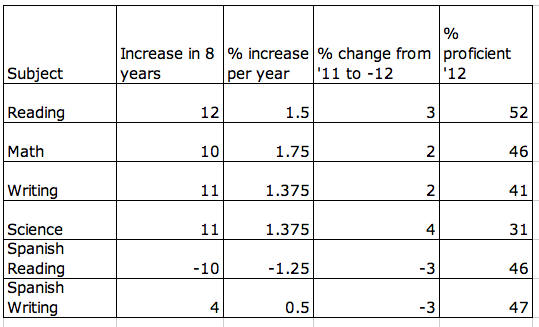
After 8 years, what academic changes has reform produced?

The following data is from 2005 through 2012, according to Colorado standardized tests. Here is the website for a deeper delve into the data

http://www.schoolview.org/performance.asp

ACHIEVEMENT:

Screen shot 2013-01-12 at 4.32.48 PM
We can’t leave achievement without looking at the State of the Union shout-out school, Bruce Randolph. Bruce Randolph Middle School in 3 years of state tracked data shows a gain of 2% in reading to 28%, stayed at 19% in math, increased by 3% in writing to 17%, and increased 7% in science to 17%. It is tied for last in proficiency – 52nd – for all of Denver’s middle schools.

Bruce Randolph High School has declined 10% to 33% in reading, declined 3% in math to 10%, declined 2% in writing to 14% increased 1% to 12% in science. Bruce Randolph is 24th out of 27 high schools in academic achievement.

ACHIEVEMENT GAP increases based on 7 years of CSAPs/TCAPs

Elementary School

Reading 4.17
Writing 5.78
Math 6.46

Middle School

Reading 3.23
Writing 4.71
Math 6.72

High School

Reading 3.01
Writing 5.82
Math 6.30

According to DPS data, the gap between FRL and paid-lunch students has widened by 9% since 2005. In 2005, percent proficient for FRL was 29%, paid was 58%. In 2012 the numbers were 41% for FRL, 79% for paid. The gap has grown to 38%.

ACT RESULTS: (A composite score of 21 is generally accepted as a college readiness benchmark)

From a DPS presentation of September 2012​

2005 17
2012. ​17.6

GRADUATION for 2011 – we are still waiting state numbers for 2012 but the number of students graduating increased from 2,642 in 2005 to 3,414 in 2012, for a total of 772 more graduates in 8 years…or an average of 96.5 more graduates each year.

Here is how Denver Public Schools compares with the state:

State​​ 73.9%
Denver ​ 56.1%

REMEDIATION (from Fall of 2010)

From the Fall of 2007, when this data was first available to the Fall of 2010 (the latest data available, remediation numbers have increased from 57.1% to 59.7%. The state of Colorado is at 31.8%.

This is the achievement for 8 years of reform.

Need I say more?

Jeannie Kaplan is an elected member of the Denver Board of Education. She has been critical of corporate-style reform and of the heavily-funded effort to persuade the public that it is successful. When she heard that Jonah Edelman of Stand for Children told an audience in Tulsa recently that Denver was a national model of success, she decided to review the score card for the district. (Stand for Children boasts of its civil rights credentials but supported a slate of Republican candidates for the state legislature in 2012, as part of its campaign for corporate reform).

Kaplan wrote for this blog:

So Much Reform. So Little Success

Denver, Colorado is a poster child for much of what reformers like to see: standardized testing, teacher accountability, charter schools, choice, co-location, and oh, did I mention testing? Denver Public Schools is trying or has tried almost all of them. Why, even Jonah Edelman, founder of one of the most well-funded, prominent reform organizations, Stand for Children, just today, January 10, 2013, pointed to Denver as a leader in reform because of its “portfolio” of school choice led by its charter schools. So, how is reform really working in Denver?

Let’s start by focusing on achievement, meaning test scores, since that is the focus of all things reform. (This post will have a lot of data since reform and data go hand in hand these days, especially data that can be spun). Denver Public Schools have been rated by the Colorado Department of Education as “Accredited with Priority Improvement Plan,” for the last three years. Out of five grades this is the second to the bottom. To be fair, DPS is inching toward the next category, “Accredited with Improvement plan.” The cut point is 52% of eligible points; Denver is at 51.7%. I am not sure how meaningful this data point is, since the GROWTH points count for 35 points out of 100 and ACADEMIC ACHIEVEMENT, meaning proficiency, counts for only 15.

Colorado now places enormous emphasis on “the growth model.” While no one would contest you need to have growth to get to proficiency, I believe this model masks what is really happening, and so the data I am citing is all about proficiency. To further emphasize how growth can mask proficiency, allow me to quote from one of Denver’s most ardent reformers, Alexander Ooms, who said on in a commentary on EdNewsColorado:

“Denver can celebrate academic growth for years to come without making much progress in the exit-level proficiency of students. And that is simply not the right direction. Growth is means, not end.” http://www.ednewscolorado.org/2012/05/23/38581-commentary-our-unhealthy-obsession-with-growth to read his entire commentary.

I could not have said it better. The data I cite are proficiency numbers, not growth numbers.

In 2005, when reform was in its infancy, Denver Public Schools hired its first non-educator superintendent: Michael Bennet, former businessman/lawyer, former mayoral chief of staff . Mr. Bennet’s childhood friend and fellow businessman, Tom Boasberg, was hired to replace him when Bennett became a Senator. Denver has been experimenting with reform since then. Oh, and BTW, Jonah Edelman grew up as Tom Boasberg’s neighbor in Washingon, D.C.

After 8 years, what academic changes has reform produced?

The following data is from 2005 through 2012, according to Colorado standardized tests. Here is the website for a deeper delve into the data

http://www.schoolview.org/performance.asp

ACHIEVEMENT:

8 yr increase–% incrse per year–% chnge from ’11-’12–% proficient

Reading – — 12———-1.5 ———– 3 –————— 52

Math — — 10———–1.75————–2———————-46

Writing —- 11——— 1.375————2———————41

Science —– 11 —— 1.375 ——— 4 ——————31

Lectura -10 /—–// -1.25 /// -3 /// 46
Spanish Reading

Escruita 4 ////—/ .5 ///// -3 ////// 47
Spanish Writing

We can’t leave achievement without looking at the State of the Union shout-out school, Bruce Randolph. Bruce Randolph Middle School in 3 years of state tracked data shows a gain of 2% in reading to 28%, stayed at 19% in math, increased by 3% in writing to 17%, and increased 7% in science to 17%. It is tied for last in proficiency – 52nd – for all of Denver’s middle schools.

Bruce Randolph High School has declined 10% to 33% in reading, declined 3% in math to 10%, declined 2% in writing to 14% increased 1% to 12% in science. Bruce Randolph is 24th out of 27 high schools in academic achievement.

ACHIEVEMENT GAP increases based on 7 years of CSAPs/TCAPs

Elementary School

Reading 4.17
Writing 5.78
Math 6.46

Middle School

Reading 3.23
Writing 4.71
Math 6.72

High School

Reading 3.01
Writing 5.82
Math 6.30

According to DPS data, the gap between FRL and paid-lunch students has widened by 9% since 2005. In 2005, percent proficient for FRL was 29%, paid was 58%. In 2012 the numbers were 41% for FRL, 79% for paid. The gap has grown to 38%.

ACT RESULTS: (A composite score of 21 is generally accepted as a college readiness benchmark)

From a DPS presentation of September 2012​

2005 17
2012. ​17.6

GRADUATION for 2011 – we are still waiting state numbers for 2012 but the number of students graduating increased from 2,642 in 2005 to 3,414 in 2012, for a total of 772 more graduates in 8 years…or an average of 96.5 more graduates each year.

Here is how Denver Public Schools compares with the state:

State​​ 73.9%
Denver ​ 56.1%

REMEDIATION (from Fall of 2010)

From the Fall of 2007, when this data was first available to the Fall of 2010 (the latest data available, remediation numbers have increased from 57.1% to 59.7%. The state of Colorado is at 31.8%.

This is the achievement for 8 years of reform.

Need I say more?

Jeannie Kaplan is an elected member of the Denver school board. Denver is one of the major sites for corporate reform. Several commenters have asked about Denver’s pay-for-performance plan. I invited Kaplan to explain how it works and with what results, which she does here:

The (D)Evolution of Denver’s Pay-for-Performance Model

This is a story about what happens when a successful “pay for performance” (PFP) education model collides with Broad trained, Gates and Walton funded businessmen in an urban city school landscape. The place is Denver, Colorado. The PFP is called Professional Compensation, ProComp for short. The year of the collision is 2008. But first, some history.

Denver Public Schools was one of the first districts to address the merit pay issue. In 1999 through a collaborative effort between the district and the teachers’ union, Denver Classroom Teachers Association (DCTA), a two year pilot was put into place. It was based on meeting objectives teachers set with principals. In 2004 a Joint Task Force on Teacher Compensation was formed, leading to a vote by DCTA and the Board of Education in 2005 to ask the voters to approve a special mill levy for teacher merit pay.

In November 2005 such a vote occurred, and the measure passed 58% to 42% . A $25 million fund, adjusted for inflation, was established to be overseen by 3 representatives from DPS , 3 from DCTA, and 2 from the community. The 2005 version of ProComp was NOT a strictly PFP plan; rather it was a hybrid consisting of four components: 1) student growth based on teacher-principal decided objectives, 2) market incentives based on hard-to-serve schools determined by numbers of students receiving Free and Reduced Lunch, English Language Learners and Special Education students and hard-to-staff assignments, such as middle school math, English as a second language SpEd speech and language specialist and school psychologists. 3) knowledge and skills based on completing and implementing professional development units, and 4) professional evaluation based on five revised standards and a body of student work. This plan was a long time coming and was carefully and very collaboratively developed.

As ProComp began to be implemented, a large surplus developed because incentives were not large enough to woo teachers into hard to serve schools, and there were not enough hard to staff positions to spend all the $25 million. Something needed to happen.

2008 – The DCTA contract was up at the end of August 2008; the surplus was big; DPS had just financed and re-financed its pension for $750 million, losing hundreds of millions of dollars due to the timing and method of incurring this new debt. It was a perfect storm for then superintendent now U.S. Senator Michael Bennet and his then chief operating officer and current superintendent Tom Boasberg to demand changes in the voter-approved compensation package.

What happened next changed the original “pay for performance” hybrid methodology to a business-based bonus system. And with this the teaching profession in Denver has fundamentally changed as well. The business guys came in and negotiated as business people often do with employees: they target employees as bad guys defining them as greedy and lazy, while they, the business men, swoop in as “the saviors.” Mr. Bennet, Mr. Boasberg and their team threatened not to renew the DCTA master agreement , thus shutting down the union, and they threatened to go back to Denver’s citizens for another vote voiding the 2005 mill levy increase, thus depriving teachers of any extra compensation. The union negotiators were subjected to bullying, were forced to negotiate well into the night and early in the morning with little sleep. This resulted in a crack within the bargaining team.

DCTA was able to secure 2 minor salary increases that would be available EVERY YEAR to ALL teachers, but its victory was relatively small. And the salary caps were much lower, resulting in professional teachers relying on the once a year business bonus model. Teachers no longer have the financial security of negotiated salary increases because their once a year bonus – distributed in November – vary from year to year, are non-existing some years. Family budgeting becomes difficult. (I can hear business folks saying, “Well, no one is guaranteed a certain amount of money,” as they cash their huge end of the year bonuses. Look people, public education isn’t and shouldn’t be a business. We are talking about the education of ALL children, and we are talking about the adults serving children.) Public education is not a business

And then, of course, there is the pension issue. While bonuses are pensionable, the base salary of teachers does not increase significantly, resulting in lower overall salaries for teachers. With the current system of bonuses and very small salary increases, the amount of many teachers’ monthly pension will most likely go down. And with enough of these smaller pension eligible salaries and with enough teachers ultimately deciding not to teach for as many years, DPS retirement payouts may also decline. Get the picture?

All new DPS must participate in ProComp, yet charter schools, an ever-growing and important component in the DPS “portfolio of schools,” are NOT subject to this pay model. Each charter establishes its own pay scale. This is important to note because Denver now has 40+ charter schools out of over 150 total schools.

So while Denver Public Schools talks about the importance of its three “R’s” – recruiting, rewarding and retaining excellent teachers, the fourth “R”, results of its actions have added to the overall change in the profession. Recruitment is often focusing on short term teachers from programs such as Teach for America, rewarding teachers has been transformed to one time bonuses, and retaining the best is still open for debate. Have some teachers benefitted from what I will call Act II of ProComp? Absolutely. Those in hard-to-serve schools filling hard-to staff positions have seen the most benefits. But for the vast majority of teachers in Denver Public Schools, the change in ProComp has not provided a stable and permanent salary increase, and the initial wishes of Denver’s voters has been significantly altered.

Act I of this PFP experiment showed great promise. Did it need to be tweaked? Yes, but with the history of experimentation and collaboration behind it winning solutions could most probably have been found. Act II has been constructed on a business model centered on competition and bonuses. Has it been successful? Well, the money is being paid out and that is a good thing for sure. But the teaching profession is changing profoundly in Denver. As Act III opens, Denver Public Schools and its PFP prototype will have some new challenges, for Colorado has passed legislation mandating new teacher evaluations, 50% of which is based on student performance. How will that fit in with the already established PFP? Denver anxiously awaits how this will play out.

Two days ago, the New York Daily News published a beautiful tribute to the heroes of Sandy Hook, both the dead and the living. The newspaper called them its Heroes of the Year. The editorial was written with such eloquence and feeling that it brought me to tears.

I admit I was surprised by this editorial because the Daily News is known for its stridently anti-teacher, anti-union editorializing. (On the other hand, its reporters are unfailingly fair, and the newspaper publishes the amazing Juan Gonzalez, whose column has exposed numerous scandals.)

Today, the New York Daily News resumes its regular flaying of teachers and their union with one of the world’s dumbest opinion pieces. This one was written by a teacher who belongs to Educators4Excellence. She says she moved from Denver, where test scores count for 50% of educators’ evaluations, to NYC because of the Big Apple’s reputation for innovation. The Colorado law was written by a young state senator who is an alumnus of Teach for America.

Based on this teacher’s opinion piece, we may safely assume that Denver was not innovative enough to keep her there nor was the lure of its fabulous teacher evaluation program.

She says that she really, really wants to be a better teacher but she can’t be unless she is evaluated by her students’ test scores. Does she not know her students’ test scores now? This is puzzling indeed.

Please, someone, send this young woman the report by the National Academy of Education and the American Educational Research Association on the inaccuracy of value-added assessment. Or the statement by leading researchers published by the Economic Policy Institute.

For the uninformed, here are a few details about Educators4Excellence. The organization is two years old. In its first year, it had grants and contributions of $339,031.00. That’s pretty amazing for a start-up.

Even more amazing, E4E had receipts last year of $1,926,028. About one-quarter of the total came from the Gates Foundation.

I wish E4E would share its secrets about how a small group of teachers raised nearly $2.4 million in only two years. Inquiring minds want to know. Think what we could do to support public education if we had their fundraising secrets.

Its mission seems to be to demonstrate–in testimony before legislative bodies, advertisements, and opinion pieces like this one–that teachers want to be evaluated by test scores, and they don’t want tenure. And above all, don’t pay any attention to experienced teachers. Listen to the kids who have taught for a few months or a few years. They know best.

Joanne Barkan has written an excellent summary of how public education fared in the recent elections.

Barkan knows how to follow the money. Her article “Got Dough?” showed the influence of the billionaires on education policy.

She begins her analysis of the 2012 elections with this overview of Barack Obama’s embrace of GOP education dogma:

“Barack Obama’s K-12 “reform” policies have brought misery to public schools across the country: more standardized testing, faulty evaluations for teachers based on student test scores, more public schools shut down rather than improved, more privately managed and for-profit charter schools soaking up tax dollars but providing little improvement, more money wasted on unproven computer-based instruction, and more opportunities for private foundations to steer public policy. Obama’s agenda has also fortified a crazy-quilt political coalition on education that stretches from centrist ed-reform functionaries to conservatives aiming to undermine unions and privatize public schools to right-wingers seeking tax dollars for religious charters. Mitt Romney’s education program was worse in only one significant way: Romney also supported vouchers that allow parents to take their per-child public-education funding to private schools, including religious schools.”

Barkan’s analysis shows significant wins for supporters of public education–the upset of uber-reformer Tony Bennett in Indiana, the repeal of the Luna laws in Idaho, and the passage of a tax increase in California–and some significant losses–the passage of charter initiatives in Georgia and Washington State.

The interesting common thread in many of the key elections was the deluge of big money to advance the anti-public education agenda.

Even more interesting is how few people put up the big money. If Barkan were to collate a list of those who contributed $10,000 or more to these campaigns, the number of people on the list would be very small, maybe a few hundred. If the list were restricted to $20,000 or more, it would very likely be fewer than 50 people, maybe less.

This tiny number of moguls is buying education policy in state after state. How many have their own children in the schools they seek to control? Probably none.

The good news is that they don’t win every time. The bad news is that their money is sometimes sufficient to overwhelm democratic control of public education.

David Sirota, an author and talk-show host, here analyzes the election results and says they exposed the Big Lie of the corporate reform movement.

The public is not hankering to privatize their public schools.

The corporate leaders and rightwing establishment dropped millions of dollars to push their agenda of privatization, teacher-bashing and anti-unionism. They lost some major contests.

I will be posting more about some important local races they lost.

We have to do two things to beat them: get the word out to the public about who they are and what they want (read Sirota).

Two: never lose hope.

Those who fight to defend the commons against corporate raiders are on the right side of history.

Nothing they demand is right for children, nor does it improve education.

Stand for Choldren endorsed five Republican candidates in Colorado, and all five lost!

A friend in Denver reports:

“In addition to going for Obama tonight, Colorado stood up to Stand for Children. All 5 Democratic candidates where SFC supported Republican opponents won, albeit one by 115 votes.

“Maybe they have overstepped their “power.” And earlier in the day I heard the Colorado Executive Director of said organization resigned.

“Now back to getting public education back.”