The St. Louis Post-Dispatch reported that the PAC called American Federation for Children, started by Betsy DeVos, is supporting pro-charter Republican candidates in Missouri. We frequently get comments from charter advocates who insist that charters are progressive but it is hard to sustain that idea when the money to expand them comes from plutocrats like DeVos and the Waltons.
JEFFERSON CITY — A political action committee supporting state Sen. Andrew Koenig accepted $50,000 last week from a Washington, D.C., group that supports expanding charter schools, according to state ethics commission records.
Including the contribution to Koenig, the American Federation for Children, formerly chaired by U.S. Education Secretary Betsy DeVos, has poured $670,000 into Missouri races this year after legislators have continued to block efforts to allow more charter school options in the state.
By comparison, the group spent $200,000 in Missouri in all of 2018, the year of the last general election.
While proponents view charters as innovative alternatives to public schools, critics say the operations drain money from local districts. The issue is one of the most hotly contested in the Legislature, with a coalition of Republicans and Democrats scuttling recent expansion efforts.
The 15th Senate District also includes some of the highest-rated public school districts in the state, covering all or parts of the Kirkwood, Lindbergh, Valley Park, Rockwood, Parkway, Mehlville and Hancock Place school districts.
Currently, charter schools only operate in St. Louis and Kansas City. A proposal this year would have allowed the schools to operate in any charter county — St. Louis, Jefferson, St. Charles and Jackson counties — or in any city with more than 30,000 residents.
Nebraska is one of the few states that has thus far managed to keep the privatizers out. That makes it a tempting target. Here is a message by one of the state’s strong advocates for public schools.
As you know, Stand For Schools is dedicated to advancing public education in Nebraska. Our work involves not only advocating for evidence-based policies that would help schools serve all students better, but also being vigilant for and responsive to efforts to privatize our state’s public schools.
Campaign filings reveal that William Oberndorf, a billionaire hedge fund manager from California, has donated $125,000 to Nebraska Federation for Children, and the organization is spending $25,000 in each of two legislative races in Nebraska.
For decades, Oberndorf has spent huge sums of his fortune to influence elections and education policy across the country. Oberndorf succeeded Betsy DeVos as AFC board chair, so while he is not new to the school privatization agenda, his political campaign contributions are new to Nebraska.
Oberndorf’s large contribution caught our attention, but he is hardly the first out-of-state billionaire attempting to advance his agenda in Nebraska–a state where voters and nonpartisan legislators have rejected school privatization time and again.
The evidence is clear: School privatization does not benefit students or low-income families; it benefits wealthy privatizers like William Oberndorf.
Nebraskans deserve to know about the presence of out of state money in our democracy and the attempted interference on education policy by special interests that will directly impact our schools and communities.
We are a state widely known and revered for our unicameral legislature. Our Second House is supposed to be the people of Nebraska and our best interests – not people like Californian William Oberndorf and his financial interests. Nebraska has some of the most lax campaign finance laws in the country, and that needs to change.
As always, Stand For Schools remains committed to advancing public education in Nebraska, and that means doing our part to inform the people of our state about threats to our public schools. We are a nonpartisan nonprofit that does not endorse any political candidate – but we believe Nebraskans deserve to know the truth about who is spending money in our elections.
Stand For Schools is a nonprofit dedicated to advancing public education in Nebraska byadvocating for evidence-based policies to close the opportunity gap and ensure schools havethe resources they need to serve all students better – no matter their race, ethnicity,nationality, citizen status, language, religion, gender identity, sexual orientation, disability or special need. You can find our organization’s Form 990 here.
Some of us have spent years trying to explain to the public why school choice—charters and vouchers—is a bad idea. Samantha Bee does the job effectively in this video in seven minutes. She notes that school choice has had bipartisan support but that its enthusiastic advocates are people who hate public schools and want to turn them over to the free market or religious zealots , or both.
Samantha Bee has an excellent solution: Instead of using public money to drain the coffers of public schools, why not fund our public schools to be the best in the world?
Tom Ultican, retired teacher of physics and advanced mathematics, has been studying the spread of the fake “reform” efforts across the nation (aka the Destroy Public Education Movement).
In this post, he reviews the damage done by authoritarian education “leaders” who have robbed students and teachers of the joy of learning while attacking public schools. He names names.
He begins:
For more than two decades, bureaucratic style top down education “reform” has undermined improvement efforts by professional educators. For budding teachers, beginning in college with the study of education and their own personal experience as students, an innate need to better education develops. However, in the modern era, that teacher energy to improve education has been sapped by the desperate fight to save public education from “reformers,” to protect their profession from amateurs and to defend the children in their classrooms from profiteers.
Genuine advancements in educational practices come from the classroom. Those edicts emanating from government offices or those lavishly financed and promoted by philanthropies are doomed to failure...
Sadly, every business and government sponsored education innovation for the past 40 years has resulted in harm to American schools. Standardized education, standardized testing, charter schools, school choice, vouchers, reading science, math and reading first, common core, value added measures to assess teachers and schools, mandatory third grade retention, computer based credit recovery, turnaround schools, turnaround districts, and more have been foisted on schools. None of these ideas percolated up from the classroom and all are doing harm.
What do you think the Walton Family Foundation has in mind when they seek out “innovative” approaches to schooling? We know that they speak their mind when they hand out millions every year to charter schools, school choice organizations, privatization advocacy groups, and Teach for America. They usually drop a few dollars in the bucket of their Bentonville, Arkansas, public schools, peanuts compared to the money for privatization.
Families, Students and Educators Invited to Share Their Creative, Surprising
and All-Too-Real Moments This School Year on Social Media
BENTONVILLE, Ark. – Today the Walton Family Foundation launched #SchoolsIN, a national campaign to provide inspiration, spotlight innovation and build an inclusive community in support of student learning. With COVID-19 shifting how learning happens across the country, the campaign is an opportunity to build awareness about creative approaches and emphasize the importance of continuing learning amid adversity.
“At this pivotal moment, America’s students, families and educators are reinventing when, where and how learning happens,” said Marc Sternberg, K-12 Education Program Director at the Walton Family Foundation. “As challenging as this school year is and will be, I’m inspired and energized by families and educators channeling frustration into inspiration in all settings. From parents to policymakers, we all must do whatever it takes to ensure learning continues and #SchoolsIN for students.”
The four-week campaign encourages families, students and educators to share on social media the ups and downs of keeping school in session – with a focus on student success during a difficult school year. From brilliant ideas to flashes of inspiration, and occasional moments of chaos, the campaign will chronicle and celebrate the wide range of experiences people across the country are having in all different types of educational settings, linked by the hashtag #SchoolsIN.
The Walton Family Foundation has been supporting innovative approaches to teaching and learning for over 30 years, guided by the belief that a great education can put opportunity and a self-determined life in reach for every child, regardless of background. The foundation works alongside and sources ideas from families, educators, innovators and community leaders who have a bold vision for student success. This surfaces new ideas and practices that challenge traditional assumptions about where and how learning happens and what’s possible for children.
About the Walton Family Foundation The Walton Family Foundation is, at its core, a family-led foundation. Three generations of the descendants of our founders, Sam and Helen Walton, and their spouses, work together to lead the foundation and create access to opportunity for people and communities. We work in three areas: improving K-12 education, protecting rivers and oceans and the communities they support, and investing in our home region of Northwest Arkansas and the Arkansas-Mississippi Delta. In 2019, the foundation awarded more than $525 million in grants in support of these initiatives. To learn more, visit waltonfamilyfoundation.org and follow us on Facebook, Twitter and Instagram….
Congress again gave $440 million to the wasteful and unnecessary federal Charter Schools Program, enabling Secretary DeVos sole discretion over where she wants to plant new charter schools, whether or not the community wants them.
DeVos just handed out $131 million to start new charters. The largest amount went to Texas, which is under heavy siege by national charter chains.
As studies by the Network for Public Education revealed, nearly 40% of the charter schools subsidized by the CSP either never opened or closed soon after opening, a waste of $1 billion in taxpayer money.
The federal Charter Schools Program is a massive boondoggle for the charter industry and a personal slush fund for DeVos. She has given many millions to corporate charter chains so that they can compete with and undermine public schools that are democratically controlled.
In a time of fiscal crisis, why is the federal government paying for a separate system of privately managed schools instead of helping public schools?
Laura Chapman, intrepid researcher, writes here about the billionaire and corporate money supporting the rating system for schools called GreatSchools. It clearly exists to promote school choice, not community cohesion or civic responsibility. GreatSchools recently announced that it would use “growth scores” to measure school quality, not just test scores, but the difference is miniscule, and the outcome is the same: to promote segregation and school choice by linking “school quality” and test scores.
Laura Chapman writes:
Great Schools is supported by income from Scholastic, Zillow and other advertisers, who pay for packages that can push up their page views or allow them to license the school ratings. The whole website functions as a tool to perpetuate redlining, charter schools, and advocates forf school choice.
Here are the largest financial pushers of the dubious ratings:
Walton Family Foundation, Laura and John Arnold Foundation, Bloomberg Philanthropies, Carnegie Corporation of New York, Einhorn Family Charitable Trust, Leona M. and Harry B. Helmsley Trust, and Bill and Melinda Gates Foundation.
These big funders are offered a display of their logos. Other supporters are: America Achieves, The Charles Hayden Foundation, Charles and Helen Schwab Foundation, Charles and Lynn Schusterman Family Foundation, David and Lucile Packard Foundation, EdChoice, Heising-Simons Foundation, Innovate Public Schools, The Joyce Foundation, Excellent Schools Detroit, The Kern Family Foundation, The Lynde and Harry Bradley Foundation, The Ralph M. Parsons Foundation, and Startup: Education. These are not supporters of public schools.
This website is designed to market an ideology and a rating scheme. The Terms of use policy says: “Some information contained on the website may represent opinion or judgment… GreatSchools does not guarantee the accuracy or completeness of any information on the website. As such, GreatSchools will not be responsible for any errors, inaccuracies, omissions or deficiencies in the information provided on the website. This information is provided “as is,” with no guarantees of completeness, non-infringement, accuracy or timeliness, and without warranties of any kind, express or implied.”
Great Schools also lists “Partners.” Sad to say, the Great Schools website, designed to steer parents away from most public schools has a partnership with the US Department of Education and the US Department of Housing and Urban Development.
“Community Action Partners” are: Choice Matters Oklahoma, Colorado Succeeds, Community Foundation of Atlanta, Delaware Department of Education, Families Empowered, Innovate Public Schools, The Indianapolis Mayor’s Office, and United Way of Central Indiana.
“Partners for Content” include the Yale Center for Emotional Intelligence featuring Yale’s RULER program, a system of direct instruction in: (a) managing emotions by naming them and (b) thinking out loud about degrees of emotional intensity (energy) and pleasantness. Students learn to Recognize, Understand, Label, and Regulate their emotions at about $7,500 per school team.
The second “Content Partner” (believe it or not) is PARCC Partnership for Assessment of Readiness for College and Career. As of the 2019-2020 school year, these tests were only used in Washington DC, Louisiana, Massachusetts, and New Jersey. New Jersey will stop using these tests in 2020-2021.
“Other Partners” are:
–Be a Learning Hero, offers parents a “roadmap” for school readiness and test prep. Key leaders worked for the Bill and Melinda Gates Foundation.
–Common Sense Media is a marketing website offering parents reviews and lists of kid-suitable videos, books, other media.
–Education Cities is a network promoting school choice in 24 cities in cooperation with 31 city based organizations. The network is funded by the Broad Foundation, Michael and Susan Dell Foundation, Bill and Melinda Gates Foundation, and Walton Family foundation.
–National PTA which claims not “to endorse any commercial product or service.” But also says “Companies making a financial contribution to PTA may be entitled to promotional consideration and, in some cases, may have limited use of PTA’s marks and assets.” Deals for members are offered by PTA’s 18 Corporate Alliances.” The National PTA also markets Common Core resources with outdated claims about these “being fully implemented.”
–Understood is devoted to serving families and children with disabilities. It is funded by15 non-profits, not counting these recent supporters: The New Teacher Center, Relay Graduate School of Education, the Achievement Network, and New Visions for Public schools,.
Great Schools also lists Bellwether Education Partners, the Center for Reinventing Public Education, Thomas B Fordham Institute, and Public Impact as “Partners. All promote charter schools as if these are “public.”
Great Schools generates and leases data to “leading real estate, technology and media websites.” Great Schools claims to be “the nation’s leading source of school performance information…. with “more than 55 million unique visitors” last year and “over half of American families with school-age children.”
Great Schools is designed to forward three real estate practices associated with parents seeking a school. The first is block busting—a process designed to promote fear among white home owners or prospective buyers that a neighborhood school brings too many low income racial minorities to the community and devalues its real estate. The second is redlining, illegal, but the practice of denying loans or property insurance to applicants based on the racial makeup of a neighborhood, including school demographics. The third and most common is steering, the real estate practice of directing homebuyers to or away from specific neighborhoods and schools based on the prospective homebuyer’s race color, religion, gender (sex), sexual orientation, disability (handicap), familial status, or national origin.
Great Schools rating schemes for “school quality” are a case study in what Cathy O’Neal has called mathematical intimidation. If you are mathematically inclined, see if you can make sense of the rating schemes available here. https://www.greatschools.org/gk/ratings-methodology/
David R. Taylor is a veteran teacher and blogger. He asks the important question of what to expect the consequences to be for public education if Trump is re-elected.
Very likely, it means four more years of Betsy DeVos and her crusade to destroy public education and shower federal money on charter schools, private schools, and religious schools.
Taylor reviews some of her worst actions, such as favoring predatory lenders and favoring for-profit colleges that rip off students. Such as, abandoning the kids who need her most by downplaying civil rights complaints and stripping transgender students of any protections. Such as, trying to starve her own department of funding.
Between the return of DeVos and a voucher-loving majority on the Supreme Court, public schools are in for a rough ride. We can’t change the composition of the Supreme Court (unless there is a genuine effort to expand it and add balance), but we can vote to make sure Betsy goes back to Michigan and her ten yachts.
William J. Gumbert has studied the performance of charter schools in Texas and has consistently documented that they are inferior to public schools. Their promoters have sold the Legislature a Bill of goods, meaning that their results are nowhere as impressive as their promises. In this post, he shows that charter graduates are poorly prepared for higher education.
Privately Managed, College Preparatory Charter Schools: A Common Approach and a Common Result – Graduates Underperform in College
By: William J. Gumbert
Without any notices or disclosures, the Texas Legislature has been experimenting with students in public education for 25 years. The experiment allows a separate system of taxpayer funded, privately managed charter schools (“State Charters”) to recruit students from locally governed school districts. In this regard, the State provides approximately $10,000 for each student that a State Charter recruits from local school districts. In total, the State has diverted over $25 billion of taxpayer funding from local school districts to fund its separate system of privately managed State Charters.
With State Charters receiving taxpayer funding for recruiting students to attend a low-performing school and with the flexibility to relocate underperforming schools to another community, it is not surprising that State Charters are rapidly expanding. It is also not surprising that many State Charters are targeting the enrollment of low-income, minority students. In low-income communities across the State of Texas, the “sales pitch” is the same and it goes like this:
“Because school districts offer limited high-quality educational options, privately managed charters were created to provide a tuition free, college preparatory education to close the achievement gap for low-income and minority families. As highlighted in our recruiting brochures, our schools are nationally recognized and 100% of the graduates are accepted to college every year. We are a non-profit organization with a mission to ensure that all students get in and through college. With limited seats, please contact our full-time staff of student recruiters to assist with the submission of an application”.
However, these promotions are disingenuous and “very economical with the truth” as the facts document that school district graduates, from Dallas to Houston to the Rio Grande Valley, outperform State Charter graduates upon enrolling in college.
Results in First Year of College Indicates Probability of Graduation: Many studies have indicated that students with a low-grade point average (“GPA”) in their first-year college are less likely to persist in college and graduate. According to the published article: “First Semester GPA a Better Predictor of College Success than ACT Score” by the University of Illinois at Urbana-Champaign, students with a first semester GPA below 2.33 were half as likely to graduate from college in comparison to higher performing students. For low-income students, a GPA below 2.0 (a “D” average or below) has the potential added consequence of losing their student loans or financial scholarships/grants that make college an option. The consequences of a failing GPA for low-income students are a reminder that college acceptance is one thing and succeeding in college is another. As such, prior to college enrollment it is vital for students to be academically, emotionally, and socially prepared to succeed. If not, students are being set-up to fail.
State Charters and School District Graduates – Comparison of College GPAs: Given the relationship between first year GPA’s and college graduation, the Texas Higher Education Coordinating Board (“THECB”) tracks the first year GPA’s of Texas students that enroll at a 4-year public university. The table below compares the GPA’s of State Charter and school district graduates within the Class of 2018 that enrolled in a 4-year public university in 2019. As shown, almost 30.3% of State Charter graduates had a failing GPA versus 17.5% of school district graduates. In addition, the percentage of State Charter graduates achieving a GPA or 3.0 or above lagged school district graduates by 15.4%.
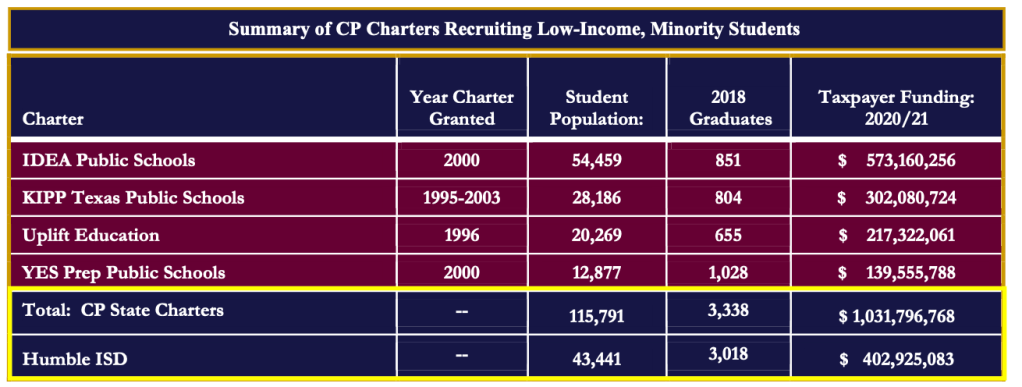
College Preparatory State Charters Targeting Low-Income, Minority Families: There are 4 primary State Charters in Texas that target the recruitment of low-income, minority students with the allure of a “college preparatory” education (referred to as the “CP Charters” herein). As shown in the table below, the enrollment at CP Charters is 115,791 students (which is approximately 33% of the enrollment in all State Charters) and over $1.0 billion of taxpayer funding will be provided in the current year. It is noteworthy that after 20 years, CP Charters produced 3,338 high school graduates in 2018. In comparison, Humble ISD with an enrollment of 43,441 produced a comparable number of high school graduates and it will receive $403 million of taxpayer funding this year.
CP Charter Graduates Underperform in College: Although touted as “tuition-free” college preparatory schools, 39.0% of CP Charter graduates had a GPA below 2.0 upon enrolling in a 4-year public university in 2019. In comparison, only 17.5% of school district graduates had a similarly low GPA. In addition, 27.0% of CP Charter graduates excelled with a GPA of 3.0 or above, which is about half of the 53.0% of school district graduates with a GPA of 3.0 or above.
While this general comparison of college GPA’s does not account for the difference in the student populations that are enrolled at CP Charters and school districts, it does indicate that CP Charters are not successfully closing the “achievement gap” for the low-income, minority students that are actively recruited.
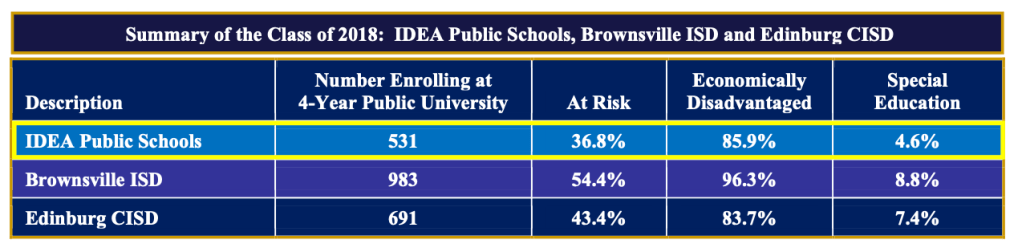
Comparison of College GPA’s – IDEA Public Schools, Brownsville ISD and Edinburg CISD: To compare the postsecondary success of CP Charter and school district graduates that serve similar student populations, a comparison of IDEA Public Schools (“IDEA”), Brownsville ISD (“BISD”) and Edinburg CISD (“ECISD”) is included below. IDEA Public Schools currently enrolls 7,972 students within BISD and ECISD and each school system had a similar percentage of economically disadvantaged graduates within the Class of 2018. For purposes of comparison, we will ignore that both BISD and ECISD had a higher number of graduates and a higher percentage of “At Risk” and “Special Education” graduates.
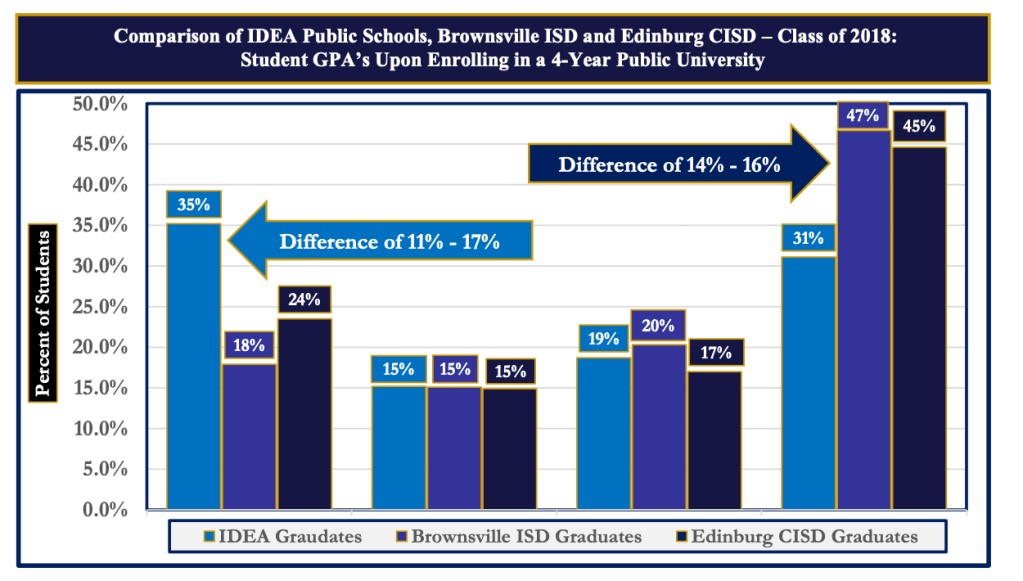
As highlighted in the graph below, the college GPA’s of BISD and ECISD graduates are similar. But despite serving a comparable student population, the GPA’s of IDEA graduates are well below BISD and ECISD graduates. For instance, 35% of IDEA graduates had a GPA below 2.0 versus only 18% of BISD graduates. In addition, the percentage of IDEA graduates that earned a GPA of 3.0 or above was 14% – 16% lower than ECISD and BISD graduates.
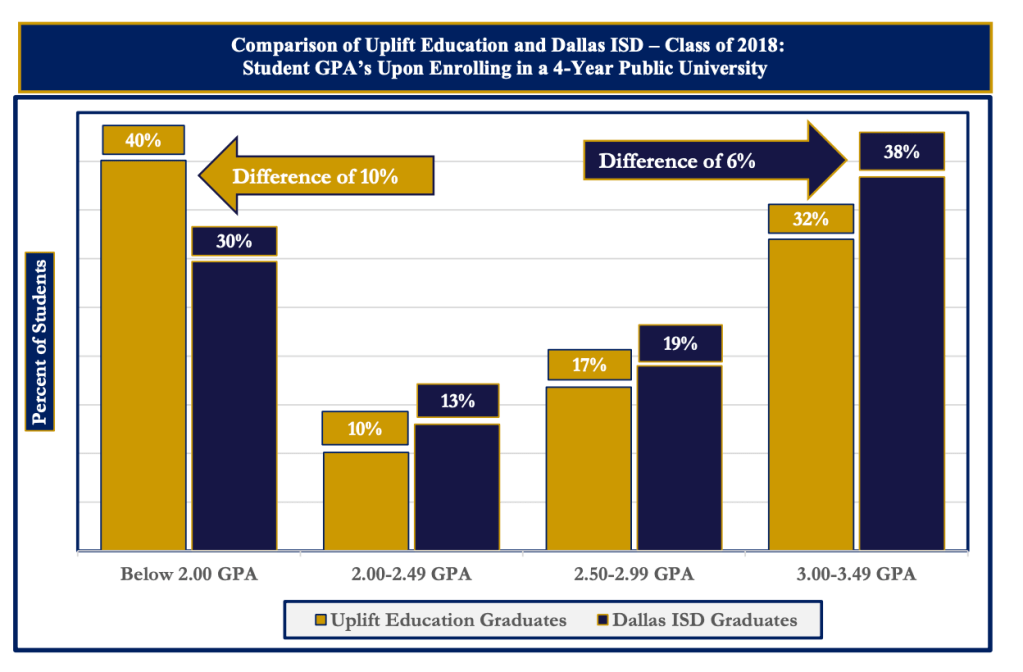
Comparison of GPA’s — KIPP Texas, YES Prep and Uplift Education: To further compare the GPA’s of CP Charter graduates to school district graduates with similar student populations, the GPA’s of KIPP Texas and YES Prep graduates are compared to Houston ISD graduates on the following page. KIPP Texas and YES Prep collectively enroll 20,957 students within Houston ISD. In addition, a comparison of the GPA’s of Uplift Education graduates and Dallas ISD graduates is included. Uplift Education currently enrolls 9,549 students within Dallas ISD.
The results of these comparisons are consistent with previous GPA comparisons, as a significantly higher percentage of KIPP Texas, YES Prep and Uplift Education graduates had a GPA below 2.0 as compared to Houston ISD/Dallas ISD graduates that enrolled in a 4- year public university. In fact, at least 40% of KIPP Texas, YES Prep and Uplift Education graduates had a GPA below 2.0 upon enrolling in a 4-year public university in 2019. Furthermore, the percentage of KIPP Texas and YES Prep graduates that earned a GPA of 3.0 or higher was equal to about half of the Houston ISD graduates that obtained a comparable GPA.
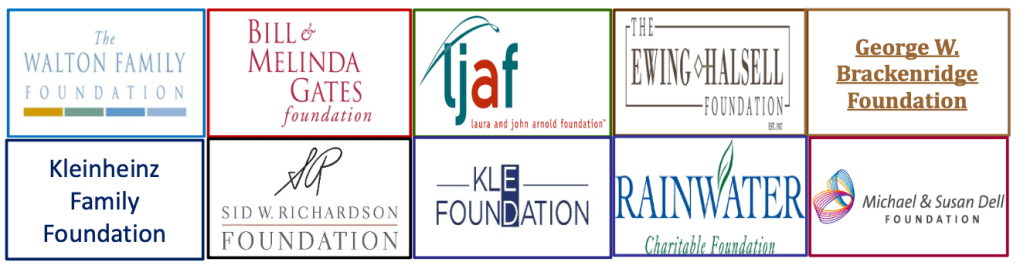
Common Attributes of CP Charters: With the strikingly similar low postsecondary performance of CP Charter graduates relative to school district graduates, there are numerous other commonalities among CP Charters that may be contributing to these results as discussed below. Funded and Directed by Special Interests: Every CP Charter has received millions of dollars from private foundations to expand in local communities. A few of the private foundations that are financially supporting CP Charters is included below. To maintain ongoing influence on public education in local communities and to oversee their financial investments, it is common for trustees of private foundations to be appointed to the governing boards of CP Charters. For example, Ms. Victoria Rico, Chairwomen of the George W. Brackenridge Foundation, has served on the Board of IDEA Public Schools and Ms. Carrie Walton Penner, a Board member of The Walton Family Foundation, serves on the Board of KIPP.
Expenditure Model: Prior studies have indicated that higher funding for student educational programs improves student outcomes. But each CP Charter deploys a conflicting “expenditure model” that devotes fewer dollars for student programs/services. In comparison to the state average of all public schools, CP Charters allocate up to $928 less per student for student “Instruction/Instructional Resources”, while allocating as much as $1,014 more per student for “Administration/Leadership” costs as summarized in the table below.
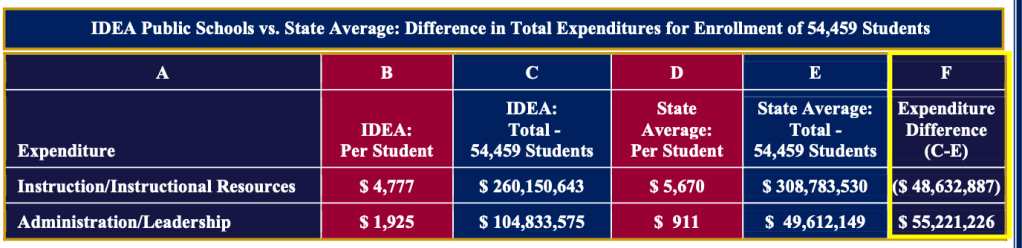
To illustrate the magnitude of the difference in the expenditures that CP Charters deploy to serve primarily low-income and minority families, the table below compares the “Instruction/Instructional Resources” and “Administration/Leadership” expenditures of IDEA Public Schools to the state average. Based upon the enrollment of 54,459 students, IDEA annually devotes $48.6 million less for student “Instruction/Instructional Resources” than the average public school in Texas and $55.2 million more for “Administration/Leadership”. To put it another way, if the 54,459 IDEA students were enrolled in a school district, an additional $48.6 million would be annually directed to support the instructional needs of students from low-income homes and $55.2 million fewer taxpayer dollars would be siphoned to pay the administrative costs of the private organizations within the State’s separate system of State Charters.
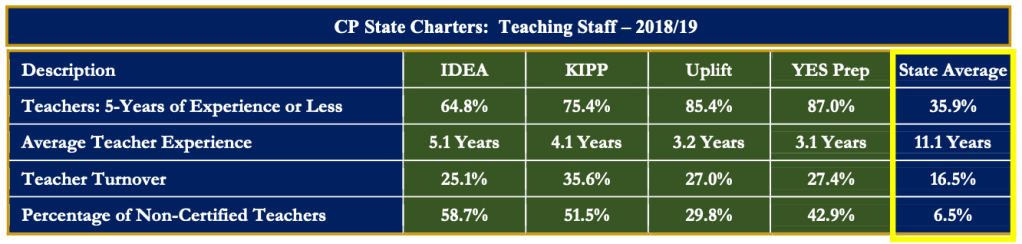
Teacher Staffing Model: There have been multiple studies concluding that teachers with more experience and lower teacher turnover improve student achievement. This includes information published by “tpier-Texas Education Reports” that is co-managed by the Texas Education Agency (“TEA”). According to “tpeir-Texas Education Reports”, teachers with 1-3 years of experience have 6% fewer students that pass the State of Texas Assessment of Academic Readiness” (“STAAR”) test than teachers with 10 years of experience. Despite these findings, CP Charters impose an unorthodox approach that does not value teacher experience, teacher certifications, or teacher persistence. As demonstrated in the table below, as much as 87% of the teaching staffs at CP Charters have fewer than 5 years of experience, and in some cases, almost 60% of teachers are “non-certified”. In addition, with an annual teacher turnover rate of over 25% – 35%, the ability of CP Charters to implement consistent instructional practices and develop long-term, nurturing relationships with students is diminished relative to school districts.
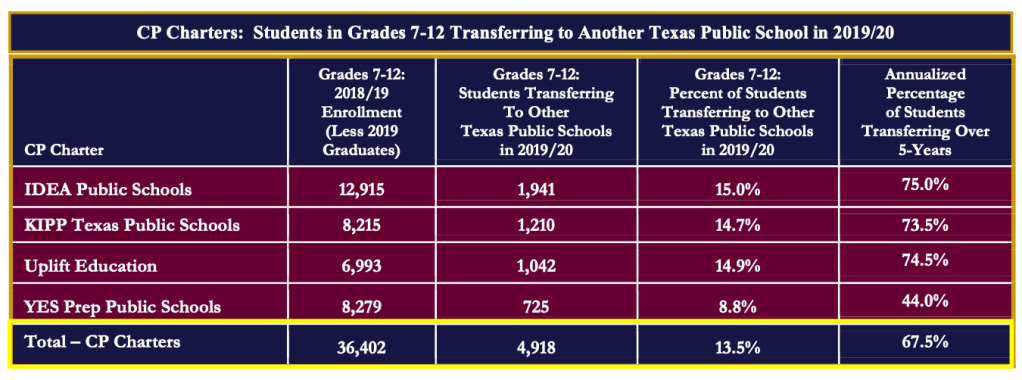
Families Transfer from CP Charters to Another Texas Public School at High Rates: CP Charters recruit new families by marketing the perception that students will be enrolled in a prestigious and nationally acclaimed, tuition-free private school. But upon acceptance and witnessing the educational experience offered by CP Charters, 13.5% of the student enrolled in CP Charters in grades 7-12 transferred to another Texas public school in 2019/20. Comparatively, the student transfer rate at Brownsville ISD and Edinburg CISD that have been bombarded with the expansion of State Charters is 6.1% and 5.8%, respectively. This revolving door means that up to 75% of the students enrolled at a CP Charter in grade 7 are not enrolled in grade 12. This high transfer rate is concerning given the growing evidence that academic outcomes can be negatively impacted as students change schools.
If a restaurant or local business were required to replace 75% of its customers every 5-years, it would likely indicate a flawed business model and the restaurant or local business would be forced to close. But the business model of CP Charters anticipates the loss of students. Which is why CP Charters devote millions of dollars each year to develop a “wait list” of new families to replace those that transfer to another Texas public school each year.
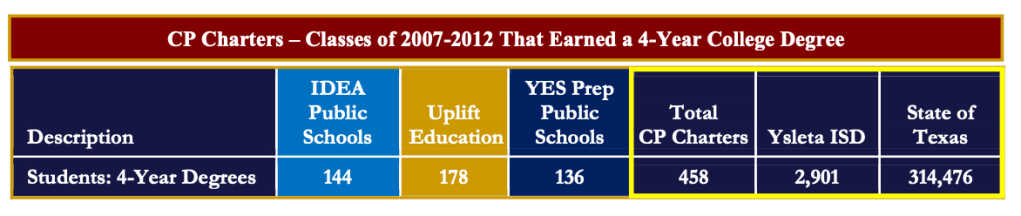
Limited CP Charter Graduates Have Earned a 4-Year College Degree: While each CP Charter has been operating in Texas for at least 20-years, the number of graduates that have earned a 4-year college degree remains very limited. According to “tpeir – Texas Education Reports”, the table below summarizes the number of graduates from the Classes of 2007-2012 at IDEA Public Schools, Uplift Education, and YES Prep Public Schools that earned a 4-year college degree by 2018 (i.e. 6 or more years after high school graduation). It is noted that KIPP Texas was excluded from the table as only 13 graduates were shown to have earned a 4-year college degree and that appeared to be potentially misleading. From the 6 graduating classes in years 2007 – 2012, a total of 458 CP Charter graduates earned a 4-year college degree. For perspective, the number of CP Charter college graduates represents 0.0014% of the total graduates within the State of Texas that earned a 4-year college degree during this time and the number of CP Charter college graduates is 6.3X lower than Ysleta ISD in El Paso.
The point is not to criticize the number of CP Charter graduates that have earned 4-year college degrees. Rather, it is to highlight that the State continues to permit CP Charters to rapidly expand and recruit additional low-income families, despite the limited evidence that CP Charters are adequately preparing students to be successful in college.
Conclusion: In our public schools, students are taught to use the “scientific method” to analyze and answer questions. In this regard, students perform extensive research, formulate a hypothesis, conduct an experiment to test the hypothesis, analyze the data, and draw an evidence-based conclusion.
However, to establish public education policies the Texas Legislature does not rely upon research to form its hypothesis that privately managed State Charters will produce better student outcomes than locally governed school districts. For the last 25 years, the State has conducted a $25 billion taxpayer funded experiment to test its hypothesis about State Charters. The data produced by the State’s experiment documents that State Charters have consistently produced lower student outcomes than school districts as measured by the State’s own academic metrics. These metrics include results of the STAAR test, district and campus academic ratings, graduation rates, financial standards, etc. The difference in the postsecondary outcomes of State Charter and school district graduates referenced herein is further evidence.
So why does the State ignore the facts of its privatization experiment and continue to support the rapid expansion of State Charters in local communities? To answer that question, I conducted my research, formed a hypothesis, analyzed the facts of the experiment, and formed an evidence-based conclusion that the State’s separate system of privately managed State Charters is not about improving student outcomes for low-income and minority students. Rather, the State’s separate system of privately managed State Charters is to please the billionaire, political donors that desire to transfer the governance and taxpayer funding of public education to private organizations.
With fewer resources and a limited political profile, the initial recruitment of low-income and minority families provided the path of least resistance to establish the State’s separate system of privately managed State Charters. With the State approving more and more State Charter expansions in suburban school districts such as, Conroe ISD, Frisco ISD, Hays CISD, New Braunfels ISD, Prosper ISD, Round Rock ISD, Sherman ISD, and Whitewright ISD to name a few, the next phase of the State’s efforts to privatize public education is well underway.
It is your students, your children, your grandchildren, your tax dollars, and your community. It is time for the State to serve students with the basic principles that our taught in our public schools: honesty, integrity, morality, equality, and the scientific method.
DISCLOSURES: This material solely reflects the opinions of the author and the author has not been compensated in any manner for the preparation of this material. The author is a voluntary advocate for public education. The material herein is based upon various sources, including but not limited to, the Texas Education Agency, Texas Academic Performance Reports, Public Education Information Management System, tpeir-Texas Education Reports, The Texas Higher Education Coordinating Board, and other publicly available information. While the author believes these sources to be reliable, the author has not independently verified the information. All readers are encouraged to complete their own review of the State’s separate system of privately managed charter schools in Texas, including the material referenced herein and make their own independent conclusions.
The National Center for the Study of Privatization in Education at Teachers College, Columbia University, recently released a major study of segregation and charter schools by Dr. Helen Ladd and Muvzana Turaeva of Duke University.
Dr. Samuel Abrams introduced it here.
The issue of school choice and segregation has been central to education policy debates for decades. In his initial argument for vouchers, published in 1955, Milton Friedman conceded that segregationists stood to employ vouchers to enroll their children in all-white private schools instead of public schools mandated to integrate a year earlier by Brown v. Board of Education. But to Friedman, the answer was not regulation but moral suasion. Friedman’s opinion was rendered technically moot in 1976 by Runyon v. McCrary, which barred private schools from making admissions decisions based on race, yet it nevertheless indicated a fundamental problem with systems of school choice.
With the introduction of charter schools in the early 1990s, commentators raised concerns about school location, inadequate transportation, contracts mandating significant parental involvement, and shared parental proclivities as implicit mechanisms or pathways to segregation. In “Parental Preferences for Charter Schools in North Carolina: Implications for Racial Segregation and Isolation,” Helen F. Ladd and Mavzuna Turaeva add substantially to the literature validating these concerns.
Using data for the nearly 11,000 North Carolina families who transferred their children from traditional public schools to charter schools in 2015-16, Ladd and Turaeva document that the migration of white, though not minority, switchers from traditional public schools to charter schools increased segregation. “We find that by switching to charter schools that are whiter than the traditional public schools they leave behind,” they write, “white switchers contribute to racial segregation across schools.” At the elementary level, 67 percent of white switchers enrolled in charter schools with lower shares of minority students; at the middle-school level, 72 percent of white switchers did so.
To buttress their analysis, Ladd and Turaeva employ a conditional logit model to estimate revealed preferences. To infer parental preferences by race as well as socioeconomic status, Ladd and Turaeva use five criteria to define the value of charter schools for parents: racial composition; proximity; academic achievement; availability of transportation and lunch; and mission. Ladd and Turaeva conclude that with these dimensions considered together, it is clear that white parents disproportionately favored white charter schools and exhibited a pronounced aversion to significantly minority charter schools.
With this working paper, Ladd, a professor emerita of public policy and economics at Duke University, and Turaeva, a doctoral candidate in public policy (with a specialization in economics) at Duke as well as a research associate at the Duke Center for Analysis of Longitudinal Data in Education Research, build on research Ladd did with Charles Clotfelter and John Holbein for an article published by Education Finance and Policy in 2017 on growing segregation across the charter sector in North Carolina from 1999 to 2012. In addition, Ladd and Turaeva’s analysis complements a 2019 NCSPE working paper on charter schools in Kansas City by Patrick Denice, Michael DeArmond, and Matthew Carr, who found a disproportionate number of white students transferring from traditional public schools to new charter schools from 2011 to 2015.
Lucid, rigorous, and supported with eight tables of telling data, this study advances our understanding of school choice and raises important questions about how choice systems should be designed.






 Diane Ravitch's blog