Archives for category: Charter Schools

Dr. Allison Neitzel writes a blog called “MisinformationKills,” where she exposes charlatans promoting fake cures for COVID. I recommend that you follow her blog. She knows who the fakers and grifters are and calls them out.

She recently discovered that Dark Money was deeply invested in the privatization of education. She posted this link on Twitter and wrote the following commentary on her blog.

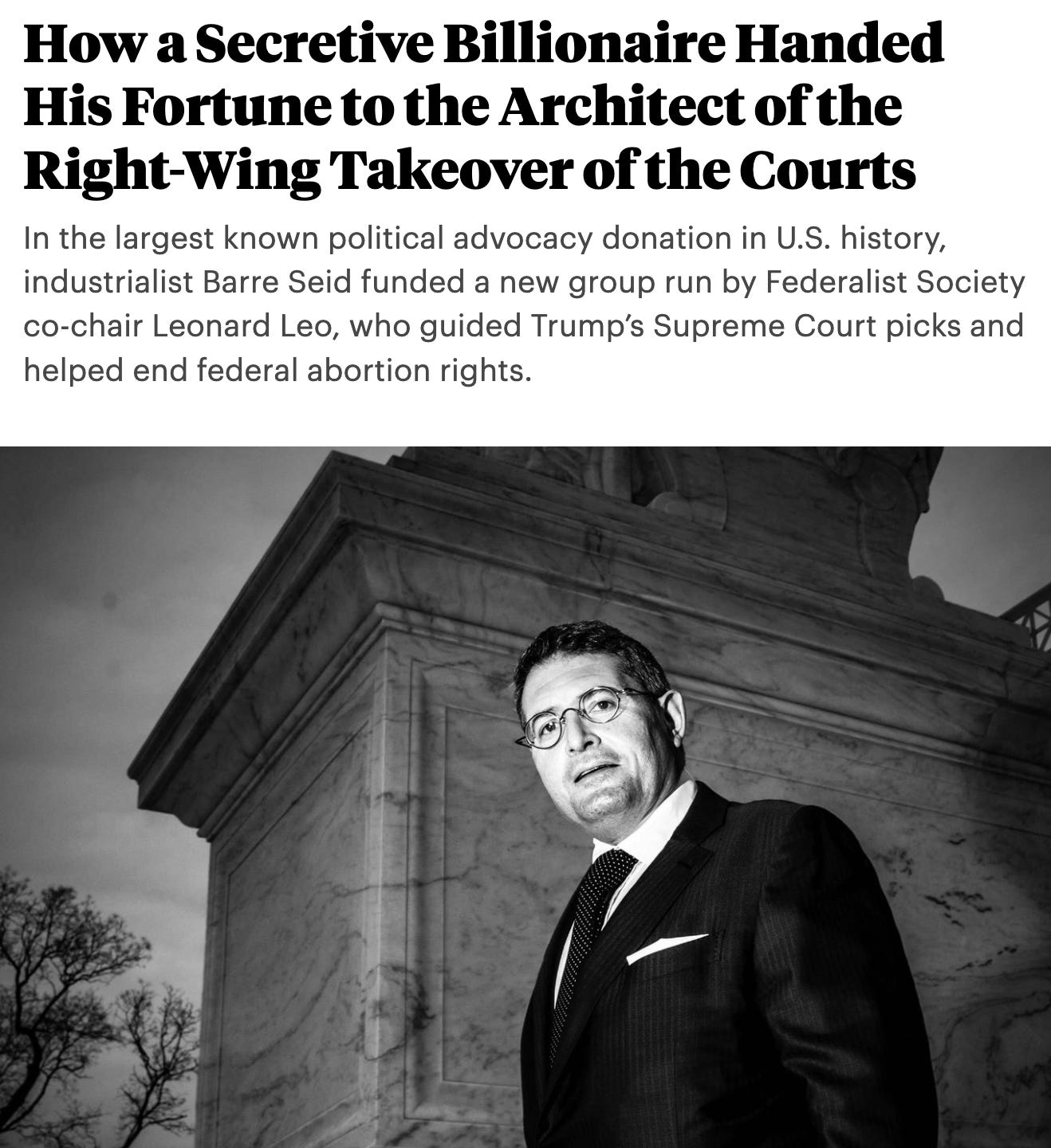
Leonard Leo, the former VP of the Federalist Society and current member of the Council for National Policy, was recently outed for his funneling of dark money to a conservative parents group fighting the “woke-ification” of the US school system. While such groups need their “concerned parents” to voice their messages, groups like this do not hold the political power they think they do. They are granted the illusion of grassroots power that actually comes from the astroturfing campaigns of the shadowy, far-right Council for National Policy. These parents are lower level marks recruited into a GOP multi-level marketing scheme that benefits from counting Trump’s Secretary of Education Betsy DeVos’s parents of Amway wealth as CNP members.

Like his CNP colleague Charles Koch, Leo has been active in covertly controlling our government for some time. He was instrumental in the halting of Obama’s appointment of Merrick Garland to the Supreme Court where his old friend Clarence Thomas serves as an extremely controversial justice on a rogue court. The organizing efforts of the CNP and Federalist Society since the late 70s/early 80s were successful in overturning Roe v. Wade, despite the majority of the nation supporting abortion.
MisinformationKills’s Newsletter

Roe overturned in win for Council for National Policy

The Supreme Court of the United States voted today to overturn Roe v. Wade. This was a long time coming thanks to “most pro-life president ever” Donald J. Trump’s digital strategist Steve Bannon’s political efforts and influence. Source: Slate Bannon is a former member of the Council for National Policy, part of a shady network of Christian extremist pol…

The CNP brought us the fall of Roe as well as the rise of America’s Frontline Doctors. Ginni Thomas, Clarence’s QAnon wife, served as CNP Action Committee Chair when the pro-Trump, pro-hydroxychloroquine group was created in concert with the Tea Party Patriots for Dr. Simone Gold. The future insurrectionist’s organization appears to have been staffed by the existing far-right American Association of Physicians & Surgeons. Gold, now being sued for embezzling AFLDS’s dirty money, has shown herself to be completely corrupted by proximity to this powerful network. Without her MD or her JD, Gold’s quest for self-importance could have easily led her to Moms for Liberty. She’s now a member of the CNP, naturally.

Gold’s anti-vax movement ties into a larger GOP anti-science movement that includes anti-abortion (for the Christians) and anti-climate science (for the Kochs). Beyond that it is part of a larger anti-truth, anti-regulation movement for an attempted Christo-fascism takeover of the country by the GOP overlords at the CNP. To keep a propaganda machine like this going, they must continue to recruit talent and make sure younger generations don’t wise up to what they are doing. While New Jersey starts implementing media literacy in their curriculums, less progressive states like Florida are banning books and waging war on the culture of the American classroom. Trump’s 2024 CNP heir apparent Ron DeSantis has an AFLDS member as his Florida Surgeon General and has recruited more talent from the existing Koch Network for his own public health “accountability” committee. This is not coincidence.

The CNP has made power grabs for control of the courts, public health, media, and now the classroom. They won’t stop until they have complete control over the American people and our way of life. This is not small government, but rather silent large government. Unfortunately for the CNP ideologue oligarchs, younger generations – including those in medicine – are paying attention and forming real grassroots opposition. Fighting this network requires understanding of the inter-connectedness of their various efforts to take down the many pillars that uphold this decades old house of cards. It requires educating the public about the CNP’s forty year reign and the risk in allowing it to continue. Somewhere in those banned history books are the stories of empires that have fallen before them.

It is time to wake up from our postmodern nightmare of never-ending information warfare, epistemological conflicts/divides, incoherent narratives, and existential despair. We must embrace the hard realities of our complicated and complex world to stop falling prey to the comfort and convenience of simplicity. First and foremost, we need to dispel the myth that an individual can survive independently without responsibilities to others or in a world devoid of trust. It is simple to believe that a person’s success is theirs and theirs alone or even simpler to blame their failures on the distrusted others.

Unlike their attempted coup on January 6th, 2021, this revolution does not require violence – just education, some of that Trump sunlight on the issues, active citizenship, and a great deal of spine from our many American institutions under attack.

Crain’s New York reported that New York City’s high-flying super-wealthy high-test-scoring Succes Academy charter chain bought up 11 plots in Jamaica, Querns, for $30 million as part of its expansion plans.

The charter chain previously bought property in the South Bronx for $105 million, to build a K-12 school.

Leonie Haimson, executive director of Class Size Matters wrote about these purchases:

Class Size Matters issued reports in 2019 and 2021 that showed the following:

  • In FY 2019, DOE overspent on charter lease subsidies by over $21 million compared to their legal obligation.
  • In several cases, the charter school rents charged to DOE appeared to be greatly inflated, including in cases where the CMO owned the buildings.
  • As of FY 2023, 81 charter schools are housed in 103 buildings owned or subleased by their CMO or other affiliated organization, charging DOE about $125 million per year.
  • For at least 34 of these schools in 39 buildings, DOE is paying entire cost of the lease rather than per pupil amount, totaling nearly $43 million in FY 2023 – and in these cases, it is unclear if the rent charged to DOE is inflated or assessed at fair market value.
  • More than a year ago, March 15, 2022, Senator John Liu, Senator Robert Jackson and CM Rita Joseph, sent a letter to NYC Comptroller Brad Lander asking him to audit the issue of charter rent as well as millions of dollars in missing matching funds for facility enhancements, supposed to be provided to public schools co-located with charters as required by law. Yet to our knowledge, no such audit has yet happened.


The issues mentioned below re New Markets Credits for charter school land acquisition and construction is another issue that the Comptroller should look into. I see New Markets Credits were used to convert a theater into the Brownsville Ascend Charter School Middle School as explained here.


We have a charter schools briefing here, that we’d be happy to provide to any CEC or other parent organization.We also drafted a charter resolution in opposition to raising the cap and for amending the charter law in many ways, including eliminating the obligation that DOE pay for charter rent or provide them with space in a public school, the only district in the country with this onerous obligation, as well as touching on many other issues.

Noah Gotbaum, a community activist, responded to Leonie’s post. He cited another article in Crain’s about a 70,000 square foot lease for Brooklyn Prospect Charter School,

…showing that the City’s obligation to pay rent for Charters with taxpayer dollars has become a boondoggle for private investors. “Investor appetite for charter school development has also grown, due to the long-term nature of their occupancy,” he added, citing the length of Brooklyn Prospect’s lease. Re Success, I wouldn’t be surprised if they are structuring the land purchase as a private investment, so beyond using city rent dollars to pay its private investors a healthy return, Success likely is also selling the New Markets’ Tax Credits to make even more money for its friends. Also could be getting the State on the hook to float tax exempt bond funding to pay for the construction. All while paying Eva Moskowitz over a million dollars a year through various different entities. Nice work if you can get it.

Under legislation endorsed today by the Republican supermajority in the Florida legislature, the state will underwrite vouchers for every student in the state, regardless of income. Students in private schools, students who never attended public schools will get a subsidy from the state.

TALLAHASSEE — The Florida Senate gave final approval Thursday to a bill creating universal school vouchers, and sent it to Gov. Ron DeSantis for his expected approval.


The Senate voted 26-12 along party lines to approve the bill (HB 1).


Republican state lawmakers, who hold a supermajority in the Legislature, want to open state voucher programs that currently provide scholarships to more than 252,000 children with disabilities or from low-income families to all of the 2.9 million school-age children in Florida, with an estimated cost ranging from $210 million to $4 billion in the first year.


Senate President Kathleen Passidomo, R-Naples called it “one of the most transformative bills the Legislature has ever dealt with….”

But opponents raised concerns about sweeping money out of the public school system and subsidizing private education, in some cases for children of wealthy parents.

“There is no money following the child like we hear over and over again because they were never in public school,” said Sen. Tracie Davis, D-Jacksonville. “You can’t ever follow something that was never in public school.”

Private schools don’t follow the same academic standards as public schools and can set their own curriculum, they said, pointing out that they could be teaching neo-Nazism and the state couldn’t do anything to stop them.

Nor do they have to meet the same safety requirements as charter and public schools must do.

The state does not generally regulate private schools, so there are no requirements that teachers have college degrees or for standardized testing to grade the quality of the schools.

Private schools also don’t have to follow the same safety requirements as charter and public schools.
Democrats also objected to taxpayer dollars being sent to religious schools. About three out of four schools that receive vouchers are religious in nature.

“House Bill 1 further erodes the separation of church and state. Taxpayers are paying for Floridians to discriminate,” the League of Women Voters of Florida tweeted.

The New York Times dug into financial records of a new group lobbying in support of Governor Kathy Hochul’s proposed $33 billion budget. The group is called American Opportunity. It’s biggest funder is billionaire Michael Bloomberg. Its biggest goals: no new taxes on the rich and more charter schools.

The slick campaign-style ads have been running on repeat during telecasts of “Jeopardy!” and March Madness basketball. They trumpet, at great expense, the agenda of New York’s governor, Kathy Hochul. And at the end of each, a tiny message says they are paid for by a vanilla-sounding group, American Opportunity.

But beneath a maze of shell groups and indirection, the real source of most of the funding for the mysterious new multimillion-dollar campaign to shape the state’s gargantuan budget is a familiar billionaire who once ran New York City and had all but disappeared from state politics: Michael R. Bloomberg.

The emerging alliance between Mr. Bloomberg, a business leader and three-term mayor, and Ms. Hochul, a Buffalo Democrat still struggling to forge a connection with New York voters, could be as significant as it is unforeseen. Though he has become one of the Democrats’ most prolific donors nationally, Mr. Bloomberg did not open his wallet for Ms. Hochul’s 2022 campaign, and sat out some of the state’s most pressing recent policy disputes.

Now, he has given $5 million in seed money to help fund a blitz of television advertising, social media influence campaigns and rounds of mailers targeting individual lawmakers as they grapple with Ms. Hochul over the shape of the budget, according to two people briefed on his giving. Two more people, who also insisted on anonymity, confirmed the gift but not the amount.

Cecily Riesenberg, a teacher at Caprock High School in Amarillo, Texas, wrote an opinion article for the Amarillo Globe-News. She explained why vouchers will benefit the most affluent families and offer low-quality schools to most other students.

She wrote:

Both sides of the aisle agree that education needs reform. At first glance, vouchers seem like a great solution. Who wouldn’t think that parents should have “freedom,” and “choices,” and that more “competition” will make the market stronger. But that simply isn’t what the data shows.

Data shows that vouchers benefit the wealthy who need it the least, hurt the disadvantaged the most, abuse taxpayer dollars, and erase the separation between church and state. Vouchers act like a discount for wealthy students already in private schools. Picture a country club that won’t allow any new members, but now their current members get to use taxpayer money to subsidize part of their dues. Not only is everyone else stuck at the public pool, but now we’re all paying for a few people to go to the country club, and we have less money to maintain or upgrade the public pool. That’s how vouchers work in the states that have them.

There are three kinds of private schools. The first type are elite, exclusive, “country-club” schools that don’t want or need more students and won’t accept vouchers at all. These schools are able to stay elite because of their exclusivity. Then there are new private schools that pop up after states implement vouchers. New private schools don’t focus on quality education at all – they use taxpayer money to market themselves to attract more students and take more public money. After a few months, families realize these schools can’t offer what they were selling. Students withdraw, but the school keeps the money. Most of these schools close within four years, but not until after they’ve made a profit, and the students are left further behind. The third type of private schools are subprime schools that need taxpayer money just to stay afloat. These schools have a 40% failure rate.

Vouchers only offer the illusion of choice.

Many states have tried vouchers, the data shows they failed and abused public resources. Not only do charters and private schools in Arizona, Indiana, Ohio, and Louisiana, have worse educational outcomes than public schools, but when so many programs receive public money, it’s impossible to monitor where the money goes in the same way that public schools are held accountable. In Arizona, for example, an audit showed that parents were using taxpayer dollars to buy kayaks and take vacations. We can’t claim to value fiscal responsibility and support a shady cash grab for corporate charters, “service providers,” and bank fees.

Rural areas will be harmed the most by vouchers, because there aren’t enough students to make opening new schools profitable. But rural public schools would still lose enrollment and funding as some parents use vouchers for homeschooling or online schooling. Again, the quality of these options is almost always lower than public schools.

Lieutenant Governor Dan Patrick and Governor Abbott are always ready to listen to their wealthy donors and the corporations that are lined up like vultures to make a buck. Recently, Governor Abbott has been on a whirlwind tour of private Christian schools to sell his agenda. He even came to Amarillo on March 2nd to speak at San Jacinto Christian Academy, a tiny school that serves less than 400 students. But the governor refused an invitation to tour Amarillo ISD public schools and listen to the tens of thousands of teachers, students, and parents who would be harmed by vouchers. Even if San Jacinto offered a world-class education, they would never have the capacity to serve a significant number of Amarillo’s students.

There are answers on how to actually reform education. We can follow the lead of countries like Finland that consistently rank high on international measures of reading and math skills. Finland doesn’t have vouchers. They don’t even have private schools. There, every school is public and wellfunded. Every student can get a quality education from their neighborhood school, and every student has an equal opportunity to achieve. Finland attracts the best and brightest to the teaching profession by requiring a masters degree and paying them as much as doctors or lawyers. Finnish teachers are empowered, respected, and trusted – essentially the opposite of how teachers are treated in Texas.

Imagine Texas as a state that consistently ranks higher in education than other states and countries, where students excel academically and socially, and find fulfilling careers post-graduation. We can get there, but it will not be by following Governor Abbott’s orders. The governor’s orders will only lead to the wealthy donor class pocketing taxpayer money while the average student falls further behind.

We know what works. So why don’t politicians want to do it? Simple – it’s impossible to monetize and profit from this approach the way they can with vouchers.

Reach out to your state senators and representatives to let them know that public schools are the bedrock of our communities. We need to make them stronger instead of tearing them down and selling them for parts.

The right to public education is enshrined in our constitution. We have to guarantee that right to every child, regardless of race, income, or zip code, and the best way to do that is by fully funding public schools.

Carol Burris, executive director of the Network for Public Education, asks you to show your support for #AbbottElementary, the delightful weekly show that favorably portrays the real life of teachers, students, and public schools. The show was written, produced by, and stars the amazingly talented @QuintaBrunson.

Carol writes:

ABC’s award-winning sitcom Abbott Elementary is the story of a wonderful group of teachers who stick with a challenging Philadelphia public school because they love teaching and kids. In recent episodes, it has been critical of the effects of charter schools.

It seems hard to believe it, but “Ed Reformers” are attacking its creator, Quinta Brunson, on Twitter.

Please stand up for Abbott Elementary & Ms Brunson by copying and tweeting the Tweets below. The show and its producers need to know you stand for truth-telling and for public schools.

Thank you @AbbottElemABC & @quintabrunson for yr amazing show that dares to tell truth abt how charters hurt public schools. Love the show. Keep up the great work! I love #AbbottElementary https://abc.com/shows/abbott-elementary

How small @JeanneAllen & @edreform look trying to suppress @AbbottElemABC from criticizing the charter system by lying about @quintabrunson. https://www.yahoo.com/entertainment/quinta-brunson-shuts-down-critic-151809283.html I love #AbbottElementary

When @AbbottElemABC critiques Pa billionaire trying to undermine public schools w/charters, @edreform goes on the attack. Pathetic to go after a beloved show & its beloved creator/star @quintabrunson. Gotta say it. I love #AbbottElementary. https://abc.com/shows/abbott-elementary

You can read about the show’s critique of charters here and the Jeanne Allen controversy here including the Tweets in which Brunson pushes back.

Thanks for all you do,Image

Carol Burris

Network for Public Education

Executive Director

Quinton Brunson is the writer, producer and star of the award-winning TV series “Abbott Elementary.” Abbott Elementary is a comedy about an urban elementary school, realistically depicting life in a Philadelphia public school. It is a funny, joyful celebration of life in public schools and a song of praise to public school teachers. No matter how silly they are at times, they are heroes!

In season 2, the show turned to the topic of charter schools, because a big charter chain wants to take over Abbott. The staff is mortified. The staff lays bare the unfair practices of the charter school (e.g. pushing out kids they don’t want), and the series lays bare how underfunded Abbott is (in contrast to the charter school, which is equipped with the best of everything).

Jeanne Allen, founder and chief executive officer of the Center for Education Reform, lashed out on Twitter against Quinta Brunson for her negative portrayal of charters when Quinta had gone to charter schools “her entire education” in Philadelphia and had previously praised them.

Quinta responded on Twitter: “you’re wrong and bad at research. I only attended a charter for high school. My public elementary school was transitioned to charter over a decade after I left. I did love my high school. That school is now defunct- which happens to charters often.”

She immediately added: “Loving something doesn’t mean it can’t be critiqued. Thanks for watching the show :)” (Her quotes appear in the article linked above.)

Hundreds of tweets from Quinta’s passionate followers excoriated Allen, supported Quinta and defended her right to say whatever she wanted.

At one point, Jeanne Allen gratuitously claimed “Money talks,” implying that Quinta was paid off by someone to criticize charter schools. On these pages, it’s not surprising to hear a charter lobbyist jeer that critics must have been paid off by the teachers’ unions. But Allen didn’t spell it out, possibly because it was so preposterous on its face.

Quinta’s fans jumped all over the ”she was bought” idea; one said that this Allen person, with not quite 8,000 followers, must be “clout catching”—that is—trying to grab attention by attacking a celebrity—by going after the great Quinta Brunson, who has more 800,000 followers.

It is more than funny reading Jeanne Allen chastise the brilliant, creative Quinta Brunson for taking aim at charter schools because “money talks.” The Center for Education Reform is handsomely funded by conservative billionaires like the Walton Foundation and Jeffrey Yass, as well as billionaire Wall Street charter suporters. Yes indeed, money talks.

The Center for Education Reform serves the goal of right-wing billionaires like Jeff Yass to destroy public education, even though he is a graduate of New York City public schools. Yass funds election deniers and candidates who want to ban critical race theory in the schools. The school-choice lobby says they are deeply devoted to children of color, yet the heavy hitters are funding the candidates and astroturf parent groups that want to ban teaching Black history. Hypocrites!

Since Jeanne is so concerned about hypocrisy, she might ask Jeff Yass why he wants to destroy the very schools that educated him. Why doesn’t he endow state-of-the-art public schools in New York City and Philadelphia to show his gratitude? The great singer Tony Bennett endowed the Frank Sinatra School of the Arts, why not a Jeffrey Yass High School for Financial Success and Ethics?

This contretemps has not worked in favor of the charter lobby. Attacking a beloved TV star is a bad idea. Even TIME magazine used the controversy to explain the shortcomings of charter schools.

For teachers around the U.S., charter schools are a constant concern, beyond an episode of television. They find relief, both comic and real, in Abbott—as well as tangible education and information.

“There’s this myth that charter schools provide more opportunity or their graduation rates are better, but that’s just because they exclude kids,” says Brooklyn public school teacher Frank Marino, who formerly worked at a charter school. Watching Abbott “felt so cathartic, because I was like, yes, it was a public platform where those myths are being busted by parents….”

Abbott Elementary has brought Kathryn Vaughn, an art teacher at a public school in Tennessee, and her husband back to appointment viewing TV like it’s the ‘90s. Vaughn loves the show, but says she was surprised to see it tackle charter schools, a $49.5 billion industry with heavy political sway. She appreciated how the most recent episode hands the power to the parents….

In many states, public schools are mandated to have arts education in each building, and tenure in the arts for someone like Vaughn is possible. Charter schools, however, have more leeway: Some, like Addington Elementary in Abbott, can choose to bring in an art teacher a couple of days a week, often subcontracted out from a company.

“Charter schools make me incredibly uneasy,” Vaughn says. “They don’t have to offer their employees tenure. They don’t have to hire certified staff to teach. So if you’re sending your child to a charter school expecting a great arts education, you might not even be taught by certified staff.”

Abbott Elementary is set in West Philadelphia and Vaughn’s school is in western Tennessee, but no matter where you are in public education right now, she says, you know: the push for privatization is huge.

“That’s really the big connection between urban poor and rural poor, like I’m in, is the funding,” Vaughn says. “Urban schools almost are a little sexier. They get more of the money than us in the rural, poor areas. But we’re all behind where we should be with funding.”

A few episodes ago, at the fictional Pennsylvania Educational Conference for the South East Area (PECSA), Jacob (Chris Perfetti)—a well-meaning history teacher—is hanging out with a group of teachers from Addington Elementary. One of them, Summer (Carolyn Gilroy), tries to convince him to switch schools, telling him, “We’re all about focusing on the kids who have the best chance of making it out.”

“Out?” Jacob asks. “Out of what?”

The scene hit home for Marjahn Finlayson, a climate change educator, researcher, and activist who previously worked at a charter high school in Hartford, Connecticut. While teachers there often took a personal interest in their work, she says, there was little trust in the community.

“In the PECSA conference episode, Addington teachers are talking to Jacob about, like, ‘Oh, we take the best kids, and we try to get them out of the ‘hood,’” Finlayson says. “And Jacob is like, ‘Why are you taking them out?’ That was how the feeling was for me.”

Finlayson noticed disparities in resources between public and charter schools, regardless of the quality and dedication of teachers.

“That’s why it’s easier for these schools like Legendary Schools to get into an inner city space, like where Abbott is, where Hartford is,” she says. “It’s easy to prey on these communities that have a need, based on the fact that public school funding isn’t going to this space, but it’s going to another.”

One of Abbott’s arguments against charter schools is that, as Barbara grimly puts it, “They don’t see students. They see scores.” At Finlayson’s former charter high school, one student was repeatedly pressured into applying to college, despite wanting to pursue a trade career.

“And it wasn’t even the fact that she needed to go, it was just that she had to apply,” Finlayson says. “Because, ‘We have a 100% college acceptance rate, and we’re not going to mess with that number.’”

Note to Jeanne Allen: Don’t attack a beloved celebrity. The blowback will not be good for your cause.

Jessica Winter, a staff writer at the New Yorker, wrote an article in the latest issue of the magazine describing how the hit-TV program “Abbott Elementary” is sharply critiquing the charter school movement. The show and its creator and star Quinta Brunson have won multiple awards.

It’s a terrific article.

Most of the public doesn’t know what charter schools are. Abbott Elementary tells them. Abbott artfully weighs in against the privatization of public schools.

I wish I could repost the article in full. Here are snippets:

The local and national growth of charter schools has been propped up by lavish support from a center-to-right spectrum of billionaires with various, sometimes overlapping desires, which include lower taxes, fewer and weakened teachers’ unions, state funding for religious schools, and a more entrepreneurial approach to public education. Prominent advocates include Bill Gates, Michael Bloomberg, the Walton family, Betsy DeVos, the late Eli Broad, and Jeff Yass, reportedly the richest man in Pennsylvania. When the “weird cash” episode of “Abbott Elementary” aired, viewers immediately speculated that Barbara was referring to Yass. Jeanne Allen, the director of Yass’s education foundation, was unamused, telling the Philadelphia Inquirer that the line was a “gratuitous slap against people with wealth” and tweeting, “This has TEACHERS UNION written all over it.”

Brunson is the daughter of a veteran public-school teacher in West Philadelphia, and “Abbott” doesn’t flinch from the decrepitude of the city’s education system. (For one thing, an out-of-date calendar hanging in Abbott’s main office covers up a hole in the wall that appears to be choked with asbestos.) But the show also dismantles the benevolent narrative of “escape” promulgated by the Yasses and other charter-school advocates—the notion that a public-school system cannot be raround and improved, only bled out and abandoned. “Abbott” grabs this idea around the neck in a conversation between Jacob (Chris Perfetti), who teaches history at Abbott, and Summer (Carolyn Gilroy), an Addington teacher who tries and fails to recruit Jacob to her school, where he’d be, she says, “with the brightest kids from the neighborhood,” “the cream of the crop from all over the city.” “We’re all about focussing on the kids who have the best chance of making it out,” Summer says. (“Out of what?” Jacob asks. He receives no answer.)

In this exchange, as when Addington offers a chance of “escape” to Josh and just as quickly rescinds it, “Abbott” is building a cogent, legally grounded argument against charter-school practices. According to Pennsylvania law, a charter school cannot discriminate “based on intellectual ability or athletic ability, measures of achievement or aptitude, status as a person with a disability, English language proficiency, or any other basis that would be illegal if used by a school district.” But, as Summer openly admits, these prohibitions are not reflected in charter schools’ student populations. In 2019, the Education Law Center found that Philadelphia’s district schools enrolled about five times as many students with intellectual disabilities as charters. They also enrolled twice as many autistic children and three times as many English-language learners and students experiencing homelessness. A 2016 reportby the Center for Civil Rights Remedies hypothesized that “some charter schools are artificially boosting their test scores or graduation rates by using harsh discipline to discourage lower-achieving youth from continuing to attend.”

It’s rare to get this kind of cogent, clear-eyed reporting about charter grift in a major publication.

The article made me wonder about the billionaires’ end game.

Charters for “the cream of the crop.”

Vouchers for the religious who want public money to pay tuition at a church school.

Vouchers for wealthy families to underwrite their pricey tuition.

Homeschooling for those who prefer to avoid organized schooling altogether.

What will be the role of public schools? They will serve the students whom no else wants.

What a mean, undemocratic view!

The reality is that our society needs public schools, open to all, more than ever. As our society becomes more diverse, we need more institutions where people from different backgrounds interact as equals. We need more places where diversity, equity and inclusion are functioning realities, not a goal or a scapegoat.

In 2025, Texas passed a ridiculous law stating that if a school district had even one school that was deemed to be “failing,” the state could take over the entire school district. Houston has one high school, Wheatley High School, that has persistently low test scores (and also unusually high percentages of students with special needs and other groups of high-needs students).

The State Department of Education has been trying for years to seize control of the Houston public schools. The state superintendent, appointed by callous Governor Gregg Abbott is software engineer Mike Morath, whose sole claim to educational “experience” is having served on the Dallas school board.

These Republicans do not believe in local control of schools. They believe the state should take away local control, the easier to erode democracy and advance privatization.

Ruth Kravetz, a former teacher and administrator in the Houston Independent School District, now leads an organization called Community Voices for Public Schools. She wrote an editorial in The Texas Observer (where I published my first article) denouncing the threatened takeover as “unfair, racist, and wasteful.”

As a 1956 graduate of HISD, I take this personally.

After years of wrangling and legal battles, the state took control of HISD a few days ago.

Kravetz writes:

I am a parent and teacher with Community Voices for Public Education, a Houston-based nonprofit rooted in the belief that our community schools are a public good, not a commodity to be sold off to the highest bidder. That is why we, along with many other Houstonians, have protested the attempted state takeover of Houston ISD for years—a dramatic assault on local control that may take place this week.

At a February protest, HISD student Elizabeth Rodriguez stated, “Instead of punishing us with a takeover, our schools should be better funded to make sure students have all the support we need and the facilities we deserve. We are not just test scores.”

Contrary to what you may hear from some Republican leaders, Houston Independent School District (HISD) is not a failing district. HISD received a B grade in the most recent state school ratings and is AAA bond-rated.

Why, then, is Houston ISD even under threat of a takeover?

In 2015, Texas passed a law that allows the state to take over an entire school district if even one campus is rated F in standardized test performance for five years. The state says the rationale for the takeover is Wheatley High School’s low 2019 accountability rating and problems with the HISD school board. Since 2019, when the takeover bid began, Houston ISD had successfully delayed Texas’ efforts, but the GOP-controlled state Supreme Court cleared the state’s legal path in January.

In the past few years, HISD already proved that local control works: Since 2019, voters elected an almost entirely new school board, and students and teachers worked to bring Wheatley’s state score up to a C in 2022. Since 2015, HISD reduced its number of low-performing schools from 58 to nine, which is fewer than are found in Dallas ISD. Even using the state’s deeply flawed accountability system to rate schools, Houston ISD comes out fine.

Nevertheless, the state’s takeover efforts persist. If successful, a state-appointed board of managers will make all policy decisions with Texas Education Agency (TEA) Commissioner Mike Morath pulling the strings behind the scenes. HISD’s democratically elected board will only have a ceremonial role with no voting authority. And the kicker is that the unelected Morath, who’s appointed by Governor Greg Abbott, has full discretion to expand the takeover. The superintendent could also be replaced, and individual schools could be parceled off to charter school operators—such as YES, KIPP, IDEA, and churches—with the usual consequences as seen around the country.

Charter schools often purposefully underenroll students with disabilities and other at-risk children, inflating their state accountability ratings. Should this occur in Houston following a takeover, the state will likely take the credit in its accountability shell game.

A takeover may also lead to teachers leaving the district, creating more classroom vacancies. The chances for a bond to replace older elementary schools will go out the window. If other takeovers are any indication, we can also expect more of our taxpayer dollars to go to costly consultants than to the needs of children.

If all this doesn’t make you mad, how about this? Over and over again, the governor and the TEA commissioner have moved the goalposts in the middle of the game.

In 2019, Wheatley High initially received a passing grade from the TEA, but the agency later changed its scoring criteria and applied them retroactively. And in January, TEA publicly announced more rule changes that will be implemented immediately and applied retroactively to last year’s seniors, whose data is counted in this year’s accountability rating. At the high school level, schools that were projecting a B rating are now projecting a D. School districts around the state are raising the alarm about the change.

We tell our children they have to be honest and to play by the rules; we should expect the governor and TEA commissioner to do the same.

Unfortunately, the state takeover of Houston ISDhas nothing to do with student needs. It is about power, profits, and a willful disregard for children living in poverty.

As I ponder the district’s future, I am reminded of a student I once taught. When I went to his house to help him think about college, he had no electricity and the only furniture in the house was a bed, an engine block, and a chair. He did his homework by a street lamp outside. The last thing he needed was more pressure to meet arbitrary standardized testing goals or for the state to punish his school for serving low-income students like himself.

From Beaumont to New Orleans to Detroit, takeovers—which disproportionately target districts with high Black and Brown political participation—do not improve student achievement and experiences.

Please open the link to finish this excellent article.

Governor Abbott and Mike Morath don’t have any idea how to improve schools or districts. They do know how to loot them and privatize them for the benefit of their cronies and campaign donors.

Shame on you, Governor Abbott and Mike Morath!

Jeff Yass is the richest man in Pennsylvania.

Jeff Yass is a billionaire. The Bloomberg Billionaire Index says he has $33 billion.

Jeff Yass created a Wall Street firm with partners called the Susquehanna International Group.

Jeff Yass is a huge supporter of charter schools. He created the annual Yass Prize, which is administered by the anti-public school organization called “The Center for Education Reform.” CER supports every kind of choice (charters, vouchers, online charters, for-profit charters, homeschooling) while vehemently denouncing public schools. CER is opposed to any regulation or accountability of “choice” schools. CER distributes millions in prizes to charter schools, thanks to the Yass family.

ProPublica says there’s something else you don’t know about Jeff Yass.

He funds Republican candidates and election deniers.

He opposes abortion.

He funds candidates who oppose critical race theory.

His top priority is to defund public schools.

According to ProPublica:

The firm he and his friends founded, Susquehanna International Group, is a sprawling global company that makes billions of dollars. Yass and his team used their numerical expertise to make rapid-fire computer-driven trades in options and other securities, eventually becoming a giant middleman in the markets for stocks and other securities. If you have bought stock or options on an app like Robinhood or E-Trade, there’s a good chance you traded with Susquehanna without knowing it. Today, Yass, 63, is one of the richest and most powerful financiers in the country.

But one crucial aspect of his ascent to stratospheric wealth has transpired out of public view. Using the same prowess that he’s applied to race tracks and options markets, Yass has taken aim at another target: his tax bill.

There, too, the winnings have been immense: at least $1 billion in tax savings over six recent years, according to ProPublica’s analysis of a trove of IRS data. During that time, Yass paid an average federal income tax rate of just 19%, far below that of comparable Wall Street traders.

Yass has devised trading strategies that reduce his tax burden but push legal boundaries. He has repeatedly drawn IRS audits, yet has continued to test the limits. Susquehanna has often gone to court to fight the government, with one multiyear audit battle ending in a costly defeat. The firm has maintained in court filings that it complied with the law.

Yass’ low rate is particularly notable because Susquehanna, by its own description, specializes in short-term trading. Money made from such rapid trades is typically taxed at rates around 40%.

In recent years, however, Yass’ annual income has, with uncanny consistency, been made up almost entirely of income taxed at the roughly 20% rate reserved for longer-term investments.

Congress long ago tried to stamp out widely used techniques that seek to transform profits taxed at the high rate into profits taxed at the low rate. But Yass and his colleagues have managed to avoid higher taxes anyway.

The tax savings have contributed to an explosion in wealth for Yass, who has increasingly poured that fortune into candidates and causes on the political right. He has spent more than $100 million on election campaigns in recent years. The money has gone to everything from anti-tax advocacy and charter schools to campaigns against so-called critical race theory and for candidates who falsely say the 2020 election was stolen and seek to ban abortion.

Grassroots groups, led by the Working Families Party, held a protest in front of his offices to protest his funding of groups that undermine democracy.

The LittleSis Project, which tracks the connections among rightwing funders and organizations, has more information about Yass. He is the money man behind Pennsylvania’s rightwing political machine. His top priority is school privatization. He wants to dismantle public schools. Read the article.

Yass’s influence over state politics doesn’t stop after elections are over. His money gets distributed throughout the right-wing network in the state and influences legislation and the conservative agenda year round. The right-wing organizations that spend Yass’s money consistently and successfully lobby to cut corporate taxes, bust unions, block climate solutions, ban abortion, target trans youth, and prevent what the right calls “critical race theory” from being taught in schools.

The Pennsylvania Capital Star worries about what Yass is doing to our democracy.

Yass is a threat to democracy in Pennsylvania. Our organizations were in the trenches during the 2020 election organizing on the frontline against MAGA Republicans, white nationalists, and conspiracy-riddled extremists. Yass was funding them. Despite Yass trying to back away from those associations publicly and in the press, this year he quietly continued to fund those same organizations like the Club for Growth – a right-wing front group that backed nearly 50 election deniers across the country.

What a guy. Does Senator Corey Booker know? Does Senator Michael Bennett know? Does Representative Hakeem Jeffries know? Does the Center for American Progress know?

Jeff Yass’s enthusiastic support of charter schools is another reason why charter schools should not get federal funding. Why should the US Department of Education spend $440 million a year to open new charter schools (half of which never open), when Jeff Yass and his partners could easily foot the bill, along with other billionaires like the Waltons, Michael Bloomberg, Charles Koch, and Betsy DeVos?

For billionaires like Yass, that amount is pocket change. Or, as the saying goes, chump change.