Archives for category: Charter Schools

A recent Heritage report warns that parents can’t trust charter schools because so many of them are just as “woke” as public schools. Some are even more woke than public schools.

The report, written by Jay Greene, Ian Kingsbury, and Jason Bedrick, asserts that the major philanthropic foundations supporting charter schools—the Walton Family Foundation and the Gates Foundation—are also woke. This is where it gets crazy. Walton is woke? The anti-union, rightwing Waltons?

The solution the authors prefer is a fully funded voucher system, where schools are not regulated by the state and do not need money from woke philanthropies like Walton or Gates. That way, parents who are racist, homophobic, and sexist can find a school that teaches their values.

They begin:

There is a loose set of political and social values that can succinctly be labeled as “woke.” These woke values tend to be characterized by a departure from traditional American and classical-liberal values of individual responsibility and equal treatment in favor of emphasizing differentiated treatment by group identity and social rather than individual justice. Of course, there is a constituency of parents who favor an education infused with these woke values—but they tend to be a distinct minority. As past research suggests, when parents have more control over the education of their own children, that education tends to be less woke.

Given that parental empowerment is associated with less woke education, one might expect that charter schools—which are chosen by parents rather than strictly assigned based on the location of a family’s home—are less woke than nearby public schools operated by school districts. But school choice could produce more woke options if those choices are highly regulated and controlled by distant regulators and philanthropists. School districts still retain a fair amount of responsiveness to the preferences of the communities they serve given their democratic governance.

Charter schools, on the other hand, might become less responsive to the preferences of local parents if they have to please state authorizers to be established and remain open and if they are overly dependent on national philanthropies to subsidize their operations. Those charter schools may have to adopt woke values to gain permission to open from the public authorities that grant them their charter and to receive funding, especially for capital expenses, from large donors with progressive values.

Parents may nevertheless choose woke charter schools, either because they are among the minority that hold those values or because safety and quality of instruction may induce parents to select a school that is otherwise at odds with their values. By contrast, policies that permit private school choice with vouchers or K–12 education savings accounts do not require permission from an authorizer for schools to open their doors and therefore are less likely to require capital funds from donors since they often already have school buildings. That means that private schools are typically more directly accountable to parents than charter schools and so are more likely to reflect the values of the families they serve.

It is an open question whether highly constrained and regulated types of school choice, like charter schools, are actually less responsive to parental preferences regarding values than are public district schools, which are also regulated and insulated from parental control by unions and the imperfections of democratic governance.

The purpose of this Backgrounder is to examine whether, on average, charter schools embrace a woke education more strongly than do nearby public schools operated by school districts. By analyzing key words in student handbooks as a proxy for wokeness, the authors find that charter schools actually tend to be more woke than traditional district schools. The authors consider how regulatory and donor capture of charter schools could be reduced so that this type of school choice could be more responsive to parental preferences regarding the values emphasized in the education of their own children.

They conclude:

School choice should empower parents to obtain an education for their own children that is consistent with their values. That is still occurring with private school choice, but with charter school choice it is falling short. Regulatory and financial constraints need to be removed from charter schools so they can better align with the values preferences of parents. In states and localities where charter schools have not been able to be more responsive to parents, private school choice is the better path for avoiding the woke capture of school choice.

Lisa Haver is a former Philadelphia teacher. She is co-founder and coordinator of the Alliance for Philadelphia Public Schools. She warns about the absurdity of defunding the state’s public schools while expanding vouchers to subsidize students currently in private and religious schools. This article appeared in the Philadelphia Hall Monitor.

Lisa Haver writes:

Musician and entrepreneur Jay-Z last month joined the ranks of out-of-town billionaires lobbying to expand voucher programs in Pennsylvania. Representatives from his Roc Nation came to Philadelphia to push for passage of PASS (Pennsylvania Award for Student Success), legislation that would divert more tax dollars from the state’s education budget to private schools. Roc Nation representatives repeated claims by voucher supporters, including Governor Josh Shapiro and suburban billionaire Jeffrey Yass, that PASS would give the students an alternative to the city’s “failing schools.” Jay-Z’s spokespersons told reporters that after seeing students “struggling in the public education system, within the lowest performing schools, we wanted to do something to help the community.” 

Not being from around here, Jay-Z and his representatives, apparently, are not up on the history of underfunding and privatization in the city and the state and the many schemes over the years that have failed to deliver on promises for a better education and stronger communities.  They seemed unaware of how vehemently Philadelphians oppose the idea of diverting even more money from underfunded public schools to affluent private schools.

The proposed expanded voucher legislation allows for even less accountability than the state’s existing programs. Since their passage in 2001, the Education Improvement Tax Credit (EITC) and the Opportunity Scholarship Tax Credit (OSTC) have sent over $2 billion in taxpayer funds to private schools. Education Voters PA estimates that 78% of EITC and OSTC funds go to religious schools that do not have to be accredited or adhere to the same curriculum standards that public schools do. This means public money going to schools that teach creationism or that slavery wasn’t really that bad and to schools that can and do discriminate against LGBTQ students and those with special needs. School choice has always meant the schools’ choice. And a feature, not a bug, of EITC and OTSC is the absence of data. Ed Voters PA points out that Act 46, passed in 2005, “explicitly prohibits the state from collecting data about voucher programs or students” who participate in them. 

There is already conflicting information about how PASS would work, who would be eligible, and the size of the scholarships, which range from $2500 to $15,000 depending on grade and level of need. But even the maximum allowance wouldn’t cover the tuition of the exclusive private schools whose tuition ranges from $25,000 to almost $50,000. The reality is that most of the voucher money goes to families with students already in private schools, not to students transferring from public schools.  

Republican legislators and pro-school choice lobbyists maintain that distributing public funds to privately managed schools with a minimum of public oversight will help the city’s children get a better education. Where have we heard that before? 

In 1997, the state legislature passed the Pennsylvania Charter Law. Privatizing public schools, they assured us, would rescue the children trapped in failing public schools. The reality? Yearly assessments–using the framework formulated by charter operators themselves–show that Philadelphia charters rarely outperform district schools in academics. The district has spent millions in years-long legal proceedings to close substandard schools. Other charters have closed due to financial malfeasance of the schools administrators, or in the recent case of Math Science Civics, the whims of the charter CEO. The state charter law allows substandard charters to operate for years while they appeal non-renewal actions. 

Parents who had hoped to find better schools in charters are returning to their neighborhood schools, with over half of the city’s charters now under-enrolled. Since the passage of No Child Left Behind, which enabled the privatization of public schools, students have been subjected to learn-to-the-test scripted curricula, with test prep classes replacing interesting and challenging electives. Their schools have been branded as failures, and many of their neighborhoods have lost the schools that served as community anchors.

Does Jay-Z really believe that the children of Philadelphia will win in a “hunger games” approach to education? 

Last year, school districts in Pennsylvania won a significant victory when the Commonwealth Court ruled that the state must provide, as mandated in the state constitution,  a “thorough and efficient system of public education to serve the needs of the Commonwealth.” Jay-Z should join the parents, students, educators and community members urging the state legislature to pass a budget that will fund smaller class size, school libraries, and healthy school buildings–in every school in every Philadelphia neighborhood.  

Peter Greene wrote in Forbes about a bill just introduced in the House of Representatives to ban federal funding of for-profit charters. He explains how some ostensibly non-profit charters are actually managed by for-profits. Will Congress have the gumption to stop profiteering in charter world? Expect fierce opposition from the charter lobby. Bottom line: charter schools claim to be “public schools.” Public schools do not operate for profit.

He begins:

In almost every corner of the U.S., charter schools are non-profit. And yet, there are numerous ways to run a non-profit for profit.

In two reports (Chartered for Profit and Chartered for Profit II), the Network for Public Education showed numerous examples of the most common techniques. Some charters lease their buildings back from related businesses. In one New York case, a chartering organization leased a space from the diocese, then leased that space to its own charter school for over ten times the amount it was paying.

There are “sweeps” contracts, where a non-profit charter hires a for-profit management organization to handle everything, in return for nearly every dollar the charter takes in. As one EMO contract cited in the report states, it receives “as renumeration for its services an amount equal to the total revenue received” by the school “from all revenue sources.”

In many cases, a non-profit charter school simply serves as a pass through for money headed to a for-profit business.

Why be concerned? Because every dollar spent on students is a dollar that the company doesn’t get to keep. Every dollar that makes it into the classroom doesn’t make it into the company’s pocket. When profit-making businesses provide human services, there is a conflict of interest between the company and its customers.

Don’t public school districts use for-profit contractors? They do, particularly for big ticket items such as for preparation and bus service. But those contracts are overseen and approved by elected school board members who are responsible for looking after the interests of the students, not the vendors. Nor do public schools contract with vendors to conduct the main business of the school.

To address the issue of charter schools operated for a profit, United States Representative Rosa DeLauro (CT-03) and Representative Suzanne Bonamici (OR-01) this month introduced the Championing Honest and Responsible Transparency in Education Reform (CHARTER) Act. Said DeLauro,

The CHARTER Act would ensure that for-profit education management organizations can no longer jump through loopholes that have given them access to funding that has always been intended for nonprofit entities. Educating our children should be for their enrichment and future prosperity – not to maximize the profits of their owners and investors.

The bill adds to the definition of a charter school given in Section 4310 of the Elementary and Secondary Education Act. In addition to the other qualifiers already in the federal definition of a charter school, the bill would add that a charter school

does not enter into a contract with a for-profit entity, or have a charter management organization or other nonprofit entity enter into such a contract on behalf of such school, under which the for-profit entity operates, oversees, manages, or otherwise carries out the administration of such school, which may include curriculum development, budget management, and faculty management (such as hiring, terminating, or supervising school-level staff);

The bill also specifies that a charter school may contract for food, payroll, facilities maintenance, transportation services, classroom supplies or other ancillary services.

The bill then goes on to require the amended definition be used for ESEA and IDEA, thereby blocking charters that don’t meet the amended definition from receiving any federal funds.

The issue of charters operated for profit has been addressed before, when the Biden administration tightened rules governing the Charter School Program grants handed out by the federal government. Those changes required charters to be more transparent about where the money was going, and the grantee had to offer assurances that a for-profit CMO “does not exercise full or substantial control” over the school.

If the CHARTER Act gains traction in Congress, it will continue this trend of seeking greater assurance that federal dollars sent to charter schools will find their way to the classroom, and not some for-profit company’s bank account.

Steve Dyer, former legislator and perennial budget hawk, tracks wasteful spending on charter schools in Ohio in this post. Ohio is throwing away billions on charters and vouchers, at the expense of its public schools, which typically outperform its privatized schools. A pro-charter analyst concluded that Ohio’s charter schools were among the worst in the nation.

Dyer writes on his blog Tenth Period:

It’s difficult to say that a $1.3 billion state program can go under the radar, but lately it seems that Ohio’s charter school industry has done just that, thanks in large part to the absolute explosion of taxpayer funded subsidies given to wealthy private school parents.

And while the state’s largest taxpayer ripoff ever — in excess of $200 million plus — happened as the result of the infamous ECOT scandal (the state is only going after about $100 million of the $200 million plus that I calculated because they just didn’t do the forensic audit of years prior to the couple prior to the school shutting down), the per pupil funding explosion in Ohio’s charter schools has been equally remarkable.

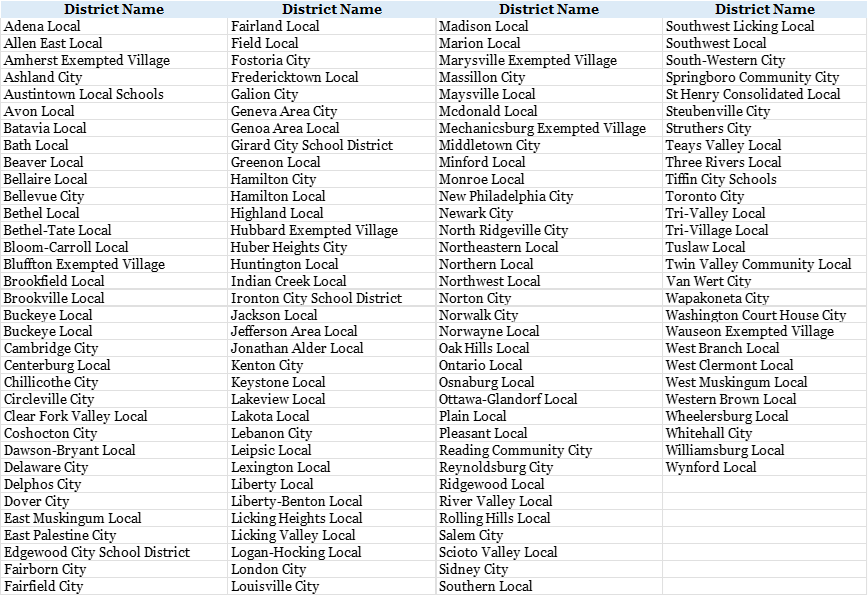
The amount of money the state sends, on average, to Ohio’s charter schools is now more than what 129 Ohio School Districts SPEND per equivalent pupil, including all locally raised property and/or income taxes. 

That’s right. 

Ohio now provides Ohio’s Charter Schools (all but 5 of which rated in the bottom 25% of all schools nationally) more money on average than 1 in 5 Ohio school districts spend per equivalent pupil, including all their local property tax money. 

I’ve included a list of all the school districts that spend less per equivalent pupil than Charter Schools receive on average in state aid.

That’s quite a list, don’t you think?

This explains how Ohio’s charter schools now get nearly $1.3 billion in state aid while having fewer students than they had in the 2013-2014 school year, I suppose. That year — the record for number of charter school students — had about $300 million less going to charters despite having about 1,000 more students than today.

This is why it’s critical to keep our eyes on all the privatization efforts, not just the shiniest one in front of us. 

It is. Inevitable.

Organize and vote accordingly.

Because if there’s one thing I’ve learned in about 25 years of following, analyzing and writing Ohio education policy, it’s that there is nothing more certain than Ohio Republican elected officials taking tax dollars out of the hands of our 1.4 million public school students and instead stuffing the bank accounts of political contributing profiteers and wealthy private school parents. 

Kathy Gebhardt was elected to the Colorado State Board of Education, despite nearly $1 million behind a charter school candidate. Kathy says she is not opposed to charters, but she did stop a Hillsdale College Barney charter school from opening in her district. Governor Jared Polis, a charter enthusiast, backed her opponent; Polis opened two charters himself, years ago. Kathy’s experience was far more extensive that that of her opponent. The voters paid attention. Kathy won. Her election assures that the charter lobby will not control the state board of education.

For the background, read Peter Greene’s summary of the race and Carol Burris’s endorsement of Kathy, whom she has worked with.

Carol Burris wrote:

No one is more qualified to serve. Kathy is an education attorney with expertise in school finance, a long-time school board member, and has served on both state and national school board organizations. All five of her children attended public schools.

The Denver Post reported:

Former Boulder school board president Kathy Gebhardt won the Democratic primary for a seat on the Colorado State Board of Education on Tuesday, despite a group supporting charter schools having spent nearly $1 million to oppose her campaign and back political newcomer Marisol Lynda Rodriguez.

The preliminary results for the 2nd Congressional District seat on the state education board almost certainly ensure Gebhardt will win the seat in November as there is no Republican candidate in the race. She will replace board member Angelika Schroeder, whose six-year term ends in January.

“It shows that money can’t buy an election,” said Gebhardt, adding that the results so far showed that “people were stepping up for public education.”

As of 10:15 p.m., Gebhardt led with 43,156 votes, or 56% of the total. Rodriguez had 33,911 votes, or 44%.

Rodriguez told The Denver Post that she called Gebhardt to concede shortly before 9 p.m.

Good news! The Oklahoma Supreme Court ruled against public funding for a religious charter school. Many were watching closely to see how the court ruled. A decision that went the other way would have rebuffed the tradition of separation of church and state and erased the distinction between charters and vouchers. The fact that Oklahoma’s ultra-conservative Governor Kevin Stitt and its State Commissioner of Education Ryan Walters strongly supported the religious charter school idea makes the decision even more startling.

CNN reports:

An effort to establish the first publicly funded religious charter school in the country has been blocked by the Oklahoma Supreme Court.

The court Tuesday ordered the state to rescind its contract with St. Isidore of Seville Catholic Virtual School in a 6-2 decision with one recusal.

“Under Oklahoma law, a charter school is a public school,” wrote Justice James R. Winchester for the court. “As such, a charter school must be nonsectarian. However, St. Isidore will evangelize the Catholic faith as part of its school curriculum while sponsored by the State.”

A charter contract for St. Isidore was approved by a state board last year.

Charter schools in Oklahoma are privately owned but receive state funding under the same guidelines as government-operated public schools.

The fight over the school exposed a fault line between two of the state’s top Republican politicians. Gov. Kevin Stitt strongly advocated for the school, saying when the contract was approved that it was “a win for religious liberty and education freedom in our state.”

But the school’s charter status was strongly opposed by Attorney General Gentner Drummond, who filed the lawsuit against it and predicted the state could be forced to fund other types of religious education if St. Isidore succeeded.

“The framers of the US Constitution and those who drafted Oklahoma’s Constitution clearly understood how best to protect religious freedom: by preventing the State from sponsoring any religion at all,” Drummond said in a statement Tuesday. “Now Oklahomans can be assured that our tax dollars will not fund the teachings of Sharia Law or even Satanism.”

PLEASE OPEN THE LINK TO FINISH THE STORY.

[Thanks to reader FLERP for alerting us to this story.]

Every time I see New Hampshire Governor Chris Sununu interviewed on CNN, he plays the role of the GOP “moderate.” Don’t be fooled. When it comes to education, he’s a clone of Betsy DeVos.

Veteran New Hampshire Garry Rayno pulls away the mask of “moderate” that Sununu wears in this article in InDepthNH.

This is an important article for everyone to read, no matter where you live. It explains succinctly the true goals of the privatization movement.

He writes:

Public education has been since its inception with the work of Horace Mann, the great equalizer.

Students from poor families have been able to compete with students from the other side of the tracks, maybe not in reality, but close enough to at least have an opportunity to excel.

Many of the founding fathers understood the need for an educated public if democracy was going to survive and thrive.

A responsible citizen is an informed citizen, and that appears to be the problem today. Too many people interested in power instead of governing don’t want a truly informed public. Instead, they want enough of the public spoon fed “alternative facts,” conspiracy theories, and outright lies to ensure they retain power although they have views that are both harmful to the majority of citizens and allow the tyranny of the minority to overturn the will of the majority.

At the heart of the minority’s transformation plan is the destruction of the public school system.

New Hampshire has had a front row seat to the war on education since Chris Sununu was elected governor and named his rival for the Republican nomination in 2016, Frank Edelblut, to be Education Commissioner, a man without any experience in public education, which was the first for someone holding that position in our lifetime.

If Sununu did not know what would happen when he put Edelblut in charge of this critical state department, shame on him, because Edelblut’s one term in the House was a roadmap for his actions during his two terms as commissioner, his second ending in March 2025.

Sununu has also packed the State Board of Education with school choice advocates instead of supporters of public education, so you have the two entities in the executive branch responsible for the state’s public education systems, maybe not anti-public schools, but certainly not advocates for the state’s public education system.

According to the statutes, the education commissioner “is responsible for the organizational goals of the department and represents the public interest in the administration of improving the effectiveness and efficiency of administrative and instructional services to all public schools in New Hampshire.”

Notice it says public schools, not private schools or religious schools, or homeschooling, or learning pods, or any of the other non-public entities that are approved vendors under the state’s Education Freedom Account program, some with questionable philosophies or intent.

An attempt by lawmakers this year to better define the education commissioner’s qualifications and responsibilities to the public school system was defeated this term by the same element that pushed to establish the EFA program and then to expand it, although this year’s attempt to increase the income threshold to participate in the program failed on the last day of the session to act on bills.

The outright attacks on public education began in New Hampshire about a decade ago but gained more warriors as FreeStaters/Libertarians swelled the ranks of the House and Senate Republican members.

The attack on public education here has been much the same as it has been in other states, mostly in the south and the west, with claims of the indoctrination of students by leftwing faculty members.

They have also attacked educators directly and have tried to pack school boards — without much success — to undermine curriculum, educators and slash budgets as happened in Croydon several years ago when the annual school meeting was poorly attended due to a snowstorm.

The Republican majority in the 2021-2022 legislature passed the state’s divisive concepts law forbidding teaching controversial subjects such as institutional racism.

The law was recently found unconstitutional by a US District Court judge.

That was the same term the EFA program was approved after earlier unsuccessful attempts.

Both the EFA program and the divisive concepts law were included in the state’s biennial budget package because they were not likely to pass on their own.

The same folks also tied education into the trumped out recent outrage over the LGBTQ community and sold it as an attack on parental rights.

The intent was to start a war between parents and educators, although parents already have many of the rights touted by the anti-public school advocates.

The theory touted was that educators were keeping information from parents about their students and their sexual identification and that educators were urging students to explore different sexual identities.

Then came the book banning other areas of the country experienced like Florida where some school libraries were stripped of books.

The red herring advocates touted here came from a national app that contains almost every book published that students could access both in schools and at home, and not on school library shelves.

Some tried to enlist town and city libraries in the surveillance of children and what they read and accessed, but that did not go very far.

All of this goes to create the appearance that schools are hotbeds of leftist politics and anti-parental values, some fueled by Edelblut in an op-ed he sent to media outlets.

And despite all this ginned up controversy, local public schools that educate about 90 percent of the school age children in the state remain very popular with parents and the public at large.

If that is true, you have to ask what is behind the push to demonize public schools like political candidates demonize opponents.

Keep in mind this attack on public education occurs at the same time when the superior court’s latest education funding decision says the state does not provide enough money to cover the cost of an adequate education for every student and the way it raises its biggest contribution to public education — the Statewide Education Property Tax — is unconstitutional.

Education is governments’ —not just state government’s — single biggest expense, costing about $3.5 billion a year.

If you are a Libertarian or Free Stater who believes “taxation is theft,” destroying public schools will shift the cost directly to parents, and you could keep a lot more of your money to spend as you see fit and not for the good of society.

And if you espouse the philosophy of the Koch Foundation or former US Education Commissioner, Betsy DeVos, you not only keep more of your money, one of the largest union-backed workforces in the country will be dismantled when certified teachers are no longer needed.

Without a public education system, a child would receive the education his or her parents could afford and for many, particularly minorities, and the historically poor, that may not be much beyond the time they turn 16 and have to go to work to keep the family treading the economic waters.

And then maybe they will work for a lot less than if they had a high school, or even a college education.

And without even an adequate education, how informed will the general public be or how capable of the critical thinking needed to realize all those folks touting their parental rights really do not have their best interests at heart.

Garry Rayno may be reached at garry.rayno@yahoo.com.

Distant Dome by veteran journalist Garry Rayno explores a broader perspective on the State House and state happenings for InDepthNH.org. Over his three-decade career, Rayno covered the NH State House for the New Hampshire Union Leader and Foster’s Daily Democrat. During his career, his coverage spanned the news spectrum, from local planning, school and select boards, to national issues such as electric industry deregulation and Presidential primaries. Rayno lives with his wife Carolyn in New London.

The Republicans in North Carolina have submitted legislation in the General Assembly to authorize a charter school with powerful political connections.

Ann Doss Helms of WFAE reported:

Buried deep in the 271-page House budget bill introduced Monday night, there’s a provision that would allow an unnamed charter school to bypass state review and open in August.

The description is very specific: The “expedited opening” would apply only to applications filed in 2024, for schools in the state’s largest statistical metropolitan area, in a fast-growing county and a school district serving fewer than 25,000 students.

Also, “the proposed charter school will be located in a fully furnished school facility purchased from a local board of education.”

That description applies to Trinitas Academy, which bought the old Mt. Mourne School in Mooresville from Iredell-Statesville Schools in 2022.

Trinitas hasn’t even begun the state review process that ensures its board is ready to educate students and responsibly handle millions of dollars of public money.

But it does have a website describing it as a K-8 classical academy. It lists a board that includes:

  • Susan Tillis, wife of Republican U.S. Senator Thom Tillis and founder of the Susan M. Tillis Foundation. She’s described as having  “an extensive background in state and national politics.” (Her name was removed from the site Wednesday, after this story aired.)
  • Will Bowen, communications director for Republican Rep. Patrick McHenry.
  • Marcus Long of Mooresville, described as a retired chief circuit judge from Virginia.
  • Board Chair Mark Lockman, described as having been “part of the district leadership at Charlotte-Mecklenburg Schools and Iredell-Statesville Schools. Additionally, Mark was instrumental in building the State of North Carolina’s first data-based instructional growth model for public K-12.”

They couldn’t immediately be reached. Trinitas board member Mikail O. Clark, a Charlotte lawyer, confirmed that Trinitas plans to open in August, but said he didn’t know enough about the House Bill to discuss it. “We’ve obviously engaged counsel to assist us with this matter,” he said, and hung up before answering a question about the status of the Trinitas application…

State Charter Schools Director Ashley Baquero said Tuesday that she knew nothing about the plan to bypass the approval process.

Open the link to finish the story of cronyism.

Jeff Bryant, veteran education journalist, writes here about the success of community schools in Chicago, in contrast to the failed ideas of “education reform.” The latter echoed the failed strategies of No Child Left Behind and Race to the Top: testing, competition, privatization, firing staff, closing schools, ranking and rating students, teachers, principals and schools based on test scores. So-called “education reform” created massive disruption and led to massive failure.

Bryant describes the evolution of community schools in Chicago, led by grassroots leaders like Jitu Brown, where parents are valued partners.

Bryant writes:

“Until now, we haven’t even tried to make big-city school districts work, especially for children of color,” Jhoanna Maldonado said when Our Schools asked her to describe what Chicago Mayor Brandon Johnson and his supporters have in mind for the public school system of the nation’s third-largest city.

Johnson scored a surprising win in the 2023 mayoral election against Paul Vallas, a former CEO of Chicago Public Schools (CPS), and education was a key issue in the race, according to multiplenewsoutlets. Maldonado is an organizer with the Chicago Teachers Union (CTU), which is reported to have “bankrolled” Johnson’s mayoral campaign along with other labor groups, and Johnson is a former middle school teacher and teachers union organizer. What Johnson and his supporters are doing “is transforming our education system,” Maldonado said. There’s evidence the transformation is sorely needed.

For the past two decades, Chicago’s schools experienced a cavalcade of negative stories, including recurring fiscal crisis, financial scandals and mismanagement, a long downward slide in student enrollment, persistent underfunding from the state, the “largest mass closing [of schools] in the nation’s history,” and a seemingly endless conflict between the CPS district administration and CTU.

Yet, there are signs the district may be poised for a rebound.

“The people of Chicago have had enormous patience as they’ve witnessed years of failed school improvement efforts,” Maldonado said. “And it has taken years for the community to realize that no one else—not charter school operators or so-called reformers—can do the transformation. We have to do it ourselves.”

“Doing it ourselves” seems to mean rejecting years of policy and governance ideas that have dominated the district, and is what Johnson and his transition committee call, “an era of school reform focused on accountability, high stakes testing, austere budgets, and zero tolerance policies,” in the report, “A Blueprint for Creating a More Just and Vibrant City for All.”

After experiencing more than 10 years of enrollment declines between 2012 and 2022, losing more than 81,000 students during this period, and dropping from its status as third-largest school district in the nation to fourth in 2022, CPS reported an enrollment increase for the 2023-2024 school year. Graduation rates hit an all-time high in 2022. The number of students being suspended or arrested on school grounds has also declined significantly. And student scores on reading tests, after a sharp decline during the COVID-19 pandemic, have improved faster than most school districts across the country. Math scores have also rebounded, but are more comparable to other improving districts, according to a 2024 Chalkbeat article.

Johnson and his supporters have been slowly changing the district’s basic policy and governance structures. They are attempting to redefine the daily functions of schools and their relationships with families and their surrounding communities by expanding the number of what they refer to as “sustainable community schools.” The CPS schools that have adopted the community schools idea stand at 20 campuses as of 2024, according to CTU. Johnson and his transition committee’s Blueprint report has called for growing the number of schools using the sustainable community schools approach to 50, with the long-term goal of expanding the number of schools to 200.

The call to have more CPS schools adopt the community schools approach aligns with a national trend where several school districts, including big-city districts such as Los Angeles and New York City, are embracing the idea.

Community schools look different in different places because the needs and interests of communities vary, but the basic idea is that schools should address the fundamental causes of academic problems, including student health and well-being. The approach also requires schools to involve students and their families more deeply in school policies and programs and to tap the assets and resources available in the surrounding community to enrich the school.

In Chicago—where most students are non-white, more than 70 percent are economically disadvantaged, and large percentages need support for English language learning and learning disabilities—addressing root causes for academic problems often means bringing specialized staff and programs into the school to provide more academic and non-academic student and family services, often called wraparound supports. The rationale for this is clear.

“If a student is taken care of and feels safe and heard and has caring adults, that student is much more ready to learn,” Jennifer VanderPloeg the project manager of CPS’s Sustainable Community Schools told Our Schools. “If [a student is] carrying around a load of trauma, having a lot of unmet needs, or other things [they’re] worrying about, then [they] don’t have the brain space freed up for algebra. That’s just science,” she said.

“Also important is for students to see themselves in the curriculum and have Black and brown staff members in the school,” said Autumn Berg, director of CPS’s Community Schools Initiative. “All of that matters in determining how a student perceives their surroundings.”

“Community schools are about creating a culture and climate that is healthy, safe, and loving,” said VanderPloeg. “Sure, it would be ideal if parents would be able to attend to all the unmet needs of our students, but that’s just not the system we live in. And community schools help families access these [unmet] needs too.”

Also, according to VanderPloeg, community schools give extra support to teachers by providing them with assistance in all of the things teachers don’t have time to attend to, like helping families find access to basic services and finding grants to support after-school and extracurricular programs.

But while some Chicago educators see the community schools idea as merely a mechanism to add new programs and services to a school’s agenda, others describe it with far more expansive and sweeping language.

“Community schools are an education model rooted in self-determination and equity for Black and brown people,” Jitu Brown told Our Schools. Brown is the national director of Journey for Justice Alliance, a coalition of Black and brown-led grassroots community, youth, and parent organizations in more than 30 cities.

“In the Black community, we have historically been denied the right to engage in creating what we want for our community,” Brown said.

In Chicago, according to Brown, most of the schools serving Black and brown families are struggling because they’ve been led by people who don’t understand the needs of those families. “Class plays a big role in this too,” he said. “The people in charge of our schools have generally been taught to believe they are smarter than the people in the schools they’re leading.”

But in community schools, Brown sees the opportunity to put different voices in charge of Chicago schools.

“The community schools strategy is not just about asking students, parents, and the community for their input,” he said. “It’s about asking for their guidance and leadership.”

It Started with Saving a Neighborhood

Chicago’s journey of embracing the community schools movement has been long in the making, and Brown gets a lot of credit for bringing the idea to the attention of public school advocates in the city.

He achieved much of this notoriety in 2015 by leading a hunger strike to reopen Walter H. Dyett High School in Chicago’s predominantly African American Bronzeville community. Among the demands of the strikers—Brandon Johnson was a participant in the protest when he was a CTU organizer—was for the school to be reopened as a “hub” of what they called “a sustainable community school village,” according to Democracy Now.

The strike received prominent attention in national news outlets, including the New York Times and the Washington Post.

But Brown’s engagement with the community schools approach started before the fight for Dyett, going back almost two decades when he was a resource coordinator at the South Shore High School of Entrepreneurship, a school created in 2001 when historic South Shore International College Preparatory High School was reorganized into three smaller campuses as part of an education reform effort known as small schools.

Brown was responsible for organizing educators and community members to pool resources and involve organizations in the community to strengthen the struggling school. He could see that the school was being “set up,” in his words, for either closure or takeover by charter school operators.

“School privatization in the form of charter schools was coming to our neighborhood,” he said, “and we needed a stronger offer to engage families in rallying to the school and the surrounding community.”

Brown pushed for the adoption of an approach for transforming schools that reflected a model supported by the National Education Association of full-service community schools.

That approach was based on five pillars that included a challenging and culturally relevant curriculum, wraparound services for addressing students’ health and well-being, high-quality teaching, student-centered school climate, and community and parent engagement. A sixth pillar, calling for shared leadership in school governance, was eventually added.

After engaging in “thousands” of conversations in the surrounding historic Kenwood neighborhood, where former President Barack Obama once lived, Brown said that he came to be persuaded that organizing a school around the grassroots desires of students, parents, teachers, and community members was a powerful alternative to school privatization and other top-down reform efforts that undermine teachers and disenfranchise families.

Brown and his collaborators recognized that the community schools idea was what would turn their vision of a school into a connected system of families, educators, and community working together.

Open the link to continue reading this important story.

There’s a crucial election on June 25 in Colorado for an open seat on the state school board.

Carol Burris, executive director of the Network for Public Education, gives her personal endorsement to Kathy Gebhardt. She has worked with Kathy and knows that she has the experience to be an excellent member of the state school board. Her opponent has no qualifications for the seat other than having worked for the charter lobby. Less than 20% of the children in the state attend charter schools but the charter lobby wants to control education policy for the all students, especially so they can keep on expanding the charter sector and opposing accountability and transparency for charters (while insisting on accountability and transparency for public schools).

Burris writes:

The Colorado charter lobby is worried. It may be about to lose its rubber stamp through its majority on the state board. That is because Kathy Gebhardt is running for the Colorado State Board of Education. No one is more qualified to serve. Kathy is an education attorney with expertise in school finance, a long-time school board member, and has served on both state and national school board organizations. All five of her children attended public schools.


I met Kathy when we worked together on the National Education Policy Center’s Schools of Opportunity Project, which honored public high schools that did an outstanding job providing students with excellent and equitable opportunities. Kathy is a smart, serious professional with a kind heart who cares deeply about all children.


From her well of kindness and devotion to equity, she took a courageous stand. As a School Board member, she joined the majority decision to deny an Ascent Classical charter school connected with the Hillsdale College Barney Charter School initiative from opening in her district. The poorly prepared application from Ascent sought waivers from nearly all district requirements, including protections against discrimination based on LGBTQ status and disabilities. 


The charter school lobby, like the NRA, is known for its staunch opposition to reforms and regulations. It is not above using NRA tactics to put down challenges to protect its privilege. The lobby and its billionaire supporters view every reasonable denial of a charter school as an attack. This is why Kathy was perceived as a threat despite her track record of supporting high-quality, truly public charter schools that cater to unmet community needs.


In this Forbes article, Peter Greene explains how they put forth an unqualified candidate, a consultant who worked for the Waltons and whose clients include Jeb Bush’s Chiefs for Change, the National Alliance of Charter Schools, and PIE, a network of “reform” organizations.


When the unqualified Marisol Rodriguez jumped in the race at the last minute, dark money flooded the race. Negative ads against Kathy making ridiculous accusations started flooding mailboxes. 


Kathy needs your help. Voting has begun by mail and will continue until June 25. She also needs funds to help get her message out and reply to the barrage of dark money-funded deception. Please give here up to the personal legal limit of $450 if you can. And if you know anyone who lives in Congressional District 2 (Joe Neguse’s district), tell them to vote for Kathy Gebhardt for State School Board.