Archives for category: Bush, Jeb

Peter Greene writes here about two basic facts: 1) vouchers are unpopular; and 2) because they are unpopular, their supporters call them something else, not vouchers. There have been more than 20 state referenda on vouchers. None passed. So voucher advocates had to become creative and come up with new names for them.

In Florida, the state constitution forbids spending public money on religious schools. So Jeb Bush, a fervent voucher guy, became creative. He proposed a referendum to remove that wording from the state constitution in 2012. The referendum was titled “The Religious Freedom Amendment.” Opponents of vouchers cried foul, but the misleading title remained. Others had to vote against “religious freedom” to oppose vouchers. Some were undoubtedly fooled, but the Religious Freedom Amendment was defeated anyway; only 44% supported it. Nonetheless, the Florida legislature enacted vouchers, ignoring the referendum failure, and in the past year, removed all income limits. As in every other state with universal vouchers, the majority of students applying for vouchers were already enrolled in private and religious schools.

Peter Greene writes:

Voucher supporters have one major problem: school vouchers are unpopular.

The term doesn’t test well. Measure of public support is iffy– if you ask people if they would like every student to have the chance to ride to a great school on their own pony, people say yes, but if you ask a more reality-based framing (“should we spend education dollars on public schools or subsidies for some private schools”) the results look a bit different

But one clear measure of public support for vouchers is this; despite all the insistence that the public just loves the idea, no voucher measure has ever been passed by the voters in a state. All voucher laws have been passed by legislators, not voted in by the public. 

Voucher supporters have developed one clear strategy– call them something else.

The basic school voucher idea is simple– the state takes money that it was going to spend on public education (either after that money has been paid in taxes, or by having someone trade a “contribution” to a voucher fund in exchange for tax credit) and giving it to parents, who in turn can go out and buy education services on their own. 

They’re not taxpayer-funded vouchers–they’re “tax credit scholarships.” They’re not vouchers– they’re an Education Freedom Account. And if you want to get in a twitter battle, go ahead and call education savings accounts “vouchers,” because part of the whole point of education savings account was to create an instrument that was both a super-voucher and not-something-we’ll-call-a-voucher-at-all-so-stop-doing-that-dammit.

I expect that behind the curtain there have been folks fervently doing messaging testing on other names for vouchers, and from the results around the nation, we can deduce that words that tested well were “education” and “freedom” and “scholarship.” Also, “empowerment” is coming on strong. States with education savings accounts have the chance to play with the initials ESA. 

So what pops out of the branding machine is Empowerment Scholarship Accounts (Arizona), Education Freedom Account (Arkansas, New Hampshire), Family Empowerment Scholarship Program (Florida), Choice Scholarship Program(Indiana), Opportunity Scholarship Program (North Carolina), Education Choice Scholarship (Ohio), and, of course, who could forget Betsy DeVos’s national tax credit scholarship voucher program, the Education Freedom Plan

You can mad lib your way to a voucher program of your own. Education Freedom Scholarship Opportunity Program! Family Freedom Education Scholarships! Family Freedom Empowerment Education Scholarship Opportunity Choice Program Plan! Just don’t call it a voucher.

Bonus credits to Louisianna, where someone took the trouble to write a bill pushing the Louisiana Giving All True Opportunity to Rise– LA GATOR. And in California, legislature voucherfiles are trying “Education Flex Account” for their latest attempt to pass an ESA voucher.

But a voucher by any other name still smells the same. It’s a payoff to parents so that they’ll exit public education, a false promise of education choice, a redirection of public taxpayer dollars into private pockets, an outsourcing of discrimination, a public subsidy for private religious choices, a means of defunding and dismantling public education as we understand it in this country, a transformation of a public good into a market-based commodity. Call it what you like. There isn’t enough air freshener in the world to make it smell like a rose.

Thom Hartmann explains the lies, hoaxes, And scams that Republicans use to deceive middle-income people to vote for them, against their self-interest. He shows how Jeb Bush tilted the election of 2000 in favor of his brother George.

This is a must-read.

Hartmann writes:

The GOP — to keep the support of “average” American voters while they work entirely for the benefit of giant corporations, the weapons and fossil fuel industries, and the morbidly rich — have run a whole series of scams on voters ever since the original Reagan grift of trickle-down economics.

Oddly, there’s nothing comparable on the Democratic side. No lies or BS to justify unjustifiable policies: Democrats just say up-front what they’re all about:

Healthcare and quality education for all. Treat all people and religions with respect and fairness. Trust women to make their own decisions. Raise the pay of working people and support unionization. Get assault weapons off the streets. Do something about climate change. Clean up toxic waste sites and outlaw pesticides that damage children. Replace fossil fuels with renewable energy.

Nonetheless, the media persists in treating the two parties as if they were equally honest and equally interested in the needs of all Americans. In part, that’s because one of the GOP’s most effective scams — the “liberal media bias” scam — has been so successful ever since Lee Atwater invented it back in the early years of the Reagan Revolution.

For example, right now there’s a lot of huffing and puffing in the media about how the Supreme Court might rule in the case of Trump being thrown off the ballot in Colorado. They almost always mention “originalism” and “textualism” as if they’re honest, good-faith methods for interpreting the Constitution when, in fact, they’re cynical scams invented to justify unjustifiable rulings.

Thus, the question: how much longer will Americans (and the American media) continue to fall for the GOP’s scams? 

They include:

— Originalism: Robert Bork came up with this scam back in the 1980s when Reagan appointed him to the Supreme Court and he couldn’t come up with honest or reasonable answers for his jurisprudential positions, particularly those justifying white supremacy. By saying that he could read the minds of the Founders and Framers of the Constitution, Bork gave himself and future generations of Republicans on the Court the fig leaf they needed.

The simple fact is that there was rarely a consensus among the Framers and among the politicians of the founding generation about pretty much anything. And to say that we should govern America by the standards of a white-men-only era before even the industrial revolution much less today’s modern medicine, communications, and understanding of economics is absurd on its face.

— Voter Fraud: This scam, used by white supremacists across the South in the years after the failure of Reconstruction to prevent Black people from voting, was reinvented in 1993, when Bill Clinton and Democrats in Congress succeeded in passing what’s today called the “Motor Voter” law that lets states automatically register people to vote when they renew their driver’s licenses. Republicans freaked out at the idea that more people might be voting, and claimed the new law would cause voter fraud (it didn’t).

By 1997, following Democratic victories in the 1996 election, it had become a major meme to justify purging voting rolls of Black and Hispanic people. Today it’s the justification for over 300 voter suppression laws passed in Red states in just in the past 2 years, all intended to make it harder for working class people, minorities, women, the elderly dependent on Social Security, and students (all Democratic constituencies) to vote.

The most recent iteration of it is Donald Trump‘s claim that the 2020 election, which he lost by fully 7 million votes, was stolen from him by voter fraud committed by Black people in major cities.

As a massive exposé in yesterday’s Washington Post titled “GOP Voter-Fraud Crackdown Overwhelmingly Targets Minorities, Democrats” points out, the simple reality is that voter fraud in the US is so rare as to be meaningless, and has never, ever, anywhere been documented to swing a single election. 

But Republicans have been using it as a very effective excuse to make it harder for Democratic voters to cast a ballot, and to excuse their purging almost 40,000,000 Americans off the voting rolls in the last five years.

Right To Work (For Less): back in the 1940s, Republicans came up with this scam. Over the veto of President Harry Truman, they pushed through what he referred to as “the vicious Taft-Hartley Act,” which lets states make it almost impossible for unions to survive. Virtually every Red state has now adopted “right to work,” which has left their working class people impoverished and, because it guts the political power of working people, their minimum wage unchanged.

— Bush v Gore: The simple reality is that Al Gore won Florida in 2000, won the national popular vote by a half-million, and five Republicans on the Supreme Court denied him the presidency. Florida Governor and George W. Bush’s brother Jeb had his Secretary of State, Kathryn Harris, throw around 90,000 African Americans off the voting rolls just before the election and then, when the votes had come in and it was clear former Vice President Al Gore had still won, she invented a new category of ballots for the 2000 election: “Spoiled.”

As The New York Times reported a year after the 2000 election when the consortium of newspapers they were part of finally recounted all the ballots:

“While 35,176 voters wrote in Bush’s name after punching the hole for him, 80,775 wrote in Gore’s name while punching the hole for Gore. [Florida Secretary of State] Katherine Harris decided that these were ‘spoiled’ ballots because they were both punched and written upon and ordered that none of them should be counted.

“Many were from African American districts, where older and often broken machines were distributed, causing voters to write onto their ballots so their intent would be unambiguous.”

George W. Bush “won” the election by 537 votes in Florida, because the statewide recount — which would have revealed Harris’s crime and counted the “spoiled” ballots, handing the election to Gore (who’d won the popular vote by over a half-million) — was stopped when George HW Bush appointee Clarence Thomas became the deciding vote on the Supreme Court to block the recount order from the Florida Supreme Court.

Harris’ decision to not count the 45,599 more votes for Gore than Bush was completely arbitrary; there is no legal category and no legal precedent, outside of the old Confederate states simply refusing to count the votes of Black people, to justify it. The intent of the voters was unambiguous. And the 5 Republicans on the Supreme Court jumped in to block the recount ordered by the Florida Supreme Court (in violation of the 10th Amendment) just in time to prevent those “spoiled” votes from being counted, cementing Bush’s illegitimate presidency.

— Money is “Free Speech” and corporations are “persons”: This scam was invented entirely by Republicans on the Supreme Court, although billionaire GOP donors — infuriated by campaign contribution and dark money limits put into law in the 1970s after the Nixon bribery scandals — had been funding legal efforts to get it before the Court for years.

In a decision that twists logic beyond rationality, the five Republicans on the Court — over the strong, emphatic objections of all the Democrats on the Court — ruled that our individual right to free speech guaranteed in the First Amendment also includes the “right to listen,” as I lay out in detail in The Hidden History of the Supreme Court and the Betrayal of America and they wrotein Citizens United:

“The right of citizens to inquire, to hear, to speak, and to use information to reach consensus is a precondition to enlightened self-government and a necessary means to protect it.”

Without being able to hear from the most knowledgeable entities, they argued, Americans couldn’t be well-informed about the issues of the day.

And who was in the best position to inform us? As Lewis Powell himself wrote in the Bellottidecision, echoed in Citizens United, it’s those corporate “persons”:

“Corporations and other associations, like individuals, contribute to the ‘discussion, debate, and the dissemination of information and ideas’ that the First Amendment seeks to foster…”

“Political speech is ‘indispensable to decision-making in a democracy, and this is no less true because the speech comes from a corporation rather than an individual.’ … The inherent worth of the speech in terms of its capacity for informing the public does not depend upon the identity of its source, whether corporation, association, union, or individual.”

They doubled down, arguing that corporations and billionaires should be allowed to dump unlimited amounts of money into the political campaigns of those politicians they want to own so long as they go into dark money operations instead of formal campaigns. What was called “bribery” for over 200 years is now “free speech”:

“For the reasons explained above, we [five Republicans on the Supreme Court] now conclude that independent expenditures, including those made by corporations, do not give rise to corruption or the appearance of corruption.”

— Cutting taxes raises revenue: As Nobel Prize-winning economist Paul Krugman notes, the idea promoted by Reagan, Bush, and Trump to justify almost $30 trillion in cumulative tax cuts for billionaires and giant corporations is “The Biggest Tax Scam in History.”

Reagan first pitched this to justify cutting the top income tax rate on the morbidly rich from 74% down to 25% in the 1980s, and it was reprised by both George W. Bush and Donald Trump for their own massive tax breaks for their well-off donors and peers.

The simple fact is that America went from a national debt of over 124% of GDP following World War II to a national debt of a mere $800 billion when Reagan came into office. We’d been paying down our debt steadily, and had enough money to build the interstate highway system, brand new schools and hospitals from coast to coast, and even to put men on the moon.

Since Reagan rolled out his tax scam, however, our national debt has gone from less than a trillion in 1980 to over 30 trillion today: we’re back, in terms of debt, to where we were during WWII when FDR raised the tippy-top bracket income tax rate to 90% to deal with the cost of the war. We should be back to that tax rate for the morbidly rich today, as well.

— Destroying unions helps workers: In their eagerness to help their corporate donors, Reagan rolled out a novel idea in 1981, arguing that instead of helping working people, corrupt “union bosses” were actually ripping them off.

Union leaders work on a salary and are elected by their members: the very idea that they, like CEOs who are compensated with stock options and performance bonuses and appointed by their boards, could somehow put their own interests first is ludicrous. Their only interest, if they want to retain their jobs, is to do what the workers want.

But Reagan was a hell of a salesman, and he was so successful with this pitch he cut union membership in America during his and his VP’s presidency by more than 50 percent.

— Corporations can provide better Medicare than the government: For a corporation to exist over the long term, particularly a publicly-traded corporation, it must produce a profit. That’s why when George W. Bush and friends invented the Medicare Advantage scam in 2003 they allowed Advantage providers to make as much as 20 percent in pure profit.

Government overhead for real Medicare is around 2% — the cost of administration — and corporations could probably run their Advantage programs with a similar overhead, but they have to make that 20% profit nut, so they hire larger staffs to examine every single request to pay for procedures, surgeries, tests, imaging, and even doctors’ appointments. And reject, according to The New York Times, around 18% of them.

“Advantage plans also refused to pay legitimate claims, according to the report. About 18 percent of payments were denied despite meeting Medicare coverage rules, an estimated 1.5 million payments for all of 2019.”

When they deny you care, they make money. If they ran like real Medicare and paid every bill (except the fraudulent ones), they’d merely break even, and no company can do that. Nonetheless, Republicans continue to claim that “choice” in the marketplace is more important than fixing Medicare.

With the $140 billion that for-profit insurance companies overcharge us and steal from our government every year, if Medicare Advantage vanished there would be enough money left over to cut Medicare premiums to almost nothing and add dental, vision, and hearing. But don’t expect Republicans to ever go along with that: they take too much money from the insurance industry (thanks to five corrupt Republicans on the Supreme Court).

— More guns means more safety: Remember the NRA’s old “The only way to stop a bad guy with a gun is a good guy with a gun”? They’re still at it, and there’s hardly a single Republican in America who will step up and do anything about the gun violence crisis that is uniquely experienced by our nation.

Bullets are now the leading cause of death among children in the US, and we’re literally the only country in the entire world for which that is true. And a child living in Red state Mississippi is ten times more likely to die from a gun than a child in Blue state Massachusetts. But as long as the NRA owns them, Republicans will never do anything about it.

— The media has a liberal bias: This canard was started by Lee Atwater in an attempt to “work the refs” of the media, demanding that they stop pointing out the scams Republicans were engaging in (at the time it was trickle-down). The simple reality is that America’s media, from TV and radio networks to newspapers to websites, are overwhelmingly owned by billionaires and corporations with an openly conservative bent.

There are over 1500 rightwing radio stations (and 1000 religious broadcasters, who are increasingly political), three rightwing TV networks, and an army of tens of thousands of paid conservative activists turning out news releases and policy papers in every state, every day of the year. There are even well-funded social media operations.

There is nothing comparable on the left. Even MSNBC is owned by Comcast and so never touches issues of corporate governance, media bias (they fired Brian Stelter!), or the corruption of Congress by its big pharma and Medicare Advantage advertisers.

— Republicans are the party of faith: Republicans claim to be the pious ones, from Mike Johnson’s creepy “chastity ball” with his daughter, to their hate of queer people, to their embrace of multimillionaire TV and megachurch preachers. But Democrats, who are more accepting of people of all faiths and tend not to wear their religion on their sleeves, are the ones following Jesus’ teachings.

Jesus, arguably the founder of Christianity, was emphatic that you should never pray in public, do your good deeds in private as well, and that the only way to get to heaven is to feed the hungry, house the homeless, heal the sick, and love every other human as much as you love yourself.

Republicans, on the other hand, wave their piety like a bloody shirt, issue press releases about their private charities, and fight every effort to have our government feed the hungry, house the homeless, heal the sick, or even respect, much less love, people who look or live or pray differently from them.

— Crime is exploding and you’re safer living in an area Republicans control: In fact, crime of almost all sorts is at a low not seen since 1969. Only car thefts are up, and some of that appears to have to do with social media “how to” videos and a few very vulnerable makes of autos.

New FBI statistics find that violent crime nationwide is down 8 percent; in big cities it’s down nearly 15 percent, robbery and burglary are down 10 and 12 percent respectively. 

But what crime there is is overwhelmingly happening in Red states. Over the past 21 years, all types of crime in Red states are 23 percent higher than in Blue states: in 2020, murder rates were a mind-boggling 40 percent higher in states that voted for Trump than those Biden carried.

— Global warming is a hoax: Ever since fossil fuel billionaires and the fossil fuel industry started using the legal bribery rights five corrupt Republicans on the Supreme Court created for them, virtually every Republican politician in the nation is either directly on the take or benefits indirectly from the massive infrastructure created by the Koch brothers and other fossil fuel barons. As a result, it’s almost impossible to find even one brave, truthful Republican who’s willing to do anything about the climate crisis that is most likely to crash not just the US but civilization itself.

— Hispanic immigrants are “murderers and rapists”: Donald Trump threw this out when he first announced his candidacy for president in 2015, saying, “They are bringing drugs. They are bringing crime. They’re rapists.” In fact, Hispanic immigrants (legal or without documentation) are far less likely, per capita and by any other measure, to commit crime of any sort than white citizens.

— Helping people makes them lazy. The old Limbaugh joke about “kicking people when they’re down is the only way to get them up” reveals the mindset behind this Republican scam, which argues that when people get money or things they didn’t work for it actually injures them and society by making them lazy. The GOP has used this rationalization to oppose everything from unemployment insurance in the 1930s to food stamps, Medicaid, and housing supports today.

In fact, not only is there no evidence for it, but studies of Universal Basic Income (UBI), where people are given a few hundred dollars a month with no strings attached, finds that the vast majority use the extra funds to improve themselves. They upgrade their housing, look for better jobs, and go back to school.

If the morbidly rich people behind the GOP who promote this scam really believed it, they’d be arguing for a 100% estate tax, to prevent their own children from ending up “lazy.” Good luck finding any who are leaving their trust-fund kids destitute.

— Tobacco doesn’t cause cancer: Back in 2000, soon-to-be Indiana Governor and then-Congressman Mike Pence wrote a column that was published statewide saying, “Despite the hysteria from the political class and the media, smoking doesn’t kill.” Pence’s family had made money off tobacco for years with a small chain of now-bankrupt convenience stores called “Tobacco Road,” but he was also being spiffed by the industry.

Similarly, George W. Bush pushed the “Healthy Forests Initiative” as president after big contributions from the timber industry: “healthy” meant “clear cut.” Bush also had his “Clear Skies Initiative” that let polluters dump more poison into our air. And the Trump administration, after big bucks and heavy lobbying from the chemical and Big Ag industries, refused to ban a very profitable pesticide used on human food crops that was found to definitely cause brain damage and cancer in children.

— For-profit utilities produce cheaper and more reliable electricity than government-owned and -run ones: This one goes back to the Reagan era, with Republicans arguing that the “free market” will always outperform government, including when it comes to generating and distributing electricity. In fact, each of us has only one wire coming into our homes or offices, so there is no possible competition to drive either improved performance or lower prices among for-profit utilities.

In fact, non-profit community-owned or government run utilities consistently produce more reliable electricity, serve their customers better, and charge lower prices. And the differences have become starker every year since, in 1992, President GHW Bush ended federal regulation of electric utilities. It’s why Texas, which has almost completely privatized its power grid, suffers some of the least reliable and most expensive electricity in the nation when severe weather hits.

— The electoral college protects our democracy: There was a time when both Democrats and Republicans wanted to get rid of the Electoral College; a constitutional amendment to do that failed in Congress by a single vote back in 1970. But after both George W. Bush and Donald Trump lost the White house by a half-million and three million votes respectively but ended up as president anyway, Republicans fell newly in love with the College and are fully planning to use it again in 2024 to seize power even if ten million more people vote for Biden this time (Biden won by 7 million votes in 2020).

This is just the tip of the iceberg.

Republicans are now defending billionaires buying off Supreme Court justices and most recently Lever News found that they’ve been spiffing over 100 other federal judges — who regularly vote in favor of the interests of corporations and the morbidly rich — in addition to Alito, Thomas, Roberts, et al.

Republicans are also claiming that:

— Trump isn’t a threat to our democracy and his promises to be a dictator are “mere hyperbole.” 
— Letting Putin take Ukraine won’t put Taiwan and other democracies at risk.
— Ignoring churches routinely breaking the law by preaching politics while enjoying immunity from taxes is no big deal. 
— Massive consolidation to monopoly levels across virtually every industry in America since Reagan stopped enforcement of our anti-trust laws (causing Americans to pay an average of $5,000 a year more for everything from broadband to drugs than any other country in the world) is just the way business should be run.
— Teaching white children the racial history of America will make them feel bad, rather than feel less racist and more empathetic. 
— Queer people are groomers and pedophiles (the majority in these categories are actually straight white men).
— Banning and burning books is good for society and our kids.
— Ending public schools with statewide voucher programs will improve education (every credible study shows the opposite).

I could go on, but you get the point. When will America — and, particularly, American media — wake up to these scams and start calling them out for what they are?

I’m not holding my breath, although you could help get the ball rolling by sharing this admittedly incomplete list as far and wide as possible.

No wonder Jeb Bush wrote an opinion article defending his so-called reforms, especially high-stakes standardized testing.

The Republican-controlled Legislature is moving to dismantle the structure that Bush created when he was governor. Some legislators wanted to cancel recess but the outcry from parents made them drop that idea.

Leslie Postal of The Orlando Sentinel, one of the best education writers in the nation, writes here about the seismic changes in Florida:

The Florida Senate backed away Tuesday from plans to end the state’s recess requirement after objections from “recess moms” but moved ahead with proposals to scrap key, and controversial, parts of the Republican education agenda.


The Senate’s fiscal policy committee agreed by an 18-0 vote to end policies ushered in by former Gov. Jeb Bush more than 20 years ago. Those include requirements that high school students pass two exams to graduate and that third graders pass a reading test to move on to fourth grade.


Under the bill approved by the GOP-dominated committee, students would no longer have to pass an Algebra 1 and a language arts exam to earn high school diplomas. But the 10th-grade language arts exam would count as 30% of a student’s final grade in 10th-grade English classes, just as the algebra exam already counts as 30% of the final grade in Algebra 1 classes.


The bill also would allow third graders who failed the state reading test to be promoted to fourth grade, if that is what their parents thought was best.

Jeb Bush’s allies objected to the changes and said they would water down standards. It’s not yet clear whether DeSantis will go along. Moms for Liberty also objected.

But Republicans in the Senate have pushed and supported the measures, and two committees have now approved them.


Senate President Senate President Kathleen Passidomo introduced the proposals in a memo she sent to senators last month that was titled “Learn Local – Cutting Red Tape, Supporting Neighborhood Public Schools.”


The idea, she said, was that after the Legislature expanded school choice (HB 1) earlier this year, making many more children eligible for private school scholarships, it should look in its 2024 session to remove regulations on public schools, which serve the bulk of the state’s students.


In the memo, she called the ideas “bold,” “controversial” and, she conceded, ones that might “not make it across the finish line.”


Many of the Senate’s suggestions have broad support from school superintendents, administrators, teachers and parents.

Representatives from the Broward, Orange and Seminole county school districts all showed their support Tuesday, for example.


Simon noted that Florida’s new standardized test, FAST, is a “progress-monitoring” exam given several times a year starting in pre-Kindergarten.
“We’re able to find those students much earlier on in the process,” he said, making the current third-grade rule unnecessary.

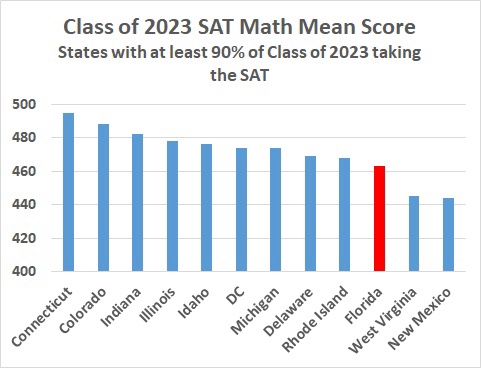
When you hear Jeb Bush or Ron DeSantis boast about the success of education in Florida, don’t believe it. Laugh out loud. Fourth grade reading scores are high, but could it be because low-scoring third graders are retained? Eighth grade reading scores are at the national average on NAEP—nothing to brag about. Florida’s SAT scores are embarrassingly low for a state that brags about test scores. Apparently those impressive reading scores in fourth grade ebb away as each year passes.

Scott Maxwell, opinion columnist for The Orlando Sentinel, called out the fraudsters by pointing to Florida’s pathetic SAT scores.

New rankings show Florida students are posting some of the lowest SAT scores in America.

We’re talking 46th place. Down another 17 points overall to 966, according to the combined reading and math scores shared by the College Board.

Florida trails other Southern states like South Carolina and Georgia. We trail states where more students take the test, like Illinois and Indiana.

We somehow now even slightly trail Washington, D.C. — a district long maligned as one of the supposedly worst in America, where all students take the test.

This should be an all-hands-on-deck crisis. Yet what are Florida education officials obsessing over?

Pronouns. And censoring books.

While other states focus on algebra and reading comprehension, Florida’s top education officials are waging wars with teachers about what kind of pronouns they can use and defending policies that have led to books by Ernest Hemingway and Zora Neale Hurston being removed from library shelves. We are reaping what they sow.

But perhaps the most disturbing thing about Florida’s current crop of top education officials isn’t just the misguided policies they’re pushing, it’s the way they behave. Like it’s all a joke. Like Twitter trolls.

They’re calling names, mocking those trying to have serious conversations about education and generally reveling in owning the libs.

A few months ago, Orlando Sentinel education reporter Leslie Postal spent weeks trying to get public records about a newly hired state education employee. Postal just wanted to explain to taxpayers how their money was being spent. But state officials refused to answer questions.

So Postal wrote up the piece, and Florida Education Commissioner Manny Diaz shared the piece on Twitter (now X) with a two-word comment: “Cry more!”

For those of you who don’t speak troll, “Cry more” is a response used by some social-media users — usually those juvenile in age or intellect — to mock someone who is unhappy. The folks at Urban Dictionary, who revel in all things trolly, define “Cry More” as a “phrase used in online games when someone is getting owned, and they b*tch about it.”

The game in question here, mind you, was the Sentinel’s two-month quest to get answers about how the state was spending tax dollars. And the response from the state’s top education official was: “Cry more!” What a role model for students.

That’s just one example. Last week, after I wrote a column about rampant book-censorship in the state — with one district shelving 300 titles — State Board of Education Member Ryan Petty responded (at quarter ’til 1 in the morning): “Just dumb. This passes as journalism.” Followed by a clown emoji.

OK, for argument’s sake, let’s say I’m the dumbest clod to ever set foot in the Sunshine State. Petty still wouldn’t answer any of the direct questions posed in both the column and on Twitter. Specifically, if the goal isn’t widespread book-banning, why won’t his education department provide a definitive list of what books it believes students shouldn’t have access to in school?

Petty opted for emojis over answers, because that’s what trolls do.

The responses on Twitter to Diaz and Petty — both appointees of Gov. Ron DeSantis — were about what you’d expect. One user told Petty: “My ninth grader could have crafted a more articulate response.” Several users responded similarly to Diaz’s “Cry More!” post, questioning his ability to maturely discuss policy and referring back to a Miami Herald investigation into student claims of “inappropriate behavior” by Diaz back when he was a teacher; claims Diaz said were bogus smears.

None of this did a thing to address this state’s education issues. Yet that’s where we are in Florida these days, mired in culture wars and trolling each other.

We also saw something similar last week when Diaz refused to directly answer questions from Orange County Public Schools about whether teachers were allowed to honor the requests of transgender students who wanted to be addressed with different pronouns — if the teachers wanted to and if those students also had their parents’ written permission. (Think about how bizarre it is that schools must even ask that question … in the so-called “parental rights” state.)

In his response to the district, Diaz offered a theatrical and condescending response that referred to “false” pronouns but which school officials concluded didn’t actually answer the question in a straightforward manner. Just more troll games … involving a population of teens more prone to self-harm and suicide, no less.

As far as the SAT goes, the test certainly has its share of legitimate critics. But it’s still one of the best apples-to-apples metrics we have for student learning.

Yet hardly any Florida media organizations even covered the October release of the new SAT scores that showed Florida’s poor showing. Why? Because we’ve been trained to follow the bouncing-ball, culture-war debate of the day.

So we see plenty of coverage about Florida supposedly ranking No. 1 in “educational freedom” by partisan political groups and scant addition to real education issues.

Call me old-fashioned, but I like hard numbers more than political posturing or magazine rankings. So do others who actually care about and study education.

Paul Cottle, a physics professor who authors a blog that focuses on STEM education, noted Florida’s increasingly cruddy SAT scores back in October when they were released — when everyone else was focused on the debate-of-the-day.

Cottle noted that Florida’s math scores for 4th graders were solid but that the SAT scores for graduating seniors were so bad, they suggested something was going awry for students before Florida schools sent them into the real world.

Cottle called the showing “a sad state of affairs.”

He’s right. Yet we’re getting precisely the educational environment and results that our culture-warring politicians are cultivating — an environment where trolls thrive, even if students don’t.

Jeb Bush, a founding father of the corporate reform movement, was governor of Florida from 1999 to 2007. He implemented a regime of high-stakes standardized testing, third grade retention, school report cards, and choice. He vigorously championed charter schools and tried to change the state constitution to allow vouchers for religious schools. Now he is concerned that the legislature might undermine high-stakes testing, so he penned this opinion piece for the Orlando Sentinel bragging about the success of his test-and-punish regime.

Yes, Florida’s fourth-grade NAEP scores are high. But he does not acknowledge that the scores are high because Florida “retains” third-graders who don’t pass the reading test. Holding these kids back artificially inflated the fourth-grade scores. By eighth grade, Florida’s scores are at the national average. Nothing to boast about there. The moral of the story: retention raises test scores by removing from the testing pool the kids who were retained (flunked).

The other curious omission in this article is voucher schools. Jeb is a huge fan of vouchers but voucher schools don’t take any state tests. How does he explain this? He doesn’t.

He wrote:

For more than two decades, Florida has remained committed to educational excellence by ensuring that transparency, accountability and opportunity define our K-12 system. We’ve consistently pushed the envelope, transforming Florida into a national leader. This has not happened by accident.

When I took office, nearly half of Florida’s fourth graders had significant reading deficiencies. Similarly, half of Florida’s fourth graders were significantly below grade level in math. Only half of high school students graduated on time.

In partnership with state lawmakers, we championed the A+ Plan in 1999 based on core principles of high expectations, standardized measurement, a clear and achievable system of accountability, rewards and consequences for performance, effective teaching in the classroom and more choices for families to customize an education for each student.

Today, Florida’s fourth graders rank third in the nation for reading achievement and fourth in the nation for math achievement. Our high school graduation rate is approaching 90%.

This is why it’s concerning that some lawmakers now seem eager to throw out or water down key components of the policies that led our students from the back of the pack to top in the nation.

I understand the goal of the Florida Senate’s recently unveiled deregulation package (Senate bills 7000, 7002and 7004). Cutting red tape and removing outdated regulations is a worthwhile effort.

But this cannot come at the cost of our state and students taking a step backward.

Lawmakers have proposed watering down our third grade literacy policy, removing the backstop of retention and paving the way to reinstate social promotion. Requiring that students objectively demonstrate they are reading successfully before being promoted to fourth grade has been a core part of Florida’s comprehensive early literacy policy — one that research has consistently supported.

This is why it’s concerning that some lawmakers now seem eager to throw out or water down key components of the policies that led our students from the back of the pack to top in the nation.

I understand the goal of the Florida Senate’s recently unveiled deregulation package (Senate bills 7000, 7002and 7004). Cutting red tape and removing outdated regulations is a worthwhile effort.

But this cannot come at the cost of our state and students taking a step backward.

Lawmakers have proposed watering down our third grade literacy policy, removing the backstop of retention and paving the way to reinstate social promotion. Requiring that students objectively demonstrate they are reading successfully before being promoted to fourth grade has been a core part of Florida’s comprehensive early literacy policy — one that research has consistently supported.

Most parents believe their children are reading on grade level even when they are not. Florida’s retention policy raises expectations. We know there are grave later-life outcomes for struggling readers. Lowering expectations by watering down the retention requirement will not help students in third grade or beyond.

Moreover, abandoning the requirement that Florida students pass the tenth grade English Language Arts and Algebra I end-of-course assessments further reduces expectations and hampers Florida’s workforce development efforts. Removing this requirement may aid Florida’s graduation rates, but it will reduce the diploma to nothing more than a participation certificate.

If we expect less, we will get less. This cannot be the future we want for Florida.

Finally, part of the package would turn back recent gains for charter schools to be treated equitably alongside their traditional public school peers. The bill’s proposed changes would make it harder for charter schools to access vacant public school buildings and reduce the share of Title I funds made available to students attending charter schools. This is a step backward.

Maintaining Florida’s system of high expectations, clear accountability and robust choice is as important to our future as anything. We’ve spent two decades establishing, maintaining and building upon these ideals.

Now is not the time for lawmakers to get weak-kneed on policies that have played key roles in contributing to two decades of educational progress.

Jeb Bush was governor of Florida from 1999 to 2007. He is the founder and chair of ExcelinEd, ExcelinEd in Action and the Foundation for Florida’s Future.

Veteran teacher and blogger Nancy Bailey was stunned by Nicholas Kristof’s column in the New York Times describing Mississippi’s schools as a national model of success. Her reaction: Can children learn to read when they are segregateed and hungry?

Bailey points out that Kristof is praising the work of Jeb Bush, who has pioneered third grade retention and even funded the study that allegedly proves the value of holding back third graders who flunk the reading test. This helps to improve fourth grade scores but multiple other studies assert that it harms those who are held back.

Billy Townsend writes in the Tampa Bay Times about how Florida politicians game the NAEP (National Assessment of Educational Progress) scores to boast about unearned “success.” The gaming consists of bragging about fourth grade scores (which are high) while ignoring eighth grade scores (which are unimpressive).

The big Florida trick is third grade retention—holding back the children in third grade who have low reading scores. This artificially boosts fourth grade scores. But then comes the eighth grade scores, and Florida falls behind. They can’t hide the low-scoring students forever.

He writes:

A close look at ‘the Nation’s Report Card’ shows how Florida fails its students as they move up through the grades.

A few years ago, just before COVID hit, a Stanford University study of state-level standardized tests showed that Florida’s “learning rate” was the worst in the country — by a wide margin.

Florida has the worst learning rate, according to a Stanford study.
Florida has the worst learning rate, according to a Stanford study. [ Provided ]

Florida students learned 12 percent less each year from third to eighth grade than the national average from 2009 to 2018. The next worst state was Alabama, according to The Educational Opportunity Project at Stanford University. Florida’s political and education leaders completely ignored that finding.

Contrast that deafening silence with the hype and misinterpretation that comes with the release of the National Assessment of Educational Progress (NAEP), “the Nation’s Report Card.” When those results came out last fall, Gov. Ron DeSantis crowed on Twitter that, “We kept schools open in 2020, and today’s NAEP results once again prove that we made the right decision. In Florida, adjusted for demographics, fourth grade students are #1 in both reading and math.”

Tellingly, DeSantis ignored the eighth grade results, which came out far worse than fourth grade — just as they have in every NAEP cycle since 2003.

The “Nation’s Report Card” is a snapshot of group proficiency taken by different cohorts of kids every two years in reading and math in fourth grade and eighth grade. It produces state-by-state results and proficiency rankings. It does not track individual kids year over year. But it does tell you how Florida’s fourth and eighth graders compare with students in other states. I crunched the data, and here’s the bottom line: Florida’s students perform worse as they move up through the grades. There is consistent, massive systemic regression with age. And the gap is widening.

This is a state failure, not a local one attributable to individual districts. Yet, in every NAEP cycle, Florida politicians and education leaders brag about fourth-grade NAEP results in press releases.

But ignoring the eighth grade results or the “learning rate” study does not change these facts:

· Florida kids regress dramatically as they age in the system. Since 2003, Florida’s eighth grade rank as a state has never come close to its fourth grade rank on any NAEP test in any subject.

· The size of Florida’s regression is dramatic and growing, especially in math.Florida’s overall average NAEP state rank regression between fourth and eighth grade since 2003 is 17 spots (math) and 18 spots (reading). But since 2015, the averages are 27 spots (math) and 19 spots (reading).

· No other state comes close to Florida’s level of consistent fourth to eighth grade performance collapse. In the last three NAEP cycles — 2017, 2019 and COVID-delayed 2022 — Florida ranked sixth, fourth and third among states in fourth grade math. In those same years, Florida ranked 33th, 34th and tied for 31st in eighth grade.

· For comparison, Massachusetts typically ranks at or near #1 among states on both the fourth grade and eighth grade NAEP for math and reading. Its eighth grade rank has never been more than one spot lower than fourth.

· Florida has never matched the U.S. average scaled score on eighth grade math NAEP.

· In COVID-marred 2022, Florida’s eighth grade scale scores in reading and math both lost 8 points relative to the national average, compared to fourth grade. That’s larger or equal to the overall collapse of NAEP scores nationwide attributed to COVID.

To restate, what happens every NAEP cycle between fourth and eighth grade in Florida matches and mostly exceeds the negative impact of COVID. Overall, recent NAEP cycles show Florida collapsing from elite test scores in fourth grade reading and math to abysmal in eighth grade math and average in eighth grade reading, even after its much-hyped approach to COVID in 2022.

And, worse, there is no reason at all to believe Florida’s test performance regression with age stops at eighth grade. The only two years the NAEP tested 12th graders — 2009 and 2013 — the Florida collapse worsened significantly with further age, but against a smaller pool of states.

Willful ignorance, useless testing

So what to make of this?

You can rest assured that your top education officials know all about Florida’s eighth grade NAEP and learning rate failures, which is why they never discuss them. I suspect these test data realities helped drive Florida to drop its big state growth test — the Florida Standards Assessment — and move toward a “progress monitoring” regime this year that may or may not create functionally different data reporting models.

The discourse around Florida’s NAEP performance — and the catastrophic learning rate that we ignore on our state tests — makes me deeply skeptical of standardized tests and their use in our education systems and society. I see them as punitive political and social sorting tools, rather than “assessments” designed to help individual children reach their potential.

Forget whether test results are valid or biased. We can’t even accurately describe what the test results say — on their face — about the success of our state school system. So what use are they?

Florida’s politicians, education leaders, policy community and journalists should look at these results and ask this basic question: The data tells us your child will regress dramatically every year he or she stays in the Florida system. What’s going on?

If we can’t do that, then why do we force standardized tests on kids at all?

What we should be studying

I’ve been attempting to draw attention to this dramatic Florida regression dynamic for years. So I was pleased to the see the Tampa Bay Times Editorial Board and Hillsborough County Schools Superintendent Addison Davis notice and publicly address the massive drop in test performance between fourth and eighth grade in Florida on the 2022 NAEP. But I was puzzled by suggestions that it was something new, caused by COVID. It isn’t; and it wasn’t.

Indeed, if we took standardized tests seriously as diagnostic and development tools, we would have long ago started asking: What causes this? What changes need to be made beyond rebuilding and supporting a developmentally focused teacher corps? What are the system quirks of Florida that cause this dynamic?

Here are some good questions to ask and study:

· Why doesn’t “learn to read, read to learn” work in Florida?

One of our treasured education cliches is “learn to read” so you can “read to learn.” It’s essentially the policy justification for imposing mass retention on third graders, as Florida does. And yet, although Florida routinely ranks high fourth grade NAEP reading, our readers immediately lose massive ground relative to other states. The data shows that Florida’s often punitive emphasis on “learn to read” by third or fourth grade creates no benefit in “reading to learn” in later grades — in math or reading. Why not?

· What is the role of mass third grade retention in Florida’s fourth grade peak and subsequent collapse?

Florida pioneered mass third grade retention based on reading standardized test scores in 2003. This prevents the lowest scoring third grade readers from taking the NAEP with their age cohort in fourth grade. And when that low scoring third grader finally takes the fourth grade NAEP, retention has made it as if he or she is a fifth grader taking the fourth grade NAEP.

Florida law theoretically subjects more than 40 percent of Florida’s roughly 200,000 public school third graders to retention because of low scores. A smaller — but still significant — number is actually retained. Florida does not appear to publish that actual total number of third graders retained.

· What is the cost to the individual children and overall system performance?

Essentially all data shows that ripping kids away from their age cohort because of testing leads to significant human harm and increased drop out rates over time.

Is that affecting Florida’s learning rate for older kids and the eighth grade NAEP collapse? A 2017 study of a cohort of southwest Florida students showed that seven years after retention, 94% of the retained group remained below reading proficiency. It also showed that third and sixth graders find retention as stressful as losing a parent.

· How many voucher third grade testing refugees are there? What effect do they have on the fourth grade NAEP?

Third grade retention is not Florida’s only way to get low scoring fourth graders off the books for the NAEP. It’s been well-established that Florida over-testing and third grade retention is a primary sales tool for vouchers.TheOrlando Sentinel’sPulitzer-worthy “Schools without Rules”report in 2017 about voucher schools reported: “Escaping high-stakes testing is such a scholarship selling point that one private school administrator refers to students as ‘testing refugees’.”

How many testing refugees are there? And how does Florida’s massive voucher program — America’s largest and least studied — affect performance on the NAEP by allowing low scoring kids to duck it?

· What effect do voucher school dropouts have on scoring when they return in massive numbers to public schools?

At the same time, 61 percent of voucher kids abandon the voucher within two years (75 percent within three years),according to the Urban Institute, in the closest thing to a study ever done on Florida vouchers.

Enormous numbers of “low-scoring” kids duck third and fourth grade tests and then come back into the public system to be counted in the eighth grade NAEP and other yearly tests. That’s likely a recipe for score collapse. But there is no hard data to analyze. Florida is long overdue for such a study, and voucher advocates know it will be a data bloodbath.

Perhaps that’s because independent studies of smaller state voucher programs — with much greater oversight — shows attending a voucher school will “meet or exceed what the pandemic did to test scores,” according to Michigan State researcher and former voucher advocate-turned-critic Josh Cowen.

· Does chasing test scores kill test scores over time?

Test-driven instruction isn’t engaging. Kids come to understand how useless these tests are to their lives; and they behave accordingly. Teachers come to hate the test-obsessed model and leave the profession. How has that affected test scores?

A longstanding waste of human potential

For me, the eighth grade NAEP and “learning rate” failures are evidence that we’ve wasted a generation of human potential and severely damaged Florida’s teaching profession. Will anyone “follow the data” where it leads? Will anyone ask: Should our kids peak at age 9 and decline inexorably from there?

I believe Florida has long had one of America’s worst test-performing state school systems because of its governance model and intellectual corruption and pursuit of useless measures and fake accountability.

I

Billy Townsend was an award-winning investigative reporter for The Lakeland Ledger and Tampa Tribune. He oversaw education reporting as an editor for The Ledger. He has been an independent writer and journalist since 2008, focused on Florida history, education and civic systems. He was an elected Polk County School Board member from 2016-2020. Today he writes the Florida-focused email newsletter “Public Enemy Number 1.” He can be reached at townsendsubstackpe1@gmail.com.

Josh Cowen is a veteran voucher researcher, having worked in the field for more than 20 years. He is a professor of education policy at Michigan State University. After two decades as a researcher, he concluded that vouchers are a disaster for the children who use them.

Today, he writes an inside guide to voucher research. All pro-voucher research is actually disguised advocacy for vouchers, especially if it funded or produced by the organizations listed here.

I hope you will share this post with your friends on social media, post blogs about it, and get it into the hands of journalists. The public deserves transparency.

Josh Cowen writes:


The entire base of evidence to support school vouchers comes from a small, interconnected and insular group of research-activists with direct ties to Betsy DeVos, Charles Koch, the Waltons and other privatization financers.

If you stopped reading this post right now, that’s the take-home message right there: the case for vouchers relies entirely on data and evidence contributed by what amounts to industry-funded research and advocacy on behalf of the cause.

But if you’re a journalist, an educator, or just a committed public school supporter (thank you!) and you want the links and the details, read on.

WHO’S WHO IN THE VOUCHER RESEARCH/ADVOCACY WORLD?

If you’re a professional journalist either in the education space or a broader policy/politics issue, you’ve probably heard of some of these people and certainly their institutions before. But you’re busy, you’ve got deadlines to meet and editors to approve your copy, and it’s not always easy to connect some of the important dots in this area.

But they need to be connected. The single most difficult task I’ve found in my writing on school vouchers has been to explain to journalists how the question of whether vouchers “work” for kids is not some obscure academic ivory-tower debate in which both sides have a nuanced, complicated and reasonably well-founded point.

There is credible research on one side—that vouchers are largely a negative force for student outcomes—and politically oriented reports on the other. That’s it.

So the next time you see a press release, or are given a quote, or talk off record to a voucher supporter saying that vouchers work, try this little exercise and see what you find for yourself:

STEP 1: DOES THE RESEARCH COME FROM ONE OF THE FOLLOWING ORGANIZATIONS?

• American Federation for Children: the 501(c)(4) advocacy organization co-founded by Betsy DeVos to lobby for vouchers. DeVos was so close to this group she had to recuse herself as Secretary of Education from contact with the group in her first year in government.

• Cato Institute: A Right-wing advocacy think tank co-founded by Charles Koch (although Koch later sued for lack of direct control of the group).

• EdChoice: Formerly the Friedman Foundation for Educational Choice, named for conservative economist who first proposed vouchers. Enough said.

• ExcelInEd: The advocacy group founded by Jeb Bush to expand vouchers and other conservative education priorities from the model Bush developed while he was governor of Florida.

• Goldwater Institute: A self-described libertarian think tank in Arizona that is chiefly oriented toward litigation on behalf of a number of different conservative policy priorities—most recently school vouchers.

• Harvard University Program on Education Policy and Governance (PEPG): A research center at Harvard run by Professor Paul Peterson, also of the Hoover Institution, and the father of modern-day pro-voucher research.

• Heritage Foundation: the most influential Right-wingthink tank in the country, devoted in part to privatizing schools and exploiting culture wars. Also directly tied to voter suppression efforts, per deep reporting by The New Yorker.

• University of Arkansas Department of Education Reform: A university-based doctoral training department responsible for producing nearly all of the currently active voucher research-advocates working at the institutions above today. This department was founded by a $10 million gift from the Walton Family Foundation in the early 2000s.

STEP 2: IS THE AUTHOR, CO-AUTHOR OR SOURCE FOR BACKGROUND OR ATTRIBUTION ONE OF THE FOLLOWING PEOPLE?

The Original Voucher Research-Advocates

Jay P. Greene Currently Senior Fellow at Heritage, former founding head of the University of Arkansas Department of Education Reform, received his PhD under Paul E. Peterson.

Paul E. Peterson Currently Professor at both Harvard and the conservative Hoover Institute at Stanford University, and the primary intellectual force behind the original positive voucher studies of the late 1990s.

Their Students, Colleagues and Acolytes

Lindsay Burke Currently at the Heritage Foundation and a member of GOP Governor Glenn Youngkin’s transition team.

Corey DeAngelis Currently Research Director for DeVos’s American Federation for Children group. But so much more: a regular Fox News contributor and active campaigner with far-Right governors like Kari Lake in Arizona and Kim Reynolds in Iowa.

Greg Forster Currently at EdChoice and a co-blogger with Jay Greene.

Matthew Ladner Currently at ALEC, EdChoice, Goldwater, and the Charles Koch Institute.

Martin Lueken Currently a research director at EdChoiceand former PhD student of Jay Greene and Patrick Wolf at University of Arkansas.

Mike McShane Currently a research director at EdChoiceand former PhD student of Jay Greene and Patrick Wolf at University of Arkansas.

Neil McCluskey Currently “Director of Education Freedom” at the Cato Institute and a member of the editorial board for the Journal of School Choice—a publication edited by Robert Maranto of the University of Arkansas.

Patrick Wolf Currently interim-head of the University of Arkansas Department of Education Reform, former colleague of Jay Greene and a former PhD student of Paul Peterson.

Not all of these organizations or individuals occupy the same problematic position. For example, I happen to make a point of reading everything McShane publishes, for example, because I respect his writing and the way he talks about the world even though I fundamentally disagree with his conclusions.

And the University of Arkansas group also includes a robust and insightful group of researchers examining the needs of teachers in the Ozarks and other high-poverty areas. I’m a great admirer of Professor Gema Zamarro and her students, who are doing some very important work on the role that the COVID0-19 pandemic played in teacher workforce conditions.

For that matter, some of what we know about the devasting effects of vouchers in Louisiana actually comes from Patrick Wolf’s reports. I’ve written with him myself on studies like one showing how critical strong oversight is to voucher program performance. Wolf is in fact the only person on the list abovewith a long and commendable history of publishing negative voucher impacts in top academic journals. The point here is not to disparage the individuals but to judge the insular and self-citing base of research that supports vouchers.

The point here is to be critical consumers of this line of research. Think of it this way: no news editor would release a story on an explosive topic going on the say so of a single source. At minimum that editor would require two and usually more sources. The problem for voucher advocacy research is that it is usually the only source for positive voucher impacts available. And it’s been that way for a decade or more.

What’s the take home point? It’s this: not all voucher advocates publish exclusively pro-voucher studies, but all pro-voucher studies come almost exclusively from pro-voucher advocates.

STEP 3: WHO FUNDED THE WORK YOU’RE READING OR THE SOURCE YOU’RE CITING?

One or more of the following funders—the Lynde and Harry Bradley Foundation, the Kern Family Foundation, the Koch Family Foundation, and the Walton Family Foundation—funded the original studies supporting school vouchers.

The Bradley and Koch Foundations—along with Heritage—are directly involved in Big Lie, election denialism, and voter-suppression funding, as reported by Jane Mayer of the New Yorker in painstaking detail last summer.

The next time you read a report, or talk to a source for attribution, ask first about their funding sources. If they decline to provide those sources, consider declining to report their results or their viewpoint. It is common for philanthropists to request non-disclosure of their donations—that is their right. But it is your right as a reporter, and certainly the right of your readers, to decline to print their material.

Transparency is just the name of the game for credible research. You can see my own research funding right here. You can see that I once upon a time also received grant funding from the Walton Foundation. And from Bloomberg, and the Laura and John Arnold Foundation. My only current active funding comes from the U.S. Department of Education Institute for Education Sciences—awarded to my research team while Betsy DeVos was education secretary!

Do I believe those organizations swayed my earlier research? Of course not. And the advocates above would say the same thing. But I don’t get to decide what to think and neither do they. That’s for the reader to judge, and that can’t happen without full transparency.

WHAT DOES ALL THIS MEAN?

This all may seem like inside baseball. A bunch of current and former voucher researchers arguing about who’s who and what’s what. A bunch of annoying and self-centered PhDs.

But in some sense that’s the entire point.

Whether an educator, reporter, researcher, policymaker or just avid reader of Diane’s blog here, you would be hard-pressed—if not find it absolutely impossible—to find a single study of voucher participant effects (how vouchers impact outcomes) that did not come from one of the few organizations or few individuals listed above, or a handful of others with direct ties to Greene, Peterson, or Arkansas.

That’s a problem, because what that means is that hundreds of millions of dollars, and hundreds of thousands of school children are being affected every day by the advocacy of a small group of people. In many cases advocacy disguised as objective and credible research.

As a counter point, consider this humble list of studies showing far more nuance and at times outright negative results from voucher programs. To create that list, I made a simple rule: no studies from organizations listed in Step 1 above. Notice the variety of names and the diversity of venues and outlets. That’s what a credible research base looks like.

A LITMUS TEST: IS THE PRO-VOUCHER EVIDENCE I’M READING POLITICAL/IDEOLOGICAL?

If at this point you’re still not convinced that the entire structure of pro-voucher research amounts to industry-funded research—think the Sacklers funding research on oxycontin’s addictive properties, or ExxonMobil funding research on fossil fuel environmental effects—there is also this:

Many of the organizations and individuals noted above also contribute to other areas of politically engaged conservative education reform.

Consider that Greene alone has published in the last 12 months studies arguing against the provision of gender-affirming care, against “wokeness”, and against Diversity, Equity and Inclusionoffices in both K12 and higher education.

Greene even put right in print for you to see that these culture war issues are useful to Right wing activists pushing the privatization of schooling.

In other words, pro-voucher research exists right alongside—and is often published by—the same people and organizations pushing other far-Right education outcomes. You need to know that to have a full picture of what voucher research truly says.

Pro-voucher research is pro-voucher advocacy, and pro-voucher advocacy is part of the larger effort to undermine public education, undermine a more humane approach to tolerating difference and diversity in our schools, and in many cases undermine free embrace of democracy itself.

Billy Townsend, Florida blogger, has reported regularly on Florida’s gaming of NAEP scores. He writes here that Governor Ron DeSantis is carrying out Jeb Bush’s old trick to inflate 4th grade NAEP scores. He calls the governor Ron Jebsantis. The trick is third grade retention, which ensures that the lowest scoring third graders never take the fourth grade NAEP test (the kids who take the NAEP test are selected at random).

Thus, DeSantis put out a flashy press release celebrating fourth grade NAEP scores in the test scores recently released. But, as usual, DeSantis neglects to mention the collapse of eighth grade NAEP scores. Somehow the kids who were retained in third grade managed to skip fourth grade and rejoin their classmates by eighth grade.

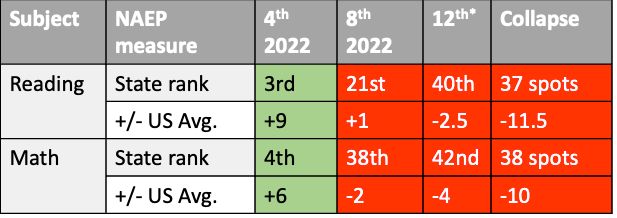
Here are his numbers, drawn from NAEP reports:

With that in mind, here is a view of Florida’s 2022 NAEP scores peaking in elementary school and dramatically worsening with the older cohorts —- which is ALL of the red numbers after the green baseline.

I personally put no stock in the twelfth grade numbers (which Billy extrapolated) because NAEP stopped testing seniors a decade ago. Seniors know that NAEP doesn’t count and they don’t do their best. Some don’t even try. Their answer sheets had doodles, or some just picked the (A) answer to every question or some were blank.

But the stark drop from fourth grade to eighth grade says something’s fishy in Florida.

The ever wise Jan Resseger points out that the Ohio House overwhelmingly voted 82-10 to end the policy of holding back third graders who don’t score proficient on the state reading test. Now, she hopes that the State Senate will complete the elimination of this disastrous experiment. The idea that children will become better readers if they are failed is nonsense. Years of experience and research shows that failure leads to negative consequences, causing a loss of confidence, a sense of failure and higher dropout rates in later years.

She writes:

Ohio’s Third Grade Guarantee, enacted by the legislature in 2012 and implemented beginning in the 2013-2014 school year, requires that students who do not score “proficient” on the state’s third grade reading test must be retained for another year in third grade. Brown reports that,”Ohio has retained around 3,628 students per year.”

Jeb Bush and his ExcelInEd Foundation have been dogged promoters of the Third Grade Guarantee, but last May, the Columbus Dispatch’s Anna Staver traced Ohio’s enthusiasm for the Third Grade Guarantee to the Annie E. Casey Foundation: “In 2010, the Annie E. Casey Foundation released a bombshell special report called ‘Early Warning! Why Reading by the End of Third Grade Matters.’ Students, it said, who don’t catch up by fourth grade are significantly more likely to stay behind, drop out and find themselves tangled in the criminal justice system. ‘The bottom line is that if we don’t get dramatically more children on track as proficient readers, the United States will lose a growing and essential proportion of its human capital to poverty… And the price will be paid not only by the individual children and families but by the entire country.’”

But it turns out that promoters of the Third-Grade Guarantee ignored other research showing that when students are held back—in any grade—they are more likely later to drop out of school before they graduate from high school. In 2004, writing for the Civil Rights Project, Lisa Abrams and Walt Haney reported: “Half a decade of research indicates that retaining or holding back students in grade bears little to no academic benefit and contributes to future academic failure by significantly increasing the likelihood that retained students will drop out of high school.” (Gary Orfield, ed., Dropouts in America, pp. 181-182)

Why does holding children back make them more likely to drop out later? In their book, 50 Myths & Lies That Threaten America’s Public Schools, David Berliner and Gene Glass explain the research of Kaoru Yamamoto on the emotional impact on children of being held back: “Retention simply does not solve the quite real problems that have been identified by teachers looking for a solution to a child’s immaturity or learning problems…Only two events were more distressing to them: the death of a parent and going blind.” Berliner and Glass continue: “Researchers have estimated that students who have repeated a grade once are 20-30% more likely to drop out of school than students of equal ability who were promoted along with their age mates. There is almost a 100% chance that students retained twice will drop out before completing high school.” (50 Myths & Lies That Threaten America’s Public Schools, pp. 9-97)

In a recent report examining the impact of Third-Grade Guarantee legislation across the states, Furman University’s Paul Thomas explainsthat short term gains in reading scores after students are held back are likely to fade out in subsequent years as students move into the upper elementary and middle school years. But, Thomas quotes the National Council of Teachers of English on how the lingering emotional scars from “flunking a grade” linger: “Grade retention, the practice of holding students back to repeat a grade, does more harm than good:

  • “retaining students who have not met proficiency levels with the intent of repeating instruction is punitive, socially inappropriate, and educationally ineffective;
  • “basing retention on high-stakes tests will disproportionately and negatively impact children of color, impoverished children, English Language Learners, and special needs students; and
  • “retaining students is strongly correlated with behavior problems and increased drop-out rates.”

Here is what Thomas recommends instead: “States must absolutely respond to valid concerns about reading achievement by parents and other advocates; however, the historical and current policies and reforms have continued to fail students and not to achieve goals of higher and earlier reading proficiency by students, especially the most vulnerable students who struggle to read.” Specifically, Thomas urges policymakers to eliminate: “high-stakes policies (retention) around a single grade (3rd) and create a more nuanced monitoring process around a range of grades (3rd-5th) based on a diverse body of evidence (testing, teacher assessments, parental input)…. Remove punitive policies that label students and create policies that empower teachers and parents to provide instruction and support based on individual student needs.”