Archives for category: Billionaires

Confidential documents were leaked to the media in Tennessee revealing collaboration among out-of-state interests to buy seats in the legislature for anti-public school candidates. As you would expect, the funders included Koch and DeVos. The goal is to privatize school funding.

NASHVILLE, Tenn. (WTVF) — Confidential documents reveal that a group of school privatization groups, each claiming to be separate entities with separate agendas, actually work together to try to buy seats in the Tennessee legislature for candidates who are willing to vote against traditional public schools.

The documents, leaked to NewsChannel 5 Investigates, show how those groups — working as part of what they call the “Tennessee Coalition for Students” — sometimes try to convince voters that politicians who support traditional public schools are just bad people.

Most of those in the “Tennessee Coalition for Students” do not live in Tennessee. Not Betsy DeVos. Not Charles Koch.

The Houston Chronicle published a stunning editorial denouncing the voucher legislation that Governor Abbott demands. Abbott has called four special sessions of the Legislature, and so far rural Republicans have blocked vouchers. Now the Governor threatens to run a candidate in the primary against every Republican who opposes vouchers. Why the pressure? To satisfy two billionaires.

The editorial board writes:

In March, when Arkansas Gov. Sarah Huckabee Sanders signed the state’s new school voucher program into law, she repeated several talking points that advocates use to justify using taxpayer dollars to subsidize private school tuition.

“We’ve seen how the status quo condemns Arkansans to a lifetime of poverty,” said Sanders. “We’re tired of sitting at the bottom of national education rankings.”

Arkansas tried to avoid the pitfalls of some other states’ voucher programs. Participating private schools would have to select a standardized test to use — a small measure of, if not accountability, at least transparency. Likewise, the schools must prove they are accredited or working toward accreditation. And the state set eligibility requirements that should have helped target funds toward the neediest students, including those in foster care, enrolled in failing public schools, experiencing homelessness or living with a disability.

But in the first annual report on the program since its launch, the state found that of the more than 4,700 participants, nearly all were either new students enrolling in kindergarten or existing private school students.

The promise of transforming the lives of poor students trapped in failing public schools hasn’t materialized. Instead, the state has taken on significant new costs to fund both existing public school students and voucher recipients.

SPECIAL SESSION: School vouchers, border bills fall short as Gov. Abbott calls fourth session

From what we can see, Texas lawmakers — whom Gov. Greg Abbott called abruptly back into special session Tuesday for the fourth time this year — have worked to craft school voucher bills that also seek to avoid some of the worst abuses seen in other states. Bills have included some degree of required testing, fraud guardrails, effective enrollment caps and prioritization for lower-income students and those with disabilities. There have also been sweeteners for folks planning to stay in public schools: an increase in the per-student allotment and one-time teacher bonuses, among others. As voucher bills go, the House version proposed last special session was one of the most palatable around.

It still wasn’t good enough for Abbott, who continues to push for a more universal program.

And it isn’t good enough for us, either. Because there is no such thing as a good voucher bill. Not the bill passed by the Senatethat would create $8,000 vouchers nor the one that, for the first time this year, made it through the House committee Friday that would offer students $10,500 annually to attend private schools. Even seemingly benign or narrowly tailored bills have a way of ballooning in cost and generating underwhelming results.

Not only have wide-scale voucher programs largely failed to produce resounding academic improvements for participants, states have consistently seen the programs benefit existing private school students, whose parents most likely could already afford the tuition. They don’t really benefit the struggling public school students often used to sell them.

In Arkansas, restrictions meant to target students with disabilities have been almost meaningless after the state lowered its standards for approval. Investigative reporting there revealed that some of the 44% of students who were granted vouchers based on disabilities had as little as a doctor’s note worth of documentation. Here in Texas, the current House version — an omnnibus school spending bill with education savings accounts wedged inside like a booby trap waiting to spring — makes clear that students who are currently in private schools would still be eligible for the voucher.

TOMLINSON: Texas school vouchers would be financially ruinous, fundamentally unfair or quite likely, both

Then there’s the price tag. The estimated price of the Senate’s voucher program put forward in the previous session was $500 million for the first year.

But buyer beware, that’s just the first year. What voucher advocates want is a foot in the door. And within two or three budget cycles, the number of participants will soar and — more than likely — all those careful (or not so careful) restrictions meant to narrow the program would disappear.

“They’re telling you you’ve got an interest free payment: You can sign up to get vouchers for the next, say, two, three budget cycles. And then the price tag really comes due,” said Josh Cowen, a policy analyst and professor of education policy at Michigan State University. He has been following voucher bills — often nearly identical ones — working their way through state legislatures and sees a cautionary tale in Arkansas.

While some districts may feel the loss of public funding, the real threat, Cowen explains, is that this program will end up helping existing private school families. Meaning the state — and you, dear taxpayer — will be on the hook for two systems.

There are many reasons to oppose vouchers: They don’t guarantee academic improvements; they’ve been shown to increase segregation; they don’t protect the legal rights of students with disabilities in private schools that can discriminate against them; they use public dollars to support private and often religious instruction.

Lawmakers can nip and tuck to address some concerns. But there’s not much they can do to make vouchers less economically disastrous or to slake the thirst of deep-pocketed, pro-voucher advocates pouring in buckets of dollars. Those Wilks and Dunn types aren’t funding this because they want to help low-income students escape failing public schools. They want a universal program that undoes the power of the public school as a secular, accountable, publicly funded institution.

CARTOON EXPLAINER: Austin’s the new Kremlin! A guide to vouchers and puppet masters Wilks and Dunn.

Some want to use carrots to lure lawmakers. Others prefer a stick, threatening to primary out those rural Republicans who have stood up time and again for their communities and against vouchers. There’s a reason this is so hard. It’s clear that, after decades of bipartisan rejection, Texans don’t want this voucher scheme.

So why are we on the verge of passing it, of making the same mistake as Arkansas and other states?

State Rep. James Talarico, D-Austin, said it best amid the marathon testimony that opened the latest special session: “All this for one man and two billionaires.”

Only Abbott, Wilks and Dunn will benefit if bipartisan opposition crumbles. Texas public schoolchildren and taxpayers will lose.

Some stories are too outrageous to be true, and yet they are. This is one of them, as reported by Jason Garcia on his blog “Seeking Rents.”

Koch Industries owns a major pulp mill in Taylor County, Florida, where one of five people lives in poverty. Koch recently announced that it was shutting down the mill and laying off all of its 500+ workers. At the same time, the closed mill might receive a large tax break because some of its machinery was damaged by a hurricane. This is not helpful to the workers who will be unemployed but will be a nice gift to Koch Industries, a multi-billion dollar conglomerate. Always annoying to see our tax dollars flow to needy billionaires, instead of laid-off workers.

Garcia, a journalist who exposes corporate corruption, writes:

In mid-September, just three weeks after Hurricane Idalia tore through Taylor County in North Florida, the tiny community suffered a second disaster.

The company that operates a large pulp-and-fiber mill in the area — a 69-year-old factory known locally as the “Foley mill” that has long been one of the region’s most important employers — announced that it would shut the facility down and lay off all 500-plus people who work there.

It’s a devastating blow to Taylor County, a timber-dependent community with a shrinking population of fewer than 22,000 people where one-in-five families live in poverty. A report by the University of Florida estimates the Foley mill closure will lead to the loss of approximately 2,000 jobs in total, including the truckers and loggers who supply the mill with slash pine.

And now Florida might hand a farewell tax break to the fleeing company — which is part of Koch Industries, the global conglomerate led by billionaire Republican donor Charles Koch.

The potential tax break for Koch Industries is included in a roughly $420 million hurricane aid package that Florida’s Republican-controlled state Legislature is expected to approve this week, during a four-day special session in Tallahassee.

The same tax-break legislation meant to ease the damage wrought by Hurricane Idalia showers benefits on another multi-billionaire.

Garcia writes:

The problem is that most of the timberland in this particular area is owned by one person: Billionaire investor Thomas Peterffy, one of the 100 wealthiest people in the world, according to Forbes.

It’s not much of an exaggeration to say that Peterffy owns Florida’s Big Bend. He purchased more than 500,000 acres in the region about eight years ago — an enormous tract of land that was believed the largest contiguous piece of undeveloped property in private hands east of the Mississippi River.

Property records show that Peterffy owns about 380,000 acres in Taylor County alone, through his company, Four Rivers Land & Timber. That’s more than half the land in the entire county. And virtually all of it is in timber production.

And while there’s little doubt that Peterffy’s timber lands were hit hard by Hurricane Idalia, a land baron worth an estimated $25.3 billion probably doesn’t need help from taxpayers to deal with it.

To be clear: I’m not suggesting that Florida lawmakers drew up these tax breaks specifically to help Koch Industries or Thomas Peterffy — both of whom have been big donors to DeSantis during his time as governor.

But it is reasonable to ask, as Garcia does, why tax breaks are being doled out to billionaires who don’t need the money, while there are so many people in Taylor County who do.

Last week, ProPublica wrote about billionaire Tim Dunn and his efforts to defeat a $1.4 billion bond issue in Midland, Texas. Dunn ran his campaign through a Dark Money nonprofit that is staffed by his colleagues. Dunn wants a voucher program for the state and opposes new funding for public schools.

Allies of influential Texas billionaire Tim Dunn are pushing ahead in Austin with efforts to create a private-school voucher system that could weaken public schools across the state. Meanwhile, Dunn’s associates in his hometown of Midland are working to defeat a local school bond proposal that his district says it desperately needs.

Dunn, an evangelical Christian, is best known for a mostly successful two-decade effort to push the Texas GOP ever further to the right. His political action committees have spent millions to elect pro-voucher candidates and derail Republicans who oppose them. Defend Texas Liberty, the influential PAC he funds with other West Texas oil barons, has come under fire after The Texas Tribune revealed that the PAC’s president had hosted infamous white supremacist Nick Fuentes for an October meeting and that the organization has connections to other white nationalists.

Less known are Dunn’s efforts to shape politics in his hometown of Midland, which will come to a head next week. On Tuesday, residents in the Midland Independent School District will vote on a $1.4 billion bond, the largest in its history, after rejecting a smaller measure four years ago. A dark-money organization whose leaders have ties to Dunn’s Midland oil and gas company, as well as to a prominent conservative public policy organization where Dunn serves as vice chairman, have become among the loudest voices against the bond.

On Sept. 21, less than two months before the Midland bond election, three Midland residents with deep connections to Dunn and his associated public policy organization registered a “social welfare” nonprofit called Move Midland.

The nonprofit is headed by Rachel Walker, a public affairs manager for Dunn’s oil and gas company, CrownQuest Operating LLC, according to public records. A second member, Ernest Angelo, is a former Midland mayor and board member of the Texas Public Policy Foundation, a conservative think tank that Dunn has helped lead for more than two decades. The third member of the nonprofit’s board is Elizabeth Moore, a former West Texas development officer for the Texas Public Policy Foundation.

But then the voters got a chance to be heard. They said NO to Tim Dunn!

Update, Nov. 8, 2023: On Nov. 7, Midland school district voters approved a $1.4 billion bond proposal by a 56% to 44% vote, rejecting arguments against the measure from a nonprofit led by associates of billionaire oilman Tim Dunn.

Thom Hartmann writes here about the most consequential Supreme Court decision of our time: Citizens United. That decision unleashed the power of big money to control our politics. It’s consequences have diminished our ability as a nation to take action on pressing issues. It has allowed the Uber-rich to buy politicians. That always existed to some extent. Citizens United established the practice as business as usual.

Hartmann writes:

According to Talkers Magazine, the “Bible of the Talk Radio Industry,” I talk with around 6 million people every week on my nationally syndicated call-in radio/TV show. What I’m hearing, increasingly (I’ve been doing this program for 20 years now), is frustration bordering on despair about the inability of America to get basic, necessary things done.

Why is it, people ask, that we can’t do anything about guns amidst all these mass shootings? Or homelessness? Or affordable healthcare and education? Why are we moving so slowly on climate change? How did social media get excused from responsibility for its own content and then become overrun by Putin bots and Nazis?

And why do we let the billionaires who own social media (along with all the other billionaires) get away with only paying an average 3.2% income tax when the rest of us are making up for it by paying through the nose? Why can’t Congress pass a simple budget or raise taxes enough to stop running deficits?

What happened, people ask, that caused America’s politicians — in the years after JFK — to stop listening to the people who elect them? Why is it that (other than tax cuts), when Republicans have power or the ability to block Democrats efforts, nothing gets done?

The simple and tragic answer to all these questions comes back to a single root cause: money in politics. Or, to be more specific, Republicans on the Supreme Court having legalized political bribery (and, thus, functional ownership) of judges and legislators, both federal and state.

In 1976, in response to an appeal by uber-rich New York Republican Senator James Buckley, the Court ruled that wealthy people in politics couldn’t be restrained from using their own money to overwhelm their political opponents. They then went a step farther and struck down other limitations on billionaires using their own money to “independently” promote the campaigns of politicians they like.

Their rationale was that restrictions on rich people buying political office “necessarily reduce the quantity of expression by restricting the number of issues discussed, the depth of the exploration, and the size of the audience reached. This is because virtually every means of communicating ideas in today’s mass society requires the expenditure of money.”

In other words, for morbidly rich people to have “free speech,” they must be able to spend as much money on politicking as they want. If you don’t have millions or billions, your free speech is pretty much limited to how loud you can yell: this was a decision almost entirely of, by, and for the morbidly rich.

Two years later, in 1978, four Republicans on the Court went along with a decision written by Republican Lewis Powell himself in declaring that corporations are “persons” entitled to human rights under the Bill of Rights (the first 10 amendments to the Constitution), including the First Amendment right of free speech.

And free speech, as they’d established two years earlier, meant the ability to shovel money into political campaigns. Effective in April of 1978, elections could go to whoever spent the most money.

Democrats largely ignored the rulings (until 1992). They hadn’t been the party of the rich since the 1920s, and, with a third of American workers in a union, those unions provided plenty of money for political campaigns.

But Republicans — specifically, the 1980 Reagan campaign — jumped forward with both hands out for all the cash they could grab. The gift they offered wealthy people who supported them? Tax cuts, even if they drove the deficit sky high.

There were still quite a few campaign restrictions in place in 2010, when five Republicans on the Supreme Court did it again, striking down literally hundreds of state and federal laws and regulations by doubling-down on their assertion that “money is free speech” and “corporations are persons with human rights.”

Thus, we can track many of the worst aspects of America’s political dysfunction to these three corrupt Supreme Court decisions, as I detail in The Hidden History of the Supreme Court and the Betrayal of America and The Hidden History of American Oligarchy.

Prior to the Court’s Citizens United decision, for example, there was a bipartisan consensus in Congress that climate change was caused by burning fossil fuels and that we should do something about it, as Senator Sheldon Whitehouse so eloquently documents.

John McCain campaigned for president on a platform of doing something about climate change: he was the lead cosponsor of the Climate Stewardship Act, which had multiple other Republican cosponsors. At the time, he said:

“While we cannot say with 100 percent confidence what will happen in the future, we do know the emission of greenhouse gases is not healthy for the environment. As many of the top scientists through the world have stated, the sooner we start to reduce these emissions, the better off we will be in the future.”

The Clean Air Planning Act was supported by Republican Senators Lamar Alexander, Lindsay Graham, and Susan Collins. Republican Senator Olympia Snow was the lead cosponsor of the Global Warming Reduction Act of 2007. Multiple Republicans supported the Low Carbon Economy Act and the Clean Air/Climate Change Act.

In 2009, Republicans supported the Raise Wages, Cut Carbon Act and the Waxman-Markey carbon cap-and-trade proposal. Maine Republican Susan Collins was the lead cosponsor of the Carbon Limits and Energy for America’s Renewal Act, a bill that would have imposed a fee on burning fossil fuels. At the time, she said:

“In the United States alone, emissions of the primary greenhouse gas carbon dioxide have risen more than 20 percent since 1990. Clearly climate change is a daunting environmental challenge…”

And then, in 2010, everything changed.

Clarence Thomas, actively groomed for decades by fossil fuel and other billionaires, became the deciding vote in Citizens United, legalizing not only his own corruption but that of every Republican in Congress.

Once the fossil fuel industry could pour unlimited money into either supporting — or, perhaps more importantly, destroying — the candidacy of any Republican politician, every Republican in the House and Senate began to say, “What climate change?”

As Senator Whitehouse said on the floor of the Senate:

“I believe we lost the ability to address climate change in a bipartisan way because of the evils of the Supreme Court’s Citizens United decision. Our present failure to address climate change is a symptom of things gone awry in our democracy due to Citizens United. That decision did not enhance speech in our democracy; it has allowed bullying, wealthy special interests to suppress real debate.”

When Poppy Bush was president, the world confronted a crisis with acid rain destroying monuments and buildings; Democrats and Republicans came together and put into law a sulfur dioxide cap-and-trade “free market solution” that largely solved the problem.

Why can’t we do the same with a cap-and-trade system for carbon pollution from fossil fuels like the European Union, Australia, New Zealand, and South Korea have already done? Citizens United.

Similarly, why can’t America get our gun crisis under control? We’re the only country in the world where schoolchildren are subjected to the monthly terror of active shooter drills.

Bullets are the leading cause of death among our nation’s children. But no Republican will take on the issue because they know the firearms industry and its front groups will destroy them with a waterfall of money for their inevitable opponent in the next election. Citizens United.

Our public schools are crumbling as the charter and private school industries pour millions into politicians’ coffers. Instead of fixing our schools and raising our educational standards, the private school industry has gotten Republican governors in several states to offer vouchers to every student in the state.

It’s busting the budgets of states (once the public schools are dead, they’ll cut back on the generosity of the vouchers), but making literally billions in profits for the private school industry — money that’s then, in part, recycled back to the politicians promoting their interests. Citizens United.

Please, please, please open the link and read the rest of this brilliant article.

Thom Hartmann has checked out the record and public statements of the new Speaker of the House of Representatives, Representative Mike Johnson of Louisiana. He is even more of an extremist than his idol Donald Trump.

Hartmann writes:

The election of Louisiana’s Mike Johnson as House Speaker proves the premise that all the GOP has left are Donald Trump and hate.

As Congressman Jamie Raskin told reporters yesterday:

“Donald Trump has cemented his control over the Republican conference in the House of Representatives. He has a stranglehold on the Republican Party. Even as he faces 91 criminal charges and several of his election lawyers have pleaded guilty now to election-related offenses, one of his enablers on January 6 has just become the speaker of the House Representatives.”

Johnson’s hate of Democrats is so deep that he led a Trump-backed effort in the House to get Republicans to back a lawsuit by 18 Republican state attorneys general to overturn Biden’s election as president.

Their lawsuit had no merit and no facts — everybody, including the Republicans involved, knew that Biden had won fair-and-square — but Republican hate of Democrats is now so deep that the idea of Democrats legitimately governing after winning an election is repugnant to them. No matter how big the Democrats’ victory (7 million votes in this case) may be.

Johnson went public with his support of Trump’s hateful, poisonous Big Lie just a week after the 2020 election, saying:

 “You know the allegations about these voting machines, some of them being rigged with this software by Dominion, there’s a lot of merit to that…They know that in Georgia it really was rigged.”

As The Washington Post noted at the time:

“Rep. Mike Johnson (R-La.), head of the conservative Republican Study Committee, spearheaded the effort to round up support on Capitol Hill. Johnson emailed all House Republicans on Wednesday to solicit signatures for the long-shot Texas case after Trump called. The congressman told his colleagues that the president ‘will be anxiously awaiting the final list to review.’”

Johnson got 106 of the 196 Republicans then in the House to sign on to the effort to force four swing states to throw out Democratic votes and declare Trump emperor for life: he was the legal architect of the argument. It doesn’t get more hateful against our republican form of government than that effort to destroy confidence in the vote at the cornerstone of our democracy.

Johnson’s hate of women having agency over their own bodies and lives is so intense that he has repeatedly championed a nationwide ban on abortion. 

His wife Kelly, a “licensed pastoral counselor” with whom he’s in a “covenant marriage,” makes money from Louisiana Right To Life, and before being elected to the House in 2016 he was an attorney for the far-right-billionaire-supported Alliance Defending Freedom that pushed the Dobbs case before the Supreme Court.

While there, he helped sue New York and New Jersey to force them to allow official state license plates that displayed an anti-woman, anti-abortion message; sued New Orleans to try to block benefits for the partners of queer city employees; and promoted a “National Day of Truth” to encourage homophobic students to hate on their LGBTQ+ peers.

Johnson and the GOP explicitly hate queer people and their allies.

“Radical homosexual advocacy groups” are promoting “the culture’s assault on traditional values,” Johnson wrote in an op-ed for a Louisiana newspaper. That “assault,” of course, was gay marriage, something that horrifies Johnson and his wife. 

He wrote:

“Same-sex ‘marriage’ selfishly and deliberately deprives children of either a mother or a father. Children need both. Homosexual relationships are inherently unnatural and, the studies clearly show, are ultimately harmful and costly for everyone.

“Society cannot give its stamp of approval to such a dangerous lifestyle. If we change marriage for this tiny, modern minority, we will have to do it for every deviant group. Polygamists, polyamorists, pedophiles, and others will be next in line to claim equal protection. They already are. There will be no legal basis to deny a bisexual the right to marry a partner of each sex, or a person to marry his pet.”

Johnson also supports a federal version of DeSantis’ “Don’t Say Gay” law that would outlaw any discussion of queer people in any public school classroom in America. In another anti-gay newspaper screed, Johnson wrote:

“Your race, creed and sex are what you are, while homosexuality and cross-dressing are things you do. This is a free country, but we don’t give special protections for every person’s bizarre choices. Where would it end? This is one Pandora’s box we shouldn’t open.”

While Johnson hates queer people, he apparently loves Vladimir Putin, an affection that has earned him the loyalty and help of Donald Trump.

Last month he joined Matt Gaetz and 93 other Republicans in voting to cut off all US military aid to assist Ukraine’s survival in the face of Russia’s ongoing terror campaign.

He’s also a friend to mass shooters and the psychopaths at the NRA. 

Johnson repeatedly voted against gun safety and gun control legislation, and voted against re-authorizing the Violence Against Women Act.

Hating on Medicare and Social Security is another specialty of Johnson and the GOP. As Social Security Works Executive Director Alex Lawson noted yesterday:

“Rep. Mike Johnson has a long history of hostility towards Social Security and Medicare. As Chair of the Republican Study Committee from 2019-2021, Johnson released budgets that included $2 trillion in cuts to Medicare and $750 billion in cuts to Social Security, including:
— Raising the retirement age
— Decimating middle class benefits
— Making annual cost-of-living increases smaller
— Moving towards privatization of Social Security and Medicare.”

Johnson also pushed for $3 trillion in cuts to Medicaid and the Affordable Care Act (Obamacare), saying slashing the entitlement programs should be Congress’ “top priority.” Johnson is also a huge advocate for a Catfood Commission to figure out ways to slash Social Security benefits to seniors (thus forcing them to eat catfood: the White House refers to it as a “death panel for Social Security”).

Like Red state Republican politicians beholden to the tobacco, alcohol, and pharmaceutical industries, Johnson also hates marijuana. He’s repeatedly argued and voted against legalization, as well as helping shoot down a bill that would let legal pot dispensaries use banks to conduct their business.  

Hating on science and our children’s future is a feature, not a bug, of Republican politics, and Mike Johnson fits right in. The largest single group of donors to his political career have been the oil and gas industries, and he happily takes their money and spreads their lies. For example, he argued:

“The climate is changing, but the question is, is it being caused by natural cycles over the span of the Earth’s history? Or is it changing because we drive SUVs? I don’t believe in the latter. I don’t think that’s the primary driver.”

The League of Conservation Voters gave his environmental record a 0 percent (yes, zero) score for 2022: this guy has burrowed so deeply in Big Oil’s pocket that he’s like a blood-filled tick on a shaggy dog. He’ll never let go.

On voting rights, Johnson hates voters in Blue cities in Red states as much as their own Republican legislatures do. A big fan of voter suppression laws, he argued that making it harder to vote and purging people from voter rolls would help the GOP in the 2022 election:

“They’re making sure that the election results can be counted upon, and that’s a critical thing for us to do.”

That was followed by his voting against the John Lewis Voting Rights Act and the For The People Act, both of which would have guaranteed Americans’ right to vote regardless of race, religion, or geography. On the other hand, he voted for a Republican bill that would have enshrined GOP voter suppression efforts nationwide. 

Like Rand Paul and Tommy Tuberville, Johnson apparently also hates our men and women serving in the armed forces.

He voted against the Honoring our Promise to Address Comprehensive Toxics (PACT) Actthat President Biden was cheerleading because it would aid service members like Biden’s son Beau who became deathly sick because of exposure to open-air burn pits and other toxins.

He also voted against a year-end package of bills to aid service members, including requiring states to honor the professional licenses of military spouses who find themselves stationed in states other than where they were originally certified. And he joined Tuberville in his opposition to the Pentagon paying to fly raped servicewomen stationed in countries or states where abortion is illegal to places where it is available.

Johnson has supported a few Republican military spending bills, but only, as military.comnoted, when they are “packed with GOP policy riders such as provisions to bar abortion services, transgender health care, and LGBTQ+ Pride flags at the VA.”

Johnson, like most Republicans who hate the idea of Brown people entering our country legally, is also a “border hawk,” having visited our southern border with Donald Trump and introduced two pieces of legislation that would restrict immigration and refugee status. Speaking of his desire to “build a wall” and keep would-be refugees out of the US, he said:

“Now, I have no illusions about this. I’m sure that President Biden will veto anything we send him, but it will send a very strong message. If we can’t override a veto, we’ll be ready to run when the next Republican president is elected two years later.”

Republicans like Johnson love to plaster the word “freedom” all over everything they do. But they’re just fine with a for-profit prison industry lobbying for harsher sentences, and to keeping draconian drug laws in place.

When Republicans say “freedom,” it’s a safe bet they mean they want the freedom to hate on minorities, the freedom of rich people and giant corporations to screw average working people, and the freedom of billionaires to continue paying only around 3 percent of their income in income taxes.

In MAGA Mike Johnson (what Trump calls him), Republicans have found the perfect embodiment of their deplorable basket of hatreds. At this point, the only “loves” they have are rightwing billionaires and the fossil fuel industry. And, of course, Trump’s good buddy and fossil fuel oligarch Vladimir Putin.

Thank you for reading The Hartmann Report. This post is public so feel free to share it.
Mike DeGuire is a veteran educator in Denver who has been a teacher and a principal in the public schools. He has researched the heavy hand of billionaires in expanding charter schools in Denver. He explains here that the current school board elections have been heavily influenced by billionaires, mostly out-of-state. As usual, they are hiding behind the name of a “parent” group. He predicts that their candidates will have a 10-1 funding advantage over those they run against. The billionaires plan to buy control of the school board.

He writes:

The Denver school board race is off and running, and several key groups have announced their endorsements.

The Denver Classroom Teachers Association, the local teacher organization, endorsed Charmaine Lindsay, Scott Baldermann, and Kwame Spearman. Denver Families Action endorsed Kimberlee Sia, John Youngquist, and Marlene Delarosa.

Who is Denver Families Action? Chalkbeat says it is the “political arm of a relatively new organization,” Denver Families for Public Schools,formed with the backing of several local charter school networks, and they get funding from The City Fund, a pro-charter education reform national organization.

What is City Fund? How much funding did they give to this new group called Denver Families for Public Schools? What Denver Public Schools “families” do they represent?

According to Influence Watch, The City Fund is an “education organization that funds initiatives that promote the growth of charter schools and other school choice organizations. It also funds activist organizations that support increasing charter school access and school choice programs.” Chalkbeat reports that City Fund was started in 2018 by two billionaires, Reed Hastings and John Arnold, who donated over $200 million to “expand charter schools or charter-like alternatives in 40 cities across the country.”

Reed Hastings has called for the elimination of democratically elected school boards, he serves on the national KIPP charter school board, and he built a training center in Bailey, Colorado, to house the Pahara Institute, an education advocacy and networking group that supports the expansion of charter schools. In December, 2020, he spelled out his vision. “Let’s year by year expand the nonprofit school sector … for the low-performing school district public school — let’s have a nonprofit public school take it over.”

The City Fund set up its own political group, a PAC, called Campaign for Great Public Schools (also called City Fund Action), to give money to organizations that promote charter schools and lobby to privatize education. Since its formation, the Campaign for Great Public Schools has given millions to Education Reform Now, which is the political arm of Democrats for Education Reform. DFER is a “New York-based political action committee which focuses on encouraging the Democratic Party to support public education reform and charter schools.”

Campaign for Great Public Schools also gave millions to the American Federation for Children, which is “a conservative 501(c)(4) dark money group that promotes the school privatization agenda via the American Legislative Exchange Council (ALEC) and other avenues. It is the 501(c)(4) arm of the 501(c)(3) non-profit group the Alliance for School Choice. The group was organized and is funded by the billionaire DeVos family.”

The City Fund Action PAC also funds the National Alliance for Charter Schools, 50 CAN, and numerous other organizations that support the expansion of charter schools.

Denver Families for Public Schools received $1.75 million in 2021 from the Campaign for Great Public Schools to promote their three selected candidates in the current Denver school board race. Denver Families for Public Schools functions as a 501(c)(4), which means it can donate unlimited amounts of money in political elections without disclosing its donors. It functions as an “astroturf” group by engaging in the practice of creating the illusion of widespread grassroots support for a candidate, policy, or cause when no such support necessarily exists. It set up a website, Facebook page, hired staff and recruited others to lobby for its cause. It posts videos of parents who say they don’t like the current school board candidates if they are opposed to them. It participates in forums to promote its selected candidates.

When Denver Families Action announced its school board endorsements in August, the leading fundraiser in the at-large seat at that time, Ulcca Hansen, withdrew from the race since she did not gain its endorsement. Hansen stated she could not win without the significant financial resources that come from “soft side spending.”

This money is also referred to as outside spending or “dark money,” because the funders of the outside groups often remain secret. Hansen felt the dark money would outpace campaign spending by a 10 to 1 margin. The $1.75 million that Denver Families for Public Schools received from The City Fund will be a major factor in the DPS school board race.

Denver citizens need to know who is behind the endorsements, who pays money for the ads, the flyers, the canvassing, the messaging on social media, and why they are supporting their candidates for the school board.

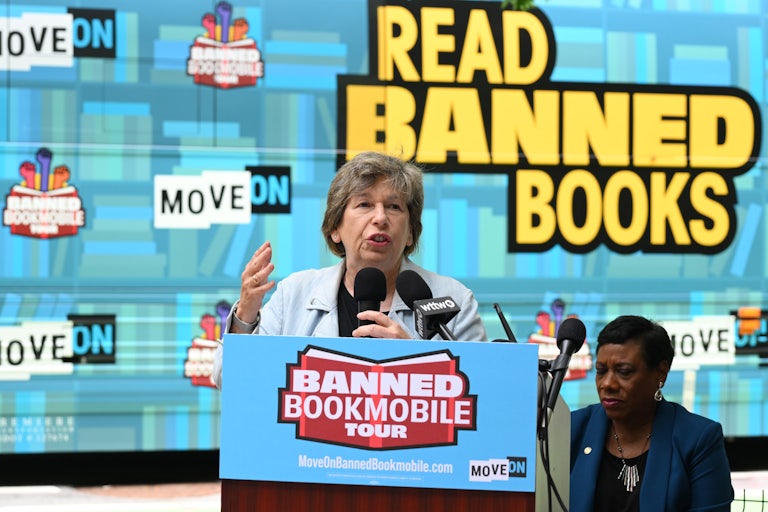
The New Republic convened a meeting to discuss Trump, book banning and the culture wars. Randi Weingarten described the attack on schools as a coordinated strategy to destroy public schools and promote vouchers. Edith Olmsted of The New Republic interviewed her. None of this is new to readers of this blog, but the American public needs to hear this message. Again and again.

Book Bans Are a Conservative Plot to Destroy Public Schools, Says Randi Weingarten, The teachers union head denounced the “extremist strategy,” which also includes voucher campaigns and manufactured outrage over critical race theory.

DANIEL BOCZARSKI/GETTY IMAGES FOR MOVEON

Teachers union head Randi Weingarten says that the campaign by conservatives to ban books isn’t about the books at all, but part of a broader strategy to destroy public schools—one that was supercharged by the pandemic.

“You take the agita and the anxiety that people had at Covid, that fear, and you combine it with a right wing who has wanted to kill public schools for years and take that money for vouchers, and you have the scenario we have,” Weingarten, the president of the American Federation of Teachers, said Wednesday at The New Republic’s Stop Trump Summit.

Vouchers, which use public education dollars to fund private and religious school attendance, are just one pillar of the conservative campaign to “undermine, destroy, and defund” public schools, she said. The other two are book banning and manufactured outrage over critical race theory.

Weingarten pointed to conservative activist Chris Rufo and a comment he made at Hillsdale College, a Christian nationalist school, in which he admitted that focusing on these issues was all part of a master plan to promote universal vouchers: “To get to universal school choice, you really need to operate from a premise of universal public school distrust.”

In an interview with TNR after the event, Weingarten explained the “extremist strategy” Rufo and other conservatives have used to defund public schools. “The hook was trust. If you really create as much distrust as possible in public schooling, then parents will look at privatization as an option,” she said.

That’s where critical race theory comes in.

“[Rufo] tried to make a term that nobody knows so toxic, so that you can weaponize it and make fear,” she said. “Conversations about hard subjects became weaponized as indoctrination. Which is patently ridiculous, and dangerous.”

Race, as well as gender, is the subject conservatives have focused on in their campaigns to ban books in public schools and libraries.

“What [Republican Governor Ron] DeSantis is doing in the so-called ‘war on woke,’ is exactly part of their playbook—to make people afraid of books, and afraid of what we do in school,” Weingarten said. According to Pen America, Florida passed 15 “educational intimidation” bills in the last two and a half years.

The “parents’ rights” movement is made up of a loud minority, Weingarten said, and actively undermines what most parents want. “What we see in Florida is that 60 percent of the book banning has been done by 11 people,” she said.

The AFT has partnered with The New Republic in fighting back against such bans. TNR’s Banned Books Tour has been delivering thousands of banned books across the country this month, most recently in Florida.

ProPublica researched the power of Leonard Leo, the man most responsible for the rightwing majority on the U.S. Supreme Court and other levels of the federal judiciary. Few people know who he is. Now you are among them.

ProPublica writes:

The party guests who arrived on the evening of June 23, 2022, at the Tudor-style mansion on the coast of Maine were a special group in a special place enjoying a special time. The attendees included some two dozen federal and state judges — a gathering that required U.S. marshals with earpieces to stand watch while a Coast Guard boat idled in a nearby cove.

Supreme Court Justice Clarence Thomas’ decadeslong friendship with real estate tycoon Harlan Crow and Samuel Alito’s luxury travel with billionaire Paul Singer have raised questions about influence and ethics at the nation’s highest court.

Caterers served guests Pol Roger reserve, Winston Churchill’s favorite Champagne, a fitting choice for a group of conservative legal luminaries who had much to celebrate. The Supreme Court’s most recent term had delivered a series of huge victories with the possibility of a crowning one still to come. The decadeslong campaign to overturn Roe v. Wade, which a leaked draft opinion had said was “egregiously wrong from the start,” could come to fruition within days, if not hours.

Over dinner courses paired with wines chosen by the former food and beverage director of the Trump International Hotel in Washington, D.C., the 70 or so attendees jockeyed for a word with the man who had done as much as anyone to make this moment possible: their host, Leonard Leo.

I can’t think of anybody who played a role the way he has.

– Richard Friedman, a law professor and historian at the University of Michigan

Short and thick-bodied, dressed in a bespoke suit and round, owlish glasses, Leo looked like a character from an Agatha Christie mystery. Unlike the judges in attendance, Leo had never served a day on the bench. Unlike the other lawyers, he had never argued a case in court. He had never held elected office or run a law school. On paper, he was less important than almost all of his guests.

If Americans had heard of Leo at all, it was for his role in building the conservative supermajority on the Supreme Court. He drew up the lists of potential justices that Donald Trump released during the 2016 campaign. He advised Trump on the nominations of Neil Gorsuch, Brett Kavanaugh and Amy Coney Barrett. Before that, he’d helped pick or confirm the court’s three other conservative justices — Clarence Thomas, John Roberts and Samuel Alito. But the guests who gathered that night under a tent in Leo’s backyard included key players in a less-understood effort, one aimed at transforming the entire judiciary.

Many could thank Leo for their advancement. Thomas Hardiman of the 3rd U.S. Circuit Court of Appeals had ruled to loosen gun laws and overturn Obamacare’s birth-control mandate. Leo had put Hardiman on Trump’s Supreme Court shortlist and helped confirm him to two earlier judgeships.

Kyle Duncan and Cory Wilson, both on the 5th U.S. Circuit Court of Appeals, both fiercely anti-abortion, were members of the Federalist Society for Law and Public Policy Studies, the network of conservative and libertarian lawyers that Leo had built into a political juggernaut. As was Florida federal Judge Wendy Berger, who would uphold that state’s “Don’t Say Gay” law. Within a year of the party, another attendee, Republican North Carolina Supreme Court Justice Phil Berger Jr. (no relation), would write the opinion reinstating a controversial state law requiring voter identification.

Duncan, Wilson, Berger and Berger Jr. did not comment. Hardiman did not comment beyond confirming he attended the party.

The judges were in Maine for a weeklong, all-expenses-paid conference hosted by George Mason University’s Antonin Scalia Law School, a hub for steeping young lawyers, judges and state attorneys general in a free-market, anti-regulation agenda. The leaders of the law school were at the party, and they also were indebted to Leo. He had secured the Scalia family’s blessing and brokered $30 million in donations to rename the school. It is home to the C. Boyden Gray Center for the Study of the Administrative State, named after the George H.W. Bush White House counsel who died this May. Gray was at Leo’s party, too.

A spokesperson for GMU confirmed the details of the week’s events.

The judges and the security detail, the law school leadership and the legal theorists — all of this was a vivid display not only of Leo’s power but of his vision. Decades ago, he’d realized it was not enough to have a majority of Supreme Court justices. To undo landmark rulings like Roe, his movement would need to make sure the court heard the right cases brought by the right people and heard by the right lower court judges.

Leo began building a machine to do just that. He didn’t just cultivate friendships with conservative Supreme Court justices, arranging private jet trips, joining them on vacation, brokering speaking engagements. He also drew on his network of contacts to place Federalist Society protégés in clerkships, judgeships and jobs in the White House and across the federal government.

He personally called state attorneys general to recommend hires for positions he presciently understood were key, like solicitors general, the unsung litigators who represent states before the U.S. Supreme Court. In states that elect jurists, groups close to him spent millions of dollars to place his allies on the bench. In states that appoint top judges, he maneuvered to play a role in their selection.

And he was capable of playing bare-knuckled politics. He once privately lobbied a Republican governor’s office to reject a potential judicial pick and, if the governor defied him, threatened “fury from the conservative base, the likes of which you and the Governor have never seen.”

To pay for all this, Leo became one of the most prolific fundraisers in American politics. Between 2014 and 2020, tax records show, groups in his orbit raised more than $600 million. His donors include hedge fund billionaire Paul Singer, Texas real estate magnate Harlan Crow and the Koch family.

Leo grasped the stakes of these seemingly obscure races and appointments long before liberals and Democrats did. “The left, even though we are somewhat court worshippers, never understood the potency of the courts as a political machine. On the right, they did,” said Caroline Fredrickson, a visiting professor at Georgetown Law and a former president of the American Constitution Society, the left’s answer to the Federalist Society. “As much as I hate to say it, you’ve got to really admire what they achieved.” Belatedly, Leo’s opposition has galvanized, joining conservatives in an arms race that shows no sign of slowing down.

Forbes magazine released its annual list of the 400 richest people in the world, called the Forbes 400. This article includes a link to the 400.

In New York State, Michael Blooomberg is the richest. He is a huge supporter of charter schools, as are many other billionaires.

Lisa Finn of the Patch for the North Fork of Long Island writes:

Overall, the 400 richest billionaires in America are worth $4.5 trillion, tying a record set in 2021. Overall, they are about $500 billion richer than they were a year ago, in large part because of rebounding stock markets and an AI-driven tech boom, Forbes said.

NEW YORK — Billionaire Michael Bloomberg is the wealthiest person in New York, according to The Forbes 400, an annual ranking of America’s super rich released Tuesday.

Billionaires had to have a net worth at least $2.9 billion to be included on the prestigious list, up from $2.7 billion a year ago. Forbes said its net worth calculations use stock prices from Sept. 8.

New York’s former mayor Michael Bloomberg, 81, of Bloomberg LP and the richest person in New York, is worth an estimated $96.3 billion. He is ranked the 10th most wealthy man nationwide.

In April, he was ranked the 7th richest person in the world, according to Forbes.

Inequality may well be at its worst point in our history. A handful of people have as much wealth as the lower 50%. This is unhealthy for our society.

If you want to know more about the consequences of intense inequality, I recommend a book by two British sociologists, Richard Wilkinson and Kate Pickett, called The Spirit Level: Why Greater Equality Makes Societies Stronger.

Their thesis is that the more equality a society is, the happier it is.