Archives for category: Bigotry

Last week, I reported a poll in Educatuon Week, which found that half the public thinks that schools should not teach about racism today. With opinion polls, the results are influenced by many factors, including how the questions are worded. A poll by CBS got very different results.

Greg Sergeant writes in the Washington Post that Democrats should take heart from a CBS News poll: Most Americans oppose book banning. Democrats should stop being defensive.

He writes:

As Democrats debate the GOP’s all-culture-war-all-the-time campaign strategy, here’s a maxim worth remembering: If you’re wasting political bandwidth denying lies about yourselves, you’re losing.

A new CBS News poll offers data that should prod Democrats into rethinking these culture-war battles. It finds that surprisingly large majorities oppose banning books on history or race — and importantly, this is partly because teaching about our racial past makes students more understanding of others’ historical experiences.

The poll finds that 83 percent of Americans say books should never be banned for criticizing U.S. history; 85 percent oppose banning them for airing ideas you disagree with; and 87 percent oppose banning them for discussing race or depicting slavery.

What’s more, 76 percent of Americans say schools should be allowed to teach ideas and historical events that “might make some students uncomfortable.” And 68 percent say such teachings make people more understanding of what others went through, while 58 percent believe racism is still a serious problem today.

Finally, 66 percent say public schools either teach too little about the history of Black Americans (42 percent) or teach the right amount (24 percent). Yet 59 percent say we’ve made “a lot of real progress getting rid of racial discrimination” since the 1960s.

This hints at a way forward for Democrats. Notably, large majorities think both that we’ve made a good deal of racial progress and that we should be forthrightly confronting hard racial truths about our past and present, even if it makes students uncomfortable.

Culture warriors in the Republican Party want to ban all teaching about racism, in the past or present. They pass vague laws that are meant to intimidate teachers.

Their rhetorical game works this way: If you focus too much on the persistence of racial disparities in the present, you’re denying the racial progress that has taken place. You’re telling children that race still matters. You’re not telling a positive or uplifting story about our country. You’re saying America is irredeemable. You’re trying to make children hate our country, each other and themselves.

But this polling suggests many Americans doesn’t necessarily see things this way. Place proper emphasis on the idea that racial progress has been made, and it’s fine to highlight the problems that remain, even if it creates feelings of discomfort. It’s possible to tell a story that is in some ways about progress but also doesn’t whitewash our past.

Republicans and Democrats joined in a rare bipartisan vote to censure extremist Rep. Wendy Rogers. Rogers, a MAGA zealot, took part by video in a white nationalist conference where she called for “public hangings” of high-level officials and used anti-Semitic slurs.

During the conference, speakers made racist remarks and cheered on Russian President Vladimir Putin, comparing the Russian leader favorably to Adolf Hitler.

Rogers, in her remarks, praised Fuentes — an outspoken racist who has said he does not believe women should have the right to vote — as “the most persecuted man in America.”

Republican leaders joined Democrats in voting to censure Rogers.

Thirteen Democrats and 11 Republicans voted for the censure language read on the Senate floor. It was the first time in three decades senators publicly censured one of their own members, and the move was applauded by Gov. Doug Ducey — who just days ago was criticized for his support of Rogers.

Arizona Republic columnist Laurie Roberts commented on the hypocrisy of Governor Doug Ducey, who first defended Rogers, then praised her censure. Ducey raised $500,000 to elect Rogers.

Well, it took a while – far, far too long, in fact – but the unmasking of state Sen. Wendy Rogers has finally begun and what a sight it is to behold.

At long last, a few Republican leaders are beginning to speak out about the far right rock star from Flagstaff, a first-term state legislator who has built a national following as she rants about election conspiracies and George Soros and the cabal of Jews, journalists, political elites and other nefarious characters who plot to create a New World Order.

The Senate on Tuesday actually voted 24-3 to censure her for inciting violence at a white nationalist conference on Friday and conduct unbecoming a senator … or any decent human being.

Gov. Doug Ducey isn’t speaking out, of course. Oh, he issued a statement after the censure vote, saying that “antisemitic and hateful language has no place in Arizona.”

Since Ducey’s comment, Rogers has gone on to speak to white nationalists at the America First Political Action Conference where she heaped praise on conference organizer Nick Fuentes, a Holcaust denier who has warned that America needs to protect its “white demographic core” and on Friday noted that people are comparing Russian President Vladimir Putin to Adolph Hitler, “as if that isn’t a good thing…”

During her pre-recorded speech, Rogers lauded the white nationalists as “patriots” and complained that the country is “forcibly vaccinating people with a bioweapon.” She followed that up with a call for public hangings.

“When we do take back our God-given rights, we will bring these criminals to justice,” she said. “We need to build more gallows. If we try some of these high-level criminals, convict them, and use a newly built set of gallows, it’ll make an example for these traitors who have betrayed our country. They have yet to be justly punished for the crimes they have committed.”

She was just getting started.

Over the weekend, Rogers took to Twitter to fire off post after post of antisemitic and just plain unhinged tripe, decrying the West’s treatment of Russia and calling Ukrainian President Volodymyr Zelenskyy “a globalist puppet for Soros and the Clintons”. Canadian Prime Minister Justin Trudeau, French President Emmanuel Macron and New Zealand Prime Minister Jacinda Arder, she said, “all report to the same Satanic masters.”

“I stand with the Christians worldwide not the global bankers who are shoving godlessness and degeneracy in our face,” Rogers wrote.

No matter what Rogers said, no matter how foul, Ducey remained silent.

FYI, Trump has endorsed Ducey’s opponent, because Ducey was in sufficiently loyal to him.

John Oliver explained the Republican hysteria over “critical race theory.” At bottom, as he shows, the GOP goal is to persuade parents to escape “CRT” by abandoning their local public schools and enrolling in charter schools or seeking vouchers. The leading anti-CRT crusader, Chris Rufo, made this linkage explicit, as Oliver demonstrates, as did Betsy DeVos. The big money supporting the anti-CRT campaign is coming from the same people funding school choice. And, as Oliver explains, “school choice” has its roots in the fight to block school desegregation in the 1950s.

The fight against CRT is being used to silence any teaching about racism today. Teachers are supposed to teach slavery and racism as a strange aberration from our founding principles and to pretend that it no longer exists.

But if it really were the terrifying problem that people like Rufo describe, why was there no uprising against it in the past 40 years? Why didn’t George W. Bush speak up about CRT? WhY was Trump silent about it until 2020? Why now? Is it mere coincidence that the anti-CRT madness took off after the murder of George Floyd and the nationwide protests against racism?

Governor Ron DeSantis and the Florida Legislature passed a law to ban any discussion of homosexuality in school; the legislation is known as the “Don’t Say Gay” law. Other red states are rushing to pass copycat legislation. Some are using their gag orders to target both critical race theory and any discussion of LGBT.

PEN America, the authors’ organization, summarized this frenzy:

Last month PEN America reported that 2022 had seen a steep rise in the introduction of educational gag orders. So far this year, 103 different bills have been introduced in state legislatures across the country, many of which target higher education and feature severe punishments. Cumulatively, they represent a national assault on our education system, censoring both what teachers can say and what students may learn.

Some top line numbers:

  • Since January 2021, 156 educational gag order bills have been introduced or prefiled in 39 different states
  • 12 have become law in 10 states
  • 113 are currently live in 35 different states

Of those currently live:

  • 105 target K-12 schools
  • 49 target higher education
  • 62 include a mandatory punishment for those found in violation

The effort to censor anti-LGBTQ identities is expanding rapidly

Of the bills currently live, many are progressing quickly through their state legislatures. Florida’s HB 1557, better known as the “Don’t Say Gay” bill, is a typical example. Having won support from Governor Ron DeSantis last week, it was swiftly voted out of the state senate. This bill would prohibit public K-12 teachers from “encourag[ing] classroom discussion about sexual orientation or gender identity” in primary grade levels, as well as teachers in any other grade level from doing so in a manner that is not “age-appropriate or developmentally appropriate for students.” As commentators have noted, HB 1557 would be a magnet for censorious lawsuits, allowing a school’s most conservative parent to dictate what every other student learns.

But Florida’s “Don’t Say Gay” bill is just the tip of the iceberg. While race, sex, and American history remain the most common targets of censorship, bills silencing speech about LGBTQ+ identities have also surged to the fore. Currently, 15 such bills are under consideration in 9 states. This is in addition to the wave of book bans sweeping through schools and public libraries, bans that overwhelmingly target materials dealing with gender and sexuality or that center LGBTQ+ characters. Many other bills currently under consideration target LGBTQ+ students for special scrutiny and exclusion in other ways.

What’s behind this sudden interest in censoring these topics and themes? In reality, it is not very sudden. Rather, what we are seeing in 2022 is a convergence between two distinct but related sets of actors: First, anti-LGBTQ+ activists, well-established but with limited success in penetrating public schools; and second, the “anti-Critical Race Theory” movement. The latter has primed the public to support sweeping censorship of classroom speech. For anti-LGBTQ+ activists, this is a once-in-a-generation opportunity, a chance to ram through bills that are far more restrictive than anything the public would normally accept. The goal is quite simply to lock LGBTQ+ topics on the wrong side of the schoolhouse gate.

No bill better exemplifies this trend than Kansas’s HB 2662. Introduced last week, it appears at first glance to be a typical “curriculum transparency” and “parents’ rights” bill, similar to many others we have seen this year. The first six pages are a long list of rules about curricular materials, where they must be posted, how parents are to be notified, etc., all of it punctuated by occasional broadsides against “racially essentialist doctrines.” In other words, standard “anti-CRT” fare. But tucked back toward the end, HB 2662 also proposes to make a change to the state’s obscenity law, making it a class B misdemeanor for a teacher to use any material in the classroom depicting “homosexuality.” Note well: not sexually explicit depictions of homosexuality. Just homosexuality in general.

Bills like this are piling up. South Carolina’s H 4605 begins by enumerating a now-familiar list of concepts to be prohibited in the classroom (e.g. that “one race or sex is inherently superior or inferior to another race or sex”), but abruptly shifts halfway through to forbid teachers from “subject[ing]” students to “controversial and age-inappropriate topics” like “gender identity or lifestyles.” Indiana HB 1040 operates similarly: The bill contains 19 pages of rules about race, sex, and American history, before declaring on page 20 that teachers would be prohibited from discussing in any context “sexual orientation,” “transgenderism,” or “gender identity” without parental consent.

The list goes on. A bill introduced last month in Indiana would require schools to consult with parents before inquiring about a student’s preferred pronouns. Arizona HB 2011 would force students to seek their parents’ permission before joining any school club “involving sexuality, gender or gender identity.” As a result, gay and bisexual students seeking support from their classmates would essentially have to out themselves to their parents first. HB 800 in Tennessee would prohibit public K-12 schools from adopting any instructional materials that “promote, normalize, support, or address lesbian, gay, bisexual, or transgender (LGBT) issues or lifestyles.” And under North Carolina’s S 514, teachers and college faculty would have to report to a parent if their child displays signs of “gender nonconformity.” This last bill has stalled in the state senate, but it remains live and a renewed push could come at any time.

Everywhere across the country, anti-LGBTQ+ advocates and the “anti-CRT” movement are converging. The more that lawmakers warm to classroom censorship, the more anti-LGBTQ+ activists will seek to exploit that fact. And as the “Don’t Say Gay” bill’s speedy progress in Florida shows, this strategy can be successful.

Spotlight: Oklahoma

Perhaps no state has gone further or with greater speed than Oklahoma. As of today, lawmakers there are considering ten separate educational gag orders of varying scope and severity. Of the five most extreme, all contain major implications for how teachers, librarians, and school administrators talk about LGBTQ+ identities.

The first is SB 1142. If passed, public school libraries would be prohibited from placing on the shelf any books that:

make as their primary subject the study of sex, sexual preferences, sexual activity, sexual perversion, sex-based classifications, sexual identity, or gender identity or books that are of a sexual nature that a reasonable parent or legal guardian would want to know of or approve of prior to their child being exposed to it.

SB 1654 contains a similar ban (no library may distribute any materials that “make as their primary subject the study of lesbian, gay, bisexual, or transgender issues or recreational sexualization”), but extends the prohibition to teachers.

Higher education is being targeted as well: SB 1141 would bar public colleges and universities from requiring students to enroll in any course “that addresses any form of gender, sexual, or racial diversity, equality, or inclusion.” This bill supplements HB 1775, which was passed in Oklahoma last year and applies a similar ban to college training and counseling. That law has already chilled classroom instruction on race and sex, as detailed in a federal lawsuitfiled by the Oklahoma ACLU.

Lastly, there are two Oklahoma bills that, while not addressing LGBTQ+ related issues explicitly, would nevertheless likely expel all mention of them from the classroom. SB 1470 forbids public schools from employing any person who “promotes positions in the classroom or at any function of the public school that is in opposition to closely held religious beliefs of students.” And HB 614 requires colleges and universities to offer an “unbiased education that does not endorse, favor, promote, demean, show hostility toward or intentionally undermine any particular religion, nonreligious faith or religious perspective.” If passed, the bill would also establish a hotline that students can use to report a professor who besmirches their faith. Again, these bills do not mention LGBTQ+ identities explicitly. Nevertheless, it requires little imagination to see how they could silence any discussion of such topics, to say nothing of conversations about natural history, cosmology, or biology.

Censorship goes mainstream

It is important to understand that to their supporters, these bills are not extreme. On the contrary, they are the natural extension of the “anti-CRT” movement and its critique of classroom “indoctrination.” State senator Robert Standridge, for example, justified his support for SB 1142 this way:

The purpose of our common education system is to teach students about math, history, science and other core areas of learning – all of which are further expanded on in college as students pursue their fields of interest. Unfortunately, however, more and more schools are trying to indoctrinate students by exposing them to gender, sexual and racial identity curriculums and courses. My bill will ensure these types of lessons stay at home and out of the classroom.

This sort of “indoctrination” argument opens the door to all manner of classroom censorship. Anti-CRT activists did not invent it, but they certainly have made it popular. And in the wake of their success, many more ideas and values will be targeted for exclusion next. After all, LGBTQ+ identities are clearly regarded by some as “divisive concepts.” If systemic racism is unfit for classroom discussion, what is the principled argument against censoring conversations about homophobia too?

From book bans to educational gag orders, schools and universities are being threatened today to a degree that has no recent parallel. There is a willingness, and even eagerness, to bring the weight and power of government to bear on controlling classroom speech. And as is always the case in such times, students will be the ones to pay the price.

This update from PEN America was compiled by Jeffrey Sachs and Jonathan Friedman.

Note: the number of bills has been updated as of 2/15/22.

Kimberlé Williams Crenshaw is a professor of law at Columbia and UCLA and one of the leading figures in the field of critical race studies. She wrote the following article for the Los Angeles Times, where she demonstrates that the new laws banning the study of systemic racism simultaneously ban Dr. King’s views of America’s racial problems, which were not solved by passing civil rights laws. The furor over CRT shows that racism remains a powerful force today. Critics of CRT maintain illogically that teaching the history of racism is racist, that uncomfortable facts must not be taught at all, and that history must be scrubbed clean of divisive realities. As Crenshaw points out, King would have fought the current effort to cleanse U.S. history; his own words and works cannot be taught.

For the first time, we’re observing the Rev. Martin Luther King Jr. holiday under new laws in multiple states that ban the instruction of “divisive” interpretations of our racial past. The assaults have given new weapons to an enduring faction in American society that has long resisted the reckoning that his life’s work demanded.

In King’s day, this faction was known as the “Massive Resistance,” an effort to organize and frustrate the Supreme Court’s 1954 Brown vs. Board of Education ruling and efforts to build multiracial classrooms. Today, this faction is known as the “anti-CRT” effort, which seeks to proscribe race-related curricula, books or trainings that offer a discomforting view of our past and its current implications.

Teachers, public officials and students are in a particularly unsustainable bind. They’re charged with honoring King as a figure while disavowing the ideas that he lived and died to advance. They’re being asked not merely to defer King’s dream of racial equality but to decommission it altogether.

King would likely take bitter note of the all-too-familiar dynamics behind today’s backlash. After the 2020 global movement for racial justice in the United States and beyond in the wake of the savage police killing of George Floyd, legislatures in 32 states have relied on what is patently a lie — that antiracism is antiwhite — to fuel the antidemocratic crusade against what they call “critical race theory.”

For more than 30 years, scholars have employed critical race theory as an analytical tool. The right has rebranded it as the new racism, as wokeness run amok, as a threat to innocent schoolchildren and as a stalking-horse for the demise of “Western civilization” itself. The theory has become the target of coordinated efforts to stigmatize and erase generations of antiracist knowledge, advocacy and history. The objective is both to disappear antiracism’s history and to deny its contemporary salience.

King himself is a prime casualty in this effort. Apostles of the McCarthyite crackdown on critical race theory have exploited him as a mouthpiece for their cause, reducing him to a solitary, decontextualized line from the “I Have a Dream” speech about a future in which his four children were to be judged not “by the color of their skin, but by the content of their character.”

Some use King’s words to erase his deeds and those of millions more who rose up to “make good the promises” since Reconstruction. In Tennessee, for example, the Moms for Liberty sought to ban Frances E. Ruffin’s children’s book “Martin Luther King Jr. and the March on Washington” by framing its descriptions of segregation and the violence meted out against King and others as traumatizing and racist. The Moms argue that Ruffin’s portrayal of white racism against people of color “will sow the seeds of racial strife, neo-racism, neo-segregation, and is an affront” to King’s ideals. This reveals precisely what comes of a persistent and willful ignorance of King’s legacy.

The sheer power on display to turn King against himself — a process that has been underway since the first day this holiday was celebrated — is a grim reflection of the way opponents have long subjected antiracist thinking and activism to distortion, misappropriation and redefinition. The brazen casting of critical race theory as the contemporary villain following 2020’s racial reckoning is no surprise.

The King holiday and Black History Month are an excellent opportunity — perhaps the only opportunity — to course-correct, contest and redirect the misconceptions about King’s legacy and its interface with critical race theory. Recovering the real King begins by freeing his image from the clutches of those seeking to substitute truthful education with a saccharine narrative built on illusions, delusions and lies.

Dr. King was an “inconvenient truth teller.” His insistence on the urgency of racial justice put him at odds with moderate whites in the South, and his denunciation of imperialism put him at odds with allies more narrowly focused on the freedom struggle within U.S. borders.

For telling these truths, in life, King was often criticized rather than celebrated. At the time of his death, polls showed that most white people held an unfavorable view of him. The FBI, under J. Edgar Hoover, framed him as a national security threat. Some Black leaders were hardly convinced of his tactics — his civil disobedience was too radical for some, his nonviolence too accommodationist for others. But for King, the demands for racial justice were not to be won through a popularity contest or by painting a comforting picture of the U.S. social order. Nor was King’s an identity-obsessed demand for recognition. He offered a clear-eyed assessment of a would-be democracy in a state of disrepair. Confronting it at its source was the only way forward.

It’s no accident that the firestorm over critical race theory has singed King’s message: King was, in fact, a critical race theorist before there was a name for it. A core observation of the theory is the recognition that the promise of liberation extends beyond the elimination of formal segregation and individual-level prejudice. Critical race theory explores how racial inequality was historically structured into the fabric of the republic, reinforced by law, insulated by the founding Constitution and embedded into the infrastructure of American society. Similarly, King observed in 1967 that “the doctrine of white supremacy was embedded in every textbook and preached in practically every pulpit,” entrenched as “a structural part of the culture.”

Accordingly, King’s appeal in the March on Washington in 1963 was grounded in the assertion that the promise of a fully inclusive American democracy — one that lived up to its oft-stated ideals — required creative confrontation with a republic out of step with its promises. He rebuffed those who found fault in the tensions created by placing our norms and our realities in sharp relief.

King famously wrote a letter rejecting the counsel of white moderate allies who argued for a gradualist accommodation to the prioritized sensibilities of those who didn’t experience the sting of segregation. As a father, he conveyed the anguish of his own children, who couldn’t understand why they weren’t allowed into the Funtown amusement park, which barred Black visitors, while the joy of white children was privileged. He argued elsewhere that “justice for black people cannot be achieved without radical changes in the structure of our society.”

King centered the promise of equal access to the ballot — now under concerted assault — at the heart of his prophetic mission. He fought to win passage of both the Civil Rights Act and the Voting Rights Act, and he understood that the provisions of each law were part and parcel of the same struggle for true and lasting racial justice. While he hailed the landmark voting reform as “a great step forward in removing all of the remaining obstacles to the right to vote,” he also insisted that the vote be used to “rid the American body politic of racism.” King would instantly recognize the mutually reinforcing objectives of denying the ballot, an indispensable instrument of reform, while also silencing the substantive case for reform by whitewashing the country’s racial past.

Contrary to countless assertions from the right, King did not endorse colorblindness. It wasn’t the remedy for dismantling the ugly realities that white supremacy had produced. Like today’s critical race theorists, King understood that American racism was systemic and demanded systemic remedies. He was forthright in acknowledging that anti-Black racism “was not a consequence of superficial prejudice but was systemic.” Throughout his career, King set his sights on institutional-level change, calling for solutions built on the race-conscious analysis of inequalities across our society.

King invoked a “bank of justice” to be mobilized against the many structures of racial oppression to ultimately realize “the security of justice” for all Americans. This commitment explicitly extended to the mode of race-conscious practice that now goes by the name of affirmative action.

When questioned whether he would support such outlays, King bluntly replied, “I do indeed,” and went on to explain: “Can any fair-minded citizen deny that the Negro has been deprived? Few people reflect that for two centuries the Negro was enslaved and robbed of any wages — potential accrued wealth which would have been the legacy of his descendants. All of America’s wealth today could not adequately compensate its Negroes for his centuries of exploitation and humiliation.”

Much of King’s legacy may never be taught in public schools, if this manufactured panic that demands critical thinking about racism be expunged from curricula and libraries continues. In North Dakota, for example, King’s understanding of structural racism would contradict the state’s newly minted edict that racism cannot be taught as anything more than an individual’s prejudice and bias. His understanding of the historical debt created by centuries of uncompensated labor flies directly in the face of Oklahoma’s prohibition of material suggesting that current generations bear any responsibility for the actions of their ancestors.

Not only did King clearly recognize that antiracism must address built-in headwinds that unnecessarily disadvantage some groups over others, but so does, incidentally, the Supreme Court, as seen in its many rulings. Yet an instructor seeking to explain King’s expansive vision of justice or a professor highlighting legal cases about institutional discrimination will be in jeopardy if they teach these ideas in some states that have adopted such laws.

King’s ideas could also fall under efforts in states such as Oklahoma or Texas that forbid the use of classroom materials that might create guilt or discomfort in public school students. King’s description of a social order in need of repair would trigger complaints that current generations are made to feel responsible for the sins of our past. New Hampshire, meanwhile, has proposed legislation forbidding antiracist critiques of the nation’s founding and history.

Indeed, under most of these laws, King’s concrete work and documented analysis of racism’s enduring legacy in American society would be suspect. In his final speech, on the eve of his death, he said he might not get to the promised land with us. This prophecy would rest uneasily in curricula that sanction assumptions that we haven’t already become that society that King dreamed we would one day be.

This imposition of a fairy-tale account of America makes King’s sacrifice utterly illegible. It is a memory-holed vision of the past better suited to George Orwell’s dystopian reveries than to a nation seeking to redeem its promise of genuine, expansive and democratic self-rule.

Nationwide, lawmakers are legislating that our schools and workplaces turn away from King’s mandate to make good on the country’s broken promises, and wallow instead in the wages of this ignorance. It is an ignorance that grows out of an earlier effort to impose an approved orthodoxy about the American past. One of the enduring consequences of the United Daughters of the Confederacy’s textbook campaigns was the persistence of Confederate propaganda and Lost Cause mythology masquerading as the truth about the history of the Civil War and its aftermath. The United Daughters ensured that millions of children inherited a view of America’s past grossly warped by the whitewashing of slavery and the violent Redemption, when white Southerners called for a return to white supremacy, that followed Reconstruction. The democratic crisis we face today is an unrecognizable spasm from that past, illegible in part because our educational system and national myths have not overcome these past manipulations to embrace this history.

To truly honor King’s memory, then, we must defeat the faction that facilitated the U.S. Capitol riot, put democracy on life support, and continues to demand that critical interrogation of its past be censored by law. King implored that we put our bodies on the line to face the organized forces of white reaction in his day — and it’s clear that he’d be fighting in exactly the same way to preserve his prophetic legacy in our own day, when the right to equal education, to vote freely and to realize true cross-racial justice are once more under bitter attack.

Reclaiming his legacy is to realize that there is no daylight between a truly democratic society and a racially just one.
Governor Youngkin invited parents to report the names of teachers who are violating the state’s vague and ill-defined law banning the teaching of “divisive concepts,” critical race theory, and anything else any parents object to.

Peter Greene describes the creative responses of respondents. Responses to an email address can come from anywhere, not just Virginia. You too can write to Youngkin’s Stasi.

Anyone can send their reports to the tip line email:

helpeducation@governor.virginia.gov

Greene writes:

But of course you know what else happened next. The tip line has apparently been hit with a variety of reports, like a complaint that Albus Dumbledor “was teaching that full blooded wizards discriminated against mudbloods.” Some of this has been goaded on Twitter by folks like human rights lawyer Qasim Rasgid. And John Legend correctly pointed out that under the guidelines of the decree, Black parents could legitimately complain about Black history being silenced (because, as sometimes escapes the notice of anti-CRT warriors, some parents are Black). Ditto for LGBTQ parents.

Greene also includes a useful list of questions to answer if you write the Governor: like, “who was your favorite teacher and what did they teach?”

Peter Greene describes his latest gambit. He is pressing for the adoption of his “Stop WOKE” act.

Florida Governor Ron DeSantis is doing his level best to wreck education in his state by politicizing every education policy. It’s a textbook illustration of fear-mongering and race-baiting. How low can he go without scraping his head on the ground?

Greene writes:

Florida owns the Number One spot on the Public Education Hostility Index, but Governor Ron DeSantis is not willing to rest on his laurels. You may have already heard about this, or you may have passed over the news because it’s Florida, but some bad news needs to be repeated, particularly when it comes from the state that launches so many of the bad trends in education.

DeSantis has borrowed from Texas, where a new abortion banhas come up with a clever way to circumvent rules about what a state can and cannot enforce. Now upheld by SCOTUS, the law makes every citizen a bounty hunter, with the right for “anyone to sue anyone” suspected of being in any way involved in an abortion (in a rare display to restraint, Texas exempts the woman getting the abortion from the civil liability). 

The idea of insulating the state is not new to education privatization efforts. Part of the reasoning behind education savings accounts is that it let’s the state say, “What? We didn’t give taxpayer dollars to a private religious institution. We just gave the money to a scholarship organization (and they gave it to the private religious school). Totally not a First Amendment violation.”

So here comes DeSantis with his “Stop WOKE Act” (as in “Wrongs to Our Kids and Employees”– some staffer was up late working on that one). This is legislation he’ll “push for” because of course a governor doesn’t propose legislation–he just orders it up from his party in the legislature. 

The proposal comes wrapped in lots of rhetoric about the evils of “critical race theory,” which DeSantis defines broadly and bluntly: Nobody wants this crap, OK? This is an elite-driven phenomenon being driven by bureaucratic elites, elites in universities and elites in corporate America and they’re trying to shove it down the throats of the American people. You’re not doing that in the state of Florida.

Along with vague rhetoric about learning to hate America, DeSantis brought in crt panic shill Christopher Rufo for his pep rally. And of course he trotted out some highly selective Martin Luther King Jr. quotage, because, hey, he’s totally not racist.

But the highlight here is creating a “private right of action” for parents, an actual alleged civil rights violation. Anyone who thinks their kid is being taught critical race theory can sue (and this will apply to workplace training as well). Parents who win even get to collect attorney’s fees, meaning they can float these damn lawsuits essentially for free– watch for Florida’s version of Edgar Snyder--attorneys advertising “there’s no charge unless we get money for you.”

Allowing parents to file lawsuits would have the effect of making the operating definition of crt even vaguer–it’s whatever Pat and Sam’s mom thinks it is. You can say that using a bad definition that loses the lawsuit would limit this vaguery, but that misses the point–the school would still have to defend itself in court, costing money and time…

Open the link and read the rest.

Greene predicts that teachers will not feel free to teach about America’s racist past. I agree with him.

A few nights ago, I watched a PBS documentary about the life of Marian Anderson, who was hailed in her lifetime as one of the greatest singers in the world. She toured the capitals of Europe to great acclaim. Yet for most of her life, she sang to racially segregated audiences in the United States. The documentary showed that Hitler admired America’s segregationist laws and practices and saw them as a model. Today, those who remember Anderson’s name know her as the black woman whom the DAR (Daughters of the Revolution) prohibited from performing in Constitution Hall in 1939, D.C.’s premier concert hall. D.C. was rigidly segregated. Instead she sang at the Lincoln Memorial to a crowd of 75,000 people. Her opening number was “My Country ‘Tis of Thee.”

I expect that no teacher in Florida would show that documentary in class. It may be factual, but some students’ parents would complain and sue the teacher for exposing their children to CRT.

A reader who signs in as “Democracy” posted the following comment in response to Jennifer Berkshire’s article in The Nation. Berkshire argued that Terry McAuliffe lost the governor’s race in Virginia because he is a corporate Democrat who doesn’t understand or value public education and couldn’t defend it against Glenn Youngkin’s attacks.

Democracy wrote:

I’ll agree with Jennifer Berkshire that Terry McAuliffe didn’t exactly grasp the historical foundation(s) for public schools. But then, neither do MOST politicians. Nor do most voters. That’s NOT why McAuliffe lost the Virginia election. Racism was.

As I noted previously, prior to the election, the NY Times reported this: “Republicans have moved to galvanize crucial groups of voters around what the party calls ‘parental rights’ issues in public schools, a hodgepodge of conservative causes ranging from eradicating mask mandates to demanding changes to the way children are taught about racism…Glenn Youngkin, the Republican candidate in Virginia, stoked the resentment and fear of white voters, alarmed by efforts to teach a more critical history of racism in America…he released an ad that was a throwback to the days of banning books, highlighting objections by a white mother and her high-school-age son to ‘Beloved,’ the canonical novel about slavery by the Black Nobel laureate Toni Morrison.”

The Washington Post reported this: “Youngkin surged in the late weeks of the race by tapping into a deep well of conservative parental resentment against public school systems. He promised to ban the teaching of critical race theory, an academic approach to racial history that’s not on the Virginia K-12 curriculum….the conservative news media and Republican candidates stirred the stew of anxieties and racial resentments that animate the party’s base — thundering about equity initiatives, books with sexual content and transgender students on sports teams.”

And, again, the NY Times: “the past half-century of American political history shows that racially coded attacks are how Republicans have been winning elections for decades…Youngkin dragged race into the election, making his vow to ‘ban critical race theory’ a centerpiece of his stump speech and repeating it over the closing weekend — Race is the elephant in the room.”

The Associated Press reported this, on CRT and the the Virginia governor’s race: “The issue had weight in Virginia, too. A majority of voters there — 7 in 10 — said racism is a serious problem in U.S. society, according to AP VoteCast, a survey of Tuesday’s electorate…The divide along party lines was stark: 78% of Youngkin voters considered the focus on racism in schools to be too much.”

How does Jennifer Berkshire explain all this? She doesn’t. UVA political analyst Larry Sabato described the Youngkin Critical Race Theory strategy this way: “The operative word is not critical.And it’s not theory. It’s race. What a shock, huh? Race. That is what matters. And that’s why it’s sticks. There’s a lot of, we can call it white backlash, white resistance, whatever you want to call it. It has to do with race. And so we live in a post-factual era … It doesn’t matter that [CRT] isn’t taught in Virginia schools. It’s this generalized attitude that whites are being put upon and we’ve got to do something about it. We being white voters.”

White voters — especially low-education white voters surely did listen hard and hear well. Youngkin won 76 percent of non-college graduate whites. And Youngkin got way more of the non-college white women votes (75 percent) than McAuliffe.

Check the exit polls:

WHITE WOMEN COLLEGE GRADS
VA 2020: 58% Biden, 41% Trump
VA 2021: 62% McAuliffe, 38% Youngkin

WHITE WOMEN NON-COLLEGE
VA 2020: 56% Trump, 44% Biden
VA 2021: 75% Youngkin, 25% McAuliffe

How does Jennifer Berkshire explain all this? She doesn’t. There’s a reason that KKKers, and Neo-Nazis and white supremacists — Trump’s “very fine people” — identify with the Republican Party. And that’s because it is the party of Trump, and racism, and voter suppression, and white grievance and white nationalism. The Virginia election just mirrored who and what white Republican voters are.

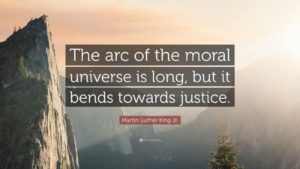
Marty Levine recalls the famous saying by Dr. Martin Luther King Jr. that the arc of the moral universe bends towards justice. He read a new book about police killings of Black men and wonders if Dr. King was overly optimistic. Consider this to be a validation of critical race theory.

He begins:

In 1968, shortly before he was murdered, Dr. Martin Luther King, Jr, was still giving us hope that we would overcome. Speaking at the National Cathedral, he said we needed to keep not become despondent when things seem to be stuck because “the arc of the moral universe is long, but it bends toward justice.”

I am now wondering if he was correct.

I’m reading “America on Fire”,  a recently published book looking at police and community violence written by Elizabeth Hinton, a Yale Associate Professor of History & African American Studies and Law. Spurred to write by the series of police murders of Black men and women and the protests and violence that arose in response, Professor Hinton has found a history of a national failure to learn and unwillingness to confront reality. Time after time police violence was the match that set off violent uprisings in Black communities which had been marginalized and systematically kept in poverty and neglect. Time after time she found we said we knew that we needed to invest in people and communities. And time after time, she found, that we ignored these lessons and turned our resources to defending the built-in bias, expanding our police forces, and expanding our prison systems.

Hinton’s conclusion, formed after she analyzed more than 2,200 separate community outbreaks between 1964 (Harlem, New York) and  2001 (Cincinnati, Ohio) was that the conflict is more than just a symptom of racism and poverty. “They happened when police seemed to be there for no reason, or when the police intervened in matters that could be resolved internally (disputes among friends and family). Rebellions began when the police enforced laws that would almost never be applied in white neighborhoods (laws against gathering in groups of a certain size or acting like a “suspicious person”). Likewise, they erupted when police failed to extend to residents the common courtesies afforded to whites (allowing white teenagers to drink in a park but arresting Mexican American teens for the same behavior).”

Those in power were interested in protecting their power and the status quo rather than bringing the changes they promised. They listened to the voices of the hurting communities, said pious words about their now seeing the pain of those left out of the American Dream, vowed to take on the underlying and systemic problems that had been ignored, and then did little beyond strengthening the police.

Jeff Bryant reports on a frightening phenomenon: the notorious and violent Proud Boys are targeting public schools.

He begins:

When violent insurrectionists stormed the U.S. Capitol on January 6 to attempt to overturn the result of the 2020 presidential election, some of the rioters were members of the Proud Boys, a far-right group prone to street brawling and pro-Western, anti-Muslim, and misogynistic rhetoric.

The insurrectionists were thwarted, but now extremist groups—including the Proud Boys—are aiming their threats and violence at a new target: public schools.

In Orange County, North Carolina, the Proud Boys and other white nationalist groups have begun showing up at high school football games and school board meetings, “protesting the district’s COVID-19 and LGBTQ+ policies.” Their intimidating language, apparel, and physical gestures prompted officials to hire extra security and pass a resolution opposing “incidents of hostile and racist behavior,” according to a report in the News and Observer.

The resolution charged that the rightwing agitators had “shouted racist and homophobic slurs at students” and included “emails from teachers and students who describe how unsafe they feel being around the Proud Boys.”

A local radio station quoted Orange County board chairwoman Hillary MacKenzie describing a recent meeting of the board where “there were two men in Proud Boys shirts and hats . . . one wore a stocking over his face . . . the other one told our board during public comment that someone should tie rocks around our necks, and we should throw ourselves in a river.”

Similar occurrences from around the country seem to indicate that the Proud Boys’ targeting of public schools is a coordinated, nationwide effort, suggesting a direct line from the group’s involvement in the January 6 insurrection to its current participation in the wave of protests at public schools and school board meetings.