Archives for category: Betsy DeVos

David Armiak of the Center for Media and Democracy reviewed the recent defeat of vouchers in three states: Colorado, Kentucky, and Nebraska. He points out that vouchers have never won a state referendum. Voters have always said “No” to sending public money to private and religious schools.

Who pays for the state campaigns on behalf of vouchers?

Billionaires.

The two most reliable funders of voucher proposals are billionaires Betsy DeVos and Charles Koch.

The billionaires keep pushing vouchers even though we now know that they are subsidies for families whose children are already enrolled in private schools. And we now know that vouchers don’t help public school students who use them. And we now know that vouchers are a huge drain on state budgets and always cost more than predicted.

DeVos and Koch like to fund failure. Their goal is not to improve education but to destroy public schools.

Armiak writes:

The dark money group Advance Colorado Action (ACA, formerly Unite for Colorado) qualified the ballot measure, but most of the identifiable money spent pushing its passage came from a related advocacy group, Colorado Dawn.

Unite for Colorado was founded in 2019 by Dustin Zvonek, the former vice president for strategy and innovation and state director for Charles Koch’s astroturf operation Americans for Prosperity. As of 2022, Unite for Colorado provided Colorado Dawn with almost half of its revenue ($2.7 million out of $5.9 million).

Both groups have been hit with multiple campaign finance complaints in recent years, including one last month against Colorado Dawn for sending misleading text messages and spending money to influence a ballot measure without registering as an issue committee.

Colorado Dawn reported spending nearly $1.9 million as of October 23 to back Amendment 80, The Colorado Sun reported.

In Kentucky, voters in every county rejected Amendment 2 by a margin of almost two to one (65%).

If it had passed, the state constitution would have been amended to allow public funding to go to private schools.

A record-breaking $14 million was spent by groups in favor and against the amendment, Kentucky Public Radio reported. The Protect Freedom PAC pulled in $5 million from school privatization billionaire Jeff Yassand spent $4 million on ads supporting the measure.

Other groups spending in favor of the amendment included Kentucky Students First ($2.5 million); Empower Kentucky Parents ($1.25 million); Empower Kentucky Parents PAC ($800,000); and the state chapter of Koch’s Americans for Prosperity ($328,000).

Empower Kentucky Parents received $1 million from American Federation for Children, a group organized and funded by the billionaire DeVos family. Betsy DeVos served as secretary of education during Trump’s first term in office and now supports his plans to eliminate the department.

In Nebraska, 57% of voters supported a ballot measure (Referendum 435) to repeal a new state law that would have provided parents with $10 million in public funds per year in the form of vouchers for their children to attend private K–12 schools.

The Nebraska Examiner reported that Keep Kids First spent just $111,000 as of November 4 to prevent the repeal of the referendum in the Cornhusker state. The American Federation for Children is also the largest known donor so far to Keep Kids First, giving $561,500 in 2023–24.

Perry Bacon, a regular columnist for The Washington Post, paints a sunny view of the politics of education. He thinks that the public is so strongly united behind their public schools that Trump might back off his plan to turn federal funding into vouchers. Higher education, however, is a different story, he says, with a bipartisan coalition arrayed against student protests and debt relief.

I do not share his view that Republicans will relinquish their fealty to vouchers and privatization. No matter how determined the public is to defend their public schools, the billionaires who want vouchers are unrelenting. Bacon doesn’t see that the monied people don’t give a damn what the public wants. Betsy DeVos, the Koch machine, Jeff Yass, and Texas billionaires Tim Dunn and Farris Wilks don’t care what the public wants. Perry Bacon would have written a different article if he had read Josh Cowen’s new book The Privateers: How Billionaires Started a Culture War

Bacon writes:

The Biden years have featured some surprising bipartisan and cross-ideological coalitions on education issues, including school vouchers and protests on college campuses, that might extend into Donald Trump’s presidency. It’s the rare policy area where the divides aren’t simply along party lines.


On K-12 education, Republican and Democratic voters have unified — against the desires of powerful conservative groups and Republican politicians. The political right has long been frustrated with American education and is pushing a number of major changes, most notably voucher programs that would put more kids in private schools and either shrink or, perhaps eventually, dismantle the public school system.


But a clear majority (57 percent) in Nebraska earlier this month voted to repeal a voucher initiative, nearly matching Trump’s support there (60 percent). In Kentucky, all 120 counties (and 62 percent of voters) rejected a proposal to start a voucher program.


The results from those two states aren’t outliers. States with huge Republican majorities in their legislatures have struggled to get voucher programs passed because lawmakers are hearing from wary constituents, including Republicans. Even when they are enacted, voucher programs so far have not resulted in a huge number of students flooding to private schools.

In another rejection of conservative education policy, Moms for Liberty, the group that backs right-wing candidates running in local school board races, has struggled electorally. Only about one-third of the candidates it backed won their races last year, according to a Brookings Institution analysis. (There hasn’t yet been a detailed analysis of the group’s election results in 2024.) There has been a strong backlash against Moms for Liberty and other conservative groups seeking to ban books on racial and LGBTQ+ issues from public schools.


Meanwhile, counties throughout Florida, where Trump won easily, voted to increase local property and sales taxes to boost public school funding.


What’s behind this strong support of public schools? Only 45 percent of all Americans and 31 percent of Republicans say they are satisfied with public schools nationally, according to Gallup polling. But 70 percent of all Americans and 62 percent of Republicans are satisfied with the schools their kids are attending. Education policy tends to reflect local dynamics, so schools in very conservative areas are probably cautious in speaking about racism or LGBTQ+ issues. But what I suspect is actually driving that strong support for public schools is that for Republicans, particularly in rural areas, public schools are a central, positive part of their lives, where their friends and relatives work and their kids play sports.


But on higher-education policy, the bipartisan coalition is against the left. Like their Republican counterparts, many Democratic politicians and prominent left-of-center leaders and activists think both that the United States became overly invested in recent decades in having people attend college and that campuses are too left-wing. (I disagree with both claims.)

So in the spring, Democratic politicians, including President Joe Biden, joined Republicans in portraying on-campus protests against Israel’s military actions in Gaza as antisemitic. Schools in both red and blue states, pushed by their centrist or conservative governing boards, have now created new limits on protests, particularly barring the kind of encampments that pro-Palestinian students created.


Biden himself was under fire from centrist Democrats and Republicans alike for trying to cancel student-loan debt, a policy strongly backed by many progressives. Many in either party argue that mass college attendance, unlike K-12 education, is not a necessity for the country and people who accrued debt during college knew the costs and should pay it back in full. The recent progressive pushes for both universal free college and mass debt cancellation seem stalled for now.


Prominent liberals have joined conservatives in questioning the value of humanities classes and departments and want colleges to focus more on graduating students ready to work in science, technology and other fields where jobs are growing. Nearly every day a Democratic politician says something along the lines of, “Our party is too influenced by the views and perspectives of professors and students on campuses and college graduates,” mirroring the rhetoric of conservatives such as Vice President-elect JD Vance.


How did we end up with Republican voters defending public schools and Democratic politicians criticizing colleges? Part of the explanation for why education policy hasn’t split on predictable partisan lines is that Biden hasn’t made the issue one of his major priorities. Education Secretary Miguel Cardona has been more low-profile than Betsy DeVos and Arne Duncan. Biden didn’t have a major education initiative such as No Child Left Behind (President George W. Bush) or Race to the Top (President Barack Obama).

Trump and his incoming administration could make this issue super-partisan. The activist right is unified around the idea that both K-12 schools and colleges are using taxpayer dollars to force liberal ideas on young people, particularly on issues of race, gender and sexual orientation. So, the Trump administration could push hard to get more K-12 students enrolled in private schools, stop K-12 schools and colleges from offering classes out of line with conservative ideology, and limit on-campus protests for left-wing causes.


Trump, in his post on Truth Social announcing that Linda McMahon would be education secretary, emphasized his support for vouchers.
But in that statement, Trump also said that education policy should be left largely to states. (It’s not clear that Trump can or would fully eliminate the federal Education Department, as he suggested during the campaign.) So perhaps his administration will take a more hands-off approach, aware that many Republican voters like how their schools are run locally.


Looking forward, it’s possible that Republican voters fall in love with voucher programs if the Trump administration pushes them hard. Or perhaps Democratic politicians will feel more compelled to defend colleges if they become a target of Trump.

But if I had to guess, I would predict that education policy continues to be an issue that doesn’t break down simply along party lines. After all, it’s personal for so many Americans, who vividly remember their time in grade school or college. And it’s complicated — exactly how should colleges have handled the Gaza protests? The happy middle for America might be a robust public school system, more of a Democratic goal, along with less liberal colleges that fewer people attend, more in line with Republican preferences.

When I first heard about the sex scandal swirling around Corey DeAngelis, I didn’t believe it. As I did more digging through links on the Internet, my disbelief turned to amazement. I never met Corey, but he used to harass me on Twitter until I blocked him.

How could someone who had inveighed against “the woke agenda” and urged the adoption of vouchers to escape that agenda have done what the rumors said? I didn’t think I would touch it with a ten-foot pole. I don’t care what others do in their private lives. I believe in Tim Walz’s credo: “Mind your own damn business.” But I was troubled by the hypocrisy.

Corey worked for Betsy DeVos and was her leading salesman for vouchers. DeVos and her family are rabidly anti-LGBT. For years, they have funded anti-LGBT organizations like the Family Research Council, Focus on the Family, and Alliance Defending Freedom. Yet the rumor was that Corey had performed in gay porn, and there were many videos online to prove it.

One of the alleged virtues of vouchers was that they enable students to escape pedophile teachers and to attend schools that ban LGBT students. I couldn’t make sense of these two lives.

Peter Greene wrote about Corey’s apparent double life.

Peter began:

I’m old enough to remember when you could have a reasonably civilized conversation with Corey DeAngelis on social media, and everyone is old enough to remember when his main social media function was to lead a small army of trolls against anyone who dared to oppose the right wing school privatizing culture panic crowd (we can all remember that because it was as recent as about a week ago).

Those days are gone, of course, now that DeAngelis has become the sixty-gazzilionth person to discover that the internet is not a private place, as he’s been outed as a featured performer in a bunch of gay porn under the name Seth Rose. Since the story was broken (in a far right website of all places), DeAngelis has been erased from several websites of the many thinky tanks and advocacy groups that employed this chief evangelist for choice. 

The pro-public school crowd has been largely quiet about the news, and big time education media hasn’t picked it up yet. Andy Rotherham has a piece about it, which is appropriate– Rotherham and Bellwether have been unique in the right-tilted reformster edusphere in not jumping on the culture panic bandwagon. 

There is no reason for any of us to care what an adult human person does. Lord knows we could have some more useful conversations right now if folks weren’t wasting so much time panicking over other peoples’ business. 

And yet this parade of personal scandal– the Zieglers, Mark Robinson, Seth Rose–matters for several reasons….

I don’t wish DeAngelis ill, even though he so often wished people ill straight to their faces. At the same time, I don’t wish him to be spared the karma that he has so richly and ambitiously earned; he used cultural panic over LGBTQ persons to help him sell vouchers and troll armies to try to silence anyone who dared to disagree with him. He had a choice to pursue his ambitions without being awful to other human beings, and he chose being awful. And you can’t spread toxins all around you without getting soaked in it yourself. 

You should open the post and read Peter’s measured views.

Matthew Stone of Education Week described the plans for K-12 education in a second Trump term, as they appear in Project 2025, a document written by hundreds of former Trump officials. The 44-page education section emphasizes eliminating the U.S. Department of Education, distributing its functions to other agencies, converting categorical funds (like Title I for low-income children) into block grants, and rooting out “critical race theory” and any recognition of the existence of LGBT students. The document emphasizes the primacy of parental rights.

Trump has distanced himself from the document, because its recommendations are so radical, but it was prepared under the watchful eye of Kevin Roberts, president of the ultra-rightwing Heritage Foundation. Roberts is a close associate of Trump’s.

Stone wrote:

What would Donald Trump do in the realm of K-12 if voters return the former president to the White House?

He and his campaign haven’t outlined many specifics, but a recently published document that details conservative plans to completely remake the executive branch offers some possibilities. Among them: 

  • Title I, the $18 billion federal fund that supports low-income students, would disappear in a decade. 
  • Federal special education funds would flow to school districts as block grants with no strings attached, or even to savings accounts for parents to use on private school or other education expenses.
  • The U.S. Department of Education would be eliminated.
  • The federal government’s ability to enforce civil rights laws in schools would be scaled back.

The proposals are contained in a comprehensive policy agenda that’s part of a Heritage Foundation-led initiative called Project 2025: Presidential Transition Project, which includes nearly 900 pages of detailed plans for virtually every corner of the federal government and a database of potential staffers for a conservative administration. It will also feature a playbook for the first 180 days of a new term.

The agenda is designed to be ready for a conservative president to implement at the start of a new administration next year, depending on the outcome of November’s election.

Project 2025 involves former Trump administration officials and other allies of the former president, as well as dozens of aligned advocacy organizations. One of those is Moms for Liberty, the Florida-based group that rose to national prominence fighting school boards over COVID-19 safety protocols and has endorsed conservative school board candidates across the country in recent years.

On the campaign trail, Trump has said that parents should elect school principals, called for merit pay for teachers and the abolition of teacher tenure, promised to cut federal funding to schools pushing progressive social ideas, and pledged to establish universal school choice.

But because he’s released little in the way of detailed plans, Project 2025’s 44-page agenda for the U.S. Department of Education offers the clearest picture yet of the education priorities Trump could pursue in a second term, and how a second Trump administration could use the federal government to advance conservative policies like private school choice and parents’ rights that have taken root in many Republican-led states.

Trump is trying to distance himself from Project 2025 because it is so radical. But no one takes his protestations seriously.

Peter Greene, who taught for 39 years in Pennsylvania, wrote recently in The Progressive about Corey DeAngelis, who travels the nation to trash public schools and to advocate for vouchers. If you hate public schools and unions, he’s your guy. If you adore Betsy DeVos and her plans to destroy local communities and to get more children into discriminatory religious schools, he’s your guy.

Greene writes:

Corey DeAngelis is an influential, if not the most influential, voice in the rightwing campaign to demonize public schools and privatize public education. The guy’s résuméhits all the bases in the libertarian gameplan. After earning a doctorate at the University of Arkansas’s education reform program (funded bythe pro-school choice Walton family), DeAngelis helped found the Education Freedom Institute, became a senior fellow at the Reason Foundation, worked as an adjunct scholar at the CATO Institute, took up an appointment as a senior fellow at the Hoover Institution, and was hired on as a senior fellow at Betsy DeVos’s American Federation for Children.

He still holds all of those jobs, but his more common title is “school choice evangelist.” As the recent school voucher wave has surged in state after state, DeAngelis has been there to spread the word. While on tour in support of his new book, he distills the current pro-voucher argument.

In a recent talk at the Heritage Foundation, DeAngelis touched on most of the main arguments for vouchers (many of them false) and revealed a few truths about the pro-voucher strategy.

1. The Evil Unions and COVID

The villainy of the teachers union is a thread that runs through much of DeAngelis’s argument, especially related to the COVID-19 pandemic narrative. DeAngelis blames the unions (and American Federation of Teachers president Randi Weingarten) for “fear mongering” and accuses them of extorting ransom payments by holding schools hostage. The unions, he charged, used the pandemic to empower themselves and the “government schools” that he calls “a jobs program for adults.”

There’s no recognition that teachers had a legitimate fear during the pandemic or that hundreds of educators died of COVID-19. Nor did he mention the many private and non-union charter schools that also closed their doors. Every problematic decision that he cited from pandemic times is blamed on the union, with no mention that Betsy DeVos’s Department of Education provided little or no guidance to districts facing difficult decisions in an evolving situation.  

DeAngelis’s narrative argues that parents viewing Zoom school were appalled and awakened by what they saw. That oft-repeated tale stands in contrast to polls that show the vast majority of parents were satisfied with how their schools handled COVID-19. A 2022 Gallup poll found that, while the general public’s opinion of public schools is “souring,” parents’ favorable opinion of their own school matched pre-pandemic levels. The common sense conclusion to draw from this data is that people who don’t have first-hand experience with public schools are developing a low opinion of them based on some other source of information.

DeAngelis’s argument has other flaws. He claimed that the unions extracted a huge ransom from schools. But he also argued that pandemic relief funds given to schools never reached teachers and were, instead, soaked up by administrative bloat, which would seem to be a big tactical blunder on the unions’ part.

2. The Evil Unions and the Democratic Party

DeAngelis made the unusual claim that Democrats aren’t having kids, but Republicans are. But that, he said, won’t save conservatives because schools are fully “infiltrated by radical leftist union teachers.” The left uses schools as a way to control other people’s children. The Democratic Party, he added, is a fully owned subsidiary of the teachers’ union.

DeAngelis also repeated a false narrative of the National School Board Association’s supposed campaign to muzzle parents. In fall 2021, local school boards found their usually sleepy meetings had turned into wild, threatening, and even violent chaos. The NSBA turned to the Biden Administration for help, calling some of the actions “the equivalent of a form of domestic terrorism or hate crimes.” This was quickly and inaccurately cast as the Democratic administration calling parents domestic terrorists.

The resulting controversy caused the NSBA to lose some members, which DeAngelis seemed happy about. “Play stupid games, win stupid prizes,” he said.

This narrative that smears public school-friendly groups fits a general pattern of conservative attacks on groups seen as Democratic Party supporters.

Open the link to read more about the DeVos-funded public school hater who is spreading his propaganda across the nation.

Senator Bernie Sanders issued a report lambasting the billionaires who are funding the voucher movement. It’s good that someone in Washington, D.C., is paying attention to this mean spirited effort to shift public money to private and religious schools. As scholar Josh. Owen has repeatedly demonstrated, voucher schools have been a disaster for low-performing kids. The main beneficiaries are students from wealthy families whose children are already enrolled in no public schools. Texas is not mentioned in the Sanders release, but billionaires DeVos, Yass, and native Texan billionaires used their wealth to oust anti-voucher Republicans.

Common Dreams reports:

Sen. Bernie Sanders released a report Tuesday detailing how right-wing billionaires are bankrolling coordinated efforts to privatize U.S. public education by promoting voucher programs that siphon critical funding away from already-underresourced public schools.

The report notes that last year, the American Federation for Children (AFC)—an organization funded by former Trump Education Secretary Betsy DeVos—”ousted state lawmakers in Iowa and Arkansas who resisted proposals to subsidize private education in states and passed expansive private school vouchers.”

Aided by millions of dollars in funding from DeVos and her husband, “AFC’s political affiliates and allies spent $9 million to win 277 out of 368 races to remove at least 40 incumbent lawmakers,” the report adds.

The DeVos family is hardly alone in using its wealth to undercut U.S. public education. The Bradley Foundation, which has been knee-deep in efforts to privatize education in Wisconsin and across the country, spent $7.5 million in 2022 “to fund 34 state affiliates of the State Policy Network to push conservative policy agendas, including privatizing education, and $8.3 million to building a youth movement to ‘win the American Culture War.'”

“The Koch-sponsored group, American Encore, has funneled substantial amounts into state governor races and ballot initiatives around the country, including more than $1.4 million to elect Arizona’s former governor Doug Ducey in 2014 (who led the efforts to create the nation’s first universal private school voucher),” the report adds.

“For too long, there’s been a coordinated effort to sabotage our public schools and privatize our education system. Unacceptable.”

The analysis also names billionaires Jess Yass of Susquehanna International Group, Richard Uihlein of Uline, and Bernard Marcus of Home Depot, all of whom have recently donated to the School Freedom Fund—a PAC that supports voucher programs and shuttering the U.S. Education Department.

School voucher programs disproportionately benefit wealthy families, analyses have shown, while undercutting the goal of serving all students within a community.

Every time I see New Hampshire Governor Chris Sununu interviewed on CNN, he plays the role of the GOP “moderate.” Don’t be fooled. When it comes to education, he’s a clone of Betsy DeVos.

Veteran New Hampshire Garry Rayno pulls away the mask of “moderate” that Sununu wears in this article in InDepthNH.

This is an important article for everyone to read, no matter where you live. It explains succinctly the true goals of the privatization movement.

He writes:

Public education has been since its inception with the work of Horace Mann, the great equalizer.

Students from poor families have been able to compete with students from the other side of the tracks, maybe not in reality, but close enough to at least have an opportunity to excel.

Many of the founding fathers understood the need for an educated public if democracy was going to survive and thrive.

A responsible citizen is an informed citizen, and that appears to be the problem today. Too many people interested in power instead of governing don’t want a truly informed public. Instead, they want enough of the public spoon fed “alternative facts,” conspiracy theories, and outright lies to ensure they retain power although they have views that are both harmful to the majority of citizens and allow the tyranny of the minority to overturn the will of the majority.

At the heart of the minority’s transformation plan is the destruction of the public school system.

New Hampshire has had a front row seat to the war on education since Chris Sununu was elected governor and named his rival for the Republican nomination in 2016, Frank Edelblut, to be Education Commissioner, a man without any experience in public education, which was the first for someone holding that position in our lifetime.

If Sununu did not know what would happen when he put Edelblut in charge of this critical state department, shame on him, because Edelblut’s one term in the House was a roadmap for his actions during his two terms as commissioner, his second ending in March 2025.

Sununu has also packed the State Board of Education with school choice advocates instead of supporters of public education, so you have the two entities in the executive branch responsible for the state’s public education systems, maybe not anti-public schools, but certainly not advocates for the state’s public education system.

According to the statutes, the education commissioner “is responsible for the organizational goals of the department and represents the public interest in the administration of improving the effectiveness and efficiency of administrative and instructional services to all public schools in New Hampshire.”

Notice it says public schools, not private schools or religious schools, or homeschooling, or learning pods, or any of the other non-public entities that are approved vendors under the state’s Education Freedom Account program, some with questionable philosophies or intent.

An attempt by lawmakers this year to better define the education commissioner’s qualifications and responsibilities to the public school system was defeated this term by the same element that pushed to establish the EFA program and then to expand it, although this year’s attempt to increase the income threshold to participate in the program failed on the last day of the session to act on bills.

The outright attacks on public education began in New Hampshire about a decade ago but gained more warriors as FreeStaters/Libertarians swelled the ranks of the House and Senate Republican members.

The attack on public education here has been much the same as it has been in other states, mostly in the south and the west, with claims of the indoctrination of students by leftwing faculty members.

They have also attacked educators directly and have tried to pack school boards — without much success — to undermine curriculum, educators and slash budgets as happened in Croydon several years ago when the annual school meeting was poorly attended due to a snowstorm.

The Republican majority in the 2021-2022 legislature passed the state’s divisive concepts law forbidding teaching controversial subjects such as institutional racism.

The law was recently found unconstitutional by a US District Court judge.

That was the same term the EFA program was approved after earlier unsuccessful attempts.

Both the EFA program and the divisive concepts law were included in the state’s biennial budget package because they were not likely to pass on their own.

The same folks also tied education into the trumped out recent outrage over the LGBTQ community and sold it as an attack on parental rights.

The intent was to start a war between parents and educators, although parents already have many of the rights touted by the anti-public school advocates.

The theory touted was that educators were keeping information from parents about their students and their sexual identification and that educators were urging students to explore different sexual identities.

Then came the book banning other areas of the country experienced like Florida where some school libraries were stripped of books.

The red herring advocates touted here came from a national app that contains almost every book published that students could access both in schools and at home, and not on school library shelves.

Some tried to enlist town and city libraries in the surveillance of children and what they read and accessed, but that did not go very far.

All of this goes to create the appearance that schools are hotbeds of leftist politics and anti-parental values, some fueled by Edelblut in an op-ed he sent to media outlets.

And despite all this ginned up controversy, local public schools that educate about 90 percent of the school age children in the state remain very popular with parents and the public at large.

If that is true, you have to ask what is behind the push to demonize public schools like political candidates demonize opponents.

Keep in mind this attack on public education occurs at the same time when the superior court’s latest education funding decision says the state does not provide enough money to cover the cost of an adequate education for every student and the way it raises its biggest contribution to public education — the Statewide Education Property Tax — is unconstitutional.

Education is governments’ —not just state government’s — single biggest expense, costing about $3.5 billion a year.

If you are a Libertarian or Free Stater who believes “taxation is theft,” destroying public schools will shift the cost directly to parents, and you could keep a lot more of your money to spend as you see fit and not for the good of society.

And if you espouse the philosophy of the Koch Foundation or former US Education Commissioner, Betsy DeVos, you not only keep more of your money, one of the largest union-backed workforces in the country will be dismantled when certified teachers are no longer needed.

Without a public education system, a child would receive the education his or her parents could afford and for many, particularly minorities, and the historically poor, that may not be much beyond the time they turn 16 and have to go to work to keep the family treading the economic waters.

And then maybe they will work for a lot less than if they had a high school, or even a college education.

And without even an adequate education, how informed will the general public be or how capable of the critical thinking needed to realize all those folks touting their parental rights really do not have their best interests at heart.

Garry Rayno may be reached at garry.rayno@yahoo.com.

Distant Dome by veteran journalist Garry Rayno explores a broader perspective on the State House and state happenings for InDepthNH.org. Over his three-decade career, Rayno covered the NH State House for the New Hampshire Union Leader and Foster’s Daily Democrat. During his career, his coverage spanned the news spectrum, from local planning, school and select boards, to national issues such as electric industry deregulation and Presidential primaries. Rayno lives with his wife Carolyn in New London.
One person who takes credit for the rapid advance of vouchers, which send public dollars to private and religious schools, is named Corey De Angelis. You probably never heard of him. He works for Betsy DeVos. He hates public schools, although he is a product of public schools. The taxpayers paid for his free education, but now he wants to divert money from public schools to private ones. We now know that most vouchers are claimed by families whose children are already enrolled in private schools. The voucher is a subsidy for them. Frequently, the school hikes its tuition by the amount of the voucher. Why does Corey hate public schools? It’s a puzzlement.

Carol Burris, executive director of the Network for Public Education, wrote this post:

Corey De Angelis works for Betsy De Vos’s American Federation for Children, which pays him to travel the country hawking ESA vouchers. He directs its PAC to destroy candidates who oppose vouchers.


De Angelis obsessively hates teacher unions, calls public schools “government schools,” believes that telling the truth is, at best, a suggestion, and has dubbed himself the “school choice evangelist.”


During a recent interview at the Heritage Foundation, De Angelis defined public schools like this: “failing unionized indoctrination centers that we call schools.” His contempt for public education was apparent from beginning to end. Here is a clip from that interview and NPE’s response on his mission to destroy our public schools.

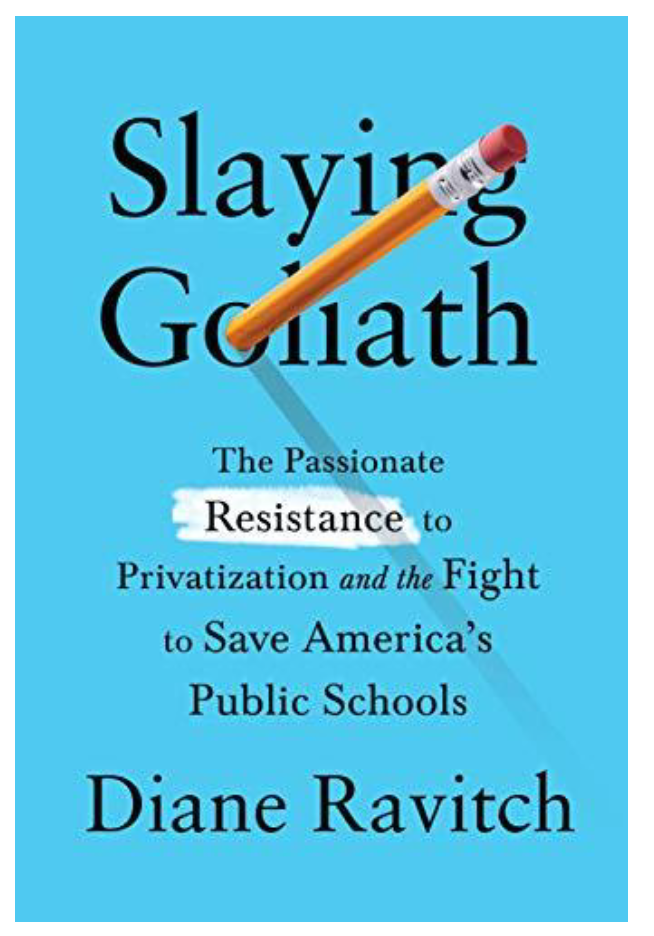
I am almost four years late in discovering this review by two scholars for whom I have the greatest respect: David C. Berliner and Gene V. Glass.

I was happy to read this review because Slaying Goliath had a checkered fate. It was published in mid-January 2020. I went on a book tour, starting in Seattle. By mid-February, I made my last stop in West Virginia, where I met with teachers and celebrated the two-year anniversary of their strike, which shut down every school in the state.

As I traveled, news emerged of a dangerous “flu” that was rapidly spreading. It was COVID; by mid-March, the country was shutting down. No one wanted to read about the fight to save public schools or about its heroes. The news shifted, as it should have, to the panicked response to COVID, to the deaths of good people, to the overwhelmed hospitals and their overworked staff.

To make matters worse, the New York Times Book Review published a very negative review by someone who admired the “education reform” movement that I criticized. I thought of writing a letter to the editor but quickly dropped the idea. I wrote and rewrote my response to the review in my head, but not on paper.

Then, again by happenstance, I discovered that Bob Shepherd had reviewed the review of my book in The New York Times. He said everything that I wish I could have said but didn’t. His review was balm for my soul. Shepherd lacerated the tone and substance of the review, calling it an “uniformed, vituperative, shallow, amateurish ‘review.’” Which it was. His review of the review was so powerful that I will post it next.

Then, a few weeks ago, I found this review by Berliner and Glass.

The review begins:

Reviewed by Gene V Glass and David C. Berliner Arizona State University, United States

They wrote:

In a Post-Truth era, one must consider the source. 

In this case, the source is Diane Rose Silvers, the third of eight children of Walter Silverstein, a high school drop-out, and Ann Katz, a high school graduate. The Silvers were a middle-class Houston family, proprietors of a liquor store, and loyal supporters of FDR.

After graduation from San Jacinto High School, she enrolled in Wellesley College in September, 1956. Working as a “copy boy”for the Washington Post, Diane met Richard Ravitch, a lawyer working in the federal government and son of a prominent New York City family. They married on June 26,1960, in Houston, two weeks after Diane’s graduation from Wellesley. The couple settled in New York City, where Richard took employment in the family construction business. He eventually served as head of the Metropolitan Transit Authority and Lieutenant Governor in the 2000s, having been appointed by Democratic Governor David Paterson.

 Diane bore three sons, two of whom survived to adulthood. Diane and Richard ended their 26-year marriage in 1986. She had not been idle. For a period starting in 1961, Diane was employed by The New Leader, a liberal, anti-communist journal. She later earned a PhD in history of education from Columbia in 1975 under the mentorship of Lawrence Cremin.

Diane was appointed to the office of Assistant Secretary of Education, in the Department of Education by George H. W. Bush and later by Bill Clinton. In 1997, Clinton appointed her to the National Assessment Governing Board (NAGB), on which she served until 2004. 

Ravitch worked “… for many years in some of the nation’s leading conservative think tanks.

Read the full pdf here.

Yesterday was a crucial election for the future of public schools in Texas. The Republican primaries pitted civic-minded Republicans against challengers committed to vouchers and endorsed by Governor Greg Abbott.

Abbott received the biggest single contribution in state history from Pennsylvania billionaire Jeff Yass. The gift came with a purpose: pass a voucher law.

Governor Abbott has been in charge since 2015 and until now, he never cared much about vouchers. But the money came pouring in from evangelical oil-and-gas billionaires like Tim Dunn and Farris Wilks, as well as out-of-state billionaires like Yass and Betsy DeVos. Suddenly, vouchers was the Governor’s top priority. He toured Christian schools around the state to promote them.

When the vote came in the Legislature, a bloc of rural Republicans in the House opposed vouchers. They said their community loved their public schools; they didn’t want to undermine them. Their public schools are the heart of their community and their local economy.

Abbott offered new money for public schools and teacher pay raises, but only if the Legislature approved vouchers. The rural Republicans (and every Democrat) said no.

Abbott said he would call special sessions until the House passed a voucher bill and he did. He called four special sessions. They said no to vouchers. He threatened to run primaries against them and to replace them with legislators who supported vouchers. They stood firm.

Yesterday some of those rural Republicans were defeated by Abbott and about $100 million in billionaire money. Some prevailed. Some are in run-offs.

Pastor Charles Johnson of Pastors for Texas Children (PTC) is a stalwart friend of public schools. He and his network of pastors across the state understand the importance of well-funded public schools and well-paid teachers.

PTC just released this update on the Republican primaries.

https://www.pastorsfortexaschildren.com/

Election Results

Dear Friends,

We have mixed emotions as we reflect on last night’s outcomes of the Texas House of Representatives races. While we may not have achieved the sweeping results we had hoped for, we are grateful for the victories your work and witness achieved!


Of the 16 House Republican primary races we focused on, we enjoyed six victories and suffered six losses. Four of our Republican friends face runoff elections.


The path to positive change is often fraught with challenges, and setbacks are an inevitable part of any endeavor. Though we may not have won every race last night, we are grateful for the re-election of six of our strongest Republican allies in the House and look forward to working hard to re-elect four more in the runoffs.


We find hope and encouragement in the upcoming May runoffs. These runoffs are crucial to fighting taxpayer-funded vouchers here in Texas. We will continue to fight to ensure that the Texas Public Schools voice we advocate for is heard loud and clear. Your continued support is crucial, and together, we will forge a brighter future for the children of Texas.

We want to express our gratitude for your unwavering support throughout this journey. We remain steadfast in our commitment to championing our Texas public schools, teachers, parents, and, of course, the 5.5 million children in our Texas public schools.


Let us stand united, resilient in the face of these challenges, and hopeful for the positive outcomes that the runoffs may bring. The journey may be long, but with your dedication and support, we can make a lasting impact on the lives of children and families in our beloved community.


Rev. Charles Foster Johnson, Executive Director

Pastors for Children

Donate to PTC