Archives for category: Accountability

Heather Cox Richardson is an American historian at Boston College. I enjoy reading her views, which are always well-informed.

She writes:

December 30, 2021

Heather Cox RichardsonDec 31

On January 6, insurrectionists trying to overturn the results of the 2020 presidential election stormed the U.S. Capitol and sent our lawmakers into hiding. Since President Joe Biden took office on January 20, just two weeks after the attack, we have been engaged in a great struggle between those trying to restore our democracy and those determined to undermine it. 

Biden committed to restoring our democracy after the strains it had endured. When he took office, we were in the midst of a global pandemic whose official death toll in the U.S. was at 407,000. Our economy was in tatters, our foreign alliances weakened, and our government under siege by insurrectionists, some of whom were lawmakers themselves.

In his inaugural address, Biden implored Americans to come together to face these crises. He recalled the Civil War, the Great Depression, the World Wars, and the attacks of 9/11, noting that “[i]n each of these moments, enough of us came together to carry all of us forward.” “It’s time for boldness, for there is so much to do,” he said. He asked Americans to “write an American story of hope, not fear… [a] story that tells ages yet to come that we answered the call of history…. That democracy and hope, truth and justice, did not die on our watch but thrived.”

Later that day, he headed to the Oval Office. “I thought there’s no time to wait. Get to work immediately,” he said.

Rather than permitting the Trump Republicans who were still insisting Trump had won the election to frame the national conversation, Biden and Vice President Kamala Harris, as well as the Democrats in Congress, ignored them and set out to prove that our government can work for ordinary Americans.

Biden vowed to overcome Covid, trying to rally Republicans to join Democrats behind a “war” on the global pandemic. The Trump team had refused to confer during the transition period with the Biden team, who discovered that the previous administration had never had a plan for federal delivery of covid vaccines, simply planning to give them to the states and then let the cash-strapped states figure out how to get them into arms. “What we’re inheriting is so much worse than we could have imagined,” Biden’s coronavirus response coordinator, Jeff Zients, said to reporters on January 21.

Biden immediately invoked the Defense Production Act, bought more vaccines, worked with states to establish vaccine sites and transportation to them, and established vaccine centers in pharmacies across the country. As vaccination rates climbed, he vowed to make sure that 70% of the U.S. adult population would have one vaccine shot and 160 million U.S. adults would be fully vaccinated by July 4th.

At the same time, the Democrats undertook to repair the economy, badly damaged by the pandemic. In March, without a single Republican vote, they passed the $1.9 trillion American Rescue Plan to jump-start the economy by putting money into the pockets of ordinary Americans. It worked. The new law cut child poverty in half by putting $66 billion into 36 million households. It expanded access to the Affordable Care Act, enabling more than 4.6 million Americans who were not previously insured to get healthcare coverage, bringing the total covered to a record 13.6 million.

As vaccinated people started to venture out again, this support for consumers bolstered U.S. companies, which by the end of the year were showing profit margins higher than they have been since 1950, at 15%. Companies reduced their debt, which translated to a strong stock market. In February, Biden’s first month in office, the jobless rate was 6.2%; by December it had dropped to 4.2%. This means that 4.1 million jobs were created in the Biden administration’s first year, more than were created in the 12 years of the Trump and George W. Bush administrations combined.

In November, Congress passed a $1.2 trillion infrastructure bill that will repair bridges and roads and get broadband to places that still don’t have it, and negotiations continue on a larger infrastructure package that will support child care and elder care, as well as education and measures to address climate change.

Bloomberg and the Wall Street Journal report that U.S. economic output jumped more than 7% in the last three months of 2021. Overall growth for 2021 should be about 6%, and economists predict growth of around 4% in 2022—the highest numbers the U.S. has seen in decades. China’s growth in the same period will be 4%, and the eurozone (the member countries of the European Union that use the euro) will grow at 2%. The U.S. is “outperforming the world by the biggest margin in the 21st century,” wrote Matthew A. Winkler in Bloomberg, “and with good reason: America’s economy improved more in Joe Biden’s first 12 months than any president during the past 50 years….”

With more experience in foreign affairs than any president since George H. W. Bush, Biden set out to rebuild our strained alliances and modernize the war on terror. On January 20, he took steps to rejoin the World Health Organization and the Paris Climate Accords, which his predecessor had rejected. Secretary of State Antony Blinken emphasized that Biden’s leadership team believed foreign and domestic policy to be profoundly linked. They promised to support democracy at home and abroad to combat the authoritarianism rising around the world.

“The more we and other democracies can show the world that we can deliver, not only for our people, but also for each other, the more we can refute the lie that authoritarian countries love to tell, that theirs is the better way to meet people’s fundamental needs and hopes. It’s on us to prove them wrong,” Blinken said.

Biden and Blinken increased the use of sanctions against those suspected of funding terrorism. Declaring it vital to national security to stop corruption in order to prevent illicit money from undermining democracies, Biden convened a Summit for Democracy, where leaders from more than 110 countries discussed how best to combat authoritarianism and corruption, and to protect human rights.

Biden began to shift American foreign policy most noticeably by withdrawing from the nation’s twenty-year war in Afghanistan. He inherited the previous president’s February 2020 deal with the Taliban to withdraw U.S. forces from Afghanistan by May 1, 2021, so long as the Taliban did not kill any more Americans. By the time Biden took office, the U.S. had withdrawn all but 2500 troops from the country.

He could either go back on Trump’s agreement—meaning the Taliban would again begin attacking U.S. service people, forcing the U.S. to pour in troops and sustain casualties—or get out of what had become a meandering, expensive, unpopular war, one that Biden himself had wanted to leave since the Obama administration.

In April, Biden said he would honor the agreement he had inherited from Trump, beginning, not ending, the troop withdrawal on May 1. He said he would have everyone out by September 11, the 20th anniversary of the al-Qaeda attacks that took us there in the first place. (He later adjusted that to August 31.) He promised to evacuate the country “responsibly, deliberately, and safely” and assured Americans that the U.S. had “trained and equipped a standing force of over 300,000 Afghan personnel” who would “continue to fight valiantly, on behalf of the Afghans, at great cost.”

Instead, the Afghan army crumbled as the U.S began to pull its remaining troops out in July. By mid-August, the Taliban had taken control of the capital, Kabul, and the leaders of the Afghan government fled, abandoning the country to chaos. People rushed to the airport to escape and seven Afghans died, either crushed in the crowds or killed when they fell from planes to which they had clung in hopes of getting out. Then, on August 26, two explosions outside the Kabul airport killed at least 60 Afghan civilians and 13 U.S. troops. More than 100 Afghans and 15 U.S. service members were wounded.

In the aftermath, the U.S. military conducted the largest human airlift in U.S. history, moving more than 100,000 people without further casualties, and on August 30, Major General Chris Donahue, commander of the U.S. Army 82nd Airborne Division, boarded a cargo plane at Kabul airport, and the U.S. war in Afghanistan was over. (Evacuations have continued on planes chartered by other countries.)

With the end of that war, Biden has focused on using financial pressure and alliances rather than military might to achieve foreign policy goals. He has worked with North Atlantic Treaty Organization (NATO) allies to counter increasing aggression from Russian president Vladimir Putin, strengthening NATO, while suggesting publicly that further Russian incursions into Ukraine will have serious financial repercussions.

In any ordinary time, Biden’s demonstration that democracy can work for ordinary people in three major areas would have been an astonishing success.

But these are not ordinary times.

Biden and the Democrats have had to face an opposition that is working to undermine the government. Even after the January 6 attack on the Capitol, 147 Republican members of Congress voted to challenge at least one of the certified state electoral votes, propping up the Big Lie that Trump won the 2020 presidential election. Many of them continue to plug that lie, convincing 68% of Republicans that Biden is an illegitimate president.

This lie has justified the passage in 19 Republican-dominated states of 33 new laws to suppress voting or to take the counting of votes out of the hands of non-partisan officials altogether and turn that process over to Republicans.

Republicans have stoked opposition to the Democrats by feeding the culture wars, skipping negotiations on the American Rescue Plan, for example, to complain that the toymaker Hasbro was introducing a gender-neutral Potato Head toy, and that the estate of Dr. Seuss was ceasing publication of some of his lesser-known books that bore racist pictures or themes. They created a firestorm over Critical Race Theory, an advanced legal theory, insisting that it, and the teaching of issues of race in the schools, was teaching white children to hate themselves.

Most notably, though, as Biden’s coronavirus vaccination program appeared to be meeting his ambitious goals, Republicans suggested that government vaccine outreach was overreach, pushing the government into people’s lives. Vaccination rates began to drop off, and Biden’s July 4 goal went unmet just as the more contagious Delta variant began to rage across the country.

In July, Biden required federal workers and contractors to be vaccinated; in November, the administration said that workers at businesses with more than 100 employees and health care workers must be vaccinated or frequently tested.

Rejecting the vaccine became a badge of opposition to the Biden administration. By early December, fewer than 10% of adult Democrats were unvaccinated, compared with 40% of Republicans. This means that Republicans are three times more likely than Democrats to die of Covid, and as the new Omicron variant rages across the country, Republicans are blaming Biden for not stopping the pandemic. Covid has now killed more than 800,000 Americans.

While Biden and the Democrats have made many missteps this year—missing that the Afghan government would collapse, hitting an Afghan family in a drone strike, underplaying Covid testing, prioritizing infrastructure over voting rights—the Democrats’ biggest miscalculation might well be refusing to address the disinformation of the Republicans directly in order to promote bipartisanship and move the country forward together.

With the lies of Trump Republicans largely unchallenged by Democratic lawmakers or the media, Republicans have swung almost entirely into the Trump camp. The former president has worked to purge from the state and national party anyone he considers insufficiently loyal to him, and his closest supporters have become so extreme that they are openly supporting authoritarianism and talking of Democrats as “vermin.”

Some are talking about a “national divorce,” which observers have interpreted as a call for secession, like the Confederates tried in 1860. But in fact, Trump Republicans do not want to form their own country. Rather, they want to cement minority rule in this one, keeping themselves in power over the will of the majority.

It seems that in some ways we are ending 2021 as we began it. Although Biden and the Democrats have indeed demonstrated that our government, properly run, can work for the people to combat a deadly pandemic, create a booming economy, and stop unpopular wars, that same authoritarian minority that tried to overturn the 2020 election on January 6 is more deeply entrenched than it was a year ago.

And yet, as we move into 2022, the ground is shifting. The House Select Committee to Investigate the January 6th Attack on the U.S. Capitol is starting to show what it has learned from the testimony of more than 300 witnesses and a review of more than 35,000 documents. The fact that those closest to Trump are refusing to testify suggests that the hearings in the new year will be compelling and will help people to understand just how close we came to an authoritarian takeover last January.

And then, as soon as the Senate resumes work in the new year, it will take up measures to restore the voting rights and election integrity Republican legislatures have stripped away, giving back to the people the power to guard against such an authoritarian coup happening again.

It looks like 2022 is going to be a choppy ride, but its outcome is in our hands. As Congressman John Lewis (D-GA), who was beaten almost to death in his quest to protect the right to vote, wrote to us when he passed: “Democracy is not a state. It is an act, and each generation must do its part.”

—

Notes:

https://khn.org/morning-breakout/covid-deaths-skew-higher-than-ever-in-red-states/

The “vermin” and “national divorce” quotations are tweets from Representative Marjorie Taylor Greene (R-GA) but I didn’t want to spread them on social media. They were retweeted by several other Republicans.
Michael Hiltzik, a superb columnist for the Los Angeles Times, says farewell to “the stupidest year in American history. “ (Again, I violate copyright law by posting this column. I appeal to the good graces of the wonderful L.A. Times. If they object, I will delete the post.)

My one criticism of his incisive critique is that he nearly ignores the astonishing, unprecedented attack on the U.S. Capitol by insurrectionists on January 6, 2021, a day that will live in infamy, a day that a sitting President urged his supporters to overturn the election he lost, a day that the Capitol was breached and ransacked by hundreds or thousands of Trump supporters, who proceeded to attack scores of law officers defending the Constitutional transfer of power and hundreds of legislators. Hundreds of those legislators—all Republicans—soon became defenders and apologists for the insurrectionists who besieged them. It doesn’t get stupider than that.

Hiltzik writes:

One year ago, we were looking forward to a safer and sounder 2021.

The Food and Drug Administration had granted emergency authorization to the Pfizer-BioNTech and Moderna vaccines against COVID-19.

A new presidential administration was poised to take office in the next month, armed with a commitment to bring together a nation cleaved by four years of divisive policymaking.

Instead of unity and immunity, this year has brought us stupidity and insanity on an unimaginable scale. In the categories of public health, education policy, fiscal policy and investment options, we appear to have taken leave of our collective senses.

Certainly there are other years or periods in which stupidity or heedlessness brought civilization in general close to eradication.

Consider 1914, when most of Europe dived hellbent to war for no discernible reason. (Read Barbara Tuchman’s book “The Guns of August” for the full horrific picture.) The Dark Ages were a period benighted by scientific ignorance.

Some individual countries and national leaders stand out for tempting fate, to their and their citizens’ misfortune. Britain in 1938 under Neville Chamberlain. Russia’s warmongering with Japan in 1904-1905. Louis Napoleon poking a stick into the Prussian bear’s cage in 1870-1871. Saddam Hussein invading Kuwait in 1990.

The perpetrators of some of these errors might assert in their defense that they were brought low by circumstances they didn’t know at the time.

But America in 2021 can’t plead that it didn’t know. Didn’t know that vaccines representing stupendous scientific achievements were the solution to the COVID-19 pandemic?

It was not to be.

Didn’t know that Donald Trump wasn’t joking when he demanded that government officials overturn a fair presidential election? Didn’t know that bitcoin, NFTs, SPACs and meme stocks were destined, even designed, to take unwary investors to the cleaners?

Of course we knew, and know. We don’t seem to care.

In reviewing the most intellectually demoralizing events of 2021, I’ll leave aside a few discrete outbursts of asininity.

So I won’t go into detail about the conservative movement’s lionizing of Kyle Rittenhouse, the self-confessed but acquitted killer of two unarmed men at a protest rally in Kenosha, Wis. Or the openly antisemitic ravings by former President Trump. Or the ugly, dishonest attacks that forced the withdrawal of Saule Omarova, one of the most qualified nominees for a federal banking regulatory job in memory.

Or the shameful behavior of congressional Republicans, who cowered in safety during the Jan. 6 insurrection, pleading with Trump to help quell the riot, only to claim ever since that the violence of the crowd was no big deal.

Or the posting of Christmas cards by politicians showing their families hoisting assault weapons, as Rep. Thomas Massie (R-Ky.) did just four days after a gunman killed four students at a Michigan high school. He was followed by Rep. Lauren Boebert (R-Colo.).

Instead, we’ll focus on a few of the bigger pictures. So, as Virgil said to Dante before guiding him into the Inferno, “Let us descend now into the blind world.”

COVID-19

The pandemic is surely the focus of the most obtuse and ignorant public reactions and state and local policy responses to any crisis in American history. It’s as if the grown-ups have all been beamed up, and we are left in the hands of people like Florida Gov. Ron DeSantis. (I am paraphrasing a line from the great pandemic movie “Together.”)

In any rational world, the refusal or failure by some 50 million adult Americans to take a vaccine of known efficacy against a deadly disease would be inexplicable. But this is not a rational world, and the situation is even worse.

Vaccine refusal is seen in many benighted corners of the United States not merely as the exercise of personal choice for personal reasons but as a means of showing moral superiority over the vaccinated.

A conservative critic of anti-pandemic measures writing from rural southwest Michigan for the Atlantic bragged absurdly and selfishly, “I am now closer to most of my fellow Americans than the people, almost absurdly overrepresented in media and elite institutions, who are still genuinely concerned about this virus.”

The author may think he’s remote from virus concerns, but that’s not the case at a hospital visited by CNN in Lansing, Mich., which can’t be much more than 100 miles from his location and where “the latest COVID-19 surge is as bad as healthcare workers there have seen.”

How did it come to pass that Americans, who almost uniformly are inoculated against at least a half-dozen serious diseases in childhood, chose this moment to refuse a spectacularly effective shot against one of the most dangerous diseases to arise in their lifetimes, out of pure ignorance?

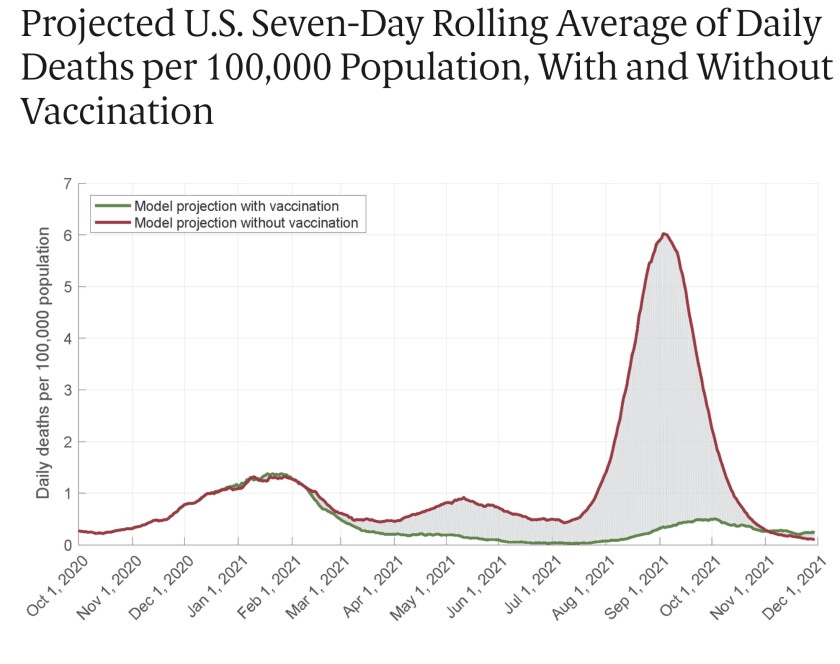
Its effectiveness is scarcely disputable: The Commonwealth Fund estimates that the vaccine averted about 1.1 million American deaths from COVID-19 and more than 10.3 million hospitalizations this year.

A chart showing COVID-19 deaths

The Commonwealth Fund estimates that the U.S. would have experienced more than 1.1 million additional deaths from COVID-19 if not for the vaccines.(Commonwealth Fund)

The answer lies in politics.

Trump drew the line first, dismissing social distancing steps and refusing to speak up for vaccination. He established these steps as partisan choices, and his political acolytes followed him over the cliff.

DeSantis has been a leader in this descent into the Inferno. He’s chosen to make Dr. Anthony Fauci, head of the National Institute of Allergy and Infectious Diseases and America’s most respected authority on the pandemic, a target of partisan calumny. He’s appointed a vaccine doubter as his state’s top public health official.

What is the outcome? Florida currently ranks eighth-worst among states in its COVID-19 death rate, with more than 62,000 Floridians having perished from the virus. Of the seven states with worse records, six are red states like Florida.

Corporate America has not showered itself in glory. On Dec. 18, Boeing announced that it was dropping its requirement that all U.S. employees be vaccinated. Its explanation was that a federal judge had blocked the enforcement of a federal executive order that employees of government contractors be vaccinated.

This is absurd. Nothing in the ruling required Boeing to drop its requirement. The company announced its step back just as the Omicron variant was about to produce a surge in infections. The pusillanimity of American corporations on this subject continues to astound. (The Times, which is owned by a physician and biomedical entrepreneur, is requiring all employees to be fully vaccinated by Jan. 31.)

To its credit, on Dec. 17 the Biden White House issued an uncompromising warning about the dangers of remaining unvaccinated.

“For the unvaccinated, you’re looking at a winter of severe illness and death for yourselves, your families and the hospitals you may soon overwhelm,” White House Chief of Staff Ron Klain said. “So, our message to every American is clear…. Wear a mask in public indoor settings. Get vaccinated, get your kids vaccinated, and get a booster shot when you’re eligible.”

Investment follies

In May, I asked whether we were experiencing a peak in investment absurdity. The examples then were bitcoin, dogecoin and nonfungible tokens (NFTs), as well as meme stocks, the prices of which were not tied to sober reflections about their issuers’ business prospects but to internet-fueled speculation.

Assets like these, which are priced in accordance with the “greater fool” theory (they have no intrinsic value beyond what you can cadge from a bigger fool than yourself), have only proliferated since then. Or perhaps it’s only the absurdity that has ballooned.

NFTs, for instance, are tradable digital files that confer no ownership to anything but the digital file, which may be an image of an object that is actually owned by someone else. Someone has parodied the NFT market by purporting to sell NFTs of images of individual Olive Garden restaurants, but it’s the kind of parody that gets at the essential truth of the target.

You don’t get to own the restaurant or the photo. You don’t get a discount on menu items or a guarantee that the photo is even accurate. You supposedly get to own something on the Non-fungible Olive Garden Metaverse, whatever that is, and you can try to find a greater fool to sell it to.

NFTs generally don’t confer ownership of the underlying asset or even the digital representation of the asset. The market doesn’t exist for any reason except to produce activity to suck in greater fools.

The best clue that there’s something hinky about these markets is that the Trump family is going all in. A purported media company started by Donald Trump, for instance, is merging with a special purpose acquisition company, or SPAC.

As I reported, the deal promptly came under the scrutiny of financial regulators. In any case, no discernible business plan of any substance has emerged for the Trump company. People appear to have invested because of his name.

Now Melania Trump has gotten into the act, hawking NFTs of paintings of her eyes—”an amulet to inspire,” the pitch says, though obviously you don’t get to own the eyes or even the original watercolor.

Software developer Stephen Diehl, an established skeptic of these things, writes that we are entering upon “a hustler’s paradise … where the market now provides a financial token game for every meme, every celebrity, every political movement, and every bit of art and culture.” The old saw applies about how if you’re looking around the poker table and can’t identify the mark, it’s you.

Inflation and Build Back Better

Republicans and conservatives have never cottoned to spending on programs that assist the middle and working class. President Biden’s Build Back Better program was destined to get their backs up.

How could they attack a program that provides for universal prekindergarten education, assistance with child care, caps on the price of drugs such as insulin and better access to healthcare? Simple: Raise the old bugaboo of inflation.

That’s been the approach of Sen. Joe Manchin III (D-W.Va.), who recently announced — via Fox News, of course — that he couldn’t support the plan in any way. He’s since backed off a bit from his adamantine opposition, but the core of his position was concern that the measure would add to inflation.

As we’ve reported, that’s just wrong. Not even former Treasury Secretary Lawrence Summers, who sounded an inflation alarm about the pandemic relief package enacted this year, thinks it applies to this measure. The provisions of Build Back Better are paid for and represent investments in the economy, so they’re anything but inflationary.

Indeed, Wall Street views Manchin’s resistance as an economic negative. According to MarketWatch, Goldman Sachs cut its growth forecast for the first quarter of next year to 2% from 3%, for the second quarter to 3% from 3.5% and for the third quarter to 2.75% from 3%.

That’s not counting the direct impact of Build Back Better on Manchin’s own state, which is among the poorest in the nation and one in which government programs are crucial. That’s well understood on the ground: The United Mine Workers union publicly urged Manchin to reconsider his opposition to a program that would have “a meaningful impact on our members, their families, and their communities.”

Much more happened in 2021 that prompts one to hold head in hands. To be fair, however, there were also glimmers of hope.

Biden on Dec. 21 announced steps to strengthen the country’s response to the Omicron variant, including mobilizing troops to help staff overwhelmed hospitals, opening thousands of vaccine sites and sending 500 million free testing kits to households. The Build Back Better plan is not entirely dead, and a revival effort will start in January.

Whether 2022 will be less stupid and insane than 2021 won’t be known until we can view it in a rearview mirror 12 months from now. We can only hope.

Mercedes Schneider digs into the background of Virginia’s new Secretary of Education. She is a data collector, not an educator. On the good side, she is conservative but apparently not an anti-CRT warrior:

On December 20, 2021, Virginia Governor-elect Glenn Youngkin announced that his choice for state education secretary is “education consultant” Aimee Guidera. In the ABC8News in which I read Youngkin’s choice, political analyst Rich Meagher commented, “We don’t know a lot about this nominee just yet in part because she is not a political operative. She is a data scientist.”

We don’t know much about this nominee, but let’s unequivocally label her a *data scientist* and not just a data collector.

The ABC8News article does identify Guidera as “founder and former chief executive of the Data Quality Campaign (DQC), a leading voice advocating for improving the use of data to increase student achievement,” a statement that reads more like the pro-data-collection sales pitch than perhaps the article author realizes.

Guidera holds no degree in data collection and analysis or statistics and research. According to her Linkedin bio, Guidera’s bachelors of arts is from Princeton’s Woodrow Wilson School of Public and International Affairs (public policy), and her masters is in public policy from Harvard’s John F. Kennedy School of Government. Nevertheless, since she founded and operated a data collection organization, Guidera is cloaked in presumed credibility as a student data expert.

For those who are sketchy about founder Guidera and her DQC, allow me to offer information from several posts I have published between 2013 and 2017 concerning DQC, DQC’s controlling nonprofit, Education Trust, and her connection to Common Core and ubiqitous Gates funding, among other market-based, ed-reform connections. Then, readers can decide whether they believe “education consultant” Guidera to be more “data scientist” or just a well-funded, well-positioned data collector.

As for me, I’m going with “well-funded, well-positioned data collector.”

In the rest of the post, Mercedes (who has a doctorate in statistics, unlike Guidera) reviews the Data Quality Campaign. Open the link and read all about it.

Who is responsible for the widespread teaching exodus? Who demoralized America’s teachers, the professionals who work tirelessly for low wages in oftentimes poor working conditions? Who smeared and discouraged an entire profession, one of the noblest of professions?

Let’s see:

Federal legislation, including No Child Left Behind and Race to the Top.

George W. Bush; Margaret Spellings; Rod Paige (who likened the NEA to terrorists); the Congressional enablers of NCLB; Sandy Kress (the mastermind behind the harsh, punitive and ultimately failed NCLB).

Erik Hanushek, the economist who has long advocated for firing the teachers whose students get low test scores; the late William Sanders, the agricultural economist who created the methodology to rank teachers by their students’ scores; Raj Chetty, who produced a study with two other economists claiming that “one good teacher” would enhance the lifetime earnings of a class by more than $200,000; the reporters at the Los Angeles Times who dreamed up the scheme of rating teachers by student scores abd publishing their ratings, despite their lack of validity (one LA teacher committed suicide).

Davis Guggenheim, director of the deeply flawed “Waiting for Superman”; Bill Gates and his foundation, who funded the myth that the nation’s schools would dramatically improve by systematically firing low-ranking teachers (as judged by their students’ scores), funded “Waiting for Superman,” funded the Common Core, funded NBC’s “Education Nation,” which gave the public school bashers a national platform for a few days every year, until viewers got bored and the program died; and funded anything that was harmful to public schools and their teachers; President Obama and Arne Duncan, whose Race to the Top required states to evaluate teachers by their students’ scores and required states to adopt the Common Core and to increase the number of charter schools; Jeb Bush, for unleashing the Florida “model” of punitive accountability; and many more.

We now know that ranking teachers by their students’ test scores does not identify the best and the worst teachers. It is ineffective and profoundly demoralizing.

We now know that charter schools do not outperform public schools, as many studies and NAEP data show.

We now know that public schools are superior to voucher schools, and that the voucher schools have high attrition rates.

We now know that Teach for America is not a good substitute for well-prepared professional teachers.

Who did I leave out?

We have long known that students need experienced teachers and reasonable class sizes (ideally less than 25) to do their best.

Given the vitriolic attacks on teachers and public schools for more than 20 years, it almost seems as though there is a purposeful effort to demoralize teachers and replace them with technology.

Rob Levine, charter skeptic, photographer, and charter critic, recently discovered that the Hmong College Prep Academy had hired one of its loudest critics.

He writes:

BY NOW MOST people who follow education in Minnesota are aware of the Hmong College Prep Academy’s illegal $5 million investment in a hedge fund that ended up losing $4.3 million, costing the power couple who run the segregated St. Paul-based charter school their jobs and casting doubt on the long term viability of the institution.

As the messy saga unfolded, an opaque school finance and consulting outfit called The Anton Group weighed in on the scandal with two blog posts, the first in June of 2021, and the second in late September. In a nutshell, Anton’s assessment was: This is fraud! The following month, something weird happened: Despite Anton’s very public criticisms of HCPA, the company landed a $100k contract to clean up the mess. A month after that, Anton’s Finance Officer became the Chief Financial Officer of the school itself. And sometime between that second blog post in September and the hiring of Anton in October those two blog posts were deleted.

As Levine puts it, “Charter school decided to feed the hand that bit it.”

Please note that Rob Levine asked me to correct the way I wrote the last line.

After the inspiring teachers’ strike in 2019, which closed every public school in the state, the billionaire Governor Jim Justice of West Virginia promised to veto any charter school legislation. He lied. The legislation passed, and the Governor signed it.

The state established a state charter board, which proceeded to award seven charters, mostly to a for-profit charter corporation that manages low-performing charters in Ohio.

But a county judge stopped the clock by issuing an injunction to halt the new charter schools.

A Kanawha County judge has temporarily blocked five public charter schools from opening in West Virginia.

Circuit Judge Jennifer Bailey granted a preliminary injunction Monday sought by parents and education union members.

They filed a lawsuit against Gov. Jim Justice and leaders of the state Senate and House.

In the suit, the plaintiffs claim residents should be able to weigh in on any charter school established in their county.

They are challenging the authority of the Professional Charter Schools Board, a group that has its members appointed by the governor.

Last month, the board approved charter schools in Morgantown, Nitro and in Jefferson County, along with two online charter schools.

The judge outlined her logic in granting the temporary injunction.

“The plain language of Article 10, Section 12 of our state constitution provides that no independent school district or organization shall hereafter be created except with the consent of the school district or districts, out of which the same is created, expressed by a majority of the voters voting on the question,” Bailey said.

One of the arguments in the lawsuit was that the transfer of the student – and the tax money that goes with that student – is the same thing as creating an independent school district, and there is a specific prohibition against that in the state constitution – unless there is a public vote.

The two parents bringing suit are members of the American Federation of Teachers union.

“It is unconstitutional to create a new school system within our current school system and that’s what this bill seems to do,” AFT-WV President Fred Albert said.

After some county school boards voted no to approving a charter school in their areas, lawmakers created the Professional Charter Schools Board, which could OK charter schools without a county school board’s approval.

State Attorney General Patrick Morrisey said the injunction is wrong because acts of the Legislature are presumed to be constitutional and because the parents should have sued the charter school board not the governor and legislators. He said he will seek relief from the state Supreme Court.

Denis Smith writes here about the past, present, and hoped-for future of West Virginia. He urges West Virginians to throw out the leaders who undermine their health, safety, and well-being. He reminds us and them of the state’s past progressive leaders. A lifelong educator, Smith retired as an official in the Ohio State Department of Education, where he oversaw charter schools.

He writes:

In her earlier post, West Virginia: The Battle of Blair Mountain, Diane Ravitch not only reminded us about the emergence of the labor movement but also shed light on how, a century later, the coal industry, though greatly diminished in activity from earlier times, still maintains a grip on the state through the misfeasance of its political leadership in the governor’s office and by its representatives in the Congress.

The story goes back to 1921, when 10,000 coal miners, in reaction to the murder of a union-friendly local sheriff, joined together to check the power of coal companies and the low wages, unsafe working conditions, and horrific housing they provided in company towns situated near the mines operated by these representatives of corporate America.

Inasmuch as I completed almost all of my graduate work in West Virginia and lived there for nearly 20 years, I was familiar with the Blair Mountain story and the sad history of exploitation of the land and workers by extractive industries like coal companies. Unfortunately, I thought that this tale of labor history was widely known but learned otherwise about eight years ago.

At that time, I was asked to teach a number of American history courses for Ohio public school teachers so they could meet the then-new content area Highly Qualified Teacher requirements. A review of the draft course syllabus showed, however, that additional content was needed to bolster the students’ knowledge of the Progressive Era and the emerging American labor movement. In particular, there was no treatment of the horrific Triangle Shirtwaist Factory Fire as well as the Battle of Blair Mountain, which remains the largest labor uprising in American history.

I soon learned that none of the students in my class in suburban Columbus, Ohio had any knowledge of either event, and the Blair Mountain post, with its spotlight on West Virginia, sheds light on that state’s history of exploitation by energy companies and the lack of political leadership today to ensure the health, safety,and welfare of its citizens based on that past history.

But in light of the state’s challenges in the past, and with the neglect of the health, safety, and welfare shown by its top political leaders, are West Virginia residents also unknowing of its past history? Or have they been bamboozled by their politicians in not realizing what is at stake in the current political climate?

That lack of leadership to ensure the health and welfare of the populace is shown in the misfeasance and conflicts-of-interest manifested by West Virginia’s Governor Jim Justice and its senior U.S. Senator, Joe Manchin, who also served as the state’s governor before his election to Congress.

As the owner of several coal companies, Justice has a history of exploiting not only the land but of the communities affected. Moreover, like his friend Donald Trump, he also has a history of tax avoidance. In 2019, for example, Justice companies paid $1.2 million in back taxes owed to Knott, Pike, Harlan and Magoffin counties in Kentucky, with more delinquent taxes to be paid at a later date. A review of his tax delinquency showed that he had additional obligations to be paid in Virginia and West Virginia, along with past due mine safety fines.

Yes, mine safety fines owed by companies owned by the governor of the state where 10,000 miners revolted against unsafe working conditions exactly a century ago. But that was then, right? Or are we back to the future and the past simultaneously?

Then we have the case of Senator Joe Manchin, a predecessor of Jim Justice in the West Virginia governor’s office. The current Build Back Better legislation would provide funds to deal with climate change, expand Medicare, and assist families with lower costs for child care and elder care. Yet Manchin, who has interests in the energy industry and a daughter who formerly was the CEO of Mylan, a pharmaceutical company, seems to have a conflict-of-interest when it comes to supporting lower prescription drug costs and dealing with the environment.

When many communities lack safe drinking water caused by years of mining and health consequences caused by such mineral extraction activity in West Virginia, wouldn’t you think that the political leadership on both sides of the aisle would support legislation that would protect the health, safety, and welfare of residents?

If you have financial interests in a top industry, as Manchin and Justice do, that’s asking far too much.

On Sunday, Manchin announced, appropriately enough, on Fox News that he does not support the Build Back Better Act. This is what Bernie Sanders had to say about his colleague, Joe Manchin:

“Well, I think he’s going to have a lot of explaining to do to the people of West Virginia, to tell him why he doesn’t have the guts to take on the drug companies to lower the cost of prescription drugs,” he said. “West Virginia is one of the poorest states in this country. You got elderly people and disabled people who would like to stay at home. He’s going to have to tell the people of West Virginia why he doesn’t want to expand Medicare to cover dental, hearing, and eyeglasses.”

When it comes to drug companies and Manchin’s lack of courage in dealing with them, Bernie Sanders is certainly knowledgeable about some family history. And then some. He went on to add this observation:

“If he doesn’t have the courage to do the right thing for the working families of West Virginia and America, let him vote no in front of the whole world.”

Manchin used the canard of not wanting to increase the national debt as one of his arguments in opposing Build Back Better. But he does not acknowledge that West Virginia greatly benefits from all types of federal spending. A study several years ago demonstrated that a number of red states, including West Virginia, receive much more in federal dollars than they receive from the treasury. As examples, West Virginia receives $2.07, Kentucky $1.90, and South Carolina $1.71 for every dollar sent to Washington.

In light of his concern about the national debt, would Manchin favor West Virginia being treated on a par with states like Massachusetts and New York, which receive far less than a dollar back from the treasury for every dollar sent to Washington?

So as I reflect a bit more about the Mine Wars and the Battle of Blair Mountain, I am puzzled by the descendants of these mine workers offering such enthusiastic support to the likes of Governor Jim Justice and Senator Joe Manchin, who obstruct legislation that would improve the health, safety, nutrition, and educational opportunities for West Virginia, one of the poorest states in the union.

There are two great West Virginia Senators who must be turning in their graves as they view the likes of the state’s present political leadership. The first, Jennings Randolph, entered the U.S. Senate in 1933 at the start of FDR’s New Deal and was a champion of Social Security, Medicare, voting rights and the abolition of the Poll Tax. Then there was Robert Byrd, who served with Randolph as the long-time Senate leader who distinguished himself as a check on many of Ronald Reagan’s policies, opposed the Iraq War, and in his last days championed the Affordable Care Act from a wheelchair on the Senate floor.

In a Senate speech on February 12, 2003 that attacked the march toward war with Iraq, Byrd said that “We are truly “sleepwalking through history.” In my heart of hearts I pray that this great nation and its good and trusting citizens are not in for a rudest of awakenings.”

In the same vein, it’s past time for the people of West Virginia to emerge from their sleepwalking and support leaders, unlike Manchin and Justice, who will put the interests of the people first and not those of the pharmaceutical industry and energy interests.

One more thing. Dear West Virginians, the next time you vote, remember your ancestors who fought for justice (small j, of course) and basic human rights at Blair Mountain. It’s now the 21st century. Jennings Randolph and Robert Byrd might be pleased with your awakening.

Robert F. Kennedy Jr. has made himself the face of the anti-vaccination movement, embarrassing his family. His book attacking Dr. Fauci is at the top of the Amazon nonfiction bestseller list, and his foundation has raised millions of dollars. Even before the pandemic, prominent members of his family wrote a public letter criticizing his anti-vaccine views, which were spreading “dangerous misinformation.” How much worse they must feel now!

But when he threw a party, Politico reported, the guests were required to be vaccinated.

Kennedy blamed it on his wife, a likely story. This is akin to “the dog ate my homework.”

What a shame to see this man sullying his family name, although some might say there were plenty of others sullying it before him. But their private peccadillos fade in comparison to a man who urges the public not to protect themselves against a deadly virus.

This is what Politico posted:

TALES OF AN ANTI-VAXXER — Robert F. Kennedy Jr. is one of the most prominent anti-vaxxers in the country. So it came as a surprise when an invitation to a holiday party at his home in California last week urged attendees to be tested or vaccinated beforehand, two people familiar with the matter told Daniel Lippman.

When we called up Kennedy for comment, he pinned it on his better half, actress Cheryl Hines of “Curb Your Enthusiasm” fame. Kennedy said the party was for her entertainment industry friends and cast members, and he was unaware of what the e-vite invitation said before the day of the party.

“I guess I’m not always the boss at my own house,” Kennedy told Lippman. There was also no effort to verify vaccination or testing status of the attendees before entering, he said. (Hines didn’t respond to a request for comment.)

Just this week, Kennedy was the subject of a major AP profile titled “How a Kennedy built an anti-vaccine juggernaut amid COVID-19.” The article reported that the revenue of his charity, Children’s Health Defense, more than doubled in 2020 to $6.4 million. Last month, he released his new book, “The Real Anthony Fauci: Bill Gates, Big Pharma, and the Global War on Democracy and Public Health,” which continues to be a best-seller on Amazon.

Maurice Cunningham is a retired professor of political science in Massachusetts who specializes in following the trail of Dark Money into school issues. He was a major influence in turning the public against a state referendum to expand charters in 2016; he revealed the Dark Money behind the charter advocacy and that revealed the lies behind the rosy rhetoric.

In this post, he describes the role of Koch money behind “parent groups” harassing educators in Newton, Mass.

He writes:

On Friday Travis Anderson of the Boston Globe reported that two Black principals in Newton had received “racist and confrontational” messages for doing their jobs: to help their students process the verdicts in the Kyle Rittenhouse and Tracy McMichael, Gregory McMichael, and William Bryan Jr. (murderers of Ahmaud Arbery) trials. The hate came rolling in after the educators’ teaching methods were blown up in the right wing media network. Yes it’s terrible but it’s also deliberate.

The Globe reported that the hateful messages came after the radical right Breitbart News ran a heated misrepresentation about the Newton educators. Similar bulldust was published by conservative provocateurs Daily Caller, Washington Examiner, and The Federalist.

The generator of the story to the right wing propaganda network was Parents Defending Education. PDE is run by veteran Koch operative Nicole Neily, who refuses to discuss who funds the outfit (she can’t; it’s bad for business). PDE has ties to the Council for National Policy (CNP) which, as Anne Nelson has shown in Shadow Network, manages and coordinates strategy and tactics for an array of radical billionaire funders and Christian nationalist activists.

PDE is working on a model Koch and CNP have long used to attack college professors. Isaac Kamola explains how it’s done in “Dear Administrators: To Protect Your Faculty from Right Wing Attacks, Follow the Money.” Some information is received (PDE encourages anonymous tipsters) and then twisted or taken out of context. This works best if the educator is a woman, person of color (like the Newton principals), or LGBTQ. Then fringe outlets like Breitbart, Daily Caller, Federalist pick it up and publicize it. (With a little luck and the CNP’s connections, it might get on Fox). Post it online for the lip reading haters who act on this garbage and just sit back. The racist hate mail, phone calls, and social media posts will flow.

It’s depressing right? But it’s also intentional. This is part of a coordinated right wing attack on public schools (Critical Race Theory, anti-vaxxers, anti-maskers, billionaire funded “parent” groups) and an assault on our government and American democracy. Parents Defending Education, Campus Reform, Moms for Liberty, Breitbart, Federalist—they all know what they’re doing and they know the results that eventuate from their tactics.

This is a hard story for daily journalism to tell, but it has to find a way. American democracy doesn’t have much time left.

We all need to stand up for our democracy and our public schools.

Cunningham recently published a new book, Dark Money and the Politics of School Privatization.

This very important story appeared in the Washington Post.

She had seen her grandson’s red, spiral-bound notebook before that night, but now, as Catherine O’Connor sifted through its pages for the first time, what she read astonished her.

“School Shootings,” Joshua O’Connor had titled the first page, above a reconstruction of the Columbine High School massacre that left 13 people dead. In the pages that followed, Joshua, who’d just turned 18, described a detailed plan to carry out his own massacre: the shotguns, pistols, assault rifle and ammunition he would buy and the bombs he would build; the doors he would zip-tie “so bitches can’t escape”; the spot by the bleachers where he would set off the first explosion; the route he would take on his killing spree; the moment, when it was over, that he would end his own life.

“I Need to make this shooting/ bombing… infamous,” he wrote in early 2018. “I Need to get the biggest fatality number I possibly can.”
Catherine O’Connor, a retired probation officer who was Joshua’s guardian, showed the journal to her husband, who was equally disturbed. The next day, after O’Connor dropped her grandson off at school, she searched his room and found a semiautomatic rifle in a guitar case. Then she did what many parents of school shooters never do: called the police to report that a child she loved posed a threat to his classmates, his community and himself.

Last week’s shooting at Oxford High School in Michigan, which left four students dead and seven other people wounded, has focused unprecedented attention on the responsibility parents bear when their children fire shots on campuses.

For decades, mothers and fathers have overlooked clear warning signs that their teens were capable of violence, but adults are almost never held accountable when their negligence leads to bloodshed. That’s what makes Jennifer and James Crumbley, the parents of the 15-year-old charged with the shooting, so unusual. They each face four counts of involuntary manslaughter, almost certainly the most serious charges ever brought against an alleged school shooter’s mother or father.

Since 1999, children have committed at least 175 school shootings, according to a new Washington Post analysis. Among the 114 cases in which the weapon’s source was identified by police, 77 percent were taken from the child’s home or those of relatives or friends. And yet, The Post discovered just five instances when the adult owners of the weapons were criminally punished because they failed to lock them up. Another three cases in which adults were charged, including the one against the Crumbleys, are pending.
[More than 278,000 students have experienced gun violence at school since Columbine)

In Michigan, Oakland County Prosecutor Karen McDonald has argued that the facts justify the felony charges against the couple, alleging “unconscionable” negligence.

Four days before the shooting, McDonald said, James Crumbley bought a 9mm Sig Sauer, which their son, Ethan, later posted a photo of on Instagram, writing, “Just got my new beauty today.” Three days before the shooting, Jennifer Crumbley posted that she and Ethan were at the gun range “testing out his new Christmas present.”

One day before the shooting, a teacher caught Ethan searching online for ammunition, but when the school alerted his mother, authorities say she instead texted her son: “Lol. I’m not mad at you. You have to learn not to get caught.”On the day of the shooting, McDonald said, a teacher found a note on which Ethan drew a person shot dead, along with “blood everywhere” and “The thoughts won’t stop. Help me.” When his parents were summoned to the school, the prosecutor noted, they refused to take him home — nor did they search his backpack for the gun. Less than three hours later, his rampage began.

The Crumbleys have pleaded not guilty, and their attorney denied the prosecutor’s allegation that the 9mm was kept in an unlocked drawer, saying “that gun was actually locked.”

School administrators also deny they did anything wrong, but the parents of two sisters who survived the shooting filed a pair of lawsuits, in federal court Thursday, accusing the district of negligence, too.


Regardless of who’s at fault, research shows that such deadly outcomes are not inevitable. In a report issued earlier this year, the Secret Service’s National Threat Assessment Center reviewed 67 “disrupted plots” targeting schools between 2006 and 2018. Every time, the report said, “tragedy was averted” when others came forward after seeing alarming behavior. In most cases, friends, classmates or other peers spoke up, but in eight instances — or about 1 in 9 — a parent or grandparent noticed and reported something, sometimes after going through a relative’s bedroom or, as O’Connor did, reading a journal.


She discovered that Joshua had scheduled the attack for April 19 — the day before Columbine’s anniversary. She found the list of his self-diagnosed mental illnesses and the pages with the will that he’d written, explaining what was to be done with his ashes. In the journal’s seventh entry, she read this: “So today I just bought a Hi-Point 9mm Carbine rifle. … I can’t wait for April, it will be a blast.”

The day after his arrest, on Feb. 14, 2018, O’Connor watched what happened when another attacker wasn’t stopped.

Just past 2 p.m., 3,300 miles away in Parkland, Fla., another angry teenager who had threatened to shoot up a campus did just that, killing 17 people during the deadliest high school shooting in American history.
‘Not impulsive acts’

She never feared her grandson, but Joshua’s horrifying plot made clear that he needed help she and her husband couldn’t give him.
“What’s the right next step?” she recalled thinking before alerting authorities. “I don’t know what other choice there was.”

Because she made that choice, her grandson never fired a shot or took a life. Police arrived soon after her 911 call and searched Joshua’s room, where they found a collection of bomb parts and confiscated his rifle and notebook. Within hours, he was taken into custody.

Four decades before the shooting at Marjory Stoneman Douglas and two decades before the shooting at Columbine, a teenager named Brenda Spencer opened fire on a San Diego elementary school on Jan. 29, 1979, killing two adults and wounding eight children and a police officer.
Spencer was 16, and her father, Wallace, had given her the .22-caliber rifle a month earlier. It was, just like Ethan Crumbley’s handgun, a Christmas gift.

Prosecutors never charged the man with a crime.

His potential culpability garnered little attention in the press at a time when school shootings were considered disturbing anomalies rather than a national crisis that demanded intensive training, expensive technology and armed officers to deter.
[‘Scared to death’: More than 4 million children endured lockdowns in the 2017-18 school year]

Not much had changed by 1998, when Kip Kinkel shot 27 people, killing two, at Thurston High in Oregon. He used three guns from home, including a Glock his dad had bought for the firearm-obsessed 15-year-old as a way to strengthen their relationship.

Kinkel had access to the weapons despite being an angry, violent, depressed and deeply delusional ninth-grader who had twice been suspended for attacking other students and, another time, was caught by police trying to buy a stolen firearm. Whether prosecutors would have charged his parents for their negligence is impossible to know; Kinkel killed them both the day before the school shooting.

Much of the country would not awaken to the threat of school shootings until the next year, when Eric Harris and Dylan Klebold killed 13 people and wounded more than 20 others at Columbine.

Klebold’s mother, Sue, has talked about her experience perhaps more than any other shooter’s parent, even writing a book about her son, the attack and its aftermath.

“Dylan did not learn violence in our home. He did not learn disconnection, or rage, or racism. He did not learn a callous indifference to human life,” she argued in “A Mother’s Reckoning: Living in the Aftermath of Tragedy.” “Dylan showed no clear and present danger, the way some children do.”


Harris’s parents, who have never given an interview, could not make the same claims, according to Peter Langman, a psychologist and the author of “Warning Signs: Identifying School Shooters Before They Strike.”
“Eric Harris’s parents knew he had anger management problems — they said he punched a wall about every four weeks — knew he had been suspended for hacking into the school’s computer system and stealing everyone’s locker combination, knew he had been arrested for breaking into an electrician’s van and stealing equipment, and also knew that he had built at least one pipe bomb,” Langman said. “They also knew he drank and smoked pot. This, of course, does not predict mass murder, but should have warranted at least conducting room searches to see what else might be going on.”

Mass shooters, experts have found, seldom kill without warning.
“These are definitely not impulsive acts,” said Matt Doherty, who used to run the Secret Service’s National Threat Assessment Center. “They are planned in advance, and that planning can occur over days, weeks or months or years.”

In 2017, parents in Maryland discovered such a plan in their 18-year-old daughter’s journal, where she laid out a “Columbine-type attack” on her high school, said Frederick County Sheriff Charles A. Jenkins.


The teen’s father also found materials for explosive devices, shotgun shells and a shotgun she had purchased, Jenkins said. The parents contacted school officials, who called the sheriff’s office. She later pleaded guilty to possessing explosive material.


“I wonder how parents cannot see signs that are developing in a home and in a family situation,” Jenkins said. “There are always signs somewhere.”

Few school shooters offered more warning signs than Nikolas Cruz, the Parkland gunman who pleaded guilty to the murders.

On the first day that the Marjory Stoneman Douglas High School Public Safety Commission gathered, one of their investigators presented a slide breaking down nearly 50 instances of threatening behavior that people knew about but didn’t report or that authorities knew about and didn’t act on. Instances in which Cruz tortured or killed an animal: seven. Times he was seen with a bullet, knife or firearm: 19. Declarations of hatred he made toward a group or person: eight. References he made about wanting to hurt or kill someone: 11. Threats that he would shoot up a school: three.

The commission’s chair, Pinellas County Sheriff Bob Gualtieri, called Cruz’s mother, Lynda, an “enabler.” She died a few months prior to the Parkland shooting.

“There’s no question about it,” he said in an interview, noting that she had taken her son to get a state ID card when he was 18 so he could buy a gun, despite knowing he was violent. Investigators learned that Cruz had once knocked out three of her teeth and, at least once, pointed a gun at her.

“There is no way she should not have known” what her son was capable of, Gualtieri said. “There is no way a reasonable, prudent person wouldn’t have recognized and identified it.”


‘A wake-up call’

Twenty-one years ago, in a town just 40 miles from Oxford, Mich., a first-grader found a handgun in a shoe box, took it to school and used it to kill a 6-year-old classmate. The 19-year-old man who owned the weapon later pleaded no contest to involuntary manslaughter and served 29 months behind bars.

No gun owners since have faced a harsher penalty for allowing their firearms to fall into the hands of a child school shooter.

Politics are often blamed for the lack of accountability. Three years ago, Commonwealth’s Attorney Mark Blankenship wanted to charge the stepfather of a 15-year-old boy who had used the man’s gun to kill two people and wound 14 more at Marshall County High, in a deeply conservative part of Kentucky.

But, just as in Michigan, state lawmakers in Kentucky had never passed a regulation mandating that adults prevent children from gaining access to their firearms, limiting Blankenship’s options. He lost reelection, blaming the failure, in part, on his comments about going after the stepfather.

Safety advocates now wonder whether the Crumbley case represents a broader shift in the way that the country assigns responsibility after school shootings. But its long-term impact may depend on the outcome. If the couple are convicted, will more prosecutors feel emboldened to go after negligent gun owners and, specifically, parents? If they’re exonerated, will the case have the opposite effect?

Regardless, some experts say, the charges could make a meaningful difference right away.


“My hope is that this will be a wake-up call for gun owners who are not safely storing their firearms,” said Allison Anderman, senior counsel at the Giffords Law Center to Prevent Gun Violence. “There are millions of teens and children who live in homes with unsecured guns.”

In fact, if the only change America had made after Columbine was to prevent children from obtaining firearms, hundreds of kids who accidentally shot themselves or each other would not have died or been maimed or suffered through the guilt of their mistake, at least 10,000 children might not have ended their own lives in suicide and more than half of the country’s school shootings wouldn’t have happened.

For Catherine O’Connor, the woman who reported her grandson to police in Washington state, doing the right thing came at a devastating cost. She pleaded with the court to show Joshua mercy, but he still received a 22-year prison term.


At a hearing, the judge called her a hero. O’Connor hated that. She just wanted to help her grandson.


The case has eroded her faith in the justice system, but she agreed with the Michigan prosecutor’s decision to charge the Crumbleys. O’Connor couldn’t comprehend why they hadn’t searched their son’s backpack during that meeting at the school.


“That’s so irresponsible, beyond belief,” she said. “That just outrages me.”
O’Connor said she had long been wary of allowing her grandson to go near unsecured firearms. She and her husband owned guns but said they were always hidden and equipped with trigger locks.

Of course, she could do nothing to stop Joshua from buying the semiautomatic rifle when he turned 18. But even her grandson came to a realization about America’s gun culture.


“Grandma,” he said the first time she saw him after this arrest, “guns are too easy to get.”