Archives for category: Accountability

The Washington Post reported that the anti-vaccination movement has prompted the return of diseases that were previously thought to be eliminated. The anti-vaccination folk are mainly Republicans, and their antipathy to vaccines has been encouraged by their party’s leaders, like Ron DeSantis, who has banned vaccine mandates in Florida. Republican members of Congress forced the abandonment of mandatory vaccinations for the military.

Veteran reporter Lena H. Sun wrote:

A rapidly growing measles outbreak in Columbus, Ohio — largely involving unvaccinated children — is fueling concerns among health officials that more parent resistance to routine childhood immunizations will intensify a resurgence of vaccine-preventable diseases.


Most of the 81 children infected so far are old enough to get the shots, but their parents chose not to do so, officials said, resulting in the country’s largest outbreak of the highly infectious pathogen this year.

“That is what is causing this outbreak to spread like wildfire,” said Mysheika Roberts, director of the Columbus health department.

The Ohio outbreak, which began in November, comes at a time of heightened worry about the public health consequences of anti-vaccine sentiment, a long-standing problem that has led to drops in child immunization rates in pockets across the United States. The pandemic has magnified those concerns because of controversies and politicization around coronavirus vaccines and school vaccine mandates.

More than a third of parents with children under 18 — and 28 percent of all adults — now say parents should be able to decide not to vaccinate their children for measles, mumps and rubella (MMR) to attend public schools, even if remaining unvaccinated may create health risks for others, according to new polling by the Kaiser Family Foundation, a health-care research nonprofit.

Public sentiments against vaccine mandates have grown significantly since the pandemic, said Jen Kates, a Kaiser senior vice president. A 2019 poll by the Pew Research Center found that less than a quarter of parents — and 16 percent of all adults — opposed school vaccination requirements.

The growing opposition stems largely from shifts among people who identify as or lean Republican, the Kaiser survey found, with 44 percent saying parents should be able to opt out of those childhood vaccines — more than double the 20 percent who felt that way in 2019.

Adam Moore, a father of three in the Detroit suburbs, said none of his children — 9, 12 and 17 and enrolled in private school — have received routine childhood immunizations, let alone vaccines for the coronavirus or flu. He values personal liberty and says the government has no right telling people what to do with their bodies.

“I find it a hard argument when the government says we’re all for individual liberty on abortion rights and all this other stuff, but when it comes to vaccinations, there’s no such thing as ‘my body, my choice,’” said Moore, 43, an account manager for a marketing company.

Moore, who describes himself as Republican-leaning, said he does not view childhood diseases such as measles and polio, which have resurfaced in recent years, as threats. But if the deadly Ebola virus were circulating, he said, he would want his children to get vaccinated.

Other parents who oppose school immunization mandates echo long-standing misinformation about vaccines that continue to spread via anti-vaccine groups.

Bianca Hernandez, a 37-year-old dog breeder in the Albuquerque metropolitan area, described concerns about the link between vaccine ingredients and autism, a view that has been extensively disproved. She said her two youngest children receive religious exemptions from school vaccination requirements.

Support for immunization mandates has held steady among Democrats, with 88 percent saying that children should be vaccinated to attend public schools because of the potential risk for others when they are not.

Overall, 71 percent of all adults still support school immunization requirements, compared with 82 percent in 2019.

“The situation about increasing negative sentiment about childhood vaccination is concerning, but in absolute terms, vaccines remain the social norm,” said Saad Omer, director of Yale’s Institute for Global Health and an infectious-disease expert who has studied vaccine hesitancy.

Anne Zink, chief medical officer for Alaska’s health department, said that even in a state with historically lower vaccination rates, childhood immunization rates have yet to return to their pre-pandemic levels. In the years before the pandemic, about 65 percent of Alaskan children 19 to 35 months old had completed their routine childhood immunizations. By the end of 2021, 46 percent had.

A few weeks ago, Zink, an emergency room doctor, saw her first case of chickenpox when a young woman walked into the Mat-Su Regional Medical Center in Palmer covered in large, painful lesions. The woman said she and her family did not believe in vaccinations and told Zink she thought chickenpox no longer existed.

“I think there is more mistrust of the government, there’s more questioning of vaccines, and we’ve been having a harder time getting people vaccinated,” said Zink, who is also president of the Association of State and Territorial Health Officials.

“I was like, ‘Well, it really doesn’t when all of us choose to get vaccinated, but you aren’t vaccinated, your family’s not vaccinated, and the people you hang out with are not vaccinated. Chickenpox has been spreading in your community, and now you’re really sick,’” Zink recalled.

In the past, Zink said, herd immunity would have protected the woman against such childhood diseases. But that protection has waned as anti-vaccine sentiment grows, she said.


To distance its push for vaccination from the current political narrative, the Alaska health department recently brought back images and language from a 1960s promotion for polio vaccination. The new social media campaign uses the vintage Wellbee cartoon and rocket — “Get a booster!” — to remind people that immunization has always been part of the country’s history.

It is too early to see the effects of eroding public support for school vaccination requirements on childhood immunization rates because federal data typically lag by about two years. During the pandemic, routine vaccination rates slipped because of school closures and because children were not going to the doctor.


The growing negative attitudes about school immunization requirements are troubling for health workers. Kentucky officials are urging that people get flu shots after six children — none of whom were vaccinated — died after contracting influenza. South Carolina officials had also promoted childhood vaccinations after two chickenpox outbreaks in March — the first since 2020 — affected nearly 70 people.


A case of paralytic polio in a New York man this summer prompted worry that low childhood immunization rates and rising vaccine misinformation could result in the disease’s resurgence, decades after vaccination had eliminated it in the United States.

“There is definitely a group of parents who have shifted their attitudes,” said Jennifer Heath, immunizations program coordinator for Minnesota’s health department who works on vaccine hesitancy and outreach. “Part of it is true attitude shift. But part is a disconnection to the primary care provider, the human being who’s telling you that vaccines are important.”


School vaccination requirements are among the most effective tools to keep children healthy. All states and the District of Columbia require children to be vaccinated against certain diseases, such as measles, polio and whooping cough, to attend public school. All states grant exemptions based on medical reasons; a growing number allow religious or philosophical exemptions.


D.C. also requires students 12 and older to be vaccinated against covid-19 but has delayed enforcing the mandate until the 2023-2024 school year. California has a pending statewide student coronavirus vaccine mandate that will not take effect until after July 2023. Nearly two dozen states have some form of ban against student coronavirus vaccine mandates.


The Centers for Disease Control and Prevention recommends children get two doses of MMR vaccine, with the first dose at 12 to 15 months, and the second dose between 4 and 6 years old. One dose of the vaccine is about 93 percent effective in preventing measles, one of the most infectious pathogens on the planet that can cause serious complications, including death. Two doses are about 97 percent effective at preventing the disease.

In the Ohio measles outbreak, only three of the 81 children had received a single dose of vaccine, according to state data. None were known to be fully vaccinated.


“I think some of these attitudes were here before the pandemic, and then we probably picked up some additional community members who were accepting of vaccines before but now maybe are more critical about vaccines as a result of what transpired with the coronavirus vaccine,” Roberts said.

Some of the cases occurred in Columbus’s large Somali community, the second-largest Somali population in the United States after the Minneapolis area, Roberts said. Parents have said they “intentionally delayed” giving their children the measles vaccine because of their fear of autism, she said, despite considerable research disproving any relationship between vaccines and autism.

Those fears echoed similar concerns of parents in Minnesota’s Somali community during a 2017 measles outbreak that infected 75 children, mostly unvaccinated preschool kids.

Minnesota is also battling a new measles outbreak — 22 cases — as vaccine hesitancy around the MMR vaccine continues to be an issue, said Doug Schultz, spokesman for the Minnesota health department.

Officials are bracing for more cases in the coming weeks as families travel and gather indoors for the holidays. At least 29 of the Ohio children have been hospitalized, some so sick they required intensive care.

Most of the sickened children — 78 percent — are Black, 6 percent are Asian, 6 percent are White, and 4 percent are Hispanic, according to Columbus officials.

Because the measles virus is so contagious, an overall community vaccination rate of about 90 to 94 percent is needed to keep the virus from causing large outbreaks, according to infectious-disease experts. In the United States, nearly 91 percent of children have received at least one dose of the MMR vaccine by age 2. In the Columbus area, Roberts said, the measles vaccination rate is estimated at 80 to 90 percent, but health-care providers are not required to report data to Ohio’s vaccine registry.

Even if overall coverage in a community is high, measles can transmit easily in clusters of under-vaccinated or unvaccinated people. The Columbus outbreak began when one or two unvaccinated people traveled to countries where measles is still common between June and October and infected others in the community, Roberts said.

In recent years, many of the measles cases reported to the CDC have occurred in underimmunized, close-knit communities, where anti-vaccine misinformation has gained a foothold. In 2019, the United States reported the highest annual number of measles cases — 1,294 — in more than 25 years; three-fourths of those cases occurred among New York’s Orthodox Jewish communities. Outbreaks have also occurred among the Amish in Ohio and Eastern European groups in the Pacific Northwest.

After consulting with counterparts in Minnesota, health officials in Ohio have been working closely with the Somali community to increase vaccination uptake without stigmatizing them. Columbus public health workers have hosted vaccine clinics at a community center and a mosque and are conducting home visits to provide shots. They have also reached out to schools, day-care centers and grocery stores about the importance of vaccination.


The efforts appear to be making a difference.
Nationwide Children’s Hospital in Columbus recently saw a 20 percent increase in the number of parents seeking the MMR vaccine, Roberts said. The health department, too, has seen a small uptick in vaccinations.


“They are trickling in,” she said, “slowly but surely.”
Ruth Ben-Ghiat is a history at New York University who specializes in fascism and authoritarian leaders.

She wrote:

Authoritarianism is about having the power to get away with crime, and waging a genocidal war against another country without othercountries intervening in ways that force a cessation of conflict counts as a big win in the autocrat world. In fact, from the minute they receive intelligence about a planned invasion, autocrats watch carefully to see what happens to transgressors of the international order–and adjust their own plans for aggression accordingly.

Allowing Russian President Vladimir Putin’s war of annihilation against Ukraine to continue by not giving Ukraine the arms it needs to definitively repel the Russian invaders increases the risk that other autocrats will ramp up their own imperialist aspirations. Autocrats interpret any ambivalence about shutting down their peers’ territorial expansions as license to proceed with similar aggressive acts.

History is clear about what happens in such cases. Most people are familiar with the folly of the September 1938 British and French-brokered Munich agreement, which allowed the Third Reich to annex the Sudetenland in Czechoslovakia six months after it annexed Austria.

Far fewer know about the earlier appeasement that set the stage for Hitler’s actions: Benito Mussolini’s war on League of Nations member Ethiopia, which started in October 1935. This was the biggest military operation since World War I, with Italy’s formidable air force dropping hundreds of tons of illegal chemical weapons on Ethiopians.

The weak sanctions levied on Italy by the League of Nations did not deter Il Duce from continuing to commit war crimes. He declared victory in May 1936, and occupied Ethiopia until the Allies drove the Italians out in 1941. “Was it ever likely to be effective?” Winston Churchill wrote critically of the sanctions in June. “Was it real or sham?” That same month, exiled Emperor Haile Selassie I denounced the war crimes to the League of Nations, but no action was taken against the Fascists.

By then, Mussolini’s admirer Hitler had all the information he needed about the consequences a despot might face for military aggression. In March 1936, while Mussolini’s war entered its sixth month, the Führer remilitarized the Rhineland, in violation of the Treaty of Versailles.

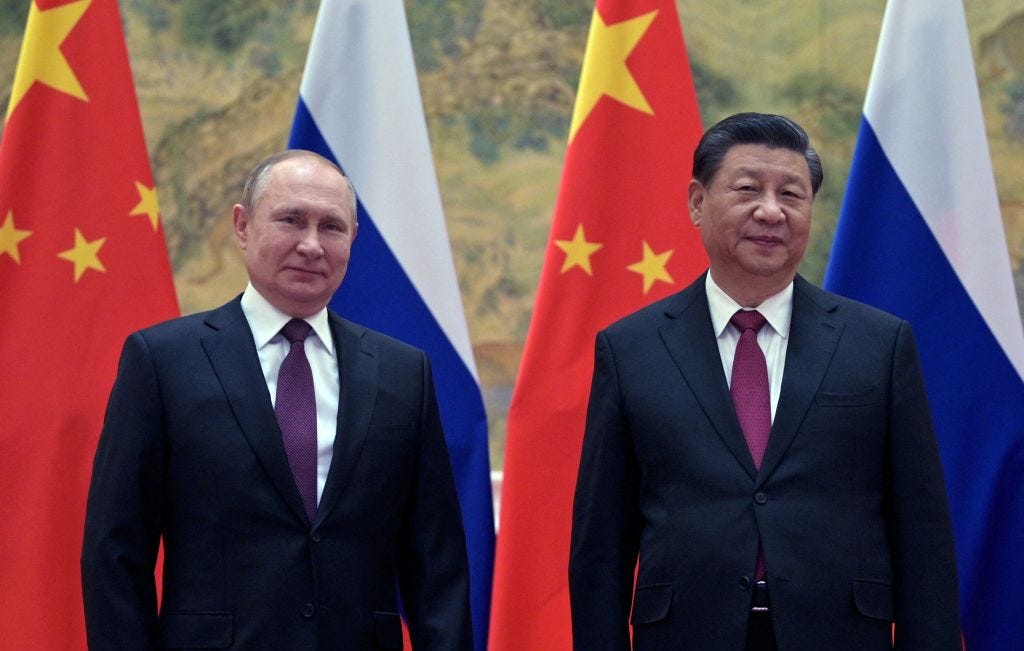
Twenty-first century autocrats watch their kindred spirits’ fates with equal interest. Since the start of Putin’s war on democratic Ukraine, the world has become far less safe. A few weeks before the Russians invaded, Putin and Chinese head of state Xi Jinping issued a joint statementabout the new “multipolar” era of international relations. The premise of this new era –unrestrained imperialism for Russia and China– has become all too clear.

Russian President Vladimir Putin and Chinese President Xi Jinping together in Beijing, Feb. 4, 2022. Alexei Druzhinin/Sputnik/AFP/via Getty Images

Xi Jinping has since become far more aggressive towards the West. His government has increased its rhetoric about its imperialistic claims on Taiwan. He has consolidated his personal power with a third term, while further puffing up his personality cult in ways not seen among Chinese premiers since Mao Zedong.

Turkey has also ramped up its bellicose and expansionist rhetoric regarding Syria and Greece. It has also persecuted Armenians, through its ally Azerbaijan, in the disputedterritory of Nagorno-Karabakh.

Autocrats are transactional beings. You have a deal with an autocrat until you don’t, meaning no one should think that Putin will negotiate with or about Ukraine in good faith. That also holds for their relationships with each other (as Joseph Stalin discovered when Hitler invaded Russia despite signing the Molotov-Ribbentrop non-aggression pact).

Even as dictators cheer on lawlessness that goes unpunished by the democratic order, they also circle each other like vultures, looking for signs of weakness that they can exploit. And everyone knows that Putin is more vulnerable as a player in the sphere of influence game with his resources and attention focused on Ukraine. Turkey, along with China, will seek to fill any power vacuum Putin’s weakness opens up in Eurasia and beyond.

Turkish President Recep Tayyip Erdogan’s relationship with Putin has always been volatile. In the course of a few months in 2016 they went from almost going to war to being “best friends,” dining on plates that immortalized their friendship. I was skeptical of Erdogan’s early claims that he would be a “peacemaker” and mediator between Russia and Ukraine. Turkey intends to exploit this international crisis to increase its own power and prestige.

Now Serbian President Aleksandr Vucic has become the latest authoritarian to be galvanized by the possibilities created by the prolongation of Putin’s war. He has put his military on high alert, citing rising tensions with the Republic of Kosovo. Serbia does not recognize the sovereignty of Kosovo, which declared independence from Serbia in 2008.

All of these conflicts have long histories that are independent of the new climate created by Putin’s invasion of Ukraine. Yet democratic powers’ acceptance of a continuance of Putin’s war will only further destabilize the international order. It also increases the chances that democratic strongholds such as Taiwan will be targeted for “reunification” –the word of choice for autocrats since the days of Hitler to market their imperialism to their peoples and the world.

That’s why Ukrainian President Volodymyr Zelensky was right to state in his speech to U.S. Congress that supporting Ukraine is an investment in global security. He knows that when an autocrat gets away with an imperialist and genocidal war it only increases his megalomania and hubris, making it far more difficult to rein him in later on. It also increases the likelihood that other autocrats will commit their own aggressions toward targeted territories.

And it’s why the warning that economist Anders Aslund issued to his fellow Europeans should be heeded, not least because it builds on historical precedent. As an expert on Putin’s kleptocracy, Aslund knows the value and prestige impunity has among autocrats. “If you don’t deliver enough of arms & funds to Ukraine now,” he tweeted, “you might have to face Russian troops yourselves later on.”

Heather Cox Richardson shares news about the fissure in the Republican Party between Trump crazies and responsible elected officials.

Today, President Joe Biden signed into law the bipartisan year-end omnibus funding bill passed by the House and the Senate before lawmakers left town.

The $1.7 trillion measure addresses key goals of both parties. It funds the military and domestic programs. It funds public health and science, invests in law enforcement, and funds programs to prevent violence against women. It funds veterans’ services, and it provides assistance to Ukraine in its struggle to protect itself against Russia’s invasion. It updates the Electoral Count Act to prevent a president from trying to overturn a presidential election, as former president Trump did.

Biden said, “This bill is further proof that Republicans and Democrats can come together to deliver for the American people, and I’m looking forward to continued bipartisan progress in the year ahead.”

But on his social media platform, Trump took a stand against the bill that funds the government. “Something is going on with [Senate minority leader] Mitch McConnell [(R-KY)] and all of the terribly and virtually automatic ‘surrenders’ he makes to the Marxist Democrats, like on the $1.7 Trillion ‘Ominous’ Bill,” Trump wrote. “Could have killed it using the Debt Ceiling, or made it MUCH better in the Republican House. Nobody can be this stupid.” Then he went on to blame the deal on McConnell’s wife, Trump’s own Transportation Secretary Elaine Chao, using a racist slur.

This exchange reveals the dynamic dominating political leadership at the end of 2022. Biden and the Democrats are trying to show that the government can produce popular results for the American people. They are joined in that effort by Republicans who recognize that, for all their talk about liberty, their constituents want to see the government address their concerns. Together, they have passed the omnibus bill, as well as the CHIPS and Science Act, the bipartisan infrastructure law, and gun safety legislation.

This cooperation to pass popular legislation is an important shift in American politics.

But Trump and his cronies remain determined to return to power, apparently either to stop this federal action Trump incorrectly calls “Marxism” or, in the case of extremist Republicans, to use the government not to provide a basic social safety net, regulate business, promote infrastructure, or protect civil rights—as it has done since 1933—but instead to enforce right-wing religious values on the country. They reject the small-government economic focus of the Reagan Republicans in favor of using a strong government to enforce religion.

The determination of Trump and his team to dominate the government, and through it the country, has been illustrated powerfully once again today with the release of more transcripts from testimony before the House Select Committee to Investigate the January 6th Attack on the U.S. Capitol. Former White House director of strategic communications Alyssa Griffin recalled how Trump’s son-in-law, Jared Kushner, dismissed the idea that the Trump administration should coordinate with the incoming Biden officials over the coronavirus pandemic. “It was the first COVID… meeting that Jared led after [Biden won],” Griffin recalled, “& Dr. Birx… said, “Well, should we be looping the Biden transition into these conversations?” & Jared just said, ‘Absolutely not.’”

Similarly, in an extraordinarily petty exchange, the chief of staff to former first lady Melania Trump, Stefanie Grisham, recalled that Trump wanted to fire the chief White House usher, Tim Harleth, for being in contact with the Biden team about the presidential transition. (Secret Service agents told Trump about the contact, raising more questions about the role of the agents around Trump.) Melania Trump stopped the firing out of concern for the stories Harleth could tell about the Trump family, but he was let go just before Biden’s inauguration, leaving the Biden’s standing before the closed doors of the White House for an awkwardly long time when they entered for the first time.

This determination of far-right Republicans to bend the country to their will presents a problem for the Republican Party. Establishment Republicans came around to backing Trump in 2017 after he promised them lower taxes and less regulation, the goals they had embraced since the presidency of Ronald Reagan.

But Trump managed to stay in power by feeding the reactionaries in the party: those who reject the idea of American equality. Trump’s base is fiercely opposed to immigration and against the rights of LGBTQ Americans, while also in favor of curtailing the rights of women and minorities. Rejecting the equality at the heart of liberal democracy, many of them hope to enforce religious rules on the rest of the country and admire Russian president Vladimir Putin and Hungarian leader Viktor Orbán for replacing democracy with what Orbán has called “Christian democracy,” or “illiberal democracy” that enforces patriarchal heterosexual hierarchies. As Trump encouraged them to, many of them reject as “fraudulent” any elections that do not put their candidates in power.

Now, as Republican establishment leaders recognize that Trump’s star is fading and his legal troubles seem likely to get worse—his tax returns will be released tomorrow, among other things—they seem eager to cut Trump loose to resurrect their anti-tax, anti-regulation policies. But those Americans who reject democracy and want a strong government to enforce their values are fighting for control of the Republican Party.

The far right has turned against Republican National Committee chair Ronna McDaniel, whom Trump hand-picked and who helped arrange the false electors in 2020. Trump loyalist Mike Lindell, the pillow magnate, is challenging McDaniel. Of more concern to her is the challenge of Harmeet Dhillon, a prominent election denier who has provided legal counsel for Trump in his struggles against the January 6th committee, calling it “a purely political witch-hunt, total abuse of process & power serving no legitimate legislative purpose.” Orbán supporter and Fox News Channel personality Tucker Carlson and Turning Points USA founder Charlie Kirk are backing Dhillon.

Kirk, who is a prodigious fundraiser, has warned the RNC that the party must listen “to the grassroots, our donors, and the biggest organizations and voices in the conservative movement” or it would lose in 2024. “If ignored, we will have the most stunted and muted Republican Party in the history of the conservative movement, the likes of which we haven’t seen in generations.”

The far right is also challenging the bid of House minority leader Kevin McCarthy (R-CA) for House speaker, creating such havoc that today former Republican representative, senator, and secretary of defense William S. Cohen and former congressional staff director and presidential senior fellow emeritus at the Council on Foreign Relations Alton Frye published an op-ed in the New York Times warning that “the Republican caucus is dominated by campaigns and commitments that gravely encumber efforts to define common ground in the political center.” They urged House members to recruit a moderate speaker from outside the chamber and to “fortify those Republicans who seek to move the party beyond the corrosive Trump era.”

They called for a secret ballot, so Republican members won’t have to fear retaliation.

Cohen and Frye suggested that organization of the House by an outsider would allow for “meaningful coalition building,” but the Republicans about to take control of the House have so far indicated only that they intend to investigate the Biden administration before the 2024 election, a throwback to the methods party leaders have used since 1994 to win elections by portraying the Democrats as corrupt.

Representatives James Comer (R-KY) and Jim Jordan (R-OH), who are expected to take over the House Oversight Committee and the House Judiciary Committee, respectively, have already demanded records from the White House. When White House Special Counsel Richard Sauber said the White House would respond to those committees after the Republicans were in charge of them—a position administrations have as taken since the 1980s—Comer and Jordan took to social media today to complain that “at every turn the Biden White House seeks to obstruct congressional oversight and hide information from the American people.” (Jordan, of course, refused to respond to a subpoena from the January 6th committee.)

The year 2022 has seen an important split in the Republican Party. The party’s response to voters’ dislike appears to be either to reject democracy altogether or to double down on the old rhetoric that has worked in the past, although you have to wonder if they have gone to that well so many times it’s drying up.

In the meantime, the Democrats have worked with willing Republicans to demonstrate that lawmakers in a democracy really can accomplish big things for the American people, and for the world.

Which vision will win out will be a key political story of 2023.

—

Timothy Snyder, a pre-eminent scholar of fascism, summarized the report of the January 6 Committee:

What did Trump know, and when did he lie about it? How did his Big Lie lead to specific actions to overturn and election and bring down the American system? What did the coup attempt of 2020-2021 look like from within the Trump administration itself?

Thanks to the excellent “Final Report of the Select Committee to Investigate the January 6th Attack on the United States Capitol,” we now know the answers to these and many other questions. I provide here just the briefest of summaries of the report’s recounting of the events of November 2020-January 2021.

It is very easy, when a long report is released, to underplay its basic findings. There is a temptation to act as if something is not shocking if we have heard part of it before, as though this were a mark of political sophistication. The American tendency to normalize threats to democracy is also present in retrospect.

What is described in palpable and convincing detail in the Final Report is indeed profoundly shocking: a planned and coordinated attempt by the president of the United States and his allies to carry out regime change in the United States of America on the basis of a Big Lie.

Here is my very brief summary of the factual part of the report, in fifteen quick points. I am deliberately understating here; the evidence, in the Final Reportitself, permits much broader conclusions.

1. Trump knew that he was likely to lose the 3 November 2020 election, and planned in advance to declare victory (to tell a Big Lie) if he lost.

2. On 3 November 2020, Trump knew that he was very unlikely to have won the election of that day, and declared victory anyway. In the days following, aware that he had lost, he continued to declare victory.

3. Over and over again in November, December, and January, Trump publicized specific claims of electoral fraud shortly after being informed that they were false.

4. Aware that his advisors, campaign officials, and cabinet knew his claims of fraud to be false, Trump promoted people, such as Rudolph Giuliani, who would lie for him in public.

5. In the full knowledge that he had lost the election and that his claims of fraud were false, Trump made several deliberate efforts to overturn the election results and thus American democracy.

6. In states he had lost, Trump personally pressured state officials to fraudulently and illegally alter the electoral outcome.

7. Informed that the Department of Justice had investigated and found no evidence of fraud, Trump nevertheless sought to use its powers, via Jeffrey Clark, to intimidate state officials to change electoral outcomes.

8. Knowing that he had lost the electoral college vote, Trump oversaw an effort to create fake slates of electors. These entirely bogus documents were then sent to the vice-president (who refused them).

9. Though aware that it was the vice-president’s role only to count the electoral votes, Trump pressured the vice-president not to do so, on the theory that the vice-president could, in effect, choose the president.

10. Even the person who devised the plan regarding the vice-president, John Eastman, knew it to be illegal.

11. Knowing by January 6th that all that remained was the formality of certifying Biden’s victory, Trump encouraged supporters he knew to be armed and angry to halt this procedure and violently overthrow our form of government.

12. Trump’s call to violence was successful because enough of his supporters believed his lies and understood what he wanted them to do: prevent a peaceful transition of power.

13. At a time when the Capitol was under attack, the vice-president was in flight, and the members of the vice-president’s security detail feared for their lives, Trump urged his supporters on to further violence.

14. After the failed coup attempt, a number of Republican legislators sought presidential pardons, thereby acknowledging their fears that they had acted illegally.

15. Even had Trump believed that he had won the 2020 election, which he did not, his coup attempt would remain a coup attempt, and his crimes would remain crimes.

These are some of the simple facts, as we now know them, two years on.

Two years ago, I wrote a long essay about the January 6 insurrection, entitled “American Abyss.” It could be published right after Trump’s supporters stormed the Capitol, because I had written it beforehand, as a study of the Big Lie and its consequences. Thanks to the work of some excellent reporters and editors, I could add details from the horrors of the day before the final text went to press in The New York Times Magazine.

Trump’s coup attempt itself was predictable, and I had been predicting it throughout the autumn of 2020. Indeed, since the publication of On Tyrannyin early 2017, I had been trying to make the case that something like this could happen in the United States, and in late 2020 I spent a lot of time saying that it would happen. I like to think that this helped to prepare some of us for the coup attempt when it did come.

Trump is obviously personally responsible. But the techniques he used are not unique to him, and could be perfected by others. The weaknesses he exploited are structural. Now that a coup attempt has taken place, and we know a great deal about how it happened, it is important for us to ask some of the deeper questions about why it could have happened, not least to make sure that nothing similar takes place in the future. In posts to come, I will be interpreting the report, returning to some of the themes I established these last few years, such as the Big Lie.

Heather Long is a member of the Washington Post editorial board. She pinpoints the reasons for the national teacher shortage: low pay, but also pandemic stresses, and the ongoing political attacks on the teaching profession by extremists who want to prevent any teaching about racism or sexuality.

Message: pay teachers as professionals and let them teach as professionals, without censorship or interference by busybodies.

Long writes:

The U.S. economy hit a milestone this year: All 22 million jobs lost during the coronavirus pandemic were fully recovered. But that doesn’t mean workers went back to the same jobs. One of the sectors struggling the most to rebound is K-12 public education, which is still down more than 270,000 employees.


There is an educator shortage in the United States, but it is crucial to understand the details. First, this is about more than teachers. That 270,000 figure includes a lot fewer bus drivers, custodians and other support staff. Second, education isn’t simply about getting enough warm bodies into classrooms; it’s about having effective and qualified teachers and staff. The best analysis of the situation this fall, from the Annenberg Institute at Brown University, indicates a teacher shortage of nearly 2 percent, but more than 5 percent of positions are currently held by under-qualified teachers. Third, the shortage isn’t nationwide. It’s much worse in some schools and in some subjects.

In October, nearly half of public schools were still struggling to fill at least one teacher vacancy, according to a recently released Education Department survey. But schools in high-poverty neighborhoods were significantly more likely to have unfilled positions. Similarly, school districts report having an especially hard time finding special education, computer science and foreign language teachers, and bus drivers and custodial staff.

This isn’t a new phenomenon, but many signs indicate it worsened during the pandemic. Teachers experienced extreme levels of burnout from Zoom classes and safety concerns during the early days of the pandemic. Then came the culture wars that put teachers and staff under constant scrutiny over any conversations involving history, racism and sexuality. Throw in the Great Resignation, a tight labor market and rapidly rising pay in other professions, and the net result has been some teachers and staff retiring early. Others have quit and gone to work in different professions. And some recent graduates have decided not to enter education at all.

The short answer is: Nothing. At least in Washington, D.C.

The story in New York is different.

Federal and local prosecutors are investigating whether his multiple lies broke any laws. Anne Donnelly, the local prosecutor in Nassau County, where he was elected, is a Republican, and she too has opened an investigation.

The New York Times, which broke the original story, reported last night:

Federal and local prosecutors are investigating whether Representative-elect George Santos committed any crimes involving his finances and lies about his background on the campaign trail.

Federal prosecutors in Brooklyn have opened an investigation into Mr. Santos that is focused at least in part on his financial dealings, according to a person familiar with the matter. The investigation was said to be in its early stages.

In a separate inquiry, the Nassau County, N.Y., district attorney’s office said it was looking into the “numerous fabrications and inconsistencies associated with Congressman-elect Santos” during his successful 2022 campaign to represent parts of Long Island and Queens.

It was unclear how far the Nassau County inquiry had progressed, but the district attorney, Anne Donnelly, said in a statement that Mr. Santos’s fabrications “are nothing short of stunning.”

Why are the Republicans in Congress silent?

Charlie Sykes, who used to be a conservative Republican, writes in The Bulwark that Kevin McCarthy needs Santos’ vote. End of story. His colleagues are saying “He’s learned his lesson,” although he remains defiant. Santos says “Everyone embellishes his resume.” But the proper word is not “embellish,” it’s “lie.” The Congressman-elect lied about his education, lied about his employment, lied about his religion, lied about his family. What part of his resume is true? No one knows.

Probably none of it except his name.

Sykes writes:

Of course, a political party with any sort of intact immune system would move quickly to send this sociopath back to ScamLand, whence he came.

But this is the GOP circa 2022, and so it faces a painful dilemma. With a narrow majority in the House, Republicans (and especially Kevin McCarthy) need his vote, of course.

But that’s not the real problem here, is it?

After years of ignoring, enabling, and rationalizing Big Lies and small ones, it will now be exceedingly difficult for the GOP to find their misplaced conscience that might morph into outrage and something like a moral standard. As Nick Catoggio writes:

Anyone willing to set aside their qualms about Trump for the sake of holding executive power logically should be willing to set aside their qualms about Santos for the sake of holding legislative power

So, not surprisingly, GOP leaders are either silent, or in a forgiving mood.

To deepen the puzzle of Santos, read this article in The Daily Beast about one of his big donors.

Rich Lowry, editor-in-chief of conservative National Review, calls out Republicans for their reluctance to call out Trump by name. Instead, when confronted by his latest outrage, they issue statements condemning his actions without mentioning his name.

Part of his perceptive article:

The man who has spent a lifetime putting his name on everything can still keep it off the lips of people appalled by something he has said or done. It’s a GOP taboo that became so deeply ingrained during his presidency and the immediate aftermath that it will only lift slowly, if ever.

“The entire nation knows who is responsible for that day. Beyond that, I don’t have any immediate observations,” Mitch McConnell said in a statement after the Jan. 6 criminal referrals on Tuesday.

So, who exactly is responsible? Do we know anything about this person? Is there any description? Has he or she been seen since Jan. 6, 2021? In what direction did he or she flee afterward?

The Republican Jewish Coalition spoke out after the infamous dinner with Ye (better known as Kanye West): “We strongly condemn the virulent antisemitism of Kanye West and Nick Fuentes and call on all political leaders to reject their messages of hate and refuse to meet with them.”

“Political leaders”? Why not say the name of the man who dined with the two extremists?

The party leaders’ fear of naming Trump demonstrates his power. They are still afraid of him.

I recall Mel Brooks long ago explaining why he wrote The Producers, which includes a hilarious spoof of Hitler. He wanted to break Bitler’s power by making a joke of him.

Whether or not it worked, it is clear that Trump will retain his hold on Republicans until they feel free to call him out by name.

Indiana blogger Steve Hinnefeld reports on a disturbing possibility in the Hoosier state: charter schools are eyeing property taxes as a source of additional funding.

I remember when charter schools were first launched, in the late 1980s, their advocates (and I was one at the time) made three promises: one, they would get better results than public schools (they don’t); they would be more accountable than public schools (they are not); and they would cost less because they eliminate bureaucracy (they insist on the same funding as public schools).

Hinnefeld wonders whether it would be “taxation without representation” if property taxes were allocated to privately managed schools.

Unfortunately, the heavily gerrymandered legislature gives the privatizers whatever they want.

Will they draw a line now?

I hope you will consider making a donation to the Network for Public Education—either a one-time gift or a monthly gift.

NPE is working on behalf of students, families, teachers, public schools, and communities every day.

We have a small but mighty staff. We don’t waste money on a physical office. We produce reports, letters to legislators, and work with journalists to spread the good news about our public schools and their incredible teachers and students.

We need your help!


From Carol Burris, executive director of NPE:

December Newsletter: A new “Conversation with Diane Ravitch” and more

Can you spare just $5.00 a month to save public education?

Your monthly gift provides a dependable source of funding, enabling our team to put out Action Alerts, newsletters, seminars, and reports that inform the public, the press, and policymakers about the war on public schools.

Please commit today to a monthly amount of $5, $10, $15, or even $20. For NPE, monthly donations add up to make a big difference.

The stakes are getting higher all of the time. Just this week, the outgoing Oklahoma attorney general declared that it is unconstitutional to prohibit religious charter schools.

Betsy DeVos’s American Federation for Children and the Oklahoma governor applauded.

A Catholic online charter chain is ready to put in its application. The time is now to act to save public education.

Please sign up to make a monthly donation today.

DONATE NOW

I was happy to discover this post on the Network for Public Education, which is curated by teacher-blogger Peter Greene. It was written by South Carolina teacher Steve Nuzum.

A South Carolina think tank has issued a “report” that connects every organization in sight to an indoctrination conspiracy in the state. It would be easier to dismiss if the head of the think tank weren’t the state’s newly elected superintendent of education. Teacher Steve Nuzum looks into the work.

This week, incoming Superintendent of Education Ellen Weaver’s “think tank” dropped a crazy “dossier”. Or sometimes it’s “a report”— one without citations for most of its central and most outrageous claims. And sometimes it’s a “handbook”— one without much in the way of advice, except some version of support us and be mad at those teacher unions in NC and VA).

The document, and especially its accompanying graphics, are breathtakingly stupid. Aligning yourself with Aristotle on education policy— a philosopher who, on the one hand, explicitly called for public funding of education1 and, on the other hand, believed some human beings are physically and mentally designed to be slaves2— is quite a look for a pro-voucher think tank that doesn’t want people to think about “segregation academies” every time they hear “school choice”. Openly labeling “progressives” as “villains” is another. This thing was clearly cobbled together hastily by political hacks masquerading as scholars, in the vein of the 1776 Commission Report from the Trump Administration, and they clearly thought lots of colors and graphics would keep us dumb South Carolinians from thinking too hard about any of it.

Even a quick gloss over the “dossier” reveals claims that are unfounded and contrary to the general argument (privatization is good; Leftist woke indoctrinator teachers are “villains”). For example, the report claims that grassroots teacher advocacy group SC for Ed (I’m a board member) was primarily founded to oppose “schools of innovation” legislation. This seems to be a garbled reference to SC for Ed’s opposition to the education omnibus bill H. 3759, a legislative beast with a few good ideas glued to a lot of bad, often ALEC-drafted ideas. There is no citation provided, of course, because it isn’t true— I was there at the rally the “dossier” mentions, which was centered around many educational issues, and I was also there as a member of the group when the bill was just a twinkle in Jay Lucas’ eye. The omnibus bill, thankfully, did not pass, and the “schools of innovation” legislation that did pass, although not supported by SC for Ed, was certainly not some kind of major motivating factor for starting the group. The “dossier” goes on to use the “public-private partnership” Meeting Street Schools as its sole example of why the “schools of innovation” legislation was a good move. This is a weird rhetorical move during a week when, on “almost every criterion, Meeting Street Schools fell below both district and state performance,” according to Nick Reagan of WCSC.

But the thing is, it doesn’t need to make sense.

Read the full post here for more details.

You can view the post at this link : https://networkforpubliceducation.org/blog-content/steve-nuzum-palmetto-promises-conspiracy-corkboard/